




Abstract
Two Dublin-born playwrights, Dion Boucicault and John Brougham (9 May 1810–7 June 1880), shadowed each other through the world of nineteenth-century theatre. In recent years, critical attention has often focused on their representations of racial and national identities, with Boucicault's plantation drama, The Octoroon, and Brougham's frontier parodies deservedly attracting attention. However, in this essay I want to spotlight their contribution to the local drama, and in particular their staging of urban America within the wider transatlantic context of staging the nineteenth-century city, in such plays as The Poor of New York (1857) and The Lottery of Life (1868). The city as it appears in their work is a place of spectacle, shapeshifting, and sheer illicit fun.
Two Dublin-born playwrights, Dion Boucicault and John Brougham (9 May 1810–7 June 1880), shadowed each other through the world of nineteenth-century theatre. They first crossed paths in London, where according to Brougham they co-wrote Boucicault's first hit, London Assurance (Covent Garden, London, 4 March 1841; Park Theatre, New York, 11 October 1841), and after some Atlantic crisscrossing, they both eventually came to rest in New York. Almost equally prolific, they both worked in a range of genres, developed a similar repertoire of stage-Irish characters, and at various times they even appeared together on stage. But they also put America itself on stage. Boucicault tried his hand at this in The Poor of New York (1857), The Octoroon (1859) and Belle Lamar (1874); Brougham worked more extensively in this vein, producing parodies of frontier drama such as Met-a-mora (1847) and Po-ca-hon-tas; or, The Gentle Savage (1855), social comedies of the upper ten thousand, such as Romance and Reality (1848), and urban melodramas like The Lottery of Life (1868). In recent years critical attention has often focused on their representations of racial and national identities, with Boucicault's plantation drama, The Octoroon, and Brougham's frontier parodies deservedly attracting attention. However, in this essay I want to spotlight their contribution to the local drama, and in particular their staging of urban America within the wider transatlantic context of staging the nineteenth-century city. 1 While living in New York, Boucicault reworked a Parisian play to devise his most influential local drama, The Poor of New York; famously he would later develop the sensation scene, and ‘localise’ it again for the British cities in which it played, beginning with The Poor of Liverpool and culminating in The Streets of London. Brougham started his career in a London production of W. T. Moncrieff's Tom and Jerry, the theatrical adaptation of Pierce Egan's Life in London, but while living in New York, he saw the possibilities of localising Moncrieff's drama in order to capture the excitement and pace of urban America; the result was a string of New York plays from Life in New York (1844) to The Lottery of Life: A Story of New York (1868). Both playwrights recognised that transatlantic urban audiences would be drawn by the sight of their everyday reality made melodramatic. Drawing on their extensive knowledge of international drama and literature, and tapping into the energy of their new surroundings, Boucicault and Brougham extended the range of American stage characters, tropes, and settings, and in the process contributed to the formation of the United States as an imagined community. The city that they conjure up is at once vital, changeful, and volatile, a place of self-invention and spectacle.
The general outline of Boucicault's career will be familiar to readers of this special edition, but we might note his transatlantic crossings, and his sheer longevity as a successful playwright, with hit plays in the 1840s, 1850s, 1860s, and 1870s. Although his work brought the crowds, and lingered a long time on the popular stage, he never enjoyed the critical success that he had earned for his innovations, his craftsmanship, and sheer productivity. By 1882, eight years before Boucicault's death, the British critic William Archer was already writing him off in English Dramatists of To-Day as one of the ‘playwrights of yesterday’: acknowledging that the Irishman was the ‘supreme showman of the Victorian stage’, the critic maintained that he was ‘no longer a living and effective influence in the drama of the country’. A longer view shows a rather different picture, particularly in the United States and Ireland. 2
Brougham's career is a good deal less well known, so I will outline it here. Ten years older (b. 9 May 1810) than Boucicault, he too came from a middle-class Dublin Protestant family with some French ancestry: according to the playwright's own account, his maternal grandfather was a French refugee who found work in the Dublin Custom House, and married a woman of Huguenot descent. Brougham's father died when he was still very young, and he says little about that branch of the family; he seems to have spent a good deal of time at the house of his Aunt Mary and Uncle William, a retired East India Company officer, whose home was a ‘museum of hideousness in the way of Indian so-called curiosities’. 3 He and his brother were sent to the Diocesan School in Trim, Co. Meath, run by a Dr Hamilton, the uncle of the distinguished mathematician. 4 With some difficulty he managed to pass the entrance exam for Trinity College Dublin, but admits that he spent more time on off-campus amateur theatricals than on study. His circle of friends in this period included several future Members of Parliament, though also one Luke Dillon, ‘later of disgraceful notoriety’, transported for rape in 1831. 5 Brougham embarked upon medical training at the ‘Peter Street Hospital’, presumably the private Theatre of Anatomy and School of Surgery, at 28 Peter Street, before the failing family finances drove him to London in search of paid employment.
He briefly contemplated following in his Uncle William's footsteps into the East India Company, but instead drifted into acting, debuting on 7 August 1830 in a production of William Thomas Moncrieff's 1821 hit burletta, Tom and Jerry; or, Life in London. The play follows the comic adventures of the eponymous men about town as they shuttle between scenes of urban luxury and ‘low’ life, and Brougham recalled that he took ‘some twelve or fourteen’ minor parts. 6 This was at the Queen's Theatre in Tottenham Street, later the Prince of Wales, a venue co-managed by Thomas Melrose, whom Brougham had met in Dublin through his amateur dramatics circle. He followed this with an appearance with the Irish actor Tyrone Power (1795–1841) in Power's The Irishman's Fortune, or The Adventures of Paddy O’Rafferty, which indicated another theatrical direction for the young actor – the stage Irishman. 7 As a student he had met Madame Vestris on a Dublin visit, and it was to her company that he moved next, following her from her burletta days at the Olympic Theatre to Covent Garden, which she and husband Charles Mathews took over in 1839 after an unsuccessful American tour. That same year Brougham married actress Emma Williams, a statuesque beauty who may have also managed a theatre at Richmond at some point. 8 At Covent Garden he played relatively minor parts: in January 1839, for instance, the Era confirms that he was Joseph in Mathews’ Why Did You Die. According to Brander Matthews and Laurence Hutton, he managed the Lyceum in 1840; they conclude that this was a ‘financial failure, as indeed were all his managerial enterprises … He had no business ability; he trusted everybody.’ 9 We might note in passing that although he had his financial ups and downs, Boucicault was a much cannier businessman.
The 1841 census places the Broughams on Alpha Road in Marylebone. 10 It is at this point that Brougham's career intersects that of Boucicault. The younger man was in one of his periodical seasons of financial precarity when a chance encounter with Charles Mathews led him to write a play for him and Madame Vestris, under his stage name, Lee Moreton. The play was London Assurance which opened on 4 March 1841, and became a considerable hit; according to his own account in a letter to his mother, Boucicault made some £300 from it, an enormous sum for a fledgling playwright. 11 However, in his autobiographical fragment, Brougham claims co-authorship of the hit comedy, and maintains that he was paid a sum of money by Boucicault so that the latter could have sole title. Boucicault was frequently accused later of sharp practice in the matter of his borrowings from other plays, and especially from French originals, so much so that ‘Boucicault’ came to be a verb, meaning to plagiarise. 12 Brougham's claim here is a little different, though. There is some evidence for his assertion from contemporary sources, for instance when there was a revival of London Assurance at the Haymarket in October 1847, the Era's critic commented that ‘[w]e always recur to the fact … that London Assurance was the joint production of Mr Dion Bourcicault and Mr John Brougham, an actor very popular in the days of the Olympic's prosperity, and now giving single-handed entertainments in America’. 13 This account also had currency on the other side of the Atlantic: in the 1860s, Col. Picton in his ‘Reminiscences of a Man About Town’ column in the New York Clipper, claimed that after a legal action Brougham was given half the profits of London Assurance; and similar statements appear in Winter's Life, Stories and Poems of John Brougham, Matthews and Hutton's Actors and Actresses, and elsewhere. It is unlikely, however, that we will ever know the extent to which the older writer collaborated with the younger. The actor-manager Lester Wallack, who had heard both playwrights on the subject, thought that Brougham came up with the germ of the play, and planned himself to play the part of Dazzle. Likewise, the contemporary American theatre critic Stephen Ryder Fiske argued that Brougham never wrote a similar piece, while Boucicault did (e.g., Old Heads and Young Hearts), so it might be reasonably assumed that the actual writing was done by Boucicault. Richard Fawkes takes as definitive an 1878 interview in the New York Herald, in which Brougham denied that he had offered anything other than suggestions to Boucicault, but it is possible that the more famous playwright's generous role in the forthcoming benefit for his old friend (reported in a contiguous article) influenced this revised account. Fawkes also records that Madame Vestris insisted that Brougham be paid for his work on the play. 14
Perhaps with a share of the profits of London Assurance, Brougham and Emma decided to try their luck elsewhere: the Era announced in August 1842 that ‘Mr and Mrs Brougham, late of Covent Garden, were about to make ‘a professional tour in America’. 15 In October 1842, they arrived in New York, where Brougham first appeared at the Park Theatre, in William Bayle Bernard's comedy, His Last Legs, and played Dennis Brulgruddery in George Colman's John Bull; Emma appeared as Lady Teazle in Sheridan's School for Scandal. It was the beginning of a forty-year era in which Brougham ‘held a high place in the dramatic annals of America’, famous not only for his original plays and burlesques, and his stage Irishmen, but for his comic acting in his adaptations of such characters as Dickens's Bunsby and Joey Bagstock. 16 According to the career synopsis he wrote himself, after touring for a period he next ‘attached himself to the Burton dynasty’ (64), for whom he created his frequently produced adaptation of Charles Dickens's Dombey and Son, inter alia, before managing the Niblo's Garden theatre. Among other things he offered ‘Mr Brougham's Evenings’, at which ‘Pat's Peculiarities, or Ireland and Irishmen, illustrated in Songs and Stories’, was followed by material that reminded audiences of a less whimsical side of Ireland: a temperance lecture in the style of Father Matthew, and a Repeal speech in the style of Daniel O’Connell. 17 In these years he was seen to be ‘unsurpassed by any contemporary’ as a comedian. 18 He added to his income by writing for various journals and comic papers, and even briefly ran one of his own, The Lantern, in 1852 (Figure 1).
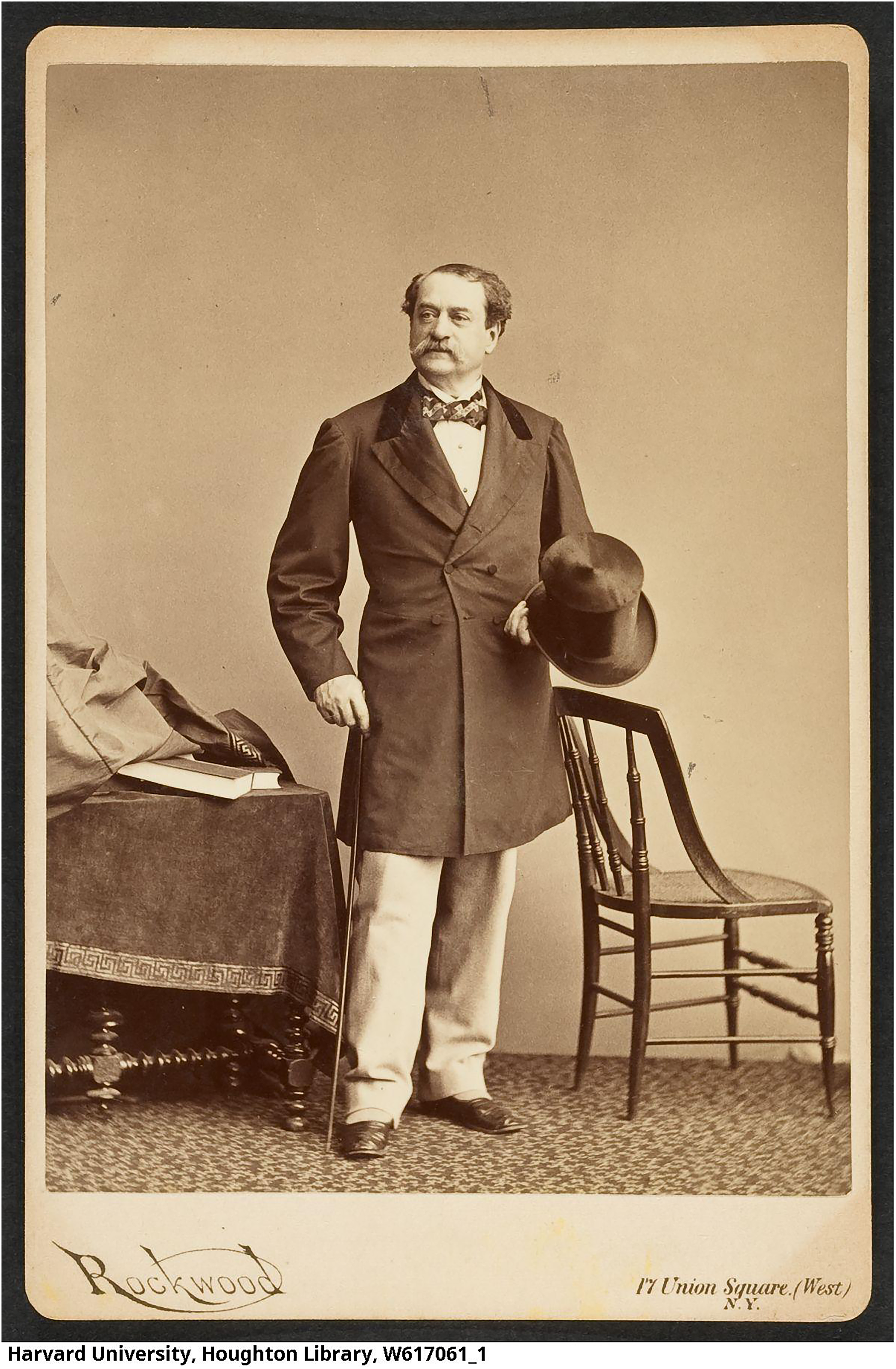
Cabinet photograph of John Brougham, Harvard Theatre Collection TCS 1.3729, Harvard University.
Although, unlike Boucicault, he was part of the Bohemian circle of American and international writers and actors who frequented Pfaff's beer cellar, Brougham's private life does not seem to have been quite as colourful as that of his younger countryman. 19 After some years apart, he and Emma divorced in 1852 (she remarried, but kept the stage name of Brougham, later managing Mrs Brougham's Broadway Boudoir at 444 Broadway) and in 1847, he married another English actress, Annette Hawley Nelson, ‘generally called a beauty’, who had come to the US in 1833. For a few months she had managed the Richmond Hill theatre in Greenwich Village as Miss Nelson's Theatre; in later years she continued to appear at Burton's and Wallack's, though the pass-remarkable Joseph Ireland claims that ‘her immense rotundity long unfitted her for the profession’. 20 In December 1850, the playwright took over the lease of a small theatre on Broadway and Broome Street, which became known as Brougham's Lyceum. It failed to prosper, despite a successful version of David Copperfield, and he moved on to the more downmarket Bowery Theatre, where he wrote sundry lively ‘Bowery dramas’, and melodramas, complete with blow-up endings. He later produced a range of work for James Wallack at the Lyceum – including his burlesque Pocahontas – as well as for William E. Burton. The versatile playwright wrote American-themed burlesques, such as Columbus, El Filibustero!!: A New and Audaciously Original Historico-Plagiaristic, Ante-National, Pre-Patriotic, and Omni-Local Confusion Of Circumstances (Burton's Theatre, December 1857), but also catered to the appetite for British material, giving Burton a popular role as Captain Cuttle in an 1859 adaptation of Dombey and Son. Like Boucicault, in 1860 he returned to London, where in the following years he wrote and appeared in two historical swashbucklers, The Duke's Motto and Bel Demonio, both hits for Charles Fechter at the Lyceum, and he adapted Mrs Braddon's hit sensation novel, Lady Audley's Secret, for Ruth Herbert at the fashionable St. James's Theatre. 21 In another overlap of their stage careers, Boucicault had produced his own version of the Bel Demonio story in 1851 as Sixtus V; or, The Broken Vow. The two Irishmen were evidently on cordial terms: Boucicault was at the Lyceum for the opening night of Brougham's adaptation, and does not seem to have resented its success; and Brougham acted as Colonel O’Grady in Boucicault's Arrah-na-Pogue at the Princess's. 22
Back in New York, Brougham's work ranged from comedies to such circus-theatre hybrids as The Christian Martyrs under Constantine and Maxentius, which employed animals from Van Amburgh's menagerie. 23 With the proceeds of one of his greatest successes, The Lottery of Life: A Story of New York (Wallack's, 1868), he tried once more to establish his own theatre, Brougham's Theatre on Madison Square, but after clashes with the owner, James Fisk, he had to return to stock company work for Daly's Theatre and Wallack's. After his wife's death in 1870 he found companionship in the literary Lotos Club (still extant), whose members included Mark Twain. The club played a significant part in the circulation of transatlantic writers and performers, and as vice-president Brougham was among those who welcomed Wilkie Collins, J. A. Froude, Mark Lemon, Charles Mathews, John Lawrence Toole, and Edmund Yates. 24 He planned to visit Ireland in 1874, and the Lotos Club even gave him a farewell dinner, but ill-health prevented this trip. In his later years he ‘declined into poverty’, a process accelerated by the collapse of Duncan, Sherman and Co. Bank in 1875. 25 A testimonial benefit in January 1879 at the Academy of Music raised more than $10,000, and this was converted into a small annuity. The ageing playwright continued to take parts, and his last role was as detective Felix O’Reilly in Boucicault's British-set sensation drama Rescued (Booth's, 25 October 1879). He died on 7 June 1880, and his large funeral was attended by Edwin Booth and William Winter, among others. He is buried alongside his wife Annette at the Green-Wood cemetery in Brooklyn, the final resting place of several other important figures of the nineteenth-century theatre, including actor-manager Laura Keene, Barney Williams, and William Niblo – though not Boucicault, who outlived him by ten years, and is buried at Mount Hope in Westchester County.
Brougham's Local Dramas
The American theatre had a pronounced British and Irish character in this period: Boucicault and Brougham had been preceded there by Tyrone Power, and their Irish peers on the American stage included Barney Williams, John Drew (forebear of the Barrymore dynasty), and Matilda Heron; Burton, James Wallack, and Annette Nelson were all born in England, as was Laura Keene. 26 At least some of these figures, though, were keen to bring their adopted home to life on stage in local dramas. 27 Brougham's first effort in this line was Life in New York; or, Tom and Jerry on a Visit. This play was published in New York in 1856 as No. 94 in French's American Drama, complete with a cast list for the 1856 production at the Bowery. However, this date is misleading, as Brougham had been trying his hand at this local drama for quite some time. Life in New York was first produced on 13 November 1844 at a benefit for Brougham at the Chatham Theatre, and was revised in 1846 as Life in New York; or, Tom and Jerry on a Visit, which was in turn rewritten in 1847 as Tom and Jerry, or Life in Boston. 28 This last version was staged at the Adelphi Theatre in Boston, which Brougham and a Mr Bland had opened on Court Street on 5 April 1847. According to a contemporary source the play did well in Boston ‘from its local hits’, that is to say its comic local references. 29
Although we do not know how much it differs from its predecessors, the published two-act Life in New York; or, Tom and Jerry on a Visit, gives us a sense of how such ‘hits’ worked and how Brougham developed his own brand of American urban drama out of imported material. 30 Taking the skeleton of the very first play in which he acted professionally, Moncrieff's Tom and Jerry; or, Life in London, Brougham added not only New York scenes, and local ‘street celebrities’ like the Four Cent Man, but also targeted some contemporary concerns. 31 For instance, he parodies the figure of the English traveller who immediately sets up shop as an expert on American life, but he also touches on less comic contemporary issues: sweatshops, sexual predators, and fears that the anonymity of city life made it a breeding ground for confidence men. 32 The original men about town of Moncrieff's play (and Pierce Egan's novel, on which it is based), Tom and Jerry visit their old friend Bob Logic in New York, planning to ‘have a larking run through the States for the fun of the thing’. 33 They are accompanied by their valets, Smith and Laporte (played by Brougham himself), and one of their fellow passengers is a cockney writer, who plans to publish ‘Hamerica and the Hamericans, by James Trollope Fidler Dickens Greene, Gent.’ 34 They are also secretly followed by their wives, Kate and Sue, who hope to catch them up to no good with other women. In Act 1 their valets promptly desert them, and set themselves up as distinguished foreigners, the Count Anatole Sebastian, Sulpice de Nybobbe and Captain, the Hon. Lord Fitzgammon Bowlingreene. The comedy initially turns on Greene's gullibility, and his misconstruing of various aspects of New York life, before the action turns to the naiveté of the Americans themselves, who at the house of hostess Mrs Codfishe take the disguised valets at face value. Act 2 introduces the source of the Codfishes’ money, a Ready Made Shirt Establishment that exploits young seamstresses. We also meet two poor-but-honest characters, Fanny Martin, ‘a poor sewing girl’, and plucky porter Harry Manly, who defends her from the predatory advances of young Cubbe Codfishe, and the financial predation of his father, Skinneflynte. After various complications, the valets marry the Codfishe daughters; Tom and Jerry are united with their wives; Tom offers to lend Harry and Fanny (now married) money to set up their own business; and Codfishe senior promises to mend his ways.
Moncrieff's slang-powered comedy of swells exploring the seamier side of London had entertained audiences with such real settings as the Burlington Arcade, Hyde Park Corner and the slums of the ‘Holy Land’, and Brougham adapts this template of urban diversity to New York: as well as elegant hotel interiors and Mrs Codfishe's ballroom, we see a number of bustling urban exteriors. 35 The curtain rises in Act 1 on Canal Street Wharf, showing us a ‘Crowd of Cabmen, Newsboys, etc’ … ‘Travellers pass across – One lady drops her boa in the muss – Newsboys cry ‘Herald – Extra Express, second edition, etc, etc’. 36 This is a scene that closely resembles the opening scene in the last of Moncrieff's hits, the local crime melodrama The Scamps of London; or, The Cross Roads of Life (Sadler's Wells, 13 November 1843): there the curtain rose on an ‘Exterior of South Western Railway Station’, with Waterloo Bridge in the background, and a crowd that included street sellers of matches and baked potatoes, men with sandwich boards, and, setting the tone of the play, a policeman. 37 Crime is less to the fore in Brougham's piece, and instead we are reminded of American diversity, but also of what a few years later Frederick Douglass would name as America's great sin and shame: slavery. 38 The first American that Greene meets on the wharf is Cuffee, an African-American porter who introduces himself by saying ‘luggage toted, boss’, a term that Greene fails to understand; and he thinks that Cuffee must be a ‘Hindian with his war paint on’. 39 The porter for his part thinks that Greene is so exceptionally ‘green’ that he should be exhibited at Barnum's American Museum, which had opened three years earlier. 40
Off-stage New York is evoked in some detail in Act 2.2, when Tom summarises their tourist excursions to date, which is a veritable checklist of contemporary topics: ‘We’ve been to the High Bridge, peered through the City Hall, shook hands with his honor the Mayor, fraternized with Captain Rhynders, got nearly sun-stricken at a target excursion, lightened our pockets at faro, salooned at Niblo's, warmed ourselves at the summer garden, and cooled off at the Bowery’. 41 However, we do not visit the streets of New York again until Act 2.3, which is set on ‘Tryon Row and part of Centre Street’. 42 Again this is a tour-de-force crowd scene, featuring a ‘market cart, apple stand, [vendors of] soda water, pop corn, weighing machine, etc., etc., every body in motion’. 43 The bustle conveys the sense of urban America as a place of speed and high commercial pressure, but it shows another aspect too. At the end of this scene, after Harry saves Fanny from young Codfishe's advances, punching Greene, who gets in his way, the stage directions announce the arrival of a ‘Street Celebrity’, the ‘Four Cent Man’; at this point the ‘Ham Seller’ ‘begins his trade’ before a general row breaks out. (The costume directions specify that the ‘Street Celebrities’ should be ‘as near to the originals as possible’.) 44 The Four-Cent Man was a well-known New York figure: a vendor of writing paper and envelopes, his ‘distinct sonorous voice’ could be heard on the street day and night as he loudly advertised ‘Twelve sheets – of writing paper – for – 4 –cents – twen-ty five self-sealing en-velo-pes for – 4 – cents’. 45 The 1821 London production of Tom and Jerry anticipated this use of street characters, employing, for instance, the African-American busker, Billy Waters. 46 Brougham, following this lead, shows us the streets of the city not as an anonymous place, but as to some extent a place of familiar faces and voices, more village than metropolis, where we are not surprised when Tom and Jerry run into their disguised wives. At the same time, the Four-Cent Man was a somewhat mysterious urban figure to his contemporaries, and for later generations he became part of the mythology of ‘Old Gotham’. As the Brooklyn Eagle recorded many years later, ‘One day he disappeared from the street, and entered into the past along with the other oddities of the metropolis’. 47 The play touches very lightly on this paradoxical aspect of mid-nineteenth-century urban life, in which other people can be both familiar and yet unknowable; it is not the same street life that Baudelaire captures in the poems of Fleurs de Mal (1857), which he began writing around this time, but it shares the latter's sense of everyday street mysteries, if not of swirling emotional depths.
Before we turn to Boucicault's picture of American city life in The Poor of New York, it is worth mentioning in passing another play that acted as something of a bridge in the staging of urban America. Among the most successful plays to derive from Tom and Jerry is Benjamin A. Baker's A Glance at New York (Olympic, 15 February 1848), which introduced audiences to one of the most influential stage New Yorkers, Mose, volunteer fireman and ‘Bowery b’hoy’, played by Francis S. Chanfrau. George Parsells is a simple countryman, who is an easy mark for streetwise New Yorkers until Mose takes him under his capacious wing. Parsells is a stock innocent abroad or greenhorn, an American version of Brougham's Greene, but Mose is a considerable advance on Harry, the well-spoken working-class hero of Tom and Jerry: a charismatic rough diamond, with his red shirt and slicked down hair he was both a ‘mirror and an “etiquette book”' for working-class audiences, as Richard Butsch puts it. 48 He is, in his own distinctive words ‘a man, and no mistake – and one ov de b’hoys at dat’. 49 The part ‘carried [Chanfrau] as a star triumphantly through every theatrical town in the Union’. 50 Other playwrights recognised a good thing, and many ‘Mose’-centred plays followed. The other star of the play, though, as in Brougham's work, is New York itself, and we travel from Barclay Street pier, to Front Street, Broadway, to a Ladies’ Bowling Saloon, to Loafer's Paradise, a rough saloon, to New Street, to a ‘Mock Auction Store’, and finally to a pleasure ground, Vauxhall Garden. As in Tom and Jerry, street sellers and newsboys populate the backgrounds, and there is much comic business and a few knockdown fights. Although Mose describes his firefighting activities, and a baby makes a cameo appearance, we do not see him actually rescuing babies from burning buildings in Baker's play, a deficiency that later Mose plays rectified. 51
The popularity of Mose, the fearless fireman, seems a likely source for the great sensation scene of The Poor of New York in which we see the repentant scapegrace, Badger, enter a burning tenement building, No. 19 ½ Cross Street, Five Points, to rescue not a baby, but a vital document, the receipt for a bank deposit. Billed as a ‘great drama of American life’, The Poor of New York is made of the stock materials of nineteenth-century melodrama: through deceit an unscrupulous banker, Bloodgood, has ruined a middle-class family, the Fairweathers, who are now in desperate straits. They are saved through the actions of Bloodgood's former employee, Badger, now reformed, and the general moral would appear to be that love and goodness are more powerful than gold. It was first produced on 7 December 1857 at Wallack's Theatre on Broadway, a more upmarket venue than either the Bowery and Olympic, and at this point leased by Boucicault and his partner, William Stuart. 52 (A revival of Brougham's Tom and Jerry in New York was playing at Burton's that evening.) Lester Wallack himself played Badger, and E. A. Sothern, later the celebrated Lord Dundreary of Our American Cousin, played the role of ruined man of fashion Mark Livingstone. Back in England after his falling out with Stuart, Boucicault famously revived the play as The Poor of Liverpool, and then localised it for other cities, culminating in a lavish production of The Streets of London at the Princess's Theatre (1 August 1864); the play was also revived in the US at this point. 53 Boucicault's play was in fact a freely adapted and ‘localised’ version of Edouard-Louis-Alexandre Brisebarre and Eugène Nus's Les Pauvres de Paris (Ambigu-Comique, Paris, 1856), though it is possible that Boucicault had come to that play by an indirect route. As Sarah Meer has described, Charles Reade had written the authorised translation, Poverty and Pride the previous year (his 1863 novel Hard Cash is also based on its story of a family ruined by an unscrupulous banker), and there were several other anglophone versions, including Stirling Coyne's semi-authorised Fraud and Its Victims (Surrey, London, March 1857; Barnum's Museum, New York, August 1857), and the unauthorised version by Benjamin Barnett and John Beere Johnstone, The Pride of Poverty; or, The Real Poor of London (Strand Theatre, London, 1857). 54
However, as Daniel Gerould notes, Boucicault thoroughly Americanises the play: ‘in adapting Les Pauvres de Paris, Boucicault did more than cleverly change streets signs; he drastically shifted the focus of the drama, constantly adding topical references … and supplanting sentiment by observation of national character and regional custom’. 55 Although the elaborate house-on-fire sensation scene – which has no equivalent in the French original – is what the play is known for, Boucicault also drew audiences by offering a number of contrasting New York settings: before we reach the burning tenement at 19½ Cross Street, we have already visited the Park, near Tammany Hall in Act 2; Union Square by night, complete with falling snow, in Act 4; and ‘Brooklyn Heights, overlooking the city and its harbors’ at the opening of Act 5. 56 Boucicault, then, had learned by the example of Tom and Jerry and A Glance at New York that audiences wanted to see their own city on stage; the canny playwright calculated that what enchanted working-class audiences would also play to more middle-class ones in a five-act structure, with a few nods to cross-class solidarities, as in the Mose plays. Puffy, a baker turned street vendor of hot potatoes, is a friend to the Fairweathers and Mark Livingstone, and Boucicault makes Puffy's son Dan a volunteer fireman for good measure. The New York Herald, which recognised that the play was as much French as American, opined that Dan was ‘the only really local character’, but we know that at least in some performances the street scenes were fleshed out with local street characters more than they are in the printed version. 57 For instance, the young Charles T. Parsloe, later known for his ‘yellowface’ roles, appeared as a minor character, Bob the Bootblack, though he is not listed in the published cast list, and does not feature in the action. 58
Although he offers a chequered picture of the city, Boucicault ultimately suggests that the real poor of New York are middle-class folk like the Fairweathers who have fallen on hard times, and that poverty is ‘more frequently found under a black coat than a [workman's] red shirt’. 59 This paradoxical message was presumably meant to appeal to the more middle-class segment of the audience at Wallack's, who had been shaken by the financial panic of 1857 that provides the play's backdrop. Jacksonian America had been suspicious of bankers: now such fears were shown to be well founded. 60 We might also note that New York is presented here not just as a place of violent swings of fortune, but of actual violence and gunplay: in Act 4 Badger and Bloodgood draw pistols on each other almost casually, something that would have been unusual in a local London play.
Brougham's last major urban play – and according to himself his most commercially successful – revisits this image of the American city as a violent and changeable place. This was the ‘original local drama’ The Lottery of Life: A Story of New York, first produced at Wallack's on 6 June 1868, after earlier runs in Boston, Richmond and elsewhere. 61 There are echoes of the earlier Tom and Jerry plays, but this time the central characters are not transatlantic visitors to America, but first or second-generation immigrants. Originally conceived as ‘a burlesque upon the sensation of the time’, Tom Taylor's The Ticket-of-Leave Man, but later turned into a five-act local play, it centres on one Robert Mordaunt, who is out of prison on a pardon, having been convicted of robbing Mr Allcraft, his supposed benefactor. But Allcraft (Charles Fisher at Wallack's) is a whited sepulchre who disguises himself as a Mr Smithers to conceal his womanising, and who also appears to be in league with the forger and racketeer Mordie Solomons (also played by Fisher). Solomons is a stereotypical Jewish villain based on Melter Moss in The Ticket of Leave Man; the published play suggests he wears a ‘false Jewish nose with glasses’. 62 The innocent Mordaunt does not know that he is really Rupert Downe, the son of Allcraft's former partner, and Sir Wilton Downe has now returned to America to find his lost child. Acting as something of a guardian angel to Mordaunt is another transatlantic figure, Terence O’Halloran, aka Terry the Swell, an Irish immigrant played by Brougham himself, a diamond in the rough who has had enough of working for Solomons (shades of Badger), and is trying his luck as a private detective. In the end Robert/Rupert's name is cleared, and Allcraft and Solomons turn out to be the same villain: Sir Wilton Downe's former partner, Bolter. As in earlier local plays we see a panorama of New York life, from the ‘handsome apartments’ of Mordaunt's genteel sweetheart, Emily Summers, to Solomons’ den at the back of an old clothes shop, to the lively Japonica Concert Saloon, featuring blackface minstrels. Like The Poor of New York, the play features gunplay, and there is also a bar fight at the end of Act 2 that is more in the Mose tradition, as well as a blow-up nautical ending that resembles the final sensation scene of Boucicault's The Octoroon. The play ran until 8 August, and was successful enough to generate a blackface minstrel parody sketch by Bryant's Minstrels, as well as touring productions, and a novelisation by Brougham himself that was serialised in the New-York Fireside Companion, a popular story paper. 63
Generically the play contains elements of the transatlantic Tom and Jerry play, the knockabout comedy Mose play, and Anglo-French sensation melodrama, borrowing from both The Poor of New York and The Ticket of Leave Man. New York itself remains the principal subject, and according to the New York Herald audiences applauded ‘the view of the Fifth Avenue and Broadway … the view of Tiffany's front and the Fulton ferry by moonlight and gaslight, and of the East River and Brooklyn by the light of the burning ship.’ 64 Advertisements were soon billing it as ‘New York Photographed!’ The same review indicates that as with The Poor of New York, street scenes were not just nicely painted flats, but were filled out with characters who do not appear in the printed play, such as Judy O’ Squall, ‘a substantial and lucky apple woman, some other apple women … newsboys, bootblacks’.
Brougham places some elements of the urban scene more firmly in the background: the passing acknowledgement of Black America in Tom and Jerry now only appears in the form of the entertainment within the entertainment – the blackface minstrelsy at the Japonica. It is difficult to know how to read one of the play's other prominent stagings of race, the stereotypical Jewish villain, Mordie Solomons, a figure straight out of Dickens’ Oliver Twist. At one level the way Solomons is represented as ethnically other can be seen to make O’ Halloran seem more white, more American; the play's use of blackface minstrelsy is also significant in this respect. 65 But is Allcraft/Bolter really Solomons, or vice versa? The printed play seems to suggest the former, since the costume directions for the shapeshifting Allcraft/Bolter/Solomons are given under Solomons, and the last line in the play is given to Solomons, whom Sir Wilton Downe has just recognised as Bolter: ‘And all unharmed, myself the only victim after all! Cheated out of my revenge! Oh! curse you! curse!’ 66 However, Bolter and Downe originally arrived from England together many years earlier, so it is a very long game that the villain has been playing if that is the case. That Solomons is in fact Bolter's creation is more in keeping with the idea that the play began its life as a burlesque of The Ticket of Leave Man; Taylor's Melter Moss, is here turned into a costume Jewish villain, conjured up by Bolter/Allcraft for his own criminal convenience. 67 One assumes though, that most audiences would have taken the stage Jew at face value, as another familiar figure from the stage city that provided a distorted double of their own.
Across a twenty-year period Brougham and Boucicault helped to shape a new kind of American play, the ‘local’ drama that offered the vitality of the city itself as its main attraction. A stage America was emerging, with its own types and situations. In the words of Rosemarie K. Bank, such drama ‘localizes and authenticates a fictional city in which … there is ample opportunity for staging both the self and the “American”’. 68 But what emerged can be seen as a transatlantic phenomenon as much as something American: quite apart from the fact that in this case the playwrights were Irish immigrants, the urban American play was an unstable hybrid form, drawing initially on the imported picaresque of Tom and Jerry, later embracing sensation melodrama, and with elements of the Bowery-born Mose play thrown in. By the late 1860s, the local/sensation play had begun to morph more definitively into the detective play as a way of representing urban American life; we might even claim that Terry O’Halloran in The Lottery of Life foreshadows the two-fisted, hard-boiled detective who becomes the perfect hero for streets that are imagined to be more dangerous than simply colourful; this more paranoid version of the city is already visible in the 1840s in the ‘Mysteries of the City’ novels and plays that appear in the wake of Eugène Sue's Mystères de Paris (1842–43). Over the following decades, the staged city moved towards an economy of pleasure rooted in investigation and punishment rather than in picaresque adventure, and this version informed the cinema's representation of the city. (The screen actors who later populated this grittier, film noir version of the city include some of the descendants of the transatlantic Power and Barrymore dynasties.) 69 But in Boucicault and Brougham, although the law and order element is often present, there is still a less focused delight in the American city as a place of spectacle, shapeshifting, and sheer illicit fun.
