



Abstract
The introduction to this issue provides an overview of the New York Hippodrome's construction, the historical references and symbolic resonances of its exterior and interior theatrical space, and the human and animal performers who contributed to its overall importance in the opening season and beyond. First, we discuss how Thompson and Dundy drew on the vibrant transatlantic theatrical networks of the era to conceptualise the New York Hippodrome as a theatrical space, while at the same time highlighting the uniquely American quality of their venture. This played out in periodical coverage of the venue's construction, where the celebrations of oversized scale and backstage technological innovation took on a nationalistic tone. The boosterism had local resonance as well, since New York City was undergoing a building boom at that time, staking its claim as a world-class city representative of the whole nation. The venue's architecture, interior design, and onstage performances work together in ways that recent scholarship has identified as racialising: we suggest that this overall racialised aesthetic creates a transportive experience where audience members feel part of an exoticised space. We conclude by considering how performing animals develop all these overarching concerns, calling upon local, national, and international resonances in popular performance.
We would like to begin this special section with a dedication to David Mayer (1928–2023), Professor Emeritus at the University of Manchester. David insisted upon the importance of the New York Hippodrome as a vital site in the history of popular performance, instigating this special issue. He brought the contributors together with his warm and generous spirit. The essays’ contextualisation and interrogation of the New York Hippodrome's architectural and theatrical influence should be considered a testament to David's academic vision and mentorship. Indeed, David continued the transatlantic exchange we map in our introduction, mailing us crucial archival evidence from England.
The New York Hippodrome was a hulking variety entertainment venue that maximised early twentieth-century technology to offer an amalgamation of performance styles. It was built by the entrepreneurial duo Frederic Thompson and Elmer Dundy (generally known by his nickname ‘Skip’) who had opened Luna Park on Coney Island in 1903. However, that land of fantasy and recreation was on the fringes of Brooklyn, by the beach and boardwalk. In contrast, the New York Hippodrome occupied a full city block proximal to Times Square and the subway, giving Thompson and Dundy access to more audiences, and giving audiences access to more entertainment (see Figure 1). Located on Sixth Avenue between Forty-Third and Fory-Fourth Street and seating 5200, the venue was famous for its scale and hybrid programming. Before it was built, the New York Hippodrome could only be described by listing all the elements of other entertainment venues that would be included under the same roof. A 1904 article touted the new playhouse as a ‘Zoo, Circus, Spectacle All in One’. 1 In this introduction, we draw on a similarly varied set of disciplines including theatre history, circus studies, architecture, animal studies, American studies, and technology studies in order to provide a thick description of this important performance venue and the shows that it presented.
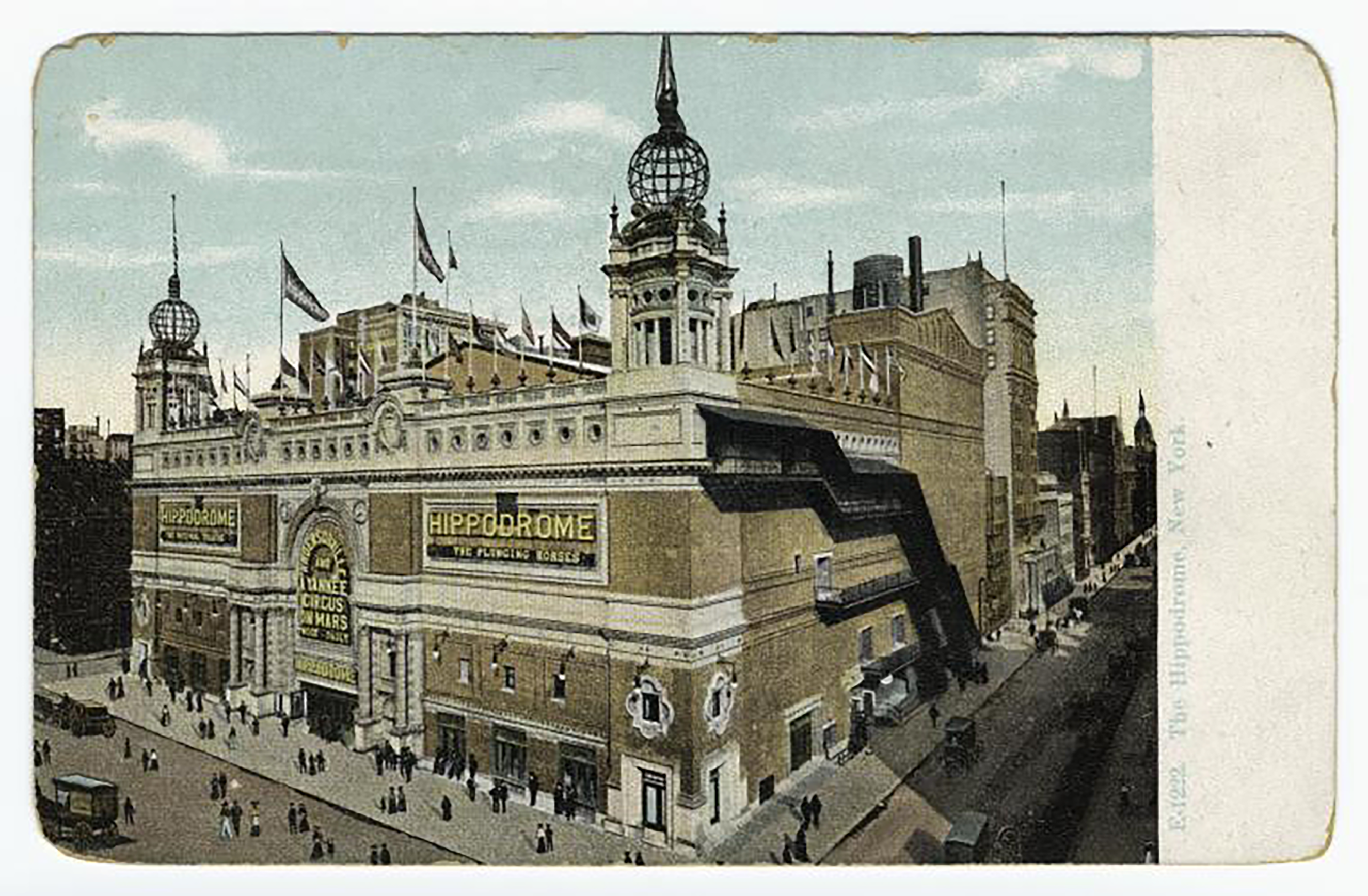
Hippodrome, Exterior. The Miriam and Ira D. Wallach Division of Art, Prints and Photographs: Picture Collection, The New York Public Library. "The Hippodrome, New York" New York Public Library Digital Collections. Accessed November 27, 2023. https://digitalcollections.nypl.org/items/510d47e2-8ceb-a3d9-e040-e00a18064a99
In recent years, scholars have published many edited collections and anthologies that address the complexities of nineteenth- and early twentieth-century Anglophone popular performance. 2 However, they have not yet reckoned with the New York Hippodrome's cultural importance at the turn of the twentieth century, when it was one of the largest mass entertainment venues in the United States, and its shows were seen by millions of people every year. This is partly because its programmes were so varied. The opening night programme began with a full-length musical spectacle called A Yankee Circus on Mars. That extravagant production included a brief intermission for circus acts between scenes one and two, followed by a ‘Circus Tournament’. The ballet, ‘Dance of the Hours’ from La Giaconda, ended the eclectic first act. After the intermission came a Civil War melodrama called Andersonville, A Story of Wilson's Raiders. From 1905 to its demolition in 1939, it presented enormous spectacles of all sorts, including concerts, pageants, opera, sports, circus, Wild West shows, and vaudeville. In this special issue, we want to begin providing the necessary contexts for understanding just how these performances drew on transatlantic nineteenth-century performance traditions and combined them with twentieth-century technological discourses to create a unique venue and type of performance worthy of further academic attention.
In the following sections, we provide an overview of the New York Hippodrome's construction, the historical references and symbolic resonances of its exterior and interior theatrical space, and the human and animal performers who contributed to its overall importance in the opening season and beyond. First, we discuss how Thompson and Dundy drew on the vibrant transatlantic theatrical networks of the era to conceptualise the New York Hippodrome as a theatrical space, while at the same time highlighting the uniquely American quality of their venture. This played out in periodical coverage of the venue's construction, where the celebrations of oversized scale and backstage technological innovation took on a nationalistic tone. The boosterism had local resonance as well, since New York City was undergoing a building boom at that time, staking its claim as a world-class city representative of the whole nation. 3 The venue's architecture, interior design, and onstage performances work together in ways that recent scholarship has identified as racialising: we suggest that this overall racialised aesthetic creates a transportive experience where audience members feel part of an exoticised space. We conclude by considering how performing animals develop all these overarching concerns, calling upon local, national, and international resonances in popular performance.
Transatlantic Hippodromes
To call a performance venue a hippodrome was to emphasise its all-encompassing aspirations. Thompson characterised the aspirational ambitions of early twentieth-century variety: ‘We are coming to the age of the department store in theatricals’. 4 The department store analogy also points to the Hippodrome's embrace of huge spaces. On a stage twelve times larger than that of the average Broadway theatre, hundreds of performers – both human and animal – played in front of thousands of audience members for two shows a day. Turn-of-the-twentieth-century hippodromes offered audiences indoor hybrid theatrical venues with massive performance spaces and audience seating, combining the comforts of a well-appointed vaudeville house with the spectacular capacities of the circus. The New York Hippodrome literalised its hybridity by featuring a stage wide enough to include two forty-two-feet regulation circus rings – halfway between the single rings still common in Europe and the three rings of American railroad circuses. Not only had Thompson and Dundy opened Luna Park two years before they opened their Hippodrome, they briefly ran the Colonial Theatre (a traditional vaudeville house at 62nd and Broadway) in January 1905. 5 The New York Hippodrome can thus be seen as a triangulation of the urban popular entertainment market by fusing the spectacular outdoor amusements of Luna Park with proscenium vaudeville. The term ‘hippodrome’ comes from the Ancient Greek for ‘horse race’ or ‘horse course’. Indeed, the oblong racing track surrounding the Barnum and Bailey Circus rings at Madison Square Garden was referred to as the hippodrome track. However, ‘hippodrome’ was also applied to late nineteenth-century indoor venues in European capitals to imbue modern variety with grandeur.
The late nineteenth and early twentieth centuries saw a proliferation of transatlantic commercial entertainment competition facilitated by technological advancements and cultural mediators. Theatre historian Nic Leonhardt assesses the broad imbrication of transatlantic theatrical communities, highlighting the roles of agents, managers, and other mediators who made this circulation possible. 6 For example, British variety magnate Edward Moss had opened the London Hippodrome in 1900, himself inspired by Joseph Oller's Nouveau Cirque because of the Paris venue's innovative water spectacles. The London Hippodrome motivated Thompson to best the transatlantic competition by mimicking its programming while significantly amplifying its size and production ambitions. Thompson travelled frequently to London and Paris, both to borrow design elements from their theatres for his architectural sketches and to poach circus acts for his bills. If the London Hippodrome stage was ‘nearly 50 feet’ 7 and had one circus ring, the New York Hippodrome stage would be ninety-two feet wide and have two circus rings. As Frank Schiede discusses, Marceline the Clown was already an established star at the London Hippodrome when Fred Thompson hired him away for the New York venue's opening season. Marlis Schweitzer observes in Transatlantic Broadway that ocean liners helped extend the scope of New York City's theatrical ambitions: like Thompson, other American theatrical impresarios frequently travelled to the United Kingdom and continental Europe in search of acts to book, while American performers found eager audiences there for their acts. 8 This borrowing evoked some anxiety, since it suggested that the United States lacked its own homegrown quality entertainment. When Thompson took yet another transatlantic trip while the theatre was still under construction, Billboard joked that the Hippodrome manager was ‘ransacking Europe’. 9 Such jokes highlighted the aggressive cultural competition that played a role in the United States’ increasing political and economic dominance at the turn of the twentieth century. Part of this competition included relying on the transatlantic animal trade to lure audiences with interspecies novelty.
As with vaudeville palaces, the New York Hippodrome's architecture was inspired by European structures, but was meant to establish American ascendance. According to Broadway Magazine, similar venues in London, Paris, and Berlin ‘were mere pygmies of construction in comparison with the superb gigantic proportions’ of New York's Hippodrome. 10 The first season's programme featured a headline that made the same point: ‘Dwarfing All Stages of All Countries,’ perpetually reminding audiences that they were not just enjoying a variety show, they were participating in national triumph. Indeed, we understand the narratives surrounding the New York Hippodrome's construction as constituting a spectacle in themselves, albeit one that played out not onstage but in local and national periodicals.
Venue Scale and Technological Innovations
The ambition to scale up the theatre and refine the circus created engineering and marketing complexity, even as the venue's structural feats became an important part of its hype. The promotional blitz anticipating the Hippodrome's opening night included a Scientific American article detailing the ‘Mechanical Features of the New York Hippodrome’. The 25 March cover features two carefully rendered grey-scale illustrations of New York's newest performance venue. The image (see Figure 2) presents the Hippodrome backstage from the point of view of the stage-right theatre wing. Suspended steel beams, pulley systems, and stripes of electric lights cut across curves and sharp angles. Massive walls dwarf the humans at work; they seem like toy figurines, rendering the human context insignificant within the massive architectural marvel. To orient and impress readers, the illustration itemises specific physical triumphs with labels (‘asbestos curtain’, ‘counter weights’, ‘plunger’, ‘runway’, and ‘tank’).
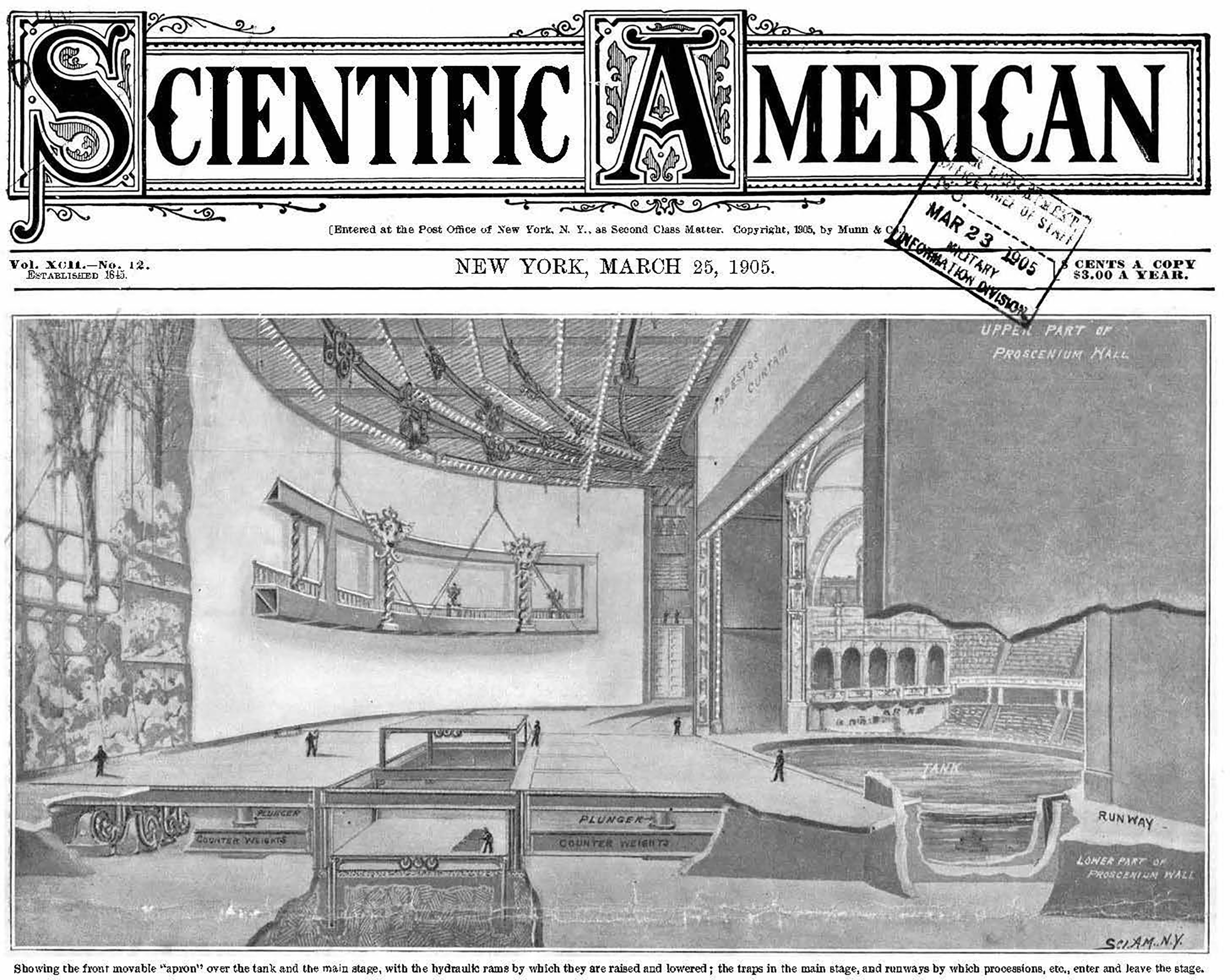
First illustration appearing on the Scientific American cover, 25 March 1905. Via JSTOR, https://www-jstor-org-443.web.bisu.edu.cn/stable/24994875
This modular design became a focal point because it promised to dazzle audiences while superseding the technological advancements of European antecedents. As Sunny Stalter-Pace argues in her essay on scenic designer Arthur Voegtlin, the New York Hippodrome's scale and aesthetics contributed to what David E. Nye terms ‘the American Technological Sublime’. According to Nye, ‘The technological sublime celebrates progress’ and ‘points toward the future’. 11 It demands ‘conquering space, time, and gravity’ 12 to salute humans’ capacities for invention. In terms of national identity, ‘the technological sublime has been one of America's central “ideas about itself” – a defining ideal’ that ‘served as an element of social cohesion’. 13 Accordingly, Scientific American emphasises the New York Hippodrome stage design's ingenuity and capacity to facilitate crowd-pleasing spectacles. The caption reads, ‘Showing the front moveable “apron” over the tank and the main stage, with the hydraulic rams by which they are raised and lowered; the traps in the main stage, and runways by which processions, etc, enter and leave the stage’. 14 The illustration takes pains to render the invisible visible, using an ‘X-ray vision’ effect to depict the structural details of otherwise hidden wonders behind walls and beneath the boards. Thus, Scientific American celebrates the labour of design and preparation, cultivating an audience for the venue's engineering triumph. To the left, a painted backdrop of rocks and trees subtly signals that this enterprise will, eventually, attempt to represent the outside world. There will be people here to watch.
Scientific American makes two main assertions: that the scale of the New York Hippodrome's water spectacles ‘will rival the outdoor exhibitions’ available at Coney Island, and that ‘there is no playhouse, here or abroad, that rivals it in size, construction, or equipment’.
15
The Hippodrome, then, aimed to serve its immediate audience and send a transatlantic message: this marvellous venue would thrill spectators and shame rivals. To bolster the hype, the article features an ecstatic cascade of numbers, which was an old circus promotion strategy: That portion of the stage, 60 feet in depth, which lies forward of the proscenium arch, is known as the apron. It is generally elliptical in form, and measures 48 feet in depth and 92 feet in width. Like the main stage, it is carried on 12-inch hydraulic plungers, with, in this case, a vertical travel of 14 feet…Beneath the apron is built a huge steel and concrete tank, over 14 feet in depth, and large enough for the whole apron to sink within it. When aquatic performances or naval pageants are to be given, the tank is filled with water, and the movable apron is submerged below the water to the bottom of the tank…The use of such large quantities of water necessitates an extensive hydraulic plant. The main tank is served by three centrifugal pumps of a combined capacity of 8,000 gallons per minute. Around the back of the stage, at a height of 14 feet, a 12-inch pipe extends for a distance of 180 feet. From this pipe, by means of flexible connections leading to a cataract and fountains, a fine cascade with a fall of 14 feet is formed, with the full capacity of the three centrifugal pumps to maintain it in constant flow.
Locating the Hippodrome Within New York City
To understand the Hippodrome's position within the cultural landscape of early twentieth-century New York City, it is useful to consider the playhouse's geographical location. Business and government interests of Lower Manhattan dominated in the nineteenth century, but the borough's center of gravity shifted in this era to the ‘pleasure district’ of midtown Manhattan where hotels, restaurants, and other sites of entertainment had been built. 19 The Hippodrome's liminal position within this commercial area echoes its hybridity as a performance space. The Hippodrome was nearby – but not quite a part of – the burgeoning theatre district around Broadway and Forty-Second Street, the intersection newly christened Times Square. Thompson was interested in building there, but he said that lots within that immediate area were prohibitively expensive and would have made it impossible to open the Hippodrome as a popular-priced venue. 20 He and Dundy instead chose a location a few blocks east of Broadway on the former site of a horsecar depot and stable. 21
Thompson and Dundy selected the Hippodrome's location in part because audiences could reach the theatre using several different forms of transit. The building's entrance faced the Sixth Avenue elevated train line; the New York Central railroad terminated at Grand Central Station, three avenues to the east. New York City's subway system was the most recent addition to its transit network: it opened in October 1904, with express and local trains at Forty-Second Street and Broadway. A front-page newspaper article discussing the New York Hippodrome's first night compared the city's newest theatre to its six-month-old subway system: Viewed upon a broad plane, it is a question which is the greater achievement. They stand, side by side, as engineering marvels – the one sunken into the rock of Manhattan more marvelous than the Catacombs of Rome, and the other reared to the sky, a veritable up-to-date Greek Hippodrome.
22
The opening of the Hippodrome took place during a building boom. Many of the midtown landmarks known today were then being developed: the cornerstone for the New York Public Library (two blocks south) was laid, but the building would not open until 1911; Grand Central Station had been reimagined but not yet rebuilt as the iconic edifice with cerulean blue and gold leaf ceilings. Unlike the creamy, classical entrances to these buildings, the Hippodrome façade was dominated by terra cotta and red brick (see Figure 3). Trained as an architect, Thompson shamelessly borrowed elements from other palaces of amusement for his design. He evoked the second Madison Square Garden, designed by Stanford White and built in 1890, through the Hippodrome's corner towers. The Hippodrome competed with Madison Square Garden outside of the rings as well. The corner towers were topped with domes in the same Orientalist style as the buildings at Luna Park and the Pan-American Exposition.
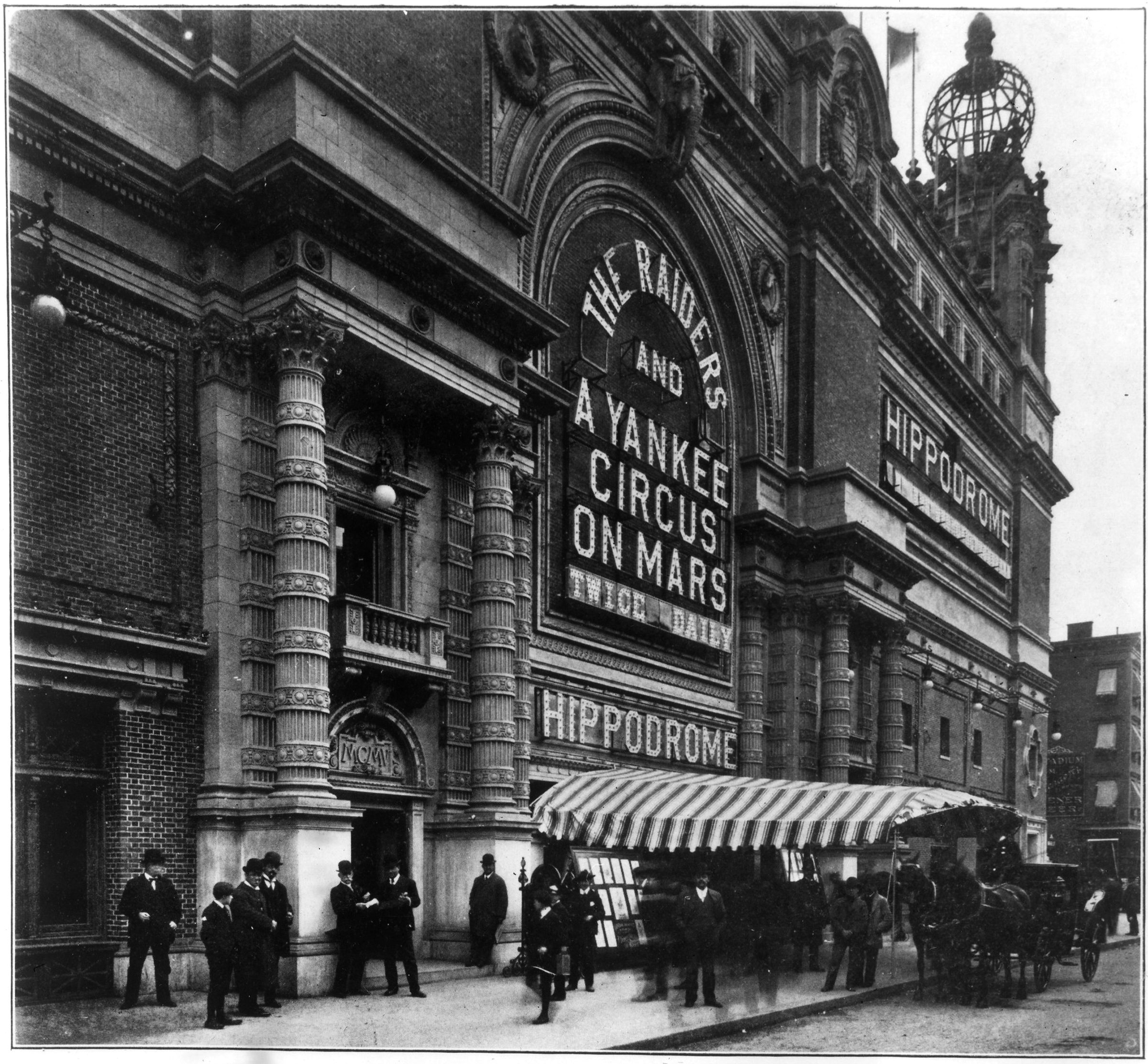
Hippodrome, exterior Yankee Circus/Raiders, courtesy of The Shubert Archive.
The city was in a period of cultural transition: writers and artists noted the move away from an ‘Old New York’ (split between high society and the very poor) to a ‘New New York’ that was seen as more modern and uniquely American. 24 The Hippodrome's north side faced a stretch of Forty-Fourth Street representative of the wealthy and powerful denizens of ‘Old New York’. Along with the Algonquin Hotel, this block housed bastions of gentility like the New York Yacht Club and the Harvard Club. 25 The area became known as ‘Rubberneck Row’: tourists in motorised coaches were driven slowly down the street so they could gawk at members of the social elite. These wealthy clubmen and other neighbours were initially wary of the ‘circus’ being built in their midst, 26 but they were eventually won over, participating in an auction for first-night boxes. 27
While they welcomed the respectability that came from the social elite of ‘Old New York’, Thompson and Dundy aligned themselves far more closely with the new middle and working classes, who were often immigrant or second-generation. Prices offered in the first season allowed a wide range of patrons to attend: though box seats were two dollars apiece, around the cost of a high-end Broadway ticket at the time, ‘family circle’ seats in the gallery cost 25 cents. 28 If you could afford to attend a vaudeville show, you could afford the Hippodrome. The account of the opening night that appeared in the New York Sun called the audience ‘just New York, collected into a compacted sample of unprecedented size, and therefore of unprecedented catholicity’. 29 The varied identities and shared thrills of the audience made it something of a melting pot, to use the term that would come into fashion when Israel Zangwill's play opened in Washington, D.C. three years later.
The New York Hippodrome as a Racialised Space
The New York Hippodrome opened during a key time of modern racial formation in the United States. European immigration to the US reached record highs, while Chinese immigration was prohibited by federal law. The 1896 Supreme Court case Plessy v. Ferguson codified the constitutionality of providing ‘separate but equal’ facilities for African Americans. In this section, we want to think through some of the ways that the theatre's architectural space and its spectacular productions shaped the audience's experience of diversity and national identity. The décor was sumptuous and ‘exotic’, transporting the patrons into a shared experience that was visually and physically set apart from the everyday. This interior design reinforces the dramatic perspectives afforded due to the Hippodrome's size and scale. The focus on visual spectacle rather than dialogue made the performances especially appealing to attendees whose first language was not English. Merchants from Chinatown, for instance, attended Hippodrome shows with some frequency. 30 After the 1895 Civil Rights Act in New York state, places of public amusement were required to provide equal access to patrons, regardless of race. 31 This was of course far from true in practice: de facto discrimination occurred through behaviour, refusal of service, and spatial segregation. 32 Further research is needed to understand how these practices may have played out at the New York Hippodrome. The society column in African American newspaper The New York Age includes reports of Black audience members attending from the suburbs; the fact that these patrons all attended Monday evening performances may be a coincidence, or it may suggest a tactic for ensuring safety in numbers.
Like the skyscraper, the Hippodrome foregrounds the malleability of perception through the new positions in space that it offers for perceiving others and being perceived by them. Following the work of Adrienne Brown and other theorists of racialisation in modern American architecture and culture, we suggest that the New York Hippodrome shaped the ‘racial sensorium’ of its patrons. 33 The theatre's interior was opulent, decorated in Roman red with accents of gold and silver. Bronze elephant heads decorated the walls on each floor, some with electric lights extending from their tusks (see Figure 4, interior hallway). Newspapers observed that the ‘Elephants’ heads and Oriental carvings and tapestries’ in the promenade echoed the settings of the Martian king's courtyard in Yankee Circus in Mars. 34 Josephine Lee contends that ‘A variety of Oriental settings allowed for fantastic escapes from reality’ in performance. She notes that ‘R. H. Burnside's 1909 extravaganza A Trip to Japan at the Hippodrome followed a plot in which ‘the Japanese hire a circus to disguise their shipments of submarines back to their homeland’, and was full of stunning effects including a steamship, [and] a ‘Feast of Lanterns’. 35 The repeated engagement with ‘Oriental’ design is notable in that it took place during an era when Chinese immigration to the United States was prohibited. Esther Kim Lee notes that yellowface performance during this period functioned as a technology to help European performers shed their racialised identities and participate in white Americanness. 36 The Hippodrome's onstage and offstage environment that visually evokes Asia and distant realms could be understood to help the audience do the same thing.
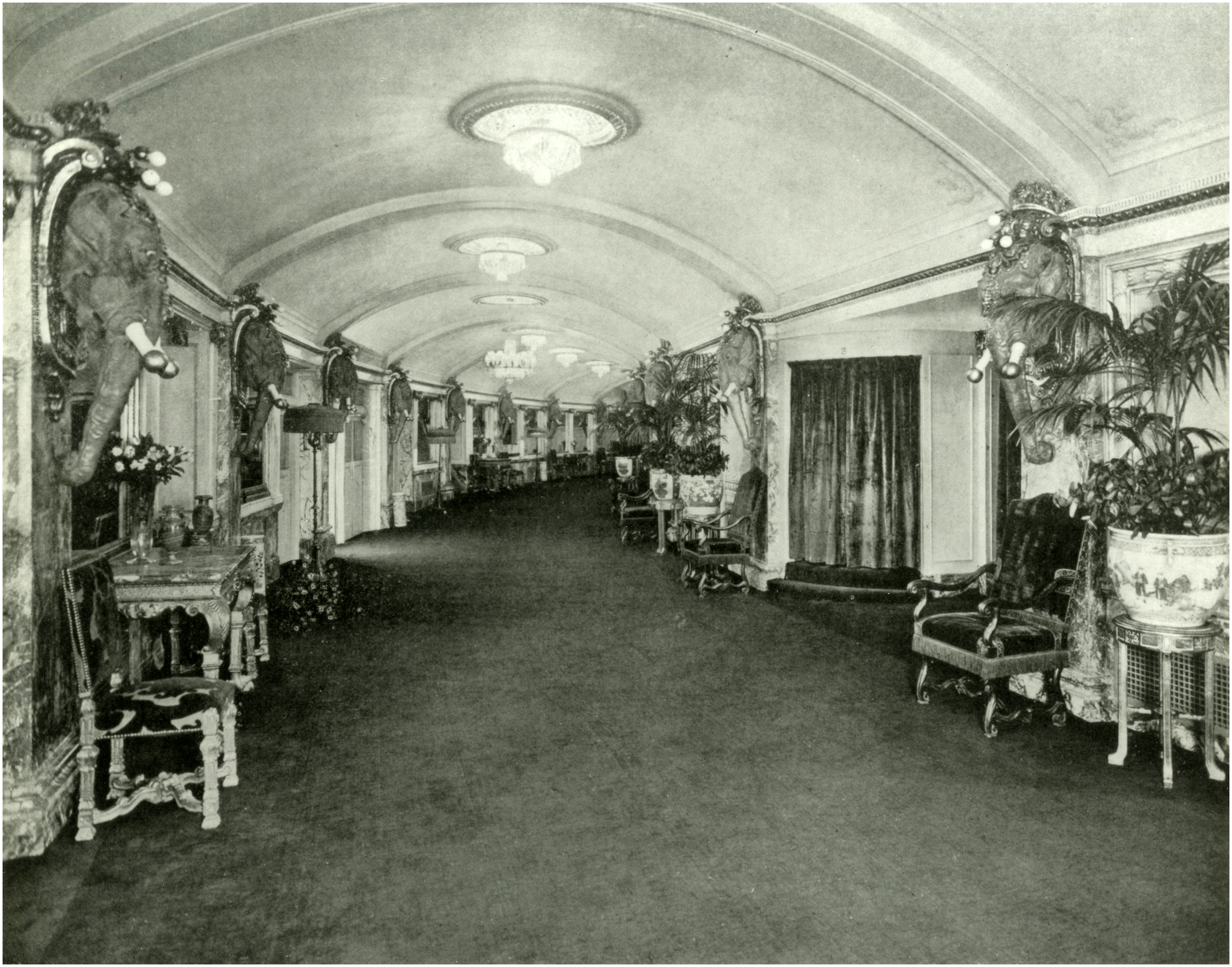
Hippodrome, interior hallway w/ elephant heads, courtesy of The Shubert Archive.
Thompson and Dundy's entertainment empire extended the cultural work done by nineteenth-century world fairs. Luna Park ‘relied on world's fair standards’ for its designs. 37 Before the amusement park opened on Coney Island, the New York Clipper touted the exhibitions of ethnic differences that could be found there, dubbing the area of the park where they could be seen the ‘New World's Fair’ and the ‘Twentieth Century Midway’. 38 Indeed, Thompson worked at Chicago's World's Columbian Exposition while still a teenager, which had a major effect on the direction of his career. 39 Scholarship on the Hippodrome examines how later spectacles reinforced the burgeoning identity of the Progressive Era United States as an imperial power. 40 The 1909–1910 season, with two major spectacles called A Trip to Japan and Inside the Earth, was particularly notable in this respect. Margaret Werry discusses the production as an articulation of American fantasies about national power and cultural influence over the Pacific Rim that echoed the statecraft of Theodore Roosevelt; both were ‘textured, animated, and organised by a logic of race’. 41 Marianne Schultz considers the Māori performers who presented native dances as part of Inside the Earth. 42 The newspaper coverage of these performers offers a fascinating look at the complexities of cross-cultural performance. Onstage, they appeared exotic and outside of time. Offstage, stories about their rituals appeared alongside descriptions of their ultra-modern style and politics, including female performers’ participation in suffrage rallies.
Notably, Hippodrome spectacles participated in the erasure of Black Americans onstage during the Jim Crow era of segregation even as international acts were welcomed to import glamour, prestige, and novelty. This had not always been the case: Thompson and Dundy collaborated on an attraction for 1901 Pan-American Exposition in Buffalo, New York, an ‘Old Plantation’ exhibit that included a replica of an American antebellum plantation house and African American actors who were coached in the racist performance traditions of minstrelsy. 43 The Raiders melodrama in the Hippodrome's first season initially included a scene with ‘plantation Negroes’, though these were likely to be white actors in blackface. 44 That scene was cut after the first performances, as David Mayer's document of performance discusses. The Raiders was pared down to diminish the perceived sectionalism (Northern whites against Southern whites) and instead to emphasise scenes of white military display and equine vigour.
The Hippodrome's Theatrical Animal Capital
The venue's complicated politics were not only about humans. Animal acts were indispensable for the Hippodrome's initial allure and ongoing appeal. With their experience opening Coney Island's Luna Park, Thompson and Dundy understood the public's regenerative interest in seeing a variety of mammals trained to perform remarkable feats. The entrepreneurial duo deployed animal acts frequently to fill the Hippodrome's elephantine space and to counter the appeal of a hyperlocal rival – Madison Square Garden, the arena just over a mile away where Barnum and Bailey's circus premiered its season each March. As Kate Holmes discusses in this issue, Thompson and Dundy were in fierce competition with the corporate circus. Thompson and Dundy aimed to best Barnum and Bailey by launching the Hippodrome several weeks before the circus's traditional debut. However, their grandiose ambitions to fill a Manhattan block with carefully engineered bricks, lumber, and steel did not materialise in time, and Barnum and Bailey had been running for nearly three weeks by the time the New York Hippodrome opened its doors to the public.
Horses and elephants were the most integral species to the New York Hippodrome's hybrid theatre–circus formula because of horses’ versatility and elephants’ impressive size. Elephants had become increasingly essential to large-scale circuses during the nineteenth century. Cultural historian Susan Nance argues that creating ‘such enormous circus shows by the systematic use of captive elephants was a uniquely American innovation. Thus, the long nineteenth century of the American circus was equally the elephant's long nineteenth century in America’. 45 Popular pachyderms and exciting equines came to represent the Hippodrome in different ways. The Australian horse trainer and performer Frank Melville had decades of experience and already worked with Thompson. Melville became the New York Hippodrome's Equestrian Director, doing his best to bring Thompson's often outlandish plans to fruition. For example, in January 1905, the Sun reported that Melville was beleaguered by Thompson's impossible demand to train twenty-four horses to ‘go through a quadrille at a trot… while twenty-four ballet girls did whirligigs on the horses’ backs’ 46 because Thompson had recently seen one expertly trained circus performer do such an act at a European hippodrome. Although the act did not make it to opening night, horses were crucial to the Hippodrome's offerings, with two of the songs in A Yankee Circus on Mars being specifically horse-themed (Scene I's ‘Hold Your Horses’ and Scene II's ‘Git a Horse’), the so-called Circus Tournament within the show including Clarks equestrian act, and, of course, the water tank being the site for the famed plunging horses that performed the finale of The Raiders and the entire evening. Melville trained the ‘troupe of diving cavalry horses’ in a 16-foot tank of warm water in ‘a rehearsal barn… at the very back of the Streets of India site, under the famous Himalayas, in Luna Park’. 47 A water tank for performing horses on the edge of imagined India aptly characterises a variety of entertainment's relentless commodification and display of species and cultures.
Many of the animals exhibited at Coney Island – Asian elephants in particular – became valuable commodities secured through elaborate global networks of capture, transportation, and training. Once trained for theatrical exhibition, the creatures’ value transformed into a new type of animal capital. According to Nicole Shukin, ‘animal capital’ describes the ‘historically, culturally, and politically contingent’ 48 processes that rendered animal bodies into valuable raw material and final products – both material and symbolic – in the modern circulation of capital dependent on advancing transportation and communication technology. Building on Shukin, theatrical animal capital emphasises just how spectacular such rendering could be, and how live audiences actively participated in and took pleasure in such ephemeral rendering. The Hippodrome became an important site of theatrical animal capital because, unlike vaudeville where large animals were incongruously squeezed onto stages primarily designed for humans, the Hippodrome was purpose-built to display animals on its mammoth stage and contain them in basement stalls.
As the iconic circus animal and the venue's namesake, horses embodied the Hippodrome's theatrical animal capital. Indeed, the playbill cover for the week of 24 April 1905 features three sinewy and dynamic horses galloping on clouds while pulling a woman in a chariot (see Figure 5). The equines seem to burst forth from the page itself, their hooves breaking past a circular frame. For the actual performances, Thompson and Dundy procured horses from the military and the racing industry. The Hippodrome's modular stage apron's massive water tank – arguably the venue's most impressive feature for sensation-seeking audiences – was built to hold plunging horses embodying warfare and strife. Hippodramas had been performed in purpose-built spaces at least since The Battle of Waterloo (1824) stoked national fervour at Astley's Amphitheatre in London. Much more recent and closer to the New York Hippodrome, Ben-Hur opened at the Broadway Theatre in 1899 and became a popular favourite due to its chariot race scene featuring three horses running on tracks that created the illusion of covering distance. Thompson and Dundy were clearly hoping to follow Ben-Hur's lead when, as Stalter-Pace observes in her essay, they initially hired its designer for the Hippodrome. Unlike the Broadway Theatre, at the Hippodrome there was stage distance to cover. And, even more exciting, there was vertical depth in the water tank. The playbill describes The Raiders’ Tableau II as ‘Battle at Rocky Ford Bridge of Men and Horses in which Participate the Thompson & Dundy Stud of Plunging Horses; Peace Declared’. As David Mayer's production description attests, this stud of plunging horses created a crowd-pleasing spectacle powerful enough to drastically diminish the play's narrative. Hence, the horses’ theatrical animal capital contributed mightily to Thompson and Dundy's revenue.
The production, distribution, and consumption of theatrical animal capital required complex logistics and normalising animal abuse. For example, transporting seven elephants and over 100 horses from Luna Park to midtown Manhattan in late March, an elephant named Alice protested being separated from her elephant companion, Queenie. Thompson and Dundy's elephant trainer, Peter Barlow, casually reported using the elephants’ close relationship to successfully dominate them: ‘When Queenie has been fractious, Mr. Barlow has made great demonstrations of beating Alice’. 49 Such casual reference to abuse indicates its perceived normality (indeed, Thompson and Dundy had infamously collaborated with Thomas Edison to film the electrocution of a Luna Park elephant in front of a crowd in early 1903). 50 Any reluctant or recalcitrant elephant became labelled ‘bad’, as Alice was because she ‘refused to be packed away in a crate’. 51 Reportedly, her protests were so adamant that ‘one of the four horses which had been hitched to the truck died from fright’. 52 After a third elephant ‘succeeded in butting her way to liberty’ while en route near Prospect Park in Brooklyn, that runaway pachyderm and two horses had to be recaptured. The mayhem was not limited to the animals themselves, as this capital enterprise also damaged public transportation when a transport wagon derailed one trolley and short-circuited another. This seemed to be accepted as the exasperating but not wholly surprising cost of urban animal performance. Finally, the creatures arrived. While the horses went to a stable on Twenty-Third Street, the elephants, who would have walked miles daily in their natural habitats, were led to their new basement lodging. They would remain there without sunlight or significant movement except for rehearsals and performances. Such deprivation did not deter the species’ popularity. In fact, stand-alone circus offerings with no musical theatre pretences were staged at the Hippodrome through 1915 and, from 1915 to 1922, the producer Charles Dillingham presented a yearly musical revue highlighting Power's Elephants, who became synonymous with the Hippodrome. 53
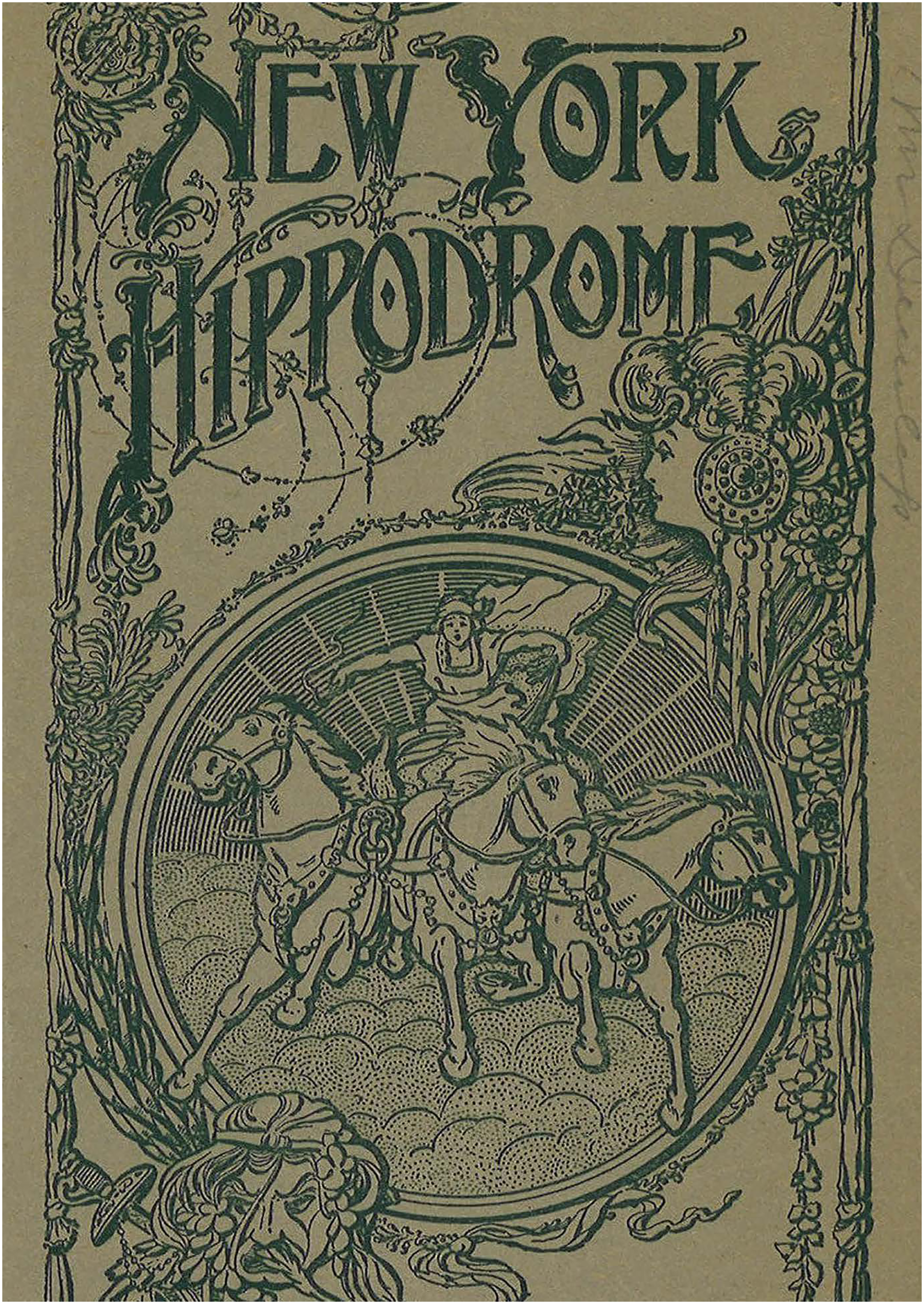
April 1905 Hippodrome Program Cover. Collection of author.
The circus aesthetics continued during the Hippodrome's second season. Opening in December 1905 and running for nearly 600 shows, A Society Circus ran for nearly a year. In an example of the class signifiers that were constantly at work in popular entertainments, the framing device for A Society Circus involved ‘a doubtful Duchess who engages the performers to amuse her friends at a house party’. 54 Thus, the Hippodrome audience was elevated to the status of leisure-class socialites as part of their experience as spectators. In its premiere issue, Variety reviewed the show with tepid regard, offering ‘intense admiration’ only for the director/stage manager Edward P. Temple, due to his coordination of the elaborate set changes. A Society Circus utilised even more animals than A Yankee Circus and Variety's summary sheds light on the hit-or-miss quality of the acts, as well as the public's acceptance of trainers abusing and drugging animals. Variety noted that Claire Heliot's lion act was similar to the famous female trainer Agie. However, ‘Whereas Agie must punch the brutes to have them growl, Miss Heliot must punch very hard to induce the opening of their eyes so the meat dangling in front will be seen’. 55
Variety was equally unimpressed with Marquis’ ponies because they had already performed in New York City regularly. The reviewer dismissed the Powell Sisters equestriennes as ‘not sensational in any degree and a poor act of its kind’ because the women's poses were not spectacular enough and, again, the horses moved slowly’. Variety concluded, ‘Those having the “Hipritis” fever will go many times, no doubt, but to the others who consider once sufficient, that will do’. 56 Though Variety was committed to covering the six pillars of variety entertainment (vaudeville, circus, parks, burlesque, minstrels, and fairs), the reviewer did not favour the hybrid revue/circus form and may have been suspicious of the Hippodrome's extreme hybridity. It was neither a true stadium-style venue like Madison Square Garden nor a ‘true’ vaudeville house, yet it hosted revues and musical comedies under a proscenium. It was an amalgam that showcased an insatiable desire for spectacle. In the essays that follow, we consider some of the components of popular performance at work in the New York Hippodrome's first season, both to illuminate the nineteenth-century antecedents for this hybrid spectacle and to consider how they were put to new use at the dawn of the twentieth.
Sunny Stalter-Pace recuperates the largely forgotten scenic designer Arthur Voegtlin, analysing his contributions to the New York Hippodrome as he balanced ‘scale and detail’. Through an analysis of Voegtlin's work prior to the New York Hippodrome and how it changed at the huge indoor venue, Stalter-Pace argues that he ultimately captured an aesthetic of ‘realistic spectacle’ as the venue's artistic director. Combining two terms often thought to connote divergent performance traditions, Stalter-Pace's identification of Voegtlin's realistic spectacle demonstrates ‘the ways that nineteenth-century scenic practices carried on and scaled up at the dawn of the twentieth century’ through Voegtlin's immersive environments and hyper-realistic settings.
Kate Holmes's essay highlights the US nationalism at work in the Hippodrome's publicity as well as its dramaturgy. The theatre's ‘bigness’ becomes emblematic of the Progressive Era United States because it brings excessive scale under control with technological efficiency. Circus plays a central role in the first season's programme, Holmes argues, where it too is understood to be uniquely American (after all, it is a Yankee circus that travels to Mars). Aerialist acts the Clarkonians and the Ty-Bell Sisters took advantage of the Hippodrome's theatrical space above the sets in a way that other performances could not. But the spatial orientation of the Hippodrome's audience to the action kept it from being truly immersive as an in-the-round circus show would be.
Circus traditions are also considered in Frank Schiede's essay: Marceline trained as an acrobat before he was a clown. Born in Spain and performing in London when he only spoke Spanish and a little French, he could not sell dialogue where clowns might be expected to. As a consequence, he became a pantomimist. His refined skills of bodily communication, distinctive makeup, and costume all helped him communicate nonverbally in the Hippodrome's massive space. Marceline's antics allowed audience members a point of identification and granted coherence to what would otherwise have been a disjointed collection of spectacles. The clown's attempt to transfer this ‘Hippodrome idea’ to his touring show suggests one way of separating Hippodrome performance from its space. We hope that these essays work similarly, giving scholars a portable sense of the New York Hippodrome's animating spirit.
David Mayer's document of performance is his last contribution to the journal he co-founded. He describes Andersonville, The Story of Wilson's Raiders by Carroll Fleming with incidental music by Manuel Klein and equestrian direction by Frank Melville, detailing the setting and reconstructing the marketing of the Civil War melodrama to consider how it was publicised and edited over the first few weeks of performance.
