



Abstract
This article compares the enactment of Football Banning Order legislation in Scotland to that in England and Wales. Football Banning Orders evolved in England and Wales through the 1990s into a particular form of hybrid legislation, culminating in the Football (Disorder) Act of 2000. The legislation was not introduced into Scotland until the Police, Public Order and Criminal Justice (Scotland) Bill in 2006. By 2010, it appeared that orders were being under-utilized in Scotland. This raised questions as to whether there was less need for orders within the context of Scottish football, whether the legislation was either being poorly implemented or if imposing orders was being actively resisted. In focusing primarily on the utilization of the legislation by police on the ground, this article questions whether the football or policing contexts are markedly different in the two jurisdictions. We argue that one of the dominant explanations for the comparatively low use of orders in Scotland relates not to the content or interpretation of the particular legislation involved, but to broader differences in how criminal justice legislation is typically enacted.
Introduction
Football Banning Orders (FBOs) are court-issued, preventative orders that impose a number of restrictive conditions on an individual who has (a) previously been involved in football-related disorder and (b) is likely to be involved in disorder in the future (Moss, 2009). At their simplest, FBOs aim to prevent future disorder by banning individuals from attending specified matches for a set period of time, though they also belong to a broader family of legislative innovations that emerged in the UK in the late 1990s (Moss, 2009; Zedner, 2009). Anti-Social Behaviour Orders (ASBOs) represent the most high profile of such innovations, which primarily aim to prevent specific populations from engaging in particular types of behaviours (see Squires, 2008). These preventative orders are commonly labelled as ‘hybrid’ in that they can be issued on top of a sentence resulting from a criminal conviction, or they can be issued through a civil application process, where the qualifying misbehaviour need not be established with a criminal standard of proof but only with the lesser civil standard (e.g. on the balance of probabilities) (Moss, 2009). However, breach of such orders, even when they are issued as part of a civil process, can result in a criminal conviction.
In their current form FBOs were introduced into England and Wales in 2000, but were not extended to Scotland until the Police, Public Order and Criminal Justice (Scotland) Act of 2006. As Nixon et al. (2010) note this type of policy transfer has become more common as legislators are keen to draw upon lessons and good practice from other jurisdictions. With the establishment of a devolved Scottish Parliament at Holyrood in 1999 – and the ceding of limited legislative and policy making powers from Westminster to Holyrood – the variety of ways in which policy transfer can occur between England and Scotland have increased in number and complexity. Legislation can still be effectively imposed by Westminster in some areas, while in others legislation may be copied or significantly adapted by Holyrood (Keating et al., 2003). Even where legislation is transferred to Scotland with similar drafting and shared objectives, the application of that legislation in a Scottish context can lead to significant deviation or innovation. For instance, ASBOs, a similar type of hybrid order to FBOs, were introduced across the UK in the 1998 Crime and Disorder Act. However, in Scotland ASBOs were both resisted and significantly subverted as practitioners steered the policy agenda away from the imposition of punitive orders towards other interventions focusing more on the root causes of anti-social behaviour (Nixon et al., 2010)
No previous research has examined the transfer of the FBO legislation from the English to the Scottish context. This is somewhat surprising for two principal reasons. First, the composition of Scottish football is different to English football. In total, 92 professional clubs operate in England and Wales. They play in four divisions (The Premiership, Championship, League One and League Two) and in 2010–2011, 30 per cent (n = 28) of all English teams had average attendances of over 20,000. Although, 42 clubs operate in Scotland across four divisions, 1 (The Scottish Premier League (SPL), Leagues One, Two and Three) the professional game is dominated by Rangers and Celtic, whose average attendances are over three times that of other ‘larger’ Scottish teams. 2 Second, the FBO was implemented in England and Wales to tackle the persistent problem of violence involving English hooligans abroad (Stott and Pearson, 2006), whereas in Scotland – in the absence of any notable problems with followers of the national team (see Guilianotti, 2005), the focus was on disorder at domestic club football, and in particular disorder related to sectarianism.
The issue of sectarianism 3 in Scotland has been the focus of much academic attention (see Bruce et al., 2004; Devine, 2000) and club football has long been associated with the problem (Flint and Powell, 2011). Although sectarian allegiances have been observed with the supporters of several Scottish football clubs, the issue is most commonly linked to the ‘Old Firm’ of Rangers and Celtic (Bradley, 1995). Within these clubs, sectarianism is centred on the British protestant heritage of Rangers and the Irish Catholic tradition of Celtic and commonly manifests itself in the display of banners and the singing of songs (Millward, 2009). In academic circles, debates exist as to whether the Old Firm rivalry should be understood in terms of being symptomatic of substantive sectarian hatred that reaches beyond the confines of football or as merely ritualized forms of abuse intended to ‘wind-up’ rival supporters (Bruce et al., 2004). However, until recently the issue of sectarianism was often ignored in official discourse on football disorder. For example, in the influential 1977 working group report on football crowd behaviour, commissioned by the then-Secretary of State for Scotland, not one mention of sectarianism is made (Scottish Education Department, 1977). The 2006 Action Plan on Tackling Sectarianism in Scotland (Scottish Executive, 2006) marked a new determination to address behaviours that had previously at least enjoyed some level of official resignation or neglect. The Plan emphasized the problematic nature of sectarian behaviour at football matches and proposed to introduce FBOs to help prevent such incidents.
This article examines the implementation of FBO legislation in Scotland and England by utilizing data collected as part of a Scottish government-commissioned evaluation. 4 The evaluation sought principally to explore the operation of banning order legislation in Scotland, and through comparative analysis of the legislative process in England revealed a number of findings that are pertinent both to the control of football-related disorder and policy transfer. The article begins by describing the development of the FBO legislation in England and Scotland, and it outlines the backdrop to the evaluation. Patterns of FBO imposition are then compared, and we consider a number of explanations for the differences that are observed. Overall, the article identifies that key differences in how the legislation has been driven and resourced across the two jurisdictions has resulted in a low use of civil orders in Scotland with the focus being on the imposition of orders upon conviction. However, we argue that in light of the perceived recent increase in sectarian disorder in Scottish football, this relatively restrained use of the orders could be superseded by a more draconian regime, pushed by an increasingly assertive Scottish government intent on making its mark on criminal justice issues.
The Development of Football Banning Order Legislation
The incremental development of FBOs in England and Wales has been well covered, notably in the work of Stott and Pearson (2006, 2008). Prior to the Football (Disorder) Act of 2000, which introduced FBOs in their current form, attempts to ban hooligans from matches had gathered momentum from the early 1980s onwards (Frosdick and Marsh, 2005; Stott and Pearson, 2006). Early attempts to control match attendance focused on preventing fans from travelling abroad to attend fixtures through the imposition of ‘restriction orders’ that compelled individuals to surrender their passports for a limited period either side of specified matches (Stott and Pearson, 2006). However, these orders could only be imposed on the back of a criminal conviction and it was often difficult to secure convictions against some hooligans (James and Pearson, 2006). FBOs were therefore introduced in the Football (Offences and Disorder) Act (1999) and the Football Disorder Act (2000), extending existing powers in three key respects:
FBOs could be targeted at stopping troublemakers from attending specified regulated domestic football matches for an extended period of up to 10 years (provisions for surrendering passports prior to international matches were retained).
FBOs could include restrictions that went beyond stadia bans to include measures that sought to prevent trouble in locations that – while away from stadia – nevertheless attracted trouble on match days.
Finally, FBOs could also now be imposed through a civil application process (14B applications) whereby a chief police officer could apply to a court to issue an FBO on the basis that there were ‘reasonable grounds to believe that making a banning order would help to prevent violence or disorder’. 5 This allowed police forces to apply for FBOs in the absence of a criminal conviction. Rather, intelligence and action taken in other jurisdictions (e.g. being arrested at a match abroad) could be used to establish reasonable grounds to show that an individual was associated with violence and disorder of some sort, and that imposing an FBO might help prevent future violence and disorder ‘at, or in connection with any regulated football match’.
While FBOs imposed through these new civil powers were less restrictive than FBOs issued on the back of a conviction (with the maximum period of any ban being three years compared to 10 years on conviction), the provisions still caused controversy. As with ASBOs, the ability to impose significant restrictions on an un-convicted individual’s freedom of movement or association, and the ability to then criminalize them for failure to comply with such restrictions – were widely criticized as disproportionate (Pearson, 2002). Indeed, the civil aspects of the FBO legislation survived an early legal challenge (see the case of Gough v Chief Constable of Derbyshire, 2002), with a Court of Appeal ruling that section 14B orders were a preventative measure that were justifiable, proportionate and did not contravene EU Human Rights legislation. However, the court recognized that the preventative measure did impose serious restrictions on recipients and in upholding the orders issued against Gough ruled that the standard of evidence used to support these orders should meet an ‘exacting standard hard to distinguish from the criminal standard’ (2002: para. 90, 96). Pearson (2002) is unsparing in his demolition of the court’s logic, questioning why – if a criminal standard of proof existed – wasn’t a criminal charge brought against the defendants? Equally damning is Pearson’s reminder that a key justification for section 14B orders in the first place was that there were active hooligans who the police did not have sufficient evidence on to secure a criminal conviction. James and Pearson (2006) go on to demonstrate that not only were the FBOs issued to Gough based on insufficient evidence, but that courts have subsequently continued to issue 14B orders on the basis of circumstantial evidence. For example, being in the wrong place at the wrong time when disorder occurs (even if an individual is not caught actually participating in that disorder), can be ‘evidence’ enough to secure an order.
Both the UK Football Policing Unit (UKFPU) and the courts have also argued that the provisions for restriction of movement contained within orders, typically the confiscation of passports, represents a proportionate response to the problem of football hooliganism as they are an effective preventative remedy. However, as Stott and Pearson (2006, 2008) have posited, available evidence as to the effectiveness of FBOs in preventing violence at football tournaments abroad suggests that such measures are ineffective, failing to prevent violence abroad even when banned hooligans comply with the orders and stay within the UK. 6
Concerns about the civil power element of the FBO legislation were also raised in the Scottish Parliament when the legislation was introduced at Holyrood in 2006. 7 Nevertheless the legislation was ultimately copied – largely unamended – into the Scottish statute book, which appears surprising given the substantive difference in the stated aim for introducing FBOs (tackling sectarianism). The only distinction of note between the two versions of the legislation is that a requirement for the judiciary in England and Wales when convicting someone of a football-related offence, to explain their reasoning if they chose not to issue an FBO, was not adopted in Scotland. This may reflect a reluctance by policy makers at the time to encroach on the autonomy of the Scottish Judiciary. Scotland has a distinct legal system, and pre-devolution professionals within this system enjoyed – unlike their counterparts in England and Wales – relative freedom from scrutiny or interference by politicians in Westminster (Tombs, 2008). 8
The Scottish Government Evaluation
By 2010, the FBO ‘regime’ 9 in Scotland was relatively well established, yet the actual number of FBOs being issued by the courts still ostensibly looked low when compared to the numbers of orders issued in England and Wales. Up to May 2010, approximately three-and-a-half years after the introduction of FBOs, only 85 orders had been issued by Scottish courts (Football Banning Order Authority, 2010: 1) 10 or an average of two per Scottish football club. In comparison, by the 2003–2004 football season in England and Wales, again some three-and-a-half years after the introduction of the legislation in that jurisdiction, over 2596 FBOs had been issued (Home Office, 2005) or an average of 28 per English league club. This led to concerns in Scotland, not only about the number of orders issued, but also the proportion of applications that were not granted, with the Scotsman newspaper reporting in April 2009 that nine out of 10 police applications for an FBO were not granted. 11 By mid-2010 the number of ‘applications’ made for orders on conviction stood at 657, with 85 (13 per cent) orders granted (Football Banning Order Authority, 2010: 1). 12
It was against this background that in 2010 the Scottish government commissioned an evaluation to examine the progress of the FBO legislation to date. There was an overarching concern that the FBO legislation in Scotland was not being effectively utilized and the evaluation aimed to identify whether this perceived under-utilization was due to poor awareness and processes, or whether it was due to active and principled resistance to the legislation. In examining these questions the evaluation had a comparative element, looking at the experience of implementing the legislation in England and Wales.
The evaluation was broadly divided into two inter-related parts, the first looking at how cases were identified and processed by the police, the second looking at how cases were then subsequently dealt with in court. The first part of the research (the role of the police in targeting FBOs) is the primary focus of this article. In order to address the research questions, the methodology focused on a multi-site case study approach both in Scotland and in England and Wales. The logic behind this approach was that it would allow the research team to examine the practices underpinning the identification and processing of FBO cases and to compare these practices across the two jurisdictions. It was also thought that the use of FBOs would be strongly influenced by how individual police forces approached the policing of football, and in turn by how individual police divisions worked with football clubs within their division to maintain order and security on match days. In total we examined practices in seven police force areas (three in Scotland and four in England and Wales), focusing in turn on 11 football clubs (five Scottish Premier League clubs and six English League clubs). 13 In addition, interviews were conducted with club officials, officials from the Scottish Football Association and the Scottish Premier League, prosecutors (known in Scotland as ‘procurator fiscal deputes’) and the judiciary. The purpose of the interviews was not only to elicit an account of how practitioners understood and used the legislation, but also to contextualize this use against the backdrop of the particular characteristics of football disorder in their area. Interviews were supplemented with attendance at various FBO-related training events, as well as qualitative and quantitative analyses of electronic case records, and police incident and conviction data. 14 The timing of the research was fortuitous, with fieldwork largely preceding the controversial events of the 2010–2011 Scottish football season, the evaluation thereby benefitting from unimpeded access and co-operation.
For the Scottish government the value in having a comparative approach was conceived in a fairly conventional manner, principally that lessons might be learnt from practices in England and Wales. However, practitioners are themselves active in learning comparative lessons from other sites and institutions (Bloor, 1997), and as evaluators we rapidly found that Scottish practitioners were fully appraised of innovations in practices and policies south of the border. This should not have been surprising, for in spite of certain structural differences 15 and a strong rhetorical emphasis on the ‘Scottishness’ of Scottish policing (Gorringe and Rosie, 2010), there are, in reality, very strong institutional links between police forces north and south of the border, with a fluid interchange of policies, practices and personnel (Donnelly and Scott, 2005). However, the comparative, case study-based approach to the work nevertheless threw up more subtle lessons regarding how FBO practices varied in different settings.
The cross-border interconnections are obviously by necessity fairly dense when it comes to the policing of football. This is an operational requirement when Scottish clubs frequently play their English and Welsh counterparts in pre-season friendlies and European fixtures, and when sets of fans have cross-border allegiances and rivalries (Dunning et al., 1986). However, these interconnections also have a historical basis in terms of the development of policies and practices designed to address the issues of safety and security at football. In particular, certain key events in each jurisdiction have been seen as a catalyst for changes to security governance in both jurisdictions (e.g. the Ibrox disaster in 1902, the Ibrox disaster of 1971, the Bradford City Stadium fire in May 1985 and the Hillsborough disaster of 1989).
Contrasting Implementation: Numbers of FBOs Issued in Scotland Compared to England and Wales
Once the legislation had bedded in, the key question was why there was such a large disparity in the average numbers of orders issued in Scotland compared to England and Wales. A retort at the time might have been that the disparity was not problematic given the calm that had come to characterize crowd behaviour in Scottish football. Among evaluation respondents, there was a consensus that Scotland had been enjoying a downward trend in football-related violence and disorder. This was partly attributed to a decline in the size and activity of some notorious hooligan groups, but other factors were also deemed important. The commercial success of Scottish Premier League football in terms of record season-ticket sales (Ellen, 2010) had leant a certain stability and predictability to match days, with supporters and officials alike broadly well drilled in what to expect and how to behave. 16 Season ticket sales were also seen to strengthen controls as ticket-holders attending home matches were identifiable via allocated seats inside stadia. However, England and Wales had also been enjoying similar clement conditions, so these factors alone cannot account for the low take-up of FBOs in Scotland.
There are other background factors unique to Scotland that may, at least partially, account for these differences. This might include the lack of opportunity for fans to cause high-profile trouble abroad given the comparative lack of success of Scottish clubs in international tournaments. Moreover, whereas English fans have acquired a reputation for violence, 17 the Tartan army (supporters of the Scottish national team) had decided that the best way to outshine the English, was not to outdo them in ‘thuggery’, but to cultivate a contrasting reputation for being ‘not hooligans but friendly fans’ (Giulianotti, 2005: 292).
Another persuasive reason for the disparity in the number of FBOs issued was that outside of the SPL, crowd attendance drops off rapidly to much lower levels than for equivalently ranked English teams. Average attendances for all clubs in the English league championship in 2009–2010 were circa 18,000 spectators per game, 18 compared with an equivalent of only 2500 spectators per game 19 for Scottish league division one matches during the same season. Certainly, FBO figures in England do appear to support what might be called the ‘strength in depth’ argument; namely that a higher total volume of FBOs reflects a higher total volume of attendance across the English divisions. Indeed, across England and Wales as a whole, 64 per cent of all FBOs issued, were issued for incidents outside the Premiership. This compares with only 7 per cent of Scottish FBOs being issued to fans of teams outside the SPL.
However, on closer inspection of English and Scottish figures, the contrast between the two jurisdictions becomes less marked. In particular, if one considers FBO performance in terms of the rate of FBOs issued per 1000 spectators, the gap between the top clubs in the Premiership and the top clubs in the SPL narrows considerably. This can be seen in Table 1 which compares rates for the six clubs with the highest average attendances in the two divisions.
Top six average attendances, banning order rates compared. a
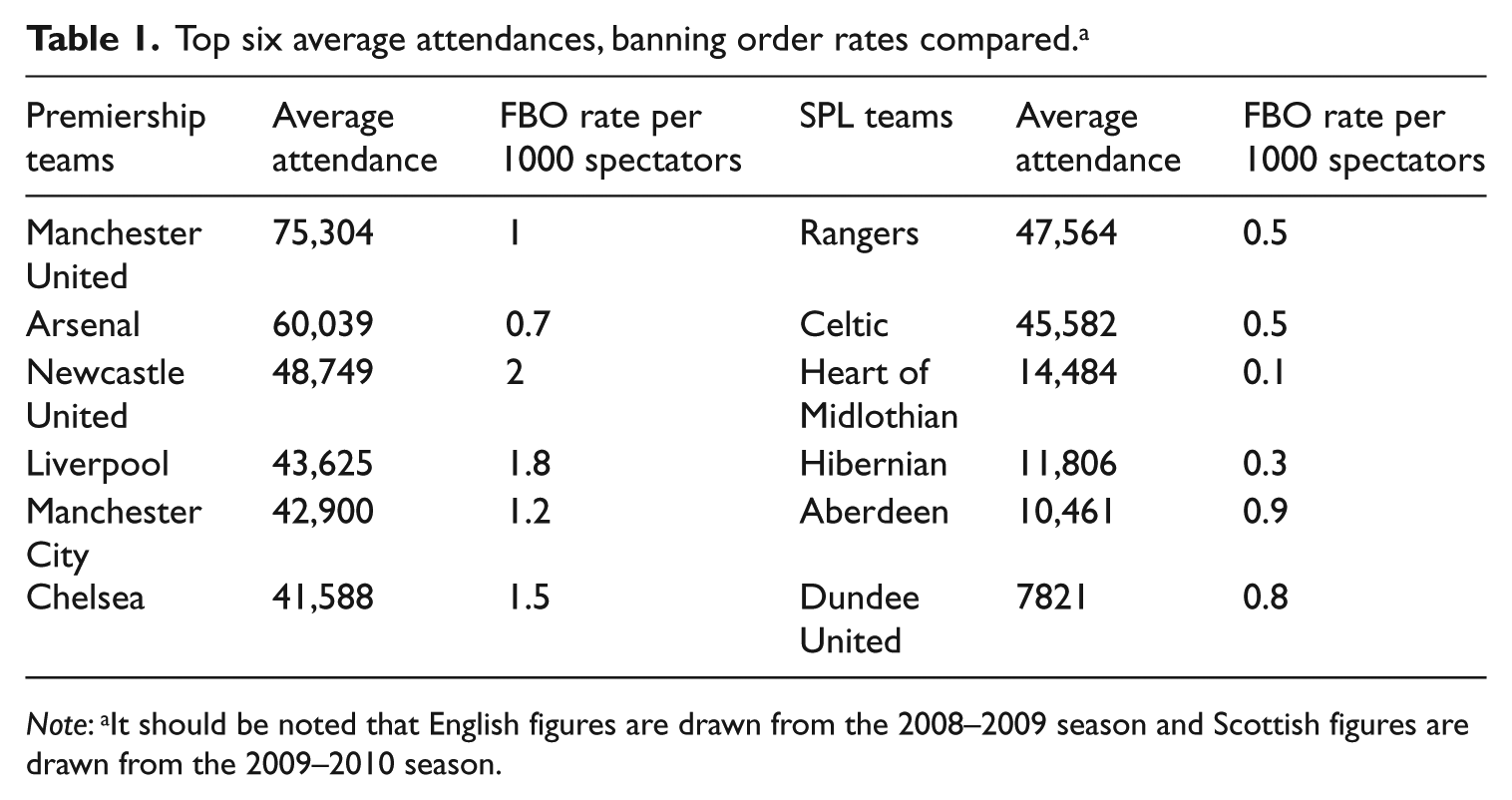
Note: aIt should be noted that English figures are drawn from the 2008–2009 season and Scottish figures are drawn from the 2009–2010 season.
There are two key observations to be made here. The first is that, far from banning rates being of another order of magnitude in the Premiership – as a simple reading of FBO figures might lead us to expect – rates of FBO use are similar for several clubs in the SPL. Second, there are wide disparities between clubs in terms of banning order rates. These disparities are as notable within the two divisions as they are across the two divisions, suggesting that the use of FBOs is significantly mediated not only by differences between the two national jurisdictions, but also by factors operating at a more local level.
The notion that there is any linear relationship between levels of attendance and the rate of issued FBOs is further dented when one looks at those clubs in England and Wales that are associated with the highest rates of FBO use. The top 10 clubs in the 2008–2009 season with the highest banning order rates were all non-Premier League clubs with much lower average attendances than clubs in the top division. The highest banning order rate was for Millwall (12.3 per 1000) who played in League One during that season, followed by Chesterfield (10.4 per 1000) who played in League Two. The most straightforward explanation for these patterns would be that, relative to the number of spectators, there are more problems of disorder in lower league matches in England and Wales. However, Home Office figures from the 2009–2010 season (Table 2) casts doubt on this explanation. While the police arrest people with a remarkable degree of consistency across the four divisions (relative to the average number attending a given match), the rate at which FBOs are issued per 1000 spectators rises consistently as one drops down the divisions. Furthermore, an analysis of the type of offences leading to arrests showed no marked differences between leagues that might help explain the greater propensity for issuing FBOs in lower leagues (e.g. if offences in lower leagues were markedly more serious this might account for any difference). 20
Overview of the 2009–2010 season – England and Wales. a
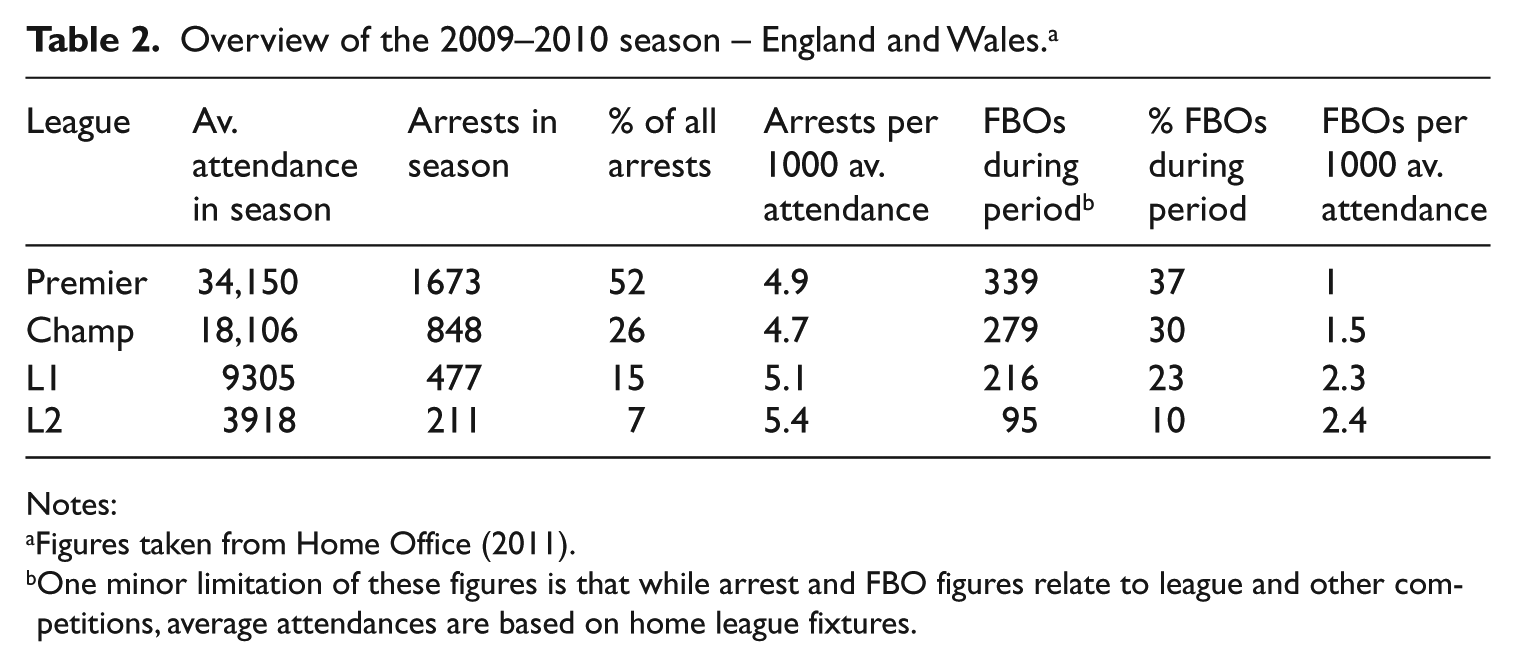
Notes:
Figures taken from Home Office (2011).
One minor limitation of these figures is that while arrest and FBO figures relate to league and other competitions, average attendances are based on home league fixtures.
Given that there appears to be no startling inverse relationship between disorder and the size of a football crowd these findings need explanation. The findings look even more peculiar when one considers the equivalent Scottish picture, where lower division clubs accounted for hardly any FBOs. The most plausible explanation for these findings is a key difference in how FBOs are administered and promoted in England and Wales. In Scotland, the expense of applying for and administering FBOs is entirely borne by the criminal justice agencies involved. This applies both to applications made on the back of criminal convictions and those made using civil powers (termed ‘summary applications’ in Scotland). Contrastingly, in England and Wales funding for specific ‘football-related’ posts (such as Banning Officers), and pump-priming monies to help police forces pursue civil FBO applications, are provided by the UK Football Policing Unit. 21 As a consequence, informal quotas are set from area to area before the start of each season, and these would appear to inflate artificially the volume of FBO applications in the lower leagues. This links in with the broader theme of resourcing, to which we will return.
Effective Processes
Even after accounting for attendance levels and financial incentives, there is still a performance gap to account for between the two jurisdictions. While during the 2009–2010 SPL season – in a sample of five forces 22 where complete figures were available 53 per cent of all football-related convictions where an FBO request was made successfully resulted in an FBO being issued; the comparable figure for England and Wales was reportedly in the region of 80 per cent (Hamilton-Smith et al., 2011: 11). In Scotland, our research examined whether this was down to deficiencies in terms of identifying suitable FBO subjects 23 or weaknesses in terms of how cases were subsequently handled through the criminal justice process.
On both sides of the border, the processes observed were robust and broadly identical. This is unsurprising given the aforementioned inter-connectedness of approaches for managing football security. In both jurisdictions there are professionalized police ‘match commanders’ who have overall responsibility for match-day security, and both police and club officials seek guidance on match-day safety and security from a shared source: the Football Licensing Authorities’ (2008) Guide to Safety at Sports Grounds. Similarly, policing policies and FBO practices are also underpinned with additional, substantially similar guidance, principally from the National Policing Improvement Agency 24 (NIPA, 2010) in England and Wales and the Association of Chief Police Officers in Scotland 25 (2010).
While procedures were similar on paper, and while there was general agreement as to the sorts of behaviour that typically merited an FBO application (a violent incident involving a repeat offender), there were occasional decisions that invited disagreement among Scottish practitioners.
young lad, got a wee bit excitable … a goal celebration, he’s ran on to the pitch, and before he’s realized what he’s done the police are on him, very apologetic, didn’t make any contact, no previous convictions … it’s an ideal opportunity for a bit of common sense, it could have been approached based on its merits, but as is, pitch incursion, Football Banning Order request put in and based on the circumstances he’s been given a Football Banning Order for 12 months … might have been a bit harsh. (Scottish Football Intelligence Officer A)
However, an analysis of a sample of Scottish conviction data and electronic court records demonstrated broadly consistent decision making. Those receiving an FBO on conviction were significantly more likely to have an existing criminal record than individuals who were convicted of a similar football-related offence but did not receive an FBO. They were also significantly more likely to have had a previous conviction for a violent and/or a football-related offence (Hamilton-Smith et al., 2011: 15). Finally, when detailed court records relating to the index offence were examined, cases where FBOs were issued were more likely to involve comparatively serious violence, or behaviour in a football ground that was deemed particularly dangerous (e.g. throwing flares). Reportedly, FBOs on conviction were targeted at similar types of offenders in England and Wales (Hamilton-Smith et al., 2011: 45).
Superficially, the use of civil 14B orders (or in Scotland, civil summary applications) also looks similar, accounting for roughly 13 per cent of all issued FBOs in both jurisdictions. However, the Scottish figures are misleading, as the majority of cases in Scotland relate to the imposition of a Scottish ban on individuals already in receipt of English bans. These additional bans were obtained because, until the implementation of the 2009 Policing and Crime Act, English and Welsh bans were not enforceable in Scotland. The majority of these retrospective impositions also related to a series of incidents of violence and disorder that accompanied the UEFA cup final match between Rangers and Zenit St Petersberg in Manchester in May 2008 (see Manchester City Council, 2008; Millward, 2009). Of the 13 summary orders issued in total in Scotland up to the start of 2011, nine were in fact issued from 2006 to 2008, and eight were issued against Rangers fans. Only one summary order was issued in 2010.
In England, the interviews with police officers revealed that 14B FBO were almost exclusively focused on individuals believed to be ‘risk supporters’; individuals who associated with – or belonged to –‘hooligan’ groups that sort out confrontation with rival groups of fans. 26 In Scotland, with little use made of the available civil powers, the focus on risk supporters was more opportunistic. Whether FBOs on conviction were a useful tool in tackling hooliganism depended on whether they were caught being engaged in violence in a way that could clearly be related to football. While some Scottish hooligan ‘firms’ have always had a clear interest in both violence and actively supporting their club (e.g. the Aberdeen Casuals), other groups of hooligans have a reputation for displaying a measure of indifference to football, rarely attending games, and often preferring (in the case of Celtic) to spend match days in a pub, or attempting to seek out disorder in areas well away from football stadia (a feature of the Hibernian risk supporters). The difficulties that such loose associations present are twofold:
First, if disorder does occur, it is often in a context – and at a time (away from the match, and after a match day police operation has wound down) – that makes it unlikely that the police will either make the connection to football, or will be able to evidence convincingly that connection in court.
Second, even if such a connection is successfully evidenced – FBOs as typically issued in Scotland – tend to focus narrowly on simply banning fans from stadia. In the absence of FBOs with additional conditions (for instance banning individuals from congregating in certain geographical areas on match days) the utility of such orders was questioned:
the fiscal decided to go along with a banning order that would ban them from within 500 yards of [… the stadia …] so there was not much effect, which caused a bit of hilarity when we went down to speak to them [the convicted risk supporters] the next day. (Football Intelligence Officer B)
Some of the interviewed prosecutors and judiciary did express reservations about the imposition of the sorts of sweeping conditions used in some areas of England. However this resistance was predominantly hypothetical as very few respondents had ever been presented with a case where the police had requested such conditions. Further anecdotal data from police respondents partially justified this on the grounds that conventional FBOs were hard enough to secure without attempting to ask for more restrictive conditions: ‘because we have not being getting banning orders to start with, to start going down the line of asking for specifics, I would be wasting my time’ (Football Intelligence Officer C).
Another likely disincentive to apply for conditions was that most Scottish FBO requests were based on only basic offence information. Forces rarely resourced the compilation of more detailed packages of evidence and intelligence that could demonstrate how an individual’s bad behaviour or disreputable associations away from a football game were nevertheless plausibly linked to football. This contrasts with England, where intelligence packages were routinely prepared for risk supporters. This touches on what proved to be the key difference in explaining the performance gap between the two jurisdictions. While processes in both jurisdictions were broadly the same, the resources available to support the implementation of the FBO legislation were very different.
The Resourcing of the Banning Order Legislation
In England and Wales the administration of FBOs and the collation and co-ordination of intelligence are both centrally supported by the UK Football Policing Unit (UKFPU), a Home Office embedded body, staffed by seven seconded police officers, with an annual budget in 2009–2010 of £2.2 million. 27 The UKFPU provides funds to forces to develop proactive intelligence packages on key risk supporters in support of 14B FBO applications. Most Premier League and many championship football clubs also have a full-time Football Intelligence Officer dedicated to them who has the role to ‘direct, collate, evaluate, analyse and disseminate intelligence’ (ACPO, 2010: 18). Many clubs also have a police Football Liaison Officer who has a more general responsibility for liaising with them regarding policing and match day operations.
This level of resourcing is in stark contrast to the situation that pertained in Scotland during our evaluation. Here, a single civilian officer held the national responsibility for co-ordinating FBOs. The individual had no budget to support force-level activity, and no support from seconded police staff. There was no capacity for the central co-ordination or collation of intelligence. Meanwhile, while most SPL clubs had a dedicated Football Intelligence Officer (FIO), the posts were normally part-time. A number of interviewed FIOs described the time available to dedicate to this role as highly limited, often less than a day a week. These limited resources impacted on the comparable effectiveness of Scottish processes in four ways:
Football-related arrests made well away from a match, or outside the period when the match day operation was running, ran the risk that the arresting officer might not flag-up that the arrest was football related or be aware of the option to seek an FBO. Even if officers knew to ask for an FBO, they did not always couch requests in a manner that persuasively linked the incident to football, or evidenced the impact of the incident on the victim. FIOs attempted to counter this by scanning arrests on match days across a wider area, quality checking FBO requests that were made. But most also admitted that they had limited capacity to do this.
Limited capacity also curtailed opportunities to develop intelligence or risk supporter profiles on the back of offences that were identified.
Even where profiles were available funding for using those profiles to apply for civil summary applications was not normally available.
Limited FIO resource had a knock-on effect in terms of the quality of communications with partner agencies in the criminal justice system. In particular, whereas colleagues in England frequently liaised with the Crown Prosecution Service to discuss cases, and attended court to follow proceedings and provide expert testimony where helpful, face to face liaison in Scotland was rare, and usually case-files were sent up to prosecutors with no additional communication. Case files were often not that detailed and police officers usually had no opportunity to explain in person the significance of cases with prosecutors, or to follow up failed requests in order to understand why orders were not granted. This was important, because in practice prosecutors and the judiciary often had limited awareness of the relevance or content of the FBO legislation, leading to FBO requests either being ‘discarded’ by prosecutors, or being poorly presented or misunderstood in court.
Consequently the resources available for implementing the FBO legislation in Scotland impacted on who was targeted by that legislation and how effectively cases were progressed, with clear-cut in-stadia incidents appearing to be more likely to result in an FBO. However, the types of incidents that the legislation in Scotland was specifically intended to tackle, namely incidents of sectarian disorder, were often less clear cut. As a result, individuals convicted of sectarian disorder were less likely to receive an FBO than those convicted of violent offences. 28 The police and football clubs alike have faced accusations in the past of turning a blind eye to sectarian behaviour in football (Moorehouse, 2006). There is evidence, however, that many clubs have been proactive in trying to deal with sectarianism. For example, Flint and Powell (2011: 199) note that as recently as 2003 Rangers took action to minimize the visibility of sectarian identities through ‘proscribing legitimate banners such as Union flags and Saltires’. Despite this, from our interviews with police officers and club officials it was clear that, while united in condemnation of sectarian behaviour, they held very mixed views on the practicality of using FBO legislation to target it.
Sectarian offences that involved insult rather than actual violence threw up a range of practical and legal challenges. Proving that an insult is sectarian is not straightforward. Most knowledgeable fans are aware of the songs or flags that are currently ‘proscribed’ as sectarian under existing legislation, and often simply adapt their insults to fall slightly outside of these categories (Howe, 2010). Even if the insult can be proven as sectarian, many police officers were of the view that an FBO was unlikely to be granted unless one could prove that (a) the offender was prominent in some way (e.g. a ringleader), and that (b) the offender’s actions caused ‘alarm’ or ‘distress’. In the absence of these aggravating factors, it is more difficult to issue an FBO for sectarian insults than for offences involving some form of violent conduct. Key to successfully prosecuting many of these offences therefore was inserting surveillance into the stadia to identify individuals, and to record clearly the nature and impact of their behaviour. At the time of the evaluation however, resources for conducting proactive surveillance operations were very limited.
Discussion
Superficial comparisons of the use of FBO legislation in Scotland and England and Wales are misleading. The comparative use of orders ‘on conviction’ in Scotland is not nearly as low as headline figures would suggest, while civil summary applications are – in effect – hardly used at all. Thus, if we re-visit the criticism of FBOs made by Stott and Pearson (2006, 2008), the Scottish position would appear to be one of admirable moderation, with orders being used sparingly for the most appropriate cases of violence and disorder, where guilt is proven to a criminal standard in a court of law, and where restrictions rarely infringe on a recipient’s liberties beyond a ban from football grounds. Such an account may certainly please advocates of Scottish judicial independence and restraint. However, our research suggests that this restraint is driven as much by considerations of economy as of due process. While there was principled resistance among some respondents to the excessive use of FBO powers, it must be noted that reservations were expressed by criminal justice practitioners in England as well.
The main point that comparative work in this area seems to illuminate is a more general one, namely differences between two jurisdictions in terms of how legislation is introduced and ‘driven’. Common security needs and inter-dependencies can recommend uniformity in the framing of many areas of criminal justice policy and legislation (Keating et al., 2003) yet there is often divergence in the detail of how policies and laws are actually implemented (Mooney and Poole 2004; Nixon et al., 2010). Policy making and legislation in Scotland is traditionally less centralized, and more mediated by the professional autonomy of public sector and legal professionals, while legislation is less driven by targets and performance indicators (Keating et al., 2003). It would appear that in England the number of FBOs issued may have been as much a reflection of political determination to target the English football hooligan problem – with that determination being given added ‘expression’ with central funding and targets – as it was a reflection of the natural demand for orders from the police and courts. Another example of this political intent would appear to be the additional pressure imposed on the English and Welsh judiciary, with provisions in the Westminster version of the legislation requiring them to justify openly their reasoning for not imposing FBOs. It would appear reasonable to hypothesize that this measure may also have ‘encouraged’ a greater use of FBOs.
The implementation of the legislation in Scotland could therefore be characterized as a consequence of weak central ownership of that legislation, though this would be to ignore the fact that in transferring the legislation, the Scottish government had its own distinct agenda – namely tackling sectarianism in football. Nevertheless, the limited central support given to implementing the legislation, the absence of mechanisms incentivising its use and the initial lack of any effective monitoring, chimes with work previously undertaken by Forbes et al. (2010) – which highlighted general weaknesses in the policy-formulation and delivery capabilities of the newly empowered but inexperienced Scottish Executive. In particular, given the professed focus on sectarian disorder, the apparently negligible consideration given to how an English legislative instrument could be successfully adapted to target these quite distinct behaviours appears damming. On the other hand, even if Scottish ministers or policy makers had wished to drive legislation harder, with more robust implementation mechanisms, a prosaic constraint on their actions has been limits to fiscal autonomy placed on Scottish Ministers by the British Treasury (Adams and Robinson, 2002). The £2 million annual fund to pump-prime the pursuit of FBO applications through the UKFPU did not extend to Scotland and Scottish Ministers would have been constrained in their ability to bank-roll an equivalent fund.
As devolution has developed, this characterization of Scottish policy making as being weak at the centre and largely ‘bottom–up’ has been qualified by commentators observing a gradual centralization of powers at the expense of local autonomy and professional independence (Parry, 2002). In Scottish criminal justice in particular, a sphere traditionally resistant to the punitive policies of Westminster (McAra, 2008), it has been argued that an ironic consequence of devolution is that criminal justice policy has in fact converged with the punitive policies of Westminster (Croall, 2006). This may be precisely because the independence of the Scottish legal and criminal justice systems has provided Scottish politicians with a key area in which they can exert and demonstrate influence, courting the electorate with their own brand of popular punitivism (Scott, 2011).
Initially, as with some other notable areas of criminal justice policy, 29 the FBO evaluation did not seem to support such characterizations. The FBO regime was markedly free of political interference, with professionals being left to use the available legislation as they saw fit. However, a subsequent upsurge in football-related sectarian controversy, which included disorder surrounding the Rangers verses Celtic match in March 2011, letter bombs being sent to Celtic manager Neil Lennon and an attack on the same man by a Hearts supporter in May 2011, led to proposals to strengthen/harshen considerably the law in respect of sectarian offences associated with football matches. Consequently, the Offensive Behaviour at Football and Threatening Communications (Scotland) Bill (2011) was passed by Scottish Parliament in December 2011. 30 Under the Act, criminal penalties have been significantly increased for offensive behaviours that may generate sectarian disorder and for communications that are perceived as threatening (those that intend to cause fear and alarm, implied threats or those intended to incite religious hatred). These proposals have attracted heavy criticism as being impractical and excessively draconian – with maximum penalties being increased from a six month to a five year custodial sentence. In addition, the Act extends the use of FBOs through the creation of a new offence ‘offensive behaviour at a regulated football match’, for which an FBO can be sought in every case. 31 Alongside these new powers, significant extra resources have been earmarked for supporting the administration of FBOs in Scotland, in particular increasing the capacities and capabilities of prosecutors and the police. 32
To some critics, the Act represents little more than a moral panic, with legislation being hastily drafted in response to a brief period of heightened tensions between the supporters of Scotland’s two major football clubs 33 (Laver, 2011). Certainly in the face of sustained tabloid media coverage and with parliamentary elections looming, Ministers were under pressure to be seen to act. Nevertheless, it is also worth noting that the Government was responsive to some of the criticisms of the draft legislation, making limited concessions 34 and agreeing to review the legislation two years after its enactment. While the legislation may still appear potentially punitive, what it cannot be said to represent is a convergence with Westminster policies. The 2011 Act is a distinctly Scottish solution to a Scottish problem, though its inception also arguably conforms to the well-established thesis that the interaction of media coverage and electoral politics tends towards the production of punitive criminal justice policies (see Newburn and Jones, 2005). One key question therefore that stands prominently in the wake of recent events, is whether the 2011 Act marks the start of more politicized and punitive criminal justice policy making in Scotland, or whether Ministers will find a way to balance better the pressures of political accountability with maintaining many of the valued attributes of Scottish Criminal Justice.