




Abstract
To address whether there is a systematic racial bias in the language used to describe offenders and victims in Canadian print media, content analysis was conducted in four Canadian local newspapers. Using 12 sub-themes relating to fear and marginalization, the results of the 1190 sampled crime articles indicate that white offenders were disproportionately criminalized and dehumanized. In addition, articles describe crimes against white victims with significantly more fearful language, while visible minority victims were blamed for their own victimization. The results reflect a bias mainly through explanations for crime rather than in what newspapers report about crime and offenders. The racialization of offender and victims creates a powerful hierarchal treatment between those who are and are not ‘meant’ to have their lives impacted by crime and for whom being a victim of crime is tragic.
Introduction
Although media outlets such as television, newspapers, magazines and social media make up diverse groups with multiple (and sometimes conflicting) interests, mass media can be thought to form a single collective social institution. This collective force constitutes one of the most influential and controversial institutions of postmodern society. In western society, much of our knowledge originates from exceedingly small groups of people with legitimated expertise or influence, and many of our institutions are structured to reinforce these power relations (Foucault, 1977). Thus, despite the vast diversity of media outlets, a common discourse often emerges: in the case of crime this discourse revolves around fear. Criminal behaviour is often treated as the product of bad people from poor neighbourhoods preying on innocent and undeserving victims (Schissel, 2006). As sensationalism and violence continue to sell, the majority of crime reports focus on street crime. Even though a linear relationship between crime report consumption and fear remains elusive, recent theories propose more subtle connections – such as the potential for crime reporting to direct fear towards certain social groups and away from others. Thus, understanding fear of crime may require analysis of the discourse surrounding crime that might marginalize or blame certain groups of people.
Despite international literature on the topic (Altheide, 2009), few studies have quantitatively analysed Canadian media reports on crime (notable exceptions include Roberts and Doob, 1990; Sprott and Doob, 1997). The current study aims to add to this literature through content analysis of 12 sub-themes related to fear of crime and marginalization on a cross-section of Canadian print media to determine if systematic biases exist in the depictions of offenders or victims on the basis of race.
The Canadian context
Although many people undoubtedly acquire information from multiple sources, newspapers remain a popular source of information for Canadians. Each day, 47 per cent of Canadian adults buy newspapers and in 2010, 73 per cent of adults read a newspaper at least once a week (Newspapers Canada, 2011).
Newspapers can serve as an ideal outlet for dominant groups to produce and broadcast hegemonic beliefs to maintain social order (Gramsci, 1971). These ideologies can help secure power for the dominant class by perpetuating crime as a problem of the ‘Other’ through simplistic, fragmented and contradictory explanations for social phenomena (Gramsci, 1971). This discourse results in decontextualization that blames crime on individual flaws rather than social forces. Given the importance of newspapers in Canada, and the theoretical importance of media representations in shaping social discourse, understanding how Canadian newspapers depict both victims of crime and offenders provides insights that have profound social implications, particularly given recent observations that visible minorities are often the focus of moral panics in the news (e.g. Muraskin and Domash, 2007; Welch, 2007).
Fear of crime
Fear of crime is a concept used to explain a range of both psychological and social reactions to the perceived threat of crime and/or victimization, and this fear can have profound consequences for the way people interact (Furedi, 2006). Data suggest that fear of crime is, at least in part, influenced by the media (Romer et al., 2003) and the modern increase in crime coverage rate may play a large role in the escalation of fear (Sacco, 2005). This creates what Glassner (1999) referred to as a culture of fear – a process of conditioning within a culture that predisposes its citizens to consider horror as the appropriate reaction to any situation that is novel and unpredictable. Crime coverage tends to emphasize the culture of fear by fashioning a familiar threat story: no one is safe, danger is eminent and there is no end in sight (Lee, 2007). This hypothetical link between media consumption (particularly the absolute amount consumed) and fear of crime has intuitive appeal and, as a result, research on this link has a long history (e.g. Gerbner et al., 1979). Often, however, the results obtained have been inconsistent, as Doob and McDonald (1979) found that television consumption does not predict fear of victimization when controlling for other variables such as neighbourhood incident rates. Thus, any link between fear of crime and media consumption must be more complex than the simple linear relationship that posits the more crime reporting an individual consumes the more fearful of crime that person will become. Instead, news reports on crime have the potential to direct, rather than create, fear of crime. Media reports and the moral panics they sometimes create do not just tell us to be afraid, rather they tell us who to be afraid of. Similarly, it is not productive for the politician seeking re-election or for stakeholders in the criminal justice system seeking increased funding to portray crime as truly random. Both of these groups benefit most if crime can be ascribed to a specific segment of the population. Once a legal and moral divide has been made between ‘us’ and ‘them’, the crime problem has a simple solution: get tougher on ‘them’ to protect ‘us’. This natural divisive tendency is why a study of media portrayals of crime is incomplete without also considering marginalization.
Media and marginalization
A substantial body of literature exists on media portrayals of visible minority groups (e.g. Altheide, 2002; Welch et al., 2004). Studies have repeatedly found that visible minorities are underrepresented in portrayals highlighting positive roles (e.g. positions of government, education or corporations), but are overrepresented in portrayals of depicting threats to social order, including criminal behaviour (Larson, 2006). These portrayals have tremendous potential to create an archetypal ‘criminal Other’ that may transcend fear of crime to become fear of certain groups of people (e.g. Larson, 2006). In this way, fear of crime becomes more than just the fear of being mugged by a faceless stranger, but is focused on being mugged by a specific type of person (Hall et al., 1978). In order to create the criminal Other, many mainstream media outlets have relied on stereotypes to classify different visible minority groups into dichotomies of ‘good’ and ‘bad’: the former made up of those who ‘pick themselves up by their bootstraps and go from rags to riches’, while the latter portrayed largely as predominantly poor people who are criminals or are otherwise plagued by social strife, creating dangerous classes (Larson, 2006: 84). Other scholars argue that stereotypes become reinforced largely by what is not reported or omitted (e.g. Entman and Rojecki, 2000). In this sense, reinforcement comes from not correcting negative racial images and patterns, particularly surrounding crime. Wortley (2009) found that Canadian newspapers tend to draw connections between immigration, race and violent crime in the rare (and highly publicized) instance of murders in which the victim is white and the offender is not. For example, he quotes the Toronto Sun as printing ‘white Canadian’s are understandably fed up with people they see as outsiders coming into their country and beating and killing them’ (Wortley, 2009: 349). In contrast, Miller and colleagues (2006) point out the phenomenon of the ‘invisible white street thug’: when media portrayals focus on street crime, whites are usually absent. In the rare instance that white offenders are portrayed, considerable time is devoted to circumstances that contributed to their crime(s), such as psychological trauma. Moreover, images of white criminals are often romanticized, portraying intelligence (in white collar crime) or heroism as white criminals fight against a failing social system (e.g. the Goetz case of a white man who shot four black teens who accosted him on a New York Subway). The authors stress that this occurs ‘because they [white middle-class offenders] mirror dominant values in our society, their crimes are met with understanding and the criminals receive sympathy or admiration’ (Miller et al., 2006: 111). The connotation seems to be that whites are presumed to be non-criminal by nature; as a result, their crimes require special explanation.
How might these differential portrayals of offenders on the basis of race impact public opinion and fear of crime? A potential account may be found in the concept of stereotype amplification, outlined by Quillian and colleagues (Quillian and Pager, 2006; Quillian, 2010). According to this perspective, real associations between crime rates and particular social conditions become distorted through many channels, including skewed media coverage. As Quillian (2010) states, this idea applies the general framework of Kasperson et al. (1988) to the perception of risk of victimization. This framework proposes that the amount of risk communicated by the media can be amplified (or attenuated) by altering the amount of coverage dedicated to a single event or story, or (more importantly for the current study) by attaching social values and meanings, including associations of risk of victimization with particular locations or groups. Importantly, these associations can also amplify the perception of victimization risk based on the reader’s proximity to the ‘risky’ location or group. One way in which media portrayals can perceptually ‘close the gap’ and maximize the perceived proximity between the reader and descriptions of crimes lies in the presentation of the victim.
Portrayals of victims
Conceivably, depictions of crime have their largest emotional impact (and thus perception of importance) if they can elicit in the reader the idea that ‘this could be me’. Consistent with the idea, the images of victims in news media are largely comprised of middle-class symbolism, mirroring the typical consumer (McShane and Williams, 1992). However, Schissel (2006: 51) explains that portrayals of crime victims serve two purposes: to evoke a passionate response to the crime, and also to disseminate a discourse surrounding simplistic and compelling explanations for victimization among certain groups of people. In order for these dual purposes to be served, victims must be systematically categorized into good ‘undeserving’ and bad ‘deserving’ victim groups (Madriz, 1997). For example, ‘deserving victims’ stories of cultural or family victimization (e.g. single mother households) tend to frame poverty as a reason for some types of victimization such as juvenile delinquency (Schissel, 2006: 51). In contrast, the ideal victim, according to Christie (1986: 19), is:
weak;
carrying out a respectful chore (e.g. caring for a sick relative);
in a place that they could not be blamed for being;
attacked by someone ‘big and bad’;
attacked by a stranger.
As seen in the last two preceding points, the ideal victim also reinforces the ideal offender. This pair can create a powerful discursive tool as they elicit strong emotional responses: the ideal victim creates sympathy while the ideal offender creates fear. According to Christie (1986), the greatest emotional response from the public comes from antithesis between the two groups; the victim is everything the offender is not. He is strong, she is weak, he is a stranger, she is home-grown, and he is a visible minority and she is white. As such, the way in which both the offender and the victim are portrayed in media reports of crime has tremendous potential, through the amplification of stereotypes, to facilitate a distorted fear of crime in specific location and around specific groups. Given the readership and potential influence of print media in Canada, it is critical to establish whether a systematic bias and a difference in the language used in depictions of crime existed in Canadian newspapers.
The Current Study
The study examines newspaper portrayals of crime, offenders and victims, with particular attention to race in order to analyse how ‘Othering’ may occur by determining the prevalence of a series of themes grounded in existing literature on fear of crime and marginalization. This analysis aims to shed light on how archetypal portrayals of visible minorities in high-profile crime articles may be different from portrayals of crimes committed by or against whites. In particular, incorporating language that speaks to both marginalization and fear within the same crime reports is uniquely suited to find empirical data to support or refute the claims of Miller and colleagues (2006) and to assess if the crimes of some offenders are disproportionately ‘explained away’ on the basis of race.
Methods
Data sample
From the 96 general interest daily circulation newspapers in Canada, four newspapers (the Vancouver Sun, Saskatoon Star Phoenix, Winnipeg Free Press and the Toronto Star) were chosen from Canada’s 20 most widely circulated English-speaking newspapers (Bivings Report, 2006). To be included in the sample, newspapers had to be local papers, as national newspapers disproportionately cover the most bizarre and unusual cases around the country, and so provide a less reliable sample (Ryan et al., 2006; Taylor, 2009). Three of the list represent the three local newspapers with the widest circulation in English-speaking Canada. The Toronto Star (owned by Toronto Star Inc.) is the largest English newspaper in the country with a daily circulation of approximately 286,303. The Vancouver Sun (owned by the Postmedia Network) has a daily paid circulation of 168,616, while the Saskatoon Star Phoenix (also owned by Postmedia) has 53,560. The Winnipeg Free Press (owned by Free Press Inc.) has a paid daily circulation of 121,858 papers (Newspapers Canada, 2011). In an effort to develop a cross-sectional sample based on population size, ethnic diversity and geographical location, only one newspaper was selected for each province (thus, the Toronto Sun, which is within the four largest local papers, was excluded). A fourth newspaper, the Saskatoon Star Phoenix, was added to this list to provide a local comparison of the subject. Lastly, the newspapers had to be available on micro-film dating back to the 1980s.
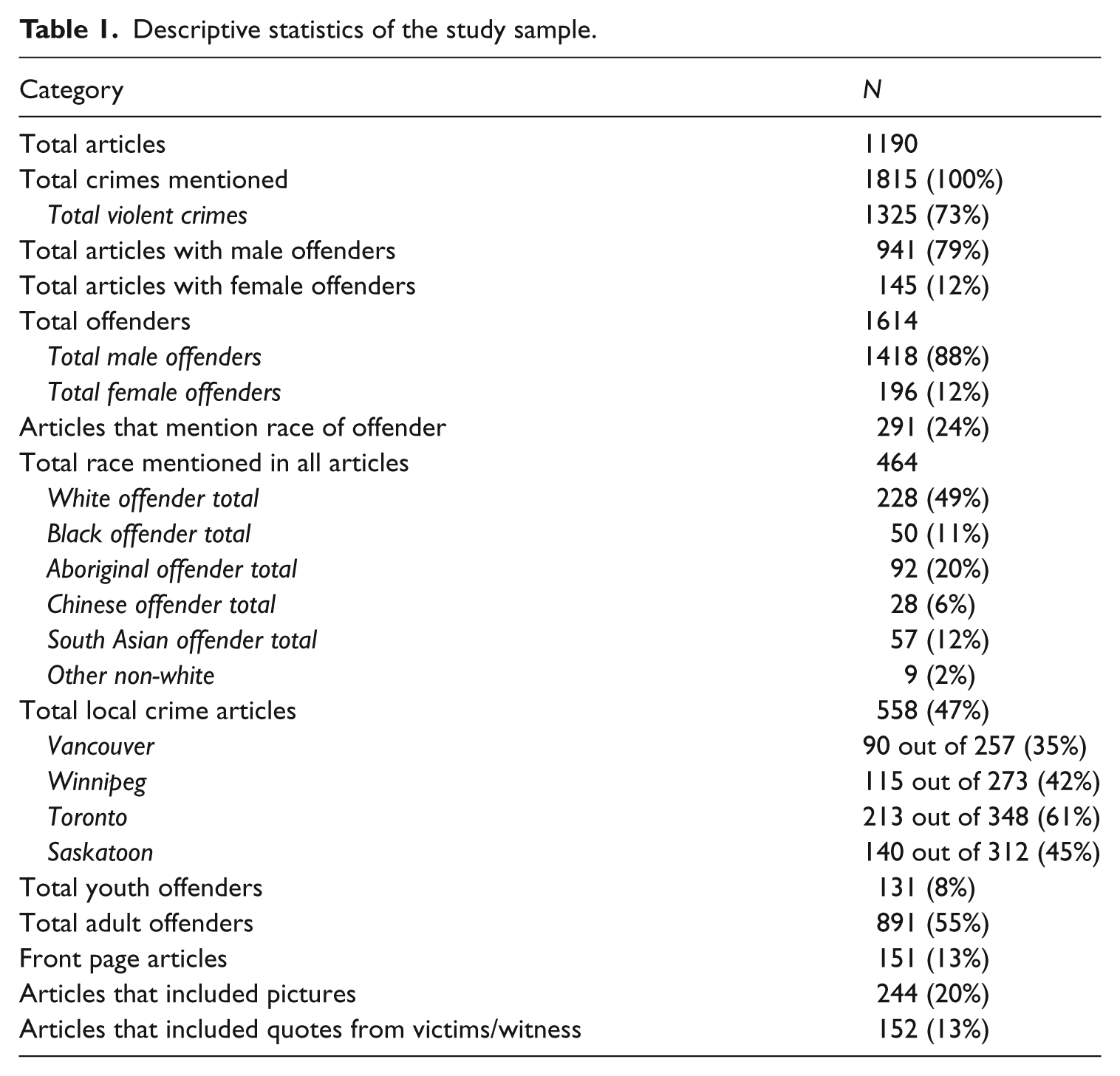
Articles from these papers were collected using a retrospective longitudinal design. In each of the past three decades (1980s, 1990s, 2000s) two numbers between one and 10 were randomly selected (two and seven) to select two years within each decade, yielding 1982, 1987, 1992, 1997, 2002 and 2007. In addition, 20 dates were selected pseudo-randomly to provide the sample dates within each year, yielding the following dates: 2 January, 20 February, 22 February, 3 March, 6 March, 17 March, 8 May, 18 May, 6 June, 8 June, 12 June, 13 June, 6 August, 17 August, 26 August, 2 October, 4 November, 14 November, 18 November and 21 November. In total, 1190 articles were collected from 480 newspapers. Basic properties of the sample are provided in Tables 1 and 2. In each paper, the first 10 pages of section A were analysed. This sampling strategy provides a way to control the sample size and also equalizes the sample size between papers, making the sample more comparable across newspapers that generally have different lengths. However, section A will likely contain the most high-profile cases and therefore the result of this study should be limited to high-profile and sensationalistic cases and as a result may not easily be generalized to all forms of crime reporting (further discussed below).
Descriptive statistics of the study sample.
Offences depicted in the newspaper.
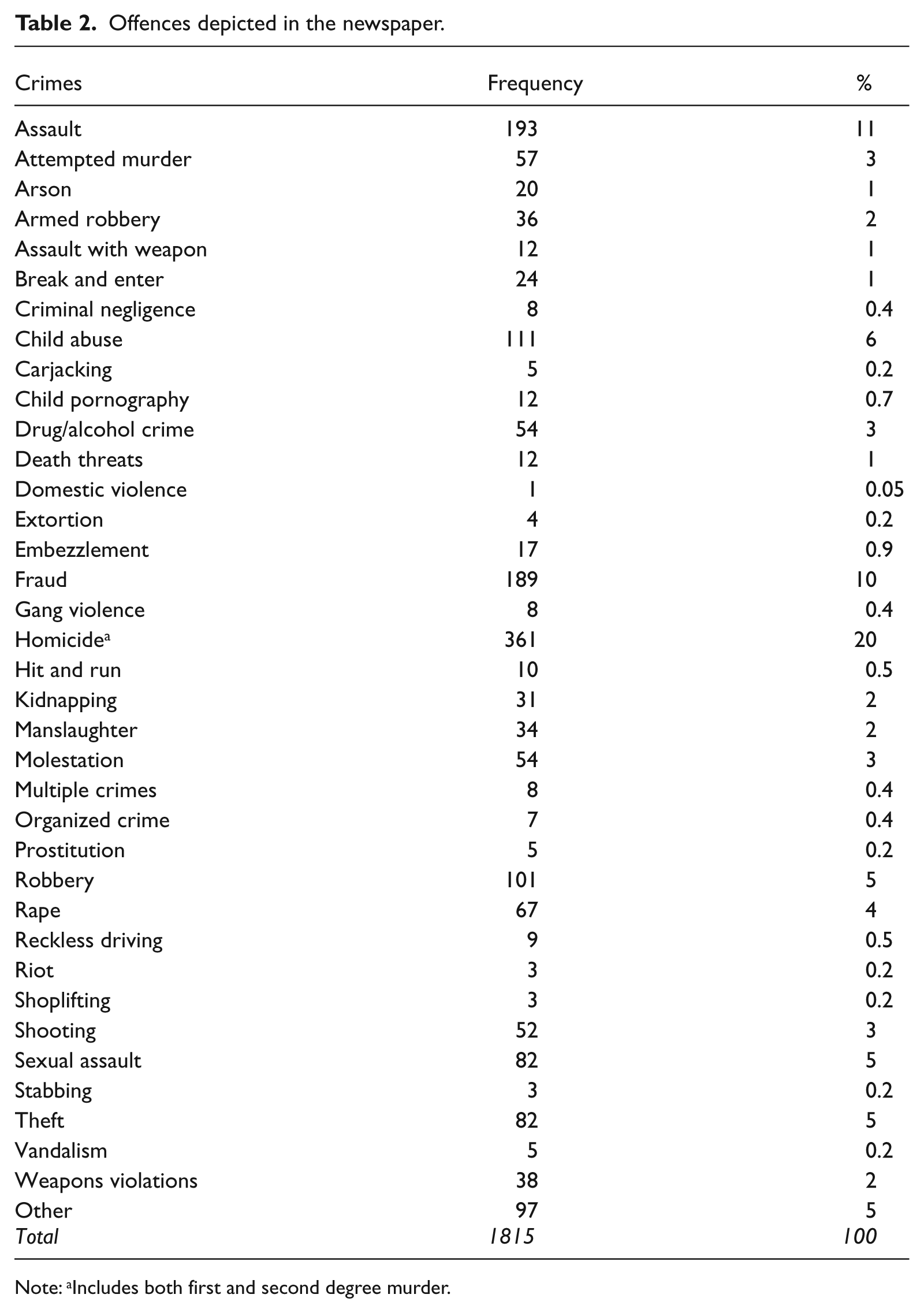
Note: aIncludes both first and second degree murder.
The type of newspaper articles included in this study were: editorials; letters to the editor; feature stories, which refers to routine crime stories; as well as police reports (a crime report that was either officially released by the police department or a journalist writing for the police); court reports; and article briefs (a very short news brief, reports the crime in less than a paragraph). The classification of the type of crime committed/reported in each article was also recorded. The current analysis coded for 37 different crimes, including homicide, rape, assault, robbery, drugs, family (family violence or disturbances that do not fall into another category), white collar (fraud, extortion, laundering and embezzlement), multiple crimes (two or more crimes covered in the same story, but the report did not mention what crimes these were), and other. Acts of terrorism and war crimes were not included in this study as there may have been a pre-existing racial bias.
Content analysis
The study utilized conceptual analysis (Carley, 1992) to address whether there is a systematic bias in the language used by the print media to depict crime based on race. The articles were coded into manageable content categories or themes (i.e. fear of crime and marginalization) and these were further divided into 12 content units or sub-themes. The sub-themes were coded by selective reduction, which consists of reducing the text to categories consisting of a set of words and phrases, rather than counting words (Carley, 1992). Despite taking all the precautions to reduce the shortcomings of content analysis, several remaining limitations should be noted. The first limitation regards reliability: although steps were taken to increase the reliability of the data, such as using only one coder, coding errors can never be eliminated (Krippendorff, 1980), particularly in such a large data set containing 34 descriptive variables across 1190 crime articles. Another limitation of the data lies in the validity of the categories (or the list of words/sentences making up each sub-theme). The decision about what words or sentences fit into each sub-theme was made by the coder, and thus this process remains vulnerable to the weaknesses of interpretation and how those interpretations may change over time.
Themes related to fear of crime
Although previous research has examined how media describe the ideology of crime (Gorelick, 1989) and offenders in terms of wilding (Welch et al., 2004), there lacks a systematic longitudinal study investigating marginalization and the fear of different groups of people. Language promoting fear of crime was divided into five sub-themes: words that relate to fear; excessive violence; the dehumanization of the crime; crime used as a metaphor and crime is everywhere. Each sub-theme is described below including examples from the newspapers.
Fear
Several studies have analysed the appearance of the word ‘fear’ and its synonyms, and how this can lead to greater fear of crime (e.g. Altheide, 2009; Welch et al., 2004). In keeping with these studies, the current analysis coded the presence of fear, any of its synonyms (e.g. ‘panic’, ‘dread’ or ‘terror’) or descriptions of fear in people or groups. Words associated with fear by alluding to random acts were also included in this category, as the implication is that no person is ‘safe’ from street crime. Example: ‘state of terror’; ‘died alone and terrorized’; ‘stark horror’.
Excessive violence
A common theme in crime reports is ‘if it bleeds it leads’ (Lee, 2007: 187). Gruesome and violent crime reports feature disproportionately in media depictions of crime, and these stories make for ‘good’ news that can remain in the headlines for weeks, propagating moral panics and sensationalism. Example: ‘blood was splattered all over’; ‘burned alive’; ‘orgy of slayings’.
Dehumanizing the crime
This sub-theme coded references to crime as a brutal or animalistic act (e.g. using words such as ‘savage’, or ‘wild’) or as mechanistic (e.g. reference to a calculating killer). Both of these uses of language have a similar effect on the connotation of the crime. That is, this language portrays the crime as behaviour that is outside the repertoire of ‘normal’ human beings. Crimes described as such are then crimes that are morally or ethically bankrupt. Example: ‘barbarism’; ‘savage’; ‘pure evil’.
Crime as a metaphor
Comparable to analyses in US newspapers (Gorelick, 1989), this sub-theme analysed allusions to crime and/or violence that suggest society is filled with crime as catastrophic or terminal (e.g. equate crime to cancer, war, tsunamis). To describe crime in terms like cancer or war is provocative because they are deeply embedded in discourse that justifies severe retaliation since failure to resist is ultimately fatal. Example: ‘war’; ‘volcanic’; ‘cancer’.
Crime is everywhere
Research (e.g. Jenkins, 2003) has analysed the depiction of crime as rampant and everywhere, particularly in the context of the media’s fascination with youth crime and school shootings. This sub-theme coded the use of language that stated or implied that crime was ubiquitous and unavoidable. Example: ‘another bloody weekend’; ‘yet again’; ‘full time gang presence’.
Themes related to marginalization
The second area of investigation considered ways media portrayals may marginalize certain groups of people, separated into seven sub-themes based on existing literature. These themes were designed both to capture the portrayal of the crime itself and the offenders (e.g. implying an offender’s criminal predisposition) as well as factors that may be used to undermine an individual’s claim to ‘normal’ membership of a group (e.g. questioning an offender’s mental state). The language used in the articles may provide circumstantial explanations for some offenders but not others, creating bias in how these offenders are viewed by the reader, particularly if this pattern of explanation (or lack thereof) is based on a person’s race.
Rationalizing the crime
According to Miller et al. (2006), American media spend a great deal of energy examining the motives behind crimes committed by white middle class people. The authors claim that this implies whites are not inherently criminal by nature, and therefore their crimes are in need of special attention. To capture this, descriptions that provided explanations of why crimes occurred were coded. Example: ‘seduced by Satan’; ‘involved in the same sad lifestyle of drinking lacquer thinner’.
Dehumanizing the offender
Language that dehumanizes the offender is particularly impactful, as with portrayals of the offender as particularly savage or evil, their characteristics cue the reader about the type of person that should be feared. Example: ‘A man so vile he makes you want to gag on your own emotions’; ‘meet the devil, he’ll chill you to the bone’; ‘almost appearing to be a member of a species other than the human race’.
Words that describe the offender as crazy or unstable
This section analysed medicalization of deviance as a special case of dehumanizing the offender. Such depictions are particularly harmful as they can marginalize the offender twice, once for committing the crime and again for being mentally ill, or diseased, which remains a very negative discourse in our society. Example: ‘nut job’; ‘mad’; ‘lunatic’; ‘sexual psychopath’.
History of crime or violence
Reference to an offender’s criminal or violent history paints a picture of the offender’s ‘predispositions’ and implies that the offender is incorrigible. This category is especially important if it is attached to a specific social group, as this can further the stereotype of certain groups of people as inherently criminal. Example: ‘not surprising given his past’; ‘violent in the past’; ‘career criminal’.
Reference to occupation
Crime reports occasionally focus on crimes that are sensationalized based on the fact that educated or powerful people committed them. If these crimes are projected as being out of the ordinary, this reinforces stereotypes that crimes are committed predominantly by the poor and uneducated. Example: ‘advertising executive’; ‘bureaucrat’; ‘star respirologist’.
Reference to poverty
Many scholars contend that media racialize poverty and its link to crime; as such this section analysed the stereotype that crime is a phenomenon of the less fortunate and assessed if this image is disproportionately attached to specific social groups. This section coded statements that describe or imply (e.g. based on the neighbourhood the offender lived in) poverty of the offender. Example: ‘a site known for its low cost single parent housing’; ‘dumping ground for alcoholics and mental patients’.
Rationalizing the offender
This sub-theme complements rationalization of the crime; however the section coded words directly focused on the offender. The section searched for distinctions made between ‘good people who have done a bad thing’ over ‘bad’ people. This section coded descriptions that provided an explanation as to why the crime was committed. Example: ‘succumbed to the pressure’; ‘had pressure because of job cuts’.
Statistical analysis
Each article in the analysis was coded in terms of the presence (1) or absence (0) of words fitting each of the above sub-themes. Coding in this way provides a probability that these words occur, and these probabilities for descriptions of both offenders and victims are provided in Tables 3 and 4, respectively. All newspaper articles were then classified as describing an offender (a) explicitly described as white, (b) explicitly described as a non-white visible minority or (c) not specified. These classifications based on the stated race of the offender were then used as factors in an analysis of variance (ANOVA), along with an identical categorization of the race of victims described in each article and the decade of publication, in order to compare the prevalence of each of the themes. The ANOVA results are provided in Table 5.
Likelihood of the appearance of themes related to fear and marginalization based on the reported race of the offender.
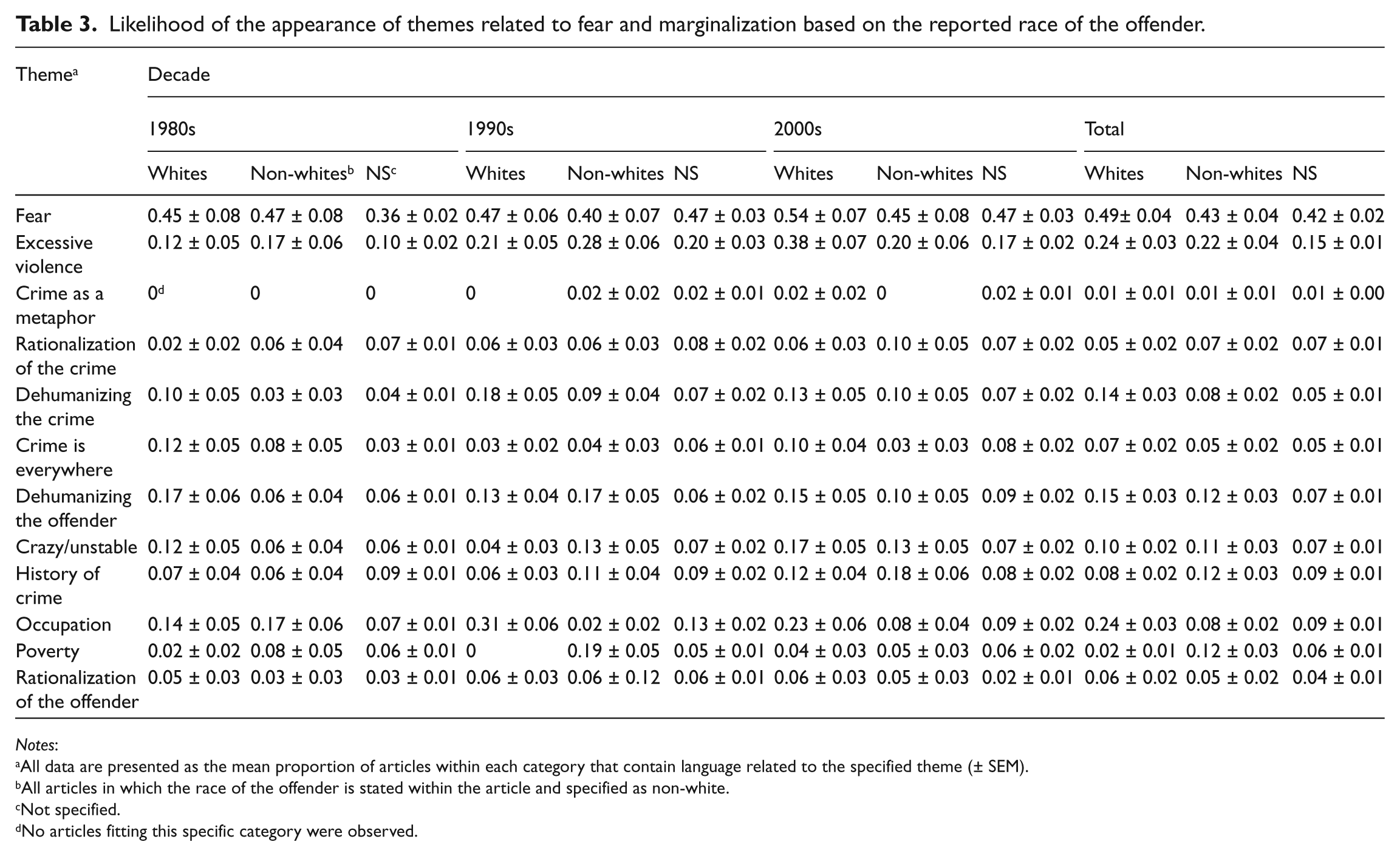
Notes:
All data are presented as the mean proportion of articles within each category that contain language related to the specified theme (± SEM).
All articles in which the race of the offender is stated within the article and specified as non-white.
Not specified.
No articles fitting this specific category were observed.
Likelihood of the appearance of themes related to fear and marginalization based on the reported race of the victim.
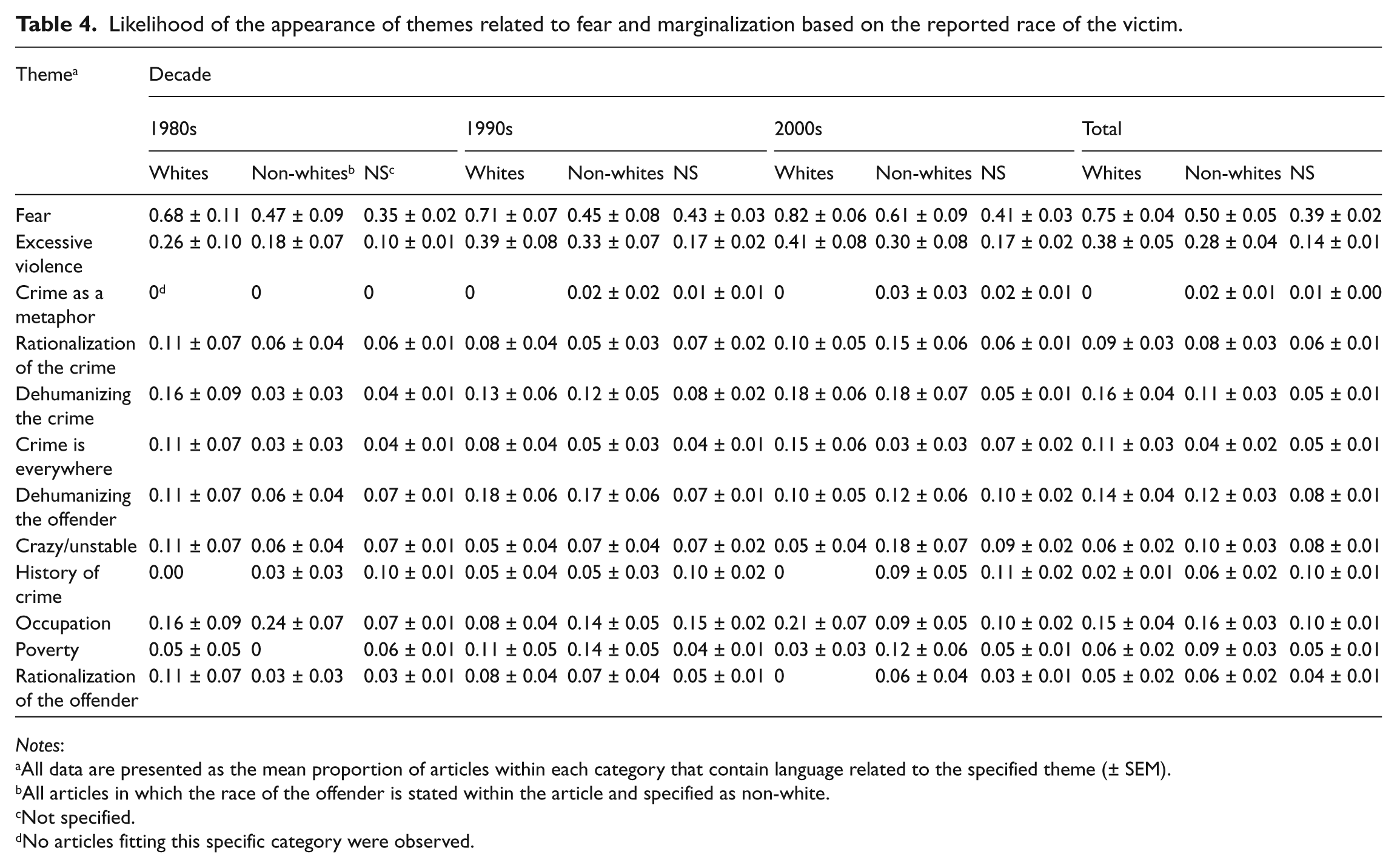
Notes:
All data are presented as the mean proportion of articles within each category that contain language related to the specified theme (± SEM).
All articles in which the race of the offender is stated within the article and specified as non-white.
Not specified.
No articles fitting this specific category were observed.
ANOVA table of reported effects.

Notes:
Degrees of freedom.
Sum of squares.
Mean square.
Results
Changes in language use over time within the 1190 crime reports sampled, both in general and with the mention of race are described below.
Changes in language over time
Language promoting excessive violence has increased significantly over the course of the past three decades (p = .01). Pair-wise comparisons show that references to excessive violence have steadily increased from the 1980s to the 2000s across the entire sample (p < .05 in all cases). Thus, crime reports have increased descriptive violence over time, including progressively more gory details.
Changes in language based on race of the offender
A significant difference in the language within the articles was observed based on the race of the offender mentioned within the article. The race of the offender significantly predicted the probability that the offender’s occupational history was mentioned (p < .001). Subsequent pair-wise comparisons show that articles mentioning white offenders were significantly more likely (0.24) to mention the offender’s occupation than either articles in which the offender was described as a visible minority (0.08; p < .001) or not specified (0.09; p < .001). All other themes showed no main effect of the race of the offender.
In addition, a significant interaction was observed between the decade of publication and the race of the offender on the likelihood that an article contained language implying that crime is everywhere (p = .004). This indicates that articles describing white and non-white offenders have changed in different ways over the past 30 years. Articles describing white offenders were consistently likely to imply that crime was everywhere over 30 years (from 0.10 in the 1980s to 0.12 in the 2000s). When the offender was a visible minority, however, this reference decreased over time when from 0.08 in the 1980s to 0.03 in the 2000s, and when the offender’s race was not specified there was an increase in prevalence from 0.03 to 0.08.
Changes in language based on the race of the victim
The race of the victim mentioned within an article impacted the language within it in several respects. Articles describing white victims were more likely to contain language implying fear (p < .001), mention excessive violence (p < .001) or the offender’s occupation (p = .002), but were less likely to mention the offender’s criminal history (p = .016). Moreover, these differences remained stable over time except for mention of the offender’s occupation (p = .014). When the victim was white the articles were less likely to mention the offender’s occupation in the 1980s and 1990s, but this trend reversed in the 2000s, such that articles describing white victims became more likely to mention the offender’s occupation.
Interactions between the race of the offender and the race of the victim
Although not significant, a notable trend was observed on the collective impact of the race of both the offender and the victim on the prevalence of rationalization of the crime (p = .056). Articles describing non-white offenders were equally likely to contain rationalizations of the crime if the victim was white or a visible minority. When the offender is white, however, rationalization for the crime was far more likely to occur when the victim was also white, and far less likely when the victim was not white (in fact, in the 15 articles found in the sample that described crimes committed by whites against non-whites, rationalization of the crime never occurred). Therefore, crimes were predominantly rationalized when the victim and offender were both white. Similarly, newspaper reports dehumanize the crime significantly (p = .001) more often if the victim is white (white victim = 0.16, non-white victim = 0.11), or if the offender is white (0.14 white offenders; 0.08 non-white offenders).
Longitudinal interactions between the race of the offender and the race of the victim
While dehumanization of the crime takes place more often (p = .002) when the victim is white, the gap between white and non-white victims is getting progressively smaller over time (i.e. 0.16 for white victims vs 0.03 for non-white victims in the 1980s, relative to 0.18 vs 0.17 in the 2000s). This same trend is true for white offenders (i.e. 0.10 for white offenders vs 0.03 for non-white offenders in the 1980s, relative to 0.13 vs 0.10 in the 2000s). Thus, crime articles seem to be getting less racially biased over the years, at least in terms of dehumanization of the crime.
Language implying that crime is everywhere (p = .02) displayed a large racial difference in 1980s (0.12 white vs 0.08 non-white), and while this difference became much smaller in the 1990s (0.03 white vs 0.04 non-white), this racial disparity became larger in the 2000s (0.10 white vs 0.03 non-whites). This same trend is apparent for race of victims.
Discussion and Conclusions
The results have shown that differences in language can be observed in Canadian crime reports based on the mention of race of both offenders and victims. Although the race of the offender and victim were reported in less than half of all articles (24%), the presence of these descriptions had a profound impact on the language within the remainder of the article. Moreover, these differences were consistent: no differences were observed between individual newspapers, and with few exceptions these biases were seen over 30 years of crime reports.
The offender
Articles describing visible minority offenders contained themes of poverty due to a lack of education. In contrast, articles describing white offenders contained more individualistic explanations for their crimes. This type of language may work to individualize both white offenders and their crimes, implying that these are not ‘typical’ crimes committed by ‘normal’ people (Miller et al., 2006). For example, in an article for the Toronto Star, Oakes (1987: 3A) provides a reason for a crime committed by a white offender, stating:
posing as a doctor and molesting a 7 year old with leukemia … no normal person would imagine committing such a weird and perverted offence … he was abused as a child and now he suffers from an anti-social personality disorder.
These explanations were provided disproportionately for white offenders. In fact, rationalizations were so prevalent for white offenders that in many cases they seemed to distort reality, or were ridiculous as plausible explanations for criminal behaviour, such as having ‘scary monsters unleashed in his mind’ (Goldstein, 1982: A3) or being ‘seduced by Satan’ (Murray, 1987: A1). It would seem that providing reasonable insight into the cause of an offender’s behaviour is irrelevant: what is important is that the article demonstrates that the white offender is not representative of their racial group.
When the offender was a visible minority, such explanations for their criminal behaviour were virtually absent (psychological, excuses or outright dismissal). This trend in the discourse presupposes that non-white criminals are normal: crimes committed by visible minorities require no further explanation. The only explanation for criminal behaviour provided for visible minority offenders was poverty due to a lack of education. However, the newspaper reports did not make a link to poverty or lack of education and crime per se, as this discourse only occurred when the offender was not white. According to Schissel (2006: 27), media portrayals have helped to create the view that visible minorities are criminal because of their socio-economic status: ‘They are born and raised in the lower socioeconomic strata of the society, their families are feminized, and their lack of morality stems from their socio-economic positions in society.’ Examples of portrayals fitting this archetype can be seen throughout the current sample.
For instance, an article by Page (1987: A6) describing two Hispanic offenders states: ‘ignorance of the law is not a defence … they came armed with “the tools of their trade” – handcuffs and leg irons … they each only have a grade 9 education and take home $244 a week’ (quotations in the original text). Similarly, this language was not crime dependent, the mention of poverty and/or a lack of education could not be linked to any factor other than the offender’s race. These results demonstrate that media portrayals promote a discourse that portrays crime as being caused by self-inflicted poverty. When crime is seen as a function of racial poverty this provides an ideological message that protects the privilege of the upper classes by suggesting that the poor and marginalized deserve to be poor because they lack the determination to overcome their hardships and find success.
The victim
Differences were also observed in portrayals of white and non-white victims. One of the biggest differences observed was that newspapers often alleged gang connections if the victim was not white, particularly when the victim was an Aboriginal. Descriptions of Aboriginal victims quickly segued to descriptions of the social pathologies surrounding gang life, drugs, alcohol and poverty. An example of this type of discourse can be found in the Winnipeg Free Press in an article titled, ‘Beaten up, left outside, man dies on reserve’, which states:
There was blood on the snow like he had been dragged there … [name of victim] had only recently turned 18 and he wasn’t working or going to school … there is nothing for young people to do up here except turn to alcohol or drugs … he was an only child and was raised by his single mother. (Rollason, 2007: A5)
Another example described an Aboriginal victim similarly implied that he died due to his ‘chosen’ lifestyle of criminal behaviour:
The Valentine’s Day killing of an 18-year old man during a day-long gang war … Deep rooted social problems and seemingly easy access to drugs … They see the need to be involved [in gangs] as well, for whatever reason. (Owen, 2007: A6).
In stark contrast, when the victims were white, articles included far more language of fear such as ‘terrorized … ultimate fear’ and ‘All women at risk’ (Winnipeg Free Press, 2002: A8) and excessive violence, such as ‘A woman whose forearms were hacked off by a rapist’ (Vancouver Sun, 1982: A1). The articles’ heightened use of fearful portrayals of white victims and their uncontested innocence suggests that crime is not ‘meant’ to occur in predominantly white neighbourhoods – if it could happen ‘here’ to one of ‘us’ it could happen anywhere, justifying alarm. In addition, the brutal descriptions of these crimes evoke a passionate response to not only the crime but also to our own risk of victimization.
In a particularly striking example, the Saskatoon Star Phoenix ran two articles which appeared on the same page. Both articles described shootings in the United States and in both cases the shootings were ‘stranger crime’ in which the victims died from their gunshot wounds. The only significant difference between the two cases was the race of the victim. The article describing the white victim appeared at the top of the page, while the article with the black victim appeared at the bottom. The first article, ‘Florida murder recalled in chilling detail’ (Russo, 1997: A9), included language such as: ‘the random futility of his death’ and ‘horrified Canadians and Americans alike’. The article also included seven quotes from witnesses, family and police, one of which read: ‘When a young, handsome man with a future gets killed, it’s a big story.’ The second article, ‘Teen could face death penalty in Cosby slaying’ (Saskatoon Star Phoenix, 1997: A9), largely focused on the shooter, who was a white Russian immigrant, rather than the victim. The article only included one quote, which was obtained from a schoolmate of the shooter. The schoolmate is quoted as saying: ‘We just thought he was a little white boy who wanted to be a “cholo” (gang member) … he was a wannabe.’ In fact, the only mention of the victim was that he was the son of actor Bill Cosby. The article went on to say that the shooter was ‘an above-average student, who struggled to fit in’ and that he was teased by his peers. This depiction stands in stark contrast to the first article which described the offenders as menacing and cold: ‘The three teens, armed with a gun … headed to Daytona Beach hoping to meet some girls and rob a tourist’ (Russo, 1997: A9). These examples show a powerful hierarchy of victimization (Greer, 2007) that ascribe deserving victim status based on race.
Moreover, although the examples described above are taken from US crime stories, the biases observed here are not merely reflections of the traits of US news. While it is true that in an age of ever-increasing media conglomerates and dependence on news services, an increasing number of Canadian crime stories are re-publications of stories from US news outlets, this fact does not account for all of the significant differences in language observed here. If the analyses are conducted excluding all but stories of crimes happening within the distribution area of the paper (e.g. only including Saskatoon Star Phoenix articles about events occurring in Saskatoon), all of the reported main effects of the race of both the offender and victim on the language within the articles are still observed. This observation is important not only to rule out media bias based on the wholesale reprinting of US crime stories, but also because these local crime articles have been shown to be among the representations most effective in engendering fear on the local reading public (Brillon, 1987; Heath, 1984; Liska and Baccaglini, 1990). Of course, this observation does not rule out more subtle ways that the power of US media and the collective fascination of Canada (and other western countries) with US culture may dictate the style of reporting.
In fact, the racial biases described above have been observed in many countries. In his comparative analysis of press bias, Marsh (1991: 75) concluded that the biases in newspaper crime coverage were strikingly similar across 15 countries, including ‘Racial prejudice and/or stereotyping’. Most studies on crime reporting outside the USA, however, have focused on the disproportionate representation of ethnic minorities as offenders (e.g. Smith, 1984) and victims (e.g. Mawby and Brown, 1984), rather than on the language used in their description, making direct comparison difficult.
The current data show that through the choice of language, victims who are non-white are portrayed as less deserving because they get far less media attention than white victims. Moreover, this bias is apparent in the provision of explanations for the crimes rather than what is reported about the offenders. The discourse seems to favour whites, despite the fact that 49 per cent of the crime reports that provided the offender’s race described white offenders. The absence of these explanations for visible minorities thus reinforces negative racial stereotypes. This is consistent with the observations of Brooks (2008: 64) that: ‘Criminal activity … [is] defined in the law, media, and many government reports as a racialized “other,” obviating the need to deal with the material consequences of racism.’
Several previous studies have observed that race profoundly impacts the likelihood that both offenders and victims are portrayed in television newscasts as well as the amount of sympathy they receive (Chiricos and Eschholz, 2002; Dowler, 2004a, 2004b; Dowler et al., 2006; Greer, 2007). The current data are consistent with this seemingly racially determined treatment of offenders, and show that they can be found consistently (and seemingly ubiquitously) within local Canadian print media. These data also show that descriptions of white offenders, when they occur, are rife with descriptions that undermine the offender’s claim to ‘normal’ membership of their racial group, providing quantitative support for the patterns seen previously in US television broadcasts (Miller et al., 2006). That is, Canadian media depictions disproportionately present white offenders as aberrant individual cases of extenuating circumstances, psychological pathology or extraordinary character defect. These racialized portrayals of offender and victims create a powerful hierarchal treatment between those who are and are not ‘meant’ to have their lives impacted by crime.