



Abstract
An increasingly dominant neo-abolitionist perspective on the issue of prostitution is currently taking hold across Europe. Pioneered in Sweden, this approach considers prostitution as inherently oppressive and seeks to tackle the dynamics of supply and demand by criminalizing purchasers and offering support to sellers who are regarded as victims. Against recent calls from both the European Parliament and an All Party Parliamentary Group on prostitution to universalize this model, we urge caution against moving any further in this direction. Our argument is informed, not only by critical accounts of the ‘Nordic model’, but also by emerging research which highlights the negative effects of recent criminal and ‘therapeutic’ interventions in England and Wales that have already attempted to reduce the demand and supply of commercial sex: the strict liability offence of paying for sexual services of a prostitute subject to exploitation and Engagement and Support Orders (ESOs) for on-street sex workers. We offer both normative insights and draw upon the findings of the first empirical study of ESOs, in order to highlight the problems that emerge when the complexities of commercial sexual exchange are reduced into a binary of ‘victims and victimizers’ to be saved or corrected by criminal justice sanctioned initiatives. In conclusion, we argue for a more productive use of the criminal law that complements rather than eclipses the wider social justice concerns in this arena.
Introduction
An increasingly neo-abolitionist perspective on prostitution policy can be seen to be taking hold in parts of Northern Europe. Weitzer (2013: 10) explains neo-abolitionism according to what he terms an ‘oppressive paradigm’, which: differs from the religious right’s objections to commercial sex, which centres on the threat it poses to marriage, the family, and society’s moral fiber. The oppressive paradigm holds that sex work is the quintessential expression of patriarchal gender relations and male domination.
Such an approach was pioneered in Sweden when, in 1998, against a backdrop of increased migration, and in the context of a radical ‘state’ feminism and a history of interventionism in social policy matters (see Kulick, 2003; Scoular, 2004), the Swedish parliament for the first time in history voted to criminalize only the purchase of ‘casual sexual services’. 1 This policy has subsequently been mirrored, to some extent, by Parliaments in Norway and Iceland, and in part, or in tone, by South Korea, France, Finland, Israel and the United Kingdom.
Alternative approaches do, of course, exist. Decriminalization was introduced in New Zealand in 2003 (see further Abel, 2014) and various forms of legalization and regulation, which treat sex work as a form of legitimate labour, are utilized in some states in Australia (New South Wales and Queensland), the USA (Nevada) and in a number of European countries such as the Netherlands, Austria and Germany (see Weitzer, 2013). However, such approaches are coming under increasing pressure. Local authorities and legislatures in both the Netherlands and Germany are abandoning legalization, as support for the ‘Nordic model’ gains pace across the continent. Such moves have recently been strengthened by the European Parliament’s endorsement of a motion by MEP Mary Honeywell to criminalize the purchase of sex across Europe. The resolution states: ‘prostitution and forced prostitution are intrinsically linked to gender inequality in society and have an impact on the status of women and men in society and the perception of their mutual relations and sexuality’. 2 Following this pattern, a self-appointed All Party Parliamentary Group on Prostitution and the Global Sex Trade (hereafter APPG) has recommended that the purchase of sexual services becomes a general offence in the UK (APPG, 2014). While neither of these bodies has legislative power the authors suggest that they offer important symbolic weight to a neo-abolitionist trend that is spreading across Europe.
This article provides a critical account of this ‘creeping neo-abolitionism’ in the context of England and Wales. 3 Such an account is not based on generalizations from neighbouring states. While it is important to keep in mind the negative impacts of the Swedish model (which are discussed in detail in the introduction and by Levy and Jakobsson (2014)), it is also vital that we recognize the local drivers and effects of this prostitution policy. Indeed, despite attempts to produce a homogenous ‘Nordic Model’, significant differences, both in substance and effect, exist in the measures adopted or proposed across neighbouring Scandinavian countries (see Skilbrei and Holmström, 2011, 2013). This is also the case in countries with even more distinctive policy and political cultures. Thus, we argue that it is vital to take account of the local impact of the interventions in England and Wales that are already in place – but are, as yet, little examined, that draw upon this neo-abolitionist agenda. Such reflection is necessary to assess whether attempts to move the UK further in this direction, in an effort to realize a standardized European prostitution policy, are likely to be productive in practice.
To commence, we provide an overview of the policy developments in England and Wales. Thereafter, we examine two recent criminal justice interventions introduced by the Policing and Crime Act, 2009 which seek to reduce the demand and supply of sexual services by increasing criminal interventions against clients and promoting ‘rehabilitation’ for sex workers: the strict liability offence of paying for sexual services of a prostitute subject to exploitation (s. 14) and Engagement and Support Orders (hereafter ESOs) to ‘rehabilitate’ on-street sex workers (s. 17). More space will be dedicated to the latter, as we discuss the findings of the first empirical study of these ESOs. In conclusion, we argue that any attempt to address what may be harmful in prostitution is ultimately and inevitably distorted by a neo-abolitionist approach to sex work which universalizes a gendered paradigm, simplifies the causes of inequality and relies upon the criminal law to reduce the demand and supply of commercial sex, creating more harm as it does. Instead we call for a more expansive understanding of prostitution within which there can be a more productive use of the criminal law.
Prostitution Policy in England and Wales: A Creeping Neo-Abolitionism
For more than four decades, the response to prostitution has remained largely unaltered across the UK. Following the Wolfenden Report in 1957 (Wolfenden, 1957), a public morality and nuisance perspective informed the law in England and Wales. Changing gender roles, socio-sexual norms and socio-economic conditions led to pressure for reform that was deemed necessary in order to modernize the law and to respond to the changing, increasingly diverse and globalized nature of commercial sex markets, which brought with them renewed concerns about trafficking and exploitation.
Aspects of the law in England and Wales were updated in the Sexual Offences Act, 2003. However, the government considered that there was a need for a distinct and comprehensive review of domestic prostitution policy (Home Office, 2000: 117). Although the reform process provided an opportunity for the adoption of provisions premised on the notion of prostitution as work, the focus nevertheless remained within the realm of sexual offences, and throughout a neo-abolitionist policy perspective on prostitution became increasingly influential (Home Office, 2004, 2006, 2008). The phrase ‘commercial sexual exploitation’ proliferated in the policy documents and was deployed, in effect, as a synonym for prostitution. Men were constructed as the problem and consequently the aim was to shift the burden of criminal justice interventions from sellers on to buyers. 4
During the reform process the rich body of empirical data on the experiences of both men and women of working in the intersections between commerce and sex was sidelined. This research suggests varied forms of regulation that could support individuals to work more safely and experience less exploitation, whether physical, economic and/or social (see Sanders, 2005; Sanders and Campbell, 2007; Sullivan, 2010). Pitcher and Wijers (2014) also emphasize the importance of engaging with those who are involved in prostitution. However, sex workers were not consulted and alternative approaches – such as the use of managed zones to deal with on-street sex work and allowing women off-street to work together in order to increase safety 5 – were rejected without discussion (Home Office, 2006). Rather, the reform process was informed by a narrow research base, primarily drawing upon work of those experienced in the field of violence against women (see, for example, Hester and Westmarland, 2004). Sex work is thus reduced to heterosexual prostitution, which is considered to be inherently abusive, and the role of law and state agencies is restricted to reducing both demand and supply.
Shifting the Burden: Criminal Interventions to Deter Demand
Consequently, in England and Wales there have been an increased stigmatizing, policing and criminalization of purchasers (Brooks-Gordon, 2010; Sanders, 2005, 2009a; Sanders and Campbell, 2008). The government has maintained that targeting those who create demand can be highly effective in disrupting the market, both on- and off-street, provided that the full range of enforcement and sentencing options are used (Home Office, 2007a). This has led to the adoption of ‘naming and shaming’ policies (Home Office, 2007b) and amendments to the offence of kerb-crawling. The latter has steadily become a summary offence (Criminal Justice and Police Act, 2001: s. 71) and as a result of s. 19 of the Policing and Crime Act, 2009 there is no longer a requirement of persistence. Hence, it can be seen that kerb-crawling is now a status, as opposed to a nuisance, based crime.
Within this context, and following Tackling the Demand (Home Office, 2008), s. 14 of the Policing and Crime Act, 2009 criminalized for the first time the act of paying for (certain) adult sexual services, and accordingly represents the most recent and radical legislative representation of neo-abolitionism. Implemented ostensibly in order to address international obligations relating to trafficking, in particular the Council of Europe Convention on Action Against Trafficking in Human Beings, 2005, it is now an offence to make or promise payment for the sexual services of a prostitute who has been subjected to exploitative conduct by a third party. The government maintained that the introduction of this new offence would be effective in deterring the demand for prostitution, which in turn would reduce both supply and trafficking (see further Carline, 2010). Significantly, this is a strict liability crime – a buyer’s knowledge or otherwise of the exploitation is irrelevant, raising a number of issues, not least of which concern due process.
Mens rea and due process
Throughout the reform process, the government argued that requiring any knowledge of the exploitation would render a conviction too difficult to achieve. Nevertheless, this does not in and of itself support the imposition of strict liability. Indeed, it is unusual and problematic to use strict liability to deal with sex offences. Convicting a buyer in lieu of knowledge, whether assessed subjectively or objectively, is contrary to basic criminal law principles that require fault (Archard, 2008: 157; see, generally, Ashworth and Zedner, 2008; Hart, 2008). Moreover, contradictory reasoning can be seen at play. On the one hand, the heinous nature of the crime is emphasized throughout the debates in order to justify relaxing the requirement of mens rea. In support of the offence, the government frequently drew upon the image of a woman forced into sexual servitude. However, the strict liability aspect of the offence impacts upon the penalty, which is a maximum £1000 fine.
The development of such a low level offence is problematic and it needs to be questioned whether s. 14 is the best means of addressing a harm that is of understandable concern. Arguably, if someone has sexual intercourse with a person they knew, or should have known, was forced into prostitution, other criminal charges such as rape are more appropriate. It is also noteworthy that the Council of Europe Convention guidance notes stipulate that if states are to criminalize those who use the services of trafficked victims (whether for the purposes of prostitution or otherwise), the user ‘must be aware that the person is a trafficking victim and cannot be penalized if unaware of it’ (Council of Europe, 2005: 234).
Preventing trafficking and protecting women?
The extent to which this offence would be effective in its aim of reducing demand and trafficking was unsubstantiated during the reform process. The complexities of trafficking and prostitution, and the multi-varied push and pull factors which operate, such as restrictive immigration and labour laws and the lack of migrants rights, were also unacknowledged; as were the negative impacts upon those who sell sex (see, for example, Andrijasevic, 2010; Doezema, 2010; Murray, 1998; Sanders and Campbell, 2008: 174). In contrast, it can be argued that further criminalization only serves to support an environment in which criminal activity and exploitative practices thrive (see Sanders and Campbell, 2008: 175), as it does little to address the material conditions that sustain the exploitative situations linked to trafficking, such as global economic inequalities and restrictive immigration practices. Moreover, the offence could also be counterproductive as clients may be reluctant to come forward to report exploitative conditions, due to fear of arrest.
There are also well-founded concerns that increased criminalization of clients may only render sex workers more vulnerable and less safe. As Kinnell (2006: 163, 2008) notes ‘violence against sex workers is intimately related to hostile legislation, law enforcement and public attitudes’. While the official rationale of the offence is to target those who purchase sexual services from trafficked victims, the offence is potentially wide reaching. Exploitative conduct for the purposes of s. 14 is defined very broadly (Home Office, 2010a), arguably reflecting the neo-abolitionist rhetoric, which equates all forms of prostitution with violence against women. Hence, the offence could be used in conjunction with other crimes that deal with the more visible aspects of prostitution – such as street sex work – which may in turn impact negatively upon the decision-making and negotiation spaces of sellers. At the same time, s. 14 also appears to be limited in effect, due to difficulties regarding enforcement (APPG, 2014: 19–21). The declining number of convictions further supports this: 43 in 2010 to six in 2012 (House of Commons, 2014: 180W). Hence, despite assertions during the reform process that this new offence would radically alter the sex industry, it may only operate to augment a feeling of anxiety and caution among those already known to the police.
Pathologizing sex buyers in the name of achieving gender equality
The legal developments in relation to purchasers demonstrate an interesting turn in policy and rhetoric. In the name of gender equality, male sex buyers are now subject to the same pathologizing definitions previously suffered by female sex workers. As opposed to focusing on the crimes committed, the law has collapsed harm, disease and anti-social behaviour with the activity of purchasing sex, which in and of itself becomes a problematic identity. This is evident in Sweden, where through a combination of psychological studies and radical feminist rhetoric, clients have become pathologized and the activity of purchasing sex is considered to be incomprehensible. As Kulick (2005: 215, 217) notes, in this framework it is impossible to be both normal and well adjusted, and a purchaser of sexual services. This paved the way for the outright criminalization regardless of conduct, and England and Wales seems to be following a similar, though less explicit, trajectory.
This neo-abolitionist policy may be a useful rhetoric, employed to give the impression that the state can tackle the sex industry. However, it is likely to be the sex workers who pay the price for it (Levy and Jakobsson, 2014), as they face progressively hostile environments and the increasing expectation that the only way to be recognized, to have rights and be safe, is to exit.
Exiting and ‘Rehabilitation’ for Sex Workers: Reducing Supply
Alongside the increased problematization and responsibilization of clients, and in order to garner support for further criminalization, there has been a greater emphasis on women involved in sex work as victims. This in turn has led to a focus on exiting, which has been welcomed by some (Matthews, 2005). In Sweden, exiting is supported by social service interventions and sex workers are decriminalized. However, and in contrast to Sweden, there appears to be little political will in England and Wales to abolish offences relating to those who sell sex. Thus far, the government has persisted with a criminal justice approach and continues to create a climate of zero tolerance regarding street sex work. 6 This is achieved by increased enforcement responses, including the use of Anti-Social Behaviour Orders (ASBOs), along with the promotion of prevention and support for women to exit prostitution. Although the APPG does suggest abolishing the offence of soliciting, criminal sanctions and enforced rehabilitation remain a possibility, due to the proposed continued use of anti-social behaviour legislation (APPG, 2014: 9).
Consequently, the Policing and Crime Act, 2009 introduced Enforcement and Support Orders (ESOs) into England and Wales for those convicted of soliciting in a street or public place for the purposes of prostitution, in lieu of a fine. Drawing upon an ‘enforcement plus support’ model (Phoenix, 2009), the Order requires an offender to attend three meetings with an ‘appropriate person’, during which they must ‘address the causes of the conduct constituting the offence’ and ‘find ways to cease engaging in such conduct in the future’. The meetings must be conducted within six months, and a failure to attend without a reasonable excuse will result in breach. Upon breach, the magistrate may revoke an Order and re-sentence accordingly, which could be either a fine or another Order. If following a breach an offender is summoned to court and she fails to attend, a warrant for her arrest may be issued. If arrested, she may potentially be detained for up to 72 hours before her court appearance (Policing and Crime Act, 2009: sch. 1). Persistence for the purposes of s. 1 is now defined as soliciting on two or more occasions over a period of three months, which is a significant extension from the previous requirement of two or more occasions in one day. Thus in order to ‘protect’, the net of control has been widened to include a larger group of women who are now subject to compulsory rehabilitation.
Evaluating Engagement and Support Orders
The move towards ESOs has been hailed by some as signalling a ‘renewed welfarism’ (Matthews, 2005). Other commentators have, however, been more critical. Concerns have been raised regarding the increased social control of the most vulnerable members of society through ‘forced welfarism’ (Sanders, 2009b; Scoular and O’Neill, 2007); the tendency of the Orders to elide the state’s responsibility for the social factors causative of prostitution, in favour of an individualized responsibilization agenda (Carline, 2012; Scoular and O’Neill, 2007); and the ongoing criminalization of those who are involved in sex work, despite their apparent universal victim status (Carline, 2012). There has, however, hitherto been no empirical evaluation of the Orders to support either perspective. To this end, with funding from the British Academy, the authors engaged in a pilot study seeking views from practitioners and recipients in order to evaluate the impact and efficacy of ESOs.
Methodology: Recruitment, research design and analysis
To commence, we submitted a Freedom of Information (FOI) request in order to establish the implementation and distribution of ESOs, along with the number of, and responses to, breaches. Thereafter, we emailed service providers in the relevant regions and placed an advertisement for the study on the UK Network of Sex Work Projects website. Those projects that participated kindly helped facilitate contact with police officers and/or ESO recipients, depending upon availability. Thirty-one participants were interviewed across eight cities, comprising of: 13 project workers/ESO supervisors, 11 police officers and seven ESO recipients.
The semi-structured interview schedules were constructed following a literature review and an analysis of policy documents. All interviewees were asked questions relating to: the benefits and drawbacks of the Orders and how they compare to other penalties; the utility of three meetings and the issues addressed; the extent to which the Orders meet the needs of the client group and their ability to facilitate exiting; the impact of the Orders (if any) on the working patterns of recipients, the relationships with those involved in prostitution, and upon project and policing practices; the responses of magistrates; the rate of Order completion and the number of, and responses to, breaches. We also asked ESO recipients to discuss the circumstances surrounding their placement on an Order (if they were happy to do so) and how receiving an ESO made them feel. Project workers/ESO supervisors and police officers were additionally asked questions regarding the decision-making processes regarding Order implementation; perspectives on good practice; and ideas for reform.
Ethical approval was obtained from the University of Strathclyde, informed consent was received from all participants and anonymity and confidentiality guaranteed. Interviews ranged from 12 minutes to an hour-and-a-half and were conducted on project premises, apart from two, which were held by telephone (with one police officer and one project worker). All interviews were digitally recorded and transcribed. The transcripts were independently scrutinized by the two authors to identify broad themes, which were coded using Nvivo qualitative data analysis software. Within each major theme additional subthemes emerged. These were discussed and agreed to ensure consistency. The following section of the article will focus on four broad themes: ‘implementation’; ‘conceptualizing and measuring success’; ‘impact of breaching’; and ‘areas in need of improvement’.
Implementation: ESOs – better than a fine
The results of the FOI reveal that Orders have not been imposed uniformly across England and Wales, with considerable divergences in some police force areas evident (see Table 1). Police and project workers noted that Orders were implemented when prostitution was a high policing priority, but also that priorities could shift very quickly, depending upon personnel. The appointment of supervisors was of an equally contingent nature, generally reflecting pre-existing multi-agency practices. This led to the involvement of a wide variety of professionals and projects, including staff from probation, the NHS and a diverse range of charities, for example, drug intervention projects, sexual health organization and Christian groups. While there was evidence of different attitudes towards sex work across the support services, there was, however, much consistency in practice, with supervisors primarily adopting a flexible and person-centric approach.
Profile of Engagement and Support Orders issued and breached.
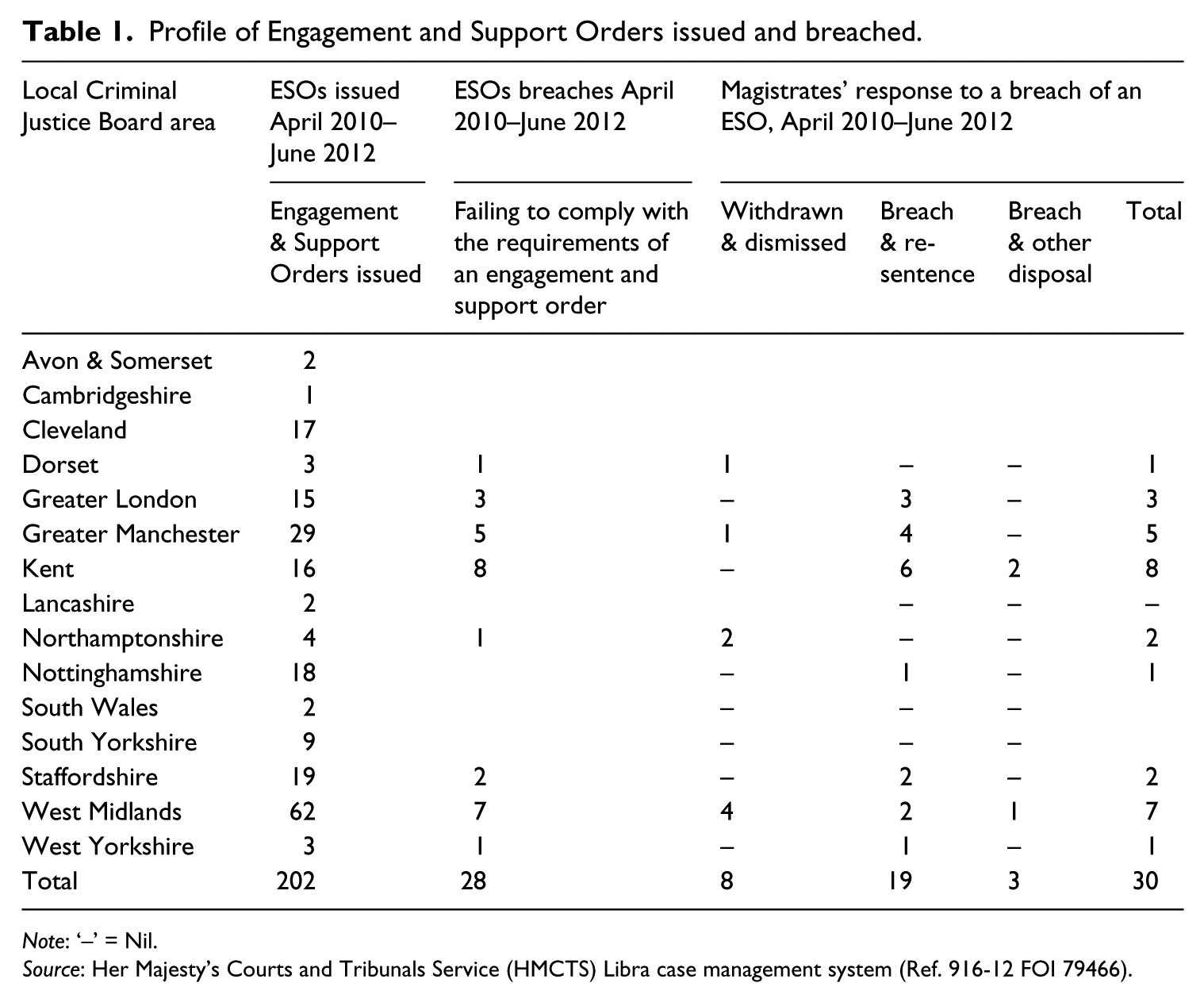
Note: ‘–’ = Nil.
Source: Her Majesty’s Courts and Tribunals Service (HMCTS) Libra case management system (Ref. 916-12 FOI 79466).
All participants, including the female recipients (no projects knew of any men who had received an Order), expressed support for the Orders. This support, however, arose from the recognition that fines were inappropriate and counterproductive: ‘the theory of the ESO is very good, it’s far better than giving a fine’ (Police officer 4 (hereafter Pol4)). One recipient commented: ‘when they’re giving you fines … they’re taking money out of your benefits, you end up with hardly any benefits, so you’re just going back out there again’ (ESO Recipient 3 (hereafter R3)).
Meetings focused on an array of practical issues and material needs. Support ranged from securing access to drug treatment; attending hospital appointments; help with benefits, debt management and accommodation; to liaising with the magistrates to quash outstanding fines. Thus, the focus was more holistic than ‘addressing causes of offending’, as anticipated in the Home Office Guidance (Home Office, 2010b). Of further importance was the flexible nature the supervisors adopted in relation to appointments: ‘I can see them where the need is. So whether it’s a housing issue, a health issue, or whether I need to see them at home’ (Project worker/ESO Supervisor 10 (hereafter PW10)). Having meetings in the evenings, at drop-in centres and at home, and allowing women to re-arrange appointments, was recognized to be helpful for those who struggled to engage and also enabled a breach to be avoided.
Accordingly, all supervisors considered that the Orders were potentially productive as they facilitated engagement with support services. Project workers noted that in the vast majority of cases an Order simply involved a continuation of previous practice, and this was the case for all of the ESO recipients: ‘I’ve worked with [ESO supervisor] for about six years and I work with her voluntary’ (R3). The recipients spoke highly of the supervisors: ‘she’s given me more support in the little bit of time I’ve known her than anything’ (R2), and in all cases the relationship continued beyond Order completion.
Three meetings – an achievable Order or an easy option?
Feelings were, however, mixed regarding the requirement of three meetings. On the one hand, all project workers commented that three meetings were inadequate to meet needs: ‘I don’t think three sessions is long enough. I think for some women who … have had traumatic lives, you need a lot longer’ (PW9). However, four interviewees (PW1, PW10, Pol4, Pol8) explicitly commented that the limited number of meetings was positive as it rendered the Order achievable, whereas any more may lead to a failure to complete: ‘I think three is a realistic amount’ (Pol4). This point was also reflected by recipients, all of whom had previously received, and struggled to complete, other court Orders: ‘if they’re too long, people would just end up not coming and breaching’ (R3).
Correspondingly, varied views also existed regarding the onerous nature of the Orders. Opinions ranged from recipients having to be disciplined and get ‘into a routine of working’ (PW1), to an ESO being seen as an easy option: the old school girls … they almost treat it as a mickey take, don’t they? You stop them and they say, I’m not bothered, er, I’ll go to court, I don’t even get fined now, I just get this. And it’s almost like a joke to some of them. (Pol7)
The relative ease of an Order was reflected in a comment made by one ESO recipient: ‘It was a good Order. I enjoyed completing it. I was sad when it finished really’ (R6). This led four participants to suggest that the Order was a ‘toothless tiger’ (Pol9) which had little deterrence value (PW6, Pol3, Pol4), a point to which we will return when discussing breaches.
Criminalizing to help? ESOs and facilitating engagement
In addition to continuing pre-existing support relationships, the Orders were also considered to help facilitate contact with those who had previously been hard to reach or engage with. Ironically, in one area the increased zero tolerance approach to prostitution had made it difficult for support workers to make contact with women, rendering an ESO necessary to facilitate engagement: ‘it’s very hard for me to find the girls who are working. The Engagement and Support Order means when she’s arrested, then I have to see her, which then brings her to me’ (PW1). This, however, may lead to over enforcement, reflecting critiques that the Orders may increase the social control of vulnerable members of society. One supervisor noted: It kind of almost gives an excuse to over … like to enforce more. Like if you’re of the mentality that you’re doing the women a massive favour by giving them a conditional caution or getting them to court to have an Engagement and Support Order because they wouldn’t be engaging otherwise, then you would kind of go, right, if I enforce more, they’re gonna get more help. (PW2)
Such opinions suggest that the introduction of ESOs may problematically encourage a tendency to predicate support upon criminalization. Indeed, one recipient commented that in the absence of an Order, support was not forthcoming: ‘It’s not, you have to fight for it’ (R2). Moreover, one supervisor (PW12) spoke of an instance where an Order had been helpful in that by compelling the recipient to engage she was then able to get respite: But somebody who’s, like, kind of, falling … some of the women, you see them and you think they’re not gonna be here tomorrow. So if we can get them an ESO, it gets them … it just gets them that respite.
These discussions highlight the ways in which different aspects of prostitution policy potentially undermine each other, as a zero tolerance approach to street sex work may impact negatively on access to support. A focus on vulnerability through the lens of Engagement and Support Orders falls within a wider recognized problematic of sentencing women on the basis of ‘needs’ as opposed to ‘deeds’ (Gelsthorpe, 2006: 422; Hedderman and Gelsthorpe, 1997), along with concerns regarding the criminalization of women for their own protection. This narrow lens may also deflect from the use of criminal sanctions in order to protect on-street sex workers from acts of violence.
Conceptualizing and measuring success
With all supervisors, success was conceptualized in terms of productive engagement and Order completion, as opposed to facilitating exiting: ‘success to us is engagement’ (PW3). Moreover, exiting was not a key priority during the meetings. Indeed, all supervisors and police noted that exiting after three meetings was not realistic for those who were entrenched in sex work: ‘an Engagement and Support Order is not going to stop the women working’, ‘I have never had anybody who has stopped in three months’ (PW1). In contrast, it was noted that exiting might be more likely for someone relatively new to prostitution: I think we’re probably best focusing on the ones that are brand new into it, the new faces, the ones that haven’t been in long, so you’re nipping it in the bud quite quickly, you’re on an Order quickly and let’s look at the issues quickly before they spiral down that entrenched route. (Pol7)
This again, however, highlights the difficult of predicating support upon criminalization, which may problematically encourage the targeting of criminal sanctions on, and increased social control of, young and vulnerable women.
Exiting, work reduction and displacement
In all study areas, recipients continued to work while on an Order and support was provided around harm reduction strategies, such as safe sex and safe injecting information. As might be expected from previous research (Pitcher et al., 2006), there was an element of displacement as women modified their working practices. Working thus took place off-street and off-phones, in order to avoid arrest. As one recipient noted, she ‘just kept off the street’ and worked ‘from home’ (R6).
When exiting or work reduction had been achieved, it was linked to the usual causative factors: coming off drugs, access to children, the fright of an assault, fear for health due to poor quality drugs and the access to support services, as opposed to the result of an Order per se. Recipients reflected this in comments: ‘[it worked], because I got support. Not because of the Order, it wasn’t so much the Order because I was still using after the Order’ (R4). Hence, and as acknowledged in the Cortson Report on vulnerable women in the criminal justice system (Corston, 2007), the availability of good support structures is key, as opposed to extending the reach of the criminal justice system, which brings its own issues of cost, bureaucracy, due process and possible punitive sanctions if Orders are breached.
Two strikes and you’re out?
In contrast to the supervisors, the police adopted a stricter stance and conceptualized success as ‘getting that woman of the street and not seeing her again’ (PW3).
One police officer stressed the importance of ensuring a woman goes ‘back into society and engaging in what we might think of as a normal lifestyle’ (Pol8). At the same time, however, there was understanding among police that exiting was a lengthy process, thus in the short term work reduction was seen as a positive result: ‘Exit’s the ultimate goal but if they’re 24/7, reducing down and down and down to exit at the end, anything in between’s a bonus’ (Pol3).
While appreciative of the difficulties faced by those involved in prostitution, police in one area mentioned a pressure to bring about quicker results, which led to discussions regarding the maximum number of Orders that an individual should be given: ‘I have to sit and, er, have conversations with my bosses because they’ll say, right, well, they’ve had one Order, they have two Orders, there’s got to be a point when we say, right, they’ve had those’ (Pol1). This linked into a mistaken belief among participants in two areas that a magistrate could only issue an offender with a maximum of two Orders. In one of these areas, a practice was developing whereby upon third summons a women would instead be issued with an ASBO/CRASBO: ‘So we came up with a sort of, er, an agreement between all the agencies that we’d look to have two ESOs, allow the girls two ESOs over a six-month … so that’ll be a maximum 12-month period’ and thereafter ‘we’d look to CRASBO [Criminal Anti-Social Behaviour Order] them and use other tactics’ (Pol2).
Such pressures, however, conflict with understandings that exiting, especially for those entrenched in prostitution, is a very difficult and a far from linear process (Cusick et al., 2011; Hester and Westmarland, 2004). Moreover, they demonstrate the problematics involved in reconciling the enforcement and therapeutic aspects of the Orders. There is the danger that for those who do not engage and subsequently exit an increasingly punitive approach may be adopted, which can also be seen if we consider the consequences of breaching an Order.
Impact of breaching: The contradictions of ‘enforcement plus support’ models
The contradictions and difficulties of an ‘enforcement plus support’ model (Phoenix, 2009) are particularly acute when considering the issue of breaching. Herein, we can see clear tensions between policy perspectives that the women are victims and the ongoing criminalization of such individuals. In particular, ESOs place project workers in a difficult position, as they are charged with breaching an offender. However, as highlighted in Table 1, in most areas breach rates were low. Projects were reluctant to breach a woman, due to fear that this would impact negatively on their relationships and effectively turn them in to a criminal justice agency. This in turn was considered to impact upon the implementation of the Orders: We’ve not had a problem with breaches, but that’s because we don’t want to become an enforcement agency. If we start breaching people left, right and centre – which is why a lot of projects wouldn’t do them … and we’d never be an enforcement agency, they’d never see us like they see probation. (PW3)
Consequently, in one area it was decided that the supervisor role should be with a criminal justice agency, as it was thought to be unfair to ask voluntary agencies ‘to be put in a position where you are breaching one of your clients’ (Pol8). For others, while this dilemma was recognized, it was thought to be ‘better the devil you know’ (PW3). Pre-existing projects, therefore, were concerned that other agencies with little specialist experience or relationship with the clients may become involved in the Orders.
From a different perspective, however, police offices and project workers in three areas lamented that the sanction for a breach was of no significance, therefore reinforcing their perspective that the Order had little deterrence value: ‘all that happens is they go back to court and they’re either given another one [ESO] or they’re fined. And if they’re fined, they just go and work to pay the fine off’ (PW6). Consequently, three police officers suggested that a breach should have more severe outcome, such as a custodial sentence. Such perspectives sit in contrast with the Cortson Report, which recommended that custody should be ‘reserved for serious and violent offenders who pose a threat to the public’ (Corston, 2007: 58). Indeed, Cortson (2007: 50) stated that more was needed to divert women out of the criminal justice system. Along these lines, in two areas developments were underway to (re)introduce voluntary referral schemes (see Aris and Pitcher, 2004) as it was feared that the introduction of ESOs had soured relationships: ‘the first thing they always see is enforcement, and that’s very much what our experience has [been]. Without the support services being in place before arrest, they see it as an enforcement and it’s not helpful’ (Pol4).
Areas in need of improvement: Magistrates and funding
All project workers and police officers identified magistrates’ training and funding as key areas where major improvements were needed. Magistrates required further guidance on the mechanics of the Order and there was a lack of knowledge regarding the availability of the ESOs. Significantly, magistrates in all areas were still at times issuing fines: ‘we’ve had girls that have been fined, where it’s clearly been placed all over the paperwork, an ESO’ (Pol1). In one area, there was also confusion regarding how to report a breach, but no information was forthcoming: ‘I’ve made some phone calls and I’ve spoke to about 7000 people at the court, and everybody said, I don’t know, I don’t know’ (Pol6). Given the potential consequences of breach, this is significant.
These difficulties led to all areas trying to arrange for either a project worker or a dedicated police officer to attend court to offer advice to the magistrates and/or facilitate training. However, this involved significant time and cost implications that were not sustainable, particularly given the lack of up-front funding from the Home Office. Projects would only receive a grant of £100 per woman upon the completion of 10 successful Orders in one year (Home Office, 2010c). On the basis that only seven out of the 15 criminal justice board areas have had more than 10 Orders (see Table 1), it is very unlikely that many single agencies reached this level, and thus must be providing this support without direct funding. One project worker speculated that the lack of funds may be a reason why some areas have been reluctant to implement the ESOs: ‘I think that’s why a lot of areas didn’t take up doing ESOs because there was nobody to do it, there was nobody to take it up’ (PW3).
Enduring poverty and poor quality plasters: The failure of ESOs
In all areas, supervisors maintained that much more was needed from the state to improve the social and economic situation of those involved in prostitution. Increased funding was required to enable long-term involvement with women in order to bring about effective and sustainable change: ‘We need more … you need some support to be able to address the underlying issues’ (PW13). The scarcity of jobs was mentioned as an issue and support workers were pessimistic regarding viable alternatives, which in turn impacted upon involvement in prostitution: ‘She couldn’t find a job and she thought, well, I don’t want to be living on this much money, like, and so she dipped back into it’ (PW13).
Thus, while there was support for the Orders, significant difficulties exist due to placing support for vulnerable members of society in an enforcement framework. The ‘enforcement plus support’ model may be an improvement upon fines; however, it is debatable whether it is positive for those who breach. Placing support in a criminal justice system brings with it a number of issues, in particular the increased policing role required of voluntary agencies and the negative impact this has upon relationships.
As outlined in previous research and highlighted by the findings of this small pilot study, these Orders tend to impose unrealistic expectations of their ability to bring about exiting. ESOs create new revolving doors for those involved in the most visible sectors of the industry, as one Order is insufficient to bring about real change. As one project worker noted, ‘this is a plaster, this is a poor quality plaster … this is not going anywhere near the root of the problem’ (PW11). Consequently, ESOs can be seen as an attempt to cover over the causes, impact and effects of poverty and austerity on vulnerable members of society. They demonstrate a lack of any real concern for needs and lived realities of those involved in prostitution. The narrow focus of the Orders individualizes the causes of poverty and prostitution, and elides wider structural factors that shape sex work (Scoular and O’Neill, 2007), while the net of criminalization is thrown wider. No concerted effort is made to effect genuine and substantial social change, which would enable women to generate alternative and sustainable streams of income or continue to engage in sex work safely, if they chose to do so.
Conclusion
In this article we have endeavoured to demonstrate the impact of a neo-abolitionist agenda upon prostitution policy in England and Wales. Since the publication of Paying the Price (Home Office, 2004), the purchasing of sex has been increasingly problematized as a form of commercial sexual exploitation and those who are involved in selling are constructed as victims who need to be saved. While this can be explained as evidence of the growing influence of the ‘Nordic model’, we note that policies do not simply leap across borders and the policies in England and Wales have their own cultural specificity. This is evident in our analysis of s. 14 and s. 17 of the Policing and Crime Act, 2009, which are clearly informed by a neo-abolitionist agenda, but yet are distinctive in both substance and effect.
Nevertheless, there are continuities between this creeping neo-abolitionism and the Swedish system (Levy and Jakobsson, 2014). Policy in both states is becoming increasingly simplified into rigid definitions of criminal responsibility that divide ‘the world into victims and victimizers’ (Bernstein, 2001: 389). Within this framework, men who buy sex are constructed as always already incapable of ethical behaviour and women involved in prostitution are criminalized for their own good. Consequently, the complex aetiology that explains the purchase of sex within a cultural, gendered and economic context is ignored (Brooks-Gordon and Gelsthorpe, 2003: 438).
However, we question whether increasing men’s criminalization will in fact reduce women’s vulnerability. The strict liability offence (s. 14) is rarely enforced, it ignores the structural causes of exploitation and leaves little incentive for clients to report or try to influence abuse and poor conditions. The mechanisms that attempt to help women exit (s. 17) do so, not via creation of viable alternatives, but through criminal justice based interventions. Enforcement plus support mechanisms continue the long tradition of stigmatizing those involved in sex work and the neo-abolitionist agenda comes at the expense of a recognition of women’s agency. The rhetoric of victimhood consolidates and legitimizes law’s power over women’s bodies, foreclosing any discussion of forms of rights or recognition that could support counter-hegemonic challenges (Scoular and O’Neill, 2007). Criminalization will not eradicate the market; it will simply create and sustain another, which is out of sight of authorities and the public, and one that is more dangerous for sex workers (Levy and Jakobsson, 2014). This all too pertinent as this agenda appears to be gaining increased support, as highlighted in the proposals put forward by the European Parliament and the APPG (APPG, 2014).
The need for a ground–up debate
This article does not aim to present a liberal defence of prostitution, nor to suggest that state intervention is not required. There is exploitation here as there is elsewhere. But the question is how the law may be used effectively. Rather than trying to reduce supply and demand via criminal justice measures, it may be better to think about how the law (criminal and other) may be used alongside other social initiatives to improve conditions and safety in and out of sex work. Policy needs to be focused on what can reasonably be done to protect those involved in sex work – both men and women, based on the reality of their experience and of the industry, which is far more diverse and complex than the heterosexual exploitation model upon which neo-abolitionism is premised (see also Weitzer, 2013: 16).
We therefore urge that the next period of reform begin with a more inclusive and ground–up debate regarding what kind of changes in the sex markets may be desirable, along with the engagement of those involved in sex work (Pitcher and Wijers, 2014). Initiatives could include forms of legal recognition that increase space for women and improve conditions (see Abel, 2014; Sullivan, 2010) and the increased recognition of violence in sex work from the perspectives of sex workers, rather than simply from the ‘prostitution as violence’ rhetoric of the neo-abolitionist campaigners. This could lead to more united support for violence reduction initiatives, such as Ugly Mugs schemes which encourage the reporting of crimes against sex workers (https://uknswp.org/um/) and increased prosecution of rape and assault. It would also, we conclude, result in the criminal law and criminal justice system having a more focused and effective role, rather than the all-encompassing, inevitably disappointing and harmful one it currently has.
Footnotes
Acknowledgements
We would like to thank the anonymous reviewers for their constructive and helpful comments and the editors of the special edition, Dr Teela Sanders and Rosie Campbell, for their enthusiasm and support.
Funding
We would like to thank all those who participated in the research project and the British Academy who funded the project (ref: SG120194).
Notes
Author biographies