



Abstract
The extent to which police officers obey instructions and policies is of permanent concern to police leaders and the community. This is especially the case when it comes to preventing police misconduct, such as the use of excessive force. In the current study we examined officer compliance from a procedural justice and social exchange perspective. Using data collected among 536 police officers of the Metropolitana Police in Buenos Aires, we explored to what extent internal procedural justice and trust are related to: (1) officer compliance with supervisors and policies; and (2) officer endorsement of regulations on the use of force. The results indicate that perceptions of fair treatment by supervisors and trust in supervisors are positively associated with (stated) compliance. Our findings suggest that a procedural justice approach may facilitate the implementation of police policies and contribute to preventing police violence.
Introduction
For many years, hierarchical top–down organizational structures and autocratic leadership styles were considered useful approaches to achieve police departments’ internal and external goals. Yet, difficulties in implementing policy changes and recurring problems of police misconduct have in recent years drawn the attention of police chiefs and researchers to the limitations of such organizational models and leadership styles (Gau and Gaines, 2012; Skogan and Hartnett, 1997; Wolfe and Piquero, 2011). The failure to gain support among officers for initiatives announced by police leaders, and to ensure voluntary compliance of officers with the regulations of the organization, has raised questions about the quality of interaction and communication between supervisors and officers, and its impact on officers’ behavior (Bradford et al., 2014; Roberts and Herrington, 2013; Schafer, 2013). The literature on procedural justice in police–citizen relationships and non-police organizations suggests that being open to officers’ input, giving them explanations for decisions made at higher levels, and treating them fairly, could encourage organizational commitment and voluntary rule following (Colquitt et al., 2001; Mazerolle et al., 2013b; Roberts and Herrington, 2013; Tyler, 2011). In this study we examine the potential of a procedural justice approach for stimulating officer compliance.
The success of hierarchical top–down organizations depends, to a large extent, on the willingness of lower ranking personnel to voluntarily obey instructions of supervisors and implement policies developed by top managers (Gau and Gaines, 2012; Schafer, 2013). This issue is particularly prominent in the policing context because street-level police officers are generally operating away from supervisory control, and have a relatively high level of discretion in how to handle their tasks (Bradford et al., 2014; Klockars et al., 2000; Tyler et al., 2007). Non-compliance by police officers can have serious consequences. Officers rejecting policies and regulations may not only hurt their department, but also members of the public (Chappell and Piquero, 2004; Wolfe and Piquero, 2011). Officers may, for instance, use excessive force. The recent fatal police shootings of two citizens in St Louis (United States), and the public outrage that ensued, underscore the relevance of this topic. The extent to which law enforcement officials obey instructions and policies is of permanent concern to police leaders as well as the community.
Inspired by comprehensive research on police–citizen relationships and employees’ behavior in non-police organizations (see later), we examine in this article whether levels of officer compliance can be linked to the quality of interaction and communication between supervisors and officers. Building on procedural justice and social exchange frameworks, and applying structural equation modeling, we test to what extent fair decision making and fair treatment are related to: (1) a general measure of compliance; and (2) officers’ endorsement of the rules on the use of force. The data that we analyze were derived from a survey conducted among officers serving the Metropolitana: a new police force in Buenos Aires, Argentina. Our findings suggest that a procedural justice approach may be a successful route for police managers and supervisors to increase officer compliance in general and to enhance officers’ obedience to the rules on the use of force.
Procedural justice, trust, and compliance
In order to formulate hypotheses about officer compliance, we will first review the literature about citizen compliance. It has been said that it is difficult, if not impossible, for a legal institution to effectively control its citizens solely by the threat and use of power (Darley, 2001; Tyler, 2006). In other words, it is important that citizens comply with the law voluntarily. Theorization and many years of cumulative research on supportive public behavior indicate that procedural justice and trust play an important role in stimulating citizens’ compliance with the police and the law. The origins of these insights go back to the work of Thibaut and Walker (1975), who showed that citizens were more willing to defer to court decisions when they felt that the court procedures were fair. In the context of dispute resolution, these authors conceptualized fairness as disputants having control over the presentation of their arguments and sufficient time to present their case. Tyler (2001, 2005; Sunshine and Tyler, 2003) elaborated these ideas. He argues that compliance with the police and courts can be encouraged by fair decision making and fair treatment, and pays attention to the mediating role of trust in the relationship between procedural justice and compliance. In his theorization on process-based policing, Tyler proposes that public trust in the police is related to citizens’ perception that the police treat people equally and respectfully, are open to citizen input, and explain their decisions. By linking these behaviors to a conceptualization of trust that involves a belief in the goodwill or benevolence of other persons (Tyler, 2011; Tyler and Huo, 2002), this approach suggests that procedurally fair behavior generates trust in the police because citizens infer from it that the police have good intentions (Van Craen, 2014). With regards to the consequences of trust, Tyler argues that trust in the police “shapes public cooperation”, increases citizens’ “deference to the directives of the police”, and “motivates compliance with the law” (Tyler, 2005: 325, 327, 333). The link between compliance/cooperation and trust is based on the idea that people’s willingness to comply and cooperate with the police increases when they believe that the police have good intentions (Van Craen, 2014).
Over the past 10 years, the impact of (perceived) procedural justice on citizens’ trust in the police, and the notion of trust-based helping and compliance, have been confirmed by studies in many different countries (Bradford and Jackson, 2010; Cherney and Murphy, 2013; Dirikx and Van Den Bulck, 2014; Jackson and Sunshine, 2007; Jonathan-Zamir and Weisburd, 2013; Murphy, 2013; Sunshine and Tyler, 2003; Tankebe, 2008; Tyler, 2005; Van Craen and Skogan, 2014). Currently, the idea of trust mediating the relationship between procedural justice and compliance/cooperation continues to underpin reflections on police–citizen relationships. In a discussion of the implications of findings from the world’s first randomized experimental field trial of procedural justice policing, Murphy et al. (2014) for instance state that if members of the public have repeated experiences of fair treatment by police, over time their willingness to cooperate or comply with police can be enhanced through the effects of increased trust and confidence. Alongside this classic approach, variations have been proposed that draw our attention to the potential mediating role of moral alignment with the police, felt obligation to obey the police, and perceived legality of the police (Hough et al., 2012; Jackson et al., 2013). Jackson and colleagues (2012, 2013) confirmed the relevance of these mediating factors in shaping compliance and cooperation in the UK. Research in Sweden and Belgium, however, suggests that in these contexts moral alignment and felt obligation to obey have limited or no explanatory power (Van Damme and Pauwels, 2013; Van Damme et al., 2013).
Fostering officer compliance with supervisors and policies
Shifting the focus to the organizational context, we expect that procedural justice and trust also play a role in stimulating officers’ compliance with supervisors and the policies of the organization. Procedural justice theories suggest that fair treatment and fair decision making promote normative commitment to an authority’s values and encourage people to accept power-holders’ right to hold authority over them (Bradford et al., 2014; Roberts and Herrington, 2013). Procedural justice would cause people to view their authority as being appropriate and proper, with the consequence that they feel obliged to defer to the decisions made by power-holders and to the policies and rules they create (Tyler, 2006). When people perceive fairness, they would be more likely to regard authorities as having earned an entitlement to command, creating an internal pressure to obey (Hough et al., 2010). Applying these general claims of procedural justice theories to the context of a police department, we expect fair treatment and fair decision making to foster officers’ compliance with supervisors and with the policies of the organization. Moreover, considering the role of trust in police–citizen relationships (see earlier), we predict the relation between procedural justice and officer compliance to be (partly) mediated by officers’ trust in supervisors. Perceptions of procedural (in)justice will lead officers to make inferences about the extent to which supervisors are benevolent and have good intentions. These assessments are constitutive elements of trust (Tyler, 2011; Tyler and Huo, 2002; Uslaner, 2004) and may influence officer behavior (Van Craen, 2014). We expect that officers will be more inclined to obey supervisors and the policies of the police organization when they believe that supervisors’ actions and instructions are guided by good intentions and benevolence.
Besides procedural justice frameworks, social exchange theories also provide a theoretical foundation for the link between procedural justice and officers’ compliance, and for the role of officers’ trust in shaping this relationship. The social exchange perspective is one of the most influential conceptual paradigms for understanding workplace behavior (Cropanzano and Mitchell, 2005). Although there exist many versions of this perspective, theorists do converge on its central essence: social exchange comprises actions contingent on the rewarding reactions of others, which over time provide mutually rewarding transactions and relationships (Cropanzano and Mitchell, 2005). Many recent contributions to social exchange theorizing build on the seminal work of Blau (1964), who differentiated social exchange relationships from those based on economic exchange. Social exchange engenders diffuse obligations that are unspecified and is based on trust in an open-ended stream of transactions. Economic exchange, on the other hand, consists of explicit, precise obligations to be rendered at a specific time and can be enforced by terms of a contract, thus obviating the need for trust.
Contemporary social exchange framework theories state that fair treatment encourages employees to redefine their working relationship as one of social exchange, with beneficial workplace behavior serving as an exchangeable resource (Colquitt et al., 2013; Cropanzano and Rupp, 2008). These approaches consider trust as an aspect of social exchange quality that mediates the relationship between organizational justice and reciprocative behaviors. They define trust as positive expectations about the words, actions and decisions of a trustee (Colquitt et al., 2013) and state that trust makes social exchange relationships more viable (Colquitt et al., 2013; Cropanzano and Rupp, 2008; Konovsky and Pugh, 1994). Broadening Organ and Konovsky’s (1989) reflection on trust and organizational citizenship behavior, one could argue that trust stimulates reciprocal behaviors because it leads employees to believe that their beneficial workplace behaviors in turn will be answered by supervisors with positive and rewarding reactions. In the literature on organizational justice and social exchange, much attention has been given to organizational citizenship behavior as an exchangeable resource, but compliance could be viewed as a form of reciprocation for received benefits as well.
Empirical research on police organizations and cultures provides a few indications of a link between procedural justice and officers’ compliance with supervisors and the policies of the organization. A survey conducted by Skogan and Hartnett (1997) revealed that it is easier to gain support for top–down initiated (community policing) initiatives when officers are satisfied with the reasonableness of management and supervisors and their treatment of employees. In line with this, research by Gau and Gaines (2012) suggests that police managers and supervisors can improve officers’ endorsement of top–down strategies (like order maintenance) by explaining changes and by giving them the opportunity to express their opinions. These studies were carried out in the USA, but similar patterns were found in other contexts. A survey by Tankebe (2010) showed that in Ghana organizational commitment is determined by police officers’ assessments of the treatment they receive from their supervisors. Positive perceptions of the quality of treatment were found to foster a stronger commitment to the organization. In the UK, research by Bradford et al. (2014) explicitly linked supervisory procedural fairness to officer compliance. Officers who felt their supervisors treated them fairly also reported being more willing to comply with instructions and procedures.
None of the discussed quantitative studies examined the potential mediating role of trust in shaping supportive behavior. Complementary findings from qualitative police research, however, suggest that trust is an important factor. Wheatcroft et al. (2012) found that participative and transactional leadership styles promote trust in police leaders and that trust, in turn, stimulates cooperation. They concluded that “an emphasis on debate, discussion, and participation in decision-making engenders the development of trust in leaders” and stressed that “where clear lack of trust exists conflict and lack of cooperation ensue” (Wheatcroft et al., 2012: 406, 407). In line with this, a four-year ethnographic study of Wood et al. (2004) showed that the extent to which officers seek autonomy from hierarchical authority is related to the degree to which officers have developed an us-versus-them attitude. This attitude expresses a feeling of being part of a distinct social group and implies a lack of trust in non-officers, including supervisors. Wood et al. (2004) observed that a strong us-versus-them stance incites officers to operate with as much autonomy from supervisors as possible.
Finally, the potential importance of procedural justice and trust for explaining officer compliance can also be derived from research on supervisor–employee relationships in non-police organizations. In the fields of psychology and management, the study of organizational justice has a long history. A recent meta-analysis summarized much of this work and showed that in non-police organizations the relationship between procedural justice and organizational citizenship behavior is partially mediated by indicators of social exchange quality, including trust (Colquitt et al., 2013). A few organizational justice studies have scrutinized explicitly whether procedural justice affects compliance, and have considered the mediating role of trust. Tyler and Degoey (1996), for instance, showed that the perceived neutrality of supervisors’ decisions, and the degree to which workers feel treated with respect, determine workers’ trust in supervisors. Workers’ trust in supervisors, in turn, was found to influence their willingness to accept supervisors’ decisions. More recent research in commercial managerial settings confirmed that employees’ perceptions of fair decision making and just interpersonal treatment determine their trust in supervisors and management, and that trust in supervisors and management shapes voluntary rule following and cooperation (Tyler, 2011).
In line with the reviewed literature, we expect to find the following patterns in the police organization under study: procedural justice will be directly related to officer compliance, and also indirectly via trust in supervisors. These relationships are visualized in Figure 1. In this figure, and in the remainder of the article, the term “internal procedural justice” refers to procedural justice inside the police organization.

General theoretical model.
In addition to examining the role of procedural justice and trust with regards to overall officer compliance, we are also interested in their relation to a specific type of compliance: officer endorsement of rules and regulations on the use of force. In the next section we briefly review relevant articles on this topic and formulate more hypotheses.
Officer endorsement of rules on the use of force
The potential or actual use of physical force to enforce the law can be considered a defining feature of police work (Gabaldón, 2009; Klahm and Tillyer, 2010). Police officers are nonetheless bound by limits regarding the amount of force they can use. Force is only to be employed as a last resort, and its use must be proportional and reasonable given the circumstances (Micucci and Gomme, 2005; Tankebe, 2011). Excessive police force can be problematic for reasons beyond those related to other types of police misconduct. Among other things it denies citizens of their right to “be free of unjust and unwarranted government intrusion and restriction” (Micucci and Gomme, 2005: 488), makes them fearful of the police, and increases their risks to be (fatally) injured. In order to try to prevent excesses, police organizations tend to have specific rules and regulations to establish various levels of the severity of force that can be applied by officers in dealing with resistant citizens (Terrill and Paoline, 2013). Nonetheless, these can only work if police officers are convinced of their merit. Given the limited supervisory control and high discretion of police work, an officer’s “own normative framework for assessing the necessity and justification for the use of force is likely to have a major influence in his or her decisions as to when to use force, and how much and what kind of force to use” (Stenning et al., 2009: 102). It is therefore critical to improve our understanding of officers’ attitudes toward (regulations on) the use of force.
There are a few empirical studies on police attitudes toward the use of force. One is a telephone survey conducted by Weisburd and Greenspan (2000) among a random nation-wide sample of 925 police officers in the United States. The majority of the surveyed officers found it unacceptable to use more force than is legally allowable, but almost a quarter of the sample did find such behavior acceptable. Furthermore, almost a third of the officers felt that they are not allowed to use as much force as is often necessary. More recently, Tankebe (2011) conducted a survey on this topic in Ghana. Almost 60 percent of the Ghanaian officers agreed that it is sometimes acceptable to use more force than legally allowable in order to make an arrest. The strongest explanatory factor for support for the use of force was police organizational commitment, with more commitment resulting in less support.
Additionally, there are several studies in which police attitudes toward the use of force were measured by having police officers respond to specific scenarios, rather than measuring their overall attitudes (e.g. Micucci and Gomme, 2005; Waddington et al., 2009). Importantly, although both types of studies measured police attitudes toward the use of force, they do not provide us with many insights about the determinants of these attitudes. In a number of cases the role of some background characteristics of officers was assessed (e.g. Weisburd and Greenspan, 2000), but researchers generally did not examine theoretically informed aspects such as organizational factors (see Tankebe, 2011 for an exception).
In this study we examine whether officer endorsement of regulations on the use of force is related to perceptions of internal procedural justice. Can perceptions of fair treatment and decision making by supervisors predict officer misconduct such as the use of excessive force? The literature suggests that this may be the case. Research by Wolfe and Piquero (2011) showed that officers’ perceptions of internal procedural justice affect justifications of police corruption in pursuit of a noble cause and engagement in police misconduct. Although the researchers focused on general measures of misconduct, and not specifically on the abuse of force, their results do underline the role of internal procedural justice. Based on these findings and our general theoretical model (see Figure 1) we expect that in the police organization under study perceptions of internal procedural justice will be directly (and positively) related to endorsement of rules on the use of force, and also indirectly via trust in supervisors.
Context of the current study
We conducted our study among officers of the Metropolitana Police, a relatively new police force created in 2008 by the autonomous city government of Buenos Aires. The formation of “La Policía Metropolitana” occurred amid a strong political struggle between the federal government and the local one. As a consequence of the continuing political struggle, two types of security forces are currently at work in the capital city: traditional federal security forces (mainly the Federal Police) on the one hand, and the Metropolitana Police on the other.
The creation of the Metropolitana was based on a paradigm of neighborhood policing, focusing on prevention and minor crimes. It has nonetheless gradually broadened its scope (ACOS, 2013). Since its formation, the number of officers working for the Metropolitana and its composition have changed considerably. In 2009 the force counted with only 886 sworn agents, who mainly came from the Federal Police. The Metropolitana has meanwhile added more officers from other police forces, and since 2010 it has annual batches of young new officers who are educated in its own training institute. The police force currently increases by 400 to 500 officers a year (ACOS, 2013). In March 2013, when this survey was carried out, the Metropolitana counted with 3979 police officers.
Although Metropolitana officers work in the entire city of Buenos Aires, the police force’s deployment is concentrated in three of the city’s 15 neighborhoods. This is explained by its relatively small number of officers, and the fact that there are also about 20,000 officers of the Federal Police working in the city. In addition to this, there are Gendarmerie and Coast Guard officers at work in Buenos Aires, who were especially deployed in some neighborhoods by the federal government.
Not only the political context, but also the social context forms a real challenge for the Metropolitana. In Buenos Aires, as well as in Argentina in general, crime rates are on the rise (Fleitas, 2010, 2013; PNUD, 2013). This makes Argentina an interesting place of study, as in many countries the crime rates have been dropping since the 1990s (Tseloni et al., 2010). The rising crime rates in Argentina are coupled with high public concerns about insecurity. In Buenos Aires in 2010, 66 percent of the population considered crime as the main problem (DGPPD, 2011).
The Metropolitana intends to be a modern organization with improved work conditions, and hopes to prevent police corruption by paying its personnel relatively high wages. The force also aims to improve police–citizen relations. To do so, it has to overcome persistent negative public perceptions and attitudes toward the police in general. Argentinian police forces are affected by an authoritarian tradition and were involved in the repression during the last military dictatorship (1976–1983). Even nowadays, problems of police abuse of force are not uncommon (CELS, 2012). There have been recent cases where police officers were accused of being involved in crime, corruption, and activities of political parties (Saín, 2008). Not surprisingly, confidence in the police is low in Argentina. According to the LAPOP (Latin American Public Opinion Project) survey, the confidence level is 43 percent, which is lower than the South American average of 48 percent (Fleitas et al., 2014).
The aforementioned circumstances make the current study particularly relevant. Argentina faces increasing security problems and at the same time has to deal with institutional inheritances. Furthermore, it is quite a unique opportunity to study a new police force that is characterized by a mix of experienced and new officers, and that aims to improve police–community relations.
Data collection
The survey was conducted in 2013 during the annual retraining of police personnel at the Superior Institute of Public Security (ISSP) of the Metropolitana Police in Buenos Aires. A total of 536 police officers participated in the survey, which amounts to 14 percent of the Metropolitana police force at the time of the data collection. Police officers were obliged to participate in the annual retraining, and their attendance day was independent of the unit of origin or any personal characteristic. As the annual retraining had already been running for a number of weeks by the time that the survey was implemented, we were not able to ensure the participation of those who by that time had already completed the training.
The survey was self-administered on computers. Anonymity was strongly emphasized to participants due to the sensitive topics in the questionnaire. A short explanatory video was presented at the beginning of each session, ensuring that all officers received identical instructions. On the days that the survey was implemented between March and April 2013, all officers who participated in the police training also participated in the study. This means that we obtained a 100 percent response rate during the time of the data collection. This was greatly facilitated by the fact that the survey was implemented as being part of a training session. Officers entered the computer room to complete the survey as the last part of their training day. Although the survey was not presented as being mandatory, all officers chose to participate anyway. Many of the officers with whom we informally spoke after their completion of the survey indicated that they liked being given “a voice”, as they are normally not given such an explicit opportunity to express their opinion about work-related matters.
The survey procedure allowed us to obtain a robust sample. The representativeness of our sample was confirmed by the large similarities between demographic characteristics of the participants and of the entire police force. There were for instance 28.7 percent women in the sample, compared to 29.3 percent in the population of the Metropolitana. The comparisons for ranks are as follows: officers (pop. 69.1 percent, sample 67.9 percent); senior officers (pop. 10.8 percent, sample 9 percent); sub-inspectors (pop. 11.4 percent, sample 16.3 percent); and inspectors (pop. 6.4 percent, sample 6.9 percent). Apart from the slight overrepresentation of sub-inspectors, the composition of the sample and population was thus very similar. Police officers of the highest ranks did not participate in the ISSP retraining session, and as such also did not participate in our survey.
Just over 17 percent of the surveyed officers was 25 years old or below, a bit over a quarter was between 26 and 30 years old, 30 percent was between 31 and 35 years old, 16 percent was between 36 and 40 years old, and less than 10 percent was older than 40. Over a third (36 percent) only worked for the Metropolitana; the rest (64 percent) used to work for other security forces such as the Federal Police (26 percent). About 37 percent completed secondary education, about the same percentage started or completed tertiary education, a quarter started or completed university education, and 2.6 percent attained the postgraduate level.
Measures and analytical models
The theoretical concepts were all measured using multiple indicators. Each of the items had a six-point Likert type response scale ranging from 1 (strongly disagree) to 6 (strongly agree). Table 1 presents an overview of the operationalization of each of the concepts. Many items were derived from the reviewed studies on procedural justice in police–citizen relationships and organizations, and from the mentioned studies on attitudes toward the use of force. We further took inspiration from a recent officer survey carried out in Chicago by Skogan and Van Craen (2013). Some of the adopted items, however, had to be adjusted to the Argentinean context. Before conducting the data collection, a meeting was held with a small group of police officers and employees of the ISSP to check the wording and understandability of all questions.
Operationalizations.
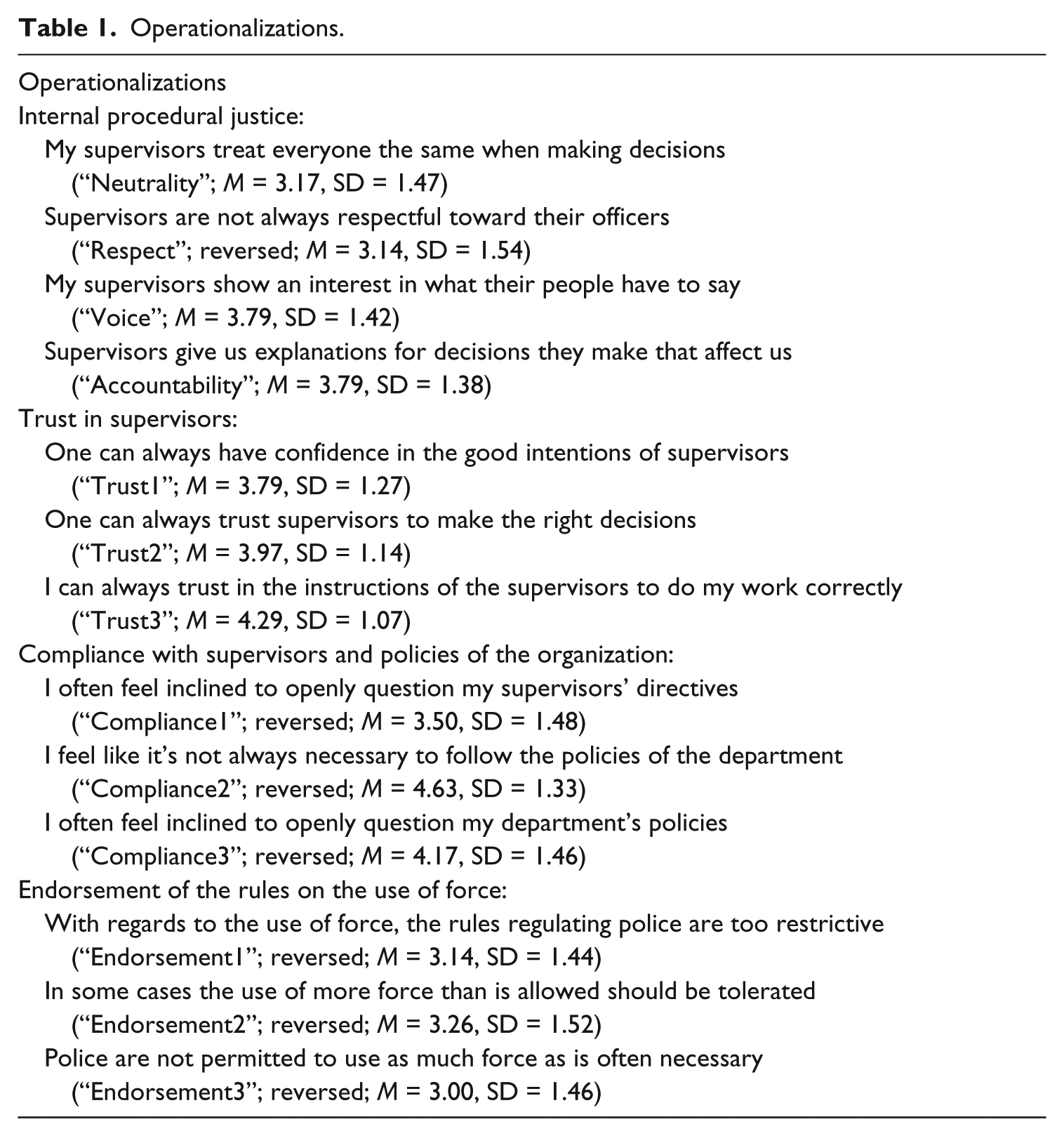
We note that in the literature broad as well as narrow definitions and operationalizations of procedural justice have been used (for a discussion of the different approaches, see Bradford et al., 2014; Colquitt et al., 2001; Roberts and Herrington, 2013). In this study, we followed the broad conceptualization and operationalization of Tyler (2005; Sunshine and Tyler 2003), who identified neutrality, respect, voice, and accountability as core principles of procedural justice in police–citizen relationships. Like Bradford et al. (2014), we adopted this approach to study procedural justice in officer–supervisor relationships.
Before employing structural equation modeling (SEM) to test the expected relationships, we conducted a confirmatory factor analysis (CFA) to check whether the indicators of “internal procedural justice” and those of “trust in supervisors” measured different concepts. This analysis revealed a very strong correlation between the two latent variables (r = .89), suggesting inadequate discriminant validity. Moreover, the goodness-of-fit statistics indicated that the model did not fit the data well (Chi-square = 84.05, d.f. = 13, p < .001; RMSEA = 0.101; CFI = 0.945). To improve the model, we merged the two highly correlated factors into a one-factor structure. Furthermore, two indicators that caused the fit of the one-factor model to be sub-optimal were dropped (Respect and Trust3). These improvements resulted in the model shown in Figure 2, which fits the data well (Chi-square = 17.116, d.f. = 5, p < .005; RMSEA = 0.067; CFI = 0.986).

Latent variable “Internal procedural justice (IPJ) and trust” (one-factor CFA model).
In a second step, and guided by the preparatory analyses, we estimated two structural equation models. These models are refined versions of the theoretical model with which we originally set out. We used the merged variable “internal procedural justice and trust” and assessed its relation to the compliance variables. The structural equation models also comprised four control variables: age (1 = 16–20 to 10 = 61–65), gender (0 = female or 1 = male), level of education (0 = low or 1 = high), and prior experience in another police force (0 = no or 1 = yes).
Results
Figures 3 and 4 show the results of the SEM analyses. Both models fit the data adequately (Model 1: Chi-square = 123.999, d.f. = 47, p < .001; RMSEA = 0.055; CFI = 0.954; Model 2: Chi-square = 69.9, d.f. = 46, p < .05; RMSEA = 0.031; CFI = 0.986).
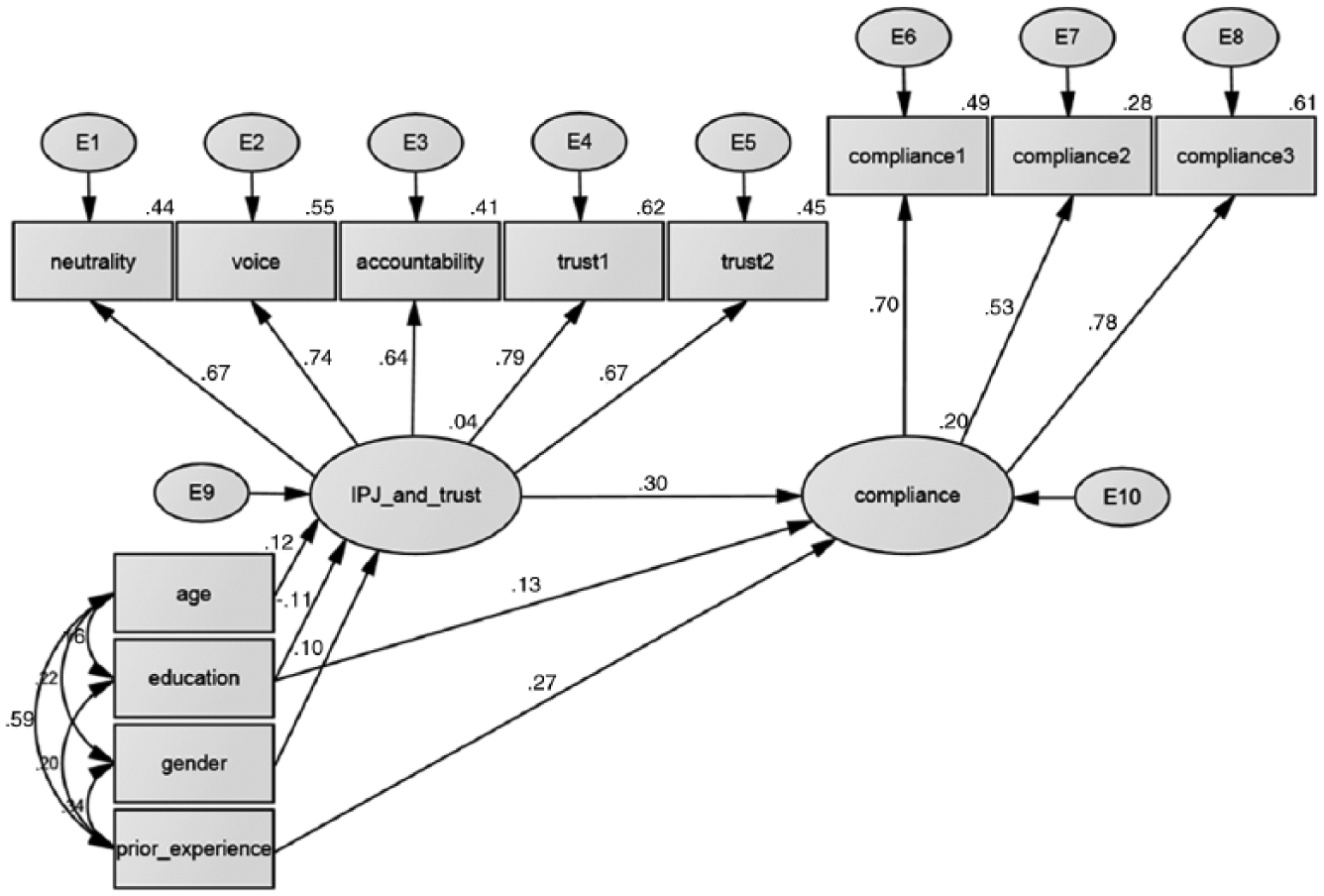
SEM model assessing the impact of internal procedural justice and trust on officers’ compliance with supervisors and policies of the organization.
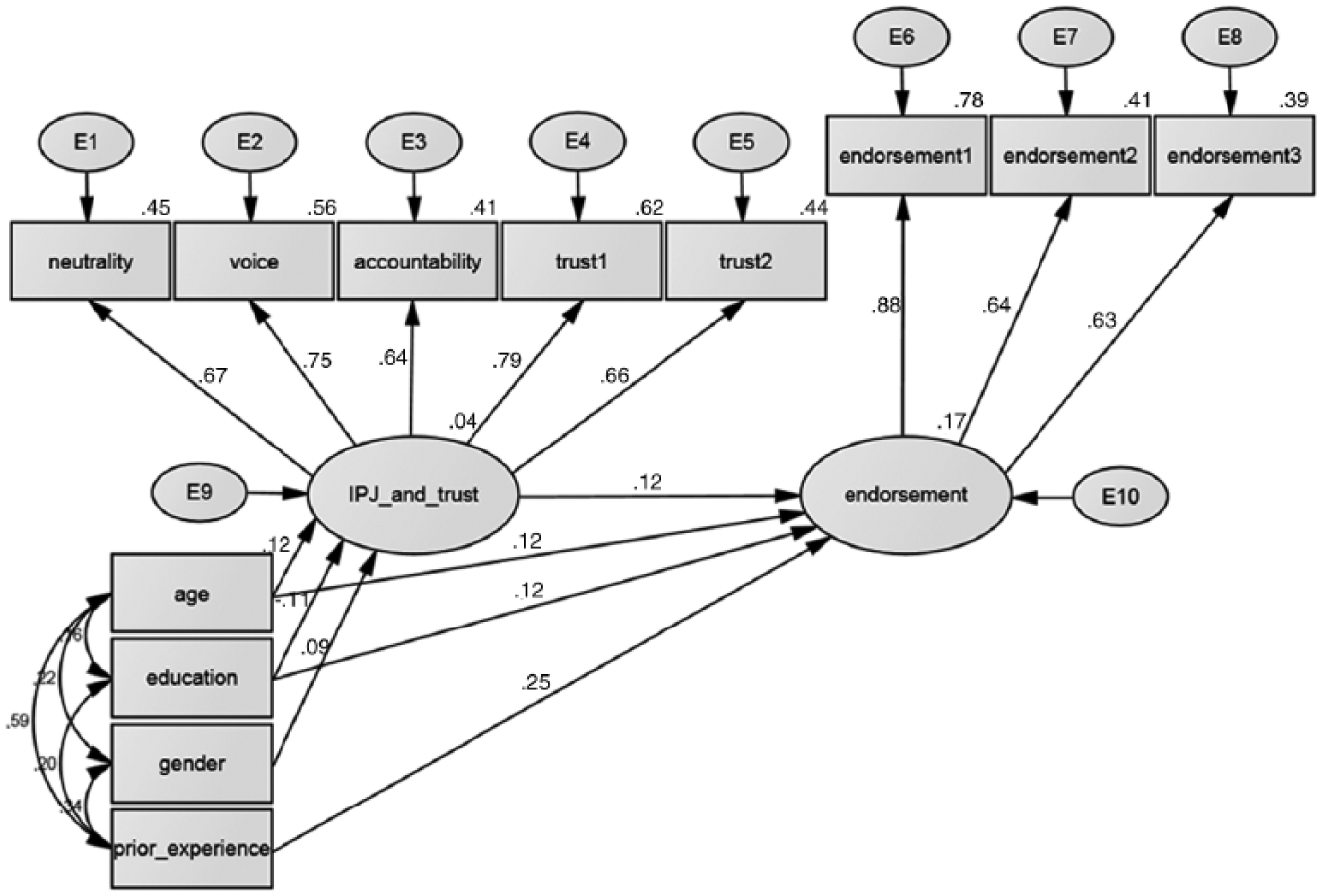
SEM model assessing the impact of internal procedural justice and trust on officers’ endorsement of the rules on the use of force.
Looking first at Figure 3, we find that the latent variable “internal procedural justice and trust” correlates positively with the general measure of compliance. This result suggests that perceived fairness and trust increase officers’ compliance with supervisors and policies of the organization.
Figure 4 indicates that this general pattern also holds for the specific case of officers’ endorsement of rules on the use of force. In the second SEM model too, the latent variable “internal procedural justice and trust” correlates positively with the dependent variable. This suggests that perceived fairness and trust foster officer endorsement of the rules on the use of force.
The background characteristics emerge as determining factors as well. Some are indirectly related to the dependent variables through internal procedural justice and trust, others are directly related, and yet others are both directly and indirectly related. Considering first the indirect effects, we find that age, education, and gender are related to perceptions of procedural justice and trust in supervisors. Those who are older, who are less educated, and who are male, are more likely to perceive fairness and to trust their supervisors. Furthermore, the SEM models show that some of the background variables are also directly related to the general compliance measure and/or officers’ endorsement of rules on the use of force. Education is positively related to both dependent variables. More highly educated officers are more inclined to comply with supervisors and policies of the organization, and to endorse the rules on the use of force. Age is only directly related to the specific compliance measure: older officers are more inclined to endorse the rules on the use of force. We find no direct effects of gender. Finally, the SEM models indicate that prior experience in another police force is not related to “internal procedural justice and trust”. It does, however, have a strong direct relationship with both dependent variables. Officers who previously served in another police force are more likely to comply with supervisors and policies of the organization, and are more likely to endorse the rules on the use of force.
The latent variable “internal procedural justice and trust” and the background variables together explain a considerable percentage of the total variation in the dependent variables. The explained variation totals 20 percent in the general model and 17 percent in the specific model.
Discussion
In the previous decades, both the literature on procedural justice in police–citizen relationships and the literature on organizational justice in non-police organizations have expanded enormously. Few attempts, however, have been made to link these bodies of research and their theoretical frameworks (for some exceptions, see earlier). This article is a step toward filling in that gap. Moreover, it contributes to the literature by widening the focus to a Latin-American country and testing the extent to which theoretical frameworks can be generalized to other cultural contexts. Lastly, another added value of this article is that it relates procedural justice to officer endorsement of regulations on the use of force.
The objective of our study was to scrutinize the relation between internal procedural justice and officer compliance in the Metropolitana. More specifically, based on data from an officer survey, we examined the relation between internal procedural justice and (1) compliance with supervisors and department policies and (2) endorsement of regulations on the use of force against citizens. We predicted that a higher level of experienced internal procedural justice would be related to higher levels of both types of compliance. We furthermore expected that trust in supervisors would play a mediating role in both relationships.
Confirmatory factor analysis revealed that in our data, trust in supervisors is not empirically distinguishable from the perception of internal procedural justice. After combining the perception of internal procedural justice and trust into one variable, structural equation modeling showed it to be positively related to (stated) officer compliance with supervisors and policies. Finally, our analyses indicated that the perception of internal procedural justice and trust is associated with higher levels of endorsement of rules and regulations on the use of force.
The role of trust
The first finding, namely that in our data trust in supervisors is not empirically distinguishable from internal procedural justice, implies a rejection of the hypothesis that trust mediates the relationship between internal procedural justice and officer compliance. How should this finding be interpreted? First, conclusions on the role of trust may be affected by empirical aspects. The operationalization of internal procedural justice and trust, for instance, seems to be an important factor. In this study we used a broad operationalization of internal procedural justice and an operationalization of trust which encompasses aspects of both the definition proposed by Tyler’s classic procedural justice framework (Tyler, 2011; Tyler and Huo, 2002) and the definition proposed by contemporary social exchange theorists (Colquitt et al., 2013). If we had used (more) narrow operationalizations of internal procedural justice and trust, the correlation between the two variables might have been lower and we might have found mediation results. Alternatively, we could have measured trust in a very general way (using items like “I trust my supervisors”), following an approach which has been used in some studies on police–citizen relationships and which has led researchers to conclude that trust mediates the relationship between procedural justice and cooperation with the police (Dirikx and Van Den Bulck, 2014; Murphy, 2013; Sargeant et al., 2014). Future research on police organizations will have to reveal to what extent operationalizations affect the relationship and differentiation between trust and internal procedural justice.
Another issue is when and on which basis we should conclude that (internal) procedural justice and trust are not empirically distinguishable. Some policing and organizational justice studies found correlations between procedural justice and trust of around .75, but presented them as separate variables and reported mediation results (e.g. Konovsky and Pugh, 1994; Sargeant et al., 2014). We decided to merge the two scales into one variable, based on the goodness-of-fit statistics for the CFA model. There is, however, much discussion about the cutoff points for poorly fitting models. As the CFI of our two-factor model was only slightly below .95 and the RMSEA was only slightly above .08, some researchers might have considered these fit indices acceptable and might have used internal procedural justice and trust separately in the SEM models. Some of the policing studies that suggest a mediating role for trust provided no information about tests checking whether the indicators of procedural justice and trust measured different concepts. Moreover, they presented SEM models with a CFI that was below .95 and reported that their models fit the data well (e.g. Sunshine and Tyler, 2003; Tyler, 2005). The latter approach has also been applied in organizational justice studies (e.g. Colquitt et al., 2013). The statistical tests that are conducted, and the criteria which are used to interpret them, thus have important implications for the conclusions that are drawn about the role of trust.
Empirical issues provide one way to deal with the finding that the indicators of internal procedural justice and trust loaded on one factor. Another is to argue that procedural justice and trust together form one concept. This interpretation would suggest that trust does not flow from the experience of fairness, but that it is a constitutive element of perceived procedural justice. Such a conceptualization differs from the one proposed by the prominent theoretical frameworks that guided this research. It is, however, in line with one of the versions of procedural justice theory that is used in the literature on police–citizen relationships. According to this view, trusting the motives of the police is one of the components of perceived procedural justice (Mazerolle et al., 2013a; Tyler, 2004). On the basis of our study one could conclude that a procedural justice framework that conceives trust as an aspect of perceived procedural justice is also useful in explaining supervisor–officer relationships. With regards to the implication for contemporary social exchange theorizing, one could derive from this study that supervisors’ trustworthiness is not an aspect of social exchange quality, but an exchangeable resource. However, it remains to be seen whether these theoretical approaches are more valuable than the ones on which we founded our hypotheses. As mentioned above, support for each of the versions may be related to empirical approaches and methodological choices.
The importance of supervisors’ fairness and trustworthiness
In complex and fast-changing societies, police organizations have to adapt their policies in a flexible way to the needs and expectations of the public. To be successful, they do however also have to gain officers’ support for their policies. The current study indicates that officers’ reactions to the policies proposed by supervisors and management are related to the quality of interaction and communication between supervisors and officers. This confirms previous indications, gathered mainly in the Anglo-American context. Our results suggest that officers will be more likely to support policy initiatives when there are opportunities to give input and when decisions are clearly explained. Given the quasi-military tradition of many police forces, applying such a decision-making process is a challenge. For one, the nature of police work includes the need for quick decision making and responses, which may not always allow for procedurally just managerial techniques (Roberts and Herrington, 2013). Furthermore, police supervisors who have been making decisions on their own for many years may not be inclined to give their employees a say (Myhill and Bradford, 2013). Therefore, in many traditional police organizations, implementing policy change requires two main steps: (1) a change at the supervisory level toward implementing (more) procedural justice; and (2) the encouragement of officers to support and implement new policies. New police organizations, on the other hand, have the opportunity to integrate procedural justice in their organizational model and culture right from the start, which puts them a great advantage compared to traditional forces.
This study also has implications for the prevention of police misbehavior, the use of excessive force in particular. The classic approach to police misbehavior is to blame it on the lack of morality of individual officers. This is called the “bad apple” theory and has been severely criticized (Ivkovic, 2003; Klockars et al., 2000). Rather than viewing police misconduct (only) on an individual level, it is important to examine the role of organizational mechanisms. With regards to the use of (excessive) force, some authors have pointed at the influence of police culture. Terrill et al. (2003), for instance, claim that the use of force over citizens is a function of officers’ varying commitments to the traditional culture of policing. We nonetheless started from a more general perspective – which previously has been used to explain employees’ behavior in non-police organizations – to claim that endorsement of rules on the use of force is a function of the way officers feel treated by their supervisors. By confirming this notion, our study helps to develop a broader view of (excessive) police violence and provides solutions to prevent it. When supervisors cultivate two-way communication, and foster trust, this can result in officers treating citizens more fairly. Our findings suggest that a police force needs to ensure internal procedural justice in order to be able to also function in a procedurally just way on the outside.
Limitations
The insights of our study should be viewed in light of some limitations. First, we point out that we were not able to measure actual police behavior. Rather, we measured attitudes toward supervisors’ directives and the department’s policies, and opinions on the rules on the use of force. This implies that, in the strict sense, this study does not allow us to draw conclusions about officers’ conduct. There is, however, research which suggests that officers’ attitudes are predictive of their actual behavior. In a study by Kop and Euwema (2001), for instance, a positive correlation was found between police attitudes toward the use of force and self-reported use of force.
Second, we are aware that survey respondents may give socially desirable answers. This especially forms a risk in a study on sensitive topics such as trust in supervisors and use of force, with police officers as respondents. We therefore strongly emphasized the anonymity of the survey and the confidentiality of the answers. Questionnaires were completed on a computer, so there were no possibilities of identifying respondents based on their handwriting. To further counter officers’ possible worries of being identified, we limited the questions about personal background information. We for instance asked officers to select an age category rather than a specific age, and asked whether they previously worked in another force without inquiring for how many years. Social desirability may nonetheless still have influenced some answer distributions.
Third, in relation to the previous point, in the Argentinean context we chose to not use strongly formulated (non-)compliance items. A discussion of the draft questionnaire with a small group of police officers and employees of the ISSP made it clear to us that too assertively formulated (non-)compliance questions would hardly yield variation in the responses. Therefore, our general compliance measure comprises two items that start with the formulation “I often feel inclined to openly question …”. One could wonder whether questioning directives and policies can automatically be interpreted as not being compliant, as officers may have their doubts about orders and policies but follow them nonetheless. We note, however, that these items loaded on one factor with the item “I feel like it’s not always necessary to follow the policies of the department”, which suggests that they do measure non-compliance. Further, we point out that in the literature authors have identified certain degrees of (non-)compliance (Bradford et al., 2014). On the basis of this differentiation and the fact that each of the three items of our general compliance scale is characterized by cautious wording, we consider our scale to measure a “soft” form of non-compliance. Although it remains challenging to ask officers directly about their own compliance, especially in particular contexts and in relation to regulations on the use of force, it should be explored how officers’ obedience can be studied more explicitly in future research. This could for instance be done by presenting vignettes about police officer compliance (or lack thereof) in various situations, and asking respondents to evaluate such behavior (cf. Micucci and Gomme, 2005), and combining these with general attitude measures. Another option is to conduct observational research, but in the current setting this would cause considerable practical issues and safety concerns.
Finally, the current data did not allow us to confront our theoretical frameworks with other existing theories to assess their relative explanatory power. Likewise, we were not able to scrutinize the role of other potential mediating factors. In addition to measuring procedural justice, in future studies it might be valuable to include distributive justice as another type of organizational justice (Colquitt et al., 2001, 2013). The literature further suggests that differences in compliance may be related to instrumental concerns such as threat of sanctions (Bradford et al., 2014), officer experience (cf. Micucci and Gomme, 2005), and/or police culture mechanisms (Paoline, 2003). With regards to alternative mediators, it could be worth evaluating the role of organizational identification, organizational commitment, perceived organizational support, leader–member exchange, and negative and positive affect (Bradford et al., 2014; Colquitt et al., 2013; Kop and Euwema, 2001; Tankebe, 2010, 2011). These factors may not only mediate the relationship between internal procedural justice and compliance, but also the influence of officers’ background characteristics. They may, for instance, help explain the intriguing finding that newly trained officers are less inclined to endorse the rules on the use of force than those who previously worked for another security force. Given the history of police violence in Argentina and the fact that the newly established Metropolitana emphasizes respect for human rights in its training of cadets, it was somewhat surprising to find that newly trained recruits are less inclined to endorse the rules on the use of force (although in line with the literature, e.g. Micucci and Gomme, 2005). Besides exploring the role of the mentioned mediators in explaining this result, it could also be worth testing the following hypothesis: as more experienced police officers are more likely to hold supervisory responsibilities themselves, they may attach more importance to conformity, in every aspect of their work (cf. Wolfe and Piquero, 2011). It may also be the case that newly trained officers feel more insecure when dealing with confrontations due to their limited experience on the streets, and for this reason see more necessity of using force.
Concluding remarks
Our research indicates that internal procedural justice may enhance police compliance with policies and regulations, which can have great benefits for the organization as well as the public. Despite the mentioned challenges, police management should try its utmost to implement elements of procedural justice in their organization. If police officers are treated fairly by their supervisors and in turn treat citizens in a procedurally just way as well, this is a promising way forward for the police to enhance citizen cooperation and compliance. We can furthermore expect that such a development, in countries like Argentina but also elsewhere, will contribute to crime prevention and a more effective criminal justice system.
Footnotes
Acknowledgements and Funding
We wish to express our gratitude to the Buenos Aires Department of Justice and Security, the ISSP and the Metropolitan Police Force for their valuable collaboration in this research. We would also like to thank the anonymous reviewers for their insightful comments on an earlier draft of this article. This research was made possible through the Niels Stensen Fellowship that was received by the first author, for which she is very grateful. Additionally, she is thankful for her position as a guest researcher at the VU University Amsterdam Department of Criminal Law and Criminology (Amsterdam, the Netherlands) during her research period in Buenos Aires, and for her position as a visiting scholar at the Gino Germani Research Institute of the University of Buenos Aires (UBA).
Disclaimer
Findings and conclusions as presented in this article are those of the authors and do not necessarily reflect the position or policies of the Buenos Aires Department of Justice, the Superior Institute of Public Security (ISSP) or the Metropolitana Police Force.