




Abstract
Using the example of metal theft in the United Kingdom, this study used mixed methods to evaluate the accuracy of police estimates of the involvement of organized crime groups (OCGs) in crime. Police estimate that 20–30 per cent of metal theft is committed by OCGs, but this study found that only 0.5 per cent of metal thieves had previous convictions for offences related to OCGs, that only 1.3 per cent were linked to OCGs by intelligence information, that metal thieves typically offended close to their homes and that almost no metal thefts involved sophisticated offence methods. It appears that police may over-estimate the involvement of OCGs in some types of crime. The reasons for and consequences of this over-estimation are discussed.
Introduction
Metal has long been a valuable commodity and so been vulnerable to thieves who seek to resell metal for scrap (Bennett, 2008). In the past decade the extent of the problem has increased substantially, driven by increases in demand for (and prices of) many non-ferrous metals (Sidebottom et al., 2011, 2014). Metal thefts have a substantial impact on critical infrastructure such as railways and power networks, causing extensive damage and widespread disruption to the public (Ashby et al., 2014).
The emergence of metal theft as a crime problem has led to significant interest among policy makers. One centre of this interest has been the presumed involvement of organized crime groups (OCGs) in metal theft. Both the United Kingdom and European Union organized-crime threat assessments identify OCGs as being involved in metal theft (Europol, 2013: 25; HM Government, 2013: 21), a link also discussed in the media (e.g. Buckley, 2007; Carter, 2013). British Transport Police (BTP) estimates that up to 30 per cent of metal theft is committed by OCGs, while the Association of Chief Police Officers (ACPO) states that there are 205 OCGs involved in metal theft in Britain (House of Commons Transport Committee, 2012). In a report for the UK Home Office, Mills et al. (2013) estimated that 20 per cent of metal theft is related to organized crime.
These estimates have generally been accepted uncritically. However, there is reason to think that official sources may over-estimate the involvement of OCGs in crime problems. Mills et al. (2013) reported police estimates of OCGs’ involvement in various crimes, but these appear to differ substantially from what might be expected based on available evidence. For example, all cash-in-transit robberies were judged to be committed by OCGs, even though several previous studies have found some to be committed by amateur, opportunistic offenders (Hepenstal and Johnson, 2010; Willis, 2006). Similarly, all distraction burglaries were claimed to be committed by OCGs, despite a recent review by Gorden and Buchanan (2013: 502) noting most offenders were dependent on drugs or alcohol.
Felson and Boba (2010: 11) argued that the public often overestimate the degree to which offending is organized, that advanced levels of organization are unnecessary for most types of crime and that such organization makes some crimes more difficult by introducing needless complexity. Although police officers can be expected to know more about crime than members of the public would, previous research suggests that officers’ perceptions are sometimes inaccurate. Ratcliffe and McCullagh (2001) found that officers could not pinpoint the locations of vehicle-crime hotspots, while Roach and Pease (2014) found that officers substantially overestimated the homogeneity of offending careers. Gregory (2003) found that police descriptions of the geographic reach of OCGs and the ethnic make-up of their members were not supported by analysis of police intelligence information. These examples illustrate the importance of empirically validating police perceptions of a crime problem.
The Present Study
The purpose of the present study was to seek evidence to test police estimates of the involvement of OCGs in metal theft. This is important for several reasons. First, in many countries OCG involvement in a crime attracts additional funding or involvement of specialist units; unnecessary allocation of such resources may cause needless expense or shortages elsewhere. Second, police often have additional legal powers to combat OCGs – for example freezing and subsequent forfeiture of financial assets – that are unavailable otherwise (Finckenauer, 2005: 70). Use of these powers when there is no actual involvement of OCGs may lead to disproportionate interference with suspects’ rights. Third, OCG involvement may make it easier to attract support for police action from politicians, the media and the public, but perceptions of police legitimacy may be damaged if such support subsequently appears to have been based on a false premise.
At the tactical level, what works to prevent organized crime may not work if the crime is largely committed by criminals not linked to OCGs. Attempts to tackle OCGs typically focus on long, expensive and complicated criminal investigations that aim to incapacitate offenders through imprisonment. This may be an effective method of crime prevention if offences are being committed by a small number of offenders or offender groups. However, there is substantial evidence that for many crime problems, prevention activity is most effective when it is focused on protecting potential targets and securing places, rather than focusing on offenders (Clarke, 1997). Thus an erroneous (but well-intentioned) focus on investigating OCGs may deflect police resources from activities that could have a much larger impact on crime.
In order to identify the degree to which OCGs are involved in metal theft, it is necessary to consider what an OCG is. This question has received sustained academic attention (Albanese, 2000, and Finckenauer, 2005, provide reviews) but this has not resulted in the formulation of a single widely accepted definition (Gregory, 2003: 79). In the absence of such a definition, the present study sought to establish the extent of OCG involvement in metal theft by firstly identifying features of the metal-theft phenomenon that practitioners have used to support their proposition that OCGs are involved, and then to test empirically whether the metal-theft problem does in fact have those features. The involvement of OCGs in metal theft is therefore not measured against a universal definition of an OCG (since none exists) but against the features described by practitioners. If evidence of those features is found, it can be said that metal theft involves OCGs in the manner described by practitioners. If no such evidence is found, this would suggest that metal theft does not have those features, that is, either that OCGs are not involved in metal theft or are involved in some way not identified by practitioners.
In order to identify features of metal theft that could be tested, discussions were held with a variety of practitioners (including detectives, intelligence analysts and representatives of infrastructure companies) who were members of an EU project that aimed to increase and exchange knowledge of metal theft. Previous official reports and statements by practitioners were also analysed. From this process, four features of metal theft that practitioners claim suggest the involvement of OCGs were identified that could be tested with data that could be made available. To validate this process, the identified features were presented to and agreed by the members of the EU project.
The first identified feature (F1) was that if OCGs are involved in metal theft, it is likely that metal thieves would have previously been involved in offences commonly associated with OCGs, such as drug trafficking or counterfeiting currency. This statement could be tested by analysing the criminal histories of known metal thieves.
Since the secretive nature of OCGs often makes prosecutions difficult, it is possible that such groups might be involved in metal theft without that being evident from criminal records. To account for this possibility, the second feature (F2) was that if OCGs are involved in metal theft then police would be likely to hold intelligence information suggesting that individual metal thieves are involved in OCGs, even if that involvement could not be proven in court. This statement could be tested by analysing information held by the National Crime Agency (NCA) about the involvement of metal thieves in other offending.
One feature of metal theft cited by police, government and infrastructure companies as evidence of the involvement of OCGs is the willingness of offenders to travel ‘hundreds of miles’ to steal metal (see, for example, House of Commons Transport Committee, 2012). More generally, if OCGs were commonly involved in metal theft, it might be expected that OCG members who steal metal would make use of the capabilities of such groups to travel further than other offenders are able to do in order to find the most suitable targets for offending, both while stealing metal and in their other offending (F3). Evidence on the distance to crime for OCG offenders is limited, but Van Daele and Vander Beken (2009) found that OCG members in Belgium travelled a mean distance of 25 miles (40 kilometres) in order to offend, compared to 11 miles (17 km) for other acquisitive-crime offenders.
The final feature (F4) was that if OCGs are involved in metal theft then it might be expected that some metal thieves would use sophisticated methods to steal metal, using the capabilities and resources of an OCG to maximize their profit from an offence. For example, a metal thief linked to an OCG might be able to obtain forged documents that would allow them to steal large amounts of railway cable from a storage depot, while an offender without such links could only obtain smaller amounts of metal left lying at the side of railway lines. This statement could be tested by analysing the methods used by offenders to steal metal.
The identified features are not binary. Even the highest estimates of the involvement of OCGs in metal theft – for example those reported by House of Commons Transport Committee (2012) – suggest that many metal thefts are committed by offenders unassociated with OCGs. Conversely, it is known that people who commit very serious crimes also commit minor offences (Roach, 2007), so some OCG members would be likely to be found in a sample of offenders convicted of any crime, however minor. Assessing the validity of the statements is therefore one of degree rather than of category: the operant question is ‘if OCGs were involved in metal theft to the extent claimed by the police, would we expect this feature to be present to this extent?’
Data
The methods used in this study required data on people known or believed to have stolen metal. For this purpose, BTP provided details of every person who had been arrested for metal theft from railway lines between 2007 and 2013. The NCA then provided data on the criminal records of these offenders from the Police National Computer (PNC), as well as a summary of any intelligence information held on their involvement in organized crime.
BTP has been collecting data on metal thieves for longer than any other UK force, allowing the use of the largest possible sample. Although people who steal metal from the railway network may be different to those who steal metal from elsewhere, half of arrests for metal thefts in the sample did not relate to thefts from the railway. 1 As such, it is believed that the sample represented the best available source of information about metal thieves.
Some studies of criminal history data analyse only offences for which offenders have been convicted. However, the criminal justice system is designed to avoid false convictions even at the expense of many false acquittals, while many reasons for acquittal do not relate to the accused’s guilt: a witness may die or move to another city, physical evidence might be lost and so on. The over-riding duty to prevent false convictions is essential in court, but criminological research requires a finer balance of risk between falsely including or excluding cases: using only convictions would prevent false positives, but at the expense of ignoring the problem of false negatives. To strike this balance, offenders were included in the final sample if they had been either charged with or cautioned for a metal theft (referred to below as being sanctioned for that offence). A person may only be sanctioned if a prosecutor (or in certain minor cases, a specially trained police officer) believes ‘that an objective, impartial and reasonable jury […] is more likely than not to convict the defendant of the charge alleged’ (Crown Prosecution Service, 2013: 6). Of the 1084 people in the initial sample, 243 were excluded because they had never been sanctioned for metal theft. A further two offenders were excluded because of apparent mistakes in recording their details on PNC, so the final sample consisted of 839 offenders. Individual offences were included in the analysis only if the person had been sanctioned for that offence.
Due to restrictions on the use of personal data, it was not possible to obtain data on other offenders (i.e. those who have never been arrested for metal theft) to form a control group. In order to minimize the extent to which this absence limited analysis of the data that were available, in the following sections comparisons are made to other sources (e.g. Francis et al., 2013; Gregory, 2003; Van Daele and Vander Beken, 2009), where possible.
Characteristics of Metal Thieves
Of the 839 metal thieves in the sample, 97 per cent were male and 94 per cent were white. This compares to an overall picture of 78 per cent of offenders on PNC who were male and 81 per cent who were white (Francis et al., 2013: 21, 23), and is higher than the 70 per cent of OCG members studied by Gregory (2003: 88) who were white. Eighty-three per cent of metal thieves were British nationals – broadly comparable to the 80 per cent of UK nationals among offenders studied by Francis et al. (2013: 21) – 12 per cent were nationals of other EU member states and the remaining 5 per cent were nationals of non-EU countries. The most common non-UK nationalities were Romanian (8 per cent), Polish (1 per cent) and Irish (1 per cent).
The median age of offenders when they were first sanctioned for an offence was 16.4 years, with 61 per cent of offenders first sanctioned while still a juvenile (i.e. aged under 18). This is a higher proportion than the 46 per cent of offenders first sanctioned while under 18 reported by Francis et al. (2013: 30). The median length of a criminal career for offenders in the sample was 9.7 years, 2 during which offenders received a median of 1.9 sanctions per year, much higher than for most offenders on PNC (Francis et al., 2013: 94). Half of metal thieves met the UK Ministry of Justice definition of chronic offending – having been sanctioned for 15 or more offences (Ministry of Justice, 2013: 12) – compared to 5 per cent of offenders in England and Wales (Owen and Cooper, 2013: 11).
Half of metal thieves had been sanctioned for an offence related to metal theft only once, with 75 per cent sanctioned for metal theft either once or twice. At the other extreme of the distribution, 10 per cent of metal thieves (n = 84) were responsible for 31 per cent of metal-theft sanctions, and 5 per cent of thieves (n = 42) were responsible for 19 per cent of sanctions. Nevertheless, for most offenders metal theft formed only a minority of their offending (15 per cent of sanctions in the median case). This held largely true even for offenders (n = 31) sanctioned for more than five metal thefts, for whom a median of 25 per cent of all sanctions related to metal theft.
Table 1 shows the number of metal thieves sanctioned for offences in different categories. Unsurprisingly, theft was the type of offence most metal thieves had been involved in, followed by criminal damage and offences related to the criminal justice system. This latter category includes offences such as failing to appear at court, breaches of police or court orders and so on. Metal thieves had varied offending histories: 92 per cent of offenders who had been sanctioned for more than one offence had been sanctioned for offences in more than one of the categories shown in Table 1. The most common single offences for which offenders were sanctioned were shoplifting, driving without insurance, possessing controlled drugs (most often cannabis, amphetamine and heroin), failing to surrender after being released on bail and driving while disqualified. More than half of metal thieves (58 per cent) had at least one sanction for an offence related to misuse of drugs or alcohol.
Offence categories for which metal thieves have been charged/cautioned.
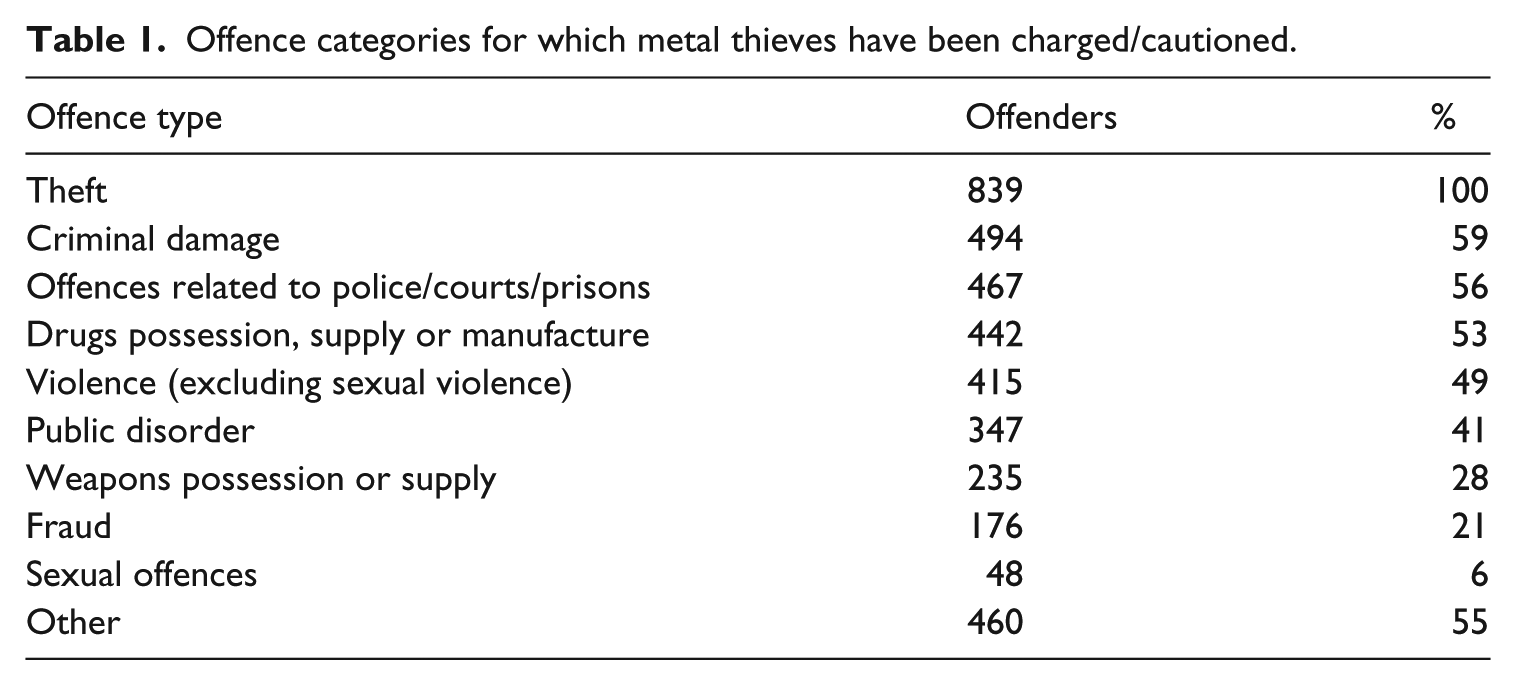
Overall, it appears that metal thieves are diverse, persistent, high-rate offenders who are likely to be male, white and slightly older than the typical offender.
Previous Convictions for Organized Crime
Evaluating F1 – that if OCGs are involved in metal theft then metal thieves will have previously been involved in other organized crimes – required use of an approach developed by Francis et al. (2013: 12) for comparing OCG offenders with ‘general’ offenders. PNC does not include a record of whether or not offences are related to organized crime, so Francis et al. (2013) deemed offences to be ‘indicative’ of an offender’s involvement in an OCG if:
the offence was of a type believed to be associated with OCGs (see Francis et al., 2013: 83–89 for a list);
the offender was sentenced with at least one co-offender; and
the offender was sentenced to at least three years in prison.
The 185 offences believed to be associated with OCGs were defined by a panel of researchers, policy makers and practitioners experienced in dealing with organized crime (for details, see Francis et al., 2013: 14). The offences included illegally importing or supplying commodities such as firearms, trademarked goods or controlled drugs; controlling prostitution or people trafficking; serious violence (particularly involving kidnapping or explosives); and money laundering or other serious fraud. This method of identifying offences indicative of involvement in an OCG is not unproblematic, but using it here allows comparison of metal thieves to the group of ‘general offenders’ studied in that report.
Of the 839 metal thieves in the final sample, four (0.5 per cent) had a previous conviction that suggested their involvement in an OCG according to this definition. This compares to 0.2 per cent of all offenders on PNC between 2007 and 2010 who had a relevant organized-crime conviction (Francis et al., 2013: 14). All four convictions were for money laundering, and all related to laundering the proceeds of metal theft from railways – none of the offenders in the sample had a conviction for an organized-crime offence that was not linked to metal theft. The criminal records of these offenders showed that three had multiple convictions for acquisitive offences and possession of controlled drugs, suggesting that drug addiction may have driven their offending.
The objective of this classification was to identify offences that may be linked to organized crime, not to make a definitive identification. It is unlikely that all instances of any crime type would be linked to organized crime, and so it is possible that this procedure may have erroneously classified some offences as being related to OCGs that were not. Conversely, the requirement for a co-offender also to be not only identified but convicted, and for a particular minimum sentence to be imposed, might have resulted in some offences that were committed by OCGs not being identified. Although this method is imperfect, the very small number of metal thieves with previous convictions for offences believed to be related to organized crime suggests that the involvement of OCGs in metal theft may be less than previously believed, and that there is little evidence to support F1 except for a very small number of metal thieves.
Intelligence on Links to Organized Crime
PNC data are inevitably limited because they only include information on specific offences that the police can demonstrate the person committed. To deal with this limitation, the personal details of each offender were checked against a variety of NCA organized-crime intelligence databases. These databases contain information about a range of criminality that the police suspect – but sometimes cannot prove – a person is involved in.
The sensitivity of the intelligence data means that only limited information can be reported, even in aggregate form. Two categories of offenders were identified with potential links to OCGs, together comprising 11 known metal thieves (1.3 per cent of the sample). This compares to an estimated 41,100 members of 9200 OCGs that the police believe are involved in different types of organized crime across the UK (Association of Chief Police Officers, 2012: 27).
The first category was of offenders suspected of being involved in the supply of controlled drugs. Mills et al. (2013: 22) claimed that all drugs supply in the UK involves organized crime, but it does not follow that every person involved at any stage of the process is a member of an OCG. Natarajan (2006: 179) found that 70 per cent of people in a drug network were linked to only one other member. The available data did not allow identification of how central to a drug network the metal thieves were. However, all but one of the offenders in this category had multiple convictions for volume-crime offences such as shoplifting, failing to attend court and burglary, as well as at least one conviction related to alcohol or drug misuse. Two of the offenders had previous convictions for the supply of drugs, although in both cases this was a minority of their known offending. Although the available evidence is limited, on the balance of probabilities it appears that these offenders are more likely to be peripheral to any drugs-supply network than to be part of a core group, and appear to be more heavily involved in petty crimes than in those related to OCGs.
The second category of interest comprised offenders who were suspected of involvement in people trafficking. Like other types of criminal network, people-trafficking groups involve several different types of offender: those responsible for moving victims clandestinely into or within the UK; those who control victims; and those who use the victims, for example for sexual or labour exploitation. Although it was not possible to identify the roles of metal thieves in any people-trafficking networks, one had a previous conviction that indicated he had sexually abused a child as a ‘customer’ of a people-trafficking group. All the offenders in this group also had convictions for volume-crime offences, with offences related to alcohol misuse (such as drink driving) being particularly prevalent.
Metal theft appeared to be peripheral to the offending careers of most offenders who were linked by intelligence to OCGs, with all but two such offenders being sanctioned for metal theft either once or twice. The narrative offence methods recorded on PNC for nine of the 11 offenders gave no indication that the metal thefts they were sanctioned for were any more sophisticated than for other offenders. The remaining two offenders appeared to be part of groups involved in stealing large volumes of metal in multiple parts of the country. As with F1, it appears that evidence to support F2 exists for only a very small minority of metal thieves, and that those offenders who are linked to an OCG are likely to be both on the periphery of that group and only incidentally involved in metal theft.
Distance to Crime
The third statement was examined by calculating the straight-line distance between each offence location and the offender’s last known home address at the time of the offence. Previous journey-to-crime research has typically made such calculations based on the offender’s home (see Townsley and Sidebottom, 2010, for a review), although offenders may travel to offences from an alternative base. When offender addresses had not been recorded at the time of arrest, the most-recent known address for that offender was used unless it was more than one year old (in which case the offence was excluded from the analysis). Distances to crime were calculated for 82 per cent of all offences and 68 per cent of metal thefts. When multiple offenders were identified for an offence, their journeys were treated separately.
The mean distance to crime for all offending (including metal theft) was 6.8 miles (11.0 km), slightly longer than mean distances found in studies reviewed by Townsley and Sidebottom (2010: 900) but much less than the mean distance of 25 miles (40 km) travelled by the acquisitive OCG offenders studied by Van Daele and Vander Beken (2009). However, the distribution of distances was heavily skewed and so the mean value (although commonly used in distance-to-crime research) is not representative: 40 per cent of offences occurred within one mile of the offender’s home and 58 per cent within two miles; only 7 per cent involved travelling more than 20 miles.
It might be expected that the distance travelled to commit a metal theft would be higher than that for offending generally, because the opportunity to steal metal exists only in certain locations. However, the increase in distance appeared to be small, with 31 per cent of metal-theft sanctions being for offences within one mile of the offender’s home address and 47 per cent within two miles; only 10 per cent involved travelling further than 20 miles.
Statistics based on aggregate distance-to-crime calculations might be misleading because they fail to account for potential variation between offenders and within the career of each offender. At the offender level, there are two potential measures of distance to crime: how far the offender typically travels, and the farthest they have ever been known to travel. Figure 1 shows these values as the distribution of median and maximum distances travelled by each offender. It can be seen that offenders typically travelled only a short distance, and that very few were ever sanctioned for offences further than 20 miles from their home.
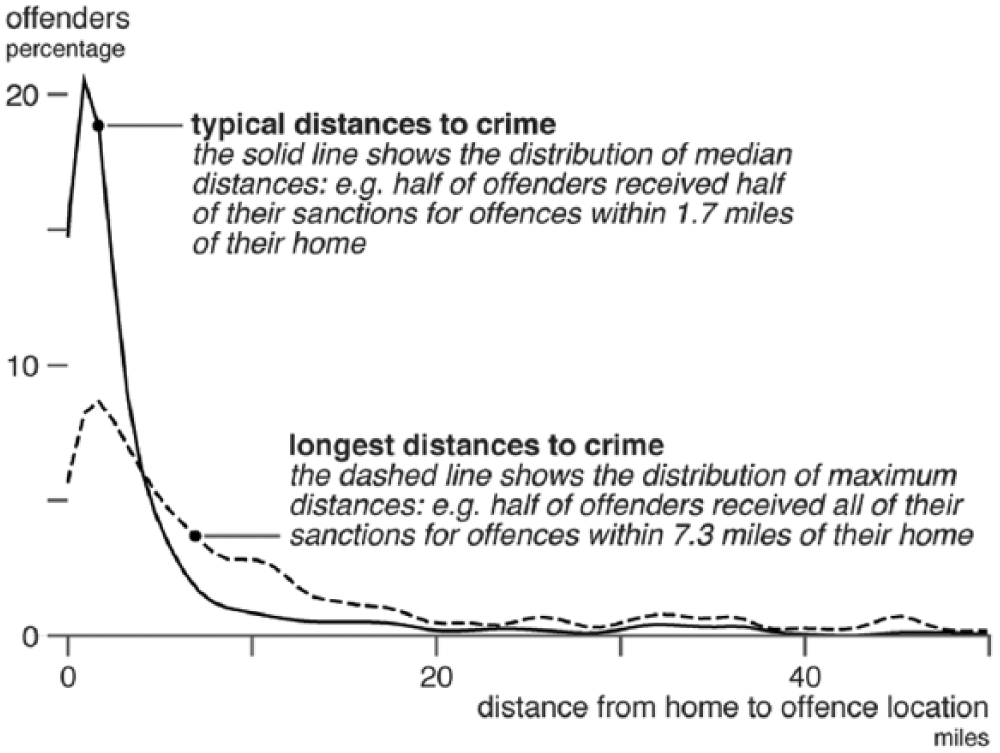
Median and maximum distances to crime for all offences committed by each offender.
Distances to metal thefts were broadly similar to those travelled for other offences: half of offenders committed half of their metal thefts within 2.3 miles (3.7 km) of home and all of their metal thefts within 3.0 miles (4.8 km). Only 17 per cent of offenders had been sanctioned for a metal theft more than 10 miles from their home address, but a very small number of offenders were prepared to travel further: 1.4 per cent of offenders had been sanctioned for a metal theft more than 100 miles from home.
Overall, it appears that a minority of metal thieves are prepared to travel moderate distances to steal metal and to offend in general, but – as has been found for other crime types – most metal thieves commit most of their offences very close to home. It is possible that this result is vulnerable to sampling bias, if offenders are more likely to be linked to offences committed closer to their homes. However, this potential source of error can be mitigated by comparing the present results to those of other distance-to-crime studies that used the same methods. Relatively, the distance travelled by metal thieves – both in general and specifically to steal metal – appeared to be much more similar to that found by previous studies of volume-crime offenders than those found by Van Daele and Vander Beken (2009) for members of OCGs. If willingness to travel long distances is a feature of an OCG, it appears to be a feature that is present for only a very small number of metal thieves.
Offence Methods
Offence records on PNC include a free-text description – written by the investigating officer – of the offence method (modus operandi). The descriptions are relatively short (median length 29 words), limiting what could be elicited from them. A more-detailed source of method descriptions would have been the case files submitted by officers at the conclusion of an investigation. However, these are held by individual police forces (often on paper) and so it would have been impracticable to obtain a national picture in this way.
To create a reasonably sized corpus for analysis, methods for 400 metal thefts (25 per cent of all metal thefts in the sample) were randomly selected. Grounded, descriptive codes were generated by the author to identify methods that were sophisticated or otherwise indicated the involvement of OCGs. 3
Very few methods involved any degree of sophistication. Many appeared to be simple, for example: ‘Suspect and younger friend […] walked past a quantity of lead in an alleyway, returned home to pick up a bag then returned and placed [the metal] in a holdall to sell it at a local scrap merchant’ or ‘Suspect drove [small motor vehicle] to trackside and cut [electrical cable] with a hacksaw. About 150 metres of copper cable was removed, coiled up and placed in his vehicle.’
Offenders used simple equipment – hacksaws, screwdrivers and pliers – to cut up metal (mentioned in 10 per cent of cases) and wheeled rubbish bins or shopping trolleys to transport metal. Vehicles (mentioned in 22 per cent of cases) were usually panel vans or ordinary cars, although there were also offenders on pedal cycles or on foot (mentioned in 8 per cent of cases). Co-offenders were mentioned in 40 per cent of cases, but often in conjunction with very simple methods, for example: Male in company with two others used his girlfriend’s car to drive to railway line […] jumped over fence and went onto tracks to collect any metal that was on the ground, passing it back over the fence to his two accomplices.
Nine offences (2 per cent of the sample) involved an unusual degree of sophistication. Seven records described conspiracies between multiple offenders to steal large quantities of metal, while five involved the use of lorries equipped with cranes to remove large quantities of metal. In one case, the offenders had developed a technique to bypass systems designed to detect cable thefts, while one offence involved forged documentation used to convince security staff that the thieves had permission to remove scrap metal from a railway depot. It should be emphasized, however, that these offence methods stood out for how unusual they were: overall, there was little evidence to support F4.
Discussion
The results presented here suggest that in almost all metal thefts there is no evidence of the involvement of an OCG. The 0.5 per cent of metal thieves with a previous conviction indicative of OCG membership (F1) was similar to the 0.2 per cent of all UK offenders with such a conviction. Although 1.3 per cent of known metal thieves were linked to an OCG by police intelligence (F2), this represents 0.02 per cent of estimated UK OCG members. Very few metal thieves appear to travel long distances to offend (F3), with almost all exhibiting travel patterns similar to those of ‘normal’ volume-crime offenders. Finally, only 2 per cent of metal thefts were found to exhibit methodological sophistication that might be indicative of the involvement of OCGs (F4). Metal thieves are not typical offenders – they seem to be far more prolific than most – but there is little evidence of any but a few being involved in OCGs.
The limitations of each method are discussed in the relevant sections above. One general limitation of using PNC data is that some offenders may never be arrested, and that offences for which offenders are detained are not representative of their total offending. However, the 12 per cent of metal thefts that led to an offender being sanctioned (Robb et al., 2014) compares favourably to similar studies reviewed by Bowers and Johnson (2015: 119). Furthermore, common alternative data-collection strategies suffer from similar issues. Offender interviews can cover undetected offending by known offenders, but provide no information about unknown offenders. The relatively small number of offenders who steal metal (compared, for example, to the number who shoplift) makes self-report surveys impracticable.
Given these limitations, it is likely that there will be some degree of inaccuracy in the estimates of OCG involvement produced by each method. However, the difference between the results presented here and the official estimates discussed above is large enough that it is unlikely to be solely due to inaccuracies based on data or methods. For example, the 2 per cent of metal thefts with methods sophisticated enough to suggest the involvement of an OCG would have to be an underestimate by a factor of 10 to reach the estimated proportion of offences linked to OCGs estimated by Mills et al. (2013) and by a factor of 15 to approach the police estimates reported by House of Commons Transport Committee (2012). One limitation of this comparison is that the police estimates relate to the proportion of crimes related to OCGs and the results of analysis relating to F1 and F2 relate to the proportion of offenders linked to OCGs. If OCG-linked metal thieves were prolific metal thieves, a small proportion of such offenders might account for a higher proportion of crime. However, the results presented above show that the most prolific metal thieves are not those with links to OCGs, with only two metal thieves linked by intelligence to OCGs having more than two sanctions for metal theft.
It therefore seems clear that the involvement of OCGs in metal theft is substantially less than is estimated by police officers working on metal-theft cases. This might seem a surprising result because police officers might be expected to know the evidence base in their field of expertise. It is therefore important to ask: why might officers over-estimate the involvement of OCGs in crime?
One answer might be that police are simply pre-disposed to look for OCGs, particularly when a new crime problem occurs. There are two potential reasons for this. First, crimes committed by OCGs tend to cause more concern among both the public and professionals than comparable offences without an organized-crime link (Woodiwiss and Hobbs, 2009). Second, there is a strong tendency towards causal reductionism in thinking about crime: people preferentially ascribe changes in crime rates to a single cause rather than a complex interaction between multiple factors (Montgomery, 1996: 109). The involvement of OCGs may provide a more appealing and simple explanation for a crime problem than other explanations, such as the behaviour of a large number of unconnected minor criminals being simultaneously influenced by changes in metal prices (Sidebottom et al., 2014) or fluctuating demand in the Chinese construction industry (Sidebottom et al., 2011). This is not a criticism of individual police officers – particularly those who have understood the influence of economic factors in metal theft – but rather a statement of how external factors can influence police decision making.
Once practitioners or policy makers look for the involvement of OCGs in a crime type, the breadth of modern definitions of organized crime make it highly likely that they will find it. The UK government has recently adopted (in section 45 of the Serious Crime Act 2015) the definition of an OCG set out in the United Nations Convention against Transnational Organized Crime (UNCTOC). This has four elements: (1) that the group contain three or more persons; (2) that the group exist ‘for a period of time’; (3) that group members commit ‘serious crimes’ (defined in the UK as an offence carrying a maximum penalty of seven or more years in prison, regardless of the actual sentence imposed); and (4) that they intend to obtain material benefit (United Nations Office on Drugs and Crime, 2004: 5). In the case of metal theft in the UK, the last two elements will always be present: the offence of theft carries a maximum sentence of seven years’ imprisonment, and theft is intrinsically done for material gain. The analysis of offence methods above showed that at least 40 per cent of metal thefts involved more than one offender, so the only remaining requirement is the need for the group to exist ‘for a period of time’. Since no minimum time is specified, this could be taken simply as meaning that whenever two metal thefts are committed by the same multiple offenders, they become an OCG. This does not mean, of course, that any multiple of thieves would be considered an OCG by a person on the street, but the definition is so broad that almost any such group could be defined as an OCG within it. The number of false-positive cases seems to be limited only by whether practitioners choose to apply the definition to its full extent in a particular case.
Once a person or organization believes they have identified OCGs as being involved in a particular crime problem, that involvement is likely to become received wisdom as a result of the operation of two cognitive processes outlined by Tversky and Kahneman (1973). The ‘availability heuristic’ is the human tendency to give disproportionate weight to information that easily comes to mind. In the case of metal theft, information that supports pre-existing ideas about likely causes of a problem – such as ‘metal theft is committed by OCGs’ – is likely to be repeated and therefore more easily come to mind, which in turn means it more easily comes to mind and is more likely to be repeated. The ‘representativeness heuristic’ describes how people are more likely to believe something to be of a particular type if that thing is similar to the stereotypical description of things of that type. For example, people may believe metal theft to be committed by OCGs because it has features – such as being done for economic gain and causing substantial damage to society – that are stereotypically associated with OCGs. Confirmation bias – the tendency to give greater weight to evidence that supports existing ideas than to evidence that does not (Wason, 1960) – is also likely to push those who have chosen to look for OCGs into believing they have found them (for further discussion of how confirmation bias can influence police perceptions of crime problems, see Townsley et al., 2011: 165). Put more simply, estimates of OCG involvement in crime problems risk ‘becoming self-referential, recycling the prevailing values and priorities of the political and law enforcement agencies consulted’ (Edwards and Levi, 2008: 373).
It should be emphasized that nothing in the preceding explanation should be read as a criticism of individual practitioners or policy makers who believe OCGs are involved in metal theft. In particular, some senior BTP officers have spoken publicly of the link between metal prices and the rate of metal theft. The social and cognitive biases described here are not failures of individuals, but rather the products of how humans have evolved to think, both individually and in society. It is the inevitability of these biases influencing our thinking that makes the application of empirical study so important and the increasing interest among practitioners in ‘evidence-based policing’ (Sherman, 1998) so welcome.
There is reason to believe that moving the focus of efforts to prevent metal theft away from the prosecution of OCGs may help practitioners and policy makers to prevent metal theft. With the exception of crime problems involving a single serial offender, incapacitating criminals is often ineffective at reducing crime because the chance of a given offence ending in imprisonment is extremely low (Barclay and Tavares, 1999). It is often more effective to employ problem-oriented policing methods (Eck and Spelman, 1987; Goldstein, 1979) such as crime scripts (Cornish, 1994) to identify the points in the metal-theft process at which police can have most impact. Indeed, this approach has already allowed police to identify scrap-metal dealers as key actors in metal theft and to use that understanding to reduce thefts (Morgan et al., 2015). There is some evidence to suggest that shifting to a focus on situational prevention measures of the type often used in problem-oriented policing may be effective at preventing crime even if a large proportion of it does involve OCGs. Edwards and Levi (2008: 375) argued that OCG members were likely to respond to changes in the environment just as other criminals do, and that situational prevention could be an effective and inexpensive way to prevent crimes committed by OCGs. Similarly, Hancock and Laycock (2010) showed that crime scripts can be useful in identifying the points in the process of committing a crime at which interventions against OCGs are likely to be most effective.
The benefits of moving from an enforcement-based approach to a focus on prevention may extend beyond the specific problem of metal theft. There is a common perception that the involvement of OCGs in crime is often underestimated (Dubourg and Prichard, 2007; Kleemans, 2007; Van Den Bunt, 2004), at times taking on the appearance of a moral panic (Woodiwiss and Hobbs, 2009) in which it is asserted OCGs are a threat ‘the magnitude and seriousness of which cannot be overestimated’ (United Nations General Assembly, 1988: 15). By contrast, relatively little attention has been given to the possibility that OCG involvement might be overestimated. The present results illustrate the importance of balancing potential sources of error in any estimate of OCG involvement in a crime to ensure that exclusive focus on avoiding underestimation does not make overestimation more likely.
The present research was the first to study the involvement of OCGs in metal theft, leaving several potential avenues for further study. First, offender interviews could be used to attempt to identify any links between OCGs and metal theft not identified using the present methods. Second, it is likely that the present results will not translate to other countries, and this should be explored. The UK may be particular because – although part of the EU – the UK has a land border with only one other member state and is not part of the Schengen border-free zone. The UK also has less experience of very large, hierarchical OCGs such as those found in Sicily or some parts of the United States. These factors may serve to limit the influence of organized crime in the UK compared to other countries. Third, the present research only looked for potential involvement of OCGs in the theft of metal itself, not the subsequent handling of stolen metal. Although stolen metal is believed to be commonly disposed of by simply selling it to local scrap yards (Ashby and Bowers, 2015), it is possible that additional regulation of such facilities (recently introduced to curb metal theft) may make illicit processing of stolen metal attractive to OCGs that provide similar services for other types of illicit property.
Footnotes
Acknowledgements
The author wishes to thank Steve Welsh, Ian Janes and John Power of the National Crime Agency for facilitating access to data and discussions with practitioners that informed the analysis presented here, as well as Kate Bowers, Hervé Borrion and three anonymous reviewers for their comments on the manuscript.
Declaration of conflicting interests
The author(s) declared no potential conflicts of interest with respect to the research, authorship, and/or publication of this article.
Funding
The author(s) disclosed receipt of the following financial support for the research, authorship, and/or publication of this article: This work was supported by the Engineering and Physical Sciences Research Council (EPSRC) [grant number EP/G037264/1] and the Pol-PRIMETT II project, which received financial support from the Prevention of and Fight against Crime (ISEC) programme of the European Commission Directorate General for Migration and Home Affairs.