



Abstract
The Scottish Crime and Justice Survey (SCJS) consistently suggests similar prevalence of domestic abuse among men and women, a finding used variously to indicate men and women’s equal risk of abuse and to dismiss the survey as a means to explore such experiences. However, assertions of equal risk are based on limited analyses of data reduced to ‘key’ figures for public dissemination, and subsequent criticisms fail to meaningfully engage with the broader data offered by the survey. Theoretically informed multivariate analyses demonstrate that risk of abuse is inadequately captured by such figures, supporting that women and men are not at equal risk, and that gender is but one of a number of influential risk factors. This article proposes the SCJS data could be put to greater use, offering rich information for developing theory and responses to violence, and that critical engagement with the survey is necessary to facilitate methodological improvement.
Introduction
Following growing pressure to address domestic abuse, survey methods have increasingly been adopted to estimate the prevalence or risk of abuse across national populations. Since 2008, Scotland, like England and Wales, has utilized its national victimization survey to explore experiences of abuse perpetrated by partners, despite historical criticisms regarding the use of such methods to capture prevalence. Early US attempts to establish prevalence relied on the much maligned Conflict Tactics Scale (CTS; Straus, 1979), wherein individuals would identify how many times they had used acts of physical violence, with responses scaled to determine violence extent and severity. Findings suggested a controversial ‘sexual symmetry’ of violence (Dobash et al., 1992) with women emerging as equally or more likely than men to use violence in relationships (Hines and Douglas, 2009; Straus, 1979; Tjaden and Thoennes, 2000). The idea that men could be as at risk as women runs contra to dominant feminist expositions of domestic abuse as an issue of men’s violence against women. Attempts to address this sexual symmetry focus on critiquing the measures used to gather data on the basis that meaning and context render men and women’s violence fundamentally different. Support is typically drawn from data gathered via different methodologies, demonstrating that very different behaviours can be conflated through reliance on narrowly conceptualized ‘act-based’ measures of violence and lack of attention to victim perspectives (Dobash and Dobash, 2004; Dobash et al., 1992; Johnson, 1995, 2001; Johnson and Leone, 2005). Further issues are raised around definition, measurement and methods of administration in surveys. ‘Fit’ between victims’ perception and definition of their experience (and of themselves and their abuser) and question wording influence responses (Thoresen and Øverlien, 2009), as might locating questions on the behaviour of partners or ex-partners within particular forms of survey (Johnson, 1995; Walby and Myhill, 2001). The effects of survey mode are also made clear, with the privacy of self-completion methods shown to encourage substantially greater rates of abuse reporting (Walby, 2005), and possible absences of the most severely and recently abused from typical sampling frames are highlighted (Walby and Myhill, 2001).
The self-completion SCJS partner abuse module has been developed broadly in line with the literature on appropriate methodologies, although key limitations remain. Presently, a series of questions ask respondents about different forms of physical and psychological abuse they have experienced since the age of 16, and query whether the abuse reported occurred within the 12 months preceding the survey interview (the ‘reference period’). As per other population surveys, questions are presented to men and women. While the development of abuse indicators has inevitably drawn from the CTS example, a far wider range of behaviours are included and, moreover, the survey is not concerned with counting and scaling specific incidents, but rather in capturing broad experience, focusing on victimization not perpetration. Nevertheless, headline findings have led to controversy due to consistent similarity of prevalence among men and women (around 3 per cent each) within the survey reference period (MacLeod and Page, 2010; MacLeod et al., 2009; MacQueen, 2014; Scottish Government, 2011). The reduction of the data into ‘key figures’ for public presentation, and the disproportionate attention that this single figure has received, has led to dismissal of the SCJS in line with criticisms levelled at historical attempts to gather information on abuse using questionnaire-based survey methods. Specifically, McFeely et al. (2013:2) critique the survey as adding to gender symmetry myths, falsely espousing men and women experience equal risk of victimization, due to its incident focus, simplistic counting of discrete acts of physical violence and ‘narrow, short-term approach’ to violence.
This is a flawed criticism, however, arising through lack of engagement with the SCJS, its measures, methods and resultant data. It is not appropriate to dismiss the survey without exploring the wider context of the 3 per cent figure. The SCJS offers rich contextual data to draw upon and simply looking deeper into the published reports highlights there is more to explore. It is possible to locate recent experiences of abuse within the context of lifetime prevalence, acknowledging broader victimization and not incorrectly labelling victims of abuse ‘non-victims’ (Smith, 1994). Indeed, that around two-thirds (61 per cent) of SCJS respondents experiencing recent abuse report that their abuse has been ongoing over the longer term supports the assertion that the two groups are not so distinct (MacQueen, 2014). It is also possible to examine prevalence and risk across other key groups using the demographic information provided. Survey publications consistently indicate that this may vary substantially, but ‘at risk’ groups are routinely ignored in public discussion.
The aim of this article is to demonstrate the importance of contextualizing the discussion about prevalence and risk of abuse through more rigorous engagement with such data. The purported similarity in risk between men and women is critically explored through theoretically informed analysis, considering other possible explanatory factors within the existing dataset and linking these back to lifetime prevalence, bringing the extrapolated figures back ‘into the fold’ of the more complex dataset in which they are situated. To anticipate the key findings, when exploring lifetime prevalence and controlling for other influential factors, men do emerge as less at risk of abuse than women, but gender is shown to be just one of a range of influences on risk. Furthermore, through this deeper analysis and engagement, the greater potential of the SCJS as a tool through which we might learn about victim experience is considered through discussion of the conceptual and methodological improvements that could be made. The analyses should be seen as the first phase in a wider analytical programme to inform such a discussion. The first step though is to critically address present misunderstanding of the survey and misrepresentations of prevalence and risk.
Prevalence, Risk and Intersectionality
In addressing the issues outlined above, this article proceeds in line with a growing body of literature around intersectionality, the role of gender and other identities in shaping experiences of violence, and how this ought to be applied in analyses. It is well established that experiences of violence are shaped by multiple gender, race and class identities, and that individual position within interlocking social structures alters the meaning and consequences of violence, and how it is responded to (Bograd, 1999; Crenshaw, 1991; Sokoloff and Dupont, 2005). As such, the primacy of gender inequality as the explanatory model for domestic abuse, and the traditional message of the violence against women campaign – that all women are at risk of domestic abuse – have been challenged. Emphasizing the universality of risk for women fails to address other inequalities that abuse victims may have to contend with, hindering pathways to safety (Bograd, 1999; Crenshaw, 1991; Lindhorst and Tajima, 2008). Failure to provide a sound explanation for violence, and ensure adequate pathways to safety for those who may be disproportionately victimized, risks jeopardizing the validity and legitimacy of the anti-violence movement (Sokoloff and Dupont, 2005) and its capacity to effect change. Nixon and Humphries (2010) note increasing demand for a more nuanced collective framing of domestic violence that accounts for the influence of inter alia gender, race, class and disability. The messages of traditional movements were necessary in steering direction in policy and practice, but growing evidence supports the importance of intersectionality and the marginalization of the experience of particular groups, necessitating a more empirically accurate and reflective picture of vulnerability to, and experience of, violence (Bograd, 1999; Donovan and Hester, 2010).
Such challenges, and the caution against privileging one identity over another, present new difficulties in conceptualizing and analysing relationships between inequalities. The potential upshot is rejection of categorical approaches in explaining domestic abuse, risking denial of key structural frameworks shaping identity and experience. The dilemma is to make visible the separate components of identity, while recognizing that social relations may change at the point of intersection between identities (Walby et al., 2012). Strid et al. (2013) suggest the adoption of the concept of ‘mutual shaping’ whereby identities, or systems of inequality, are recognized as adapting and changing one another when brought together, yet remaining as individual facets of overall identity: the presence of one may shape, but not destroy, another. Analyses of intersectionality and policy responses to issues such as domestic violence must proceed, therefore, in two phases. First, separate inequalities that shape the experience of abuse must be identified and rendered visible and, second, how these different elements may shape one another must be considered.
Those advocating the need to consider the impact of multiple inequality and intersectionality on domestic abuse discuss a range of possible influences within gendered contexts, including age, socio-economic disadvantage (as well as other disadvantaged statuses brought about through state mechanisms in welfare, justice and immigration), race and ethnicity, sexuality and disability (Bograd, 1999; Crenshaw, 1991; Lindhorst and Tajima, 2008; Sokoloff and Dupont, 2005). Moreover, there is growing evidence to support the impact of such identities and inequalities in shaping the experience of abuse: sometimes within the context of violence against women, yet sometimes refocusing the debate to explore the experience of violence across gender, acknowledging that men do report experiences of abuse, however different or similar these may be from the experiences of women. For example, research increasingly highlights the greater risk of experiencing abuse among young people. The SCJS and other surveys consistently show high prevalence of violence among younger respondents and interesting curvilinear patterns for lifetime prevalence (MacLeod and Page, 2010; MacLeod et al., 2009; MacQueen, 2014; Scottish Government, 2011), and studies focusing on younger teenagers also suggest higher rates of victimization than in the general population (Barter et al., 2009; Fox et al., 2013). Furthermore, attitudinal studies reveal high acceptance and support for gendered ideals and use of violence within young people’s real and imagined relationships (Corr et al., 2013; Lombard, 2013).
Social and economic disadvantage are increasingly well-evidenced influences on risk of violence and abuse. Links between lack of economic resources and increased likelihood of victimization are observed (Benson et al., 2003; Walby and Allen, 2004) and complex analyses highlight combined effects of economic disadvantage and social exclusion, and the resultant stigmatization, labelling and isolation, in fostering violence and reducing capacity for escape (Bograd, 1999; Murray, 2007; Murray and Farrington, 2005). Emerging research also queries whether the effect of disadvantage may be observable at the individual or household level, or at the wider neighbourhood level, suggesting broader social ecology may influence risk levels (Benson et al., 2003; Lauritsen and Schaum, 2004). Critically, it is suggested that this relationship between neighbourhood and risk is strongest within the most disadvantaged areas. How this may be explained is debated, although factors more commonly invoked to explain high volume street crime – weak social ties, low collective efficacy and supportive cultural norms – have been suggested (Browning, 2002; Pinchevsky and Wright, 2012). Relatedly, risk of abuse is frequently highlighted as high among offenders, particularly those imprisoned. Female offenders are repeatedly observed to experience high levels of violence and abuse, perpetrated by partners and family (Batchelor, 2005; Burman and Batchelor, 2009; Loucks, 2004), with similar patterns observed among serious offending young men (Gadd et al., 2013). Broader research also highlights the links between experiences of other forms of victimization, such as parental and other family abuse or more general violent crimes like robbery and assault, and increased risk of partner abuse (Batchelor et al., 2001; Fox et al., 2013; Gadd et al., 2013; Piquero et al., 2014).
The impact of key identities, notably race and ethnic background, sexuality and disability, are often examined separately. Yet core similarities in emerging findings highlight how these identities were hidden within ‘mainstream’ understandings of domestic abuse, and why little is known or understood about the risks faced within such groups. Minority race and ethnic background is frequently linked in US research to heightened risk of violence and abuse (Carbone-Lopez, 2013), albeit tenuously due to strong overlap with socio-economic disadvantage (Sokoloff and Dupont, 2005). This is not a pattern repeated in UK analyses (Walby and Allen, 2004), although it is established that minority ethnic women may be subject to a range of abusive experiences by partners and their wider families, many of which are excluded from the abuse indicators utilized in large surveys (Gill, 2004, 2006). The perspectives of same-sex couples and disabled women are emerging in debates on risk, with the prevalence of abuse within same-sex relationships suggested to be comparable or higher than in heterosexual relationships (Donovan and Hester, 2010; Hester and Donovan, 2009; McClennen, 2005; Tjaden and Thoennes, 2000), and disabled women’s heightened vulnerability, due to dependence on partners to facilitate daily life and intimate, personal care, increasingly raised as a concern (Barile, 2002; Nixon, 2008). Across each of these groups, a range of barriers to disclosure and participation in research are highlighted as limiting our ability to assess prevalence and risk. For a number of minority ethnic groups, honour, shame and familial control coupled with language and conceptual barriers and fear of ostracization (Burman et al., 2004; Gill, 2004) are cited as key, with fear of rejection by the group or community also flagged as an issue in research with same-sex couples (Donovan and Hester, 2010). The lack of fit between abusive experiences in different contexts and the dominant conceptions of domestic abuse utilized in empirical research is also problematized. Thus it is imperative to consider the risks borne within such groups, but the limitations of our current methodologies and measures must be acknowledged.
Overall then, there is a broadening field exploring the prevalence of domestic abuse and challenging the primacy of gender inequality as the key risk factor. To develop effective theoretical accounts of abuse and the role of inequality and identity in shaping risk, we must test which of these proposed explanatory factors have significant effects on the likelihood of experiencing abuse.
Data
The Scottish Crime and Justice Survey (SCJS) is a national victimization survey drawing on a representative sample of adults (aged 16 and over, no upper age limit) living in private households in Scotland. An optional self-completion module (described previously) explores relationship-based abuse, asking respondents whether they have experienced any of a range of physical and psychological abusive behaviours. The physical behaviours range in severity, encompassing acts of aggression through to serious physical and sexual violence. The psychological indicators include behaviours and threats that may be used to achieve control and coercion (see Appendix 1 for a full breakdown) and respondents are offered ‘other’ options to allow inclusion of additional behaviours they consider important. The terms ‘domestic abuse/violence’ are not introduced until the end of the module.
While lifetime abuse prevalence, typically reported by around one-sixth of respondents in any given survey year, provides a substantial sample size for analysis, the low prevalence of abuse within the survey reference period (typically 3 per cent) precludes meaningful analysis of the experience of minority groups (see MacQueen and Norris, 2016). To test appropriately for risk of abuse across minority groups, this analysis draws on a dataset combining responses across two survey sweeps. The 2009/2010 and 2010/2011 sweeps were selected due to the short and stable time period covered, and the inclusion of key explanatory variables not available in other sweeps. The overall sample drawn from the combined self-completion datasets is 29,046. Of this figure, 23,126 respondents reported having had at least one partner in adulthood, and it is to this subset that questions about experience of abusive behaviour are posed. Overall, 17 per cent report experiencing abusive behaviour at some point since they were 16 years old. The prevalence reported within each of the separate survey years is very similar at 16.9 per cent and 17.0 per cent for 2009/2010 and 2010/2011 respectively. Only 3 per cent of the overall combined sample report having experienced such behaviour within the survey reference period (the 12 months preceding their survey participation), although within this group 74 per cent (n = 663) reported having experienced abuse prior to this period as well.
Measures
Variables were selected as indicators of key constructs discussed above on the basis of suitability, and availability within the SCJS. How well these available indicators reflect the constructs is an important question for improving the SCJS and other surveys. The differing prevalence of partner abuse across the key indicator variables is reported in Appendix 2, further highlighting the importance of deeper analysis of the survey data. Gender is included as a somewhat limited categorical variable documenting respondents’ self-identification as male or female (as is common in most large-scale social surveys, no further response options are available), and age is included in continuous form in both models (the age range of sample respondents is 16–98 years). Due to observation of a curvilinear relationship between age and reported lifetime prevalence (see Appendix 2), an age squared variable was created to test this relationship. A series of variables indicate individual- or household-level socio-economic status. Occupational status is indicated by an NS-SEC System-based categorical variable and household income by a categorical variable with ‘missing’ responses included, in part due to the large numbers of respondents refusing to answer income questions (a common issue across social surveys), but also because of the interesting response pattern of refusers (see Appendix 2). A further categorical variable describes how big a problem it would be to find £100 to meet unexpected expenses, indicating household financial strain. Again, ‘missings’ are included.
Given emerging interest in area-level disadvantage, a variable indicating deprivation of the area of respondent residence is included. This categorical variable indicates which quintile of the Scottish Index of Multiple Deprivation (SIMD) the area falls within. Overall, very few measures capture the nature of the area of residence, particularly in terms of social bonds and collective efficacy. Nevertheless, the survey does include a series of five indicators of perceived collective efficacy asking the extent to which respondents’ trust people in their local area to provide support and security, and address disorder. Exploratory factor analysis using principal components analysis extracted a single factor here, suggesting these indicators are derived from a single factor or scale (reliability confirmed by Cronbach’s α .78) suitable for inclusion in the analysis.
Only time-limited measures of wider victimization are available for analysis. Measures of respondents’ experience of personal and property crime during the survey reference period are included, as well as whether they report other experiences of abusive behaviours such as less serious forms of sexual assault or stalking and harassment. As with partner abuse, such questions are posed to men and women, and experiences reported by both. A core limitation of the survey in capturing experiences of abuse is the separation of these particular behaviours into distinct modules, which cannot be meaningfully linked to questions on partner abuse. Given existing evidence on abuse (Krebs et al., 2011), and the patterns observed in the bivariate analysis in Appendix 2, it is highly likely these experiences are linked in reality, if not in the survey, and their inclusion in analyses should support such an assertion. The SCJS does not gather information about respondents’ offending behaviour, but does include a measure of whether an individual has ever been sentenced or remanded in Scotland, providing a crude proxy for offending.
Minority ethnic status is explored using two categorical variables indicating respondent defined ethnic background and religious affiliation, and sexuality is included using a categorical variable indicating whether a respondent reports as heterosexual, gay or lesbian, bisexual or ‘other’. Disability is indicated by a derived categorical variable capturing whether respondents report having a disability, and whether this limits their day-to-day activities in any way.
Finally, in analyses considering recent abuse experience, a variable indicating whether the respondent reports historical abuse (i.e. abuse occurring prior to the 12 month reference period) is included.
Analytical Technique
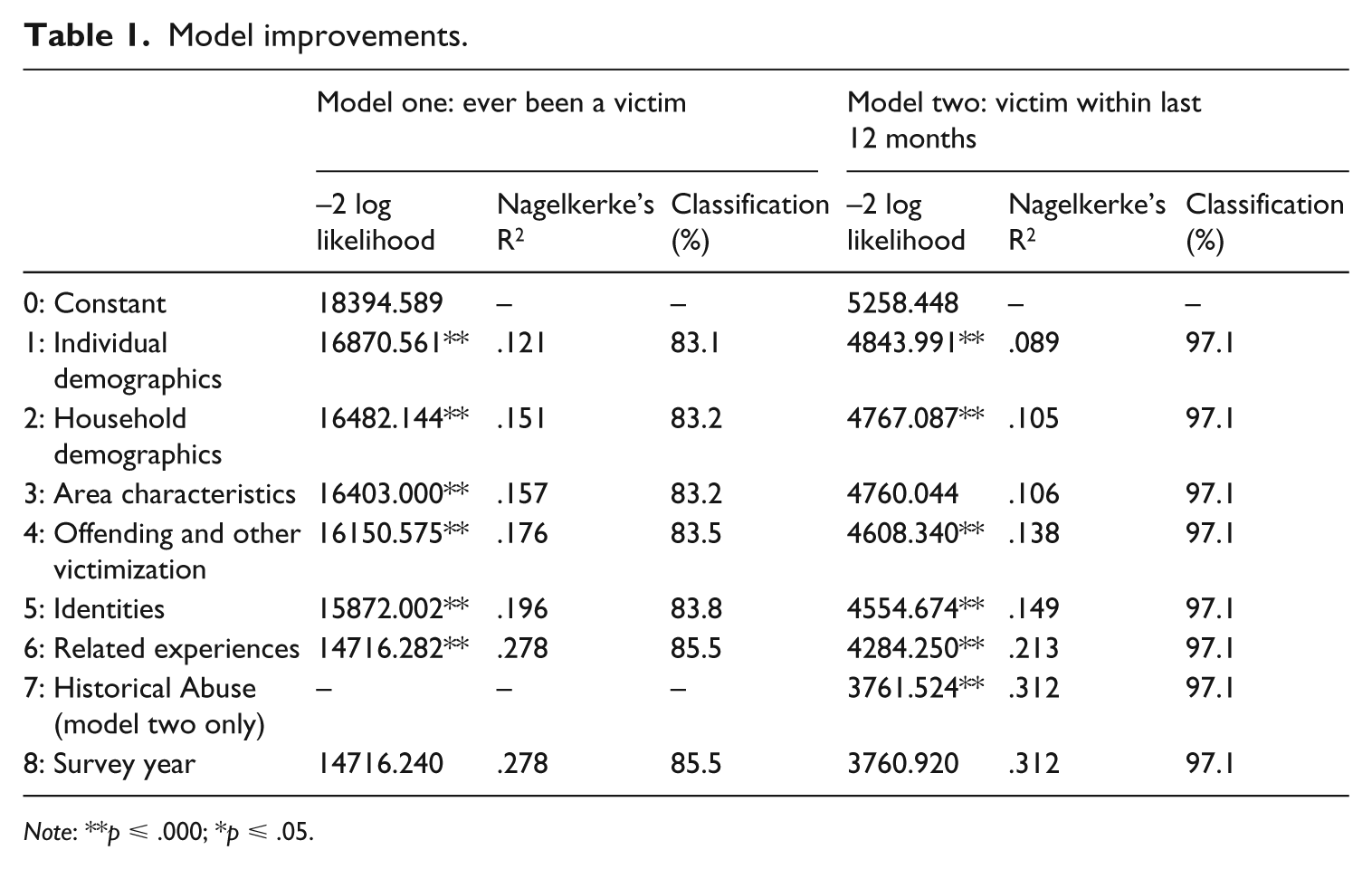
Logistic regression modelling was employed to identify those indicators of identity and inequality (entered as dummy variables) with significant and independent effects on the likelihood of an individual experiencing abuse. 1 Two models were specified initially. The first predicted a respondent ever having experienced abuse, allowing consideration of all those who reported experiencing abusive behaviour, and the second predicted experience of abuse within the survey reference period. Given the exploratory nature of this research, and the wide array of potential influences on the outcomes of interest, each model was specified incrementally. A block entry approach was employed, with key blocks specified according to the broad categories of variables identified within the literature: individual and household-level demographics; area characteristics; offending and other victimization; related experiences; identities; and historical abuse. To control for unforeseen changes over time across survey sweeps, survey year was also included as a variable in the models. This was not significant in either. As demonstrated in Table 1, each block makes a significant contribution to its respective model (with the exception of survey year), although the overall extent of the improvement offered does vary. We observe that the impact of area characteristics is comparatively small (failing to achieve significance in model two), but that related experiences and historical abuse exert strong effects on model fit and explanatory capacity. In view of the results observed here, the complexity of the final models is justified.
Model improvements.
Note: **p ⩽ .000; *p ⩽ .05.
Notwithstanding the above, the SCJS draws on a population sample in order to generalize findings and estimate population-level prevalence and incidence of crime. This means that particular types of crime or experiences are ‘rare’ within the resultant datasets. When limiting analyses to the survey reference period, partner abuse as measured becomes one such rare event. Logistic regression modelling techniques should be able to cope with predicting rare outcomes, as long as the number of cases representing the outcome of interest are sufficiently high. In the combined subsample here, partner abuse has been experienced within the last 12 months in 663 cases. The cut point for models predicting recent experience was adjusted to 0.05 to allow for the event rarity in prediction, and key explanatory variables, where ‘n’ in any one category was particularly low, were collapsed accordingly. Nothing in the emerging results suggests anything untoward occurring in the analyses, and interpretation of results is led and informed by the preceding model results and the wider evidence in the field to avoid erroneous conclusions being drawn. Nevertheless, all results should be treated with appropriate caution.
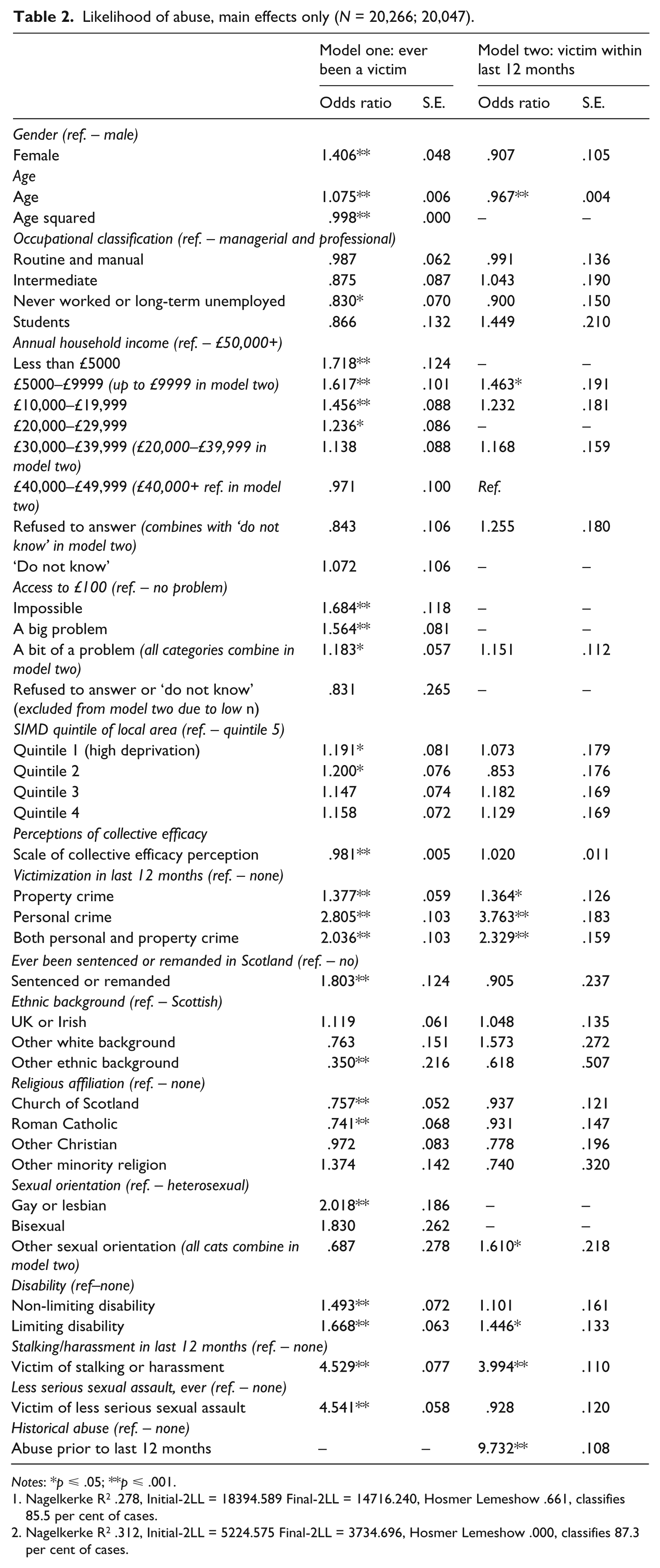
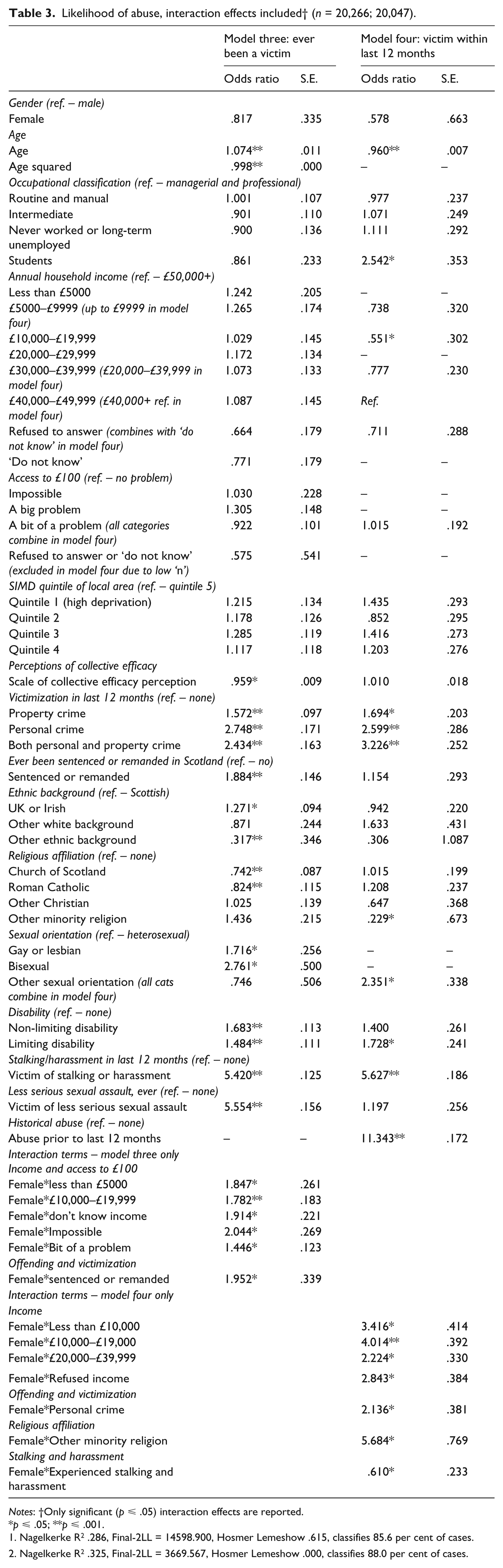
Results from the final models (models one and two) are presented in Table 2, with odds ratios provided for ease of interpretation. Where an odds ratio is significant with a value greater than 1, the variable increases the likelihood of victimization. If a significant value is less than one, the variable decreases the likelihood of the same outcome. As the questions on partner abuse are only posed to a subset of the full sample of survey respondents, that is, those who reported having a current or previous relationship, no sample weights are applied here. To provide a tentative exploration of the applicability of intersectionality as a conceptual framework in the field, interaction terms were added to both final models to determine whether the effects of key variables differed according to gender (models 3 and 4, presented in Table 3). Each interaction term (female*…) creates a value of 1 for female respondents within the other explanatory variables included in the model, to allow comparison of how the effect differs for female respondents compared to male.
Likelihood of abuse, main effects only (N = 20,266; 20,047).
Notes: *p ⩽ .05; **p ⩽ .001.
Nagelkerke R2 .278, Initial-2LL = 18394.589 Final-2LL = 14716.240, Hosmer Lemeshow .661, classifies 85.5 per cent of cases.
Nagelkerke R2 .312, Initial-2LL = 5224.575 Final-2LL = 3734.696, Hosmer Lemeshow .000, classifies 87.3 per cent of cases.
Likelihood of abuse, interaction effects included† (n = 20,266; 20,047).
Notes: †Only significant (p ⩽ .05) interaction effects are reported.
p ⩽ .05; **p ⩽ .001.
Nagelkerke R2 .286, Final-2LL = 14598.900, Hosmer Lemeshow .615, classifies 85.6 per cent of cases.
Nagelkerke R2 .325, Final-2LL = 3669.567, Hosmer Lemeshow .000, classifies 88.0 per cent of cases.
Results
Taking model one first, a range of variables emerge as having significant, independent effects on the likelihood of experiencing abuse. As anticipated, examining lifetime prevalence shows that women do have greater likelihood of experiencing abuse than men (OR 1.4). However, while significant and important, it is not gender that exerts the strongest effect here. The strongest contributions overall are provided by indicators of other victimization. An individual experiencing stalking and harassment, and sexual assault, greatly increases their odds of experiencing abuse (OR 4.5 for both). This is not entirely surprising and points to the considerable limitation of the SCJS questionnaire design raised previously. Experiences of sexual assault and stalking and harassment go hand in hand with other experiences of abuse by partners (Krebs et al., 2011), yet this information is captured in separate modules and it is not possible to link responses to determine if the experiences are part of a pattern of partner perpetrated abuse. This flaw must be overcome in future sweeps. Importantly, being a victim of other survey crimes also greatly increases the odds of an individual experiencing abuse (OR 1.4, 2.8 and 2.0 for property, personal and multiple victimization respectively). The effect is strongest where individuals report experiences of multiple victimization and violence. Perhaps relatedly, individuals who have been sentenced or remanded also have significantly greater odds of victimization at the hands of partners (OR 1.8).
Age makes a strong contribution to the model, with a curvilinear relationship confirmed (i.e. the odds of experiencing abuse increasing until an age threshold is reached, then declining). An interesting pattern emerges across socio-economic status variables at the individual, household and area levels. There is little effect of occupational class, but it is clear that individuals from households with less economic resources (both annual income and access to £100 for unexpected expenses) have significantly greater odds of experiencing abuse than those from the most affluent (OR 1.2–1.7 and 1.2–1.8 respectively). Importantly, as income levels and access to resources decrease, the odds of experiencing abuse become greater, indicating that the difference is most stark between those in the very bottom categories (i.e. household income below £20,000 and finding £100 being impossible or a big problem) and those at the top (income greater than £50,000 and £100 being no problem to find). The concentration effect anticipated appears confirmed. Community-level deprivation does not exert the same strength of effect, but a similar pattern is observed. Those residing in the most deprived areas have significantly greater odds of experiencing abuse (OR 1.2). Interestingly, perceiving other people in your local area to exhibit collective action or efficacy significantly lessens the odds that an individual will report abuse. Caution must be exercised in interpreting this; it may be that abuse victims are less inclined to believe in the collective good of others by virtue of their abusive experiences.
Turning to indicators of identity, ethnic background emerges as a significant predictor, with minority ethnic individuals having significantly lower odds of experiencing abuse than ‘Scottish’ individuals (OR 0.4). Religious affiliation is also significant, with individuals describing themselves as ‘Church of Scotland’ or ‘Roman Catholic’ having reduced odds compared to those reporting no religious affiliation (OR 0.8 and 0.7 respectively). Once again, the findings must be treated with caution. While no prevalence data exist from which dispute them, existing research indicates the scope of the SCJS is too limited to pick up on more diverse experiences of abuse within minority communities (Mirza, 2015). Sexual orientation and disability both emerge as significant. ‘Gay or lesbian’ individuals have greater odds of experiencing abuse than ‘heterosexual’ respondents (OR 2.0), and individuals reporting disabilities have greater odds of experiencing abuse than those with none. Interestingly, the effect appears strongest among those reporting limiting disabilities (OR 1.7), a finding which ought to be further explored in view of Nixon’s (2008) discussion of heightened vulnerability.
In model two, examining recent abuse, a similar picture emerges albeit with important differences. Crucially, gender is no longer a significant predictor of experiencing abuse. Given the previously observed similarity between men and women (3 per cent) this is not unexpected. However, the single strongest effect in this model is produced by the new variable capturing prior experience of abuse. The odds of an individual experiencing historical abuse reporting a recent abuse are nine times greater than someone with no prior experience. Given prior evidence on the ongoing, cumulative nature of abuse, this is not surprising. Critically however, this provides robust evidence that survey findings on recent abusive experiences should not be considered in isolation from those on lifetime prevalence. There is greater complexity to the data, reflecting the complex experiences captured, that must be considered.
Once again, wider victimization (survey crimes and stalking and harassment) emerges as a key predictive factor (OR 1.4–4.0). Age also emerges as significant, although the pattern differs to model one in highlighting a linear relationship with risk of abuse. Specifically, as age increases, the odds of an individual experiencing abuse decrease. In other words, it is the youngest respondents who are most likely to have experienced recent abuse. Household income remains significant. However, here it is only those within the lowest income bracket whose odds of experiencing abuse are greater (OR 1.5). Other indicators of socio-economic disadvantage are no longer significant. Sexual orientation and disability both remain significant predictive factors. Individuals reporting an ‘other’ sexual orientation (gay or lesbian collapsed with bisexual due to small numbers) have greater odds of experiencing recent abuse than heterosexual individuals (OR 1.6). Interestingly, only those individuals with a limiting disability have significantly greater odds of experiencing victimization than those with no disability (OR 1.4). As per the observations with socio-economic disadvantage in models one and two, and considering the disability findings in model one, it may be the case that a concentration effect exists here around the extent to which disability may impact on risk. This finding demands further exploration.
Both models three and four show small, significant improvements in fit and accuracy with the interaction terms included (see Table 3). A number of changes are observed, adding greater nuance to the findings observed above. Looking first to the main effects, a number of variables ‘drop out’ of both models, whereas previously insignificant variables ‘re-emerge’. This is due to the main variables switching from the ‘1’ category to the ‘0’ reference category after the addition of gender interaction terms to the model. In model three, the main effects of gender, income, access to financial resources and area deprivation are no longer significant, but significant effects for UK or Irish (OR 1.2) and bisexual respondents (OR 2.8) emerge. With regard to the significant interaction effects, strong interactions are observed between being female and being in the lower household income categories (OR 1.8–1.9), 2 as well as having limited or no financial resources (OR 1.4–2.0) and previous offending-related contact with the criminal justice system (OR 2.0). The odds ratios observed suggest that there is an important interaction effect between being female and experiencing financial and other disadvantage, and the subsequent likelihood of experiencing partner abuse. In other words, the effect of socio-economic disadvantage on risk of abuse is greater for women than men. Moreover, it also points to a difference in risk for women according to socio-economic background.
Looking to the main effects in model four, the effect of income on risk of recent abuse is altered, with the middle income category now emerging as significantly less likely to be at risk than the highest (OR 0.6). Interestingly, ‘students’ emerge as having significantly greater odds of experiencing partner abuse (OR 2.5), and respondents citing a minority religious affiliation emerge as having significantly lower odds (OR 0.2). Turning to the interaction effects, the interaction between gender and the experience of stalking and harassment suggests that female respondents experiencing this behaviour are less likely than males to report recent experiences of partner abuse (OR 0.6). However, once again strong interaction effects are observed between being a female respondent and being in the lower income categories (OR 2.2–4.0), as well as experiencing broader violence (OR 2.1) and citing affiliation with a minority religion (OR 5.7). Notably, the main effect of minority religious affiliation is the opposite to that observed here, suggesting the emergence of a particular gender difference among this group of respondents, supported in the wider literature (Mirza, 2015) but previously thought to be beyond the scope of SCJS measurement.
Thus, it appears that there is a critical interaction effect between being a woman experiencing socio-economic disadvantage and marginalization, and being at greater risk of experiencing partner abuse. Crucially, the findings also point towards key potential differences between male and female respondents, both in terms of profile and the nature of abuse being reported in the survey. Taking both models together, it may be suggested that it is younger, more affluent males, or those identifying as gay or bisexual, who are more likely to report abusive experiences within the survey, and that there may be a particular pattern to the behaviours comprising their abusive experience that marks them as distinct from the female respondents.
Discussion
The analysis illustrates that the picture of risk and prevalence that can be drawn from the SCJS is far more complex and revealing than its most publicized finding might suggest. Theoretically informed multivariate analyses demonstrate (a) that a wide range of factors significantly, independently and interactively increase the risk that an individual will experience abuse, and (b) the crucial link between recent and lifetime prevalence. Despite limitations with the measures deployed, many of the tentative assertions made in the emerging literature find some degree of support in the models presented. The importance of gender and age is highlighted, with women and young people apparently at greatest risk. Links with other victimization, and engagement in sanctioned, offending behaviour are demonstrated, and important concentration effects for individuals, particularly women, experiencing the greatest deprivation at the household and area levels are observed. Moreover, attention is brought to the apparent links between sexual orientation, the experience of disability and minority religious affiliation (for women at least) and heightened risk of abuse. Finally, the strong interaction effects observed suggest that intersectionality is an important conceptual framework in understanding risk of domestic violence.
With regard to the applicability of intersectionality, it seems likely that there is a cumulative effect of the risk factors captured by the SCJS. Longitudinal research supports the findings outlined above by highlighting the crossovers between experiences of social disadvantage, victimization and abuse, and offending behaviour, and showing that such experiences are mediated by gender and age (McAra and McVie, 2012; Murray and Farrington, 2005). Data suggest the highest volume of abuse perpetration is concentrated in the smallest, most deprived groups of men. Those experiencing unmet material and emotional need, parental antisocial behaviour and wide conflict and abuse, emerge as most likely to exhibit early onset antisocial behaviour, progressing to abusive behaviour as intimate relationships are formed in the teenage and early adult years (Lussier et al., 2009). Critically, within this broad framework of disadvantaged community and family life, high degrees of mutuality of physical violence between male and female partners are noted (Lussier et al., 2009), albeit with women remaining less likely to perpetrate more serious acts of violence.
This provides an interesting context in which to view the findings here, and points to a need to better understand why violence arises in particular groups in order that an explanation for the effects observed may be reached. Research highlights the complexity of violence and how it is used and experienced within particular communities. Gadd et al. (2013) illustrate the broader experience of victimization and abuse within the lives of abusive and disadvantaged young men, discussing the differing ‘uses’ of abusive behaviour. Here it is observed that not all abuse is ‘instrumental’ to assert control over partners, but may arise as an expression of overwhelming emotions related to experience of difficult events (e.g. loss, and betrayal or rejection by family and friends) or ongoing neglect/lack of support for difficulties. Thus, even within contexts where coercive control may be exercised, not all violence falls under that umbrella. Similarly, young women have been shown to both experience and utilize violence in a variety of ways. Disadvantaged and imprisoned young women have been shown to experience broad violence, abuse and threats, perpetrated by families, peers and partners, and to regard violence as an inevitable, imminent occurrence, and as an acceptable, necessary means through which to establish their own reputation and command respect from others (Batchelor, 2005; Batchelor et al., 2001). It is clear from the analyses here that women are more at risk of abuse than men, yet women can and do exercise agency through violence, and men have been shown to experience abuse that may be retaliatory ‘abuse’ from partners or more severe violence and controlling behaviours (Donovan and Hester, 2010; Gadd et al., 2002). The implication is that cultural responses to structural disadvantage merit serious further exploration in the field.
Of course, the data utilized here are limited by their cross-sectional nature, and causality must not be inferred. The correlations observed must be explored more thoroughly in view of the wealth of research cited and the potentially different profiles of experience emerging in the analyses presented above, but also to establish how other important but less examined identities around sexual orientation, religious affiliation and disability fit into such a picture. There is a need for a far more nuanced understanding of how and why abuse, and violence more broadly, is perpetrated, how it is understood by perpetrators and victims and what its impact is. There is a complexity to the perpetration and experience of violence, encompassing the context in which it occurs and how this may justify its use, its nature, the motivations behind it, as well as how it is experienced by and impacts on victims. All of this needs to be better distinguished, with a critical next step in research being a deconstruction of the broad measures of abuse used here and elsewhere. As stated at the outset, the analysis here represents the beginnings of a much needed, wider research programme. Having identified key risk factors and discussed possible ways in which some of these may be, and are, interacting with one another, the next step is to establish why risk is greater in these particular contexts, and to explore how different groups may experience abuse in different ways. We need to specify more clearly how and why the nature of the experience varies, and for whom, before we may truly assess risk of abuse.
Notwithstanding, the complexity of the emerging findings help to highlight the greater potential of the SCJS to meaningfully explore the experience of abuse. The misleading nature of its most publicized finding (that men and women are at equal risk of abuse) is clearly demonstrated and, far from functioning as a simplistic, blunt incident count as McFeely et al. (2013) might suggest, the SCJS is shown to provide a richly contextualized picture of the prevalence of abuse, highlighting differential risk across key groups and the inter-related effects of gender, disadvantage and marginalization, while presenting opportunities for deeper analysis still. Yet the discussion of the emerging literature, and some of the issues arising in analysing and interpreting the data, raises questions about whether the survey may be fit for moving forward as suggested. Critical engagement with the survey must be informed by ongoing conceptual and methodological debate. For example, how much would the risk or prevalence observed change if the definition of domestic abuse was widened and additional indicators included? As suggested, there is likely overlap between experience of partner abuse as defined in the survey, and other sexual assault, stalking and harassment. These variables must be linked to better capture prevalence and nature of abuse. A range of other possible indicators are also highlighted, including threats of outing for same sex couples (Donovan and Hester, 2010), wider familial violence to support partner control for minority communities and other culturally specific forms of abuse (Gill, 2004, 2006; Lindhorst and Tajima, 2008), and use of social media to harass, humiliate or ostracize (Barter et al., 2009). Inclusion of such behaviours may alter the prevalence captured in the survey and debates around how domestic abuse ought to be defined and operationalized are critical to the development of attuned research tools and understanding. Further contextual information for the behaviour reported would also facilitate assessment of the nature of abuse reported and how this may vary for different groups (Walby and Myhill, 2001).
Given their significance in the models presented, the contextual variables provided by the survey could usefully be improved. Suitable area-level or geographic identifier variables are available, and could be included in future to facilitate multi-level modelling of risk, providing information on the concentration of abuse to inform violence prevention strategies. Greater detail on offending and contact with the criminal justice system would allow deeper exploration of the experiences of this particular group of abuse victims, and more information about historical victimization (not limited to survey reference periods) could help unpick emerging patterns. Issues around sampling, recruitment of respondents and accessibility also merit attention in view of the small numbers of respondents from minority groups and the extent of ‘missing’ data in questions eliciting these particular statuses in the SCJS (see Appendix 2), particularly those from ethnic and LGB communities where under-reporting of abuse and poor representation in research is increasingly acknowledged (Mirza, 2015; Walby and Myhill, 2001), but whose experiences, as drawn out here, can be and are captured within the survey but remain ‘hidden’ within blunt analyses of the data.
Concluding Comments
The aim of this article was to draw on the contextual and broader prevalence data provided by the SCJS to critically explore the apparent similarity in risk of abuse between men and women. Drawing on a growing body of literature that demonstrates gender is but one of a number of influential identities and inequalities shaping the likelihood of abuse, the findings presented support that women and men are not at equal risk of violence, but also that risk or prevalence is not universally distributed across all women.
The findings have important implications for the development of theory and methodology, as well as policy, strategy and response. Strid et al. (2013) assert that policy responses need to recognize inequalities as ‘mutually shaping’, with circumstances in one policy domain presenting consequences in others. The results here support this assertion. A range of risk factors, including gender, age, socio-economic disadvantage, characteristics of local communities, ethnic and religious minority status, sexual orientation, disability and wider victimization and offending behaviour appear to influence the likelihood of an individual experiencing abuse, and many of these factors and the disadvantages they create, can be and are the focus of policy strategies. Difficult assertions are made about the concentration of risk in particular groups, and while universalizing policy tactics may avoid stigmatization, by glossing over critical differences in risk, vulnerable groups are left open to harm. The evidence suggests that it is those groups already facing exclusion and stigmatization who are most at risk, and that any policy or practice approach to domestic abuse must be incorporated into wider strategies addressing violence more generally, and inequalities or disadvantage. This is not to take away from ongoing work, but simply to encourage broader thinking across policy that locates approaches to domestic violence and gender inequality within an understanding of the role of the structural and cultural contexts in which these are played out and experienced. Central domestic abuse policy in Scotland, while progressive, has tended to perpetuate the discourse of the single issue domestic violence campaign. The current consultation on the future direction of the national approach (underway at the time of writing) provides real opportunity for engagement with evidence on the importance of a range of social structures, identities and disadvantage to develop a more informed and holistic approach to tackling domestic violence.
The limitations of the available data hinder the explanatory power of the models presented here. However, in highlighting the impact of identity and inequality on risk, and that top-level summary figures ought not to be taken in isolation, the analyses demonstrate the greater potential of the SCJS than has previously been acknowledged. In highlighting these critical findings and spotlighting the remaining gaps in our knowledge and understanding about the multiplicity of abuse experiences and influences on risk, as well as the limitations of our current research tools, a series of substantive and methodological questions have been raised. We must use these to move forward empirically and conceptually, in Scotland and beyond.
Footnotes
Appendix 1
Appendix 2
Declaration of Conflicting Interests
The author(s) declared no potential conflicts of interest with respect to the research, authorship, and/or publication of this article.
Funding
The author(s) disclosed receipt of the following financial support for the research, authorship, and/or publication of this article: A grant for the research was awarded through the Scottish Institute for Policing Research Strategic Research and Knowledge Exchange Funding call. The award was made in 2013.