



Abstract
This article examines critically the persistently antagonistic relationship – across the past quarter-century – between the provisions of international human rights instruments and the nature and direction of youth justice reform in England and Wales. It introduces the core provisions of the human rights framework that pertain to youth justice and it sketches the nature and direction of policy reform over the 25-year period under scrutiny (1991–2016). To obtain a comprehensive sense of the relationship between human rights and youth justice reform in the jurisdiction, it applies a detailed systemic analysis; beginning at the point at which criminal responsibility is formally imputed and progressing through each stage of the youth justice system, up to the point where the child might ultimately be deprived of her/his liberty. By taking a ‘long-view’ of youth justice reform and by adopting a systemic end-to-end analysis of the human rights–youth justice interface, the article presents an analytical account of both change (policy reforms) and continuity (the enduring nature of human rights violations).
Introduction
This article derives from an extended programme of research – The Comparative Youth Penality Project – which comprises the first comparative study of youth justice culture, theory, law, policy and practice within and between selected Australian state jurisdictions and England and Wales. A core concern of the wider project is to explore the relationship(s) between discourses of human rights and discourses of youth crime and, more specifically, to examine critically the extent to which international human rights standards have exerted influence, over time, on the evolution and development of youth justice policy and practice. For present purposes, the analytical focus privileges the persistently antagonistic relationship – across the past quarter-century – between the provisions of human rights instruments and the nature and direction of youth justice reform in England and Wales. 1 Within this context, the Criminal Justice Act 1991 might be taken to represent the final piece of ‘moderate’ legislation before policy and practice took a distinctly punitive turn. During much of the 25 years that followed, the jurisdiction evolved into one of the most retributive and punitive youth justice sites in the western world. More recently, financial crisis and conditions of austerity have been accompanied by substantial penal downsizing in the youth justice sphere. Notwithstanding this otherwise welcome trend, however, children’s human rights continue to be profoundly compromised. By taking a ‘long-view’ of youth justice reform and by adopting a systemic end-to-end analysis of the human rights–youth justice interface, we attempt to present an analytical account of both change (policy reforms) and continuity (the enduring nature of human rights violations).
The Human Rights Framework
The contemporary international human rights framework within which youth justice is located – in England and Wales and elsewhere – comprises three key instruments. First, the United Nations Standard Minimum Rules for the Administration of Juvenile Justice (the ‘Beijing Rules’) (United Nations General Assembly, 1985), second, the United Nations Guidelines for the Prevention of Juvenile Delinquency (the ‘Riyadh Guidelines’) (United Nations General Assembly, 1990a) and, third, the United Nations Rules for the Protection of Juveniles Deprived of Their Liberty (the ‘Havana Rules’) (United Nations General Assembly, 1990b). Furthermore, the core provisions contained within the ‘Beijing Rules’, the ‘Riyadh Guidelines’ and the ‘Havana Rules’ were substantially bolstered, in 1990, when the United Nations Convention on the Rights of the Child (UNCRC) – the most widely ratified human rights instrument in history – came into force (United Nations General Assembly, 1989).
More recently, the United Nations Committee on the Rights of the Child (2007) adopted General Comment No. 10 that encapsulates the ‘core elements’ of human rights compliant youth justice policy and, more recently still within the European context, the Council of Europe Committee of Ministers has extended the human rights principles that inform the European Rules for Juvenile Offenders Subject to Sanctions or Measures (Council of Europe, 2009) by formally adopting specific Guidelines for Child Friendly Justice (Council of Europe, 2010).
Taken together, therefore, the United Nations and the Council of Europe human rights standards, treaties, rules, conventions and guidelines both impose a wide range of obligations and provide a well-established framework for modelling youth justice statute, formulating policy and developing practice in England and Wales, alongside each of the other nation states to which the same instruments apply. 2 However, a note of caution is warranted regarding human rights in general and, more particularly, children’s human rights. Indeed, we are aware of the limitations of human rights discourses that uncritically conceptualize rights as ‘universal’. We are also persuaded by wide-ranging critiques of such discourses. Alston (2013), for example, details the ‘deeply critical’ body of academic literature emanating from anthropology, history, jurisprudence, philosophy and political science. We are equally aware of the uneasy relationships between critical criminology and (some) human rights discourses owing to the ‘liberal’ derivations of such discourses and their failure to recognize and challenge structural and institutionally embedded social divisions, inequalities and injustices through which ‘rights’ are mediated and differentially inflected. Harris-Short (2003), for example, notes that theoretical problems – deriving from notions of ‘cultural relativism’ – are invoked by the concept of universal human rights. On one level universalism might be conceived as an expression of western liberal hegemony (recalling vestiges of ‘civilizing’ colonialism and imperialist intervention), whereby rights obligations are imposed on nation states where cultural and/or socio-economic conditions are such to render them unable or unready to meet such obligations. Conversely, constructions of ‘cultural difference’ might be deliberately mobilized to rationalize non-compliance with human rights obligations and, at the extremes, even to justify or excuse human rights violations.
Turning more specifically to children’s human rights, if the practical translation of universal human rights standards and principles is, at least in part, culturally relative, it is also economically contingent. It is difficult to imagine, therefore, how international human rights standards might be evenly and universally applied within a global context that is unequal and deeply divided. Goldson and Muncie (2009a: xi–xii) question:
How do the provisions of the UNCRC apply, for example, to the poorest children in the world? More than 1 billion children suffer from a lack of proper nutrition, safe drinking water, decent sanitation, health-care services, shelter and/or education; every day, 28,000 children die from poverty-related causes; in 2004 alone, an estimated 10.5 million children died before they reached the age of 5, most from preventable diseases; in the same year, approximately half of all refugees around the world were children; an estimated 143 million child orphans live in ‘developing’ countries; more than 1 million children in conflict with the law – most of them poor – are detained in penal institutions; the precise number of street children is not known, but estimates range within tens of millions; the International Labour Organisation (ILO) estimates that 246 million children are engaged in child labour, 70% are working in hazardous conditions and 73 million of them are below the age of 10.
Similarly, Penn (2005: 14) has observed that economic globalization serves to consolidate and deepen ‘unequal childhoods’ by creating a ‘wake of poor and victimised people’. Furthermore, while the contrasting material conditions that distinguish the ‘minority rich world’ from the ‘majority poor world’ graphically reveal global disparities, inequalities also exist within rich countries and rights are additionally moderated through the prisms of age, class, disability, ethnicity, gender, ‘race’ and sexuality.
Although we acknowledge the limitations of idealized and uncritical constructions of ‘rights talk’, however, we are also taken by Brown’s (2002: 96) argument that:
there is a need […] to become more adept at using human rights arguments and to be able to give them a practical and specific operation […] to enter more constructively into debates around how human rights concepts might be made more concrete and operational.
In this way we believe that the human rights framework provides a vital conceptual benchmark that can be employed for critically analysing both the changes, and the continuities, that have characterized youth justice policy and practice reform in England and Wales over the last quarter-century.
Youth Justice Reform in England and Wales 1991–2016
Youth justice reforms in England and Wales during the 25 years beginning in 1991 and ending in 2016, have been characterized by ‘circular motions’ (Goldson, 2015) or, to put it another way, transitionary processes that have both flowed into, and ebbed away from, conspicuously punitive tendencies. The quarter-century can be divided into three discrete periods: 1991–1997, during which time a burgeoning punitiveness unfolded; 1998–2008, a decade when such punitiveness consolidated and intensified; and 2009–2016, a period characterized by discernible penal moderation in the youth justice sphere.
The Criminal Justice Act 1991 privileged the use of community sentences, abolished the use of prison custody for 14-year-old boys and contained provisions to end prison remands for 15- and 16-year-olds (although they were never implemented). Indeed, the 1991 Act extended a sequence of (largely progressive) youth justice reforms in England and Wales that had evolved throughout the previous decade and, in doing so, it marked the final staging post of a moderate era before law, policy and practice took a decidedly punitive turn. This is not the place to engage with detailed analyses of the principal drivers of youth justice reform in the post-1991 period. 3 Suffice to note that a complex of political imperatives served to usher in a distinctly populist ‘tough’ mood and to drive policy towards increasingly punitive responses.
During the final years of Conservative government – preceding the 1997 General Election – each of the major political parties was energetically engaged with programmes of ‘tough’ youth justice policy reform. It was not until the landslide election victory of New Labour in May 1997, however, that the full weight of punitiveness truly consolidated. Within months of assuming power, the New Labour government issued a major White Paper, the title of which left little to the imagination: No more excuses: A new approach to tackling youth crime in England and Wales (Home Office, 1997). This was followed by a seemingly relentless sequence of new legislation that carried major implications for youth justice. Further, unprecedented legislative activity was accompanied by numerous ‘consultation papers’, ‘action plans’ and ‘task force’ reports that, taken together, amounted to a ‘blizzard of initiatives, crackdowns and targets’ (Neather, 2004: 11).
While it was not always easy to discern intelligible coherence within New Labour’s youth justice reform programme, its ultimate effect authenticated the ‘toughness’ rhetoric within which it was shrouded and more and younger children were detained in penal custody for longer periods (Goldson, 2010). Indeed, it is perhaps the patterning of child imprisonment during the 1991–2008 period that comprises the single most telling indicator of evolving punitiveness (see Figure 1).
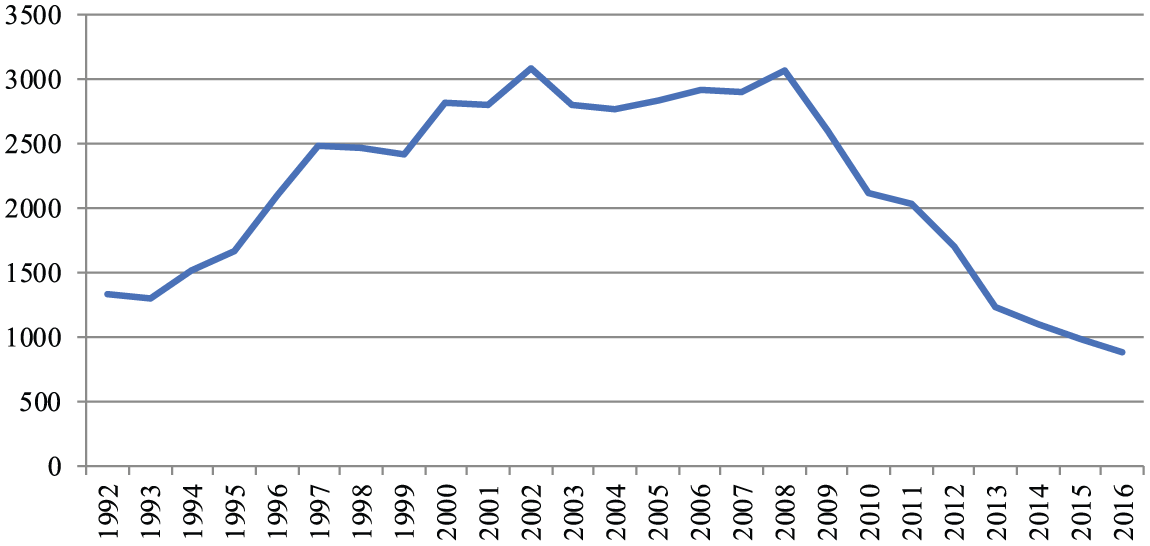
Child imprisonment in England and Wales 1992–2016 (30 June).
Insofar as child imprisonment can be taken to comprise the key proxy of punitiveness, the post-2008 period appeared to signal a ‘cooler’ penal climate.
4
Again, this is not the place to subject this phenomenon to detailed analysis, but the key driver of this otherwise surprising trend derived principally from fiscal imperatives, underpinned by the global financial crisis and concomitant conditions of austerity (Bateman, 2014; Goldson, 2015). In this way, it is no coincidence that the ebbing of punitiveness – at least in so far as it equates to reductions in the numbers of child prisoners – has been, and remains, framed by deep cuts in public expenditure:
Since 2009 the YJB has delivered savings of £287 million (or approximately 55%), reducing its budget from £516 million to £229 million. The number of young people in custody has fallen from 3,200 at its peak in 2002/3 to 971 in August 2015. This reduction has helped the YJB deliver these savings. (Youth Justice Board, 2015: np)
Furthermore, shrinking budgets and diminishing investment in correctional interventions not only substantially moderated the size and shape of penal populations, they also imposed an overall ‘slimming effect’ on the youth justice system per se. ‘Between the years ending March 2005 and March 2015 arrests [of children] fell by 71%, from 332,800 to 94,960’ (Ministry of Justice et al., 2016: 22) and, by year ending March 2015, there were 67 per cent fewer children who entered the youth justice system for the first time and 65 per cent fewer children who received a youth caution or court disposal compared to year ending March 2010 (Ministry of Justice et al., 2016: 5). To put it another way, the ‘cooler’ post-2008 penal climate – significantly truncated processes of child criminalization at one end of the continuum and major reductions in child-prisoner populations at the other end – while welcome, reflects more of a pragmatic adaptation to fiscal constraint than a deliberative expression of human rights compliance.
It follows, therefore, that the correspondence or, more commonly, the discordance, between human rights obligations and youth justice law, policy and practice over the previous quarter-century requires closer scrutiny. It is to this that we now turn.
A Systemic Analysis
In order to obtain a comprehensive sense of the relationship between human rights and youth justice reform, it is necessary to apply a systemic analysis: to forensically examine the correspondence between human rights standards and law, policy and practice at each discrete point of the system. This begins with the point at which criminal responsibility is formally imputed and progresses through each stage of the system, up to the point where the child might ultimately be deprived of her/his liberty.
Minimum age of criminal responsibility (MACR)
Although there is no categorical international standard regarding the age at which criminal responsibility can reasonably be imputed on a child, the provisions of a number of international human rights instruments are pertinent. For example, Article 4(1) of the Beijing Rules provides: ‘in those legal systems recognising the concept of the age of criminal responsibility for juveniles, the beginning of that age shall not be fixed at too low an age level’. Set against this, a state of legislative stasis has prevailed in England and Wales for more than 50 years. Since the Children and Young Persons Act 1963 set the MACR at 10 years, there has been no progressive reform. In fact, the only movement has been regressive.
The Crime and Disorder Act 1998 abolished the doctrine of doli incapax, the rebuttable presumption that children aged 10–13 years are not necessarily capable of discerning between right and wrong. Doli incapax had provided a measure of protection for children of this age ‘for hundreds of years […] dating back to the time of Edward III’ (Bandalli, 2000: 83) and was only rebuttable if the prosecution could satisfy the court (‘beyond reasonable doubt’) that the child knew that what s/he had done was seriously wrong, not merely naughty or mischievous. Bateman (2012: 5) has argued persuasively that ‘the abolition of doli incapax represent[ed] an effective lowering of the age [of criminal responsibility]’. In 1999 the number of 10–13-year-old children issued with police cautions and/or court convictions for indictable offences was 29 per cent higher than it had been the previous year (prior to abolition) (Bateman, 2012: 5).
At 10 years, the MACR in England and Wales is ‘the lowest in the European Union’ (House of Lords House of Commons Joint Committee on Human Rights, 2003: 18) and, as such, it is ‘out of line with prevailing practice in Europe’ (House of Lords House of Commons Joint Committee on Human Rights, 2003: 19). Indeed, the average minimum age of criminal responsibility in the European Union is 14 years (Goldson, 2013) where ‘it can be shown that there are no negative consequences to be seen in terms of crime rates’ (Dünkel, 1996: 38). Similarly, within the context of the 86 countries worldwide surveyed by Hazel (2008: 31) – in which ‘the median age was [also] 14 years’ – ‘the situation in England and Wales looks even more out of kilter’. Indeed, in reviewing global developments Hazel (2008: 32) notes that ‘despite […] variation there has been a trend for countries around the world to raise their ages of criminal responsibility’. Moreover, and closer to home, Crofts (2009: 284) observes that ‘there is now a clearly developing consensus in Europe […] that the age of criminal responsibility should be set at 12 years at a minimum and preferably much higher’ and, closer still – in immediately neighbouring jurisdictions to England and Wales; Ireland, Northern Ireland and Scotland – there is also a tendency towards raising the MACR (Goldson, 2013).
Such observations chime with a wide range of persistently expressed expert opinion that, in accordance with human rights standards, the MACR should be raised in England and Wales including: the All Party Parliamentary Group for Children (APPGC) (2010); the All Party Parliamentary Group on Women in the Penal System (2012); Dr Maggie Atkinson (a previous Children’s Commissioner for England) (2010); the Centre for Social Justice (2012); Council of Europe Commissioner for Human Rights (2009); House of Lords House of Commons Joint Committee on Human Rights (2003, 2009); the Royal Society (2011); the United Kingdom Children’s Commissioners (2015); and the United Nations Committee on the Rights of the Child (1995, 2002, 2007, 2008, 2016). Notwithstanding the human rights standards, the weight of authoritative/expert opinion and international evidence, and the most recent recommendation to the UK Government from the United Nations Committee on the Rights of the Child (2016: para. 78(a)) to ‘raise the minimum age of criminal responsibility in accordance with acceptable international standards’, the political mood remains resistant and there appears to be little immediate prospect of progressive reform.
Policing
At the ‘front end’ of the youth justice system in England and Wales a range of policing practices that have evolved, and/or consolidated, over the previous quarter-century – including stop and search powers, strip-searching, overnight detention in police cells and the retention of children’s DNA – are seemingly incompatible with core provisions of the United Nations Convention on the Rights of the Child. Such practices, for example, sit uneasily alongside the ‘best interests of the child’ principle and arguably subject children to ‘arbitrary interference’, ‘degrading treatment’ and excessive ‘detention or imprisonment’. Furthermore, they also compromise the ‘inherent dignity of the human person’, the child’s right to have their ‘privacy fully respected at all stages’ and to be treated in a manner ‘appropriate to their well-being’ and consistent with the ‘promotion of the child’s sense of dignity and worth’ (United Nations General Assembly, 1989: Articles 3, 16, 37).
Stop and search
Her Majesty’s Inspectorate of Constabulary (HMIC) (2013: 3) has observed that ‘some of the most intrusive and contentious [police] powers are those of stop and search’. This is particularly so in the case of children where the practice, and its human rights implications, has attracted the critical attention of authoritative bodies including the APPGC (2014a, 2014b), together with a wide range of civil society agencies and non-governmental organizations (Children’s Rights Alliance for England, 2015). The APPGC (2014b: 30) reported that ‘data recorded on stop and search in relation to children and young people is not collected nationally’ but, following a Freedom of Information (FOI) request, it revealed that:
from 2009 to 2013 […] across 26 of the 44 police forces (in England and Wales), over one million stop and searches were carried out on children […] [and] in as many as 19 forces the number of stop and searches carried out on children made up between one fifth and one quarter of all stop and searches […] several witnesses stated that stop and search is being used on children and young people too frequently and without good enough reason. (APPGC, 2014b: 11–12)
From a human rights perspective, the apparent disproportionate exposure of children to police stop and search powers is problematic in at least four key ways. First, despite problems regarding data collection, the records available across 22 police forces showed that, in a five-year period, 1136 stop and searches were carried out on children under the age of 10, that is below the MACR (see earlier) (APPGC, 2014b: 29). Second, although evidence submitted to the APPGC (2014b: 30) is such to imply that ‘we have no idea of the scale of the problem nationally’, the available data suggest that black and minority ethnic (BAME) children and young people are particularly targeted (APPGC, 2014a, 2014b; Children’s Rights Alliance for England, 2015; HMIC, 2013, 2015a), with research indicating that black people are stopped and searched six times more often, and Asians more than twice as often, as white people (Eastwood et al., 2013). Third, notwithstanding the fact that the police use of stop and search powers has been raised as a ‘key concern for police legitimacy and public trust in most of the major public inquiries into policing since the 1970s’, 27 per cent of the cases examined by HMIC ‘did not include sufficient grounds to justify the lawful use of the power’ (HMIC, 2013: 8). Fourth, HMIC (2015a: 10) has also reported that ‘the absence of official records means that we have no way of knowing how many children undergo these more intrusive searches [including strip-searches], and whether or not they are being conducted lawfully and in a fair and proportionate manner’.
Arrest and strip-searching
International human rights standards, and particularly the United Nations Convention on the Rights of the Child, explicitly address the related questions of child arrest and criminalization in a number of ways including: ‘in all actions concerning children […] the best interests of the child shall be a primary consideration’ (Article 3); ‘the arrest […] of a child shall be in conformity with the law and shall be used only as a measure of last resort’ (Article 37b) and ‘whenever appropriate and desirable’, measures for dealing with children ‘alleged as, accused of, or recognized as having infringed the penal law’ should avoid ‘resorting to judicial proceedings’ (Article 40(3), our emphases). The human rights presumption clearly favours diversionary and decriminalizing responses. Notwithstanding this, and although the numbers of children arrested have significantly declined year-on-year in the post-2008 period (in tandem with austerity conditions, see earlier), between 2010 and 2014 inclusive, there were 842,147 recorded arrests of children in England and Wales (Howard League for Penal Reform, 2015: 3). Furthermore, not unlike the trend with regard to stop and search, black and minority ethnic children are grossly over-represented ‘accounting for 23% of all child arrests’ (Howard League for Penal Reform, 2015: 1), in violation of Article 2 of the United Nations Convention on the Rights of the Child which provides for the human rights of all children ‘without discrimination of any kind’. The APPGC (2014b: 13) has further reported that ‘evidence […] to the inquiry […] suggested that many children and young people find the experience [of arrest] highly stressful and traumatic’.
As stated above, no official records are maintained in respect of the numbers of children who might be liable to strip-searching following the police use of stop and search and/or arrest. Reporting data retrieved following a Freedom of Information Act request, however, Clarke (2014: np) revealed that between 2008 and 2013, in one city alone (London), more than 4600 children, some as young as 10, were strip-searched post-arrest by the Metropolitan Police. The fact that ‘just over a third were released […] without charge’ (Clarke, 2014: np) raises serious questions pertaining to the unnecessary exposure of such children to ‘cruel, inhuman or degrading treatment or punishment’ (Article 37a of the Convention).
Detention in police custody
Section 38(6) of the Police and Criminal Evidence Act 1984 (PACE) provides that if a child is refused police bail following arrest and charge, they should be transferred to local authority accommodation (secure or non-secure as appropriate) prior to their court appearance. Further, the provisions of both domestic and international law are also explicit concerning the responsibilities of public agencies to safeguard and promote the welfare of all children. Despite such legal mandates, the Howard League for Penal Reform (2011) found that in 2010 and 2011 86,034 children were detained overnight in police custody in England and Wales, an average of more than 800 children each week including many for relatively minor transgressions. Racialized over-representation was again evident with 27 per cent of the detained children belonging to BAME groups. Three hundred and eighty-seven of the total number of children detained were aged just 10 and 11 years and 10 were less than 10 years old and thus actually below the MACR. Further, Article 37(c) of the Convention provides that ‘every child deprived of liberty shall be separated from adults unless it is considered in the child’s best interest not to do so’ and yet the APPGC (2014a: 1) found that ‘just under half of police forces do not provide separate custody facilities for children, meaning that they may be in close proximity to adults and potentially exposed to unnecessary harm and distress’.
HMIC (2015b: 22) has itself acknowledged that ‘the detention of children overnight in police cells has been a concern for many years, but has not yet been addressed effectively’. Indeed, following a major thematic inspection of police custody it reported: ‘in all of the forces inspected we found examples of children being detained overnight’ (HMIC, 2015b: 19) ‘in an environment […] wholly unsuited to the task’ (HMIC, 2015b: 20) where, despite the manifest vulnerabilities of such children, ‘some police officers did not regard [them] as vulnerable, they saw the offence first and the fact that it involved a child as secondary’ (HMIC, 2015b: 18). In recognition of such human rights violations, in 2015 the then Home Secretary and the Secretary of State for Education, Theresa May and Nicky Morgan respectively, circulated a letter – addressed to the ‘Lead Member for Children’s Services’ – to every local authority in England in which they stated: ‘evidence suggests that the legal requirements are not being followed’ and ‘it is essential to comply with the law to prevent the needless detention of children in police custody’ (Home Office and Department for Education, 2015).
Retention of DNA
In England and Wales, the practice of storing the DNA records of children on the Police National DNA Database, is widespread.
5
Muncie (2015: 251) reports:
In 2006, police loaded the three millionth genetic profile onto the UK’s national DNA database including some 24,000 10–18 year olds who had never been cautioned, charged or convicted for any offence […] By 2008 there were 4.5 million DNA records including those of 150,000 children under the age of 16. This had doubled to 337,000 by the following year.
Similarly, the Howard League for Penal Reform (2013: np) has noted that: ‘police take a DNA sample from a child every 10 minutes in England and Wales and […] many of the children required to give a sample will not have been charged with a criminal offence’.
In consideration of the child’s right to ‘protection of privacy’, the United Nations Committee on the Rights of the Child (2008: para. 36(a)) expressed ‘concern that DNA data regarding children is kept in the National DNA Database irrespective of whether the child is ultimately charged or found guilty’. Moreover, in the 2008 case of S and Marper v United Kingdom, the European Court of Human Rights held that retaining DNA samples of those acquitted or subject to discontinued proceedings is in violation of the right to privacy under Article 8 of the European Convention on Human Rights. While some progress was made in respect of addressing such human rights violations via the Protection of Freedoms Act 2012, it remains the case that ‘the application of indefinite retention after two convictions means that a child convicted of two relatively minor offences when very young could have their DNA retained for life’ (House of Lords House of Commons Joint Committee on Human Rights, 2011: para. 66).
Freedom of movement and association
United Nations standards, treaties, rules and conventions, together with domestic legislation, each contain provisions in respect of children’s human rights to freedom of movement and association. Article 15 of the Convention on the Rights of the Child, for example, states that governments must ‘recognise the rights of the child to freedom of association and to freedom of peaceful assembly’ and Article 11.2 of the Human Rights Act 1998 specifies that:
no restrictions shall be placed on the exercise of these rights other than such as are prescribed by law and are necessary in a democratic society in the interests of national security or public safety, for the prevention of disorder or crime […] or for the protection of the rights and freedoms of others.
Within the youth justice sphere, however, forms of legal prescription and the meanings attributed to ‘necessary’ have been stretched to such an extent as to: compromise children’s rights to freedom of movement and association; problematize the very public presence of (identifiable groups of) children and effectively ‘criminalize sociability’ (Crawford, 2009a). 6
The Anti-Social Behaviour Order (ASBO) was initially provided by the Crime and Disorder Act 1998 and the Anti-Social Behaviour Act 2003. It was a civil order that could be imposed on any child over the age of 10 whose behaviour was deemed ‘likely to cause nuisance, alarm, distress or harassment’. Breach of an ASBO, however, comprised a criminal (and imprisonable) offence. Furthermore, the Serious Organized Crime and Police Act 2005 removed legal safeguards protecting the anonymity of children who breached the terms of an ASBO, thus allowing for such children to be publicly ‘named and shamed’. The Order attracted a barrage of human rights-based critique, not least because it served to: obfuscate the boundaries between civil and criminal law; negate due process; allow hearsay ‘evidence’; disproportionately target children and effectively compound social exclusion (Burney, 2005; Squires, 2008; United Nations Committee on the Rights of the Child, 2002, 2008). Despite this, by 2008, 50 children a month were being imprisoned under anti-social behaviour legislation (Statewatch, cited in Goldson and Muncie, 2009b: 263) and, in 2013, 21 per cent of all ASBOs issued were imposed upon children (Home Office, 2014).
The Anti-Social Behaviour Act 2003 also provided powers of ‘dispersal’ that enabled the police to remove under 16-year-olds from public places if they had occasion to ‘believe’ that a member of the public ‘might be’ ‘intimidated, harassed, alarmed or distressed’. By 2004, ‘dispersal zones’ had been established in over 800 areas and the slippage between civil and criminal law was again apparent; if two or more children, together in a public place, failed to disperse under the instruction of a police officer they were deemed to have committed a criminal offence and faced the prospect of custodial detention (Walsh, 2003).
More recent legislation has modified both anti-social behaviour and dispersal powers, although human rights concerns persist. The Anti-Social Behaviour, Crime and Policing Act 2014 served to replace ASBOs with Injunctions to Prevent Nuisance and Annoyance (IPNAs). The House of Lords House of Commons Joint Committee on Human Rights (2015: para. 129) has ‘expressed concern […] about whether the best interests of the child were taken into account’ in drafting the legislation and, perhaps more significantly, ‘over the use of detention as a sanction for breaches of an injunction for children aged 14 and over’. The same legislation also replaced Dispersal Orders with Dispersal Directions. Again, subjective police discretion is privileged (whereby a child ‘over the age of 10 can be directed to leave an area where s/he has, or is believed likely to commit, anti-social behaviour’), and the problematic criminalization of civil transgression endures (any ‘failure’, on behalf of a child, ‘to comply with a direction is a criminal offence’) (Children’s Rights Alliance for England, 2015: para. 80).
Courts and judicial proceedings
The United Nations Convention on the Rights of the Child (Article 40(3)(a)) provides that, wherever appropriate and desirable, States Parties shall promote and establish laws, procedures and measures for responding to children who have infringed the penal law without resorting to judicial proceedings. Similar provisions are provided by the Council of Europe (2010) and the Beijing Rules (Rule 11). In itself, the low MACR in England and Wales (see earlier), effectively undermines compliance with such obligations.
Furthermore, a number of international instruments provide for the fundamental rights of children when they are engaged in judicial proceedings including: Article 14 of the International Covenant on Civil and Political Rights, Article 6 of the European Convention on Human Rights and, perhaps most significant for present purposes, the comprehensive protections laid down in Article 40(2) of the United Nations Convention on the Rights of the Child. The Guidelines on Child Friendly Justice (Council of Europe, 2010: ss. 34–74) also set out children’s human rights with regard to: access to court; legal counsel and representation; their right to be heard and to participate meaningfully in court processes; and for the environment and language used to be ‘child-friendly’ and understandable.
Although most children in England and Wales have their matters heard in specialist Youth Courts, ‘some children are tried in adult courts’ (United Nations Committee on the Rights of the Child, 2016: para. 78(b)). Children with adult co-offenders may be tried in an adult Magistrate’s Court whereas children facing charges for serious offences can be tried in an adult Crown Court. Moreover, the decrease in the numbers of children being prosecuted and processed through the youth justice system in the post-2008 period (see earlier) has, paradoxically, further compromised their human rights in respect of judicial proceedings. ‘Fewer youth court sittings’ have meant that ‘more children are now more likely to appear in adult Magistrates courts where Magistrates lack appropriate training’ and specialist experience and where it will also ‘increase the likelihood that children will come into contact with adult defendants’ (Children’s Rights Alliance for England, 2015: para. 231; see also Carlile, 2014). Equally, many children are intimidated by the formality of the adult courts where there are also no automatic reporting restrictions and no public exclusion obligations. Rather ‘the courts are open to the public and the presumption of anonymity that applies in the youth courts is reversed’ (Children’s Rights Alliance for England, 2015: para. 230).
Even in the Youth Courts in England and Wales no specialist training or professional accreditation is required in order for lawyers to represent children in criminal proceedings, contrary to recommendations issued by the United Nations Committee on the Rights of the Child (2007). The ‘Inquiry by Parliamentarians into the Operation and Effectiveness of the Youth Court’ (Carlile, 2014), received 53 submissions of written evidence from a wide range of youth justice experts, many of whom drew attention to the fact that children are often poorly defended and inadequately represented in court proceedings (National Children’s Bureau and the Michael Sieff Foundation, 2013). But it is perhaps the appearance of children in adult Crown Courts that raises the most profound human rights concerns.
In the high-profile case of T and V v the United Kingdom 1999 in the European Court of Human Rights, it was ruled that the three-week trial of two 10-year-olds in public, in an adult Crown Court, was a violation of their right to a fair trial under Article 6 of the European Convention of Human Rights. The breach principally derived from the children’s inability to understand the proceedings and to participate meaningfully in the judicial process. More generally, Carlile (2014: x) determined that the Crown Court is ‘inappropriate for children; its intimidating nature and lack of youth specific expertise’ prevents effective sentencing and participation in court proceedings and ‘ultimately, contravene[s] the right of children to a fair trial’, proceeding to argue that:
the increasing use of adult courts for children is an issue of serious concern […] It frustrates the principle that children will be treated differently from adults in reflection of their young age and makes poor use of the resource of specialist youth courts. (Carlile, 2014: 5)
Privacy
Article 40(1) of the United Nations Convention on the Rights of the Child recognizes ‘the right of every child alleged as, accused of, or recognised as having infringed the penal law to be treated in a manner consistent with the promotion of the child’s sense of dignity and worth’ in ways that might best enable ‘the child’s reintegration’ and ability to assume ‘a constructive role in society’. More specifically, Article 40(2)(b)(vii) provides the child’s right ‘to have his or her privacy fully respected at all stages of the proceedings’ and the United Nations Committee on the Rights of the Child (2007: para. 29) ‘reminds States parties that […] no action may be taken that can hamper the child’s full participation in his/her community, such as stigmatization, social isolation, or negative publicity’. Similarly, at a domestic level each of the four UK Children’s Commissioners (2015: 44) has recommended that ‘children […] should be entitled to privacy at all stages of the criminal process including following conviction and sentence’.
In addition to the above provisions and guidance, the Children and Young Persons Act 1933 provides courts with the ‘power to prohibit publication of certain matter in newspapers’ (s. 39) including ‘the name, address or school, or include any particulars calculated to lead to the identification, of any child or young person concerned in the proceedings’ (s. 39(1)(b)), together with a similar power to impose ‘restrictions on reports of proceedings in which children or young persons are concerned’ (s. 49). More recently, the Criminal Justice and Courts Act 2015 (s. 80 and Schedule 15) has extended the above provisions to apply to online media in addition to press and broadcast media. Such legislation provides a power as distinct from imposing a duty, however, and civil society organizations have identified ‘several gaps in the protection’ it offers including:
new powers to impose lifelong reporting restrictions in criminal proceedings to children who are witnesses and victims do not extend to child defendants. This means a child defendant can be identified when he or she turns 18, contrary to the child’s best interests and the requirement for reintegration under Article 40 [of the United Nations Convention on the Rights of the Child, see earlier]. (Children’s Rights Alliance for England, 2015: para. 83)
Furthermore, children subject to Civil Injunctions (such as those provided by the Anti-Social Behaviour, Crime and Policing Act 2014, see earlier) are not afforded the same protections as children appearing in the courts. Indeed, ‘the new anti-social civil injunctions presume that children subject to an injunction will be publicly named unless the court orders otherwise’ (Children’s Rights Alliance for England, 2015: para. 83), echoing earlier concerns raised by the United Nations Committee on the Rights of the Child (2008: para. 36(b)) in its observation that ‘the State party has not taken sufficient measures to protect children, notably those subject to ASBOs, from negative media representation and public “naming and shaming”’.
Criminal records
In the same way that compromising the child’s right to privacy, or worse, subjecting them to ‘naming and shaming’ rituals, can impose damaging forms of stigmatization that can extend into adulthood, criminal records also tend to blight children’s prospects. Indeed, unduly protracted criminal records are antithetical to both the spirit and the word of myriad human rights instruments including, but not limited to, the United Nations Convention on the Rights of the Child ‘best interests’ principle (Article 3) and the child’s right to be treated in a manner consistent with their ‘sense of dignity and worth’, in accordance with the promotion of their ‘reintegration’ and in ways that best enable them to assume ‘a constructive role in society’ (Article 40(1)). It is well known that the effects of criminal records can ripple both long and wide: damaging employment prospects; limiting, if not precluding, access to certain health, education and social care courses; restricting travel opportunities; jeopardizing the likelihood of being offered a mortgage; undermining the capacity to secure insurance and inducing ‘shame and embarrassment [that] is often a greater problem than the practical issues offenders face’ (Holt, 2011: np).
Set against this, research conducted by Sands (2016: 5) – in which she examined criminal records protocols in 16 jurisdictions drawn from Australasia, Canada, Europe (West and East) and the United States – revealed that a ‘criminal record acquired by a child in England and Wales can affect the person for longer, and more profoundly, than in any of the other jurisdictions reviewed’:
Unlike many jurisdictions, there is no means to ‘wipe’ or expunge a criminal record acquired in childhood in England and Wales. At the same time, the rules on disclosure are relatively unrestricted, meaning there are few ways to prevent the disclosure of comparatively minor convictions and cautions, and all convictions […] can be disclosed for lengthy periods […] The overall environment is such that a childhood criminal record, even for a relatively minor offence or misdemeanour, can have severe implications during childhood and beyond into adulthood […] for years to come. (Sands, 2016: 5)
Penal detention
Perhaps above all else, it is the size and shape of penal populations, together with the conditions and treatment that child prisoners routinely experience, that comprise the clearest indicators of human rights compliance, or otherwise, within youth justice systems (Goldson and Kilkelly, 2013). The most pertinent provisions of the United Nations Convention on the Rights of the Child are both unequivocal and consistent with the wider corpus of human rights standards, treaties, rules, conventions and guidelines: ‘the […] detention or imprisonment of a child shall be […] used only as a measure of last resort and for the shortest appropriate period of time’ (Article 37(b)) (see also ‘every child deprived of liberty shall be treated with humanity and respect for the inherent dignity of the human person, and in a manner which takes into account the needs of persons of his or her age. In particular, every child deprived of liberty shall be separated from adults unless it is considered in the child’s best interest not to do so’ (Article 37(c)); and ‘no child shall be subjected to torture or other cruel, inhuman or degrading treatment or punishment’ (Article 37(a)).
Detention as a last resort
The United Nations Committee on the Rights of the Child (1995, 2022, 2008, 2016) has repeatedly had occasion to raise concerns about the excessive use of penal custody for children in England and Wales. The flows into, and the subsequent consolidation of, punitiveness between 1991 and 2008 – represented by more-or-less year-on-year increases in child imprisonment that rendered the jurisdiction the most punitive in Europe and one of the most punitive in the western world – exposed recurring violations of the ‘last resort’ principle (Goldson, 2010). As stated earlier, however, severe cuts in public expenditure and unrelenting conditions of austerity in the post-2008 period, have had the effect of ‘cooling’ the penal climate in the youth justice sphere. It follows that the numbers of child prisoners have reduced from 3072 on 30 June 2008 to 890 on the corresponding date in 2016 (Ministry of Justice and Youth Justice Board, 2016a, 2016b). But although this is welcome, it has to be understood within the context that between 1989 and 2009, the child prisoner population in England and Wales had increased by 795 per cent (House of Lords House of Commons Joint Committee on Human Rights, 2015: para. 119). Furthermore, the reduced numbers of child prisoners do not, in themselves, necessarily represent complete compliance with the ‘last resort’ obligation.
A wide range of civil society organizations have noted that:
Detention is still not used as a last resort […] Children continue to be sentenced to custody for breaching community orders, for minor offences and for failing to comply with civil orders where the behaviour itself is not a criminal offence (the ASBO and the replacement civil injunction […]). (Children’s Rights Alliance for England, 2015: para. 221)
Custodial remands are also particularly problematic. According to official data for the year ending March 2015, children were remanded in custody on 1456 occasions and yet ‘66% were not given a custodial outcome following their remand […] 32% were acquitted and 34% were given other court convictions’ (Ministry of Justice et al., 2016: 41). Equally, the Criminal Justice and Courts Act 2015 (s. 28) introduced minimum mandatory custodial sentences in respect of children convicted of a second knife offence (including carrying a knife). Such prescriptive mandatory sentencing is clearly at odds with the ‘last resort’ principle and further violation is especially conspicuous in respect of identifiable groups of children. The United Nations Committee on the Rights of the Child (2016: para. 77(d)), for example, has observed that ‘the number of children in custody remains high, with disproportionate representation of ethnic minority children, children in care, and children with psycho-social disabilities’. Similarly, the UK Children’s Commissioners (2015: para. 10.6) have reported that:
there is a disproportionate number of Black and Minority Ethnic children in custody in England and Wales (38% of the current total) [and] there are also a disproportionate number of looked after children and care leavers […] in custody. Fewer than 1% of all children in England are in care but in 2012 looked after children made up 30% of boys and 44% of girls in custody.
Detention for the shortest appropriate period of time
The imposition of life sentences and/or indeterminate sentences on children are at odds with the ‘shortest appropriate period of time’ principle. The United Nations Committee on the Rights of the Child (2007: para. 77) has stated that: ‘no child who was under the age of 18 at the time he or she committed an offence should be sentenced to life without the possibility of release or parole’. Similarly, the United Nations Human Rights Council (2014: 24/12: para. 22) urges States to ensure that ‘life imprisonment [is never] imposed for offences committed by persons under 18 years of age’. Further, the United Nations Special Rapporteur on Torture and Other Cruel, Inhuman or Degrading Treatment or Punishment has stated:
Life imprisonment and lengthy sentences […] are grossly disproportionate and […] have a disproportionate impact on children and cause physical and psychological harm that amounts to cruel, inhuman or degrading punishment […] mandatory sentences for children are similarly incompatible with the State’s obligation regarding children in conflict with the law […] Mandatory minimum sentences may result in disproportionate punishments that are often overly retributive […]. (Méndez, 2015: para. 74)
Set against this, mandatory sentences pertaining to offences including the carrying of knives apply in England and Wales as discussed immediately above and, moreover, ‘detention during Her Majesty’s pleasure’ (DHMP) – in essence a sentence of life imprisonment – is the mandatory sentence in cases where a child is convicted of murder. One hundred and seventeen children were sentenced to DHMP between 2008 and 2014 and ‘in one instance the child was just 13 years old at the time of sentencing’ (Children’s Rights International Network, 2015: 36). Furthermore, in the period 2005–2012, 325 children were subject to so-called ‘indeterminate sentences for public protection’ (Ministry of Justice and National Statistics, 2013: 58).
Treatment and conditions in detention
It is very well established that child prisoners comprise a profoundly vulnerable group of young people who are invariably drawn from the most distressed and disadvantaged families, neighbourhoods and communities. 7 It is especially important, therefore, that such children are protected from ‘torture or other cruel, inhuman or degrading treatment or punishment’ and are ‘treated with humanity and respect’ in accordance with Articles 37(a) and 37(c) of the United Nations Convention on the Rights of the Child and similar provisions of related human rights instruments. That being said, the application of solitary confinement and segregation, the failure to always separate child and adult prisoners, routine exposure to assault and violence, the impositions of physical force and the practices of ‘restraint’, regular incidents of self-harm and, at the extremes, child deaths in penal custody, combine to seriously violate the human rights of child prisoners in England and Wales.
The United Nations Committee on the Rights of the Child (2007: para. 89) has stated that ‘disciplinary measures in violation of article 37 of CRC must be strictly forbidden, including […] closed or solitary confinement’. Reflecting upon youth justice policy and practice in the UK, the same United Nations Committee (2002: para. 59) had previously reported that it was ‘extremely concerned at the conditions that children experience in detention […] noting […] [that child prisoners were held] in solitary confinement in inappropriate conditions for a long time’ and it ‘urged’ the UK Government ‘to review the use of […] solitary confinement in custody […] to ensure compliance with the Convention’ (United Nations Committee on the Rights of the Child, 2002: para. 34). Fourteen years later, however, the very same Committee (2016: para. 78(g)) noted that ‘segregation, including solitary confinement, is sometimes used for children in custody, including in young offenders’ institutions’ and it recommended that the Government should act to ‘immediately remove all children from solitary confinement, prohibit the use of solitary confinement in all circumstances and regularly inspect the use of segregation and isolation in child detention facilities’ (United Nations Committee on the Rights of the Child, 2016: para. 79(f)). Similarly, a major independent inquiry into the conditions and treatment endured by child prisoners in England and Wales (Carlile, 2006) reported on the ‘largely hidden world of prison segregation’ and found that ‘most segregation units, which were known by a range of euphemisms, were little more than bare, dark and dank cells. [Moreover] in the intervening years, little has changed’ (Howard League for Penal Reform, 2016: 6). Indeed, although no national data are kept on the numbers of child prisoners placed in segregation units ‘an answer to a Parliamentary Question revealed that between October 2013 and September 2014 [child prisoners] spent 7,979 days in segregation units’ (Children’s Rights Alliance for England, 2015: para. 235). It is clear that practices of segregation and de facto solitary confinement of children and young people comprise enduring features of the penal landscape in England and Wales:
too many boys spent too long locked alone in their cells […] Last year we reported on boys […] who were confined to their cells for up to 22 hours a day; this year, 26% of the population were being managed on units under a restricted regime that excluded them from activities and meant that they were unlocked for less than an hour a day – in effect, solitary confinement. (Her Majesty’s Inspectorate of Prisons (HMIP), 2015a: 81)
Paradoxically, while segregation has the effect of separating child prisoners from each other, penal policy and practice in England and Wales is less effective in ensuring the separation of child and adult prisoners. The UK Children’s Commissioners (2015: para. 10.9) have reported that ‘the requirement of Article 37(c) of the Convention that children be separated from adults in all places of detention, except in their best interests, has not been fully implemented in custodial settings’. In particular:
children transported to and from Young Offenders Institutions are moved in cellular vehicles which are inappropriate for children’s age and development and where adults may be transported on the same vehicle […] [and] in some Young Offenders Institutions there is an adult prison on the same/adjoining site and total separation is very difficult to achieve.
Widespread violence in penal institutions in England and Wales further compromises the human rights of child prisoners. HMIP (2015a: 24) has reported that ‘levels of violence in young offender institutions (YOIs) […] continued to be high […] nearly a third of boys told us they had felt unsafe in their establishments’. Moreover, in January 2016 – following a sustained undercover operation by an investigative journalist – the BBC screened a documentary programme displaying serious incidents of physical and verbal violence and abuse being visited upon children by staff at Medway Secure Training Centre (a privately managed penal institution). In March 2016, an official report to the Secretary of State for Justice stated:
The events depicted in the Panorama programme broadcast on BBC1 on 11 January 2016, were, by common consent, deeply shocking. In the programme, we saw highly vulnerable children in custody at Medway Secure Training Centre (STC) being physically and emotionally abused by those who were employed to protect and care for them […] Our overriding sense is that, as a society we must do better by these vulnerable young people. (Medway Improvement Board, 2016: 3)
Notwithstanding this, however, a subsequent report published in August, 2016 – following a detailed inspection of Medway STC by Ofsted, the independent Office for Standards in Education, Children’s Services and Skills that reports directly to Parliament – stated that ‘the findings and recommendations of the Medway Improvement Board […] have not been implemented properly’ and concluded that ‘the overall effectiveness of Medway secure training centre is inadequate’ (Ofsted, 2016: 4). More specifically, both the ‘safety of young people’ and the ‘care of young people’ were both also deemed to be ‘inadequate’ (Ofsted, 2016: 1).
If all forms of violence compromise the human rights of child prisoners, perhaps it is the institutionalized and state-sanctioned applications of physical force and ‘restraint’ (including pain-compliant methods) that are the most problematic. Indeed, the United Nations Committee on the Rights of the Child (1995, 2002, 2008, 2016) has persistently expressed disquiet in this regard: ‘the Committee is concerned that legislative and other measures relating to the physical integrity of children do not appear to be compatible with the provisions and principles of the Convention’ (1995: para. 16); ‘the Committee is concerned at the frequent use of physical restraint’ (2002: para. 33); ‘the Committee remains concerned at the fact that […] physical restraint on children is still used in places of deprivation of liberty [and] […] urges […] the State party to ensure that restraint against children is used only as a last resort and exclusively to prevent harm to the child or others and that all methods of physical restraint for disciplinary purposes be abolished’ (2008: paras 38–39); and, most recently:
the Committee is concerned about […] the increased use of restraint […] against children in custodial settings in England and Wales […] and the use of physical restraint on children to maintain good order and discipline in young offenders’ institutions and of pain-inducing techniques […] [and] urges the State party to […] abolish all methods of restraint against children for disciplinary purposes […] and ban the use of any technique designed to inflict pain on children. (2016: paras 39(b), 39(c) and 40(b))
Similar consternation has also been repeatedly raised by the House of Lords House of Commons Joint Committee on Human Rights (2003, 2009, 2015): ‘the level of physical assault and the degree of physical restraint experienced by children in detention in our view still represent unacceptable contraventions of UNCRC Articles 3, 6, 19 and 37’ (2003: para. 52); ‘we reiterate our strong concerns that pain compliance is still used as a tactic against young people in detention […] and […] we reiterate our previous conclusions that techniques which rely on the use of pain are incompatible with the UNCRC’ (2009: para. 94); and ‘we remain very concerned about the use of force on children in custody […] [that] cannot be considered compatible with the UN Convention on the Rights of the Child’ (2015: para. 127).
Despite such authoritative interventions, however, child prisoners continue to be exposed to problematic practices of physical force and ‘restraint’ and policy and practice reforms have, in essence, been lame. The Independent Review of Restraint in Juvenile Secure Settings (Smallridge and Williamson, 2008: 7–8), for example, concluded that:
a degree of pain compliance may be necessary […] [however] irreconcilable the proposal is with the UN Convention on the Rights of the Child and how unpopular it is likely to be with the Children’s Commissioners, the Parliamentary Joint Committee on Human Rights and others.
Furthermore, in 2013 a new system of restraint – ‘minimizing and managing physical restraint’ (MMPR) – was ‘rolled out’. HMIP (2015b: 5) reported:
the introduction of MMPR was the culmination of a long process initiated following the deaths of two boys in 2004. Gareth Myatt died after he became unconscious during a restraint in an STC […] Adam Rickwood, aged 14, hung himself after a ‘pain compliance’ technique was applied to him.
8
Notwithstanding the ‘long process’ – amounting to nine years between the deaths of the two boys in 2004 and the practical implementation of MMPR in 2013 – HMIP referred to ‘significant delays in the roll out of MMPR [and] the new system is not yet being consistently implemented or achieving the intended outcomes […] what we have found has been too variable and sometimes very poor’ (HMIP, 2015b: 5). Moreover, MMPR continues to sanction the infliction of pain on children detained in YOIs and STCs and HMIP found: ‘pain-inducing techniques were used frequently in YOIs’; ‘unacceptable examples of children being strip searched under restraint’; ‘underreporting of the use of pain-inducing techniques in YOIs’;
9
and ‘no evidence to justify the deliberate infliction of pain as an approved technique’ (HMIP, 2015b: 6). Indeed, HMIP’s conclusion that ‘there is no such thing as “entirely safe” restraint’ (HMIP, 2015b: 5) is seemingly verified by the response offered by the Secretary of State for Justice to a Parliamentary Question in which it was reported that for an eight-year period – year ending 31 March 2008 to year ending 31 March 2015 – 7784 injuries were sustained by children held in the juvenile secure estate as a consequence of ‘restrictive physical interventions’ (RPIs) (Selous, 2016). Finally, notwithstanding the widespread and longstanding concerns that have been repeatedly raised regarding ‘restraint’, and irrespective of the reduced numbers of child prisoners in the post-2008 period:
The number of RPIs per 100 young people increased by 60% from the year ending March 2010 […] [to] the year ending March 2015 […] [and] the number of RPIs per 100 young people […] was higher for the younger age group (10–14), females and young people who were Black, Asian or Minority Ethnic (BAME) than other cohort groups. (Ministry of Justice et al., 2016: 53)
The violations of both ‘last resort’ and ‘shortest appropriate periods of time’ principles, alongside the practices of solitary confinement and segregation, the failure to always separate child and adult prisoners, children’s exposure to assault and violence and the enduring impositions of physical force, ‘restrictive physical interventions’ and/or the practices of ‘restraint’, comprise a toxic mix. Within such conditions it is not uncommon for violence to turn in on itself. ‘Incidents of self-harm are high across all types of locked accommodation’ (Children’s Rights Alliance for England, 2015: para. 234) and
the number of self-harm incidents per 100 young people in the year ending March 2015 […] increased by 46% compared with the year ending March 2010 […] and has shown an increase of 17% between the year ending March 2014 and the year ending March 2015. (Ministry of Justice et al., 2016: 55)
The most fundamental human right – the right to life – has also been compromised during the period under scrutiny. Between July 1990 and the Autumn of 2015, 32 children lost their lives in penal custody in England and Wales (Prison Reform Trust, 2015: 41). During the same period, successive governments have steadfastly refused to open a public inquiry into any of the child deaths.
Conclusion
The size, composition and distribution of child-prisoner populations are important signifiers of the mood and temper of the penal climate – at any given place and time – and the extent to which youth justice laws, policies and practices observe human rights obligations. While the excesses of punitiveness – that came to characterize youth justice reform in England and Wales for much of the period 1993–2008 – represented blatant violations of children’s human rights, however, the downsizing of child-prisoner populations that have been witnessed in the post-2008 period cannot, in themselves, be taken to symbolize a maturing human rights consciousness. For sure, the quantitative dimensions of youth penality have been moderated but the ‘last resort’ and ‘shortest appropriate period of time’ principles continue to be compromised and the qualitative experiences of child imprisonment – including solitary confinement and segregation, the mixing of child and adult prisoners, exposure to assault, violence and physical force, increasing rates of self-harm and, ultimately, deaths in custody – continue to violate international human rights standards. Moreover, for identifiable groups of children – perhaps most notably black and minority ethnic children and ‘looked after’ children – overall reductions in child-prisoner numbers have only served to compound and intensify their disproportionate presence among the population that remains incarcerated. It recalls a cruel paradox: those whose need is greatest are often those who benefit least.
Furthermore, the value of adopting a systemic analysis is that it extends the focus beyond penal custody. In this sense diminishing numbers of child-prisoners – although welcome in themselves – make no positive impact on: the criminalizing impulses of the conspicuously low MACR in England and Wales; the human rights violations intrinsic to the policing practices that we have reviewed; the problematic incursions imposed on children’s freedom of movement and association; the inappropriate nature of the courts and judicial proceedings; the extent to which children’s privacy is compromised and/or the degree to which their futures are blighted and adversely stained by criminal records. In other words, youth justice policy reforms might be taken to signal change (the size and shape of the penal landscape) but they have ultimately failed to displace continuities in the form of systemic human rights violations. This reminds us of both the potentialities and the limitations of international human rights standards in the youth justice sphere (Goldson and Kilkelly, 2013). On one hand, such standards offer the prospect of establishing a unifying framework for a ‘youth justice with integrity’ (Goldson and Muncie, 2015b). On the other hand, by taking a ‘long-view’ and by adopting a systemic end-to-end analysis, we summon up the limited, contingent and even the relative nature of the same standards.
In sum, for the past quarter-century, youth justice reform in England and Wales has, more often than not, been driven by political imperatives, pragmatic adaptations and ulterior motives that are situated beyond the immediate governance and regulation of youth crime itself. The same processes have ultimately been blind to human rights obligations and in reality – and despite rhetorical constructions to the contrary – they mark England and Wales out as a jurisdiction that can be seen to have scant regard for the human rights, needs and prospects of a profoundly disadvantaged population of children.
Footnotes
Acknowledgements
The authors would like to acknowledge the work and contributions of other members of the Comparative Youth Penality Project research team: Eileen Baldry; Damon Briggs, David Brown; and Melanie Schwartz.
Declaration of Conflicting Interest
The author(s) declared no potential conflicts of interest with respect to the research, authorship and/or publication of this article.
Funding
The author(s) disclosed receipt of the following financial support for the research, authorship, and/or publication of this article: The Comparative Youth Penality Project is supported by an Australian Research Council Discovery Project Grant [grant number DP 130100184], an Economic and Social Research Council Studentship [grant number ES/J500094/1] and a contribution from the Howard League for Penal Reform.