




Abstract
This article analyses 10 years (2004–2014) of An Garda Síochána controlled drug data to investigate the impact of economic recession and globalization on the Irish illicit drug market. The limited international literature on recessions and drug markets suggests that economic downturns can increase both drug consumption and dealing. Gardaí data may, however, suggest that the 2008 Great Recession reduced drug use and dealing, yet increased the cultivation and manufacture of drugs: trends which largely conflict with the international literature. Two testable hypotheses are drawn from the data: (1) net consumption and trade of illicit drugs were reduced by emigration triggered by the Great Recession; (2) the Great Recession forced an adaptation in the market which sped up the process towards import substitution of cannabis cultivation. The article concludes by investigating how recent changes highlight the globalized nature of Irish drug markets before proposing avenues for further research.
Keywords
Introduction
Drug consumption in the Republic of Ireland increased significantly during the 1990s, partly due to a sustained economic boom, and by 2001 Ireland had one of the highest rates of drug consumption per person in Europe (Kilcommins et al., 2004; O’Gorman, 2014). While the Irish media and policymakers commonly express concern over the proliferation of illicit drug markets and associated problems, there has ‘been an almost total absence of in-depth research and analysis of […] illicit drug markets in Ireland’ (Connolly and Donovan, 2014: 15; see also Irish Focal Point, 2014).
This article goes some way towards filling this gap in the knowledge base by reviewing a decade (2004–2014) of An Garda Síochána (the Irish police force) recorded controlled drug offence data. 1 The data provide a snapshot from the tail-end of an economic boom through the 2008 Great Recession. The analysis is framed around a discussion of the impact of globalization and economic recession on the Irish drug market. As such, the article adds to the limited literature on Irish drug markets and the equally limited literature on the impact of recession on drug markets.
The following section provides contextual information on the Irish drug market. This is followed by discussion on the limitations of using Gardaí data to investigate drug market trends. The data are then explored and two hypotheses are cautiously developed to explain why cultivation or manufacture of drugs increased as all other recorded drug offences declined. The article concludes by discussing limitations to the current study and proposes future research ideas.
Irish Drug Markets
Cannabis has consistently been Ireland’s most widely consumed illicit drug, followed by cocaine or MDMA and then amphetamine-type stimulants and heroin (Figure 1). While the rise in heroin between 2010/2011 and 2014/2015 is quantitatively small (Figure 1), media accounts suggest a significant increase since the mid-2000s (Irish Examiner, 2014). Indeed, the number of people in opioid substitution treatment has steadily increased from 8727 in 2010 to 9640 in 2013 (EMCDDA, 2016). Consumption of crack cocaine remains limited in Ireland, although increasing in parts of Dublin (Connolly et al., 2008) with numbers presenting for treatment having increased from 17 in 2006 to 62 in 2013 (EMCDDA, 2016).
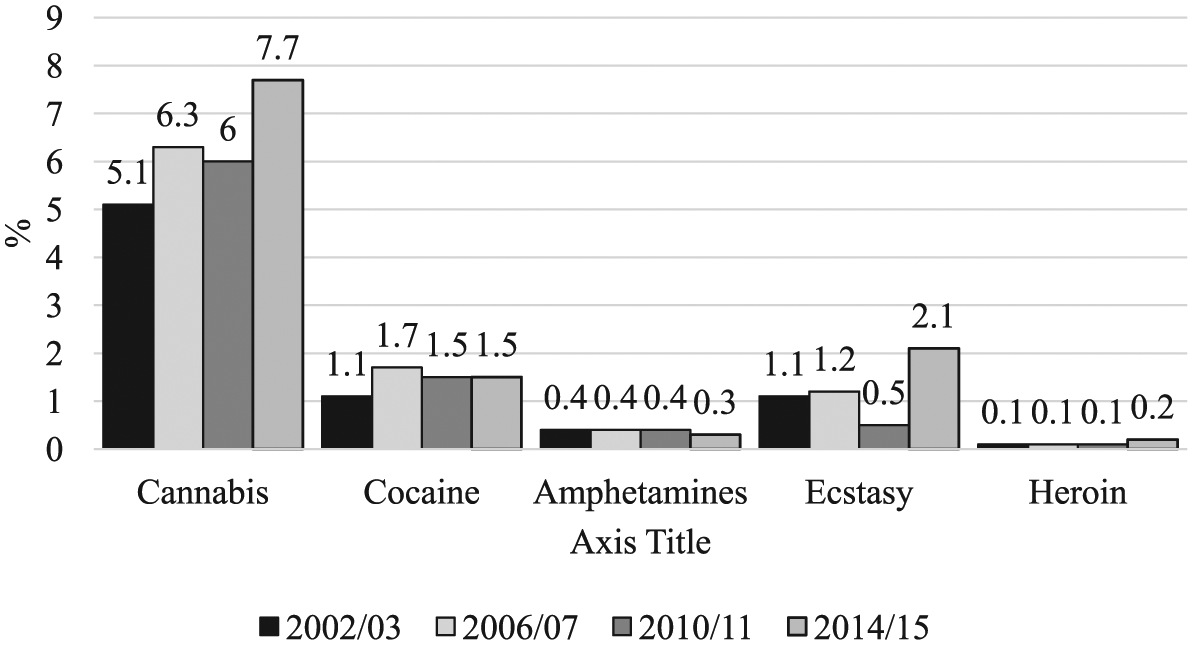
Last year prevalence of drug use.
Ireland is primarily a destination market for illicit drugs, although some traffickers use the country to tranship drugs to Britain. While the importation and wholesale distribution of drugs remain dominated by Irish nationals linked to actors with access to source countries (Connolly and Donovan, 2014), official and media reports commonly associate large-scale cannabis cultivation with Asian (EMCDDA, 2013; Irish Examiner, 2015; Migrant Rights Centre, 2014; PSNI and An Garda Síochána, 2014) and, to a lesser extent, Eastern European (O’Keeffe, 2014) cultivators. The Police Service of Northern Ireland (PSNI) and An Garda Síochána (2014) have, however, suggested that industrial farms in both Northern and Southern Ireland are increasingly being managed by Irish nationals, as their agricultural expertise improves. Indeed, the UK experience suggests that Asian nationals often work with indigenous illicit entrepreneurs (Silverstone and Savage, 2010).
Ireland possesses a variety of local market structures (Connolly and Donovan, 2014). There are open-markets in some economically deprived urban areas which tend to negatively impact the communities within which they are situated (see Connolly and Donovan, 2014; Connolly et al., 2008; Hourigan, 2011). Closed-markets are, however, the norm with the majority of consumers buying from friends and acquaintances (see Bingham et al., 2015; Van Hout, 2009) in predominantly non-violent markets.
Literature Review: Drug Markets and Recession
In late 2007/early 2008, Ireland entered recession. The exact end of the Great Recession is unclear. While official accounts identified a slight rise in gross domestic product (GDP) as signalling the end of recession in late 2009, unemployment and household income figures suggest that the country remained in recession, or at least in an economic slump, until at least 2012. The country then officially dipped back into recession in 2013, as indicated by reduced GDP (Molloy, 2013).
Between 2008 and 2011 Ireland’s national income dropped by over 10 per cent, one of the largest drops of any European country (Callan et al., 2013), and Ireland moved from having the second lowest rate of unemployment in Europe to having the second highest within three years (White, 2010). Unemployment increased from 4.6 per cent in 2006 to 15 per cent in 2012: youth unemployment rose from 9.9 per cent to 33 per cent during the same period (Kelly and McGuinness, 2015). Furthermore, many of those in employment suffered wage cuts and increased tax burdens. Consequently, average equivalized disposable household income fell by 13 per cent between 2008 and 2013, or 20 per cent for Ireland’s poorest households (Callan et al., 2013).
The Great Recession followed the Celtic Tiger boom. Between 1994 and 2000 Ireland experienced annual average growth in real GDP of 7 per cent: among the highest in the Organization for Economic Co-operation and Development (OECD). The number of people in employment rose from 1.2 million in 1994 to 2.1 million in 2007, and Ireland’s long-term trend of net emigration was reversed (Callan et al., 2013). The boom years increased drug consumption, especially of powder cocaine (O’Gorman, 2014; Van Hout, 2007): Figures 1 to 4 illustrate, between 2004 and 2008, sharp increases in recorded drug control offences (Figure 2–4) and drug prevalence (Figure 1). Increased consumption has been attributed to: young people possessing ‘greater levels of disposable income’; reduced ‘parental monitoring’ due to high employment (Van Hout, 2009: 6); increased demand for drugs such as ecstasy and cocaine among the middle classes (Hourigan et al., 2018); and the expansion of the night-time economy (O’Gorman, 2014). Furthermore, these trends occurred at a time when the growing interconnectedness of Ireland to the world (see Share et al., 2007) increased the availability and reduced the price of drugs (see O’Gorman, 2014; see also Windle and Farrell, 2012).

Number of recorded possession offences (2004–2014).

Number of total drug offences (2004–2014).
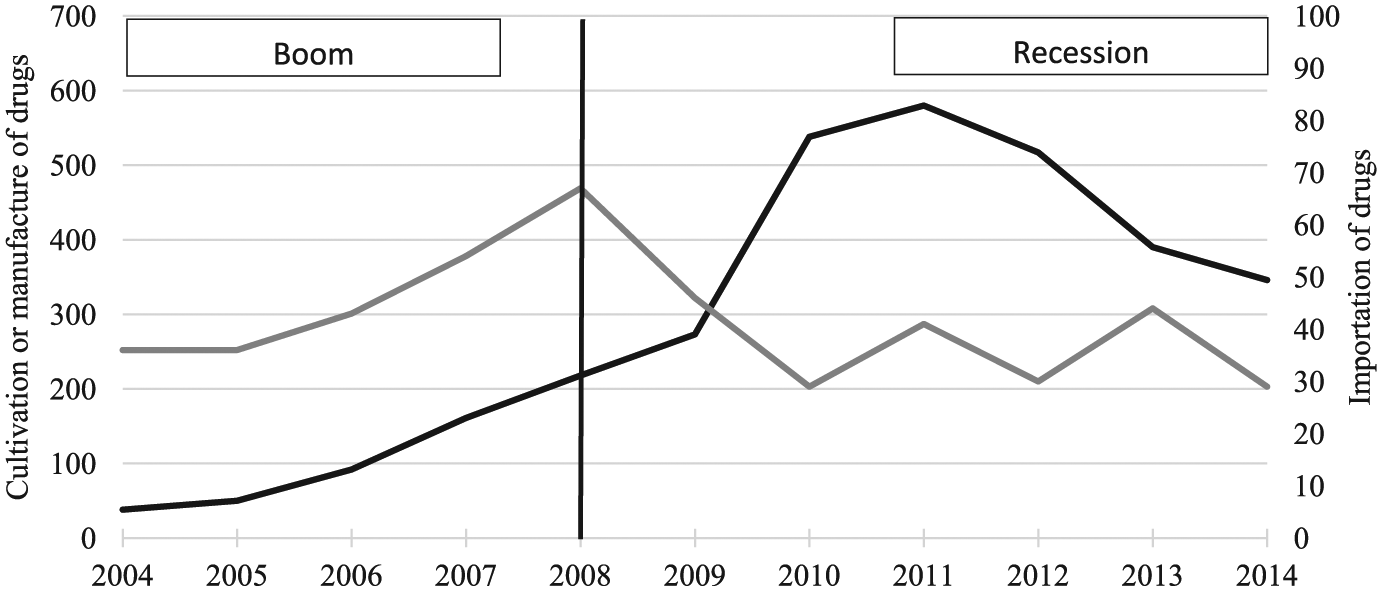
Number of cultivation or manufacture of drugs and importation of drugs offences (2004–2014).
That drug use increased when people had more money would intuitively suggest that use should decline when people have less. The literature, however, suggests the opposite. A collection of articles published in a special edition of the International Journal of Drug Policy (Storti et al., 2011) reached a consensus that recession and economic downturns can increase drug use and/or dealing.
During recession people may sell drugs as a means of augmenting lowered incomes or social welfare, at a time when the risk of drug dealing may be reduced by austerity measures applied to police resources (Arkes, 2011; Storti et al., 2011). Indeed, Mocan and Rees (2005) found teenagers in areas with high unemployment were more likely to sell drugs than those in low unemployment areas. A recent British ethnography found the 2008 recession ‘prompted’ young people to drift in and out of drug dealing (Edwards, 2014: 8). That recessions will increase illicit enterprise is a reasonable argument, supported by strain theory. That is, in Ireland, consumer desires had been augmented by the expectations of the boom (Keohane and Kuhling, 2004), yet the means of achieving these cultural goals were blocked (Merton, 1938) by reduced employment, wages and social welfare.
In terms of consumption, three separate studies in Australia (Chalmers and Ritter, 2011), the USA (Arkes, 2011) and the UK (Mott, 1985) found cannabis use to increase when unemployment was higher or the economy weaker. In the US study, a 1 per cent increase in the state unemployment rate increased teenage: past-year drug consumption by 4.1 percentage points; past-month consumption by 1.9 percentage points; and heavy use by 0.9 percentage points (Arkes, 2011). The Australian study found an increase in frequency of use for those aged 25–34, although older consumers tended to reduce their consumption (Chalmers and Ritter, 2011). Indeed, Caulkins (2011) suggests that while the number of users will likely increase during recession, heavy users often stabilize their consumption. And, as heavy users tend to account for a significant percentage of total spending on drugs net consumption can stabilize. Finally, a Scottish study found general illicit drug use to be ‘moderately associated’ with unemployment (Peck and Plant, 1986: 931).
Four recent studies have analysed the impact of the Great Recession on European drug markets. Research in Greece by Kondilis and colleagues (2013) found a substantial increase in problematic drug use, most notably among older persons. One Spanish study by Colell and colleagues (2015) found an increase in cannabis consumption among older unemployed men and women, while another found a strong increase in cannabis and cocaine consumption (Bassols and Castelló, 2016). In Italy, Zuccato and colleagues (2011) identified reduced heroin and cocaine consumption with increased cannabis and amphetamine consumption. A number of British (i.e. MacDonald and Marsh, 2002; Pearson, 1987) 2 and Irish (i.e. O’Gorman, 1998; Punch, 2005) studies have, however, identified strong links between social exclusion and heroin consumption.
There are a number of interrelated theories on why recessions and economic downturns can increase consumption. First, during recession, people have more free time to search for, and use, drugs (Arkes, 2011). Second, Bretteville-Jensen (2011) hypothesizes that drug prices should fall during recessions: competition increases as the number of dealers grow, and dealers demand less pay than they would have pre-recession, partly because operational risks are reduced by thinner police resources. Third, drug use can represent an escape from, or medication for, the nihilism, hopelessness and depression of recession (see Arkes, 2011; MacDonald and Marsh, 2002). Fourth, recession can intensify a host of risk factors associated with drug use, such as parental divorce, unemployment and disruption to education (Caulkins, 2011). Finally, those who start selling drugs such as heroin and crack, in response to unemployment, may drift into consuming these drugs (Seddon, 2008).
In summary, the limited academic literature suggests that economic downturns and recession can increase both drug dealing and cannabis consumption. The evidence regarding the impact of recession on expensive drugs and heavy drug use is, however, mixed.
Methodology
The purpose of this article is to map recent trends in Irish drug markets from the tail-end of the Celtic Tiger boom through the Great Recession. The official statistics recorded by the Gardaí on their PULSE (Police Using Leading Systems Effectively) system (CSO, 2015), and published in annual reports by the Central Statistics Office (CSO, no date a) were used as proxies for consumption and trade.
The annual reports include data on all recorded offences, including drug offences. Recorded offences are: Offences reported or which become known to members of An Garda Síochána are recorded as crimes when, on the balance of probability, a Garda determines that a criminal offence defined by law has taken place and there is no credible evidence to the contrary. (CSO, 2015: 6)
The chapter on drug offences includes information on offences shared by other relevant agencies, such as the custom service. The CSO divides controlled drug offences into five separate offences: importation of drugs; cultivation or manufacture of drugs; possession of drugs for sale or supply; possession of drugs for personal use; and other drug offences (including forged or altered prescriptions and obstruction under the Misuse of Drugs Act).
Limitations of official statistics
The general limitations of official Gardaí data are well documented (see McCullagh, 1996, 2011; O’Donnell, 2005; O’Mahony, 2004). Official reports can only reflect those crimes that are known and reported to the Gardaí by the public or state agencies, and if the Gardaí are satisfied that an offence has taken place (CSO, 2015). As such, many crimes remain unreported and thus unrecorded, especially drug offences where there are few direct victims.
Law enforcement data are influenced by numerous economic, political and institutional factors, including: the creation of new offences or re-definition of existing offences; public reporting; availability of resources (see Bottomley and Pease, 1994; Maguire, 2007; O’Mahony, 2004; Windle, 2016a); and the ‘zealousness with which law enforcement agencies pursue drug offenders’ (Ousey and Lee, 2002: 81; O’Mahony, 2004). All of which can be influenced by political or media pressure.
There exists, alongside this ‘dark figure of crime’, a ‘grey figure of crime’: that which is reported but not recorded, or inappropriately recorded (Bottomley and Pease, 1994: 34). Several UK and US studies have shown how discretion in recording can result in manipulation of data in order to show either increases or decreases in offending in order to respectively attract greater resources or demonstrate effectiveness (see Maguire, 2007; Windle, 2016a). Indeed, in 2015 the CSO reviewed a sample of Gardaí data from 2011. They found that 20 per cent of all crimes reported through the Gardaí computer aided dispatch system were not recorded on the PULSE system, and a number of serious crimes were incorrectly classified as ‘non-crime’. This should not, however, affect the current study as the review found that, if recording procedures had been followed correctly, controlled drug offences would have increased by just 1 per cent (CSO, 2015).
Discretion in recording should have a greater impact on some controlled drug offences than others. It is, for example, easier to turn a blind eye to cannabis possession for personal use than the importation of heroin. Not only is it difficult to categorize importation as anything other than importation but seizures are politically useful: Ireland is a strict prohibitionist state and seizures demonstrate to politicians and the public that the state is being proactive in reducing the flow of drugs entering the state.
More importantly for the current study, there was a ban on Gardaí recruitment, promotion and overtime, enforced as part of austerity measures after 2008. The number of Gardaí retiring also increased during that period (Conway, 2014). Cusack (2015) suggests post-austerity working conditions led some Gardaí to overlook more serious and resource intensive offences in order to concentrate upon less serious offences; increasing Gardaí attention on possession for personal use. A survey of English police forces similarly reported an expectation that austerity would reduce ‘proactive work related to the detection of drug supply’. Which would, consequently, increase policing of more visible issues while reducing capabilities to investigate higher-level wholesaling, importation and manufacture/cultivation (Beck, 2011). A Scottish study, conversely, found austerity to shift police resources from less serious offences, reducing attention on possession for personal use (Cyster and Rowe, 2006). Nonetheless, as the impact of austerity measures on policing in Ireland has yet to be rigorously assessed its influence cannot be commented upon with any confidence.
The ‘counting rules’ may also skew official Gardaí data. The counting rules state that: (1) in cases where two or more offences are part of an occurrence only the most serious offence be counted; (2) only one offence be counted per person; and (3) a continuous series of offences against a victim involving the same offender be counted once (CSO, 2015). For example, if an offender in an assault possessed cannabis the record would reflect the assault and omit possession. Therefore, a large number of drug arrests are excluded from the official figures (O’Donnell, 2005).
There are, however, benefits to using the official Gardaí data in academic research. The data not only provide useful indicators of trends in offending over time (Connolly, 2006; Irish Focal Point, 2016; see Windle, 2016a) but constitute the primary source of information on crime and law enforcement activities in Ireland (Connolly, 2006; McCullagh, 2011). Furthermore, Gardaí data are influential in political decision making, resource allocation (see Maguire, 2007) and public debate (see Bottomley and Pease, 1994).
Recorded crime data as a proxy for drug market activity
Using recorded crime data as a proxy is limited by the influence of political interest, and law enforcement resources, practices and priorities (see O’Mahony, 2004; Ousey and Lee, 2002; Windle, 2016a). Furthermore, the lack of specificity in the data limits more sophisticated analyses. The data do not differentiate between drugs, and different drugs operate under different market conditions (Ousey and Lee, 2002), nor do they distinguish between drug production or cultivation techniques (Bouchard and Dion, 2009), or provide an indication of the number of people involved in drug trafficking, dealing or consumption. Recorded crime is simply an indication of the number of offences known to the Gardaí, and the offences the Gardaí choose to record. They are what Bottomley and Pease (1994: 169) term ‘records of decisions’ rather than true reflections of drug market activity.
Law enforcement data have, however, been used as a proxy for consumption and/or drug dealing in studies conducted in: Australia (Bright and Ritter, 2011; Snowball et al., 2008); Canada (Bouchard, 2007; Bouchard and Dion, 2009); Ireland (Connolly, 2006; Irish Focal Point, 2016; O’Gorman, 2014; O’Mahony, 2004); the UK (Adda et al., 2014; Peck and Plant, 1986); and the USA (Fryer et al., 2013; Gorman et al., 2005; McCall et al., 2008; Ousey and Lee, 2002). In Ireland, for example, O’Gorman (2014: 26) observed: ‘lifetime prevalence of cocaine use almost doubled over the period of the boom […] Similar trends were noted in the number of drug offences.’
Furthermore, a number of studies have found statistically significant correlations between law enforcement data and other drug market indicators, including: arrestee urine tests; emergency department admissions; overdoses; and direct observations (see Moffatt et al., 2012; Rosenfeld and Decker, 1999; Sara et al., 2011; Snowball et al., 2008; Warner and Coomer, 2003). This relationship is explained by Bright and Ritter (2011: 190) as: ‘the greater the use, the higher the frequency of targets and the greater the focus of police attention’.
Finally, at present, alternative quantitative national data on drug dealing and/or trafficking do not exist, and existing drug prevalence data are of limited use to the current study: as the national prevalence survey is conducted every four years (2002/2003, 2006/2007, 2010/2011, 2014/2015) it missed the peak years of the recession (2008/2009). Furthermore, alternative indicators would likewise have been affected by austerity measures as other state agencies also froze recruitment and promotion. For example, the recruitment ban imposed on the Health Service Executive (HSE) may have reduced the numbers attending treatment services. Alternative indicators have, however, been considered and used where applicable (i.e. Figures 1 and 6). The following section explores the Irish recorded controlled drug data, used here as proxies for consumption and trade.
The Great Recession and Irish Drug Markets
Figure 2 shows possession of drugs for personal use steadily increasing between 2004 and 2008, after which a subtle decline is witnessed. As the majority of drug offences are for possession of drugs for personal use, this trend is also represented in total controlled drug offences (Figure 3). 3 Possession of drugs for sale or supply follows a similar trend: increasing until 2008, after which a steady decline is interrupted by two spikes in 2010 and 2014 (Figure 2). Other drug offences follow a similar, if somewhat more dramatic, trend to possession of drugs for sale or supply.
Recorded incidents of importation of drugs also increased between 2004 and 2008, followed by a sharp decline. Importation then fluctuates at a lower level between 2010 and 2014 (Figure 4). Traditionally, the most commonly seized drug has been cannabis, often in resin form from Morocco for both the domestic market and transhipment to the UK (EMCDDA, 2012). As such, the general decline can be accounted for by the number of cannabis seizures almost halving between 2008 and 2013. This said, seizures of all drugs declined, with the exception of large increases in ecstasy pills and slight increases in heroin and cannabis herb (EMCDDA, 2016; Irish Focal Point, 2016).
While all recorded drug offences declined between 2008 and 2014, the cultivation or manufacture of drugs appear to have thrived in recession: recorded incidents continued on an upward trajectory at the tail-end of the boom (2004–2008). A dramatic increase in 2009 is then followed by a slight drop between 2011 and 2014. Incidents, however, remained higher than pre-2009 levels (Figure 4). The remainder of this section proposes two hypotheses to explain (1) the decline in total illicit drug offences and (2) the concurrent increase in cultivation or manufacture of drugs.
Hypothesis 1: Emigration
There was a clear reduction in recorded total controlled drug offences during the recession, generated by reductions in incidents of importation of drugs, possession of drugs for personal use and possession of drugs for sale or supply: all used here as proxies for consumption and trade of illicit drugs. As such, bearing in mind the limitations discussed above, Gardaí data conflict with much of the international literature: indicators suggest a decline where there should have been an increase.
It is hypothesized here that significant levels of emigration, in response to recession, represent a likely explanation for this trend. Not only did the level of emigration increase from 36,000 in 2006 to 89,000 in 2013 (Figure 5), but young people were the most likely to suffer unemployment and thus emigrate (Kelly and McGuinness, 2015); and the young are the largest consumers of drugs. Cahill (2014) estimates that 9 per cent of the population aged 15 to 24 emigrated between 2007 and 2012, while Healy (2015: n.p.) estimates that, at the peak of migration in 2012–2013, between 10 to 15 per cent of 15–24-year-olds emigrated, as did ‘a significant number’ of the 25–29 age group. In addition, approximately 10 per cent of university graduates were in employment overseas in 2012: double the percentage in 2008 (Healy, 2015). Emigration was, furthermore, coupled with an outflow of those who had immigrated to Ireland during the boom (Barrett and Kelly, 2010). These migrations were primarily due to low employment caused by economic recession (Cahill, 2014; Kelly and McGuinness, 2015). In short, emigration, triggered by the recession, may have reduced net consumption and trade of drugs within Ireland.
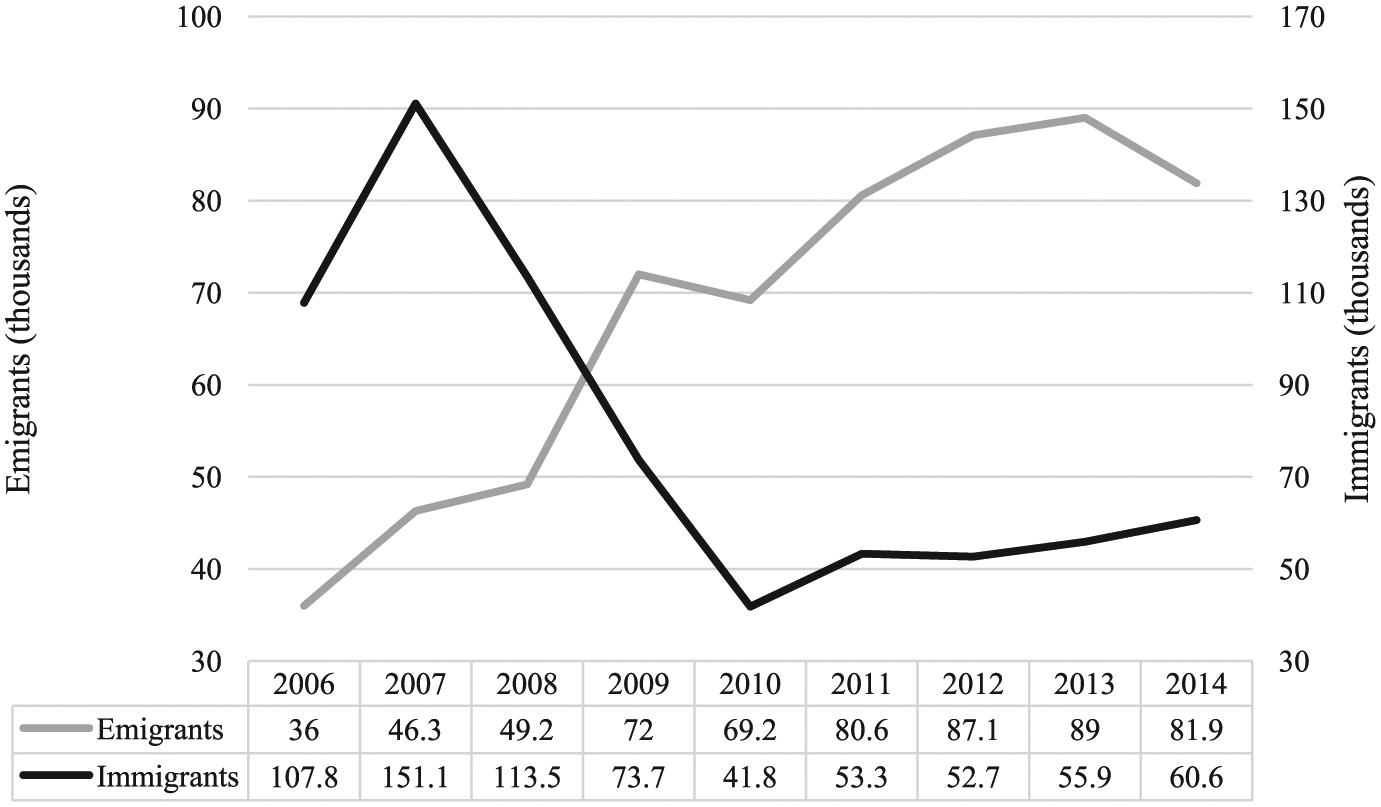
Republic of Ireland migration numbers (thousands) (2004–2014).
Hypothesis 2: Import substitution
While the first hypothesis does not differentiate between illicit drug types, the second focuses on cannabis. The second, related, hypothesis is that Irish dealers and consumers adapted to lowered incomes by producing their own cannabis, as reflected in increased recorded incidents of cultivation or manufacture of drugs. Indeed, Ireland reported to the EMCDDA (2012) a gradual increase in domestic cannabis plant seizures from 2004, with a marked increase from 2010 until 2012 (Figure 6). Furthermore, seizures of industrial farms increased from 11 in 2011 to 28 in 2012 (O’Keeffe, 2014). 4 As increased domestic cultivation may reflect a mixture of global cannabis cultivation trends and recession, the remainder of this section will explore the international literature.
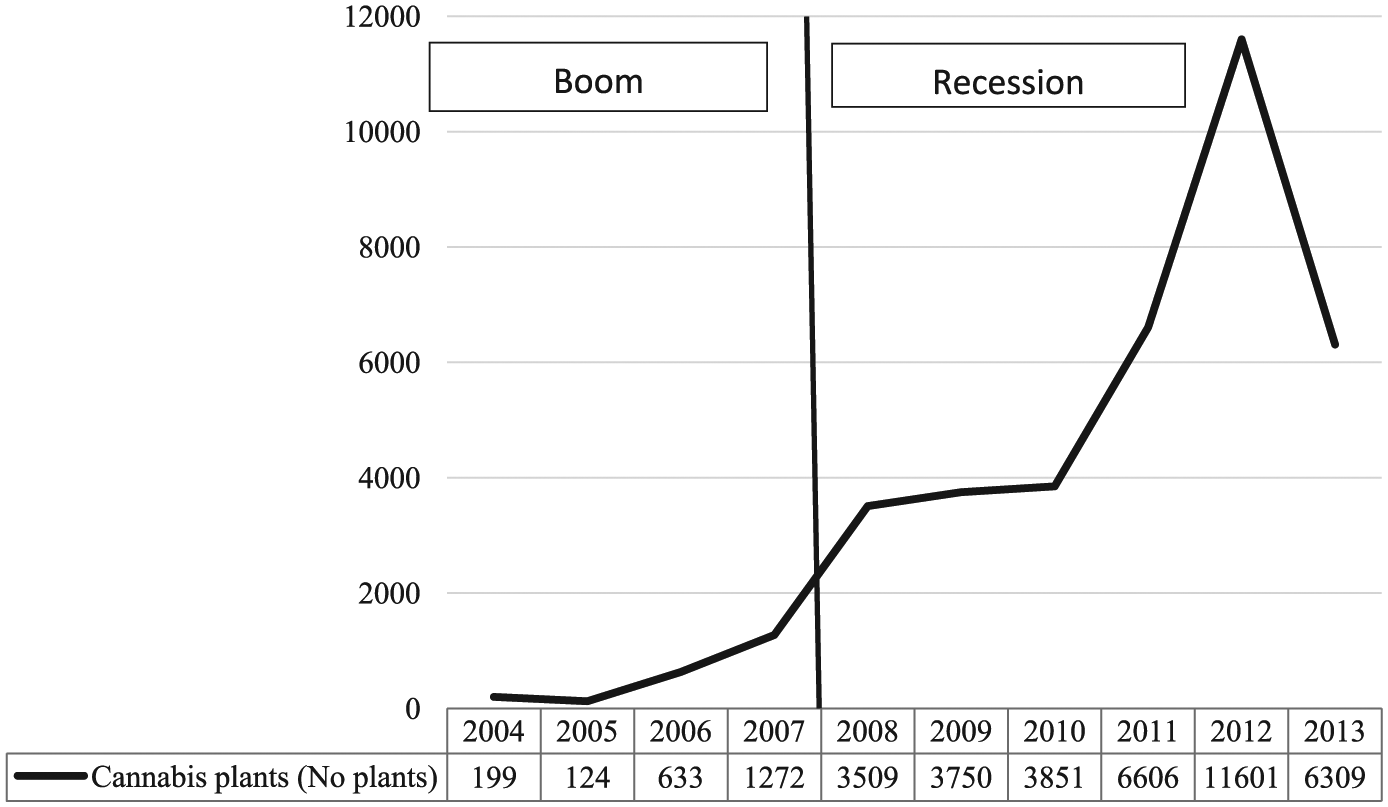
Cannabis plant seizures (number of plants) (2004–2013).
Many countries have witnessed similar trends towards cultivation closer to the consumer, often referred to as import substitution (Decorte et al., 2011). Indeed, Decorte and colleagues (2011) predict that domestic cultivation will increase in all countries, although some will be ‘late bloomers’. It is estimated, for example, that over 50 per cent of cannabis consumed in the UK and the USA is produced nationally (Gettman, 2006; Potter, 2010). In most western countries, small-scale cultivation for personal consumption is most common (Decorte, 2010).
Several studies have highlighted cost as a contributing factor in the decision to grow cannabis (Decorte and Potter, 2015; EMCDDA, 2012; Potter, 2010; Potter et al., 2015). It is possible that the propensity to waste money during the boom was tempered during the Great Recession. Indeed, domestic cannabis cultivation may parallel the upsurge in business at butchers and cobblers: people are more willing during economic downturns to spend time on products and services which save them money. Cannabis cultivation, buying meat which will not shrink in the oven and repairing shoes may all represent increased frugality founded in recession.
This said, cost is but one reason for import substitution. Other reasons given in the cannabis cultivation literature for small-scale personal or social cultivation include: avoidance of contact with criminals; the satisfaction of cultivation; control over quality and taste (see Decorte and Potter, 2015; EMCDDA, 2012; Potter et al., 2015); and limiting the transactional risks involved in buying cannabis (Belackova et al., 2015). Whereas, domestic cultivation allows illicit entrepreneurs to: control the source while reducing the risks associated with buying from other criminals (see Windle and Briggs, 2015) and cross-border smuggling. As such, Irish cannabis cultivation may have risen regardless of recession; driven, as will be discussed below, by opportunities presented by globalization.
Ireland may well have been a late bloomer, and import substitution may well have been inevitable, however, recorded incidents of cultivation or manufacture of drugs did increase during the recession, as all other indicators declined. As such, it is hard not to conclude that recession forced an adaption in the market. Even if recession sped up the inevitable.
Discussion: The Influence of Globalization
This article has used recorded controlled drug data to suggest two testable hypotheses which may account for recent changes in the Irish drug market:
Net consumption and trade of illicit drugs were reduced by emigration triggered by the Great Recession.
The Great Recession forced an adaptation in the market which sped up the process towards import substitution of cannabis cultivation.
Both hypotheses demonstrate how Irish drug markets are heavily impacted by globalization, defined by David Held as: ‘the widening, intensifying, speeding up and growing impact of worldwide interconnectedness’. This includes the increased speed and power of technological innovation, spread of global communications and multinational corporations, and development of neo-liberalism (Held, 2010: 28).
The impact of globalization on the illicit drug trade is well documented. 5 Not only does cheaper and faster transportation, and economic integration, make trafficking cheaper and easier, but trade liberalization and increased flows of people and goods across borders provide increased cover for smugglers (see Seddon, 2008; Windle and Farrell, 2012).
Ireland has embraced globalization. It came first in Foreign Policy’s Globalization Index in 2001 and 2002, gaining the title of the ‘world’s most global country’, due to its embrace of neo-liberal policies and practices, and innovations in communication and information technology (Yester, 2009).
McCullagh (1996) has suggested that, from the mid-1960s, rapid social change connected to industrialization and globalization increased general crime rates in Ireland. This was partly because economic liberalization undermined traditional working-class industries, and the marginalized adapted through illicit enterprise – especially drug dealing (Kilcommins et al., 2004) – and drug consumption (Punch, 2005). For example, it is little surprise that Limerick city became an important hub in the national drugs trade as wholesalers, living in areas affected by the changes described by McCullagh, began exploiting Limerick’s extensive sea- and airports to import drugs (Hourigan et al., 2018; see also Hourigan, 2011).
The Great Recession can be viewed in a global perspective (Pakes, 2013; Steger, 2013). While White (2010: 42) lays blame for the severity of the Irish recession with ‘a runaway construction sector, and an irresponsible financial sector’, the Irish recession was founded upon, or at least augmented by, global and foreign factors. The US subprime mortgage crisis, and collapse of Lehman Brothers, were catalysts of a recession which quickly spread beyond the USA. Furthermore, irresponsible lending was not limited to Ireland, but witnessed in many western states who possessed central bankers and other regulators who not only failed to exercise sufficient control over financial institutions but tolerated ‘global current-account imbalances and the housing bubbles’ (The Economist, 2013): as the global hegemonic ideology of neo-liberalism dictates (Steger, 2013). This ideology, promoted by the Bretton Woods Institutions, has also led to the corrosion of social welfare safety nets in many countries, ensuring that recessions hit the poorest the hardest (Friedrichs and Rothe, 2013). Indeed, many of Ireland’s poorest families were disproportionately affected by the EU–IMF agreed Economic Adjustment Programme, which increased taxation while reducing social welfare and public sector wages and employment (Callan et al., 2013). Finally, economic environments in one country can impact others. In 2008, for example, tourism from the USA declined by 25.9 per cent. This sent shock-waves through the Irish economy, which was heavily reliant upon tourism (White, 2010). That is, as recession hit the USA, Americans tightened their belts by not taking expensive foreign holidays. This reduced incomes and jobs in Ireland, forcing some to migrate and consume their drugs of choice in other countries.
Import substitution is largely facilitated, and indeed driven, by globalization. Not only have there been advances in agricultural technology and cross-breeding of new cannabis varieties, but the Internet has made it easier to share growing techniques and quicker, cheaper and easier to buy seeds and technology (see Decorte, 2010; Decorte et al., 2011). Many of the innovations in cannabis cultivation are outcomes of innovations in legitimate industries. Bouchard and Dion (2009), for example, show how the illicit use of hydroponic techniques followed hot on the heels of the use of hydroponics to grow vegetables and flowers. In another example, as websites such as Skype and Amazon allow us to ‘run our household to a large extent online’ (Pakes, 2013: 2) online seed banks, chatrooms and grow-shops allow cultivators to run their business, to a large extent, from the safety and comfort of their homes. 6
Limitations and future research
While recorded offence data are an imperfect proxy for illicit drug market activity they do represent a useful jumping-off point. Developing a fuller picture, however, requires triangulating Gardaí data with alternative quantitative and/or qualitative data (e.g. Windle, 2016a). Currently available alternative indicators are unable to chart changes caused by migration. As discussed in the methodology, national drug prevalence data fail to account for Irish citizens who emigrated during the recession and the timing of the survey unfortunately missed the peak of the recession. Filling this gap in the knowledgebase would require a survey of the historical drug consumption patterns of Irish citizens, rather than Irish residents. Furthermore, as recorded offence data tell us little about causation, future research must talk to consumers and dealers. Such research would include both those who emigrated during the Great Recession and those who stayed behind. Additionally, as the largest effects may surface in 10 to 20 years, when children born and reared during the recession mature into young adults, this research would ideally represent the first stage of a longitudinal project.
There are a number of additional confounding factors which should be accounted for in a larger study. First, the Irish Focal Point (2016) and O’Gorman (2014) suggest that increased recreational consumption of New Psychoactive Substances (NPS) and prescription drugs may have reduced the consumption and trade in traditional drugs. This said, in 2010, Ireland scheduled approximately 200 NPS as controlled drugs under the Misuse of Drugs Act. This should have increased the number of recorded controlled drug offences while diversion from pharmacists is covered under the other drug offence category. While the data should show these trends, whether they actually do depends upon Gardaí practices and priorities and, as Beck (2011) shows for the UK, austerity measures can impact intelligence gathering on new market developments.
Second, austerity measures, an outcome of the recession, represent a plausible explanation for reduced recorded controlled drug offences. The risk associated with dealing may have been reduced by less visible policing while an overstretched force may have overlooked lesser controlled drug offences. This said, Cusack’s (2015) journalistic account suggests that austerity measures increased policing of possession for personal use, which should have produced an increase in total drug offences (see also Beck, 2011). Whereas, total drug offences declined by 8032 between 2008 and 2013. Reduced Gardaí resources is a plausible explanation, however, it is likely to be only part of the story for, to use McCullagh (1996: 20) slightly out of context, ‘it would have required an enormous feat of under-reporting’ to hide thousands of controlled drug offences. Indeed, the next step may be to identify not only to what extent austerity measures impacted official statistics but to compare the extent of the impact on different offences, drugs and geographical locations.
Third, a draft of this article was presented at a conference attended by practitioners (Windle, 2016b). At the conference, members of the probation service suggested that many consumers and dealers living in Dublin’s inner city were unable to emigrate due to a lack of education, training and transferable skills. 7 This suggestion, however, risks falling into an underclass theory of drug consumption and trade: the socially excluded are not the only people consuming and selling drugs. Indeed, increased boom time drug consumption has been attributed to increased middle-class cocaine consumption (Hourigan et al., 2018). Furthermore, those who stayed behind may have increased cannabis cultivation in order to maintain consumption at a lower cost or reduce importation costs.
Conclusion
This article has analysed 10 years of An Garda Síochána controlled drug data from the tail-end of an economic boom through one of the nation’s worst economic recessions. While the use of recorded controlled drug data as a proxy for drug market trends is limited, and may hide various confounding factors, two testable hypotheses have been cautiously drawn from the data:
Net consumption and trade of illicit drugs were reduced by emigration triggered by the Great Recession.
The Great Recession forced an adaptation in the market which sped up the process towards import substitution of cannabis cultivation. This trend accounts for reductions in importation of drugs.
In short, the recession, a product of domestic and foreign financial mismanagement, forced young people to migrate for work. This outflow of potential consumers reduced net consumption and trade of illicit drugs. Those who stayed behind took advantage of opportunities presented by innovations in technology and communications to cultivate their own cannabis, which may have further reduced the importation of cannabis into Ireland. While this market change may have been inevitable, following a trend witnessed in other industrialized nations, it was likely accelerated by a need for frugality born of recession. That is, together, these developments demonstrate Ireland’s global interconnectedness and support Aas’s (2013: 286) suggestion that we can no longer study crime, or drug markets, by ‘simply looking at what happened in that territory’. Furthermore, proactive drug policy and practice require the identification of emerging global and regional drug market trends which could affect the local, and an appreciation of the influence of global economic trends.
Footnotes
Acknowledgements
The author would like to thank participants in a panel session of the 10th North–South Criminology Conference, the editors and anonymous reviewers for valuable feedback on earlier versions of this article.
Declaration of Conflicting Interests
The author(s) declared no potential conflicts of interest with respect to the research, authorship, and/or publication of this article.
Funding
The author(s) received no financial support for the research, authorship, and/or publication of this article.