



Abstract
This article explores the question of how to expand restorative justice as a national policy in a country underrepresented by the literature. We maintain that considering legal culture is essential. We identify restorative justice traditions that are characteristic of civil law and common law legal systems, respectively, and compare them with a case study belonging to the former system. We argue that restorative justice practices are shaped by the legal culture, political tradition and criminal justice identity of the system where they develop. We suggest an approach to transferring restorative justice practices based on comparative criminology, restorative justice traditions and legal culture, making a theoretical contribution to the field, as well as having practical implications at the level of public policy design.
Keywords
Introduction
This research explores the question of implementing restorative justice on a national level once the approach has been successfully introduced and realized on a more modest scale. The question was prompted by the experience with restorative justice (RJ) in Chile, where there have been RJ practices operating for more than a decade; where there have been large scale structural incentives for RJ; and where criminal justice policy favours or is open to RJ approaches, but nonetheless, where it has not moved to the centre stage in the Chilean juvenile and criminal justice system. One contribution of this article is to introduce the RJ experience of a jurisdiction underrepresented in English language academic literature. In addition, and just as fundamentally, it aims to address a gap in knowledge, in how RJ expands from local to national public policy. Of the studies that do cover implementation of RJ (Aertsen et al., 2012; Blad, 2012: 97; Dignan, 2000; Van Ness and Strong, 2015: 49, 133–147), there is little reference to issues of legal culture (Friedman, 1997; for exceptions, see Dignan and Cavadino, 1996; Shapland, 2011). An analysis of Chile, where the legal culture has elements analogous to or drawn from both civil and common legal jurisdictions, offers a novel setting to interrogate models of RJ that are largely studied in specifically civil legal (e.g. Continental European) or common legal (e.g. the USA, UK or Australian) systems.
A possible path to follow in understanding the expansion of RJ as a national policy is to analyse comparative experiences and to learn from them. In the Latin American region, penal policies are frequently imported from abroad (Fonseca and Bolívar, 2015: 153). In the literature on comparative criminal justice, some important findings related to this are that: (1) criminal justice practices and policies tend to reflect the culture and national histories in which they are embedded (Tonry, 2015: 512); and (2) there are risks inherent in the transfer of criminal justice policies and practices, given the complexities of criminal justice systems and the problems of translating concepts and institutions from one culture to another (Brants, 2011: 52–55). Taking into account these observations, this article’s analysis starts with the premise that: a country seeking to expand RJ should look at countries or systems which have had success in implementation and which have similarities with its own legal and socio-political culture in general, and with its RJ tradition, in particular, in order to learn from it/them. This framing of RJ in comparative context fits with Nelken’s (2011: 1–3) argument for sound comparative criminological analysis and policy transfer. The following hypothesis allows one to operationalize this premise for the present analysis: RJ developments in a given country will be a reflection of said country’s legal, social and political culture.
In order to explore this hypothesis, the single case study research method was adopted. The selected case study consisted of RJ developments in Chile. These are contextualized through two dominant RJ models, which reflect wider legal, political and cultural traditions. An assessment then followed of whether or not RJ in Chile was closer to one of these models, and whether this enables us to generalize the case study findings to the theoretical proposal contained in the hypothesis.
In the first section, a concept of RJ is provided. In the second section, RJ traditions and legal systems are analysed. In the third section, the methodology is discussed. In the fourth section, the case study context is examined. In the fifth section, the case study is analysed according to key features, followed by further analysis and lastly, our conclusions.
Concept of Restorative Justice
Restorative justice emerged in the 1970s and 1980s in different parts of the world (Bazemore and Schiff, 2001: 25; Braithwaite, 1999: 3; Zehr, 1990) as a new practice and theory of criminal justice, as well as a social movement, aiming to transform and/or replace the current criminal justice system of contemporary, western societies, based mainly on retributive and/or rehabilitative philosophies and goals.
Restorative justice proposes a more inclusive and participatory criminal justice process, whereby victims and offenders are the key actors in a collective, ideally face-to-face, process designed so that they can talk about the offence and how to make things right again. In this process, the community and the State also have important roles. The community’s participation allows it to: incorporate a community ‘input’ into the process; contribute to the reintegration of victims and offenders; receive material or symbolic reparation as an affected party by the offence; and strengthen community bonds. In turn, the State is expected to provide the conditions for RJ processes to flourish as well as securing the observance of basic due process rights within them (Van Ness and Strong, 2015: 56–57; Walgrave, 2000: 268–269).
Initially, the most generally accepted definition of RJ was that of Marshall (1999: 5), which placed an emphasis on RJ as a process involving a new set of stakeholders compared to traditional criminal justice. This definition has been criticized because it does not place sufficient emphasis on the outcome of reparation (Bazemore and Walgrave, 1999: 48). The United Nations Resolution on Basic Principles on the Use of Restorative Justice Programmes in Criminal Matters (ECOSOC 2002) adopts a definition of RJ that encompasses both processes and outcomes (Articles 2 and 3). Walgrave (2000) maintains that it is possible for RJ to consist of only outcomes in certain cases (e.g. a restorative community service sanction imposed by a judge). For the purpose of this research, we employ a comprehensive understanding of RJ practices involving both processes and outcomes, believing that this entails a more fully ‘restorative’ system (Wachtel, 2013: 4). Additionally, we affirm a concept linked to the values that underlie RJ processes (encounter, amends, reintegration, participation, responsibility and respect), which guide their implementation and/or operation (Braithwaite and Strang, 2001: 1–2; Van Ness and Strong, 2015: 48–50; Zehr and Gohar, 2003: 35–39).
Traditions of Restorative Justice
There are many different traditions of RJ that have been identified in the literature (see, for instance, Adler, 1993; Dignan and Cavadino, 1996: 166; Dünkel et al., 2015: 188). In what follows, we identify RJ traditions that are characteristic of civil law and common law jurisdictions, in that they reflect key cultural elements of these two main arrangements of legal systems.
Authors have previously used the civil law and common law distinction as a framework for explaining differences and similarities in developments of restorative justice. For instance, Faget (1993, 2000) explained how the political, historic and socio-legal features of France, which has a civil law system, tend to run in tension with some of the values of restorative justice, thus shaping the dominant model of ‘penal mediation’ there, which is a limited form of victim–offender mediation (see later). Several authors have analysed penal mediation in France as illustrative of the tensions between two notions of justice: the first inherited by the Napoleonic tradition, where the principle of legality is central, 1 and the second prioritizes flexibility of practice, is party-centred and allows for different normative orders to co-exist (Faget, 1993). Shapland (2011), in turn, refers to the ‘uneasy’ relationship with ‘community’ that RJ practices have in countries such as France, Belgium and Germany, explaining this as a consequence of the particular features of their civil law traditions and national criminal justice cultures. Crawford (2000) analysed penal mediation in France, its connection to Houses of Justice and the discourse of ‘justice de proximité’ as a very ‘un-French legal response’, one which departs from French legal tradition and at the same time, embodies, as well as tries to resolve, significant contradictions within French legal culture in a period of socio-legal challenges (Crawford, 2000: 31).
Two important RJ traditions that emerge respectively from civil law and common law systems are the Continental European and communitarian traditions.
Continental European tradition
This is related to western Continental European countries, which share a common political regime (liberal, social democratic), a similar civil law legal system, a Catholic religious tradition (with some exceptions such as Germany) and where the development of RJ has been, in general, more widespread and longstanding than in eastern Europe (Crawford, 2000: 29; Dünkel et al., 2015: 6, 209–210). Napoleonic legal heritage lies at the heart of this tradition, which is exemplified by legal codification. From a religious perspective, civil law and common law traditions reflect the influence of Catholicism and Protestantism, respectively. The religious variable has a particular influence on the different conceptions of community shared by these systems. Whereas Catholicism supports a centralized vision of power, Protestantism is openly anti-statist and defends the idea of the city governing itself and of citizen responsibility in local affairs (Faget, 2000: 42). Thus, systems influenced by the Catholic tradition give less space for community participation in public life than those based on Protestant ethics.
Another difference between civil and common law systems is the way in which the relationship between individuals and authority is conceived. According to Faget (2000: 42), British common law illustrates the idea of individual or group autonomy over the power of the monarch or government. Justice and judges are seen as emanating from society, and citizen participation is considered a crucial element of democracy. This is reflected in the British understanding of community which, according to Crawford, is ‘nourished by a powerful “anti-statism”’ (cited by Faget, 2000: 41). In civil law systems, in contrast, the State distributes law, and justice is a bureaucratic appendix of the central power, whereby judges are agents of the sovereign authority. In this context, the delegation of power to the community is much more limited (Faget, 2000).
The concept of civil rights in civil law systems is fundamentally linked to the State and to notions of citizenship, and this goes back as far as to Roman law (Weinacht, 2002: 210). Napoleon’s Civil Code brought about the ideal of the universal application of civil rights and of equality of all citizens in a given nation.
In the particular field of criminal justice, these systems accord great importance to the principle of legality in prosecution, though this has begun to change in recent decades, where increasingly a principle of prosecutorial discretion exists. This has helped to facilitate the introduction of RJ initiatives in Continental European systems (Dünkel et al., 2015: 184–185; Faget, 2000: 39–40).
The above discussion identifies wider political and religious cultural features in civil law countries that produce the Continental model of RJ adopted, and we particularly note the factor of weak community participation. This is reflected especially in the type of RJ programme that is pre-eminently found in these jurisdictions: the victim–offender mediation process (VOM) (Dünkel et al., 2015: 189), called ‘penal mediation’ in Spain and France. This type involves bilateral processes of conflict-resolution between the victim and offender, where the community has little or no participation. 2 A second characteristic is that mediators within this tradition tend to be mostly professionals 3 (Aertsen, 2000: 174; Dünkel et al., 2015: 204; Faget, 2000: 44; Pelikan, 2000: 134–137). This is in contrast with the victim offender reconciliation programmes (VORP) within a faith-based tradition of RJ (Zehr, 1990; Zehr and Gohar, 2003), in which mediators are usually volunteers from the community and are seen as representatives of community in the process (Díaz Gude, 2004: 182).
The fact that VOM models are the prevalent form of RJ practices in the Continental European tradition (Zinsstag et al., 2011: 26) and that they use mostly professional mediators, may be understood as a consequence of the uneasy relationship that civil law systems hold with the idea of direct involvement of lay community members in criminal justice processes. Shapland (2011) asserts that the reluctance to incorporate community within RJ processes in civil law countries is due to the fact that this would be seen as a threat to equal delivery of services to individuals in those countries that have a strong state model (Shapland, 2011: 447). She argues that although there has been a move towards recognition of the importance of community in RJ in these jurisdictions, this has been in the form of alternative notions to community, such as the concept of ‘proximity justice’ in France, which keeps elements of state’s justice in it (to ensure the principle of ‘universality’ in the delivery of justice services is maintained) (Shapland, 2011: 444).
In Continental Europe, only Belgium and The Netherlands have implemented nationally a model of restorative conferences for juveniles (Dünkel et al., 2015: 198), but the number of cases handled through conferences is rather small. Furthermore, the agreements that are reached and successfully completed do not necessarily have an influence on penal proceedings (Dünkel et al., 2015: 27). In Belgium, taking both adults and juveniles into consideration, RJ has primarily taken the form of VOM (Aertsen, 2012: 68).
Another important feature of this tradition, expressed in the works of Lode Walgrave (2000), is the relevance accorded to the role of the State in RJ, serving the functions of preventing abuses from community and safeguarding rights and legal standards within RJ processes. As such, a judicial framework for VOM is an important feature in this tradition (Zinsstag et al., 2011: 35).
Communitarian tradition
This is linked to communitarian debates (e.g. Etzioni’s communitarianism as cited in Crawford, 1999: 195), and to John Braithwaite’s normative theory of justice, republicanism (Braithwaite and Pettit, 1990) according to which, the goal of RJ should be the ‘maximisation of dominion’ (Braithwaite, 1995: 279) – or republican freedom – for all citizens. It conceives RJ as ‘deliberative justice’ (Braithwaite, 1998: 329), which is opposed to the ‘professional justice of lawyers’. This tradition stresses the importance of a mutual checking of powers between the State and the community (Braithwaite, 1998: 335–336), and conceives of community as the most important site of social regulation and crime control in society.
Another line of a communitarian RJ tradition is the theory and social movement called ‘restorative community justice’ (Bazemore and Schiff, 2001: 27–34), which seeks to involve communities in the decision-making processes regarding crime, in order to strengthen relationships and informal social control processes. It places a special focus on crime prevention, problem solving and ‘quality of life’ issues. Community input and involvement is promoted within a RJ vision and value-based framework (Pranis, 1998). Professionals are involved in decision making, but in new, different roles to the ones they have played in traditional community policing and criminal justice systems (Bazemore and Schiff, 2001: 37; Pranis, 1998: 42).
At the practical level, this tradition encompasses all RJ practices in which the community plays a key role, whether they be ‘communities of care’ in Australian community conferences (CCs) (Hayes et al., 2014: 111–114), the nuclear and extended families and support groups in New Zealand family group conferences (FGCs) (Morris and Maxwell, 2000) and/or community panels at youth offender panels (YOPs) in England and Wales (Crawford and Newburn, 2003) and restorative panels in Vermont, USA (Karp and Walther, 2001). Within this tradition, community involvement may play various different roles (Crawford and Clear, 2001: 132).
The communitarian model of RJ conceives the transfer of power from the State to lay citizens and community, and has emerged primarily in English-speaking countries that follow the common law system and, from there, has expanded to non-English-speaking countries and civil law jurisdictions. Its emphasis on the role of community reflects key socio-legal and cultural elements of common law systems, where for example, verdicts are given by juries. It is, therefore, not a coincidence that conferences and other community-oriented RJ programmes have had a stronger presence in those systems, where they have also taken a more systemic and central place in their juvenile justice systems, compared to Continental European ones (Dünkel et al., 2015: 194, 199; Zinsstag et al., 2011: 19, 72). This is the case, for instance, of YOPs in England and Wales, FGCs in New Zealand, CCs in Australia and youth conferences in Northern Ireland, all of which have been established as mainstream responses to juvenile offending. They have been incorporated into national legislation, and have operated either as diversion from prosecution and/or at the court level, with the aim of constituting a barrier to formal court proceedings or to traditional punitive sanctions. In most of these models, referrals are mandatory and agreements reached have an influence on the continuation of proceedings (Crawford and Newburn, 2003: 9–18; Dünkel et al., 2015: 54–57, 195; Hassall, 1996: 18; Hayes et al., 2014: 111; Maxwell and Morris, 1996; SRSG, 2013: 8; O’Mahony, 2006).
Table 1 shows the key characteristics of the two RJ traditions discussed.
Key characteristics of the Continental European/civil law model and the communitarian-republican/common law model.

Note: aAccording to Zinsstag et al. (2011: 46), by giving voice to more people and introducing the concept of a facilitator, conferencing programmes limit the power accorded to professional mediators, and by including in the process local community and community of support stakeholders, it encourages more active community dialogue and responsibility.
Research Methodology
This research analyses a case study belonging to the civil law tradition but with a hybrid mix of RJ elements of common law (communitarian republican) and civil law (Continental European) systems. It has both a descriptive as well as an explanatory nature, aiming to show and to analyse how RJ practices are being shaped in a specific jurisdiction, and whether and how legal culture influences these developments.
Given the nature of the research question and the interest to share the experience of an underrepresented country, namely Chile, the case study strategy was deemed appropriate (Yin, 1994: 4–11). Regarding the problem of external validity (Yin, 1994: 33), analytic generalization has been adopted (Yin, 1994: 30), whereby the findings of the research are linked to the key theoretical proposition of the research, which is contained in the hypotheses stated earlier. The key conditions to test this proposition come from the Continental European side of Table 1:
the case study has a preeminent practice of VOM;
it uses pre-eminently professional mediators.
If these conditions are met, the case study will likely be a reflection of a socio-legal, political and cultural tradition based on civil law systems, and it will specifically reflect a Continental European RJ tradition.
The period of data collection for the selected case study consists of RJ developments in Chile taking place between 2001 and 2014. Twenty-four penal mediation and restorative justice programmes, pilots or experiences were identified for this period (see Table 2), which involved over 7400 cases.
Case study penal mediation and restorative justice programmes, pilots or experiences.

The method consisted, first, of a literature review in order to understand the socio-legal context of the case study. Second, data were collected on RJ practices of 24 programmes. 4 Programmes were then systematized according to some key features used in the international research literature in order to compare Chile with RJ practices between different jurisdictions (see Dünkel et al., 2015; Miers, 2001; Zinsstag et al., 2011).
The analytical methods used were secondary and tertiary data analysis (Arksey and Knight, 1999), employing content analysis of texts gathered on the RJ programmes (Bell, 1999; May, 1997; Silverman, 2000: 89). These consisted of programme documents, manuals, public service reports 5 some of which contained analysis and evaluations of the projects, 6 statistical reports from some of the surveyed projects and questionnaires. Updated statistics from the Legal Aid Department of the Judicial Division of the Ministry of Justice and Human Rights and from the mediation centres themselves were obtained regarding Legal Aid Corporations, hereinafter CAJ. 7 For programmes where there was no public information available, 8 and for those which were inactive (during the period of data collection but active during the time frame studied), a questionnaire was developed and sent to the heads of these programmes or their related participants (when possible). Fifteen questionnaires were sent, and 11 responses were collected. 9 Taken together, this information provides a rich picture of the operating philosophies, caseload profiles and numbers, organizational setups and involvement with other actors (e.g. prosecution) of two dozen RJ programmes in Chile. Programmes were systematized (using criteria below) based on secondary data and tertiary analysis of available programme information.
Context of the Case Study: Mixed Civil and Common Law Influence in Chile
Chile is a country which follows the civil law tradition. Its legal culture has been shaped by ideas of classic constitutionalism and the codification movement. Politically, it has a strong, centralized state (Krebs, 1998: 48) accompanied by several authoritarian features and centralist visions of power in society. Catholicism has remained the dominant religion. A key principle which runs through its judicial system and professional legal culture is the principle of legality, with a strict separation of powers between the legislative, the executive and the judiciary (although this may not apply so strictly in practice). The creation of law is seen as an exclusive competence of the legislator, who is a representative of the sovereign will (Correa, 1988: 86). The judiciary during most of the 20th century kept a hierarchical structure and maintained a culture distant from the social and political processes that took place during that period. This caused it to be marginalized by other powers of the State, and to be considered as a public service subordinated to the other political powers but functionally autonomous (Correa, 1988: 86). Specifically with regard to criminal justice since the 19th century, the Chilean state has had an inquisitorial system, with no community participation (for instance, no jury system). With a strict principle of legality in prosecution, the functions of investigation, prosecution, judgement and sanction were in the hands of the same judge (Duce and Riego, 2000). In 2000, Chile underwent major criminal justice system reform, changing to an adversarial system, which has an oral trial in front of three judges and the incorporation of more prosecutorial discretion, among other features as key components (Riego, 2008). This reform was part of a broader process of modernization, democratization and strengthening of human rights in the country, after a long period (17 years) of military dictatorship (Riego, 2008: 339). Interestingly, the criminal procedure reform followed the Model Criminal Procedure Code for Ibero-America, which in turn was modelled on the Continental European tradition of criminal procedure systems (Riego, 2008: 343–345). However, during the parliamentary debates, Anglo-American systems exerted considerable influence, particularly those of the United States and England and Wales, with the resulting reform producing institutional arrangements which in some key aspects made the legal framework more adversarial than its Latin American counterparts (Riego, 2008: 343). Chilean criminal procedural reform in turn has had a significant influence on legal reform processes in other Latin American countries (Riego, 2008: 355–356).
One of the diversionary mechanisms that the reform introduced are the so-called ‘alternative settlements’, which served to incorporate RJ in the country. This has taken place despite the fact that the law does not specifically mention RJ or penal mediation (Díaz Gude, 2010).
After the criminal procedure reform took place, the juvenile justice system underwent a significant change too, with Law No. 20.084 (June 2007). It changed from an essentially welfare, rehabilitative model, 10 to a rights-based, ‘just-desert’ model with some educative goals. A key purpose of the law was to align the juvenile justice system to the 1990 UN Convention on the Rights of the Child. Procedurally, it adopted the basic adversarial framework of the adult criminal justice process, with some specific juvenile justice institutions.
RJ in Chile is a theory and practice that has been transferred from abroad (Díaz Gude, 2010), and the most widely used concept is ‘penal mediation’. Apart from the incorporation of prosecutorial discretion as stated above, key factors that have contributed to the development of RJ in Chile are (Díaz Gude, 2010: 16–35):
the arrival of the alternative dispute resolution (ADR) movement in the 1990s, as part of the broader processes of democratization and modernization of the Chilean state and its justice system, which has sought to improve access to justice for people, especially for the poor, improve the quality of justice solutions, reduce overloading of the courts and empower communities;
the expansion and influence of the victims’ movement; and
various initiatives from non-governmental organizations (NGOs), 11 academic institutions (both public and private), the government (particularly through its Ministry of Justice and Human Rights), the judicial body (in recent years, through the Supreme Court) and international organizations to support training, evaluations, experimentation and seminars on these matters. 12
The research undertaken reveals that though there is availability of RJ programmes in different parts of the country, it is not possible to ascertain that there is a national availability of RJ in Chile, for the following reasons: (a) it is mainly applied to adults; (b) programmes are not located in all the main capital regions of the country; and (c) the number of cases referred to the initiatives is still marginal considering the universe of cases being processed through the criminal and juvenile justice system (see note 20).
Explanations for the limited development of RJ in Chile have been proposed (González and Fuentealba, 2013: 199; Peñaloza, 2012: 102) as: lack of institutionalization of RJ; managerial considerations; legal discourses critical of RJ; punitiveness of the population; and lack of a national model of RJ.
From a socio-legal and cultural perspective, the centralist, authoritarian and hierarchical features of the Chilean state, society and judicial actors may run in tension with the values of RJ, making it harder to flourish. However, these elements may not be enough to explain the slow development of RJ in Chile since they can also be found in Continental Europe, where RJ has flourished. For this reason, a second factor may contribute to the explanation, which is the enactment of criminal procedure reform in 2000. This reform put in place a significant amount of human, economic and institutional resources to support widespread implementation of RJ (Riego, 2008). It also effected cultural change in respect of legal actors (Riego, 2008: 348–351), who historically worked in an inquisitorial, secret, written, criminal justice system, by creating new ones (such as the prosecutor), who acquired a protagonist role in the procedures. In Chile, the movement for Judicial Reforms that has spread in South America 13 since the 1990s, meant that the new adversarial system was the ‘fresh air’ that put an end to centuries of the inquisitorial system. This contrasts with the situation experienced in the United States and other European countries where RJ emerged as a critique to an adversarial system that had been operating for decades (if not centuries) (Díaz Gude, 2010), and had entered into a crisis of legitimacy and/or effectiveness (Crawford, 2000: 44; Shapland, 2011: 454–456; Zehr, 1990: 94), or a ‘general dissatisfaction’ with the system (Braithwaite, 1999; Pavlich, 2005, cited in Hayes et al., 2014: 111). Since RJ posits a fundamental critique to adversarial justice, one could hypothesize that its ideological message would be weaker in countries undergoing justice changes such as Chile (Díaz Gude, 2010: 61). The legitimacy enjoyed by the newly established criminal justice system in Chile may have acted as a barrier against the flourishing of RJ (as there was no sense the system needed this further ‘reform’). Paradoxically, the introduction of the principle of prosecutorial discretion through reform opened up space for the incipient incorporation of RJ.
Chilean Case
This section systematizes programmes according to key features.
Type of restorative practice
All the programmes studied adopted the VOM model of RJ, with 55 per cent of the programmes studied 14 using direct mediation, 10 per cent indirect mediation and 35 per cent both mediation formulas. In terms of the total number of cases (not programmes) which went through mediation (4.520 cases), 96.9 per cent of them used direct penal mediation. Seventeen programmes (85 per cent) utilized individual sessions held with each party prior to the joint session.
Institutional location and operation of programmes
Mediation was conducted in different institutional locations: one programme operated at the prosecutor’s office, eight in civil society organizations and 15 at public organizations.
The role of the mediator was mostly undertaken by professional mediators (a psychologist, social worker or lawyer trained in ADR) contracted by organizations operating outside the criminal justice system. In the case of the programme at prosecutor’s office (URAVIT) mediation was conducted by professionals working at the Victims’ Unit (mostly social workers and/or psychologist) trained in mediation.
Referral sources
The Public Prosecution Office was the dominant referring body (18 programmes). 15 This is explained by the fact that penal mediation in Chile mainly takes place at an informal stage, as a form of ‘diversion’ of cases governed by the public prosecutor who has the exclusive right to public prosecution.
Stage of case disposal
In six projects cases were disposed through ‘optional prosecution terms’ (OPT) that operate before arraignment of the case; in three projects, cases were disposed through ‘alternative settlements’ (AS) that operate after arraignment but before trial and require the judge’s approval; and in 10 projects cases were disposed through both mechanisms. Two projects working with juveniles have added the possibility of referrals at the sentencing stage.
Crimes undergoing restorative processes
The most frequently referred offences were damage, threats, minor and moderate injuries, theft and reckless bodily harm. A second group corresponded to misappropriation, fraud and theft in a non-inhabited place and robberies in national public property. A small number of referrals included negligent homicide, serious injury, rape and violent robbery. 16
Cases admitted/mediated/settled
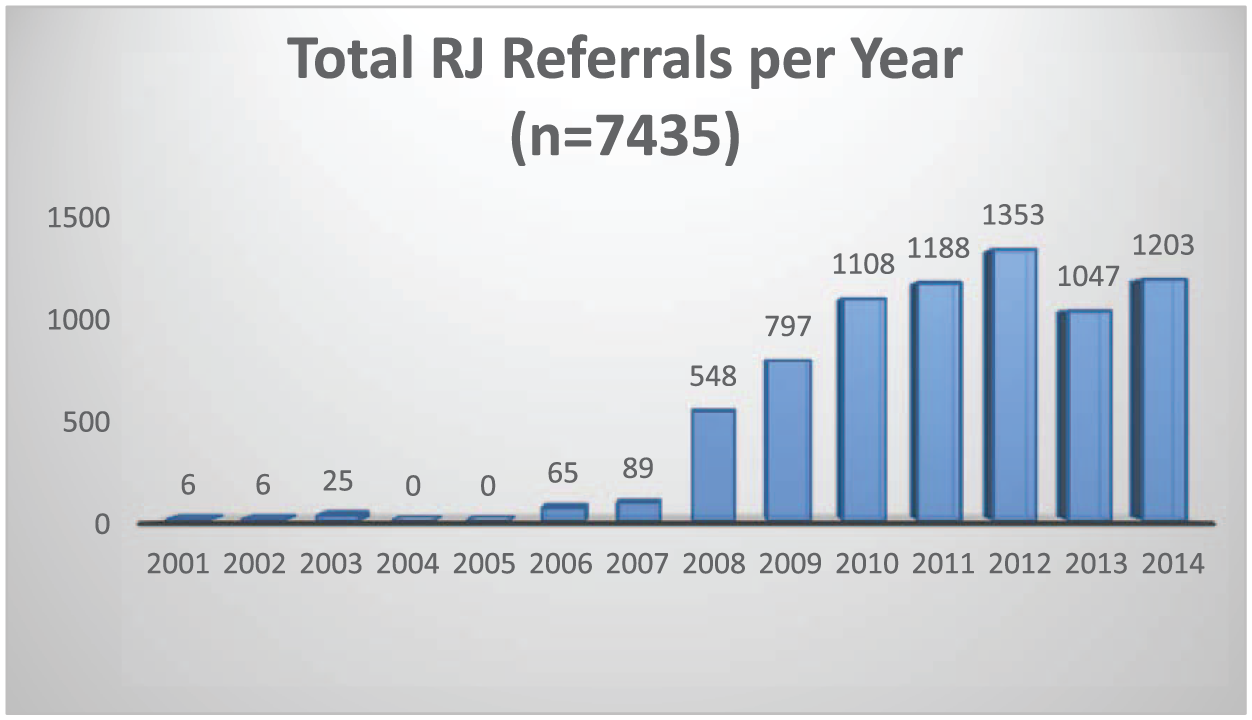
A total of 7435 cases were referred to penal mediation projects from 2001 until 2014 (See Figure 1). 17
Total number of cases referred to RJ programmes per year.
From 2001 through 2007, there were only some isolated experiences of experimentation and development of referral protocols between prosecutors and mediation centres. Subsequently, there was a second stage, from 2008 onwards, where CAJ reached agreements with prosecutors to increase referrals. This coincides with the transfer of resources to the Chilean government by the European Commission through its programme EUROsociAL, which sought to increase the use of penal and community mediation as mechanisms of social cohesion. In 2016, 18 only seven projects were still operational.
The percentage of mediated cases (where at least one joint session was conducted) over the total referred was 60.80 per cent. Agreements were reached in 62.60 per cent of mediated cases.
Objectives of programmes
Most programmes were oriented towards the objective of RJ (e.g. reparation, restoration, reintegration), followed by objectives linked to the ADR movement (e.g. improving access to justice, seeking more collaborative solutions to conflicts, informal justice). Half of the programmes (12) followed more than one goal. 19 Crucially, managerial objectives (e.g. easing court and/or prosecution congestion) contributed to participation of the Prosecution in seven programmes.
Analysis
The number of cases referred from 2001 to 2014 confirms that RJ in Chile has not yet become a mainstream practice, 20 although there has been significant growth in referrals since 2008 (and following infusion of European funding). It has been primarily applied to adult offenders, following the trend of countries such as France, but distancing itself from most other civil law countries in Continental Europe, where RJ has grown primarily with juveniles (Dünkel et al., 2015: 4–5, 209). The management of cases shows consistency over time in understanding and practice among RJ programme operators.
From the standpoint of programme philosophy, penal mediation familiar to the Continental model is mostly inscribed in the theory and practice of RJ in Chile, often co-existing with other goals or ideologies, especially those derived from the ADR and access to justice movements (Matthews, 1988). These movements arrived in Chile before RJ in the fields of family, civil and labour law, and many mediators – from their practice and experience with mediation in these areas – became involved in penal mediation practices (Díaz Gude, 2010: 16–30). The infusion of European money, which had among its goals the promotion of social cohesion in the country, has also played a significant role in the increase in cases referred and the dominance in the RJ market of CAJ organizations.
The Chilean model corresponds to a Continental, professionalized approach to RJ, but it also contains some elements of the common law model. The latter tradition is expressed in the existence of: a political framework which values separation of powers; a criminal procedure reform which has received considerable influence from Anglo-American systems, particularly with regard to the incorporation of the principle of prosecutorial discretion; and the arrival in Chile of the ADR movement which has been a key force in the emergence of RJ. On the other hand, the professionalized approach of RJ in Chile, together with the fact that it operates mainly as diversion from prosecution for less serious crimes, is likely a reflection of Chile’s own socio-legal, cultural and political tradition. It demonstrates a resistance to decentralize the resolution of conflicts out of the judicial structures and a cultural and ideological distrust of community participation in criminal matters, an area which is perceived by the legal and political community as the symbol of the sovereign state.
At the same time, the arrival of the ADR movement in Chile, and the political process of modernization of the justice system as a whole, making it more responsive to citizens’ demands, has paved the way for a certain transfer of power over the decision making of conflicts from judges and professionals, to lay people directly involved in them. This, together with the changes introduced by the criminal procedure reform, illustrates the incorporation of common law, republican elements in the Chilean case. However, the role of a third, neutral party – the mediator – that is performed by a professional, who is usually part of a public service or a private sector organization that signs a contract with the State, shows that this transfer of power is still mediated by the country’s deep-rooted legal culture. Community is not yet seen as capable of resolving serious conflicts where the public interest is also a key concern, and where state sovereignty is involved.
It is also illustrative of Chile’s legal culture that expansion of penal mediation took place primarily thanks to a national implementation policy (facilitated by external funding), as shown in Figure 1, despite some scattered initiatives from civil society.
Given the above findings, should Chile, in seeking to expand RJ through a specific public policy, examine countries or systems that follow a similar tradition on RJ to its own and that have been more successful in its implementation?
This research suggests that it should, because penal practices and policies are to some extent the product of national legal and political cultures, and so their transfer involves risks related to the different contexts in which they take place. Some of those risks can be reduced by transferring from ‘similar’ RJ traditions to the target one. This may also make the transfer easier by confronting less resistance from legal actors called to implement them. Given that RJ in Chile has not yet moved to a mainstream position, this strategy may also seem wise. The particular Chilean tradition suggests that it should continue to develop the civil law elements shown until now (bilateral, professionalized, processes of conflict resolution), through learning from more successful civil law models, while also assessing what features from the common law, communitarian-republican tradition of RJ could benefit its model. After all, the successful criminal procedure reform in Chile started within the framework of the Continental European tradition and subsequently incorporated common law institutions in specific areas of the whole new system. This is our ‘own’ successful experience that we could follow. 21
Communitarian-style conferences could be introduced in juvenile justice at certain stages of the process since children’s ‘communities of care’ (Braithwaite, 1989) could contribute to juveniles’ reintegration into society. The involvement of families in the process would be an element consistent with Chilean legal institutions, given the extended practice of family-mediation in the country. A communitarian-republican philosophy could also be beneficial from a socio-political standpoint. Chilean society has been characterized as unequal and with little social mobility (Andrews and Leigh, 2009), so the inclusion of such a philosophy in a RJ public policy may contribute towards a more egalitarian society (Braithwaite, 1995). Community RJ theory would involve transforming the role of professionals in the youth justice system, a role which has historically evolved around needs-based, rehabilitative philosophies, only to recently change to a rights-based, just-deserts one (with some educative goals). This would represent a further challenge for the system, as well as an opportunity.
Conclusions
Restorative justice developments in Chile are a reflection of the country’s legal culture, national criminal justice identity and socio-political tradition, and of the changes that they have undergone in recent decades. They are connected with a Continental European tradition of RJ that is typical of civil law systems. However, they have also incorporated elements from the common law systems, specially linked to the broader reforms to its justice system that took place with the transition to democracy. For various reasons, it is herein suggested that public policies seeking to expand RJ in Chile would do best to start from working within its own legal institutional tradition. Given the hybrid approach to RJ that Chile has undertaken so far, those looking for a national policy need to draw both from civil law as well as common law, communitarian-republican traditions with regard to both the specific features of the conflict-resolution process to be implemented and the theoretical framework underpinning it.
Footnotes
Acknowledgements
The authors would like to thank Prof. Vernon Jantzi, EMU University, for his useful comments on this article, and to the 24 programmes who collaborated with this research.
Declaration of Conflicting Interests
The author(s) declared no potential conflicts of interest with respect to the research, authorship, and/or publication of this article.
Funding
The author(s) disclosed receipt of the following financial support for the research, authorship, and/or publication of this article: This work was supported by Comisión Nacional de Investigación Científica y Tecnológica-CONICYT PIA (SOC 1406).