




Abstract
This article makes the case for greater use of systematic archival research as a methodological tool of criminology. Drawing upon insights from the author’s 2018 historical study of ‘early release’ in England and Wales, it reviews the legal framework underpinning the current ‘right of access’ to official records and demonstrates how greater engagement with this underused public resource can reveal a richer understanding of penal policy making and the continuities and dislocations within contemporary criminal justice. It goes on to consider the methodological challenges of gaining access to historical sources in criminological settings and concludes with a number of reflections upon the evolution of the discipline at a time of digital abundance and significant changes in government record keeping.
Keywords
Introduction
In 2017/2018, the Parole Board organized a series of events to mark the 50th anniversary of the parole system in England and Wales. This milestone provided a rare opportunity for academics, and the wider policy-making community, to step back from everyday concerns and compare contemporary policy and practice against the methods of a previous generation of criminal justice actors. Reflecting upon this moment of institutional reflexivity the then Chairman of the Parole Board, Professor Nick Hardwick, alluded to the complex picture of continuity and change that characterizes our perception of time and cultural construction of ‘the past’: Fifty years is a long time in the life time of any organisation – but perhaps less so for the Parole Board than other organisations. We deal with the legacies of the past. We have a parole review coming up for a man who has been in prison since he was first sentenced in January 1967 – before the Parole Board was first established. Were he to be released, imagine how the world has changed since he was last free. (Parole Board, 2017)
This insight captures something of the value of a historical criminology. Even the events of a single lifetime can underline the contingency of seemingly stable social structures and prompt us to re-examine taken for granted ideas and assumptions about the world we inhabit. For this reason, ‘distilling the frenzy’ (Hennessy, 2012) of contemporary events can help to focus our attention on the changing aims and techniques of government as well as the ideas, tensions and struggles that re-shaped penal policy in the latter half of the 20th century. Greater sensitivity to history and our embeddedness within these complex developmental trajectories encourages a more productive dialogue between criminology and historical sources of evidence (Godfrey et al., 2008; Sewell, 2006). But, what should this look like in practice? How do we acquire knowledge of the contemporary history of criminal justice?
Drawing upon insights from the author’s recent historical study of ‘early release’ in England and Wales (Guiney, 2018) this article makes the case for greater use of systematic archival research as a tool of criminology and reviews the practical challenges of applying these methodological tools in ‘real world’ research settings (Gunn and Faire, 2012). It will proceed as follows: First, it considers the continuing relevance of contemporary historical analysis by way of a short case study of the Parole Board of England and Wales. Second, it explores the potential of systematic archival research as a natural methodological counterpart to a grounded historical criminology. Third, it reflects upon the methodological challenges of archival research in contemporary historical settings, with particular reference to the current legislative framework underpinning the public right of access. Fourth, it examines the evolution of the discipline at a time of digital abundance and significant changes in record-keeping practices within central government departments from the early 1990s onwards. The article concludes with a call for greater exchange between archivists, civil servants and academic researchers to unlock the full potential of this underused public resource.
An Uncertain Inheritance: The Parole Board of England and Wales
Harold Wilson once observed that a ‘week is a long time in politics’ and the events that came to define the 50th anniversary of the Parole Board for England and Wales in 2017/2018 offer a timely case study of why detailed excavation of archival sources still matters. In 2009, John Worboys was found guilty of 19 sexual offences against 12 victims. He received an indeterminate sentence for public protection (IPP) and was ordered to serve a minimum tariff of eight years before he could be considered for parole. The decision to release Worboys, announced by the Parole Board in January 2018, has generated unprecedented public interest and renewed questions about the transparency, fairness and independence of the parole system. But more than this, these events are significant for what they reveal about the anatomy of a ‘penal crisis’ and how events can become dislocated from their historical context. Confronted by a complex and fast-moving sequence of events, the Ministry of Justice has struggled to ‘control the narrative’, and this has encouraged a largely ahistorical response as concern for the past and future has been subsumed within the short-term demands of the immediate present (Rock, 2005). In reality, historical parallels abound, and it is impossible to understand the current controversies surrounding the Parole Board without some knowledge of where it has come from and the unresolved contradictions that were apparent from its formation. As Tilly (2006: 433) has noted, ‘every single political phenomenon lives in history, and requires historically grounded analysis for its explanation. Political scientists ignore historical context at their peril.’
As originally introduced in Parliament, section 22 of the Criminal Justice Bill 1966/1967 left the decision of whether to release a prisoner on licence wholly at the discretion of the Home Secretary. The question of governance provoked considerable discussion within the Home Office, but it was significant that the Prison Department, who were expected to inherit responsibility for the ongoing administration of the new parole system, were wedded to an internalized decision-making structure (TNA: HO 383/219). In a memorandum, prepared in June 1966, for the attention of the Secretary of State, Roy Jenkins, and his Minister of State, Lord Stonham, senior officials set out their formal advice for a centralized system, ‘based on a continuous process of assessment within the prison machine and that S. of S. should have the final responsibility for selecting prisoners for release’ (TNA: PCOM 9/2248). This was driven, in part, by a pragmatic instinct to integrate parole within the existing administrative apparatus of the penal system, but it also reflected the ongoing influence of a strong ‘command and control’ governmentality within Whitehall that instinctively favoured an amenable decision-making framework that would support the wider strategic objectives of the department in the medium to long term.
This emphasis grew in importance as the prison population began to grow after 1966. On 31 January1967 Jenkins instructed his officials to explore further ways to reduce the prison population, including the suspended sentence and further iteration of the proposed parole scheme (TNA: HO 291/1246). In a wide-ranging briefing prepared for the Home Secretary it was noted that the impact of the parole system was highly contingent upon the discretion bestowed upon parole decision-makers: everything turns on the way in which the discretion is exercised, (and if we were to have an independent parole board deciding who should be licensed, you would largely lose control of the way in which the power is used). (TNA: HO 291/1246)
The thrust of this argument was accepted, but records indicate that Home Office Ministers and the ‘Bill Team’ charged with the safe passage of legislation through Parliament were unwilling to expend significant political capital in defence of this arrangement. The minutes from one Cabinet Legislation Subcommittee reveal that the Home Office were prepared to concede ground on this point, if pushed, and it was agreed in advance of the marshalling of the Bill that ‘government spokesmen would not commit themselves firmly against it and if the case for a board was strongly argued when the Bill was under discussion in Parliament, policy could be reconsidered’ (TNA: CAB 134/2956).
As anticipated, the point was strongly argued in Parliament. At Second Reading Quentin Hogg set out the opposition’s preference for an independent parole board, arguing that a strong judicial presence was essential if the new system was to command the confidence of the courts and ensure that questions of liberty never became a matter for government ministers (Churchill/ HLSM 2/42/ 2/16). Scrutiny intensified when the Bill reached Commons Committee. Sir John Hobson, a former Attorney General, tabled a series of amendments intended to curtail executive control over the system by establishing an independent parole board and the issue was debated at length in Committee where Roy Jenkins attended all Committee proceedings in person rather than delegate this responsibility to junior Ministers (Hansard Standing Committee A 7 March 1967 c704). While the Home Secretary was unable to accept the opposition’s proposals he did eventually yield to political pressure bringing forward his own plans for a system of parole incorporating an independent parole board while noting that, ‘the Government are disposed to consider a scheme on the lines I have put forward and would endeavour to put down Amendments in this direction if they appealed to the Committee at the Report stage’ (Hansard Standing Committee A 7 March 1967 c743). The Home Office honoured this commitment on Commons Report with the introduction of a ‘Prison Licensing Board’, a name subsequently changed to the Parole Board after repeated interventions from the House of Lords.
While brief, this analysis hints at the value of contemporary historical analysis in criminological settings. The challenges currently facing the Parole Board are legion, but they are not sui generis. Many of the questions raised by the Worboys case, from the confused normative basis of the parole system, to the quasi-legal status of the Parole Board and its relationship with central government have been apparent since the creation of the modern parole system in 1967. Failure to recognize these connections denies us access to historical knowledge. As Rock has argued, historical contextualization can equip us with the analytical tools to push back against the slow drift of ‘chronocentricity’ and the ‘belief that we live in “new times” […] that demand new concepts, ideas, understandings’ (Rock, 2005: 473). This tendency is prevalent in a great deal of policy debate and may help to explain the complex picture of continuity and change that characterizes our perception of penal policy making. It is often the unfolding political response to age-old questions, rather than those underlying policy problems themselves, which reveals most about the shifting contours of criminal justice.
The Contours of Contemporary Historical Criminology
The recent history of crime and justice has been a subject of detailed criminological investigation (Godfrey et al., 2008). A burgeoning literature has explored the human experience of criminal sanctions (Bosworth, 2001), the interconnectedness of punishment and the emergent welfare state (Garland, 1985), the new politics of law and order (Downes and Morgan, 2007; Newburn, 2007) and the ‘punitive turn’ experienced by many liberal democratic systems in the latter half of the 20th century (Bottoms, 1995; Morris, 1989). Over time, this eclectic analytical gaze has generated a varied ‘historical criminology’ which has accommodated a broad spectrum of theoretical and methodological perspectives (Godfrey et al., 2008). As Lawrence (2012: 315) has documented, historical study played a central role in the formation of British criminology (Radzinowicz, 1948), however in recent decades the discipline has fractured into a number of distinct intellectual pursuits each with ‘its own constituency, avenues of publication, conferences and networks’.
A detailed review of this literature is largely beyond the scope of this article which is concerned with the contemporary history of criminal justice 1 and must therefore be distinguished from the broader conventions of ‘social history’ favoured by many criminal justice historians (see Godfrey et al., 2008). Rather the argument developed here is that the inherent temporality associated with historical study requires all criminologists with an interest in contemporary criminal justice to confront an additional suite of a priori choices between ‘structure’ or ‘agency’, as the major engines of policy change (Hay, 2002). Above all else, it is this elemental dichotomy, often tacit and left unspoken, which continues to generate a wealth of distinct ontological, epistemological and methodological constellations within the literature (Bosworth, 2001: 439), with significant implications for the likelihood that a research design integrating archival research will be adopted (Godfrey, 2011).
In general, ‘agent-centred’ approaches have tended to draw heavily upon historical methods with a strong focus upon chronology and the actions of individual actors. Research within this broad tradition is often associated with descriptive complexity and a methodological preference for empirical particulars which has yielded both ‘bottom–up’ studies of civic engagement as well as ‘top–down’ accounts of the powerful and political elites. The latter has included the reflections of retired public figures (Faulkner, 2014), Lord Windlesham’s (1993) detailed commentary on the evolution of penal policy in post-war Britain and the wide-ranging Official History of the Criminal Justice System announced by the Prime Minister in March 2009. In contrast ‘structuralist’, or ‘big picture’ accounts of criminal justice change continue to demonstrate a strong sociological preference for generalizability and analytical approaches to methodological enquiry designed to reveal the broad organizing principles of society, typically associated with neoliberalism (Wacquant, 2009), late-modernity (Young, 1999) or post-Fordism (Di Giorgi, 2006). In the introduction to the Culture of Control, Garland (2001) offers a penetrating analysis of the inherent tension between ‘broad generalization’ and ‘empirical particulars’ when seeking to make sense of the social world. While recognizing the inevitable costs of abstraction, Garland considers this a productive epistemological exchange in order to reach a level of analysis capable of yielding an explanatory account of the broad social structures that shape the causes of crime and our responses to it in late-modern liberal democratic systems (2001: viii). As a result of these choices, Garland (2001: 2) adopts an approach that is ‘analytical rather than archival’ and attempts to distance his project from the ‘conventions of narrative history and above all from any expectation of a comprehensive history of the recent period’ (2001: 2).
This sociological posture, or disciplinary habitus with regards to the study of contemporary criminal justice, remains preeminent within the mainstream criminological scholarship (Lawrence, 2012: 315), but it has arguably come at the expense of empirically grounded methodological approaches, such as systematic archival research. Reflecting upon the influence of seminal texts including Young’s The Exclusive Society (1999) and Wacquant’s Punishing the Poor (2009), Farrall et al. (2014) have argued that in giving preference to the ‘big picture’ of penal change the criminological literature has tended to focus on macro-level analyses and in so doing, ‘gives primacy to theoretical rather than empirical considerations to the extent that few claims are subjected to rigorous data analyses’ (2014: 3).
Where possible greater methodological diversity should be encouraged, drawing not only upon insights from grand theory but innovations from neighbouring disciplines, such as criminal justice history, political science and historiography (Lawrence, 2012: 320–323). While systematic archival research is arguably more commonplace within agent-centred accounts of criminal justice change it remains a largely untapped tool of criminology scholarship and an underused methodological complement to established research designs including semi-structured interviews, media content analysis or quantitative scrutiny of large historical data sets (Godfrey, 2011). The author’s own experience also indicates that archival research may be particularly effective when employed as a methodological counterpart to ‘middle range’ scholarship, including approaches such as historical sociology and institutional analysis (see Amenta, 2009; Mahoney and Rueschemeyer, 2003), which seek to explain a limited aspect of the political world and occupy an epistemological position that is: intermediate to general theories of social systems which are too remote from particular classes of social behaviour, organization and change to account for what is observed and to those detailed orderly descriptions of particulars that are not generalized at all. (Merton, 1967: 39)
In this way systematic archival research can open new vistas for criminological enquiry and encourage researchers to ask different types of questions at a time when the ‘State’ (Barker and Miller, 2017), penal policy making (Annison, 2018) and ‘policy transfer’ (Jones and Newburn, 2004) have emerged as key arenas of contestation within contemporary criminological scholarship. For example, many comparative historical accounts of criminal justice change have, and will continue to, coalesce around the ‘punitive turn’ within criminal justice that saw the breakdown of an optimistic and bipartisan approach to crime associated with the ‘rehabilitative ideal’ (Allen, 1981), and the emergence of an increasingly politicized ‘populist punitiveness’ that gathered pace from the mid-1990s onwards (Bottoms, 1995). This issue remains fiercely contested within the criminological literature (Matthews, 2005) but it is surely of note that we are now reaching a point in time when the events of the 1990s are within reach of systematic archival excavation by historical criminologists.
While the broad contours of this shift may have been well mapped in the criminological literature (Newburn, 2007), detailed excavation of these key moments of political controversy, policy contestation and crisis can add much needed colour and texture to the criminological terrain. How was the emergence of a more ‘populist punitive’ posture towards crime and criminal justice viewed by Home Office officials and special advisers? What conversations took place within the Labour Party machine as it began to cultivate a tougher law and order platform under shadow Home Secretary Tony Blair? How did the annual Public Expenditure Survey (PES) negotiations with HM Treasury evolve as the prison population began to swell in the mid-1990s? Greater engagement with the archival record can help us to gain access to aspects of the policy-making cycle that would otherwise be hidden from public view and begin to make sense of the ‘small structures and processes’ that ‘animate the very core of the routine politics of criminal justice’ (Rock, 1995: 1). The key point being that a more constructive dialogue between theory and archival sources of evidence has a central role to play in developing new research trajectories that are certain to confirm and challenge prevailing penal orthodoxies.
With this in mind, Loader and Sparks (2004) have championed a ‘historical sociology’ of crime which seeks to cultivate a ‘more quizzical historical sensibility that is attuned to the trajectories of competing practices, ideologies and ideas and the legacy particular signal events and conflicts bequeath us today’ (2004: 14). This aspiration has significant implications for the research strategies employed by historically minded criminologists. It requires a more productive dialogue between theory and empirical particulars, and greater methodological precision in examining how policy actors operate within institutional settings, the competing ‘meanings in-use’ of value-laden crime categories and the interconnections between crime control and the wider terrain of political ideas (2004: 13). In practice, a grounded historical sociology of crime demands a more practical and iterative research craft that is closer in spirit to that taken by historians than by social scientists (Gunn and Faire, 2012). If we are to begin the ‘historiographical operation’ of translating scattered documentary traces into a written history of events (De Certeau, 1988) contemporary historical criminologists must engage with primary historical sources. Only then can we hope to arrive at an empirically rich, and theoretically informed, account of penal policy change.
Reflections on the Methodological Challenges of Archival Research
The analysis of the early Parole Board set out above, and the wider study of ‘early release’ in England and Wales from which it is drawn, was informed by a significant period of archival research, complemented by exploratory interviews with senior decision-makers (Guiney, 2018). Records were obtained from the National Archives where several hundred files and many tens of thousands of pages of documentation were reviewed. To support detailed contextualization this study also drew heavily upon materials held at specialist archives such as Churchill College Cambridge and the British Library. To gain access to more recent events, the author was able to access personal papers from retired public servants and a total of 10 freedom of information (FOI) requests were submitted to the Home Office, Ministry of Justice and the Parole Board of England and Wales on topics as diverse as sentencing practice and the annual Public Expenditure Survey. In total these requests for information yielded a further 500 pages of documentation, many of which were reviewed in Home Office and Ministry of Justice reading rooms while exercising the statutory right to view files in person. This process of immersion in the archival record highlighted a number of distinct methodological challenges that all researchers engaging in contemporary historical analysis are likely to confront, irrespective of prior knowledge and expertise. These are discussed below in turn.
The right of public access
The release of official records in England and Wales is underpinned by a complex legislative framework. Historically, the UK Government operated within a culture of official secrecy and this was reflected in its attitude towards public record keeping (Vincent, 1998). Under the Public Records Act 1958 (as amended by the Public Records Act 1967), all official records were automatically closed for a period of 30 years, at which point they would be reviewed by government and, subject to a number of legislative exemptions, transferred to the National Archives under the ‘30-year rule’ for public release. This began to change with the Freedom of Information Act 2000 which made qualified moves in the direction of ‘open government’ with the creation of a general right of access to official records (Hazell and Glover, 2011). Since the Act came into force on 1 January 2005, individuals have enjoyed the right to request information from public authorities who are required by law to release all relevant information within 20 days, subject to exemptions relating to cost, national security, personal information and so on. Of particular interest in this context, the Freedom of Information Act 2000 also modified the existing regime for the storage, preservation and destruction of older government records. Under Part IV of the Act, records over 30 years in age became classified as ‘historical records’ and a new statutory duty was placed upon government departments to work with the National Archives to review extant records and select those of ‘historical value’ for preservation. This framework was substantially altered by the Constitutional Reform and Governance Act 2010 which introduced a new ‘20-year rule’ for the selection and transfer of official records to the National Archives for public release. Given the expected administrative burden of clearing such a large backlog of documentation, a transitional timetable was agreed with the expectation that government departments will release two years’ worth of records each year over a 10-year period commencing in 2012 and concluding by 2023 (see Allan, 2014: 4).
In recent years there has been significant interest in the Freedom of Information Act 2000 as a social research tool (Brown, 2009; Lee, 2005; Savage and Hyde, 2014) but this has tended to view the FOI regime in isolation from the wider statutory framework underpinning the release of official records in England and Wales. For criminologists with an interest in the broad developmental trajectory of contemporary criminal justice, rather than seeking analytical snapshots at one point in time, it is far more profitable to view the current framework as three interlocking regimes that cover the release of official records from the immediate post-war period through to the present day (see Figure 1). While the legal framework envisages a frictionless transition between the Public Records Act 1958, the Freedom of Information Act 2000 and the Constitutional Reform and Governance Act 2010, these distinct building blocks of the existing legislative framework can result in radically different research experiences as historical criminologists interact with records from different periods in time. While records held under the 30-year rule are often well catalogued and offer comprehensive ‘meta-data’, such as name, age, serial numbers and keywords that can be searched extensively on the National Archive’s Discovery Catalogue, more recent files held by public bodies are often poorly catalogued and may lack an organizing chronology. Moreover, there remains a considerable backlog of files subject to the 20-year rule which are yet to be classified or undergo sensitivity analysis prior to onward transit to the National Archives. This can make identification and triangulation of more recent historical events difficult. Data from the National Archives website indicate that both the Home Office and the Ministry of Justice, the two major Departments of State most likely to be of interest to comparative criminologists, continue to report significant delays and a backlog of files for review, preservation and destruction (TNA, 2016).
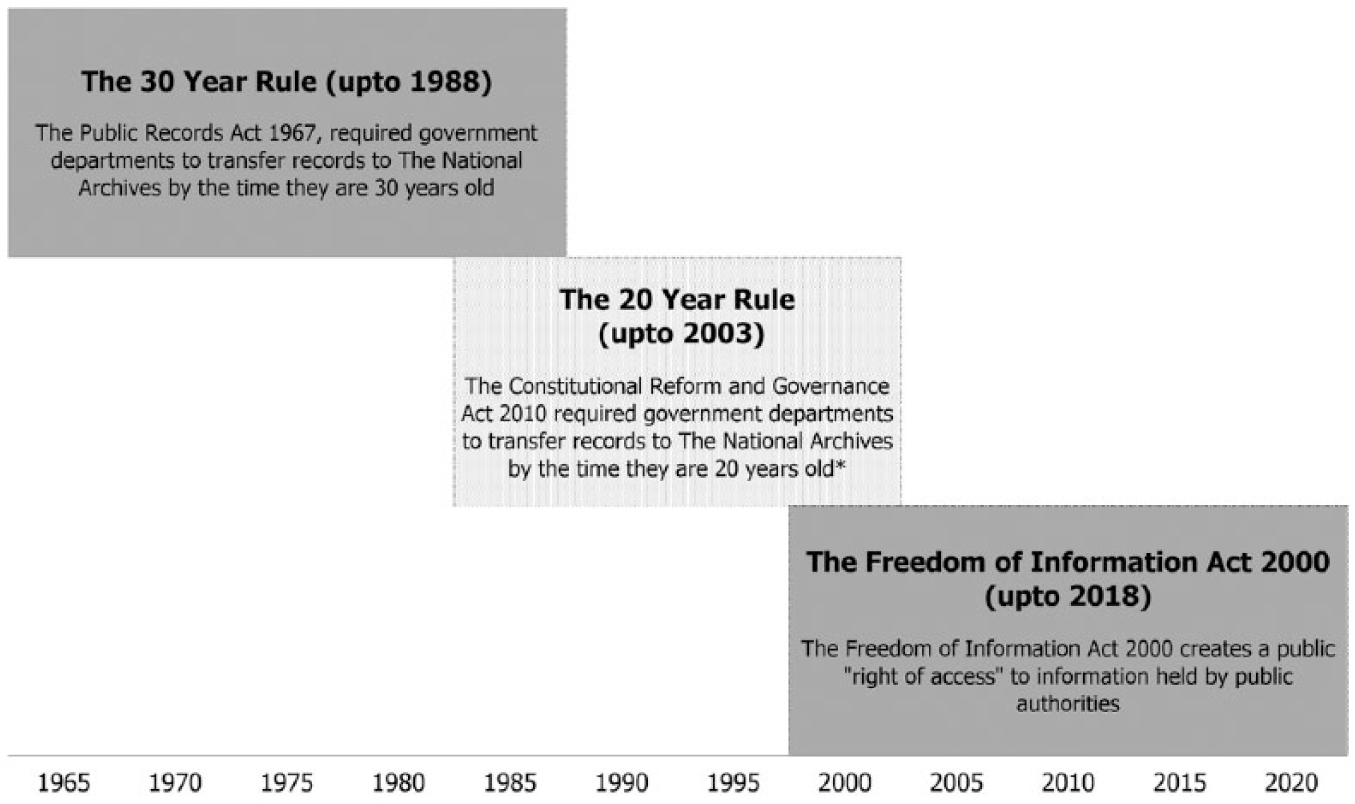
The public right of access in England and Wales.
Bridging the divide: Researchers and public bodies
Despite being in operation for over a decade, it remains the case that researchers working in empirical fields of study, such as the social sciences and law, are yet to realize the full potential of the public right of access (Savage and Hyde, 2014: 303). This is regrettable. Without collaborative spaces to cultivate effective institutional exchange there remains considerable misdirected effort as successive generations of researchers (the author included) strive to reinvent the wheel and repeat past mistakes. As Brown (2009: 89) has noted, this widespread disciplinary reticence has created something of a methodological vacuum where misconceptions and misunderstandings have proliferated, including ‘a perception that to rely on FOI risks antagonising agencies and jeopardising future research access’. Once again, the author’s experiences are illustrative.
Undoubtedly the starkest, and most frustrating, challenge facing contemporary historical researchers is establishing which records are held by public authorities, and by extension, framing information requests in ways that are likely to yield meaningful data. Often this can be attributed to a lack of proficiency in navigating the provisions of the Act, but at a more fundamental level it may also reflect a basic feature of historical study. Unlike investigative journalists who seek specific evidentiary sources to corroborate reports of government waste and corruption, historians are more likely to pursue research strategies which are sensitive to ‘social temporality’ or what might be described as the timing, order and sequencing of events (Amenta, 2009). This is less of an issue for records held by the National Archives under the 20- and 30-year rules, which can be examined in detail over an extended period of time. However, for more recent historical sources, it can be extremely difficult to articulate this exploratory ethos through the vocabulary of specific and bounded information requests. Overcoming this knowledge deficit can be extremely onerous. Nearly all exploratory requests for information are rejected on the basis of the section 12 exemption that a request has placed an unreasonable demand on the resources of a public authority. Currently, the cost limit for complying with a request, or a linked series of requests from the same person or group, is set at £600 for central government, Parliament and the armed forces, and £450 for all other public authorities. As a result, section 12 can be a real barrier to research, often resulting in an FOI tango of request, refusal and counter request which can take upwards of a year to resolve.
For this reason, freedom of information requests should be considered a second phase research tool that follows on sequentially from an extended period of desk research and secondary data collection. Ambiguous, poorly drafted or open-ended requests for information are nearly always declined under the section 12 exemption or result in the provision of low quality, incidental material. As has been noted elsewhere (Savage and Hyde, 2014: 307) high quality drafting can greatly improve the likelihood of success and it is advisable to approach archival research as a transactional exchange, rather than an adversarial process. A research design incorporating the section 16 provision for ‘advice and assistance’, and a willingness to view public records in person can significantly improve both the experience and effectiveness of the freedom of information process.
Future Directions: Archival Research in an Age of Digital Abundance
The techniques outlined in this article, and in more detail elsewhere (Carey and Turle, 2008; Savage and Hyde, 2014) can help historical criminologists to bridge the gap between the expectations of the researcher and the records held by public bodies. But this will only ever be a preparatory step in the historiographical operation (De Certeau, 1988: 54–57). When it comes to data collection, there is no substitute for the informal, and applied research crafts that are needed to take real-time decisions in the archive (Amenta, 2009).
This reduced role for theory and formal research methods can prove disorientating for those familiar with the structures of social research methods (Godfrey, 2011; Gunn and Faire, 2012). Working through the sheer volume of documents, ‘both endless and banal’ (King, 2012: 20) can often be an unforgiving process when only a small proportion of the documentation reviewed by the researcher is likely to be relevant, offer promising leads or profound insight. In the formative stages of this study the author frequently struggled to calibrate the appropriate level of cognitive investment in an archival record, often alternating between the two extremes of over-reading largely inconsequential records and rushing through promising files that it later transpired contained useful insights. In general, the paper files held by the National Archives offer well-organized and bounded accounts of discrete policy issues, but it is not uncommon to encounter records that are bulky, lacking in a clear organizing chronology or tending towards miscellany rather than a clear policy focus. Records of this nature are particularly challenging for archival researchers since they are likely to consume time and energy better directed elsewhere, or worse still, encourage a cursory review of the records when a detailed review may reveal profound insight. In the author’s experience records of this nature become more frequent as you progress from the immediate post-war period towards the present day, a trend that may reflect changing attitudes and working practices with regards to government record keeping. This is particularly apparent for records from the mid-1990s onwards as digital records begin to replace the meticulous and well-choreographed analogue records of an earlier era.
As the transition to the 20-year rule gathers pace we are entering an era of digital abundance within the official record, but the implications of this momentous shift have not yet been fully understood by criminologists. As Sir Alex Allen (2015: 3) noted in his recent review of government digital records, there is little doubt that the digitization of the archival record will radically alter the practices of policy-makers, archivists and contemporary historians alike: Maintaining the public record for the benefit of historians and researchers when files are opened in 20 or 30 years’ time is of course one particular reason for ensuring good record management practices are adopted and followed. The existing material in The National Archives [TNA] is almost all paper based, but departments are beginning to enter the era when digital records will gradually overtake paper in new transfers to TNA. The scale and scope of the material at TNA provides a huge and valuable resource, and it will be important to maintain the breadth and quality as digital transfers develop.
In this sense, the chronology of events that marked the evolution of government information technology (IT) is arguably as important as the substantive content stored within those systems. As Allan (2015: 4–5) would go on to note, the major Departments of State began to make greater use of information technology from the late 1980s onwards. Interestingly, this did not take the form of a digital ‘big bang’ but, perhaps reflecting the pragmatic instincts of the British political establishment, was characterized by incremental, and often haphazard shifts in technological, cultural and working practices within Whitehall. As the use of information technology began to accelerate many Departments of State adopted a ‘print to paper’ policy whereby official printed copies of significant digital records were made and stored in filing systems that were organized along traditional lines. This policy persisted well into the 2000s but over time, as the volume of electronic records proliferated, digital records were finally recognized as part of the official record, albeit frequently stored alongside analogue records as part of a hybrid system. With the ubiquity of modern IT systems, government records have now become ‘digital by default’ and this has seen significant changes in record-keeping practices often corresponding with the increasing fragmentation of the archival record. In contrast to the self-contained and meticulously prepared analogue policy files of a bygone era, digital records are often stored on personal hard drives, network folders and scattered across a multitude of email servers. In response, the Foreign and Commonwealth Office was the first to introduce an official Electronic Document and Records Management System (EDRMS) in 1992 and by the early 2000s most major Departments of State were beginning to roll out EDRMS to store critical records. Take-up of these discretionary systems has been extremely patchy given the administrative burden they have placed upon already busy officials and steps are now being taken to encourage greater automation in record keeping where possible (Allan, 2015: 4).
While these shifts may appear remote, the digitization of the archive will have wide-ranging, and unanticipated implications for a future generation of historical criminologists. To take but one example, the author’s study of early release made considerable use of handwritten Ministerial annotations and Private Office memorandums to interrogate government thinking during periods of acute stress and policy contestation (Guiney, 2018: 106). It is unclear whether these documentary traces have survived the transition to information technology systems and whether the immediacy of these thoughts will be preserved when notes are electronically transcribed within a Minister’s private office. These changes undoubtedly represent a considerable challenge to contemporary historians but the proliferation of information technology and associated growth within the digital archive, should also be seen as a huge opportunity. As search engines improve it should be possible for computer assisted qualitative data analysis software packages (CAQDAS) to interrogate the digital record in far greater detail than was possible previously. With greater access to email systems and other correspondence there is huge potential for better use of social network analyses and big data analytics to reveal elements of penal policy that are currently hidden or obscured from public view.
The National Archives is beginning to engage with this challenge (TNA, 2017), but information consumers such as civil servants, researchers and investigative journalists have an important role to play in shaping this process, whether by facilitating exchange of best practice, encouraging innovation or adapting existing methodological approaches to meet the demands of the digital era (Allan, 2014: 18). In turn this may help to drive innovations in government record keeping. Above all else, the digitization of the archive should serve as an important reminder, if one were needed, that archival records continue to provide a mirror, often partial and warped, within which we can view the changing character and temperament of the liberal democratic state. Far from a neutral and objective store of information the archive, and the production of official records more generally, must be seen as an active and value-laden process that is central to the creation of ‘official history’ and all the disputes over power, legitimacy and hegemony that come with it. As Jacques Derrida (1996: 77) once noted, the archive must be understood as a powerful symbol of state authority and an example of collective ‘remembering’ and ‘forgetting’. Highlighting the inherent ‘violence of the archive’ Derrida (1996: 77) reminds us that archives are not merely sites of memory and preservation but are also a place of forgetting and destruction. As King (2012: 18) would later express it, every act of remembering and preserving is fixed to its shadow of loss and forgetting; ideas and experiences are written down in the first place so that they may be forgotten; documents are selected for inclusion into archives by acts of exclusion; the very preservation of documents in an archive ‘exposes [them] to destruction’.
It may well be that in future the violence of the archive is of an altogether different character to that observed in the analogue era. In an age of digital abundance, the State has the capacity, both consciously and unconsciously, to record more about its activities than ever before. As the balance between ‘remembering’ and ‘forgetting’ becomes blurred, we may find disruptive and sensitive files are not excluded from the official record in their entirety but merely hidden in plain sight.
Conclusion
The purpose of this article has been twofold; to build the case for systematic archival research as a methodological tool of historical criminology, and in turn, to reflect upon some of the practical challenges implicit in making sense of policy change in criminological settings. In so doing, it has been argued that while the contemporary history of criminal justice continues to attract considerable academic scrutiny, the criminological literature has tended to eschew systematic archival research in favour of analytical approaches that prioritize generalizability over descriptive rigour (Lawrence, 2012). This lack of methodological diversity is to be regretted. A constructive dialogue with the archival record, particularly when used as a methodological counterpart to middle-range scholarship (Merton, 1967), can reveal new insights into the evolution of criminal justice, and equip us with the tools to challenge existing penal orthodoxies. This has significant implications for contemporary criminology, particularly at a time when the ‘State’ has re-emerged as a key site of criminological research (Barker and Miller, 2017) and the events of the 1990s and beyond, widely seen as a transformational period for criminal justice, are beginning to come into focus. Systematic archival research offers us new vantage points from which to critically appraise the continuities and dislocations within contemporary penal policy and drill down into those key signal events (Loader and Sparks, 2004), such as the riots at HMP Strangeways or the murders of Stephen Lawrence and James Bulger, which continue to cast a long shadow over contemporary penal policy (Downes and Morgan, 2007; Newburn, 2007).
At a time when government is subject to unprecedented public scrutiny over its handling of the ‘Brexit’ negotiations, the Grenfell Fire and allegations of destroyed records pertaining to the ‘Windrush Generation’, maintaining a clear commitment to open government is of considerable importance. Effective record keeping is a key component of good governance and evidence-based policy making (Allan, 2014), but access to official records has also proved an invaluable research tool for ‘outsiders’ seeking to understand the inner-workings of the liberal democratic state and hold government to account (Lee, 2005; Marx, 1984). This is particularly relevant to criminal justice given the unique constitutional position of the Home Office and the Ministry of Justice, and the dense network of associated agencies including the Crown Prosecution Service (CPS), the police and intelligence services which occupy a privileged position at the frontier between citizen and state, and often enjoy exemptions from freedom of information regimes (Murphy and Lomas, 2014; Williams and Emsley, 2006). 2
Translating these aspirations into ‘real world’ research settings remains a challenge for many historical criminologists. As this article has noted, there is little methodological guidance to help researchers refine the practical skills and research craft of the historian or navigate through the complex statutory framework that underpins the right of access to official records in England and Wales. As a discipline criminology, perhaps reflecting the social sciences and law more generally, remains somewhat reticent of radical departures, but as contemporary historical analysis stumbles into the digital era there is a pressing need for collaborative spaces that bring together archivists, civil servants and academic researchers to share best practice and develop new research strategies that respond to the ever-present, if increasingly subtle, violence of the archive. This insight brings us full circle. As Nick Hardwick went on to observe in his keynote speech to mark the 50th anniversary of the Parole Board, ‘when they look back on our work in 2067 they may smile at some of our ways’ (Parole Board, 2017) but this will only be possible if a future generation of historical criminologists can gain access to robust archival studies that connect the past, present and possible futures of criminal justice change.
Footnotes
Acknowledgements
The author is grateful to David Downes, Harry Annison and the anonymous reviewers for their constructive feedback on earlier drafts of this article.
Declaration of Conflicting Interests
The author declared no potential conflicts of interest with respect to the research, authorship and/or publication of this article.
Funding
The author received no financial support for the research, authorship and/or publication of this article.