




Abstract
Although police culture is a widely researched topic, not much is known about the nature of the relationships among the various components and the degree to which they are critical in the make-up of police culture. In this study, we revisit the concept of police culture and explore the nature and directions of the relationships among the various elements that constitute police culture. Drawing data from a survey of 1970 Turkish National police officers we identify six commonly recognized dimensions of police culture based on the existing literature. The results from the four different confirmatory factor analyses (CFA) indicate that of the six dimensions, the first-order CFA with five factors best fit the data. Further, the results suggest that police culture did not account for the covariation among the six first-order factors. These findings suggest that police culture is a more complex and multifaceted concept than the prior literature suggests.
Introduction
Culture in policing can be divided into two categories: street cop culture and management cop culture (Reuss-Ianni, 1983). Paoline (2003: 204) notes that though occupational cultures emerge and are “maintained” by line officers, the norms and values associated with culture are typically articulated and disseminated from top to the bottom of the organization. While occupational culture is related to a set of routines and practices that are necessary for dealing with uncertain job environments (Manning, 2007a), the organizational culture is related to the specific styles and mission statements—for example, legalistic, watchmen, and service approaches—police departments assume as their primary mission (Paoline, 2003). Much of the existing research focuses on police occupational culture (Loftus, 2007). Similarly, our study also focuses on rank-and-file police officers (hence only police officers) and their occupational culture.
Police culture is defined as “a set of widely shared outlooks that are formed as adaptations to a working environment characterized by uncertainty, danger, and coercive authority and that serves to manage the strains that originate in this work environment” (Skogan and Frydl, 2004: 131). Essentially, it consists of a set of occupational norms and values that guides officers’ behaviors. Some scholars view police culture as monolithic and argue that all officers share the same values, norms, and behaviors. The central premise of this group of scholars is that police officers tend to share the same values because their work contexts are similar (Crank, 2004), involving danger (Skolnick, 1975) and isolation (Brown, 1988), with traits that include loyalty among officers (Skolnick and Fyfe, 1993), cynicism (Niederhoffer, 1967), and authoritativeness with extensive discretion (Bittner, 1974; Muir, 1977). Others view police culture as a more complex and multidimensional concept (Brown, 1988; Ganapathy and Cheong, 2016; Paoline, 2004; Reiner, 1992). While some aspects of policing, such as coercive force and danger or uncertainty, are shared by most police organizations, across different departments a diversity in mission, duties, style, and membership is inevitable; these differences also bring different foci and content to police culture (Ford, 2003). Further, the assumption that police culture is insular and removed from the larger social, legal, and political influences is contested (Chan, 1996).
Herbert (1998: 346) notes that police culture is an assortment of “schemas, tools, and frames” that officers adapt to handling varied situations in their day-to-day operations. Thus, he notes that grasping the idea of police culture comprehensively requires comprehending the “formal and informal group wide dynamics that constitute the police as a distinct group while also providing a means to adequately capture internal variations” (1998: 345).
Some note that there is currently no recognized threshold for establishing officer agreement or how strongly officers share orientations toward their occupational and organizations’ environments (Paoline, 2003). Given this lack of a “threshold of cultural agreement”, others argue that there is a need to clarify variation in police cultures as well as the degree to which officers share the specific elements of police culture (Ingram et al., 2013). However, only a couple of researchers offer a model to explain causes and consequences of police culture. For example, Chan (1997: 74) offers an “interactive model” which has never been tested. Paoline (2003) also offers a more comprehensive model of traditional police occupational culture to explain its causes, prescriptions, and outcomes. This model was tested recently by Paoline and Gau (2018). However, as they note, “the magnitude of the statistical associations was not very powerful and overall model fit was marginal” (2017: 1).
Thus, we believe that alternative models and perspectives are still required to enhance our understanding of police occupational culture. We begin with an overview of police culture, outline the literature review for each of the identifiable elements of police culture, and develop an empirical framework to assess a model of the nature of the interrelationships between various elements. Finally, we will employ structural equation modeling to assess whether all elements, considered critical to shaping police culture, empirically coalesce not only to constitute the phenomena but if some of these elements have greater influence relative to some others in shaping police culture.
Components of Police Culture
Researchers define the police working personality as suspicious, conventional, cynical, prejudiced, distrustful, and authoritarian (Balch, 1972). The police working personality is developed through the characteristics of the working environment, such as danger, authority, and efficiency (Skolnick, 1975). According to Manning (2007b: 869), line-level officers refer to their working environment with the terms “dependence, autonomy, authority, and uncertainty”. These four terms form the elements of two broader concepts: “(1) the job consisting of dependency and autonomy, and (2) real police work combining authority and uncertainty in relationships with the public” (Manning, 2007b: 869). Waddington (2012: 94) notes that although police culture is not homogenous, it has some core characteristics. Drawing on the work of previous researchers like Brown (1988), Reuss-Ianni (1983), Skolnick (1975), and Van Maanen (1973), we identify six key components or elements of police culture: (1) cynicism; (2) solidarity; (3) loyalty; (4) occupational identity (alienation); (5) autonomy; and (6) authoritarianism.
Cynicism
To cope with and reduce uncertain and dangerous environments, police officers have to be trained to be suspicious (Balch, 1972; Skolnick, 1975). Police officers are cautious in their work environment and trained to observe unusual signs as well as pay attention to motor vehicle plate numbers, passengers in cars, pedestrians, and people in general. It is argued that “this general suspicion tends to take the form of hard-bitten cynicism” (Waddington, 1999: 102) and consequently leads police officers to lose their trust and faith toward people (Champion, 2005). Niederhoffer (1967) noted that cynicism occurs as part of new officers’ socialization into the occupation. Police officers have a sense that the public fails to help police officers when necessary. They think they are under siege and stand alone against crime (Gaines et al., 2003). Therefore, police officers tend not to trust the public and count on other police officers instead (Shernock, 2007). There are a couple of points that should be also noted. First, suspiciousness and cynicism should be treated as two different concepts. We see suspiciousness as one of the main sources of cynicism as argued by researchers like Waddington (1999). Second, police officers might have cynical attitudes toward their managers, organizations, and the criminal justice system (Chan, 2007; Paoline, 2004; Waddington, 1999). However, we have focused on police officers’ cynical attitudes toward the public in this article. Thus, a more comprehensive research on forms of cynicism and their roots and consequences should be conducted by future research.
Solidarity
Danger, in addition to suspiciousness, causes police officers to be isolated from the community (Skolnick, 1975), just as citizens keep their distance from police officers. Citizens do not contact police officers unless it is necessary, because police officers have a unique coercive power and authority over them (Paoline, 2003). As a result, police officers have to face a “lonely and largely friendless world” (Van Maanen, 1973: 38). Isolation from the community, police officers’ daily experiences, and the social learning process as a part of police culture subsequently lead to more solidarity among the line-level police officers (Shernock, 2007). According to Goldsmith (1990: 93), perhaps the “bond of solidarity” between police officers constitutes the core critical values, attitudes, and practices of police culture. Some researchers also note that police officers see their managers as outsiders as in the case of how they see the public (Shernock, 2007). Thus, it is argued that police officers tend to develop bonds toward their colleagues rather than their managers or organizations as a collective protective response (Shernock, 2007).
Loyalty
Loyalty in policing could be referred to as officers sheltering and protecting fellow personnel from criminal investigation, disciplinary scrutiny, or punishment (Waddington, 1999: 100). Being a key feature of police culture, it is argued that police officers are exposed to loyalty, which is reinforced during their policing career starting from the police academy (Skolnick, 2002). Police officers develop “a close-knit subculture” to overcome any possible threat or problem they may encounter at work (Skolnick, 2002: 8). In addition to danger and authority in police work, cynicism toward their own department, supervisors, and solidarity also foster stronger bonds of loyalty among police officers (Chan, 1997; Paoline, 2003; Shernock, 2007). Police officers, thus, close their eyes to their fellow officers’ mistakes (Reuss-Ianni, 1983; Skolnick, 2002). Further, it is also noted that because of fear of being labeled a rat, police officers show a high level of loyalty to other police officers (Skolnick, 2002). Thus, it could be argued that police officers are more loyal to their colleagues than their managers, organizations, ideals of policing, and the people they serve.
Occupational identity (alienation)
According to Christiansen (1999: 547), occupations are “key not just to being a person, but to being a particular person”. Some conceptualized occupational identity as a key element of one’s “overall sense of identity” (Skorikov and Vondracek, 2011: 694). It is argued that adult identity “is largely a function of career movements within occupations and work organizations” (Becker and Strauss, 1956: 253). Occupational identity of police officers occurs as early as entering the police academy and continues to develop during their career stages (Van Maanen and Schein, 1977). According to Bahn (1984: 390), few vocations encompass the “history and the demand of forging an occupational identity so strong that it suffuses the individual’s life, coloring and modifying all other social roles that the individual occupies”.
Research in policing shows that sometimes individuals may have difficulty adapting to their occupational identity. Existing research indicates police recruits’ conflict between their perceptions and expectations about policing they had before joining the police academy and the experiences they had in the police academy or in policing as a drop out factor from policing (Haarr, 2005). Fielding and Fielding (1987: 35) argue that those who resign from policing are those “whose early idealism is soonest traded for the pragmatic instrumentalist perspective which overtakes all police to some degree”. Thus, it could be argued that policing requires officers to develop and harmonize attitudes, values, and norms consistent with what police work requires.
Autonomy
Manning (2007a: 69) calls policing an “occupation that emphasizes autonomy”. Most police officers work on the streets. For example, Bittner (1974) found that nearly four out of every five police officers work on patrol duty on the streets under strict internal regulations. Police officers define their routine patrol with “territory and autonomy” (Fielding, 1984: 574). Police officers are allowed to exercise autonomy in their assigned patrol areas with little interference from supervisors (Fielding, 1984). Several factors cause police officers to enjoy an autonomous work environment. Feldberg (1995) lists inefficiency of planning police officers’ patrol work, lack of time for supervisors to make direct supervision of police officers, and unplanned requests for services from dispatchers as the main reasons for police officers’ autonomy. Police officers benefit and are granted autonomy as long as they do their jobs (Goldsmith, 1990). In addition to these factors, police officers also “create islands of individual control” and “make substantial efforts to create autonomy” to deal with contingencies they face in the work environment (Manning, 2007a: 73). Solidarity and loyalty among police officers are seen as other important factors that cause police officers to enjoy “considerable individual autonomy to get on with the job” (Goldsmith, 1990: 94).
Subsequently, police officers have great discretionary power because they work in an autonomous environment (Bittner, 1974; Worden, 1989) and flexibility of interpreting ambiguous and vague rules (LaFrance and Day, 2013). Even though police officers work in an autonomous work environment, it is argued that police officers’ discretion is constrained by organizational and other environmental factors (Goldstein, 1977; LaFrance, 2011). LaFrance (2011) argues that when there is good communication between police officers and managers, police officers and managers respond to these constraints in a similar way.
Authoritarianism
It is argued that authoritarianism is part of police culture (Balch, 1972; Twersky-Glasner, 2005). Researchers explain police officers’ authoritarian attitudes with two major models: the predispositional model and the socialization model (Austin et al., 1987). Hall (1987: 307) argues that “people tend to move into career environments that are congruent with their personal orientation”. Consistently, some suggest that policing attracts certain types of individuals who are authoritarian and conservative in nature (Balch, 1972; Brogden and Shearing, 1993; Rokeach et al., 1971). However, existing research suggests inconclusive results about whether police recruits have a higher sense of authoritarianism than ordinary people (Brown and Willis, 1985; Crank, 2004; Skogan and Frydl, 2004; Van Maanen, 1973). Some other researchers, on the other hand, suggest that socialization processes also foster and exacerbate police officers’ cultural attitudes including authoritarianism (Crank, 2004; Singh and Kempa, 2007). The police socialization perspective argues that police personality is often “learned on the job” (Crank, 2004: 241) as a consequence of daily interactions with fellow officers (Austin et al., 1987: 196). Even though the socialization process takes place in every stage of policing, from the academy to retirement (Crank, 2004; Van Maanen, 1973), some researchers note that working in the field is a more dominant factor than training that affects police recruits’ cultural attitudes (see Chan, 1997). Brown and Willis (1985) found, in accordance with the socialization model, that levels of authoritarianism among recruits increased over time after they started work in the field. However, some researchers found no difference between experienced and inexperienced police officers in terms of authoritarian traits (Austin et al., 1987; Laguna et al., 2010).
The Present Study
Carpenter et al. (2009: 349) note that identification of the norms and values that describes cultures also helps to measure and manage them more efficiently. This article seeks to empirically measure the phenomenon of police culture. The existing literature on police culture, whether or not it portrays police culture as monolithic, proposes the existence and undeniability of the complex nature of police culture. We can measure theoretical constructs or latent variables using structural equation modeling (Byrne, 2010; Kline, 2011). Further, we can also measure a theoretical construct that is hypothesized to account for the variation among the related constructs through second-order confirmatory factor analysis (Wang and Wang, 2012). To this end, drawing from existing literature, we focus on the six core dimensions of police culture, all of which are related to police work and subsequently shape police culture. Thus, it could be expected that police culture should load and account for variance among the factors. We have observed indicators/items for the six dimensions or constructs of police culture. Based on the theory posited here, these six constructs were considered as the sub-constructs of a second-order construct that is police culture.
The hypothesized model
A second-order model, police culture, is modeled as the cause of first-order factors including autonomy, cynicism, work alienation, authoritarianism, loyalty, and social cohesion. As Byrne (2010: 130) suggests, each item has nonzero loading on the first-order factor it was designed to measure and a zero loading on each of the other first-order factors, error terms associated with each item would be uncorrelated, and all covariance between each pair of the first-order factors would be explained by a higher-order factor. The second-order model hypothesis states that “these seemingly distinct, but related constructs can be accounted for by one or more common underlying higher order constructs” (Chen et al., 2005: 471). In a simple way, the existing literature suggests that all of these six dimensions are common among police officers because of police occupational culture. If this premise is true, then we should find a strong relationship among these six dimensions. Further, if police occupational culture leads to such attitudes among police officers, then we can treat police culture as a latent variable that affects these six dimensions. According to Kline (2011), two conditions should be met to identify second-order confirmatory factor analysis: (1) there must be at least three factors in the first order; and (2) each first factor should consist of at least two indicators. As can be seen in Figure 2, the required conditions were met for the second-order model.
Although there are no comprehensive analyses conducted on how those dimensions are related to each other, we have some partial evidence, to some extent, indicating the direction of relationship among the variables. Drawing from the literature on policing, it could be argued that since those above-mentioned dimensions are related to the police work environment, all dimensions should be positively related to each other. However, limited literature on the issue suggests an adverse relationship among some of the dimensions. Based on the existing research and arguments, we expect cynicism and autonomy to be negatively related (Johnson, 2012a; Poole et al., 1978; Richardsen et al., 2006), cynicism and authoritarianism to be positively related (Andersson, 1996; Travis and Vukovich, 1990), cynicism and cohesion to be related negatively (Johnson, 2012a), cynicism and work alienation to be related positively (Regoli et al., 1990), autonomy and cohesion to be related positively (Johnson, 2012a), autonomy and authoritarianism to be negatively related (Wortley, 2003), autonomy and work alienation to be related negatively (Poole et al., 1978), authoritarianism and social cohesion to be related positively (Twersky-Glasner, 2005), authoritarianism and work alienation to be related positively (Stearns and Moore, 1993), and cohesion and work alienation to be related negatively (Johnson, 2012b; Leiter et al., 1994). Since loyalty is one of the indicators of social cohesion (Friedkin, 2004), we expect loyalty to have the same relationship with other variables as in the case of social cohesion.
Thus, we have a limited understanding of the interconnectedness of various dimensions of the larger concept of police culture and very few empirical explorations of the relationships among the widely recognized elements of this phenomenon have been conducted. Additionally, we have limited understanding if some of these elements have greater influence relative to some others in shaping police culture. Thus, exploring the nature and directions of the relationships among the various elements that constitute police culture will advance our understanding of the concept both theoretically and empirically.
Data
The study sample consisted of police officers who were members of the Turkish National Police (TNP). Unlike the decentralized police organizations in the United States, the TNP is a national organization under the authority of the Ministry of the Interior. Some researchers argue that broader cultural, political, and legal environments might also affect the attitudes and behaviors of police officers (Chan, 1997; Singh and Kempa, 2007). Reiner (2010: 118) calls police officers a “microcosmic mediator of the relations of power in a society”. TNP preclude any local democratic input into policing because of being highly bureaucratized and centralized in nature (Ellison and Pino, 2012; Goldsmith, 2009). The headquarters of TNP and the Ministry of Internal Affairs decide the priorities of police and police officers. All these factors might cause police officers and TNP to have immunity from society and civil administration. However, since the data are limited, we could not examine how larger political and cultural dimensions affect or are related to police officers’ occupational culture.
As we noted earlier, it is argued that generally all line officers have shared cultural elements because often they “respond to similar audiences and share similar functional concerns” (Crank, 2004: 57). Consistent with these arguments, researchers in Turkey argue that police officers working in Turkey also share similar attitudes with their western colleagues (Caglar, 2000; Cerrah, 2000; Simsek, 2015). This research indicates being conservative, prejudiced, cynical, macho, authoritarian, and loyal to each other are the features of police officers working in Turkey. This may have something to do with the idea that police occupational culture is heavily persuaded by a few American or English contributions based on and drawn from patrol officers working in large urban areas (Manning, 2007a: 59). Consistent with this idea and what we present here, this research used sources developed by the United States and other western countries. Additionally, as we argued earlier, almost all of this research conducted in Turkey used narrative approaches to explain police occupational culture.
The Istanbul Security Directorate was chosen as the research site, since it is the biggest police department and serves the largest population in Turkey. The total number of police officers working at the Istanbul Security Directorate was about 35,000 at the time of the study. However, a purposive sample of 2500 from over 10,000 police officers who worked in three different police departments—the airport, public order, and plainclothes—was drawn for the purposes of this study.
Officers working in these three departments had totally different working environments. Police officers working in the public order department work as a group consisting of three to five uniformed people and respond to emergency calls, intervene in crimes, and patrol the streets. They were assigned to patrol specific geographic areas of the city. However, since the geographical area of assignment factor was applicable only for police officers working in the public order department, we did not collect information about their assigned patrol areas. Police working in the plainclothes department work alone in their normal daily clothes. They are assigned to particular places of the city where people gather for shopping or entertainment. Their task is to impersonate people like street sellers and observe people’s movements. When they encounter crime, they try to prevent it and apprehend offenders. Their focus is mostly on preventing pickpocketing, extortion, and molestation. Finally, police officers working in the airport work in a close and isolated environment. Aside from a very few instances, their priority is not crime fighting but surveillance of people and their belongings. Thus, we believe that the sampling of this study is suitable for examining police culture since police officers working in the public order and plainclothes departments are street-level officers.
The questionnaire was administered to the officers in their respective departments with a prior notice seeking their participation in the study between 30 January 2012, and 20 February 2012 with permission from TNP. The survey was delivered to police officers with the assistance of the administrative officer in charge during roll call. These administrative officers were informed and guided by researchers regarding how to minimize pressure on study participants and how to secure the confidentiality of the police officers. They were asked to inform all police officers working in their respective departments.
A consent form providing information about the researchers, the research, and participants’ rights was provided to the subjects with the questionnaire. To eliminate any possible pressure on subjects from their supervisors and the researcher, each department was asked to provide a locked collection box in an arranged room where there were no personnel or physical security systems for completed surveys. A total of 2132 surveys were returned, representing a response rate of 85%. After the data-cleaning process, we were left with 1970 usable cases. The general characteristics of study participants indicate that the police officers age ranged between 20 to 55 years. The average age of the participants was 27, and 97.4% of the participants were male, which is similar to the distribution of the TNP police force by gender. The education level of police officers ranged from high school diplomas to baccalaureate degrees. However, only 3% of the police officers have only high school education, nearly 35% of the police officers have a two-year college degree, and 62% hold a baccalaureate degree.
Measures
The survey questions that measured the key constructs was designed to measure officers’ perceptions on a five-point Likert scale ranging from 1 (strongly disagree) to 5 (strongly agree). Autonomy refers to “volition, to having the experience of choice” (Deci and Ryan, 2008: 8). We assessed officers’ perceived sense of autonomy with three items developed by Crank (1993) and Regoli et al. (1987). Respondents were asked in general about the following statements: (1) I make my own decisions regarding what is to be done in my work (M = 2.74); (2) On the job I make a lot of decisions on my own (M = 3.04); and (3) When problems arise at work, there are opportunities to use my own judgment (M = 3.18).
Authoritarianism is composed of three factors: conventionalism; authoritarian submission; and authoritarian aggression (Altemeyer and Hunsberger, 1992). Duckitt (1989: 70) describes conventionalism as “behavioral and attitudinal conformity with in-group norms and rules”, authoritarian submission as “respect and unconditional obedience to leaders and authorities”, and authoritarian aggression as “intolerance of and punitiveness toward persons not conforming to in-group norms and rules”. Altemeyer and Hunsberger (1992) use a scale consisting of 30 items to address all dimensions of authoritarianism. However, since each question places an extra burden on researchers and participants, this article focuses on authoritarian aggression and examines participants’ approval of enforcing strict rules and severe punishment with three items. Participants’ sense of authoritarianism was measured by three items adapted from Altemeyer and Hunsberger’s (1992) authoritarianism scale. The items are: (1) What our country really needs, instead of more “civil rights”, is a good stiff dose of law and order (M = 3.10); (2) The situation in our country is getting so serious, the strongest methods would be justified if they eliminated the troublemakers and got us back to our true path (M = 3.04); and (3) One reason we have so many troublemakers in our society nowadays is that parents and other authorities have forgotten that good old-fashioned physical punishment is still one of the best ways to make people behave properly (M = 2.98).
Cynicism within the social context can be defined as a negative view of human nature empowering mistrust among people (Bond et al., 2004). Participants’ cynicism toward the public was measured by three items from Regoli et al. (1990); (1) The public shows a lot of respect for policemen (M = 3.50); (2) The public trusts policemen (M = 2.99); (3) The public is eager to cooperate with policemen to help them perform their duty better (M = 3.37). Work alienation is a psychological state that represents “a cognitive separation from one’s job and other work-related context” (Kanungo, 1992: 414). The variable, work alienation, was measured using four items developed by Regoli et al. (1990). Respondents were asked to what extent they agreed or disagreed with the following questions: (1) I very much like the work I am doing (M = 2.47); (2) My job gives me a chance to do what I do best (M = 2.99); (3) My work gives me a feeling of pride in having done the job well (M = 2.44); and (4) My work is my most rewarding experience (M = 2.43). All items for cynicism and work alienation were reverse coded.
Loyalty refers to a willingness to protect each other (Butler and Cantrell, 1984). Participants’ sense of loyalty consists of the following three items: (1) If my fellow officer makes a mistake at work, it is my responsibility to protect him (M = 3.66); (2) I will never report against my fellow officer even if he has violated the rules (M = 2.97); (3) If I violate a rule, I expect my fellow officer to protect me (M = 3.13). Finally, social cohesion, however, refers to the “nature and the quality of the emotional bonds of friendship, liking, caring, and closeness of group members” (MacCoun et al., 2006: 647). Participants’ sense of social cohesion was measured by two items: (1) Officers in my work unit enjoy their coworkers (M = 3.48); (2) I trust my fellow officers to do what is in the best interests of the organization (M = 3.61).
Results
We tested two measurement models, including the hypothesized one, and the two alternative models. The first model tests the correlation between the six factors with their respective indicators. The second model tests a higher-order factor model with the six first-order factors representing the core dimensions of police culture. The same number of indicators measure each factor as in the first model. The only difference between this model and the previous model is that the first-order factors in the second model are specified as indicators of the second-order factor that is police culture.
Kline (2011) suggests model chi square (χ2), root mean square error of approximation (RMSEA), Bentler comparative fit index (CFI), and standardized root mean square residuals (SRMR) as the minimum set of statistics to be reported for evaluation of model fits. In addition to these statistics the adjusted goodness of fit index (AGFI) is also provided. Values below .10 for RMSEA, below .08 for SRMR, and equal or above .90 for CFI and AGFI indicate a good fit for the data (Kelloway, 2015).
The χ2 statistics are significant in all models, which is not desired. However, χ2 statistic is highly sensitive to sample size (Wang and Wang, 2012). Thus, we use other fit indices to evaluate and compare the relative fit of the models. All models fit the data well (see Table 1). The results suggested that the first-order with the six-factor model fit the data well χ2 (120) = 476.37, p < .001; CFI = .96; AGFI = .96; RMSEA = .04; SRMR = .04. The results indicated that the hypothesized second-order CFA with six first-order factors and one higher-order factor also fit the data well, χ2 (129) = 709.04, p < .001; CFI = .94; AGFI = .95; RMSEA = .05; SRMR = .06. A comparison of the first two models indicated that the first model fit the data significantly better Δχ2 (9) = 232.67, p < .001.
Summary of the fit indices for alternative models of the police culture.

p < .001.
However, all proposed paths, with the exception of the path from loyalty to police culture, were significant in the second model. The explanatory power of loyalty is very small (.00) and nonsignificant, which indicates that loyalty is unrelated to police culture in the second model. Based on these results, we respecified the model by removing loyalty from the hypothesized model. Thus, a first-order CFA with five factors (third model) and a second-order CFA with five first-order factors and one higher-order factor (fourth model) were examined to see whether alternative models fit the data better and had model parsimony. As can be seen in Table 1, the fit indices are χ2 (80) = 289.33, p < .001; CFI = .97; AGFI = .97; RMSEA = .04; SRMR = .03 for the first-order CFA with five factors, and χ2 (85) = 334.51, p < .001; CFI = .97; AGFI = .97; RMSEA = .04; SRMR = .04 for the second-order CFA with five first-order factors and one second-order factor. The results indicated that both models fit the data well. However, the chi-square difference test between the third and fourth models was significant Δχ2 (5) = 45.18, p < .001. This suggests that the first-order CFA with five factors fit the data better than other models, including the hypothesized one (Δχ2 (40) = 187.04, p < .001) and the second-order CFA with six first-order factors and one higher-order factor (Δχ2 (49) = 419.71, p < .001). The unstandardized and standardized factor loadings for the model are presented in Figure 2. All indicators, with the exception of indicators in which loadings fixed to 1.0, loaded significantly to their corresponding latent factors in the model.
Kline (2011) notes that while unstandardized estimates among the factors and error terms are covariances, the standardized estimates are the correlation among those factors and errors. Thus, according to Figure 2, the result of first-order CFA with five latent factors suggests positive relationships between cynicism and alienation (β = .48, p < .001); cynicism and authoritarianism (β = .18, p < .001); and autonomy and social cohesion (β = .31, p < .001). However, there were negative relationships between autonomy and cynicism (β = –.37, p < .001); autonomy and alienation (β = –.42, p < .001); alienation and social cohesion (β = –.57, p < .001); and cynicism and social cohesion (β = –.30, p < .001).
This study compared the results of a first-order CFA model with the second-order CFA model to examine police culture further. The results indicated that both first-order CFA models (Model 1 and Model 3) fit the data better than their respective second-order CFA models (Model 2 and Model 4). Among all models, the CFA analyses indicated that the first-order CFA model with five correlated factors most accurately represented police culture with the given sample.
The CFA analyses supported our hypotheses drawn in Figure 1. The standardized estimates represented in Figure 2 reveal that there is a negative relationship between autonomy and cynicism (r = –.37, p < .001), autonomy and alienation (r = –.42, p < .001), alienation and cohesion (r = –.57, p < .001), and cynicism and cohesion (r = –.30, p < .001), while there is a positive relationship between cynicism and alienation (r = .48, p < .001), cynicism and authoritarianism (r = .18, p < .001), and autonomy and cohesion (r = .31, p < .001). However, the results indicated no significant relationship between authoritarianism and autonomy, authoritarianism and work alienation, and authoritarianism and social cohesion. Further, the findings indicated that excluding loyalty from the model makes the model fit the data better. That is, loyalty, against our expectation, has weak explanatory power on police culture and is not highly related to other dimensions of police culture at least for the given sample. Possible explanations will be explored in the discussion section.
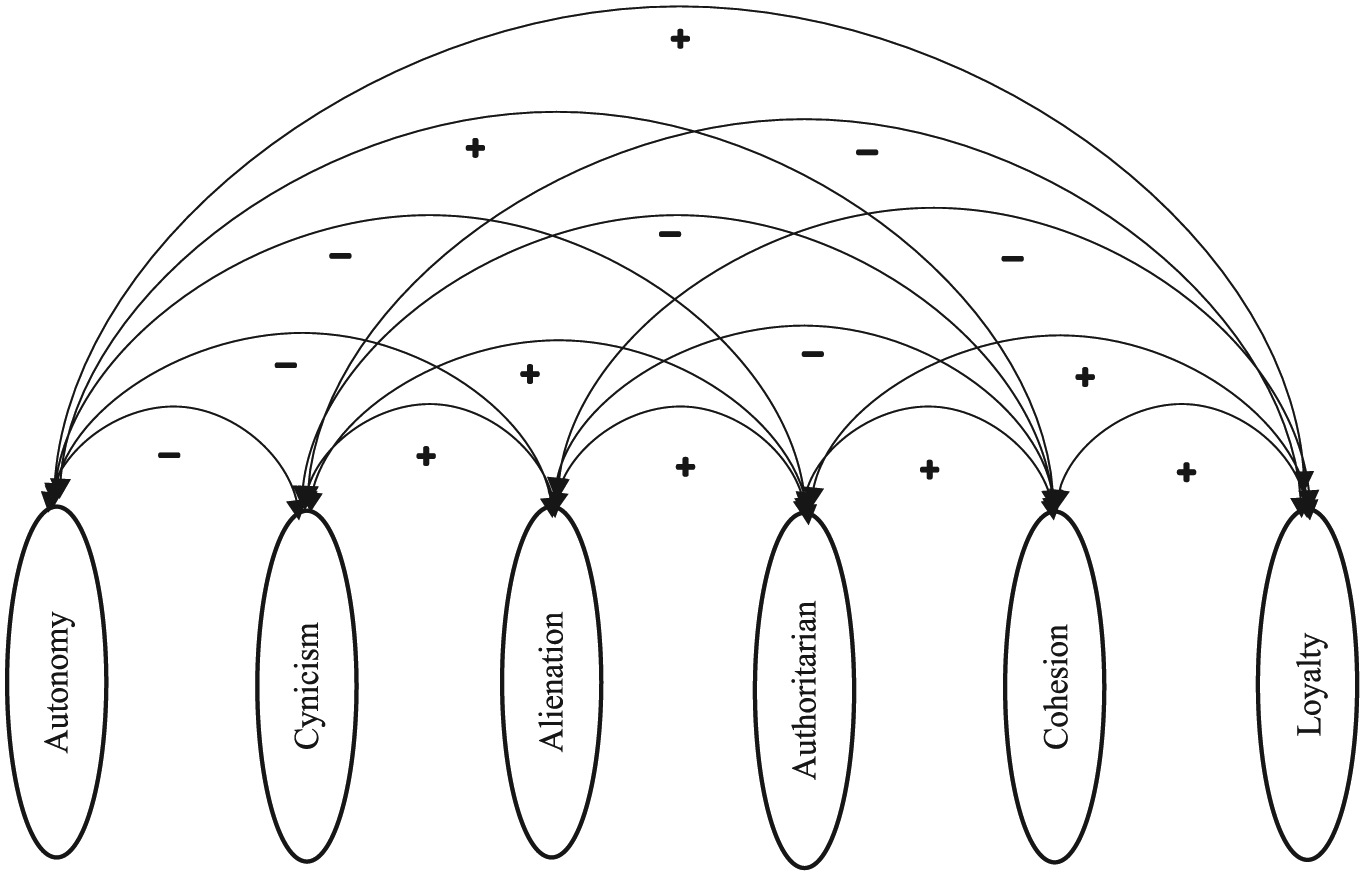
Hypothesized relationships among the factors.
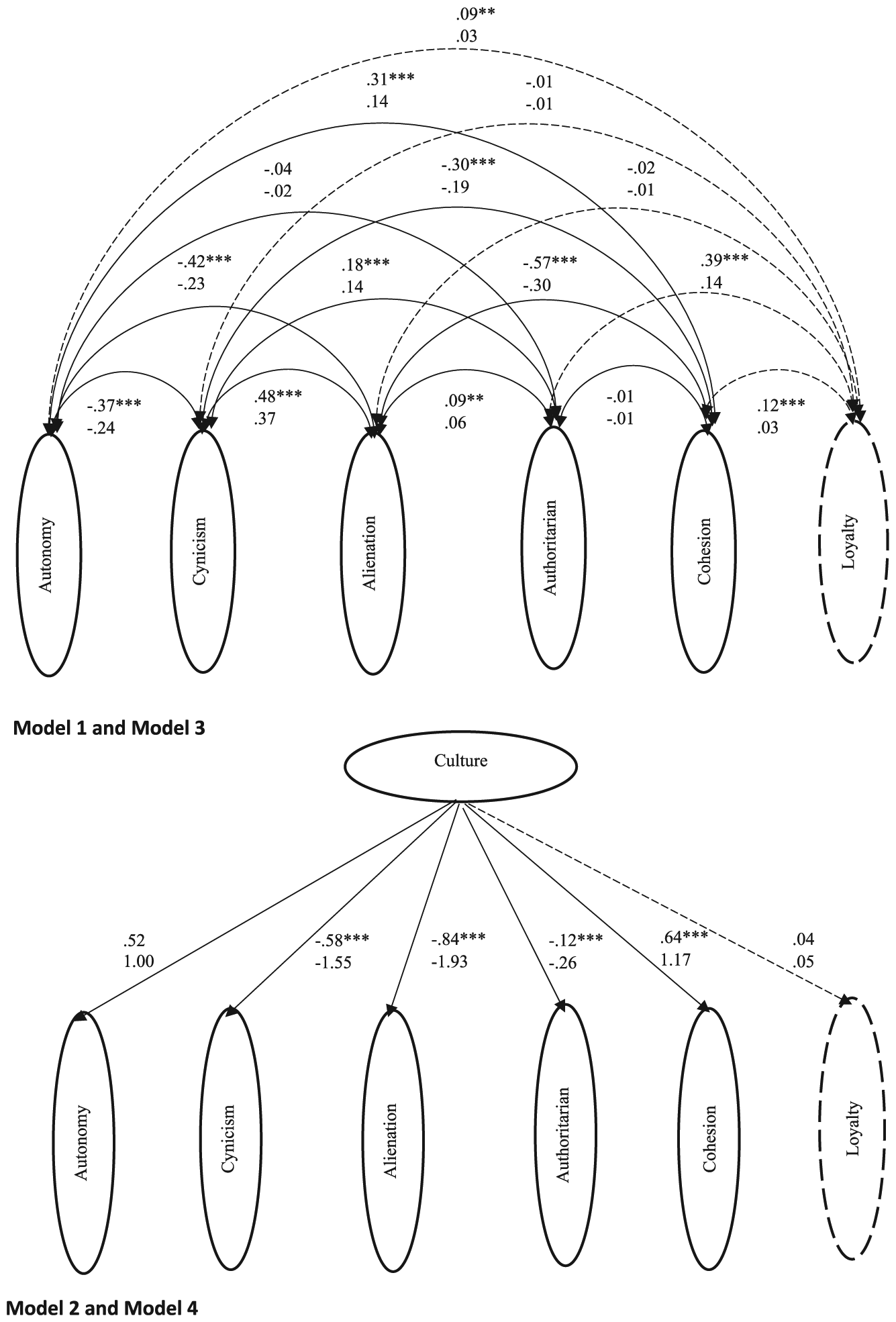
Results of the of first-order (Model 1 and Model 3) and second-order (Model 2 and Model 4) CFA.
Discussion and Conclusion
The aim of this study was to investigate the interrelationships between various indicators of police culture and the degree to which some dimensions relative to others are stronger predictors of police culture. Although researchers have examined police culture extensively, this is the first study to examine police culture with a large non-US sample using first- and second-order CFA. Between the proposed model, including six latent variables, and an alternative model consisting of five latent variables, the alternative model with five correlated factors fits the data better with the given sample.
Existing policing literature that mostly uses a qualitative approach indicates that the nature of policing encourages police officers to develop a greater sense of autonomy, authoritarianism, cynicism, social cohesion, and alienation. Thus, one can expect those dimensions to be related positively and contribute to police culture accordingly. However, the CFA analyses in this study revealed that some of the factors were related to each other adversely, which is consistent with the previous research in general. Further, since we did not examine the causation, causality among the latent variables cannot be inferred and reverse causality is possible among the factors.
The results from the study failed to show the existence of police culture as a more generalized construct that underlies the autonomy, cynicism, alienation, authoritarianism, cohesion, and loyalty. It was found that police culture did not account for the covariation among the six first-order factors. In other words, the relation among the six dimensions was not explained by the second-order factor, namely, police culture. Even, the correlations among the first-order factors in Model 1 and Model 3 showed that some of the dimensions of police culture were not substantially correlated with each other and some have no significant relationship with other dimensions of police culture. However, we expected to find a significant relationship among the dimensions even if they have adverse relationships. One question then arises: why does police culture not affect those dimensions as expected, if it really exists?
The simple answer to this question could be that there may be variations in police culture and officers may develop different attitudes based on their backgrounds, characteristics, and experiences (Chan, 1996). There could be other factors that directly influence officers’ attitudes or mediate the influence of police culture on the attitudes of police officers. Further, it is suggested that “some phenomena could be stronger and more consistent in their appearance and influence across time, situations and groups than others” (Iso-Ahola, 2017: 2). Thus, it could be argued that police culture in the given context might not be so powerful as to influence all police officers to develop the same attitudes at the same level. Further, similar to this argument some researchers also suggest that police attitudes might change with the years of service (Johnson and Lafrance, 2016; LaFrance and Day, 2013). The research shows that police officers’ attitudes toward standard operating procedures (LaFrance and Day, 2013) and the predicative values of opportunity, ability, and instrumentality on work activities vary with their career stage (Johnson and LaFrance, 2016) and follow a curvilinear pattern. These arguments invite us to use a longitudinal research design to examine such attitude changes or adaptation of police officers during their career stages.
We acknowledge that there could be variance among police departments nationally and internationally, though overall, they have fairly similar shared values with subtle variations in the specific elements that constitute the comprehensive phenomenon of police culture. Schein (2010: 21) argues that “most of the occupations’ cultures are global to the extent that members are trained in the same way to the same skill set and values”. However, in absence of comparative data, it is not possible to demonstrate the prevalence of this argument for policing across the nations. Future comparative research on data from different nations would be a starting point.
This study suggests that we could still classify officers into more than one group as some researchers do (Brown, 1988; Muir, 1977; Prenzler, 1997) based on their job designation. It is very well known by police managers that some police officers prefer to work at desk jobs while some other police officers prefer to work on the streets. Among those who prefer to work on the streets, some of them do a better job than others even though they all go through the same education and training experiences during their policing careers. All these findings suggest there is a variety of behaviors and types of police officers. Since we did not know the causes of those differences among the police officers (i.e. why some officers are more cynical than others), further research should be conducted to examine the possible determinants of differences among police officers.
Thus, the findings presented here suggest a number of theoretical and practical implications. First and foremost, this study empirically examines and shows how dimensions of police culture are related to each other. For example, this study clearly shows that autonomy has an inverse relationship with cynicism. Cynicism is negatively related to cohesion among police officers. Further, cynicism and authoritarianism are positively related to alienation. The results could be used to develop strategies to retain police officers in organizations or at least to create work environments in which police officers are less alienated. Specifically, these results can guide in planning successful communication strategies between police officers, managers, and individuals.
Second, these results, that is, understanding the influence of specific elements in police culture could be used by managers and supervisors to develop and revise programs like community-oriented policing (assuming it means the same across different programs), reducing officers’ use of force, and handling police stress to improve police officers’ well-being. Some researchers argue that leadership styles like transformational leadership might influence police officers’ attitudes and behaviors (Deluga and Souza, 1991), although the nature of police culture poses some challenges for transformational leadership (Cockcroft, 2013). According to transformational leadership, prospective managers are supposed to convince police officers to have certain values and behaviors because they are the right and proper thing to do (Mastrofski, 2004). To do so, transformational leadership suggests police managers arrange environments in which officers can participate and have a say (Cockcroft, 2014). Such an environment is expected to dissipate cultural impediments that endure within the hierarchy of the police organization (Cockcroft, 2014: 6). Thus, these findings can be used by police managers to develop better communication channels with police officers.
This article clearly and empirically shows how to use the findings in the future research. Much of the previous research refers to employing police culture as a single concept. For example, researchers argued police culture as an obstacle for realizing community policing programs (Goldstein, 1987; Greene, 2000). However, the findings suggest that ignoring individual effects of a dimension of police culture on a program might lead to unexpected or negative outcomes. Thus, researchers and managers should consider examining individual effects of each dimension controlling for other dimensions of the concept for successful policy outcomes.
One of the key limitations of the present research is that the study is grounded in a concept of police culture developed in the 1970s and 1980s. Some argue that “policing is not what it used to be” (Sklansky, 2007: 21). Several factors like enforcing civilian oversight, increasing diversity among police forces, increasing numbers of college-educated officers among police forces, and introducing programs like community policing have had a profound impact on police culture (Sklansky, 2007). These factors might weaken or change the cultural attitudes of police officers (Loftus, 2010). For example, it is argued that the insularity of police officers from society and loyalty and solidarity among police officers has declined (Sklansky, 2007). Future research should explore what constitutes police culture and see if new elements need to be added to the concept of police culture. A longitudinal research design also would allow researchers to see whether the changes at the macro level or micro level affect cultural attitudes of police officers. Incorporating cross-cultural designs would allow researchers to compare the variances in police culture among nations, if any. Relatedly, another limitation of this study is that we grounded this study based on studies conducted in the United States and other western countries. That is, in addition to cross-cultural studies, there need to be more national studies on police occupational culture.
Finally, and most importantly, there is a need for more theoretical analysis and quantitative studies on police culture. Paoline and Gau (2018: 690) note that “attempts to understand and/or change police culture confront rather vague conceptualization regarding the precise mechanisms that comprise occupational culture”. Unfortunately, limited theoretical frameworks have been offered and tested up to now. Thus, we believe that this study makes a modest contribution for showing a way to quantify the concept empirically.
Footnotes
Declaration of Conflicting Interests
The author(s) declared no potential conflicts of interest with respect to the research, authorship, and/or publication of this article.
Funding
The author(s) received no financial support for the research, authorship, and/or publication of this article.