



Abstract
This article argues that understanding current approaches to sex offender risk management and its operationalization must account for front line situational decision-making practices and the culture from which they develop and operate. The research utilizes a mixed-methods approach, combining an online questionnaire survey (N = 227) with a series of semi-structured interviews (N = 27) with members of the police service of England and Wales. Analysis identifies ambivalence about the effectiveness of the current system of categorizing sex offenders and suggests concerns about accountability and a lack of resources results in discretion being used to engage with but also negotiate policy in practice. The article suggests that the task for sex offender risk management is to create classification tools that work with this discretion rather than against it.
Keywords
Introduction
Since the 1990s risk has become a central component of the criminal justice system (Ericson and Haggerty, 1997). Within this wider focus on risk, the management of people who have committed sexual offences has become a particular public protection concern (Kemshall, 2002, 2017). Hebenton and Seddon (2009) identify how understanding current approaches to sex offender risk management must account for situational decision-making practices. Taking this further, the current article seeks to give voice to those working for the police on sex offender risk management to understand their views on policy and how its tools of implementation are operationalized in practice. By doing so, a critical understanding of the strengths and weaknesses of current sex offender management policies and practices can be developed and wider discussions about policing in the risk society can be engaged with. The article will briefly introduce some of the wider debates around risk and the criminal justice system (CJS) before focusing on sex offender risk. It will then examine the role that police culture and situational decision-making practices may play in negotiating sex offender risk management policy in practice.
Risk, actuarial justice and sex offender management
During the last three decades the arena of criminal justice policy and practice has undergone a shift in approach whereby the understanding, assessment and management of risks have become central pre-occupations (Garland, 2001; Maguire, 2000). This shift can be associated with the development of the risk society (Beck, 1992) where rapid social changes in the late 20th century arguably led to the breakdown of community and the proliferation of fears from resultant insecurity (Young, 2007). Ericson and Haggerty (1997) argue that as a result securitization has become the central focus of public and private organizations and within the CJS this has led to a focus on risk and the development of risk classification technologies to assess risks and secure public protection from them. As Ericson and Haggerty (2002: 253) suggest, ‘the focus in criminal justice becomes the efficient production and distribution of risk knowledge for the management of populations of victims, informants, suspects, accused, and offenders’.
The impact that this re-focus on risk management has had on the criminal justice system and those who both work within and are subject to it has been debated (Kemshall 2002, 2003; Kemshall and Maguire, 2001; O’Malley, 2004). For example, Feeley and Simon (1994) argue that it has resulted in a shift from criminal to actuarial justice, where predictive and statistical tools are used to create aggregate categories of risk which can then be subjected to management thereby securing public protection. One of the most high-profile areas within which this shift can be observed is in relation to sex offending (Lacombe, 2007). In fact, it could be argued that sex offenders offer a unique kind of risk for the CJS to assess and manage. For example, the recent UK transforming rehabilitation agenda (MoJ, 2013) review of the probation service did not seek to allow private companies to take ownership of the management of sex offenders, regardless of their level of risk, as they did with all other types of low or medium risk offenders.
Within the current political context, sex offenders and their risk management are therefore of central importance to the government and the CJS. There are currently, as of October 2018, 58,637 registered sex offenders in England and Wales (MoJ, 2018) and this number is certain to increase thanks to a recent upturn in reporting and sentencing (Crown Prosecution Service, 2016) linked in part to a series of high-profile, historical cases and inquires (e.g. Independent Inquiry into Child Sexual Abuse, 2017). This increase will inevitably incur further structural, procedural and logistical strain on the criminal justice system (Hudson et al., 2015) and a range of policies have been introduced to try to improve the management of registered sex offenders. For example, the National Police Chiefs Council (2017) recently announced that police forces are implementing a risk-based approach to managing registered sex offenders to ensure the robust, proactive management of those who pose the greatest risk to the public. Additionally, sex offender management policy has seen a raft of developments since the turn of the last century, such as the Sex Offenders Act 1997, Criminal Justice Act 2003, Sexual Offences Act 2003 and the Criminal Justice and Court Services Act 2000. These developments have resulted in the establishment of ‘public protection sentences’, the ‘sex offenders register’ and the multi-agency risk management of sexual offenders among others (see Kemshall and McCartan, 2014).
It is perhaps the development of multi-agency approaches exemplified by Multi Agency Public Protection Arrangements (MAPPA) that most clearly signify the importance of sex offender risk management within the criminal justice system (Corcoran and Weston, 2017). Based on the idea that registered sex offenders, especially those deemed high risk, are managed better in the community post-release, MAPPA rely on each agency working in a similar way and with a similar understanding of the issues posed by sex offender management. Understanding these working practices and the viewpoints of those involved is therefore of great importance to understanding the success of such arrangements.
To assist in their management there has also been a corresponding increase in demand for risk assessment tools for sex offenders and a range of different tools have been developed in the United States, Canada, Europe and the UK (for a broader discussion of the construction and utility of sex offender risk assessment measures see Wilson and Sandler, 2017). The development and proliferation of technologies of risk assessment to help manage such offenders has been further supported by findings that structural methods for predicting risky behaviour are superior to clinical judgements (e.g. Simon, 2005).
Issues with Risk Assessment Technologies
However, the assessment of risk, and specifically sex offender risk, remains controversial and fraught with a number of problems. The first of these relates to what factors should be taken into consideration when making such risk assessments and why (Beech et al., 2016). For example, should they include static factors (those which cannot change) or dynamic factors (those that may be amenable to change) or a combination of both (Bonta, 2002; Hanson and Harris, 2000). The second problem relates to what professionals actually mean when they discuss and assess risk and why. For example, is the focus on the risk associated with the likelihood of the person re-offending, the risk associated with their resistance to treatment or intervention, or the risk of harm likely to be caused if the offender re-offends (Wilson and Sandler, 2017)? The third problem, related to issues arising from the previous two, is the accuracy of different methods of evaluating and assessing risk (Barbaree et al., 2001; Hart and Boer, 2010; Wakeling and Barnett, 2014). The final problem is associated with controversy about the implications of all this for offenders, victims, professionals and the public (McCartan and Prescott, 2017).
Risk, Discretion and Negotiation
The development of technologies of risk assessment has implications for those delivering public services. It has been argued that such technologies have been driven politically by the notion that practitioner discretion is problematic for effective risk management and must be combatted through the development of more objective risk management tools. As Hardy (2014: 305) suggests, the view that the ‘knowledge base of the social professions is ontologically suspect’ now dominates policy-making. Therefore, a move towards actuarial justice and the supposed certainty it brings corresponds to the diminution of practitioner discretion and its supposed uncertainty in the name of public protection, security and control. Thus, it can be argued that an outcome of actuarial justice is the reduction of professionals to mere automatons of criminal justice policy, subsequently undermining their professionalism (Werth, 2016).
However, despite such critique, a range of authors have suggested caution when discussing the extent to which risk technologies and their underlying logics have changed practices as practitioners always act as mediators of criminal justice policy (Bullock, 2010; O’Malley, 2008). As Hannah-Moffat and Maurutto (2010) argue, risk may best be understood as a negotiated process in which criminal justice practitioners both engage with and resist risk technologies. This is perhaps nowhere more apparent than within the police service, where police culture has long been identified as a potential barrier to organizational and operational change and high levels of discretionary decision making have been shown to operate (Kewley, 2017b; Nash, 2016; Stroshine et al., 2008). Lipsky’s (1980) concept of street-level bureaucrats is useful in understanding the impact police decision making can have on operationalizing criminal justice policy in practice. Lipsky (1980) argues that front line workers such as the police can exercise considerable discretion because the unpredictable environment these workers face requires them to interpret and translate formal policies into practices that can be carried out on the ground. Thus, for Lipsky, discretion is an unavoidable aspect of the street-level bureaucrats’ role enabling them to negotiate policy into practice.
Police Culture, Discretion and Control
To understand the role that police culture might play in decision-making practices when managing sexual offenders, it is important to understand the context within which the police operate and culture is formed. Waddington (1994) argues that police culture develops from accountability concerns and that police decision making and practice is centred on avoiding trouble associated with these concerns. In particular, Waddington identifies two types of trouble linked to accountability concerns, on-the-job trouble and in-the-job trouble. On-the-job trouble refers to the everyday problems associated with policing the occupational environment. For example, having to use force to make an arrest during which the arrestee is hurt or an observing public audience is angered. In-the-job trouble on the other hand, can be regarded as trouble in the organizational environment caused by ‘fallout’ from trouble in the occupational environment. The potential for in-the-job trouble is vast, ranging from the burden of arrest paperwork to a long-running public inquiry and ‘top–down’ political pressure. To cope with pressures associated with managing these troubles police culture develops as a set of adaptive rules, rhetoric and rites to help protect officers in their work (Skolnick, 2008).
Relating this to the development of actuarial justice and specifically to the risk assessment and management of sex offenders, we can see how on-the-job and in-the-job accountability concerns might influence the situational decision-making practices involved in managing sexual offenders. Within the UK, the process of risk assessment regarding sex offenders underpins the operational planning needed for their subsequent management. In other words, the risk assessment largely determines the amount of time and level of resource available to the officer to manage that offender. In terms of accountability the risks associated with inaccurately assessing and subsequently incorrectly managing sex offenders are apparent in, for example, the deaths of Holly Marie Wells and Jessica Aimee Chapman in 2002 (on-the-job trouble) and the subsequent Bichard Inquiry in 2004 (in-the-job trouble). Therefore, the risk assessment of sexual offenders is of central importance for police accountability and avoidance of subsequent trouble. Yet sex offender policy and the assessment tools designed to support it have increasingly sought to take decision-making power away from the police, creating in them a sense of lack of control over how they manage offenders and therefore how they avoid associated troubles. In this way sex offender management may be seen as a key site of struggle within which the police must engage with, but also resist, risk policy and associated technologies.
Situational Decision Making and Sex Offender Classification Tools
An example of this struggle can be found in relation to the sex offender classification tool Risk Matrix 2000 (RM2000). RM2000 was adopted for use across police and probation to create a common language and understanding of the assessment of sex offenders (Hanson and Thornton, 2000). This static risk prediction tool (assessing historical factors shown to be statistically predictive of future sexual and violent offending) resulted in offenders being classified as high, medium or low risk and accorded associated levels of resources to manage them. This tool left little room for police input or judgement, therefore lessening their sense of control and increasing possible vulnerability to accountability troubles if the offender re-offended on their watch. The RM2000 was viewed unfavourably by officers and deemed insufficient to aid in their management of sex offenders as it was unable to account for changes in offender behaviour (Nicholls and Webster, 2014) – changes which might only be observed and recorded by their managing officers.
Subsequently, a new tool called the Active Risk Management System (ARMS) was developed which incorporates RM2000 as well as enables dynamic risk factors to be assessed. According to Nicholls and Webster (2014: i): ARMS is a structured assessment process to assess dynamic risk factors known to be associated with sexual re-offending, and protective factors known to be associated with reduced offending. It is intended to provide police and probation with information to plan the management of convicted sex offenders in the community.
Recent evaluative research identified that practitioners viewed the tool positively because it did not rely solely of static factors and therefore enabled professional judgement and greater flexibility in identifying and changing offender risk (Kewley, 2017a; Nicholls and Webster, 2014). It could be argued that the use of ARMS appears more widely supported by practitioners as it affords them greater input in the classification process, thereby increasing a sense of control over the offender management process and reducing concerns about vulnerability to on-the-job and in-the-job troubles.
The current study seeks to examine these issues in greater detail by analysing police perspectives about sex offender risk management policy and the procedures and tools of assessment. If understanding current approaches to sex offender risk management should account for situational decision-making practices (Hebenton and Seddon, 2009) then understanding police perspectives on sex offender risk management policy is vitally important to help assess the mediating role the police play in shaping practice. By doing so the article seeks to inform future policy and engage in wider ideological debates about policing in the risk society.
Methodology
Design
The current article focuses on the perspectives and experiences of police officers and staff who work with and manage sex offenders. To capture a breadth and depth of these perspectives the research combined an online questionnaire survey with a series of semi-structured interviews. The survey was developed by the authors from a study by Harris et al. (2015), which examined law enforcement perspectives of sex offender management and policy in the USA. Where appropriate, to reflect the English and Welsh context (legislation, language and policy), the type and nature of questions asked in the current study were adapted from the original. The online survey formed part of a wider project about police sex offender management (see O’Sullivan et al., 2016). It consisted of a number of different types of question (i.e. closed, open-ended, Likert scale questions) and addressed opinions on and understandings of sex offender policy, management practices and risk classification processes. In total the online survey had 63 questions and took the respondents approximately 30 minutes to complete. The current article focuses on those questions that related to sex offender risk management policy and issues of risk classification.
The semi-structured interview schedule was developed from analysis of the online survey data, building upon and reflecting the structure and content. The interviews addressed a range of issues linked to police perceptions and attitudes to sex offender risk management policy, classification and other management practices. The current article focuses on those aspects of the interviews which discussed sex offender risk management policy, risk classification and classification tools, in particular ARMS. Interviews were recorded verbatim on Dictaphone and later transcribed in full. Interviews were participant focused and this flexibility enabled a body of data to be obtained that would have been impossible to acquire through a sole reliance on surveys (Robson and McCartan, 2016). Each interview lasted approximately 45 minutes.
Sampling and participants
The College of Policing helped to facilitate access to participants and establish the credibility of the research. The online survey was developed using ‘Qualtrics’ and using a random/opportunity sample (Robson and McCartan, 2016), was emailed, via the College, to all individuals they identified as involved in the management of sex offenders in England and Wales. The survey was completed by 227 members of the police drawn from 37 of the 43 force areas with a spread of respondents from within these areas. Some forces returned a large number of participants (i.e. Northumbria, N = 25), others smaller numbers (i.e. Avon and Somerset, N = 2) and six had no participants (i.e. no data obtained from City of London, Dorset, Metropolitan, Staffordshire, Sussex and West Mercia).
The sample included a broad range of participant demographics, however for the purposes of the current article focus was given to the respondent’s rank/role (see Table 1). This is important as there is considerable force by force variation in terms of who carries out risk assessments and manages offenders (uniform or detective, police officer or staff, constable or more senior rank). Thus, having a blanket focus on a specific role/rank would have restricted participation from some forces. A further rationale for using rank/role for analytical purposes rather than other demographic variables such as gender was, that as rank is tied to operational responsibility, levels of accountability to on-the-job and in-the-job trouble may vary and therefore different ranks/roles may have divergent views on the realities of sex offender risk management and public protection.
Participant police role.
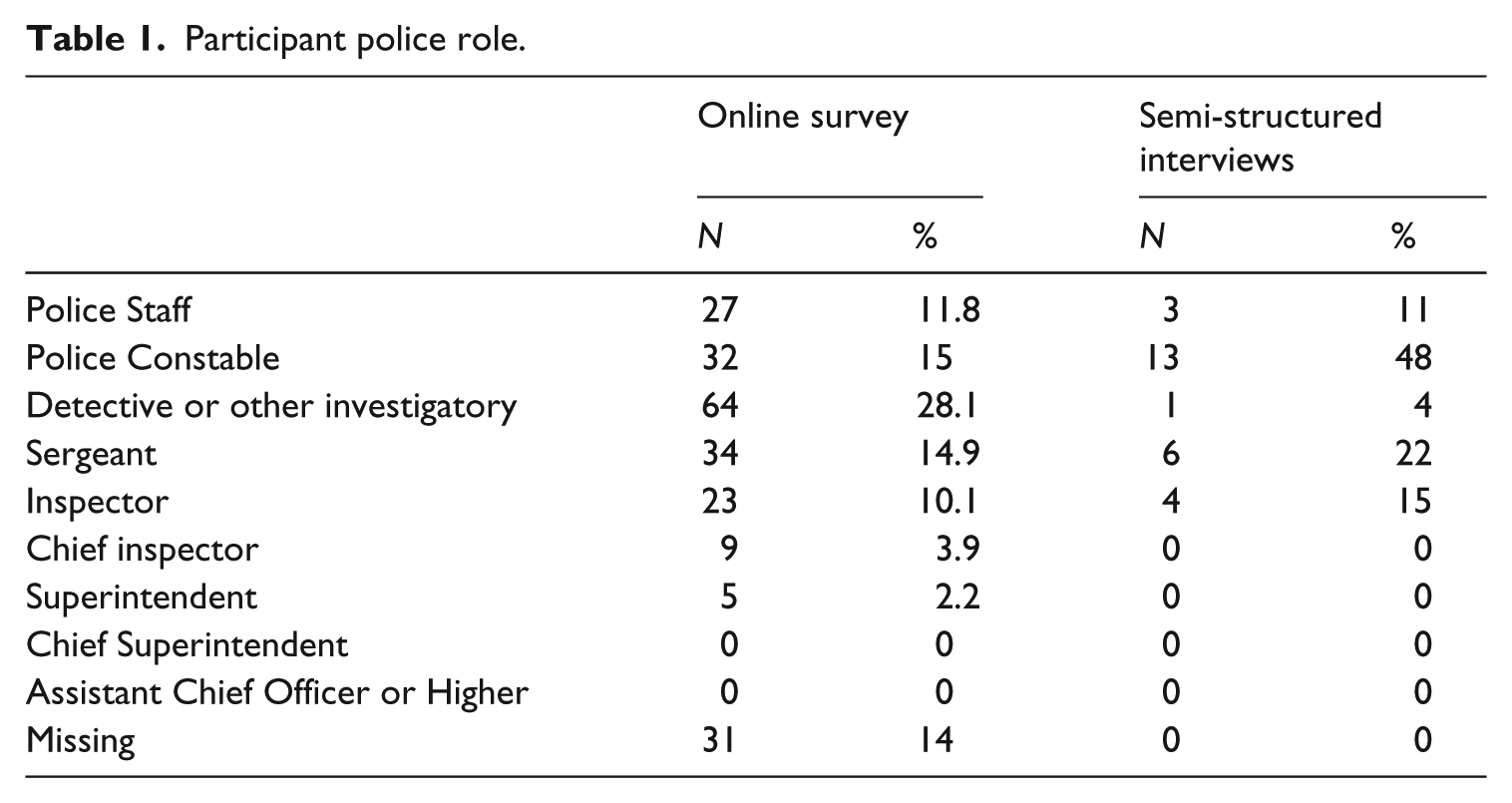
The online survey was followed up with semi-structured interviews with a purposive sample of officers (N = 27) from 13 out of the 37 force areas who had previously engaged in the online survey. Participants were chosen from those who responded to a question at the end of the survey asking if they would be willing to volunteer to take part in a follow-up face-to-face interview and provide an email address to contact them by. From those that responded, participants were sampled in a way that purposively reflected the spread of demographics of the questionnaire respondents (rank/role, length of service, police force).
Ethics
A range of ethical issues were considered by the researchers and formed the basis for ethical approval obtained from the researchers’ university ethics committee. Issues considered included participant anonymity, data sharing, data storage, informed consent and confidentiality. Participants were provided with an information and consent form that they had to register agreement to before they could undertake the electronic survey and sign before interviews commenced. Additionally, working with the College of Policing meant that ethical guidelines and procedures were of upmost concern and the researchers strictly adhered to the British Society of Criminology’s code of ethical research conduct (www.britsoccrim.org/codeofethics.htm).
Analysis
Frequency tests were run on the quantitative data from the online survey using SPSS to understand the spread of participants’ attitudes to issues of sex offender risk management policy. Subsequently, ANOVAs were conducted in relation to the demographic data on rank/role to see if there was any variation in responses. The quantitative data presented here are used to create a broader context for the qualitative data. The qualitative data were analysed via thematic analysis (Braun and Clarke, 2006) by the first author, with a number of themes emerging from the reading and coding phases of the analysis. The second author then reviewed the analysis and discussion and reformation of analysis occurred until agreement was reached. Qualitative data were subsequently triangulated with the quantitative data and framed in relation to the overall research aims and objectives which forms the basis of the analysis presented below.
Analysis
The analysis is broken down into two sections, quantitative and qualitative. The qualitative analysis is further divided into two different themes: (1) risk, resources and control; and (2) discretion, risk classification tools and accountability.
Quantitative analysis
As part of the questionnaire survey respondents were asked about the current system of risk classification and a range of associated issues which might affect the management of sex offenders in the community. For example, participants were asked to respond on a four-point Likert scale to the question ‘Generally speaking, how effective would you consider the current system of categorizing sex offenders for the purposes of registration?’ Of total respondents (N = 144), 14.6% reported it was very effective, 53.5% said it was somewhat effective, 25.7% somewhat ineffective and 6.3% very ineffective. This suggests that there is some ambivalence towards the current system of categorizing sex offenders. A one-way between-groups analysis of variance was conducted to explore the impact of rank/role on how effective participants considered the current system of categorizing sex offenders. Respondents were divided into seven groups according to their rank/role (uniformed Police Constable, Sergeant, Inspector, Chief Inspector, Superintendent, Detective and Police Staff). There was no statistically significant difference at the p < .05 level in the effectiveness rating given by the seven groups: F (6, 137) = 1.2, p = .29.
In the survey, participants were also asked about how different measures might contribute to the overall effectiveness of the sex offenders register. Responding (N = 142) on a four-point Likert scale to a statement about how ‘increasing the ability to expand or contract registration requirements based on changes in offender risk over time’ could contribute, there was again some ambivalence. A total of 30.3% reported that it would make the system significantly more effective, while 40.1% said that it would make the system somewhat more effective. Additionally, 23.9% answered that it would have minimal or no impact and, 5.6% that it would make the system less effective. A one-way between-groups analysis of variance was conducted to explore the impact of rank/role on respondents’ views. There was no statistically significant difference at the p < .05 level in the effectiveness rating given by the seven groups: F (6, 135) = .82, p = .55.
Participants were also asked whether refining the classification scheme to better distinguish higher risk from lower risk offenders would contribute to the overall effectiveness of the sex offenders register. In response (N = 142), 19.7% reported that it would make the system significantly more effective, while 41.5% said that it would make the system somewhat more effective. Additionally, 37.3% answered that it would have minimal or no impact and, 1.4% that it would make the system less effective. A one-way between-groups analysis of variance was conducted to explore the impact of rank/role on respondents’ views. There was no statistically significant difference at the p < .05 level in the effectiveness rating given by the seven groups: F (6, 135) = .74, p = .61.
Finally, respondents were asked for their opinion in respect of priorities for policymakers regarding the management of sex offenders in the community. In relation to issues directly related to risk classification and risk management participants were asked to rank on a three-point Likert scale (high, moderate or low) the level of priority they would assign to a policy to ‘re-align registration requirements in a way that redirects resources from lower risk to high risk offenders’. In terms of responses (N = 126), 50% responded that it was a high priority, 36.5% that it was a moderate priority and 13.5% that it was a low priority. A one-way between-groups analysis of variance was conducted to explore the impact of rank/role on respondents’ views. There was no statistically significant difference at the p < .05 level in the effectiveness rating of the seven groups: F (6, 119) = 1.9, p = .08.
Quantitative analysis suggests that perceptions on the effectiveness of the current system of categorizing sex offenders are mixed and that there was no significant difference in responses to the questions by rank/role. Within this, issues associated with the ability to expand or contract registration requirements, refine the system to better distinguish higher from lower risk offenders and the ability to redirect resources from lower to high risk offenders all register some ambivalence. To help unpick some of the reasons for this ambivalence qualitative analysis will be used to shed light on the findings.
Qualitative Analysis
Risk, resources and control
Regarding concerns about the current system of categorizing sex offenders, interviewees framed their explanations primarily in terms of the relationship between risk classification and subsequent resources. Interviewees noted that the current system results in them having a large caseload of people to manage. This meant they were spread thinly which caused concern about their ability to work with and control all those they were responsible for. This in turn appeared to raise concern about their ability to manage associated accountability pressures. As an interviewee explained: I’ve been doing this role for 10 years now, and my view really is that the actual criteria of people ending up on the register needs to change, to make it higher. Offenders that we can actively impact on by monitoring. I think that, in relation to the need to reduce the numbers what we find is that people are managing numbers in their 60s and 70s per officer, per offender manager, which means that the actual concentration and the depth we can or should spend on those offenders is negligible. So, I think that, either the criteria of the register need to change, or police forces need to make braver decisions about the rationale, about who we are actively going to manage. For example, do we actively visit those low risk offenders or are we going to focus our resources on the high risk people, rather than just treating it as one the same. I think we need to be more descriptive about each individual offender as opposed to just following a set of rules on each one. (PO26)
Other interviewees however expressed concern about removing low risk offenders from the register. This appeared to be because they felt that just because someone is classified as low risk does not mean they will not become high risk in the future. Further, the biggest concern about this change in risk was that it may occur precisely because of the lack of resources available to control low risk offenders compared to high risk. Thus, by the very nature of being classed as low risk and receiving low levels of resources, accountability concerns linked to on-the-job trouble were raised. For example: Should we be managing low risk offenders? I think just because they are low risk doesn’t mean that you don’t have to monitor them. Because they could be changing from low risk to high anytime, if nobody is seeing them, then how do we know? (PO23)
However, it was not just low risk and resource relationships that interviewees had concerns about. Those offenders classified as medium risk appeared to create on-the-job as well as in-the-job concerns, linked to their potential to cause serious harm due to the lack of resources available to control them. For example: I look back through some of the serious case reviews or the domestic homicide reviews that we’ve had over the country and a lot of those deaths and murders have come about in situations where you’ve got an offender who has previously been assessed medium risk. So, that’s where your biggest risk is, because your high risk cases in whatever context you know, if its sex offenders or domestic abuse or whatever, your high risk cases have been identified as high risk and therefore you tend to get an appropriate level of resourcing and commitment, it’s medium risk cases that tend to bother me. (PO11)
Qualitative analysis identified a number of attitudes which were primarily linked to concerns about resource implications. These included views about the ability to expand or contract registration requirements based on changes in offender risk, the need to distinguish higher risk from lower risk offenders and to re-align registration requirements in a way that redirects resources from lower risk to high risk offenders. Concerns about a lack of resources in turn raised questions about officers’ ability to adequately manage and control offenders thus making them vulnerable to on-the-job and in-the-job accountability issues. For example, a participant noted how: ‘resources and risk don’t balance in my opinion’ (PO9). While another interviewee noted how despite changes ‘the resources still don’t match the risk’ (PO10).
Within this context interviewees described how being able to fall back on their own judgement, decisions and practices regarding the use of resources made them feel more confident that they could control offenders and thus avoid troubles. For example, an interviewee described how they used their professional judgement to supersede national policy and guidelines and develop what they saw as more tailored strategies that would allow for the better control of offenders: From the policing processes, the level of risk would determine the amount of time between home visits. I’ve moved away from that a little bit so that it is a bit more bespoke, because with some of the high risk offenders, it might be that we need to see them every week, so you know I’ve kind of like, whilst I broadly stick to what is the national kind of like best practice for home visits, I’m still trying to do it a bit more bespoke to offenders, it’s a bit more tailored to the individual offenders rather than just ticking the boxes. (PO12)
Discretion, Risk Classification Tools and Accountability
Within more general discussions about current sex offender risk management policy interviewees also discussed in more detail issues associated with classification tools, processes and practices. Opinion on these issues again largely appeared to be informed by the relationship between the tools and the ability to use professional judgement and thus maintain some control over the classification and management process. Within this context ARMS was seen as an improvement on previous tools as it allowed greater input, and risk scores were viewed as more closely matching professional judgement. For example: It’s [ARMS] much better than RM2000. Previously you would have somebody who you would look at and think he’s high risk and he’s come out as low in that assessment of risk, but ARMS is a lot better than that. You really are confident when you’ve done an ARMS assessment that that risk level is appropriate and suitable and matches that offender. (PO5)
The issue of trust and confidence in the tool appears important. Respondents felt more confident because, by allowing them greater input in the risk classification process, ARMS gave them a greater sense of control and thus more security against vulnerabilities associated with job troubles. For example: I’ve got a lot of confidence that the risk level we’ve come up with at the end of it, you know I’m quite confident and I would be happy to stand in court and say this is the risk level that we felt that somebody was at, and I think it’s really defensible, probably more so than before, so I think from that point of view it is really good. (PO12)
The suggestion that ARMS is a tool that offers greater protection from possible in-the-job troubles was re-enforced by other participants: ‘[i]t’s very thorough, it’s a very defensible document and the reputation of any organization that has this in place, I believe at this stage could stand the test of being you know challenged’ (PO10). However, while ARMS allowed discretion and professional judgement to be used in the classification and management of offenders, it was not viewed as a replacement for it: The ARMS assessment isn’t the be all and end all. You’ve still got discretion when you put your management plan together about whether you just want to rate it just using ARMS, or you want to factor other things as well. (PO7)
Interviewees noted that while ARMS is an improvement on previous tools it still creates problems because of its impact on their ability to manage and control offenders. One of the problems identified is that completing ARMS is time consuming, time that interviewees argued could be better spent out doing police work, that is monitoring and controlling these offenders: It’s very long winded, it’s over the top, in terms of the categories of information that you have to provide, and it’s very repetitive. There are 11 categories, I would probably say it could be cut down to three or four effective ones, and I think that we spend far too much time sat at computers, supposedly managing the risk of sex offenders typing up long winded reports, when we could be better actually out there knocking on doors. (PO13)
It appeared that traditional face-to-face police work was still seen as the best way to manage offenders as doing so gave greater confidence that they could be controlled. For example: ‘I’m not an advocate of it if I’m honest, I think the process of completing an ARMS assessment is extremely time-consuming, I would much rather my time was utilized actually more face-to-face contact with the offenders’ (PO2).
Finally, in terms of issues with risk classification, a criticism levelled against ARMS is that while it allows risk to be changed this does not necessarily change the level of accountability the police have for these offenders. For respondents, it appears that being able to control all offenders face to face is key because you can never be certain if they will offend again or not. Offenders therefore have to be controlled regardless of whether they are classified as low, medium or high. The biggest worry is that an offender under their watch commits a crime that causes a lot of harm because this will have the worst consequence for everyone in terms of the on-the-job and in-the-job trouble it creates. Therefore, all offenders need control through allocation of time and physical monitoring that is often at odds with national guidance. This hints at the mediating role that police situational decision making may play in shaping practice. Concerns with policy and risk assessment tools are summed up in the following quote: The only concern that I have got about ARMS, is it’s about the risk of re-offending, rather than a risk of serious harm, that is what it assesses, because I think that, risk of re-offending if they are a flasher probably isn’t that serious, but if they are, you know a child rapist, then it is really serious, but you know, they might not be as likely to re-offend, but the risk of serious harm would be great if they did, so I would change it, I would change it to risk of serious harm. (PO16)
Discussion
The study set out to examine the perspective of professionals working within the police on sex offender risk management policy and its tools of implementation to understand how they are operationalized in practice. Analysis revealed a level of ambivalence towards current systems, risk classification and the utility of the tools they use to assess risk. The study identified a range of issues associated with police discretion, culture and accountability and how this mediated their views and influenced their situational decision making, informing what they did in practice.
Current policies for sex offender risk management
When responding to questions about the current system for sex offender risk classification and management, quantitative analysis suggested that perceptions of its effectiveness are mixed. There was also no significant difference in responses between rank/role suggesting that accountability pressures are shared equally as part of the wider police culture. Qualitative analysis highlighted that there was disagreement about the classification of risk and who should be on the sex offender register, the level of risk police officers should be working with (high, medium, low) and the amount of resources they felt they needed to manage this risk. All of these issues appeared to cause accountability concerns for participants.
Qualitative analysis identified that the high number of offenders being managed by individuals caused concern about police ability to fully monitor and control offenders. Thus, the suggestion was that low risk offenders should not be managed by the police which would enable the reallocation of resources to be concentrated on controlling medium and especially high risk offenders. However, others expressed concern about this, suggesting that without police monitoring they would be unaware if a low risk offender’s behaviour changed and if they subsequently re-offended then the police would be held accountable for this. Similarly, in a discussion about medium risk it was identified that while high risk offenders are deemed to have suitable levels of resources and are thus deemed to be under control, those classed as medium risk lack appropriate resource allocation. Referencing high-profile cases, it was suggested that due to resource issues medium risk offenders posed the greatest risk of serious harm to the public and therefore the greatest risk for on-the-job and in-the-job trouble.
Risk levels not matching the resources needed to manage them was one of the key critiques of current policy and this can be understood through the culture of control dominant within policing (Skolnick, 2008) and the resultant vulnerability respondents felt to the different accountability dynamics they are subject to (Waddington, 1994). To protect against these troubles, officers identified how they utilized the discretion afforded them to create their own bespoke or tailored approach to individual offenders. It was acknowledged that this might differ from national policy but allowed them to feel they had greater control over the offenders they managed and thus more secure against possible problematic outcomes (troubles) associated with more rigid policy guidelines. This is an example of respondents acting as street-level bureaucrats (Lipsky, 1980) in the implementation of sex offender risk management policy and how risk may best be understood as a negotiated process in which criminal justice practitioners both engage with and resist risk technologies (Hannah-Moffat and Maurutto, 2010). Therefore, despite a wider context of ontological suspicion surrounding the knowledge base of those in social professions (Hardy, 2014) those in the police view the ability to use discretion to inform their decision making as vitally important for successful operationalization of policy in practice (Stroshine et al., 2008).
Risk Classification Tools
Issues of police culture, decision-making autonomy and accountability concerns were also all found in analysis of participant perceptions of current sex offender classification tools. Similar to the work of Nicholls and Webster (2014) our research identified that ARMS was perceived to be a better classification tool than those used previously such as the RM2000. Supporting aspects of the work of Kewley (2017a) it is suggested that this was because ARMS enabled greater input into assessment, therefore a greater sense of control over the process and a feeling of protection from associated job troubles. Utilizing professional knowledge and being able to draw on their own experience and practice of working with sexual offenders enabled officers to make more professionally informed judgement calls in terms of classifying risk. However, although generally supportive of ARMS, participants identified the time it took to complete this assessment as an issue. This was problematic when operating with restricted resources as being at the computer completing ARMS took away from the time they believed they could have been working face to face with and thus better controlling offenders.
Furthermore, in relation to the risk that is assessed by risk classification tools, participants suggested there was a need for a reconsideration of what was actually meant by risk. Kemshall (2001) identified that risk is a complex concept, and similarly participants suggested that it was the risk of harm caused by an offender re-offending not whether they simply re-offended or not that was of greatest concern to them as the greater the harm caused the greater the associated accountability issues. For example, an offender might be classified as low risk due to it being highly unlikely they will offend again, yet at the same time depending on the original crime committed, if they did re-offend the impact of this could be serious harm to the public and also the police. Thus, respondents raised concern about relying too much on ARMS and other classification schemes rather than their own judgement about who should be managed and how. It can be argued that for the police service, rather than creating confidence in what they do through the supposed certainty predictive assessment tools bring, current policy and practice creates uncertainty as it restrains police action yet still holds them accountable for it (O’Malley, 2004).
The issue of confidence in risk assessment technology as well as its relationship to the subsequent level of resources available to manage risk are of key importance to understanding the limitations of current policy and practice. For example, the risk versus resource issue identified by respondents raises questions about the National Police Chiefs Council (2017) risk-based approach to managing registered sex offenders. This is because without an understanding of concerns about resources, lack of trust and confidence in risk-based approaches may mean that policy continues to be negotiated in practice. Similarly, rather than assuming that everyone is working in the same way for the same reasons, MAPPA (Corcoran and Weston, 2017) need to have greater awareness of the potentially differing perspectives and practices of those involved so that more effective management can be achieved.
Limitations of the study
The study suffered from some limitations which impacted the findings and analysis. As with other research that has adapted surveys from US literature on sex offender management (e.g. McCartan et al., 2018) the current study faced restrictions related to the scales used combined with a smaller sample size. If the current study were to be replicated, it would adapt and standardize the Likert scales used to ensure capacity for a greater range of data analysis. Although the sample is respectable, especially the size of the qualitative sample, it is still small overall. If re-run it could be expanded to other types of professionals (i.e. probation, prison, etc.) given the volume, as well as variety of, professional staff that work with perpetrators of sexual harm. The study focused on police officers only, but many of the policies and systems discussed in the research are used by prison and probation staff as well. As such, the research provides a one-dimensional view of professional attitudes and the study could be replicated with other professional organizations. The current study, therefore, acts as a starting point for future research in this area.
Conclusion
The study suggests that there are a number of issues associated with risk classification, its relationship to resource allocation and the tools used that need to be acknowledged in order to understand how situational decision-making practices impact upon sex offender risk management (Hebenton and Seddon, 2009). Despite a move towards actuarialism, street-level bureaucracy (Lipsky, 1980) remains central to police sex offender management due to concerns that current limitations will leave the police vulnerable to troubles associated with on-the-job and in-the-job accountability dynamics (Waddington, 1994). In this situation respondents appeared to put greater trust in their expertise and experience and used their discretion to develop more bespoke approaches to sex offender management rather than adhering strictly to national guidance.
The findings also reflect previous research that suggests the role of the police in sex offender management is to control offenders thereby securing public protection (Kewley, 2017a). In lieu of this, participants felt that the introduction of ARMS helped with the management of sexual offenders by enabling the use of greater professional judgement, but that a wider re-examination of the risk it classified and the policies on which it was based was required if it is to be made fit for purpose.
If understanding police perspectives on sex offender risk management policy are vitally important to help assess the mediating role the police play in shaping practice, then the current article suggests issues of accountability are central to this. Far from creating greater certainty (O’Malley, 2004) current policies and tools appear to create uncertainty for practitioners as they circumscribe the freedom to practise while correspondingly increasing accountability for it. In this context practitioners negotiate and resist current policy as much as they engage it. This suggests that in the future, practitioner perspective should be used to inform policy and the development of classification tools rather than be simply subject to them. Only by helping them to address the accountability concerns they face will such policies and practices be fully adopted. Discretion is inherent to the functioning of street-level bureaucracy and cannot be eradicated by ever more complex risk management tools. The task therefore is to create tools for managing risk that work with this discretion rather than against it.
Footnotes
Declaration of Conflictiong Interests
The author(s) declared no potential conflicts of interest with respect to the research, authorship, and/or publication of this article.
Funding
The author(s) received no financial support for the research, authorship, and/or publication of this article.