




Abstract
This study explores the difficulties that Spanish judges face during the judicial investigation and trial of the trafficking of human beings for sexual exploitation. Here, we highlight the issues of judges’ lack of training and the saturation of the courts due to the excessive work that these crimes entail. To collect data, responses from 71 Spanish judges were collected through a questionnaire, and nine semi-structured interviews were conducted in three Spanish provinces (Barcelona, Malaga and Madrid). Noteworthy findings include the fact that almost half of the judges had dealt with a case involving this type of crime and that a third ended up closing the case. In the responses received, the lack of victims’ collaboration in the judicial process was highlighted as one of the difficulties as was the lack of resources to investigate these crimes and the involvement of other crimes.
Introduction
This study reveals the difficulties Spanish judges confront while investigating and trying crimes of trafficking. Most noteworthy among them is the lack of training the judges have in dealing with this crime and the increase in work that it entails for the courts, since obtaining evidence not based on the victims’ testimony is no easy task.
Human trafficking is a complex, multidimensional phenomenon (involving globalization, migration, labour relations, regulation of sexuality, gender inequalities, new communication technologies and the advances in transport) and occurs in different ways or forms (sexual labour exploitation, committing of crimes, organ removal, etc.). In recent decades, the governments of Europe have become aware of their responsibility to end human trafficking both inside and outside their borders, to pursue the traffickers and to protect the victims. However, Spain has embarked on this task rather tardily, as it was not until 2010 that this crime appeared in the penal code, in accordance with the Palermo Protocol. However, it was only in 2015 that all the types of exploitation currently mentioned in the Protocol were introduced. This delay may have occurred because Spain ratified the convention in 2003 and did not take on the international commitments until they were endorsed by the European Union (EU). In other words, European directives and agreements seem to be a greater priority for Spain than their international counterparts. Until 2010, Spanish legal regulation related human trafficking to clandestine immigration, although the two phenomena are different. Thus, a vision of Europe with borders was prioritized, in which the greatest concern was controlling irregular immigration rather than preserving the rights of victims of trafficking (Villacampa, 2010). Since then, there have been few convictions in Spain in this area compared to those related to other crimes, such as gender violence or drug trafficking. According to the Defensor del Pueblo, the Spanish Public Prosecutor’s Office (2017), in 2017, 254 prosecution procedures were initiated for human trafficking crimes. However, among them, only 122 prosecutions had as their goal any modality of trafficking stipulated in Article 177 bis CP, with 55 criminal groups investigated; this trend is similar to that of the previous years (2209 and 439 victims of trafficking for sexual exploitation and labour exploitation, respectively, were identified between 2014 and 2017). These numbers are significantly low compared to other European countries (Eurostat, 2015), all the more so considering that Spain is a country of transit and a destination for victims coming from various countries due to its strategic location in Europe. In this context, the following questions arise: Why is there such a scant incidence of sentences for trafficking crimes compared to other criminal activities? What are the difficulties in trying these crimes?
Europe has two procedural models (Gascón, 2009): the adversarial model, in which the investigation is carried out by the police and the public prosecutor without court proceedings, and the mixed inquisitorial model, with a phase of court investigation that oversees the police investigation. In both cases, once the investigation is over, the criminal case is tried by a different judge than the one who presides over the investigation. Spain follows a mixed inquisitorial procedural model, in which a judge oversees and instructs to ensure the legal guarantees of the investigative phase.
The literature highlights two factors that require special attention for more effective investigation and prosecution of the crime: those relating to the victim (Chahín-Pinzón et al., 2017; Dols, 2012; Huang, 2017; Marcu, 2008) and those relating to the procedure of investigation (Helfferich et al., 2011; Villacampa and Torres, 2017), although both are closely related.
Among the problems that concern the victims of trafficking, a series of aspects stand out. First, the victims go unnoticed and undetected for several reasons: they are not seen as victims of a crime; they are isolated and cannot speak to anyone; they present factors of vulnerability; they do not know the language, the rights they have and the laws of the country they find themselves in; they are in precarious psychosocial situations due to the process of victimization; and so on (Chahín-Pinzón et al., 2017; Dunkerley, 2017; Mancy and Johns, 2011; Meneses-Falcón et al., 2015). While professionals, non-governmental organizations (NGOs) and even civil society can be involved in detection, a victim can only be identified by the police. Second, apart from feeling unsafe and not cooperating, the victims usually do not lodge a complaint or report out of fear that the traffickers might harm them or their families. This is because, sooner or later, traffickers find out who has reported them, and as they are often from the same country of origin, they seek ways to avenge themselves or intimidate the victim into avoiding cooperation with the law (Greenbaum and Crawford-Jakubiak, 2015; Helfferich et al., 2011).
Among the obstacles related to procedures in the police and judicial investigation, a series of aspects identified in different studies (e.g. de Pérez, 2015) are worth highlighting: the lack of consensus on the definition of trafficking that muddles the boundaries with other crimes (migrant smuggling, enforced prostitution, sexual exploitation or inducement or incitement to prostitution); the absence of agreed indicators for identification, since they vary among countries (Piscitelli, 2012; Surtees, 2008) and even among professionals from the same country (Villacampa and Torres, 2017); the lack of training of the professionals involved in the process of identification and protection (Brunovskis and Surtees, 2019); the places where the identifications are conducted – many through raids with the traffickers present – are not perceived as safe or comforting and neither do they instil a sense of security in the victims, who, thus, resist being identified; the lack of manpower and various resources in the crime investigation (Meneses-Falcón et al., 2015); and inadequate police practices in the procedure (Bjelland, 2017). Some studies of judicial cases of sex trafficking have revealed aspects that have led to the low level of convictions of this crime in the EU. Skilbrei (2010) shows how Norwegian judges are influenced by the social context and must confront cultural norms and unlegislated public and political problems through the penal code. In this sense, Skilbrei highlights the lack of limits and clarification concerning crimes such as trafficking and forced prostitution or exploitation, which creates confusion between the two social phenomena. Constantinou (2013) emphasizes the need for victim testimony to be able to determine the fault of the traffickers; this requires that the safety, confidentiality and protection of the victims be made paramount so that their testimony is not invalidated. Constantinou also highlights the influence of social values on judicial decisions and the need for better training of judicial professionals. Finally, an important contribution has been made by Matos et al. (2019) in their study of the factors of effectiveness and ineffectiveness in criminal justice processes in cases of trafficking for sexual exploitation in Portugal. Among these factors, one can highlight aspects related to victim testimony, the need to have sufficient evidence to achieve conviction without relying exclusively on the victim’s statement and the need for victims to feel protected and safe while testifying. Moreover, in this study as well, the authors emphasize the need for judicial cooperation and training of judicial professionals and international police.
This study aims to take stock of the difficulties faced by investigative and trial judges while dealing with sex trafficking crimes. Specifically, we aim to explore the circumstances that influence the judges, victims and judicial process resulting in there being not many court convictions in Spain. In other studies, although information has been gathered on various professions, they either fail to include the judiciary (Meneses-Falcón et al., 2015) or included them with a low representation (Villacampa and Torres, 2017). The analysis of the judges’ experience can contribute to better knowledge of the obstacles they confront while dealing with trafficking and to designing mechanisms that could help remove these obstacles.
Methods
We carried out exploratory research with data collection methods and mixed analysis as per Bericat (1998), which enabled the complementation and triangulation of results. The quantitative approach facilitates access to a higher number of judges and quantifies questions of interest. The qualitative methodology provides a closer examination of the discourses and internal perspective of the subjects of study, delving deeply into the views and experience of the judges regarding human trafficking.
Data collection
The study began with a survey of investigative and trial judges in three Spanish provinces (Barcelona, Malaga and Madrid). These provinces were selected as they had the highest levels of prostitution in that year (2016). The population of judges at the time of the survey was 673 (296 in Madrid, 269 in Barcelona and 108 in Malaga). A hard copy of the questionnaire (in Spanish) was sent to all the judges in January 2016, accompanied by a letter of support from the General Council of the Judiciary and a return envelope.
The questionnaire comprised 26 questions divided into four sections: knowledge of trafficking, experience of trafficking, opinions and socio-demographic data. The variables of opinion and experience were collected on a scale of ‘1’ (completely disagree or infrequent) to ‘4’ (completely agree or very frequent). We intentionally chose not to use a neutral point, since we considered that the judges had the evident capacity for discernment and would be able to choose one way or the other, thereby avoiding a neutral or indifferent standpoint. The questionnaire, which took 10 minutes to answer, was created by the authors based on previous interviews of experts and the advice of some judges. Once devised, it underwent expert review by an investigative judge from a large Madrid court, who made certain corrections and suggestions that were incorporated into the definitive version. Faced with a limited initial response to sending the questionnaires once the 4 months allowed for their completion had passed, a reminder was sent via the General Council of the Judiciary. In the end, 71 (10.5%) judges responded to the questionnaire. This is standard for postal surveys, which have low response rates but the advantage of being able to reach the whole population under study. Of the judges who responded, 48.5% (n = 33) were men and 51.5% (n = 35) women. The average age was 50 years (SD = 9.88), ranging from 28 to 68. Trial judges made up 66% (n = 48), while 33% (n = 23) were investigative judges.
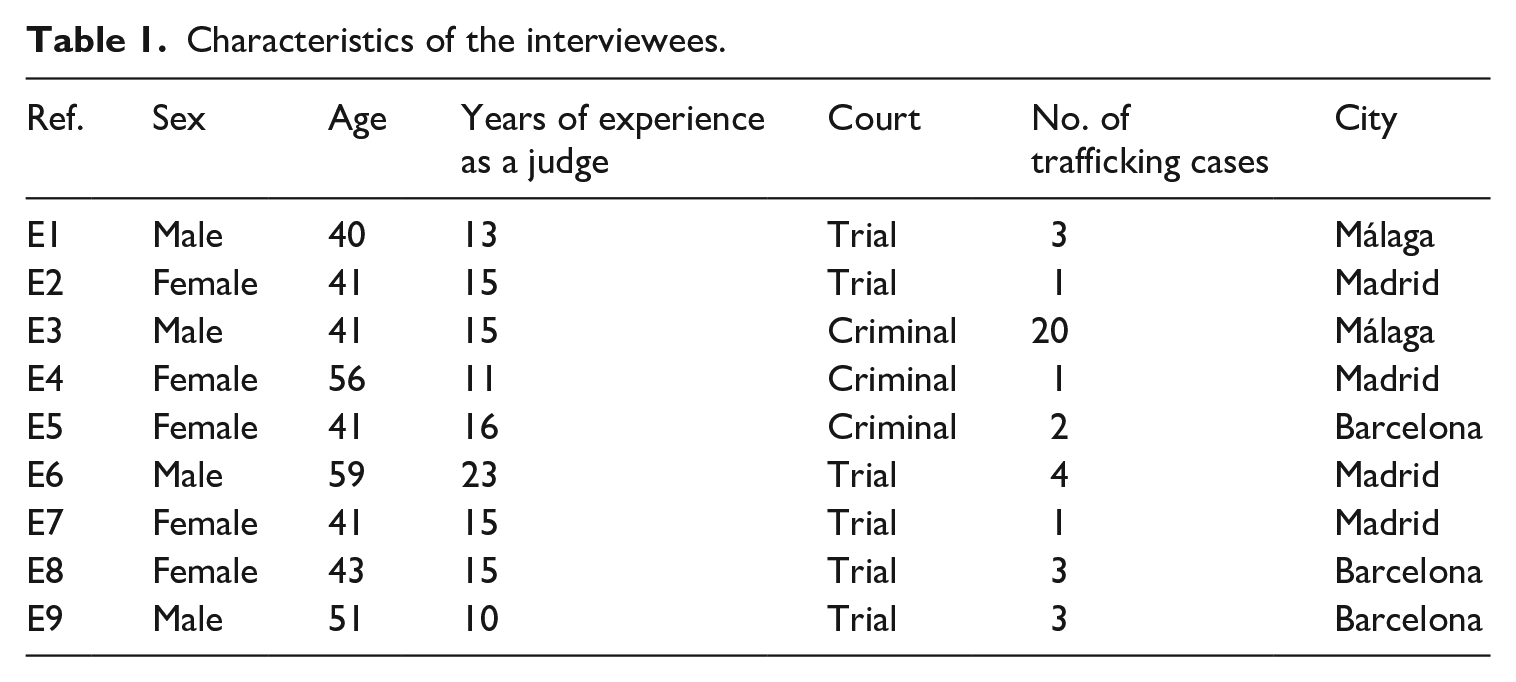
If the responding judge had tried or presided over the investigation of a trafficking case, there was a request at the end of the questionnaire for a voluntary interview to expand on the information provided. This was the second phase, in which respondents’ views on crime were explored qualitatively. The interviews took place in June and July 2016. Eleven of the judges who completed the questionnaire were receptive to in-depth interviews, but, finally, only nine could be interviewed. The interview script was designed following on from the questionnaire and focused mainly on their difficulties and needs. The characteristics of the interviewees are presented in Table 1.
Characteristics of the interviewees.
The judges were offered a confidentiality agreement, guaranteeing anonymity and the voluntary nature of participation, and informed consent was requested. We followed the recommendations given by the University Ethics Committee upon approving the project.
Data analysis
Once the quantitative data collection was finalized, the data set was cleaned and prepared for analysis. A descriptive analysis was conducted for all the variables. In the case of variables that asked about the opinion or experience (degree of agreement and frequency) of the judges in different aspects, we checked for the existence or absence of indifference (see Table 2). For analysis, IBM SPSS v. 24 for Windows was used.
Experience with the crime of trafficking.

Note: Boldfaced and italicized values in Table indicate significant values.
All information obtained from the interviews, once transcribed, was subjected to analysis and uploaded into the qualitative analysis software NVIVO v12. Some basic categories were drawn up based on the literature review, aims of the research and interview script, and these were used to codify all the transcripts obtained. This first coding was subsequently refined, reworking it as the analysis advanced and as relationships between categories and informants appeared.
Results
The quantitative and qualitative results obtained from the corresponding analyses are presented in an integrated and thematic way, according to the topics covered in both analytical strategies. Based on the results, the main problem is the judges’ lack of training, as they have limited options for training on trafficking and gain the most knowledge while investigating or trying the crime.
Knowledge and experience of the judges regarding trafficking
The percentage of judges who had dealt with a case of human trafficking was 47.9% (n = 34). The mean number of cases was 4 (SD = 4.15), ranging from 1 to 20 (n = 29). Sexual exploitation was the predominant type of human trafficking, at exactly 82.4% cases (n = 28), followed by labour exploitation, at 17.6% (n = 6). The percentage of cases sent to the Criminal Court was 28.6% (n = 8), another 28.6% (n = 8) were dismissed and 42.9% were sent to the Provincial Court.
No significant differences were found between male and female judges. The judges who had dealt with trafficking cases were of a higher average age, had served as judges for more years, had presided over more courts and had spent a longer period at their current court, compared to those who had not dealt with a trafficking case. Furthermore, the judges who had dealt with these crimes stated that they were better trained than those who had not (p = 0.01).
One of the aspects that most of the interviewed judges agreed upon was that this type of proceeding was not common. In this regard, a female judge in Madrid pointed out that One female colleague from here has also had a trafficking case, because they are not very common proceedings – the truth is that you don’t find people who have had one. I’ve only had one and I’ve been working since 2001 and I’ve only had one. (E2, female judge, Madrid)
The prevalence and incidence of sex trafficking cases do not appear to be high. Two important aspects can be perceived in the interviews: first, the lack of awareness and knowledge among judges concerning this phenomenon, as a male judge from Malaga stated, … there is a complete lack of training and knowledge in the judiciary, the judges and the public prosecutor’s office. (E1, male judge, Malaga)
Moreover, a female judge from Barcelona said that A public prosecutor and a judge who both lack knowledge leads to a clear acquittal, above all, if it is also an issue of prostitution, which is taboo . . . There are judges who try to avoid these cases, and the police know it; they try to look for the court they know is more sensitive to this type of crime. And it is unjust because they overload the judges who are sensitive to these issues. (E8, female judge, Barcelona)
The second aspect is the pressure from the highest authorities of the judiciary for the judicial proceedings to be brief, based on annual completion quotas in investigations and court trials. This conflicts with what investigating these crimes entails, as they involve a lot of work and lead to over-congestion of the court. This was observed by a male judge from Malaga: Look, an acquittal is two-and-a-half pages. A guilty verdict is fifty pages, because you’ve got fifty or sixty pages and two months of study; because you have to analyse a huge summary that many people have worked on for many years . . . It’s a mess, which paralyses the court, and on top of that, you risk it going to the Provincial or Supreme Court, and they tell you that the first or third act of telephone tapping was not sufficiently justified because the lawyers, when there is evidence, they cling to formal details. (E1, male judge, Malaga)
The judges who have had these cases described them as complex because other crimes are also often involved (drugs, money laundering, weapons, etc.).
In the trafficking investigation procedures, 87.3% (n = 62) of the judges did not know of the application of recovery and reflection for the victim stipulated in Article 59 bis of the Immigration Law of Spain. According to this article, the victim is given a period of at least 90 days to decide whether they wish to cooperate with the authorities. Only 11.3% (n = 8) gave a positive response to this question. These results may indicate that this measure is applied in a minority of cases or that its existence is unknown. Other questions on the judges’ experience are summarized in Table 2.
The police are responsible for investigating the crime in collaboration with and under the supervision of the investigative judge. A certain amount of evidence is needed to detain the criminals and deprive them of freedom; further evidence is needed to attain conviction. Mentions of some of the existing difficulties can be found in the testimonies of these judges from Malaga and Madrid, for whom these two processes were expensive and presented greater difficulties compared to other crimes. Apart from being uncommon, as we have already mentioned, they overran the investigation period and lacked conclusive evidence; if a conviction was attained, it was more due to the associated crimes than having managed to prove the crime of trafficking. One judge from Madrid remarks, Of course, the police don’t see that. Let’s say that the police by arresting the bad guys they finish their work, they send them to the judiciary, and that’s that, all sorted. But it isn’t, it’s not all sorted if in the end there’s no conviction. (E6, male judge, Madrid)
Another male judge, from Malaga, notes another problem: The crimes where money is involved, there are better lawyers, and the lawyers take care of prolonging the investigation because the longer it is delayed, the more likely that later the trial ends in an unsuccessful result, in the sense of a judgement of acquittal. (E3, male judge, Malaga)
The difficulty of attaining clear evidence was a common denominator in the judges’ discourses. Traffickers move with great flexibility and dynamism, which hinders the gathering of sufficient evidence to apply the articles that correspond to trafficking. Without a well-justified judicial investigation, it becomes difficult for the judge trying the case to achieve a conviction. Let us look at the obstacles indicated by the judges in detail.
Difficulties of the judges in criminal inquiry
The main difficulties in the judicial investigation of trafficking crimes could be different from those involved in the trial, but there are problems that affect both processes, as is the case with everything concerning the victims. The most prevalent difficulties in the development of the investigation or the trying of such cases are the lack of victim collaboration, their disappearance and their unformed testimony. Table 3 shows all the difficulties indicated, using the judges’ answers to count multiple difficulties.
Difficulties with trafficking crimes.
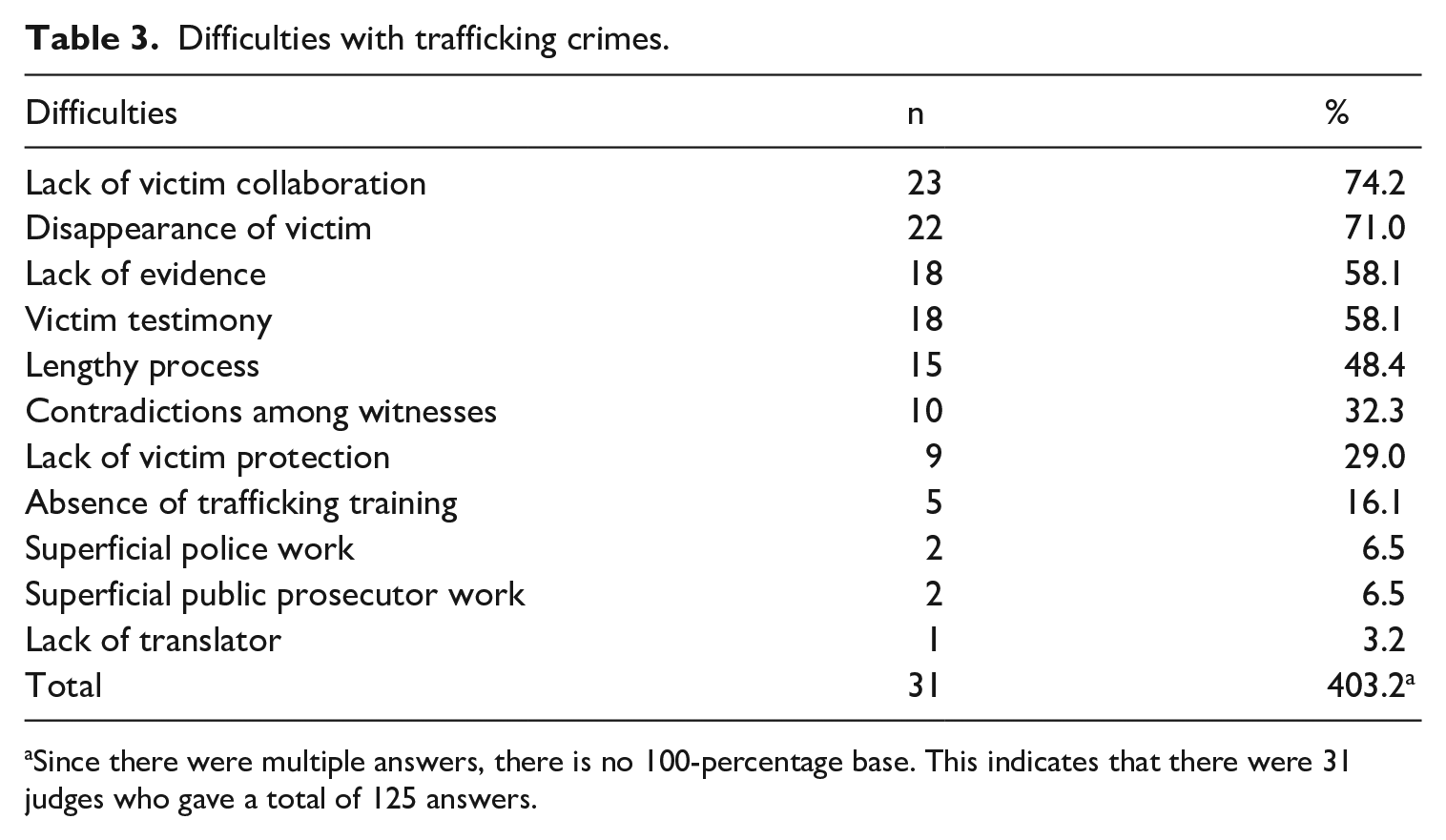
Since there were multiple answers, there is no 100-percentage base. This indicates that there were 31 judges who gave a total of 125 answers.
The interviews provided details of the problems encountered in the judicial investigation. One of the difficulties detected based on the response of a judge from Malaga is that the reporting of the crime and statement by the trafficking victims are often infrequent due to two reasons: First, they do not consider themselves victims, for many reasons; second, they usually feel threatened by their traffickers: The orientation of the victims . . . if we have 40 women . . . One, we have one who came here to lodge a complaint that they had beaten her; here, before me, her father called her up from Bulgaria to tell her that they were threatening his life and such like, and I had a perfect statement, and we were almost, and the girl has gone back with the organization. We lost her. We lost her as a witness for the prosecution. What is happening? Well, that there is not one girl who is willing to testify. (E1, male judge, Malaga)
Only when the victims are in an extreme situation or their children are directly affected, are their report and statement successfully attained; however, this is not the norm. The following account by a judge from Madrid highlights the problem: The girl reported a crime; one of the victims reported it because they had kidnapped her girl . . . sure . . . They were Nigerians. She went running to the police station. There they already had a reliable statement that that was what that group did. There she made a statement to the police; she told them everything: that they had brought her over by deceiving her, that they had told her that she was going to work as a hairdresser, what she had had to pay, everything, that she had been in brothels in Madrid, then somewhere else . . . She told them everything. But afterwards, we could not find her again. (E7, female judge, Madrid)
The biggest problem pointed out by one judge in Madrid is that if the victim does not lodge a formal complaint, the case ends up being closed in the absence of other evidence: If there is no victim, there is no crime . . . but obviously, without a victim who tells you, ‘Yes, indeed, this happened to me’, it is very difficult to convict a person . . . (E6, male judge, Madrid)
All the judges interviewed were aware that even if they had other evidence, to get a conviction, it is necessary for the victim to explain what had happened to them, although the European directive is to not focus on the victim. For the victims to testify and report a lived situation of slavery, protection measures for them and their families must be provided. However, the judges highlighted problems in this context as well: … gaining the confidence of the victims and giving them sufficient protection so that they can freely recount what has happened to them. I believe this is the most important thing, and if it is necessary in some cases to bring the families over, I think that these violent people, then, bring them over . . . I think it would be the only chance of ensuring that these women can testify freely. Because I think that the fundamental evidence is what they have to say. There isn’t any other evidence. We have to keep hold of the victims, they are the ones who tell us how they have been brought over, what they have been promised, what they have been told, how they are treated here, what they do with their money, whether they send it to their country. . . (E4, male judge, Madrid)
Finally, the judges pointed out that better and more resources are needed to investigate sex trafficking crimes more effectively: There are not sufficient resources to be able to investigate this type of crime. (E5, male judge, Barcelona)
Thus, the main difficulty was that sex trafficking is a complex crime, which requires dedication, resources and awareness from judges and public prosecutors and reports and testimony from victims. Without these things, the case is likely to be closed.
On being asked whether they considered they had sufficient information on the social phenomenon of trafficking, only 40.2% (n = 71) of the judges agreed or completely agreed with the statement; 47.9% disagreed and 11.3% completely disagreed. In other words, more than half considered the information they had insufficient. About 88.7% (n = 63) of the judges indicated that knowledge on social and cultural aspects of the phenomenon could be included in training; moreover, 88.7% also agreed with introducing these aspects to the initial training of judges and 67.6% (48) agreed with ‘I lack training on the phenomenon of trafficking’. The same was mentioned in their accounts: It would be very good if the council organized training courses on human trafficking, for investigative judges and public prosecutors, jointly. Because what cannot happen is that we subsequently have a different view of the matter. And to do it regularly. (E1, male judge, Malaga) I practically knew nothing about this issue, what you see on the TV and that’s it, because we have not had any special training; I don’t remember having seen a course, maybe there was one, you know, on human trafficking, but I can’t recall having seen one. The Council gives training courses every year. I can’t remember ever having seen a course on trafficking. (E2, male judge, Madrid)
Finally, there was a question on the possibility of having specialized judges for the crime of trafficking, as occurs with other crimes, or an authority similar to the public prosecutor’s office, with a public prosecutor who specializes in the issue in some Spanish provinces. However, again, no consensus was found among the interviewees. In this regard, two judges from Malaga and Barcelona proposed specializing the judiciary in crimes of trafficking, while fellow judges in Madrid and Barcelona positioned themselves against it: I think that just as there are specialist public prosecutors, there should be specialist judges. If I were specialized in human trafficking, I could take all the trafficking cases in the province. No problem, but only dealing with that . . . If I were the judge in the province dedicated to that, then I could devote myself to it hand-in-hand with the public prosecutors. Then the police would know that they are always going to work with that judge, that the criteria will be such and such . . . and a relationship of trust is established. (E1, male judge, Malaga) That would mean that you would have to specialize for all crimes. . . (E2, male judge, Madrid) If you specialize in one part of the Penal Code, you forget the rest. That there be specialization in the public prosecutor training, sure. Obviously, because they are going to be an investigator. Not the judge. The Judge must see it aseptically, from above, and, well, what’s happening to the French public prosecutors is going to take place here. (E6, male judge, Madrid) Specialization would be ideal. Judges who are specialized according to crimes. The experience accumulated is very good for future cases. Moreover, it would be very good for the same police unit to work with the same judges and public prosecutors. (E8, female judge, Barcelona) I would prefer it as it is here in Barcelona, which is a specialized public prosecutor, but the judiciary should not be specialized. (E9, male judge, Barcelona)
In summary, in the discourses of the interviewed judges, there was agreement on the need for greater international cooperation on the cases investigated, greater information and training on the social phenomenon of human trafficking and greater knowledge of the European regulations on this crime.
Discussion
This study examines the difficulties faced by Spanish judges and magistrates in the investigation and trying of sex trafficking, which has received scant research till date (Jernow, 2009). Almost half of those surveyed had dealt with some kind of human trafficking case. The most highlighted difficulties, both in the questionnaire and in the discourse, concerned the victims’ lack of cooperation in the judicial process; the same aspect has been identified in many studies (Bjelland, 2017; Dols, 2012; Helfferich et al., 2011). For a victim to report a crime and cooperate in the judicial process, they must be protected from the threats and actions of the traffickers, which is not always possible for various reasons. First, it has been stated that the judicial process is especially protective of the traffickers (Meneses-Falcón et al., 2015), who can employ good lawyers to appeal against any judicial or public prosecution action. In this regard, the existence of pre-constituted evidence (the testimony of the victim previously recorded in the presence of the public prosecutor, judge and defence counsel, which is valid for the oral trial and does not require the presence of the victim) may not be admitted in the oral trial, where the presence of the victim is again required. There have been convictions of the European High Court that have ruled in favour of this type of testimony in the oral trial, and which lawyers make use of when there is sufficient condemnatory evidence. 1 Second, it is impossible to articulate international protection measures. The results show that 96.8% of the Spanish judges surveyed agreed that the European protection order should be requested, and all agreed that international cooperation was necessary in these cases; the European Police are also of the same opinion (Europol, 2016). In Spain, after this protection measure came into force, 34 European protection orders were carried out between 2015 and 2018, of which 21 were for gender-based violence, but not one European order has been received (CGPJ, 2019). The Organization for Security and Co-operation in Europe (OSCE, 2013) has shown that international cooperation is fundamental to carrying out the fight against human trafficking, both for the protection of the victim and for the prosecution of the crime, and member states have been recommended to intensify their instruments for cooperation (information exchange, cooperation in the investigation, mechanisms for coordination between states; OSCE, 2013). However, international cooperation presents difficulties for judges, who have to cope with enormous differences in the legislation of different countries, different forms of obtaining evidence, and so on. For this reason, there is a tendency for the judicial authorities to avoid approaching cases from a multilateral perspective and opt for a bilateral mode of cooperation (Jordana, 2015).
The judges interviewed had presided over cases where if a victim in Spain and/or their family in the country of origin was not well protected (i.e. if they could not be brought to Spain or given protection in their own country), they could not succeed in getting them to report and cooperate. The Foundation of the Spanish Legal Profession states that there are many trafficking victims who cannot return to their countries of origin because they face the risk of becoming an object of trafficking again (re-trafficking) and suffer reprisals against themselves and their families by the network if they collaborated with a penal process or stigmatization in their environment for being a trafficking victim (Fundación Abogacía Española, 2015). In these cases, the victims require international protection. However, the protection measures generally prove to be insufficient and limited to a specific period of time, that is, the duration of the penal process (Defensor del Pueblo, 2017). Moreover, if the victim is an illegal immigrant, the Immigration Law makes them susceptible to a deportation order if they are not recognized as a victim (Castro, 2012). Finally, the psychological state of the victim leads to an inconsistent and contradictory testimony. The experience of trauma and victimization makes it difficult to carry out a coherent testimony (Chahín-Pinzón et al., 2017; Dols, 2012; Greenbaum and Crawford-Jakubiak, 2015; Mancy and Johns, 2011).
Both the male and female judges interviewed were aware that although they might have other evidence to attain a conviction, it was necessary for the victim to state what had happened because this is how the Spanish juridical system is configured, although the European directives recommend not focusing on the victim. Spain has typified the crime of trafficking according to the minimum standards established by European regulation regarding the fight against human trafficking (specifically, Directive 2011/36/EU on preventing and combating trafficking in human beings and protecting its victims 2 and Directive 2012/29/EU establishing minimum standards on the rights, support and protection of victims of crime 3 ) and is yet to adopt the approach based on human rights initially dealt with by the 2005 Council of Europe Convention, 4 on the basis of which the investigation or trial of offences related to human trafficking does not depend upon denunciation by the victim and the penal process may follow its course even if the victim withdraws the statement. 5 In Spain, the human rights–based approach to trafficking is not applied. The first set of legal measures adopted is based on an immigration-based approach to trafficking that has been prevailing in Europe (Castaño-Reyero and Pérez-Adroher, 2018). Apart from this immigration-based approach, the intervention and protection of trafficking victims in Spain have been characterized by a gender-based approach. Thus, above all, the trafficking of women and children for the purpose of sexual exploitation has been the focal point, leaving aside other reasons and purposes of human trafficking. In line with Directive 2012/29/EU on the minimum rules for victims of crimes, it is necessary to adopt a definition of a victim of a crime that is not linked to the offender having been identified, detained, accused or convicted. 6 However, based on the results, none of these aspects appear to have been adopted by the judges interviewed, given that only around 10% had applied Article 59 bis of Immigration Law, which makes it possible for the victims to recover and consider cooperating against the traffickers, as is stipulated in Directive 2004/81/EC of the Council from 29 April 2004. The period of recovery and reflection established in the said article can be made effective regardless of the victims’ cooperation with the State security forces and bodies. In 2016, 68 periods of recovery and reflection were conceded to victims and 140 periods offered were rejected by the victims themselves (Rodríguez, 2017). The Spanish legislation even provided for the possibility of a residency and work permit, not only for cooperating in the investigation or case trial but also for humanitarian reasons. However, although the data have improved, they indicate a low number of applications: from four permits conceded in 2013 for humanitarian reasons to 30 permits in 2016. This contrasts with the number of permits given by other neighbouring countries (Italy conceded 316 permits in 2016), attending to the personal situation of the victims (GRETA, 2018). Furthermore, it remains uncertain whether these residency permits would be extended once the investigation or trial ends. This means that the victims would remain in a situation of complete defencelessness once the processes come to an end. This is why many women choose not to cooperate with the judicial system and remain in their situation of forced prostitution until their debts are paid off to the network that exploits them (Milano, 2017). It is noteworthy that 60.7% of the judges surveyed detected the need for international protection but only 3.2% requested European protection. This could indicate that outside the EU, greater protection is needed due to the specific characteristics of these victims compared to those from the EU.
The difficulties begin, however, when international cooperation must be established outside the EU. Spanish judges have few offers of training on the crime of human trafficking and come to learn about this crime only when they investigate or try a case. In this study, 67.6% of the judges surveyed reckoned that they needed more information. These data are similar to those found in other studies with respect to professionals from social, police or judicial services (Cuhna et al., 2018; Villacampa and Torres, 2017). Specifically, compared with another study carried out in Spain in which 43% of the judges identified human trafficking with objectification and slavery and only 205 had received sufficient training (Villacampa and Torres, 2017), the judges surveyed and interviewed for the present study had more information. Nevertheless, the lack of knowledge and training on the subject can be overcome through judicial specialization. However, when the participating judges were questioned on this issue during the interviews, they showed no consensus. According to some studies, although specialization could facilitate a better investigative process and its improved effectiveness, it does not guarantee success, as there are factors that do not depend on the judge, such as those relating to the victim or the police investigation (Bjelland, 2017; Cuhna et al., 2018).
Limitation
Owing to the limitations of the study, the results should be treated with caution. First, the sample of judges surveyed is not representative of the whole judge population, since the response rate was only 10%. Second, the number of judges who had dealt with trafficking cases was low, meaning that all the difficulties may not have been addressed. Third, the data collection tool did not gather many aspects on traffickers, since on opting for a short questionnaire, those questions were sacrificed; it is possible that this might have produced bias. Finally, although anonymity was guaranteed in the questionnaires, it is possible that the self-reporting involved in this instrument could have led to answers being influenced by social acceptability. However, this was not the case in the interviews, in which the conditions necessary for maintaining anonymity were achieved and the interviewees were able to reveal their opinions and experiences (Kvale, 1996).
Conclusion and practical implications
This study demonstrates the importance of establishing and analysing the difficulties in the investigation procedures of trafficking crimes, particularly those found by judges. Preparation and knowledge of judges and magistrates, existence of sufficient resources for the investigation, existence of knowledge and legislation favourable to trying the cases of human trafficking, and international cooperation and victim protection measures can all help in attaining greater effectiveness in the judicial investigation and trial of the crimes of human trafficking.
A series of recommendations can be drawn from the results to enhance effectiveness in the investigation and trial of trafficking crimes. First, judges must be better trained, both initially and in further education, to enable them to deal with these crimes with greater wisdom. Second, the judicial system should reconsider a broader investigation that is not based on the testimony of the victims. Furthermore, for a victim to be a suitable witness, their safety, protection, confidentiality and care must be guaranteed throughout the whole judicial process. Last, because human trafficking cases are often related to other crimes and perpetrated by international criminal networks, greater international cooperation is needed, along with better resources for investigation so as not to collapse the court or prolong cases and cause their closure. These actions will help reduce the dynamism shown by traffickers in the perpetration of this crime, elevating the number of convictions.
Footnotes
Acknowledgements
The authors would like to thank General Council of the Judiciary in Spain for their support in this investigation and the judges who collaborated in the Study.
Declaration of conflicting interests
The author(s) declared no potential conflicts of interest with respect to the research, authorship, and/or publication of this article.
Ethical requirements
This research project was approved by the Ethical Committee of the Comillas University de Madrid on 15 September 2014.
Funding
The author(s) disclosed receipt of the following financial support for the research, authorship, and/or publication of this article: This project is part of the National RDI Project, ‘VISIBILITY FOR THE VICTIMS OF HUMAN TRAFFICKING: acting against the trafficking of women for sexual exploitation’, subsidized by the Ministry of Science and Innovation of Spain, Reference: CSO2014-55209-P.
