



Abstract
Criminal justice policy, as public policy, is not the result of a single decision but evolves over time through the policy making process. To demonstrate this premise, the author uses the disjointed incremental framework to analyze the broadening of the definition of a victim of trafficking in persons in U.S. law to encompass not only the foreign-born but also domestic minor sex trafficking victims. The framework characterizes the policy making process, in practice, as limited to a few familiar policy alternatives and preoccupied with ills to be remedied rather than positive goals sought. Trafficking in persons emerged as an international and U.S. policy issue during the 1990s. Analyzing the definitional expansion reveals the evolution of policy over the law’s 20-year history. As criminologists and criminal justice organizations seek to impact national and international criminal justice policy, research enhancing our understanding of the practice of policy making in diverse arenas is critical.
Keywords
The underlying premise of this article is that criminal justice policy, as public policy, is typically not the result of a single decision but evolves over time through the policy making process. As criminologists and criminal justice organizations seek to impact international and domestic criminal justice policy, further research to enhance our understanding of criminal justice policy making, in practice, is imperative. One analytical framework used to study the policy making process is disjointed incrementalism or the “science of muddling through.” Developed by economics and political science professor, Charles E. Lindblom (1959, 1979), the policy making process is characterized as focused on (1) consensus around concrete policies, (2) limited analysis of a few somewhat familiar policy alternatives, and (3) ills to be remedied rather than positive goals sought. As public policy, applying this framework to analyze criminal justice policy making is appropriate.
The purpose of the article is to demonstrate the premise by using the disjointed incrementalism framework to analyze the broadening of the definition of a victim of trafficking in persons in U.S. law to encompass not only the foreign-born but also domestic minor sex trafficking victims, by way of example. Passed by the U.S. Congress and signed into law by President Clinton, the Trafficking Victims Protection Act of 2000 (TVPA) is the keystone of modern U.S. anti-human trafficking policy. Between 2003 and 2019, congress reauthorized the legislation six times. While maintaining the pillars of the 2000 legislation, each subsequent reauthorization included substantive policy changes, thus demonstrating that criminal justice policy is not static but can evolve over time. Among the substantive changes was the broadening of the scope of the federal definition of victim of trafficking to include domestic minor victims of sex trafficking, although the operative definition remained constant.
The article lays out the characteristics of a disjointed incremental framework; research underlying this study; a brief legislative and political contextual background; a description of policy changes promulgated through the reauthorization process; analysis of the evolution of the definition applying the framework; and implications for future U.S., transnational, and international criminal justice policy research and practice. Although focused on U.S. law, the observations presented not only contribute to our understanding of criminal justice policy making, in practice, but also suggest areas for future U.S. and transnational policy research and practice. In light of the global evolution of anti-human trafficking policies and challenges of combatting other transnational crimes, this article should be of interest to diverse criminal justice audiences (e.g. governmental, organizational, professional, and lay).
Disjointed incrementalism and policy change: The framework
In a 1959 article entitled “The Science of ‘Muddling Through,’” Charles E. Lindblom, proposed an alternative to the approach to analyzing policy formulation found in the policy literature. In contrast to a rational-comprehensive approach, 1 he described policy making as a process of successive approximation to some desired objectives in which what is desired itself continues to change under reconsideration (Lindblom, 1959: 86). That is, the method of policy analysis is incremental (Lindblom, 1959: 88, note 9). The selection of value goals and empirical analysis are not distinct but closely intertwined; means and ends are not distinct; a test of a “good policy is typically that various analysts find themselves agreeing on a policy; analysis is limited (i.e. important possible outcomes and alternative potential policies are neglected); and a succession of comparisons greatly reduces or eliminates reliance on theory” (Lindblom, 1959: 81). Lindblom (1959: 81, 88) asserted that while it is a common method of policy making for complex problems, this method of analysis was largely neglected in the literature.
In a subsequent article on incremental policy analysis, Lindblom (1979) clarified the complex method that he called disjointed incrementalism. The framework includes the following:
(a) Limitation of analysis to a few somewhat familiar policy alternatives;
(b) An intertwining of the analysis of policy goals and other values with the empirical aspects of the problem;
(c) Greater analytical preoccupation with ills to be remedied than positive goals to be sought;
(d) A sequence of trials, errors, and revised trials;
(e) Analysis that explores only some, not all, of the important possible consequences of a considered alternative;
(f) Fragmentation of analytical work to many (partisans) participants in policymaking. (Lindblom, 1979: 517)
Rooted in the actual policy making process, the framework may be used to analyze U.S. criminal justice policy making at the federal, state, and local levels and may even be used as a tool to strategize developing comprehensive policy change (Stolz, 1984). Moreover, since the framework is not linked to specific political structures (e.g. a legislature), it may be applied in diverse policy making contexts—legislative, executive, and organizational—and in different national and international settings. The possible application of the framework in different arenas is discussed in the implications section.
This study
This study draws on two primary sources (1) a content analysis of the 2000 U.S. anti-human trafficking legislation, subsequent reauthorizations, related executive orders, and relevant implementation documents and (2) a synthesis of case studies of the 2000 legislation and early reauthorizations. The content analysis of relevant documents provides evidence of changes in policy (e.g. technical corrections, modifications, or expansions) and the realization of participant interests. The case studies, additional document reviews, and monitoring of the legislation shed light on the political context underlying the changes identified.
The content analysis included reviewing proposed and enacted U.S. anti-human trafficking legislation and related executive branch documents. Specifically, proposed and enacted language to expand the definition of a victim of trafficking was tracked across documents to ascertain changes in wording in order to identify possible policy changes. By considering amendments proposed, as well as enacted, during the reauthorization process, it was possible to identify policy alternatives that failed or failed initially but were later enacted.
The study is grounded empirically in a synthesis of the author’s case studies of the initial and early reauthorization legislation, extended through the more recent reauthorizations. Academic literature generally defines a case study as “the study of the particularity and complexity of a single case, coming to understand its activity within important circumstances” (Stake, 1995: xi). Political scientists have used this method to examine political decision-making in urban settings and legislatures (e.g. Banfield, 1961; Dahl, 1961; Redman, 1973). The approach usually involves a review of documents and newspaper accounts, in addition to interviews, to reconstruct events and identify participants in a particular policy decision.
The case studies permitted the analysis of the evolution of U.S. trafficking policy and criminal justice policymaking in a compact time frame (See Stolz, 2005, 2007a, 2007b, 2010, 2014, 2017). From the document review and interviews, the process leading to the TVPA was reconstructed; additional interviews and document reviews expanded the original case study to encompass the reauthorizations. Through the case study method, the author identified organizations, members of congress, and executive branch officials with different views on human trafficking (e.g. assumptions about the problem and who is a victim of trafficking) who sought to effect legislative policy. To interpret legislative initiatives and enforcement results, Justice Department reports on the implementation of the legislation were reviewed (e.g. U.S. Department of Justice (U.S. DOJ), 2006, 2010a, 2010b, 2012, 2015, 2017; U.S. Department of Justice, Bureau of Justice Assistance (U.S. DOJ) Fiscal Years, 2016–2018).
The analysis that follows focuses on changes to U.S. law that broadened the scope of the definition of a victim of trafficking in persons to encompass not only foreign-born trafficking victims but domestic minor sex trafficking victims. Given its 20-year legislative history and required reauthorizations, the TVPA provides the opportunity to analyze policy change in a relatively short time frame. Although this article examines only one aspect of U.S. trafficking in persons policy, the example demonstrates the underlying premise of this article that policy is not the result of a single decision but evolves, incrementally, over time.
Background
The purpose of the background section is not to present a comprehensive history of U.S. anti-human trafficking policy, generally, but to provide the legislative and political context necessary to understand the analysis of the evolution of the broadened definition of trafficking victim that follows. 2 A brief legislative history describes the impetus for the 2000 legislation, key components of TVPA, and the chronology of subsequent reauthorizations. The political context describes the presidential, congressional, and nongovernmental participants engaged in policy making in the trafficking in persons policy arena.
Legislative context: Enactment and reauthorization of the TVPA
Impetus: International and U.S. factors
Emerging as both an international and U.S. policy concern during the 1990s, trafficking in persons, while not a new issue (e.g. Bales, 1999; Barry, 1979; Outshoorn, 2004), has generally been associated with the fall of the Soviet Union. Although not limited to the Newly Independent States (NIS), a variety of factors provided fertile ground for the illicit trafficking in persons. These—push and pull—factors included conditions of poverty, on the one hand, and opportunities for freer travel, migration out of the country, and the growth of trade between Russia and former Eastern Bloc and Asia, Western Europe, and the United States, on the other hand. The human rights organization Global Survival Network drew international attention to the issue through its documentary Bought and Sold (Caldwell, 1995), which detailed a 2-year undercover investigation of sex trafficking in Russia and the NIS during the 1990s. Post-Soviet human trafficking was typically depicted as prostitution rings, whose victims were woman and girls, and individuals involved against their will. (Stolz, 2005)
What distinguished trafficking in persons as a policy issue in the 1990s was that it became a concern of international organizations, national governments, and nongovernmental organizations (NGOs) from different policy arenas—human rights, migration, organized crime, and national security (Stolz, 2005). By 2000, the United Nations had promulgated the protocol on trafficking, supplementing the convention on organized crime (United Nations, 2000). 3 Nations, including the United States, began passing their own anti-human trafficking laws (Gallagher, 2010; Scarpa, 2008; Stolz, 2005). Internationally and nationally, NGOs played an active role in raising awareness about the issue and advocating for anti-human trafficking policies (Ditmore and Wijers, 2003; Stolz, 2007b).
The mid-to-late 1990s in the United States was a period of identifying gaps in the existing federal laws used to prosecute human trafficking offenses (Stolz, 2005, 2007a). While primarily the responsibility of state and local governments, the U.S. Constitution established federal responsibility for certain specified crimes (e.g. counterfeiting securities and currency, piracy, and felonies committed on the high seas, and treason). Although expanding since the Civil War, the evolving federal criminal justice role has (1) been limited in scope (i.e. rooted in the interstate commerce clause, power to tax, and power of the purse), (2) federalized but not nationalized selected crimes, and (3) “bubbled up” from the state and local levels, while not eliminating state and local responsibility (Stolz, 2014: 1–4, 9). Prior to the enactment of the TVPA, “trafficking” offenses were federally prosecuted under several statutes.
The federal statutes included the Mann Act (18 USC §§ 2421–2424), 4 peonage (18 USC §§ 1581), involuntary servitude (18 USC §§ 1584), forced labor (18 USC §§ 1589), and labor laws concerning workplace conditions and compensation (e.g. 29 USC § 1851) (U.S. DOJ, 2006: 17; U.S. Government Accountability Office (U.S. GAO), 2007: 46–47). Nevertheless, federal law failed to address key characteristics of contemporary trafficking in persons, including its international scope, the use of psychological coercion as well as physical abuse, and not requiring transportation across national or state boundaries (U.S. GAO, 2007: 46–47). A 1998 presidential directive set out the Clinton Administration’s three-pronged anti-human trafficking strategy—prevention, protection, and prosecution. The so-called 3 P’s became the pillars of U.S. anti-human trafficking policy (Stolz, 2005: 409).
The TVPA
During the late 1990s, the U.S. Congress began considering legislative proposals on trafficking in persons (Stolz, 2005: 415). While acknowledging that the debates over provisions in these proposals were often vitriolic and compromises made “strange bedfellows,” the purpose of this article is not to rehash these debates but to focus on the outcomes of the process as an example of disjointed incremental policy making. Grounded in the 13th amendment to the U.S. Constitution, TVPA set out the fundamental framework and principles of U.S. anti-human trafficking policy—the three-pronged victim-centered approach—prevention, protection, and prosecution. Defining those who met the legislative definition of trafficked as victim although their behavior might be criminal (e.g. prostitution) was a major substantive policy shift.
To implement the legislation, TVPA established governmental structures and defined agency responsibilities, filled gaps in federal criminal law, and set up special programs for alien victims of trafficking. While responsibility for implementing the new legislation fell to a spectrum of federal agencies, the designation of the Department of State as the lead agency, with the support of the Departments of Justice and Health and Human Services, underscored the TVPA’s emphasis on the noncitizen, although crossing an internal or national border was not required to be determined a victim of trafficking. The act authorized a range of service programs for those found to be victims of trafficking. Congress also required that the TVPA be reauthorized every 2 years.
Reauthorization legislation: 2003 to 2020
As shown in Table 1, congress has reauthorized the TVPA six times since 2000, roughly every 2 years. 5
Reauthorizations of U.S. anti-human trafficking legislation.
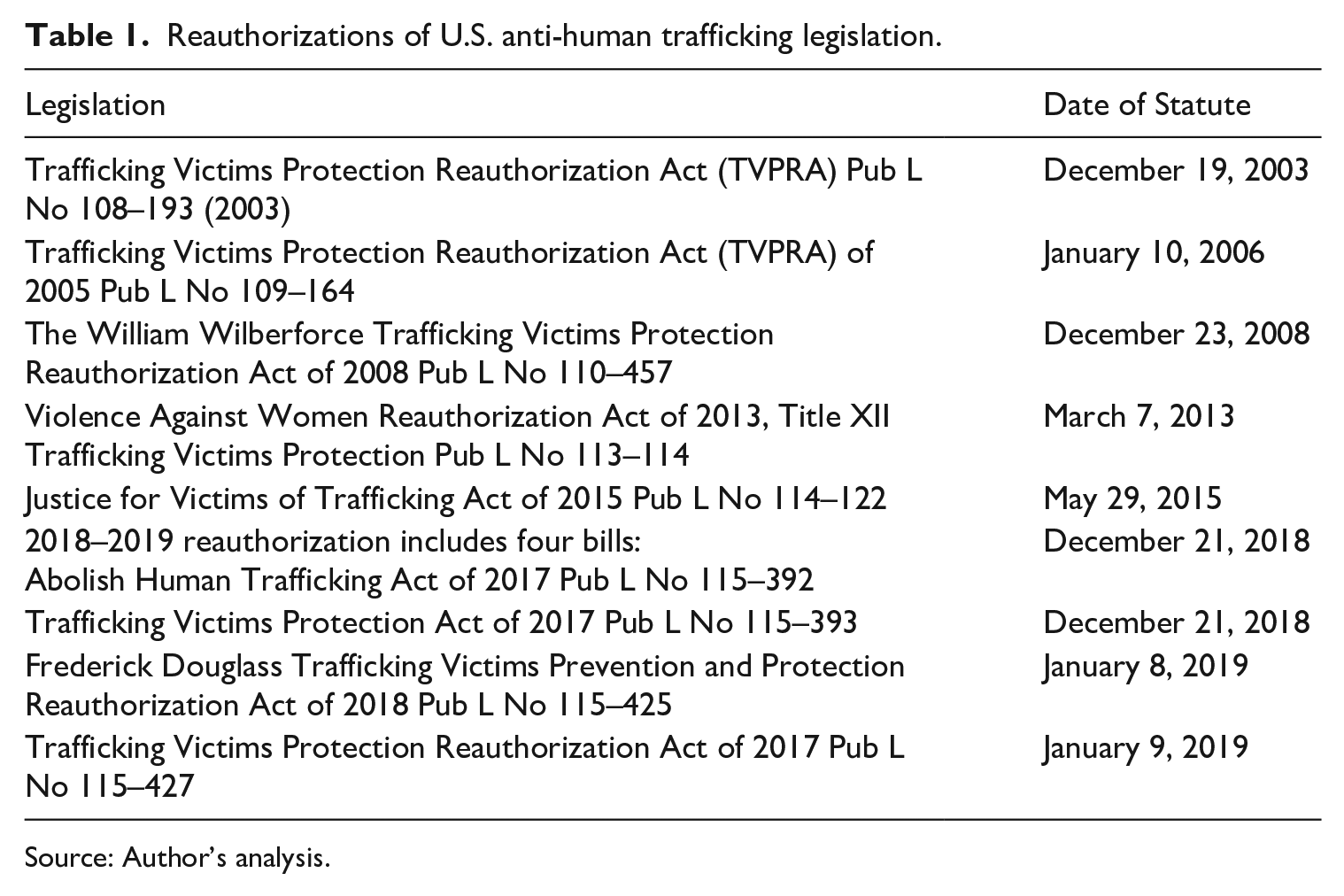
Source: Author’s analysis.
Reauthorization provides what political scientists have called “policy windows”—“an opportunity for advocates of proposals to push their pet solutions or push attention to their special problems.” These windows may open predictably or unpredictably (Kingdon, 1984: 165). By including language requiring reauthorization, congress, in effect, built predictable windows of opportunity for policy change into the TVPA.
Analysis of the reauthorization legislation identified four types of changes—programmatic funding to continue authorized programs, technical amendments to correct or clarify previously enacted provisions, expansion of legal tools to enhance the investigation and prosecution of traffickers, and substantive policy change. Among the substantive policy changes promulgated through the reauthorization process was the broadening of the definition of a victim of trafficking in persons to include domestic minor sex trafficking victims. The policy change is first evidenced in the 2008 reauthorization and expanded in subsequent reauthorizations, as will be discussed below.
Political context
Formal political institutions—executive and legislative branches—and NGOs played key roles in the broadening of the definition of trafficking victim in U.S. law. Understanding the respective roles and interactions in the trafficking policy arena is key to the analysis of the evolution of the definition of trafficking victim.
Congress and the president
The TVPA was passed by a congress controlled by Republicans in both the Senate and House of Representatives. Nevertheless, leaders of both parties were active in the development of the legislation―Senators Sam Brownback (Republican) and Paul Wellstone (Democrat) and Chris Smith (Republican) and Sam Gejdensen (Democrat) in the House. Bipartisan support for the TVPA was evidenced by its passage by a vote of 95 to 0/100 in the Senate and 371 to 1/435 in the House. President Bill Clinton, a Democrat, signed the bill into law on October 28, 2000 (Stolz, 2005, 2007b).
As shown in Table 2, reauthorizations of the TVPA occurred under different political conditions. 6
Congress and the president: reauthorization of trafficking victims protection act.
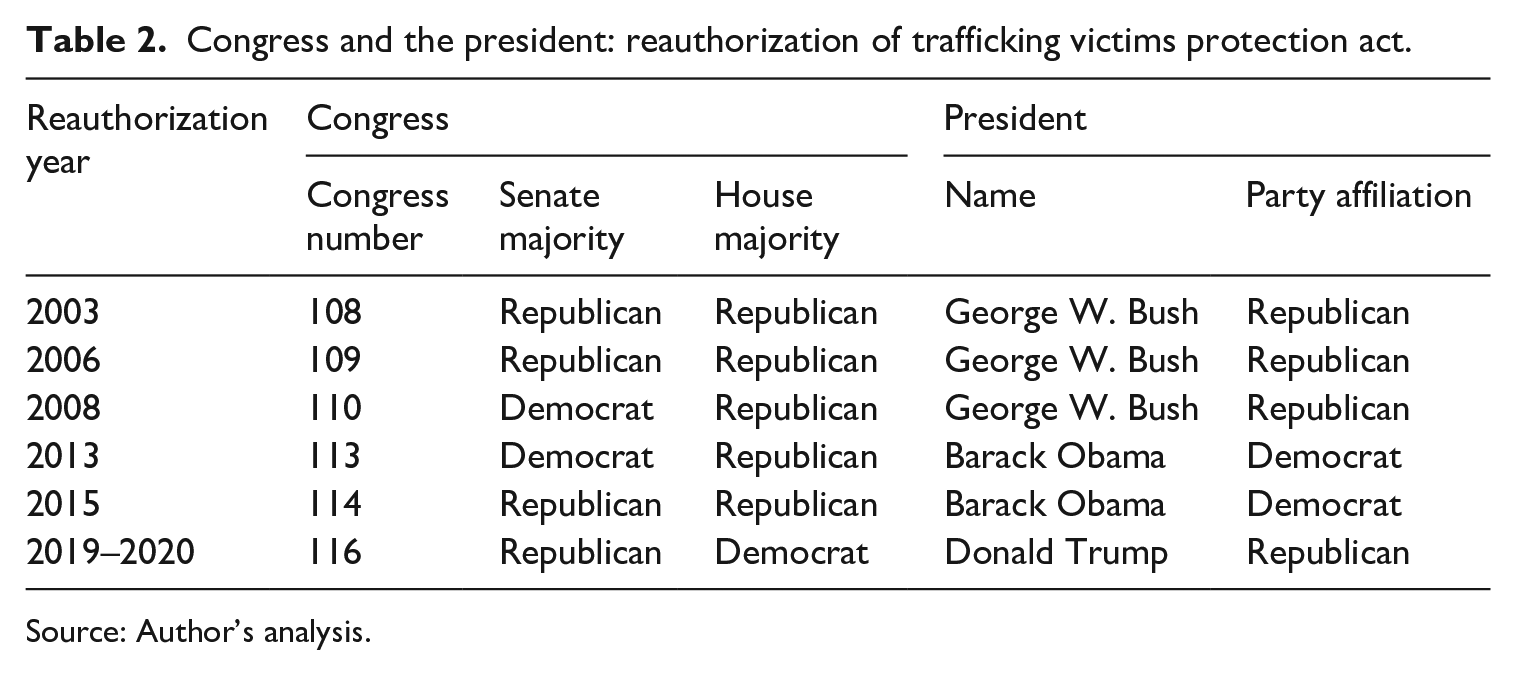
Source: Author’s analysis.
Differing views on particular aspects of anti-human trafficking, generally associated with one or the other political parties explain, in part, differences in policies promulgated in specific reauthorization legislation. Nevertheless, the repeated reauthorization of the TVPA, whatever the party in power in the White House or congress, indicates continued support for a federal role in combating human trafficking.
Perspectives and participants
NGOs or interest groups have been viewed as integral participants in U.S. political decision-making. The trafficking in the persons arena is no exception. Political scientists use terms such as “ironclad triangle,” subgovernment, or subsystem to describe ongoing relationships among interest groups and the formal policy making institutions (i.e. congressional committees and executive branch officials). Actors within a subsystem generally play different roles. For example, interest groups (NGOs) advocate policy positions and legislators process legislation, which often necessitates compromising on positions (Fritschler and Hoefler, 1996). Analysis of the case studies revealed two competing subsystems, reflecting the differing perspectives on trafficking among NGOs and their respective allies in congress and the executive branch.
NGOs from a wide range of policy arenas (e.g. human rights, legal rights, religious, and feminist organizations, and refugee service providers) and from across the political spectrum have sought to influence U.S. anti-human trafficking legislation (Stolz, 2005, 2007a, 2007b). Nevertheless, these organizations tend to cluster into two broad spheres of interest—the (1) anti-prostitution sphere and (2) anti-human trafficking sphere (Stolz, 2017). While recognizing that organizations in both spheres oppose human trafficking, differences in perspectives on three key aspects of trafficking policy—the victim, the crime, consent, and scope—distinguish the spheres, as shown in Table 3.
Perspectives on trafficking in persons: anti-prostitution and anti-human trafficking spheres.
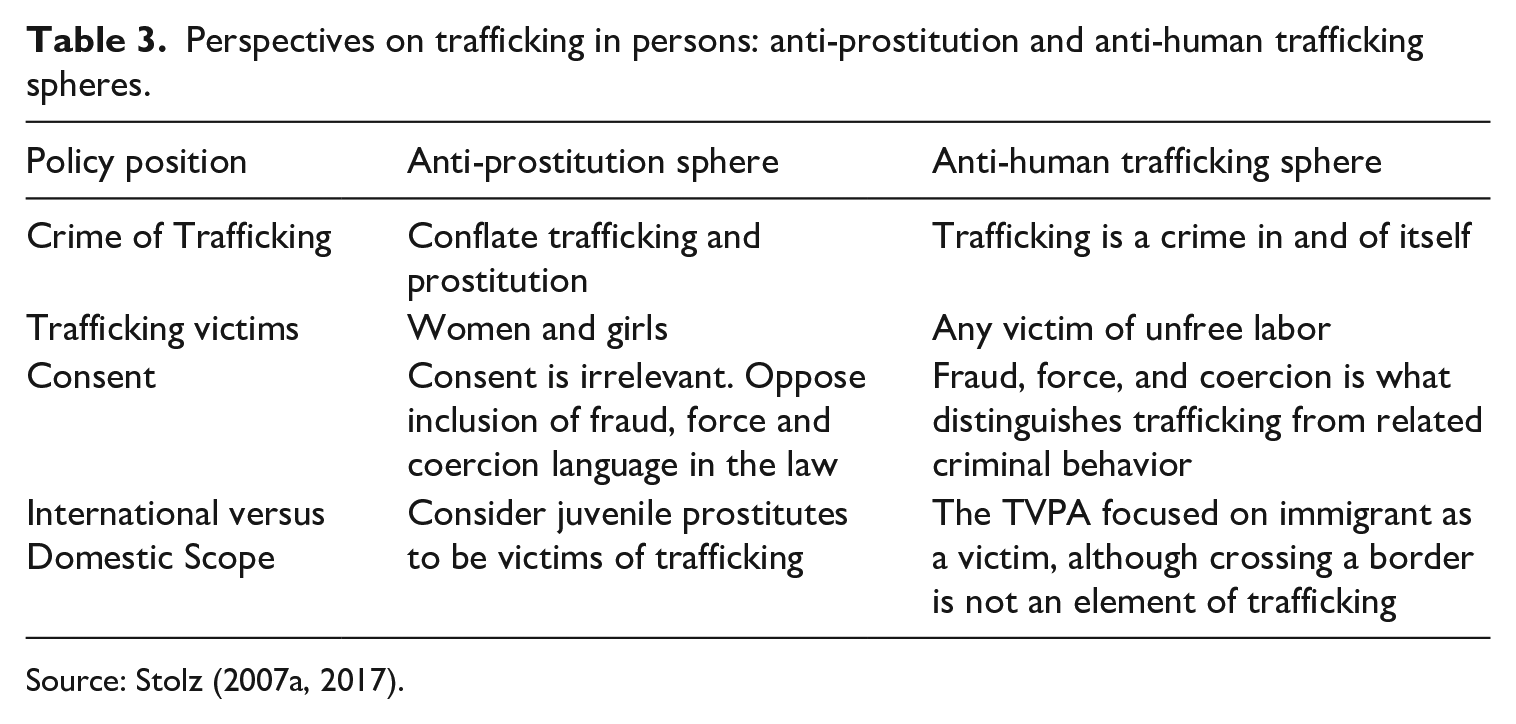
Source: Stolz (2007a, 2017).
At the crux of the differences between these two systems is the debate over the relationship between trafficking and prostitution (Adams et al., 2010; DeStefano, 2007; Doezema, 2000; Raymond, 2013; Stolz, 2005, 2007b, 2014) The anti-prostitution sphere comprises organizations holding the position that prostitution is inherently coercive and therefore falls under the definition of trafficking. In contrast, organizations comprising the anti-human trafficking sphere argue that conflating prostitution and trafficking would make prostitution a federal offense, and, unlike the Mann Act, would not require transportation across a state line to prove trafficking. These differences affected positions taken on specific policy proposals, sometimes making compromise difficult. 7
Over the 20-year history of the TVPA, both subsystems were active. Both perspectives are evidenced in the legislative proposals allied with members of congress and executive branch officials. The predominating perspective on trafficking in persons varied with the political party in power in the executive branch and congress. Changes in administration (e.g. from Clinton to Bush) affected which NGOs had access to the executive branch. Relationships among NGOs in each subsystem and their respective congressional supporters and staff were usually ongoing and along party lines. Nevertheless, some trafficking issues (e.g. conflating trafficking and prostitution, which was supported by some feminist groups and religious organizations) challenged usual party boundaries. These complexities, notwithstanding, the concept of subsystems enhance the analysis that follows.
Who is a victim of trafficking in persons?: Evolving definition and changing image in U.S. law
An analysis of the TVPA and its subsequent reauthorizations reveals the broadening of the definition of victim of trafficking in persons to encompass not only the foreign-born but also domestic minor sex trafficking victims. While maintaining the fundamental elements of the original operational definition of victim of trafficking in persons, the legislative changes altered the image of the trafficking victim conveyed by the law. Legislative changes, however, may take time to implement or may not affect practice. A review of selected research and educational materials, developed subsequent to the legislative changes, provides evidence of the implementation of the legislative policy change. Accordingly, both legislatively and in practice the image of the trafficking victim has evolved.
TVPA: The original image of the victim
As passed in 2000, the TVPA established the fundamental elements of the definition of victim of trafficking in persons. The TVPA defined those found to be trafficked as victims, although their behavior might be criminal; distinguished between trafficking for sex and labor; established operative definitions for the severe forms of sex and labor trafficking for purposes of prosecuting trafficking crimes; and provided a range of programs for those found to be victims of trafficking. Any man, women, or child determined to have been trafficked was to be considered a victim, not an offender. The primary consideration was the status of the individual as trafficked, not any related criminal behavior (e.g. prostitution or illegal entry into the country).
Specifically, with respect to trafficking for sex, the TVPA established the severe form of trafficking for sex as the operative definition, filling in the gaps existing in law (e.g. illegal transportation of any woman or girl across state lines for immoral purposes offenses) and, thereby, enhancing the prospects for prosecuting traffickers. The severe form of trafficking for sex is sex trafficking in which a commercial sex act is induced by “force, fraud, or coercion” or in which the person induced to perform such acts has not attained 18 years of age. That is, to be considered as trafficking for sex, the law requires the presence of conditions of “force, fraud, or coercion (physical or psychological)” except for underage victims (Stolz, 2007a: 320).
The image of the trafficking victim conveyed by the TVPA was foreign-born children and adults. The legislation did not address domestic trafficking victims (e.g. domestic minor sex trafficking victims) (Kittling, 2006), although crossing an internal or national border was not required (Bales, 1999; Barry, 1979; Outshoorn, 2004; Stolz, 2005). Further underscoring the international focus of the TVPA was the (1) establishment of an office in the State Department to monitor and combat trafficking, (2) creation of special T-Visa to protect victims of trafficking from removal, and (3) requirement that U.S. diplomatic missions in countries receiving U.S. economic aid collect information describing the nature and extent of severe forms of trafficking. (Stolz, 2007a: 320; U.S. DOJ, 2006: 17–22; U.S. GAO, 2007: 9) The underlying assumption was that the TVPA was created to provide services and benefits to undocumented victims who might otherwise be simply deported, while citizens and other lawful residents had access to state and local programs (Goździak, 2020).
In short, as defined in the TVPA, trafficking in persons was a problem brought into the United States, not a domestic problem indigenous to the country. This message was modified by changes enacted in subsequent reauthorizations.
Expanding the definition of victim in reauthorization legislation
Within the recurring debate over the relationship between trafficking and prostitution, described above (DeStefano, 2007; Doezema, 2000; Stolz, 2005, 2007b, 2014), domestic juveniles engaged in prostitution were the so-called “low hanging fruit” (Goździak, 2020). The 2003 and 2006 TVPA reauthorizations did not include provisions protecting domestic minor sex trafficking victims (Kittling, 2006). Nevertheless, by 2005, some human rights advocates had expanded their definition of victims of trafficking beyond immigrants to include U.S. citizens and residents traveling within the nation’s borders as forced laborers, invariably young people and children used for sex (DeStefano, 2007: 12). The widening of the definition of the trafficking victim to include the domestic juvenile is evidenced in the 2008 reauthorization.
The 2008 reauthorization directed the secretary of health and human services (HHS) and Attorney General, in consultation with the secretary of labor, to establish a program to assist U.S. citizens and permanent residents who were victims of severe forms of trafficking. NGOs that provide services to such victims were to be consulted. In addition, the program was to facilitate communication between the providers of services to these victims, provide a means to identify such providers, and make referrals to programs for which such victims were already eligible. The legislation also authorized appropriation funds for fiscal years 2008 through 2011 to carry out the program.
For purposes of the analysis that follows, it is important to underscore that proposals to expand the definition of sex trafficking to encompass prostitution were considered but failed to pass during the 2008 reauthorization process. For example, one proposed provision would have, in effect, federalized pandering-, pimping-, and prostitution-related offenses. The provision reflected the position of the anti-prostitution sphere that consent is irrelevant to a victim of trafficking; the Department of Justice opposed the change. The 2008 legislation did, however, ensure assistance for all victims of trafficking in persons including U.S. citizens and lawful permanent residents (Stolz, 2017).
The 2013 reauthorization addressed the domestic minor sex trafficking of children for the first time (Roby and Vincent, 2017: 203). The legislation no longer limited the category of child trafficking victims to foreign-born minors but included domestic trafficking victims, explicitly providing assistance for domestic minor sex trafficking victims. A minor victim of sex trafficking is defined as an individual (A) younger than 18 years of age and victim of an offense, described in section 1591(a) of title 18 of the U.S. Code or comparable state law, or (B) not younger than 18 years of age nor older than 20 years of age. The act established a grant program to develop, expand, and strengthen assistance programs for certain persons subject to trafficking. Four block grants to combat the sex trafficking of minors were to be awarded to entities in different regions of the country by the Assistant Attorney General for the Office of Justice Programs, in consultation with the Assistant HHS secretary for children and families. The authorization was for fiscal years 2014 through 2017, with a sunset provision after 4 years. The act also mandated the promulgation of model state criminal law protections for child trafficking victims and survivors, which states could adopt to protect children exploited through prostitution. 8
Entities, eligible to receive the grants under the 2013 legislation, included a state or local unit of government that had significant criminal activity involving sex trafficking of minors and in addressing sex trafficking of minors. The amount of each grant, which was for a period of 1 year, was to be for not less than $1.5 million and not greater than $2 million dollars, with the possibility of renewal for up to 3, 1 year periods. Authorized activities directed to minor victims of sex trafficking included providing residential care, 24-hour emergency social services responses, case management services, mental health counseling, specialized training for providers, deterrence and prevention outreach and education programs, and treatment programs.
Subsequent reauthorizations from 2015 through 2020, included provisions to further the response to child sex trafficking. For example, the 2015 legislation established a domestic trafficking victims fund to award grants to states and localities to provide protection and assistance for victims of trafficking, develop and implement child abuse and prosecution programs, and provide services for victims of child pornography. In 2019, reauthorization legislation included grants to local educational agencies, in partnership with nonprofit nongovernmental agencies, to educate school staff to recognize and provide information to avoid becoming victims of sex and labor trafficking. In awarding grants, priority was to be given to “high-intensity child sex trafficking areas.” 9
As has generally been the case in addressing trafficking in persons, the federal government led efforts to address the domestic sex trafficking of minors. Essential to this effort is the decriminalization of commercial sex by minors and providing criminal immunity and the extension of services to these victims. States have differed in their approaches (See, for example, Roby and Vincent, 2017). The purpose of this article is to demonstrate that incremental modifications of the TVPA changed the face of the victim of trafficking in persons from the foreign-born to encompass domestic minor sex trafficking victims.
Implementation of the expanding legislative definition of trafficking victim: Evidence of the changing image, in practice
As noted above, legislative changes are not always evidenced in practice. That incremental changes to the TVPA transformed the image of the victim of human trafficking, not only legislatively but in practice, is supported by the findings of subsequent research and Office for Victims of Crime (OVC) 10 educational materials directed toward raising public awareness of trafficking. Once profiled by law enforcement as juvenile offenders, with widespread attention to human trafficking and enactment of federal and state legislation, these youth may now be viewed provisionally as potential minor victims of sex trafficking (Kotrla, 2010: 184; Musto, 2013: 258). Determining the number of domestic minor victims of trafficking is a challenge, subject to many of the same obstacles associated with the identification of foreign-born trafficking victims (e.g. not identifying as victim or distrust of law enforcement) (Goździak, 2020: 4–5: Kotrla, 2010: 182; Roby and Vincent, 2017: 202). Nevertheless, qualitative research underscores a shift of focus to domestic victims by law enforcement and service providers (e.g. Goździak, 2020).
For further evidence of the implementation of the expanded definition of trafficking victim, the reader need only visit the OVC website, specifically its video series, “Faces of Human Trafficking” (U.S. DOJ, 2024). The series is to be used for the outreach and education efforts of service providers, law enforcement, prosecutors, and others in the community. It provides information about sex and labor trafficking, multidisciplinary approaches to serving victims of human trafficking, effective victim services, victims’ legal needs, and voices of survivors. The videos present the diverse faces of today’s victims of trafficking in persons.
Analysis: Disjointed incrementalism and criminal justice policymaking
To demonstrate that criminal justice policy making, in practice, is evolutionary, the disjointed incrementalism framework was used to analyze the broadening of the definition of a victim of trafficking in persons in U.S. law to encompass not only foreign-born victims but also domestic minor sex trafficking victims. The analysis reveals that the policy change promulgated through the reauthorizations of TVPA was (1) incrementally different from status quo; 11 (2) focused on remedies to ills; (3) pragmatic and concrete, intertwined with policy goals; (4) a product of trials, errors, and revised trials; and (5) involved multiple participants. This analysis has implications for the further study of criminal justice policy making and strategizing future policy change in the United States, transnationally, and internationally.
Disjointed incrementalism and expanding the definition of the victim of trafficking in persons
Incremental policy change
Expanding the definition of trafficking victim to encompass domestic minor sex trafficking through reauthorizations of the TVPA, incrementally broadened the definition of trafficking victim by including additional populations. Although eliminating the Mann Act limitation requiring the crossing of a state line and allowing for the treatment of domestic minors as victims not delinquents, the legislative change did not remove the “force, fraud, and coercion” language in the TVPA. The operational definition of the severe form of trafficking for those over 18, which required the presence of conditions of “force, fraud, or coercion” remained. Accordingly, the legislative change did not alter the federal role and responsibilities with respect to prostitution, as it did not conflate prostitution and trafficking. Nevertheless, including domestic minor sex trafficking victims changed the image of the trafficking victim to include both foreign-born and domestic persons—an evolution of the definition of trafficking victim.
Remedies for ills
Encompassing domestic minor sex trafficking victims under the definition of trafficking victim can be characterized as remedying an ill by filling gaps in existing law. Defining these domestic minors as victims remedied an ill by eliminating the Mann Act restrictions and treating these children as victims not delinquents. Traditionally, such children were treated as offenders or juvenile delinquents under state law and committed to facilities housing juveniles who had committed criminal acts. As trafficking victims, this population, by definition, would be distinguished from youthful offenders and that distinction would affect how they were to be treated by the justice system. It should be noted that, while addressing an ill experienced by some victims, the expansion of the definition of trafficking victim to encompass domestic minor sex trafficking victims did not remedy the ill—the more encompassing gap in the TVPA—perceived by those advocating the conflating of trafficking and prostitution.
Pragmatic and concrete policies
Typically, achieving political agreements is easier when the policy proposed is pragmatic and concrete rather than ideological. Providing assistance to domestic minors as sex trafficking victims presented a policy change that could be accepted by organizations comprising both the anti-prostitution and anti-human trafficking spheres. The victims were children, their treatment as trafficking victims did not substantively change the definition of trafficking by conflating trafficking and prostitution, and providing assistance was a pragmatic and concrete response to the problem of sexually abused minors. Since the “force, fraud, and coercion” language in the law remained unchanged, ideological conflicts among participants over the relationship between prostitution and trafficking were avoided. The assistance, which was to be provided through federal grants, was concrete and did not require direct federal involvement in the treatment of domestic juveniles. Accordingly, this policy change could be expected to garner support across ideological differences.
Trials, errors, and revised trials
The process of reauthorization can be one of trials, errors, and revised trials, allowing more than one bite at the apple. Technical amendments are clearly responses to identified errors. Substantive proposals may address errors in existing law, for example, by filling gaps or expanding policy into new areas. Given the failure of efforts to broaden the definition of sex trafficking by conflating prostitution and trafficking, it can be argued that the successful expansion of the definition to encompass domestic minors, which did not require changes to the “force, fraud, and coercion” language, was a product of trial and error.
Furthermore, recognizing domestic minors sex trafficking victims as victims remedied an ill, an error in existing law, as discussed above. Encompassing the treatment of these juveniles under federal law, however, extended the federal enforcement role into the juvenile justice area, a responsibility that had generally been relinquished by the federal government and left to states and localities. This extension of the federal role raises potential implementation issues and, therefore, could involve identifying and addressing errors and revised trials (e.g. future amendments). That, however, is a topic for another article.
Multiple participants
Described in this article as the anti-prostitution and anti-human trafficking spheres, multiple participants were involved in the policy making process leading to the enactment of TVPA. These subsystems (including presidents, executive branch agencies, members of congress, and NGOs holding different perspectives on trafficking) continued to impact subsequent reauthorizations. For example, subsequent to the passage of the TVPA in 2000, participants comprising the anti-prostitution sphere continued to advocate for legislative changes (e.g. deleting the force, fraud, and coercion requirement) that would conflate trafficking and prostitution. Despite alliances between NGOs and policy-makers, roles differ. NGOs typically seek to promote their values and goals. In contrast, policy-makers seek to pass legislation, which often requires compromise. Consequently, the latter typically focus on concrete policies and the pragmatic questions of what is enactable and what is enforceable. The expansion of the definition of a trafficking victim reflects the confluence of these competing interests.
Implications for future U.S. and transnational policy analysis and practice
The preceding analysis of the broadening of the U.S. definition of a victim of trafficking in persons to encompass domestic minor sex trafficking victims, using a disjointed incremental framework, affirms the premise that criminal justice policy may not be the result of a single decision but evolves over time. Although the observations presented advance both our understanding of U.S. anti-human trafficking policy and criminal justice policy making, generally, the article should be considered as an initial study. Drawing from the preceding analysis, this section explores how the disjointed incrementalism framework might be applied to the study and practice of criminal justice policy making within and beyond U.S. borders.
Additional research
Following on the current study, a logical next step would be to apply the framework to the analysis of other aspects of U.S. trafficking in persons policy. For example, beginning in 2004, TVPA reauthorizations federally funded state- and local-level anti-trafficking enforcement task forces to enhance the involvement of state and local governments in U.S. anti-human trafficking efforts (U.S. Department of Justice, Bureau of Justice Assistance (U.S. DOJ) Fiscal Year 2016–2018: 1; U.S. GAO 2007). As they reinforced the traditional criminal justice roles of federal and state and local agencies, these task forces can be characterized as incremental change, and, therefore studied using a disjointed incremental framework. Another potentially fertile topic to explore using the framework is the recent efforts to broaden the legal definition of trafficking by recasting all forced labor as trafficking and labeling all trafficking as slavery—“exploitation creep” (Chuang, 2014). Beyond human trafficking, the framework might be used to analyze the evolution of U.S. criminal justice policy on drug control, gun control, juvenile justice, and organized crime at the federal, state, and local levels. A compilation of such studies should substantially enhance our understanding of U.S. criminal justice policy making and the effect of the process on the resulting policies.
The contribution of the disjointed incrementalism to the analysis of criminal justice policy making is not limited to the United States. Given that the framework focuses on the analysis of the policy making process and is not restricted to particular political structures, it may be used to analyze criminal justice policy making in different political contexts, even transnational and international policy arenas. Studies of the evolution of international anti-trafficking laws and instruments to combat trafficking offer a starting point for such analysis (e.g. Gallagher, 2010; Scarpa, 2008). International, transnational, and national efforts to combat emerging crimes (e.g. cybercrime and crimes perpetrated using artificial intelligence), present opportunities for the application of the disjointed incremental framework, especially given the need to respond to rapidly changing technologies. In addition, applying a single framework to compare efforts across nations and organizations could provide important insights into the dynamics of crime-related information transfer across political boundaries and internationally.
Strategizing change
Recognizing the political realities of policy making not only enhances the analysis of what is but evokes the question of what might be. Although not part of Lindblom’s scheme, this author previously proposed disjointed incremental framework as a means to promote planned change by incorporating the concept of a “broad vision” to integrate incremental policy changes (Stolz, 1984). While not necessarily a “master” plan or strategy with a planned outcome, a “broad vision” could provide direction for the evolution of policy over time and the basis for integrating concrete incremental solutions to achieve more dramatic change (p. 56). Whether expanding the definition of trafficking victim to encompass domestic minor sex trafficking was part of the vision of some participants or simply the result of focusing on a few somewhat familiar policy alternatives would be difficult to prove. Nevertheless, having a broad vision of who is the trafficking victim could provide direction for further policy change.
Having a “broad vision” of what “good” comprehensive criminal justice policy is, may be an important consideration when developing future policies and attempting to influence national, transnational, or international criminal justice policy making, generally. Acknowledging that criminal justice policy making is usually incremental and evolutionary, and that the process allows more than one bite at the apple, a vision of the end-policy goal may facilitate efforts to influence the criminal justice policy making process over time. Criminal justice researchers could play a role in developing such a vision or visions.
Conclusion
The underlying premise of this article is that criminal justice policy, as public policy, is not the result of a single decision but evolves over time through the policy making process. Bearing in mind that the evolution of policy may not be linear but iterative due to changes in the political environment, the 20-year history of TVPA provided an excellent case study of policy making, in practice. Using a disjointed incrementalism framework to analyze the broadening of the definition of a victim of trafficking in persons in U.S. law to encompass not only the foreign-born but domestic minor sex trafficking victims, demonstrated that U.S. criminal justice policy making can be evolutionary. Given the efforts of many academics and researchers today, including criminologists and leading criminal justice organizations, to impact criminal justice policy making, understanding the actual practice of policy making is critical. The disjointed incrementalism framework is one tool that may be used to enhance that understanding. What is most important, however, is recognizing the need for further criminal justice policy making research that focuses on diverse international, transnational, and national arenas.
Footnotes
Declaration of Conflicting Interests
The author(s) declared no potential conflicts of interest with respect to the research, authorship, and/or publication of this article.
Funding
The author(s) received no financial support for the research, authorship, and/or publication of this article.
