




Abstract
This article explores the experiences and impact of long-term imprisonment on the lives of women sentenced to lengthy periods of incarceration (serving at least one sentence of 10 years or more) in the mid- to late-19th century in England and Wales. While most female offenders who were thought to warrant imprisonment in the Victorian period resulted then and today, in short prison sentences, this article focuses upon a smaller group of 41 women, who were subject to longer terms of penal servitude for serious or recidivist offending. This group was a combination of repeat property offenders, whose sentences got longer as they were multiply reconvicted, and those women committed under a long sentence for one serious act, usually of violence. Using ‘whole life’ history methodology, this article explores the offending and impact of imprisonment on these women’s lives, their experiences inside prison, and where possible their lives after release.
Introduction
This article explores the experiences and impact of serving a long sentence of imprisonment on the lives of women sentenced to at least one sentence of 10 years or more in mid- to late-19th century England and Wales. This article, therefore, focuses upon a small group of 41 women, subject to long terms of ‘penal servitude’ as it was then known, for serious or recidivist offending. This group was a combination of repeat property offenders, whose sentences got longer as they were multiply reconvicted, and women committed for one serious violent act. The latter included women who were sentenced to long periods for serious violence against their infants and children. While much has been written on the crime of infanticide and the ways in which such cases were dealt with by the law and in the court (see Arnot, 2000; Dixon, 2022; Higginbotham, 1989; Kilday, 2013; Ward, 2001), and women who were executed having been found guilty of serious offences, namely murder (Ballinger, 2000), there is less written about women who were reprieved, or given long sentences of imprisonment, after conviction for such offences.
The original Economic and Social Research Council-funded project, from which this sample of women is drawn, reconstructed the lives of 645 men and women sentenced to penal servitude, examining their imprisonment and their release on licence (early form of parole). In total, 288 of the 645 convict prisoners were women. Within the 288 female convict prisoners, there were 41 women serving long sentences, defined here as criminal history containing at least one 10-year penal servitude sentence, sampled for this discussion. This article will begin by contextualising the long-term prison system in Victorian England, before turning to the methodology employed here and then to the experiences and lives of these women in prison and after release. Women’s deviance or offending and the ways in which it is viewed cannot be ‘separated off from the study of how all women are defined and controlled in society’ (Gelsthorpe and Wright, 2015: 40). In Victorian society, views about womanhood and femininity were deeply embedded in middle-class notions of family and the home, women’s roles were defined through this lens as wives, mothers, primary carers and in the domestic sphere; this was reinforced through patriarchy and capitalism. Women’s criminality and deviance therefore were set against such prevailing norms as an aberration of femininity (Davidoff and Hall, 1994; Zedner, 1994). Today and historically, ‘women’s prisons are . . . filled with mainly poorer women, who, in one way or another, have been adjudged as beyond the control of the conventional (idealised) nuclear family’ (Carlen, 1988: 11).
Over half of the women in this study, were repeat property offenders, they were more likely to have long criminal careers, starting their offending earlier in their lives and desisting later. Women who committed serious violent acts were often one-off offenders, with no previous convictions. None of these women reoffended after release on their last licence or if they did reoffend (two minor cases), it was not at a level that would see them return to the long-term prison estate. However, all these women, through a combination of socio-economic circumstances, age and wider consequences of long and multiple periods in prison, were only partially able to ‘recover’ their lives and most continued in circumstances of precarity, not unlike those preceding their imprisonment.
This article examines the penal servitude experience and ‘whole life’ histories of these 41 women. Penal servitude was the long-term prison sentence given out by the courts in England and Wales between 1853 and 1948. This sentence was distinguished from prison sentences, which were less than 2 years in length, and were served in local prisons. The minimum term of penal servitude was 3 years 1 but those subject to it could be sentenced to life terms. It was the most severe sentence, short of death and was served in the convict prison system, a system of long-term prisons designed for this purpose, which developed from the early 1850s onwards.
Penal servitude and the female convict prison estate
Penal servitude had developed in the early 1850s as a response to the declining use of transportation to Australia. Initially enacted through the Penal Servitude Act 1853 and subsequently through 1857 and 1864 Acts of the same name, those serving penal servitude experienced a long-term sentence of three stages: first was a period separate confinement, women served this in Millbank prison, then they were removed to the ‘public works’ stage. In the early decades, women went to either Brixton convict prison (1853–1869) or to Parkhurst (1863–1869). By the 1870s, the female public works prisons used were Fulham and Woking. By the end of the century, the female convict prison population had dramatically declined and from 1891, Aylesbury prison was the only female convict prison, and this remained the case until the sentence was abolished in 1948 (Smith, 1962). The number of female convicts under sentence declined from around 1100–1200 in the late 1860s and throughout the 1870s to 753 by 1885 and further still to 358 in 1889 (Directors of Convict Prisons (now on DCP) Annual Reports, 1853–1894). Due to this decline, women were removed from Millbank prison in 1886 and from Fulham prison in 1888, leaving Woking prison as the only female convict prison. By 1892–1893, there were 245 women sentenced to penal servitude (DCP, 1853–1894) and the character of the population was also regarded as different, being largely made up of ‘older habitual criminals . . . [who] has fallen into evil ways seldom recovers her position’ (Griffiths, 1896: 134).
During their time in separate confinement or on the ‘public works’, each woman would pass through a system of ‘progressive stages’, these stages were denoted by time periods and marks were to be awarded for daily for labour (42 marks per day for 6 days a week), prisoners could gain small alterations in the regime as they passed through each stage (e.g. additional diet or letter home). Letters to friends or relatives were permitted, all prisoners were offered a standard form on their entry, this detailed their location and told the recipient when they would be allowed to write again and other rules about contact. They were able to write and receive letters every 6 months, then 4, then 3, then 2 months as they progressed through the sentence. Special letters could be granted, for example, in cases of bereavement or locating children. Convicts were similarly permitted visits, though the geographical location of the prisons in London and the South of England, prohibited many families from doing so (Johnston et al., 2022).
As punishments for breaching prison rules, prisoners could be put back stages, lose stage or remission marks (days off when they might be released), be confined to cell, placed on bread and water diet, placed in handcuffs or in a solitary punishment cell. Each day followed a strict timetable, prisoners rose at 6:00 a.m., consisting of labour, exercise, meals, time in chapel, until they were locked in their cells at 9:00 p.m. (DCP, 1853–1894: 93).
The final part of penal servitude was release on licence, introduced by Penal Servitude Act 1857. The licencing system proceeded in two ways; women could be released on a ‘conditional licence’, something male convicts were not subject to, in such cases, they were sent to a refuge. Usually, they spent 6 months to 9 months there (Johnston and Cox, 2020; Turner and Johnston, 2016); 200 of the 288 women were released initially to a refuge but they were only permitted to go once. Alternatively, they could be released on licence to be ‘at large’, like their male counterparts, and were subject to licence conditions, to report to the police in the district they arrived in and report changes of address. They were to refrain from crime, from associating with bad characters, habitual offenders and the like, and from leading an idle or dissolute life (Kimberley Commission, 1878–1879: xxii). Their licence could be revoked if they breached these conditions, or if they had no visible means of support, in such circumstances, they would be returned to prison, to complete their remainder of their original sentence and any additional periods for further offences. The aim of early release was to help convicts to reintegrate, to settle back with family or community. Both refuges and licencing were viewed as particularly important for women, refuges would teach them habits for employment on release and provide a reference. At the refuge, they could ‘be brought to restrain their tempers, to be quiet and orderly, civil, respectful, and cleanly, [. . .] no small progress on the road to better things’ (Jebb, 1857–1858: 57).
Methodology and materials
To give as much breadth and depth in understanding people’s experiences of penal servitude and their lives before and beyond prison, a ‘whole life history’ methodology was employed. This methodology uses record linkage through a range of archival material from ‘cradle to grave’ to illuminate detailed information about the women in our study. This approach has been employed to understand everyday and serious offending, as well as young people’s interactions with criminal justice historically (Godfrey et al., 2007, 2010, 2017) and to explore experiences of the long-term imprisonment (Johnston et al., 2022). Utilising such an approach allows insight beyond the offence they have been sentenced to, to observe other contact with the criminal justice system, the onset and the type of nature of offending, other sentences received and social circumstances outside prison (employment, family circumstances, relationships) and how these might have changed over time.
In creating the ‘whole life’ histories of the individual convict prisoners, we brought together a myriad of historical material to support the detailed information on each convict provided by the penal record and licencing documents from Prison Commission files (PCOM 3 and 4, National Archives (TNA) and partially available at https://www.ancestry.co.uk and https://www.findmypast.co.uk). We used the Home Office Criminal Registers, 1805-1892 (HO 26 and 27); Metropolitan Police Habitual Criminals Registers, 1881-1940 (MEPO 6); Old Bailey Proceedings Online, 1674-1913 database and Prison Registers (PCOM 6). The penal record information allowed for us to create a life grid for each individual which we then populated with personal and social data from; births, marriages and death indices, Census returns 1841–1911, employment and military records, newspaper reports (British Newspaper Archive; British Library Nineteenth Century Newspapers Online, The Times and Guardian digital archives), and other institutional records (notably, workhouses, asylums).
Female offending and penal servitude
The larger data set of 645 convict prisoners produced ‘whole life’ histories of 288 women; most women only ever served one sentence of penal servitude (sentenced to 5 years or 7 years) usually for larceny offences and were released on licence only once. The majority did not return, they did not breach their licence, or have it revoked, nor did they commit any further offences serious enough to warrant penal servitude later in their lives. Therefore, confirming patterns of offending in other studies; women were committed to long-term imprisonment, overwhelmingly for theft and only in the minority for serious interpersonal violence (D’Cruze and Jackson, 2009; Godfrey et al., 2005; Williams, 2013; Williams and Godfrey, 2020; Zedner, 1994). Most women who committed crimes in the Victorian period appeared in the lower courts and therefore experienced short terms (often days or weeks) in local prisons and never experienced this long-term estate (D’Cruze and Jackson, 2009; Di Méo, 2023; Johnston, 2015; Turner, 2011; Williams and Godfrey, 2016).
Most of the 288 women had previous convictions, usually for low-level summary offences, theft, or theft-related offences and sometimes for street disorder and drunkenness. We over-sampled the number of females to account for the difficulties in tracing women in historical records; maiden names can be difficult to find due to marriage, women adopted the names of men they co-habited with, and families, especially those from lower socio-economic groups, moved home more frequently. 2 A further challenge was first names as nearly half of the women in our sample (46.5%) were named Mary, Elizabeth (or Eliza), Sarah or Ann (or Annie).
Female serious offenders in prison
The sample of 41 women (see Table 1) who had committed serious offences which included at least one sentence of 10 years or more, shared similar characteristics to the larger female group but with some important distinctions. More than half, 22 of the women, were property offenders; 19 women having received 10 years’ penal servitude for larceny, two for receiving stolen goods and one for burglary. Sixteen women received sentences for serious violence: nine for murder or attempted murder, three for manslaughter, two for grievous bodily harm with intent and two for robbery with violence. The remaining three women were sentenced for fraudulent or dishonesty offences, namely uttering counterfeit coins (received 10 years), arson in attempt to defraud (received 15 years) and perjury (received 14 years). Overall, the average mean sentence was 11.85 years’ penal servitude (counting ‘life’ as a 20-year sentence). Eighteen of these 41 women only ever received one sentence of penal servitude and were released on licence only once; 15 served two penal servitude sentences and eight served three such sentences during their lives.
Number of female convict prisoners with at least one sentence above 10 years and offence.
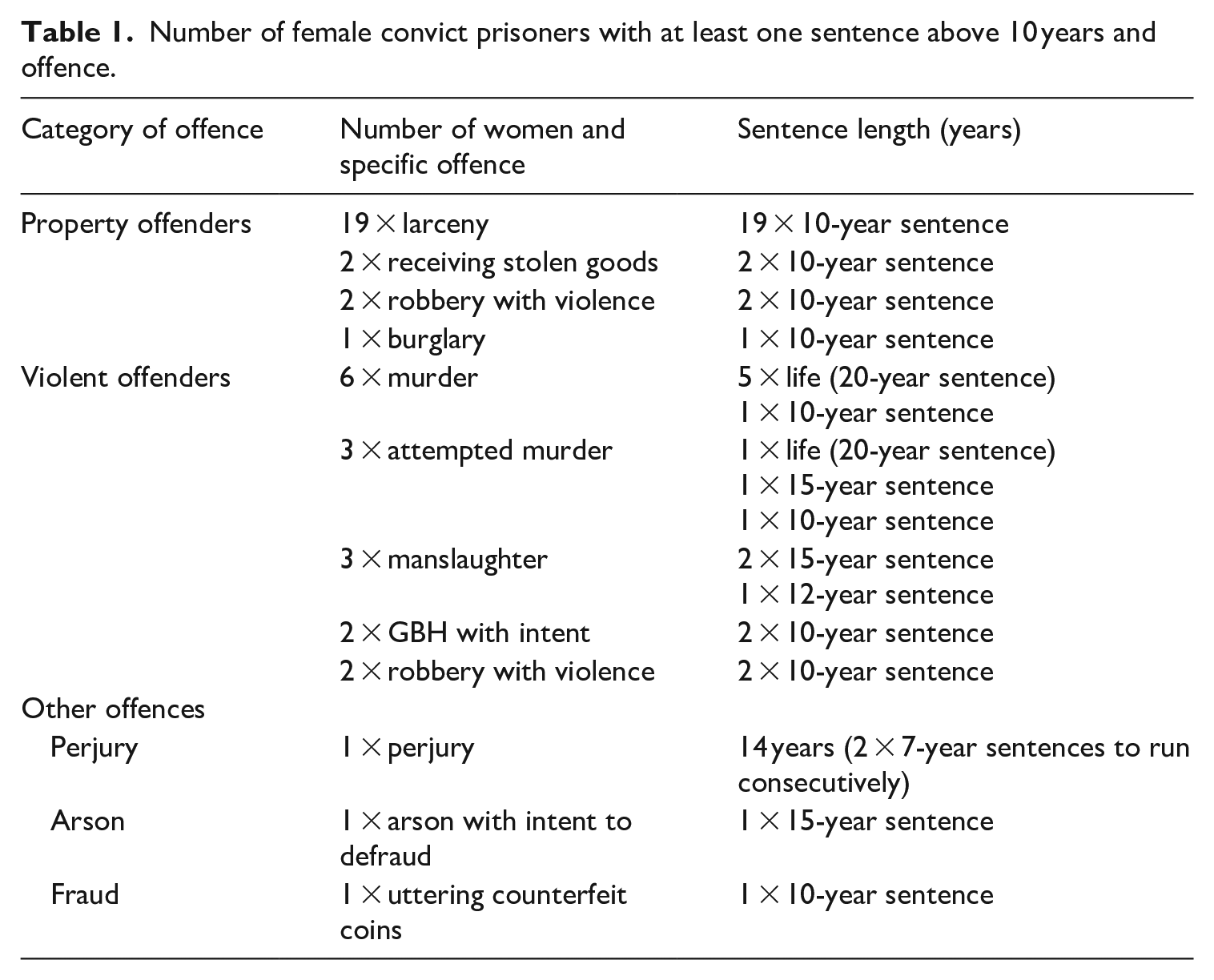
The average mean age of the women at the time of their conviction for last penal servitude sentence was 34.9 years, making them slightly older than the wider group and explaining why this group were also more likely to be married or widows and more likely to have had children. Of the 41 women, 21 were married, 12 were widows and only eight were recorded as single. This was compared to the wider sample of 288 women, where 41% were single, 40.3% were married and 17% were widows. Furthermore, 34 of the 41 women were mothers, 19 were judged to be mothers of dependent children. Seven of the women appear never to have had children or any children had died. The following discussion will examine the two dominant offence categories to explore women’s experiences in the criminal justice system and beyond, first property offenders and then women who had committed acts of serious violence.
The ‘persistent’ female property offenders
Research on female offending from the 18th to the 20th centuries has found that property offences, chiefly larceny to be the largest single category of offending and this appears to be the case across numerous jurisdictions (Beattie, 1975; D’Cruze and Jackson, 2009; Godfrey et al., 2005; Piper and Nagy, 2017; Van der Heijden, 2016; Williams, 2013; also see Van der Heijden et al., 2020). This remains the case in the 21st century (Baroness, 2007; Gelsthorpe and Wright, 2015; Moore and Scraton, 2016).
The female property offenders received their lengthy sentences for the theft of a whole range of different items but those commonly stolen in this period. They stole money, clothing, boots, money, bedding, watches and jewellery, household items, items to sell on or pawn, or for their own use. Mary Blake received 10 years’ penal servitude for stealing a pair of boots (PCOM 4/68/2), as did Mary Brannan (PCOM 4/68/15). Sarah Ann Kay (PCOM 4/67/25) and Mary Ann Graham (PCOM 4/67/21) were co-accused, both given 10 years’ for stealing 12 shillings from Robert Davies. These offenders, as the length of these terms suggests, were repeat offenders, all had previous convictions often for larceny. The women in the sample had 266 previous convictions between them, a mean average of 6.4 offences per women, when looking only at female property offenders, they had a mean average of 12.6 previous offences. As a group, they were more likely to have served short prison sentences and penal servitude before and were more likely to be multiple licence holders. Seventeen out of the 22 women were multiple licence holders (including one case of mixed offending), seven of these women had three licences and for 10 women this was their second licence.
The female property offenders were slightly younger at the age of their first conviction, a mean average 26 years old compared to the wider group of 27.1 years old. They were on mean average 33.6 years old at the beginning of their last penal servitude sentence. Thus, the onset of offending tended to be later, fitting with the recent criminological literature on the notion of late onset adult offending (Eggleston and Laub, 2002) or onset for females adulthood or middle age (Block et al., 2010) rather than in youth. Studies have also found onset of offending in adulthood more prevalent in females (Delisi, 2002 cited in Block et al., 2010). However, this sample is drawn from women serving penal servitude for serious offences; it might be the case that examining women in the Victorian local prisons system serving short sentences for less serious offences would give a different picture. The female property offenders had long criminal careers, the mean average 13.6 years committing offences between the age at first conviction and conviction for this offence. The earliest first conviction was estimated at 10 years old and the oldest first conviction was at 46 years old.
Women over the age of 30 years at the time of their first conviction, made up nine out of 22 of these cases and may well have been linked to their lifecycle (King, 1996). Social and familial circumstances outside prison had a material affect on their offending; lack of support and ability to subsist, especially for widows, left women vulnerable. In addition, as their criminal careers continued and spells in both short- and long-term imprisonment, may have cut away their relationships outside, led to difficulties with employment. Indeed, in the late-19th century, female recidivism generated a great deal of concern, notably in the lower courts and local prisons, where older women were frequently committed for drunkenness, alcohol-related offences and vagrancy (Turner, 2011).
Williams and Godfrey (2020) found that by the time women entered their 60s, the risk of institutionalisation increased (prison, workhouses, asylums), notably so for the workhouse. They argue that
penal, semi-penal, and voluntary institutions operated not in isolation, but as part of a cohesive whole, responding to and regulating women’s behaviour throughout their lives. While women might ‘vanish’ from one kind of institution, we do not have to look hard to find them ‘reappearing’ elsewhere. (Williams and Godfrey, 2020: 132)
Five of the 22 property offenders were above 50 years old at the time of their last conviction and at least five could be traced to a workhouse, asylum or similar shelter after release from this sentence (six out of the 41 women).
Maria Allen had a one of the longest criminal careers in property offending, though it did not begin until she was in her 40s (PCOM 4/72/8). In 1852 and 1854, she was convicted of larceny and served 6 months then 12 months’ imprisonment. On her third conviction in August 1856, she was sentenced to 4 years’ penal servitude. Maria was released from Fulham Refuge in August 1860 having completed her full sentence; early release on licence was not introduced until 1857. In April 1861, she was reconvicted and received 5 years’ penal servitude. She was released on licence 13 months early, at the end of February 1865.
Maria was recorded as a widow with two children, who worked as a needlewomen and dressmaker; when in 1867, she was once again convicted of larceny of clothing and sentenced to 7 years’ penal servitude. After serving 50 months of this sentence, she was removed to Battery House Refuge in November 1871 and subsequently released. Her freedom was short lived, as in December 1872, she was reconvicted of larceny from a dwelling place and sentenced to 7 years. She was released from Woking prison in 1880. However, only 1 month later, Maria was convicted again and received 10 years’ penal servitude for stealing a sheet. The Times newspaper stated, ‘the career of this woman had been remarkable . . . It was proved that she had actually spent more than 25 years in prison’ (15 July 1880).
On entering Millbank again, Maria declined the standard form for family contact. During earlier sentences, her next of kin is listed as, her sister in 1856, her daughter in 1862, her uncle in 1872, but by 1880 she cannot give any address. Now in her 70s, she spends 3 months in the infirmary due to debility. In February 1887, Maria was again released on licence, with 40 months of her sentence still to serve, she headed for the Discharged Prisoners Aid Society on Charing Cross Road, London intending to return to South London. She does not breach this licence and does not reoffend, but we lose track of her.
Serious violence by female offenders
Crimes of serious violence are rarely committed by women and this sample would support that claim. As D’Cruze and Jackson (2009) note ‘the gendered social contexts of women’s lives have often coloured the circumstances in which they have committed criminal violence’ (p. 47). In the wider sample of 288 women, only 34 had been convicted of major violence or sexual crimes, so serious violent crime was in the minority. In this sample of 41 women, 16 fell into the violence category (one property offender also had a previous conviction for manslaughter) and overall, there were 17 women who had no previous convictions, 14 of these were for one-off acts of serious violence.
Of these women, five were sentenced to penal servitude for life, four for the murder of their own child and one for the murder of her husband (all commuted death sentences). While murder was punishable by death until 1965, there were no women executed for infanticide from the 1840s onwards (Higginbotham, 1989). On average, these women served 11 years and 4 months. The longest period served was 17 years, in the case of Fanny Oliver who was convicted of murdering her husband in 1869 (PCOM 4/66/5). The shortest was Elizabeth Stacey who was convicted of newborn child murder in November 1880 and served 5 years and 7 months (PCOM 4/68/18).
Two other women convicted of murder were sentenced to 10 years’ penal servitude (one case a commuted death sentence) and two for attempted murder, one received 15 years, and the other 10. Three women were convicted of manslaughter, in two cases they received 15-year sentences, one for manslaughter of her male child, another for abuse and neglect that led to the death of her partner’s 5-year-old child. The third received 12 years for stabbing the man she was co-habiting with.
‘Shame and despair’: Serious violence towards infants and children
Of the women sentenced for serious violence against their own children or in one case their partner’s child – six were cases of newborn child murder or what would later become legally defined as infanticide (Infanticide Act 1922). In the other cases, the children were older, between two and five years old. 3 However, in all cases the women shared similar social and economic circumstances, compounded by illegitimacy.
Mary Jones, aged 19 years, was convicted of murder in 1859 at Surrey Assizes (PCOM 4/41/31). She was given a life sentence after the death penalty was commuted and her case reflects wider cases of infanticide of the period (Higginbotham, 1989; Kilday, 2013). Mary was young, unmarried, she had been ‘seduced and found herself in the family way’ and after giving birth alone, she had concealed the dead infant. Shortly after, the child was discovered with its throat cut; Mary claimed she had tried to cut the umbilical cord (Hampshire Advertiser and Salisbury Guardian, 2 April 1859).
Similarly, Edna Reed had given birth to an illegitimate child in the local workhouse. She may have entered the workhouse for birthing assistance, as her father and brother lived nearby, her mother had died 16 years earlier. A few weeks later, her brother collected her and took her home. When the child was 6 weeks old, Edna claimed she had arranged for a nurse to care for it, but a child’s body was found in the river and subsequently identified as her child. In court witnesses contested Edna’s treatment of the child, some claimed she did not feed it unless compelled to do so, but others said she had cared for the child properly. After release from prison, Edna returned to her father’s house, she had written to him regularly and to her brother during her imprisonment and they had visited her (PCOM 4/67/10). She did not commit any further offences, and 5 years after release she was still single, living with her father and they were both employed as upholsterers.
Caroline Goode was sentenced for attempted murder, after being accused of stirring poison (laudanum) into her infant’s food, while the carer’s attention was turned. Twenty-one-year-old Caroline was a servant, and she managed the care of her illegitimate child by leaving it with a nurse and visiting regularly. Caroline was a little disruptive in prison and was charged with a number of offences, mainly for being disorderly, refusing to work, destroying prison property, on one occasion she is placed in handcuffs for 18 hours and put on punishment diet (bread and water) (PCOM 4/42/12). She did write letters out but not as frequently as the other women. After her release, she returned to Birmingham and in the following decades, continued to work as a servant in the Handsworth area, remaining unmarried.
Sarah Jemmison and Mary Wright were both found guilty of murdering older children, aged around 3–5 years old, but their circumstances were similarly desperate – both had tried to manage their situation, Sarah had placed her child with a carer but had fallen behind with payments, leading to her increasingly desperation (PCOM 4/44/23). Mary feared she was pregnant a second time, and having had one illegitimate child already, was turned out of her father’s house. She tried to drown her 3-year-old daughter and herself but succeeded only in the former. Although a jury of matrons had said she was pregnant before the trial, when she entered Millbank prison in 1881, she was not (PCOM 4/72/7). She returned to her father’s house after release, she did not reoffend, neither did she marry or have any other children; she was occupied as a housekeeper or a domestic servant.
Lucy Lowe’s (or Ellis) case had some marked parallels. Lucy was already a mother, having had at least five children by the time of this case. The 1861 Census recorded her as a widow, aged 20, with a 3-day-old child. She remarried and had four daughters, but in 1876, her husband had left the family. Lucy found herself pregnant again and was subsequently convicted of having suffocated the 3-week-old child. The body had been hidden in a nearby plantation, where a local gamekeeper discovered it.
Initially, her young daughters were placed in the local workhouse. Lucy wrote regularly to her father, mother, and sister and they visited her in prison. During her time in prison, two of Lucy’s daughters, then in their mid-teens, died as did her father. She did not commit any prison offences, though she was once admonished for ‘talking in a loud and angry manner’. In early 1886, she petitioned for release, stating she had committed the crime ‘whilst in a state of madness, to which she was driven through excessive grief, shame and despair’ (PCOM 4/69/7). After release, in September 1886, Lucy returns to her home area, she does not remarry or have more children, she does not commit any further offences, and works as a domestic servant or housekeeper.
While, illegitimacy was important in the above cases, it was not the sole factor, as some of these women had had other children or had tried to manage their situation within limited means. As Higginbotham (1989) notes, the offences were occurred ‘at a time of immediate crisis’ (p. 334) . . . [and] reflected the vulnerability of Victorian women left to support infants or young children. No doubt the gravity of the index offences also produced guilt, regret, anger and affected women’s emotional wellbeing in prison (Crewe et al., 2017) and that was also the case for other women who committed serious violence.
As noted earlier, the literature on infanticide and child murder by mothers has often explored the motivations of such offences, the court trials and juries responses to such cases, as well as the use of expert evidence (Arnot, 2000; Dixon, 2022; Kilday, 2013). These cases of serious violence against infants and children by mothers give us a different insight into those who were found guilty, served long periods of incarceration and were released after. For all these women, these were one-off acts of violence, they often returned to the geographical area they were from, most to a parental home, they did not marry or remarry, or have any further children. It is difficult to know if the stigma of these offences followed them perhaps affecting their ability to form new relationships and may explain why they remained with those who knew them. They were more likely to be in employment than the wider group sample here, though sometimes this was within family setting or trade. Given that most would have been alone without that family support, they probably would have found survival financially very difficult otherwise.
Violent wives
Fanny Oliver, who was convicted of murder having poisoned her husband, frequently petitioned the Home Office contesting the events and claiming her innocence in the case (PCOM 4/66/5). In the initial period of custody, she appeared to be deeply distressed by what had occurred and is described as having ‘hysteria for 58 days’, as ‘low and desponding’ and was watched closely by staff. In subsequent years, she requested a ‘likeness’ of her husband, all such requests were declined. There are numerous examples how distress related to women’s behaviour in prison, as breaches of prison rules can be connected to letters received from outside or requests refused.
Elizabeth Chambers received a 10-year sentence for attacking her husband with vitriol. He received severe burns to the left of his face and while his sight was not affected, he did require an eye operation. They had been married for 9 years, but their relationship had been fractured for some time. At Worship Street police court, it was claimed that Elizabeth had become a ‘most dissolute character’ with ‘wasteful and intemperate habits’ selling all their furniture and causing Henry to lose part of his business (Morning Post, 4 February 1865). Henry claimed they had been living apart for 12 months, but that he had supported her financially until recently when he had lost his business. Elizabeth claimed Henry had been with other women, he had ‘put her in hospital’ twice, spent his time with gamblers and thieves, and was living with a ‘common prostitute’. The spark for this altercation had been Elizabeth’s admission to the workhouse for which Henry was summoned for her maintenance. Elizabeth’s mother, Margaret also testified to Henry’s ill-treatment stating, ‘he was most cruel creature to her that God ever created in beating and ill-using her’ and that Elizabeth had also spent 3 weeks in hospital after being badly burnt by the vitriol (Old Bailey Online, 1865, t18650227-313).
In other cases of violence, women were convicted of Grevious Bodily Harm and of robbery with violence. On the face of it, these women had more in common with the property offenders. Mary Ann Roberts was a prolific low-level offender, having been convicted 46 times for summary offences in Liverpool between 1867 and 1878. But in July 1879, she was convicted of wounding James Kavanagh, a police constable. There are few details of the exact injury, but the stipendiary magistrate took a disposition from the victim, regarding his condition as life threatening, but he subsequently improved. Mary was single, about 27 years old and a native of the city. Her removal to Millbank and then Woking does not deter her behaviour, and her disruptive life outside continues inside. She was regularly in trouble for breaching prison rules, notably for quarrelling, fighting, and assaulting other prisoners with some quite serious and violent incidents as well as regulatory offences like talking, singing, shouting, and breaking prison property that many women in prison fell foul of. Interesting, the medical officer at Woking, noted, in February 1880, that Mary was ‘very excitable and there cannot be a doubt that the extensive injury to the skull and brain makes her at times unreasonable’. Others described her as ‘irresponsible and dangerous’.
She did write letters, indicating connections outside, but at her release says she has no one to go to and requests a workhouse or hospital. Unsurprisingly, Mary lost remission time due to prison offences but was released to East End Refuge, 3 years and 4 months early in March 1886. She returned to the North-west and by 1891, is living with her brother and his family, she does not appear to reoffend and dies 5 years later.
Two women, Catherine Cain and Jane Galloway were sentenced to 10 years’ penal servitude for robbery with violence, they were a little younger, 21 and 28 years old and were co-defendants, neither had previous convictions. They were convicted with Bridget Coleman, all were described as married, at the Old Bailey trial in February 1864. The victim, George Neale, new to London and had spent the day drinking and was accosted by the women during the evening in the Drury Lane area. They assaulted him, cut his pockets, robbed him of 15 shillings and during the assault, a knife was used to cut the victim’s face. A local policeman testified the women were known to him and that they had regularly been in court though had not been convicted (Old Bailey Online, 1864, t18640201-259), this clearly went against them. Both were from London and were visited by family or friends, as well as corresponding by letter.
Both women were released on conditional licence to Battery House refuge during 1870. Jane was sent in April 1870, she had committed only one offence during her 6 years in prison, for which she had lost 2 days remission and been confined to her cell for ‘loud talking in her cell after 8 p.m.’. Catherine did not go to the refuge until September; she had lost 514 remission marks for a number of prison offences namely, destroying prison property, being disorderly and refusing to work.
Pathways in and out of penal servitude
If we measure recovery from imprisonment as avoidance of further offending, all the women in this sample recovered. Most of the property offenders recovered as they did not reoffend, but nearly half had a considerable criminal career before doing so, 10 women had criminal careers that lasted more than 15 years. As a group, the property offending women were much more difficult to trace beyond 5 years after release.
Feminist research on women’s pathways into crime suggested that factors like poverty, socio-economic circumstances, histories of violence and abuse and substance use are all prominent (Gelsthorpe and Wright, 2015; Petrillo, 2022). We cannot know everything about offenders’ lives historically from the records we have (Godfrey et al., 2010), for example, we might find evidence of marriage but nothing about the nature of that relationship. However, in the 41 cases here, there are women who had been previously convicted with partners or husbands, experienced physical abuse in relationships, had exhibited problems with alcohol and a few with low-level convictions relating to prostitution, which draws some parallels with contemporary research (Baroness, 2007; Gelsthorpe and Wright, 2015). Despite the lack of reoffending among these women many of these factors, poverty, precarity in living (housing, employment) continued into their lives beyond the prison sentence.
But what can we say about the gendered nature of women’s experiences of penal servitude in Victorian England. We know from contemporary research that outside relationships with family, friends, especially loss of relationships with children, can cause a considerable strain for women during long or life prison sentences (Crewe et al., 2017; Walker and Worrall, 2000). This research shows the deep-rooted and enduring character of such gendered experiences upon women during long-term imprisonment. Nineteen of the 41 women were judged to be mothers of dependent children, some children remained with their fathers or with the women’s mother or sister, but in at least eight cases, children were placed in either workhouses, industrial schools or similar institutions during their mother’s incarceration (see Johnston, 2019) and it is unclear if they were reunited. Such circumstances, as for women in the 21st century, caused considerable distress. Mary Brannan was sentenced to 7 years’ penal servitude in 1871 for larceny, on admission to Wakefield prison she was found to be pregnant and gave birth in November, unfortunately, the infant died within hours of the delivery. Mary was released from Finchley refuge in early 1876 but by July she had had her licence revoked. She was released on licence again in November, due to pregnancy. Yet by early December, Mary had been recommitted on a charge of stealing boots, for which she received this 10-year sentence. On her removal to Millbank, her child was sent to Sheffield workhouse. The Medical Officer noted that she had several times threatened to committed suicide on account of her child (PCOM 4/68/15).
Within the limits of the prison regime, women actively pursued their role as mothers, writing out to discover information about their children and family circumstances (Johnston, 2019) but similar to the women in Crewe et al.’s study, this was distressing; they were unable to influence their child’s circumstances and experienced long periods without seeing their children, left bereft of their maternal role. More broadly, any contact with the outside world was heavily constrained, not only by the regime – letters were permitted and visits permitted (see above) as the sentence progressed – but also by the location of women’s prisons in either London or the South of England, mirroring contemporary problems presented by the geography of the women’s prison estate (Baroness, 2007; Moore and Scraton, 2016). Many women lost touch with friends or other support outside, this was notable if they were repeat offenders, letters were frequently returned as ‘not known’ from communities where populations moved accommodation frequently.
The fear of loss and bereavement also featured prominently in Crewe et al.’s (2017) research, notably concern that family or relatives would lose touch or die while the women were in prison. This research shows that bereavement and loss of both children and family members was a significant reality for many of the 41 women here, both before and during their imprisonment. Twelve out of the 41 were widows entering prison for their last sentence, at least six had lost at least one child or family member during their incarceration, though many women had previously lost children in infancy. Loss in the form of bereavement was a reality for many women’s lives, reflecting also the socio-economic circumstances they found themselves in during their offending careers. Mary Blake’s penal record notes that she had had 10 children though only three were living and five of Maria Doran’s six children had died before this sentence.
Maria Cain was sentenced to two consecutive 7-year terms of penal servitude for two counts of wilful perjury in ‘conspiring to hang a man’ (Liverpool Mercury, 17 December 1875). Maria and five others (four women and a man, including the mother and brother of the deceased) were witnesses in a case against Jeremiah Cash accused of murdering Winifred McCabe. They testified that this was the case at both the coroner’s inquest and the Assizes. Maria, an Irish married woman with five children, was resident in the Scotland Road area of Liverpool. Criminal registers suggested that she had one previous conviction nearly a decade earlier, when she was convicted of wounding and received 12 months’ imprisonment, yet her penal record stated no previous convictions.
During her time in penal servitude, two of her children died, one of whom was a baby, this caused strain with her husband, who had been reluctant to inform her of the second loss, and she found out through another women’s committal to the prison (Johnston, 2019). However, they do resume their correspondence and remained married until Maria’s death in 1899. Maria repeatedly petitioned to get her sentences treated as one 10-year sentence, the Home Office finally agreed in 1882 and she was released on licence in December. Less than 4 months later, her licence was revoked after a conviction for larceny and 6-month prison sentence. Once she completed that prison term, she was returned to the convict system to serve out her penal servitude sentence. After her release in October 1886, she returned to Liverpool. She did not reoffend, and 5 years later, in 1891, Maria, Patrick and two of their children are living in Widnes with another family as lodgers.
Mary Jane Yendall (PCOM 4/64/17) was convicted of the manslaughter of her son, shortly after his birth. During the first year of her imprisonment, her ‘husband’ (court case stated the child was illegitimate) met with a serious accident and later died. Her father and her infant niece also died, and her daughter, Maude, who was cared for by Mary’s mother, was seriously ill for a time, but recovered.
At least half of the female property offenders were very difficult to trace beyond 5 years after release, two may have emigrated through Discharged Prisoner Aid Societies (penal records suggest that possibility), five certainly experienced the workhouse, asylum or women’s shelter in their later lives and at least three died within 5 years of release. As a group their post-prison experiences were more varied and precarious than those who had committed crimes of violence. Even where family connections existed there was no guarantee of support as relations may well have been long fractured. Martha Carter, had a long history of offending, released in 1871 on licence on 10-year sentence for stealing 14lbs of paper (PCOM 4/45/48), found herself in Crossland Workhouse and all three of her working sons were prosecuted for her non-maintenance, none of them appeared in court (Huddersfield Chronicle and West Yorkshire Advertiser, 1 November 1873). Martha died a year later.
Conclusion
Women who served long sentences within the Victorian convict prison system were largely drawn from two groups; property offenders who were multiply convicted, the sentences they received getting progressively longer, or women convicted for one-off acts of serious violence. Overall, they made up a small minority of the women who experienced penal servitude in the mid- to late-19th century, most of the women serving penal servitude did not commit offences with this level of severity or frequently that warranted long terms of incarceration of 10 years or beyond.
All the female offenders in this sample ‘recovered’, they did not commit further offences or return to long-term imprisonment. The property offenders had long criminal careers and repeated spells in prison saw them increasingly disconnected from their support networks outside (Condry et al., 2016). For these women, the aim was to ‘wear down repeat offenders, to watch over them constantly, to incapacitate them with long periods of imprisonment, weakening them physically and mentally’ (Godfrey et al., 2010: 196). As a result, this group was more difficult to trace beyond 5 years after release, no doubt reflecting their lifestyle before prison too.
Women who committed violent crimes, including those sentenced for crimes against infants or children, tended to return to the communities in which they previously lived and often they had good familial support during custody. Most had very regular contact with family, through letters and visits, and often they lived with parents or siblings, at least initially on their release. Most of these women never married or remarried, they did not have more children, though at least half were released when they were young enough to have probably still had that option. The older women’s choices would have been limited by the combination of the lengthy sentence and their reproductive cycle (Jewkes, 2005; Walker and Worrall, 2000). However, as a group they were easier to trace, and they were more likely to be employed post release and less likely to be in the workhouse than the property offenders.
Yet, for all these women their lives after release, despite no further evidence of criminality, continued to be precarious, most had had their roles as mothers and wives fractured, either before or during imprisonment and subsequently their lives continued to be dominated by poor socio-economic circumstances, the very factors that had often led to their offending in the first place.
As Crewe et al. (2017) note research on women’s experiences of long-term imprisonment remains relatively limited. This detailed study, reconstructing the lives of 41 women who experienced long-term prison sentences for serious or persistent offending in Victorian England, further adds an historical understanding to the character of women’s prison experiences since the mid-19th century. While this research is dependent on existent historical evidence and women’s voices are mediated through the prison and social records that exist about them, we can observe a number of long-standing significant and distinctive problems experienced by women (Crewe et al., 2017) and the entrenched and persistent nature of the gendered pains of incarceration.
Footnotes
Acknowledgements
Many thanks to the author’s collaborators on the originally funded project, Professor Barry Godfrey and Dr David J Cox and to the anonymous reviewers.
Declaration of Conflicting Interests
The author(s) declared no potential conflicts of interest with respect to the research, authorship, and/or publication of this article.
Funding
The author(s) disclosed receipt of the following financial support for the research, authorship, and/or publication of this article: This research was supported by the Economic and Social Research Council [ES/I028889/1].
