



Abstract
As television production becomes increasingly global, television studies must advance its understanding of how the global and the local intersect and impact upon the cultures of production. Drawing on original comparative research of three small European nations – Denmark, Ireland and Wales – this article offers empirical insights into the distinct challenges and opportunities for non-Anglophone producers and public service broadcasters (PSBs). The concept of small nations is employed critically to reveal how distinctions of scale and power make a tangible difference to how television is produced and distributed, and to how smaller, national PSBs are trying to secure a sustainable future.
This article expands scholarly understanding of the cultures of television production. Large organisations like the BBC loom large in both industry and academic debates about creative production and European models of public service broadcasting (PSB). While there are a number of generic challenges facing all publicly funded broadcasters, this research provides a view from within broadcasters who all work in a non-Anglophone context but who must compete in a global market often dominated by English-language content and companies. In this article, scale frames the analysis providing critical insights into the unique challenges faced by smaller broadcasters and into the ways in which power is distributed, negotiated and leveraged within the television industry. This research addresses the following questions: What are some of the shared challenges that non-Anglophone broadcasters face when trying to satisfy diverse demands from domestic stakeholders and simultaneously secure their long-term sustainability? How does scale condition the strategic responses that these public service broadcasters (PSBs) have adopted?
The broadcasters in this study are all important players in their domestic markets with some access to international markets. DR (Danish Broadcasting Corporation) is the largest (and oldest) of the three and is the main PSB in Denmark. However, despite its size, it is still a relatively small media organisation compared to other national broadcasters such as the BBC (cf. the BBC employs 19,357 in its domestic services (BBC, 2017), while DR employs 2669). TG4, known as ‘Teilifís na Gaeilge’ before a rebranding campaign in 1999, is the principal Irish-language broadcaster and is positioned as Ireland’s fourth channel. S4C (Sianel Pedwar Cymru) is the United Kingdom’s only Welsh-language service but competes domestically with BBC, ITV and Channel 4. In terms of scale, it is notable that neither TG4 nor S4C is the largest PSB in their respective countries (see Table 1 below for a comparative overview of the three broadcasters).
Overview of the broadcasters.
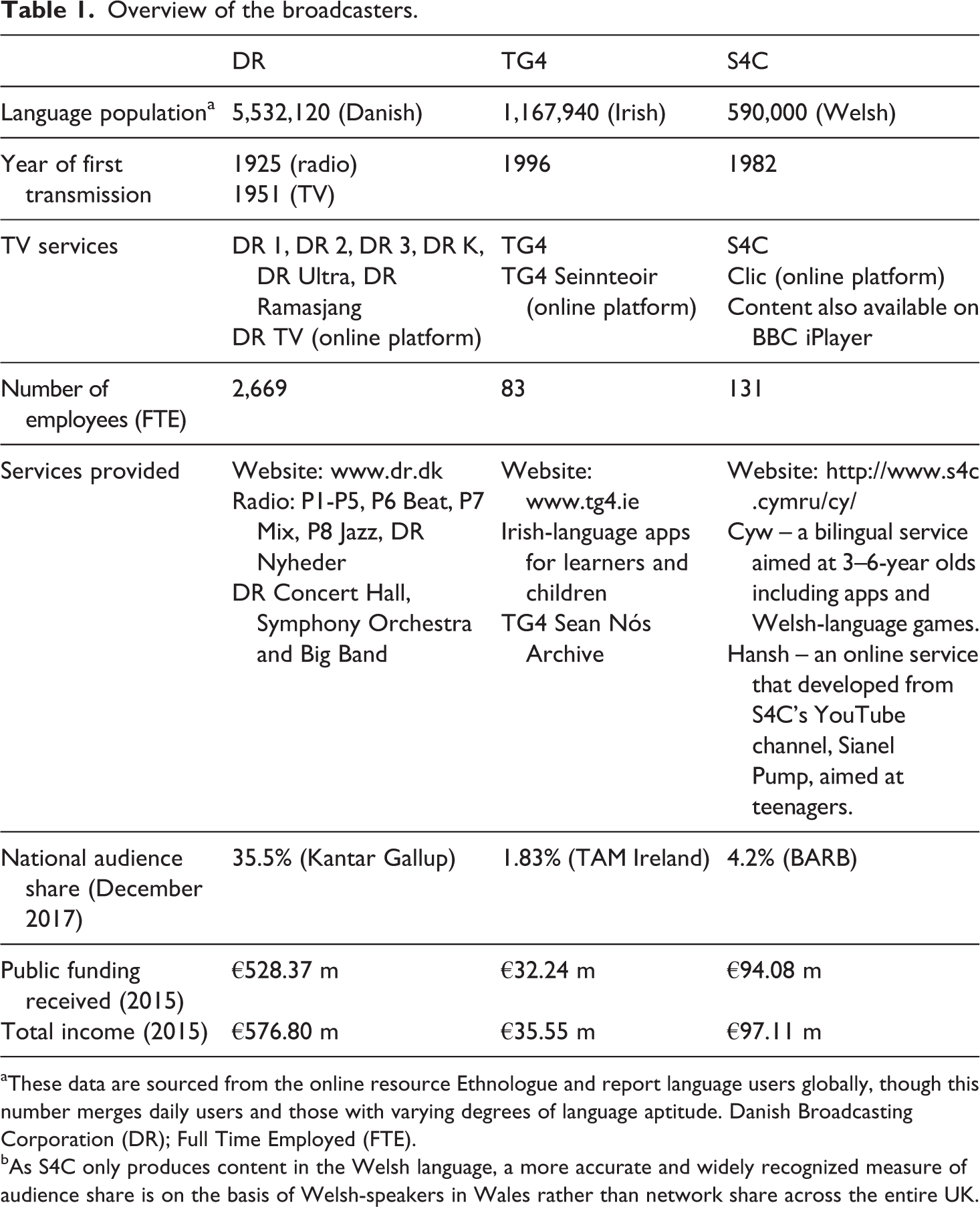
aThese data are sourced from the online resource Ethnologue and report language users globally, though this number merges daily users and those with varying degrees of language aptitude. Danish Broadcasting Corporation (DR); Full Time Employed (FTE).
bAs S4C only produces content in the Welsh language, a more accurate and widely recognized measure of audience share is on the basis of Welsh-speakers in Wales rather than network share across the entire UK.
The analysis also conceives of scale through the lens of nation. The nations that these broadcasters serve are regarded as small European nations. Here, small may refer to elements such as geographical size, population, Gross National Product (GNP) or political power, and, as a number of authors have argued, small nations continue to occupy an important place in the economic and political landscape (Hjort and Petrie, 2007; Iosifidis, 2007; Lowe and Nissen, 2011; McElroy, 2016). It is worth remembering that while globalisation and European Union (EU) integration have undoubtedly been features of the post-war European landscape, so too have regionalism and separatism, evident, for example, in the Catalan independence movement and Brexit.
This article begins with a brief introduction to the framework of small nations media production and then to the specific context of Denmark, Ireland and Wales. This comparative research seeks not to homogenise these nations nor to impose a singular small nations paradigm, but rather to locate the broadcasters in a wider political, economic and cultural landscape and thereby reveal some common and distinct challenges (Arriaza Ibarra et al., 2015; Brevini, 2013). The methodological basis for this research is outlined attending to the value of direct industry engagement in capturing the complexity of contemporary television cultures. The analysis focuses on three key challenges facing the PSBs in this study, including imposed changes to the scale and scope of smaller broadcasters, the substantial talent resources required in the changing television landscape and the need for sustained access to international markets.
The cultures of television production in small nations
Several theorists have argued for the enduring significance of nation states in a globalised TV ecology (Flew and Waisbord, 2015; Flew et al., 2016). This is not to deny the considerable force of globalisation nor the significance of internationalisation to the contemporary TV industry. However, these authors remind us that key elements of media policy, including questions of governance, funding, media law and international negotiations with supranational bodies (e.g. the EU), remain primarily determined by national systems.
Equally, public broadcasting structures and values often remain bound to region and nation (Holtz-Bacha, 2015). Even when content is made available across national borders, the remits of PSBs continue to emphasise responsibilities to national publics. Research by the EBU (2017), the alliance representing public service media, indicates that over half (56%) of the linear services provided by publicly funded broadcasters are targeted at local communities, with only 7% of services available internationally. That is not to say that the output of PSBs does not travel. Television professionals increasingly ‘work within a new cultural economy of production in which the capacity to export content (albeit often to culturally proximate screens) has become one of the most important measures of value’ (McElroy, 2016: 70). This includes PSBs who, on the one hand, must meet local demands and responsibilities sometimes associated with linguistic communities and, on the other, need to appeal to international stakeholders such as TV content buyers, distributors and platform providers in order to realise additional revenue at a time of widespread budget cuts.
There are specific structural characteristics facing small nations and their broadcasters, including a limited pool of licence fee income, advertising revenue and creative talent (Iosifidis, 2007). Budget cuts can be even more threatening if funding is already under pressure and in the context of small broadcasters can become disproportionately significant in their effect. These structural conditions mean small nations broadcasters and their markets have had to find alternative and distinctive strategies in order to compete (Lowe and Nissen, 2011), including finding innovative ways for content to enter into international markets (Jensen et al., 2016).
Small nations are not scaled down versions of larger states but have resources, challenges and strategies of their own. A pluralistic and sustainable media is vital to a nation’s capacity both to inform a democratic public sphere and to nurture the linguistic and cultural identities of citizens. The capacity of smaller PSBs to remain agile to opportunities and mobilise resources like creative skills, digital properties and new forms of data will be crucial to their sustainability. Therefore, like Hjort and Petrie (2007), we believe they warrant specific attention, as much can be learnt from their strategies. Further, there is value in comparative production studies that demonstrate how common forces such as neoliberalism and globalisation take shape differently in specific local contexts. To this end, this article continues by outlining some of the specific historical, political and market characteristics of the nations included in this study. The aim here is to position the sampled broadcasters in a wider context and the article concludes by examining some distinct and shared market conditions.
Denmark
Broadcasting in Denmark shares many characteristics with other Nordic countries. For instance, Syvertsen et al. (2014) outline the concept of ‘the Nordic media welfare state' as including a preference for durable, consensual solutions that involve cooperation between the main stakeholders (the state, media and communication industries and the public), support schemes to secure diversity and quality, and the organisation of communication services as public goods.
Danish television, in the form of DR, began as a public service monopoly in the 1950s. This monopoly was upheld until the late 1980s when state-owned TV 2 was introduced to ensure plurality in public service provision. Very quickly, TV 2 established itself as the market leader and today, DR and TV 2 hold an almost equal audience share. Combined, they account for three-quarters of television viewing in Denmark.
‘In the last decade, there have been only small adjustments to market share among the four main broadcasters and public service television retains its prominent position in this market enjoying a total share of 63% of all television viewing in 2016. However, there has been a drop in average daily television viewing from 2011, where it peaked at 3 hours 18 minutes, to 2 hours 38 minutes in 2016 (Mediernes udvikling i Danmark, 2017). While these levels are back to those seen in the period 1994–2008 (Medieudviklingen, 2008-9), the drop is accompanied by an increase in the use of streaming services, including both DR and TV 2's platforms, and international platforms offering localized services (e.g. Netflix and HBO Nordic).
While market share has been relatively stable in Denmark, changes to the funding and structure of the sector are evident. Historically, DR received funding through television/radio licences. The increased availability of online streaming led to the introduction of a media licence in 2007 charged to all households with television sets, computers, smartphones and other devices with internet access. More recently, a shift to tax funding has been proposed by interest groups and numerous politicians in parliament, as have drastic reductions to DR’s organisational scale (Bloch and Kildegaard, 2017) along with the proposed privatisation of TV 2 (Regeringsgrundlag, 2016).
Ireland
Ireland is one of the most open TV broadcasting markets in Europe with a large penetration of multichannel pay TV from overseas subsidiaries (e.g. Sky Ireland), which simultaneously increases competition for the purchase of content rights and takes advertising revenue out of the Irish market. The economic downturn in Ireland (2008–2013) severely impacted the market for television advertising with a 25% fall in revenue (Horwath, 2013). This reduction was keenly felt by the PSBs – RTÉ and TG4 – as both rely heavily on funding from advertising to supplement licence fee revenue.
However, there has been some economic recovery and today television continues to be a prominent element of the Irish media market. TAM Ireland (2017), the national agency for audience measurement, reports that in Ireland average daily TV viewing is 3 hours 13 minutes, up 5 minutes a day over the last decade, and 89% of consumption is live television. Assessment of the PSBs suggests they have weathered the economic downturn relatively well through extensive cost-cutting and expansion of their revenue streams (Horwath, 2013); however, the long-term sustainability of publicly funded broadcasting in Ireland remains a live question (Ramsey, 2018). In 2017, a report from the Committee on Communications (Oireachtas, 2017) declared that the current TV licence funding model was ‘not fit for purpose’ and recommended it be replaced by a broadcasting charge applied to every household consuming media regardless of the technology used, similar to the Danish funding model.
Also recommended within this report was the restoration of TG4 to ‘more sustainable funding levels’. Established in 1996, the broadcaster TG4 provides Irish-language content across many genres including live sport, children’s services and original drama. The majority of TG4’s resourcing comes from public funding, with the Irish government allocating funding of €32.79 m to the channel for 2017. Since 2009, TG4 has seen significant reductions in its funding with a reduction of almost €6 m (TG4, 2015). It is within this financial context that TG4 has delivered a total of 1751.5 hours (an average of 4.8 hours per day) of new/original Irish-language programming in 2014, 680 hours of which were commissioned from the independent sector (TG4, 2015).
Wales
Political devolution has had a profound effect on UK policymaking. In 1997, political powers were devolved from the UK government in Westminster (London) to the newly created national governments in Northern Ireland, Scotland and Wales. Each of these nations now has its own government with differing powers over policy areas such as education and health, but also business and culture. Crucially (and perhaps paradoxically), powers over broadcasting and media policy remain reserved to the Westminster government, meaning that major policy issues such as the funding of PSBs are not decided in Wales by the Welsh Government, creating a complex media policy environment (McElroy et al., 2017). This sharply differentiates the Welsh media policy environment from that in Ireland and Denmark.
However, the National Assembly for Wales does oversee some broadcasting matters and holds inquiries into market provision recognising the crucial role PSBs play in the democracy and knowledge of civic society, especially within a newly self-governing nation. This role is particularly pronounced in the context of Wales, which suffers from a weak indigenous press. Television is central to the Welsh media system, not least as Wales has the highest average television viewing per day (4 hours) across the United Kingdom’s four nations (Ofcom, 2017: 24).
Along with S4C, which operates as a publisher-broadcaster, the main PSBs in Wales are BBC Cymru Wales and ITV Wales, both of whom supply some programming to S4C. The BBC’s contribution in Wales has included its investment in drama production, for example, the internationally distributed series Doctor Who (2005–) and Sherlock (2010–2017). While this investment has undoubtedly raised the profile, ambition and capacity of the Welsh television production sector (McElroy and Noonan, 2016), significant questions remain about the levels of English-language programming commissioned by the BBC that reflect and portray Welsh society (CWLCC, 2017).
S4C is the only Welsh-language television service available in the United Kingdom. It is integral to the Welsh Government’s commitment to growing the number of Welsh speakers to one million by 2050. Until 2010, funding for S4C came principally through a direct grant from the UK government’s Department of Culture, Media and Sport (DCMS). However, in 2013 as part of the government’s spending review, this grant was cut and the responsibility for funding S4C was transferred to the BBC to be supported through the licence fee (McElroy et al., 2017). For S4C, this has meant a significant budget reduction of at least 36% in real terms since 2010. To offset some of these cuts, advertising, programme sales, sponsorship and merchandising have been used by the channel, raising £2.515 m during the 12-month period to 31 March 2016 (S4C, 2015: 100). An independent review of S4C was launched by DCMS in autumn 2017 looking at the broadcaster’s remit, governance, accountability, its partnership with the BBC and current funding methods (at the time of writing this review had not concluded).
There are distinct political, cultural and market differences between the three nations, and public broadcasting is still defined in nationally distinct ways. However, one can also observe some commonalities. Firstly, television retains its prominence in these markets. Although all the broadcasters report substantial changes to consumption patterns, particularly among young people, they still retain relatively sizeable audiences in this demographic and others. Second, they face considerable external competition compounded by the porousness of media borders. International streaming services like Netflix, YouTube and Amazon and pan-regional pay-TV groups like Sky and HBO Nordic are expanding their viewership and reach, though not equally in all nations. Simultaneously, Google and Facebook are taking large chunks of the domestic advertising market and redirecting it away from the country. Yet, for these broadcasters, their responsibilities to the cultural sustainability of their nation and its indigenous language remain significant. They provide institutional capacity to normalise non-Anglophone languages and promote diverse cultural identities within our media. These publicly funded broadcasters are central to providing the conditions in which a nation can thrive culturally, economically and politically.
Methodology
A robust future for the study of media industries does not require dogmatic adherence to a particular tradition or outlook so much as flexibility that matches research questions and research methods and draws from a vast toolkit of techniques for inquiry. (Lotz, 2015)
To understand cultures of production, television scholars need to think innovatively about methods and approaches, as much is to be gleaned from both formal data gathering and informal exchanges and interactions. To this end, the analysis in this article draws on two sources of data.
The first is empirical research carried out in Denmark, Ireland and Wales between 2012 and 2016 that entailed interviews with industry professionals from broadcasters (including S4C, DR and RTÉ), but also policy stakeholders and production companies across the three nations. This article draws on 25 individual interviews conducted independently by the authors and, while the themes were not synchronised between the researchers prior to conducting the research, in subsequent discussions we were struck by the similar challenges facing these broadcasters despite the particularities of their media systems and their respective position within them. We wanted to explore this further and to share these insights with other researchers and television professionals of small nations, thereby testing the validity of our observations in a shared forum.
Therefore, a second source of data was through exchanges gathered' to ‘a second source of data was gathered through exchanges gathered at an Arts and Humanities Research Council (AHRC)-funded international network on ‘Television in Small Nations’ (https://smallnationstv.org/), a collaborative project between the authors and industry partners including TG4, S4C and the European Broadcasting Union. The workshops, which took place during 2015–16, provided rich insights into both the common and distinct experiences of broadcasters who operate in particular cultural, linguistic and political contexts. The workshops allowed space for both formal presentations and informal discussion and were recorded and transcribed with the permission of those in attendance (of which there were approximately 63 participants from 12 countries). It is the combined data set from the workshops and the interview transcripts that forms the basis of this analysis.
There are specific methodological and conceptual challenges of doing comparative work, and doing research across different linguistic (all non-Anglophone) domains further compounds many of these difficulties. Terminology shifts across languages, reporting systems use different frames, and there are national specificities in the legislative remit of PSBs. Therefore, rather than attempting to make direct comparisons of the structural characteristics of these cultures, we chose to focus on the ‘shared discursive terrain’ (Hjort and Petrie, 2007) occupied by creative professionals in their small nations context. In doing this, the material reality of production cultures as experienced by television workers at a time of change and uncertainty is crucial. As Hill and Steemers (2017) argue, this kind of methodology involves capturing subjective and shifting relations. It raises its own inherent challenges, for example, around the sharing of commercially sensitive data. Crucial to overcoming these challenges was the stated commitment within the network to the collective and individual expertise of academics, industry and policymakers. Furthermore, there was a common disposition across all of the research phases to leverage that expertise for the benefit of small nations – a perspective in which all the participants live and work.
The scale and scope of small nations PSBs
The scale, scope and funding of public broadcasting is changing. Political support for the large-scale operation of publicly funded broadcasters is eroding (Lowe and Nissen, 2011). Under neoliberalism, public organisations that are ‘big’ are deemed detached from public needs, inefficient in their running and slower to adapt to changes in the market. Scale is simultaneously mobilised as a threat to and by domestic commercial media providers (especially in areas such as news provision and entertainment), themselves in peril from diminishing advertising revenues and greater competition. This section considers the changing scale and scope of the PSBs in this study. Small PSBs often face the same expectations as large PSBs, despite fewer resources and often greater exposure to the rigour of the market. However, reduced scale does not curb their ability to innovate and deliver high-quality content for their diverse audiences.
Decades of neoliberal policy and the drive to create efficient public services have seen successive reductions to funding. For example, there has been a €6 m reduction in TG4’s funding since 2009 (TG4, 2015), while S4C’s budget fell by more than a third since 2010, following cuts to its funding by the UK government. In the latest media settlement in Denmark, license fee payments from businesses were abolished, and since DR receives about two-thirds of the license fee, the end result was an annual reduction of approximately €7.5 m. Discussions of a potentially much larger scaling down of DR have intensified recently in anticipation of the 2019–2022 media settlement. The head of DR’s board, Michael Christiansen, has responded estimating that the suggested cuts of 25% to DR’s budget would in effect cut a third of DR’s activities (Bloch and Kildegaard, 2017). Quite unusually, the Ministry of Culture has published reports by DR and two external consultants that map in detail DR’s financial activities, as well as an analysis of the consequences of cutting activities or organisational units (‘Ny analyse af DR’s økonomi’, 2018). The analyses suggest a discrepancy. DR's main expenditure lie in programming such as the in-house production of news and factual programming – genres that politicians can be reluctant to cut from DR’s activities (see e.g. Skaarup et al., 2016). In other areas such as DR’s drama production (an area which has delivered much commercial success and international prestige), the average expenditure is approximately €30 m annually (2013–2017). Crucially, this includes significant outsourced expenditure (in 2016 only €2.5 m but generally around €6m–€7.5 m) (‘Analyse vedr. DR’s økonomi – baggrundsmateriale’, 2018: 48). Of the remaining expenditures for in-house production, approximately 74% returns to the market due to the drama division’s longstanding strategy of hiring personnel from outside DR (‘Analyse vedr. DR’s økonomi – ibid.: 45, 49). Consequently, very little remains to be outsourced.
These funding cuts occur at a time when these broadcasters are increasingly directed to extend their remit and services beyond television content. The scope of their activities now incorporates a variety of economic and cultural responsibilities, many focused on sustaining their specific locales including supporting the independent production sector, job creation (primarily outside the broadcaster), building digital infrastructure, providing education through children’s services and contributing to the visibility of the nation internationally.
Building local production ecologies is often an immediate requirement, even if that is in tension with declining budgets. This ambition is often delivered through commissioning content and services from the independent production sector and so interviewees stressed that the impact of successive cuts affects not only the range and volume of content transmitted but also the suppliers of that content. As outlined above, substantial cuts to DR’s drama production will cut jobs both within DR and in the independent production sector. The public service contract for 2015–2018 compels DR to outsource approximately €40 m annually, though they consistently exceed that requirement (€64 m in 2016). Equally in Ireland, in 2015, TG4 spent €21.2 m with the local independent production sector directly sustaining over 300 full-time jobs (TG4, 2015). In all three countries, a reduction in funding not only impacts the broadcasters, but also the financial sustainability of these external companies, many of whom are SMEs and freelancers located in the nation. Indies are important to regional economies and indigenous workforces, but they are also integral to public service television as a source of diverse and innovative content.
To deliver on another element of this regional agenda – job creation and skills development – the broadcasters have developed additional strategies including locating their productions and services in those locales. S4C has made a strategic decision to relocate its headquarters from Cardiff to Carmarthen in West Wales, a heartland of Welsh-speaking Wales, meaning ‘huge spin-off benefits to Carmarthenshire with hundreds of jobs being created locally and millions going into the region’s economy’ according to the Secretary of State for Wales (DCMS, 2017). Meanwhile, DR too is in the process of moving more of its production to the regions of Aarhus and Aalborg, under the aegis of a broader political move to decentralise public services and in part to strenghten DRs journalistic presence and coverage outside of Copenhagen. TG4’s production of the Irish-language soap opera Ros na Rún (1996–) has significant benefit for the rural Gaeltacht economy in An Spidéal as the production broadcasts for 35 weeks of the year (airing two episodes weekly from September to May) supporting around 150 jobs and providing ‘really good employment and a training ground for people to learn the ropes’ (Interviewee Screen Producers Ireland, 2015).
Despite the initial costs of relocating, regional development is often presented politically as a way of promoting efficiencies, as for instance studios, post-production facilities and wages in these regions are seen as lower cost, though the broadcasters were keen to reiterate that it did not mean quality would be compromised: What I’m trying to foster is that [when producers] stay in Wales [they may also] make programmes for other broadcasters but they don’t have to have an address in Covent Garden to get that commission, to make that programme. […] the programme is equally valid if it’s made in a small village in West Wales as it is in any big city. (Llion Iwan, Factual Commissioner S4C, 2016)
Talent and the indigenous labour market
Among the interviewees, the concept of talent formed a significant part of the concerns and strategies of their organisations. As broadcasting becomes more competitive, their concern to secure and develop talent has deepened and extended. Talent is not simply restricted to on-screen talent but has extended to a range of other roles including predicting and interpreting audience demands, negotiating content rights, and establishing co-production and investment partnerships. The sector continues to move outside its traditional offering to expand its scope and explore new revenue streams often tied to digital technologies. Therefore, these broadcasters need new talents that understand the technology's potential and can commercially exploit the opportunities afforded. While smaller broadcasters may have fewer financial resources, the expectation is still there to build dedicated digital platforms (e.g. S4C’s Clic, Seinnteoir TG4 and DR TV) and develop strategies to engage audiences with those offerings. This requires a labour force not only with technical skills, but also with the cultural and linguistic capabilities to adapt, translate and repurpose content for non-Anglophone audiences. Therefore, the cultivation and development of talent by these broadcasters is in direct response to the increased risk and uncertainty of the sector.
There are specific challenges facing broadcasters in small countries in relation to talent. Small nations often have structural conditions that impact their labour markets, including a smaller population size and unequal demographic profile. But often it is their geographic proximity to larger markets that proves the most challenging factor. As the television workforce is highly mobile and transient, the risk of losing high-value talent such as writers, actors and producers to major hubs like London and LA is very much alive: [T]he mobility of on-screen talent […] is always a factor in a small island like Ireland, living in the shadow of a bigger island with the world language of television spoken there and in ours, and bigger budgets, that’s always going to happen. There is no legislation that the Irish government can pass that will stop Graham Norton or Terry Wogan or Brendan Gleeson or whoever migrating to the other island, their deeper pockets and their common language ensures that. So we tend not to worry about that, that’s a fact of life. (Padhraic O’Ciardha, TG4, 2016) I think it is good that talents leave. If they’re the very best, it is good for them to go […], because of the prestige they bring to the country, to our people, they become fantastic role models. So there are cases where we should be encouraging talent to move abroad. (Llion Iwan, S4C, 2016) The nature of drama is very different to commissioning in other genres; it just is. Because you really have to nurture. […] you have to believe, and you have to take risks with writers and with directors, […] you do have to be quite careful about how you treat talent in such a small country. (Screen Producers Ireland, 2015) [F]or a station of our size and scale and delicate linguistic and cultural remit, people have to trust you, and you have to be trusted by both the creatives who are pitching at you, by your peers in the industry, and by your colleagues in management. (Padhraic O’Ciardha, TG4, 2016) We are continuing to develop new production talent in association with publicly funded bodies; cooperation with An Taibhdhearc on a competition and mentoring to develop dramatic writing skills; working with Údarás na Gaeltachta on a development initiative with particular emphasis on writing skills to rekindle the Donegal Gaeltacht production sector in the production of low cost comedy drama; and, the co-funding of a project with Filmbase. (TG4, 2015)
Access to international markets and sustainability
Although all of the broadcasters fulfil significant responsibilities at home, there has been considerable emphasis placed on them moving beyond their own national borders either in response to the threat of further cuts or as a way of boosting otherwise stretched production budgets. Limited resources mean that small nation's PSBs need to be innovative in terms of funding. These broadcasters are actively forming international partnerships through co-financing, co-producing or other forms of collaboration. In addition, all the broadcasters recognised the need to build relationships and be visible in an international setting, despite associated cost implications (e.g. attending international trade fairs like MIPCOM and MIPTV). For DR and S4C, drama has been a valuable genre in gaining access to international markets. The explosion in channels globally and the demand for first-run quality drama has opened up new markets, though of course success is not always guaranteed. Here, we consider two different experiences of the mobility of non-Anglophone crime drama in order to understand the varying routes to internationalisation.
The global success of Scandinavian crime drama, often termed Nordic Noir, has been one of the most significant recent developments in the international television market. A number of factors have coalesced to drive this success. In an interview with Ingolf Gabold, who headed DR's drama division, he recounted how DR strategically developed content with a prominent audio-visual style to draw the eye of potential co-financiers at international festivals. In the ensuing years, co-financing from Germany helped boost production values and, with the aid of ZDFE’s distribution network, DR series such as The Eagle (2004–2006) and Forbrydelsen (2007–2012) were introduced to a wider international audience. In 2016, only 62% of the drama division’s in-house production budget came from license fees, the rest from funds such as Nordvision, co-production funding and net income from sales of viewing rights. (‘Analyse vedr. DR’s økonomi – baggrundsmateriale’, 2018: 78). Since international interest is a precondition for most of these funding sources in the first place, it is hard to believe – as argued by Nadia Kløvedal Reich, the Fiction Director of DR (2010–2014) – that international success is not a focal point (Nielsen, 2012).
DR’s series have been successful in sustaining a twofold target audience – at least in the cases of Forbrydelsen and Borgen (2010–2013), and to some extent also Bron/Broen (2011–). Domestically, they have had a remarkably wide audience (both Borgen and Forbrydelsen averaged around 1.5 m viewers) while they catered to a more ‘elite, cosmopolitan and even culturally trendsetting audience’ as they travelled into other territories (Jensen, 2016). Cultural proximity (Straubhaar, 1991) has some explanatory potential as to the export patterns of Danish drama series. However, the cosmopolitan niche-viewing of Danish drama series can be located in countries with widely different geo-linguistic ties to Denmark, such as Turkey, the United States, Japan and Australia. When asked, the various heads of drama at DR – Gabold, Reich and Piv Bernth – consistently claim that the pathway to international appeal is ‘the more local, the more global’ (e.g. in an interview with Bernth in 2014). Reich fleshes out the argument: Developing internationally oriented stories is exactly what we shouldn’t do. Instead we need to delve further down into the matter to see what stories can be generated from Danish society, because that’s what’s interesting out there, also abroad. (cited in Nielsen, 2012)
The impact of Nordic Noir’s international success has also been felt in Wales, most notably with the journey taken by the bilingual crime drama Hinterland/Y Gwyll. Shot back to back in English and Welsh, the series is a Fiction Factory co-production with S4C and All3Media International for S4C, BBC Wales and BBC Four. Three distinct versions were produced; a Welsh-language version for S4C transmitted as Y Gwyll; a bilingual version transmitted as Hinterland on BBC Wales and an English-language version (also Hinterland) shown on BBC Four across the United Kingdom. Recognising the work done by Danes in cultivating a market for non-Anglophone content, Ed Thomas (series director/producer) explained how: Ten years ago or twelve years ago […] nobody would be interested at all in seeing Welsh anywhere. The differences between then and now is that they are; but only because of other countries like the Danes and the issue of subtitling.
It is instructive therefore to hear the series producer, Ed Talfan, outlining the multistage process of securing finance for the series. He explained how ‘a mix of big international partners and local partners’ was vital to delivering ‘the show from a business point of view’. While ‘S4C gave the producers their top tariff, that tariff doesn’t go a long way’. Consequently, they pitched the series to the distributor All3Media who pledged 25% of the series budget. With that funding secured, they successfully approached BBC Wales, meaning the series had two Welsh PSBs and a UK-based international distributor on board, so they were majority financed. However, both local and international partners were important at the final stage, which included funding from Welsh Government, the EU Media Fund and Aberystwyth University who helped them access local locations. Compromises are often made in co-productions and one of the concessions was for S4C to share branding with the co-production partner, the BBC. Co-production is thus a complex cultural and economic space potentially enabling sustainability while also preserving imbalances of power.
Conclusion
This article has analysed the common forces that shape small nations PSBs when trying to satisfy domestic obligations and simultaneously compete in the international marketplace. Three challenges were identified: the expansion of their scope at a time in which their funding is being threatened, the structural challenges of developing an indigenous talent pool and the routes for gaining access to international markets in order to build sustainability. Despite significant cuts, the broadcasters in our sample have repositioned their public service provision to encompass strategies around the sustainability of local production ecologies and the wider regional economy. Further, they are using the development of skilled labour to sustain themselves and the communities they serve, including their language communities and regional identities, and in the process engaging with a variety of stakeholders. International co-productions, the development of digital platforms, negotiating distribution agreements and taking creative risks are tools in their attempts to access international markets. This research illustrates that, despite persistent structural challenges and competitive disadvantages, public broadcasters in small nations can be creative, agile and technologically adept.
However, a major challenge for public service broadcasters is the ongoing threats to core funding which would undermine these elements. While a host of variables exist, the experience of Denmark, Ireland and Wales highlights how PSBs in these nations are crucial to the realisation of multiple economic, cultural and political agendas. They play a vital role in the preservation of indigenous production and resilience of cultural and language communities.
Power conditions the production cultures of these small European broadcasters. The availability of resources predicates power, and broadcasters from smaller countries have fewer resources from which to draw. Therefore, in order to perform their various roles, PSBs need to cultivate links with and gain access to larger nations, broadcasters and technology companies, thereby complicating questions of power. This makes the role of policymaking within and for small nations (e.g. through supranational bodies like the EU) even more crucial. However, care needs to be taken not to marginalise the distinct and valuable cultures of production that exist in broadcasters like TG4, S4C and DR.
Footnotes
Declaration of Conflicting Interests
The author(s) declared no potential conflicts of interest with respect to the research, authorship, and/or publication of this article.
Funding
The author(s) disclosed receipt of the following financial support for the research, authorship, and/or publication of this article: Elements of the research reported in this article were funded by the UK Arts and Humanities Research Council's international research network scheme (AH/M011348/1). The Project ‘Television Production in Small Nations' was led by McElroy and Noonan with Anne Marit Waade at Aarhus University (Denmark), and with support from the European Broadcasting Union, S4C, TG4 and the Royal Television Society Wales. Funding was also obtained through the Independent Research Council in Denmark as part of the research project ‘What Makes Danish TV Drama Series Travel? (2014-2018).
