




Abstract
Berlin has had a long, often complex history as a location site and centre for production dating to the end of the 19th century. By the 2010s however, the German city had once more become a central location and production site for international and national television, in part because of changing media policy and shifts in the global media industry, as well as related to the mediated imagination of the city. The article charts those changes in local production cultures related to technology, politics and economics but also to the aesthetic and narrative representation of the city which affected audiences and producers. The central argument is that local production cultures are not homogeneous, but ambivalent and sometimes contradictory.
Keywords
Introduction
Ever since the fifth season of Homeland (2011–2020) was filmed in Berlin in 2015, the city has become a hotspot for national and international productions. Due to changes in the global media landscape with the emergence of new players in the market, such as Netflix and Amazon Prime Video, an increasing number of transnational TV dramas have been produced in Berlin. These include 4 Blocks (2017–), 8 Tage (8 Days, 2019), Babylon Berlin (2017 –), Beat (2018), Berlin Station (2016–2019), Counterpart (2017–2019), Dark (2017–), Dogs of Berlin (2018–), Hanna (2019–), Sense8 (2015–2018), The Team (2015–) and You Are Wanted (2017–2018). Nevertheless, Berlin has had a long history of film and television production, beginning at the end of the 19th century, and one hugely influenced and shaped by historical events: World War I (1914–1918), the Weimar Republic (1919–1933) and the Nazi regime (1933–1945), World War II (1939–1945), the period of the Cold War (1947–1991), concluding with the re-unification of Germany (Unification Day, 3 October 1990). The beginning of the 21st century when Berlin emerged as the capital of a unified Germany and became a tourist hotspot and a city of clubs, organised crime, counter-terrorist activities and intercultural life in a contemporary metropolis, marks another historical era. Each period of the history of Berlin is furthermore represented in movies and television dramas.
During the Cold War there were two different production cultures, one in the GDR/East Berlin and the other in West Germany/West Berlin. Whereas East German films were produced in Babelsberg and television at a Studio in Berlin-Adlershof, on the other side of the wall movies and TV were produced in several studios in West Berlin (Havelchaussee, Spandau and Tempelhof) (Borgelt, 1979). After unification Studio Babelsberg, a few studios and the city itself emerged to make Berlin the attractive production site it is today (Hake, 2008). In many ways, Berlin has reclaimed the central role in German audiovisual production it had before World War II, when the city was at the heart of the German film industry. ‘Before 1945, 90 percent of German feature film production took place in Berlin’, writes Hans Borgelt. ‘In 1974, Berlin accounted for only 12 percent of film revenues’ (1979: 222). Despite the advent of television in November 1953 changing the circumstances of a separated Berlin as the site of production (Eichner and Mikos, 2017), it wasn’t until after unification in 1990 that the popularity of a reunited Berlin grew apace. In 2016, most German films were produced in Berlin (42 per cent), ahead of Munich (24 per cent) (Castendyk and Goldhammer, 2018: 128). This brief overview of the history of Berlin as a production location indicates how much the political history has influenced production activities. It underlines also the importance of historical developments for the production level of the city’s local production culture.
Berlin as a location and production site for transnational TV drama is very much influenced by local politicians who have supported the film and television industry with various measures. This includes, since 2015, the regional film funding body, Medienboard Berlin-Brandenburg, which has supported the production of high-end drama. In the same year, the German Motion Picture Fund (GMPF) was created to support international co-productions in Germany (as I will discuss later), while at the same time, the city has been affected by changes in the global media industry more broadly. With the advent of streaming platforms like Amazon Prime Video and Netflix as commissioners, and the entrance of commercial broadcasters like Sky and TNT into the production of original content, there has been a boost to the production activities of television drama in Berlin. Finally, the city as a production site and location has also been heavily influenced by a history of mediated images of the city in numerous films and television series (Eichner and Mikos, 2017). As indicated, the production culture (Caldwell, 2008) of Berlin is, and has always been, in permanent transition due to political, economic, technological and cultural transformations, whereby local production culture remains dynamic. On the one hand, this is based on older structures of producing for the national film and television industry and influenced by the effects of regional funding policies, while on the other hand also affected by the emergence of global players and the mediated images of the city.
The article will argue that the local production culture of Berlin is not homogeneous, but ambivalent and sometimes contradictory. It will focus on two forces that have had a significant impact on the local production culture: 1) the policy of the media cluster in Berlin-Brandenburg; and 2) the changing nature of TV drama production in Germany with the arrival of global players like Amazon Prime Video and Netflix. In terms of critical framework, the article is informed by theories of production culture (Caldwell, 2008; Szczepanik and Vonderau, 2013) and theories of location and space in media (Eichner and Waade, 2015; Hansen and Waade, 2017; Lefebvre, 2006). I will discuss concepts of local colour (Eichner and Waade, 2015; Hansen and Waade, 2017) and production culture (Caldwell, 2008) to create a dynamic model of local production cultures with its diverse influences. With a focus on these three influential forces I will make the case for the ambivalent nature of Berlin’s local production culture.
Location, landscape and production site
For several years, locations and production cultures have been the subject of academic interest. Some scholars talk about a ‘spatial turn in media studies’ (Falkheimer and Jansson, 2006) and more recently the notion of ‘local colour’ has been introduced into the debate (Eichner and Waade, 2015; Hansen and Waade, 2017). This includes the touristic and cinematographic interest in film and television locations (Beeton, 2005; Leotta, 2011; Reijnders, 2011; Roesch, 2009; Tzanelli, 2010), mirrored in a book series called ‘World Film Locations’, originally introduced in 2011 by Chicago University Press and Intellect with four books (London, Los Angeles, New York, Tokyo), and has published 41 books to date, including one on Berlin (Ingram, 2012). Furthermore, production culture became an important part of media industry studies (Banks et al., 2016; Bondebjerg et al., 2017; Caldwell, 2008; Mayer et al., 2009; Redvall, 2013; Szczepanik and Vonderau, 2013). According to John Caldwell, production cultures are local: ‘While film and television are influenced by macroscopic economic processes, they also very much function on a microsocial level as local cultures and social communities in their own right’ (2008: 2). Industrial reflexivity is an important part of production cultures, because it informs its cultural practices. Corporate macrostrategies, specifically the decision by Amazon Prime Video and Netflix to produce local drama and the support public funding bodies have given for the production of television drama and microstrategies on the level of production decisions (i.e. of authors, directors, location manager, producers and showrunners), have had an impact on local production cultures. Thus, the terms local colour and production culture both refer to aspects of production that concern locality and local structures.
The notion of ‘local colour’ derives from an examination of notions of space, place, settings and landscapes. In a narrow sense the concept deals with an aesthetic/textual strategy related to a production context. Susanne Eichner and Anne Marit Waade take a broader approach, to argue that ‘local colour can be located at three different levels: firstly, at the level of representation as part of an overall narrative and aesthetic strategy that produces structures of appeal for the audiences. […] Secondly, local colour can be located within the frame of production, regulation and policy that stages the general precondition of cultural products. […] Thirdly, we regard locality as commodity and cultural consumption (e.g. branding, tourism, investments)’ (2015: 2). Kim Toft Hansen and Waade further break the above down to three basic semiotic levels: ‘the physical place (object), the mediation of the place (setting, cinematic landscapes, literary space etc.) (representation) and the imagination of the place (the producer’s/viewer’s expectations and imaginations) (interpretant)’ (2017: 41, emphasis in original).
Although some aspects of the concept of local colour are comprehensible, I would like to argue that in times of transnational production for transnational and global markets (Bondebjerg et al., 2017; Hilmes et al., 2019; Weissmann, 2012), the term local colour is a misleading umbrella term. The reason for this is because it indicates that there is a kind of cohesive specific local colour which could be assigned to a specific place. This might be true for regions like Scandinavia and the production of TV drama labelled as Nordic noir, but not for Hollywood or Berlin, and certainly not for transnational co-productions or television series aimed at a global audience and shot in different locations. It would be difficult, for example, to define the local colour of Game of Thrones (2011–2019), which is shot in several countries from Croatia, Northern Ireland and the Republic of Ireland, to Iceland, Malta, Morocco and Spain, and in different locations across these various nations. Furthermore, Ruth McElroy and Catriona Noonan (2019) and Phil Ramsey et al. (2019) reveal how support from Northern Ireland Screen resulted in a temporal reinforcement of the local production culture based in Belfast and its surroundings but without a sustainable impact. With the end of the series, it is therefore difficult to see how Northern Ireland Screen will be able to attract a similar transnational production, for Game of Thrones as McElroy and Noonan argue ‘enjoys a significant production budget, setting it apart from many productions, especially indigenous drama’ (2019: 134–135). The production of the series did not only include above-the-line professionals from the United States and below-the-line professionals from Northern Ireland, but also below-the-line professionals from Croatia and other countries involved in the production. Neither the production nor the aesthetic level refers to something like local colour in Game of Thrones, as the HBO series is a global product with a transnational production culture involving local production ones from various countries and regions around the world.
Beyond the issues that transnational productions cause for notions of ‘local colour’, Ib Bondebjerg et al. (2017: 112–114; 120–122) describe how different local production cultures met in the production of The Team, a transnational European co-production. The flow of talent led to a confrontation of different production cultures rooted in different places: different acting and directing styles, different reputations of authors and directors and different uses of aesthetic tools such as slow motion or music clashed. Many conflicts in the production derived from these cultural encounters and the example thus demonstrates that it can be difficult to attribute a local colour to film or television drama productions. Moreover, in the case of Berlin, some international below-the-line talent which was part of an international production team shooting Hollywood movies such as The Reader (Stephen Daldry, 2008) or The Monuments Men (George Clooney, 2014) stayed in the vibrant city and are now part of the local production infrastructure. In this sense the local production culture in Berlin is also informed by international talent from various production cultures. Overall, then, the above indicates the need for a complex understanding of place in relation to production cultures.
In order to investigate the role of Berlin in film and television, it is necessary to distinguish between location, landscape and production site on the one hand and differentiate several levels of a production culture on the other. By location I mean the place where the action on screen takes place. It is similar to the notion of setting as defined by Martin Lefebvre, ‘the space of story and event’ (2006: 20) related to the narration and can therefore be called narrative space. Landscape is a ‘representation of space’ (51) detached from narrative and which has an autonomous status. For instance, iconic pictures of walls full of graffiti in underpasses close to the typical yellow Berlin subway could be described as landscape. Different from location and landscape is the production site, the place where the production takes place and production cultures become visible. Therefore, production site and production culture are closely linked, but the production site is also the place where various production cultures meet.
My notion of production culture extends Caldwell’s notion of an indigenous ‘interpretative framework of local production cultures’ (2008: 14) by adding elements of media texts and media consumption. Petr Szczepanik and Patrick Vonderau also see a connection of texts and production practices because one of the problems of media industry studies is how texts could be understood ‘through industrial practices and vice versa’ (2013a: 2). My model of local production culture consists of three levels and nine sublevels which connect the technological, political and economic conditions of local productions to textual structures and the consumption practices of audiences, of which politicians, economists, authors, producers and distributors are part. But it is important to bear in mind that all levels and sublevels of the extended notion of production culture are interconnected and intertwined.
Here, the levels and sublevels are explained in more detail. First, there is the production level with three sublevels: technology, policy and economy. By technological sublevel I mean the production infrastructure, production facilities, production services. The political sublevel includes regulations, political decisions, laws. At the economic sublevel, tax incentives, public funding, bank credit etc. play an important role (see Figure 1).
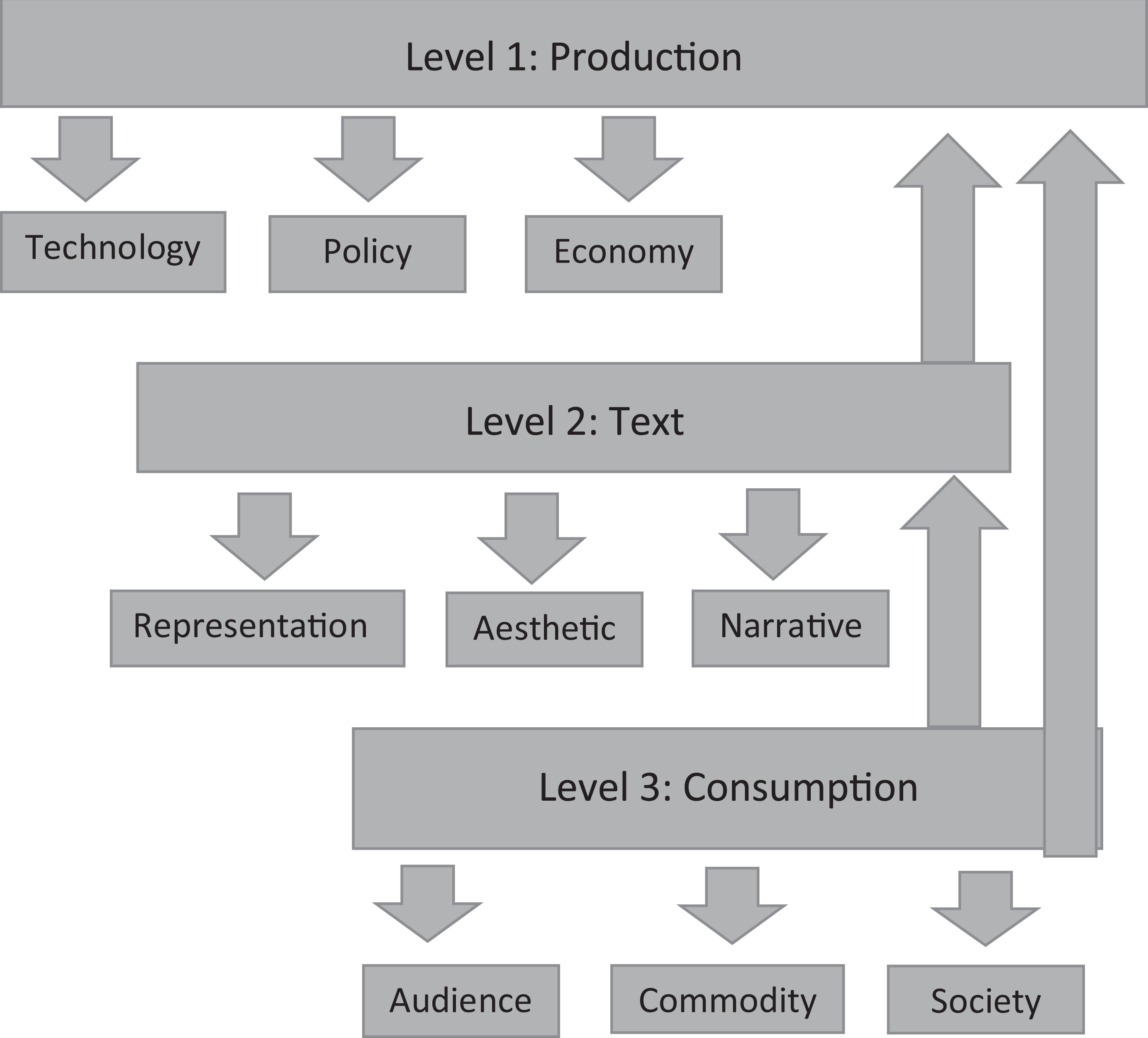
Levels and sublevels of local production cultures.
Secondly, there is a textual level, also with three sublevels: representation, aesthetic and narrative. All these sublevels are visible in the programmes that are produced under the conditions of the production level. According to Stuart Hall, there are two systems of representation: the system of signs, in which articulation happens; and the system of mental concepts, which ‘classify and organise the world into meaningful categories’ (2013: 28). The aesthetic sublevel includes styles, dramaturgy and conventions of staging (Mikos and Perrotta, 2012). The narrative sublevel consists of plots and stories, the history of places and imagination and symbolic meaning of places. Thirdly, there is the level of consumption with the audience, commodity and societal sublevel. The sublevel audience is emotion- and knowledge-based and related to locations, landscapes and production sites. The commodity level consists of branding and touristic place, whereas the societal sublevel includes social milieus, conditions, atmosphere and finally a mediated imagination of places, locations and production sites. Local production cultures are always informed by previous productions, by their textual, production and consumption level. While the production level affects texts and consumption, consumption also affects texts and production. The change of local production cultures over time is grounded in this ongoing cycle of production, texts and consumption. Therefore, local production cultures (e.g. the production culture of Berlin) are not homogeneous and coherent, but ambivalent and sometimes contradictory. Above-the-line and below-the-line talent have an imagined, mediated picture of Berlin which is the result of the films and television series they have watched about and from the city, and this mediated image will affect the productions they realise in Berlin. In the following sections I will focus on two aspects of the model of local production culture, first the importance of regional funding policy and then the changes provoked by new players in transnational drama production.
Policy and the media cluster in the berlin Brandenburg region
The following highlights the importance of political and economic decisions for Berlin’s local production culture. The activities of funding institutions emphasise the importance of attracting foreign productions as well as the support for the infrastructure for film and television productions. Until the appearance of Netflix and Amazon Prime Video, television drama productions were associated with German public service broadcasters. External production companies were commissioned by broadcasters to produce TV movies and dramas, however the broadcasters kept all licensing rights. Despite the arrival of new players, this indigenous culture still exists, but new structures are increasingly changing the local production culture (as I will discuss in the next section).
The development of the film and television industry in Berlin has been linked to politics since the early 20th century, with for example, the founding of the UFA (Universum Film AG) in 1917, based in Babelsberg, the result of a merger of several private production companies, was due to political influence. The German government wanted to create a counterweight to foreign film propaganda (Kreimeier, 1992). In May 1937, the Nazi regime socialised UFA and centralised German film production (ibid.). After World War II the now GDR-owned studio in Babelsberg was home to the DEFA (Deutsche Film-Aktiengesellschaft) film studios, where most of the East German films were shot. Today UFA is a subsidiary of FreemantleMedia which itself is owned by RTL (Radio Television Luxembuerg) Media Group. Bertelsmann holds 90.4 per cent of the RTL Group (Mänz et al., 2018).
In response to the number of productions decreasing in West Berlin during the Cold War, the federal government saw the need to support film production. In 1954, it founded a film credit trust which supported many productions with loans (Borgelt, 1983). Three years earlier, the first International Film Festival Berlin took place which was arguably also a product of the Cold War. The festival was meant to attract foreign filmmakers and film professionals to Berlin and symbolise West Berlin as part of the ‘free world’ (Fehrenbach, 1995: 234–253). In 1977, the federal government introduced a new initiative to support film and a new film promotion programme was introduced. In the following years the number of productions increased. In 1994, the economic and cultural funding bodies merged and the Filmboard Berlin was founded. Ten years later and the Medienboard Berlin-Brandenburg became the successor organisation, with an annual budget of 26.9 million Euro to support film and series production, new digital formats and events in the region. Shareholders of the funding body are the federal states of Berlin and Brandenburg. But the funding of film and television must be seen in the context of a wider economic policy in the region.
Film and television production in the Berlin area are based on the specific economic structures of the region. In an era of globalisation, the economic development of geographical regions depends mainly on the potential of the regional economy to produce on a global scale. Since the end of the 20th century, this is a central part of regional economic policy to define so-called economic clusters that lead to a concentration in specific industries: ‘The regional integration of companies and institutions resulting from their transaction, cooperation and communication links is one of the constitutive elements in the concept of clusters’ (Krätke, 2002: 28). The common economic region of Berlin and Brandenburg defined several clusters of which the cluster ICT, Media and Creative Industries is the most prominent one. This cluster is responsible for a total revenue of 40.5 billion Euro in the region (Medienboard Berlin-Brandenburg, 2018). 19.2 per cent of all companies in the region belong to the cluster and the film and television industry in Berlin Brandenburg is one of the local cores which makes up 30 per cent of the cluster (ibid.). Berlin and Babelsberg as production sites are central elements of the cluster and its attractiveness derives from the fact, ‘that virtually all the functional elements in the film industry value chain are represented in the region’ (Krätke, 2002: 34). A central factor is the film funding institutions in Berlin and Brandenburg, which in 2017 reported that 70,000 employees worked in 12,000 companies in the film and television industry and generated total revenues of 7.5 billion Euro (Sagatz, 2017).
In order to understand the role of regional film funding in Berlin-Brandenburg, it is necessary to give a brief, general overview of film funding in Germany (Castendyk, 2008; Giehl, 2017). Due to the federal constitution of Germany, there are regional funding bodies and national funding bodies. On the national level the two funding schemes DFFF (Deutsche Filmförderfonds) and DFFF II are important in the context of attracting foreign production. They have a budget of 75 million Euros in total and can support international productions with funding of more than one million Euros (DFFF) and another of more than 8 million Euros for the German part of an international production (DFFF II). Since 2016, the GMPF has supported international film productions with a budget of more than 25 million Euros and transnational TV drama productions with a minimum of 1.2 million Euros per episode. In addition, there are the regional funding bodies such as Filmstiftung Nordrhein-Westfalen and Medienboard Berlin-Brandenburg, to name the most important. Medienboard Berlin-Brandenburg has an annual budget of 38.8 million Euros for the funding of development, production, post-production, new media and supports location-related activities such as advanced talent training, conferences and festivals (Huber, 2019). In general German funding does not use special tax incentives for film and television productions; rather, a rebate system offers direct funding of production costs (KPMG, 2019). The funding has to be spent in Germany (for national funding) or in the specific region (regional funding). For regional funding the so-called ‘regional effect’ is important. It will be calculated by the amount of money spent in the region in relation to the funding, with a regional effect of 200 per cent means that two Euros were spent in the region for a single Euro of funding. In Berlin-Brandenburg the regional effect is 544 per cent (average) for film productions and 778 per cent for high-end drama productions (Medienboard Berlin-Brandenburg, 2020). In this sense high-end drama productions have become attractive for funding institutions and increasingly important for regional and national funding schemes, not only in Berlin and Germany, but also in other regions, i.e. Northern Ireland (McElroy and Noonan, 2019) or Scandinavia (Hansen and Waade, 2017; Redvall, 2013).
The funding policy of Medienboard Berlin-Brandenburg and other funding institutions based in Berlin like the GMPF which was created to support international co-productions, led to a growing attractiveness of Berlin and Studio Babelsberg as production sites for international productions. These include The Bourne Supremacy (Paul Greengrass, 2004), Bridge of Spies (Steven Spielberg, 2015), Captain America: Civil War (Anthony and Joe Russo, 2016), Grand Budapest Hotel (Wes Anderson, 2014), Hunger Games: Mockingjay Part One (Francis Lawrence, 2014) and Part Two (Francis Lawrence, 2015), Inglorious Basterds (Quentin Tarantino, 2009) and The Reader. Due to public funding for productions from the Medienboard and other German funding bodies, Studio Babelsberg was able to serve as co-producer for these international productions. Frank Marshall, producer of The Bourne Supremacy noted: ‘Berlin is an excellent shooting location. Most of our crew are Germans, the city has great locations, and the rest is taken care of in the Babelsberg studios. You’ve got all you need there’ (quoted in Wedel, 2012: 40). A condition for funding is that the production should spend this money in the region: that is, for local below-the line talent, local technical equipment and local post-production. The availability of qualified personnel, production infrastructure, technical infrastructure, existence of other creative industries and the ‘internationality’ of the city are important factors when it comes to deciding whether to shoot in Berlin or in other German cities (Castendyk and Goldhammer, 2018: 130–131). In addition, such international productions have also brought creative talent to Berlin who have stayed in the city. This production-friendly atmosphere goes back to a decision by the Berlin mayor in 1999 to declare the German capital as ‘film friendly city’ (Raab, 2018), which means that the local authorities are required to support film and television productions. As a result, it is relatively easy to get permission to film in Berlin.
In 2015, the Medienboard Berlin-Brandenburg started to fund drama production. The idea behind this was to expand the region as a production site for series production. Veronika Grob, responsible for High End Drama Series at Medienboard, saw a shift to television drama in 2015, starting in the United States with the complex dramas of HBO, Showtime and others. So, the Medienboard decided to support the production of the fifth season of Homeland. When we started production funding, the first one was Homeland, an international series. And I mean, if you look at it, you can read about it, it’s insane what happened here that summer. There were 500 busy employees working for the production one summer. They shot here for four or five months in different teams and they didn’t bring many people, but they actually shot with teams here on location. Additionally, hotels and catering, that’s all part of it. So, the effect for the region was of course incredibly high. (Grob, 2017, all translations by author)
Since 2015, the Medienboard funded the production of more than 15 dramas in the Berlin Brandenburg region (see Table 1).
Medienboard funding for selected series.
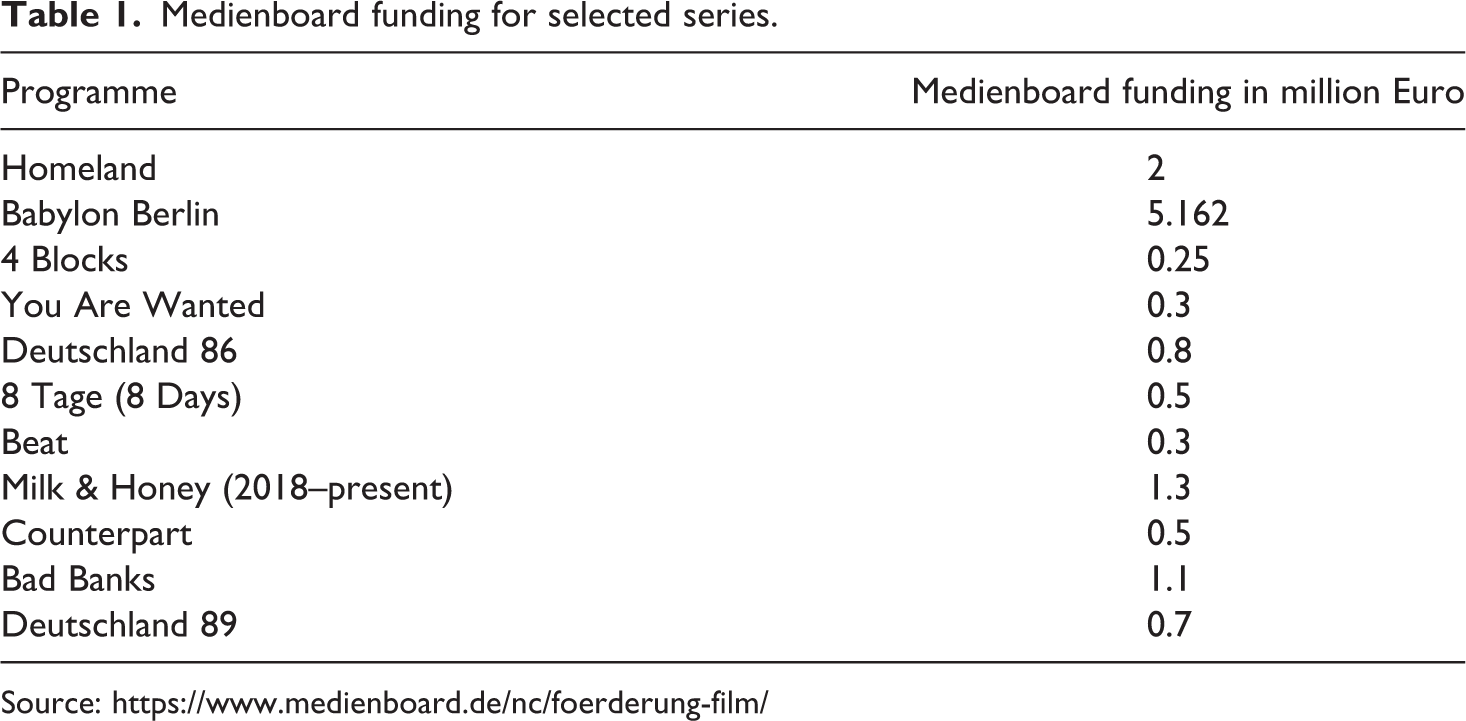
All of these dramas also got funding from the German Motion Picture Fund, except 4 Blocks and Milk & Honey.
There are reasons for the popularity of Berlin as a location and production site for national and international drama. The funding policies of the Medienboard and the German Motion Picture Fund forces international production companies to spend parts of their production budgets in the region, and this has led, in turn, to increased employment of local below-the-line talent. These are reasons why politicians and the administration of Berlin facilitated shooting in the city. Berlin’s local production culture thus incorporates contradictory forces. On the one hand, the increasing number of productions gives employment for local below-the-line talent; while on the other hand, the revenues remain with the global companies, such as Showtime, Starz, Amazon Prime Video and Netflix. The regional and national funding policy make apparent that Berlin’s local production culture is integrated into the structures of the global film and television market. The global and the local equally influence the production of films and television series in Berlin, which reveals that there is no homogeneous local production culture, but rather a heterogeneous one. Above all, the dynamics of the global media market for transnational TV drama productions has had a massive impact on the local production culture of Berlin.
Transnational TV drama production in Berlin
Since digitalisation became an important driving force of the global media market, production, distribution and consumption of television have changed. In times of (de-) converged media environments (Jin, 2013; Mikos, 2017) transnational – and sometimes transmedia – TV dramas play an important role in the global television market. There has always been a transnational flow of TV drama, mainly limited to geolinguistic regions, like the United States and the United Kingdom (Hilmes et al., 2019; Weissmann, 2012) or the Latin American region (Straubhaar, 2007). Since the international success of TV crime drama from Scandinavia, branded as Nordic noir (Gamula and Mikos, 2014; Hansen and Waade, 2017; Hedling, 2014; Hochscherf and Philipsen, 2017), locally produced TV drama with a transnational appeal has travelled well and the flow of TV formats developed multi-directionally: flows and contra-flows (Thussu, 2007).
At the same time, the process of convergence impacts on television and goes hand-in-hand with processes of de-convergence (Jin, 2013: 111–126). It is a dialectical process. The convergence of telecommunication and television leads to a multiplicity of channels and platforms. Television content gets fragmented as it is delivered on multiple platforms. The fragmentation of channels and platforms results in a fragmentation of audiences (Mikos, 2017: 160). Digitalisation and (de)convergence made it possible for new suppliers to enter the market. Telecommunication companies such as Vodafone or Telefonica, device manufacturers like Apple or Sony, consumer goods manufacturers such as Lexus or Red Bull and content aggregators like Amazon Prime, Netflix or Viaplay entered the market and started to produce original content, mainly web series and TV drama. Because these companies are active in the global market, they produce transnational drama to appeal to a global audience: ‘Where, traditionally, texts were produced for domestic markets and, then, altered for broadcasts as imports, Netflix’ in-house productions are produced with a desired transnational appeal in mind’ (Jenner, 2018: 237). Even if Netflix is working on a global level with an international reach (exceptions include China, Iran and North Korea), ‘it is highly territorial because of its licensing model’ (Lobato, 2019: 70). Since 2015 Netflix localises its content by hiring local production companies to produce local original material in several countries, including Germany – and Amazon Prime Video followed and applied the same strategy. The first two German TV dramas produced for each of these streaming platforms were shot in the region of Berlin-Brandenburg, mainly in Berlin. Whereas Dark was filmed in the Brandenburg region, You Are Wanted was mainly shot in Berlin. While the productions for US companies such as Showtime (Homeland) and Epix (Berlin Station) brought above-the-line talent to Berlin, the Netflix and Amazon Prime Video productions employed also above-the-line talent (authors, directors, producers) from Germany and Berlin. On the other hand, they usually kept the licensing rights of the commissioned programmes for an unlimited time for all territories.
Netflix and Amazon Prime Video’s entrance into the local production market in Germany increased the budgets for drama productions. Dark’s budget was 18 million Euros for 10 episodes of 44 to 60 minutes, while the six episodes of You Are Wanted with an average length of 45 minutes was shot on 10 million Euros in total. In contrast, the average budget for an ordinary 90-minute Tatort episode, the most popular German crime series (Eichner, 2018), is 1.2 to 1.4 million Euros. To compete with these global players, German productions aimed at an international audience had to increase their budgets. Babylon Berlin received funding from the Medienboard, with 1.5 million Euros each for the first two seasons. Filmstiftung NRW, the regional funding institution of North-Rhine Westphalia contributed with two million Euros. The German Motion Picture Fund contributed 6.2 million Euros. A total budget of 40 million Euros for the first two seasons was collected. To date Babylon Berlin is the most expensive German drama. Another example of a huge budget is
Bad Banks (2018–). Producer Lisa Blumenberg explains the composition of the budget of 8.1 million Euros for six episodes of 52 minutes: We have a budget of 8.1 million Euros in total. About 52 percent came from the broadcasters. Then we have the Film Fund Luxembourg from the co-producer to the tune of 2 million Euros. The Luxembourg funding body has already contributed a certain amount to the development and that was very early on. There is funding from the regional film fund in Hessen, a minimum guarantee of the global distributor and we have the German Motion Picture Fonds as a new financing instrument, which was handily launched last year and that we were able to use, so to speak. The GMPF is an economic development scheme especially designed for high end series productions where you have to meet certain requirements, i.e. a budget of more than 1.2 million Euros per episode, less than 60 percent of the broadcaster’s share in the financing. And, of course, there are our own contributions as producers. (2017)
The appearance of new players has changed the production of television drama in Germany. Whereas traditionally procedurals were produced for public service broadcasters and commercial channels, the new players asked for mini-series with horizontal storytelling, so-called complex TV (Mittell, 2015). Berlin’s talent was best prepared because it already had experience with major Hollywood film productions. On the other hand, new ways of production were introduced to German authors, producers and directors, such as the writers’ room, showrunner, appreciation of authors, tight time frames for shooting and picture lock. The condition set by public funding to spend in the region provided employment mainly for below-the-line talent. Baran Bo Odar and Jantje Friese, creators of Dark, stated that the production for Netflix has an aspect of professionalisation for German film and television professionals, mainly because of the tight time frames and Netflix’s demand to see six edited versions (Bo Odar and Friese, 2019). They got the Netflix contract because both had an international track record (ibid.). The role of the showrunner as a kind of executive producer was nevertheless new for them. Before the transnational drama productions, the director was the person who had the vision of a project. With the shift to an American way of drama production, the role of the showrunner became more prominent, a development that took place in the production of Nordic noir drama some years before (Redvall, 2013: 102–131). Quirin Berg (2017), producer of Dark and 4 Blocks, explained how the vision of a drama shifted from director to showrunner, because it is important to have one creative vision for horizontal, complex television serials. Therefore, in the production of Dark ‘we rather lived the showrunner principle’ (ibid.). This is different from productions for public service broadcasters in which the director-as-auteur principle is common.
Similar to Scandinavia, the concept of showrunner was not adapted one to one and the German system of production was combined with the American system. In Germany the executive producer is still important as Lisa Blumenberg, producer of Bad Banks explains: The system is not transferable. This is another system. For me as a producer, at least that’s how I work, that’s the secret, it’s always a balance between intimacy and distance. So, to work very closely together and to be involved in the content process, but not completely. If I had been in the Writers’ Room the entire time, I would have been part of this process and wouldn’t have had that outside view anymore. So, I always strike a balance between intimacy and distance. We still have a more classic division of tasks between author, director and producer, but who at the same time work very closely together as a team. (2017).
The creative freedom also implies more sophisticated images of Berlin. Whereas many domestic productions use the location of the city as an interchangeable backdrop against which the action takes place (Eichner and Mikos, 2017: 47), like the procedural crime dramas of public service broadcasters and commercial channels, actual transnational dramas conceptualise Berlin as an integral part of the story as it is told. 4 Blocks is praised for its authenticity in presenting Neukölln, an urban quarter of Berlin and its Arabian and Turkish inhabitants. The series tells the story of Tony ‘Ali’ Hamady (Kida Khodr Ramadan), the leader of a Lebanese clan involved in organised crime such as drug dealing, gambling and racketeering. In addition, the series is about collaborations and competition of several clans and a biker gang. The authors wanted to create a local story, as Richard Kropf explained But I believe that there are things in Germany right now – and we have made an effort to go in exactly this direction with 4 Blocks – which at first glance are very regional, but which, because of a deeper universal topic, could target a global audience. In the case of 4 Blocks, all this takes place in Neukölln, but there is a family history and a family conflict underlying it, which hopefully many people can relate to. (Hackfort et al., 2017)
Babylon Berlin and Berlin Station are two remarkable dramas in which the city is an integral part of the story. For Berlin Station ‘US writer Olen Steinhauer was very focused on the city to define the characters in the series’ (Fidel, 2016). This drama includes ‘the narrative of Berlin as the centre of the Cold War and the capital of spies and continues this into the present time’ (Eichner and Mikos, 2017: 48). In Babylon Berlin the city is the main character, in this case in the year 1929. When producer Stefan Arndt of X-Filme and author and director Tom Tykwer presented the concept of the series to Marcus Ammon, Senior Vice President Film and Entertainment at Sky Germany, they presented an aesthetic and visual concept, ‘in which the city of Berlin in 1929 was the leading actor in this series’ (Ammon, 2017). Streaming platforms and cable channels want to produce authentic local stories to attract local audiences as subscribers. This demand for local stories goes hand-in-hand with the need for the expertise of talent from local production cultures, in this case Berlin.
The examples of television drama productions from the second decade of the 21st century make evident how the arrival of new global media players changed the possibilities and circumstances of television drama production in Berlin. It becomes quite obvious how new production structures and narrative and aesthetic strategies of complex television drama interact. The production level of Berlin’s local production culture is thus strongly connected to the textual level of transnational drama which emphasises an ‘authentic’ locality which requires local expertise by authors, producers and directors whose creativity is now valued as a marker of distinction.
Conclusion: Berlin’s production culture
Since the early days of film, images of Berlin have travelled around the world. The production of movies and television drama mirrored historical events that took place in the city; or put another way, Berlin experienced the major events of the 20th century in a nutshell. This history is still present in many buildings. According to Andreas Huyssen: ‘there is no other western city that bears the marks of twentieth century history as intensely and self-consciously as Berlin’ (2003: 51). This history is visible in the architecture of the city, in distinct buildings, places and streets. All images of Berlin in movies and drama have travelled and are well known to audiences and producers across the world. They have turned into a commodity, a brand of the city. Therefore, in the book ‘World Film Locations’ Berlin is labelled as the ‘city of the imagination’ (Ingram and Sark, 2012: 6). In times of the increasing production of transnational television drama, this remark becomes even more meaningful. Berlin as imagined and as a mediated city has turned into a commodity. Here, the level of production, the textual level and the level of consumption of Berlin’s local production culture interact. The imagined image of the city affects authors, producers, politicians and audiences as my model suggested.
The local production culture of Berlin is informed not only by the mediated image of the city, but also by political decisions regarding funding and new global players who meanwhile operate at the local level. Since the Medienboard Berlin-Brandenburg changed its policy and started to fund television drama, more and more complex transnational television dramas were shot in Berlin. These programmes were able to collect about 13 million Euros from the Medienboard and about 39 million Euros from the German Motion Picture Fund. The amount of public money that has gone into the series shows the important role these productions play in the politics of the region. As regards to the new players in the market, in addition to the traditional production of crime series for national broadcasters, a new culture of high-end drama production appeared. The production of complex, transnational drama saw the introduction and local adjustment of the showrunner concept. In the words of the creators of Dark, a professionalisation of German productions took place (Bo Odar and Friese, 2019), by this they mean an adjustment to American standards of drama production. Moreover, local and national funding institutions jumped on the train of transnational drama and attracted global companies with funding to shoot in the region. Therefore, the local production culture of Berlin is not homogeneous. It is a place where various production cultures meet – American, European and German. The increasing number of productions has now, however, led to a shortage of authors and other professionals. The locations where filming is still possible and which are not yet well known, are becoming scarce. Some productions move to Hamburg, a city with a similar architecture and old bourgeois houses (Bensch, 2019). Other productions like Berlin Station moved for the shooting of the third season to Budapest in Hungary or like Charité (2017–present) to Prague because they have fully-equipped studios there and historic buildings that resemble Berlin – and finally offer direct state funding and tax incentives. The nature of film and transnational television production as a kind of runaway production makes it difficult to establish an industry on a permanent basis (Castendyk, 2018). Therefore, the sustainability of public funding must be questioned (see also Ramsey et al., 2019). Nevertheless, Berlin will be an important location and production site for transnational drama production in the near future, because Berlin ‘has secured its place in history, not just as a centre of cinematic innovations, but as a site of political and cultural upheaval and a mirror of the turbulent twentieth century’ (Kraenzle, 2012: 107). The vibrant metropolis of the 21st century seems to be an excellent location and production site for transnational drama production in the era of streamed content.
The example of Berlin’s local production culture and the production of transnational TV drama shows how transnational television culture is a social process with signifying patterns of production, distribution, legislation, aesthetic and narrative conventions and media use (Mikos, 2020). Due to national legislation, television is transnational but ‘takes nationally specific forms’ (Bignell, 2013: 18). Thus, transnational television is an arena in which the global, the local and the regional interact. Similarly, transnational television culture exists within social relations of nation states and of transnational and global formations. It reinforces shared meanings of imagined cities like Berlin – in the case of transnational producers homogeneous meanings, mainly related to the Nazi regime and the Cold War, in the case of local producers diverse shared meanings not only of the mediated city, but also the ‘real’, ‘authentic’ social life in Berlin. Thus, the city’s local production culture is influenced by many elements: the historic image of Berlin, its production infrastructure, the dynamics of the global media market with new players on the scene who commission transnational TV drama and finally the imagined images of the city of authors, producers and audiences. All this is the essence of Berlin’s local production culture. In this respect we must be careful with the notion of local colour, because the local production culture in Berlin is also transnational and global at the same time. As Elke Weissmann demonstrated with the example of Y Gwyll/Hinterland (2013–2016), the series ‘is clearly not just transnational, but also intensely local and national’ (2018: 132). The local production culture of Berlin is as global, transnational and local as the movies and drama produced in this location. Berlin-based local TV drama productions show ‘the significance of local production [that] lies not only in its economic value, but in its potential to create local dramas that imaginatively reflect our communities at home and to others’ (McElroy and Noonan, 2019: 4). Berlin is a city where 20th-century history concentrates and traces of that can be found in many of the transnational local drama productions.
In Berlin as a production site for transnational TV drama various production cultures come into play and different imaginations of the city meet diverse understandings of cultural practices of production. Therefore, the local production culture in Berlin is heterogeneous and ambivalent. Similarly, Berlin as location, landscape and production site can be described as a complex net of several elements on the production, textual and consumption level. Besides a real, historical place, Berlin is always an imagined and mediated place in transnational TV drama productions that is very much influenced by the course of the city in the 20th century, its film and television funding policy and its representation in film and television drama.
Footnotes
Acknowledgement
The author would like to thank Simone Knox and Elke Weissmann for constructive comments on an earlier version of the article and the reviewers who helped to clarify the main argument.
Declaration of conflicting interests
The author(s) declared no potential conflicts of interest with respect to the research, authorship, and/or publication of this article.
Funding
The author(s) received no financial support for the research, authorship, and/or publication of this article.
