



Abstract
This article shows how the Arctic landscapes in the Danish political drama series Borgen—Power & Glory (2022) demonstrate Greenland as a contested land in distinct ways: culturally due to the postcolonial tension between Denmark and Greenland; politically due to the conflicted interests from Denmark and other nations for the country’s natural resources; environmentally due to the looming transformation of the Arctic landscapes due to global warming, and commercially due to increasing interest in screen production from Greenlandic tourism actors. Furthermore, we contribute to the location study method approach by focusing on location management and the contestedness of the industry itself.
Introduction
When Borgen—Power & Glory (2022) premiered on Danish public service broadcaster Danmarks Radio (DR) in February 2022, several changes had transpired since the last and third season of its successful predecessor Borgen (2010-2013) aired in 2013 (Grønlund and Redvall, 2022). Firstly, the season is the result of the first-ever collaboration between DR and Netflix, produced by Borgen-creator Adam Price’s production company SAM Productions. While the circumstances surrounding the collaboration between Netflix and DR are relatively secretive, it was made clear from the start that the creative power was with DR, while Netflix solely financed (and thus enabled) the production of the reboot series (Benner and Roliggaard, 2020). Secondly, the new season is focused on one main plot rather than presenting new political intrigues in each episode through the more episodic structure of the original series. This leads to the third major change of the new season. With the main plot focusing on Birgitte Nyborg’s (played by Sidse Babett Knudsen) new position as Minister of Foreign Affairs, an oil finding in Greenland, and the implications that follow, the plot is now split between two main geographies: Denmark (Copenhagen) and Greenland (Ilulissat). While a large part of the cast continues into the new season, Borgen—Power & Glory is a new approach to the Borgen universe, reimagining the series within the international framework established by the collaboration between a Danish public service entity and a dominant Subscription Video-on-Demand (SVoD) player with two audiences in mind: the national and the international. As an additional factor—caused by the choice of the Greenland-set plot and on-location shooting in Greenland—is the Greenlandic production service company, Polarama Greenland, whose interests concern the Greenlandic audience and society affected in different ways by both the on-location shooting and the series’ representation of Greenland. The approaches to, and management of, location were thus a particularly new and challenging endeavour that required specific approaches and cooperation between production actors. In other words, Borgen—Power & Glory is interesting from a multitude of perspectives centred on the choice of location, location work and the representation of landscapes entangled in (screen) history, postcolonial relations and conditions of production. As such, understanding Borgen—Power & Glory’s representations of landscapes requires a broad analytical lens that considers both the production and aesthetic conditions. This highlights some of the conditions that characterise contemporary Nordic noir and televisual landscapes more generally as they move further north.
Our main contribution in this article is twofold. Firstly, we argue how the Arctic landscapes in the Danish political drama series Borgen—Power & Glory demonstrate Greenland as a contested land in distinct ways: (1) culturally due to the postcolonial tension between Denmark and Greenland; (2) politically due to the conflicted interests from Denmark and other power nations for the country’s natural resources; (3) environmentally due to the looming transformation of the Arctic landscapes as a result of global warming; and (4) commercially due to the use of the series by Greenlandic tourism actors such as Visit Greenland underlining the economic interests within Greenland to develop sustainable tourism where the internationally recognised series—despite its geopolitical and climatic theme—is used as destination branding. Secondly, we contribute to the location study method approach by focusing on location management as a distinct aspect of producing televisual landscapes.
Throughout the article, we use the term contestedness to describe the intricate dynamics surrounding Arctic landscapes and their depiction in media, highlighting the convergence of geopolitical, environmental and Indigenous concerns. This concept extends to screen productions that navigate the Arctic’s unique environment, strategic relevance and locally anchored stories. It thus manifests itself in a dual contestedness in the screened landscapes; aesthetically (visually, narrative) in the representation of Greenland and practically in the challenges faced by a large Danish crew managing a complex on-location production affected by way of physical challenges such as weather, infrastructure and capacity as well as historical, affective Danish-Greenlandic relations. Both aesthetically and practically, this is intertwined with growing Greenlandic influence and awareness that permeates every stage of the production processes and challenges historical narratives and landscape representations. Additionally, as the analysis will illustrate, the historical portrayal of Greenland has led to its commercialisation, prompting nations to capitalise on its landscapes to attract tourism and investment.
In short, contestedness in this context refers to the nuanced dynamics of Arctic landscapes and their media depictions, blending historical and contemporary geopolitical, environmental and Indigenous concerns with the practical challenges of on-location production. It highlights the aesthetic and operational complexities of filming in the Arctic, the evolving Danish-Greenlandic relations and the impact of historical portrayals on commercialisation and local identities. The term contestedness thus encapsulates the multifaceted interplay between history, landscape representation, production challenges, commercialisation and the broader narratives shaping the Arctic.
Arctic landscapes in art, film and Nordic noir
Art historian Malcolm Andrews (1999) draws a line from classical landscape panting to more recent land art and environmental art, emphasising the viewer’s engagement with landscape art: ‘landscape in art tells us, or asks us to think about, where we belong’ (1998: 8) and ‘our absorption in the real or the pictured landscape may well be recreational, aesthetic and spiritual all at once’ (10). However, beyond aesthetic contemplation and spiritual pleasure, the symbolic meanings of landscapes in art have been used to demonstrate power and ownership, for example national constructions, colonialism and manifesting a masculine landscape gaze desiring the beauty of (female) nature. Within film studies, landscape has also played a pivotal role both in film aesthetics and film theories (Higson, 2003). Lefebvre (2007) argues that the cinematic landscape gaze is distinct from setting; setting is related to the story, while the cinematic landscape aesthetic displayed in, for example, opening shots, panoramas, high angle shots and fly cams draws on the contemplative landscape painting gaze. The relationship between landscape and screen media has received particular attention, and scholars have introduced new interdisciplinary subfields such as cinematic landscapes (Lukinbeal, 2005), ecological cinema, Anthropocenic cinema (Leyda and Negra, 2021) and geopolitical television (Saunders, 2020).
Arctic landscapes with snow-capped mountains, ice flows, tundra, barren areas and iconic sites such as the North Cape have played a particular role within historical landscape paintings and literature. In this regard, the concept of ‘Arctic sublime’ (Morgan, 2016) encompasses a romantic, mythological fascination with Arctic landscapes that represents nationalism, imperialism and the (male) Arctic explorer. Shelagh D Grant explains that Europeans historically ‘envisioned the Arctic as a wilderness, a place of unknown—cold, mysterious, forbidding, inhabited by beasts, yet magnificent in its grandeur—bereft of Western civilisation’ (1998: 27) and the idea that ‘from an Inuk’s perspective, the concept of the Arctic as wilderness is a figment of an outsider’s imagination, unsupported by history or experience’ (28). This distinction between insider and the outsider perspectives on the Arctic land is also pivotal in Arctic cinema. Mackenzie and Stenport (2015: 1) distinguish between three types of Arctic cinema: films made by Arctic residents, but mostly seen in the South; films made outside the Arctic, typically by outsiders, and viewed mostly in the South; and films made and viewed by Arctic residents through narrowcast broadcast and alternative venues. This distinction can also be related to Arctic noir, in which no series so far is made and viewed by Arctic residents through narrowcast broadcast.
Arctic noir is to be understood as a sub-genre; a branch of Nordic noir and, as such, encompasses many of the same narrative and aesthetic elements that characterise Nordic noir, such as complex characters, strong female protagonists, iconic Nordic locations, landscapes and climate conditions, and Nordic welfare systems and gender politics. Furthermore, Arctic noir is characterised by significant use of arctic landscapes often related to plots reflecting critical political and climate conditions in the Arctic region (Badley et al., 2020; Saunders, 2020). In this way, Arctic noir takes ‘Nordic noir a step further by making the Arctic setting and climate significant to the plotline of the crime narrative as well as in the visual aesthetic’ (Waade, 2020: 39) often approaching regional discourses of geopolitical tensions, postcolonial relations and the rights of Indigenous peoples (Grønlund, 2021: 2). Though a political drama rather than a crime series, the original Borgen can be regarded as a quintessential Nordic noir (Engelstad, 2018: 27); with the new season, the crime elements are arguably present, for instance through a questionable suicide. However, it is especially in the use of landscapes that Borgen—Power & Glory appears more closely linked to Arctic noirs such as Fortitude (2015-2018), Ófærð/Trapped (2015-), True Detective: Night Country (2024) and, especially, Tunn is/Thin Ice (2020-) with spectacular snowy landscapes of glaciers, fjords and settlements combining ‘real dilemmas from the Arctic region with features from the Gothic thriller tradition’ (Agger, 2021: 32). The series thus includes distinct Arctic noir elements such as Arctic locations and winter landscapes, critical climate and political conditions, international power relations and critical Indigenous/postcolonial power relations.
Both Arctic noir and Nordic noir as media commodities have significant international markets and are sold and marketed outside the Nordic region (Agger, 2016; Hansen and Waade, 2017). In this context, Arctic landscapes play a pivotal role in the narratives and visual aesthetics, and not least as a selling point for the Arctic noir series, mirroring the same international popularity known from the historical romantic landscape paintings from the Arctic region.
Cosgrove’s (1998) bifurcated definition of ‘landscape’—as an artistic genre historically linked to painting and as a conceptual tool in environmental geography—reveals the term’s rich complexity. Cosgrove traced the artistic lineage of landscapes as romantic visual representations, with structured compositions and perspectives that evolved alongside and intertwined with scientific innovations like the microscope and the camera, supporting the adage 'seeing is believing' (1998: 9). He also infused landscapes with ideological significance, framing them as experiential constructs shaped by specific societal groups and historical contexts (1998: 15). This interpretation of landscapes as both aesthetic constructs and ideological expressions finds contemporary relevance in the genre of Arctic noir, as exemplified in Borgen—Power & Glory. The series navigates the dual nature of Greenland's landscapes identified by Cosgrove, interweaving the artistic allure of the Arctic—a pillar of traditional landscape painting—with the geopolitical and environmental critiques central to the noir genre. Jackson’s (1984) acknowledgment of a broadening landscape vocabulary in academia mirrors this approach, suggesting that even as the term diversifies to include ‘scapes’ of all kinds, it remains a means to distil complex realities into singular, visual impressions. Borgen—Power & Glory employs these concepts, presenting Greenlandic vistas that are at once visually captivating and laden with the darker hues of the political and climatic challenges emblematic of Arctic noir.
As is shown in the following, the screening of Greenlandic landscapes in Borgen—Power & Glory draws on the Arctic noir tradition and demonstrates the two different approaches that Cosgrove describes: a spectacular landscape aesthetic while simultaneously reflecting critical climate and political conditions. But first, the approach to production and location management will be presented, which will then be used to expand on the points about the inherent contestedness of the representation of Greenlandic landscapes.
Location and location management in screen productions
The location study approach is a branch within screen production studies, and, as such, focuses on empirical methods to study the impact, aesthetics and value of locations within screen productions. Hansen and Waade (2017: 53ff) present a location study model encompassing on-screen location features such as urban/rural landscapes, architecture, infrastructure, shore/inland/island and climate, as well as off-screen factors that influence the use of filming locations such as geographical conditions, local production facilities, financial support and tourism industries. To emphasise the landscape aspect in this context, we focus on certain kind of outdoor settings such as urban and rural landscapes, shore, inland, island, seascapes, mountains, forest, nature and land.
In the location study model, certain professionals and functions dealing with locations are listed (Hansen and Waade, 2017: 57). This is the case for production designers, cinematographers, set designers, location managers and location scouts, as well as directors, producers, line producers and executive producers. The location scout searches for possible locations as part of the pre-production and works closely together with the production designer, while the location manager takes care of practical, logistical, technical and legal arrangements with the locations during the production. When it comes to the visual landscape design, it is the same professionals who have the decisive influence as for locations in general, even though the cinematographers have a pivotal role, since landscape imageries in screen production, to a large extend, concern camera use. Title sequences often consist of landscape sceneries, and the title sequences are often externally produced by a title sequence company or graphic designer. In some cases, local authorities and tourism organisations are involved in the production as part of a destination branding and location placement strategy offering financial support and sometimes practical assistance. In these cases, location management may be coordinated with local agencies. In a specific production, the director and cinematographer work closely together with the production designer and location manager to decide on the locations and landscape imageries in the specific series. Sometimes the landscapes are edited and changed in postproduction or artificial landscape elements are included in the series (Aggerholm et al., 2022).
In this article, we follow location studies’ two-fold method by analysing both on- and off-screen elements of Borgen—Power & Glory. Firstly, the season is analysed through textual analysis based on the landscape theory presented above. Secondly, the production circumstances is analysed based on semi-structured interviews with Greenlandic and Danish (production service) producers (Péronard, 2021; Quist, 2022) as well as the location manager and assistant (Berg, 2022; Buus, 2022). In addition, the article’s commercial focus is made through an analysis of marketing material from Visit Greenland (Por, 2022, 2023). Overall, this approach provides insights into the complex representation of Greenlandic landscapes in Borgen—Power & Glory, blending on-screen aesthetics with off-screen production and commercial dynamics. Our study delves into the series’ Arctic noir elements and its place within landscape discourses, revealing how narrative, production, and marketing shape and redefine Greenland’s portrayal, highlighting the interplay between locale, narrative, and the screen industry.
Greenland as contested (production) landscapes in Borgen—Power & Glory
Choosing Greenland as setting and location, Borgen—Power & Glory wrote itself into a century-long history of Greenland on screen (Grønlund, 2021, 2023; Nørrested, 2011; Pedersen, 2003). Starting in the late 1800s, Greenlandic film history has been fundamentally entangled with a wide range of foreign nations as a result of colonialism and the desire for exotic locations, exploration and supremacy. As such, Greenland was an early subject for expedition and ethnographic films not only by the colonising nation of Denmark, but also by a longer list of Western nations. During World War II and the subsequent Cold War, Greenland was—along with the rest of the Arctic—seen as both barrier and expanse in the East-West conflict, firmly establishing the region as a ‘militarized geography’ (MacKenzie and Stenport, 2015: 21–22) still dominant. Today, these geopolitical discourses of expedition and conflict have been supplemented by, and merged with, climate discourses on climate crisis, environmentalism, resource extraction, new waterways and neo-colonialism. Overall, this has created a fundamentally entangled film history dominated by foreign perspectives both in fiction and documentary formats, which have shaped Greenland as contested landscapes.
In recent years, the foreign dominance has increasingly been challenged by an indigenous screen industry producing and co-producing Greenlandic content. Rooted in emerging self-production in the 1980s and 1990s, the local Greenlandic industry has gained momentum following the first professionally Greenlandic-produced feature film, Nuummioq, in 2009, starting a wave of Greenlandic produced feature films (Grønlund, 2023; Thisted, 2015: 103; Thorsen and Péronard, 2021: 267–268). This has created an ultra-small but vibrant film community with a range of new initiatives such as the filmmaker’s association, Film.gl, the film workshop, Filmiliortarfik, and the annual Nuuk International Film Festival. In addition, a range of collaborations has been established with not only Danish and other European nations but also, and especially with, similar Indigenous communities such as those in Nunavut and Sápmi. 1
Despite these developments, Greenland is still a highly challenging nation in which to be an indigenous filmmaker due to a lack of film infrastructure (such as a film institute), low policy support, (sub)arctic climates, limited capacity and a continued dominance of foreign filmmakers depicting the nation. This has also created an ambivalence between producing local content for a domestic audience and attracting foreign productions to place capital in the Greenlandic economy, which to this day ‘loses’ productions to cheaper, more experienced, and accessible nations such as Iceland, whose Arctic landscapes frequently doubles the Greenlandic ones (Grønlund, 2022a). As such, the Greenlandic locations are both commodity and challenge caught in a complex interplay against more professionalised production cultures with (for a foreign audience) similar landscapes.
One solution to these issues of location has been to demand influence, which has led the Greenlandic screen industry to adapt the phrase ‘nothing about us without us’ (Schmidt, 2023)—a phrase also used by the International Sámi Film Institute (ISFI) in their Ofelaš—Pathfinder guidelines for responsible filmmaking with Sámi culture and people (The Sámi Film & Culture Advisory Board, 2021: 6). In this way, Greenland can be seen as part of a movement among Indigenous Arctic communities to demand more agency in the foreign production, which will continue to be drawn towards the still-increasing interest in the region. This is also evident in the growing activity from SVoD actors, which have brought new formats to Greenland such as the Netflix feature, Against the Ice (2022), the C More serial, Thin Ice and, most recently, Borgen—Power & Glory. While foreign production companies do show interest in involving Greenlandic companies and filmmakers, this has also resulted in an issue of—in the wording of Greenlandic producer Emile Hertling Péronard—brown-washing. The co-producer set-up is sometimes something that seems a bit like a formality, like a brown-washing of a project. As if they just ‘check the box’ where there should be a Greenlandic co-producer. What is the actual co-production? What is the actual collaboration? (personal communication, March 2021)
Story, characters and (contested) landscape aesthetics
In many ways, the new season of Borgen—Power & Glory continues the main plot of its predecessors in following politician Birgitte Nyborg’s career torn between ambitions and family, as well as subplots following other central characters such as journalists Katrine Fønsmark (Birgitte Hjort Sørensen) and Torben Friis (Søren Malling). With almost 10 years between the third and final season of Borgen and the DR/Netflix resurrection—both in terms of production and plotline—a lot of things have changed not only with the absence of some characters and introduction of new ones, but also with remaining ones. Most central, Nyborg is now Minister of Foreign Affairs, promoting a green agenda which is heavily challenged by an oil discovery in Greenland. Through this, Nyborg is thrown into a spiral of conflicts showcasing the postcolonial tensions between the two nations: Greenlandic desire for independence financed by potential oil extraction contra Danish desire to claim a share in that wealth, while maintaining a progressive climate policy. However, Greenland was part of the first season of Borgen, specifically episode four, that focused on a scandal involving secret CIA prisoner flights at Greenland's Pituffik Space Base (former Thule Air Base), shaking Nyborg's government. This episode delves into geopolitical tensions, described by producer Camilla Hammerich as ‘a thriller about Denmark’s big-brother relationship with Greenland and little-brother relationship with the US’ (2015: 230).
This geopolitical theme is continued and broadens into a full season with the new single main plot structure focusing on an oil discovery. Through this, new perspectives naturally enter the Borgen universe. Rather than focusing solely on Denmark, Greenland and its politics has a significant role as an autonomous territory within the Kingdom of Denmark. As such, Greenland holds executive power in local government affairs with control over some political areas (e.g. culture and the rights to raw materials), while some are controlled by the Danish state (e.g. defence and law enforcement). In addition, military bases such as the US Pituffik Space Base continue to make Greenland a contested geography and the Greenlandic government keeps striving for influence in its own affairs. Due to this change of perspective, a wide range of new Greenland-related and Greenlandic characters are introduced: Arctic Ambassador Asger Holm Kirkegaard (Mikkel Boe Følsgaard); Greenland’s Minister of Foreign Affairs and Raw Materials, Hans Eliassen (Svend Hardenberg); Greenlandic government official Emmy Rasmussen (Nivi Pedersen); and a wide range of smaller parts played by known actors such as Ujarneq Fleischer and singer Rasmus Lyberth. There is thus a large amount of on-screen representation of both Greenlandic Inuit characters and language (Kalaallisut).
As the oil discovery is made in the Arctic city of Ilulissat—a popular destination for tourists and known for the UNESCO heritage site, Ilulissat Icefjord—picturesque Arctic landscapes have a central place in the Arctic noir aesthetics of the new season. While large parts are still filmed in Copenhagen and its surroundings, showing a variety of mostly iconic urban landscapes, the Greenlandic arctic sublime landscapes make a substantial contrast to the dark corridors of the Danish parliament and the ever-grey streets of Copenhagen. In many ways, the season thus presents an extension of the series’ roots in Nordic noir aesthetics into the growing number of Arctic noirs by using climate, landscape and regional discourses such as Indigenous rights, geopolitical tensions and post-colonial relations at the centre of the narrative. In Borgen—Power & Glory, a significant amount of screen time is used on Greenlandic landscapes as either spectacular backdrops or as longer sequences showing solely the landscapes—often in the form of long drone panning shots. Although these are spread throughout the series to varying degrees, it is especially evident in the season’s opening and title sequence, where both aesthetics and symbolism are paramount.
Starting with a black screen and a quote by Henry George, underpinning the series’ exploration of human greed (‘Man is the only animal whose desires increase as they are fed’), the season opens with the capture of a bowhead whale (in Danish, literally a Greenland whale). The subsequent flensing is done by Greenlandic hunters who meticulously cut off blocks of skin and place them in small heaps on the gradually reddening ice. It then cuts to a close-up of Greenlandic Josva Johansen (Rasmus Lyberth) drinking coffee, followed by an extreme long shot that reveals him sitting in front of the spectacular Ilulissat Ice Fjord by a characteristically colourful Greenlandic house. He briefly speaks in Greenlandic with a young girl (Kiki Godtfredsen), before she heads to the beach for the whale skinning. The silence is broken by a helicopter crossing the sky, cutting to the whale slaughter in a panning shot that follows the movement of the helicopter. However, it does not land at the whale slaughter but rather at an oil drilling site where representatives from a Canadian oil company disembark. Here, in front of a crowd of international workers, a representative announces ‘Congratulations, boys. You found oil!’.
The opening scene consists of a variety of different landscape images and drone shots—from a panorama view showing the open icy landscape and a typical Greenlandic colourful wooden house against the white coast, to a high angle camera looking down at the bowhead whale in the water. Via a high angle drone shot, the viewer can later follow the whale slaughter from above, looking at people as if in miniature moving around on the ground, cutting, and spreading the raw meat, watching the blood against the white snow (Figure 1). The spectacular Arctic white landscape is seen from different angles: at close hand, from a distance, from above, and via cameras that move around in the landscape. Opening scene: a bowhead whale caught, cut, and spread on the ice, seen through a high-angle drone shot. Netflix/DR, Borgen—Power & Glory (E1, 2022). Fair use.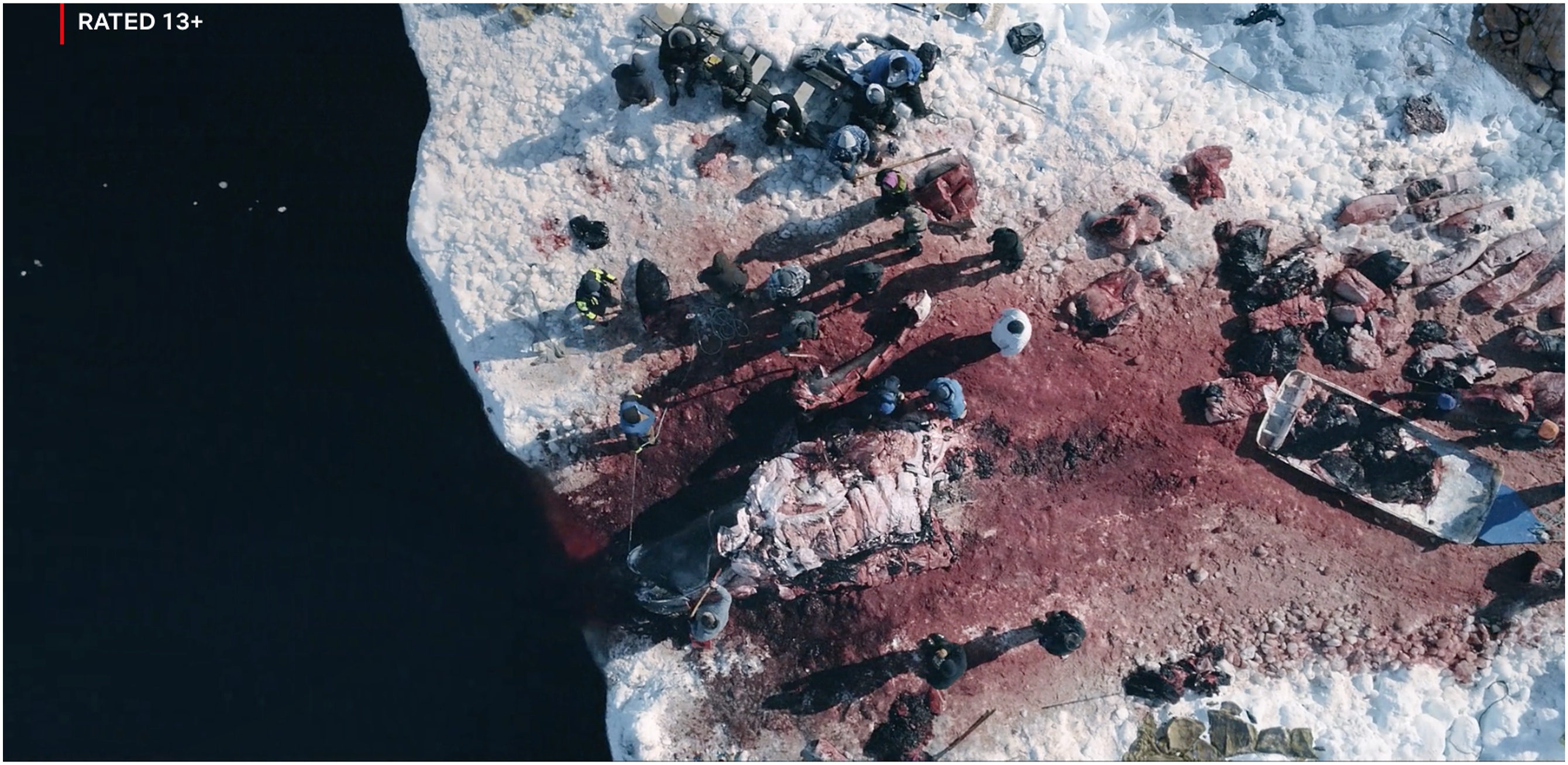
In this two-minute sequence, the narrative is anchored in Greenland with a clear local colour in the form of rural landscapes, climate, architecture, language and whaling. Besides encapsulating the main plot, the sequence symbolises transitions and change, from traditional livelihoods to new sources of income. At the same time, it illustrates the neo-colonialist trajectory of foreign actors whose oil drilling in Greenlandic soil is now to be profitable. All in all, the contrasts are clear: between tradition and change, sustainability and exploration and, from an ecocritical perspective, between snow and oil.
In the following title sequence, a strong symbolism continues along with situating the season in the Borgen universe. In the first frame, Nyborg’s profile is interspersed with floating icebergs in both stark darkness and clear blue-white icy nuances (Figure 2). In the following frames, imagery of the main characters is mixed with these icebergs drifting apart, cut together with images of torn documents and news articles. These are in sharp contrast with dark images of iconic urban sites in Copenhagen with yellow streetlamps, neon light, and heavy traffic emphasising the great distances between Denmark and Greenland—geographically, culturally, and politically. Furthermore, a frame with flames and smoke from a large industrial site underlines the ecocritical discourse: with oil engulfing the ice, the heavy symbolism is unmistakably linked to climate crisis, the political drama, the divisions between nations and characters, greed, concealment and state secrets. In this way, the Greenlandic landscapes are used as a platform for a wide range of universal, contemporary challenges such as climate and geopolitical disputes, as well as articulating growing Indigenous voices in the political and cultural debates. Still from the title sequence from Borgen—Power & Glory illustrating the melting ice seen through a drone shot of a landscape effected by climate change (Benny Box, https://bennybox.dk/project/borgen-riget-magten-og-aeren/. Accessed on 20 March 2023. Fair use).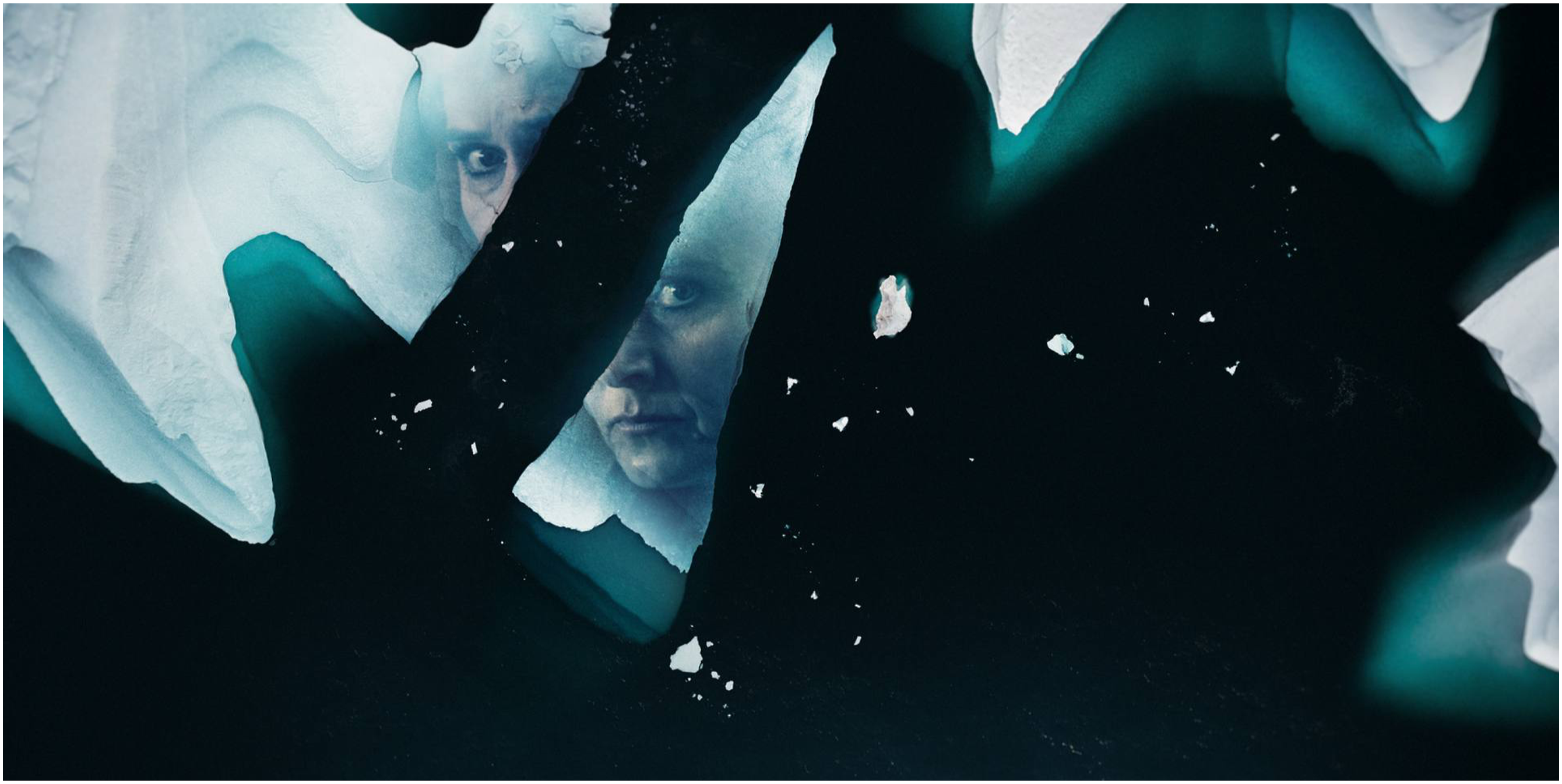
The Greenlandic landscapes are also used to show Nyborg's own professional and emotional life. Now divorced and going through menopause, Nyborg, 10 years older, is plagued by sweating, which is at odds with her professional image of absolute control. As formulated by Waade and Julia Leyda Although it is a land of snow and ice, Greenland makes Birgitte sweat as she struggles to maintain Danish political and economic ties. The Greenlandic surface is cracking, ice caps are breaking apart, liquids are coming out, oil is burning, the ice is melting, and the politicians and the citizens have lost control. (2022)
Choosing and managing a contested location
According to creator and main writer Adam Price, he met with Netflix in Paris as early as when the company was establishing itself in Europe discussing the possibility of a Borgen reboot: I own the writer’s rights for it, but it’s owned by DR … Then we managed to bring Netflix and DR together at a table … And they actually got a deal, and I think, on behalf of DR, that part of that deal was that Netflix could never interfere with the writing process at any time even though they paid most of the check. (conference presentation, 2022)
With more funding, Greenland was chosen over Iceland, although associate producer Nina Quist (personal communication, 2021) emphasises that this was an early consideration. However, partly due to Covid-19 making production across three nations highly uncertain, as well as DR’s role as a public service broadcaster making the de-selection of a nation in the Kingdom of Denmark problematic, all exteriors were placed in Greenland. This makes Borgen—Power & Glory differ from a range of productions set in Greenland such as Against the Ice and Thin Ice, which chose Iceland as the primary runaway location for Greenlandic landscapes (Grønlund, 2022a).
As a result, all exterior scenes in Borgen—Power & Glory were shot on-location in Greenland. With a 45-person crew (not counting the actors), the production was a challenge to the emerging Greenlandic screen industry and the newly established production service company Polarama Greenland, which was established due to experiences from Thin Ice (Grønlund, 2022b). The Icelandic production service company, Truenorth, was used in the early phases of research in Greenland, before the launch of Polarama Greenland gave SAM Productions a more Greenland-based service option. Polarama Greenland became an important factor in manoeuvring the particular production conditions of Greenland.
According to Price, the choice of Ilulissat as the main Greenlandic setting was an additional layer to the critical narrative If you look at climate change, every time Danish politicians want to prove a point when it comes to climate change, they go to Greenland. They stand next to a glacier that is almost gone. … I just thought it would be so ironic that not only in Greenland, but in the probably most touristed, prestigious area for tourism in Greenland, Ilulissat, that is the very core of the jewel in the crown, and that’s where they find the oil. (conference presentation, 2022)
While on-location shooting is made possible by a wide range of above and below the line personnel, two functions were at the centre of the Ilulissat recordings: Location manager Kenneth Berg and location assistant Karen Buus. Hired by SAM Productions, Berg is a highly experienced in location management in Danish fiction, for example through Den skaldede frisør [Love Is All You Need] (2012) and Norskov (2015-2017); while Buus was hired by Polarama Greenland with only one film production experience from Against the Ice. As a permanent resident of Ilulissat working in the tourism sector, Buus was a link between large-scale Danish production and the local population (personal communication, 2022).
As location manager, Berg describes his role as being at the centre of the tension between the creative and the practical, greatly involved in the production itself and the local community. There are the specifics of the locations, but also the surroundings. That is, authorities, neighbours, municipalities, regions, and now in this case a completely different part of the country or part of the world, who are completely uncomprehending when we come roaring with our ‘Danishness’ and would like to impose on them what we would like. Again, it’s something that the director and production designer want, but it's not always the case that it goes hand in hand with the context we enter. So, it’s my primary task to convey their wishes and ideas to the society … we end up in. (personal communication, 2022)
2
Furthermore, Berg points towards cultural differences and the necessity of ‘a radical change in the mindset of us Danes’ in how to approach small, Indigenous communities and understand that they are not just two different climatic and geographical realities, but two peoples who, despite 300 years of entangled histories, are in many ways culturally different. In line with this, Péronard identifies exactly what foreign productions should do to best adapt to Greenlandic conditions. Listen to the locals. And be open to schedule changes. In Greenland, the nature is so vast and powerful that you immediately understand that it controls you and not the other way around. When scheduling your shoot, flexibility is essential, so always make room for potential delays due to weather and place your interior shoots late in your schedule so they can be moved forward if needed. (quoted in Por, 2023)
Greenlandic conditions require film crews to be adaptive on several levels, which places particular high demands on location management centred on precisely what is feasible within the given conditions.
In Borgen—Power & Glory, Buus was one of the connections. According to her, the film crew on location were generally very understanding and flexible and relied on her expertise, which gave her a sense of agency. What I actually experienced was that there was a lot of trust in my ideas, and there was a lot of trust that when we as locals came up with an idea for what can be done to solve a specific scene, they listen to it … . I also experienced that there was a very good dialogue with the local assistants to support their managers, but that the managers also really listened to the local helpers. (personal communication, 2022)
Borgen—Power & Glory thus exemplifies the complex nature of location management and how it operates at multiple planning, implementation, creative and cultural levels shaped by the societal, climatic and cultural conditions of a given location. In Ilulissat, characterised by an Arctic climate, a small, Indigenous population and a colonial history, this management is particularly challenging, requiring preparation, exchanges of experiences and adaptiveness. At the same time, there is also a wider commercial potential, which is particularly evident in the marketing of the series: namely, in the national branding of Greenland as destination.
Visit Greenland and commercialisation
The connection between the tourism and film industry in Greenland is not new, dating back to the 1980s and, in the case of airline companies assisting film productions, even further back to films such as the British/Italian/French feature film, The Savage Innocents (Nicholas Ray, 1960) (Grønlund, 2023). Though the state-owned tourism agency Visit Greenland has used film as branding on several occasions, making watchlists (Cooper, n/d), promoting Nuuk International Film Festival (Visit Greenland, n/d), or collaboration with Film.gl since 2016 (Film.gl, n/d), Borgen—Power & Glory marked a new focus on screen production as branding.
On both the main website and social media outlets, the launch of the reboot resulted in multiple postings focusing on various aspects of the series. Most of these are collected in the long-read article, ‘When Borgen goes to Greenland’ (Por, 2022), consisting of an introduction to the season, the Greenlandic political history, fun facts and reviews of every episode of the season by Greenlandic member of the Danish parliament Aaja Chemnitz Larsen. In addition, four ‘actor spotlights’ were made on four of the main Greenlandic actors with small 2.5 minute presentation of themselves on their hobbies and personal life accompanied by music and images of what they describe. Each video ends with the actor presenting their favourite thing about Greenland. For instance, Nivi Pedersen describes the proximity to nature One of the things that I love about Greenland being my home is that nature is right there. And it sounds like such a cliché, but, I mean, I just look out the window and it’s right there. And I am immediately at my peaceful spot. You know, it’s just a nice little break from busy everyday life. Just look out the window. This is my view. This is where I live. (quoted in Por, 2022) When I really need to get away from everything, I like to sail to Kapisillit fjord with my family and have some free time. Just have some great food and also a little bit of free time from social media, and, when I really get tired of my family, I can just go out with some warm clothes and hike up to the mountain and have a little free time for myself and just get to breathe a little. (quoted in Por, 2022)
Following a growing international recognition of Greenlandic filmmaking, Visit Greenland has continued this most recently with the Oscar nomination of the Danish short film Ivalu (Anders Walter, 2023), which, with a Greenlandic co-director, Polarama Greenland as production service and a crew consisting primarily of Greenlanders and an all-Greenlandic cast, is also considered a Greenlandic production. Here, the production has resulted in an article on the Visit Denmark sub-site, ‘Travel Trade,’ aimed at the tourism industry; key takeaways on tourism and film are showcased, once again formulated by producer Emile Péronard Film productions can be an integral part of the tourism eco-system. As more films and TV-series break into the mainstream, we also expect that tourists will want to visit for instance the Icefjord in Ilulissat where the TV-show ‘Borgen’ was shot … . Our films help put Greenland on the map, and on the screens worldwide we have a strong platform where we can showcase our country with all the emotions and magic of storytelling. … Together, we can showcase Greenland internationally, and at the same time develop a stronger and more sustainable film industry in Greenland. (quoted in Por, 2023)
In this tale of synergetic developments of both the tourism and screen sectors is not yet critically reflecting on growing challenges, especially climate change. While it is a major issue in the tourism sector in its own right—for example, around cruise tourism—the screen industry is still a place where it is about attracting rather than regulating incoming productions. It is therefore interesting to see how the increasing commercialisation, and thus climate-impacting activity, will be handled in the future, and how this handling will be inscribed in the increasing contestedness around the Greenlandic landscapes.
Conclusion
This article has explored how the Greenlandic landscapes play a pivotal role in Borgen—Power & Glory, illustrating the different political, climate and cultural challenges facing the nation. At the same time, the Arctic wilderness is made explicit in the visual framing of the story, following the aesthetics of Nordic noir and Arctic noir. As such, Borgen—Power & Glory illustrates the growing interest in Greenland and the Arctic region as a contested setting for series produced for international audiences. Even though the series encompasses Greenlandic actors and languages, Greenlandic locations, inclusive local production companies and partners, the series still represents an outsider perspective as it is produced by the Danish production company SAM for Netflix as an international streaming service and DR as a Danish broadcaster aiming at international television markets. Through two-fold location study of both on- and off-screen elements, the article shows how contestedness informs both the visual and production aspects of Borgen: Power & Glory, drawing on exploration and Cold War discourses, among others. These geopolitical discourses are in recent times, as supported by a new focus on screen production from Visit Greenland, in a commercialisation of the Greenlandic landscapes. This coincides with increasing Greenlandic co-determination and ownership of the landscapes, which characterises both geopolitical and commercial discourses.
Footnotes
Acknowledgements
We would like to sincerely thank the interviewees Kenneth Berg, Karen Buus, Emile Hertling Péronard and Nina Quist for their time and interest.
Declaration of conflicting interests
The author(s) declared no potential conflicts of interest with respect to the research, authorship, and/or publication of this article.
Funding
The author(s) received no financial support for the research, authorship, and/or publication of this article.
