



Abstract
This article examines the distribution of LGBTQ+ television from the 1990s to the beginning of the 2020s. It presents new data of what queer-oriented series were distributed and where, uncovering the relationship between ‘distributive logics’ and centrally queer themes in mainstream television drama. Examining the emergence and proliferation of the ‘queer storyworld’ in anglophone markets of the US, UK, Australia, and Canada, it reveals how queer televisual representation has developed alongside changing modes of television distribution, particularly through liminal moments of industrial experimentation. In more recent years, this has prompted greater complexity and layering of themes in queer televisual representation.
Keywords
In 1999, UK miniseries Queer as Folk (1999-2000) broke the mould of LGBTQ+ representation on television. Broadcast on the publicly owned but commercially funded Channel 4, the series introduced audiences to a queer storyworld, an ensemble of queer friends and lovers where heterosexual characters are peripheral to the action. While novel in the late 1990s, this foregrounding of queer experience has become a staple of contemporary television, reflected in a wide range of series, genres and distribution modes. With examples including Mid-Century Modern (2025–present), The Newsreader (2021–2025), Heartstopper (2022–present), and The D Cut (2020), televisual queer storyworlds centre the lives of queer people and their communities (O’Meara and Monaghan, 2024). They use the seriality of television to tell complex and nuanced stories that can engage, challenge, and even complicate stereotypes and negative tropes associated with queer representations. Focusing on the US, UK, Australia, and Canada, we use this article to identify and chart the existence of queer storyworlds in mainstream television from the 1990s to the first half of the 2020s. We focus on distribution, bringing ‘distributive logics’ (Lobato and Ryan, 2011: 189) into queer media studies by examining the relationship between changing distribution technology and LGBTQ+ representation in mainstream television. While the role and impact of distribution has existed below the surface of key queer television studies scholarship over decades, this article brings it to the fore.
Our analysis examines how the industrial influences of distribution contribute to the emergence and proliferation of queer storyworlds. We take up Amanda Lotz’s (2025) ‘modes of industrial analysis’ to examine how queer storyworlds – considered niche programming – are products of ‘niche [m]odes of industrial practice’ (2025: 228). We consider the ‘odd operations of televisual logic’ (Joyrich, 2014: 136) and ‘distributive logics’ (Lobato and Ryan, 2011: 189) as influencing queer storyworlds in television. Through content analysis, we identify, log and count the appearances of queer storyworlds across anglophone television production markets in the US, UK, Australia, and Canada. We then examine the texts themselves, interpreting themes in service of classification. Finally, we take these identifiable textual elements as a site to examine ‘distributive logics’ and to take the ‘utility of distribution research within the textualist tradition’ (Lobato and Ryan, 2011: 189), in this case, of queer television studies.
We limit analysis to the anglophone markets of the US, UK, Australia, and Canada because of their shared language, somewhat comparable cultural approaches to television, and the ability to access stories through available services and networks in Australia, where we are located. We acknowledge that other markets feature queer storyworlds in different ways that are responsive to their own cultural contexts. We undertake this charting much in the way scholars have previously sought to develop near-encyclopaedic lists of queer character appearances in single markets (see Monaghan, 2020; O’Meara and Monaghan, 2024; Tropiano, 2002; Vanlee et al., 2020). This list serves as an active and ongoing project to be built upon to help identify trends and gaps, empower audiences to understand and engage with queer content, and inform future research.
Building on initial use of the term ‘queer storyworld’ within queer television studies scholarship (Young and Herbig, 2020), we define queer storyworlds as series that emphasise the social dynamics of a group of LGBTQ+ characters. We consider queer storyworlds to be set in, or prominently feature, a queer community context, meaning the spaces we cultivate and build community, and to offer queer stories that are layered, complex and that complicate LGBTQ+ representations through serialisation. Within this frame we include series that vary in scale and approach, and those that may be considered too mainstream by some but meet these conditions.
This charting excludes the many single-episode and limited story-arcs where the setting and/or time investment are insufficient to constitute a queer storyworld. As such, it excludes Ellen (1994–7), where the series’ cancellation meant the revelation of the title character’s sexuality cut short the potentiality it presented. It also excludes the niche pay-per-view service here!, where morally dubious, gothic queer characters (Owens, 2019) do embody this complexity and setting, but the distribution format is out of scope.
Through our analysis, we find that queer storyworlds often emerge during the liminal moments of experimentation that take place in response to technological disruption. Starting with acknowledgement of the progressive experimentation in Australian and UK television in the 1970s and 1980s and then charting the 1990s to the mid-2020s, we argue that different modes of distribution foreground shifts towards more prominent queer storyworlds. However, as television becomes more disrupted by new media technologies, markets with prominent public service broadcasters (PSBs) see this format become significant for local queer stories.
Queer storyworlds and mainstream ‘distributive logics’
Within television studies, distribution refers to the process of delivering content to audiences through broadcast channels and digital platforms. Ramon Lobato and Mark David Ryan (2011) identify the utility of distribution research, challenging the idea of distribution as a neutral technology of transmission to highlight the power of ‘distributive logics’. Lobato and Ryan use this to analyse the role of distribution in the cultural development of a film genre. The approach has also been applied in numerous television studies contexts, including: genre specific subscription video on demand (SVOD) services (Balanzategui and Lynch, 2023); SVOD and online distribution for children’s screen genre (Balanzategui, 2020); and the influence of globalised streaming distribution on the development of cinema and television in specific ‘national’ markets (Bedir, 2024; Meir, 2024). The relationship between distribution and textual practices is also explored in Amanda Lotz’s recent work on industrial changes in US television, though she advocates for an approach that focuses on ‘modes of industrial practice’ (Lotz, 2025) rather than distribution in the traditional sense. Focusing on the multiple ways that television has changed over the past 25 years, Lotz highlights how ‘the business of television has grown more varied and more types of series have become commercially viable as a result’ (2025: 225). The explicit link we draw to ‘distributive logics’ is significant for how the moments of experimentation appear to enhance the potential influence of other factors.
‘Distributive logics’ have long been beneath the surface of queer television scholarship, which regularly acknowledges the impact of distribution as part of socio-cultural, regulatory, and policy factors that influence these representations (see Avila-Saavedra, 2009; Becker 2006; Ng, 2023). For instance, though it was not described as a study of ‘distributive logics’, Ron Becker’s (2006) research into the rise of gay-themed US television in the 1990s examined the impact of niche marketing and cable competition on network television. Becker’s research broke down assumptions about US audiences as singular, highlighting how networks courted upscale adult demographics through ‘edgy’, ‘hip’, and socially liberal content. This shift established a foundation for the proliferation of gay storylines and characters throughout the decade, albeit in a largely sanitised and depoliticised form.
Similarly, Guillermo Avila-Saavedra’s examination of hegemonic gay masculinities in US television, pointed to issues of distribution as it was based on ‘the premise that network and basic cable have a broader reach and therefore a stronger influence’ on representational norms than premium cable, which attracts smaller niche audiences (2009: 9). There is also a significant body of scholarship examining the impact of cable and the rise of narrowcasting as an influence on queer stories appearing onscreen (Dhaenens, 2012; Himberg, 2014; Ng, 2023) and the impact of streaming (Christian, 2020; Symes, 2017; Vanlee, 2024) that brings issues of distribution to light. A common theme within this scholarship is the conservatism of the advertising-oriented model of television, where queerness is sanitised to appease advertisers in mass distribution approaches but is allowed to flourish in cable, narrowcasting, and niche distribution contexts. Across this scholarship, US television remains a dominant focus. This article puts four culturally aligned, but distinct markets in conversation with one another to add nuance to these arguments while further contextualising the dominance of the US model for understanding queer television.
Drawing on these insights, we embrace Lobato and Ryan’s (2011) approach to argue distribution is not a neutral process for queer television. We examine a range of distribution formats over decades – commercial broadcasters, PSBs, cable/satellite networks, SVODs, broadcast video on demand (BVOD), and limited examples from independent distribution – and apply these logics to the development of queer storyworlds for mainstream television. That lack of neutrality becomes evident through comparing the US, and its largely deregulated industrial ecology, to markets with greater regulation and more prominent PSBs. Queer storyworlds can often emerge as a logic of regulatory affordances and/or public funding responses to disruption. Taking up Lotz’s call to expand investigation of modes of industrial practice (2025: 230–1), we put forward our own examination – one embedded in the ‘collisions and contradictions’ of queer television (Joyrich, 2014: 136) – where disruption foregrounds experimentation with new niche programming. We view this within both the purist commercial ideologies often attributed to commissioning logics and the more cultural-commercial balance foregrounded through regulatory affordances. As Lotz states ‘there is reason to regard many titles categorized as “niche” as emanating from a “niche mode of industrial practice” that derived from the dual funding for pay-TV among other differences’ (2025: 228). We place our analysis on those ‘other differences’ across four anglophone markets and three and a half decades.
To set up this examination, it is necessary to identify some key characteristics of each distribution format. Commercial networks are a broadcast medium that assembles audiences to achieve ratings, selling advertising space to reach those audiences (Meyers, 2021: 471). In this framing, commercial broadcasters are concerned with programming for the broadest possible appeal and have historically been risk averse to telling niche stories about underrepresented communities (Griffin, 2023). Cable/satellite networks are also commercially motivated, using a subscriber model, and may seek to carve out niche audiences through their programming choices (Smith-Shomade, 2004). SVODs and BVODs (for both commercial and public broadcasters) are non-linear internet distributors, the former being a subscription service designed for internet distribution, while the latter emerged as a broadcaster’s online option. There are only limited examples of BVOD-first series in this study, which we identify align closely with their commercial or PSB parent-distributor approaches. Independent online distribution is included in a limited capacity for examples that made the shift to mainstream formats after finding an audience.
It is necessary here to single-out PSBs, which are publicly owned and often publicly funded – although examples such as Channel 4 in the UK, and the Special Broadcasting Service (SBS) in Australia are publicly owned and can be fully or partially funded through advertising – and hold charter responsibilities to serve and reflect their national audiences. While we note that PSBs might be thought of as not distinct from commercial broadcasters, we argue that they are their own distribution format.
PSBs use the same distributive modalities as commercials, but the regulatory charters governing their role are in fact a core facet of their logics. In the ways they are significant for diversity, we contend PSB charters and policy frameworks become intrinsic to how they respond to disruption. In the UK, Australia, and Canada – not so in the US for this study of queer storyworlds – both publicly funded and advertising supported PSBs sit alongside commercials as major distributors. As part of their remit, they must provide local content that is broad-reaching, accessible, high quality, culturally significant, and representative of national identity (Ang et al., 2008; D’Arma, 2018; Department of Canadian Heritage, 2021). Despite the ‘must carry’ obligations of the US and some European markets (see Valcke, 2005) that some may feel blur the distinction between different broadcasters, the PSBs that include queer storyworlds in the UK, Australia, and Canada balance a dual focus on both cultural contribution and audience appeal in ways commercials in these markets appear unwilling to risk. Thus, we classify PSBs in these markets as representing a distinct distributive format with its own logics.
In view of ‘distributive logics’, our analysis shows that queer storyworlds emerge when distribution formats are seeking to innovate or differentiate themselves from other channels in the market. Where other production focused studies examine the ways such logics uphold normative representations (Vanlee, 2019), we see queer storyworlds as the examples that challenge such approaches. They emerge through experimentation at key establishing moments, such as: in the 1990s, when the UK’s first advertiser-funded PSB was pushing for more diverse scripted content (Dell, 1998); through the proliferation of cable television in the US and subsequent ‘narrowcasting’ strategies in the 2000s (Smith-Shomade, 2004); and with the disruption of SVODs and theories of conglomerated niches in the 2010s (Lotz, 2022: 46). We survey and chart where and when queer storyworlds emerge to identify their relationship to disruption.
From a moment of queer experimentation to established queer storyworlds over the decades
For the UK, US, Australia, and Canada, the 1970s and 1980s saw a forging of the key recognisable genres and styles of their respective television brands. These factors become important for the emergence of queer storyworlds in the 1990s. During this period, the UK and Australia saw brief, but radical examples of experimentation that indicated the potential of television as a site for queer storyworlds.
Industrially, the UK was making more comedy, soap opera and science fiction under the production arms of its broadcast networks (Currie, 2004). In the US, this period includes the ‘network era’ – known as TV I – and part of the uptake of home video and cable technologies – TV II (Lynch, 2022). In 1952, Canada and in 1956, Australia were latecomers to television, and this status meant there were legislative moves to regulate this new media technology, which has been central to these markets’ ‘distributive logics’. Canadian legislation in the late-1960s sought to ensure local content that represented ideas of national identity, supporting a brief period of innovation in genres and styles before developing more standard conventions for which its national brand is recognised (Collins, 1990; Rutherford, 1985).
For Australia, three series – Number 96 (1972–7), The Box (1974–7), and Prisoner: Cell Block H (1979–86) – were part of a significant, short-lived experimental period following the introduction of legislation in the 1960s to ensure local commercial broadcasters were commissioning local content. As such, the 1970s and 1980s were decades where Australian broadcasting sought to develop and assert its scripted television brand (Cunningham and Turner, 2020). Queer stories were featured as part of that process despite the policy being silent on such inclusion – as also seen for public service media in other markets (Vanlee, 2024). Similarly, UK PSBs BBC One and BBC2 were experimenting with such remits under their socially and culturally driven ethos, including a lesbian storyline in Girl (1974) and the extended story of a gay man in EastEnders (1985–present) from 1986. These series are recognised for their groundbreaking representations of LGBT stories (McIntyre, 2015; Monaghan, 2020). While we are careful to not directly classify Australia’s Number 96, The Box, and Prisoner: Cell Block H, and the UK’s Girl and EastEnders as queer storyworlds from our contemporary vantage point, they are early examples of the potential of television’s seriality. We note the significance of the stories as the first instances of queer serial narratives that we identify as a product of liminal moments of experimentation. Thus, the 1970s and 1980s provide our first indication of the potential of this experimentation, ahead of queer storyworlds in the 1990s.
Queer storyworlds of the 1990s
By the 1990s, queer storyworlds emerged through distributive experimentation as the UK and US were facing disruption with the rise of cable/satellite television. Australia’s brief moment of queer sensibility in commercial networks had ceased, and uptake of cable/satellite television was lower than other markets (Eklund, 2023). As such the market focused on tried-and-tested genres, such as formulaic crime and medical procedurals, where queerness was limited (Monaghan, 2020). While Canada did see a proliferation of cable television – starting in the 1980s – it became a site to access US television (Collins, 1990) and it was not until the late-1990s that cultural funds sought to include cable in pushes for local stories (Beaty and Sullivan, 2006). In this decade, however, the US and UK made some of the most bold and consequential advances for mainstream queer television.
Identified television series with queer storyworlds in US, UK, Australian, and Canadian markets in the 1990s.

aSeries appearing over multiple decades.
Gay representation dominates the queer storyworlds we have identified in the 1990s, though there are some lesbian characters and inclusions of other queer identities. The adaptation of Armistead Maupin’s Tales of the City was significant for the original books being products of openly gay authorship. It was soon followed by Will & Grace, created by openly gay producer, Max Mutchnick, which walked the challenging tightrope of placing a queer storyworld in the distinctly non-queer space of US commercial network television (Battles and Hilton-Morrow, 2002). Both series include homes, nightclubs and bars, and community groups that constitute the required inclusion of queer community spaces for the queer storyworld. Will & Grace even has moments of complicating gay identity – including an example of using a slur that resonates as particularly truthful for Author 1’s experiences as a gay man within this community – such as when Will’s (Eric McCormack) internalised homophobia manifests in a moment where he calls Jack (Sean Hayes) a ‘fag’ (S1E19 ‘Will Works Out’, 1998). It is a rare inclusion within the series that illustrated brief moments of queering this storyworld. A direct quote of the slur is used here in the spirit of ways queer storyworlds resist censoring the complicated truth of community experiences while also seeking mainstream distribution. Such uses are also evident in more readily recognised examples, such as Queer as Folk, where the slur is used by characters to reclaim the word.
US commercial and cable/satellite examples of this decade gave the broader non-queer storyworlds prominence. Such prominence is significant because in the early-1990s US networks were marred by the story of the cost to advertising revenue of thirtysomething (1987-91) airing a scene with two gay men in bed (Becker, 2006). However, lesbian and gay characters emerged later in the decade as networks sought to compete with cable. The longer running series Will & Grace and Undressed prominently feature the queer community but in distinctly straight framings. Undressed includes several gay characters, who form community and engage in the broader community as part of its anthology of stories about sex (both gay and straight).
In the same decade Queer as Folk – also a product of queer authorship by gay showrunner Russell T. Davies – became the first example of a fully queer storyworld. It presents a world entirely centred on queer lives, community and issues, and where non-queer characters and settings are often peripheral to the action, sometimes brought in to provide a foil for a story arc, much in the way queer characters have been identified as doing so in other screen studies scholarship (Monaghan, 2020; Tropiano, 2002). Through this example, we see the first realisation of the fully queer storyworld emerge through Channel 4’s experimentation within its culturally motivated remit.
The queer storyworlds of the 1990s show ways queerness was asserted in mainstream distribution, as more established broadcasters sought to attract and retain audiences through significant technological disruption. While Will & Grace and Undressed are both groundbreaking, it was the experimentation taking place through a minority-focused PSB – Channel 4 in the UK – where the first fully queer storyworld was distributed, with Queer as Folk. The importance of this advertiser-funded PSB as a distributor is that it provided a space where niche, even risky queer content, could be negotiated as something that could serve both their cultural and commercial function. It was in a way that commercial broadcasters appeared unwilling or unable to push as far. That PSBs, broadly, became distributors where such risks can be taken becomes apparent in later decades, but not before a drop-off throughout the 2000s.
Queer storyworlds of the 2000s
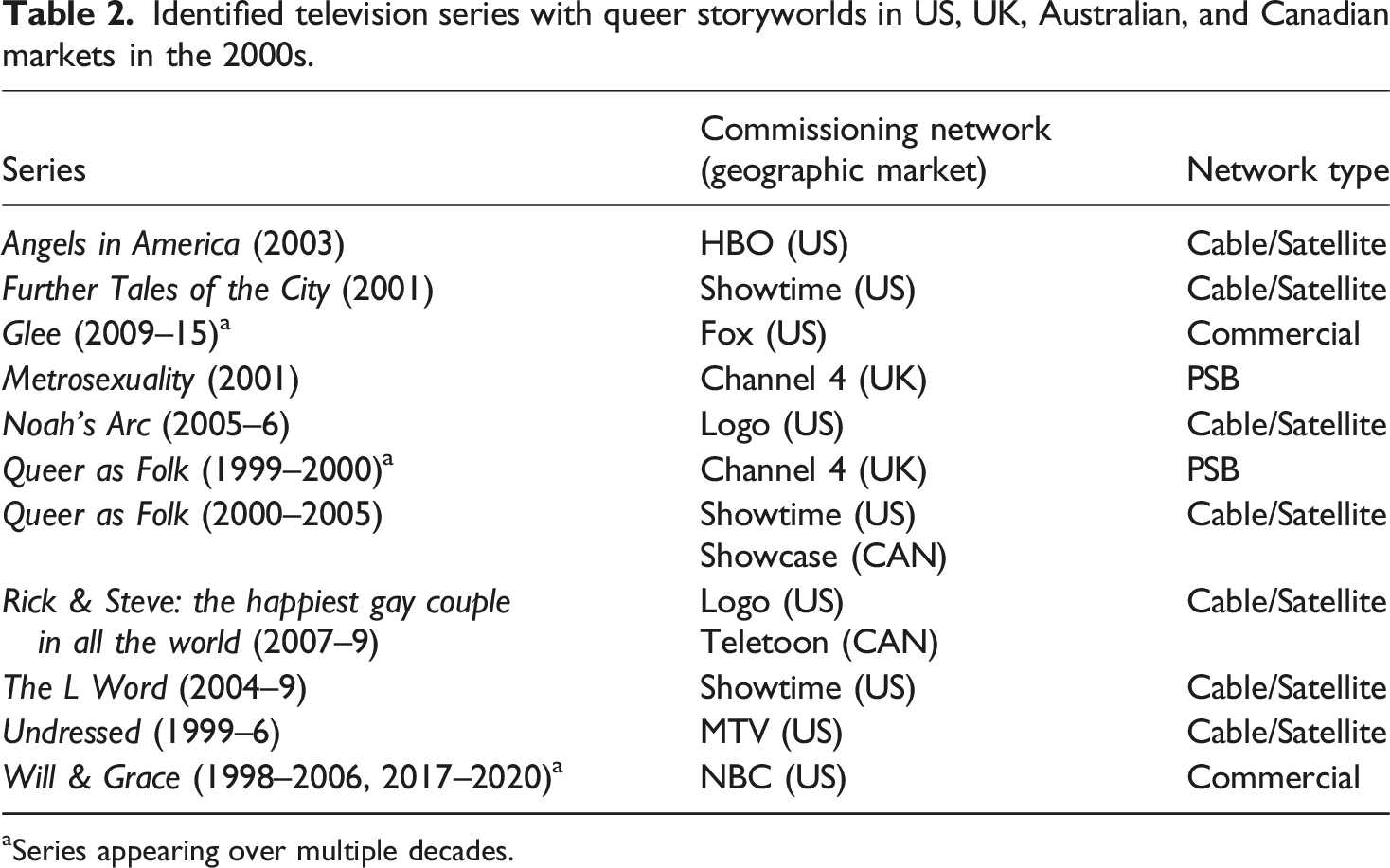
Identified television series with queer storyworlds in US, UK, Australian, and Canadian markets in the 2000s.
aSeries appearing over multiple decades.
The prominence of cable/satellite, particularly in the US, and to a smaller degree in Canada, contributes to more queer storyworlds. Julia Himberg posits that lesbian representations provided a ‘cutting-edge distinction that networks like Bravo and Showtime believe their audiences seek out on cable TV’ (2014: 293). While Eve Ng (2023) argues the LGBT-focused cable networks Logo and Bravo contributed to the mainstreaming of queer content within the decade. Of the eleven series aired in the decade five are centrally queer storyworlds – where straight characters are peripheral – distributed on cable/satellite networks: Angels in America, Noah’s Arc, Queer as Folk (US/CAN), Rick & Steve, and The L Word. The dominance of these storyworlds on cable/satellite in the 2000s reflects the view that such distribution became recognised for a willingness to seek niche audience segments with series led by underrepresented identities, often discussed for the ways Black-led series became a key feature of some cable network brands (Fuller, 2010). Although, the dominance of the US is also seen in how Canadian-made queer storyworlds were co-commissions with US counterparts and set in the US. US-Canadian co-production Queer as Folk (US) is set in Pittsburgh, Pennsylvania, and Rick & Steve is set in the fictional US town of West Lahunga Beach. The US also saw the launch of queer-focused cable/satellite networks, including Logo, the distributor of two queer storyworlds: Noah’s Arc and the US release of Rick & Steve.
Commercial networks and PSBs include two queer storyworlds each within the 2000s. Glee, similar to Will & Grace, took a mantle of queer characters in distinctly commercial – and therefore unconventional – spaces (Battles and Hilton-Morrow, 2002). However, the broader ensemble meant this queerness, while prominent, was more part of the various narratives, in the style of Undressed. Still, we include Glee with other more recognisable queer storyworlds for the role seriality played in the evolving representations and community spaces they include over the life of the series. The limited second season of Queer as Folk (UK) and Will & Grace were both continuing from the previous decade.
For many of the examples listed within this decade, the distributive influence of narrowcasting still saw limitations. Many of the identified series in the 2000s face critique for their lack of intersectional queer stories. Queer as Folk (US) is described by Wendy Peters as focusing on ‘valuable’ demographics of ‘viewers with access to race, class, and male privilege’, and thus leading ‘to whitewashed images of middle-class, primarily gender normative, gays and lesbians’ (2011: 194). Glee has been met with criticism for its reliance on stereotyping (Meyer and Wood, 2013). However, Noah’s Arc is a notable exception on Logo – the first scripted series for the LGBT-focused cable network – featuring intersectional stories of Black gay and bisexual men, created by an out gay Black man. Similarly, Channel 4 miniseries Metrosexuality brings an intersectional story of Black gay men living in England, told through the straight-identified son of two, bitterly separated men, and is included for its novel portrayal of gay dads, queer community spaces and a variety of queer characters. For a cable/satellite network that was already branded for the LGBTQ+ community, and a minority-focused PSB, the experimental approach of these niche distributors took on underrepresented positionalities rarely seen in the other queer storyworlds we identified within the decade.
Cable/satellite networks dominated in the distribution of queer storyworlds in the 2000s as its growing proliferation led to greater experimentation. As has been examined regarding Black representation (Fuller, 2010), seeking niche audiences through cable/satellite distribution leant itself to more complex stories, something we observe taking place through this decade for queer storyworlds. At the same time, PSBs and commercial broadcasters appeared to be pulling back on more radical representations, as they faced fracturing audiences and increased competition throughout the decade.
Queer storyworlds of the 2010s
Identified television series with queer storyworlds in US, UK, Australian, and Canadian markets in the 2010s.

aSeries appearing over multiple decades.
Despite the impact of streaming on ‘distributive logics’ through changing how audiences engage with television (Balanzategui, 2020; Meir, 2024), only seven of the series we identified as including queer storyworlds involved SVOD distribution in the 2010s. PSBs were becoming significant in the UK and Australia, again as a more consistent site of local drama. This shift was perhaps, as seen in the Australian context, due to an increase in government funding to PSBs seeking to uplift local drama in the face of new disruption, including the rise of dominant global – but US-aligned – streaming services (Potter and Lotz, 2022). The first Australian all-queer storyworld came out in 2012, with Outland on the ABC after decades of limited drama funding to the PSB.
The 2010s is our first inclusion of ‘independent’ series. We note that, during the 2010s, US-based independent series were key in telling complex intersectional stories of Black queer and trans lives (Christian, 2020). However, the included examples show how independent distribution can be used as a pathway for queer stories to move from web series to mainstream distribution. Starting From…Now made that leap in 2016 by being picked up by SBS for its final two seasons (Monaghan, 2017). The web series Eastsiders was rebooted through a commission by Netflix in 2017. As such the many independent series that did not make this leap are excluded from this study due to its focus on queer storyworlds in mainstream distribution formats.
The decade also saw experimentation through transmedia storytelling between the advertiser-funded PSB, Channel 4, broadcasting Cucumber – about a middle-aged gay man going through a midlife crisis and separation from his long-term partner – and its secondary multichannel, E4, with Banana – about young group of LGBTQ+ diverse people in the same storyworld. In addition, the series had a third piece through its BVOD, 4oD with Tofu (2015) – a documentary about attitudes to sex in queer communities – which is excluded from this study as it is an unscripted format.
Unlike the 2000s, where cable/satellite dominated the distribution of queer storyworlds, the 2010s saw greater variety in where these stories were seen. It reflects understandings of fracturing audiences and growing experimentation across the breadth of distribution types. This industrial mode of experimentation foregrounded more niche content to attract audiences. However, PSBs were taking on a larger role in the UK and Australia, perhaps because of their charter responsibilities.
Queer storyworlds of the 2020s, so far…
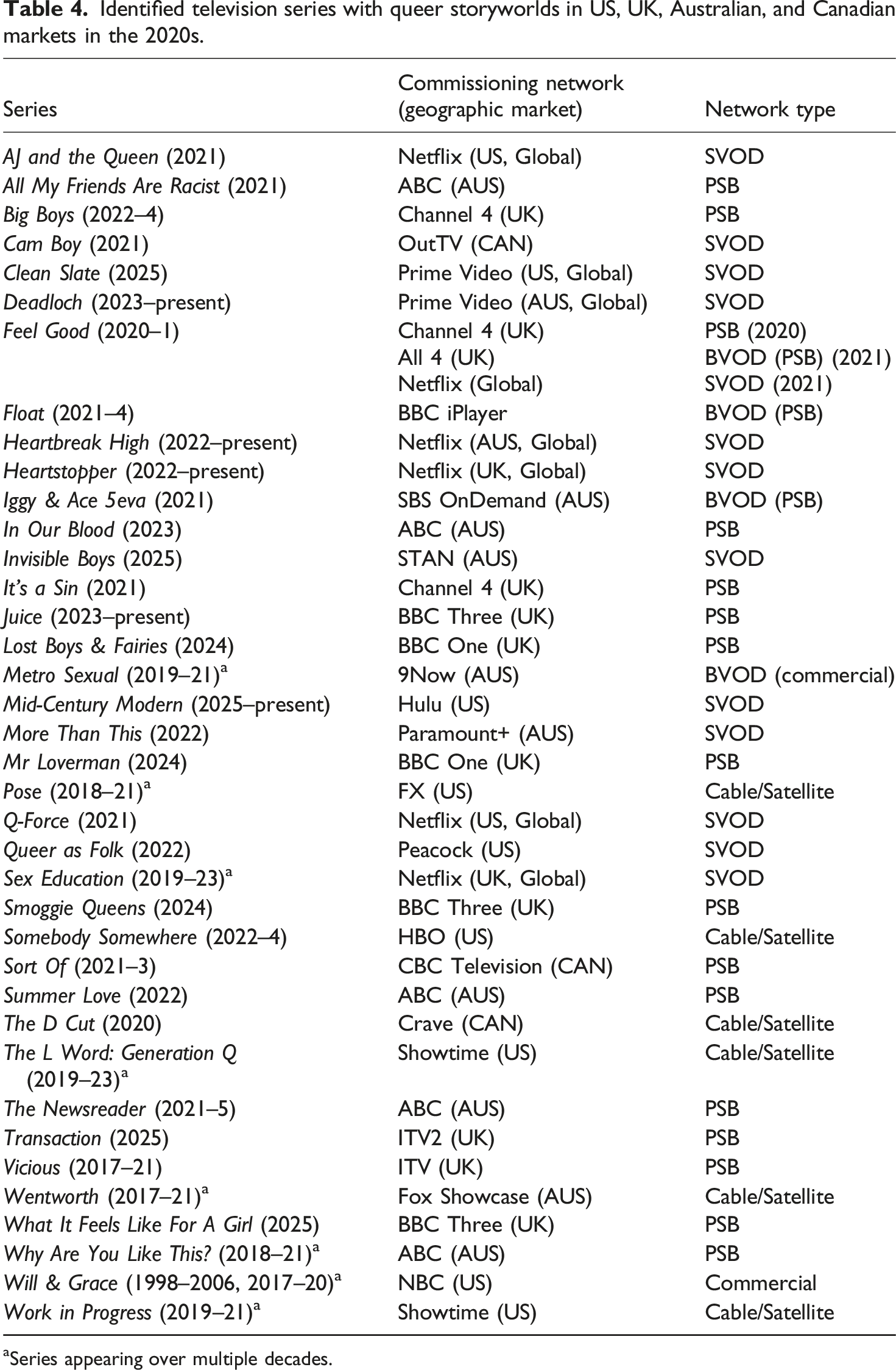
Identified television series with queer storyworlds in US, UK, Australian, and Canadian markets in the 2020s.
aSeries appearing over multiple decades.
These trends reflect a rise in SVODs focusing on and building their own commissioning slates through an industrial mode of experimentation, particularly in the local markets where they operate. However, in markets with more prominent PSBs – the UK, Australia, and Canada – there has been a growing role for these distributors to undergird local drama commissions in the face of unregulated SVODs (Chivers and Allan, 2024; Department of Canadian Heritage, 2021; Lotz et al., 2024). For example, with more prominent drama on Australia’s major PSB, the ABC, there was also a rise in the complexity of the queer storyworlds we see. All My Friends Are Racist is one such example that centres an intersectional queer and Indigenous story. In Our Blood on the same distributor tells the dramatised story of Australia’s activist and government responses to the HIV/AIDS epidemic of the 1980s, with exploration of the work undertaken by queer, Indigenous, and sex worker communities that was influential on the government response that took place.
Many of the stories in this final table show how experimentation in the face of changing distribution has leant itself to new queer storyworlds. PSBs provide what we observe to be some of the most complex and challenging queer storyworlds. However SVODs, as they build their slates, are also pushing boundaries as distributors that face less regulation and oversight from governments/regulators. However, the beginning of the 2020s has also seen several instances of rebooting such stories of the past. The Netflix reboot of the Australian teen series Heartbreak High (1994–9) in 2022 brought in complex queer stories, going beyond the brief gay storylines in the original. Cable/satellite and commercial reboots of The L Word (updated with ‘Generation Q’) and Queer as Folk sought to take on the existing intellectual property (IP) of past queer storyworlds in this new cultural moment of distributors experimenting with content. Just as Jaap Kooijman identifies the reboot of Will & Grace as ‘not necessarily [r]esonating with younger generations searching for more inclusive LGBTQI+ representations’ (2019: 454), we observe these reboots seek to use the existing IP and radical origins to capture the cultural moment but somewhat struggle to feel as groundbreaking as their originals.
The 2020s are continuing to develop, with a key trend being that there are more queer storyworlds, with SVODs and PSBs as early leaders. But there are questions about what the future will look like. SVODs are facing calls – and overdue promises from governments – for more stringent regulation and reinvestment requirements for local content in many non-US markets. We are also in the midst of legal and cultural backlash against queer visibility, particularly in the US (Weaver, 2025). It remains to be seen if this decade will continue its exponential growth of the queer storyworld through streaming distribution. The importance of monitoring the changes taking place is vital, particularly outside the US where PSBs may or may not continue to undergird queer visibility.
Conclusion
Across three-and-a-half decades and four geographic markets, we have traced the logics of new media disruption and experimentation that creates space for queer storyworlds to emerge in mainstream television drama. As we see throughout the decades of television encountered here, queerness has often provided a way to create ideas of novelty and appeal as new distribution formats experimented with ways to stand out in increasingly crowded television markets. But as these approaches have evolved, we also identified how they have potential for greater complexity and layering of themes that surround identity, community and space, to create more depth to the queer storyworld.
While there are moments of temporary experimentation across our sample, especially in PSBs and niche cable networks, we recognise that it was often the function of these distributors to push the boundaries of such storyworlds. In particular, PSBs in the UK, Australia, and Canada have evolved in their approach to balancing cultural and ratings interests over the decades by interpreting their charters and guidelines with contemporary sentiments. Thus, they have become sites for queer storyworlds when disruption appeared to tamp down other distributors’ inclusion of local drama. Mainstream commercial broadcasters have also played an important role as innovators, splashing in the shallow end of the queer pool with often benign, but highly influential representations of – mostly gay – queer lives. With their profit mandate, commercials feature some of the most popular and far-reaching queer storyworlds, but also some of the most normative queer representations. Meanwhile, streamers appear to be finding their place as commissioners and distributors of these worlds. They distribute queer storyworlds that seem to balance the mainstream and niche sensibilities that exist in contradiction. Like cable/satellite, there is a commercial mandate but one built on the disruption and innovation associated with non-linear distribution. We have identified exciting, boundary-pushing queer storyworlds that have been distributed by streamers, but there is not yet a significant enough trend to cement their role as the primary locus of queer stories in the 2020s – especially with recent reports of reduced screen industry investment from streamers in our own local market (Burke, 2024) and concerns about key queer series cancellations in the US (Paul, 2025). We write this article at a time when streaming services are still experimenting and are a site for continued analysis for the foreseeable future, particularly for the many services out of the US where the future of mainstream queer storyworlds is a concern.
By charting queer storyworlds this article presents vital data that can now inform future analyses into specific series, representations, and complications within this format. We hope it prompts further examination of the queer storyworld in the frame of what and where it is distributed. We also see potential for analysis into how these series travel between markets, such as our own viewing of the cable/satellite-commissioned Queer as Folk (US) through the advertiser funded PSB, SBS in Australia in the 2000s or the PSB-commissioned It’s a Sin through the Australian national streamer Stan in the 2020s. Further examination could also take us beyond anglophone distribution contexts, and the influence on intersectional queer representations. We hope to see scholars discuss this phenomenon through various, intersecting, overlapping and contradicting queer identities as they manifest in different markets and cultural contexts.
Footnotes
Declaration of conflicting interests
The authors declared no potential conflicts of interest with respect to the research, authorship, and/or publication of this article.
Funding
The authors received no financial support for the research, authorship, and/or publication of this article.
