



Abstract
Through a grounded theory analysis of 1301 collection reviews from The New York Times and The International Herald Tribune, issued between 1949 and 2010, the article discusses the shift in the themes that journalists employ to make sense of the latest collections. Contemporary journalists pay far less attention to the materiality of fashion than their earlier colleagues did. In the late 20th century they construed designer fashion as an intellectual practice. The article traces this shift to developments in the structural organization of the field of high-end fashion production, which today is involved in a process of de-artification, as the commercial aspects of the fashion system became more apparent in the later 20th century. In the 1990s leading fashion journalists drew on the new intellectual conception of designer fashion to engage in a process of re-artification. Hereby they seek to create an image of cultural worth for their object of criticism and for themselves, while they also seek to reinforce the long-standing but challenged division between mass market and high-end fashion.
Keywords
Introduction
Over the course of the past four decades the production system of high-end fashionable dress has lost many criteria on which people may rely to regard this type of fashion design as an artistic practice. One such criterion is the current lack of creative autonomy for high-end fashion designers (Crane, 2012), whose businesses tend to be owned by luxury conglomerates. This results in a marked public emphasis on the idea that high-end fashion design is a commercial endeavor, and a successful one at that. Today the world of designer fashion is held in high esteem because it constitutes ‘serious’ business (Tungate, 2005: 4), not because it has gained much cultural or artistic worth.
Although scholars scrutinize whether high-end fashion ever reached full-blown art status, today it seems involved in a process of de-artification (Crane, 2012). High-end fashion design has lost the artistic status that was somewhat attributed to it in the early and mid-20th-century period of couture domination. Couturiers then fashioned themselves after ‘artist geniuses’ (Crane, 2012: 105–8) and created a sense of the creative autonomous individual by dismissing the idea that fashion design has a commercial complexion (Parkins, 2012).
Nevertheless, Shapiro and Heinich (2012) noted that de-artification is not a one-way street. The various groups of actors engaged in the symbolic and material production of a particular practice may emphasize diverse and conflicting views on the practice. When some believe that the object of their concern has lost too much of its former artistic recognition, they may seek to set in motion a process of re-artification.
Through an analysis of the themes on which the leading fashion journalists of The New York Times and The International Herald Tribune relied to review the designs shown on international catwalks between 1949 and 2010, 1 this article observes that, beginning in the 1990s, journalists began to re-artify designer fashion. They did so by construing their object of criticism as an intellectual practice, for which they demanded that designers critically explore issues internal and external to the system of high-end fashion production. Such an intellectualized journalistic conception of designer fashion was unheard of before.
I will show that in the 1950s and 1960s journalists primarily understood the reality of fashion as constituted by material stuff and tangible practices. In this period journalists examined in great detail the fabrics, cuts and the technical skills required to deliver well-crafted clothing, while they also recognized the commercial aspects of fashion.
Yet by the 1970s the organizational culture of high-end fashion production began to change. For instance, the institutionalization of prêt-à-porter or luxury ready-to-wear in Paris assisted in the development of a greater field-wide acknowledgement of the commercial aspects of high-end fashion. The de-artifying that followed from this public acknowledgement of fashion’s commercial nature formed the impetus in the 1990s for journalists to intellectualize the conception of fashion. The article accounts for the marked shift from material to intellectually-centered categorization by elaborating on the gradual de-artification of the (Parisian) fashion system. I also touch on processes of concept-orientation in the arts to probe journalists’ move toward a discourse of intellectualization.
The study observes that journalists promoted the expression of intellectual concerns in fashion design by employing the rhetoric invested in the modernist tradition of ‘depth’ (Jameson, 1984). This may be surprising, given the widespread agreement in the fashion studies literature on the importance of the postmodern aesthetic tradition and its more readily acknowledged embrace of commercial values in the current fashion landscape (e.g. Crane, 1997: 125; Kaiser, 2012). The journalists at the turn of the 21st century interpreted the primary objective of all types of high-fashion as delivering designs ‘with a depth of thought behind streamlined clothes’ (Menkes, 2010a: 6, my emphasis). Thus they pushed the stuff of fashion further in the background of the review practice, because they did not perceive material features and the commercial aspects of the fashion industry as elements of high-end fashion that make it matter to the reader. Interestingly, this intellectualizing approach dismissing both the commercial and material aspects of designer fashion travels across national borders. In her study of fashion writing in the French newspaper Le Monde in the late 1990s, Rocamora (2002a: 91) has argued that ‘the creations of the designers are depicted as immaterial objects whose substance has transcended its own matter’. She concludes that these fashion journalists too ‘extract [the clothes] from their position of potential objects of physical consumption, trivial commodities’ (2002a: 93). I argue that the turn to the modernist rhetoric of depth feeds into the explicit aim of current NYT and IHT journalists to intellectualize high-end fashion design so they may engage in a process of re-artifying what is still largely de-artified.
This article contributes to the sociological knowledge of the fashion press a longitudinal map of the shift in the broad thematic categorizations that leading journalists use to grasp fashion design. I further seek to develop a more complex understanding of the idea that high-fashion is embedded in the process of losing its earlier somewhat artistic status by demonstrating that one influential group of industry professionals, i.e. the first-hand attributors of symbolic discourse, use various rhetorical tools to commence a process of re-artification.
Before I discuss the shift in the themes that articulate the symbolic boundaries drawn or the ‘conceptual distinctions made by social actors to categorize objects, people, practices’ (Lamont and Molnar, 2002: 168) in journalistic fashion reviewing, the next section examines the current sociological understanding of the fashion press. I argue that in the small and close-knit community of fashion journalists (McRobbie, 1998: 161), the fashion writers of the NYT and IHT strengthen their fashion capital by fabricating an identity of the uninvolved critic by deliberately distancing themselves from too much commercial entanglement with the industry.
Fashion Journalists and Fashion Media Discourse
Bourdieu understands fashion as a collectively manufactured cultural practice (Bourdieu, 1993a; Bourdieu and Delsaut, 1975) that relies on cultural intermediaries for its dissemination and legitimization. Examples of these intermediaries are fashion journalists (Rocamora, 2009) who write for a double readership of both potential fashion consumers and industry professionals (Kawamura, 2004). They inform and instruct this public on how to interpret and evaluate fashion correctly (Bourdieu and Delsaut, 1975: 25). Although the visual discourse of fashion is central to convincing the public of the fashionable status of an item (Aspers, 2010: 81–5), its written discourse instructs the audience in a more direct manner regarding how to perceive the nature and quality of fashion. Like other cultural critics (e.g. Baumann, 2001: 411), fashion journalists indeed do so most powerfully in their reviews. The sociology of fashion has hitherto paid only limited attention to fashion media. By primarily addressing their practices in a structural manner, like both Bourdieu (1993a) and Barthes (1990) have done, researchers have left largely untouched the thematic categorizations by which journalists make sense of fashion design (Van de Peer, 2013; Moeran, 2006). Moreover, only the work of Borelli (1997) and König (2006) has probed long-term developments in the contents of fashion media discourse.
Like all cultural critics (Van Rees, 1987), fashion journalists have no objective measures to review cultural products. Instead they ground their aesthetic judgments in ‘conceptions of fashion’ or sets of widely shared normative tenets about the nature and function of fashionable dress. I follow Bourdieu (1991) and Rocamora (2009) in seeing these conceptions as field-specific and liable to change over time because their legitimacy is the constant object of struggle between different actors and institutions. Agnès Rocamora’s (2009: 54–62) notion of ‘fashion media discourse’, i.e. the visual and written fashion discourses articulated across a plethora of media texts, draws on the Bourdieuian perspective in its understanding of fashion discourse as a tool journalists use to establish the legitimate way of seeing fashion. In the rather conflictive process of field-positioning fashion players negotiate who has the authority to articulate opinions and whose assessments count as the most legitimate and thus the most viable evaluations (Bourdieu, 1993a: 138). Industry professionals who embody large amounts of the field-specific resource ‘fashion capital’ (Entwistle and Rocamora, 2006: 740) convince other peers more easily of their opinions.
The idea of the fashion press as producing utterly biased evaluations is one of the central tenets of the small body of scholarly literature on fashion journalism (Martin, 1998: 52; Tungate, 2005). The fashion press evaluates the latest collections, but apparently its judgments are not ‘genuinely’ fair, because of the extensive commercial liaisons between press and industry, especially due to fashion advertising income (Kawamura, 2005). Fashion scholars have thus regarded critical distance in fashion journalism as black or white; only complete detachment from commercial influence allows for an unbiased criticism (e.g. Martin, 1998). Yet fashion media’s dependency upon advertising income requires differentiation. At the turn of the 21st century, for instance, the newspapers selected for this study relied far less on income from fashion advertising than mass-scale fashion magazines did. This suggests that NYT and IHT fashion writers enjoy more freedom of content (Van de Peer, 2013: 126–31).
The historian Mark Salber Philips recently contributed an insightful idea about the notion of ‘historical distance’ in historiography, which is equally valuable to better understand the distance (from commercial entanglement) enabling fashion criticism from within the field of production. Philips argues that it is more fruitful to think the general (spatial and cognitive) notion of ‘distance’ as ‘a continuum between detachment and proximity’ (1994: 126). In particular, when keeping in mind that critical distance is also an effect of ‘distantiation’ or ‘whatever has the effect of “putting things at a distance’” (1994: 126), I maintain that one cannot locate NYT and IHT journalists at the far proximity end of the distance spectrum as first-hand spokespersons of the business of fashion. For although their often career-long engagement in the symbolic production of high-end fashion renders impossible a total detachment of the structuring premises of the field, these journalists are known for distancing themselves from too much commercial interference. Unlike other fashion journalists and bloggers, they deliberately refuse to accept luxurious gifts and goody bags from designers. In a recent interview Suzy Menkes, until recently fashion editor of the IHT, noted that she has ‘always lived by the journalistic rules of never accepting free clothes, sponsored trips, etc.’, and continued that she ‘think[s] that it is tough to remain independent in spirit if you are showered with clothes and sent plane tickets and hotel nights to go and see a show. These issues need to be addressed at some stage’ (Collins, 2013: 67–8). Menkes and her colleagues at the IHT and NYT self-fashion their somewhat detached identity around this notion of ‘critical distance’. ‘I like the idea of being able to stand away and make a judgment’, Menkes stated when expressing her approval of the distanced fashion journalist (Grau, 2012).
On the pages of the NYT and IHT one may thus detect the principal condition for a type of unbiased fashion reviewing. Nonetheless, Bourdieu (1993a: 138) and Barthes (1990) consider fashion journalists at large to support tacitly the structuring values of the field of production. The double-barreled value system of fashion revolves around commercial (often associated with high-end ready-to-wear) and artistic axes (associated with restricted haute couture production) (Bourdieu and Delsaut, 1975). This has led sociologists to view its production as an aesthetic economy (Entwistle, 2009; Crane, 2012: 100) in which financial considerations are nevertheless generally thought to debase the potential status of fashion as a valorized cultural practice. Further below, I demonstrate that from the 1990s onwards journalists have policed this structuring division of the field through picturing designer fashion as an intellectual practice.
Situating the Qualitative Study
The article is part of a larger qualitative study that examines how prominent fashion writers throughout the 20th and early 21st century have construed, strengthened and challenged the symbolic boundaries of high-fashion in reviewing the latest collections. The present article focuses on 1301 collection reviews published between 1949 and 2010 in the NYT and IHT. The newspapers were selected because industry peers regard their fashion writers as experts whose opinions offer a road map that may guide the perceptions of less-established players. Peer recognition is indeed ‘the highest conceivable “confirmation” of a value judgment’ (Van Rees, 1987: 283) and designers as well as fellow journalists readily acknowledge the authoritative position taken by NYT and IHT journalists. For instance, a journalist of the widely read internet blog The Business of Fashion confirmed Suzy Menkes’ connoisseur status, writing that ‘each fashion week morning invariably starts with the same phrase – “did you read Suzy?’” (BoF, 2013).
The sample of this study consists of 1301 reviews of haute couture, women’s prêt-à-porter and men’s collections of all designers who hosted a show in one of the four major fashion capitals of the world: Paris, Milan, London and New York. Each set of reference years covered four fashion seasons: 2 1949–50, 1959–60, 1969–70, 1979–80, 1989–90, 1999–2000 and 2009–10.
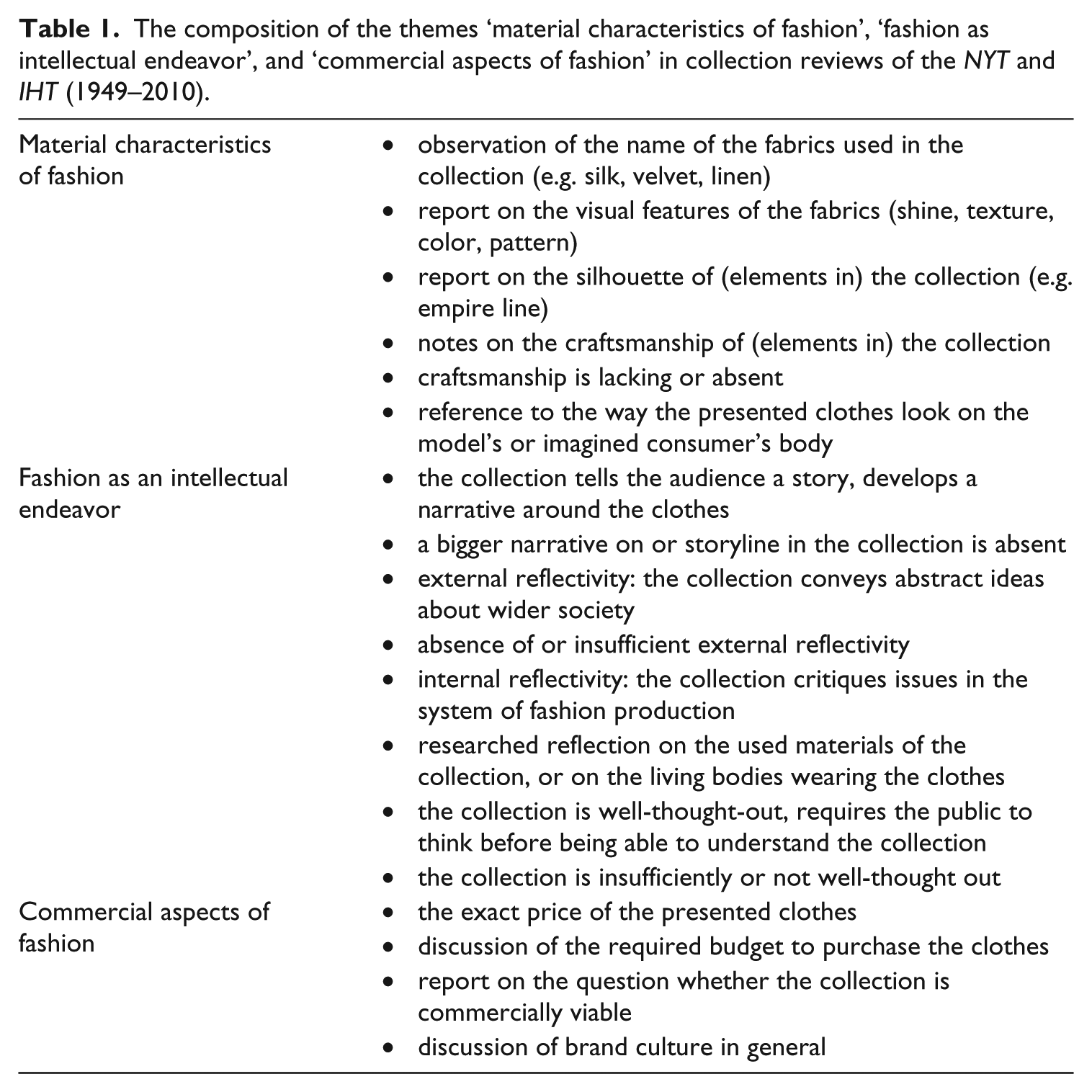
To my knowledge few studies have traced longitudinal developments in the production of symbolic boundaries in fashion media discourse. Therefore, the reviews were approached with grounded theory (Strauss and Corbin, 1990). During several rounds of coding, the data were approached in a thematic manner. The cyclical coding style, mobilized by grounded theory, allowed for a great deal of thematic detail to rise from the reviews, which were manually coded through the computer-assisted data analysis software NVivo 9. During the first round of coding the primary researcher established broad themes in the reviews such as, among others, ‘fabrics’, ‘craftsmanship’ and ‘the presentation of abstract ideas in collections’. Two prominent categorizations appeared, i.e. ‘fashion as material practice’ and ‘fashion as intellectual endeavor’. An investigator triangulation then ensured the reliability and validity of the initial broad-themed code book, as it removed the potential bias coming from a single-person analysis (Denzin, 1970: 303). A second researcher coded 270 reviews, selected at random. The triangulation process largely confirmed the valence of the established thematic codes, though it also contributed important suggestions as to the further refinement of topics that revolved around the larger categorizations. A difference was noted, for instance, between ‘actually naming the fabrics’ and notes on ‘the visual features of the fabrics’. Table 1 summarizes the topics that make up the overhanging conceptions of fashion discussed in this article.
The composition of the themes ‘material characteristics of fashion’, ‘fashion as intellectual endeavor’, and ‘commercial aspects of fashion’ in collection reviews of the NYT and IHT (1949–2010).
High-Fashion from Material to Intellectual Endeavor
Haute couture, materiality and the sedate fashion show
In 1949–50 and 1959–60 the journalists of the NYT and IHT addressed in great detail the materiality of fashion. They described the fabrics used and the visual characteristics of the materials, discussed whether designers skillfully handled the materials and reported on how the clothes looked on the models’ or imagined costumers’ bodies, which constitute a crucial part of the materiality of fashion (Entwistle, 2000). Interestingly, such observations on the materiality of fashion often occurred together with notifications about the commercial aspects of sartorial fashion.
Journalists recurrently probed whether the presented fashions would flatter the (imagined) bodies wearing the clothes. For instance, Eugenia Sheppard disapproved of Jules Crahay’s suits, which are ‘not apt to come off. Nobody is going to want to look like a pregnant dame in a Renaissance painting’ (1959: 1). The craftsmanship with which designers handled fabrics likewise merited much attention. Gilbert Orcel, for instance, ‘shows one of the best collections he has ever made. Its excellence is evident in perfection of technique, subtlety of colors and manipulation of fabrics’ (Noël, 1950: 7). Ten years later, the craftsmanship of Hubert de Givenchy again impressed journalists.
Dresses were a host of little nothings, sleeveless slips with shiny leather belts tied at the waist in a bow. They looked as if they could be run up in a morning, but their masterly cutting and seaming would defeat any but the best couturier. (NYT, 1960: 6)
As invisible as great craftsmanship thus was in the material production of fashionable clothing, it was highly visible on the pages of the selected newspapers in 1949–50 and 1959–60.
The materials used in the collection were another focal point in the reviews. In this postwar period journalists reported extensively on the fabrics used for different occasions and pinpointed materials from a wide range of fabrics and fabric combinations. In addition, journalists often described the place of production, production process, and practical features of the materials. In 1949, Noël informed her readers on the woollen houses that produced the materials for the winter collection of couturier Charles Montaigne: ‘[b]asket weaves, dotted wools, beautiful French weaves come into the picture from all the best-known wool houses, Lesur, Moreau, Rodier, Meyer, Dormeuil, Dumas and Maury’ (1949: 5). When in the 1950s and 1960s synthetic fibers became increasingly popular in luxury fashion (Blaszczyk, 2008: 6–7), the journalists carefully considered the advantages and potential drawbacks. In 1960 they found that ‘[a]rtificial fibers, such as Tergal, Crylor, Rhodianyl and Ramie ribbon, all contribute to the knitwear news’ (Noël, 1960: 6).
Notably, in these early reference years journalists often entangled reports on the actual ‘stuff’ of fashion with observations on the commercial aspects of the aesthetic economy of fashion. For instance, a journalist combined her account of the materials used in the Rochas collection with an explanation of ‘the initial cost of a lampshade tiered shantung taffeta gray evening gown, requiring 50 meters at 3,000 francs, taking 250 working hours and costing about $950’ (IHT, 1949: 5). Moreover, when occasionally fashion reviews were accorded a full publication page or when collection reports were moved to the front page, this recognition of the valence of fashion reporting appeared as an acknowledgement of the commercial underpinnings of fashion (Van de Peer, 2013: 137). Journalists emphasised such commercialism when they described the opinions of international buyers, mentioning the price of the presented garments, or discussing the consumer budget required to purchase the clothes. Nevertheless, the reports on commercial topics occurred to a large extent in reviews of ‘young’ couturiers’ collections or of ready-to-wear and boutique collections. In short, in the first reference years NYT and IHT journalists primarily considered topics that referred to a material conception of the nature of fashionable dress. They often wove together this conception with observations acknowledging the commercial roots of fashion. This is not surprising given the structural organization of high-fashion production at the time.
From the latter half of the 19th century to the late 1960s, Parisian haute couture was the ‘unrivalled laboratory for novelty’ (Lipovetsky, 2002: 56). Other sources of fashion, such as mass-produced ready-to-wear, small dressmakers and home sewers, almost exclusively looked at couture for an authoritative stand on future fashion (Grumbach, 2008), which was often dictated in a unified look or silhouette (Blumer, 1969: 280). Before the Second World War, couture houses tended to be owned by the couturiers themselves or by family members. The couture chiefly produced clothing and only to a lesser extent subsidiary fashion goods, such as perfume (Crane, 2000: 141). Their signatures on the label evoked an aura of uniqueness for couture garments (Crane, 2000: 132–70; Steele, 1998).
Despite some scholars attributing a degree of artification to the period before the 1960s (Crane, 2012), new fashion histories have argued that from its early systemic state the couture has been identified by commercial endeavors, as it was ‘a global export industry’ (Evans, 2013: 2). Its commercial goals were imprinted on the material of sartorial fashion, such as the couture label indicating the varying degrees of monetary value of fashionable dress (Troy, 2003). In the defilés of the pre-war period, business and materiality were further allied. Shows were primarily viewed as direct sales events (Evans, 2013) and the primary focus was thus on the garments. In 1949–50 and 1959–60 journalists of the NYT and IHT also emphasized the presented clothes in the reviews, while they commented little on the venue, audience or atmosphere of the showing, which was an overall silent event that could last for several hours. Only a vendeuse or mannequin called out the name, product number and price of the garments during the presentation (2013: 149). This literal mapping of the commercial on the material of models’ bodies, who were wearing ‘industrial smiles’ (2013: 185), again illustrates how the two features share a long tradition of convergence in the fashion system. For instance, couturiers pitted themselves against mannequins, whose bodies represented commerce, when they sought to construct an artistic aura for themselves in autobiographical writings. (Parkins, 2012: 138).
Yet in a fashion culture where couturiers often claimed not to be interested in business at all, NYT and IHT journalists instead combined discussions of materiality and business, as they drew attention to what they put forward as designers’ principal sales product, i.e. beautifully cut garments in a wide variety of luxurious fabrics that should flatter the wearer’s body.
Only in the 1970s did fashion shows develop into their current state of promotion and story-telling, which focused more on display context than the actual ‘stuff’ of fashion (Crane, 2000: 146). The next section explores such increasing image-orientation in connection to the rise of institutionalized ready-to-wear, which provided the organizational backcloth for the first serious cracks in the reign of couture.
Prêt-à-porter, Intellectualization and the Multimedial Fashion Spectacle
The retreat of materiality and commerce
In the collection reviews of 1969–70 the journalists started to write differently about the collections. Whereas in the early reference years journalists frequently discussed prices and budgets, they almost never mentioned such markers of the commercial in the later reference years. Also, craftsmanship received far less attention. 3 In October 1979 an IHT journalist even defended the collection of French créateur Thierry Mugler, which others had found lacking in technical skills: ‘[s]ome purists argue that he does not know his trade too well. In our day and age, that might pass for a compliment’ (IHT, 1979: 7). This disregard for the material aspects of fashion creation increased over time, and by the turn of the century Suzy Menkes combined her disinterest in craftsmanship with a demise of the importance attached to the beautifying relationship between clothing and the living body: ‘[t]he one thing [Stella] McCartney still can’t do is to cut a dress: hers clutch and cling even at a model’s non-existent curves. Who cares?’ (2000b: 20).
Furthermore, the journalists discontinued their elaborate descriptions of the raw materials of a collection, i.e. the fabrics. Although they kept pointing to the fabrics’ visual characteristics (colors and textures), they did not inform readers of the exact type of fabric. An examination of the education levels of the fashion journalists of the NYT and IHT suggests that journalists may no longer master the technical fashion knowledge required to report in detail on various fabrics and techniques. In 1950 Carrie Donovan of the NYT graduated from Parson’s School of Design in New York. In contrast, Cathy Horyn, until recently of the NYT, holds a master’s degree in journalism from Northwestern University. 4 It is thus likely that current critics enter fashion journalism with a different background knowledge that makes them less attuned to the technical aspects of dressmaking.
Interestingly, also a particular strand of fashion design education gradually de-emphasized technical proficiency in the late 20th century. In Britain (McRobbie, 1998) and Belgium (Nicewonger, 2013), a new type of fashion school emerged in the late 1970s. These ‘conceptual fashion schools’ (McRobbie, 1998: 48) were pitted against ‘professional fashion schools’ (1998: 43). Where the latter continued the earlier technical tradition of preparing students to work in the mass-manufacturing industry, the former educated students to create designs that were the result of an extensive thought-process. Like fine arts students, conceptual school students were thus taught to consider the fashion medium as a site for reflection. Key to their identity is an overall intellectual creation of fashion which, according to one of McRobbie’s (1998: 38) informants, is related to the repudiation of technical skills: ‘[n]ot to be able to sew is a matter of pride!’.
The rise of prêt-à-porter
The waning sense of fashion as a material endeavor can be understood better in light of the rise of prêt-à-porter and a connected new consumer lifestyle. The new fashion culture that grew out of this structural change in high-fashion production put more emphasis on image-production. In contrast with the older conception, about whom a journalist noted in 1969 that ‘there lingers still the pretense in some haute couture houses that they are not in commerce at all’ (IHT, 1969: 5), the new structural organization of the field displayed more clearly the commercial complexion of fashion.
In the late 1960s a younger generation of couturiers, who gestured toward contemporary music culture and street styles (Steele, 1998: 278–81), shocked the Parisian establishment. These designers revolutionized the field because they synchronized the internal changes at hand to external social changes that primarily marked a serious transition in women’s lifestyle (Bourdieu, 1993a: 134–5). The more fast-paced and career-minded lifestyle increasingly distanced consumers from couture designs. Consequently, this synchronization answered to new expectations of high-fashion. In this context ready-to-wear gained legitimacy as a type of high fashion. The international fashion world had recognized this old segment of the industry to some extent, especially in Britain and the US (Green, 1997). Also in France mass-produced ready-to-wear garments had gained momentum under the designation of confection (Lipovetsky, 1992: 90–1). Nonetheless, it was only through the inclusion of ready-to-wear in the Parisian institutionalized fashion system in 1973, when the Fédération Française de la Couture du Prêt-à-porter des Couturiers et des Créateurs de Mode recognized ready-to-wear as an ‘official’ genre, that these goods, renamed prêt-à-porter, received an unprecedented seal of approval. This set apart the luxury prêt-à-porter créateurs from other mass-producing designers (Kawamura, 2004). With the growing popularity of luxury prêt-à-porter more and more couture houses added this genre to their repertoire, switched to it entirely or simply went out of business. From the 106 couture houses in 1945 only 23 remained in 1975 (2004: 44)
Between 1965 and 1975 the underlying structures of high-fashion production thus shifted (Kawamura, 2004: 52). This resulted in a new fashion culture in which prêt-à-porter now set trends instead of following the couture (Steele, 1998: 281), though the tradition of couture never entirely disappeared (Crane, 2000: 238). Fashion houses relied more on the sale of subsidiary fashion products, such as perfume and handbags, than on clothes-production to make a profit (Crane, 2000: 142). In this context the nature of high-fashion production shifted ‘from material production to image-production’ (Kawamura, 2004: 85). As Lash and Urry (1994) have shown, it is through the notion of the brand that images are attached to goods. Fashion designers were indeed expected to create and distribute a unifying image of their fashion house (Aspers, 2010; Kawamura, 2004). Furthermore, by the late 20th century most designers had lost the autonomy over their own business. Particularly in Europe, luxury conglomerates now own fashion companies.
Key to contemporary designers’ public exposure is a fashion show in one of the major fashion centers and the media attention that comes with it. By the late 1970s fashion shows had evolved into theatrical spectacles, staged in highly visible public venues (Gregg Duggan, 2001). Through their multimedial character these shows sought to project meanings and associations around the clothes. 5 Although designers often presented eccentric clothes that did not make it to boutiques or department stores, the shows were centered more on assisting industry professionals to make sense of a designer’s ‘vision’ for a collection (Entwistle, 2009: 134) than on the actual garments on display. The new type of fashion show facilitated an understanding of the overhanging scripts, themes and images that turned the staged clothes into carriers of ideas that the designer wanted to convey to the public. The NYT and IHT fashion writers eagerly endorsed the new image- and narrative-orientation of the shows. They repeatedly emphasized that designers needed to know ‘how to put a theme across’ (Dorsey, 1980: 5) or to develop ‘a story line’ (Menkes, 2000a: 8). When successful, contemporary fashion shows thus conceptualize an image or story that often spills over into more wearable and saleable clothes and into more affordable and profitable subsidiary products.
Designer fashion as intellectual endeavor
Hitherto I have contextualized the late 20th-century image-orientation of fashion in a new organizational structuring of the field, which led to an increasing recognition of the business logic of fashion. I observed how NYT and IHT journalists supported image-orientation and moved the focus away from material production, which now left open a conceptual space to comprehend high-end fashion design in fashion media discourse. In the 1980s a new way to think about fashion began to circulate within and around the prêt-à-porter, namely the view of designer fashion as an intellectual process. In both fashion design and journalistic discourses the conception emerged that abstract ideas preceded and underpinned the clothes presented on the catwalk, resulting in the expectation for designer fashion to be ‘so intellectually brilliant that it took your breath away’ (Menkes, 2010f: 9).
In the 1980s and 1990s the work of several designers who showed in Paris and who were nearly all graduates of ‘conceptual fashion schools’ sparked the articulation of an intellectual conception in journalistic discourse. Scholars have dubbed these designers as ‘conceptual’ after the perceived formal similarities with the concept-oriented approaches in the arts (Clark, 2012: 67), which preceded conceptual fashion by nearly 20 years. The fashion collections of ‘conceptual’ designers indeed pondered the same type of ideas, such as ‘art-reflexive ideas’ and ‘socio-political’ ideas (Schellekens, 2012: 76). Conceptual designers’ work reflected on the systemic state of fashion production by transgressing conventional ideas of beauty, femininity and the body (Kawamura, 2004: 125–49), while also debating wider societal developments. Therefore, one may understand this fashion approach within a wider artistic context where, in the aftermath of the heydays of conceptual art between 1965 and 1975, ‘addressing the artworld’s internal functioning and an overtly politically engaged attitude ha[d] become vastly entrenched within the visual arts’ (Laermans, forthcoming). Clark’s (2012: 74) conclusion that ‘conceptual fashion can conceivably exist without the production of an object’ further brings to mind Sol LeWitt’s (1967: 12) famous comment that in conceptual art ‘the execution is a perfunctory affair’ and that the idea is always primary in its appeal to the mind. 6
NYT and IHT journalists welcomed critical fashion design for its appeal to the mind in 1989–90, the first reference year in which conceptual fashion design had appeared in the major fashion centers. The Rifat Ozbek collection is ‘giving viewers something to think about over the weekend’ (Morris, 1989: 7), and 10 years later Cathy Horyn celebrated the Viktor & Rolf collection because it ‘made you think of fashion in a different way’ (1999: 1). In particular, idea-centered fashion design let the public reflect on issues in wider society or socio-political ideas. In a recent interview Suzy Menkes stated that she believes fashion design to be capable of such reflection (Collins, 2013: 67). Writing on the Greek designer Sophia Kokosalaki’s collection, Menkes appreciatively noted that the clothes were ‘meant to resemble a burning forest. These vistas of Greece’s countryside and a covert reference to last summer’s fires gave depth to a collection’ (2010e: 9, my emphasis). And in the NYT Hussein Chalayan was described as ‘a one-man think tank, a philosopher and engineer, artist and showman … Suddenly, all the other people who call themselves designers seem little more than stylists’ (Bellafante, 2000: 6).
Journalists also celebrated designers when they unsettled conventions of the fashion field, as Muccia Prada who was making a fairly simple but profound comment about who has the right to say what is tasteful and pretty, and who doesn’t. In themselves, the knee-length silk dresses … are exhilarating. … these largely happy clothes express a clear reading of the uncomplicated way a lot of young and ambitious women view fashion and the media. (Horyn, 2010: 16; emphasis added)
Where in the early reference years journalists thus disclosed the reality of fashion as constituted by fabrics, living bodies and skillful technique, by the late 20th century they let such material aspects retreat, for ‘good’ fashion now lifted ‘them [clothes] beyond body coverings, imbuing them with higher intellectual meaning’ (White, 1999b: 1).
Designers deliver truly ‘great’ fashion when addressing ‘the mind’s eye’. For instance, Suzy Menkes wonders:
What is it about Prada that sets her light years ahead of the rest? It is the thought process – the way she appears to embrace the current world, so that the mind’s eye sees the new President Barack Obama in the long slim silhouette and the Russian oil mongers in the studded boots, although there is never an overt suggestion of these realities. The shows, therefore, become intensely political, yet, when broken down to a sweater, a shirt or a tough-man bag, are just offering enticing modern fashion. When it comes to ideas, Prada is certainly not running on empty. (2009c: 14, emphasis added)
All of the above citations illustrate how journalists articulated the idea-centered conception of fashion in the language of what Fredric Jameson (1984: 61) has called the modernist ‘depth model’. While journalists located the materials of fashion on the visual surface level, they wanted good high-end fashion to convey ‘an underlying message’ (Menkes, 2010a: 6, emphasis added), so that ‘the thinking behind it [the clothes] was unburdened’ (Horyn, 2009a: 24, emphasis added), because designers need ‘to bring depth to bare-bones fashion’ (White, 1999a: 8, emphasis added). The depth model is further connected to the equally modern idea of an autonomous centered subject expressing outwardly what is in his/her mind (Jameson, 1984: 63). In the journalists’ vision, high-fashion designers were indeed such modern subjects, who have to know how to ‘to base a collection on a concept [and] express it … in clothes’ (Horyn, 2000: 1). Journalists thus aligned the idea of the autonomous subject with the notion of expression and ‘a whole metaphysics of the inside and the outside’ (Jameson, 1984: 61) in their review practice. Menkes thought that ‘Mr. Kane’s viewpoint … was to savor for its outward prettiness and to ponder for its interior vision’ (2010c: 13, emphasis added). Hence, journalists allocated fashion’s material grounds to a less valorized plane, when sustaining a modern binary of depth and surface in the promotion of fashion design as an intellectual practice.
In 1999–2000 journalists still limited the discourse of intellectualization to discussions of designers’ work falling under the ‘conceptual’ rubric. But in 2009–10 their reviews increasingly promoted more conventional-style designers, who tend to present clothes that are more easily marketable, to view designer fashion as a site to explore socio-political and fashion-reflexive ideas. When designers did not live up to these expectations, journalistic reactions were hostile. In 2010 Menkes (2010d: 9) found, for instance, that ‘the D&G show was what the fashion trade calls a no-brainer: A bunch of appealing, sexy clothes’. And Horyn disapproved of the Marc Jacobs collection: ‘[t]he thinking behind these extremely feminine clothes was lighthearted, and possibly just light’ (2009: 18, emphasis added). By the turn of the 21st century journalists thus regarded all high-end fashion design as a medium for critical reflection. The concluding section considers the objectives that journalists seek to achieve when they use the rhetorical strategy that the modernist depth model affords.
Conclusion: Re-artification, Intellectualization and the Depth Model
Over the course of the past 60 years prominent fashion journalists have shifted their focus from the material aspects of high-end fashionable dress to the conception that it primarily constitutes an intellectual endeavor. Yet one may wonder whether the move towards an intellectual conception of fashion traverses all fields of high-end fashion production and cuts through all groups of industry professionals. For instance, current Milanese designers identify with ‘a culture of wearability’ (Pedroni and Volonté, 2014) that aims to offer consumers well-crafted clothing. These designers do not eye the art world for status augmentation by portraying fashion as an artistic or intellectual practice. Nevertheless, the observation that both leading voices in fashion media discourse and influential schools in fashion design education took up intellectualization suggests that it constitutes an important transformation in the symbolic values circulating in the contemporary fashion system.
The recognition that high-end fashion currently receives in the wider media largely stems from its acknowledgement as a multi-billion dollar industry (e.g. Tungate, 2005: 4), not from the assertion that fashion is a domain of great cultural or artistic worth. The new organization of the field of production (structured in luxury conglomerates, for instance) is ‘reducing the autonomy of the fashion designer and, consequently, his or her potential to engage in stylistic innovation’ (Crane, 2012: 107). For some decades now the field of high-end fashion production has been laying bare its commercial roots. Hence, high-end fashion design today seems to be in the process of de-artification (Crane, 2012: 105).
I propose that within this commerce-oriented fashion culture, however, the critics of the NYT and IHT distanced both themselves-as-critics and the object of their criticism, i.e. designer fashion, from the view of high-end fashion as solely a ‘serious business’. The discourse of intellectualization enables journalists to engage in a process of re-artification. Three dimensions are crucial to comprehend the shift toward intellectualizing media discourse and its goal to re-artify high-end fashion.
First, journalists promote intellectualization through the rhetoric of the modernist depth model by which they translate the hierarchy of ‘depth’ and ‘surface’ into the division between ‘abstract ideas’ and ‘tangible stuff’. Journalists then draw on a devaluation of matter as a subtle way to portray commerce as less important to grasp the nature of designer fashion. As I have argued throughout the article, the materiality of garments and living bodies has a long history of entanglement with commerce. Consequently, a conceptual model which allows journalists to allocate materiality to a less valorized plane equally affords them the opportunity to discredit the commercial conception of designer fashion while promoting the artistic categorization. The theorists of the artification thesis, Shapiro and Heinich (2012), further argue that for something to be regarded as art ‘technique usually must be made invisible’, which is exactly what occurred in the late 20th century when journalists ceased to write detailed and knowledgeable reports on technical proficiency.
This subtle disavowal of commerce is one important step in the process of re-artification that NYT and IHT journalists seek to bring about. They wish to do so, because ‘the desire to secure legitimacy for a practice that someone deems unjustly undervalued may … spur artification’ (Shapiro and Heinich, 2012). The journalists under review believe in the critical potential of the fashion design practice. NYT journalist Guy Trebay (Ruttenberg, 2013: 28) stated that he regrets that ‘it [fashion] isn’t taken seriously, and never has been taken seriously. I hope to live to see the day when it is’. And when Suzy Menkes said about her approach to reviewing that ‘this kind of analysis is important in an area where “fashion” is often regarded as a soft and fluffy subject’ (Collins, 2013: 69), one may interpret the journalists’ distancing from commerce as an attempt to solidify a cultural worthy status for designer fashion. Crane (2012) largely draws on the lack of creative autonomy in the current fashion landscape to develop the thesis of de-artification. Yet artification is ‘a process of processes’ (Shapiro and Heinich, 2012) in which the idea of the independent creative individual is only one constituent process, which is fervently defended by NYT and IHT journalists when they conceptualize designers as autonomous subjects who express their internal ideas in cloth. The intellectualization, which I probed in media discourse, is another feature of the process of (re-)artification.
The explicit aim to create a growing intellectual worth for high-end fashion design also benefits IHT and NYT fashion journalists themselves. They engage in competition with other members of the fashion press, who have not yet benefitted from an explicit identification with the intellectual capacities of fashion design. Likewise, the intellectual conception of designer fashion allows the journalists under scrutiny to align themselves with other fields of journalism. Guy Trebay of the NYT compared fashion journalism with other journalistic topics and concluded on a gender note that ‘[when I started here], people said, “You’re throwing your career in the toilet to write about fashion. … It wasn’t what we serious people – that is, people with testicles – do”’ (Ruttenberg, 2013: 28). By intellectualizing their object of criticism, these fashion industry professionals seek to augment their own status as cultural critics, now renamed as genuine ‘fashion critics’, which is how the NYT began to dub its fashion journalists in the 1990s, or even as cultural critics writing on fashion, which is how Guy Trebay of the NYT considers himself (Ruttenberg, 2013: 22).
Finally, taking recourse to intellectualization discourse lets leading journalists better guard the increasingly slippery boundaries between high-fashion and the mass-produced clothes that most people purchase from high-street retailers (Rocamora, 2002b: 347). Also, the journalists of the selected newspapers, who enjoy more critical freedom by which their opinions appear all the more forceful, tacitly seek to reinforce the division between mass market and restricted production or the cut between the commercial and more artistic-oriented axes of the field (Bourdieu and Delsaut, 1975) by feeding the idea that intellectualization characterizes only high-end fashion design.
Footnotes
Acknowledgements
The article has greatly benefitted from the insightful comments of Rudi Laermans, Freddy Mortier, Anneke Smelik, Rachel Lifter, Sofie Dewaele, Annelies Monseré, Danielle Bruggeman and Elizabeth Amann. The author would also like to thank the anonymous reviewers and the editors for generous feedback.
Funding
This research was funded by the Research Foundation Flanders - FWO.