




Abstract
This article analyses the structure of the Dutch literary space through an analysis of 215 publishers’ lists of Dutch fiction and poetry publishers. Examining the ways in which publishers include different genre-language combinations on their lists offers a novel way to understand the structure of literary spaces. Earlier research has mainly seen analyses of the organisational field and the practices of actors, and until now has neglected the publishers’ lists of publishing houses. This neglect is critical as it has simplified ideas about what publishing houses actually publish on the different poles of contemporary literary fields. My analysis of the Dutch literary space shows that, besides small poetry publishers, all other publishers – in terms of their publishers’ lists – are part of the large-scale pole of literary production, but that this large-scale pole is much more diverse and complex than conceptualised in earlier research.
Keywords
Introduction
Western literary fields have, in recent decades, met with increasing commercialisation, (transnational) conglomeratisation and popularisation, which have influenced the publishing practices of editors and publishers. It has been argued that editorial logic became rationalised (Childress, 2012; Schiffrin, 2001; Thornton, 2004), which introduced an ‘American model’ into European publishing (Bourdieu, 2008; Sapiro, 2010). Publishing houses have become part of large transnational media conglomerates and books are increasingly marketed as consumer goods through all kinds of media outlets (Squires, 2007; Thompson, 2010), which created a ‘popular literary culture’ and an increasing intertwining of literary fiction and the cultural industries (through, for instance, movie adaptations of bestselling literary fiction) (Collins, 2010).
It has been argued that, through these developments, literary publishing houses have increasingly sought to publish popular fiction such as crime novels or romance, and that the small-scale pole of literary production has been increasingly marginalised. The evidence that supports this is mainly qualitative research into the institutional structure and editorial practices of contemporary literary fields (see Childress, 2012; Franssen and Kuipers, 2013; Sapiro, 2010). An analysis of what publishing houses actually publish – their publishing lists – is lacking. Bourdieu (2008) comes close to this, as he analyses the contemporary French literary field but the genres of books published is not taken into account in his quantitative analysis. A study of publishers’ lists is, however, important for a number of reasons.
First, through such an analysis, it will be possible to identify the structure of the ‘literary space’, that is the space of position-takings, represented here by the genres and languages of books on the publishers’ lists of Dutch publishing houses. Through such an analysis of the literary space, we can assess the relation between genres in this space, and following from that, the relation between small-scale literary production and large-scale literary production. It is especially the position of literary fiction in this literary space that is of interest. While literary fiction traditionally had an intermediary position between the small-scale and large-scale poles (Bourdieu, 1993), it has been argued that the subfield of literary fiction has increasingly become part of the cultural industries (Collins, 2010; Sapiro, 2010) and as such is the genre influenced most by commercialisation.
Second, while a process of commercialisation and popularisation has diminished the position of literary fiction, popular fiction is rising in status (Janssen, 1999). An analysis of the contemporary literary space can show the extent to which popular genres are combined with ‘higher’ genres such as literary fiction or poetry in publishers’ lists, which would indicate an increasing status of popular genres.
Third, an analysis of publishers’ lists that accounts for both the genre and the original language of books can not only offer an understanding of hierarchies between genres but also, through taking language into account, of hierarchies within genres. The sociology of translation has taught us that different languages hold different amounts of symbolic capital (Casanova, 2004; Heilbron, 2008). An analysis of publishers’ lists can be used to analyse whether different languages within their genres hold different positions in the literary space as well. So, for instance, are Scandinavian crime fiction novels positioned differently than English crime fiction novels?
These questions are answered through an analysis of 215 Dutch publishers’ lists between 2000 and 2009. These lists are analysed by taking into account both the genre and language of the books that are published. I analyse how different languages are combined within each genre and, subsequently, how these different language clusters are combined on publishers’ lists. In this way, both hierarchies within genres (through language) and between genres can be taken into account. This analysis of the literary space offers a cultural variant to the analysis of fields that has in recent years moved increasingly towards organisational analyses, neglecting to take position-takings into account in line with Bourdieu’s seminal work (1983) on the French literary field.
The Structure of Literary Fields
Bourdieu’s studies of the French literary field (1993, 1996) opened up the production of literature for sociological analysis. He claims that producers of culture are positioned in relation to each other, in a field depending on the type and amount of capital they have. Between the position of a producer and his or her position-taking – the cultural objects he or she produces – exists a close homology because there is a reciprocal relationship between the capital of the object and that of the producer. Thus the producer consecrates objects and vice versa.
The structure of the French literary field is determined by two oppositions according to which publishing houses, writers, editors, and books and genres, differ from each other. First, there is an opposition between the pole of restricted or small-scale production and the pole of large-scale production. According to Bourdieu’s seminal article (1983), the economic logic is reversed at the small-scale side of the field. Producers do not search for economic capital, it is the l’art pour l’art principle that structures this part of the field. Authors do not produce for a known audience as their audience does not exist yet. As they strive to be new, they need to create an audience before they can sell anything. Only after symbolic capital is earned can it slowly be transformed into economic capital. On the other hand, on the large-scale side, editorial policies are based on the existing taste of consumers: producers make what consumers want.
The second dimension is that of consecrated, old and large publishers against the newcomers. This dimension divides the haves from the have-nots. The publishers whose authors have already won prizes are respected and read in schools and universities. They stand out from those publishers who are still looking for recognition for their work. This division then is as much about power as it is about aesthetics. Those in power adhere to the dominant aesthetic logic – the one that made them powerful in the first place – whereas those without power have their own, innovative yet powerless, aesthetic logic. For Bourdieu, the only real possibility of innovation comes from the fringes of the field on the artistic side. In this artistic outpost, new writers and publishers try to change the field through the production of new aesthetic laws and new ways of doing things.
This opposition between the large-scale and the restricted or small-scale poles, which indicates the opposition between two ways of producing cultural objects, and between art and commerce, has been both used and criticised extensively in research on cultural production in the last decades. The tension between an aesthetic logic and a commercial logic is present in all cultural fields, for instance fashion (Mears, 2010), art (Velthuis, 2005), television (Kuipers, 2012), film (Baumann, 2007) and contemporary literary fields (Craig and Dubois, 2010; Sapiro, 2010). This analytical frame has offered a fruitful context for the study of literary fields and especially developments within it since the 1980s. A range of scholars have shown that commercial criteria are growing more important in editorial policies (Childress, 2012; Sapiro, 2010; Thornton, 2004) and that media conglomerates are playing a greater role in the publishing industry, demanding from publishers higher yearly profits (Schiffrin, 2001; Thompson, 2010), which threatens the autonomy of editorial decision-making (Bourdieu, 2008). Moreover, editorial decisions are increasingly influenced by the star power of authors and aims of hitting the bestseller lists (e.g. Collins, 2010; Squires, 2007; Thompson, 2010; Verboord, 2011). These developments indicate the increasing importance of the large-scale or commercial logic.
At the same time, the rigid opposition between large-scale and small-scale is criticised as it does not do justice to the complexity of both the large-scale (Hesmondhalgh, 2006) and small-scale (Craig and Dubois, 2010; Dubois, 2006; Dubois and François, 2013) production processes. Moreover, it assumes a certain stability in the habitus and practices of both artists and intermediaries which in practice are more complex and ambiguous (Kuipers, 2012; Lahire, 2003). But how is it possible to incorporate this critique in a structural analysis of the contemporary literary space?
One of the ways to do so is to increase the complexity in describing and analysing publishers’ lists. Not every publisher of literary fiction holds the same position in the field and not every publisher’s list within a publishing house or conglomerate is assembled in the same way by editors and publishers. To address this complexity, I add the dimension of genre subfields to the large-scale versus small-scale opposition. Genre is an important structuring division in the concrete practices of agents in the book industry. Genres play an important role in the consumption and production of fiction books. Bookstores and online retailers often organise their stock by genre and book clubs are often restricted to specific genres. Critics, too, work in specific genres and literary prizes are usually genre-based. The significance of genre is possibly even greater on the production side. Editors classify their job in relation to the genres they have acquired, and publishers often describe themselves in terms of the genres they publish. Similarly, writers’ associations are genre-based. In the Netherlands, there is an association for literary writers (with genre-based divisions into, amongst others, poetry and prose), an association for crime fiction writers and a smaller one for romance writers. Genres are, both as cognitive categories and organisational principles (DiMaggio, 1987: 441), omnipresent within contemporary literary production.
Hierarchies Between and Within Genres
Scholars have focused on the institutional level of the production of culture, as is evident from the literature cited above, but the space of position-takings, that is, of genres, as analysed by Bourdieu (1983: 329) has not received such attention. Rather, scholars have resorted to the general opposition between small-scale and large-scale literary production, arguing that the large-scale logic has increasingly become dominant. However, Bourdieu argues that the division of genres across the field does not perfectly overlap with the opposition between large-scale and small-scale production. There is a general tendency of genres to ‘belong’ to the small-scale (poetry) or large-scale (popular fiction) subfields, but literary fiction, for instance, is located in between these poles.
Moreover, Bourdieu argues that, within genres themselves, the opposition between small-scale and large-scale is also apparent. As such, he brings out the relations within genres that have been increasingly important in studies of cultural consumption (Glévarec and Pinet, 2012; Holt, 1997). Bourdieu argues that, in each genre, an autonomous core is developed. And that:
in effect, each of the two opposed sectors of each subfield (for example, the director’s theatre) tends to become closer to the similar sector of the other genres … the opposition between genres loses its structuring efficacy in favour of the opposition between the two poles present in each subfield. (Bourdieu, 1996: 120–121)
So, in effect, each genre subfield is internally structured according to an opposition between more autonomous and more commercial production, and these genre subfields are, in turn, located within the larger opposition between large-scale and small-scale logics.
In the last three decades, the position of individual genres in this literary space has shifted. Scholars have argued that a popularisation of literature took place through which literary fiction became more and more part of popular culture and the cultural industries (Collins, 2010; Squires, 2007). At the same time, the status of popular genres such as crime fiction is rising. Janssen (1999) shows that popular genres have increasingly gained attention in newspaper reviews. Moreover, research on the way books are reviewed shows that crime fiction increasingly is reviewed in a similar fashion to literary fiction (Op de Beek, 2014). On a more general level, both the legitimacy of aesthetic hierarchy and the status of ‘high’ art have decreased (Van Eijck, 2000), which has led to a shift towards hierarchies within genres (see Coulangeon, 2013 for an overview).
One of the internal hierarchies in genres is that of the original language of books; a Dutch crime novel might have a different standing than an English crime novel. In the sociology of translations (Heilbron, 1999), it has been shown that different languages have different amounts of symbolic capital (e.g. Casanova, 2004; Heilbron, 2008; Streng, 2012). While these studies have mainly focused on literary fiction, the amount of symbolic capital of a language can also be restricted to, and differ across, genres. Anecdotal evidence suggests that this is for instance the case with Scandinavian crime fiction, which has a much better standing than English crime fiction (e.g. Appel, 2014).
To explore the literary space of the contemporary Dutch literary field, I analyse the publishing lists of contemporary Dutch fiction and poetry publishers and ask two questions. First, is there an opposition between large-scale and small-scale production that we can deduce from publishers’ lists? Second, to what extent are publishers of the same genres spread out across the literary space, indicating internal hierarchies between languages within genres?
Analysing Publishers’ Lists: Data and Methods
In this study, I analyse the literary space of the contemporary Dutch literary field through publishers’ lists. I draw on a dataset of all Dutch fiction and poetry books published between 2000 and 2009 as collected by the Dutch Royal Library in The Hague (see Franssen and Velthuis, 2014 for details). The dataset contains almost all books, both first editions and new editions of published books, published in the Netherlands (e.g. Voorbij and Douma, 1996), including those of very small publishers. I have selected all publishers and imprints that published at least 10 books between 2000 and 2009 (in any genre). I have refrained from combining imprints with publishers’ lists of the publishing houses they belong to. The resulting 215 publishers’ lists serve as cases in the analysis. The dataset does not contain print runs or average print runs, something that would be very helpful in analysing the large-scale versus small-scale dichotomy. The number of titles published by a publishing house, however, does offer an indication of its size and manpower, and it can be assumed that, in general, books with very large print runs are published by relatively large publishing houses that have the (financial) capacity to offer large sums of money to literary agents (e.g. Thompson, 2010; Franssen and Kuipers, 2013). Therefore, in the last part of the article, I analyse the position of publishers and imprints that published 200 or more books between 2000 and 2009 to assess the position of these larger publishers in the literary space.
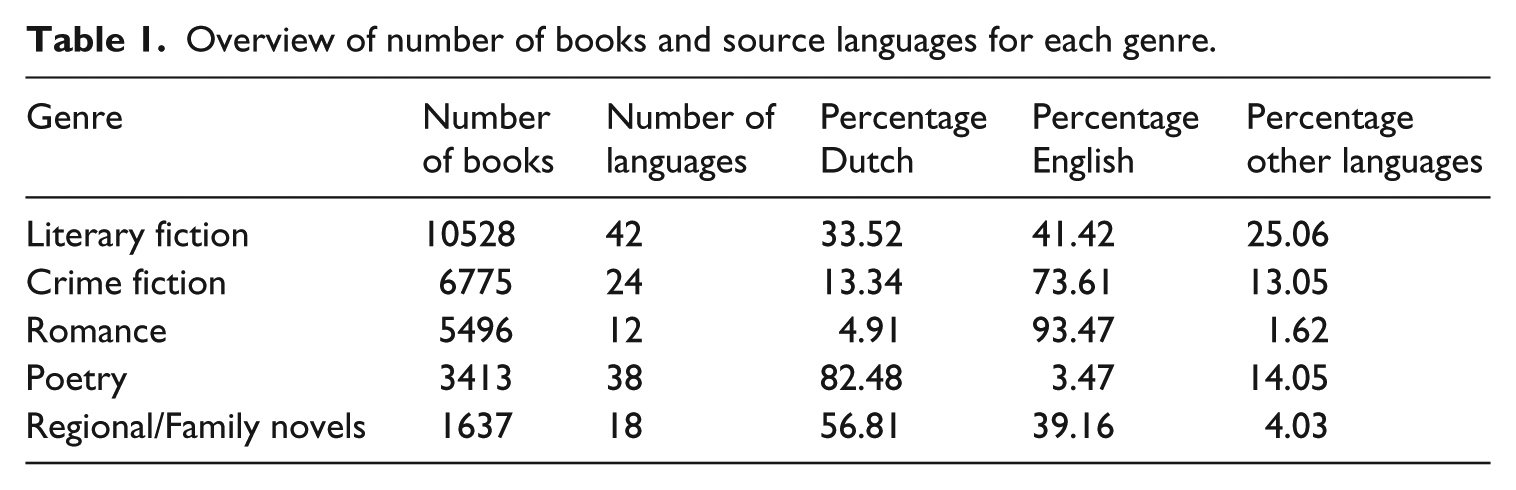
The books are coded with one or more genre-codes that are given to them either by the publishers themselves (a NUR code to help booksellers know where to put the book in the shop) or by NBC/Biblion, an organisation that reviews books for libraries. For this analysis, I have combined different specific codes into broader genres. For instance, thriller, detective and horror became part of ‘crime fiction’. In this way, I have brought the variety of genre-codes back to five genres: literary fiction, crime fiction, romance, poetry and regional/family novels. In this way, 88.7% of books published between 2000 and 2009 could be coded with one or more of these five genres. In Table 1, I give an overview of these five genres with the total number of books, number of languages in each genre, and the percentage of Dutch, English and other languages. In Table 2, the number of books per language in total is given. Because some books are coded with more than one genre-code, the total number of books differs between the two tables.
Overview of number of books and source languages for each genre.
Total number of books for each language.
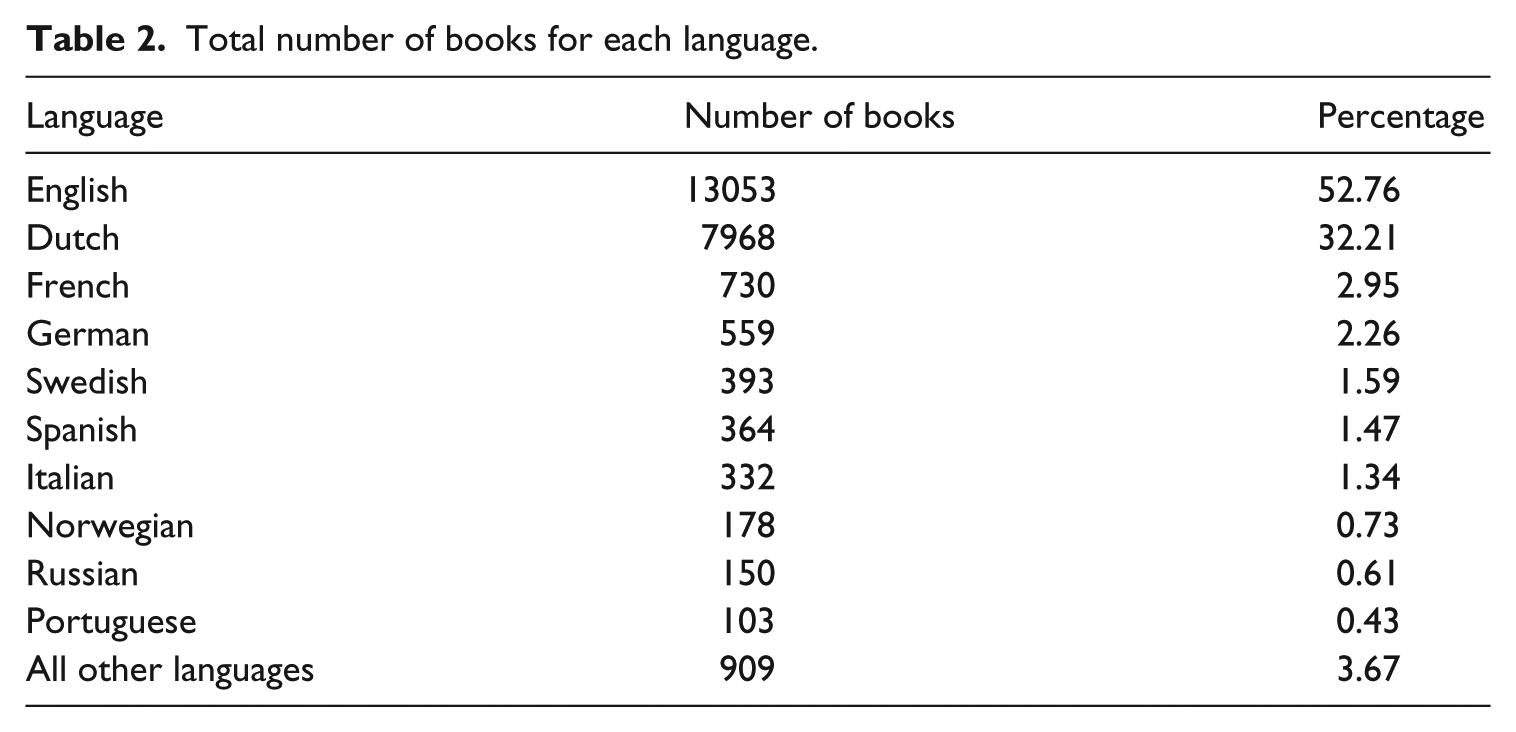
Table 1 shows that literary fiction is by far the biggest genre in the Dutch literary field, followed by romance, crime fiction and poetry, whereas regional/family novels is a smaller genre. The differences between languages as presented in Table 2 are striking. English is dominant, especially because of crime fiction and romance being dominated by translations from English. French and German, while traditionally very important languages in their own right, have now joined a group of languages other than English that include other big languages such as Spanish, Italian and Russian, but also smaller languages such as Swedish and Norwegian.
The aim of this analysis, which covers such a wide range of publishers, is to uncover some of the structural patterns in publishers’ lists. I ask, first, how are languages combined in each genre? And, second, how are different clusters of languages from different genres positioned in relation to each other in the literary space? To make such an analysis of 215 publishers’ lists possible, I first, for each genre independently, created genre–language variables (e.g. crime–Dutch, crime–English etc). The number of genre–language variables is large (134) and it is not possible to analyse the structure of the literary space using all these variables in, for instance, a correspondence analysis.
Therefore, I used cluster analysis to reduce the number of variables empirically, resisting combining them on intuitive grounds (by, for instance, combining all Scandinavian languages upfront). For each individual genre, I performed a Ward’s cluster analysis, based on Pearson equations, to analyse the extent to which languages are combined in the publishers’ lists. 1 For this analysis, I only used genre–language variables that contained more than 10 books, or more than 20 books in the case of literary fiction. 2 As such, the cluster analysis provides groups of genre–language combinations that, for each genre, are combined most often in publishers’ lists. In Table 3, all clusters are given with the languages that they contain and the number of books in each language. As such, while Poetry 2 included Dutch, Arabic and Portuguese, Dutch is clearly the determining language in this cluster, with the other two languages playing a minor role.
Ward’s cluster analysis.
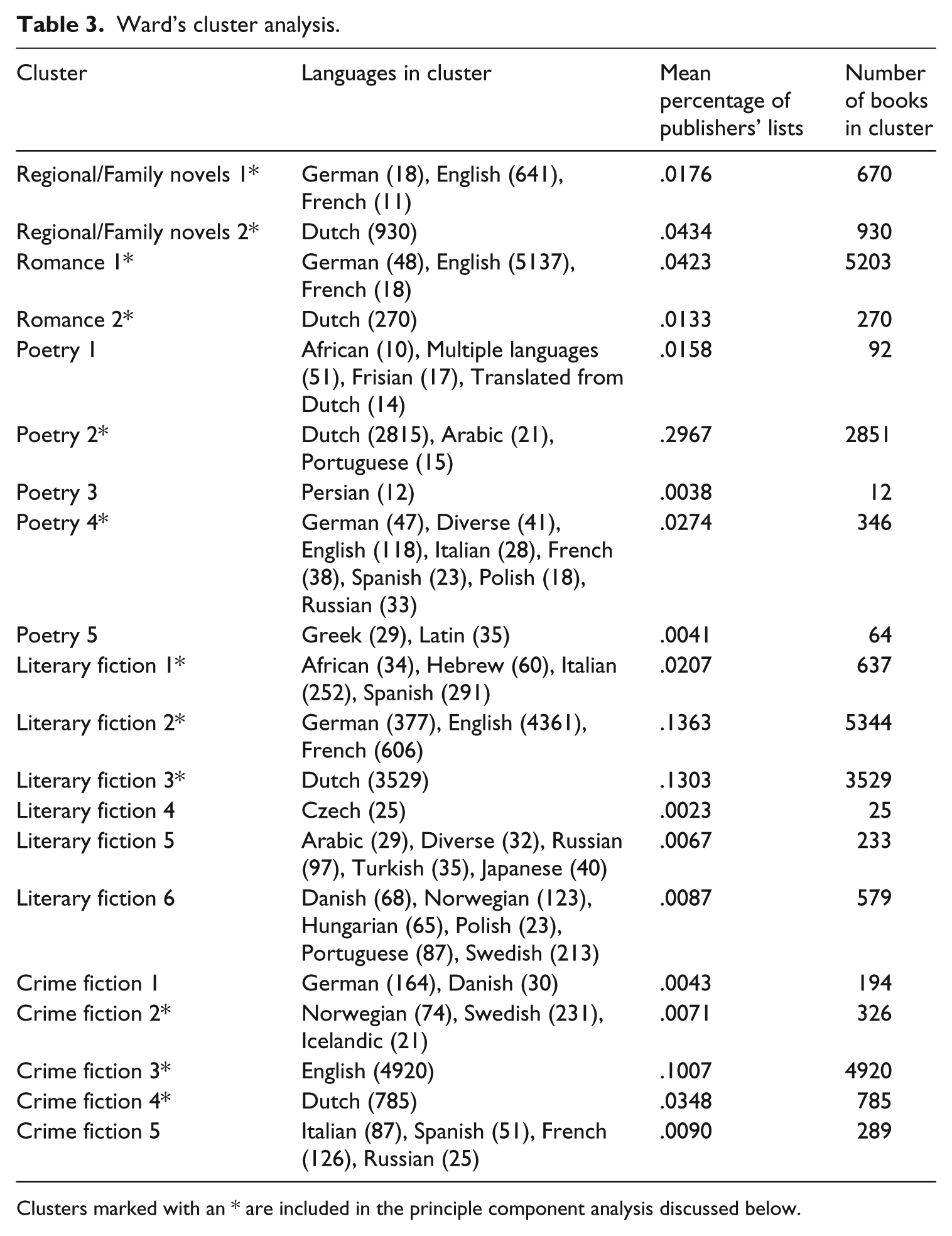
Clusters marked with an * are included in the principle component analysis discussed below.
The cluster-analysis offers some interesting initial observations regarding the publishers’ lists of contemporary Dutch publishers. In all genres except crime, French, German and English cluster together. These languages have held the most prominent place in the Dutch literary field since the 19th century (e.g. Heilbron, 1995; Streng, 2011), but while in the 19th century their shares were almost equal, during the 20th century, and especially after 1945, the share of English increased rapidly. Despite the big difference in shares now, these three ‘classic’ languages cluster together. Scandinavian languages also cluster together, albeit not perfectly, in literary fiction and crime fiction. Moreover, non-central (i.e. not English, French or German) but important languages such as Italian, Spanish and Russian cluster together, indicating that some publishers focus on combining non-central languages in their publishers’ lists (Franssen and Kuipers, 2013).
To assess the importance of each cluster, I calculated the relative prevalence of each cluster in all 215 publishers’ lists and the mean of this relative prevalence for each cluster. For instance, as Table 3 shows, on average 29.7% of publishers’ lists are made up of books from the second poetry cluster. This is higher than the second literary fiction cluster (which contains more books) because many of the publishers’ lists in which poetry is dominant are very small, making the percentage very high (in contrast with large literary fiction or crime fiction publishers).
The second step in the analysis is to analyse the relationship between these clusters in the 215 publishers’ lists. Through such an analysis, the aim is to understand which clusters are combined most often and which ones are not combined at all. So, if 20% of a publisher’s list consists of books from the third crime fiction cluster (which only contains English), which other clusters will also be present in the publisher’s list? The patterns in publishers’ lists (i.e. which clusters are combined most often) can be analysed relationally by means of a principal component analysis (see Franssen and Kuipers, 2013 for a similar approach). Principal component analysis (PCA) is widely used in social sciences to ‘reduce the dimensionality of a data set … while retaining as much as possible of the variation present in the data set’ (Jolliffe, 2002: ix), by creating principal components – which are uncorrelated variables that, taken together, contain as much of the variance of the original variables as possible (Jolliffe, 2002). These components can be thought of as underlying determinants. For instance, as I show below, the clusters containing English in crime fiction, regional/family novels and literary fiction are grouped together in the first component of the analysis; the underlying force that brings these clusters together is their linguistic similarity.
In the PCA, I used at least two clusters for each genre. I included both clusters in romance and regional/family novels and the two biggest poetry clusters. For literary fiction and crime fiction, I included the biggest three clusters (in terms of mean percentage of publishers’ lists). This means that the analysis includes all romance and regional/family clusters, three out of five crime clusters, three out of six literary clusters and two out of five poetry clusters. In total, 12 clusters were used as described in Table 4. The eigenvalue of each component shows the importance of that factor in covering variance. I focus on components with an eigenvalue above 1 in the analysis; there are five of these components. The eigenvalues, as well as the variable scores for each component, are presented in Table 4; variable scores above 0.2 and below −0.2 are shown in bold.
Principal component analysis of publishers’ lists.
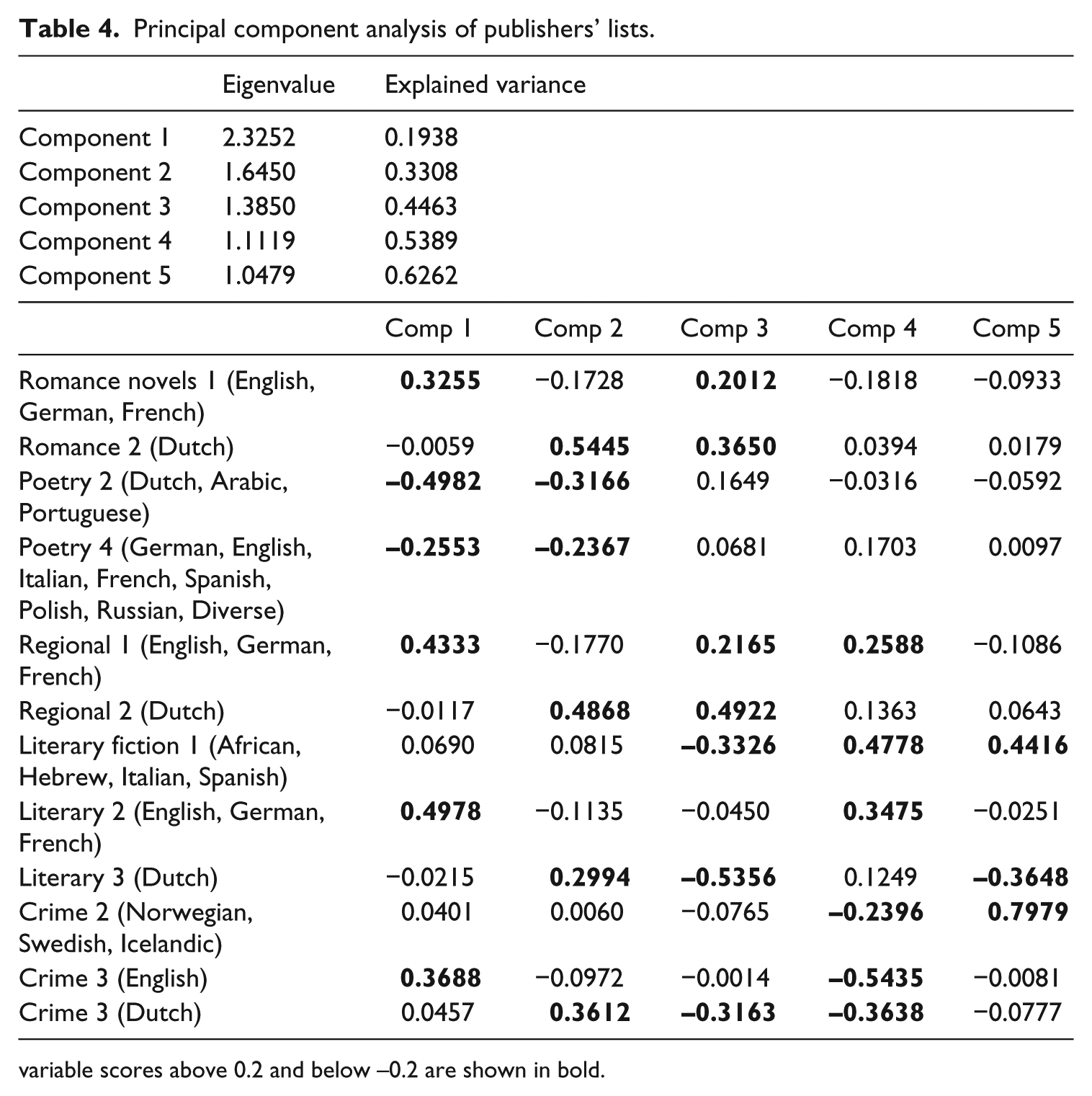
variable scores above 0.2 and below −0.2 are shown in bold.
The first component separates all poetry publishers from all language clusters containing English in the other four genres. The language clusters containing Dutch are in-between this opposition. The second component separates all language clusters containing Dutch from all other language clusters and all poetry clusters. The third component separates literary fiction and crime fiction from regional and romance novels. The fourth and fifth components divide different groups of publishers in the centre of the field. The fourth component divides literary fiction from crime fiction. The fifth separates Scandinavian crime fiction and peripheral literary fiction from all others.
The first two components, which account for 33% of all variance (19.4% and 13.7%), can be used to depict graphically the structure of the Dutch literary field. This structure turns out to be triangle-shaped (see Figure 1), and consists of four subfields: the lower-left subfield of autonomous-poetry publishers, the lower-right subfield of Anglo-American-commercial publishers, the middle-upper subfield of local-commercial publishers and the middle subfield of mostly large, generalist publishing houses that publish predominantly literary fiction combined with poetry and crime fiction.

Genre–language clusters in the Dutch literary space.
The first component, which accounts for 19% of all variation between publishers, separates publishers of all poetry language clusters from all other clusters. This axis can be understood as the classical Bourdieusian dimension of small-scale versus large-scale production. In the left lower corner of the literary field (Figure 1), we find the autonomous-poetry subfield. Here, publishers are small, often members of the organisation for Private Presses in the Netherlands, which has its own distribution network and annual book fairs. These publishers publish poetry almost exclusively. On the publishers’ lists of 58 publishers in this part of the field, poetry accounts for more than 70% of the books they publish. Take, for instance, a publishing house such as De Klaproos. All their editions are ‘set’ by hand in lead and have very limited print runs. They combine text with lithography and, on their website, they give an overview of the types of machines they have, signalling the importance of the printing process. In the autonomous-poetry subfield, there are no publishers that published more than 200 books in 10 years; most of them have published less than 25. Most have no staff and make hardly any profit. Interestingly, the internal differences between poetry language clusters are of little importance in the poetry subfield. In the first three components of the PCA, which are the three strongest structuring components, both poetry language clusters are very close together, indicating that there is little difference between poetry publishers in the poetry subfield. This means that, rather than being differentiated on the dimension of language, poetry publishers are first and foremost differentiated from other publishers along the dimension of genre. As such, the chance that a poetry publisher who publishes German poetry will also publish German romance novels is very slim.
On the other end of the first component, the far right corner of Figure 1, we find a very different group of publishers. Here, we find publishers that are far larger and do not focus on one genre in particular. They often combine romance novels, commercial literary fiction, regional novels and crime fiction. To take two examples of publishers located on the right, we find, for instance, Cargo. Cargo is a young imprint of a prominent literary house (De Bezige Bij) that primarily publishes crime fiction, mainly translated from English. Moreover, their crime fiction is often marketed as including a ‘literary component’ and they publish upmarket literary fiction, again mainly translated from English. In this same cluster, we find Voorhoeve, a very old publisher (founded 1876) but now an imprint of the main Christian publisher (Kok). Voorhoeve publishes mainly (American) Christian fiction from authors such as Lynn Austin, Karen Kingsbury and Teri Blackstock. Its publisher’s list contains commercial literary fiction, which is often also classified with romance or regional fiction genre classifications. However, this does not include all books in these genres, because each genre–language cluster in crime fiction, literary fiction, romance and regional novels that includes Dutch is separated from this subfield. In this Anglo-American-commercial subfield, contrary to the poetry subfield, publishers are differentiated from others not by genre but by language. Relatively speaking, the chance that these publishers publish both a crime novel and a romance novel is relatively high, while the chance that they publish both an English romance novel and a Dutch romance novel is lower. This shows that, while in the poetry subfield the publishers’ lists (and as such the publishers’ national and international networks) are organised within the genre, in this subfield, it is rather a specific transnational Anglo-American literary field that binds these publishers together.
The second component of the PCA, accounting for 13.7% of all variation, can be understood as a dimension that separates publishers focused on books written originally in Dutch from publishers that publish more internationally. However, this is not the case for publishers of Dutch poetry, who are not affected by this dimension. Effectively, this dimension creates a third subfield of publishers. These publishers publish commercial fiction, similar to the Anglo-American-commercial subfield. However, their books are predominantly written in Dutch. This local-commercial subfield is smaller and far more local than the Anglo-American-commercial subfield. Moreover, it includes hardly any crime fiction publishers; instead, publishers are focused on the mixture between literary fiction, romance and regional/family novels. For instance, publishers such as Zomer & Keuning and Westfriesland publish Dutch authors of this type of fiction, such as Henny Thijssing-Boer, Leni Saris and Gerda van Wageningen.
The three subfields I have discussed do not contain all publishers in the contemporary Dutch literary field. In Figure 2, I have plotted all publishers using their scores on component one and component two.
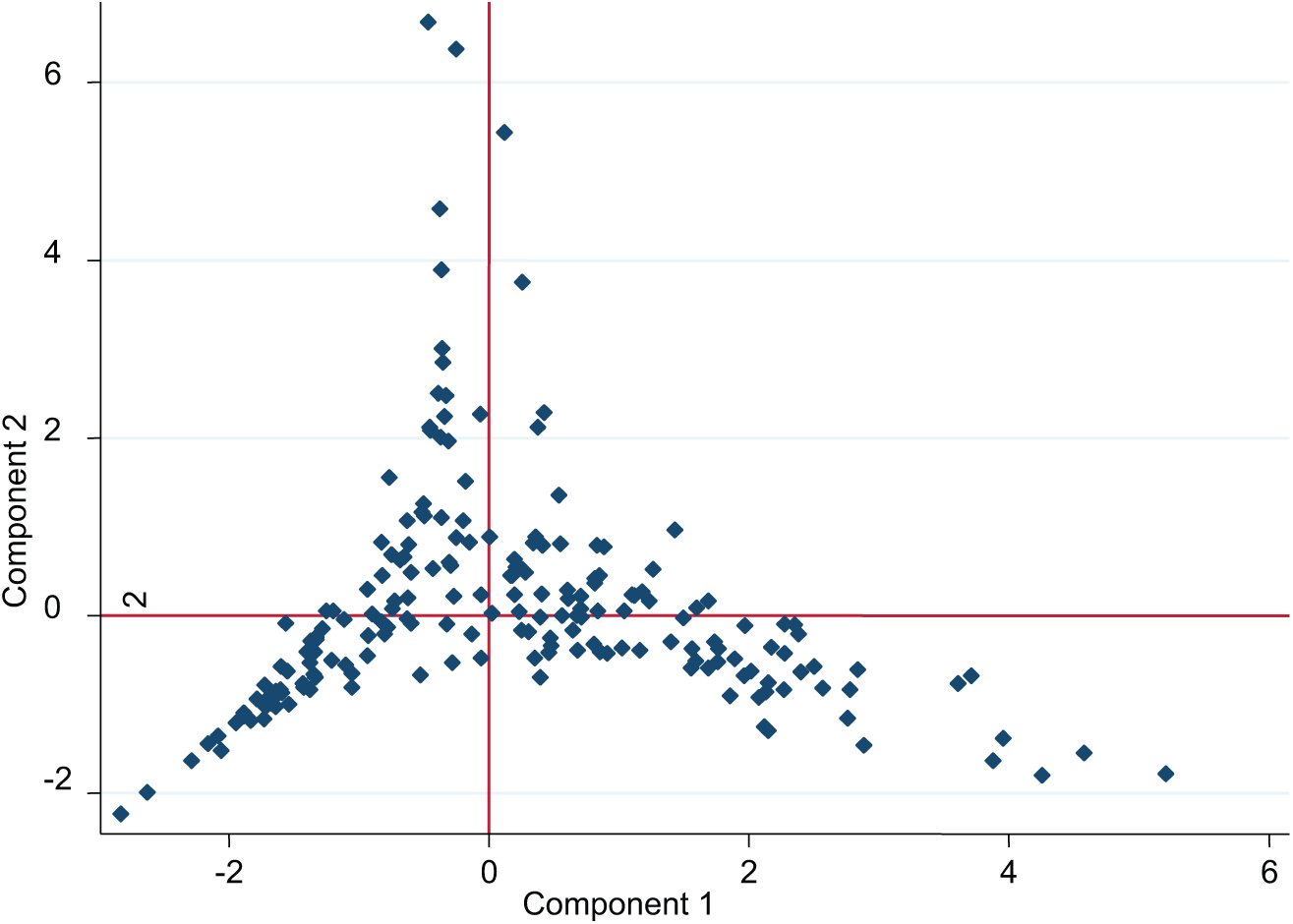
Position of publishers in the Dutch literary space.
Figure 2 shows how the subfields are intertwined with each other. Publishers on the lower left side can be considered part of the autonomous-poetry subfield. Publishers on the lower right side are part of the Anglo-American-commercial subfield. Lastly, the publishers in the upper middle are part of the local-commercial subfield, the smallest of these three subfields. In the middle there is a sizeable group of publishers that do not belong to any of these three subfields. These have catalogues that are dominated by literary fiction and, as I will show below, a large majority of the major publishers is located in this fourth subfield.
The Major Publishers of the Contemporary Dutch Literary Field
To analyse how the different subfields relate to each other in terms of power relations, I have analysed separately the position of the major publishing houses in the contemporary Dutch literary field. I selected all publishers that published 200 or more books between 2000 and 2009. These 34 publishers or imprints make up both the commercial and symbolic dominant powers in the field (Franssen and Kuipers, 2013). For instance, bestsellers in fiction are predominantly published by these publishers and the majority of literary awards are won by their authors. In Figure 3, I have plotted the position of these publishers, again using the scores of component one and component two of the PCA. However, as these publishers are predominantly located in the middle and lower-right side of the literary space, I present a smaller part of the field to show in more detail the positioning of publishing lists in the literary space.
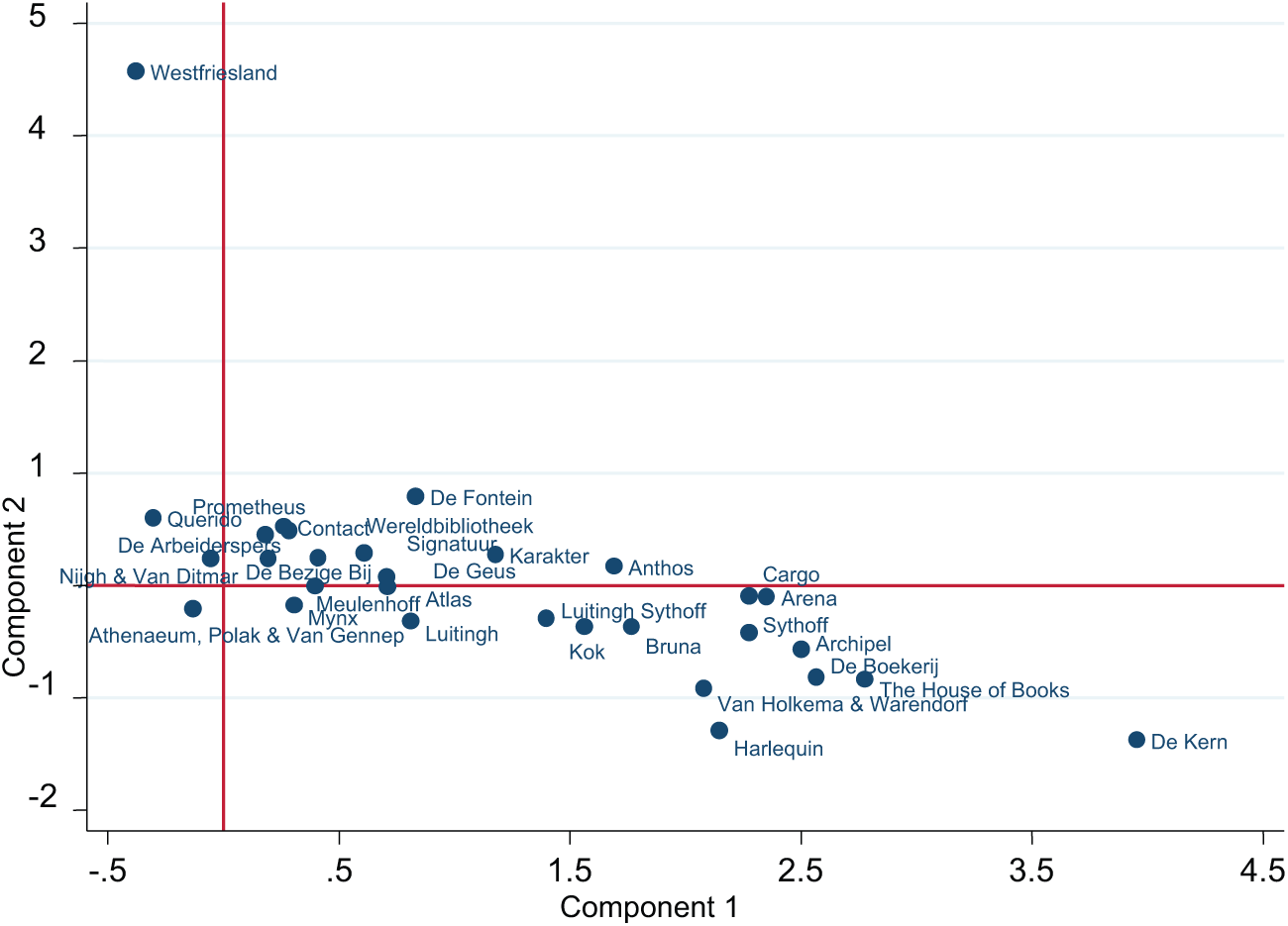
Publishing lists of the largest publishers in the Dutch literary space. 3
Within the larger structure of the literary space, the centre that now becomes visible is located in the middle and lower-right corner of the field. None of these publishers belongs to the autonomous-poetry subfield (Athenaeum, Polak and Van Gennep and Querido come closest) and only one belongs to the local-commercial subfield (Westfriesland). There are, however, a number of publishers that belong to the Anglo-American-commercial subfield.
In the lower-right corner, we find publishers of ‘commercial women’s fiction’ that is mainly translated from English, which can have a more regional/family focus (De Kern), be more romance based (Harlequin) or is more commercial literary fiction (The House of Books, Archipel, Arena). Next to this group, and intimately related to it, are publishers of English crime fiction such as Cargo, Bruna, Luitingh and Luitingh-Sijthoff. These groups of publishers are all part of the Anglo-American-commercial subfield.
In the middle of the field, we find publishers with the largest amounts of symbolic capital, 4 such as De Arbeiderspers, De Bezige Bij, Meulenhoff and Querido. They publish Dutch literary fiction combined with foreign literary fiction. Moreover, all these publishers have a list of which at least 10% consists of poetry books. This means that, in absolute numbers, some of them publish a large number of poetry books. Next to this, they also publish literary fiction from non-central languages.
What is more, we find here two publishers that publish Scandinavian crime fiction: De Geus and Signatuur. Scandinavian crime fiction is a special kind of crime fiction, which occupies a different position in the literary space than English crime fiction. The books are often sold as ‘literary thrillers’, a term coined by Anthos, which specialises in Dutch crime, as do Karakter and De Fontein. The intertwining of literary and crime fiction becomes even more evident when we acknowledge the relations between publishers in the core of the field. Archipel started as an imprint of De Arbeiderspers; Cargo is an imprint of De Bezige Bij; and Arena, De Boekerij, Mynx and Meulenhoff are part of the same publishing conglomerate. The same goes for Signatuur and Bruna.
These largest 34 publishers together published 1054 poetry books (30.9% of the total), 7248 literary fiction books (68.9% of the total) and 5388 crime fiction books (79.5% of the total). As such, while a sizeable amount of poetry is published by the largest publishers, the amount and percentage of literary fiction and crime fiction published by them is a lot higher. The biggest publishers are divided between more literary-focused houses – towards the left of the literary space – and more crime-focused ones – towards the Anglo-American-commercial subfield – but this division is gradual and publishers on the literary side of the core also publish crime fiction. Especially if we take into account the position of ‘literary crime’, which goes particularly for Scandinavian crime novels and some Dutch crime novels, it becomes clear that there is no autonomous-literary-fiction subfield. Literary fiction is, rather, part of the large-scale subfield, in which it is combined with crime fiction, and to a lesser extent with poetry, romance and regional/family novels, in a subfield of predominantly large and generalist publishing houses.
So, I argue, the literary space presented here shows, on the one hand, an autonomous-poetry subfield in which publishers are small and publish according to radically different logics than publishers on the other side of the field (see also Dubois, 2006). On this other side of the field, the large-scale subfield, we find three subfields of publishers. The Anglo-American-commercial subfield, the local-commercial subfield and, in the middle of the field, the large generalist publishers who publish mainly literary fiction, combined with other genres. These different subfields already show that the large-scale pole is not uniform. Within this part of the literary space, there is an opposition between publishers who are focused more on popular genres from Anglo-American literary fields, and those publishers in the middle that publish far more literary fiction and poetry. This opposition, however, not only exists between genres but also, importantly, within genres. In crime fiction, there is an opposition between translations from English on the one hand and translations from Scandinavian languages on the other hand, the latter holding higher status in the literary space. Within literary fiction, there is a similar distinction between publishers’ lists dominated by English literary fiction and those of publishers with a higher status who publish a variety of translations from more peripheral languages, along with literary fiction originally written in Dutch. So, as Bourdieu’s analysis of the French literary field (1983) suggested, literary spaces are characterised by a field-wide opposition between the large-scale and small-scale poles, and a similar opposition internally within each genre.
Conclusion
In this article, I have analysed the structure of the Dutch literary space through an analysis of 215 publishers’ lists of Dutch fiction and poetry publishers. Examining the ways in which publishers include different genre-language combinations on their lists offers a novel way to understand the structure of literary spaces. Literary production has been argued to have changed considerably under the influence of processes of commercialisation (Verboord, 2011), popularisation (Collins, 2010) and rationalisation (Thornton, 2004), as the book industry has increasingly become part of the cultural industries since the 1980s (Hesmondhalgh, 2006). Earlier research has mainly seen analyses of the organisational field and the practices of actors, and until now has neglected the publishers’ lists of publishing houses.
This neglect is critical as it simplifies ideas about what publishing houses publish on both sides of contemporary literary fields. Too often, publishing is brought back to the opposition between small-scale and large-scale production, which only applies to extremes in the field. In the literature, there was little to no empirical research on the actual publication practices of publishing houses. Indeed, while the field analysis of Bourdieu (2008), which comes closest to a full structural analysis of a contemporary literary field, takes into account all kinds of organisational features and, also, some characteristics of books published (e.g. number of translations and Nobel prize winners), it does not analyse the details of publishers’ lists in terms of genre, although Bourdieu does offer a research strategy and a theoretical rationale to do so (Bourdieu, 1983).
In this article, I have argued that an analysis of publishers’ lists in terms of genre–language combinations is useful. In this way, the opposition between the small-scale and large-scale poles can be nuanced through the inclusion of genre subfields in the analysis of the literary space. Moreover, including language in this analysis makes it possible to study the hierarchy within genres themselves, showing the complexity of the contemporary literary space.
In the analysis, I identified four subfields. The autonomous-poetry subfield is made up of small publishers that predominantly publish poetry. In the poetry genre, there is little internal struggle: the two poetry language clusters are positioned relatively close together on all components of the PCA, showing that the internal differences within poetry are less important structuring mechanisms than their opposition to other genres. Publishers’ lists in the local-commercial subfield and the Anglo-American-commercial subfield, on the other hand, are made up of books from different genres that are similar in terms of language. The local-commercial subfield is a small subfield of publishers who publish romance novels, regional/family novels and some crime novels predominantly originally written in Dutch. The Anglo-American-commercial subfield, on the other hand, consists of publishers who publish the same genres, albeit more crime fiction, but from different languages, mostly translated from English. This shows, in contrast with poetry, that popular genres are internally much more divided in terms of language, and that the popular genres are combined much more easily in terms of genre on publishers’ lists.
These three subfields do not contain all publishers in the Dutch literary field. In between them we can find a fourth subfield in which mostly large, generalist publishers of literary fiction, accompanied by other genres, are located. The analysis shows that the biggest publishers, in terms of number of books published between 2000 and 2009, are located in this part of the field but are reaching out into the Anglo-American-commercial subfield. In the centre of the field, there is a division between publishers that have a list dominated by literary fiction and those with a list dominated by crime fiction, but this division is gradual. Publishers that are more inclined to publish literary fiction often also carry some crime fiction. In particular, those crime books that are marketed as ‘literary crime’, often from Scandinavian languages, are very popular in this part of the field. This shows that there is no autonomous-literary-fiction subfield; rather, literary fiction is combined with popular fiction and, as such, part of the large-scale pole of the field. Crime fiction, on the other hand, has risen in the ranks of genres, and some types of crime fiction have a position in the centre of the field similar to some forms of literary fiction.
Earlier work on contemporary literary fields (e.g. Sapiro, 2010; Verboord, 2011) suggests that large-scale logic has become increasingly important. However, the question has to be raised to what extent this development is a new one. Research on 19th- and 20th-century Dutch publishing has shown that publishers were already very aware of the economic potential of their books (Kuitert, 2008; Streng, 2011). My analysis of the literary space shows that, besides small poetry publishers, all other publishers – in terms of their publishers’ lists – are part of the large-scale pole of literary production. Literary fiction in particular has a position that is less autonomous than expected. But it cannot be said whether this position is more large-scale than it was in the 1970s or 1980s.
The analysis, however, does show that the large-scale pole of literary production is far more diverse, in terms of publishers’ lists, than is usually acknowledged. It is not possible to define one type of large-scale publisher. Instead, publishers on the large-scale side of the field can be differentiated according to the genre and language of the books they publish. Understanding the large-scale pole as consisting of multiple genre subfields raises the question of the historical origins of these subfields and their relations with each other and the small-scale pole of production. It raises especially the question of how to understand the position of literary fiction. It is through a historical analysis of publishers’ lists that we could more definitively assess the impact of the commercialisation of literary production on what is published in contemporary literary fields.
Footnotes
Acknowledgements
I am grateful for comments received by David Inglis and the reviewers of Cultural Sociology. I thank Giselinde Kuipers, Toos Streng, Olav Velthuis and Alex van Venrooij who read drafts of this paper and Mariëlle Smith for her editing.
Funding
This research received no specific grant from any funding agency in the public, commercial, or not-for-profit sectors.