



Abstract
Eclecticism as formulated initially by Richard Peterson includes the two ideas that cultural eclecticism is axiological (a mix of elite and non-elite genres) and represents a ‘standard for good taste’ (a new form of distinction). Research on eclecticism progressively developed an approach of differentiation with mixed-taste profiles complicating the relationship between types of omnivorousness and social value of cultural genres. This article discusses the two dimensions of explanations for French cultural eclecticism in the 2000s: value of taste and distinction. Based on a hierarchical classification of French culturally eclectic individuals in 2008, this article shows that a model of diversification of tastes is required to describe the contemporary diversity of portfolios of tastes and the absence of a dominant eclectic figure. It argues for a new model called ‘tablature’ which is a model of genre diversification combined with the social differentiation of tastes. The model results from the cultural field’s historical development into genres and changes in the judgement of taste. The classification suggests that we have passed from a ‘distinction’ argument to a ‘differentiation’ argument.
Albert Simkus and I found omnivorousness among the highest-status occupations and something close to univorousness among those low in the occupational status hierarchy. This can be conceptualised as a two-cell matrix [Taste X Level]. In effect time was put into each cell and there was the implication that omnivorousness had completely displaced the highbrow snob. In addition it implied that all univores were lowbrows, thus obscuring the fact that, in rejecting all popular culture, the highbrow snobs were, in effect, univores too (Peterson, 2005: 262).
The development and diversification of the field of cultural goods since the 1970s has caused a certain number of shifts in the structuring and signification of tastes and cultural practices. Sociologists need to account for the place occupied in the practices of individuals (particularly in categories based on educational qualifications) by cultural genres which do not belong to classical culture like jazz, rock or electronic music, crime fiction, graphic novels, video games, television series, etc., along with the weakness or decrease in certain practices such as going to the opera, classical music, cultural programmes or literature (DiMaggio, 1987; López-Sintas and Katz-Gerro, 2005; Ollivier, 2008; Ollivier et al., 2009). This change in highbrow people’s tastes has been described in terms of eclecticism (Peterson, 1992; Peterson and Simkus, 1992) – formerly popular cultural genres being added to the repertoires of more classical tastes of upper and educated categories – and also characterized by the weakening of the cultural legitimacy of classical culture as described previously by Bourdieu (1984): The middle classes, the dominant non-intellectual classes are thus losing the feeling that the essential part of social legitimacy is based on their cultural lifestyles. This may be because they, just as much as the working classes, are receivers of the culture industry. (Passeron, 2002: 161)
1
Paul DiMaggio noted that ‘much of the Western world has entered a period of cultural declassification’ and that ‘artistic classification systems are becoming more differentiated and less hierarchical, classifications weaker and less universal’ (1987: 452). However, although the repertoire of cultural genres for the educated and upper class has indeed changed, this seems to have had little influence on the theoretical framework of interpretation which remains the model of distinction.
Chan and Goldthorpe (2010) characterized the contemporary field of cultural consumption using three arguments, namely the ‘homology argument’ characterized by ‘a close correspondence between social and cultural stratification’; the ‘individualization argument’ which argues that there has been ‘a death of social class’ in cultural determination and the ‘omnivore–univore argument’ which affirms that ‘members of higher social strata did not in the main have any aversion to popular culture and were indeed fairly regular consumers of it’ (2010: 3–7). Regarding this last argument, they added that ‘such consumption is in fact largely confined to higher social strata’. So, we could note that the ‘omnivore–univore’ argument remains homologous and complies with the previous Bourdieusain interpretation of taste as a distinctive way to consume culture. Atkinson argues with qualitative data that ‘not only the genesis but also the differentiation of musical tastes that, on the surface, seem omnivorous are wholly consistent with the original model laid out in Distinction’ (Atkinson, 2011: 169). As we have noted, a distinctive theory is above ‘homology’ and ‘omnivore–univore’ arguments with culture being interpreted as a medium of distinction through legitimacy of goods.
In France, some sociologists have focused on the cultural ‘experience’ people have in relation to culture (Chalvon-Demersay, 1999; Collovard and Neveu, 2004; Djakouane and Pedler, 2003; Ethis et al., 2008; Hennion, 2007; Négrier et al., 2010) or on the meaning of art experience (Passeron and Pedler, 1991). 2 However, a large proportion of works on the subject still appear to consist of arguing in favour of the same homological model of cultural practice stratification according to socioeconomic status and education (Coulangeon and Duval, 2013; Donnat, 2009; Robette and Roueff, 2014). As Coulangeon and Duval (2013: 380) noted in their French companion to Bourdieu’s Distinction: ‘research presented in this book suggests that a certain stability in the processes analyzed by Bourdieu in the 1970s can coexist with a transformation which is sometimes quite pronounced of their manifestations’. The distinction between ‘processes’ and ‘manifestations’ – or in fact between ‘structure’ and ‘contents’ – appears rhetorical because, as ‘a same disease but with different symptoms’, the conclusion is that ‘processes’ remain the theoretical conclusion.
A second set of studies argues in favour of maintaining the stratification model by adding eclecticism (Peterson, 1992; Roose et al., 2012; Van Eijck and Lievens, 2008) or through intra-individual ‘legitimacy dissonance’ (Lahire, 2004). Depending on the conception of the distinction, ‘soft’ or ‘hard’, eclecticism may or may not be possible. It remains that for both conceptions eclecticism never means a neutral or a descriptive pluralization of tastes. For the ‘soft’ conception of distinction, based on ‘legitimacy’ and ‘distinction’, highbrow eclecticism may be possible for upper classes or educated people with eclecticism acting as a new form of distinction. For the ‘hard’ conception of distinction, based on the notions of ‘habitus’, ‘disposition’ and ‘aesthetic manner’ (Bourdieu, 1984: 65, 171), eclecticism is not really possible and presents a sociological contradiction insofar as highbrow eclecticism cannot exist as a mix of high and low culture. Eclecticism as a real (rather than superficial or formal) practice is not possible in the ‘hard’ conception of distinction based on dispositions because ‘highbrow habitus’ cannot mix (previously) highbrow genres like opera or classical music with ‘low’ or ‘pop’ genres without changing the status of ‘pop’ genres. The argument is dispositional and based on the conception of taste as an ‘aesthetical manner’ or ‘aesthetical disposition’ applied to cultural goods (Lizardo and Skiles, 2012).
3
For Atkinson: it truly is a mix, but only through a scheme of perception—a subjective field of possibles, as I have called it elsewhere (Atkinson, 2010: 185)—disposed to attend to and discern the differences and similarities amongst products and constructed genres that are, ultimately, similarly situated and consumed on the basis of similar aesthetic orientations. This is, if you like, the phenomenology of the short-range omnivorousness—and thus, I would add, not really omnivorousness at all—discovered by Bennett and al. (2009). (Atkinson, 2011: 169)
In the realm of food, Johnston and Baumann concluded about American gourmet food culture that the broadening of the repertoire of worthy foods is concomitant with the demarcation of other food preferences as banal, undistinguished, or unsophisticated. Omnivorous food culture’s concern with exoticism explicitly widens the scope of worthy foods, but exoticism also maintains an implicit focus on foods that can require considerable economic and cultural capital to obtain. The rarity and obscurity of many exotic foods leave them relatively inaccessible to most Americans (Johnston and Baumann, 2007: 195). What the authors describe is not a real eclecticism but what could be called an extension of upper-class tastes. There is no substantial difference between dominant people in Bourdieu’s work in 1970 and eclectic dominant people in 2000.
Most sociologists conclude ‘that higher education, income, occupational prestige, occupational status and class position tend to be associated with more frequent cultural participation’ (Falk and Katz-Gerro, 2015: 2; Glevarec and Pinet, 2013) but also refer to more multivariate results (regarding age, generation, gender) in their work (Bennett et al., 2009). More precisely, some authors show the role of age and generational dynamics in the ‘horizontal differentiation’ process (Lizardo and Skiles, 2015: 10). In France, Glevarec and Pinet (2012a) and Donnat (2011) have referred to the generational structuring of cultural practices and preferences. Bellavance (2008), Berghman and Van Eijck (2009) and Purhonen et al. (2009) have shown in their work on other European countries that the classic classification between ‘high’ and ‘low’ is crosscut by the differentiation between classical genres and contemporary genres. As Prieur et al. note: In the analyses of Bennett (2006) of television viewing, of Silva (2006) of visual art, of Warde (2006) of sports, of Wright (2006) of reading, of Savage (2006) of music and of Savage et al. (2005) of diverse aspects of cultural consumption, age and gender emerge as strong discriminatory factors. From Dutch data, van Eijck and Knulst (2005) conclude that while older generations have actually extended their highbrow cultural participation, younger generations increasingly focus on popular culture; as an effect of a shift in generations, omnivorousness thus loses terrain to purely lowbrow culture. (Prieur et al., 2008: 52)
4
As we shall show, the differentiation of cultural eclecticism is supported by some authors and we will examine an article by Peterson (2005) in which he provides a synthesis of the evolution of the ‘omnivore model’ and introduces the hypothesis of two sorts of highbrow people.
In this article we would like to propose a differentiation argument which does not correspond to the ‘individualization argument’ as characterized by Chan (2010) and Chan and Goldthorpe (2010)
5
because tastes remain correlated to groups via generational and socio-demographic variables (Lizardo and Skiles, 2015) but no longer correlate with the ‘distinction’ argument. Warde (1997, see also Warde and Martens, 2000) links up differentiation and distinction about consumption of food: food habits and tastes remain structured by social boundaries and status distinctions. ‘After the publication of the book [Distinction]’, write Coulangeon and Duval: Pierre Bourdieu often emphasized how his analyses differed, in his opinion, from those of Veblen (e.g.: ‘[The] title, Distinction, […] led people to believe that all book content is reduced to saying that the engine of all human behaviour was the search for distinction. That does not make sense and, moreover, would have added nothing new, if we think, for example, of Veblen and his “conspicuous consumption”. In fact, the central idea is that, to exist in a space, […], is to differ, to be different’ (Bourdieu, 1994: 24). (Coulangeon and Duval, 2013: 13).
We argue that in the theory of Bourdieu, differentiation is not distinction because there is no sense in saying something like: ‘this manual worker listens to rap to have distinction’. This is an assertion that has no meaning in this theory and would even contradict it. But it has a meaning in a ‘differentiation model’. In other words, if everybody has distinction, nobody has distinction (Daloz, 2010, 2013).
Our aim is to support an approach to the diversification of cultural genres (rock, classical, action movie, theatre) by suggesting a shift from the status of cultural goods to ‘putting them into genres’ and a corresponding social differentiation without any homology between legitimacy (‘low’, ‘middle’ and ‘high’ or ‘savant’ versus ‘popular’) and types of eclecticism (Buch, 2012). The evolution of the sociology of cultural practices can firstly be observed at the level of the field of culture on offer which has diversified and structured itself into cultural genres and secondly at the level of the right sociological variables to be used to analyse the social structuring of practices, which historically refers back to the rise of variables previously viewed as ‘secondary’, such as age, generation or gender. In this article we shall argue that there is not one group of culturally eclectic people belonging to the upper and educated categories who incarnate distinctiveness through identifiable legitimate cultural goods. If this is distinction, it takes on different forms and therefore will be referred to as ‘differentiation’ to ensure we use a correct sociological qualification.
Firstly, we will consider both the axiological and distinctive dimensions of cultural eclecticism introduced by Peterson. The differentiation of cultural eclecticism introduced by some sociologists allows the introduction of our hypothesis of ‘differentiation’. To support our model of cultural diversification and social differentiation of tastes, we shall argue in favour of a diversification of cultural genres by examining the question of ‘levels of taste’ and proposing a model called ‘tablature’. Secondly we will present our hierarchical classification of a population of culturally eclectic French people to show how the model could be applied. The analysis is based on the findings of the survey on French cultural practices commissioned by the Ministry of Culture and Communication in 2008 (Donnat, 2009).
Two Main Characteristics of Musical Eclecticism: Axiological and Distinctiveness
As van Eijck and Lievens (2008) put it: In 1992, two publications by Richard A. Peterson (Peterson and Simkus, 1992; Peterson, 1992) introduced the concept of the cultural omnivore into the field of the sociology of culture. Peterson found that members from higher-status groups do not limit their cultural behaviour to more prestigious or highbrow cultural items, such as classical music or opera, but also engage in non-elite or lowbrow culture. In fact, high-status people were even more likely than their lower status counterparts to enjoy non-elite musical genres such as bluegrass, big band, or barber shop music. (van Eijck and Lievens, 2008: 217–218)
We may note here that one of the first characteristics of ‘Petersonian’ eclecticism is its axiological nature insofar as eclecticism is based on the varying social status of different genres – ‘high’, ‘middle’ and ‘popular’. For Peterson, the criterion of diversification, which makes it possible to speak of eclecticism, is twofold – the diversification criterion is the musical genre and genres that make eclectic people are ‘non-elitist’ genres: Using a log-multiplicative model to simultaneously stratify occupational groups and music preferences, it is clear that while those in the upper occupational groups are more apt to like symphonic music and to engage in elite arts activities, they are also more apt to like a number of kinds of music and engage in a wide range of non-elite activities. At the same time, those in the lowest occupational groups tend to engage in few activities and to strongly like one single non-elite form of music. (Peterson, 1992: 243)
Peterson combines both the generic and axiological dimensions. The ideas set forward by Peterson in his analysis have a historical origin, namely that it is because ‘non-elitist’ genres like rock, pop, etc. appeared in Western societies that people could become eclectic.
The second characteristic of eclecticism as developed by Peterson and subsequent sociologists is the distinctive dimension (i.e. snobbism). ‘Omnivorousness as a standard for good taste has come into vogue at a discrete period of time’, writes Peterson (2005: 261). As Chan and Goldthorpe put it: ‘omnivores may be seen as embracing a new aesthetic which, even if more inclusive, democratic and relativist than that which earlier prevailed, can still serve to express cultural and social superiority’ (2010: 9). Most works on eclecticism tend to argue that it is a new form of distinction and indeed a true eclecticism rather than a ‘passing knowledge’. 6 Many sociologists choose to code cultural items with hierarchical values such as ‘highbrow’, ‘middlebrow’ or ‘lowbrow’ and to use the qualifications ‘lowbrow omnivore’ and ‘highbrow omnivore’ (Bellavance et al., 2004). López-Sintas and Katz-Gerro (2005), for instance, score cultural items in the US on a highbrow–lowbrow scale through a multiple correspondence analysis (‘attendance at the opera and the ballet were the most highbrow activities’: 2005: 304). In general terms, analyses of eclecticism tend to show that cultural omnivorousness and voraciousness increase with educational qualifications and higher-status professions (Sullivan and Katz-Gerro, 2007; Van Eijck, 2001).
French sociology has been strongly influenced by Bourdieu’s theory and thus eclecticism has been interpreted as a new form of distinction through the legitimation of previous ‘popular’ genres. ‘In France, the rise of non-classical cultures is thought to have become a new distinction which has put classical culture into perspective and perhaps even devalued it’ (Coulangeon, 2011: 122). 7 In French sociology, works on eclecticism seem to pay no attention to the nature of each cultural genre and substitute one item for another (going to the theatre rather than the cinema for example) as in the reference to ‘general attendance at cultural establishments’ (Donnat, 1998: 223–227, 2009: 164–165) or ‘generic omnivorousness’ (Coulangeon and Lemel, 2007). ‘General attendance at cultural establishments’ based on the French Cultural Practices surveys – namely movie theatres, libraries, performance spaces, exhibition centres and national heritage monuments – blurs the lines between cultural practices and their respective genres which are specific to the infrastructures in which they take place. As a consequence of this undifferentiated data, highbrow cultural practices are perceived as substitutable and thus are placed on equal footing.
In a view similar to eclecticism, the theory of ‘consonant’ and ‘dissonant’ legitimate profiles according to the combination of practices with ‘high’, ‘middle’ or ‘low’ legitimacy defended by Lahire (2004: 105–109) could appear to posit a diversification model of cultural portfolios, but nevertheless retains the distinction model though the combination of ‘high’, ‘middle’ or ‘low’ legitimate genres (Glevarec, 2013). There are, however, two major difficulties with this model. Firstly, attributing, say, a ‘middle’ level of legitimacy to certain cultural genres is particularly questionable with regard to the fact that they may be attributed to the taste for educated categories (rock music, for example). 8 Indeed, consequently the a priori dimension of scales of legitimacies logically produces something homogenous or heterogeneous in the ‘consonance’ and ‘dissonance’ of individual profiles which turn into artefacts. Secondly, scales of cultural legitimacy for each cultural field could not be constructed in a balanced manner because of the logically impossible presence of ‘unclassifiable genres’ (Lahire, 2004: 105–109). What Lahire called ‘several orders of legitimacy’ is contradicted by the ‘hierarchy scale of legitimacy’ established for each cultural domain (2004: 105–109). In opposition to the idea of ‘several orders of legitimacy’ we have argued for the idea of ‘heterogeneity of orders of legitimacy’ (Glevarec, 2005). It is a theoretically strong difference.
This axiological meaning of music genres is explicit in Robette and Roueff (2014) when they consider musical eclecticism as a musical legitimacy eclectism. They indicate that ‘after choosing a taste indicator and constructing a scale of legitimacy, one must then measure omnivorism’ (Robette and Roueff, 2014: 34) but there is no relationship between establishing a ‘scale of legitimacy’ and measuring ‘omnivorism’. ‘Legitimacy’ is (here) about the social value of musical genres and ‘omnivorism’ is about the composition and number of ‘musical genres’. It could in fact be said that sociologists assume a priori that omnivorism is about legitimacy; people are, as in Lahire’s ‘legitimacy dissonance and consonance’, omnivores because they listen to genres-as-legitimate (or not) and not because they listen to different musical genres. They do not listen to rock; instead they listen to a middlebrow genre. ‘Individuals express having tastes for musical genres of varying degrees of legitimacy’ (Robette and Roueff, 2014: 34–35). 9 We could name this by coining a neologism – a ‘genremacy’. ‘We are looking to rebuild cultural profiles more or less colorful’, writes Lahire, ‘more or less homogeneous from the perspective of cultural legitimacy’ (Lahire, 2001: 65). Eclecticism does not follow from cultural genres but from cultural ‘genremacy’.
The Differentiation of Cultural Eclecticism
Recent research has progressively shown that there are different profiles of eclecticism or at least different profiles of highbrow eclecticism (Warde et al., 2007). López-Sintas and Katz-Gerro (2005) write: Research has shown that elitist highbrows can be divided into inclusive and exclusive consumers, whose needs of scale and synthesis of consumption are different. Inclusive elitist highbrows are consumers with a taste for highbrow culture but also for lowbrow culture and at levels greater than low-scale consumers. Exclusive elitist highbrows are consumers with a taste for highbrow culture and distaste for lowbrow genres. (López-Sintas and Katz-Gerro, 2005: 302)
Age is one of the most structuring variables of differentiation in a variety of national contexts (Bennett et al., 1999; Gayo-Cal et al., 2006; López-Sintas and García-Álvarez, 2002).
10
Warde et al. concluded in their paper on cultural participation in the UK that they were ‘very suspicious of the notion of the omnivore as a characterization or ideal type of cultural actor’ (2007: 160). Bennett et al. (2009: 182–190) suggest that omnivorousness unravels into a number of different mixed-taste profiles when examined more closely. Drawing on their findings on Americans’ musical preferences from 1982 to 2002, García-Álvarez et al. (2007) indicate in their findings: That many omnivores do not have highbrow taste calls for a modification of the traditional scheme of classification of cultural practices and tastes: the traditional highbrow/lowbrow split in taste must be combined with a high/low split in breadth to facilitate classification of individuals into more carefully defined positions within cultural stratification. Indeed such a conclusion has implications for research on symbolic boundaries, worth and distinction and suggests that Bourdieu’s theory has limits of time and place and should be reformulated. (García-Álvarez et al., 2007: 437–438)
All these analyses on eclecticism seem to argue in favour of a ‘differentiation model’ which articulates cultural declassification and social differentiation. It seems appropriate to test the two hypotheses of a less-axiological mix of genres and different figures of cultural sets of practices without any prior preconceptions regarding their social value.
In a 2005 article, Peterson returns to the subject of how the omnivore model of 1992 (based on 1982 data) and 2006 (based on 2002 data) has evolved:
11
Albert Simkus and I (1992) found omnivorousness among the highest-status occupations and something close to univorousness among those low in the occupational status hierarchy. This can be conceptualized as a two-cell matrix as depicted in Panel A [see Figure 1]. In effect time was put into each cell and there was the implication that omnivorousness had completely misplaced the highbrow snob. In addition it implied that all univores were lowbrows, thus obscuring the fact that, in rejecting all popular culture, the highbrow snobs were, in effect, univores too. (Peterson, 2005: 262)

The changing conception of omnivorousness.
He adds: The structure of the study by Roger Kern and me (1996), depicted in Panel B, explicitly recognized that the population still included highbrow snobs as well as omnivores, but we did not focus on the lowbrow omnivores, thus implying that all omnivores are highbrows. […] The current work by Rossman and myself (2005, 2006) is represented in Panel C. It explicitly represents the recognition that should have been clear all along, that the cross tabulation of two dichotomous variables results in four, not two or three, cells. (Peterson, 2005: 263)
Peterson called this third stage ‘a post-omnivore period in the expression of status-signalling taste and consumption’ (2005: 263).
What does the evolution of Peterson and his colleagues’ successive conceptions of omnivorism signify? Firstly it shows an extension of the ‘breadth of taste’ and secondly a generalization of the forms ‘omnivore’ and ‘univore’ at both ‘taste levels’. To sum up, in the period between 1982 and 2002, omnivore and univore tastes shifted in such a way as to no longer characterize the legitimacy of taste (‘highbrow’ and ‘lowbrow’) in a homological manner. They now characterize legitimate and illegitimate tastes equally. And yet, if there are at least two sorts of highbrow tastes (‘univore highbrow’ and ‘omnivore highbrow’), this then means that highbrow taste has lost its universality because certain people have narrow sets of tastes while others have broader sets of tastes. Bearing in mind this evolution in Peterson’s model of eclecticism, a model of differentiation can be used to depict the way tastes have spread horizontally and the social mix in the effective composition of tastes; namely, the disappearance of a dominant taste viewed as complete which the change in the conceptions of omnivorism in the work of Peterson et al. itself indicates.
The Argument of Differentiation and the Tablature Model
The ‘homology argument’ refers to the works of Gans and Bourdieu, characterized by a close correspondence between social and cultural stratification. 12 Bourdieu posits a theory of cultural practices called homology in which the ‘positions’ of individuals in a ‘social space’ correspond to dispositions (i.e. habitus) and to the positions they adopt which cover tastes, practices, judgements, ideas or productions (Bourdieu, 1984). ‘Social positions’ are defined by the combination of the economic capital and the cultural capital people possess – a combination which varies in volume (high/low) and in the way it is divided up (high or weak economic capital/high or weak cultural capital). There is a third space, the social value of each taste (i.e. ‘legitimacy’), which slots in between social positions and practices or cultural taste. As Peterson (1992: 254) names it, a ‘column’, the ‘space of cultural legitimacy’ or cultural value of tastes and practices, is a unified scale and a holistic legitimacy (i.e. a unified market of social value of cultural items and tastes (Bourdieu, 1971).
As we note in Peterson’s work, the ‘omnivore–univore’ figure maintains the correspondence between social position (i.e. ‘taste level’) and the cultural values of goods but with a larger breadth of tastes in the highbrow level and a series of specialized tastes in the lowbrow level. As Peterson writes in his 1992 article: In the first representing taste cultures there is at the top one elite taste culture constituting the cultural capital of society and below it ever more numerous distinct taste cultures as one moves down the status pyramid. In the inverted pyramid representing concrete individuals or groups, there is at the top the omnivore who commands status by displaying any one of a range of tastes as the situation may require and at the bottom is the univore who can display just one particular taste. (Peterson, 1992: 254–255)
In a ‘differentiation’ model, every cultural genre is recognized by people as a source of works of art with implied high or low appreciations – hierarchy and valuing of artworks are intragenre. Also in this model, it is no longer the case that any hegemonic dominant people cover all the genres and instead people from low and middle-class positions have specialized or eclectic tastes for recognized genres (such as rap music, television series).
The third argument we put forward – ‘differentiation’ – considers a genre as a relatively homogeneous set which hides internal hierarchies within themselves: 1) No dominant population enjoys all the classical or contemporary works, including those recognized as classical and valuable in theatre or rock music or indeed in any other genre. This is the argument of the ‘lack of culture’ or ‘field of ignorance’; 2) the internal hierarchy of a genre depends equally on the social value attributed to it by the position of its practitioners and on the cultural value it is recognized as having by experts who are not necessarily members of a dominant group (Atkinson, 2011). This is the argument of cultural recognition which we will develop later in the article.
This third argument refers to a model we called the ‘tablature’ model of cultural tastes and practices (Figure 2) whose aim is to model the extension of cultural genres which has taken place and the recognition which accompanies such genres (Glevarec and Pinet, 2012a). It is a theoretical model which duly records the end of the holistic view of cultural legitimacy at work in the cultural field. The tablature is obtained by a quarter circle – or ‘cultural’ – turn starting from the ‘column’ (to use Richard Peterson’s terms: Peterson, 1992: 254) or the ‘social space’ found in Pierre Bourdieu’s work (Bourdieu, 1984: 128–129). One of its aims is to report on the contemporary distribution of preferences in archipelagos of tastes. Another is to portray how the field of cultural practices functions in terms of cultural genres and the value taken on by judgements of indifference or tolerance between those who exist in different cultural universes along with the cultural recognition accorded to these very cultural genres.

Tablature of cultural tastes.
The ‘tablature model’ means that a form of cultural recognition has occurred since the 1970s which has been reflected, for example, in elite newspapers, cultural policies or educational institutions (Baumann, 2007; Glevarec and Pinet, 2009) which have consecrated this recognition. As Janssen et al. have shown by analysing arts coverage in four European elite papers (in France, Germany, the Netherlands and the USA), ‘these findings point to decreasing cultural hierarchies and a growing legitimacy of popular art forms and genres’ (Janssen et al., 2011: 159). Rap music is an example of a music genre which has attracted considerably increased newspaper attention in the Netherlands, the USA and France ‘underlining the genre’s increasing cultural legitimization’ (Janssen et al., 2011: 158). Lizardo and Skiles conclude their analysis of the evolution of musical tastes in the United States: The most obvious change consists of the steep declines in the probability of younger persons to reject Rap and Heavy Metal. This transformation is of enough substantive significance as to make the title of Bryson’s (1996) classic article ‘anything but heavy metal’ summarily outdated. (Lizardo and Skiles, 2015: 19)
The ‘tablature’ represents cultural genres in their current diversity and aesthetic incommensurability and indicates that hierarchy now operates within a given cultural genre. It can be used to chart the diversity or intensity of individuals’ tastes in terms of archipelagos of tastes within which figures can be situated like the eclectic practitioner of several genres or the fan of one genre, a contemporary figure if ever there was one (Flichy, 2010; Hennion, 2003; Hennion et al., 2000). With archipelagos of tastes, we describe universes of individuals’, or classes of individuals’, practices and/or tastes as characterized by more or less generic diversity and more or less use and knowledge intensity. These archipelagos can be used to define a space of cultural ignorance or lack of knowledge in counter-relief which applies to all individuals and which measures this against the idea that people must know that, while there are genres they do not themselves practice (or even like), these genres may include works which are recognized by others. Finally it does not just use the distinction register to model the social relationships or judgements between cultural genres, it also uses the register of indifference and tolerance that has now become a majority occurrence. This differs from Bourdieu’s model of distinction where dominant people are hegemonic which means they dominate even in cultural genres of which they may have little or no knowledge: ‘In other words, the lack of deep, methodical, systematic knowledge in a particular area of legitimate culture in no way prevents him from satisfying the cultural demands entailed by most social situations, even in the quasi-scholastic situation of a survey’ (Bourdieu, 1984: 89).
In the same movement, openness or neutrality to other genres has become a characteristic common to eclectic people (Ollivier, 2008; Roose et al., 2012). As Bryson writes: ‘respondents with high level educational qualifications were found to have more tolerant musical tastes than those with lower-level qualifications’ (Bryson, 1996: 895). 13 The tablature defines delimited sets of tastes in extension and in intension backed up by their biographical duration of formation and subjective investment.
According to Lena and Peterson, the two dominant approaches to genre are the textual approach in which a genre is a set of distinctive textual characteristics, and the sociological approach where a genre is a convention which brings together producers and listeners (Lena and Peterson, 2008: 698). As far as the social trajectories of musical genres are concerned, Lena and Peterson (2008: 699) distinguish genres (gospel, Chicago jazz, punk rock, for example) from non-genres (pop, teen music, boy band, middle of the road). The latter are defined as such because they are produced as commercial categories. 14 Therefore, clearly, sociologists working with the category of genre have the – at least implicitly assumed – idea that a genre is more than a category and also has what we need to call an aesthetic dimension.
Considering, here, the musical field as an example, at a given moment of history it is possible to make a socially and aesthetically relevant list (which sociological surveys do naturally) of the main genres which structure cultural fields both on the side of the music industry and that of listeners. In the 2000s, there were six or seven main contemporary genres covering the relevant musical genres for Western countries – classical music, opera, jazz, pop (‘chansons’ in France), rock, electronic music and rap. This internal autonomization and differentiation process goes hand in hand with an aesthetic elaboration which forbids any sociologist reductionism of a genre to a social, axiological or industry-based category (Pouivet, 2010).
Breadth of Cultural Tastes of French People: Classification of Eclectic People
To study the forms of contemporary cultural eclecticism, we carried out a hierarchical classification of the population of culturally eclectic French people aged 15 and over (cf. infra). We retained a total of 27 practices corresponding to 27 cultural genres from the survey of French people’s cultural practices. These correspond to cultural genres practiced over the last 12 months.
The field of 27 variables corresponding to 27 cultural items covers a variety of (cultural) areas (Table 1). The variables were selected according to the limits of the survey and mix together cultural practices in a general area (theatre, dance, etc.) and practices in a particular genre (classical music, jazz, etc.), in terms of tastes and ‘voracious indicators’ (Sullivan and Katz-Gerro, 2007). Variables related to ‘fields’ are mostly practices and variables related to ‘genres’ are preferences. If we had chosen more cultural genres or even the entire set of cultural genre variables from a survey like that of French Cultural Practices in 2008, this would only have accentuated the logic of differentiated archipelagos of tastes and the diversity of cultural eclecticisms which we aimed to reproduce. When it comes to studying eclecticisms less is more, and obtaining findings using a significant number of cultural genres of cultural eclecticisms is enough to support the model proposed in this article. The variables used in the following classification analysis were chosen to help guide a minima our thinking on the contours of cultural eclecticism.
Cultural fields and genres selected.

Note: *over the previous 12 months.
Relative to the number of variables available in each cultural field, the survey does not allow the number of genres to be balanced – there is only one genre in television (i.e. ‘television series’). Other variables are the time spent watching a channel or a programme referring to specific contents which do not allow for comparison of variables of the same level or cultural genre. There is one question on ‘going to a classical, modern or contemporary dance show’ but a rather more detailed list of tastes in music or film genres. For our analysis we gave priority to questions regarding genres and if genres were not available, then to cultural fields as variables from the Cultural Practices survey. In order to balance the number of variables related to the various fields we did not select practices that were also included as preferences. This was the case for going to the opera or to rock, jazz or classical music concerts given that we selected ‘types of music listened to the most’ which already included opera, pop-rock, jazz and classical music. We avoided selecting genres which would have considerably increased the number of items especially in the field of music (listening to French songs or ‘variété’ music [French pop or middle of the road], listening to world or traditional music, listening to international pop or RnB, going to ‘variété’ concerts, reading novels other than crime fiction or spy novels, for example). We excluded non-culturally specific genres such as the number of books read, watching videos, visiting a science park, visiting an archaeological site or seeing a ‘son et lumière’ show.
Unfortunately there is no broader diversity of genres in each cultural field. Moreover, the content of the French Culture and Communication Ministry survey restricts us to variables in cultural fields rather than genres but this remains interesting for sociological purposes and sufficient for our theoretical study based on the 27 practices or preferences in cultural fields or genres which sufficiently represent the whole contemporary cultural field in France. However, a survey with specific genres would be ideal in the future.
Cultural Eclecticism
In the field of 27 cultural genres selected, the maximum accumulation of practices is 20 – no respondent claimed to practice more than 20 of the genres out of the 27. The most frequent associations were of three or four genres and each represented 12% of the population (see Figure 3). As for ‘the most culturally eclectic individuals’ – meaning, according to a minimum threshold of practices, those who cited six genres or more – they represented 44.7% of French people aged 15 years and over and those citing 10 genres or more represented 13.5%. There was an infinitely small percentage of individuals with 19 and 20 practices out of the 27 genres − 0.06% and 0.04% of the more eclectic respondents. This means that there is no solid basis to support the idea that any social group possesses broad and significant cultural eclecticism. Of the 19 individuals (out of 5004 respondents) who engaged in 17 to 20 of the cultural practices out of 27, five were in journalism, the arts or the creative industries and were therefore interested in broader cultural diversity for professional reasons.
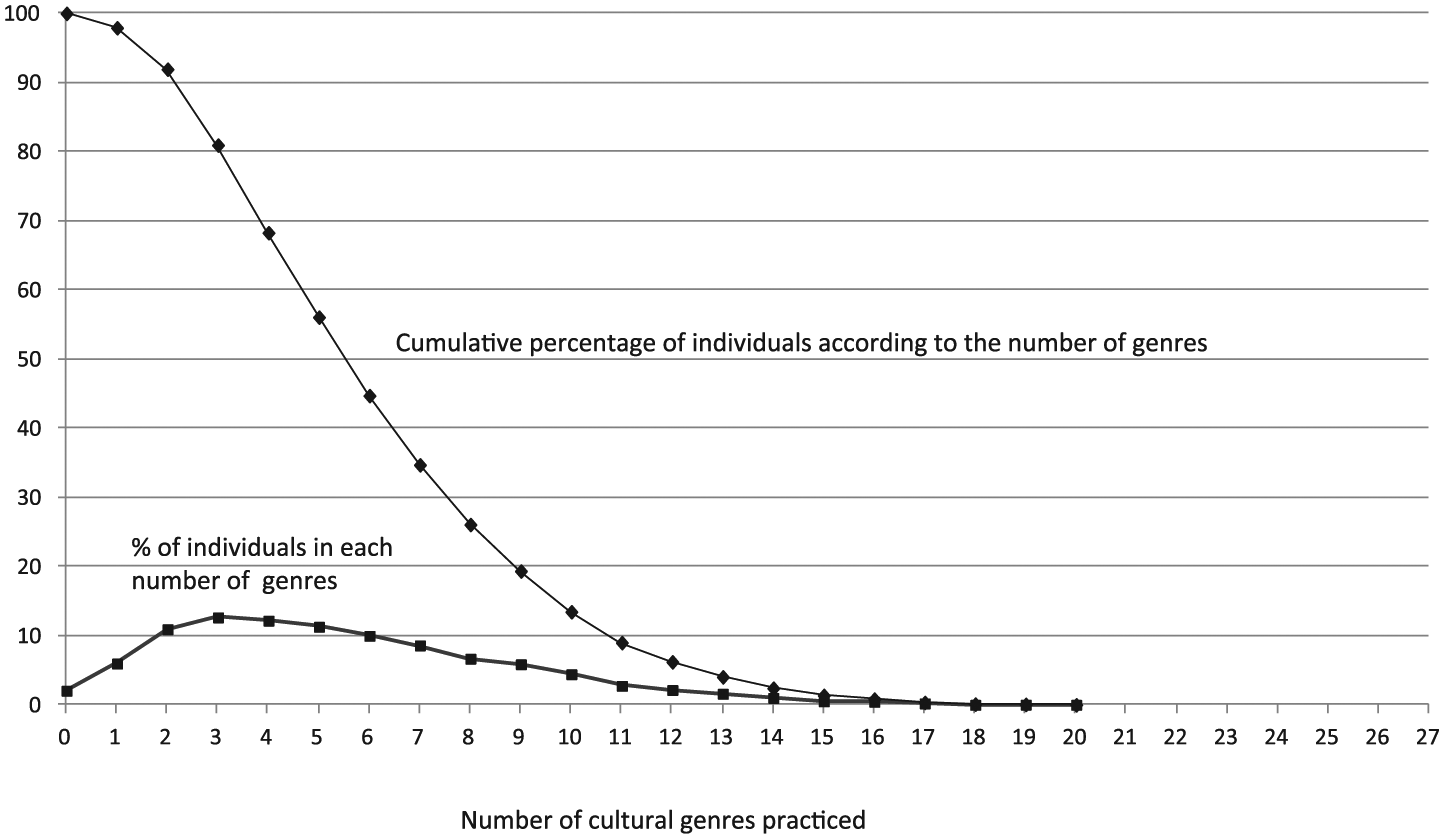
Percentage of individuals by number of genres.
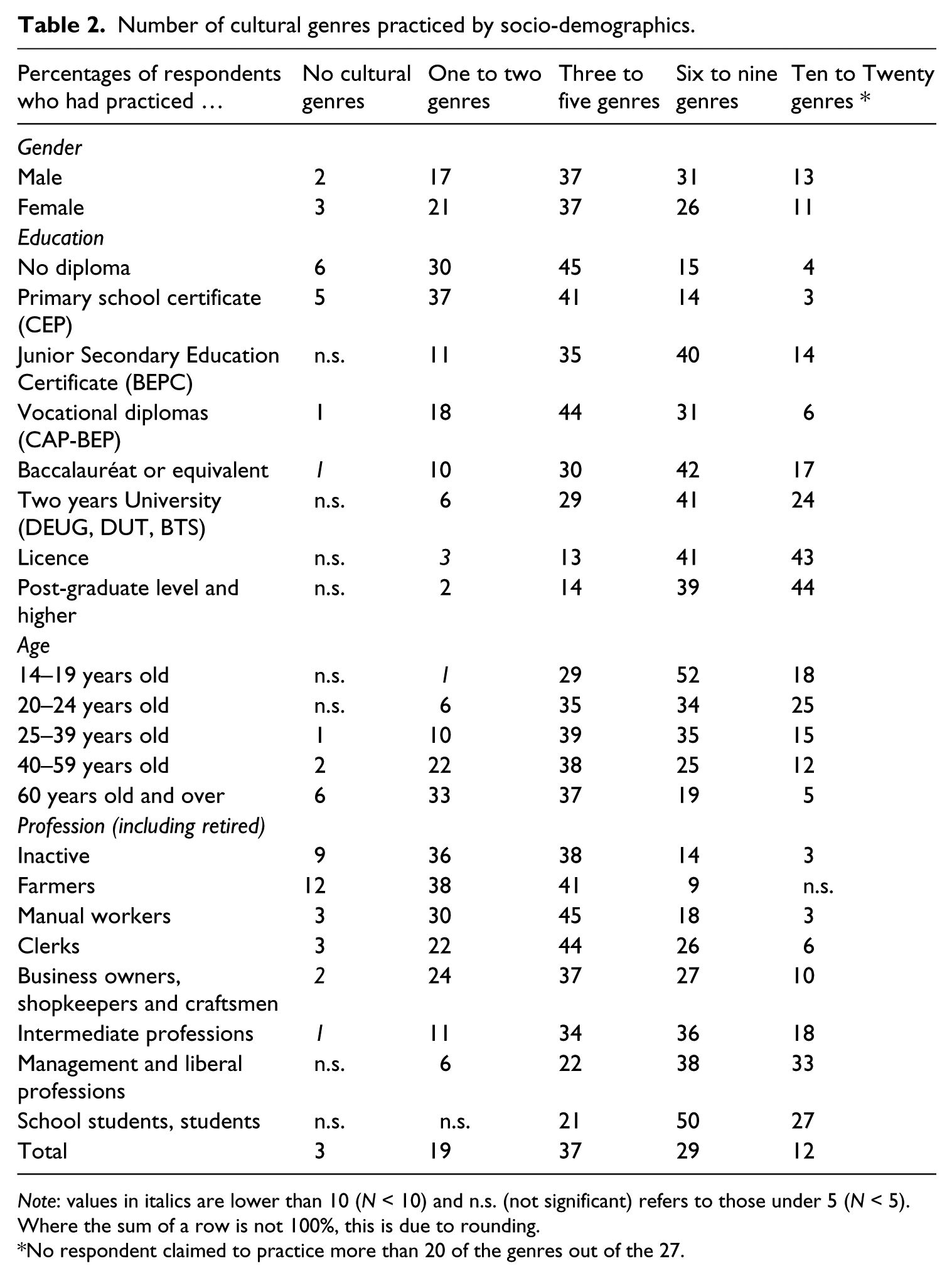
On the level of quantitative eclecticism, Table 2 confirms Peterson’s theory as applied to music (Peterson, 1997; Peterson and Kern, 1996) – cultural eclecticism increases according to educational level and socio-professional category. It also decreases considerably with age. The highest levels were found in the categories of young adults and students. Gender had relatively little influence on quantitative eclecticism with men claiming to be interested in slightly more cultural genres than women.
Number of cultural genres practiced by socio-demographics.
Note: values in italics are lower than 10 (N < 10) and n.s. (not significant) refers to those under 5 (N < 5).
Where the sum of a row is not 100%, this is due to rounding.
No respondent claimed to practice more than 20 of the genres out of the 27.
Social Differentiation of Cultural Eclecticism
We restricted our classification to the most eclectic respondents, i.e. those who mentioned several genres, in order to examine the precise question of the nature of cultural eclecticism and diversification.
The aim was to depart from any idea of an indicator of overall attendance or visits and from the epistemology of cultural substitutability which distinguishes cultural practices from each other. The reason for this was to propose a model of the diversification and diversity of cultural eclecticisms to establish a sustainable hypothesis regarding the qualitative differences between cultural genres. We therefore carried out a hierarchical classification of the population of eclectic respondents based on our stated proportion of respondents who practiced six or more cultural genres out of the 27. We choose to retain at least six genres because this represents 44.7% of the French population – less than half of the whole population – and is significant enough in terms of eclecticism. Five genres would have been too few. However, there always remains a degree of arbitrariness in setting a cultural level for a definition of eclecticism. We did not want to be too restrictive in the number of selected genres and therefore chose at least seven or more genres. We only focused on the omnivore classes and decided not to examine non-omnivorous classes as we had done in Glevarec and Pinet (2013). As we indicate, we aimed to examine the portfolios of tastes of eclectic people in the same way as Bellavance (2008) by choosing to observe six individual ‘highly qualified’ people.
The aim of this classification of eclectic people was to group them into a limited number of classes that would be as internally homogeneous as possible and with the most differentiation between them so that a large part of the heterogeneity of the population’s practices would be transferred to the heterogeneity between the classes. The quality of the analysis depends to an extent on the ‘shared explanations’ which are lost (and which need to be as few as possible) when we move from the individual descriptions of the 2239 individuals who practice six genres or more to those of the classes selected (the number of those who practice six genres or more which we defined as ‘eclectic’). Dividing the arborescence into seven classes seemed the best solution – 38% of the total inertia can still be explained when this population of 2239 people is reduced to just these seven classes. They can be described by the specific bouquet of practices (but also of ‘non-practices’) which are common, by which we mean significantly more common than the average. This homogeneity and heterogeneity is established here solely from the point of view of the practices to be analysed; the 27 cultural genres are therefore the only active variables in the analysis. Each individual is thus described by the 27-dimension ‘vector’ of his or her attitudes regarding these 27 genres. This does not prevent the integration of illustrative socio-demographic variables into the analysis and indeed these help shed light on the nature of the classes of eclecticism obtained (the procedure highlights the classes which are the most significantly characteristic of the population of a class ex post facto). Working this way brings out the archipelagos of practices corresponding to the most commonly encountered associations between them from the combined structure of the practices and non-practices.
The classification method is particularly well adapted to an approach to eclecticism in terms of tablatures which aims to show the gap between the idea of an ‘overall eclecticism’ which would henceforth characterize certain social categories and the reality of people’s sets of practices. To get a view of this, we need firstly to stop extrapolating from the profile of a statistical class of cultural practitioners obtained from a hierarchical classification of a gamut of effective practices which would concern them all in a uniform manner. Thus, while listening to opera seems to signify class seven of seven, only 27% of the members were characterized by listening to this style of music. It is clear that there is a discrepancy between the statistical profile of a class calculated with reference to the whole population and the levels of effective practices of the members of this class itself. Of course the types of eclecticism which are conveyed by the following figures do not represent the exact spread of genres which are both practiced and absent for all the individuals in a class – not even necessarily for just one of these – but instead show the average cultural profile of the members of the class which juxtaposes the most probable (and improbable) traits in that class.
The hierarchical classification of cultural eclecticisms thus reveals qualitatively diversified and non-exhaustive sets of cultural practices, or sets of practices, which are both differentiated and of which none is characterized by covering all genres. The distribution of cultural genres (of which Table 3 gives the average for each class) does not justify the argument that a set of individuals might be characterized by significantly common practices (concerning for example at least 50% of the members of the class) involving both classical genres with the longest legitimacy in time and also more recent genres derived from popular culture, the cultural industries or the media. While it has become legitimate in the view of certain observers, including cultural sociologists, to watch television series, listen to rock and read comics or crime fiction, those who do so among the strongest cultural practitioners hardly ever go to the theatre, do not go to many temporary photography exhibitions and hardly ever listen to classical music, opera or jazz. Also a relatively low proportion of respondents who did visit a museum or historical monument or listen to classical music (definitely legitimate practices in a Bourdieusian sense) said they practiced these new legitimate practices of watching television series (24%), listening to rock and reading comics or crime fiction.
Average number of genres per class.
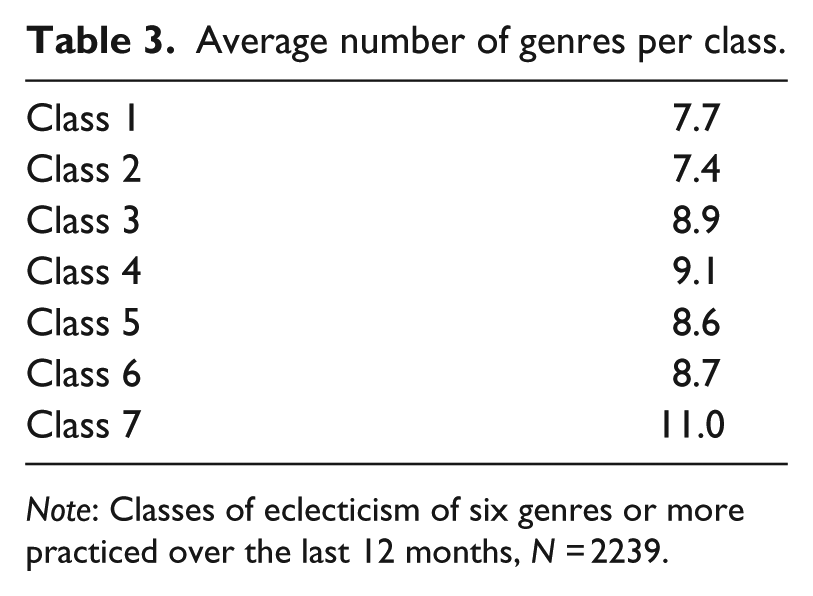
Note: Classes of eclecticism of six genres or more practiced over the last 12 months, N = 2239.
To comply with the logic behind the tablature model, alongside the significant practices we also need to show the field of cultural shortage or levels of absence of certain cultural practices in individuals in each class who are strong practitioners of certain fields. Therefore in Figures 4 to 10 below, we selected both the test-values of the modalities of practices chosen by eclectic people (i.e. strong cultural practitioners of six practices or more out of 27) and the percentages of modalities in the class (i.e. percentages of practitioners in the class) along with similar data concerning ‘non-practices’ with the highest test-values. This meant there was a particularly significant difference from the average practice but here it was lower. To make the tables below easier to read we have simplified the titles of the genres.

Classes of cultural practices (six genres or more) and cultural shortage.
Diversity of Cultural Repertoires and Cultural Shortage
If we consider the life duration of the cultural genres, two types of eclecticism show up with a first approach – the group formed by the three first classes is characterized by a high level of presence of recent cultural genres while the group formed by classes 4 to 7 is characterized by the pre-eminence of older cultural genres. This division alone might have first been thought enough to argue in favour of the relevance and continuing existence of cultural legitimacy. However, the diversity of the older and classical cultural classes 4, 5, 6 and 7 shows that this is in fact not the case. Eclecticisms of contemporary or older tastes both appear differentiated and limited.
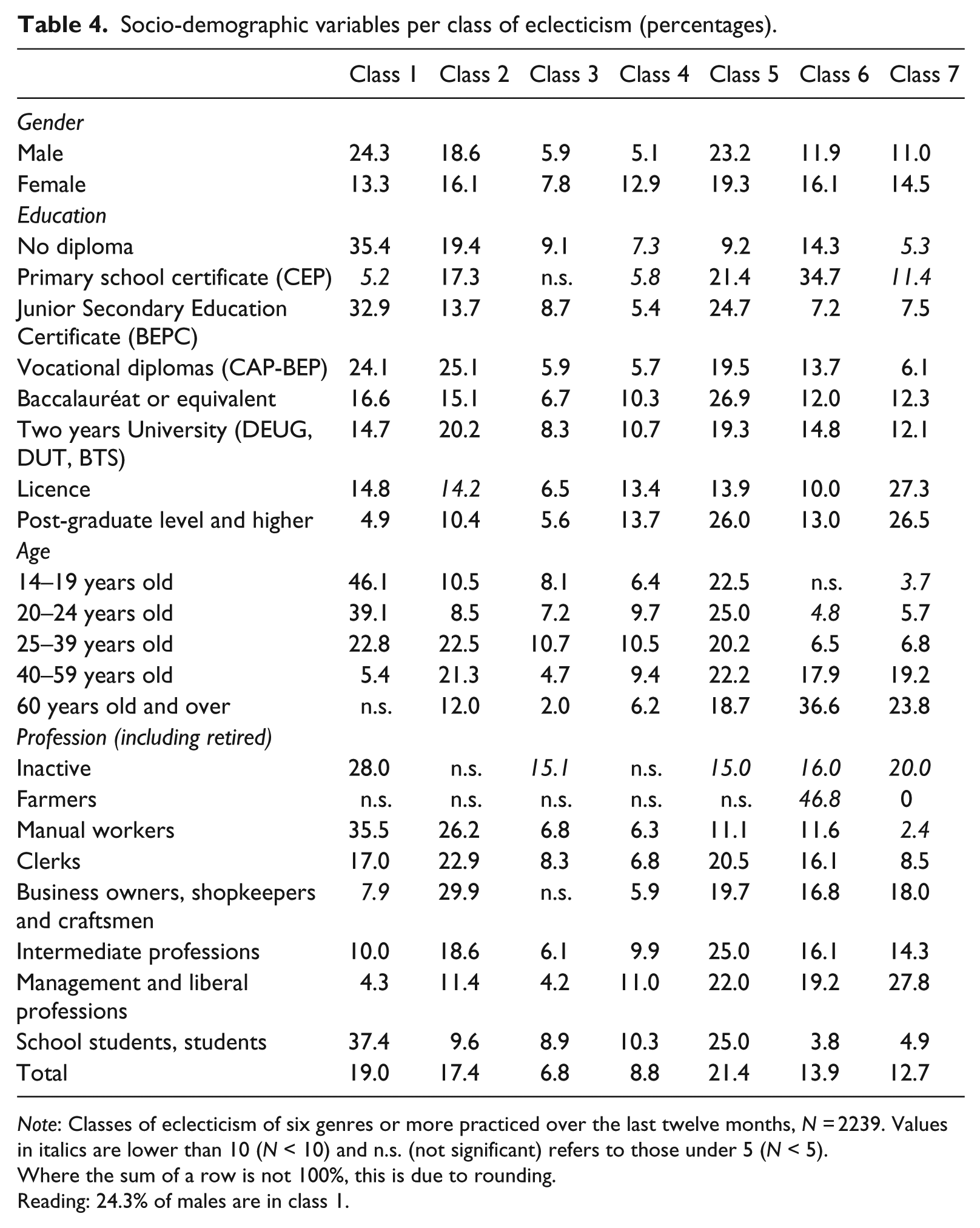
To make the classes of eclecticisms easier to read, we did not indicate socio-demographic variables which might qualify the sociological profile of each of the classes. We used socio-demographic test-values to qualify each class. 15 We refer readers to Table 4 which shows how socio-demographic variables are divided up according to classes of eclecticisms.
Socio-demographic variables per class of eclecticism (percentages).
Note: Classes of eclecticism of six genres or more practiced over the last twelve months, N = 2239. Values in italics are lower than 10 (N < 10) and n.s. (not significant) refers to those under 5 (N < 5).
Where the sum of a row is not 100%, this is due to rounding.
Reading: 24.3% of males are in class 1.
The eclecticism of class 1 (19%) is defined by rap music, video games, electronic music, action and comedy films. Only an infinitely small proportion of members of this class frequent cultural sites and the more classical genres – exhibitions, museums, theatre and classical music. Class 2 (17%) is characterized by practicing the genres of crime fiction and films, action films and television series. Like class 1, the practices of members of this class are at a significant distance from older and more classical genres. While class 1 is strongly characterized by the presence of young and very young (mainly male) categories, by secondary school and college students and also by low-level qualifications and working-class origins, class 2 seems popular in origins too (‘working class’, ‘clerks’ and ‘CAP-BEP’ – low-level school qualification – are significantly over-represented) but more centred on older categories. There are twice as many men between the ages of 35 and 49 years than the average figure.
Class 3, the smallest class of eclecticism (7%) is notable for practicing several contemporary genres but above all ‘animated material’ (animated films 16 ) and manga, video games and comics. Young adult women are at the centre of this class which is also more neutral on a social level than the previous two as over-representations linked to profession or educational qualifications are not observed.
Class 4 (9%) might appear to be part of the new legitimacy because of its members’ pronounced taste for rock, but, despite members’ strong liking for classical literature, it is also characterized by the absence of certain more traditionally legitimate genres, especially opera (98% of non-practitioners in the class) and its low levels of practice in activities such as going to the cinema but also comics, rap and electronic music, animated, action and comic films. As we can see, this class may seem modern in several ways but is in no way defined by a set of practices which cover all the most legitimate genres nor by the full set of popular genres to which some of its members do, however, give value. Firstly it is a largely feminine class (seven women for three men) which practices less common cultural tastes for the men, such as dramatic comedies, classical literature and art-house or ‘auteur’ cinema. There are more graduates and people of intermediate age than the average figure – the test values of the illustrative variables correspond to a female teacher of middling age with literary tastes as the core of this class.
Class 5 is the largest in number (21%) and is also on the list of classical eclecticisms because of the significant number of citations for visiting historical monuments, museums and painting and photography exhibitions as well as comedy films and the theatre. However, cultural genres such as opera, classical music, comedies and dramas, jazz and animated films are considerably less frequently cited than on average. A typical socioeconomic profile or age is not apparent (at most there are slightly more people with ‘baccalauréat’-level education than manual workers or respondents without educational qualifications) and the class seems in fact to encompass all those who see cultural practices in terms of going out and events.
Class 6 (14%) is defined by high levels of classic practices such as opera, classical music and jazz, reading essays and visits to painting exhibitions. It is also characterized by even higher levels (over 90% in some cases) of absence of art-house or ‘auteur’ films, theatre, cinema, reading ‘comics’, rock, electronic music and rap, along with video games, animated films and comedies. In other words, this class of practitioners is very interested in traditionally legitimate genres, is characterized by the absence of newly legitimate genres and thus by an eclecticism of tastes which again seems limited. It is a class of older and retired people (mainly former management or white collar staff rather than manual workers) who are above all faithful to classical musical genres and do not go out much. Little can be concluded about the level of studies of people in class 6 and above all age is a more significant factor here than social or cultural status.
Class 7 (13%) is characterized by the addition of a certain number of classical practices, ranging from art-house or ‘auteur’ films to historical monuments via jazz, classical literature and museum visits. However, its members exclude rock, television series, video games and action, comedy and detective films from their tastes. This class is therefore not any more representative than the previous classes of an exhaustive eclecticism in all the cultural genres, particularly contemporary genres and those to which other eclectics give value. It is a class made up of cultivated older people – mainly management staff who are still working – who enjoy many cultural outings but, unlike the more socially neutral class 5, associate these outings with reading and listening to music (but not contemporary genres). Again the very ‘Parisian’ classic cultivated model – living in this geographical area was nearly two times higher than the average – cannot be characterized by a broad eclecticism which would include contemporary genres.
It can thus be seen that classes of genre matching or mismatching and profiles of class members are factors which testify to a very strong generational effect. ‘Generation’ refers to a specific cultural environment where individuals are born and raised and which shapes their cultural patterns. We intend to argue for an intra-genre variation, but the data only allow us to infer the model from the clusters.
Conclusion: From Distinction to Differentiation
As Tak Wing Chan wrote in 2010: ‘cultural consumption is differentiated as stratified’ (Chan, 2010: 239). Our analysis is consistent with that idea. Culture and omnivorousness remain correlated with social status (Glevarec and Pinet, 2013) but the structuring by age or by cultural generation of contemporary media-based cultural practices and tastes (Donnat, 2009; Glevarec and Pinet, 2008; Octobre et al., 2011) seems to question the primacy of a holistic structuralism of social positions. Through our hierarchical classification of culturally eclectic French people, we have shown a diversification of world of tastes in which no class of eclecticism (or individual) covers all cultural genres and no class includes the others classes. Statistical classes correspond to a particular way and level to describe contemporary archipelagos of tastes in France. Different universes of cultural practices and/or taste are characterized by different sorts of generic diversity, degree of involvement and knowledge, although the latter two points are not testable hypotheses for data. It thus appears difficult to support the ideas of a hegemonic cultural eclecticism and, a fortiori, a single high profile of eclectic people.
In contrast to the distinction model of Bourdieu and the omnivore theory of Peterson, a model of the cultural diversity of tastes and practices of culturally eclectic people seems appropriate for French contemporary society. The ‘tablatures’ of diversified genres of tastes and practice repertoires indicate that we have passed from a ‘distinction’ argument to a ‘differentiation’ argument which are two different theorizations of lifestyles and individual attitudes. Differentiation is not a distinction.
Footnotes
Acknowledgements
We would like to thank the two referees for their accurate reading. We would also like to thank Sheila Perry and Raphaël Nowak.
Funding
The authors received no financial support for the research, authorship, and/or publication of this article.
