




Abstract
Individualization remains the most prominent theoretical explanation for the shifts in European demographic trends since the 1960s, including decreasing marriage and fertility rates and increasing divorce rates. Demographic theorists suggest that a shift from traditional to individualized values, such as autonomy and self-realization, has been driving these trends. However, conceptualizing individualization as a set of values cannot account for why Swedish marriage rates have increased since 1998, despite highly individualized values. This article suggests re-thinking individualization as a form of internally referring attributions in causal and moral reasoning about human behavior, emphasizing agency and internal causes over structure or context. As such, individualization shapes peoples’ perceptions and understandings of the world, including their expectations of marriage and close relationships. Data from focus groups support this conceptualization and show how participants individualize risks, while perceiving marriage itself as inconsequential. In line with previous research, individualized reasoning obfuscated assumptions that were less individualized and implicit.
Introduction
Individualization remains one of the defining characteristics of contemporary Western cultures and is a major factor in the organization of social life. This is evident in demographics research, wherein individualization is one of the most prominent explanatory mechanisms for the major demographic changes in Europe since the 1960s (Lesthaeghe, 2010; Surkyn and Lesthaeghe, 2004). In particular, individualization has been invoked to explain the large changes to the organization and practices of households, families, and intimate relationships, including decreasing marriage rates, household sizes and birth rates, and increasing divorce rates.
As in many other European countries, Swedish marriage rates have been declining since the 1960s (Eurostat, 2015). Yet, while Sweden originally spearheaded the European marriage decline and continues to top measures of individualization, its marriage rates have now turned into a steady increase since 1998, now surpassing the European average. This theoretical anomaly makes Sweden an interesting case for understanding how individualization operates.
This article seeks to offer a tentative answer to the overarching question: How can high individualization and increasing marriage rates coexist? The article first examines the notion of individualization and identifies ‘internal reference’ as its defining feature, in contrast to, for example, a set of individualistic values or liberation from social institutions. Internal reference is then specified as an attribution of behavioral causality to internal factors, used to understand social behavior. This conceptualization provides an operationalization of individualization in discourse. To demonstrate the effects of internal reference, individualized marriage discourse was generated using focus groups with young Swedish adults. These data were analyzed for strong intra- and cross-group themes and markers of internal reference. The analysis shows how individualization operates primarily on an explicit level, and is used to explain or justify implicit cultural schemas. Furthermore, the analysis indicates that Swedish marriage may be attractive to young Swedish adults not in spite of but because of individualization.
The Case of Swedish Marriage Rates
Swedish marriage rates are an interesting case for researchers interested in the relationship between individualization and marriage practices because Sweden has been a demographic forerunner in the decline of European marriage rates since the 1960s, which has been attributed by leading demographics theorists to a European shift towards individualized values (Lesthaeghe, 2010; Surkyn and Lesthaeghe, 2004). Yet over the last 18 years, Swedish marriage rates have increased, surpassing the European average around the year 2005 (Eurostat, 2015).
As shown in Figure 1, Swedish marriage rates dropped dramatically below the European average in the latter half of the 1960s, a change which was accompanied by increasing divorce rates and decreasing fertility rates (Eurostat, 2015). Marriage rates continued to decline until 1998, with the exceptions of two anomalies in 1974 and 1989 caused by changes to the legal system (Agell, 1985; Hoem, 1991). However, despite the increase in marriage rates since 1998, Sweden remains a highly individualized country with few signs of decreasing individualization (Ohlsson-Wijk, 2011). Sweden has, for example, been repeatedly ranked as a top country on measures of individualized values such as secularism and self-expression; measures which have increased over the period 1998–2015 (Sobotka, 2008a, 2008b; World Value Survey, 2015; see Figure 2). The combination of high individualization and increasing marriage rates is relatively unique for Sweden, as other highly individualized Nordic countries such as Denmark, Norway, Finland and Iceland have not seen the same increase in marriage rates. This theoretical anomaly makes Sweden an interesting case for studying the mechanisms of individualization.

Swedish and European marriage and divorce rates per 1000 citizens from 1960 to 2014.

The 2015 Inglehart–Welzel cultural map shows Sweden’s continued unique ideational position in the top right corner.
Swedish demographics research has shown that explanations such as marriage postponement or shifts in demographics resulting from changes to the labor market, immigration, and childbearing patterns can only partially account for Sweden’s break from its previously decreasing marriage trends (Ohlsson-Wijk, 2011). Furthermore, compared to most other countries marriage is not significantly more advantageous than cohabitation in Sweden. 1 A few differences remain – including inheritance rules, child surname conventions, and automatic assumptions of paternity (Andersson, 2011) – but there are no advantages for social security, legal rights, or economic benefits, as is the case outside of Scandinavia. Since the practical benefits of marriage have not increased, there seems to be a real gap in our understanding of how individualization affects behavior, which has led researchers to call for further theorizing on the mechanisms of cultural individualization (Eldén, 2012; Ohlsson-Wijk, 2011).
Theory
Individualization Theory
Among the most influential takes on individualization by social theorists are Beck’s individualization theory (2002) and the less explicit, but equally relevant, works of Giddens (1992) and Bauman (2003). These theorists view individualization as a shift of societal focus from traditional institutions to autonomous individuals. Whereas society previously prescribed predetermined life trajectories to individuals, late modern society increasingly requires people to construct their own life biographies, that is, to create their own destinies. People are assumed and expected to act in accordance with their own inner desires, rather than to conform to social or normative expectations. Choice, freedom, and the satisfaction of one’s own desires consequently become paramount.
The three big individualization theorists all suggest that individualization has a significant impact on how we organize relationships. Bauman (2003) emphasizes the role of a consumerist discourse where relationships are seen as goods for consumption and satisfaction of one’s own desires; goods which can easily be replaced if found insufficient. Giddens (1992) on the other hand raises the changing views on romantic relationships, wherein contemporary ‘pure relationships’ are relationships without external constraints or motivations, relationships which people enter into and maintain for the sole purpose of enjoying that relationship. The three theorists all agree, however, that relationships have now become more difficult due to the individualized imperative to choose your own happiness, and that marriage is now harder to justify as tradition and social institutions have lost their authority. Decreasing marriage rates is therefore an expected result of individualization.
A similar line of reasoning regarding the causal effect of individualization on marriage rates can be found in the most prominent demographics theory for explaining European demographic shifts since the Second World War: the second demographic transition theory (Lesthaeghe, 2010; Surkyn and Lesthaeghe, 2004). The demographic theory construes individualization specifically as a shift of values, away from the traditional values that promote submission to social institutions, towards individualistic and secular values that promote individual autonomy, the rejection of institutional control and authority, and the desire for self-expression and self-realization. While this theory is much less developed than those of Beck (2002), Bauman (2003) and Giddens (1992), it clearly specifies a set of values as the main mechanism of individualization.
Both social and demographic theories argue that as people reject the normative authority of traditional household formation, the purpose of close relationships shifts from family formation to satisfying personal desires, unburdened by economic dependency, moral predicates, and gendered divisions of labor (cf. Bauman, 2003; Beck, 2002; Beck-Gernsheim and Beck, 1995; Giddens, 1992; Lesthaeghe, 2010; Surkyn and Lesthaeghe, 2004). In general, the argument is that after a certain economic standard is reached, people start to reject traditional institutions – such as religion and gender roles – as illegitimate forms of social control. The marriage institution may therefore appear to be an old-fashioned and unnecessary constraint on the pursuit of happiness. It is argued that under individualized conditions (when self-actualization and autonomy are considered important, and people are responsible for their own lives), people possess a heightened concern for their autonomy and may use risk-diminishing strategies like postponing childbirth and marriage to avoid getting stuck in a bad relationship (Beck, 2002; Beck-Gernsheim and Beck, 1995; Turney, 2011).
These theoretical accounts provide an important part of the story, but they have also been heavily criticized on empirical and theoretical grounds as insufficient accounts of what individualization is and how it actually affects peoples’ behavior. Family sociologists have for example criticized the tendency of individualization theories to assume or imply that people are actually more autonomous from social institutions, conventions, relations or norms in their life choices. Although people may sometimes appear to be, or even believe themselves to be, autonomous decision makers, people are in fact embedded in complex relationships and traditional expectations and ideals of love, family, and relationships (Eldén, 2012; Gross, 2005; Jamieson, 1999; Smart, 2007; Swidler, 2001). Although this observation has also been raised by social theorists such as Beck (2002) who often states that people are assumed to be autonomous rather than that they are in fact so, there is a lack of a specific definition of individualization and its main mechanism which creates confusion regarding whether individualization actually creates autonomy or merely the impression of such. Both Beck (2002) and others seem to suggest that some autonomy is achieved, and that a central feature of individualization is that social institutions do have less power than they traditionally did.
Accounts that construe individualization as a set of values are similarly subject to critique. Values alone are rarely good explanatory mechanisms for complex behaviors, a notion which has been heavily critiqued from many directions. D’Andrade (2008), for example, has shown that people often share similar values across different cultures, but that there are much larger differences in how values are understood and implemented in practice. How people explicitly reason about actions in terms of values has also been shown to differ significantly from the implicit assumptions and intuitive practices they actually reproduce (Vaisey, 2009). Under certain circumstances, it might even be possible for an individualized discourse to support traditional institutions by masquerading as autonomous individual choices (Eldén, 2012). Finally, the idea of a value shift as the defining mechanism is unable to account for the coexistence of highly individualized values and increasing marriage rates in Sweden (Ohlsson-Wijk, 2011).
In summary, cultural individualization is generally recognized as a defining feature of our time, with a significant impact on the socio-demographic organization of societies. However, despite an agreement on broadly thinking of individualization as a shift away from traditional institutions towards individual autonomy, the actual concrete mechanism of action remains obscure. Social theorists are vague in their accounts of how individualization actually impacts individual behavior, and the demographics account of individualization as a shift of values appears insufficient, both of which have led researchers to call for further theorizing on the role of individualization in human action (Eldén, 2012; Ohlsson-Wijk, 2011).
Culture and Cognition
While the three great individualization theorists, Beck (2002), Bauman (2003) and Giddens (1992), all discuss individualization and its influence on close relationships, they also all lack an account of how cultural individualization enters into action. The obscure mechanisms of individualization are, however, but a part of the larger problem of how culture translates into individual behavior through the ‘black box’ of cognition (DiMaggio, 1997; Vaisey, 2009).
Cognitive science tells us that people perceive the world and process information through schemas derived from recurring patterns in the environment. This appears to be a realistic micro-mechanism of cultural reproduction (cf. Sewell, 2005). People are able to learn from and reproduce all kinds of patterns in their environment this way, including both reflective and intuitive logics such as discourses and practices. Previously learned schematic patterns are subsequently used to efficiently organize, categorize, understand, and respond to new experiences (D’Andrade, 1992; Mandler, 1984). Schemas actively define reality by selecting, parsing, and interpreting experiences; they help individuals make sense of the world by describing how things work and what is possible, and thereby they also motivate action.
Another important insight from the cognitive sciences is that the mind operates on two relatively independent levels: one reflective and one intuitive (see Evans and Stanovich, 2013, for a review of different dual-process theories). This means that one set of schemas might be at work as one reasons, consciously and deliberately, and an entirely different set of schemas might be involved in intuitive decisions or automatic actions (cf. Quinn, 2005; Vaisey, 2009). This is in line with Eldén’s (2012) observations of how couples may rely on individualized rationales to explain their behavior as autonomous choices, while in practice still reproducing normative behavior in accordance with traditional institutions. If individualization primarily affects the reflective level of cognition, it does not necessarily lead to critique and erosion of implicit traditional practices, as long as these can be explained away using individualized discourse. It would then be entirely possible for individualization to coexist with some traditional practices and intuitive assumptions, as long as those can be explained as individual choices rather than social conformity. Individualized discourse could then erode traditional discourse on relationships – that is, traditional ways of thinking and speaking about relationships – without necessarily having the same impact on actual practices. Making use of this notion in empirical analysis still requires specifying the defining feature of individualization and thereby operationalizing it.
Re-thinking Individualization
The three big theorists relating individualization to close relationships – Beck (2002), Bauman (2003) and Giddens (1992) – all refer to ‘internal reference’ as a defining feature of how individualization shapes peoples’ understanding of social action. However, Beck (2002) is the only one who elaborates on this notion. He argues that what he calls internal reference disembeds individuals and their actions from social contexts by attributing actions to internal factors, such as personality traits, desires, goals, emotions, or free will, as opposed to structural conditions, contextual factors or social imperatives (see Figure 3). Internal reference is here a form of causal attribution, similar to the fundamental attribution error in social psychology, by which individuals (especially from Western cultures) tend to be biased towards ascribing the primary cause of actions to internal characteristics of the actor (Markus and Kitayama, 1991).
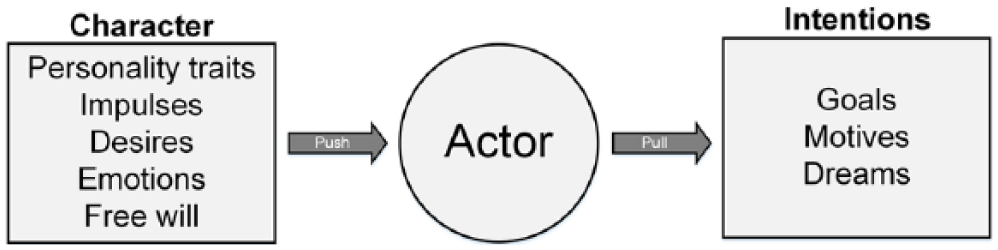
Action causality as understood through internally referring attributions.
However, in Beck’s (2002) account, internal reference is not only applied to causal inferences but to moral reasoning as well, with the consequence that only internally referring reasons can ultimately justify actions. In effect, through internal reference the individual becomes the alpha and omega, the beginning and the end of actions. This is in direct contrast with more traditional reasoning where external collective entities were allowed power over individuals (such as religion, obligations, others’ expectations, the family, social norms, or even the nation).
In conclusion, we can conceive of individualization as a shift towards internally referring attributions in causal and moral reasoning about human behavior. Furthermore, it is assumed that people learn this attribution style from exposure to recurring cultural logics, internalized and reproduced through individual cognitive schemas. Finally, the individualized attribution style is assumed to operate primarily on a reflective level of cognition and discourse, as a means to understand, explain, rationalize, motivate or justify behavior.
This re-thinking of individualization would provide us with both a realistic account of how individualization enters human minds and affects human action, and an operationalization of individualization as an observable logic of internal reference in discourse. Individualization as internal reference does not negate the idea of individualized values, or the idea that people may be increasingly autonomous from some traditional institutions, but explains those as secondary effects rather than as the primary mechanism of cultural individualization.
Data and Method
Empirical Method
A dataset of marriage discourse was generated using focus groups to assess whether individualization, as internally referring schemas, is compatible with increasing marriage rates. Focus groups were used to emphasize dominant cultural schemas over personal experiences, and to avoid using discourse ‘naturally occurring’ in specific contexts, such as magazines or online forums, where the author has a certain audience and goal in mind. Focus groups allow for some control over the context (Demant, 2012), which is important since schemas are context-dependent (D’Andrade, 1992; DiMaggio, 1997; Oyserman, 2015). Because focus groups take interaction out of its natural context, it is possible to generate discourse on marriage without promoting any particular purpose or personal motives of the participants. The main advantage of using focus groups is that they generate discourse based on the best-established cultural schemas since people are forced to rely on commonly shared schemas to communicate effectively with strangers. Furthermore, focus groups exploit the social interaction ‘biases’ of people in groups, such as social desirability biases, to parse dominant cultural schemas (De Ruyter, 1996; Nemeth and Nemeth-Brown, 2003). While biases make focus groups problematic when gathering accurate data on personal experiences, it makes them efficient tools for generating normative discourse.
For this study, three focus groups with mixed gender compositions and consisting of four to five participants were used to produce the data. The participants recruited were unmarried Swedish students between the ages of 20 and 30; this ensured the participants could consider marriage a viable option in the near future while, at the same time, avoiding personal investment in the question and thereby encouraging an impersonal discussion based on shared cultural perceptions. Participants were selected as a convenience sample by approaching students at a university library in Malmö, Sweden’s third largest city. It should be noted that relying on a small sample of students from an urban area may skew the produced data towards middle-class discourse, thus limiting insight into the discourses of working-class or non-urban young adults, as well as young adults with a different ethnic background. Another consequence of the small sample is that the analysis should not be read as representing the opinions of a population but as a sample of individualized discourse.
Prior to each focus group, the participants were informed of the purpose and conditions of the study, including subject matter, procedure, recording, transcription, the guarantee of their anonymity, and their right to terminate participation. A semi-structured discussion guide was used, which included questions formulated to encourage general rather than personal discussions. The guides started out with broad, explorative topics (‘What is marriage?’) and ended with specific questions of interest and more probing questions. After the sessions, the recordings were fully transcribed (including pauses, hesitations, and interruptions by other speakers) and then coded and analyzed using qualitative analysis software (NVivo 10). As the interviews were conducted in Swedish, the excerpts presented in the analysis have been translated with minimal changes to both syntactic structure and meaning.
Analytical Method
Because culturally shared schemas structure articulated discourse, schematic logics and assumptions can be observed as they are reproduced in discourse. Discourse analysis has, therefore, previously been used as a method to gauge cultural schemas (e.g. Ignatow, 2004; Malcolm and Sharifian, 2002; Quinn, 1982; Van Dijk, 2014). Quinn (1982), for example, identified a widely shared set of schemas concerning marriages in an American context from recurring syntactic patterns in interview transcripts. The key to identifying culturally shared schematic patterns in discourse is to assess informer agreement patterns within and across groups by identifying recurring logics and any antagonistic or alternative logics deployed. If multiple groups independent from each other spontaneously deploy a certain logic without leading questions from the researcher, and there are no present alternatives or opposition in any group, there is grounds to assume even from a relatively small sample that a culturally shared schema underlies the discursive articulations, even though the full extent of its sharedness remains an open question.
The discourse data from the focus groups were analyzed for both explicit and implicit patterns. Explicit patterns can be observed in articulated syntactic patterns such as logics, propositions, narratives, or claims, while implicit patterns can be inferred from recurring associations or presuppositions that participants must share to understand each other (cf. Malcolm and Sharifian, 2002; Quinn, 2005). Patterns were coded for frequency and markers of individualization. As previously mentioned, individualization was specifically operationalized as internally referring attributions in causal or moral reasoning about human behavior, which can be identified, for example, in attributions of marriage decisions to individual traits or desires.
To assess how well established a discourse was, patterns were also coded for inter- and intra-group sharedness, discursive dominance, and factual claims. The dominance of a discourse was also assessed using indicators of the claimed cultural standing of a statement – ranging from personal belief to majority opinion (Strauss, 2004) – and the presence or absence of alternative or antagonistic discourses. The objectivity or factual certainty claimed by a statement was assessed using indicators such as: 1) epistemic modalizations indicating a statement’s degree of certainty, ranging from the uncertain ‘it might’ to the entirely certain ‘it is’ (Latour and Woolgar, 1986; Strauss, 2004); 2) implicit presuppositions, evidentials, claims, or assumptions about universal consensus (Potter, 1996); and 3) the use of narration techniques that imply objectivity through subject-independence (Genette, 1980), including active voice acting, where ‘no one in particular’ is quoted (Woolfit, 1992), or the assumption of an omnipresent perspective (Woolgar, 1988).
The analysis presents frequently recurring themes identified as highly dominant and largely shared within and across groups. This was achieved through a two-stage coding process where the fully transcribed material was first categorized according to topics and then coded for discursive logics, dominance, sharedness and factual claims. Dominant and shared discursive logics are presented in the analysis following the order of topics provided to the groups: starting out with what marriage is, moving on to why people marry and finally addressing any downsides or risks associated with marriage.
Results and Analysis
Contemporary Swedish Marriage as Detraditionalized
One of the strongest patterns in the data was that participants in all groups explicitly dissociated marriage from traditional institutions, in particular, religion and gender roles. Contemporary Swedish marriage was never perceived as a traditional institution, but was often contrasted with traditional practices that were associated with an outdated model of marriage. For example, participants strongly rejected any connection between marriage and religion, and some participants in one group even found the notion provocative and unnatural:
I can actually become
Yes, I wouldn’t– I have absolutely no intention of marrying in church if I were to marry.
It’s so unnatural.
Yes.
This is expected and in line both with the idea that the meaning of contemporary Swedish marriage has shifted (Ohlsson-Wijk, 2011), as well as with the individualized value of rejecting traditional institutions (Lesthaeghe, 2010; Surkyn and Lesthaeghe, 2004).
In all groups, the participants often displayed a spontaneous concern for gender equality in relationships when discussing marriage. The connection between this spontaneous concern and marriage was not explicitly explained, which indicates an implicit association between marriage and gender. When probed, the participants did not explicitly recognize any relationship between contemporary marriage and gender roles. The participants would later make implicit assumptions about gender roles when it came to ‘relationship work’, but as with the observations of Swedish couples by Eldén (2012), the participants explicitly saw equality as the simple rational choices of non-gendered ‘individuals’ who simply participated in household chores according to their individual preferences.
When discussing the character of Swedish marriage, it was frequently described as detraditionalized and often compared to other cultures and eras when marriage was thought to be more traditional – and consequently problematic. The explicit and implicit presuppositions of these comparisons characterized contemporary Swedish marriage as being relatively free from tradition and constraints on individual autonomy, and therefore highly compatible with individualized values and decisions based on internal reference. These comparisons were present in all groups:
Sweden has come pretty far, and there are countries that have maybe only just begun the real equality work. I really don’t know how Spain is doing, but I can imagine that it is a bit like that, and then it becomes like… Then maybe you haven’t adapted the laws yet and everything, like, to become… and make it so that it’s legally as equal as possible.
Today it’s perhaps more accepted with divorce and such and … it can end, and people know each other more today when they marry and [noise]… And I can imagine that, kind of, well, it’s approved in another way. Approved sounds like the wrong word but yeah. It’s maybe not such a big deal. […] Before it was more, like, um, religion and such, so that… You didn’t divorce and it wasn’t accepted.
… around the 1940s and there, then you married, or, it was a way to support yourself for women, right? And… a norm and a rule.
[Everyone agrees]
Yes, and if you wanted to have children, you were maybe supposed to be married as well …
[…]
… it’s like when you entered a marriage, it was, like, really for life, no matter what you felt … today it’s more like, well, I don’t know…
Adaptable.
…you are not as dependent on each other in the same way. So you can divorce because: ‘I can afford to support myself’.
Legal-Practical Reasons to Marry
When discussing the reasons to marry, all groups heavily relied on internal references and considered marriage a rational choice based on desires or pragmatic considerations of autonomous individuals. It should be noted that internal references do not exclude reasons such as a desire to be connected with someone else, indicating that autonomy was not always of primary importance. However, these cases also included decisions referring to internal causes such as one’s own desire to be connected. This kind of individualized reasoning was assumed to be self-evident and was not contrasted with any form of external motivation to marry. The specific reasons given for why people marry were very similar across the groups and could be divided into two categories: legal-practical reasons and symbolic declarations of commitment and belonging.
When asked why people marry, most of the participants initially brought up and discussed legal or practical reasons to marry, often in comparison with unmarried cohabitation, which is a common household form in Sweden. In this initial discourse, marriage was treated as a straightforward pragmatic decision based on a presumed legal status of marriage (cf. Andersson, 2011). The assumption that marriage is legally beneficial in comparison to cohabitation, and the idea that attaining these benefits is a common reason to marry, was uncontested and treated as self-evident by all groups. However, the participants struggled to explicate and account for what the advantages of marriage actually were and had trouble finding a rationale or concrete examples for this presumption. This indicated a well-established and powerful implicit association between marriage and legal benefits. The following excerpts illustrate the difficulties the participants faced when trying to convert their assumptions to reflective reasoning:
I
Not having to discuss the last name of the children,
Yes.
–then it is already settled somehow, so that the children’s future is, like, secure, through the marriage law.
But I
[ … ]
Surname.
And when someone passes away … inheritance, that is … it belongs to the one you are married to,
… This with ownership and ownership forms, that’s a big difference between marriage and cohabitation. That is, even if you live identical lives, there are big legal differences. So that’s why I think marriage will remain because …
If you chose to marry you enter that legal… you have kind of chosen those rules.
I don’t even know what the legal …
Yeah, but if one of you… if someone passes away or so …
The participants here displayed an awareness of the fact that there are still differences between marriage and cohabitation, especially in terms of inheritance and with shared children. However, the excerpts also illustrate the presence of intuitive schematic knowledge which has been learned but rarely reflected upon.
Symbolic Declaration of Commitment
The secondary category of reasons for marriage – to declare love, commitment, and belonging to a specific person – was discussed almost as frequently as the legal-practical category. As with the legal-practical benefits, it was also spontaneously reproduced in a similar way in all groups. Here, marriage was conceived of as a declaration of belonging and commitment, either towards the partner or externally towards other people (e.g. ‘showing off’ and declaring monogamy to the world, see excerpts below). The show of commitment was considered a symbolic act that creates a stronger bond between the spouses. In other words, it was implied that marriage cements a relationship both emotionally and socially. These declarations also implied a long-term monogamous commitment to the relationship and seemed to serve as a kind of territorial claim (e.g. jokingly saying ‘He’s off the market’). The centrality of commitment in the marriage schema is in stark similarity to Quinn’s (1982) detailed observations of the importance of commitment in American marriage discourse, indicating that this is part of a more broadly established cultural schema.
Similarly to the legal-practical benefits, the symbolic function of marriage was sometimes contrasted with cohabitation, with some participants arguing that marriage is ‘more definitive’ than cohabitation. Marriage was also frequently presupposed to be a later stage than cohabitation in an implicit normative model of how relationships grow, where cohabitation was assumed to accompany a weaker degree of commitment and belonging. These presuppositions were present and uncontested in all groups.
… a natural step where you want to somehow be tied together with some other person. More than as cohabitants. […] It is as if you have stabilized the relationship and kind of prepared to, well, take yet another step.
However, although the mechanism of marriage was symbolic and implied emotion, these declarations were sometimes described through instrumental reasoning:
Yes, yes, but, like, yeah kind of… that it is a nice party,
Mm.
Exactly.
… change your last name, and have a ring on the finger, it is a bit like… well,
It may be more of a change in how others view the relationship; I don’t think that there will be any change within the relationship, but from the outside, I mean, I can look differently at a couple who is married compared to a couple who is unmarried … it really becomes: ‘alright, you two…’
‘He’s off the market’, or what?
[Many participants laugh]
[ … ]
I think that it is if someone is jealous or something, then
In the above excerpts, the participants once again use internal reference to attribute causality to internal factors, such as territorial jealousy or a desire to display one’s love, when reasoning about how people might use marriage as a symbolic declaration. The assumption is that marriage works as a public display or statement of who belongs to who, that can be used to achieve desired effects either externally to the couple – such as showing that your spouse is now off the market – or internally, as a demonstration and assurance of your commitment to your partner.
Implications of Marriage
Marriage as a symbolic declaration was said to show faithfulness and commitment and to ensure the reliability of the other partner through the social and formal recognition of the relationship, including the establishment of a household. Therefore, although they are exhibited through different mechanisms, both the symbolic and the legal-practical reasons to marry share the implicit consequence of cementing the relationship into a more durable unit with a stronger bond. Whether through a legal or a symbolic-emotional definition, the implicit function of marriage was that the couple became strengthened and stabilized as a unit:
You decide that you want to live together with a person.
To me it is a lot of the, the formal, so to speak, kind of like, the purely… to make your relationship into a formal legally recognized relationship in some way [Laughs lightly], which is recognized by… yeah.
Two people living together in
Having children together was also implied to be yet another mechanism of marriage that cements relationships. In all groups, the participants frequently made spontaneous associations between children and marriage by presuming that married couples are likely to have children or that couples with children are likely to marry. This association was not spontaneously explained but was still accepted as a simple fact by all participants, suggesting a strong implicit association. The presupposed presence of children in marriages can be observed in statements about marriage such as this one: ‘it is like you have promised your children, or future children, that you will be together and that you will take care of them together. That you won’t give up if it gets tough and divorce’. In this statement, there is a clear assumption that marriage and children are related.
Interestingly, while the participants frequently spoke about couples ‘having children’, they very rarely talked about families (82 versus 13 coded occasions). This seems to be a good example of an individualized schema about reproduction, where ‘having children’ is attributed to individuals rather than referring to a supra-individual family unit.
Because the association between marriage and children was initially implicit and presupposed, some confusion ensued when the participants were asked to explicate their own assumptions. When probed about how marriage and children are related, participants in one group first outright denied any such association, but when the question was re-framed in terms of individual agency and practical reasoning, they changed their minds. In the second group, the participants recognized a possible connection when probed, but were ambivalent about the causation (e.g. do children lead to marriage or the other way around, and if so, why?). In the final group, a possible connection was also recognized, again with ambivalence. However, the participants eventually agreed on it being an outcome of individual preferences and agency, thus making sense of the implicit marriage–children association through internal reference. Note how the participant D2 laughs at her own explanation of the assumed normative connection between marriage and children, implying that she believes that it is absurd to claim that one causes the other:
It can be one way or another. As you said, you marry before you have children or have children and then, then [laughs] you marry because you have children.
It is a step in it I think.
So it kind of goes together?
If both want it, otherwise it doesn’t.
Individualized Risk
The participants rarely spoke about marriage as a threat to ‘individualized values’ such as individual autonomy or self-realization. However, while marriage itself was not explicitly associated with risks, relationships, per se, were. In particular, participants frequently mentioned the risk of ‘getting stuck’ with ‘the wrong person’, thus indicating what Beck-Gernsheim and Beck (1995) refer to as heightened risk awareness and a concern for one’s own autonomy and self-realization. The notion of ‘the wrong person’ is itself a highly individualized discourse, internally referring to the personality traits of certain individuals as problematic, as opposed to normative relationship practices, for example. The importance of compatibility with ‘the right person’ as emphasized by the participants closely resembles Quinn’s (1982) observations of the importance of compatibility in previously established American marriages, indicating a broadly established and stable cultural schema of relationship dynamics.
All the groups shared an unopposed schema of relationships, describing them as inevitably growing more problematic and difficult over time. This was treated as an inherent dynamic of relationships, presumably related to how love works – a process of decline following the initial passion and excitement of a budding relationship. Besides time being a factor, the process was thought to be accelerated by increasing routinization of everyday life and by having children together. Further, all groups considered having children to be a factor that increases the risk of ‘getting stuck’; one group explicitly discussed postponing childbearing as a risk-diminishing strategy (Beck-Gernsheim and Beck, 1995; Turney, 2011).
All the groups reasoned that the inherent dynamic of relationships can lead to a downward spiral if it is not met with sufficient ‘relationship work’, a notion commonly recognized in relationship research (cf. Eldén, 2012; Quinn, 1982; Swidler, 2001). Such relationship work could, for example, include regularly dedicating ‘time for each other’, or participating in romantic activities to nourish and ‘re-spark’ the relationship. It was assumed that if the partners failed to invest sufficient time and effort to counteract this natural process, a relationship would inevitably develop into a ‘bad relationship’. It was under these relatively specific conditions that participants discussed the risks associated with relationships; only a bad relationship was seen as a real threat to autonomy and self-realization. For example, when asked about cheating as a risk, participants recognized cheating as a common concern, but they attributed cheating to insufficient relationship work. Cheating and other risks were thus compartmentalized to bad relationships and attributed solely to individual traits (the wrong person) or agency (insufficient relationship work):
Then I believe that there might be something that isn’t right in the relationship [if there is cheating]. There are probably many relationships that are bad, and
Too little, um, intimacy, too little company with… alone. When
Too little time to care about the relationship.
Thus, the notion of ‘bad relationships’ had an important organizational function: the participants used it as a distinct category that compartmentalized risk. Despite the fact that marriage was previously claimed to cement the relationship, to confirm a long-term commitment, and possibly to be associated with childbearing, these factors were only considered potential threats to individual autonomy in bad relationships. Further, through relationship work, bad relationships and risks were understood as controllable and avoidable, given the right person and sufficient effort. Similar to Eldén’s (2012) observations of couples talk about relationship problems, this schema individualizes and psychologizes risks, mitigating the problematization of normative relationship structures. Only certain individuals could threaten your autonomy but not marriage itself, which was constructed by the participants as a causally impotent institution: ‘personality traits don’t disappear just because you have rings on your fingers’.
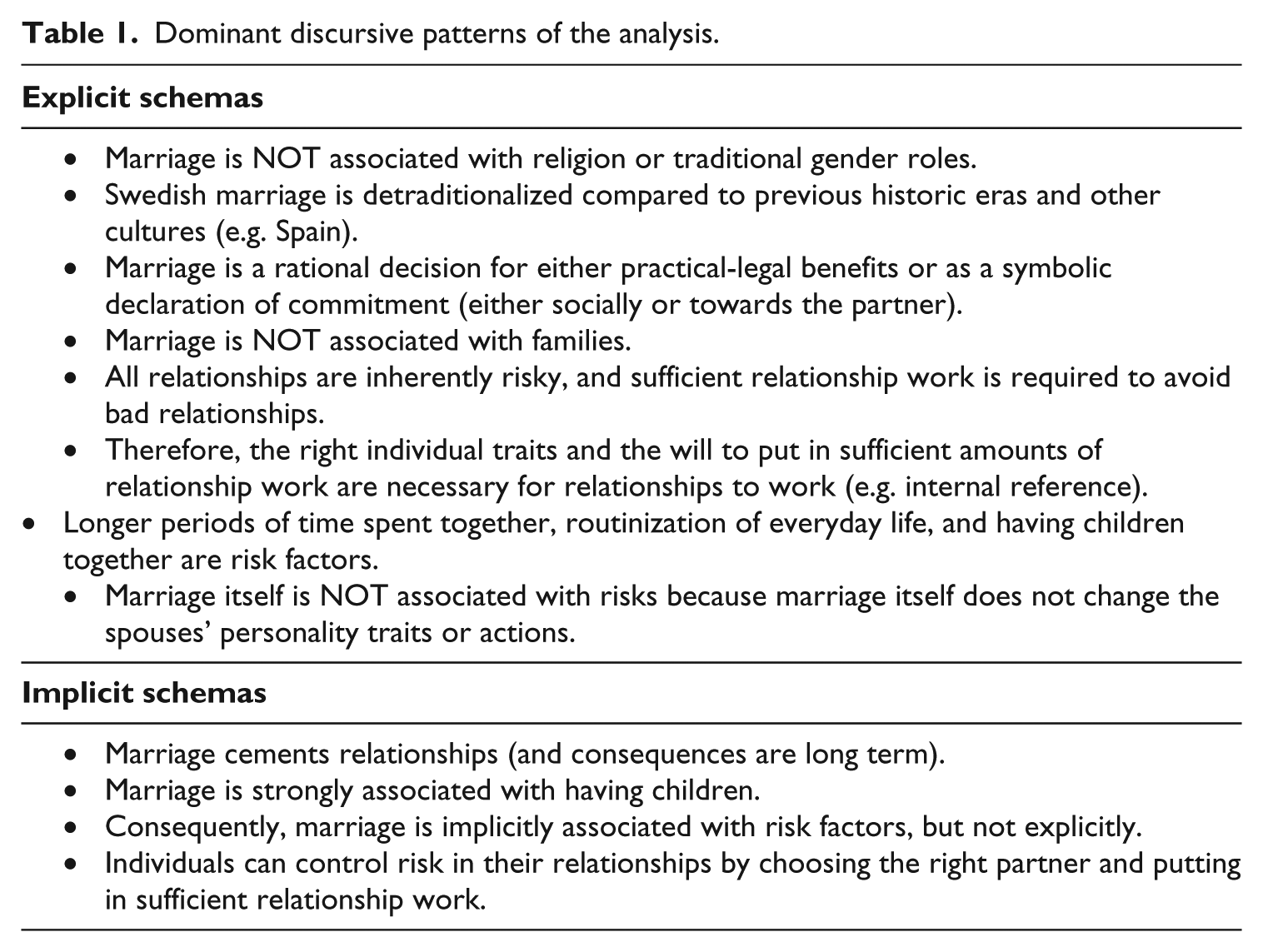
Table 1 summarizes the dominant discursive patterns of the analysis and Figure 4 illustrates the compartmentalized marriage and risk schemas in the participants’ discourse.
Dominant discursive patterns of the analysis.
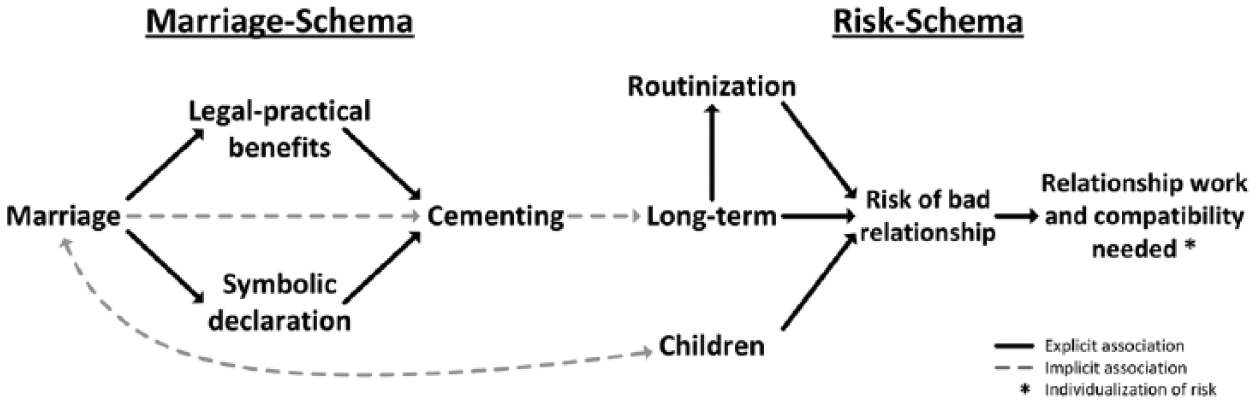
Compartmentalized marriage and risk -schemas, where marriage is only implicitly and indirectly associated with relationship risks.
Conclusions
The primary conclusions that can be drawn from the analysis are that individualization can co-exist with increasing marriage rates and that highly individualized schemas may even protect the marriage institution from problematization. While marriage was (largely implicitly) associated with potential risk elements – such as childbearing, cementation of the relationship, and long-term commitment – marriage itself was thought of as a relatively unproblematic choice for legal-practical benefits or as a symbolic declaration of belonging. Marriage was not directly (explicitly) associated with any threats to so-called individualized values such as individual autonomy, self-realization, and the rejection of traditional authority. This was in part due to the Swedish marriage institution being detraditionalized and dissociated from religion and heteronormative gender roles, for example, but also due to an individualization of risk factors, as can be observed in the schemas found in the participants’ discourse. These individualized schemas attributed risk to the traits and actions of individual actors, thus shifting problematization from normative structures to certain individuals with whom one could become ‘stuck’ over time through routinization and by having children.
This article has argued that individualization is better understood as a form of internally referring attributions in causal and moral reasoning about human behavior. This is not to say that individualized values and desires are not characteristic of individualization (e.g. Bauman, 2003; Surkyn and Lesthaeghe, 2004) or important for behavioral outcomes, but values are a crude analytical tool for understanding actual behavior. Conceptualizing individualization as internally referring attribution schemas suggests that individualization does not only (or even primarily) influence what people want but rather how they understand the world and each other. This allows for a more complex understanding of how individualization affects behavior and enables the use of insights from cognitive science to understand how individualization of explicit discourse may actually protect social institutions from critique by obscuring their reproduction through implicit associations and practices (cf. Eldén, 2012). Furthermore, internal reference explains how risk may become individualized, with the consequence that risk awareness and concern for one’s own autonomy and self-realization lead to critique of one’s partner rather than of institutionalized relationship practices. Finally, if people are concerned with risks, and if late modern relationships are more precarious and fragile, as some have argued (Bauman, 2003; Beck, 2002; Giddens, 1992), the participants’ understanding of marriage as cementing relationships may actually mean that people marry not despite individualization but because of individualization, as a means to protect the relationship from falling apart too easily.
The analysis confirms Ohlsson-Wijk’s (2011) suspicions: the meaning of marriage seems to have shifted significantly over the last few decades, and it is now taken relatively lightly (at least by these young adults), in part because it no longer differs significantly from cohabitation. In fact, the participants seemed to view childbearing and cohabitation as bigger events than marriage itself, which was just a way to ‘seal the deal’ that was already in place. If this marriage schema is widespread, Swedish marriage in the early 2000s differs significantly from the conception of marriage in the 1960s, which of course makes demographic comparison difficult since we are comparing apples to oranges. Furthermore, this change in meaning may explain in part why marriage rates have increased in Sweden if contemporary marriage is no longer thought to be an outdated traditional institution.
This analysis should not be considered to be empirically conclusive or exhaustive. Interviews with married couples would, for example, likely have yielded somewhat different results, and actual decision-making in marriages likely involves many other factors. However, while empirical generalization is beyond the scope of this study, there is good reason to believe that the schematic patterns observed are indeed very well established. The discursive patterns reported were highly dominant, unopposed, treated as facts and largely consistent across the three focus groups, suggesting that the underlying schemas are very well established. While the small sample and specific population (Swedish students aged 20 to 30 years) prevents wide generalizations, it is interesting to note that the schematic patterns strongly resemble the marriage schemas identified by Quinn (1982) in an American context over three decades ago, which emphasized commitment, dedication, promise, attachment, and unification as the core of marriage. This consistency over time and space indicates that many aspects of the marriage schema are very well established and relatively stable. This provides some support for the theoretical assertion that some cultural schemas are indeed expansive and powerful, despite sometimes being fragmented and contradictory.
Footnotes
Acknowledgements
I wish to thank Sophie Åkerhielm and Tuva Johansson for their aid with the first focus group and inspiration during the empirical phase, and Christofer Edling for his advice and mentorship while supervising the research. I would also like to thank Naomi Quinn and the Duke University Culture and Cognition group for their valuable feedback on earlier drafts.
Funding
The author received no financial support for the research, authorship, and/or publication of this article.
Author’s Note
The original empirical study presented in this article was conducted as part of a Master’s thesis undertaken at Lund University.