




Abstract
This article focuses on presenting, analysing and understanding the ‘do-it-yourself’ (DIY) representations of over 200 participants in Portuguese punk music scenes between 1977 and 2014. Through an ethnographic study of punk and the DIY ethos in Portugal, the article depicts its local interpretation and significance, and highlights the singularities of this socio-historical context. Our approach has three focal points: (1) the importance of DIY punk manifestations in the development of youth (sub)cultures, including forms of production and consumption of music, fashion, aesthetics, leisure, the night and cosmopolitanism; (2) the singularity of DIY punk manifestations in Portugal and related resistance practices in their correlation with social, political and economic development in a country outside the Anglo-Saxon context; and (3) the embedding of a DIY ethos and the associated claim to authenticity in the professions and careers in which punks engage today.
Introduction
This article is focused on presenting, analysing and understanding the ‘do-it-yourself’ (DIY) representations of over 200 participants in Portuguese punk scenes from different regions between 1977 and 2014. The article is based on the sociological principle that social actors’ reflexive knowledge is a source of scientific reconstruction, and that it contributes to advancing our understanding of DIY cultures in a single-case study: punk in Portugal. By taking an ethnographic approach, we aim to study an under-explored context in which the specific qualities of punk DIY culture can be set against Portugal’s recent socio-economic history. We therefore focus on the viewpoints of Portuguese youth as (sub)cultural social actors. One could argue that reflexive analysis of representations represents a crucial step towards interpreting this social object, by tracing the origins and history of Post-Second World War youth cultures in Europe and beyond. We seek to understand how youth social trajectories were marked by that subcultural immersion, considering the acquisition of specific DIY capital (competences, skills, scene-knowledge and networks) 1 and the importance of those scenes in transitioning to adulthood in a southern European environment filled with risk and crisis (Pais, 2003; Silva and Guerra, 2015). Following the Weberian sociological tradition and mobilizing the concept of social representation (Moscovici, 2000), we attempt to address punk’s socio-cultural development in Portugal using both theory and primary data. Our approach highpoints the connections between that punk culture and the emergence of the DIY ethos, particularly regarding two central axes: the importance of DIY punk manifestations in the development of youth subcultures, including forms of production and consumption of music, fashion, aesthetics, leisure, the night and the city; and the singularity of DIY punk manifestations in Portugal, and related countercultural resistance practices, in their correlation with social, political and economic development in a country outside the Anglo-Saxon context.
Background: Punk in ‘Another World’ After the Revolution
In Portugal, punk’s arrival – as demonstrated elsewhere (Guerra, 2014) – took place in a democratic context, which starkly contrasted with 40 years of fascism and the accompanying social, political, ideological, cultural and musical isolation. The long dictatorship that ended in 1974 had – and still has – unquestionable effects on the economic, social, political and cultural development of the country and particularly on people’s lifestyles. As Raby (1990: 23) points out, ‘when a regime lasts for so long, its values, actions and institutions are assimilated by the national culture’ – something that applies to the singularity of the DIY punk manifestations in Portugal. The current low rates of political and associative participation and mobilization (Cabral, 2014) are the result of 41 long years of dictatorship under the aegis of Estado Novo, an authoritarian, paternalistic and autocratic political regime that mistrusted political participation (Rosas, 2013). In the period of dictatorship, associativism was ‘domesticated’, leaving a legacy of low participation and traditional associative practices among younger generations in the post-revolutionary period and after. Our interviewees are perfect examples of this: they are individuals who could not relate to associative and cultural practices. Stripped of revolutionary and associative spirit they therefore decided to adopt new practices not necessarily linked to their neighbourhoods and the local community. This explains the low presence of okupas – squats or self-managed social centres – in Portugal, and the proximity of Portuguese punk dynamics to post-modern neotribalism (Bennett, 1999, 2004, 2005, 2011) in the transition from the 1970s to the 1980s. We can identify the existence of affective communities in Porto and Lisbon, based on musical, aesthetic and social affinities – but not that of a social movement.
The Revolution of April 1974 in Portugal 2 worked as a catalyst for opinions, demands and demonstrations of several kinds of freedom – political, religious, sexual, cultural and musical. This social and cultural context served as the backdrop to a fundamental drive for social change, opening youth up to artistic, creative and leisure practices in a new context of (sub)cultural belonging. Rather than reforming or battling a specific form of popular music, punk served as a springboard that developed other popular music forms in Portugal, with oppositional aesthetics and different ways to experience nightlife and new leisure spaces. Punk brought openness and cosmopolitanism. For many of our interviewees, it represented an expression of the right to be different, demonstrated in the possibility of listening to different music, wearing different clothes and adopting alternative leisure and cultural consumption preferences. Here, Regev’s (2013) view is crucial. His approach to pop-rock represents the possibility of cultural proximity, given that the expressive elements used by different cultures to highlight their singularity are quite close to one another. The cosmopolitan concept of aesthetics is only applicable when a world culture is formed as a complex, interconnected entity in which various social groups share common ground in aesthetics, expression and culture; this world culture arose in Portugal through punk, hence opening up a new space for youth cultures to flourish.
In fact, punk has been the most visible face of youth culture in Portugal, something that highlights the importance and uniqueness of Portuguese punk. Contrary to other countries – notably those in the Anglo-Saxon world, where youth cultural forms emerged during the post-war period, Portuguese society witnessed the emergence of style-based youth cultures during the transition from the 1970s to the 1980s. This uniqueness is important on two levels: first, the evolution of the country in the post-revolutionary context, when its opening up to modernity served as a background to the legitimacy of what we term ‘youth’; and second, Portugal’s integration into the European Community in 1986, the liberalization of national television (including the arrival of cable television in 1995) and the widespread use of the internet in 1997, which served to increase youth manifestations connected to punk.
Although the presence of a political dictatorship in Portugal ‘shut down’ the so-called ‘traditional’ routes of subcultures after the Second World War, ironically it was fundamental to the implementation of ‘indigenous’ DIY practices. For instance, in the case of fashion, ready-to-wear clothing only arrived in Portugal in the 1980s, in a very incipient form, and only in the two major Portuguese cities: Lisbon and Porto. Thus, in order for punks to ‘dress like punks’, they needed to resort to various expedients; hence, whenever they needed a belt, they had to customize it with spikes purchased at hardware stores, as there were no shops that sold punk belts at that time. This example can be extended to the artisanal practice of tattoos, body piercings, Mohican hairstyles and even the production and customization of clothes, which generally were homemade.
At the time of the emergence of punk in Portugal, there were no major publishers or labels interested in signing punk artists. This resulted in the local punk scene being an exclusively DIY affair, particularly during its formative years. The production and availability of punk fashion and style followed a similar route. There was no Portuguese equivalent of, for example, Carnaby Street until the mid-1980s, when the first fashion shops and punk fashion designers appeared in Portugal. Likewise, the second-hand clothing market, or rag trade, that writers such as McRobbie (1993) claim was of critical importance in supplying fashion and stylistic resources for punk and new wave in the UK, did not begin to establish itself in Portugal until the late 1980s or early 1990s. During the early years of Portuguese punk, its fashion and style involved clothes, footwear and artefacts coming from two sources: either imported from the UK or created with clothes and shoes from parents’ or grandparents’ closets, adapted to a punk style. As the following account illustrates, the situation of early Portuguese punk was quite specific, since much of its cultural infrastructure was based on grass-roots initiatives bound up with the resources of individuals, their families and neighbourhood social networks.
The effect that punk DIY had on the music industry as a whole is best seen as an ‘economic psychology of making records’ and related things, as Laing (2015: 163) dubs it. In fact, some of the most emblematic Portuguese punk bands started by recording a live tape, which became iconic and was informally duplicated; it took another decade before many bands could bring out a commercial record. That was the way independent editors flourished, and the production process stopped being something that only the economically prosperous could afford. This affected punk’s characteristic forms of illustration, design, writing, photography, concerts, venues, food, clothing, tattoos and so on. This is still characteristic of punk scenes nowadays, with considerable emphasis placed on its amateurism, informality and volatility regarding production, intermediation and consumption. Showing differences in terms of vitality, dimension, structure and organization, there is still a logic strongly anchored in the fundamental principle that punk is related to non-conformity – the DIY ethic transformed into a habitus (Bourdieu, 2009) and ethos, reflecting a transformation of the agents from cultural consumers to cultural producers (Dunn, 2016). As our interviewees stated, the lack of infrastructure for the production and performance of punk in Portugal strongly contributed to local understandings of this DIY ethos (Guerra, 2016).
It is notable that hardcore punks in the 1990s developed cultural, leisure and entertainment industries to a much greater extent than those who preceded them in the 1980s. This evolution is related to the country’s own developmental conditions, since the 1990s was a period of economic and social development. Through accessing important European funds, Portugal was able to begin recovering lost ground. Expo ‘98 3 and the creation of the first independent television channel in Portugal, SIC, in October 1992 (MTV Portugal only aired in 2003) 4 are examples of turning points that influenced the development of cultural and creative activities – particularly those linked to the music industry, such as big events and festivals.
The cultural industries, and most notably the music industry, are still facing constraints in the 21st century, because of the exiguity of their markets. However, paradoxically, the vibrant nature of the underground manifestations in Portugal is very intense, considering the demographic and geographical size of the country. An important element of this is the punk fanzines (Savage, 1992), which have existed since the emergence of Portuguese punk. The number of fanzines grew with the increasing number of participants in the scene, but the fanzines continue to be produced manually and their importance as a strong marker of punk’s DIY ethos remains, even with the emergence of e-zines. This DIY ethos operates with particular intensity in the activation of strong and mutual networks of familiarity and knowledge among Portuguese punks. This is perhaps dictated by the small size of the country and the relatively small number of people who participate in the local punk scene.
Our research team’s introduction to the DIY status of Portuguese punk was first based, on an empirical level, on the study of punk fanzines. But the perpetuation of the DIY ethos of punk is seen in other ways too – for example, in the peer-to-peer lending and provision of musical instruments, transport, and light and sound equipment for concerts, and the organization of halls and other venues for live performances. This lends to the Portuguese scene a particular form of organization, which is energized by the liveliness and defence of the underground.
In summary, we can point out the following: bands that have an established position in the Portuguese punk scene are rare; and Portuguese punk never became embroiled in the processes of mass production and marketing. Indeed, for nearly four decades, it has remained in an ‘independent’ space, from which it protects and preserves its own subjective claim to be fighting the system (Guerra, 2013). It is, in many ways, the indelible result of a DIY Portuguese ‘youth’ music industry that is still in a pioneering phase with regard to its stance against mainstream pop-rock – a characteristic that sets it apart from punk in most other western countries.
Methodology
Our analysis was based on 214 in-depth interviews, 5 conducted between 2012 and 2015 with individuals of different social backgrounds, geographical locations, ages, professional categories and genders, whose discourses and representations were analysed. 6 As indicated in Table 1, the majority of interviewees were male (87%), ranging between the ages of 15 and 67 years. Interviewees were predominantly residents of the two largest cities in the country, Lisbon and Porto, with educational levels above compulsory education and mostly with professions in so-called ‘intellectual work’ (such as university and high-school professors, journalists, artists and designers). 7
Profiles of the interviewees (N = 214).
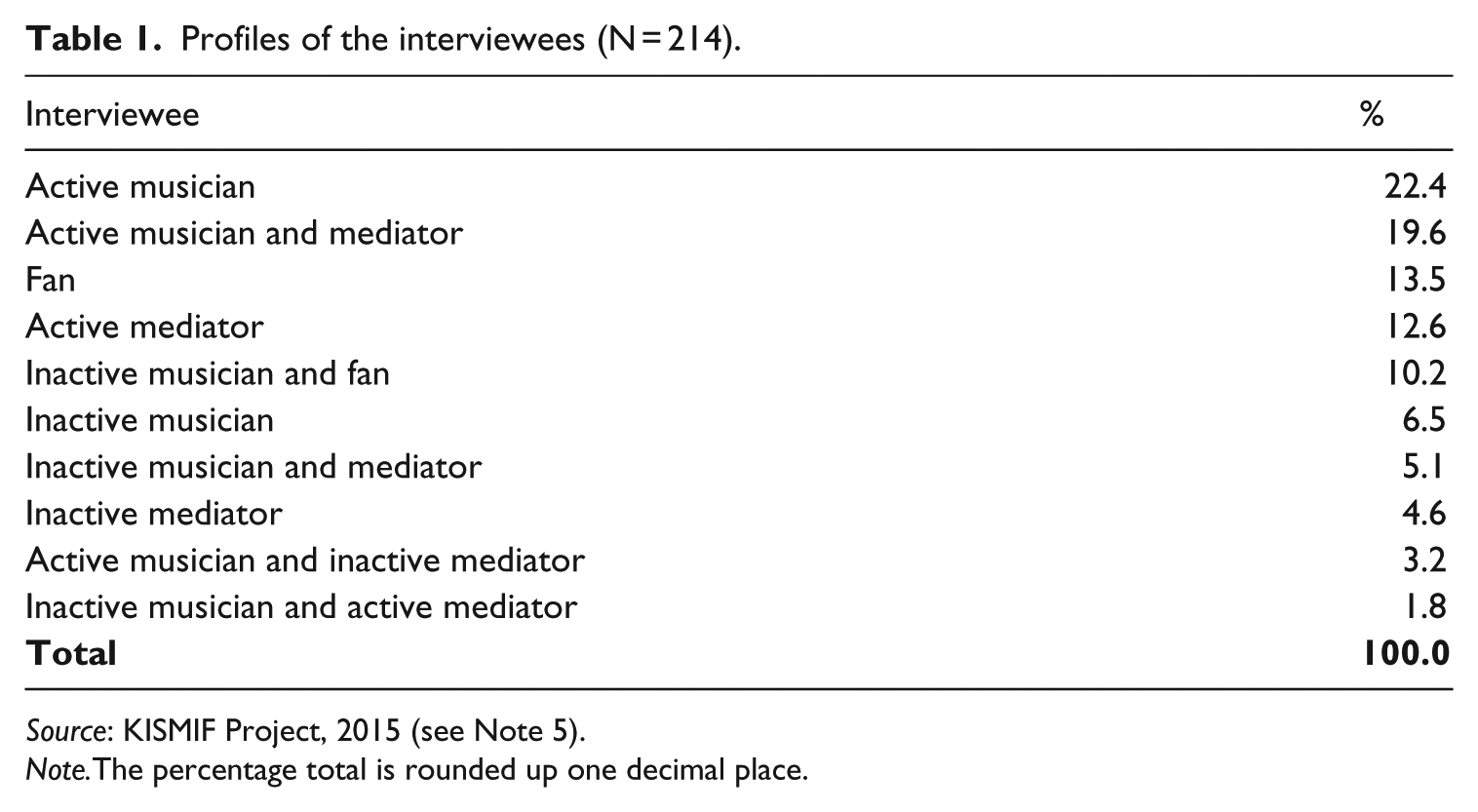
Source: KISMIF Project, 2015 (see Note 5).
Note.The percentage total is rounded up one decimal place.
To characterize the modes of participation in punk scenes, we operationalized three main categories built from empirical data: the practising of music, mediating activities (fanzine and/or phonographic production, promotion of concerts, record sales, reviewing, radio hosting and so on), and intense and passionate consumption and/or prosumption (which means, in short, ‘being a fan and a co-creator’) (Ritzer and Jurgenson, 2010). More than 66% of the interviewees were musicians: 45% self-defined as active musicians and 24% as retired musicians – and all as amateurs. Nearly 50% of all interviewees had some experience as mediators: 34% were active mediators and 13% were currently inactive. Lastly, 24% defined themselves as fans. The combination of multiple roles is the norm for 40% of the social actors, especially when it comes to combinations of active musicians and mediators (20%), or fans and inactive musicians (10%).
The plurality of roles played by individuals is clearly associated with the dynamics of the Portuguese music scene, but relates specifically to punk scenes connected with the DIY ethos. These polyvalent roles lean towards a very sharp DIY ethos that is largely due to the incipient nature of the Portuguese music industry in the late 1970s. It is likewise motivated by other constraints, such as the small size of the country and the marginal nature and expression of its punk music scenes, requiring participants to take on multiple roles, either over the course of a lifetime or simultaneously. In addition, non-professionalization in the Portuguese musical field leads musicians to adopt multiple roles in order to respond to personal economic needs, subsidizing their income with various tasks involving reduced revenue (inside and outside the musical field). As in other areas, Portugal’s structural, economic and financial development problems, which have impacted severely on cultural, creative, artistic and musical activities, affect the careers of these people. 8 In other words, this ethos of self-production and role diversity appears mostly as a pragmatic necessity – something that has been observed consistently not only in the Portuguese punk scene, but in nearly all punk scenes beyond the Anglo-Saxon gravitational axis (see Fouce, 2006, for Spanish punk; Greene, 2012, for Peruvian punk; Pilkington, 2014, for Russian punk).
‘I Against All’: Punk’s DIY Ethos and its Local Interpretation in a Portuguese Context
The first – and most representative – line of interpretation of DIY by Portuguese punks is DIY in relation to the concept of (sub)cultural resistance. This positioning was felt strongly by over 70% of interviewees. 9 In subcultural studies, resistance is understood as a form of opposition to hegemonic formations and capitalist domination. It points to an ethos and practice of self-sufficiency outside the spectrum of systems of domination within a capitalist society. Subculture researchers, strongly influenced by the work of the Birmingham Centre for Contemporary Cultural Studies (CCCS), tended to understand forms of resistance as the symbolic reactions of working-class youth to various structural oppressions. Here, emphasis was put on understanding whether the external reaction of subcultures was resistance to dominant values and hegemonic social structures (Hebdige, 1979, 1997). CCCS researchers ultimately decided that resistant qualities of this form of practice were mostly an illusion – a mechanism for escape from reality, not causing significant change in the dominant values and even, in some cases, reinforcing them (Willis, 1978).
This view has, in turn, been criticized for a number of reasons, such as a lack of empirical evidence to substantiate the claims of subcultural theorists, an over-emphasis on stylistic resistance and a monolithic vision of ‘mainstream’ culture against ‘resistant’ cultures (Haenfler, 2006). Our analysis does not completely reject the subcultural perspective; instead, we seek to reconceptualize it by considering its limitations and strengths. We should not overlook the fact that members of subcultures may experience daily life as and through resistant practices, but we must also be aware that not all members may experience this, and even the most resistant practices may not be equal for all members.
For the greatest part of the Portuguese punk scene, therefore, the concept of resistance appears as a DIY know-how that influences a set of strategies and options put into practice by social actors during their social and professional careers – which often take the form of DIY careers. These careers are based on the mobilization of several skills (strength, achievement, freedom, collective action) as new standards to promote employability and to manage uncertainty and the precariousness of building a professional career (Reitsamer, 2011; Reitsamer and Prokop, 2017). By considering the incorporation of a set of knowledge practices, this perspective allows us to move away from the notion of symbolic resistance, as presented in the CCCS perspective. As a general framework for exploring this problem, we can look to the autonomist Marxist thesis of immaterial labour (Hardt and Negri, 2003; Negri, 2005) – that is, the notion that creative, affective and informational work, which has become widespread and deeply influential as the post-industrial socio-economy has evolved, is imbricated in the system of capital.
This concept works in practice, and specifically in terms of what our interviewees sensed in DIY music scenes, as an ontological reordering of the principles of work and play (Willis, 1978). By privileging creative autonomy, measuring success in terms of symbolic capital, as Moore (2004) argues, and putting weight into institutional challenge and resistance, this focus on immaterial labour serves as an alternative and more adequate measure of work contained in DIY cultures. So DIY can mean the creation of a symbolic alternative through a (physical or metaphoric) space of self-empowerment, mutual help and alternative social engagement (Holtzman et al., 2007). Alternatively, and more frequently in the Portuguese context, it has meant the associative and hedonistic practices organized by the participants themselves in a process of empowerment that impacts their own personal projects. Most importantly, DIY serves as a force that counters neoliberalism (McKay, 1998).
Drawing on Haenfler (2004), we consider that, in the narratives of our interviewees, resistance is present on both an individual and a public basis at the micro, meso and macro levels: it criticizes not only adult culture, but also other subcultures and cultures in current society. On a macro level, in terms of systemic social interdependence, resistance was represented during the interviews conducted in our analysis as a form of skirmish with capitalist hegemony, concerning ways of living and doing things as well as ways of acting towards others that were contrary to perceived norms. It is, overall, an attitude of protest, denouncement and demarcation. The need to survive on the fringe of the mainstream, in a self-taught mode that tilts against the capitalist system, is what is at stake here.
On a meso level, besides being associated with this self-taught counter-hegemonic logic, the DIY ethos is also related to ‘doing things’ when there is scarcity of resources or lack of access to them – and that is crucial for constituting groups, scenes and collectives. In other words, DIY also means preventing differential access to resources from dictating the action of individuals by circumventing traditional ways of acquiring such resources.
On a micro level, in what way(s) is it possible to visualize the participants in the daily life of punk scenes – through frameworks of interaction and translation in DIY practices? It implies being involved in the punk scene, doing fanzines, creating labels, organizing one’s own shows and making use of devolved spaces for cultural and social practices. The rhythm and intensity of skill share-spheres are crucial for this. Many actors involved in these scenes organize (or did organize) promotional sessions, workshops or even radical study groups. These serve as yet another way to promote accumulated knowledge and, likewise, serve as a form of publicity and promotion gathered from traditional channels of information (Lingel and Naaman, 2011). DIY forms of these groups are built on the constitution of communities of practice (Hemphill and Leskowitz, 2013). As one of our interviewees stated: I think that DIY is the best thing that punk gives to people … It not only makes people be better; it helps to build a sense of community, cooperation, availability which otherwise you wouldn’t have. (Humberto, 35-year-old, university degree, record shop owner, Loures in metropolitan area of Lisbon)
This notion of resistance is strongly anchored in the habitus of participants of Portuguese punk. In a content analysis that we completed of 264 punk songs (Silva and Guerra, 2015), we corroborated the importance of feelings of protest, denouncement and demarcation (present in 42% of the songs). Yet this notion of resistance goes beyond mere musical lyrics: it is indeed a cosmology based on a critical position, with strong words and calls to fight against everything and everyone, without ever postulating an alternative. It is interesting to note, in passing, recent research by Eversley (2014), who reintroduced the term ‘insurgent citizenship’ (Holston, 2008). Using that concept in the context of the Baltimore DIY scene, the author shows how DIY is essentially a way of protesting against what is seen as the cooption of states by big multinational corporations as well as their incapacity to deal with the problems of the people. However, that situation also opens up a space for the forging of critical and empowering tools to organize society from the bottom up.
In short, these multiple forms of resistance (see Tables 2 and 3) are not directly about fighting for a radical change in society, but rather involve the production of multiple roles inside punk scenes in an organizational logic of horizontality, which seeks to make a number of actions real. It means the creation of a practice community based on emotion and affection between scene participants as well as the existence of multiple sharing practices towards the common good (Drott, 2015); it also means putting into action DIY competences as a way of promoting employability as well as dealing with precariousness and uncertainty in career-building. These actors thus strive to acquire and put into practice the competences and multiple roles, based on collaborative mechanisms of learning and knowledge accumulation, which make the relationship between artist-creator-consumer and the (sub)cultural entrepreneurs easier.
Ways of living DIY on a day-to-day basis among interviewees (N = 214).
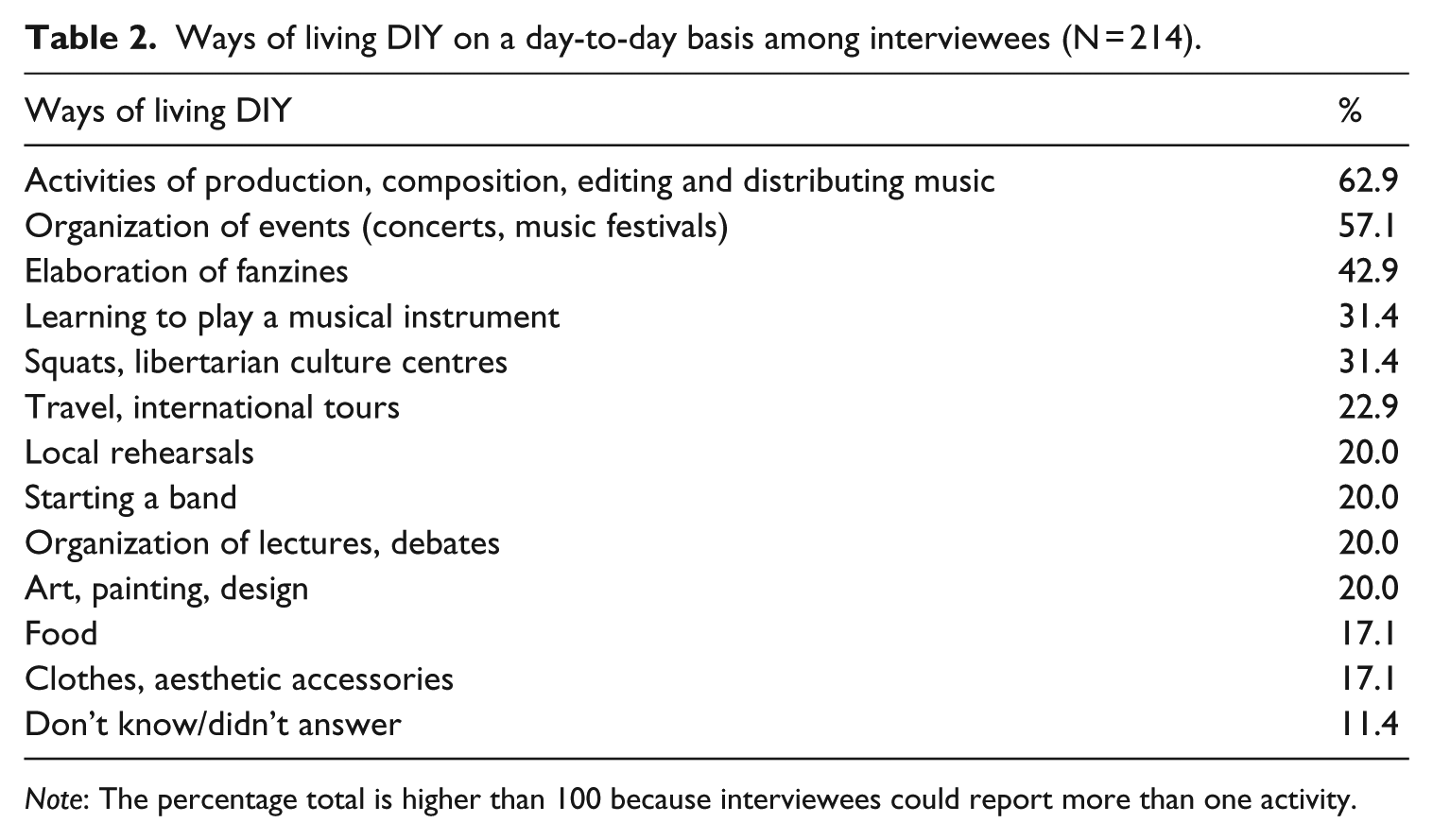
Note: The percentage total is higher than 100 because interviewees could report more than one activity.
Reasons that brought interviewees to DIY (N = 214).
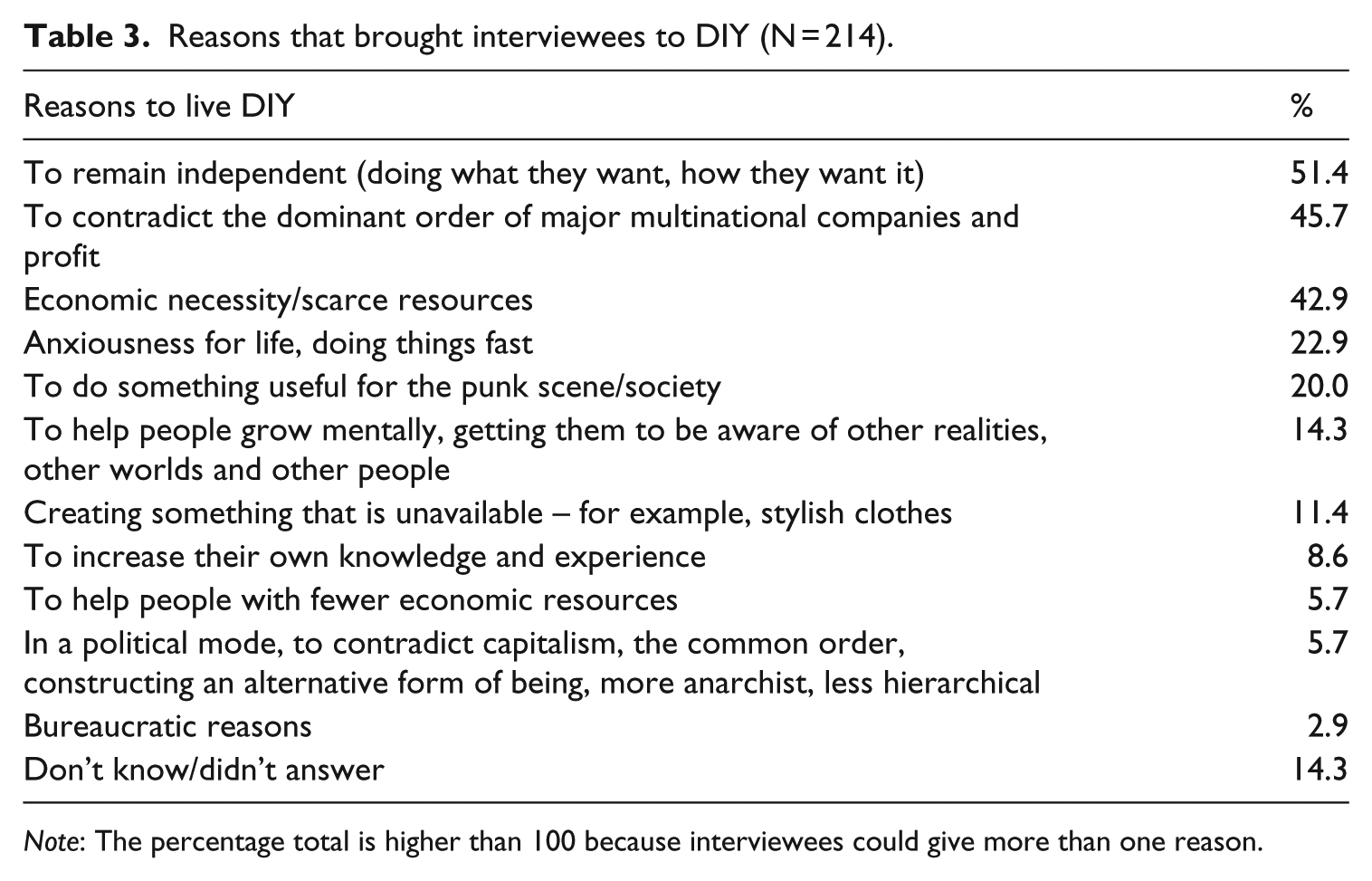
Note: The percentage total is higher than 100 because interviewees could give more than one reason.
The second line of interpretation of DIY by Portuguese punks was reported by about 33% of Portuguese punks, and is centred on the construction of a more radical framework for action. Here, DIY stands for an ethics that privileges the building of one’s own institutions, informed by principles of mutual aid, empowerment and node relations – the same relations that Marx presented as alternatives to capital (Holtzman et al., 2007). As one of our interviewees observed: What I think punk has that is crucial to it is the strength – and I think it is undeniable – that it has to go beyond the issues. It is like, even if you have no one that will sell your records, when you have no one that will schedule your concerts, you learn to do things by your own hands. This has had a brutal impact on people’s lives! That is, you realize that you will not be forever dependent on others to live. The state has left you, so did school, all the institutions. You have to create new ones for your life. (Matias, 37-year-old, incomplete university degree, musician, owner of a bar, producer of shows, road manager, Lisbon)
We can understand this as the dominion of doing things (the practical reason) – the logic of capacitation, initiative and action: acquiring resources, creating the conditions to make something and simultaneously following DIY principles. These are what empower a band to attempt to disseminate its message or manifesto by itself, without running the risk of submitting to economic interests (through, for instance, a record label). It is thus a way to oppose mainstream logic. It connects DIY to empowerment, to people believing in the power to do things, to be proactive, to create a different system of action. Likewise, it implies the defence of an alternative to a much-criticized system and behaviour, in ideological, political and social terms and lifestyles.
Noting this, it is necessary to pay attention to DIY means of information and the way they relate to the status quo: the ‘piracy’, skill-trading, open source media, wikis, fanzines and zines. Zines are especially notable: without commercial ends and with low circulation, they serve primarily to establish communication between various scenes, eventually growing into a forum that allows the discussion of little-known and little-discussed themes (Bryant, 2014). Our interviewees emphasized zines as part of a moment of recovering and appropriating something that has long been grasped by capitalism: the right to publication. The value of zines lies also in their internal organization, where there is total control over all processes and content (Ratto and Boler, 2014). As for ‘piracy’ – another common facet of DIY alternatives – Hemphill and Leskowitz (2013) open up important questions about pirate-radios:
10
their sense of giving power to the people again as well as empowering creators without negotiating with traditional media. These alternative means are fundamental to establishing communities and institutions that operate under alternative and DIY values. The words of our interviewees are prominent in this respect: Not to expect an existing structure to help, from a financial point of view, whether to build a business, do an education programme, to be creative or artistic or something. You have to make your alternatives, spaces of association with other values. (Arnaldo, 33-year-old, university degree, designer, Loures in metropolitan area of Lisbon)
We can understand the insertion of the DIY ethos inside what some authors call alternative lifestyles and social movements: ‘While all lifestyles serve as both ways to identify with and misidentify from others, alternative lifestyles, such as veganism, communal living and hardcore punk, fall outside the mainstream in some significant way, explicitly challenging predominant cultural norms’ (Haenfler et al., 2012: 1, italics in original). It is here that we find the main drivers for our interviewees to position themselves in contrast to the system. These include human rights (racism, Nazism, violence and [post-]colonialism); sustainability of the planet/vegetarianism; animal rights; non-conformist participatory action; defence of anarchism; gender and sexuality rights; apologies for anti-militarization/pacifism; the right to housing/occupation; defence of direct action and/or revolutionary action; and arguments related to spiritual causes (Silva and Guerra, 2015).
Let us evoke the case of Luis, 43 years old, the man responsible for the self-management collective CasaViva in Porto.
11
According to Luis, the collective played the ‘role of an open door to those who wanted to present works in other areas (from theatre to permaculture) without a pre-emptive censorship of being able to do it because you are handsome or not being able to do it because you are ugly’. Aside from this, CasaViva has manifested a lot of concerns in terms of political and social issues, organizing debates, workshops, conferences and seminars on topics such as alternative lifestyles, as well as seeking to put into practice ideas of those alternative lifestyles (these meetings, for the interviewee, played a crucial role in the creation of Es.Col.A).
12
Through this, Luís has shown people that it is possible to achieve alternatives to capitalism: CasaViva … wanted to have an active part in changing the city. This CasaViva worries about the streets, about making everything a little better. More than that, it is a lab for an alternative society, where the principles of hierarchy-free systems, money-free societies and living in a non-capitalist way are those which we hold to be best. That is: we try and make a small sample of a better world’. (Luis, 43-year-old, university graduate, office worker, Porto)
‘Running After the Real’: The Last Challenge of DIY and Punk
It should be clear that these two perspectives of DIY and Portuguese punk are not mutually exclusive; rather, they are part of an interpretative continuum. The common denominator in our interviewees is a defence of authenticity as a means of musical, artistic and social creation and the appropriation of products but also as a more authentic lifestyle (see Bennett, 2000; Guerra and Bennett, 2015). For example, the dynamics of stylistic rejection – which is a core issue, according to several interviewees, both implying a rejection of consumerism in its broader sense (or, at least, conspicuous consumption) and indicating knowledge and creative freedom – have led to the development of a self-concept of authenticity. It is a rejection of social pressure that constrains the potential of the individual and a rejection of the institutionalized power in society.
In an interesting way, and given punk’s Situationist roots, authenticity and reproduction of the work of art – a debate started by the Frankfurt School – comes up in the representations of these interviewees. The work of Lewin and Williams (2009) is significant in this respect. The authors stress that the search for punk authenticity has evolved along two paths: a moral path of self-discovery (akin to romanticism); and an effort to attain social stability in the face of societal fragmentation. Punk ideology is therefore centred on deconstructing these same social norms, beliefs and values towards a purer experience of the city, where no intrinsic value is seen to exist in these former practices.
Wooffitt and Widdicombe (1990), however, suggest that the style – the outer layer of punk – is one way in which one’s self-image can become objective. For instance, the dress, hair and accessories can be created instead of bought or simply replicated. For these reasons, members of Portuguese punk scenes vehemently reject the correlation between styles, aesthetics and punk belonging. Williams (2006) rejects the ignorance and apathy that come from a non-critical acceptance of the status quo. Participation in the punk scene is fundamental for individuals to form their own systems of values and beliefs, but at the same time, this does not mean any specific group conformism, since punk ideology does not entail a specific belief, value or system of praxis. It is common to consider DIY as an anti-capitalist choice – an opposition to art for profit and the statement of art for art’s sake. The DIY economy can thus be seen as ‘local, personalized, and fitting the needs of the artists and the community. The pursuit of capital is decentralized as the guiding principle of one’s labor and replaced with intersectional desires to pursue creativity and build community’ (Eversley, 2014: 35). Another theme made possible by DIY in terms of its authenticity is artistic diversity, which can only be captured by a proliferation of musical (sub)genres, opinions and feelings of belonging to a certain community, marking for these actors a barrier between what is punk and what is not (Martin-Iverson, 2011). In effect, the DIY careers of our interviewees depend both on the use of music to articulate claims to authenticity and their ability to form (trans-)local networks to share skills, knowledge and other resources, and on the changes that have occurred in Portugal’s music industry in recent years.
Our interviewees directed criticism at many contemporary definitions of what ‘being cool is all about’, particularly those associated with the creative city, creative industries, creative class, cultural producers, creative spaces, loft-projects, art-spaces and creative entrepreneurship. In their view, they end up simply being ways for capitalism to enter contemporaneity. The quest for authenticity is, for some interviewees, a symptom of a widening of horizons and the vastness of contact with international realities. This is the same as opening oneself to freedom, to authentic creativity, to learning and to what is really important in a country that is seen as small and backward in cultural, musical and aesthetic terms. As Bartolomeu put it: All that crap about creative industries never had anything to do with DIY. It’s just more capitalist ideology covered in a belief of freedom, and a search for oneself. I get sick just by hearing it. (36-year-old, incomplete university degree, photographer, Almada, in metropolitan area of Lisbon)
It is interesting to note that participants in club cultures, who are defined in that field by their possession of ‘subcultural capital’ according to Thornton (1995), have been able to get jobs as artists, remixers and producers in the music business, and also as store clerks in subcultural environments (Campbell, 2015; Hesmondhalgh and Baker, 2011). Likewise, Høigaard (2002) analyses how graffiti artists have been able to transform their subcultural capital (lettering, typewriting, design, use of perspective, etc.) to find jobs in graphic arts and publicity.
In the same way, manifestations of DIY subcultural capital in Portuguese punk are visible, particularly in a range of careers and occupational roles which include: composers, musicians and singers; graphic designers or communication and multimedia professionals; visual (plastic) artists; radio or television technicians; mid-level technicians of cultural and artistic activities; photographers; journalists; conference and event organizers; decorators; cooks; specialists in publicity and marketing; filmmakers, stage staff, producers and directors connected to the cinema, theatre, television and radio; barbers and hairdressers; actors; other artists and creative interpreters of the arts; product designers; textile, fashion and interior design professionals; gallery, library, archive or museum technicians; sport and culture centre directors and managers; cooks and chefs.
13
As Xavier shows: The people who did the ‘zines, who had distributors, who did events in the hardcore punk scene actually – some ten or 20 years later – have something in their lives connected to those DIY projects: there is that spark that makes punk and hardcore so special, and always lights up your life. (37-year-old, skate shop owner, upper secondary education, Lisbon)
More than half the interviewees developed careers and currently hold jobs that are directly connected to the development of the DIY ethos. Ageing has meant that they engage in subcultural life in a different way, directing their efforts towards the development of work-related practices where the DIY ethos is fundamental (Bennett, 2013; Hodkinson, 2013). This concern with the transition to adult life, and how it affects subculture, has been a recent focus of attention for researchers, in particular in the way it shows that subculture spreads and transforms into adult life, rather than facing an abrupt end. More than simple distractions, these identifications become a part of the individuals’ identities in adult life, influencing their choice of careers. As we have seen, and as studied by Haenfler (2015), the professions that are related to this praxis go beyond the music scene, demonstrating how subcultural capital can have an impact in several ways.
We should also note that many of these social actors are now collectively referred to as ‘creative workers’. As creative workers, they recognize that they must look after themselves, taking an entrepreneurial perspective on their own careers (McRobbie, 2016). This means taking on more tasks formerly controlled by firms and specialized technicians, as well as having to engage in widely diverse and distinct parts of the creative process in a cross-cultural or interdisciplinary mode (Threadgold, 2015). While profoundly attractive in terms of market-entering fees and costs, the career of the DIY artist is laden with labour market risk and uncertainty as to the use value of their cultural production. It then becomes more than an ethical choice; it is a systemic condition and precondition of these systems.
A related aspect is the identity factor imbricated in Portuguese punks’ DIY. As individuals internalize the DIY ethos, they seek to create a cognitive balance by remaining true to such beliefs, thereby performing the desired authenticity. Individuals are driven to create meaningful practice for themselves and their peers. However, many of them will also be caught in a liminal stage (O’Connor, 2008), where they try to translate their creative output into a way of living that does not always agree with DIY authenticity. Adérito describes this situation: I think a lot of people in my generation saw it as a very personal thing. So, I think they applied the things they learned in punk and hardcore in their lives, and they started to try to make sense of the two things, bring them together. They thought, okay, I will be vegetarian, I will apply DIY in the things I do every day, I won’t buy big brands, I will boycott some things. But in terms of a large-scale paradigm shift … I am very sceptical, yeah. Or cynical even, I can’t see the change happening … the activist part of me has been lost … For me to be an activist, I must intervene, to go out into the street, I can’t stay behind my computer. You can do a lot of things behind a computer, but you must have moments in which things start having a real impact. (27-year-old, university undergraduate degree, music editor and catering services, London)
Conclusion
The Portuguese case is of great interest to the study of the intrinsic and complex relations between DIY and punk. Given the historical specificities of the development of Portuguese society, a large number of the interviewees have never had the chance to be only punks. Despite the existence of punk scenes in Portugal since the 1970s, the density and intensity of subcultural belonging were always different from the realities of Anglo-Saxon countries, because of the incipient development of the music industry and the non-existent punk phonographic dynamic; the exiguity of venues (only available in Lisbon and Porto); the lack of a ready supply of subcultural youth goods and services; and the non-existence of subcultural and leisure-related consumption practices, owing to the paucity of youth cultures. These factors concurred with the limitation of punk dynamics to small groups of well-established youth living in Lisbon and Porto; hence only those people in the dominant classes could overcome the cultural and artistic isolation to which the country was subjected for four decades.
The significance of the Portuguese case for the study of DIY and punk also resides in the amateur profile of the participants, as musicians, promoters or editors, which has meant a great polyvalence of roles in the Portuguese punk scene since its inception. The relatively ephemeral nature of bands and venues, despite their intensity, is connected with these characteristics. Consequently, most of the bands and activists have remained underground for long periods, meaning the conditions for the mainstreaming of punk scenes have been very limited.
There is a strong and vibrant underground resistance related to the DIY ethos in punk cultures; however, this has not generated strong collective action in defence of rights and causes, as happened in other countries. In our view, this is related largely to Portugal’s socio-cultural history. Nowadays, despite being a member of the European Union, Portugal still displays characteristics that clearly come from the Estado Novo dictatorial period. This has impacts beyond political mobilization and is visible at the level of a fragile civil society, with low levels of trade-union membership, NGO membership and involvement with voluntary groups – in other words, a reduced exercise of political citizenship, which has a significant impact on the punk music scene and any decision to engage in DIY practices.
Nevertheless, DIY punk has been a space for upcoming possibilities, starting with the cosmopolitanism it brought to the cities, their nightlife and their leisure activities. About half of the interviewees, although not practising music and art-related professions, carry out (in diverse degrees) intellectual and scientific professional activities, or have pursued creative careers. It is quite possible that the proclaimed authenticity of such a DIY ethos is more visible in the younger generations’ professional careers in fields like fashion, street art, video and cinema, graphic design, DJ-ing or even cuisine.
Footnotes
Funding
The publication of this article was also supported by FCT – Fundação para a Ciência e a Tecnologia (Foundation for Science and Technology), within the scope of UID/SOC/00727/2013.
Notes
Author biography
 .
.