



Abstract
Architecture is inextricably entangled with time. Illustrating this point, the article explores two moments of architectural production centred on London in the mid-19th century: the ‘Battle of the Styles’, a struggle over the social meaning of historicist architectural design and its suitability for state-funded public buildings; and the proto-modernist Crystal Palace, which housed the Great Exhibition of 1851. While ostensibly involving different cultural orientations to pasts-presents-futures, both cases reflect how political claims can involve the mobilisation of temporalised architectural forms. The general contention is that architecture is a culturally experimental space through which nation-states and architects seek to orientate otherwise abstracted notions of temporality. While there is no straightforward or singular correspondence between temporality and architectural sites, the built environment is pushed and pulled by states’ politicised claims regarding time and temporality. Architecture always involves the materialisation of particular and partial visions of the world as is, as was, and as could be; temporal registers in the built environment involve the stabilisation of some ways of being and the displacement of others. The political basis of these processes can be illuminated sociologically.
Keywords
Introduction
Social scientific analyses of time have added much to our understanding of this fundamental category of collective human experience (Adam, 1990; Bastian, 2014; Edensor, 2006; Zerubavel, 1982, 1996, 2003). 1 For its part, sociological research in this field typically eschews metaphysical analysis in favour of the situated study of the locally rational sense-making that underpins the production of collectively meaningful time, with consensus regarding such reliant in part on objects for legibility (Stewart, 2015). Importantly, it is not just clocks and other explicitly temporal technologies that allow time to become resonant; cultural artefacts such as currency, educational curricula, flags, music, and pageantry help symbolise and narrate political belongings vis-à-vis temporality.
Here I argue that – due to its material and symbolic affordances – architecture is one site in which political institutions attempt to make understandings of time meaningful to a variety of publics. With some notable exceptions (Jones, 2011, 2016 for surveys), sociologists have been slow to address architecture; in particular the entanglement between the built environment and the cultural politics of time remains to be directly interrogated. A sociological study of architecture should set out to disrupt the ready contextual familiarity of the built environment, denaturalising the sets of spatial assumptions that lead to its commission and realisation, and to highlight buildings’ relation to social order. This is distinct to architectural historians’ approach, which is more ‘internal’, inasmuch as it can begin and end with formalistic properties of designed style. Against this backdrop, this article draws perspectives from studies of time into an analysis of state-commissioned architectures. The overarching aim is to explore some of the ways in which the built environment has been mobilised by the UK state relative to time; focusing on the 19th century, a period when experiment characterised architectural design, I take two different ‘controversies’ as a way in to this study (Yaneva, 2014).
The article is in four main parts. Section One briefly introduces some sociological analyses of time. The work of Eviatar Zerubavel (1982, 1996, 2003), amongst others, is used to address two key questions, concerning: (i) the requirement for cultural objects to materialise time’s otherwise abstract nature; and (ii) the divisive character of socially sanctioned time, which is always political inasmuch as it adds momentum to some practices and removes it from others. In Section Two the relation between time and architecture is considered. Here, the temporal nature of architectural meanings – and the practices they imply – are discussed alongside some important sociologies of architecture (from Bonta, 1979 and Molnár, 2005 amongst others). The remainder of the article focuses on two instances of governmental commission of very different – but related – architectural-temporal expressions.
Section Three addresses the ‘Battle of the Styles’, a series of mid-19th-century disagreements concerning the most appropriate form for landmark, state-funded public buildings. In this context, Gothic and Neo-classicism – two revivalist architectural styles – were positioned by their protagonists (drawn primarily from architecture, design, and politics) as materialisations of competing historicist civilisational values (Iggers, 1995; Kornwolf, 1974; Lee and Beck, 1954). Reflecting governmental appetite to exploit architecture’s socially meaningful nature – and the relative weakness of the emergent architectural profession’s interpretative authority – the Battle of the Styles drew historicist architecture squarely into governmental representation. Through the commission of these historicist buildings, the state and their architects sought actively to create cultural pasts; these political discourses were used to explore and gain authority over the political present.
Section Four addresses the case of the Crystal Palace, a temporary iron and glass structure that housed the 1851 ‘Great Exhibition’. A political-cultural experiment with radically advanced engineering construction techniques and modernist aesthetics, the Crystal Palace illustrates how in the context of ‘mega-event’ the work of architects is implicated in the cultural embedding of state-commissioned futures. The extensive use of glass and other ‘new’ materials and techniques on the Crystal Palace went with the grain of an exhibition curated explicitly to create invidious comparators between industrial-capitalist futures and the colonised, devalued pasts and ways of being of others.
Centrally then, the article concerns the mobilisation of architecture by states relative to narratives of time. While both case studies emerge from the UK context of the mid-19th century, these were buildings that their designers and politicians situated very differently relative to pasts and futures. Although the cases assessed appear as opposed temporal registers – one historicist, one modernist – they were coterminous political experiments with architecture and time. The two cases are not chosen as direct comparators, so much as complementary examples that allow sociological theories of time to be deployed. Drawing on academic retellings of the period/controversy and a few first-hand contemporaneous accounts the article seeks to reconstitute these ‘battle lines’ to emphasise their temporal dimension. The overarching argument is that state-commissioned architecture is a cultural terrain on which governments and architects experiment with cultures of time.
Section One: Sociological Study of Time
As ‘the category of time neither inheres in nature nor does it exist as an a priori category of the mind’ (Stewart, 2015: 152), the ways in which it is made ‘real’ and culturally resonant has been of much interest to sociologists (Adam, 1990; Durkheim, 2008 [1915]; Merton and Sorokin, 1937; Zerubavel, 1982, 1996, 2003). Certainly, studying how shared assumptions about time provide a context for social life, how they are made legible – and dissented from – through symbols and technologies, opens up a number of beguiling possibilities for analysis.
For example, clocks and associated time-keeping – more accurately time-making – technologies have been interrogated, as has their incorporation into industrialised work (Thompson, 1967). The highly gendered social relations that industrialised time regimes gave rise to are also the object of much critical analysis (Adam, 1990; Bastian, 2014; Browne, 2014), 2 and remind us that time is always an ‘irreducibly social’ (Adam, 1990: 89) category. In other words, the social reality of time is contingent on the cultural articulation of shared-but-partial meaning regarding collective rhythms of experience; it is this ‘[intersubjective] experience . . . created through social interaction’ (Nowotny, 2005 [1994]: 425) that forms the basis of sociological study.
Emile Durkheim’s pathbreaking The Elementary Forms of Religious Life positioned time as a fundamental category of collective human experience, without which social life is impossible. A social fact, ‘time common to the group’ (Durkheim, 2008 [1915]: 12) has an external character that constrains practice and conceptions of reality to some empirically open extent. From this perspective, if time is to be the object of effective socialisation, it requires embedding in a socially resonant form recognisable to group members. In addition to the clocks, sundials, sand timers, pendulums, and other technologies used to mark/make time, ostensibly non-temporal artefacts are also crucial in making pasts-presents-futures meaningful to this end (Adam, 1990; Stewart, 2015; Zerubavel, 1982). Such objects help to externalise implicit and/or amorphous social realities with respect to space and time, making both categories tangible and reminding members of human societies both of their mortality and their reliance on the group (Durkheim, 2008 [1915]; Miller, 2000).
In line with Durkheim’s broader theory (2008 [1915]), it is the structurally similar experience of participating regularly and rhythmically in communal rites and rituals over many generations that creates a sense of normalised, taken-for-granted time regimes (Merton and Sorokin, 1937; Miller, 2000); as time emerges from – and shapes – social life, it can only be understood relative to the practices that give/borrow meaning to/from it. In short, time is an inherently relational category that helps situate otherwise disconnected events and rituals (Miller, 2000). By approaching time-making as a practical endeavour that is symbolised in outwardly different but structurally similar ways, Durkheim and his followers make it clear that judgements concerning objects and time are inextricably linked to other social categorisation practices (Miller, 2000).
Precisely because of this relation to other hierarchical sets of value judgements concerning social categories, time is not a ‘boundless canvas’ against which any claims at all can become resonant; it is not a ‘plastic’ resource ‘infinitely susceptible to the whims of contemporary interest and the distortions of contemporary ideology’ (Appadurai, 1981: 201). As a cultural construction bound up with the distribution of resources, the normalising of time is a highly political issue. Implicitly and occasionally explicitly critiquing Durkheim’s approach, a number of thinkers exploring temporality have suggested that – far from the consensual category growing from shared assumptions concerning social interaction – the creation and embedding of time is a site of socio-cultural conflict, which benefits some groups and marginalises others (for example, Adam, 1990; Bastian, 2014; Thompson, 1967; Zerubavel, 1982, 1996). Against this backdrop, the emergence of modern states’ ‘time maps’ (Zerubavel, 2003) involves the addition of momentum to some memories and temporal visions and away from others. As Zerubavel argues, time is a socially structured form that in turn structures ways of thinking and being; not only does the temporal provide a formal feature of the ways in which we collectively remember (2003: 7), it also allows otherwise disparate events and social formations to be arranged and ranked.
If we are to approach time a category with a close relationship to material artefacts, then critical sociological analysis can concern itself with the forms these objects take, how they help make legible certain (partial) temporal assumptions concerning social order. I now turn to architecture, which I suggest is a space in which questions concerning the cultural politics of state time are extremely pertinent, if to date understudied. Sociological analysis of such must necessarily deal with the temporal dimension of politics, and the ways in which states situate themselves within differing registers of time, narrating social pasts-presents-futures as they do.
Section Two: Architecture and Time
It was suggested earlier that, as an abstracted element of collective human experience, time requires materialisation for its stabilisation and legibility. Architecture is an excellent technology to deploy to this end: not only do buildings satisfy dual requirements of symbolising social orders while sheltering their institutions (Gieryn 2002; Whyte, 2006), they are also publicly visible sites bound up with everyday experiences and/or spectacular events. Because of these affordances, architecture is frequently commissioned by states seeking to articulate cultural-temporal claims, adding meaning and status to the social activity the built environment encloses (Whyte, 2006). A number of theoretical and empirical challenges for the sociologist emerge from this context, all of which involve denaturalising the ostensible stabilities that lead to the commission, design and use of certain types of buildings for certain types of things.
This approach is in evidence in Juan Pablo Bonta’s analysis (1979) of the changing reception of the German Pavilion, designed by Ludwig Mies van der Rohe, at the 1929 Barcelona EXPO. Bonta draws out the changing nature of prominent critics’ architectural judgements of this now celebrated, but then overlooked, structure. Revealing the ‘collective plagiarism’ within critics’ pronouncements on this building’s meaning and value, for Bonta it is the emergence and dissemination of an ‘architectural orthodoxy’ – an aesthetic consensus amongst a cultural elite – that explains why the collectivised judgements concerning value ‘originate and disappear with time’ (1979: 16–22). There is an arbitrary, as distinct from random, foundation to these critics’ judgements: if they are to be considered valid by architectural publics they need to be ‘in time’ and to connect with wider sets of aesthetic consecrations of their day. Bonta shows that judgements about architecture’s aesthetic value are bound up with sets of assumptions concerning beauty and value in the built environment; architecture is a field conscious of its own history, with the ‘trained bodies’ (Stevens, 1998) of architects socialised into learning relational values regarding buildings, styles, and architects.
Further illustrating the contingency of architectural value relative to time, Virag Molnár has studied the controversy surrounding the use of tulips – a historic folk decoration – on otherwise minimalist Hungarian modernist buildings in the post-war period (2005). A series of contests centred on the adornment of buildings that had tulip motifs; these were symbols that ran counter to other definitions of international modernism’s aesthetic of future-orientation. Accordingly, in the Hungarian post-war context the use of tulip decorations became a touchstone for wider questions concerning national cultural pasts and futures. As Molnár’s study shows, interpretative struggle over architecture’s meaning does not take place in a cultural vacuum, but overwrites other forms of social division and controversy, including the ways in which pasts-presents-futures are to be articulated culturally and the place of a given society in history. In this case, the tulip was a locally important architectural symbol, with meaningful associations with pasts.
Bonta (1979) and Molnár (2005) provide critiques of architectural conventions of meaning and judgement, focusing on the practices of critics and designers respectively; a conclusion from their work is that architectural style should not be essentialised or equated with a stable meaning (also see Delitz, 2017; Steets, 2016). Rather, the creation of meanings of style, the use of certain materials, the value of certain architects, and what should be done or not in their buildings provide the basis of controversy that can fruitfully be studied sociologically (Yaneva, 2014). In contested contexts in which architecture is implicated, apolitical statements concerning the built environment are analytically inadequate; studying architectural controversies sociologically involves less taking sides in the sets of cultural assumptions that they presume, but denaturalising them. The tendency to ‘fold in’ authors’ aesthetic preferences is typical in architectural criticism (Panofsky, 2005; Porter, 2011a), but sociological accounts must not so much pick sides in architectural controversies as illuminate the implication of the built environment in projects of social ordering, political representations of institutions, and the stabilisation of certain practices and not others.
Theoretically then, it is the ‘essential arbitrariness of [architectural] symbols that allows them to be the object of struggles, in which groups try to convince others to value their capital more than that of their rivals’ (Stevens, 1998: 69). This arbitrariness, which I take to mean judgements that could be different, extends to questions concerning the ‘timing’ of values, meanings, and uses. The very presence of buildings gives the illusion of stability (a point made more broadly by Gieryn, 2002; Whyte, 2006; see also Delitz, 2017), including regarding the reality of time. In addition to the meaning of architecture, there is the extent to which it is involved in the actual shaping of practice. This is particularly evident when we think of the gendering of sites within buildings, or the disabling character of elements of the designed environment; assumptions regarding social order seep in to architectural design, taking on material form as a result, and then can in turn materially reinforce inequalities and divisions. Just as states commission architecture, they de facto create the material and symbolic conditions that emphasise some ways of being and not others, delivering the sites that are experienced as hostile by some groups of people and not others. The monumental public buildings commissioned by states overwrite and compound other sets of social boundaries; time is divisive, with assumptions concerning pasts-presents-futures underpinning the commission and design of certain types of buildings and not others.
Architecture’s affordance to embed otherwise abstracted projects within socially meaningful form has long meant leading architects – whose practice is ‘client-dependent’ inasmuch as commissions are typically required to realise it (Jones, 2009; Larson, 1996; Stevens, 1998) – are commissioned by governments seeking to symbolise change or continuity (Vale, 1992). Time remains an understudied plane in studies of these issues within what is still an emerging sociology of architecture. Although many of the sociological studies of architecture drawn upon here have a significantly temporal dimension, the analysis of time tends to be implied rather than explicit (for instance in Bonta, 1979; King, 1980; Molnár, 2005). In what follows I develop lines of inquiry from sociological studies of time to interrogate the cultural politics of major state-funded buildings; the result is an increased theorisation of the crucial temporal dimension in architectural politics.
The two cases in the following sections have been chosen purposefully. Despite being the result of commissions by the same government, at the same time, they point in very different directions with respect to time. Drawing from both sociologies of time and sociologies of architecture, I demonstrate that these buildings were part of a cultural context in which people gained understanding of the past and the future. A potential of critical sociological research is to pull buildings out of the sets of temporal assumptions that characterise their commission, design, interpretation and use. This is a challenging task, but it can be achieved with the application of theories from sociologies of time. Just as with time, the ready familiarisation we enjoy with the built environment can mean that it becomes part of a ‘time map’ (Zerubavel, 2003) that remains a crucial – but unspoken – part of the ways in which governments commission and mobilise symbols of pasts-presents-futures.
Section Three: The Politics of Architectural Pasts
In the mid-19th century in the UK, cultural claims concerning the state’s place in time, and how to best symbolise it, became the basis of interpretive struggles regarding the meaning of public architecture. In general, significant expansion of UK state activity in this period was accompanied by its monumentalisation in the built environment, with government enthusiastically commissioning architecture to serve both as part of an ‘invention’ (Hobsbawm, 1983: 4) and a ‘flagging’ (Billig, 1995) of the cultural nation. 3 As was argued earlier, the achievement of temporal continuity is a political one (Adam, 1990; Zerubavel, 1982: 3–5), that implicates all manner of objects and artefacts in empirically open ways.
The quest for an ‘appropriate’ architectural style in which to situate the expanding UK government’s functions set up a cultural-political ‘Battle of the Styles’ that involved entrenched disagreement concerning the meaning of state-funded buildings. In the Battle of the Styles, two revivalist architectural styles – Neo-Gothic and Neo-classicism – gave protagonists a material basis to support political claims concerning ‘socially appropriate narrative forms for recounting the past’ (Zerubavel, 2003: 5). It is important to note that Neo-Gothic and Neo-classicism were both historicist styles, albeit drawing from different geopolitical lineages and traditions of design; both ‘corroborate[d] the world view of the dominant class, by carving in stone their interpretation of their historical and cultural identity’ (Heynen, 1999: 375).
Controversies in architecture compel protagonists to articulate their position explicitly (and relative to that of the opponent) (Yaneva, 2014). Gothic, whose arches, ribbed vaults, and buttresses are redolent of ecclesiastical architecture and castles (Figure 1), was stylistically at odds with classicism (Figure 2) – understood by its advocates as representing symmetry, geometric form, clean lines, and Enlightenment rationality (Crinson, 1996).
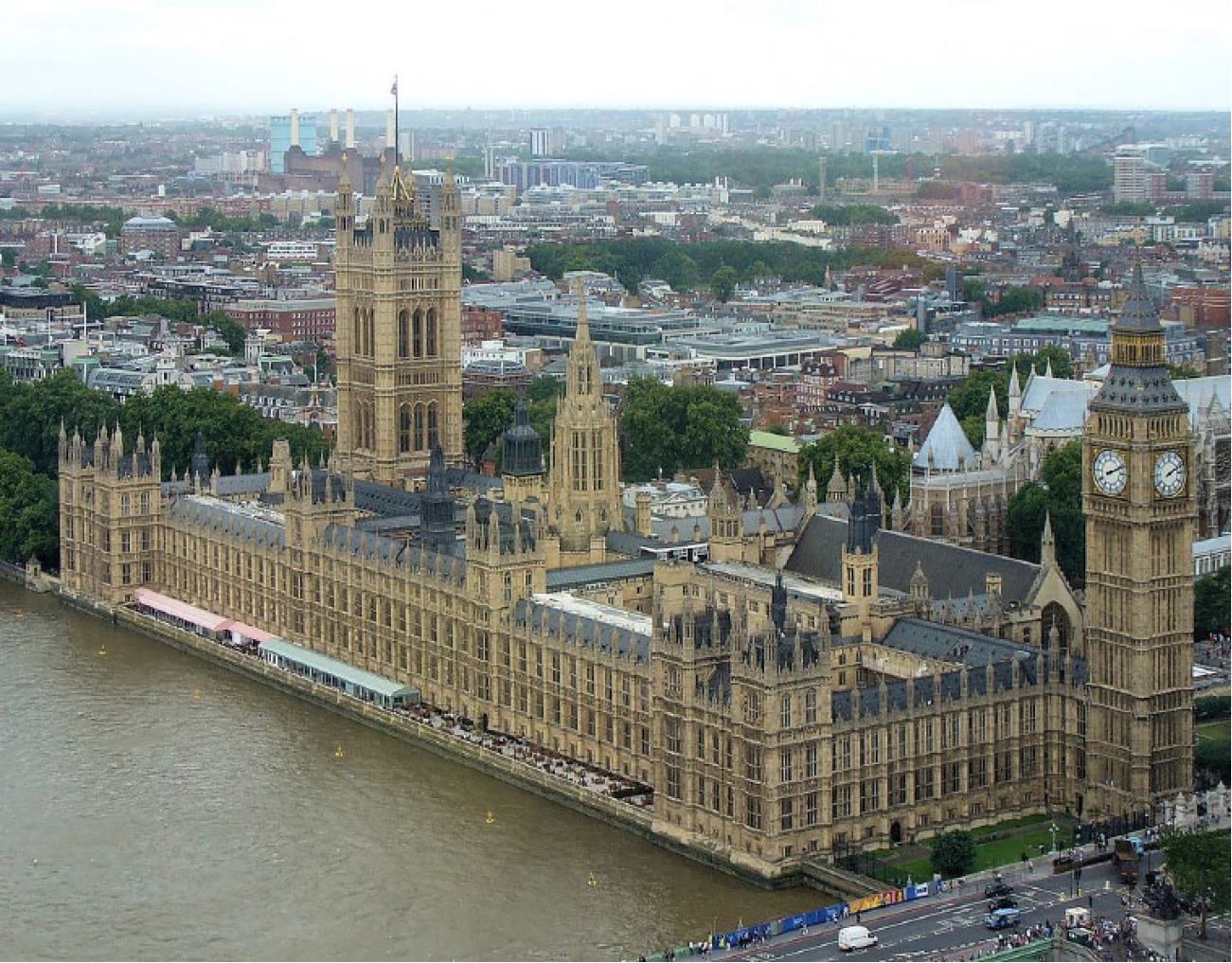
The Palace of Westminster (‘House of Commons’), London. An example of mid-19th century UK ‘English’ Gothic. Image courtesy of Wikipedia Commons; available for reproduction on a Creative Commons License https://commons.m.wikimedia.org/wiki/Palace_of_Westminster#/media/File%3AWestminster_Palace_2.jpg.

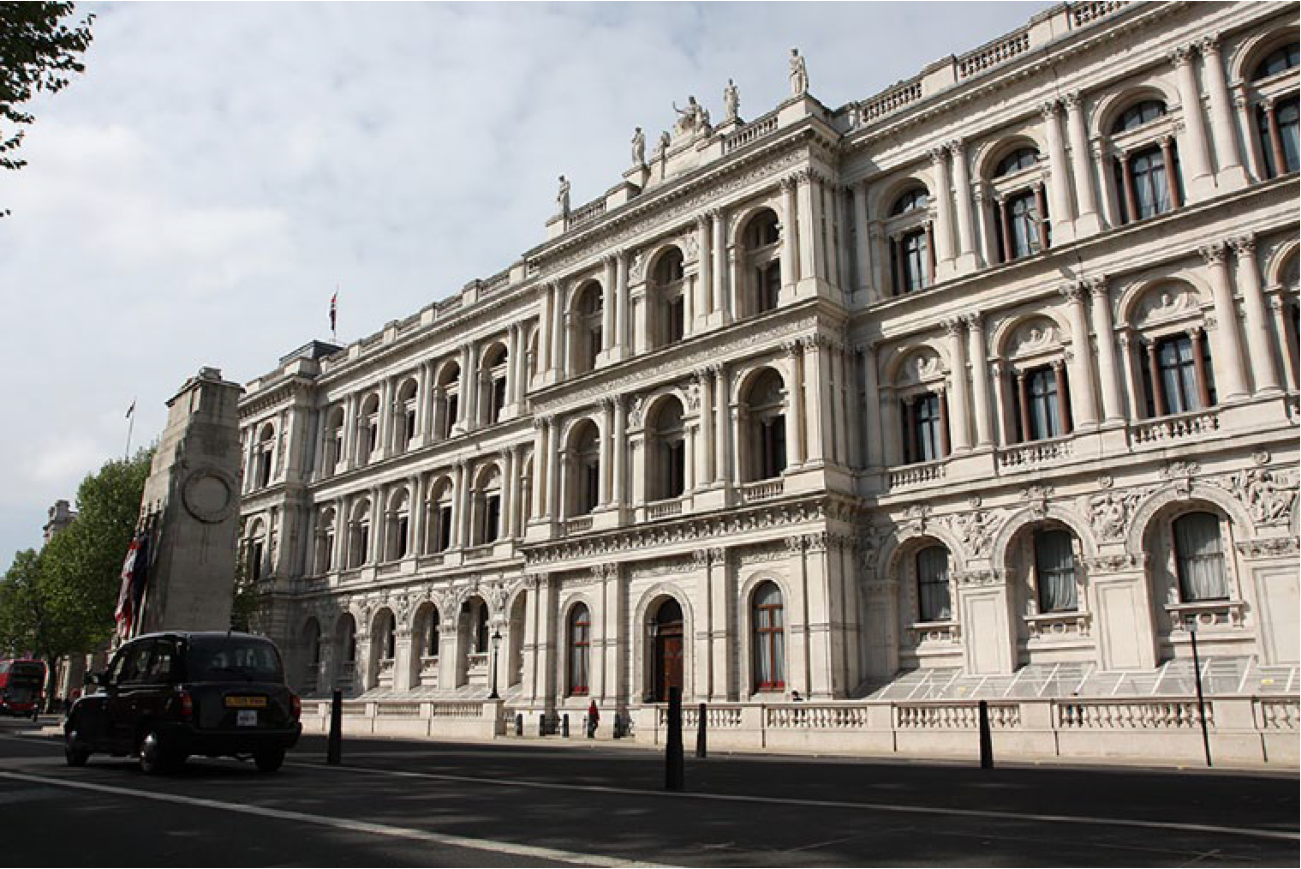
Foreign and Commonwealth Office, London. An example of mid-19th century, UK translation of Neo-classicism. Image courtesy of Wikipedia Commons; available for reproduction on a Creative Commons License https://commons.m.wikimedia.org/wiki/File:Foreign_%26_Commonwealth_Office_(15352849624).jpg.
.jpg)
These and other key buildings in the Battle (such as Marble Arch, the Albert Memorial, and St Pancras Station, all in London) are saturated in semiotic assumptions and aesthetic sensibilities of their time, even as their architects and commissioners were deploying them to stand in for others. In other words, the 19th-century architectural present was active in shaping pasts, replete with all manner of cultural-political assumptions of that day. The active creation of historic architectural styles involved the design and construction of buildings that – far from being ‘authentic’ – were highly stylised vis-à-vis Victorian cultural-aesthetic assumptions (and that accordingly bore all manner of amplified elements and oversights in terms of historic building techniques – see Crinson, 1996). These general arguments are explored and substantiated with respect to the cases under consideration in what follows.
So, while neither building in the images in Figures 1 and 2 looks like a radical avant-garde in the contemporary context, for both Neo-Gothics and Neo-classicists ‘their’ style was a materialisation of a past of which their contemporaneous society was an extension. Just as the Victorian social form was a culmination of civilisation, democracy, colonial power, and economic development, architecture helped to situate that society as the apogee of history, ‘as a continuation of the past’ (Zerubavel, 2003: 37) while also, paradoxically, emphasising the modernity of their present (Crinson, 1996; Lee and Beck, 1954). Cultural artefacts, including architectural ones, are curated to assist in metaphorically ‘inflating’ some periods and backgrounding others (Zerubavel, 2003: 25–35): in the Battle of the Styles it was partial versions of ancient social orders that were emphasised. Both styles of building are reasonably common to those familiar with major UK cities, but when first designed – despite appearing mediaeval or classical – they constituted a ‘new style’, unfamiliar to the contemporaneous gaze. There is a paradox here, which Zerubavel’s work (especially 2003) highlights: the celebration of pasts is a site of contemporary production, reworking, and reinvention.
From the perspective of the Battle’s protagonists, both styles were representations of different civilisational meanings, moralities, and ways of life. Gothic, drawn from mediaeval cathedral architecture, and Neo-classicism, primarily associated with ‘European’ (Roman) heritage, became a way that national cultural differentiation was materialised and could be made meaningful (Crinson, 1996: 38). Somewhat ironically, given the mediaeval myths of its origin that gained traction (Kornwolf, 1975), for its supporters, Gothic was ‘the fresh young Turk of a style that was supposed to sweep away the Classical dead wood and revive the architectural face of Britain’ (Porter, 2011a: 11). Put bluntly, it was a new take on an old style. On the opposing side of the ‘Battle’, for its advocates, Neo-classicism hinted at a stripped-down rationalism, a proportionate approach to building and public life that foreshadowed later modernisms.
Furthermore, although Gothic and Neo-classicism were both represented as quintessentially ‘British’ by their respective advocates (Porter, 2011b), they actually were reinterpretations of styles associated with prior European civilisations (of ancient Rome, Greece in the case of Neo-classicism, and colonial powers such as Germany and France in the case of Gothic). Allusions to historic empires elsewhere were not coincidental; transit of Gothic and Neo-classical styles through time and space involved translation of knowledge garnered on the so-called Grand Tour (Chaney, 1998), that is, classed travel around European cities and sites of architectural significance, undertaken by an elite group of classically educated ‘Gentleman Architects’ (Cohen, 2001; Naddeo, 2005). The European high cultural discourses emanating from the Grand Tour involved massively broad sweeps of time, attractive to states wanting to ‘stretch’ time to situate themselves as part of civilisational lineages (Zerubavel, 2003: 59). Despite the superficially formalistic/aesthetic similarity of buildings from radically different socio-historic periods, emphasis on cultural continuities is often bound up with political desires to create linkages and lineages between particular parts of the world, particular times, and their social arrangements.
While the knowledge made geographically and historically mobile by the Tour was key for architectural periodisation and canonisation, the interpretative ‘rules’ of the professionalising architectural field were still nascent (Brain, 1991). Reflective of this messy situation, ‘The Tour’ did not result in cultural agreement concerning the social values of architecture: disagreement concerning the meaning of styles proliferated (Chaney, 1998). While knowledge of styles distant in time and space allowed British architects to consolidate the semiotic and aesthetic parameters of their field of operation – and to distinguish their expertise from related building professionals (Stevens, 1998) – cultural disagreement revealed the then still fragile semiotic authority of the architectural profession. 4 The creation of so-called ‘correct’ readings of style was part and parcel of architecture’s project of professionalisation, but in the period under consideration they were still significantly in flux (Brain, 1991).
As no unquestionable canonical authority – of the type studied by Bonta (1979) – existed in architecture, partiality and differing interpretations of styles abounded. Formalistically speaking, both styles contending in the Battle of the Styles were hotchpotches drawn from a variety of vernaculars, and included otherwise disparate elements of historic architecture (Crinson, 1996; Kornwolf, 1975; Porter, 2011a). Despite the assured positions of Battle of the Style advocates (Porter, 2011b), both 19th-century revivals involved the partial translation of historical styles, oxymoronically expressing of the active nature of translation (Iggers, 1995; Kornwolf, 1975). In 19th-century architecture, controversy concerning accusations of translational error abounded; the sources reviewed here reflect the differing positions staked out by protagonists in the Battle of the Styles (Panofsky, 2005; Ruskin, 1992 [1842]). The variant positions in this architectural controversy are analytically significant in and of themselves (Yaneva, 2014), but the sources – including later reconstructions (for example Crinson, 1996; Kornwolf, 1975; Porter 2011a, 2011b) – can also be understood as part of a representative cultural politics surrounding the built environment and its temporal meaning.
The architect Augustus Pugin was a particularly vocal supporter of Gothic architecture, which he thought a pure and true form; he nonetheless described the popular form of Gothic as incorrect, a translation of prior misreadings and misinterpretations (Crinson, 1996). Decimus Burton, architect of many major Neo-classical houses and prominent supporter of urban development in that style, made similar observations about the technical errors associated with partial interpretations of that genre (Ruskin, 1992 [1849]). In a reflection of the relatively callow nature of architectural authority, the Battle was plural in terms of the backgrounds of those intervening. In the absence of a codified professional status for architects relative to others working in the built environment (such as masons, engineers, greenhouse designers, critics, and so on) the plurality of interlocutors is worthy of note. Rather, politically and economically dominant men, and the factions they spoke for, intervened in architectural semiotics and aesthetics. The positions of these figures reveals the general arguments suggested earlier.
In his definitive guide to the style, the critic Erwin Panofsky suggested that ‘there exists between Gothic architecture and Scholasticism a palpable and hardly accidental occupancy’ (2005: 12). The then prime minister, Lord Palmerston, who was a central protagonist in the Battle of the Styles, ‘loathed Gothic [and] thought it was dark and gloomy; he associated it with medieval superstition’ (Porter, 2011a: 12). Palmerston saw Gothic styling on state buildings such as the House of Commons as ‘wholly unsuited . . . [though] admirably suited for a monastic building, a monastery, or Jesuit college, it was not suited, either internally or externally, for the purpose to which it had now been proposed to apply’ (Parl. Debs (series 3) vol. 155, col. 931; 4 Aug. 1859). Politicians such as Palmerston voicing strong opinions about architectural semiotics further reflects the emergent status of architects who themselves were less authoritative regarding architecture’s meaning than their profession would subsequently become. The critic John Ruskin, a champion of Gothic architecture due to the astounding technical skill of the craftspeople carving stone, making stained glass, and the other elaborate features characteristic of the style, was also a critic of standards that he felt fell short of the required artistry (Ruskin, 1992 [1849]).
So, this ‘battle over the social legacy of the past’ (Zerabuvel, 1996: 283), was characterised not so much by disinterested, objective positions regarding architecture but political ones bound up with claims pertaining to pasts-presents-futures. Even when the architectural canon was uncertain, it provided a space for struggle between political elites concerning their legitimacy, contingent at that point on the authority borrowed from the cultural past (Therborn, 2002). There is an oxymoron here: the relative fragility of architectural knowledge concerning historic architectural styles meant that the styles were seen as a cultural battleground of which differing projections could be cast in stone. Accordingly, the stability of architectural meaning was not in evidence in the Battle, so much as its pliability. Of course, this is not to suggest time – or architectural meaning – is completely malleable (see Appadurai’s 1981 critique), but rather that there was an affinity between political aims and historicist architectural oeuvres, even as the cultural basis for the latter was unsure. Capturing the centrality of time to social life requires thinking sociologically about the ways in which it is made tangible (Zerubavel, 2003).
As well as rarefied debates concerning architectural interpretation, MPs wanted to avoid the politically unfavourable impression of largesse with respect to buildings paid for by the public purse but with an elite political and social function. What buildings such as the Foreign Office should be for, what they might mean, and whether they should exist at all, were issues folded into the Battle (Porter, 2011b). Despite being referred to as a ‘Palace of Administration’ by some, it was the literal collapse of the previous Foreign and Commonwealth Office that created the urgency for the commission of the new one (Porter, 2011a: 10); motivations both pragmatic and cultural led to the Victorian state to generate architectural competitions so prolifically (Roraburgh, 1973). Still, the commissioning of buildings to house government function created opportunity for newly professionalising architects keen to express their cultural capacity for the ‘construction’ of meaningful form. As well as illustrating architecture’s ‘dual function’ of symbolism and shelter for activity (Whyte, 2006), competitions were often the sites of major controversies in the Battle of the Styles; for example, the 1834 design competition for the ‘Houses of Parliament’ – which required rebuilding after major fire damage – specified a ‘mediaeval’ style, widely interpreted by architects and politicians to mean Gothic (Crinson, 1996; Kornwolf, 1975). The competition had over 240 entries; a so-called ‘pamphlet war’ between protagonists accompanied this and other design competitions (Porter, 2011a: 12).
Importantly, the buildings resulting from the Battle of the Styles provided somewhere to meet and ‘do’ the formal elements of political administration. Much of this ‘practical’ politics involved the administration of colonised societies elsewhere in the world. However, the architectural historian Bernard Porter argues that the architecture that emerged from the Battle of the Styles ‘was relatively empire-free’ (2010: 182); he sees the lack of ‘evidence’ in contemporaneous documentation as key, and places much credence on what is explicitly said or written concerning architecture by culturally authoritative sources. But if one problem, as identified by Porter, is finding empire everywhere/in all of the cultural expressions of a colonial society, then finding it nowhere is an equal if opposite problem. Porter’s position (2010, 2011a, 2011b) effectively claims a stake in the battle, contingent on an interpretative authority that posits an essentialised meaning of buildings. This misses both the dynamic basis of architecture’s production and use, and the cultural politics of time more broadly. Rather sociological analysis may seek to disrupt the central claim of the battle, that architectural styles are essentially embedded with moral value, rather than take sides in it. Porter’s reconstruction of the Battle is written from the perspective – scholarly and precise though it is – of taking a particular position in the controversy, rather than an analytical one that reflects on the ways in which architectural controversies are animated by social ones, and vice versa (Yaneva, 2017).
Sociological analysis of the Battle of the Styles is revealing of at least two key things relative to architecture and time: (i) as the architectural field was nascent, the social meaning of the built environment was open to a variety of interpretations. Precisely because knowledge of styles distinct in time and space was fragile, and architects’ professional authority uncertain, government commissioners had input regarding buildings’ meaning and value; and (ii) time matters vis-à-vis the creation of meaning in the built environment, which always rests on architecture’s ‘dual function’ of symbolism and utilitarian shelter (Whyte, 2006). It is to a very different architectural manifestation of state time that the article now turns.
Section Four: The Crystal Palace and the Politics of an Architectural Future
Coterminous with the historicist ‘Battle of the Styles’, in the mid-19th century the then British government also commissioned radically modernist architecture. Similarly to the culturally exploratory terrain of the past, the future is a fruitful timeframe within which states position themselves (Bozdoğan, 2001; Vale, 1992). Modernism always involves projection forward, creating a cultural ‘plot line that helps us string together [futures]’ (Zerubavel, 2003: 13); the narration of a bright future inherently involves the creation of beginnings, endings, and other devices that add momentum to such periodisations and claims (Zerubavel, 1996). Such anticipated futures are politically authored, and de facto entail contrasts with pasts and presents. To return to aforementioned sociological studies of time, architecturally modernist forms are never universalist expressions; they favour some ways of being and not others.
The Great Exhibition 1851 was a ‘mega-event’ (Roche, 2003) – a spectacular cultural display by the state – celebrating industrial time via the curation of objects, technologies, and architecture. Mega-events do not so much mark the passing of time, but are active sites of its construction, with the generation of periodisation via ‘cultural genres specific to modernity’ (Roche, 2003: 100) adding resonance to the present, making it seem more ‘now’ by contrasting fictionalised pasts and possible futures. As with the historicist buildings assessed earlier, in this context architecture is one way that time – future time – is given a social reality. Despite over 6 million visiting the Exhibition (Addis, 2006; Greenhalgh, 1988; Roche, 2003), exclusions and partial incorporations associated with class, gender, ethnicity and other forms of social division abounded. The Crystal Palace, which housed The Great Exhibition, involved intervention both in the phenomenological sense of affecting individuals’ time-consciousness and in the sense of broader social structures involving the state, the nation, and the Empire.
The exhibition was organised under the auspices of the Royal Society for the Encouragement of Arts, Manufactures and Commerce (the ‘Royal Society for the Arts’). The full title of the event was ‘The Great Exhibition of the Works of Industry of All Nations’, with the official exhibition guidebook suggesting that ‘to make the rounds of this palace means literally to circle the earth. All peoples come together here’ (cited in Crinson 1996: 68). The event had strong political backing: in addition to Prince Albert as Honorary President, its patrons included the future prime minister William Gladstone as a member of the organising commission.
The Great Exhibition was an event ‘during which people and things entered the new, global time–space of capital’ (Andermann, 2009: 334). Whereas Walter Benjamin remarked that this amounted to a ‘pilgrimage to the fetish [c]ommodity . . . a ritual worship’ of capitalism (cited in Roche, 2003: 47), Albert described the central aims of the exhibition as aspirational display and competition (‘products of all quarters of the globe are placed at our disposal, and we have only to choose which is the best and cheapest for our purposes’). Both positions are true. The aim of converting the entire world to capitalism via globalising free trade bore the imprint of Victorian colonialism, as did the incorporation of colonised societies into commodity exchange (Celik, 2010; Greenhalgh, 1988; Roche, 2003). The building was crucial to this aim, not just as a backdrop, but as actually adding temporal meaning to the objects displayed therein (Jones and MacLeod, 2016).
The temporary architectural structures housing mega-events are one way that their out-of-the-ordinariness is symbolised and materialised; key buildings tend to be characterised by radical experimentation with materials and forms. As with the Crystal Palace, the architectural-temporal experimentation at major events such as Olympic Games, World Cups, Expos, and World’s Fairs is part of a governmental ‘performance complex’ (Roche, 2003), typically radically modernist in form. The Crystal Palace was a breach with contemporaneous architectural styles – such as Gothic and Neo-classical and building materials such as stone (that led to the proliferation of dark, ‘heavy’ spaces). This was a glass and steel structure whose radical aesthetic captured the exhibition’s motif of ‘newness’ (Figure 3).
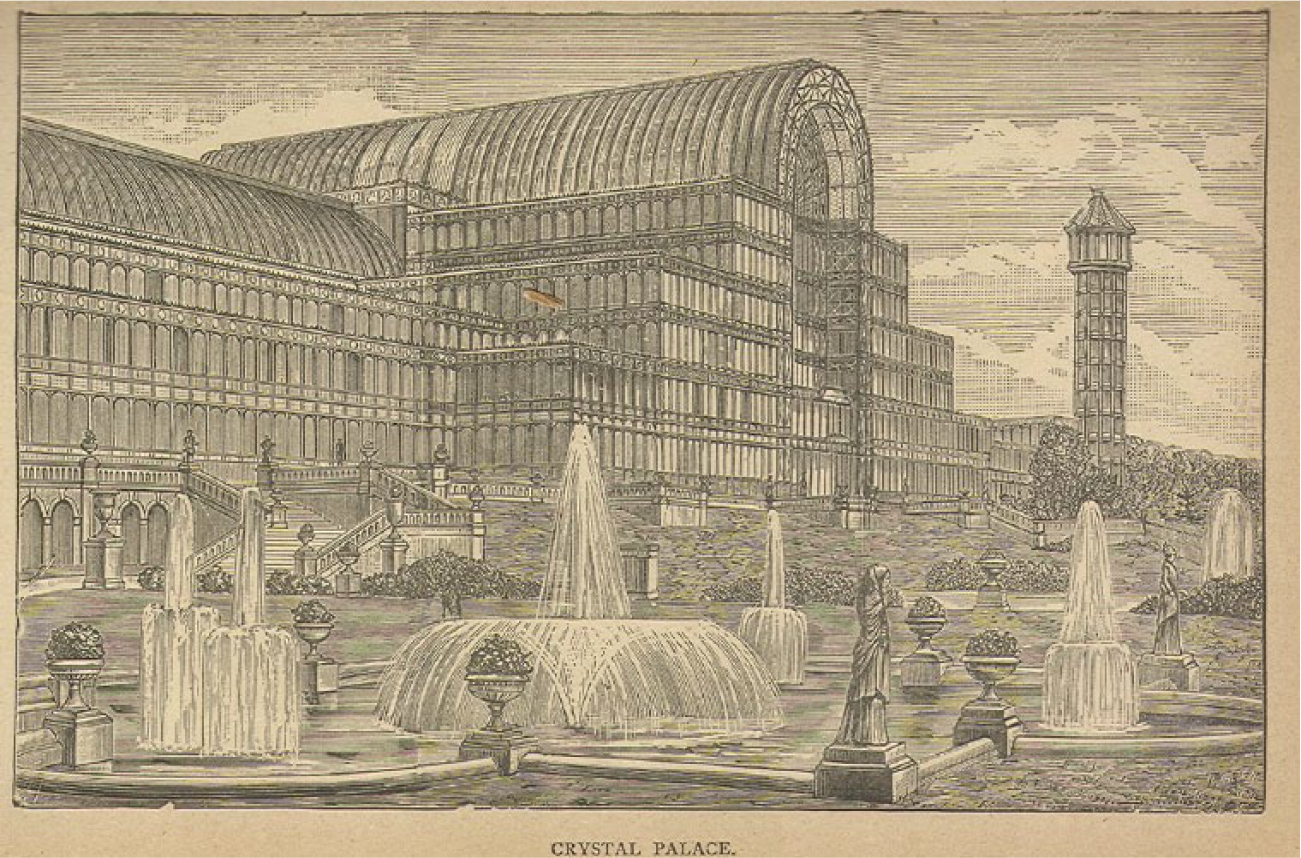
Etching of the Crystal Palace, London. Image courtesy of Wikipedia Commons; available for reproduction on a Creative Commons License https://commons.m.wikimedia.org/wiki/Crystal_Palace#/media/File%3ACrystalPalaceEngraving.jpg.

A number of features of the Crystal Palace were highly innovative, at least in combination; to create such a huge internal space, the architect drew together elements common on mills, railway sheds, dockyard structures, and greenhouses; perhaps further reflective of the uncertain status of the architectural profession, Joseph Paxton was in fact a gardener rather than an architect per se (Addis, 2006: 14–15). Ingenious drainage/guttering, the structural stability of iron frames and glass curtain walls, and prefabricated sections assembled on site had emerged in the technological firmament of the industrial revolution and were used in docks, warehouses, and factories and blurred the boundaries between architecture and function-driven engineering. Without overstating the subsequent influence that this construction technique had in ‘opening the way in Europe to the Modern Movement and, in the USA, to the growth of high-rise building’ (Addis, 2006: 3; also see Heynen, 1999; Larson, 1996), such pioneering construction on what was one of the world’s first rigid-jointed iron frames subsequently became commonplace the world over.
Thanks to such radically advanced techniques, the Crystal Palace was constructed extremely rapidly, with the whole build taking under 200 days (Addis, 2006: 3), significantly in comparison to the decades-long design and build of heavy stone buildings such as the Palace of Westminster. At its opening in 1851, the Crystal Palace was one of the largest buildings ever constructed that opened a massive internal space sufficient to house three mature elm trees and 70,000 square metres for display (Addis, 2006: 3–7). Architectural materials are one key way of signalling time-as-social reality, and the novelty of the extensive use of glass on such a large building brought with it associations of modernity, in addition to the technical affordance of enclosing a huge volume of space by removing internal supports. The mystic and representational qualities of glass have been observed elsewhere (Ersoy, 2007; Haag Bletter, 1981); the functional drivers of the design aside, such historical, fictive associations of glass were ever-present in the discourses of Paxton (Addis, 2006). Not only did his design make use of the out-of-the-ordinariness of glass and its stark contrast with the heavy, dark stone of other major buildings, the relational meaning of the extensive use of glass on a building in 1851 and 1951 is also not unbroken (pun intended) despite the formalistic similarity of the material (Fierro, 2003). Contemporaneous accounts suggest that being in and around this building, form was experienced highly affectively, both in terms of the building’s users and in adding relationally to the display of objects (Jones and MacLeod, 2016). In the case of the Crystal Palace the building gave context for the display of very large materials, and helped to create a futuristic cultural context for displaying and viewing objects.
Exoticised consumption was a prominent feature of the exhibition hall, with the predomination of spectacular artefacts and ‘theatrical’ symbols of national identity that put ‘ephemera and dramatization to the fore’ (Heynen, 1999: 378). Edward Said revealed how the construction of a generalised category of ‘others’ underpinned the self-understanding of western colonial states (2003 [1978]). The artefacts and objects displayed at the exhibition sustained a hierarchical vision of national cultures and ‘races’. The cultural essentialism underpinned the classification and exhibition of artefacts by nation, in line with the vision of prominent cultural reformer and high-profile patron of the exhibition Henry Cole (Crinson 1996: 54). Attendant hierarchies were designed to reflect positively on the British nation’s culture and industry. The creation of a mythical indigenous ethnic ‘other’ – replete with atavistic ways and objects – that could be contrasted with such was constructed (Roche, 2003; Said, 2003 [1978]). 5 If some of the 100, 000 or so objects displayed were associated with traditional ways of being, others were so new that only a few had ever seen them. Viewing such in a structure that blurred inside and outside, that was experienced as out of the ordinary, and that allowed spectacular spatial scales, compounded the effect and the affect.
However, despite, or perhaps because of, its out-of-keeping aesthetic, the Crystal Palace was not universally admired. The influential architectural critic Nicolaus Pevsner called the building ‘[A]bominable . . . wrong from any point of view . . . unpleasantly realistic . . . incongruous . . . monstrous . . . [revealing] failure, coarseness, barbarism, atrocities, vulgarity, [and] insensibility’ (cited in Kornwolf, 1975: 39). The contemporaneous press dubbed the Exhibition a ‘Chamber of Horrors’, and according to unverified reports, the arts and crafts designer William Morris was ‘violently ill after becoming overwhelmed by the excess of the event’. 6
The architecture of the Crystal Palace went with the grain of a project that stressed the future, in part by providing the perfect context for ‘showcasing’ invidious comparators drawn from the past/elsewhere (Said, 2003 [1978]). As such, the Crystal Palace building is difficult to decouple from the project it enclosed or the context from which it emerged (Porter, 2011a, 2011b; Steets, 2016). This points to the social basis of architecture: it is always collectively produced, long after the architect has left the stage. While flatly positioning the Great Exhibition, and its constituent architecture, as a cultural expression of colonial, industrial-capitalist ideology illustrates Porter’s (2011a, 2011b) point concerning the empirically non-present, the entanglements between this event, its building, and a broader political programme cannot be overlooked. Architecture is always and everywhere political, inasmuch as it is implicated in, and emerges from, particular sets of social arrangements, distributions of resources, and visions of how the world is, was, and could be.
Conclusion
Architecture is one highly material way that social activity can be situated vis-à-vis cultural pasts and futures (Vale, 1992). As a constitutive part of the ‘unmistakably social maplike structures in which history is typically organised in our minds’ (Zerubavel, 2003: 1), architecture’s distinctive combination of providing shelter in addition to cultural meaning has proved attractive to states. In this article I have argued that exploring affinities between political programmes and the form and function of the major architectural projects is rich in sociological potential. If on the one hand sociologists should not reduce architecture a priori to political ideology made cultural, then on the other they must recognise that the built environment is a component of ideological projects, which have temporal character.
In the context of the Battle of the Styles, the commission of architects engaged with 19th-century nation-building projects involved an active creation of a cultural past to lend the nation-state the appearance of historic continuity and to house a rapidly expanding colonial administration. The appropriate form in which to do this was the basis of much controversy between architects and politicians of the day. The evidence marshalled by this or that side involved interpretation of drawings and other representations of buildings from the ancient world, which had been garnered from the Grand Tour. So, ‘the battle’ was over the meaning of architectural form, while at the same time it became entangled in all manner of cultural politics concerning how best to represent the aspirations of a cultural and political elite for that particular nation at that particular point. Variations in interpretation illustrate how architectural meaning ‘can be dissociated from what architecture actually is’ (Bonta, 1979), and in that context they flourish without the limiting authority of professional canonical authoritative judgement.
The tendency for political institutions to align themselves with radical modernist cultural form is observable in the architecture of mega-events (Roche, 2003), and is politically expedient in certain – but not all – contexts (Appadurai, 1981; Bhabha, 1994; Bozdoğan, 2001; Vale, 1992). The Crystal Palace was both architecturally and politically experimental, providing the context for projections of the future to be articulated alongside artefacts and practices associated with the past and elsewhere. The exhibition’s architecture, as did the objects in and around it, celebrated the new, creating a distinctive, out-of-the-ordinary site for display and commodification. While drawing on ostensibly opposing temporal repertoires, both historicist styles and proto-modernist ones reflected the state aim of capturing the cultural legitimation of particular political relationships to time (Appadurai, 1981).
Lines of inquiry from sociological studies of time illuminate something relevant and hitherto absent from sociologies of architecture, namely the extent to which the built environment shapes and is shaped by practices associated with social categories of pasts-presents-futures. Disrupting linear narratives about the built environment, the literature on time leads us to analyse architecture as a space of temporal experiment. By studying how architectural ‘objects have histories and trajectories which when plotted over time take stable but relatively unpredictable courses’ (Stewart, 2015: 148), sociologists can reveal how states attempt to make their political activity culturally resonant through the built environment. When researching architecture sociologically, analysis of how it is bound up with political makings of ‘social time’ (Durkheim, 2008 [1915]) is crucial.
Footnotes
Acknowledgements
I am extremely grateful to Charlotte Branchu, Terence Heng, Linda Lapina, Vanessa May, Maike Pötschulat and Simon Stewart for their perceptive and constructive engagements with an earlier draft of this article. In addition, the three anonymous reviewers of this article – and a Cultural Sociology editor – gave me a series of reviews; the combination of these amounted to the sharpest and most generous I have ever received. My sincere thanks goes to all these people. As is ever thus though, errors and weaknesses of analysis remain my own.
Funding
The author received no financial support for the research, authorship, and/or publication of this article.