



Abstract
The sociology of cultural tastes and practices seeks, on the one hand, to show how tastes and practices are structured, and on the other hand, to explain them. For this purpose, multivariate analysis, and in particular, multiple correspondence analysis (MCA), has been chosen as the preferred statistical method to support a theory of ‘homology’ between ‘social position’ and preferences. This article reassesses the initial interpretation offered by Bourdieu of the two factor spaces of ‘dominant’ and ‘petit-bourgeois’ tastes in Distinction (1979) and discusses how MCA is used in the sociology of culture as ‘structural homology’, especially one-dimensionally (single-axis reduction) and positionally, without the inclusion of the age variable. The two ways of considering the effect of age are either by excluding it a priori (‘omitted axis’) or by not theorizing it (‘descriptive axis’). We show, using data from the 2008 French Cultural Practices survey on tastes in music and movies, how a factor analysis that incorporates age outlines a generational and historical structuring of tastes. We explain the different dimensions of age in terms of cultural practices and we interpret the level of education in terms of knowledge. The article advocates a model for the interpretation of tastes that is no longer based on the structure of capital, but rather on cultural history and specific competences.
Keywords
The sociology of culture as applied to cultural tastes and practices looks, on the one hand, at how these tastes and practices are structured, and on the other, seeks to explain their determinants. To this end, it makes widespread use of a specific statistical method – multivariate analysis – in particular, multiple correspondence analysis (MCA) and the geometric representation of data. Bourdieu, in 1979, was first to use this method for his theory of a ‘structural homology’ between tastes and ‘social position’, and even of a homology between the social value of goods in practice i.e. ‘cultural legitimacy’, and ‘social position’ (Bourdieu, 1984 [1979]). With regard to ‘dominant’ culinary tastes, Herpin (1980) offers the criticism ‘that within the bourgeois class, opinions on food, contrary to what the author says, are not very discriminating. If there are differences in this area, they are not due to the position in the class structure, but are effects of age’. He goes on to add:
When it comes to other indicators, such as those relating to painting or music, it is perfectly reasonable to believe that in these domains Bourdieu’s analysis is convincing, and that the frequentations and tastes displayed follow the logic of heritage. But here again, it would have been useful to be able to distinguish, among the diverse elements that make up a lifestyle, which one has more to do with gender, which with age, and which with income, or with less routine determinations that the researcher might be inspired to examine or construct. (Herpin, 1980: 445)
Bourdieu’s interpretation of the two multiple correspondence analyses found in Distinction (1984 [1979]: 262, 340) has the particularity of substituting parental origin for age, though the latter remains present. Age is interpreted as ‘seniority in the bourgeoisie’ (‘herit-age’) – a ‘social age’ (Purhonen, 2016). This reading, which needs to be revisited, doubtless plays a decisive role in the contemporary extension of ‘structural homology’. It serves just as much to explain the structuring of preferences as their social value i.e. ‘cultural legitimacy’, which is measured against declared cultural preferences and practices. Since the 1990s, several authors have combined their use of factor analysis with the theory of homology in order to establish a statistical basis for the hierarchy of cultural practices (Peterson and Simkus, 1992; Prieur et al., 2008; Van Eijck, 2001; Warde and Gayo-Cal, 2009). For instance, the examination of four areas of French cultural practices (television, music, movies and reading) in 2008 by Robette and Roueff (2017: 375) indicates that Axis 1 of the factor analysis is correlated to level of education and Axis 2 to age, but concludes that a ‘generally established homology’ can clearly be seen between tastes and ‘social position’. Evidently, this ‘structural homology’ replaces a minimal and descriptive reading of Axis 1 by (arguably) a ‘homology’ based on level of education. This comment appears to echo that of Flemmen and Hejlbrekke (2016) on the analysis of British tastes in food by Atkinson and Deeming (2015). They argue that throughout Atkinson and Deeming’s analysis there is no evidence to support the ‘homology thesis’, especially ‘the composition of capital’ as a second axis of structuration (Flemmen and Hjellbrekke, 2016: 192).
Unlike the studies cited, several recent analyses have used multivariate methods encompassing age, generation and gender. The thesis of musical eclecticism, i.e. contemporary forms of taste, demonstrates a pluralism of genres, combines homological theory and differentiation according to the secondary variables of ‘age, gender, race, region, religion and lifestyle’ (Peterson, 1992: 254; Peterson and Kern, 1996). In the case of France, Coulangeon (2013) says of the social structure of the 13 cultural practices chosen in 1981:
the horizontal axis . . . is clearly predominant, and can be interpreted as a ‘size factor’; reading from right to left, it contrasts those with a high level of commitment to almost all practices to those with a low level of commitment to almost all of them. (2013: 188)
He adds:
Education is more exclusively related to the first axis . . . of which this variable undoubtedly appears as the main structuring factor . . . Both the first and second axes are also structured by an age factor. This structuring power of age is nonetheless a little more pronounced on axis 2 . . . (2013: 191)
Glevarec and Pinet (2013) show from data on the cultural practices of French people in 2008 that the axis of social stratification of cultural practices continues to play the primary role in the structuring of cultural practices, while age structures the second dimension. 1 However, age is not theorized, except as ‘youth culture’. Only recently has Donnat developed an initial theorization of age. In 2009, he writes that ‘in the musical field, habits and tastes acquired during youth often persist in adulthood’ (Donnat, 2009: 122–123). In 2011, he interprets the age variable as ‘cultural generation’ (2011) on the basis of a retrospective analysis of the five editions of the French Cultural Practices survey. It is in qualitative studies that age is taken into account. Bennett (2013) illustrates how the music that mattered to most people in their youth continues to play an important role in their adult lives.
In this article we propose first to examine the methodology of multiple correspondence analysis and how it is used in the sociology of culture as ‘structural homology’, particularly one-dimensionally (single-axis reduction) and positionally, without the inclusion of the age variable. The two ways of obscuring the effect of age are either by minimizing its effect or by excluding it a priori (‘omitted axis’). Other authors have recently highlighted age in their analyses, but do not theorize it (‘descriptive axis’). Second, we show, using data from the 2008 French Cultural Practices survey on tastes in music and movies, how a factor analysis incorporating age outlines a generational and historical structuring of tastes that warrants sociological interpretation. In the discussion part we explain the different dimensions of ‘age’ in cultural practices and we interpret the level of education in terms of knowledge. We advocate a model for the interpretation of taste that is no longer based on the structure of capital, but rather on cultural history and specific competences.
Factorial Methods, the Theory of Structural Homology and Age
The ‘Omitted Axis’: Authors who, Following Bourdieu, do not Retain Age
Created in 1904 by the British psychologist Charles Spearman to measure intelligence, factorial analysis became correspondence factor analysis (CFA) in France in the 1960s under the impulse of the mathematician Jean-Paul Benzécri (Cibois, 1981). CFA was previously used in applied research (CREDOC, French Research Institute for the Study and Monitoring of Living Standards) and in the processing of economic and social data (INSEE, French National Institute of Statistics and Economic Studies), as well as in research in sociology and geography. In the early 1950s, Bourdieu and Benzécri were both students of the prestigious École normale supérieure on the rue d’Ulm in Paris and from that time onwards they never lost sight of each other (Benzécri, 2006). It is something of an ideological paradox that in the 1970s Bourdieu used multiple correspondence analysis to explain cultural practices, as he stood at the ideological antipodes of Benzécri. 2 However, the paradox is easier to understand when we remember that Bourdieu (1984 [1979]: 580, footnote 6) also considered social space to be structured by ‘dimensions’ located in the factors of the analysis. The function of this analysis was to represent the levels of attraction and independence between the modalities of the variables.
On the subject of ‘Life-Styles’ in Distinction, Bourdieu argues that:
Economic and social condition, as identified by occupation, gives a specific form to all the properties of sex and age, so that it is the efficacy of the whole structure of factors associated with a position in social space which is manifested in the correlations between age or sex and practices. (Bourdieu, 1984 [1979]: 105–106)
Age is conceived as a secondary variable. For Bourdieu, age is structural, and not historical. Age refers to the succession of time and the struggle between ‘social positions’ in a cultural field, and not directly to the cultural time of history i.e. the succession of music genres, artwork and artists. Bourdieu does not retain age, but he makes it a ‘herit-age’, which on careful examination, was already being structured in the 1960s. This link between age structure and levels of education was present in Distinction through the following two multiple correspondence analyses: ‘Variants of the dominant taste’ and ‘Variants of petit-bourgeois taste’ (Bourdieu, 1984 [1979]: 262, 340). Nevertheless, it lacked further analytical and a fortiori theoretical scrutiny from Bourdieu.
In the first of the two analyses, ‘Variants of the dominant taste’, an ‘axis’ of age links the 18–30 modality, bottom left, to the ‘over 60s’ modality in the top right. An ‘axis’ of education is partly perpendicular, running from ‘postgraduate degrees’ in the top left to ‘vocational diplomas, Primary School Certificate [CEP], no qualifications’ in the bottom right. The configuration is the same as that identified earlier for tastes in music. A similar connection between age and education can be found in the ‘Variants of petit-bourgeois taste’ (Bourdieu, 1984 [1979]: 340). Bourdieu’s treatment of Axis 1 and Axis 2 does not take account of age, though there is a very clear generational effect. Age modalities indicate graphically, through their dispersion, their very strong, if not their strongest link to Axis 1 (notwithstanding the position of the individual socio-professional categories), and to Axis 2 in the case of the dominant taste. Bourdieu’s qualification of the second axis as a ‘social trajectory’ axis is problematic. Age, as correlated to the second factor in the two plane diagrams, is identified by Bourdieu, but handled in a particular way: it is removed in favor of an opposition based on social origin i.e. class seniority. Bourdieu writes:
that, as in the case of the dominant taste, the second factor expresses an opposition by age (the oldest are at the top of the second axis and towards the economic pole, the youngest at the bottom of this axis and towards the cultural pole) and, inseparable from this, an opposition by social origin: the children of big or small employers, senior executives or professionals are situated on the positive-value side, the children of manual workers, clerical workers or junior executives on the negative-value side. (Bourdieu, 1984 [1979]: 341)
It is as if, in Distinction, the old enjoy inherited status, while the young are the children of the working classes (Bourdieu, 1984 [1979]: 265–266). In summary, Bourdieu removed age from the analysis and replaced it with social origin i.e. ‘seniority in the bourgeoisie’, which describes Axis 2. In particular, he removed age as a historical and cultural generation corresponding to the frequentation of a body of work and values in relation to the cultural offer at the time.
In Distinction, the generational dimension of the age variable is clearly visible in people’s choice of favorite singer. In the ‘Variants of petit-bourgeois taste’ figure (1984 [1979]: 340), Luis Mariano (born 1914) and Georges Guétary (born 1915) are positioned close to older people (between the over-60s and the 46–60 bracket); between the 46–60s and the 30–45s we find Edith Piaf (born 1915); close to the 30–45s, Georges Brassens (born 1921), Jacques Brel (born 1929); and finally, near the 20 year olds, Françoise Hardy (born 1964). A similar structure is visible near the age modalities for ‘Variants of the dominant taste’, with Françoise Hardy bottom left, Georges Guétary on the right and Luis Mariano at the top.
It seems that a certain number of contemporary authors have renewed an approach to cultural practices by excluding age. The factorial method used by Van Eijck (2001: 1182) is based on the establishment of an ascending hierarchical classification derived from a cross-tabulation between musical genres and levels of education. The following independent variables were used in the analysis: gender, level of education and occupational status. 3 As we can see, while gender is included, age is not. Meanwhile, Warde and Modesto Gayo-Cal (2009) establish – for each musical genre – the ratio of individuals without a diploma to graduates among those who claim to like the genre, and divide the genres into three classes according to whether this ratio is between 0 and 1 (‘lowbrow’), between 1 and 2 (‘middlebrow’) or 2 and higher (‘highbrow’). Once again, only the level of education variable is used. Robette and Roueff (2017) base their sociological interpretation of the factor analysis of multiple tables of four cultural practices (television, music, movies and reading) on ‘the volume of economic and cultural capital’: ‘If Axis 1 [taste] is therefore related to the overall volume of capital, the structure of the capital is also present, in which cultural capital plays a leading role. Axis 2 is correlated primarily with age, and secondarily with gender’ (Robette and Roueff, 2017: 375). 4
Finally, the multiple correspondence analysis performed by Prieur et al. (2008) appears to be problematic from a sociological and epistemological point of view since it involves using the socio-demographic variables (10 in the present case) as active variables and it considers the practices as illustrative variables.
5
It openly flouts the principle advocated by Benzécri that ‘the model must follow the data, not the reverse’. The first axis of the analysis has been interpreted as expressing the volume of capital, and is retained as an indicator of cultural legitimacy. The musical genres are then considered as additional variables along this axis and their coordinates are read off as legitimacy scores. This way of proceeding deliberately builds a social space from a selection of sociological variables grouped into two types of capital: economic and cultural. In their article, Flemmen, Jarness and Rosenlund (2019: 161) do exactly the same by using the categories as active variables, but it seems difficult to find a ‘structure strikingly similar to the model of the social space advanced by Bourdieu’ (2019) which replaces the Guttman effect. As Desrosières writes:
A form of parable appears whenever we study a strongly hierarchical structure, which is the case with social structure, in another way. The first axis, which explains most of the variance, opposes the two ends of the hierarchy. The second, which is roughly the axis of the parable, opposes the middle categories to the extreme categories. (Desrosières, 1978: 100)
We could imagine a ‘space’ with the two variables of age and gender: there would be an axis setting the youngest and the oldest in opposition and another setting male and female in opposition. The most scientifically remarkable, and yet significant, concerns ‘the space of lifestyles’. Flemmen et al. note:
For present purposes, we focus on axes 1 and 3. Due to limited space, we only focus on the axes that correspond to the structures of the social space. The omitted axis 2 depicts a division between an established, legitimate lifestyle characterised by a taste for canonised items and a more culturally savvy and emerging lifestyle, characterised by a taste for alternative and as yet uncanonised items. This axis is strongly influenced by age differences. (Flemmen et al., 2019: 163)
6
So in order to find the homology thesis, Axis 2, namely the age variable, is explicitly omitted in the factor analysis.
In Distinction, Bourdieu did not perform multiple correspondence analysis by using the socio-demographic variables as active variables; the practices are active, whereas the socio-demographic variables are illustrative (they were initially printed on a transparent page for the ‘social space’ and the two factor analyses (Bourdieu and Saint-Martin, 1976)) and it is their superimposition that supports the homological interpretation. There are good scientific reasons why sociologists do not assume a priori – even on the basis of a theory (which is also embedded in a historical epoch) – that a society is structured in such and such a way, but rather establish how a cultural practice is structured by observing the relation to a supplementary/explanatory variable. Moreover, we are not going to find any axis for age or gender, or anything else, if from the outset these variables have been excluded from the analysis, as is the case with the analyses examined here.
The ‘Descriptive Axis’: Authors who Highlight Age but do not Theorize it
Bennett and colleagues (2009) include age – as well as gender and ethnicity – in their analysis of British cultural tastes in the 2000s. They note age differences in the structure of tastes in music, and write: ‘Musical boundaries are closely associated with those of age, such that we might well talk about generations with different kinds of omnivorousness’ (Bennett et al., 2009: 82). They indicate an initial structuring principle derived from multiple correspondence analysis and based on the level of cultural participation. Subsequent lines of inquiry highlight the distinction between contemporary/commercial cultural practices and traditional practices related to age – between indoor practices and outdoor practices, and between intense practices and moderate practices. Roose et al. (2012) show that the first two strands of their analysis are very similar to those indicated by Bennett et al. (2009) in how they link to level of education and income (Axis 1), and age (Axis 2). Prieur and Savage (2013) comment that for Denmark and the UK: ‘firstly . . . the level of participation distinguishes better between survey respondents than the specific preferences or activities do . . . Secondly, age, gender and/or ethnicity may discriminate better in cultural matters than class does’ (2013: 252). They add: ‘it seems, for instance, that musical taste is strongly structured by age, and reading by gender’ (2013). Their objective is to examine the contours of a possible new cultural capital, and age does not appear to be a theoretical question in itself. This assertion is supported in the Danish studies by Prieur et al. (2008) and the Finnish studies by Purhonen et al. (2011). Ganzeboom (1990: 29) has already described how lifestyles are structured according to cultural, economic and age-related dimensions.
Several authors place particular emphasis on the role of age and generation in a process of ‘horizontal differentiation’ (Lizardo and Skiles, 2015: 10). Bellavance (2008), Berghman and Van Eijck (2009) and Purhonen et al. (2009) show that the classical distinction between ‘top’ and ‘bottom’ intermeshes with a differentiation between classical genres and contemporary genres. Age and gender appear as structuring variables in the practices of Dutch (Van Eijck and Knulst, 2005) and British people (Gayo-Cal et al., 2006). Analyses of television, music, reading, the arts and sport (Bennett, 2006; Savage, 2006; Silva, 2006; Warde, 2006; Wright, 2006) point to differences between the highbrow cultural participation of older generations and the popular participation of younger generations.
The Structuring Variables of Practices, Including Age
Here we will consider two cultural tastes, in music and in movies, based on the data collected in 2008 by the Ministry of Culture in France from the French Cultural Practices survey. 7 We conducted two multiple correspondence analyses on the 5004 individuals interviewed in the survey – these individuals are representative of the population aged 15 and over residing in metropolitan France. The survey includes questions on tastes (likes and dislikes) and practices (participation in). We retained the music and movie domains because they are the most widespread and popular cultural domains for the population.
Tastes in Music
The following questions were used as active modalities: genres of music ‘listened to the most often’ (+ sign), genres of music ‘never listened to because not liked’ (- sign), and ‘having been to concerts (rock, jazz, classical or other music) during the last twelve months’. Gender, age, individual socio-professional category, socio-professional category of the respondent’s father, level of education and frequency of listening to music were used as supplementary variables. We retain the plane for the first two factors for which the first two eigenvalues (V) are greater than 0.2 (V1 = 0.38; V2 = 0.31), which means that the factors can be interpreted (Benzécri, 1973: 43). To study the first factorial plane, we selected, from among the 36 active modalities, those that made a greater than average contribution (equal to 1000/36, or 27.8) to either of the first two factors.
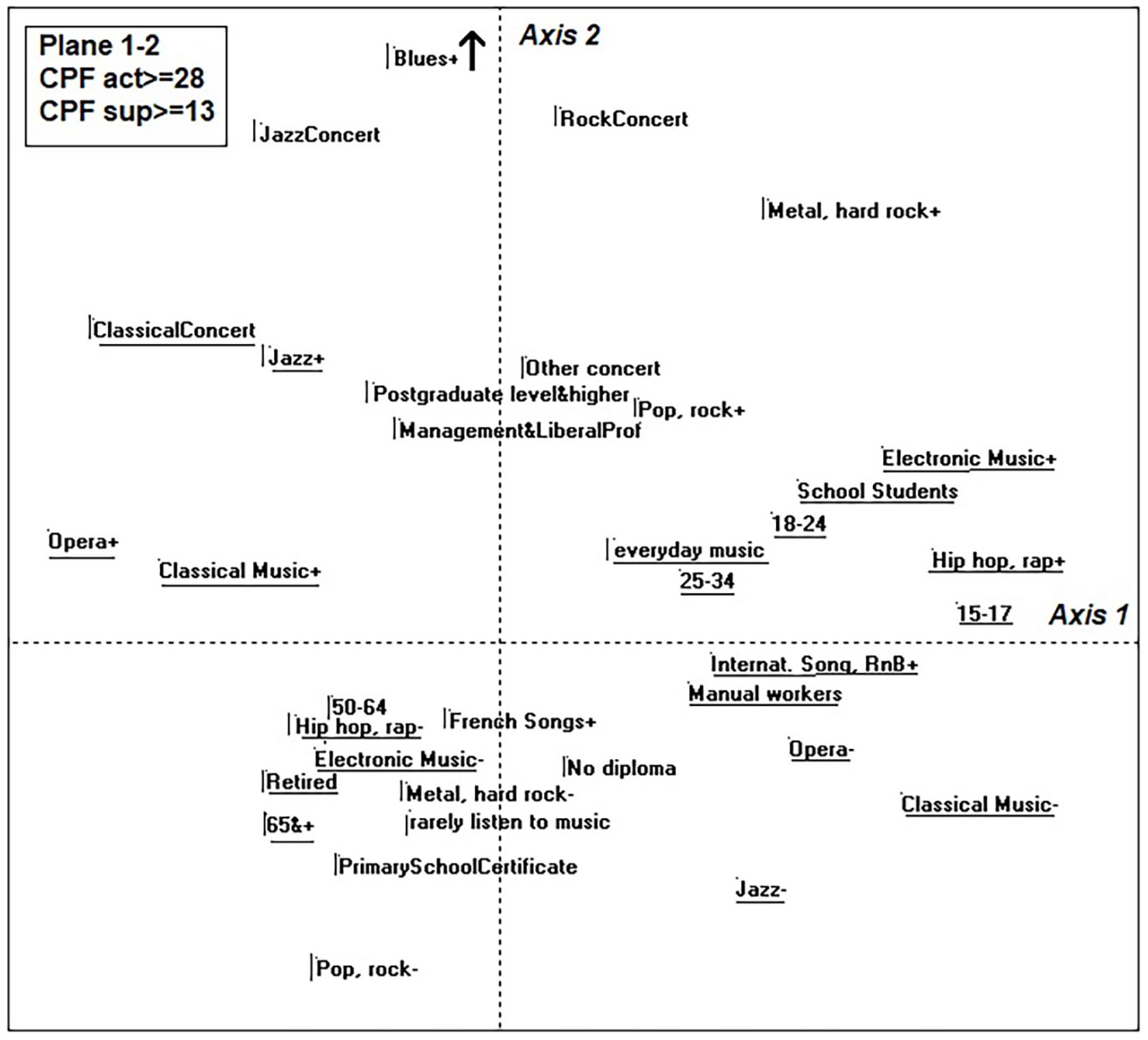
Figure 1 shows, on the negative side of the first factor, individuals who often listen to classical music as well as opera and jazz, who reject hip-hop and electronic music, and who have attended a classical music concert. The modalities of the supplementary variables, which were examined using the same threshold, are the highest age categories: 50–64, 65 and over, and retired. These, then, are the likes and dislikes of older people. On the positive side of the first axis we find the exact opposite: what was rejected is accepted and vice versa. At this pole is a taste for hip-hop, electronic music, international varieties and rhythm & blues, and a rejection of jazz, opera and classical music. The supplementary variables are: 15–17, 18–24 and high-school/college students. The practices of this cluster are linked to younger categories. Overall, the first factor highlights two opposing poles: the tastes and rejections of older people and younger people.
Space of tastes in music – Plane diagram of Axis 1 and Axis 2.
The second factor, being a correction of the first factor, is easier to study factorially using only active modalities with a contribution to the factor (noted as CPF) higher than or equal to the average (28) and supplementary (illustrative) modalities with a CPF higher than or equal to 13. These modalities are underlined horizontally for the first factor and vertically for the second factor.
The pole reflecting the choices and rejections of older people (bottom left) is the only one that contributes to both factors: young music is rejected and there is occasional listening to French songs. This pole also reflects infrequent listening. Conversely, in the upper right-hand corner, the highest frequency of listening (‘every day or almost every day’) also contributes to both axes, with contributions from younger age groups (aged 15–34) and associated genres. The other diagonal shows an opposition between classical and jazz concerts, which contributes to both axes (top left), and, symmetrically, the rejection of jazz in the lower right quadrant. This second diagonal is linked to educational qualifications: high in the upper left and absent in the lower right.
Connections between likes and dislikes illustrate a ‘normative value’ of music for specific groups: the first demonstrates a taste for classical, world music and French songs, and a rejection of international songs, R&B, hip-hop, rap, electro, metal and hard rock; the second demonstrates a taste for hip-hop, rap, international songs, R&B, disco and funk, and a rejection of world music, opera, classical and jazz; the third demonstrates a taste for metal and hard rock, and a dislike of French songs. Other positive tastes are not adjacent to specific music genre dislikes.
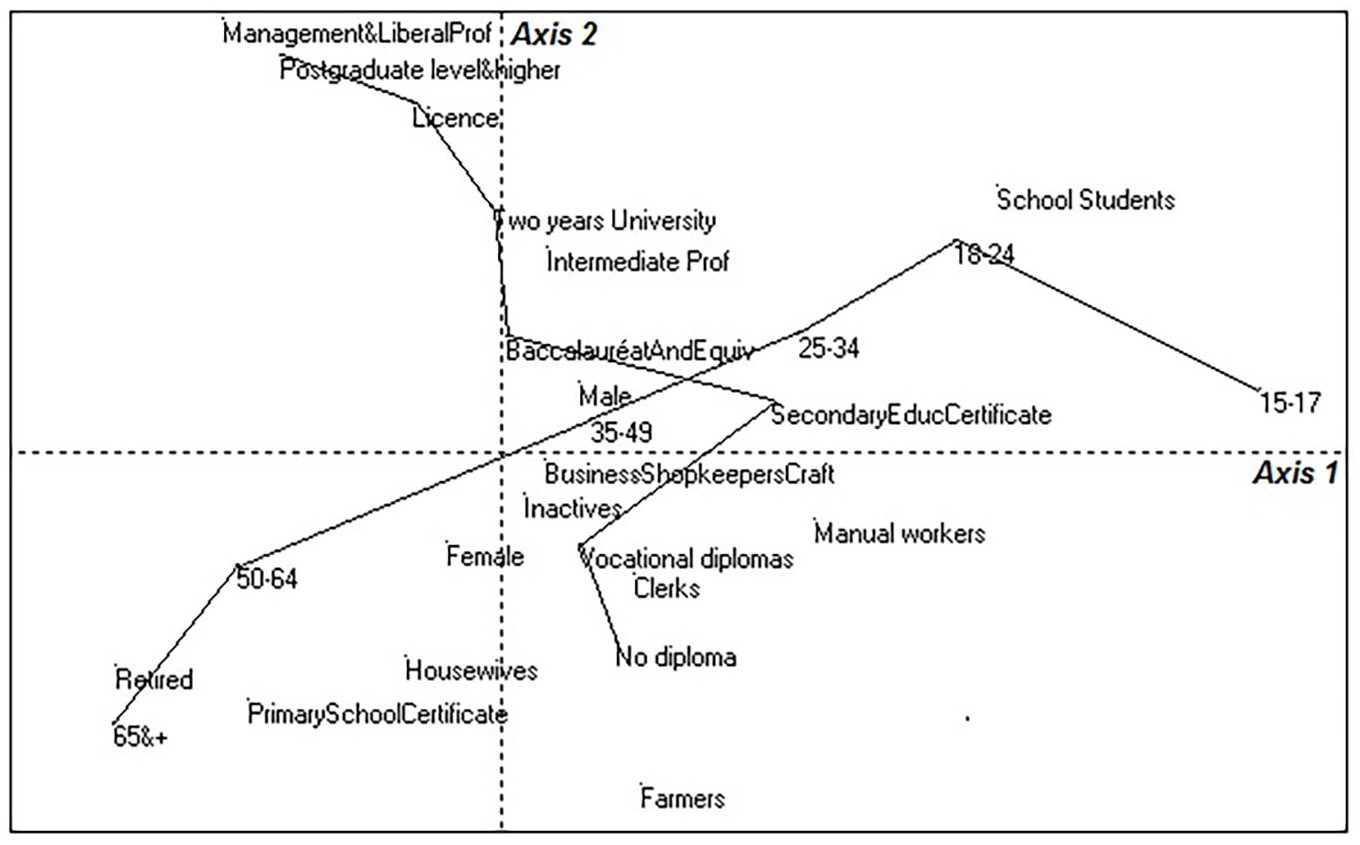
To take this further, a simplified graph (Figure 2) was produced. This represents all the supplementary socio-demographic variables, as well as the links between age and level of education (excluding the Primary School Certificate [CEP] for the oldest generation). This figure shows the orthogonality of the two dimensions of age and level of education, the first being related to Axis 1 and the second to Axis 2, but positioned on the diagonals of the graph.
Space of tastes in music – Supplementary socio-demographic variables – Simplified plane diagram of Axis 1 and Axis 2.
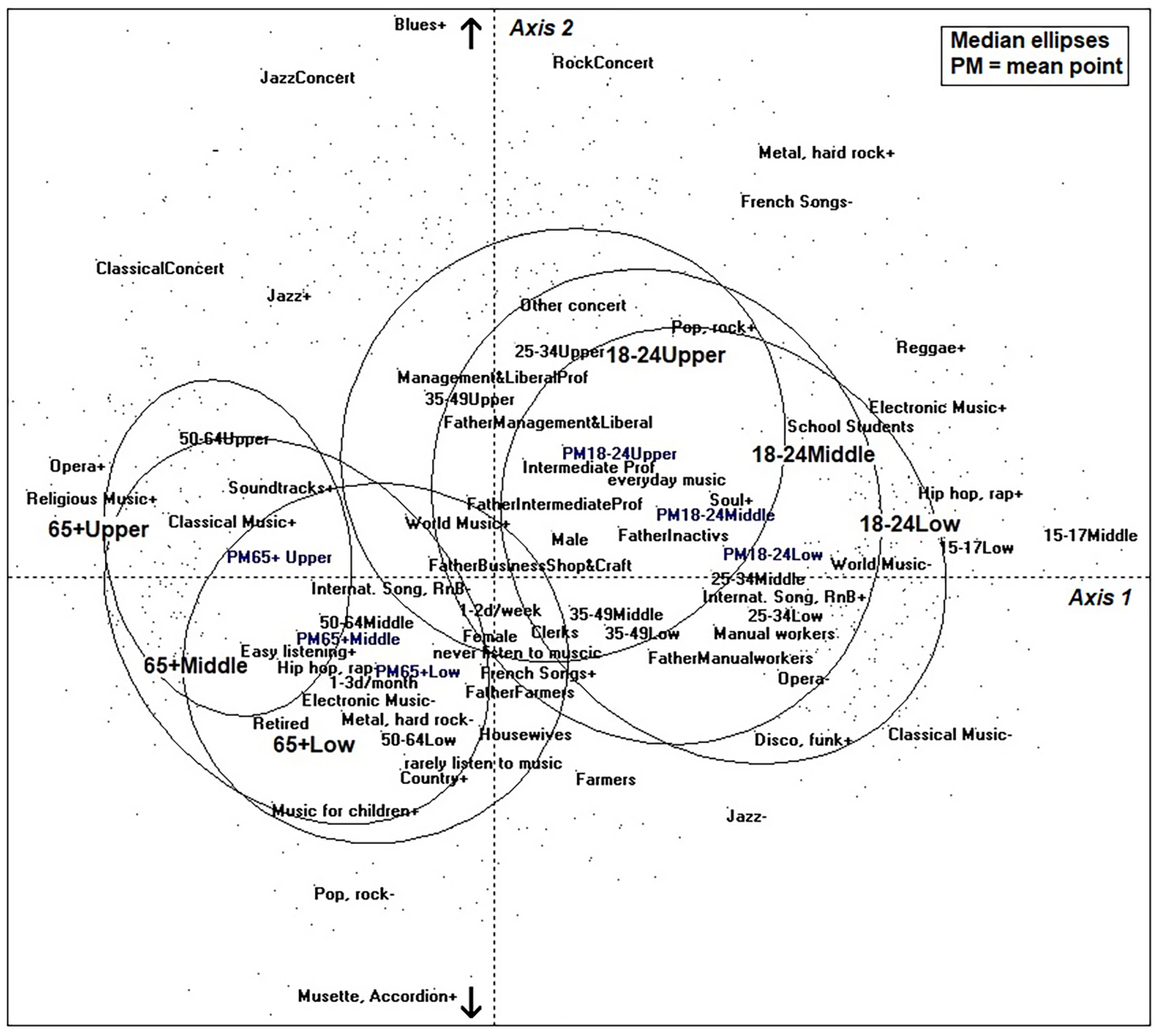
In order to see how these two variables fit together, one solution is to create a new supplementary variable that distinguishes age categories according to level of education, since gender does not play any role in the first two factors. For each age category we constructed three new educational modalities: ‘upper’ (baccalaureate and beyond), ‘middle’ (vocational diplomas [CAP/BEP/BAC/BP/BT]) and ‘low’ (Primary School Certificate [CEP], Junior Secondary Education Certificate [BEPC], or no qualifications). To visualize the effect of this new variable we took into account an individual’s universe by drawing ellipses on the factorial space to encompass a given proportion of individuals (Figure 3). The ellipse with a median concentration of 50% of the population was chosen. 8
Space of tastes in music – Plane diagram of Axis 1 and Axis 2 – Median ellipses.
Only the ellipses for the three levels of education of the 65-and-overs and the 18–24 year-olds were drawn (the youngest have not yet graduated). It is notable that tastes in music are not related to age or level of education, but to the intersection of the two. Both dimensions intervene: all highly educated age groups tend towards the top left. At this high level of education in a concert culture, we move from left to right (from older to younger) in the following order: classical music, jazz, rock, blues, metal and reggae. Conversely, people with lower levels of education reject the previous tastes in the case of the youngest, while the older groups replace them with infrequent or no listening. In conclusion, tastes in music depend primarily on age, but also on level of education. 9
Tastes in Movies
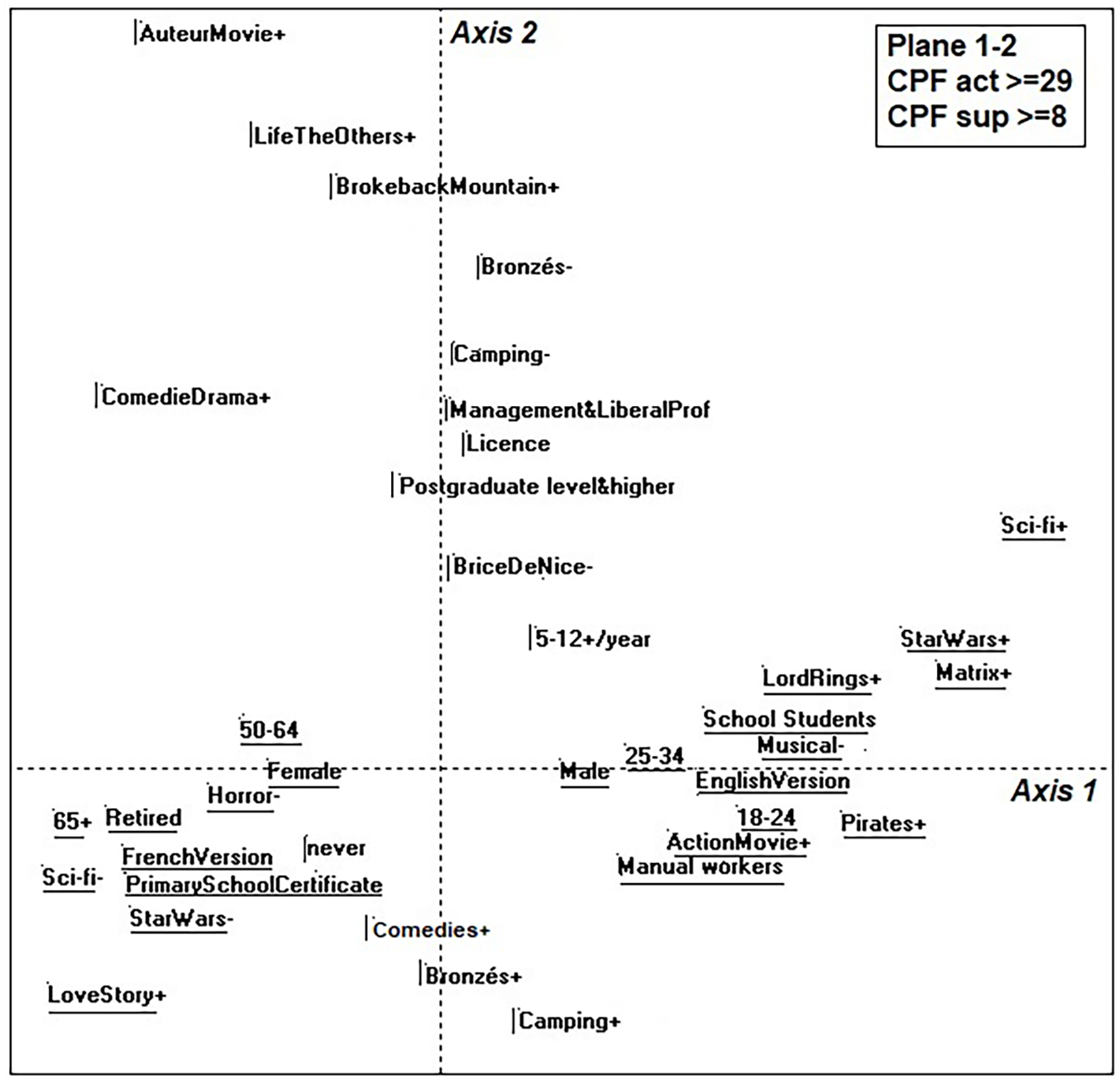
In order to understand the structuring of tastes in movies, the following questions were used as active modalities: ‘favorite movie genre’, ‘movie genre not seen because not liked’, ‘preferred movies’ (‘American movies’, ‘French movies’, ‘no preferences or other cases’), ‘particularly liked movies’ or ‘movies that you dislike’ (from a list of 14 movies). In addition, the following variable was used: ‘number of movies watched during the year’, and the following socio-demographic variables were used: gender, age, individual and father’s socio-occupational category and level of education (Figure 4).
Space of tastes in movies – Plane diagram of Axis 1 and Axis 2.
The plane of the first two factors forms the best possible summary of the data. The first two eigenvalues (V1 = 0.31; V2 = 0.24) are greater than 0.2, meaning that the relationship can be interpreted. The above-average contributions to the first factor on the negative side (1,000/62 active modalities i.e. 16.1 per thousand) are: ‘prefer French movies’, ‘dislike horror movies’ and ‘dislike sci-fi movies’, but ‘like romantic (love story) movies’, ‘like documentaries’ or ‘like no genre in particular’, ‘appreciate Titanic’, ‘do not want to watch Star Wars or Lord of the Rings’ and finally, the supplementary modality ‘have not been to the cinema over the last twelve months’. The supplementary socio-demographic modalities (with a threshold reduced to 8 per thousand) are: ‘retired’, ‘65 and over with lower or middle educational level’, 10 ‘50 to 64 with lower educational level’, ‘woman’, ‘housewife’ or ‘father owns a farm’. The negative side of the first factor is thus related to the highest ages and to the lower or middle levels of education; however, age, education and gender can interact. For age and level of education, as in the previous analysis, a crossover operation has been performed to make the factorial plane diagram easier to interpret.
For the positive side of the first factor, the higher than average contributions are: ‘prefers American movies’, ‘does not like musicals’, ‘does not like romantic movies’ or ‘does not like art-house movies’, ‘likes ‘sci-fi’, ‘likes horror’ or ‘likes action’ movies’; favorite movies were Star Wars, Matrix, Lord of the Rings, Pirates and Shrek. The supplementary modalities (threshold of 8 per thousand) are: ‘high-school/college students’, ‘18–24 years, medium education level’, ‘15–17 years, lower education level’ and ‘male’. The first factor therefore represents an opposition between young and old for the middle and lower levels of education.
The second factor, on the negative side (at the bottom) for the most popular active modalities, corresponds to: ‘prefers comedies’, ‘particularly liked Les Bronzés, Camping, Les Visiteurs, Asterix’, and ‘likes Lord of the Rings’. There are no supplementary contributory modalities above the threshold. On the positive side are the following active modalities (same contribution threshold): ‘prefers art-house movies and drama’, ‘especially likes The Lives of Others, Brokeback Mountain’, and ‘does not want to see Camping, Les Bronzés’. The associated supplementary variables are: ‘goes to the cinema more than once a month’, ‘postgraduate level and higher’, ‘first (bachelor’s) degree’, ‘aged 34–49’ and ‘aged 50–64 with higher educational level’, and the socio-professional categories ‘management and liberal professions’, and ‘father in management and liberal professions’.
In summary, if we look at the modalities that make the largest contribution, we find a triangular opposition: the most educated at the top prefer Auteur movies and dramatic comedies; they liked The Lives of Others and Brokeback Mountain, and did not like Les Bronzés, Camping or The Brice Man. The younger people on the right prefer action movies, sci-fi movies, and movies in their original language: they liked Star Wars, Matrix and The Lord of the Rings; they do not like musicals. These two poles often go to the cinema (5 to 12 times per year). The third pole is represented by older people with a low level of education who prefer French movies and comedies, and who do not like horror movies or science fiction. They loved Love Story, Les Bronzés and Camping, and did not like Star Wars.
The only slight difference between men and women is that women watch fewer movies than men (an average of 5.6 movies per year compared to 6.1 for men). Conversely, both men and women from all age groups with a high level of education are frequent watchers (women aged 65 and over watch more than men).
Figure 5 shows a triangular structure with a visible distinction between the age opposition for the first factor and the ‘cultured’ movie pole at the top. This result becomes clearer on examination of the median ellipses. By taking the age limits available for the three levels of education, we see that the three ellipses for each age category are on the left for the oldest respondents and on the right for the youngest (first factor age opposition), but that they overlap more closely at the ‘cultured’ pole of the second factor, as the level of education increases.
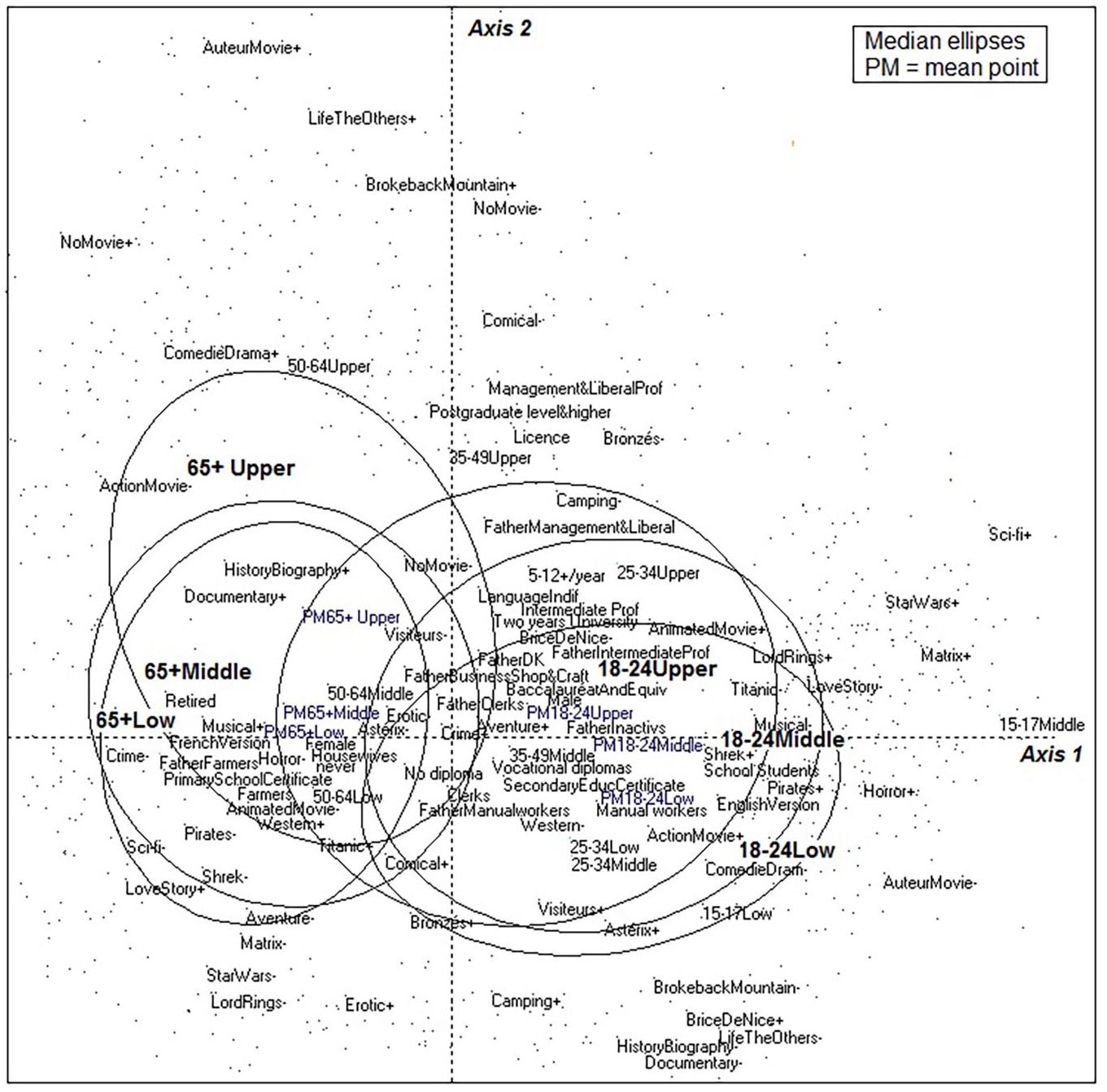
Tastes in movies – Plane diagram of Axis 1 and Axis 2 – Median ellipses.
Tastes in music and movies both reflect the age structure, which appears first but cannot be examined in isolation – only in conjunction with levels of education. Glevarec and Pinet (2013) have shown that level of education is the most contributory socio-demographic variable to Axis 1 of the space of French cultural practices, and age in the case of Axis 2. For tastes in music and movies, analysis shows that the priority of these variables is reversed, with age coming before level of education.
Discussion: Meaning of Age and Diploma – Knowledge and Cultural Generation
Our analysis of the fields of music and movies, and our critical feedback concerning Bourdieu’s interpretations of ‘dominant’ and ‘petit-bourgeois’ tastes, highlights the two axes of ‘structure’ (level of education) and ‘history’ (age and its generational value in cultural realms). With regards to the model of the volume and structure of economic and cultural capital advocated by Bourdieu, this is a sociological and critical reassessment of their primary structuring value. The interpretive model from Distinction neglects cultural history, namely the first dimension of the structuring of tastes by successive cultural periods (in music and cinema).
However, the structuring power of the level of education was retained. It refers in part to the differential mastery of specific competences in art. Structuring by level of education and age indicates a social and cultural differentiation that reflects similarities between the tastes of people born in the same historical and cultural context, which determine a dimension of cultural identity, and the mastery of specific forms of knowledge which interact with levels of education. For tastes in music, the dimension of specific knowledge is understood through classical music, and for tastes in movies, through art-house movies. In the case of contemporary classical music, Dorin (2016) demonstrates that its audience possesses knowledge gained from taking music lessons and from playing an instrument. This dimension of specific knowledge may be underpinned by the idea that the greater the age of a work of art, the more likely it ‘. . . demand[s] learning’ (Weber, 1980: 58). The dimension of specific knowledge is better understood through movie preferences such as the taste for ‘art-house movies’. Figure 6 and Figure 7 (in the Appendix) represent tastes in music and movies within a structuring approach that is no longer based on social position, but on cultural time (Glevarec, Nowak and Mahut, 2020).
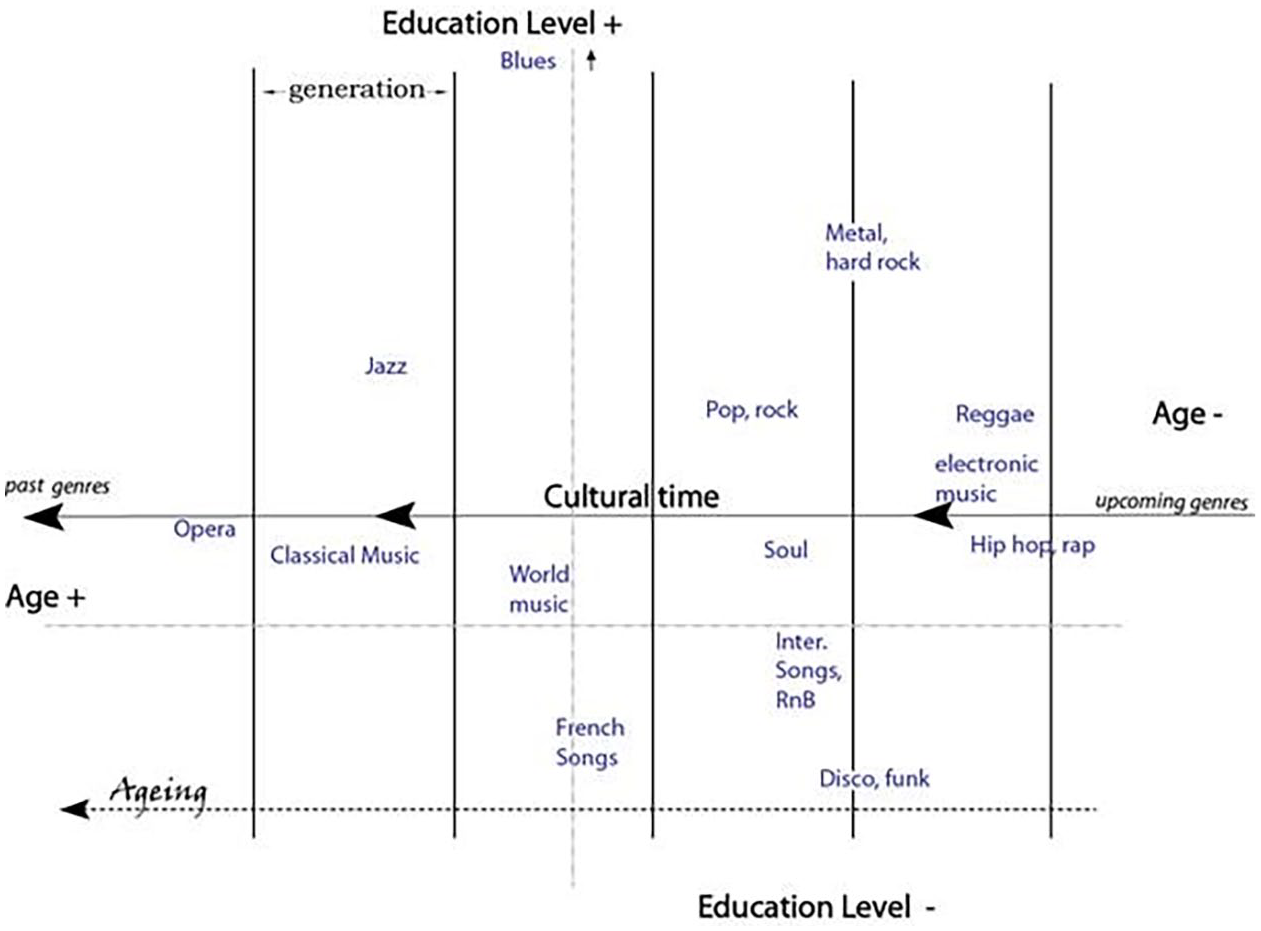
History and structure of tastes in music.
The age variable assumes five main meanings in cultural practices: first, it can display an elective affinity – in relation to the cycle of life – with cultural and social content; for example, music radio can offer content that relates to ‘youth problems’ (see Glevarec, 2005). This affinity is linked to the life cycles of individuals, such as youth, adolescence, adult youth, professional activities and retirement. Second, it can highlight a differentiation between age groups (i.e. ‘age relationships’): a practice hence has a differentiation value between recent generations and older generations, for example, when younger individuals speak of ‘old people’s music’ to designate what their parents listen to (see Glevarec, 2017). Third, age can highlight a historical (or cultural) generation. The historical generation corresponds to the frequentation of a body of work and values constituted at a certain time and in relation to the cultural offer at that time i.e. ‘tastes of our time’ (Bennett, 2013). It corresponds to socialization under specific historical conditions (Bloch, 1992; Mannheim, 1952). Thus, as Donnat writes: ‘in the musical field, habits and tastes acquired during youth often persist in adulthood’ (2009: 122–123). Lastly, age can highlight a ‘social or physical constraint’ with reference to time constraints and family responsibilities, and changes in health status (Reeves, 2016: 13): age again plays a role in the life cycle, and cultural practices are then determined, for example, by individuals’ everyday schedules or their physical capacities. Finally, it can highlight, in a particular sense, an accumulation of experiences or capital. Bourdieu proposes this definition of age as ‘social age’, or ‘herit-age’. Here age is equivalent to ‘seniority in cultural capital’. It is equivalent to a period of time that, for example, heritors obtain from their family.
In Figure 6, the first horizontal opposition – between ages (young and old) – is between generations of people who grew up in different musical environments, so there is an opposition between recent genres and older genres. The history of tastes is a movement from right to left; from upcoming genres to past genres (as all genres will one day become for their own generation of selected listeners). Here we advocate the ‘historical or cultural generation’ argument. However, the ‘elective affinity’ is also present. The cultural time and its corresponding cultural generation do not fully account for the affinity between genres and age groups, for example, more long-lasting genres, such as horror movies, can be appreciated by younger generations. It is critical that we add a dimension of content: genres are appreciated differently by different age categories because their content (character and theme) echoes the particular life cycles of these audiences too.
Conclusion: The History and Structure of Tastes
In certain analyses of cultural practices, variables and data are selected from an a priori model. To ‘uphold legitimacy’, as it were, some sociologists choose variables – income, educational and/or socio-professional category – and methods, based on multiple correspondence analysis from which they can derive a single descriptive axis of cultural tastes from an a priori correlation instead of observing the distribution. Such a methodology functions as an academic precept that does more to generate reality than reflect it. The privileged status granted to the first factor of a factorial method to establish a ‘scale of legitimacy’ and an ‘axis of distinction’, is not justified sociologically in terms of legitimacy, group norms and actual practices (relative to other practices). This diversification is better described by the modal distribution. Nor does the a priori choice to exclude age from these methods seem to be justified. It turns out that this variable, along with its effects when cross-tabulated with education, enables us to correctly describe the space of tastes in music and movies. Tastes and practices, e.g. classical music for certain graduates, rap among young working-class people, and so on should be described without explaining them in terms of legitimacy (for the dominants) or position (for the dominated) in the name of a determination theory based on capital owned; this theory fails to explain why a given generation listens to jazz rather than electronic music, since age (which, in the field of music, corresponds to generation) is the primary variable.
With regard to Bourdieu’s theory, our theoretical conclusion is that in the 1970s, 11 cultural tastes were probably not structured firstly according to the volume of capital (economic and cultural) and secondly according to the composition of these two types of capital, but rather according to level of education on the one hand and age on the other (in 2008, for tastes in music and movie, age takes precedence). More specifically, cultural tastes are linked to an individual’s cultural formation and cultural history; they are the product of the competences individuals possess and the cultural generation to which they belong: they are cognitive and cultural. The purpose of this article has been to suggest that we should understand level of education as cultural knowledge and age as cultural generation.
Footnotes
Appendix
Funding
The authors received no financial support for the research, authorship, and/or publication of this article.
