




Abstract
Ways of communicating effectively in spoken English, using technology, in a virtual globalized context have received little attention from applied linguists. The role of language in synchronous computer-mediated discourse (CMD) used in virtual teamwork is now emerging as a key area of research concern in business management and information technology disciplines. This article uses linguistic frameworks, most particularly critical discourse analysis (CDA) and systemic functional linguistics (SFL), in particular appraisal analysis, to demonstrate how interpersonal meanings may create dominance, power and solidarity within a sample of a virtual team management meetings. Focusing on one manager case study, we investigate how language is used, consciously or unconsciously, to dominate and close down discussion with his colleagues. We first present the key findings from a turn-taking analysis and then present, through the application of appraisal analysis, how this manager opens or contracts the space available for others to participate. By revealing how power and control unfold through this analysis, the findings may lead to an enhanced self-awareness among all members in virtual teams and reveal how language plays a crucial role in engaging members during a meeting, or in this case, disengaging them.
Introduction
Virtual teams can be defined as geographically dispersed work teams enabled by technologies allowing for both synchronous and asynchronous communication. Globalized workplaces increasingly communicate virtually using computer-mediated discourse (CMD) to get their work done, and while many virtual teams are located in the same country, many teams are located across the world where there is a diversity of languages and cultures. It is estimated in one recent US study (RW3 CultureWizard, 2010) that 80% of the 3500 respondents in the United States were working with teams across the continent and across the globe where ‘virtual teams are rapidly becoming a must, not an alternative’ (Tavcar et al., 2005). Workplaces have moved rapidly from being co-located to virtual in a very short period of time, mostly for cost and efficiency purposes, but what are the implications for communication when working virtually? The purpose of this article is to explore how power is distributed within a small number of virtual team meetings (VTMs) by a focus on one particular case study.
This article is concerned with how CMD, with specific reference to teleconferencing, is used in this multinational company (MNC), where English is both the lingua franca of the workplace and the first language (L1) for the on-shore managers, but its off-shore workforce are, in the main, second language (L2) speakers of English. The banking work has been off-shored and outsourced to Asian destinations and, in this study, to India. How is language used to get work done in this virtual team context? English has become the language of international business over the last decade (see e.g. Bargiela-Chiappini et al., 2013; Charles and Marschan-Piekkari, 2002). Given that English will, for the most part, be employees’ second language and that they will need to communicate virtually, the risk of miscommunication is high.
Although some studies have been conducted into the English language communication needs of L2 speakers of English working with L1 customers on the phone in the off-shore call centres in India and the Philippines (Forey, 2014; Forey and Lam, 2012; Forey and Lockwood, 2007; Friginal, 2007; Hood and Forey, 2008), few studies have investigated the communication challenges of MNCs conducting VTMs where managers and teams interact across the globe, using English as the lingua franca. Businesses often bemoan reduced productivity of virtual team work when compared to co-located teams, and complain that technology, poor leadership, poor meeting management skills and problematic communication skills, including factors related to intercultural miscommunication, all have a part to play (see e.g. Hertel et al., 2005; Meyer, 2010; Paulus et al., 2011).
Background to the study
This study takes place in an on-shore financial institution in Australia, which, for the purposes of confidentiality, we will call Moneylink. This company has been pursuing a strategy of becoming a key player in Asia, and since 2002 it has established an off-shore workforce of over 500 staff in India alone, with over 300 high-level information technology (IT) jobs sent there from Australia and New Zealand. Other offices have been opening progressively in other parts of India, Singapore, Hong Kong, China and Vietnam where they do a variety of jobs such as sales and marketing, accounting, IT and human resource (HR) development and a range of other back office functions.
Like other virtual workplaces, the different types of work at Moneylink suggest a range of virtual meeting types. For example, in China, where routine back office work has been sent, the virtual meetings tend to be highly structured and directive, where target deadlines are checked and routine information is exchanged. These highly directive meetings tend to be hierarchical in nature, where the on-shore manager sets the agenda, controls the meetings and delegates routine tasks on a regular basis. However, at the other end of the continuum, the IT virtual meetings between on-shore managers and Indian IT support engineers are meant to be highly collaborative problem-solving meetings, where all members of the team are encouraged to participate in a highly creative and interactive way. It is now a well-known fact that IT support engineers in India are of a very high calibre compared to their counterparts in the West (see e.g. Friedman, 2005; Nickerson, 2010) and come at a fraction of the cost. This fact, of course, may infuse a political agenda into the virtual exchange where on-shore professional engineers may be reluctant to share their knowledge with their Indian colleagues for fear of on-shore redundancies at Moneylink, and specifically, the loss of their own jobs.
Literature review
Studies completed in the business and organizational management literature over the last two decades have investigated communication difficulties in virtual teams and have looked at factors such as technology and communication (Klitmoller and Lauring, 2012), leadership and trust (Kayworth and Leidner, 2002), management skills and leadership skills (Chutnik and Grzesik, 2009), project complexity (Hertel et al., 2005), comparisons between virtual and co-located work teams (Daim et al., 2012) and cultural factors (Dekker et al., 2008; Holden, 2002) in trying to determine the precise nature of the problems. While there has been acknowledgement that linguistic studies may hold a key to the causes of communication difficulties, applied linguistic studies are almost non-existent.
Interestingly, there have been a number of recent studies conducted by business, technology and science experts exploring the impact of language on the effectiveness of virtual workplace communication, and in particular the centrality of language in managing work teams well (see e.g. Barner-Rasmussen et al., 2014; Hinds et al., 2014). Hinds et al. argue for the centrality of language in ascertaining power and identity issues when working virtually. They point out, Our findings extend theory on subgroup dynamics in global teams by adding language as a potential faultline dimension, showing how power struggles activated faultlines and were, in turn, reinforced by them and documenting emotion-regulation processes triggered by sub grouping and enacted through language-related choices and behaviours. (Hinds et al., 2014: 1)
Moreover, Barner-Rasmussen et al. (2014) reveal how the linguistic resources facilitate effective work practices and knowledge transfer and that language is used to ‘boundary span’ effectively. The term ‘boundary span’ is used to refer to four functions: exchanging, linking, facilitating and intervening, that is, linking devices in the virtual world that connect one site with another in a global and virtual work context. Their study shows that only ‘cultural skills, and language skills are critical for performing the most demanding functions’ (Barner-Rasmussen et al., 2014: 886). From a critical discourse analysis (CDA) and systemic functional linguistics (SFL) perspective, ‘language is culture’ and ‘culture is language’ (Martin and Rose, 2007). Welch et al. (2005) assert that language is almost the essence of international business. It is sometimes awkward, sometimes impenetrable, sometimes an irritating reminder of what may be involved in crossing foreign cultures and in managing in a cross-cultural environment. (p. 11)
Within the business field, they request more studies that explore the language of business management discourse exchanges that can be used to reveal power and solidarity relationships. Darics (2010) points out that ‘the language use within virtual teams has only received scant attention’ (p. 130). Klitmoller and Lauring (2012) adds that it is surprising that [only little] research exists on language in virtual settings since variations in language could explain why some global teams using rich media for communication might not have a high degree of knowledge-sharing effectiveness. Also language variations and communication in English as a second language is more often the case than not in virtual teams. (p. 3)
This study attempts to address this current gap by investigating the relationship between choices in a text and the social activity evident in data from VTMs, collected from an Australian MNC with overseas collaborative work teams in Asia. First, we examine how on-shore managers chair their meetings through an analysis of the control of ‘turn-taking’ (see Schegloff, 2002) and the time spent talking during these meeting. We then focus on one VTM using tools from SFL, notably ‘appraisal analysis’ (Martin and White, 2005), to examine the dialogic space created by the manager. This analysis reveals how the dominance of the meeting and language choices made by the manager close down opportunities for collaborative exchange, thus resulting in feelings of disengagement and disempowerment within the team as well as frustration and disappointment for the manager.
Insights from CDA (see e.g. Blommaert and Bulcaen, 2000; Fairclough, 1992; Wodak, 1995, 1996) have all investigated the intricate relationship between power and language and have sought to analyse ‘opaque as well as transparent structural relationships of dominance, discrimination, power and control as manifested in language’ (Wodak, 1995: 204). For example, Wodak et al. (2011) and, more recently, Lazaro-Salazar et al. (2015) have identified discursive features used by the chair of a meeting to control and direct the discussion. In addition, Holmes and Chiles (2010) have explored specifically how questions may be used as a linguistic controlling device. Many within CDA borrow from SFL in order to unpack the meanings made through the linguistic choices (see Halliday and Matthiessen, 2014 for an introduction to SFL). How choices in communication in the workplace influence getting people to do their jobs has been the focus of numerous studies (see e.g. Cameron, 2000; Duchene and Heller, 2012; Heller, 2003; 2010; Iedema and Wodak, 1999; Rhodes et al., 2008; Vine, 2004). Such studies reveal how managerial requirements impact the construction of employee identities, through language use, at work ‘where workers across a variety of sites are being confronted with having to renegotiate their knowing, their doing, and their work identity’ (Iedema and Sheeres, 2003: 316). Power therefore is seen as the ‘control exercised by one group or organization over the action and/or minds of another group, thus limiting the freedom of actions of the others’ (Van Dijk, 1996: 84).
In this study, which investigates virtual meetings, we focus on the individual’s construction of power. In particular, we examine the language used by the Chair, who is a native English-speaking on-shore manager, and we study the discursive realization of power when he is communicating, and collaborating, with his Indian colleagues and two Australian managers.
SFL provides a theoretical framework to understand how choices in language are related to the social activity, and vice versa, how the social activity influences the choices of language that we make (Halliday and Matthiessen, 2014). SFL’s position is that language simultaneously carries three key functions: to represent the world as we see it (field/ideational); to construct a relationship between the speaker/writer and the listener/reader (tenor/interpersonal); and to organize the message through the channel of the chosen communication (mode/textual). Field, tenor and mode are the register variables; they influence the choice of language and the language reflects the field, tenor and mode. The ideational, interpersonal and textual features are referred to as the ‘meta-functions’, which describes the choices within the clause. In what follows, we focus on two main factors, the mode and the tenor.
The mode, a telephonic multi-party voice-only meeting, influences how the text unfolds and is constructed. The mode therefore influences other choices in the text, and in particular we focus on the tenor, the interpersonal nature of the teleconference, as we are interested in deconstructing how relationships are developed between the speakers. We argue that by using applied linguistic frameworks in the analysis of authentic transcripts the unfolding of the text, that is, the exchange structure and the power dynamics, can be revealed and that such dynamics may ultimately contribute positively or negatively to communication success and, ultimately, to how the work is done.
When focusing on the complete text of the virtual meeting, a number of key features have been identified as indicating power. For example, who controls the flow of the conversation; who controls who takes the next turn, referred to as turn-taking (Schegloff, 2002); the amount of time one speaker talks during an interaction compared to others, and the choice of mood and speech function. Within the clause there are three choices of mood, that is, the choice of interrogatives (questions, e.g. who is on-line?), imperatives (commands, e.g. introduce yourself) and declaratives (statements, e.g. I’ll do a quick introduction) (for a detailed discussion of mood and speech function, see Eggins and Slade, 1997/2006; Forey and Lam, 2012; Halliday and Matthiessen, 2014). To give an example, a boss might say politely to his subordinate I’d appreciate it // if you could answer me immediately. Grammatically this is seen as two declarative clauses (// identifies the clause boundary) (Forey and Lam, 2012); however, in reality, the boss is giving a command answer me immediately. Therefore, the speech function of this turn would be classified as ‘commanding information’. Other features which have been identified as indicating power are the use of vocatives (the names used, e.g. Brian or Mr Smith) (Hood, 2010), the use of expletive language (see Martin and White, 2005), interruption and overlapping someone when they are speaking (Schegloff, 2002), voice quality (Van Leeuwen, 1999; Wan, 2010), and a range of non-verbal language such as body language, gesture, word stress and intonation.
Method
This study is the result of data collected and analysed as part of a large-scale training needs analysis (TNA) carried out in Moneylink for the purposes of designing a course to assist on-shore managers to better communicate and manage their virtual teams across Australia and Asia. Access was given to live meetings and key stakeholders for the purpose of designing the two-day programme on virtual team communication. It was agreed at the time of the TNA that data could be used for research purposes as long as it was ‘scrubbed’ and the anonymity of the company and its employees would be ensured.
As part of this needs analysis, six VTMs were recorded and then transcribed for linguistic analysis. Transcriptions were analysed using an open-source multimedia annotation software ELAN (Wittenburg et al., 2006) to quantify and visualize turn shifts, duration and overlaps in the meetings. First, we briefly explore the similarities and differences in the turn allocation and amount of time used by on-shore managers. We then examine in depth, using appraisal analysis, one of the meeting transcripts to see how power and control are revealed in the language choices made by one particular on-shore manager, who for the purposes of this study is called Miles.
Findings and discussion
In the TNA survey conducted for Moneylink those involved in the off-shore side of the business reported feeling marginalized and disempowered. For example, during interviews with the off-shore participants involved in the meetings, they reported a certain degree of frustration with the problematic level of management and inclusion in the meetings. An Operational Team Manager (India), who had spent a number of years working for Moneylink in Australia, reported in one of the interviews, I worked as part of a very collaborative team on-shore, but now that I am back in India the approach is very directive and top down … The new regional strategy also means job losses on-shore and managers have smaller teams which they want to protect … so they just don’t want to collaborate and cooperate that much.
And an Operational Manager (Singapore) stated that On-shore managers are very good at ‘acculturalisation’ management, that is getting their teams to think and act as on-shore, but this is not the point in virtual team management. No one group of managers should feel privileged in that role. I know a lot more about how to handle my team members out of Singapore … I’ve been doing it all my professional life. Maybe there is a great deal they can learn from us as ‘global citizens’ where we’re used to communicating all over the place.
The feedback from these two operational managers is representative of the general dissatisfaction felt by many of off-shore parties involved in the virtual teams in Moneylink. From the transcribed six teleconference meetings with six different managers, it appears that the on-shore meeting managers (M) tend to dominate the talk as well as control the turns and the distribution of time, as shown in the findings presented in Table 1.
Average length of meeting, speech time and turns taken by the manager.

A very broad indicator of power is length of time spent talking and who dominates the turn-taking within a group interaction. According to research into turn-taking (see Schegloff, 2002), there are two conventional forms of the allocation of turns; the first is that the person speaking nominates the next speaker by naming the next speaker or asking a question. If no speaker is named or asked a direct question, then the second option is for a speaker to self-select to take the floor; this option is indicated in the last column of Table 1.
As also shown in Table 1, we can see the total meeting times varied from the longest (Miles) at 42.33 minutes to the shortest (Aaron) at 16.22 minutes. What is revealing, however, is the relative amount of time each manager used as talk time, with Manfred using 86.40% of his meeting time followed by Miles who used 66%. While all six managers claimed to be collaboratively working with teams on a range of IT engineering and financial product development, as well as one working with a dispersed learning and development team, the general pattern of exchange appears to be highly centred around and driven by the managers, with the possible exception of Aaron (although his meeting was very short). Miles’ meeting is selected for a more in-depth analysis not only because he had an overall and relatively high level of speaking time, but also because a large number of Miles’ turns were self-selecting and long in duration. We were therefore curious to find out what was actually going on, in a linguistic sense, in his meeting.
Miles’ team comprised members who were all either accounting or IT professionals and who were collaboratively developing a new accounting software package for Moneylink, so our (and his) expectation was that this should be a highly interactive and collaborative type of virtual meeting. Miles is a Caucasian Australian male in his late 30s and is very motivated to work harmoniously and productively with this team, although he admits he has had problems in getting people to contribute to the meetings. He has actively sought assistance with this problem and this recording was part of a pre-training requirement for the Moneylink course called ‘Virtual Team Management’, which he opted to join in its pilot version.
Let us now further contextualize Miles’ meeting analysed for the purposes of this article. This meeting according to Miles is meant to be highly collaborative and involves a team of support engineers in India and on-shore managers and IT engineering specialists in two Australian cities working with their off-shore counterparts on the development of a new global software accounting package. The project had been going for a number of months, so the team members were familiar with each other; the team meets on a regular basis to update progress, problem-solve and brainstorm ideas. Miles reported that he tries to be collaborative and embrace the diverse groups he works with; however, he does not always feel successful at this. There are eight team members, including Miles (MS1) with Matt (MS5) and MS3 (Sam) in the same city office sitting with Miles, and Tom (M7) sitting in another Australian city office on-shore. The other team members are all Indian IT professionals sitting in the off-shore India office. This meeting was a regular catch-up meeting with the team during which Miles wanted to discuss how greater efficiencies might be achieved in the project. Miles reports at the beginning of the meeting on a leadership training event he attended with very senior Moneylink managers present (notably Brian and Fred). It was revealed in the TNA senior management interviews that this initiative was part of a multiple approach to encourage on-shore managers to be more reflective about their leadership skills and how their styles may be impacting virtual team inefficiencies and miscommunication. Miles then attempts to discuss how greater project efficiency may be achieved. The turn-taking and time of talk distribution found in Miles’ meeting are shown in Table 2.
Distribution of time throughout the teleconference interaction.

As shown in Table 2, in total there are 195 turns (a turn refers to each time the speaker participates in the interaction) and the total time for the teleconference is 40 minutes and 12 seconds. The speaking time taken by the managers ranged from 0.5%, with speaker MS8 rarely making a sound, to Miles speaking for 66% of the time. This high percentage is also reflected in the total turns taken by the on-shore managers; again Miles dominates the turn-taking by capturing a little under half of the turns, 44.5%, and speaking for 20 seconds on average for each of his 85 turns. The category ‘unspecified’ is the third most prominent category; the turns and speakers included in this category are difficult to identify as all of the participants were male, and in such a multilogue sometimes it is difficult to identify exactly who is speaking. It is possible that in such a diverse teleconference with eight speakers some of the other participants perhaps find it difficult to identify who is speaking at a particular point in the teleconference.
As demonstrated in the analysis, Miles dominates the talk and the second dominant speaker is MS5 (Matt) who talks for nearly a quarter of the time (22.5%) throughout the teleconference. Notably, MS7 (Tom) who is sitting in another on-shore Australian office, speaks for 4 minutes 31 seconds within 11 turns, and has the second highest average time per turn, of 25 seconds. Five of the eight in the meeting speak for 1.6% or less of the time, in three or less turns. This analysis paints a general picture of the on-shore managers Miles, Tom and Richard controlling the meeting, almost to the exclusion of other virtual team members, particularly those in India, Sam, Rajeev, Madhav (MS2, 3 and 4).
The virtual meeting appeared to be dominated by a minority of speakers and lacked collaboration, which was one of the main objectives of the meeting. As the manager of the meeting, it is expected that Miles will have a large number of turns, but in doing so, he perhaps unintentionally limits and controls the opportunity for others to participate. There are only two places where Miles selects the next speaker via the question, for example, Matt [MS5]and I were talking about this this morning, broadened across the whole of the online stack, I think, Tom [MS7]?
Frequently, Miles asks general questions (rhetorical and phatic type) to the team, such as anyone got questions? How are you going? or so you don’t know what’s coming and your trying to get stuff ready, how do you do it? In some cases, the questions are purely a confirmation of information Miles has already given. As shown in Example 1, Miles summarizes the changes for improved efficiency that are underway, and notes the praise they received from another internal Moneylink team (IB guys), and simply asks Tom to confirm this summary through a question: (1) Miles: […] So one of the things that the AB guys like and, and :::: which is, as Matt and I Manager were talking about this this morning, broadened across the whole of the online stack, I think, Tom? Tom (MS5): Uh:::: Yes with the exception of [name] Miles (Manager): Yeah so :: across the broader online […]
In Example 1 the turn is given to Tom, but only for a short response, a confirmation. Miles then continues to talk over a much longer turn. There is only one example when one of the other speakers asks someone other than Miles a question. With the exclusion of this question, all the other questions are controlled by Miles, and they tend to be ‘closed’ questions, including question tags, which function as a self-confirmation, or questions where only a short confirmation response is given, as in Example 1. The first principle of successful turn-taking, that the current speaker names the next speaker through a question or by naming that person, rarely occurs, and when questions are used to pass the turn to another, these questions are predominantly controlled and contracted by Miles. The specific pragmatic functions of Miles’ questions are not the focus of this article; however, this would be a promising area for further research and would build on existing work (Holmes and Chiles, 2010) in exploring how questions can be used as a controlling device in the workplace.
The linguistic analytical framework for SFL – appraisal analysis
The number and nature of turn-taking as well as the length of talk time are simple features identifiable in the text that can indicate dominance and power. However, understanding the subtle meanings made in a text, the functional ‘soft-skills’ of manager talk, requires a more detailed investigation of the language choices made. Appraisal analysis (Martin and White, 2005) provides a framework that enables insights into the tenor and discourse semantics developed throughout a text. Appraisal analysis can shed light on how a text ‘unfolds dynamically to engage us, to get us on side – not with one appeal, but through a spectrum of manoeuvres that work themselves out phase by phase’ (Martin and Rose, 2007: 56). It is informed by SFL where language is seen as a system of linguistic choice and not a set of rules. Appraisal analysis focuses specifically on the interpersonal meta-function in SFL and the nature of meaning making, that is, how we relate to others, how we position ourselves and how we position others. Martin and White (2005) introduce an analytical framework to understand the evaluative position we are constructing through three domains – attitude, graduation and engagement. We can analyse a text with respect to how we feel, how we value the things around us and how we judge people’s character or behaviour, which we refer to as attitude; how we increase the volume or intensity of what we want to say, which is categorized as graduation; and how we develop solidarity with others, which we refer to as engagement. This last aspect of appraisal, namely engagement, is highly relevant to this study where participants appear to be aligning, or being marginalized, in the meeting.
Martin and White (2005) propose the main choices within engagement, as shown in Figure 1, that either contract or expand the space to engage with others.
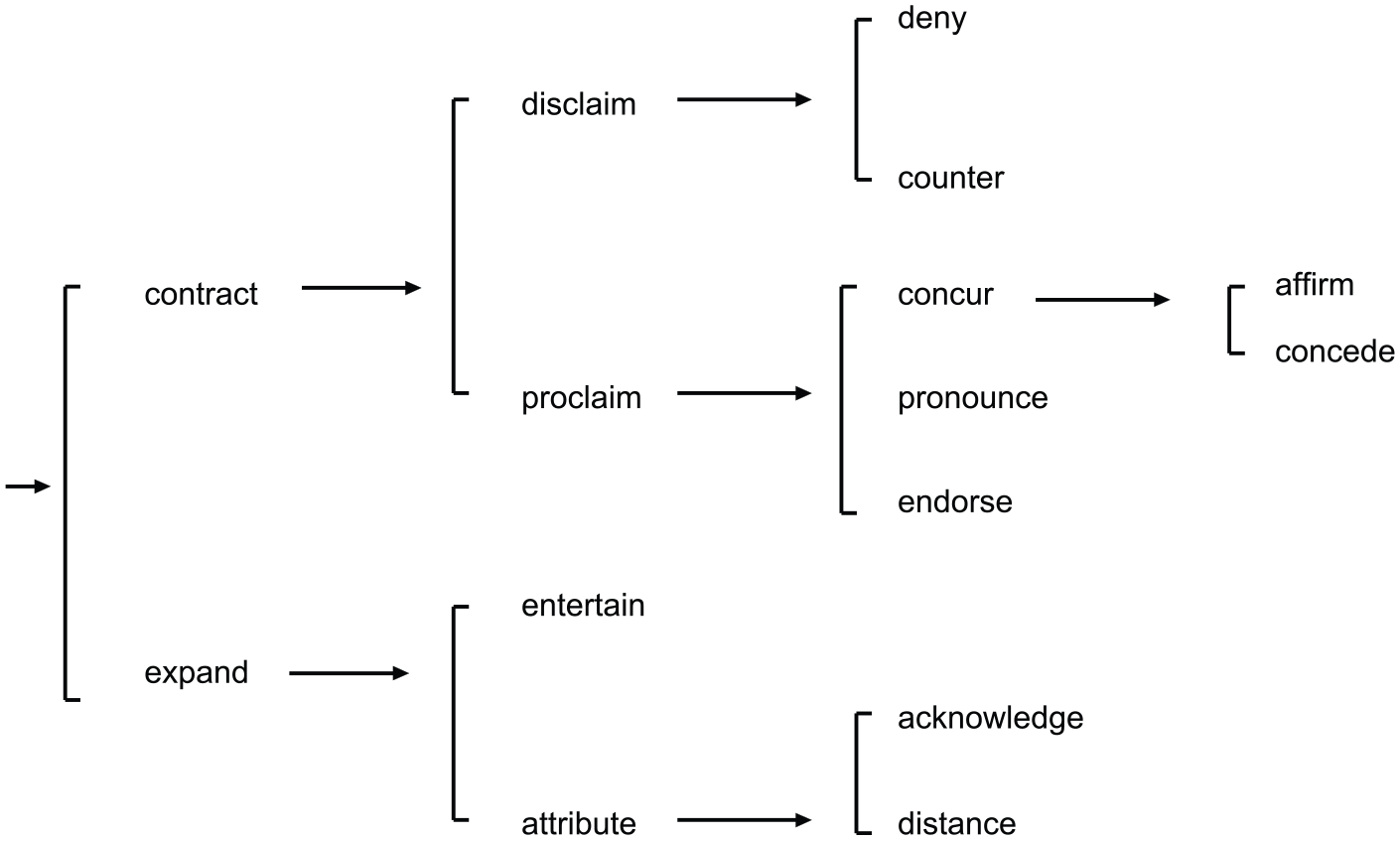
The engagement system (Martin and White, 2005: 134).
As pointed out by Martin and White (2005), there is the potential that one speaker may directly limit the space that develops the dialogic co-construction of a text. This is referred to as ‘contract’, as opposed to ‘expand’, and as shown earlier provides a space for alternative positions and the co-involvement of others in the dialogic development of a text. Contract has two main sub-categories – disclaim or proclaim; both of these deny other voices by excluding certain dialogical alternatives.
In the following discussion we will focus on how Miles contracts the space at times, through the use of ‘proclaim’, when it might be possible to be more inclusive and expand the space for dialogue. Martin and White (2005) identify three sub-types of proclaim – concur, pronounce and endorse. ‘Concur’ refers to the choice of language that attunes the interlocutor with the speaker’s own position, that is, a language choice which ‘overtly announce[s] the addresser as agreeing with or having the same knowledge as some projected partner’ (Martin and White, 2005: 122). In the first turn after the ‘roll call’, Miles establishes his position and demonstrates a pattern that we often find in his talk when he states ‘so one of the things here is we need to work out how we can leverage each other’s um time and capacity; to uh: all learn from each other’. Miles here appears to be establishing a position where collaboration is key and working with each other is valued – ‘all learn from each other’, ‘need to … leverage each other’s time’ – and yet we do not hear from the others with respect to this point or other points later. Miles appears to independently identify and ‘concur’ what the group need is.
Proclaim can be used to ‘pronounce’ a position and includes ‘formulations which involve authorial emphases or explicit authorial interventions or interpolations’ (Martin and White, 2005: 127). For example, Miles says ‘we have worked out a standard way of doing it’; in this utterance, Miles is not asking for others’ opinions and appears to use his authorial voice, invoking the stance of the on-shore management, and thus choosing to use ‘we’. In other turns, throughout the interaction, Miles states explicit authorial voice as the manager: ‘I think from my experience …’, ‘I intend to finish this meeting in thirty minutes’, ‘what I ask for, that will be a big measure of success’, ‘one of the things I think we can do better is “change”’. In all of these statements, Miles is not seeking collaborative decision-making, rather he is establishing his institutional expectations, decisions, standards and expected behaviour.
Within the domain of ‘proclaim’ speakers can also ‘pronounce’ a position taking an authorial position which involves ‘authorial emphases or explicit authorial interventions or interpolations’ (Martin and White, 2005: 127). For example, Miles, when referring to one of the on-shore senior managers, said ‘he [senior manager] made it pretty blatantly clear that they should be talking to us and if they’re not, let him know and he’ll go and have a discussion’. Miles in this projecting clause – ‘he made it pretty blatantly clear’ – attributes the statement to a senior manager (he) and amplifies the importance of this statement through the choice of made it pretty blatantly clear to legitimize that another party should be in open discussion with his team, and if not, action needs to be taken. Miles often uses his seniors, in this instance Brian (Miles’ direct line-manager), to establish and endorse a shared understanding; for example, when establishing a future action Miles states ‘which means of course, what’s Brian gonna ask me to do, a lot of forward planning for him’. The use of ‘of course’ shares and establishes future actions. Thus, with a focus on language features that contract and deny the opening of dialogic space, we can identify areas that those in power can work towards improving.
Using this framework for the analysis, we can attest that further findings in the transcript of this meeting suggest that throughout, Miles appears to contract the linguistic space available through choices that proclaim, where the function of these choices is to ‘limit the choice of dialogistic alternatives in the ongoing colloquy’ (Martin and White, 2005). Miles tends to overtly announce that the members of the meeting agree with his position rather than ask for true opinions. At the beginning of the meeting, in his initial turn, Miles establishes his position and right to proclaim what action will be taken when he states ‘this is gonna be recorded so anyone have any objections let me know otherwise we’ll continue this way’. The statement appears to a ‘given’ position, no time is afforded for other members of the group to object and the decision is now assumed. This apparent lack of ‘wait time’ for members to respond to what appears to be a question, in fact functions as a command, and tends to occur frequently during the meeting. Again this pattern is established right at the beginning of the call, when he introduces a particular topic stating ‘anyone having any objections let me know’. At this point, Miles does not pause or directly ask members if they object or approve; almost in the same breath he continues with the meeting. Other examples include when he states ‘I’m going to finish this meeting in thirty minutes’ and ‘there’s two more minutes until the end of the day in Melbourne um::: what I’d like to jump to other business, a few things …’; these announcements are not negotiable, demonstrate control of time and decision-making, and no wait time is included in order to gain consensus.
A few turns later into the meeting, when Miles is reporting back on a workshop he and other managers had attended on leadership style, Miles appears to be making a hypothetical offer to his colleagues: ‘So if you find I’m not being people-oriented, tell me off’. At this point, Miles has other linguistic options which he could employ to open the discussion to discuss leadership styles, but he does not choose to do this. Rather he makes a bold statement about his own leadership style which he does not intend to change: (2) Miles: So if you find I’m not being people-oriented tell me off mhm:: one of the other things these do and it’s a similar thing from Myer’s Brigg which is another one of these uhrr styles they talk about what you do normally but then under stress how you behave uh:: to give you an idea under stress I’ll become a planner {giggles} so if you see me with lots of lists that means then you know there’s some things I’ve gotta get done … so that was one of my key things.
If we review Example 2, Miles points out that he focuses on getting the job done and may not be people-oriented enough. This may appear as if Miles is opening up space, providing insights about his leadership style; however, he is being very forthright about how his team should upwardly manage him. He seems to be pronouncing his position with respect to leadership and there is no space for negotiation or engagement. This raises questions concerning whether Miles is truly interested in finding out whether those that work with him would agree with his assessment of his leadership style, or whether the variation of leadership styles is a topic where space is provided in the meeting to discuss. When Miles states if you find I’m not being people-oriented tell me off, within this particular context where there are limited questions, overlaps, and there appears to be a general lack of feeling of solidarity between all in the meeting, it is perhaps highly unlikely that one of the team members will actually ‘tell Miles off’. Not once throughout the interaction do the team members disagree with Miles or give him any negative feedback about a position or point he has made and there appears to be general compliance. There are no questions, no wait time for a response, and perhaps rather than opening up, he is closing down the space. There is very little effort to engage others in any form of inclusion at this point.
In addition, in order to add weight to points he has put forward, Miles constantly proclaims, through the use of endorsement, some of the actions and decisions he wishes to raise, by projecting these ideas through the verbal or mental projection of two of the on-shore senior managers, Fred and Brian. Through such reported speech, or what we shall refer to as projecting clauses, reality is constructed through the voice or mental wishes of the senior managers to align and control behaviour and action. The examples in Table 3 are all taken from the transcript of Miles’ meeting.
Senior managers: projecting clauses.

Projecting clauses are often used as a sign of power, that is, that the action has been ratified and even requested by someone who has a higher status and the endorsement of this action can and should not be ignored (see Forey, 2009; Halliday and Matthiessen, 2014). Table 3 illustrates that the senior managers either heard, said or made it clear (through something they said or wrote), all verbal porcesses; or alternatively the senior managers’ mental capacity is used to realize action that is wanted, viewed, concerned, decided. Through all of these projecting clauses, the onus of responsibility moves from the direct line-manager, in this case Miles, to the senior managers, Fred or Brian, as a form of endorsement. At another level, Miles also endorses decisions and action by referring to how a project decision was arrived at through consultation with other members of the same city on-shore group of colleagues. For example, Miles chooses to vocalize some requests through shifting responsibility for decisions to include other parties rather than just his own decision, for example, Rob and I had a discussion; I don’t know what Pete thinks …; Rob and I talked about that this morning …; I’ve asked Rob to think about …. The choice to present points that need attending to through such projecting clauses strengthens the persuasive nature of the request. The action is not presented as a question, for example could we work out …, but rather Brian (our boss) wants us to work out …. The source of the proposition is mitigated through a request from a person in power and less negotiable for those who are being addressed or requested to take action. Interestingly, Miles does this at two levels by invoking the authority of both senior management and that of his on-shore team. The off-shore team no doubt feel marginalized in the meeting.
Through the uses of two key linguistic resources in this study (i.e. turn-taking and proclamations), we are able to shed light on how these linguistic choices close down the dialogic space in the virtual meeting. However, further studies using appraisal analysis of these texts may also reveal further evidence in the language used that empowers and disempowers certain groups of participants in the meetings.
Conclusion
This article has reported on exchanges in a VTM within a large MNC where collaborative knowledge-building and problem-solving are highly valued. The data collected as part of the TNA and program development for a Moneylink training course on virtual team communication strongly indicated that VTMs were not working well at this worksite. Off-shore colleagues complained of feeling disempowered and marginalized, while at the same time, the on-shore managers complained of a lack of participation from their Indian colleagues. We chose to analyse the linguistic patterns using data from the six authentic and transcribed exchanges from this workplace using applied linguistic frameworks, namely turn-taking and appraisal analysis, with one of these used for an in-depth exchange analysis. Patterns of domination and control by the on-shore managers and off-shore team members were revealed in the high number of turns and large amount of time spent talking in the meetings, with little contribution from the team members in India. However, it is through the deeper analysis of Miles’ meeting that we were able to see how the specific linguistic choices, using his ‘proclamations’, revealed a closing down of communication. It is hard to ascertain whether such choices were made with intent, but this would seem unlikely given that Miles acknowledged both before and after the pilot training event that he would like to enhance the active participation of all his team members, and so volunteered to be part of this first group of on-shore managers to complete the training. Feeding back the impact of his language choices evident in his meeting recording and transcript in the training would no doubt be of great value to both himself and the participants. This study therefore has implications not only for the content of communications training in VTMs, but also perhaps in how such training might be delivered as language choices can be highly individualistic and reflective.
Other linguistic choices found in this transcript, but not covered in this article, also appeared to exacerbate communication within the virtual team membership including the rich use of linguistic metaphor and idiomatic phrases. Given that at least half the members of the team were not using English as their first language, the metaphorical language used by Miles and his on-shore colleagues was perhaps difficult for the Indian members to fully understand. For example, when talking about how their team is perceived by on-shore senior managers such as Brian and Fred, Miles says, (4) We’re almost the-how’d you call it-
And then says, (5) Fred’s
Clearly, the use of metaphor and how this is used by native speaker VTM managers requires further research, as does the use of idiomatic expressions. It was evident in this small data set, however, that the use of idiomatic language was prolific. For example, ‘coming up against a brick wall’, ‘a blanket rule’, ‘a turn of the handle’ and ‘growing pains’ are just a few of the idioms used by Miles in this meeting. While it was unclear in this study whether such rich use of idiom and metaphor was understood by all participants, the number of such examples and the potential for communication breakdown surprised both Miles and his on-shore team when this was brought up for discussion in the pilot training programme. There are other linguistic features identified within the appraisal framework which contribute to the closing down of space in Miles’ meeting – for example the use of conditional ‘if’ clauses that demonstrate alternative views have been considered, but then establish the ‘right’ way forward without any open discussion within the team; the use of voice quality to emphasize, persuade, cajole, deny others; overlapping and interruptions; and many other resources which are all areas for important further research.
The value of applied linguistic research has implications for training groups of individual native speaker managers of VTMs where second language collaborators are present, but also for individual coaching and feedback. English is increasingly the lingua franca of VTMs across the globe, standardizing the language used, and using other language accommodation strategies may also be used to improve communication in this virtual context (see e.g. Kankaanranta and Planken, 2010). However, perhaps the greatest contribution from this study to a manager such as Miles would be to highlight in detail how his use of language is not facilitating the kind of collaboration he so desperately wants in his team, and how such linguistic research can inform change and the opening of dialogic exchange.
Footnotes
Declaration of conflicting interests
The author(s) declared no potential conflicts of interest with respect to the research, authorship, and/or publication of this article.
Funding
The author(s) received no financial support for the research, authorship and/or publication of this article.