



Abstract
Previous studies on legitimation, multimodality and political discourse by researchers, such as Van Leeuwen, Van Dijk and Mackay, have suggested different but supplementary methods of legitimation analysis by providing a number of analytical frameworks. Multimodal legitimation research, however, seems to be in need of a better conflation of the theoretical backgrounds of disciplines, such as narratology. This article focuses on the multimodal discourse of three political advertisements of the political party New Democracy, filmed for the needs of the Greek legislative election of January 2015. What is investigated is the multimodal means by which New Democracy’s president, and Prime Minister at the time, Antonis Samaras attempted to legitimise his candidacy. In this article, I use the six-layer framework proposed by Mackay for multimodal legitimation analyses and I argue that multimodal legitimation research can benefit and get enhanced from the use of narratology and its analytical categories, such as perspective.
Keywords
Introductory remarks
Since the outbreak of the financial crisis in 2008, Greece has been an object of economic, political and social, among other, analyses that aimed to decode the many facets of the Greek phenomenon. Thus, the literature on the Greek crisis thrives in all scientific disciplines with linguistic research serving as no exception. The discursive construction of Greece, both domestically and abroad, and the representations of the country’s financial crisis have been central in the literature produced over the past 8 years. The different types of data that have been explored so far vary. On one hand, studies on European and international media discourses (e.g. Angouri and Wodak, 2014; Lampropoulou, 2014; Tzogopoulos, 2016) and discourses by the European political elite (e.g. Papadimitriou and Zartaloudis, 2015) have offered insight into the representation and linguistic construction of the Greek political, socio-economic and cultural landscape outside Greece. On the other hand, much research has been conducted on domestic discourses produced by power elites revealing the ways in which Greeks themselves have construed their own predicament. Examples of these discourses are political speeches (e.g. Boukala and Dimitrakopoulou, 2016), political statements (e.g. Boukala, 2014) and discourses on the Greek mass media (e.g. Georgakopoulou, 2014; Lykou and Mitsikopoulou, 2017). Some data types, however, have escaped the attention of linguistic studies, and this article aims to contribute towards filling this gap by focusing on the genre of political (electoral) advertisements which have hardly been examined.
The inextricable connection of discourse with power can be traced in electoral advertisements. This is where discourse is utilised by political parties in order to enter a country’s parliament and legitimate their power as democratically elected leaders. 1 Advertisements constitute an integral part of modern electoral campaigns and, thus, manifestations of the communicative strategy of each political party. Mass media, including advertisements, are multimodal (Day, 1999; Messaris, 1997), given that many modes, such as music or colour, contribute to the conveyance meaning in addition to written or spoken language. 2
This study joins previous research on multimodal legitimation with its focus being on the legislative election held in Greece on 25 January 2015. What is investigated is the legitimating discourse of the political party in power at the time, New Democracy (ND), in three of its electoral advertisements. The research questions that will be addressed are the following:
What type of legitimation is used by ND for the candidacy of its president Antonis Samaras?
What modes are employed by the political advertisements to that end?
Although existing literature on legitimation includes a profusion of studies, such as those of Van Dijk (2006), Van Leeuwen (2007a) and Mackay, (2013a, 2013b, 2015), there seems to be space for better exploration of the way in which legitimation occurs by multimodal means, especially in the case of political advertisements. For the investigation of the above questions, I borrow Mackay’s (2015) framework for multimodal legitimation analysis and suggest its expansion by including the investigation of perspective (or focalisation) as an indispensable part of multimodal legitimation, and I argue that the inclusion of narratology’s terms can equip the researchers with analytical categories that can provide terminological accuracy and more rigorous analyses. The aim of this study is dual, that is, to expand existing literature on the discourses of the so-called ‘Greek crisis’ and to introduce the use of narratology in multimodal legitimation research.
In what follows, I begin by summarising the socio-economic situation in Greece and reviewing existing literature on legitimation and multimodality. I then go on to discuss the methodology used, along with an analysis of the advertisements. Finally, some concluding remarks complete this article.
Political terrain during the Greek crisis
Greece was significantly affected by the global financial crisis in 2008. In 2010, PASOK’s 3 president and Prime Minister George Papandreou signed the First Economic Adjustment Programme, usually referred to as Memorandum of Understanding (MoU), with the International Monetary Fund, the European Central Bank and the European Commission. This agreement involved, on the one hand, the provision of financial assistance to Greece, so that it was able to meet its sizeable fiscal financing needs, and, on the other hand, the implementation of structural and fiscal reforms. These measures led to massive decreases in wages and pensions, the rise of unemployment and drastic increases in taxation, among others ( Vasilopoulou et al., 2014).
After the fall of the Colonels’ Regime in the early 1970s, a two-party system was established in Greece, with the social-democratic PASOK and the liberal-conservative ND shaping the political landscape (Vernardakis, 2011). After 2010’s loan agreement, PASOK faced a shrinkage in its popularity, unlike ND, which ruled from June 2012 until January 2015. The political scenery changed in 2015 because for the first time since 1974, a new political party, the radical left Syriza, won the election. Alexis Tsipras, Syriza’s president, adopted a non-elitist populist rhetoric that conflicted with the implemented policy of ND’s president Antonis Samaras, who defended its success and declared his intention to continue with it during January’s pre-election period. 4 Contrarily, Tsipras appeared ready to clash with the Memorandum’s creditors and proceed to unilateral actions, such as the break of the loan agreement. The advertisements to be analysed centre around this juxtaposition.
Multimodal research
As a field of enquiry, multimodality is approached by three perspectives: social semiotic multimodality (e.g. Kress and Van Leeuwen, 2001), multimodal discourse analysis (e.g. O’Halloran, 2005) and multimodal interaction analysis (e.g. Norris, 2004). Multimodal research focuses on the full range of communicational forms that people use (e.g. gesture, gaze) and the relationships between them. Hence, it approaches communication and representation as being more than about language. Four theoretical assumptions underpin multimodality (Jewitt, 2009: 14–16):
Language is only one mode among a multimodal ensemble of modes.
Each mode realises different communicative work.
Meaning making is achieved through the interaction between modes.
The meanings of signs are social in their nature, that is, they are fashioned by norms and values and they are also affected by the incentives and the interests of sign-makers in a given social environment.
Mode is defined by Kress (2009) as ‘a socially shaped and culturally given resource for making meaning. Image, writing, layout, music, gesture, speech, moving image, soundtrack are examples of modes used in representation and communication’ (p. 54). Previous studies have investigated a variety of modes like colour (e.g. Kress and Van Leeuwen, 2002), gesture and movement (e.g. Kress et al., 2001), voice and music (e.g. Van Leeuwen, 1999), space (e.g. Stenglin, 2009) and the inter-semiotic/intermodal relations between modes like image and language (e.g. Lemke, 1998) or image and text (e.g. Martinec and Salway, 2005). This interplay between modes constitutes a thorny area of multimodal research. The meaning realised by two modes might be harmonious, complementary, contradictory or in tension (Lemke, 1998). Moreover, the existence of a hierarchy between modes in terms of meaning conveyance, or whether some modes have a supportive role instead, is still an open and fluid question (Mackay, 2013b: 374).
Legitimation
With regard to legitimation, its interrelation with discourse and, to be more specific, how it is rendered, declared or performed through discourse have culminated in a major research area (e.g. Chouliaraki, 2005; Martin Rojo and Van Dijk, 1997). Borrowing Mackay’s (2015) definition, legitimation constitutes ‘the process by which the exertion of power by one person, group or political body over another is made to be – and maintained as being – acceptable to those over whom power is wielded’ (p. 325).
Key critical discourse analysis (CDA) practitioners like Van Leeuwen (2007a), Wodak (e.g. Van Leeuwen and Wodak, 1999) and Van Dijk (2006) have studied legitimation extensively. Van Dijk (2006) provided an account of manipulation, which was examined in its social, cognitive and discursive dimensions. By investigating manipulation as a form of social power abuse, cognitive mind control and discursive interaction, he proposes a list of (de)legitimation strategies such as positive self-presentation and negative other-presentation (Van Dijk, 2006: 373). As for Van Leeuwen (2007a), he distinguishes four key legitimation categories: authorisation, moral evaluation, rationalisation and mythopoesis. He states that ‘legitimation is always the legitimation of the practices of specific institutional orders’ (Van Leeuwen, 2007a: 92) and later he adds that ‘legitimation can link, on the one hand, social practices and, on the other hand, discourses of value’ (p. 108). Simply put, legitimation can apply to all discourses. Contrarily, Van Dijk’s (1998: 256) position differs, in that only institutional language is legitimating, unlike everyday language which justifies, explains or accounts.
In addition to the contributions of these scholars, Mackay (2015) suggests a framework which draws on and combines discourse-historical approach (DHA) (Van Leeuwen and Wodak, 1999), social semiotic approach (e.g. Kress, 2010; Van Leeuwen, 2005) and the two legitimation models of Van Leeuwen (2007a, 2007b) and Van Dijk (2006). In that way, she manages to provide a complete framework that allows thorough and multifaceted analyses of multimodal legitimation. However, what Mackay’s framework and, more broadly speaking, multimodal legitimation studies still seem to lack is an integrated conflation of the theoretical backgrounds of multifarious disciplines, like musicology or narratology. 5 This comes as a surprise if we consider the multidisciplinary nature of legitimation research, which is multimodal in its nature due to the growth of new technologies (Mackay, 2013b: 346). This article works in the direction of further merger of different fields by introducing some theoretical terms of narratology in multimodal legitimation research.
How multimodal legitimation research can benefit from the use of narratology?
Many electoral advertisements have a storytelling character, just like movies or literary books. As such, if the analysts are to investigate the legitimation that is performed in the advertisements, they need to explore how the construction of the narrative itself contributes towards legitimation. By construction of the narrative, I do not only mean the strictly textual or, more broadly speaking, the semiotic structures and forms, but also the role of perspective in these narratives. For this exploration to take place, we need to adopt the analytical categories of narratology.
Narratology typologies, such the one proposed by Genette (1972) on whose work I have relied, look at perspective for the examination of the way in which an event, a situation or a reality is viewed by a narrator. This can be of interest to the analysis of political advertisements because they are narratives made by political parties, and therefore, they present realities with different degrees of truth (between what is narrated and the world that we, the citizens, experience as political beings). The way a narrator views things, in a political advertisement in our case, is not necessarily the way things are. This is highly exploited by electoral advertisements considering their goal, namely to legitimise political parties and their leaders through persuasive discourse and cognitive mind control.
Structural narratology, as exemplified by Genette’s (1972) typology, has a taxonomic character. As such, it is based on theoretical terms and categories that provide analytical accuracy, and this is another reason why the use of narratology can be advantageous. Genette distinguishes between récit (narrative, that is, the signifier or narrative text 6 ), histoire (story, namely, the narrative content 7 ) and narration (the act of narrative production) (Genette, 1972; Pavel, 1985: 85–104). To summarise very briefly, Genette focuses mainly on récit and sees three aspects of a story: time (temporal relations between récit and histoire), mode (it designates the techniques for filtering how much of the story will be told in the text) and voice (it refers to the relation between, first, narration and récit and, second, narration and histoire). Although the whole analytical/theoretical inventory of narratology can be used by multimodal legitimation research, in this article I focus on perspective which falls under the category of mode. 8 Perspective is a matter of focalisation or point of view (Pavel, 1985: 99). Stories can be non-focalised (corresponding to the omniscient narrator), internally focalised (a point of view restricted to that of a given character) or externally focalised (the narrator knows less than the character). When systems change focalisation frequently, they are called polymodalities (Pavel, 1985: 99). So, we should also have in mind that focalisation is not always steady, especially in long narratives, but it can change and this sequence of changes can be of research interest, too.
Some primary questions related to perspective might deal with who narrator is the or, to put it differently, through whose point of view the realities in advertisements are constructed. The making of a narrative (electoral advertisement) in which things are presented from the perspective of a citizen might be more influential and effective compared to a narrative where reality is shown through the eyes of a politician – be it Barack Obama in the case of the American politics, for example, or Antonis Samaras in the case of Greece – since the viewers can arguably identify themselves with common citizens serving as narrators in the advertisements more easily than with politicians. Another question might regard the non-focalised, internally focalised or externally focalised character of the stories. Finally, one could examine whether the perspective is one and steady during an advertisement or whether it changes. These are only some examples that show why the exploration of perspective by multimodal legitimation research would be beneficial.
Methodological framework
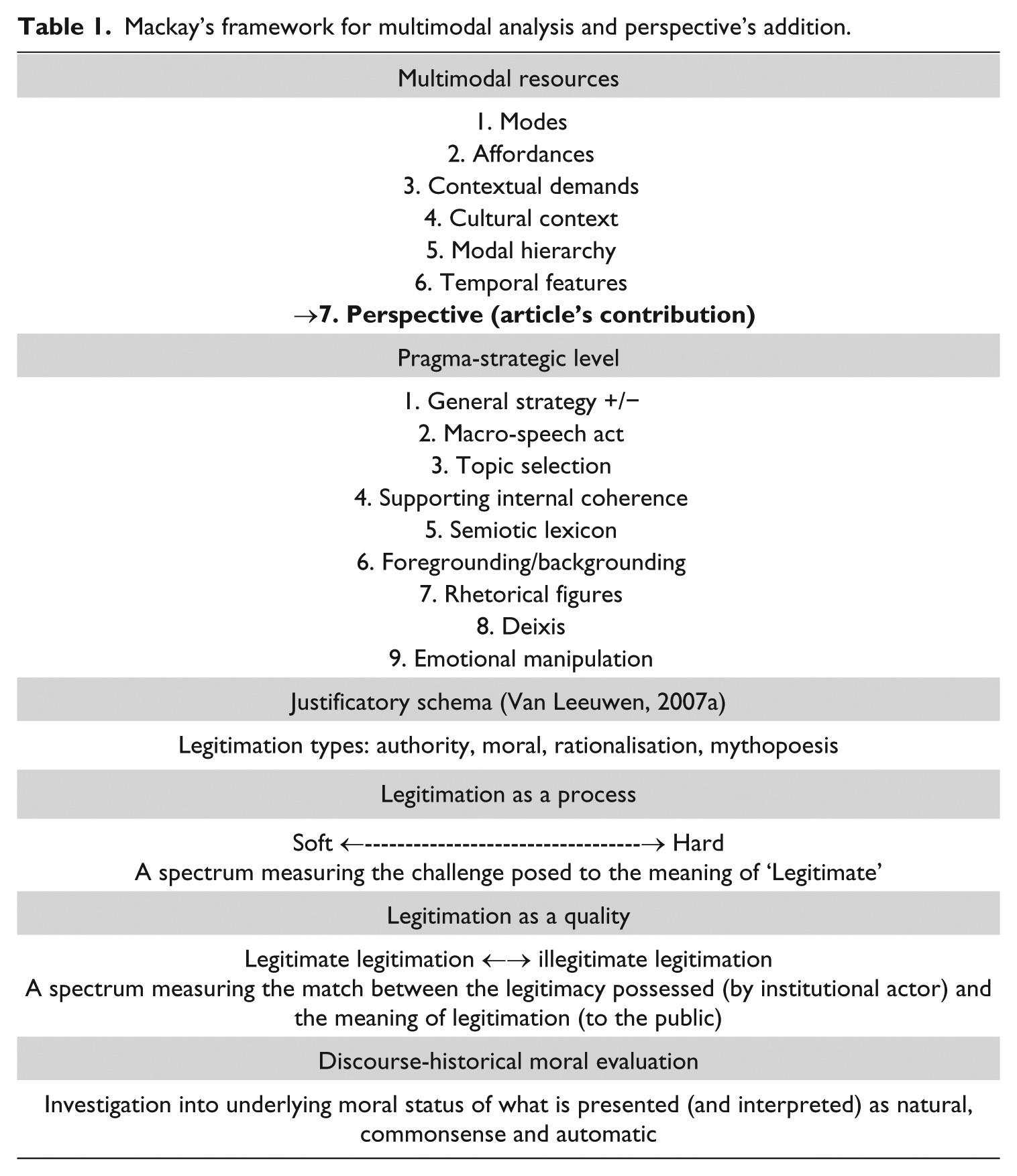
In this article, I adopt Mackay’s (2015) framework for the analysis of the advertisements because it builds upon the previous work by Van Dijk, Van Leeuwen, Kress and Wodak. Therefore, it is unifying and can secure valid analyses. It comprises six levels: multimodal resources, pragma-strategic level, justificatory schema, legitimation as a process, legitimation as a quality and discourse-historical moral evaluation (Table 1). Each level can work separately and/or with some others or all of them. The framework is shown below together with the article’s contribution.
Mackay’s framework for multimodal analysis and perspective’s addition.
Data selection
The article focuses on ND and not another political party in Greece because ND was the party in power until the January election of 2015 and lost to Syriza. Thus, I assumed that the multimodal legitimation strategies employed by ND to oppose Syriza’s rhetoric – a rhetoric that highlighted its new, different and uncorrupted character as a party – are worth being explored. The January 2015 election marked the transition from the period of governance of Greece by ND and PASOK to the period of Syriza’s rule. That is the reason why this election was chosen. The criterion for the selection of the advertisements was their popularity on YouTube as indicated by the total number of views at the time of writing. The advertisements are available on ND’s YouTube channel:
‘I am not going to take this risk’ (henceforth, ad 1);
‘We vote in order to build’ (henceforth, ad 2);
‘For this election, we choose Europe’ (henceforth, ad 3). 9
Analysis
Content Analysis
Prior to the legitimation analysis based on Mackay’s framework, an analysis of the content of the three advertisements is offered. The readers are strongly encouraged to watch the three ads.
‘I am not going to take this risk’
The ad begins with a woman in her 30s who is a mother and is tidying her children’s school material in the living room. While cleaning, she starts to think about one political statement that was made by Tsipras and she clenches her fist: ‘They say that they will go to Europe to impose their own conditions on the negotiation’. Then, the woman starts to reflect on that statement by wondering: ‘But what kind of negotiation takes place based on the conditions imposed by one of the two parts’. After this thought that arguably relies on commonsense, her fears emerge: ‘I am afraid that once again we will be isolated from the rest of the world. And whenever Greece was isolated, it got destroyed’. These fears are augmentative. Images of her worried and tired face are shown indicating her insecurity which is due to Syriza’s rhetoric. Next, the woman thinks that she does not want her children and herself to live this destruction. A parallel moving image of her child embracing her is shown. After being sceptical, she decides not to take the risk of destruction after the sacrifices she has made as a citizen. If we pay attention to her body language, we can see her embrace her child’s backpack and have a calm face while making her political decision which offers her inner peace eventually. After the completion of the scene, a male voice can be heard, first, declaring ND’s commitment to Greece’s powerful and stable position within the European Union (EU) and worldwide and, second, assuring that ND says the truth, is responsible and guarantor of the future. Within the framework and in the blue background, one can discern a ballot box and two flags: the Greek and the European, suggesting that a vote for ND constitutes a vote for Greece within the EU.
‘We vote in order to build’
In this ad, the protagonist is a middle-aged man, dressed semi-formally in shirt and trousers. While trying to copy a piece of paper by using a photocopier he starts contemplating. Following the pattern of the first ad, an internal monologue unfolds. The man reflects on Tsipras’ phrase that as a prime minister he will make the EU and the markets dance pedozali and he moves his fingers, arguably due to his distrust. 10 Then, he starts making rather rational arguments against Tsipras’ statement, unlike the mother in the first ad, whose inner speech is more emotional. The man uses the examples of other developed countries facing economic problems, like Italy or Russia, to oppose Tsipras. Based on this argument, he regards Tsipras’ words as ‘big’. At this point, the photocopier seems to dysfunction indicating Tsipras’ dysfunctional promises. The protagonist’s face appears worried in multiple moving images. Then, he wonders how Syriza will afford its ‘big’ promises (that include benefits) and speculates that this could be done with the deposits of the people. As in ad 1, the sacrifices made by the citizens are recalled and the possible ‘risk’ is incomprehensible, too heavy to bear and linked with destruction. Images of the protagonist’s confused and worried face are shown. Finally, a female voice representing ND can be heard repeating the text that was also spoken in ad 1. The same semiology (symbols and colours) is used, too.
‘For this election, we choose Europe’
The third ad follows the pattern of the previous ads. There is a scene initially and then a female voice representing ND carries the torch of the ad. To start with the scene, this ad differs from the previous ones in the identity and number of participants. Antonis Samaras himself and a typical Greek four-member family sit down at the table of the family’s living room to discuss. Samaras is dressed in casual suit and tie, unlike his usual more formal clothing. The conversation adopts the pattern of questions and answers. Three family members ask questions in a sceptical way and receive the answers of Samaras. The whole family appears to be convinced by Samaras’ responses. First, the mother brings up the issue of political promises, the sacrifices made by the citizens and their lack of trust towards politicians. Samaras acknowledges the sacrifices made by the Greeks and declares his grief. He claims that he was forced to make the political decisions he made. Now the country has moved on to the next stage, according to him. Then, the father poses the issue of when he will see concrete results of fiscal recovery in his life. Samaras highlights the difficult circumstances when he first became Prime Minister, his success in reducing all shortfalls and his responsibility as a politician unlike others (e.g. Tsipras) who are either liars or have hidden agendas against the citizens. Those ‘others’ are linked with Papandreou who promised provisions right before the loan agreement in 2010. Next, the teenager questions ND’s right actions. Samaras avoids responding directly by claiming that he did not make ‘the big mistake’ (again indexing Syriza), a fact which is more important than doing everything correctly. He contextualises the January election as a decision between staying within the EU and leaving the EU and isolation. Finally, he assures that he says the truth. The grandfather does not speak, but he nods at the end. Then, a series of images with family’s smiling faces appear and the ad ends with a female voice representing ND in a similar way with ads 1 and 2.
Legitimation analysis
Multimodal resources
Modes and affordances
In all ads, we have the mode of film which, in our cases, consists of moving image and sound. For the moving images, colour, text and movement between frames are utilised. Still images are also used (blue background with ND’s statements and symbols). Moreover, the semiotics of dress (semi-formal clothing in ads 1 and 2 and casual clothing in ad 3) and the body language (e.g. the fist or the backpack hugging in ad 1; fingers moving, face expression of a worried man in ad 2; people nodding in ad 3) are also exploited. The resource of sound can be separated into the following three categories: voice, music and atmospheric sound. 11
Contextual demands
Demands of a technological, practical and legal nature are involved in the ads. This kind of information, though, is not accessible due to my external relation to ND. Financial limits imposed by a budget on the production teams as well as time and technology constraints are assumed to have arisen. 12
Cultural context
A number of cultural expectations exist when some political ads are produced and aired, which are culture-specific (Mackay, 2015: 334). For the creation and reception of electoral ads, people expect political arguments, statements and specific plans for the next 4 years of governance. So, people watching these ads expect to be informed why they should vote for a party and not for another.
Some cultural assumptions are made. For example, in ad 3, the child questions the actions of ND, which indicates the fundamental right of political dissent in the Greek society. The very presence of the woman in ad 1 as a politically active citizen whose thoughts are valuable – politically speaking – assumes gender and political equality. Films, however, let alone political ads are culture-specific and they call for a good knowledge of the context in order to be adequately comprehended.
Modal hierarchy
In ad 1, the three modes of language, sound and images work together. It is through spoken language that the thoughts of the woman and her arguments unfold (Figure 1). Her emotions (fears) are explicitly stated through language, as well. Sound and, more specifically, the closing of the pencil pouch and the back-bag are intensified. The music’s tempo is slow rendering the expressing of thoughts and fears more prominent in that way. While the words ‘isolated’ and ‘destroyed’ are spoken, abrupt sounds can be heard. The music becomes ‘positive’ towards the end of the ad when voting for ND is encouraged. 13 As for the images, they aim to enhance the emotional effects. For example, when the woman mentions her fears about her child, an image of that child embracing her is shown. Finally, images of sad and worried faces are utilised.

Ad 1.
Ad 2 exploits modes similarly (Figure 2). Spoken language is used for arguments. However, more rational arguments are made. Atmospheric music accompanies the words spoken. What is worth mentioning is the sound of the photocopier which is reminiscent of the heartbeat. The intensifying of the heartbeat (cardiograph) occurs when the man mentions the danger that exists for the citizens’ deposits. Its role is the enhancement of the emotional effects (fear). Images of worried face expressions are also shown.

Ad 2.
Ad 3 is slightly different, in that the focus lies primarily on spoken language, then on images and, finally, on music (Figure 3). Text is utilised for questions and answers. The answers are related to the questions and rely on reason, but this does not entail lack of emotional effects. Dilemmas are created by Samaras (ND = EU vs Tsipras = outside EU, although not explicitly said) which are (arguably) rationally set, but aim at fear. Music is utilised only during the last seconds in a ‘positive’ way. Finally, images of faces that initially look sceptical and then convinced by Samaras accompany the dialogue.

Ad 3.
In general, we could say that language’s role is fundamental for arguments and emotional exploitation, with the latter being enhanced by sound and images. Ads 1 and 2 are dark, unlike ad 3 where the light is constantly bright. The light is not bright in the first two ads except for moments of face expressions (intensifying role). At the end, a ballot box can be discerned in the blue background together with two flags: the Greek and the European, suggesting that a vote for ND constitutes a vote for Greece within the EU. The symbol of ND, the torch, signals liberalism and is linked with the Conservative Party in the United Kingdom which had the same symbol from 1980s to 2006 (Lester, 2006). In addition, torch signals transparency and innovation (ND, 2016). As for the colour of the background, blue denotes calm, cold, distance and backgrounding (Kress and Van Leeuwen, 1996: 235).
Temporal features
For the sake of an accurate description of time, I shall adopt narratology’s (Genette, 1972; Pavel, 1985: 85–104) distinction between récit (narrative) and histoire (story). The narrative time is 46 seconds, 45 seconds and 1.43 minutes for ads 1, 2 and 3, respectively. The story’s time regards the natural time of the story. Thus, the time in ad 1 equals some seconds from the woman’s day (morning or noon based on the sunlight). In ad 2, several seconds from a man’s work routine are the story’s time. Finally, in ad 3, the natural time concerns the time spent for a conversation between a family and Samaras. In all ads, the story’s time corresponds to the narrative time because we have either a dialogue or internal monologues.14,15
Perspective
In ads 1 and 2, there are three points of view or focalisations. They start with a zero focalisation since the viewer can watch and experience the storyworld as an external objective observer (e.g. the tweets). Then, the focalisation becomes internal as the monologue begins and the viewer experiences the storyworld through the protagonists’ perspective. Finally, when the voice of the male/female speaker represents ND sounds, the focalisation remains internal but the viewer experiences things through the speaker’s point of view. Ad 3 has a zero focalisation during the dialogue and then it gets internal during the transition to the speaker representing ND at the end of the ad. Therefore, in all ads, the focalisation changes and does not remain one and steady. Simply put, they constitute polymodalities (Pavel, 1985: 99).
Pragma-strategic level
General strategy
Ads 1 and 2 are overall negative ads. The whole structure of the ads relies on Tsipras’ statements followed by arguments and fears against them. Within this negative context, ND’s voice appears at the end in a positive way as it is the ‘responsible power’, which ‘tells the truth’ and ‘guarantees Greece’s future within the E.U.’. Ad 3, on the other hand, is a positive ad. As is expected, Samaras is presented positively. Nonetheless, negativity cues are met as part of his arguments.
Macro-speech act
Ads 1 and 2 present similarities in their macro-speech act. Both are narratives aiming at causing fear. Striking examples are the use of a child in ad 1 and the argument about the deposits in ad 2. Contrarily, in ad 3, we meet an empathetic human interest (Samaras) together with some implicit accusations against Tsipras.
Topic selection
Ads 1 and 2 share the same topic: Tsipras’ recklessness and untrustworthiness. Both narrators begin with a promise given by Tsipras and then both question him explicitly. The topic of the last ad is Samaras’ responsibility and reliability. He is presented as having dealt with economic crisis successfully during the previous parliamentary period and being able to secure Greece’s future.
Supporting internal coherence
Coherence is achieved through the multimodal balance between positive and negative elements. For the ‘unwanted’ future, the music is ominous and moving images with sad faces are used. The light used (intense in ad 1, unlike ad 2) boosts the effects of these images. For the ‘ideal’ future, the music is positive, the colour/light is bright and images with happy faces are shown (e.g. in ad 3).
Foregrounding/backgrounding
In all ads, what is foregrounded is citizens’ sacrifices, some pre-election statements of Tsipras (e.g. imposing his own conditions on the negotiation) and ND’s wish for Greece to stay within the EU, because the majority of Greeks wished that as surveys in the past showed (e.g. Skai, 2011). Tsipras, however, never said that he wants Greece’s exit from the EU, and this is backgrounded. What is also out of focus is the negative effects of the implemented austerity policy (e.g. unemployment).
Rhetorical figures
A list of the figures that were used is given in Table 2. Blank space signifies the absence of rhetorical figures in some ads, whereas the tick symbol (
Rhetorical figures in ads 1, 2 and 3.

Deixis
In the first two ads, the pronouns I, we, my, us are used frequently. The narrators are citizens, so people identify themselves with them. Modality (will) is also used for the description of the uncertain future with Tsipras and the protagonists’ intention to vote for ND. The voice representing ND uses the pronoun we to refer to all Greeks and the party itself. In ad 3, the family uses the same pronouns. Samaras speaks both as Greek and president of ND (‘we’). His modality includes expressions like ‘I am able’. Generally, Syriza and Tsipras are mentioned only through pronouns ( ‘they’, ‘he’, ‘others’). As for the time, adverbs like now are also met.
Emotional coercion
The little kid functions as an emotive signifier in ad 1. The ominous music in this ad and ad 2, together with the sounds (of the photocopier for instance), has a similar role. The images of the convinced family, of the worried and tired citizens are also an emotive signifier. Altogether, they support an already emotional text leading to an emotional coercion.
Justificatory Schema
Authorisation
No legitimation of this type occurs apart from ad 3. Samaras was the last prime minister. So, he could be regarded as an authority. In addition, the phrase ‘Λεφτά υπάρχουν!’ (in English ‘money is available’ or ‘money can be found’) mentioned sarcastically by Samaras belongs to Papandreou, so we can consider that this phrase works in a reverse way. Papandreou as an authority contrasts with Samaras, who speaks the ‘truth’. Authority by custom is not discussed and authority by commendation is performed only if we regard the protagonists of the first two ads as legitimating ND/Samaras. 16
Moral evaluation
Moral legitimation of ND is often used. First, ND/Samaras is morally legitimised because it/he says the truth and is responsible, reliable and hard-working. Second, abstraction
17
is met in all ads (‘we vote in order to
Rationalisation. 18
Instrumental rationalisation is also utilised. Initially, Tsipras’ arguments are weakened. Then, the viewers are encouraged not to vote for him in order to avoid the destruction and to build so that, first, Greece becomes a powerful country within the EU and the world and, second, the next generation’s future is secured. This will happen through voting for ND and against Syriza. One example of theoretical rationalisation is the argument about other countries in ad 2, since it is presented as a natural order of things.
Mythopoesis
This category is subdivided into moral tale and cautionary tale. The former is to be emulated, whereas the latter is to be avoided. The first two ads are moral tales, in that the decision of the protagonist to vote for ND is to be imitated. In ad 3, Papandreou’s paradigm is connected to Tsipras; therefore, it must be avoided (cautionary tale).
Legitimation as a process
Elections are the legitimate process by which voters get to decide on who will govern them. As such, they offer the opportunity for the rejection of the legitimacy of the status quo. ND does not seize this opportunity. Therefore, only the ‘soft’ act of legitimation can be detected in the ads. ND as a party constitutes or represents the status quo. The dominant definition of what it means to be ‘legitimate’ is accepted (educated, leader of a party, strong commitment to European Ideas, Greece’s place within the EU and so forth). The ads aim to convince the Greeks of ND’s permanent and right place within that. Syriza, as other studies have shown (e.g. Boukala and Dimitrakopoulou, 2016), used the ‘deep’ legitimation approach since it was the new political power whose popularity rose exactly due to its challenge of what it meant to be ‘legitimate’ at the time.
Legitimation as a quality
According to Mackay (2015), ‘this category focuses on two disjunctions: that between the ideal notion and the real manifestation of legitimacy, and that between the body initially granted legitimacy and that same body’s inevitable evolution’ (p. 342). The ideal form of legitimation refers to a candidate being able to contribute to a country’s growth. During Samaras’ last presidency (2012–2015), citizens expected him to lead the country to a better tomorrow. Instead, many discharges in the public sector occurred, unemployment skyrocketed and poverty increased (Vasilopoulou et al., 2014). This, however, was presented as the ‘best possible’ considering the global financial crisis and the alternative scenario of leaving Eurozone and returning to drachma. 19 For the election of 25 January 2015, Samaras tries to justify the discrepancy between the ideal notion and the real manifestation of legitimacy during 2012–2015. Now, the ideal form of legitimation has changed, namely, people have experienced the crisis (e.g. unemployment) for 5 years and the ‘ideal’ is a steady return to growth escaping the crisis in that way. According to Samaras, the ‘best possible’ is the continuation of the previous policy which showed signs of effectiveness and people’s lives will steadily become better, unlike the ‘best possible’ that Syriza can offer (e.g. ‘take everything from you multiply’). Thus, Syriza’s discrepancy between ‘ideal’ and ‘best possible’ will be much wider than that of ND. If Syriza is elected (= legitimised), Tsipras will proceed to the illegitimate action of leading the country to ‘destruction’.
Discourse-historical moral evaluation
This level ‘taps into a vast resource of cultural assumptions which we draw upon in order to legitimate our very process of legitimation’ (Mackay, 2015: 333). Understanding the ads requires a degree of shared contextual knowledge. It is this knowledge that makes understanding of, first, what is being talked about and, second, the value judgements, which are culturally attributed to signs, possible (Mackay, 2015: 343). Some fundamental assumptions about positive and negative values that are made in the three ads follow:

EU: European Union.
The issue of citizens’ trust towards politicians who should tell them the truth is a value that is presented as primary. After the fall of the Colonels’ Regime in 1974, Greek politicians based their electoral campaigns on promises for provisions such as nominations and benefits (Anastasiades, 1993: 115). As the highlight of this strategy stood Papandreou’s infamous phrase ‘Λεφτά υπάρχουν!’ during his electoral campaign in 2009 and, though, the crisis was imminent. From 1974 to 2009, politicians’ promises were not necessarily false. Instead, the people were used to voting for the parties that were willing to offer the most. People’s disinterest and distrust skyrocketed in 2010 when Papandreou declared bankruptcy (Smith, 2010). Trust was lost, and politicians were treated as uncompassionate and lazy (Skai, 2011). Taking this into account, the values of trust towards politicians that was lost, their responsibility and hard work for the common good are values that inform the definition of legitimacy. An interpretation of the political expedience of indexing these assumptions and not others is their appeal to the public, especially after 5 years of economic crisis.
Albeit national, the January election received a European character. Samaras’ rhetoric included and was grounded in the dilemma about leaving or staying within the EU. The latter constituted a positive value, since the supranational European identity informs the identity of the Greeks. Greeks are educated since early years as citizens of Europe and as such their education is both Greek and European. This fact is presumably quite explanatory of why leaving Europe was very unpopular in Greece at the time, with around 70% of the Greeks wishing to remain within the EU (e.g. Skai, 2015). For Mackay (2015: 345), the national identity – and similarly the European identity I would add – has an ambivalent value and it has to be mitigated by the ads if they are to work. This, however, was not the case with ND. Although Samaras used the above dilemma, it was not actual since Syriza did not embrace it, at least officially (Smith, 2014). The rhetoric about Greece’s EU membership being at stake because of Syriza was exploited by ND, which presented the election as follows:
Vote for ND = Vote for staying within the EU;
Vote against ND = Vote against staying within the EU.
Options of this type do not have a certain ‘surfacing’ of emotions. This dilemma was part of a general scaremongering implemented by ND, which eventually had the opposite results considering Tsipras’ win. Besides, people’s distrust towards politicians did not exclude ND. It was this distrust that possibly did not allow Samaras to win the election for a second time. Therefore, the positive value of being European did not channel the feelings that would secure ND’s win and legitimation.
Conclusion
Returning to the research questions, this study focused on the multimodal strategies employed by ND, so that Samaras’ candidacy in the January 2015 election is legitimised. A multimodal analysis of three political advertisements was carried out by implementing Mackay’s suggested framework (2015). The advertisements (films) included images, language – mainly spoken – and sound. All modes contributed to Samaras’ legitimation. He based his electoral campaign on the sacrifices of citizens that were in danger if ND was not re-elected. Negativity (scaremongering, warning) was dominant in all advertisements. This finding supports existing literature on the political argumentation in Greece in 2015 – a year that found the Greek political landscape in the middle of discourses of fear and discourses of hope (Boukala and Dimitrakopoulou, 2016). The dilemmas were highlighted and the emotional coercion was disclosed in the analysis. Samaras’ legitimation and Tsipras’ delegitimation were simultaneous. The former tried to legitimate himself by being portrayed as responsible, hard-working, EU-friendly and speaking the truth, unlike Tsipras who was presented as deprived of this set of values. Although the effects of positive and negative advertising are not agreed upon (e.g. Heldman, 2009; Iyengar and McGrady, 2006; McClurg, 2009; Mackay, 2013b), we could say that negativity in this case had reverse effects for ND considering its defeat in the election.
By combining various frameworks Mackay constructed a multilevel framework that secures robust multimodal legitimation analyses. However, what appeared to be missing is the utilisation of narratology whose (some of its) terms are used in this article. I have argued that the analysis of perspective is important in multimodal legitimation research since it could help researchers decode how the way of viewing/presenting reality in advertisements is related to the advertisements’ effectiveness, especially in the case of political advertising. Viewing reality from a certain perspective (zero/external/internal focalisation) might entail evaluating or even experiencing reality from that perspective. Thus, considering that political discourse aims at the formation of mental models that support their political expedience (Van Dijk, 2006: 368), perspective’s investigation should be included in multimodal legitimation research.
Finally, future research could use more of narratology’s analytical categories for the analysis of multimodal legitimation. Categories such as the voice or subcategories of the category time (order, duration, frequency) could prove themselves useful. Furthermore, more research is needed on the discourses produced during the so-called Greek crisis. Existing literature has focused on specific data types (e.g. news media discourses or political speeches) with other genres such as political advertisements being greatly under-investigated.
Footnotes
Acknowledgements
I thank Dr Rowan R. Mackay for her professional help, insightful comments and feedback she provided me with while working and writing this article. I also thank the reviewers for their comments.
Declaration of conflicting interests
The author(s) declared no potential conflicts of interest with respect to the research, authorship and/or publication of this article.
Funding
The author(s) received no financial support for the research, authorship and/or publication of this article.