



Abstract
This study conducts a corpus-assisted discourse study of the representations of post-colonial Hong Kong in The Times over the past 20 years. The primary purpose is to reveal its preferential ways of representing Hong Kong and explicate the intricate relations between language use and the historical and socio-political contexts. Through an integration of the methods and theories associated with critical discourse analysis and corpus linguistics, this study conducts both synchronic and diachronic analyses of the representations of Hong Kong from 1997 to 2017. The findings suggest that The Times’ representations of Hong Kong tend to be crisis- and conflict-oriented. While evoking constant fear about the future of Hong Kong, it still suggests that it is Britain’s duty and moral obligation to protect the former British colony. The same trend can also be identified in The Times’ representations of the mass protests against the proposed extradition bill in 2019.
Keywords
Introduction
Twenty years have passed since Hong Kong returned from 155 years of British colonial rule to the People’s Republic of China on 1 July 1997. However, the conflicts between Hong Kong and China have become increasingly fierce in recent years, as can be seen from the recent mass protests against the proposed extradition bill in Hong Kong, a bill which allows criminal suspects to be extradited for trial in courts on the Chinese mainland. As a leading British quality newspaper, The Times (TT) featured one article entitled ‘Colonial nostalgia drives the young to reject Beijing’ on 15 June 2019, and another article entitled ‘UK has moral duty to help Hong Kong, says freed activist’ on 20 June 2019. The former emphasizes young people’s ‘nostalgia’ for the days of British colonialism in Hong Kong, while the latter represents a leading Hong Kong pro-democracy activist’s criticism towards the British government for not taking its moral duty to protect Hong Kong. Twenty years after the handover, the newspaper still plays an active role in constructing the connections between Hong Kong and Britain and pushing the British government to keep a close watch on Hong Kong. Nevertheless, there is still little information about the newspaper’s representations of post-colonial Hong Kong during the past two decades.
This study combines critical discourse analysis (CDA) and corpus linguistics (CL) with a view to giving a corpus-assisted discourse study (CADS) of British press representations of Hong Kong over the past two decades. Given the significant role of media in the present-day world, CDA has shown particular preference for the study of media discourse in the past three decades (Fairclough, 1995; van Dijk, 1988a, 1988b) and has arisen to be ‘the single most authoritative line of research regarding the study of media discourse’ (Carvalho, 2008: 162). Viewing discourse as a social practice, CDA is particularly concerned about ‘the role of discourse in the production and reproduction of power abuse and domination’ (Van Dijk, 2001: 96). The basic assumption is that media discourse, instead of being a neutral or objective reflection of reality, is a socially created product, subject to the mixed influences of a host of social, economic, political and cultural factors (Shoemaker and Reese, 1996). A critical examination of TT’s representations of Hong Kong can illuminate not only the particular ways of representing Hong Kong but also the intricate relations between language use and the historical and socio-political contexts.
Besides, most CDA studies are devoted to the examination of media discourse in a short time span (Carvalho, 2008). Even for those using temporal analyses, they have tended to focus on the change in style and genre rather than in the meaning of issues (Fairclough, 1992). However, some public issues have their own life, and public understandings of them are closely related to the evolution of these issues in news media (Chang, 1988; Lee et al., 2002). This requires the examination of not only ‘the course of social matters and their wider political, social and economic context’ but also ‘the temporal evolution of media(ted) discourses’ in order to present a better understanding of the historical development of a certain issue (Carvalho, 2008: 172). Adopting a CADS approach, this study conducts both synchronic and diachronic analyses of TT’s representations of post-colonial Hong Kong in order to answer the following three research questions: (1) What are the primary concerns in British press representations of Hong Kong? (2) How do these concerns evolve with different periods? (3) What are the socio-political factors behind British press representations of Hong Kong?
Background of the study
As a city located in the Southern part of China, Hong Kong was subject to British control either by cession or on lease following the two Opium Wars: with the Hong Kong Island in 1842, the Kowloon peninsula in 1860 and the New Territories in 1898 (Flowerdew, 2012). However, the Sino-British Joint Declaration signed in 1984 stated that Britain should return Hong Kong to China on 1 July 1997. In order to guarantee Britain’s withdrawal from Hong Kong with honour and dignity, the last British governor, Chris Patten, initiated a series of political reforms with the view of giving Hong Kong greater democracy. During the 5 years of his office, Chris Patten strived to create a ‘myth’ about British legacy to Hong Kong, including the free-market economy, the freedom of the individual, the rule of law and democracy (Flowerdew, 2012). However, they were a ‘myth’, because they deliberately ignored and backgrounded the historical facts of British colonial rule in Hong Kong (Flowerdew, 2012).
The same myth was reproduced in British media representations of Hong Kong’s handover in 1997. An examination of British media by Lee et al. (2000) found that British media, instead of apologizing for British colonial rule, preferred to focus on the bright future of Hong Kong and indulge themselves in imperial nostalgia. They depicted Hong Kong as Britain’s most successful colony, underlining Britain’s duty and moral obligations in safeguarding Hong Kong’s future. Cao (1999) found that the dominant theme in British handover reporting is the loss of empire, characterized by both nostalgia and legacy. Through constructing democracy as a part of Hong Kong’s political identity, British newspapers were inclined to construct China as a ‘rogue’ country with evil intentions for Hong Kong, and Britain as a ‘moral leader’ and ‘protector’ of Hong Kong.
Apart from the few studies on news reporting of some specific issues in Hong Kong (Berry, 1999; Bhatia, 2015, 2016; Cheng and Lam, 2010; Pan, 2002; Zhang and Mihelj, 2012), few studies have given an extensive examination of British media representations of Hong Kong over the past two decades. Besides, most of these studies relied on manual content or discourse analysis as their main analytic methods. However, Cheng and Lam (2013) give a corpus-driven CDA study of Western perceptions of Hong Kong before and after its handover at the 10th anniversary of Hong Kong’s handover, and expose not only the positive changes in Western perceptions of Hong Kong but also the benefits of using CL methods in CDA. Given the growing conflicts that have taken place in the second decade of Hong Kong’s handover, an extensive study of TT’s representations of Hong Kong in the past two decades is expected to produce significant findings concerning how the newspaper addressed the changing socio-political contexts in Hong Kong.
CADS
Analytic methods traditionally associated with CL have been used and incorporated in this study to give a CADS of the large number of news texts. As an empirical method of linguistic analysis and description (Cheng, 2013), CL has been known for its efficient processing of large data with computer-assisted corpus-analytic tools (Baker, 2006). It can benefit CDA by providing empirical foundations, reducing researchers’ bias and thus enhancing the credibility of analyses (Mautner, 2016), so the past two decades have witnessed the increasing use of CL methods in CDA (Baker et al., 2008). CADS emphasizes the balanced combination or the ‘synergy’ of the theories and methods associated with CDA and CL, based on the assumption that a balanced combination of quantitative statistical analysis and qualitative linguistic analysis can better expose the ‘non-obvious’ meanings in a discourse type, thus contributing to the development of both disciplines (Baker et al., 2008; Morley and Bayley, 2009; Partington, 2010b).
CADS values comparison in its analyses, since without comparison, it is difficult to judge which text features are typical or atypical (Stubbs, 2004). Despite the different forms of comparison (Partington et al., 2013), they can be broadly classified into two categories: synchronic and diachronic. A synchronic comparison entails the comparison of one corpus with a comparable specialized corpus at the same time or a general reference corpus. It can reveal the features of the corpus within a specific time period. A diachronic comparison refers to the comparison of discourses from the same or similar sources at different periods of time. While previous CADS studies used to resort to synchronic comparison (Haarman and Lombardo, 2009; Morley and Bayley, 2009), Partington (2010a) drew attention to the value of modern diachronic corpus-assisted discourse studies (MD-CADS), because a diachronic comparison of large comparable corpora from different time periods can track changes not only in language usage but also in social, political and cultural contexts (Duguid, 2010a, 2010b; Partington, 2012).
There are two different analytic routes in MD-CADS (Partington, 2010a). The first is a bottom-up approach (Duguid, 2010b). It starts with a comparison of the corpora from different periods in order to uncover changes in both language usage and the representations of social, political and culture issues. The second is a more hypothesis-driven approach (Duguid, 2010a). It starts with the examination of some predetermined language patterns based on the assumption that they can suggest important changes in language usage or the representations of social, political and cultural issues. However, as Partington et al. (2013) suggest, different forms of comparison can be combined in view of the research questions under investigation. This study, therefore, combines synchronic and diachronic analyses in order to identify the prominent patterns in TT’s representations of Hong Kong as well as their diachronic changes.
Data and analytic methods
This study is based on a large self-built corpus which collects all news texts concerning Hong Kong in TT from 1 July 1997 to 30 July 2017. TT is known for its wide circulation and agenda-setting influences in Britain (Lee et al., 2002). All news texts with the keyword Hong Kong are extracted from the electronic database Lexis-Nexis and further manually selected in order to guarantee all the news texts collected are related to Hong Kong. They are built into a large corpus of 798,672 tokens (i.e. the TT corpus) with 4 sub-corpora based on the 4 successive Hong Kong governments, and the number of tokens in each sub-corpus is as follows:
Period 1 (P1): July 1997–June 2002 (305,742 tokens)
Period 2 (P2): July 2002–June 2007 (176,268 tokens)
Period 3 (P3): July 2007–June 2012 (145,302 tokens)
Period 4 (P4): July 2012–July 2017 (171,360 tokens)
This study combines CL and the discourse-historical approach (DHA) of CDA (Reisigl and Wodak, 2016). DHA distinguishes itself from other approaches in CDA by its emphasis on the historical origins of discourse. According to Wodak and Ludwig (1999), being critical does not mean ‘detecting only the negative sides of social interaction and processes and paint a black and white picture of societies’, but means ‘making contradictions apparent’ with emphasis on ‘self-reflection’ (p. 12). In order to identify the contradictions and inconsistencies in ‘text-internal’ structures, it proposes a top-down analysis of texts at three different levels: (1) topics/themes, (2) discursive strategies, and (3) linguistic means (types) and realizations (tokens) (Reisigl and Wodak, 2016).
Viewing the corpus as a whole, this study starts with a synchronic analysis of the keywords in TT corpus to identify the main topics and themes. Keywords refer to those words which are statistically more frequently used in one corpus when compared with their use in a comparable specialized or reference corpus, and they can suggest the ‘aboutness’ of the corpus (Baker, 2006). With the help of the corpus-analytic tool Wordsmith 7.0, the TT corpus is first compared with a general reference corpus, that is, the 5 million sample corpus of the British National Corpus (BNC). Then a keyword list is produced, and it ranks the keywords by their log-likelihood values. The higher its log-likelihood value is, the more key the word is. This study focuses on the top 100 keywords to analyse the prominent topics and themes in the corpus (Baker et al., 2013). It is followed by a diachronic analysis of some representative topic keywords in order to identify the main trends in TT’s representations of Hong Kong.
Then we give a close analysis of the concordance lines, collocation, semantic preferences, and/or semantic prosody of three topic keywords which are considered as key to the representations of Hong Kong and its relations to Britain and China. Collocation refers to ‘the co-occurrence of words with no more than four intervening words’ (Sinclair, 2004: 141), and collocates refer to the words that co-occur with the word under investigation within a predetermined span, usually five words on either side (Baker et al., 2008). Semantic preference refers to ‘the relation between a word or lemma and a set of semantically related words’ (Stubbs, 2001: 65), while semantic prosody refers to ‘the consistent aura of meaning with which a term is imbued by its collocates’ (Louw, 1993: 157). The analysis of these keywords in their specific textual contexts can reveal the typical discursive strategies employed (e.g. nomination, predication, perspectivization) and its linguistic realizations (Reisigl and Wodak, 2016). In addition, this study also makes frequent reference to the broader socio-political and historical contexts in order to provide a solid interpretation and explanation of the findings at each level of analysis. In doing so, this study combines the synchronic and the diachronic, the macro and the micro, and the discourse and the social analyses of the TT’s representations of Hong Kong.
In addition, the findings of the above analysis have been further discussed in terms of TT’s representations of the recent mass protests against the proposed extradition bill in order to test whether they still apply to this case. A small corpus of 32 news articles (24,709 tokens) has been built by extracting all the news articles with the keyword extradition bill from the electronic database LexisNexis.
Findings
Analysis of top 100 keywords
An examination of the top 100 keywords finds that they can be broadly categorized into five categories based on the meanings they communicate: (1) Place, (2) People, (3) Topic, (4) Institution and (5) Other. The first four categories consist of these keywords which in turn refer to places, people, topics and companies. The keywords which cannot be categorized into the four categories are allocated to the category of ‘Other’. Table 1 shows the exact keywords in each category, and the top 10 keywords are shown in boldface.
Analysis of top 100 keywords.
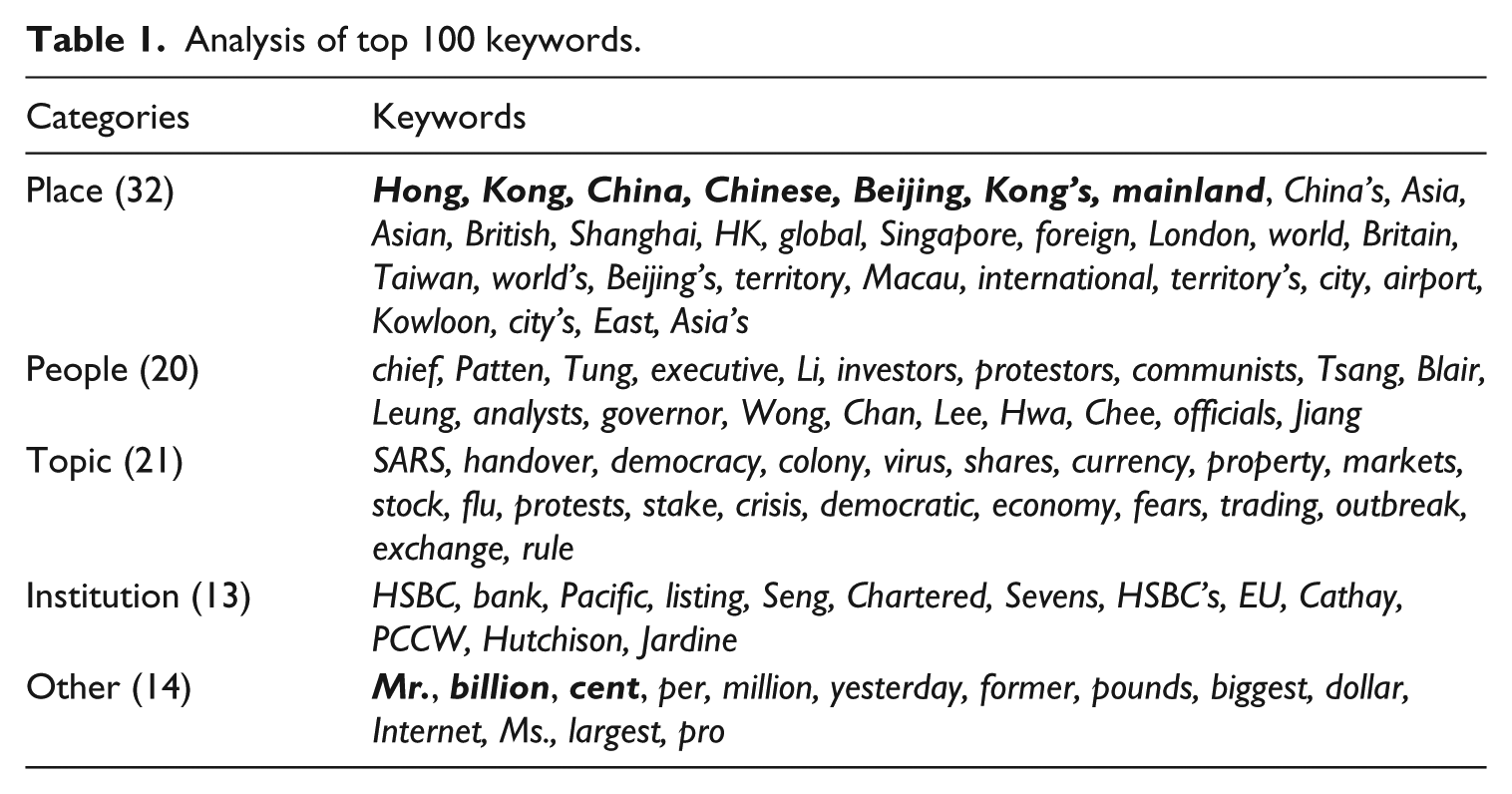
As Table 1 shows, the category of ‘Place’ stands out because it has the largest number of keywords (32). Among them, 7 rank among the top 10 keywords, and they refer to either Hong Kong or China. The emphasis on Hong Kong can be attributed to the fact that this is a corpus of news texts about Hong Kong, while the stress on China suggests that TT prefers to represent Hong Kong in terms of China. Meanwhile, the keywords British, Britain and London suggest that TT tends to underline the role of Britain in its representations of Hong Kong.
The category of ‘Topic’ consists of keywords which can suggest the content of TT’s representations of Hong Kong. Among them, the majority are related to the topics of economy and markets, including currency, property, markets, stock, stake, crisis, economy, trading and exchange. They are concerned with property markets, currency exchange, stock markets and economic crisis. The abundance of economic keywords suggests that TT’s top concern about the economy of Hong Kong. They are followed by political keywords, which are concerned with the topics of democracy (i.e. democracy, democratic), conflicts (i.e. protests), and the rule of law (i.e. rule). However, some keywords are related to the topic of health issues, including SARS, virus, flu and outbreak. The emphasis on health topics can be attributed to the outbreak of SARS (severe acute respiratory syndrome) and bird flu in Hong Kong. The rest are related to the topics of Hong Kong as former British colony (i.e. colony), the handover of Hong Kong (i.e. handover) on 1 July 1997, as well as the fears concerning Hong Kong (i.e. fear).
The dominance of economic and political topics (i.e. economy, democracy, conflicts, and the rule of law) sheds light on Britain’s lingering concerns about British legacy to Hong Kong, that is, the free-market economy, democracy, the freedom of the individual and the rule of law (Flowerdew, 2012). However, the keywords crisis, protests and fears suggest TT’s inclination to represent Hong Kong in the negative light by highlighting the crisis, protests and fears in Hong Kong. This can also be witnessed in its stress on the outbreak of pandemics in Hong Kong, including SARS and bird flu. TT’s representations of Hong Kong, therefore, are conflict- or crisis-oriented. This can be attributed to the general feature of liberal journalism (Hallin and Mancini, 2004). Besides, the emphasis on the handover of Hong Kong and Hong Kong’s history as a British colony indicates that TT tends to resort to the discourse of history to establish the solidarity between Britain and Hong Kong. Although it is impossible to examine all the topic keywords one by one in this article, the above topic keywords can at least suggest the entry points for further analysis (Baker et al., 2008). The following sections give a diachronic analysis of some selected topic keywords in their specific contexts of use in order to present a more complete picture of TT’s representations of Hong Kong.
Diachronic analysis of some selected keywords
In this section, seven topic keywords are selected for a diachronic analysis in four sub-corpora, including colony, handover, SARS, democracy, fears, protests and markets. The keywords democracy and markets are selected because Britain was particularly concerned about the development of a free-market economy and democracy in Hong Kong (Flowerdew, 2012). Besides, SARS, handover, democracy, and colony rank among the top four topic keywords in terms of keyness values. Therefore, they are considered as key to TT’s representations of Hong Kong. Since the representations of Hong Kong tend to be conflict or crisis-oriented, the keywords protests and fears are also selected in order to examine how TT represents the conflicts and fears over the 20 years. Figure 1 shows their standardized frequencies (per 1000 words) in four sub-corpora.

Standardized frequencies of selected keywords.
As Figure 1 shows, these topic keywords demonstrate different distribution patterns during the four periods. Among them, the keyword SARS is overwhelmingly used in P2, while the other six keywords can be identified in all four periods, so the former represents the ‘seasonal’ keyword, whereas the latter can be regarded as the ‘consistent’ keywords (Gabrielatos and Baker, 2008). The six consistent keywords suggest that they are constant topics in TT’s representations of Hong Kong. However, in terms of their standardized frequencies in the whole corpus, market (1.45) ranks the first, followed in turn by democracy (1.33), handover (0.52), colony (0.48), protests (0.28) and fears (0.25). It further suggests that TT prefers to highlight the economy of Hong Kong.
Overall, P1 shows its preference for market, P2 for SARS, P3 for market and P4 for democracy. This further confirms that TT’s representations of Hong Kong are conflict- or crisis-oriented. The emphasis on market in P1 and P3 can be attributed to the influences of the Asian financial crisis in 1998 and the global economic crisis in 2009. The overwhelming use of SARS in P2 results from the outbreak of SARS in 2003 and its immediate disappearance in 2004. The dominance of democracy in P4 was caused by the delay of universal suffrage and the burst of pro-democracy movement in Hong Kong.
Besides, market and democracy show the opposite trend in their use over the four periods: when democracy was more frequently used, market was less frequently used, and the opposite is also true. However, an overview of the use of democracy in the four periods finds that except for P3, TT shows an increasing use of democracy. A similar trend can also be identified for protests. It suggests that the representations of Hong Kong in TT have become increasingly politicized and conflictual.
However, the frequencies of handover show a continuous decline in the first three periods but a slight rise in P4. The preference for handover in P1 is not surprising since it was the period when Hong Kong’s handover just occurred. With time moving on, TT shows a declining trend in reference to Hong Kong’s handover. However, the growing conflicts in P4 also lead to the slight rise of handover in P4. The use of colony also shows similar trends, which also declines with time’s passing but rises slightly in P4. Therefore, while TT shows an overall declining trend in reference to Hong Kong’s handover and Hong Kong’s history as a British colony, it tends to resort to Hong Kong’s history when there were growing conflicts in Hong Kong. This can be explained in terms of the necessity to highlight the solidarity between Hong Kong and Britain, and draw Britain’s attention to Hong Kong’s development.
In regard to fears, its frequencies remain stable throughout the four periods. It suggests that it serves as a constant feature in TT’s representations of Hong Kong. However, there is no idea of how and why it was used without a close examination of its use in specific contexts. Therefore, the following sections give a close analysis of three keywords (i.e. democracy, colony, and fears) in their specific contexts in order to reveal the causes behind the growing emphasis on democracy, the stress on Hong Kong as a former British colony and the evoking of constant fears in TT.
Analysis of democracy
The keyword democracy ranks the 20th in the top 100 keywords, with a log-likelihood (LL) value of 1516.89 and a total frequency of 603. An examination of the concordance lines of democracy finds that it can be used as either (1) a head noun or (2) a pre-modifier in a nominal group. When it is used as a head noun, it has the semantic preference for ‘a topic under discussion’. When it is used as a pre-modifier, it usually occurs with pro to form the compound pro-democracy. It has the semantic preference for either ‘people who fight for democracy’ or ‘activities in support of democracy’. There were still other types of uses which are too few to be categorized. Examples are as follows:
Topic: Western-style democracy is the inevitable way of the future.
People: A gain of more than 10% for pro-democracy candidates is possible.
Activity: There are lessons for the pro-democracy movement, too.
Others: Mr. Liu’s pro-democracy manifesto, entitled Charter 08, attracted more than . . .
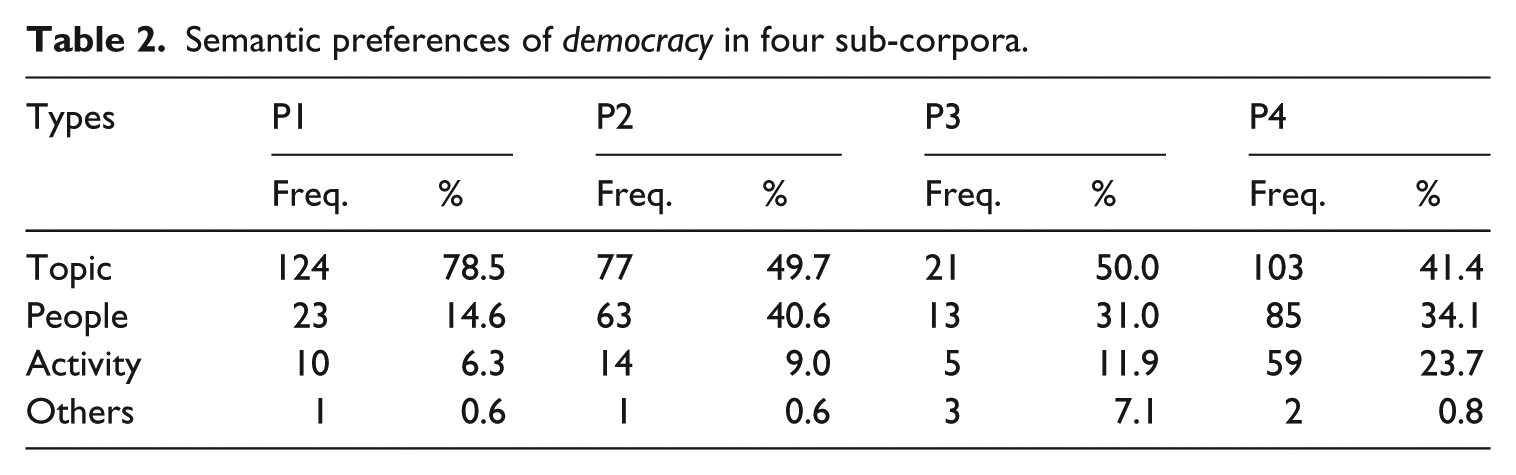
Table 2 shows the use of democracy in each period. While democracy occurs primarily as a topic in four periods, its significance decreases. Especially for P1, it was characterized by its overwhelming preference for democracy as a topic. It can be attributed to the fact that democracy was a primary concern before the handover of Hong Kong. Instead, democracy’s significance as an activity increases with each period, suggesting that pro-democracy activities showed a rising trend in the past two decades. Especially for P4, it shows a dramatic rise in pro-democracy activities. This might be caused by the growing conflicts in P4. However, while democracy’s semantic preference for people shows an apparent rising trend in the last three periods, P2 shows particular preference for democracy as a group of people. It suggests the growth of pro-democracy people in this period, which can be attributed to the growing control of Hong Kong by the Chinese government and the pro-democracy protests.
Semantic preferences of democracy in four sub-corpora.
Besides, democracy also carries different semantic prosodies in the four periods. In P1, democracy carries the semantic prosody of ‘desirability and certainty’ (Cheng and Lam, 2010). It emphasizes that democracy is necessary for Hong Kong and bound to appear in Hong Kong, as in the following:
1. The people of Hong Kong desire democracy and are willing to fight for it. (P1)
However, democracy in P2 shows the semantic prosody of ‘insufficiency’. Democracy tends to be predicated by such adjectives as pro (60), full (19), more (14) and greater (5). As mentioned above, pro occurs with democracy to form the compound pro-democracy. It is used to predicate the people who wants democracy, as can be seen from some of the most frequent lexical collocates, such as activists (11), campaigners (9), candidates (8), camp (5), forces (4) and party (4). They are used to emphasize that the current democracy in Hong Kong is not enough, and that there are many people in Hong Kong who fight for democracy, as in the following:
2. Thousands of protesters marched through the streets of Hong Kong and demanded more democracy on the eighth anniversary of the special administrative region’s return to Chinese rule. (P2)
However, democracy in P3 is not only low in frequency but also lacks definite patterns in semantic prosody. In P4, democracy carries the semantic prosody of ‘fake and not real’, since it tends to be predicated by such adjectives as full (11), real (6), fake (3), fully-fledged (2) and genuine (2). It also emphasizes the groups of people who fight for democracy in Hong Kong, because it frequently collocates with protesters (31), activists (15), campaigners (13), demonstrators (4), rally (3), camp (2), MPs (2) and politicians (2). Meanwhile, it also underlines the activities involved for democracy, such as protests (21), movement (18), demonstrations (6), protest (4), campaign (2) and march (2). An example is as follows:
3. They argue that plans published in August, which would restrict Hong Kong voters’ choice to Beijing-approved candidates in elections for their chief executive, represent a step towards real democracy. (P4)
Above all, TT’s representations of democracy in Hong Kong have also evolved with time. Despite the break in P3, the representations of democracy in Hong Kong have become increasingly conflictual and negative.
Analysis of colony
The keyword colony is at rank 24 in the keyword list, with a total frequency of 381, but a log-likelihood value of 1319.39. It collocates strongly with former (265), British (166), handed (19), China (33), handover (17), Britain (15), Kong (25), last (14), Chinese (16) and Hong (20). They further confirm that it is used to emphasize Hong Kong as a former British colony. An examination of the concordance lines finds that it represents a typical nomination strategy for Hong Kong, because it is used to refer to Hong Kong directly, such as former British colony (147), former colony (110), the colony (64) and former British territory (35). The direct reference to Hong Kong as former British colony contributes to the solidarity between Hong Kong and Britain. Also, predication strategy has also been used to describe Hong Kong as the most successful colony of Britain, as can be seen from these collocates at the L1 position (i.e. the first position to the left) of colony, such as crown, successful, significant, substantial, prospering and great. It constructs Britain’s nostalgia in relinquishing Hong Kong and the loss of empire (Cao, 1999), as in the following:
4. Not only was the Union Flag lowered for the last time on a colony that was the last substantial remnant of an Empire that once covered the globe. (P1)
In the meantime, it also represents the former British colony under China’s sovereignty during the past 20 years. However, while it still carries a positive semantic prosody in P1 and P3, and its semantic prosody becomes increasingly negative in P2 and P4. In P1 and P3, it stresses that the way of life remained unchanged in Hong Kong after the handover. However, in P2, they underline the growing control of Hong Kong by the Chinese government (see Example 7) and Hong Kong as ‘caught between dogmatism and modernity’ (see Example 8). In P4, it declares that China has broken its promises to the former British colony (see Example 10) and even turned it into a ‘Chinese colony’ (see Example 11). Examples are as follows:
5. After the handover of Hong Kong from Britain to China in 1997, the former colony continued to operate its own visa arrangement, implementing the ‘one country, two systems’ formula. (P1)
6. Cook praises China over takeover of colony. (P1)
7. In recent months, Beijing has been keen to assert its right of control over the former British colony despite guarantees of limited independence at the 1997 handover. (P2)
8. The old British colony remains as precariously and delicately poised as ever between the conflicting forces of an old, closed, fearful dogmatism and a new, outward-looking, hopeful and pragmatic modernity. (P2)
9. As agreed, the way of life in Hong Kong has remained virtually unchanged in the former British colony. (P3)
10. The pro-democracy movement believes that China has broken a promise to the former British colony: elections for the territory’s chief executive scheduled for 2017 will allow all adults to vote, but the candidates will be subject to screening by Beijing. (P4)
11. The former British colony may have become in effect a Chinese colony but 20 years after the handover it is neither at ease with itself nor with its visitor from Beijing, President Xi Jinping. (P4)
Be it positive or negative, the continual assessment of the former British colony suggests that it is British duty and moral obligation to keep a close watch on the former colony. It can also be seen from TT’s representations of British officials’ visit to Hong Kong after the handover, even though its occurrences are too few to be counted as significant, with two instances in P1, three instances in P2 and three instances in P4. However, TT also takes on a surveillance function by representing the criticisms towards Britain’s failure to give enough support to the struggle for democracy in Hong Kong (see Example 15) and Britain’s wish to maintain good relations with China (see Example 13). Examples are as follows:
12. The Princess would have been the first member of the Royal Family to visit Hong Kong since the former colony was handed over to China. (P1)
13. Britain’s new Consul-General in Hong Kong left London yesterday to take a message to the former colony that the Government wants to make a clean break with the Patten era and start afresh in its relations with China. (P1)
14. Tony Blair cast himself as the guardian of democracy in Hong Kong last night as he arrived in the former British colony during its worst crisis since it was handed back to China. (P2)
15. Hong Kong legislators criticized Tony Blair yesterday over his lack of support for democratic reforms in the former colony. (P2)
16. MPs on the foreign affairs committee had been due to visit later this month as part of its investigation into the UK’s relations with its former colony 20 years after it was handed over to China. (P4)
Analysis of fears
The keyword fears ranks the 96th in the keyword list, with a LL value of 360.09 and a total frequency of 196. Although news discourse features the constant tensions between hiding and displaying emotions (Bondi, 2007), there has been a growing use of emotion terms, especially the word fear, in dominant Western media (Altheide, 2011). However, the prominence of fears in TT’s representations of Hong Kong should not be taken for granted. As one of the most frequently used persuasive strategies in news media (Turner, 2011), fear has been constructed, framed and amplified in mass media to define situations for various audiences for the sake of ‘stance control and surveillance’ (Altheide, 2011: 261). It is especially important when it is taken as a general framework through which certain events are interpreted. The stable distribution of fears in the four sub-corpora indicates that it may have become a general framework through which events in Hong Kong are interpreted.
An examination of fears finds that it is predominantly used as a noun in its plural form rather than a verb. According to Stenvall (2008), the plural noun fears can be viewed as a typical example of nominalization, because it turns the process of fear into a ‘thing’ which can be quantified (Halliday, 1994). One of the effects of nominalization is mythification, because it can conceal the people who have the emotion as well as the cause(s) of the emotion. The use of fears in TT has further confirmed this because the majority (86%) of fears are not specified. There is no idea of who have the fears, as in the following:
17. There are fears that Chinese leaders might push for fundamental changes in the way in which the Hong Kong economy is run. (P2)
As Stenvall (2008) suggests, it is very difficult to identify those who are supposed to experience the emotion of fear. It creates the impression that there are widespread fears which are shared by both news reporters and the readers. Among the few cases in which fears are specified, the fears from the Chinese government are highlighted, which implies that the fears are felt by the Chinese government alone, as in the following:
18. Experts said it betrayed Beijing’s fears over Hong Kong as protesters wearing goggles and face masks prepared for official resistance as they rallied in apparent revenge for last week’s dismantling of a large protest site in Kowloon. (P4)
As regards the causes of the fears, four types of causes can be identified based on the semantic preferences of fears in the four periods: (1) political, (2) economic, (3) health and (4) others. Examples are as follows:
19. Fall-out from Hong Kong, where shares fell by 6% on fears that the territory could fall victim to the East Asian currency crisis, added to the confusion. (Economic fears)
20. The World Health Organization sought yesterday to calm international fears of a pandemic with a statement saying that such a danger ‘is not yet established’. (Health fears)
21. His words increased fears that Beijing might overturn the ruling, a move that would seriously undermine confidence in the rule of law here. (Political fears)
22. The group’s tour dates in Shanghai and Beijing on 1 and 4 April are unaffected, although there are fears that most Chinese cannot afford tickets. (Others)
Figure 2 shows the distribution of the different types of fears in the four periods. P1 is characterized by the presence of three dominant types of fears, with economic fears (35) ranking the first, followed in turn by political (24) and health (12) fears. The three types of fears are more evenly distributed in P2 than in P1, with political fears (16) ranking the first, followed in turn by health (14) and economic (11) fears. P3 is distinctive for its overwhelming preference for economic fears, while P4 is noted for the dominance of political fears.
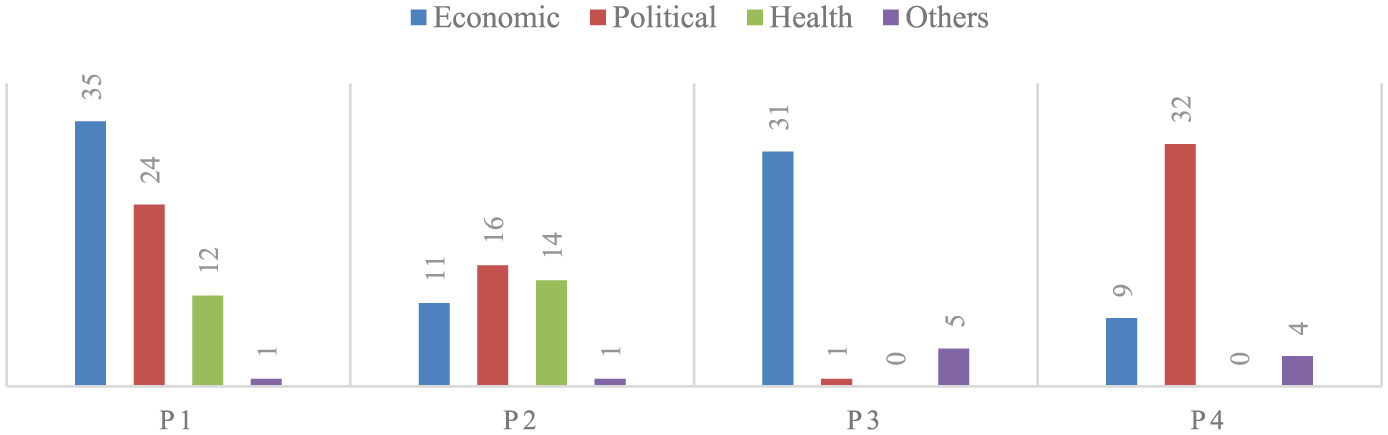
Different types of fears.
The distribution of the different types of fears is consistent with the crises and conflicts TT prefers to represent in each period. The dominance of economic, political and health fears in P1 can be attributed, respectively, to the Asian financial crisis, the handover of Hong Kong and the bird flu. The preference for political, health and economic fears in P2 was caused in turn by the Chinese government’s growing control of Hong Kong, the outbreak of SARS and the world trade deal. The dominance of economic fears in P3 resulted from global economic crisis, while the preference for political fears in P4 was primarily triggered by the growing conflicts in Hong Kong. It further confirms that fears have become an interpretative framework through which the events of Hong Kong are cast. It has become ‘a discourse of fear’ in TT’s representations of Hong Kong, and the major impact of ‘a discourse of fear’ is to promote a sense of disorder and a belief that ‘things are out of control’ (Altheide, 2003: 39).
Discussion and conclusion
To sum up, this study has found that the overall representations of Hong Kong in TT are crisis- and conflict-oriented, because it prefers to highlight economic crises, political conflicts and health risks in Hong Kong, and its representations of Hong Kong have become increasingly conflictual and negative in recent years. In addition, TT makes frequent reference to the history of Hong Kong as a former British colony and Hong Kong’s handover in order to establish the solidarity between Hong Kong and Britain, underlining Britain’s duty and moral obligation to protect Hong Kong. It is coupled with the constant reference to the discourse of fear, which helps to amplify and dramatize the disorder and uncertain future of Hong Kong.
These patterns can also be identified in TT’s representations of the ongoing mass protests against the proposed extradition bill in Hong Kong. Among the 32 news articles (24,709 tokens) about this issue in TT, the majority of them focus on the protests and conflicts in Hong Kong, with two news texts on the representations of the nostalgia for the days of British colonialism, and another two news texts on British moral duty to protect Hong Kong. A comparison of the small corpus with the sampler general reference corpus of BNC also finds that among the top 100 keywords, the topic keywords include extradition (114), bill (115), protests (97), law (88), tear (32), democracy (39), protest (36), handover (19), freedoms (20), riot (19), demonstration (24), colony (17), suspension (18), rights (39), movement (32), gas (31), umbrella (16), withdrawal (17), colonial (15), suspended (16), arrested (16), rioting (10) and fear (21). Apart from emphasizing the protests for the withdrawal of the extradition bill and the conflicts between the police and demonstrators, TT also foregrounds the topic of democracy and freedom (i.e. democracy, freedoms), underlining Hong Kong as a former British colony (i.e. colony) and making frequent reference to the ‘discourse of fear’ (i.e. fear) to dramatize the fears of Hong Kong people over the potential effects of the bill.
TT’s representations of Hong Kong, therefore, are influenced by not only the actual conditions of Hong Kong, but, more importantly, British concerns over Hong Kong. As Lee et al. (2002) suggest, ‘news is about the unexpected, the extraordinary, and the abnormal, but it can only be understood in terms of the expected, the ordinary, and the normal’ (p. 2). TT’s representations of post-colonial Hong Kong in the past 20 years can also be understood in terms of the two broad themes identified in British newspapers’ representations of Hong Kong’s handover, that is, ‘the present-oriented uncertain future of Hong Kong’, and ‘the history-oriented nostalgia’ (Cao, 1999). The former can still be perceived in TT’s preference for crisis- or conflict-oriented topics and the frequent reference to the discourse of fear, the latter in its emphasis on Hong Kong as a former British colony and Hong Kong’s handover. Underlying them are the ingrained distrust towards the communist Chinese government, and the belief of Britain’s duty and moral obligations to safeguard Hong Kong’s future. Filtered by the prisms of dominant ideologies, the representations of Hong Kong in TT thus contribute to the reproduction and reinforcement of enduring British values and beliefs.
This study has also demonstrated the benefits of combining CDA and CL, synchronic and diachronic analyses in a CADS study. CL can benefit CDA by providing the efficient automatic processing of large quantities of data with advanced corpus-analytic tools, and suggesting the entry points for further detailed qualitative analysis, so it can be used to test the hypothesis formed through the observation of a small number of texts. CDA can contribute to CL by offering the required concepts and theories for the interpretation and explanation of the results generated by corpus-analytic tools as well as the detailed qualitative analysis of some linguistic features in their specific contexts of use (Morley and Bayley, 2009). The combination of synchronic and diachronic analyses can not only expose the dominant language patterns in a corpus but also identify the distribution and evolution of certain language patterns over time, so it can be more revealing in the explication of the intricate relations between language use and the historical and socio-political contexts.
Footnotes
Acknowledgements
The authors thank the anonymous reviewer and Prof. Tuen van Dijk for their critical comments on an earlier version of this article.
Declaration of conflicting interests
The author(s) declared no potential conflicts of interest with respect to the research, authorship and/or publication of this article.
Funding
The author(s) disclosed receipt of the following financial support for the research, authorship and/or publication of this article: The writing of this article was supported by the National Social Science Fund Project of China (ID No. 17CYY065).