




Abstract
The article discusses work ethos in American ceremonial discourse addressed to the young entering adult life. Its aim is to investigate whether the Protestant work ethic still pervades the American thinking about work. Through a qualitative analysis of the corpus of 100 randomly selected commencement addresses delivered during 2016 and 2017 graduation ceremonies in American universities, it is shown how work-related topics are employed by the speakers celebrating the graduates’ academic achievements and providing them with advice for the future. The Discourse-Historical Approach, committed to Critical Discourse Analysis, has been chosen as a methodological approach, integrating the interpretation of discourses and texts with sociological and historical research, studies on narration, stylistics, rhetoric and argumentation theory. As the discourse to be analyzed is culture-specific, I have decided to combine the Discourse-Historical Approach with Cultural Studies.
Keywords
Introduction
Work constitutes a significant element of everyone’s life. It can infuse our existence with meaning, provide us with satisfaction and enhance our self-esteem. However, attitudes to work and working differ across cultures. The aim of the study is to analyze work ethos in American ceremonial discourse addressed to the young entering adult life, and to investigate the hypothesis that the representation of work in the discourse is a consequence of the Protestant work ethic being still in operation in American society.
Ethos is identified with mores, that is, traditional patterns of behavior and style of life (Sumner, 1906/1940); it can characterize a social group, a nation or ideology. Work ethos refers to the set of beliefs concerning work and its role in human life, held by members of a particular group of people, religious, professional, social, or cultural. It reflects the group’s lifestyle and moral nature in the broadly understood work context.
The data for the analysis come from a corpus of 100 randomly selected commencement speeches (approximately 281,000 words) delivered during 2016 and 2017 graduation ceremonies in American universities and colleges. The random sampling procedure involved two steps. First, Google Search was employed to find transcripts of commencement addresses delivered in 2016 and 2017. Second, the texts to be analyzed were selected from a pool of addresses delivered in the 2 years, respectively.
The Protestant work ethic
The thought of Martin Luther and John Calvin gave rise to the Protestant Reformation and contributed to the emergence of new theologies. It also presented a new attitude to work, later called the Protestant work ethic. The concept was first described by the German sociologist Max Weber, who noticed a correlation between Calvinist doctrines and entrepreneurial attitudes in modern Western society. His main thesis was that ‘man is dominated by the making of money, by acquisition, as the ultimate purpose of life’ (Weber, 1905/2005: 8). According to the Calvinist doctrine of predestination, hard work and frugality were considered a sign of the person’s being predestined to heaven, while unwillingness to work – a sign of the lack of grace (Weber, 1905/2005). The Protestant introduced the concept of ‘calling’ – ‘the idea that the highest form of moral obligation of the individual is to fulfil his duty in worldly affairs’ (Giddens, 2005: xii). They changed the common perception of everyday work: it was to benefit both the individual and the society. The Protestant ethic provided ‘a motivation for hard work’ in the pursuit of success (Hodson and Sullivan, 2008: 20). Success was perceived as recognition by God of one’s moral stance.
The Protestant ethic pictured the ‘ideal type’ of man: one who works hard, and whose main focus is on making profit to support his family and develop economic enterprise. Apart from accumulation of wealth, Calvinists believed in an absence of interest in the worldly pleasures as being in accord with God’s will. ‘The Protestant Ethic man was a model of honest initiative and aggressiveness in business’ (Segalman, 1968: 127). Character traits necessary for ‘the due exercise of an honest calling’ included loyalty, diligence and ‘moderation in the desire of gaine’ (Ames, 1643). Hard work and the possession of the character traits were to guarantee material success which was perceived as a sign of eternal salvation.
The Protestant ethic is believed to have a formative influence on the American economic values and work ethos (Frey, 1998; Weber, 1905/2005). Benjamin Franklin, one of the Founding Fathers of the United States, used to say ‘time is money’, which is considered by Weber to be central to the Protestant ethic of calculation. After the Puritan era, the ethic was secularized; economic success was no longer perceived as a duty to God, but as ‘an end in itself’. The secularized ethic got utilitarian, deprived of the obligation to conform to the divine will. Embodied in Benjamin Franklin’s writings, it made ‘explicit the self-interest that had been implicit in Puritan ethic’ (Frey, 1998: 1574). Although nowadays the Protestant work ethic ‘may have lost some of its hold on Americans’, its elements are retained in many areas of modern American culture (Althen and Bennett, 2011: 2).
Commencement address as a genre
Rhetoric has always been ‘integral to education for citizenship’ (Parry-Giles and Hogan, 2010: 2). Since Aristotle, it has primarily dealt with public address, in which speakers sought to ‘persuade or influence action or belief and thus to impose their own ideas and values on others’ (Kennedy, 1991: 7; Van Dijk, 2014: 143–144). In classical rhetoric, there are three types of oratory: the judicial (genus iudiciale), the deliberative (genus deliberativum) and the epideictic (genus demonstrativum) (Burke, 2014: 26). According to rhetorical genre theory, the epideictic speech is a ceremonial oratory which fulfills a laudatory or vituperative purpose (Reisigl, 2008; Rosenfield, 1980). It is a ‘celebration of communal values and traditional beliefs’ (Braden and Mixon, 1988: 44; Perelman and Olbrechts-Tyteca, 1971). Epideictic speeches perform the educational function: ‘the orator’s praising virtuous acts and blaming vicious acts moves the audience to admiration; . . . the value system of one generation is passed on to the next’ (Sullivan, 1993: 115). In the oratory of praise, the speaker focuses on the virtues of an individual, and on what he/she has achieved (Burke, 2014: 26). Among speeches of this type, we can distinguish commemorative speeches (of a past event); eulogies, in which the person praised is usually dead; wedding speeches and commencement addresses.
Commencement address is a ‘context genre’, defined in terms of its context properties (Van Dijk, 2008: 149). It is a structured verbal chain of coherent speech acts (e.g. thanks, congratulations, compliments, advice and good wishes), uttered by a single person (a high achiever) and addressed to a specific audience (university authorities, graduates and their families and friends) (see Reisigl, 2008: 243). It does not have a determined form and content, but it performs the laudatory, recalling, thanking, congratulatory, optative and teaching functions (Reisigl, 2008: 254–255). Commencement address constitutes the message from the experienced and successful to the young: the speakers share their knowledge and experience with the graduates. Although commencement address is classified as an epideictic genre, it often includes some deliberative elements: almost all commencement addresses involve references to the future, and perform exhorting and dissuading functions (e.g. Don’t choke the future, lift it up (Clinton, 2017b); So go out and make it happen (Barris, 2017)). It is a ‘situated rhetorical practice’ (Zarefsky, 2009: 450) which is performed during the graduation/commencement ceremony, usually on university or college premises. Similar speeches are performed in many cultures, however commencement address is mainly identified with American culture.
The Discourse-Historical Approach
To analyze work ethos in American ceremonial discourse, I have integrated the Discourse-Historical Approach (DHA) developed by Ruth Wodak and her Vienna group (Wodak, 2001; Wodak et al., 2009; Wodak and Reisigl, 2015), committed to Critical Discourse Analysis (CDA), with Cultural Studies (CS) (Barker and Galasiński, 2001; Hall, 1996a, 1996b).
DHA is an interdisciplinary approach which combines pragmatics, ‘sociolinguistics and studies on narration, stylistics, rhetoric and argumentation with historical and sociological research’ (Reisigl, 2018: 45). Discourse is understood as ‘a complex bundle of simultaneous and sequential interrelated linguistic acts, which manifest themselves within and across the social fields of action’. These acts are very often texts which belong to different genres (Wodak, 2001: 66). The social fields of action are segments of social reality which constitute ‘the “frame” of discourse’. Discourse is a multiperspectival concept (i.e. a discourse includes various perspectives on social reality) (Reisigl, 2018). ‘Through discourses, social actors constitute objects of knowledge, situations and social roles as well as identities and interpersonal relations between different social groups and those who interact with them’ (Wodak et al., 2009: 9). DHA is a problem-oriented approach which goes beyond the linguistic dimension and includes the historical, political and sociological dimensions in the analysis and interpretation of a specific discursive event (Wodak and Reisigl, 2015). The interpretation of discourses and texts is integrated with the analysis of four layers of context (Wodak, 2001: 67):
- the immediate linguistic co-text;
- the intertextual and interdiscursive references in the text;
- the extralinguistic social variables and institutional frames of a specific context of situation;
- the broader sociopolitical and historical contexts.
The contexts constitute the cognitive basis of ‘the influence of society on text and talk’. They provide the participants with the common ground, and control discourse production and comprehension (Van Dijk, 2008: 17).
DHA concentrates on five types of discursive strategies: referential strategies, predicational strategies, perspectivation/framing, intensifying strategies, mitigation strategies and argumentation strategies (Wodak, 2011: 49). The latter consist in using topoi (‘“inference warrants” granting the transition from arguments to conclusion’ (Bogdanowska, 2008; Kienpointner, 1991: 46)).
The combination of CDA and CS is justified by the focus on the cultural in the study of work ethos in commencement addresses (see Barker and Galasiński, 2001). The two approaches have a lot in common, for example, both draw important concepts from other disciplines, and explore how meaning is generated through social practices. CS deals with social institutions and practices that shape culture and enable people to acquire values, beliefs and patterns of behavior. The main concept of the field, culture, concerns shared meanings: ‘To say that two people belong to the same culture is to say that they interpret the world in roughly the same ways and can express themselves, their thoughts and feelings about the world, in ways which will be understood by each other’ (Hall, 1997: 2; Van Dijk, 2009: 156–158). The shared meanings are the product of signifying practices, mainly practices of language, through which objects and social practices acquire their meanings (Barker and Galasiński, 2001). The factors having a significant impact on the meaning-making process are said to be material and institutional contexts in which discourse is produced. Thus, drawing from CS can provide answers to questions concerning some choices made by the speakers constructing their identities in front of the audience, giving advice to the graduates and participating in the commencement rituals.
An analysis of work ethos in American ceremonial discourse addressed to the young
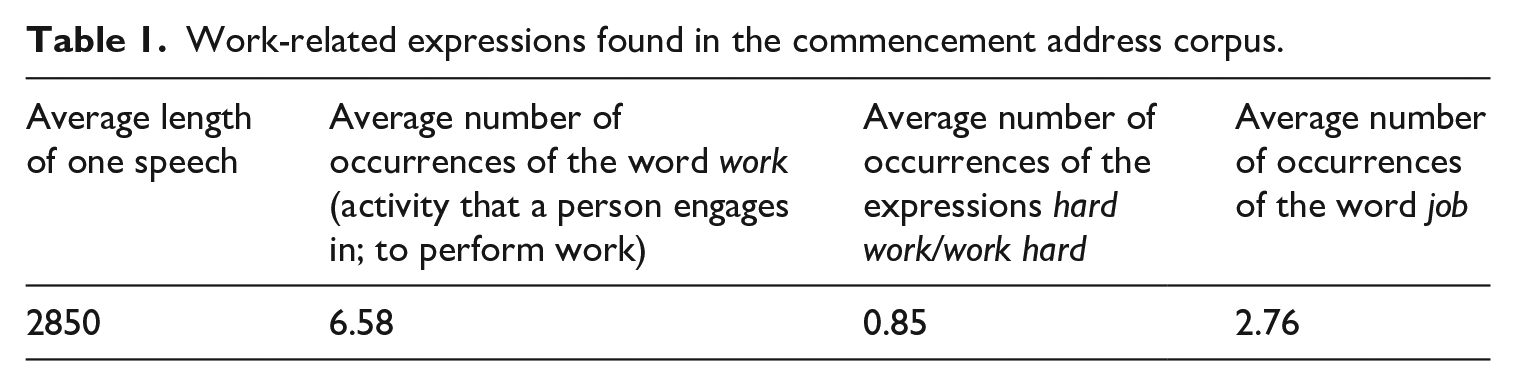
Among the most common topics picked up by commencement speakers is work. Only 5% of the commencement addresses in the corpus do not mention work at all. The remaining 95% stress the importance of hard work in human life, and include references to the speakers’ professional lives and work made in personal narratives commonly used in the construction of personal identities. The popularity of the topic among the commencement speakers is also reflected in the use of work-related expressions (see Table 1).
Work-related expressions found in the commencement address corpus.
The analysis of work ethos in American ceremonial discourse involves the three-dimensional approach (Wodak, 2001, 2011; Wodak et al., 2009). First, the work-related topics have been established. Second, the discursive strategies used by the commencement speakers have been investigated. Third, I have selected the most representative examples of the use of the topics and analyzed linguistic means used to realize the strategies. I have isolated the following recurring work-related topics: (a) hard work: a definition; (b) commitment to one’s work; (c) finding a purpose; (d) working for others/for the common good; and (e) collegiality.
Hard work: A definition
Commencement is the celebration of hard work. Graduation is perceived as a positive effect of studying, which involves hard work. During the ceremony, the speaker symbolically ratifies the graduates’ success. The topos of consequence (‘something follows as a direct result of something else’) is one of the most commonly used ones (Bogdanowska, 2008; Wodak et al., 2009: 41) (1).
(1) Today is a day of celebration. A day to celebrate all the hard work that got you to this moment. (Sandberg, 2016)
The expression hard work is used as an umbrella term for a spectrum of activities resulting in the acquisition of knowledge and experience. As Hillary Clinton (2017a) said in her commencement address, The work never ends. It is present in our life in one form or another (learning, helping, caring for others, changing the world for the better and working professionally). The declarative style typical of commencement address is reinforced by the use of definite articles which make the speech sound objective and non-negotiable (Slavíčková, 2013). (Hard) work is presented as an integral and fundamental part of human life.
The epideictic character of commencement address in stressed by the focus on positive facts (e.g. put a man on the moon; immunized children around the world against polio; and built the Hoover dam) and positive emotions (pride), and by the use of positive attributions (great, positive, satisfying, the best, high, tremendous). Hard work appears to be a source of pride not only for individuals but also for whole groups (nations, citizens of the country, or generations) that joined in some noble enterprise (2). Great projects constitute works done for the common good. The adjective great in this context is intended to mean ‘remarkable in magnitude and effectiveness’, ‘markedly superior in quality, noble’, as well as it is a general term of approval (Merriam-Webster.com Dictionary (2019b)). To justify his argument, the speaker resorts to the topos of force of facts (Wodak et al., 2009).
(2) Every generation has its defining works. More than 300,000 people worked to put a man on the moon – including that janitor. Millions of volunteers immunized children around the world against polio. Millions of more people built the Hoover dam and other
In (3), the topos of definition is employed, which is based on the following argumentation scheme: ‘a person or thing designated X should carry the qualities/traits/attributes consistent with the meaning of X’ (Wodak, 2011: 44). Although work does not always bring about a desired effect, work as such is perceived positively, as something indispensable for human condition. Making wrong choices, or failing, is human; but at least it is a proof that the individual is doing something, which is what is expected. It is doing nothing that is unacceptable and brings shame to the individual. To bring out the contrast, the speaker uses antithesis in the form of two parallel structures. Failure gets a positive attribution; it is depicted in terms of the metaphor FAILURE IS A BADGE OF HONOR (Bogdanowska-Jakubowska, 2018).
(3) You try this, it doesn’t sound so good. You try that, it comes out worse. There’s
In the majority of addresses in the corpus, there are recurring references to hard work as a means to a desired end (4–5). The speakers employ the topos of ‘you can’t have one without the other’ (Wodak et al., 2009: 41). In other words, if one works hard, one can achieve a desired effect (e.g. a university diploma, the title of Time magazine’s Man of the Year; or more generally, success, glory or happiness). The metaphor HARD WORK IS A WAY TO SUCCESS is one of the most frequently used HARD WORK metaphors.
(4) Alright. So let’s get to the commencement part of this. First, to the graduates: You (5) David Ho whose
Commencement speakers frequently quote eminent individuals, for example, figures from American history, distinguished thinkers, scholars, or politicians. A frequently employed topos is the topos of authority (‘if one refers to somebody in a position of authority, then the action is legitimate’) (Wodak, 2011: 44; authorization legitimation in Van Leeuwen and Wodak, 1999: 104). The epitome of the Protestant work ethic is the quotation of Theodor Roosevelt’s words on the role of worthwhile work in man’s life, which come from his Labour Day speech delivered in 1903 (‘Far and away the best prize that life has to offer is a chance to work hard at work worth doing’. (Offerman, 2017)). This intertextual reference constitutes a piece of indirect advice for the graduates to take a similar perspective. The metaphor HARD WORK IS THE BEST PRIZE THAT LIFE HAS TO OFFER reflects a positive attitude to work; there is an accumulation of expressions with positive connotations, such as best, prize, chance, worth. In (6), references to famous high achievers, such as Thomas Edison, Frederic Douglass or Samuel Goldwyn, are to legitimize the speaker’s arguments for hard work. In Edison’s quotation, both opportunity and work are personified: HARD WORK IS AN UNATTRACTIVE PERSON. In Douglas’ words, the topos of definition is used. Work is again associated with positive attributions. In Goldwyn’s words, the topos of consequence is used. The metaphor HARD WORK IS A KEY TO HAPPINESS is expressed by means of the correlative construction. This metaphor is once again employed at the end of the excerpt; this time the use of the topos of authority does not involve any particular person, but the indefinite construction having a vague reference is used (Scholars on the topic of human happiness). Similarly to Puritans, American high achievers perceive success not only in pecuniary terms, but also as a source of well-being and a result of self-perfection. The qualifier more in the sentence There is more value . . . triggers the following presupposition to appear: ‘hard work brings value’. Besides hard work, resilience is another trait which identifies high achievers (sustained effort, overcoming difficulties and dealing with setbacks).
(6) But nothing will improve your odds more than the characteristic that got you into this auditorium today. Ask the great achievers of history, like our greatest inventor, Thomas Edison: ‘Opportunity is missed by most people because it is dressed in overalls and looks like
As has been mentioned above, one of the main functions of the commencement address is to give advice. It often involves the use of direct speech act realization patterns, deontic modals (must, should) and imperative clauses. In (7–9), the speakers employ the topos of definition and use the metaphor HARD WORK IS A WAY TO PERFECTION/SELF-IMPROVEMENT (the best YOU that you can be; to excel in whatever they do). However, they present hard work from two different perspectives. In (7), perfection/self-improvement involves vertical movement (live up to), and the focus is on the individual’s freedom, abilities (defiantly empowered), independence (standards you’ve set for yourself) and hard work. The colloquial expression work like hell, in which like hell functions as an intensifier, is to give emphasis. In (8), perfection/self-improvement involves horizontal movement (work hard at everything), and the focus is on the action (work) performed by the individual in different areas of life. Here hard work is perceived in accordance with the Protestant work ethic: everyday work should benefit both the individual and the collectivities (e.g. members of the family, the community or the society). In the excerpt, the pronoun you is an example of cataphora: the more specific expression is used at the end of the last sentence.
(7) You can and must decide to be defiantly empowered, to live up to the standards you’ve set for yourself, and to (8) Don’t just work hard at your job;
In (9), the situation is framed differently, as the speaker is not only an invited commencement speaker, but also a member of the faculty. He uses the addressee-exclusive we (faculty, university authorities; Van Dijk, 2008: 170). Usually, the verb work is used intransitively, and the graduates, the speakers, are presented as agents performing the action. Here, students are patients of the transitive verb work, which is used to stress the important role of the external force (university teachers) in students’ success. The speaker uses the topos of consequence. The two sentences following the question include clauses of reason. The metaphorical meaning of the excerpt (HARD WORK IS A WAY TO PERFECTION/SELF-IMPROVEMENT) is emphasized by the use of intensifiers (hard, harder, high, tremendous) and the verb excel, whose meaning includes the element of intensification.
(9) Is CBS harder than your other school? It is, because we hold our students to very high standards and expect them to learn a tremendous amount. And we make no apologies for
One of the traditional values cherished by the white Anglo-Saxon Protestants, who brought the ideas of Puritanism to America, is family. The idea is echoed in (10). Giving advice-warning to the graduates, the speaker employs the topos of threat, which can be paraphrased by means of the following conditional: ‘if specific dangers or threats are identified, one should do something about them’ (Wodak, 2011: 44); and the topos of comparison: happy life versus unhappy life. The potential future danger is referred to by means of the negatively connotated expression the trap. In the ‘unhappy life’ image, work is referred to in sports terms: it is a means of winning the race/competition and getting the prize (You have reached the glory of the finish line (Offerman, 2017)); it is compared to the racetrack (The metaphor WORK LIFE IS THE RACETRACK is commonly used in everyday life). The positive (respecting your loved ones with the gift of your time, your presence and your full attention) and negative attributions (your home like the pit stop) are employed to draw two contrastive images of life.
(10) As you begin careers that will be challenging and even enthralling, some of you may fall into the trap of treating
Commitment to one’s work
Another work-related topic is commitment to one’s work. In (11), the personal narrative in which the speaker describes the beginning of his professional career is used as argumentum ad exemplum, employed to legitimize his argument, that one’s great commitment and positive attitude to one’s work can result in professional success. He employs the topos of reality, which ‘tautologically infers that as reality is as it is a particular action should be performed’ (Wodak, 2011: 44). A positive attitude, or even a strong loving emotion, helps the individual to deal with adversity (a one-semester visiting gig; with zero job security). The intensifying expression like a madman is used to describe his performance of work duties, while the clause loving every minute of it – his strong commitment to his job. The speaker, like many others, resorts to what Fairclough (1995: 19) calls conversationalization, which consists in the use of ‘discursive practices of the private sphere’ in public discourse and is often associated with informality, increased openness and democracy. The use of colloquial expressions (e.g. cling to the position, work your tail off, get your foot in the door, stick with it), and a style more informal than expected on such an occasion are to help establish a good relation with the audience. The use of the variation of the common phrase (live happily ever after), which constitutes an interdiscursive link with fairy tales, implies a happy ending.
(11) I finally emerged, like a hibernating locust clutching a PhD, but the best I could do on the job market was
In (12), the description of the graduates’ commitment to their studies constitutes part of the congratulations and acknowledgement of their effort. Directly addressing the graduates, the speaker performs a decomposition of their commitment, enumerating its components: unyielding determination, sacrifice and a whole lot of hard work, and by saying amen, she expresses solemn ratification and hearty approval of their achievement (cf. Merriam-Webster.com Dictionary (2019a)). The use of syntactic parallelism and the rhetorical figure of the two/four elicits acclamatory reactions of the audience (cf. Reisigl, 2008). In a similar direct address to the graduates (13), the speaker takes a broader perspective: graduating is not the culmination but only a stage in the process of ‘building a better future’. What is more, their commitment is not only founded on an individual desire to succeed but also on willingness to make the world a better place.
(12) [G]raduates, no matter where your journey started, you have all made it here today through the same combination of (13) Morgan State University Graduates of the class of 2016: your diplomas, as Regent Chairman Mfume said, are not simply recognition of completed coursework, they are the fruits of your faith in yourselves – testimonies to
Yet a different perspective is taken in (14), when the speaker acknowledges not individuals’ commitment to their studies and work, but the university’s commitment to public service, epitomized here in the Wisconsin Idea, that is, ‘the boundaries of the University are the boundaries of the state’ (Encyclopaedia Britannica, 2019). Generally, willingness to devote one’s time and energy to something one believes in, or dedication to some noble cause, is often presented as a way to succeed in whatever one intends to achieve.
(14) [E]ven though I only spent about a year here, I got to see how the Wisconsin Idea isn’t just a motto, it’s
Finding a purpose
Many commencement addresses still echo Protestant theologians’ truths on the importance of vocation or calling in an individual’s life (e.g. a call to keep working toward change (Baron, 2017)). Today, however, calling is rather a profession, or a strong inner prompting to a particular course of action, devoid of any divine influence. It has a solid rational foundation – knowledge and skills acquired at university. Working toward change can be both a calling to work for the common good – an implied change for the better, and an opportunity for the individual to achieve success in whatever he/she intends to do. In many commencement addresses, university is personified – providing students with much more than knowledge and skills – giving them moral support and advice for the future. In (15), the speaker uses the university personification and the intertextual reference to the university motto to depict a beneficial impact of the university – an educational institution – on the young.
(15) This is your legacy, Class of 2017. You will carry it with you – that capacity for finding strength in yourselves and building strength in the people around you. Virginia Tech
The topic of purpose often appears in personal narratives describing meanders of the speakers’ professional career. In (16), the speaker uses the topos of the superordinate aim (Wodak et al., 2009). In the personal narrative, he describes how he finally found harmony (something clicked; I finally felt aligned), when he found a higher purpose. His strong emotional involvement in the work for the high technology company is visible in the choice of computer-related terminology (click, align), and the positively connotated expressions denoting some kind of superiority: challenging, cutting edge, higher and greater.
(16) And it was in that moment, after 15 years of searching, something
The purpose frequently mentioned involves individual ambitions (get a good job), group goals (put a man on the moon), dreams (technology which didn’t exist yet could reinvent tomorrow’s world) or noble intentions (serve others; make a (positive) change). In (17), the speaker, telling an anecdote, uses argumentum ad exemplum to explain the concept of purpose. Then he defines it in general terms (the use of the generic we) in an explicit way. What the three descriptions of purpose (15–17) have in common is a moral, idealistic and other-oriented character.
(17) The challenge for our generation is creating a world where everyone has
Working for others/for the common good
The main goal of any economic enterprise is self-interest. However, in many of the commencement addresses, there are references to working for the benefit of other people, or working for the common good. They are remnants of the Protestant work ethic in American way of thinking. A frequently employed topos is the topos of advantage and usefulness, which can be paraphrased by the conditional: ‘if an action from a specific relevant point of view is useful, one should perform it’ (18–20). The topos has different subtypes: pro bono eorum (to the advantage of them), pro bono publico (to the advantage of all) and pro bono nobis (to the advantage of us) (Wodak, 2001: 74).
Helping others is more valued than working for self-interest, in which economic success is the main goal. Of course, people who have achieved everything by hard work are more valued than those who have got everything through ascription (e.g. inheritance) (18). Apart from the topos of advantage, the speaker employs the topos of definition and the topos of comparison (including ‘we are superior compared to them’) (Wodak et al., 2009: 38). The excerpt consists of two parallel sentences which serve to emphasize the opposition of ideas (antithesis). The first-person plural possessive pronoun our in the phrase our greatness is a metonymic expression (THE PERSON FOR THE COUNTRY) (Wodak et al., 2009). The use of the pronoun makes greatness a common responsibility. Thus, the word greatness refers to the American people’s marked superiority in character, manifested in hard work, pro bono eorum in particular.
(18) Finally, graduates, our
In (19), the speaker positions himself in the macro-context, and invokes shared American cultural values. Apart from the topos of advantage and usefulness (pro bono publico), to justify his claim he employs the topos of humanitarianism (‘if a political action does not conform with human rights or humanitarian values, one should not perform it’) and the topos of justice (‘if persons are equal in specific respects, they should be treated in the same way’) (Wodak, 2001: 75). The reference to American politicians who fought racial segregation, with whom the speaker wants to be identified, serves the purpose of positive self-presentation (Leary, 1995). There are also references to positive emotions of great intensity felt by the speaker (the greatest pride, forever grateful). The narrative does not make everything explicit. Gratefulness is usually a reaction to some beneficial effects, thus it can be inferred that a small difference was positive. The factive predicate in the sentence I will be forever grateful . . . triggers the presupposition to appear, ‘we made a small difference’. The use of the adverb maybe signals the speaker’s uncertainty and tentativeness, however it does not affect the presupposition. This inconsistency may result from false modesty employed for self-presentational purposes. Switching from narrating to advising, the speaker uses the deontic modal verb can and an imperative; this time, he uses the adjective positive to modify difference.
(19) The job that gave me
In (20), the speaker choses a micro perspective in the personal narrative. Apart from the topos of advantage and usefulness (pro bono nobis), she employs the topos of comparison and the topos of responsibility, which can be paraphrased by the conditional: ‘if a group of people is responsible for the emergence of specific problems, they should act in order to find solutions to these problems’ (Wodak, 2001: 75). The advice for the graduates is preceded by the praise for their skills, abilities and willingness to work for the common good. It is reinforced by the invocation of the values of the university. The explicit advice (the use of imperatives) is followed by argumentum ad exemplum, employed to legitimize her arguments. An intertextual reference to the slogan is used to show the actual implementation of the idea of pro bono nobis. The change of perspective is reflected in the pronoun use: in the advice the pronoun you refers to the graduates; in the example it is used generically.
(20) If anyone can do it, you can, because Berkeley is filled with people who want to
The work for the common good involves thinking broadly, in terms of impact on the world (Obama, 2016a); and making a change which would positively affect many people (e.g. Please work to remove the soul-destroying influence of money. Please work to make this democracy truly democratic. (Adichie, 2017)).
Collegiality
One of the great paradoxes in American culture (one of the most individualistic cultures) is that Americans highly value teamwork and collaborative effort as a way to achieve success. In (21–24), the speakers use the ‘sugarcoated world’ topos, a special form of the topos of consequence (‘pointing out positive consequences of a propagated action’) (Wodak et al., 2009: 41). The excerpts employ a number of persuasive devices: deontic modality (Everyone should make en effort to be inclusive. . .) (21); a correlative construction (the more we say ‘we’ and the less we say ‘I’, the further we go) with the pronoun we used generically (22). A similar idea is expressed in (23), where the speaker uses the addressee-inclusive we, identifying with the graduates; and in (24), where the speaker makes an assertion whose main function is to legitimize the direct advice she gives to the graduates in the following sentence. All the excerpts are didactic in tone, perhaps apart from (23), which can be explained by the small age difference between the speaker and the graduates. The didactic tone is most vivid in (25), in which the speaker makes references to the tradition and symbol of the place – the State of Utah (locus amoenus – the topos of the pleasant place). Here the metonymy PLACE FOR ACTIONS is used: the symbol of Utah, beehive for cooperative work. It is followed by a sequence of imperative sentences, which reinforce the didactic tone of the fragment.
(21) (22) If there’s a secret to success beyond hard work and good luck, it’s that (23) Our generation will have to deal with tens of millions of jobs replaced by automation like self-driving cars and trucks. But (24) Inspired (25) Utah, as you see on the seal, as you know, is the beehive state. The beehive state for
Discussion and conclusion
Results of the study may be assessed as reliable only if the data which have been analyzed are properly selected, and the theoretical framework is well adjusted to the data and suits the aim of the research. Due to the use of the two-step compilation procedure, the corpus of commencement addresses seems to be representative and not biased. The employed combination of DHA and CS has proved to be a good method for analyzing discourse reflecting the culture in which it is produced, investigating aspects of context surrounding the issue of American work ethos, and identifying rhetorical strategies and linguistic devices used in this type of oratory.
The first point to note is that the qualitative analysis of the corpus of commencement addresses seems to prove the hypothesis that the representation of work in the discourse is a consequence of the Protestant work ethic being still in operation in American society. As has been already mentioned, after the Puritan era the ethic was secularized. Nowadays, it constitutes an integral element of the mainstream American culture. The analysis seems to confirm it: the ethic in its secularized form pervades the way the commencement speakers speak about their lives and work, irrespective of their religion. The analyzed excerpts echo the main tenets of the Protestant work ethic (e.g. concerning the role of work in the man’s life; hard work as a way to success; strong emotional commitment to one’s work; the importance of vocation; working for others and for the common good). However, the work ethos in the analyzed discourse differs from the one propagated in the Protestant work ethic in some respects. Achievement of economic success is not perceived as a duty to God, but to oneself, one’s family and community. Self-interest is made explicit. Modesty in accumulation of money is no longer required. Leisure and entertainment are acceptable parts of life.
(Hard) work is presented as a positive value. As a motif, it appears in three main parts of commencement address: the celebration of graduation, the construction of the speaker’s identity and the advice for the future given to the graduates. References to (hard) work can be found in a great variety of acts, for example, congratulations, compliments, favorable comments, expressions of gratitude, advice and good wishes instilling in the graduates hope for future. Work references perform different functions: the commencement speakers refer to work to legitimize their qualifications as a role model (e.g. in personal narratives), or to establish a relation with the graduates (e.g. employing humor).
As the analysis of the corpus has revealed, speaking about (hard) work the commencement speakers most frequently employ three discursive strategies: referential strategies, by which (hard) work is represented, through such tropes as metaphors, metonymies and personifications; predication strategies – work is characterized through evaluative attributions of its positive traits; and argumentation strategies, through which the attributions are justified. To support their arguments speakers employ topoi (e.g. the topos of definition; the topos of consequence, and its special form – the ‘sugarcoated world’ topos; the topos of ‘you can’t have one without the other’; the topos of authority; the topos of comparison; the topos of the superordinate aim; the topos of advantage and usefulness).
Although commencement address has a special place in American academic tradition, both as a genre and as part of the graduation/commencement ritual, it cannot be treated as fully representative of American public discourse. Therefore, to get a more detailed picture of work in American public discourse and to find the answer to the question if the Protestant work ethic is still in operation in American culture, it will be necessary to analyze different sets of data (e.g. political speeches, newspaper articles, interviews) and discourses addressed to a greater variety of audience.
Footnotes
Declaration of conflicting interests
The author declared no potential conflicts of interest with respect to the research, authorship and/or publication of this article.
Funding
The author received no financial support for the research, authorship and/or publication of this article.