



Abstract
International education is impacted by multiple discourses, in particular the discourse of university as an educational institution responsible for producing and curating knowledge for the public good, pursuing truth and transforming student life, and the neoliberal marketing discourse which portrays the university as a business organization providing a service for international students as customers/consumers. Following a multimodal discourse analytic perspective, this study examines ‘Why Choose’ webpages of one British and two Australian universities to identify how the apparently conflicting higher education and neoliberal marketing discourses are managed in the interdiscursive space using language, images and videos. The results reveal that ‘Why Choose’ webpages are hybrid texts where the discourse of higher education is upheld in relation to the neoliberal marketing discourse through multimodal strategies of accentuation, infusion and progression. The study argues for the necessity of undertaking a multimodal discourse approach to understand how various positions are negotiated interdiscursively in online media.
Introduction
Discourses about international student education have been a topic of discussion for years. In particular, the neoliberal discourse of international education as a service trade for international student consumers (e.g. Lewin-Jones, 2019; Rizvi, 2011; Tight, 2019) has been discussed as competing with discourses which position the university as an educational institution which aims to maintain the tradition of serving the public good, transforming students, and pursuing intellectual knowledge and truth (e.g. Askehave, 2007; Natale and Doran, 2012; Zepke, 2018). As these discourses derive from different social and professional practices – education and business – it is important to investigate how they are managed by universities, in this case, on their websites.
University websites have become complex texts, transforming from relatively simple texts conveying essential information to staff and students in earlier days (Tomášková, 2015; Zhang and O’Halloran, 2013) to increasingly complex multimodal texts serving multiple purposes (O’Halloran et al., 2015). While previous studies on university websites and webpages have offered valuable insights into the nature of university communications, webpages which provide information about why students should choose one university over another have not been the focus of study so far. With this in mind, we analyse the ‘Why Choose’ webpages of one British university and two Australian universities from a multimodal discourse analytic perspective, as these webpages for international students are significant texts for understanding the various positions which are constructed in relation to the internationalisation of higher education and the drive to recruit international students in countries such as the United Kingdom and Australia. Our analysis will show that, contrary to prevailing views that neoliberal practices tend to be foregrounded on university websites, ‘Why Choose’ webpages for international students are hybrid texts which manage the discourse of higher education in relation to the neoliberal marketing discourse through multimodal strategies of accentuation (where certain elements are foregrounded), infusion (where different elements are combined) and progression (where elements undergo a transformation from ‘product’ to ‘process’). These multimodal strategies are discussed and illustrated in the analysis of the three ‘Why Choose’ university webpages.
In what follows, we first provide an overview of relevant literature on international student education in times of neoliberal thinking in higher education, university webpages, interdiscursivity in discourse analysis of university public communications, and the research questions that guide this study. We then describe the research design. This is followed by the analysis of data and discussion of the findings, and conclusions drawn from the analysis.
Literature review
Current discourses of international student education
International student education is currently being underpinned by several discourses, in particular the ‘trade discourse’ about international student education (e.g. Lomer et al., 2018; Rizvi, 2011; Waters, 2018). This discourse aligns with neoliberal thinking in higher education which views international student education as a service commodity for trade and international students as customers involved in education for individual gain, rather than for the purpose of transformation, truth seeking and the public good (e.g. Chowdhury and Phan, 2014; Tight, 2019). There has been fierce criticism of this approach on moral and ethical grounds. For example, the neoliberal discourse has been critiqued for failing to ask questions about the purpose of engagement of students in higher education (Zepke, 2018). It is argued that the recruitment and education of international students at Western universities is engendered by a Western supremacy view in which international students are charity recipients or consumers of superior Western knowledge (Stein and de Andreotti, 2016).
Comparative perspectives on international education have shed light on how different political and social goals are reflected in policies and practices in international student education in various countries (Hong, 2020; Ma and Zhao, 2018). Critiques have also been made about the compatibility of the business perspective and practices for university. For example, Marginson (2013) argues that capitalist approaches to business management are conflicting with the inherent mechanisms of university operations.
Reflecting the critical discourses in international student education, calls have been made for international student education to orientate to collaborative knowledge production (Rizvi, 2011; Ryan, 2011). According to Arkoudis et al. (2012), international students can be capitalised on to internationalise the education for both international and local students. Also, to educate international students, it has been proposed that Western universities need to consider the different knowledge traditions their international students have been initiated into (Ndhlovu and Kelly, 2020). Ogden et al. (2014) envisage a transcultural education where both international students and their universities have roles and responsibilities to undertake in order to achieve reciprocity or mutual benefits.
There is also an emphasis on international students’ agency and reflexivity in recent research on international student education (Kettle, 2021). To productively engage international students, Kettle (2021) suggested that universities and staff need to listen to their international students’ voice and act responsively. This emphasis is akin to asking for a return to the fundamentals of university, that is, to promote the public good, generate knowledge and transform people (Natale and Doran, 2012), not only in higher education for domestic students, but also in international student education. At a time of unprecedented challenge for international student education, amid the COVID-19 pandemic and counting forces of globalisation, universities and students alike are forced to rethink the purposes, goals and approaches to international student education for the sustainable development of the higher education sector (Stein, 2017; Tran, 2020).
University webpages for multiple purposes
University public communications including university websites, handbooks and prospectuses for international students are important texts in international student education. Studies of university prospectuses indicate a tendency of such texts being marketing discourses (e.g. Askehave, 2007; Ng, 2016). In addition, university public communications are becoming increasingly multimodal (e.g. Tomášková, 2015). Linguistic texts, and increasingly visuals and videos, are used to represent, construe and index marketing and promotion intentions and functions, for example, university as a lifestyle and experience (O’Halloran et al., 2015).
University websites are often reported to be contaminated by neoliberal practices in the world of economics, thus sacrificing the tradition of valuing education per se in exchange for marketing outcomes. For example, marketing the lifestyle rather than academic studies to attract the student-client/consumer is viewed in this light (Gottschall and Saltmarsh, 2017). However, as repositories of multiple webpages, university websites are complex, typically including a host of other landing webpages for various audiences. This study focuses on the ‘Why Choose’ webpage for international students because this site has the distinct purpose of presenting the reasons for choosing the university as the destination of choice for study abroad. This purpose distinguishes this webpage from other university webpages or print prospectuses, thus opening up various challenges for universities. That is, universities may need to speak to the market forces but, as organisations distinct in their tradition and values (Marginson, 2013), they need to maintain these traditions while distinguishing themselves from other higher education institutions and commercial organisations.
Current discussions of engagement of international students seem to gravitate towards treating international students as objects, for example, promoting an employable identity or lifestyle in neoliberal societies to them. They are seldom treated as subjects who are able to make reflexive deliberations (Kahn, 2014; Zepke, 2015). What makes ‘Why Choose’ webpages interesting for this study is that they construct texts which are accompanied by videos of students relating their lives and experiences at the education institution, which may align or contradict universities’ constructions of themselves and their students. An examination of these multimodal constructions and how international students themselves experience and respond to these constructions on ‘Why Choose’ webpages is highly relevant at a time of uncertainty and change in international student education.
Interdiscursivity and management of discourses
Interdiscursivity is a valuable concept for analysing the management of multiple discourses. Fairclough (1993) is often attributed to having initiated the use of this concept in studies of social practices. This concept has also been applied and further developed by Bhatia (2017), who defines interdiscursivity as the appropriation and hybridity of different discourses, genres, modes of communication, and practices for achieving the purposes of professional communication. The concept of interdiscursivity has informed the study of university publications (e.g. Teo and Ren, 2019), which have demonstrated the co-existence of multiple discourses in the construction of multimodal texts, for example, policy and promotional discourses (e.g. Feng, 2019). Interdiscursivity offers an appropriate tool for analysing ‘Why choose’ webpages which are complex multimodal texts. The complexity arises due to the need to respond to multiple purposes attributed to university webpages, for example, marketing for student and staff recruitment and displaying institutional identity (O’Halloran et al., 2015), addressing universities’ organisational goals such as aspirations for excellence and sustainability which make them similar to other business organisations (Giannoni, 2018) as well as universities’ tradition as educational institutions (Natale and Doran, 2012; Zepke, 2015). By using the perspective of interdiscursivity, we are prompted to ask how these different discourses involving business goals and academic traditions are managed in the communication space of the webpage.
Research using the concept of interdiscursivity often uses genre analysis. For example, Askehave (2007) identified the genres in university prospectuses and described their generic structure and lexicogrammatical features. This is useful as the linguistic features are clearly described through the genre analysis conducted on the texts. For our purpose, however, as interdiscursivity concerns diglossia in communication, the concept of engagement, as defined by Martin and Rose (2007), is used instead. From this perspective, engagement refers to the positioning and articulation of self in relation to the other in communication. Engagement may be achieved through a number of linguistic resources, for example, reporting voice, modality, polarity, concession, and causality. Engagement, however, does not rely only on linguistic features. Multimodal features such as gaze, camera angles, colour, layout and framing also contribute to engagement. For example, compositional features such as the top-bottom, left-right arrangement on the page, can cause certain elements to stand out to make them more salient and endow them with specific informational values (Kress and van Leeuwen, 2021; van Leeuwen, 2011, 2020). Linguistic and multimodal resources combined are therefore useful analytical tools for identifying different discourses and the way they are introduced on the ‘Why choose’ webpage.
This study is guided by the following three research questions:
What reasons are provided by the universities to encourage international students to choose them as their destination university on the ‘Why Choose’ webpages?
How do the universities position international students in relation to these reasons through engagement resources on the ‘Why Choose’ webpages?
How are international students portrayed in response to these reasons in the accompanying videos on the ‘Why Choose’ webpages?
Methods
Data
The data for this study comes from a wider corpus of studies on university webpages for international students (e.g. Zhang and Tu, 2019; Zhang et al., 2020). In this study we focus on the ‘Why Choose’ webpages of one British university, the University of Liverpool 1 (UOL), and two Australian universities, Curtin University 2 (Curtin) and the University of New England 3 (UNE). Although the three universities are not ranked among the top 100 universities internationally, they enjoy certain prestige domestically and internationally. UOL, for example, is a member of the Russel Group universities in the UK and among the top 200 universities internationally. Likewise, the two Australian universities are not among the top ranked universities domestically or internationally. However, Curtin has a long history as Australia’s first university of technology, and UNE is the oldest university in regional Australia. As the prestige of universities may impact on the way internationalisation is discursively handled (e.g. international student education being marginalised in prevailing discourses at non-elite British universities (Lewin-Jones, 2019)), we selected three universities of considerable prestige each enrolling a sizeable number of international students to investigate how they manage the multiple discourses of international student education on their ‘Why Choose’ webpages.
The webpages were captured using the FireShot screen capture software on 17 July 2020 and 17 May 2021 respectively, originally for the consideration of detecting any possible impact of the COVID-19 pandemic on the universities’ communication with their international students. No difference was detected, which means that the universities have kept this theme page consistent despite the global impact of the pandemic.
Methods of analysis
In this study we follow a content analysis approach by identifying text themes and photographic themes (de Groot et al., 2006). In this approach, text themes are derived from clusters of words and expressions that point to a concept of relevance to the professional communication under question. Similarly, photographic themes are a set of visual features in the images which realise particular concepts. The three university webpages and embedded videos were inductively coded to identify the text and photographic themes. These themes were then compared with the literature on university marketing, for example, Gray et al.’s (2003) student-reported criteria for choosing an overseas university including ‘learning environment’, ‘reputation’, ‘graduate career prospects’, ‘image of destination’ and ‘cultural integration’, as well as Gatfield et al.’s (1999) student-reported criteria for quality including ‘academic instruction’, ‘guidance’ and ‘campus life’. The themes identified were also related to research on the traditions of university (e.g. Askehave, 2007; Natale and Doran, 2012) as the discourse maintaining the university tradition. Figure 1 presents a screenshot of the analysed webpages with theme-based text blocks highlighted. An example of the coding scheme for identifying text themes and photographic themes on the webpages is shown in Figure 2. Through this coding and analysis procedure, we were able to identify the reasons the three universities constructed on their ‘Why Choose’ webpages for their international students to choose them as their destination university.
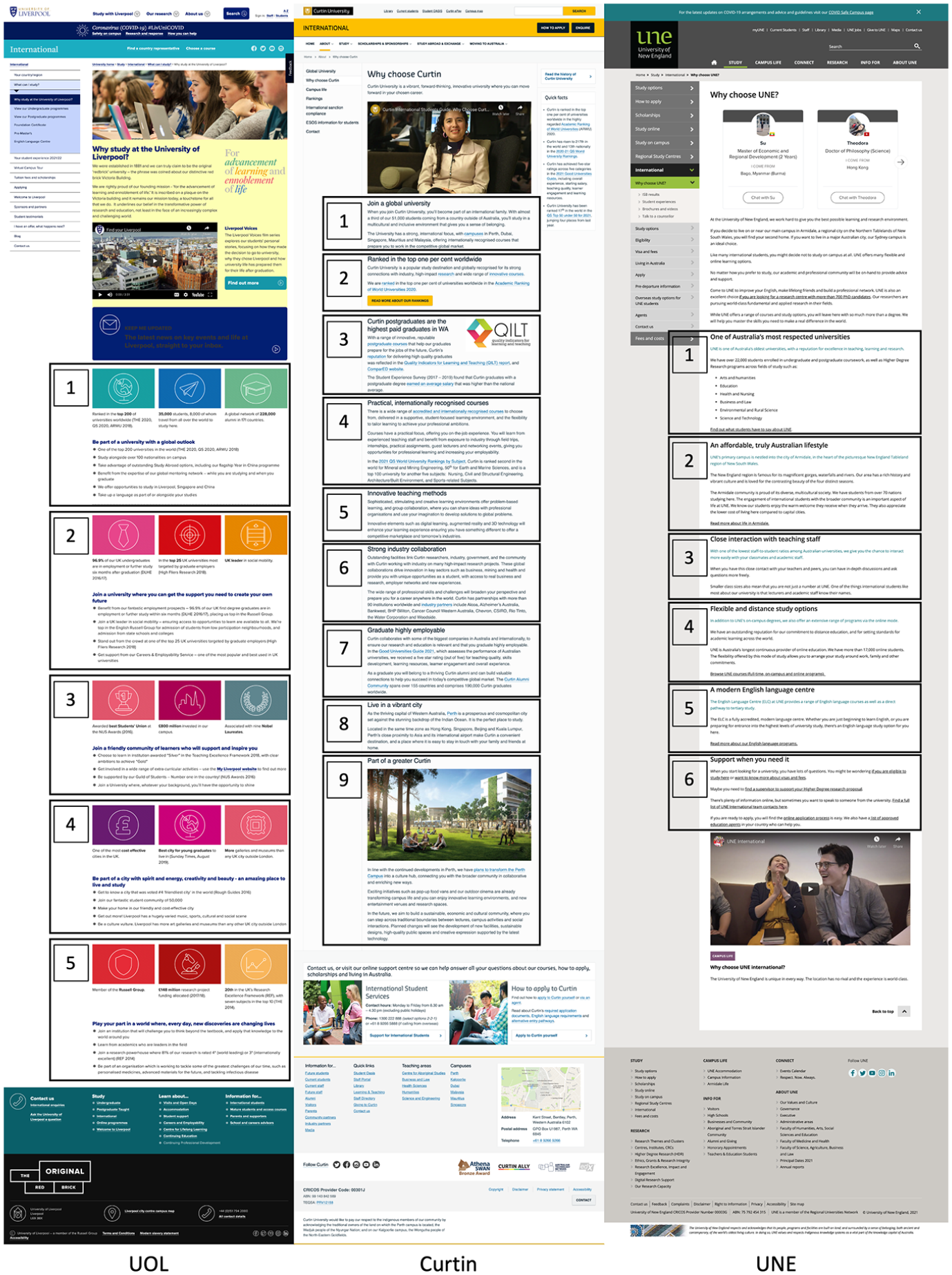
Screenshot of analysed ‘Why Choose’ webpages for international students.
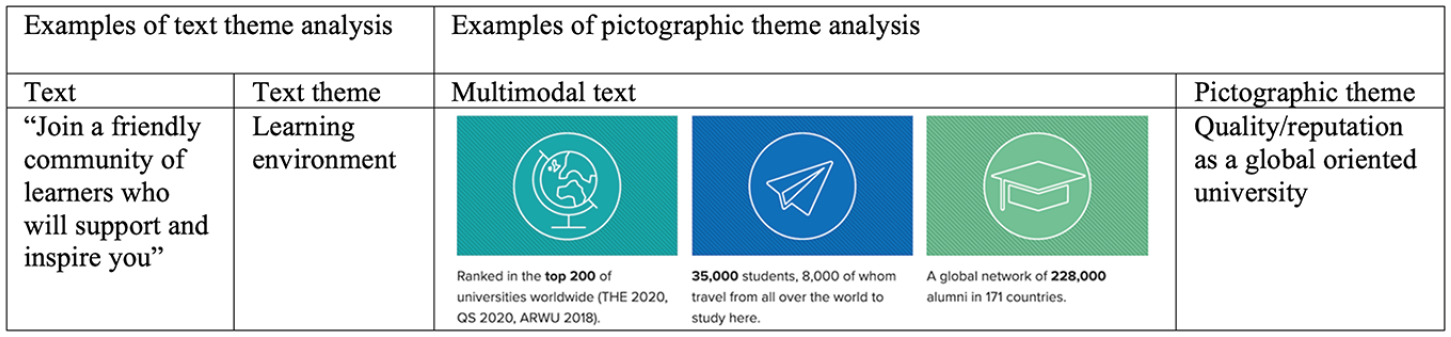
Example of coding scheme for text and photographic theme analysis.
Engagement practices were captured by coding the reporting of the university’s ranking or evaluation by external bodies or agencies, such as the Times Higher Education (THE) rankings, the use of modal expressions (such as will, can), polarity (clause expressing a positive or negative statement), mood (e.g. phrasing a clause as a statement, imperative or question), concession (e.g. clause using words such as even, just, rightly to concede other possible points of view). Causative structure was also coded as a feature of engagement, as in the following example on UNE’s ‘Why Choose’ webpage: ‘We work hard to give you the best possible learning and research environments’. In this example, the university and student roles are explicitly constructed, with the university providing and the student receiving/benefitting from the opportunity to learn and research.
While the coding of the textual and pictographic themes provides insight into the various discourses in use on the webpage, the analysis of engagement practices allows us to describe how the universities construct roles and responsibilities for themselves and their international students in relation to the discourses; that is, what reasons are provided by the universities and how the reasons are to be taken on by (prospective) international students.
The accompanying videos were analysed in similar fashion by identifying common themes and multimodal features of engagement in the voice-over narrative and filmic representations, using Multimodal Analysis (MMA) Video 4 software. The software permits users to make annotations [1] by selecting a particular system choice (i.e. coding feature) [2] from a list of available choices [3] for a range of multimodal resources [4]. All annotations are time-stamped and synchronised with the portrayed action in the video player [5], the film strip [6], the sound and dialogue strips [7] and the transcript of the voice-over narration [8] (see Figure 3 for illustration).
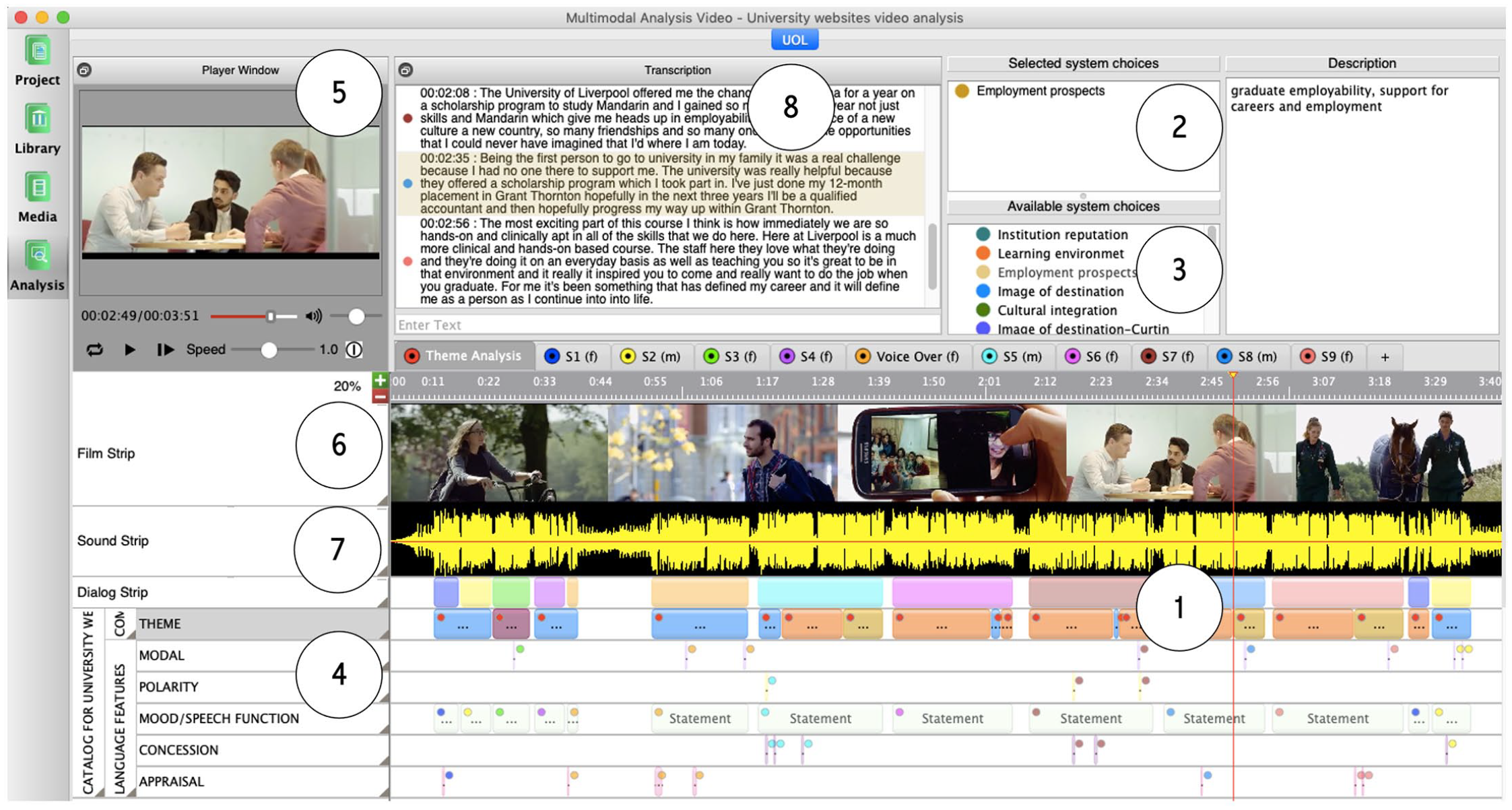
Excerpt of analysis conducted with Multimodal Analysis Video software.
Analysis and discussion of findings
Managing reasons universities give to international students for choosing them interdiscursively
The content analysis of the ‘Why Choose’ webpages yielded a range of reasons the three universities provided to international students for choosing them as the destination university. These reasons and the way they were presented illustrate the universities’ approaches to managing interdiscursivity, in particular the competing discourses of traditional higher education and neoliberal thinking in higher education (see Figure 4 for a comparison of the reasons given by each university and examples of corresponding themes taken up in the accompanying videos). These are detailed in the next two sub-sections.
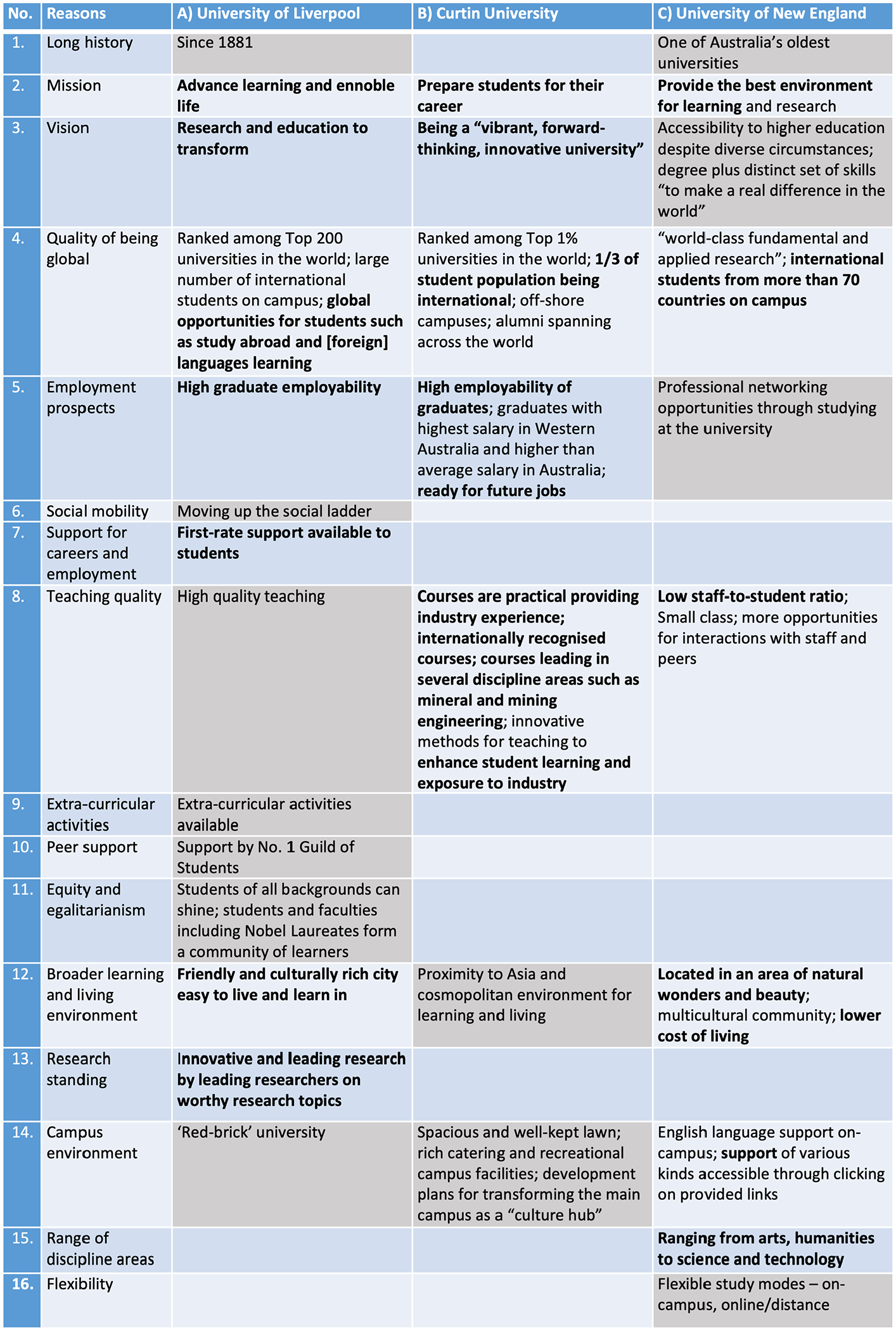
Reasons for choosing each university featured on the ‘Why Choose’ webpages and corresponding themes in accompanying videos.
Themes/reasons featured on the ‘Why Choose’ webpages
On the ‘Why Choose’ webpages, the reasons were clustered to reflect or even foreground different discourses. For example, all three universities include their mission and vision as reasons which invariably encompass learning, research and transformation, even though there exist notable differences between the universities in the specifics of learning, research and transformation each claims to offer. For instance, UOL has the mission of ‘advancement of learning and ennoblement of life’ for not only the individual but also an ‘increasingly complex and challenging world’, while pursuing the vision of transforming life and the world through ‘research and education’. Curtin’s mission has a more practical orientation, that is, to problem-solve through innovation and forward-thinking. UNE offers to make higher education accessible to students and presents the vision of educating graduates to ‘make a real difference in the world’. As learning, research and transformation are advocated to be the core of a Western university (Natale and Doran, 2012), by describing their mission and vision in these terms upfront on their ‘Why Choose’ webpages, the three universities arguably uphold this tradition of university.
Other reasons were clustered around the five factors international students value when deciding on their destination university for study abroad (Gray et al., 2003): Institution reputation (history, recognition in external rankings, range of discipline areas, quality of academic instruction), learning environment (quality of staff in teaching, peer support, extra-curricular activities, campus environment, equity and egalitarianism), employment prospects (graduate employability, support for careers and employment), image of the destination (safe life in the country), and cultural integration (valuing diversity in broader community).
In the case of UOL, below the opening section with the mission and vision descriptions, are five multimodal text blocks (see Figure 1, left), each of which is led by three icons, followed by captions and then a linguistic text. The icons are transparent as their associated meanings are readily available to viewers with some understanding of visual communication (e.g. the icon of an academic hat in text block 1 indicating graduates). The second multimodal text block then portrays possible futures for potential graduates, including further study or joining the white-collar professional workforce (e.g. as suggested by the icon of a tie) akin to Gray et al.’s (2003: 115) ‘graduate career prospects’. For UOL, this also includes the climbing up of the social ladder as suggested by the drawing of a ladder and the explicit caption of ‘UK leader in social mobility’. This future may allude to the mission of ‘ennoblement of life’, indicating the possible intention of infusing the traditional higher education discourse into the marketing neoliberal discourse. It is interesting to note that international students are included in the discussion of social mobility in the UK on UOL’s website.
For Curtin, nine text blocks follow the opening sentence of the ‘Why choose Curtin’ theme page: ‘Curtin University is a vibrant forward-thinking, innovative university where you can move forward in your chosen career’ (see Figure 1, middle). These include three text blocks focussed on the university’s reputation as a quality higher education institution, citing the university’s key strength of offering ‘practical’ internationally recognised courses (text block 4), describing course-and-student goals-commensurate teaching methods (text block 5), and showcasing university and industry connections (text block 6). Another example of Curtin’s marketing practices is that the visuals (images of campus scenes showing a spacious relaxing campus as part of the learning environment Curtin is able to provide; text block 9) complement the verbal messages by conveying a sense of study and life being balanced through laying out text-heavy study-related text blocks above the image of an iconic campus scene at the bottom of the whole webpage.
At UNE, the six text blocks elaborating on the university’s appeal to international students (see Figure 1, right) include reasons of flexibility (in the fourth text block about the on-campus and distance study options) and sufficient support as constituting the learning environment (text blocks 3, 5 and 6, highlighting close student-teacher interaction, English language support, and support and services departments and personnel, respectively).
According to Kress and van Leeuwen (2021) and van Leeuwen (2011, 2020), the compositional value of information arranged along the vertical axis on a page can be interpreted as reflecting the ‘Ideal’ and the ‘Real’. In other words, the Ideal, representing ‘the idealised or generalised essence’ of the information may be found in the upper section of a page or screen, while the Real, placed at the bottom of the page, and contrasting with the Ideal, may present the factual details, documentary evidence, or practical consequences (van Leeuwen, 2011: 677). This is evident in the compositional layout of the reasons on the ‘Why Choose’ webpages of the three universities described immediately above. The missions and visions of the three universities which embed the discourse of the tradition of higher education are presented in the opening paragraph or paragraphs at the top of the webpage, in contrast to the elements of the discourse of neoliberal marketing which are placed at the bottom of the webpage. Metaphorically speaking, the three universities impart the message that the tradition of university is still maintained as the ideal and various student-embodied concerns are recognised as the reality. The two discourses which are often described in the literature as competitive (Natale and Doran, 2012; Zepke, 2015) are shown to be in co-existence on the universities’ ‘Why Choose’ webpages.
What is more revealing is that the three universities are not presenting the two discourses as of equal weight on their ‘Why Choose’ webpages. Using multimodal resources, they tend to give prominence to, or accentuate, the discourse about the tradition of higher education. For example, UOL made its mission statement stand out by displaying it visually saliently through the use of colouring and larger and italic font. The motto ‘For advancement of learning and ennoblement of life’ is eye catching and displayed on the right next to the first two paragraphs as a separate text block of its own, using varied colours to represent key aspects of the mission. The location of the fifth (which is also the last) text block (see Figure 1, left, near bottom; reproduced as Figure 5) on the whole theme page can also be said to enhance the weight to learning, research and transformation as its first and last bullet points explicitly reflect the mission and vision of the university – transforming and ennobling the life of not just the individual but also of the broader community, or public good (Natale and Doran, 2012). That is, elements of the discourse of traditional higher education are infused into the neoliberal marketing discourse and portrayed as the real.
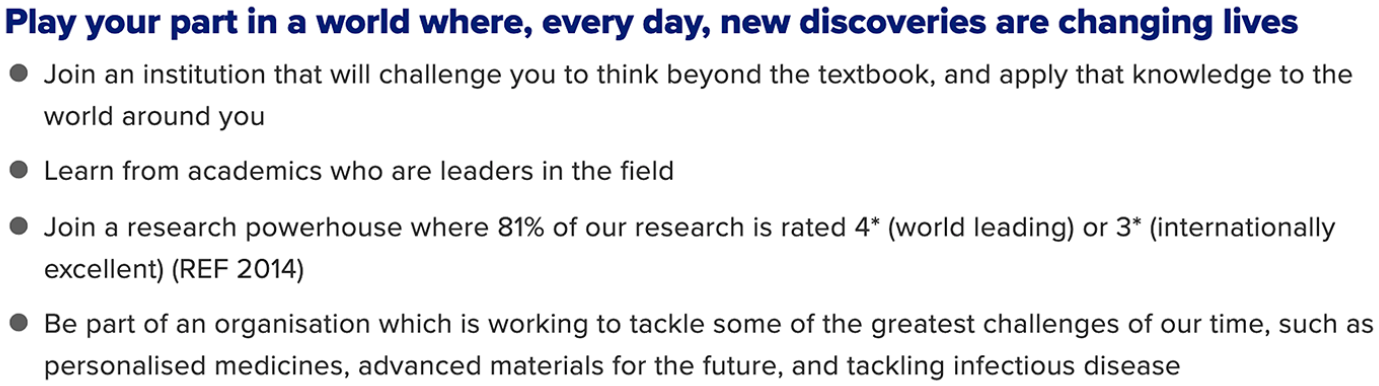
Text block 5 on UOL’s (2021) ‘Why Choose’ webpage.
The compositional layout of the ‘Why Choose’ webpages also incorporates a progression from ‘process’ to ‘product’. On Curtin’s webpage, for example, the text blocks cover both the product (employable and well-paid graduates) and process (conducive learning support and environments) of the Curtin experience. Given that the process of ‘Join a global university’ leads the nine text blocks, there is a sense of progression conveyed from choosing the university, going through the magic transforming process and achieving the anticipated outcome of securing well paid professional life. Therefore, the ideal as stated in the opening statement announcing its mission and vision ‘Curtin University is a vibrant forward-thinking, innovative university where you can move forward in your chosen career’ is not a promise but an anticipation implying action by the students; that is, choosing the university and going through the processes described in the ensuing text blocks. Therefore, international students are not constructed as merely receiving what is on offer by the university. Instead, they need to be agentive even to achieve the individual gain.
In other words, giving prominence to the tradition of higher education on the ‘Why Choose’ webpage accentuates this discourse. By incorporating elements of the mission and vision of the university into the reasons for choosing them as the destination of choice, the strategy of infusion of this discourse into the neoliberal marketing discourse is made apparent. The product presented ahead of, and as a result of, the processes indicates progression, which challenges the prevailing conception that international students are treated as objects rather than agentive subjects, as highlighted in the videos and discussed in the following sections.
Themes/reasons taken up in the accompanying videos
The analysis of the accompanying videos showed that while some of the themes aligned closely with the reasons presented on the universities’ ‘Why Choose’ webpages, others were given less emphasis or excluded entirely from the discourse (see Figure 4). In UOL’s video 5 , for example, which features nine students of different races and ethnicities who provide a voice-over commentary on varied scenes of their experiences of living and studying in Liverpool and UOL, the most predominant themes (in terms of total video time) related to students’ experiences concerning fieldwork, internships, foreign study programmes and research. Their reflections aligned closely with the university theme for its (a) vision (Figure 4, Column A, Row 3); (b) quality of being global (Row 4); (c) employment prospects (Row 5); (d) support for careers and employment (Row 7); and (e) research standing, such as being part of innovative and leading research by leading researchers on a worthy research topic (Row 13). The second most prominent theme for the students related to the university theme concerning the broader learning and living environment, such as Liverpool being a friendly and culturally rich city (Row 12). Other themes that are foreground visually and verbally on the webpage, however, either received scarce mention or were disregarded by the students in the video (see Figure 4).
Like for UOL, the most predominant theme taken up in Curtin’s video, 6 which features three international students pursing postgraduate degrees in Science Project Management and Petroleum Engineering, concerned their experiences regarding coursework and research, and aligned closely with the university theme for (a) its vision of being a vibrant, forward-thinking, innovative university with top-notch equipment and facilities (Figure 4, Column B, Row 3); and (b) teaching quality, specifically practical courses providing an industry experience (Row 8). The second most prominent theme concerned their future career opportunities and aligned closely with Curtin’s themes for its (a) mission (Row 2); (b) quality of being global (Row 4); and (c) employment prospects (Row 5). The three international students featured in Curtin’s video, however, did not seem to be at all concerned with aspects of the broader learning and living environment, or the campus environment foregrounded by the vibrant visual-verbal displays on the ‘Why Choose’ webpage.
Unlike the other two videos, UNE’s video 7 is narrated by an anonymous male representing the university voice. Although international students are depicted in some scenes, as shown, for example, in the thumbnail image of the video on UNE’s ‘Why Choose’ webpage (see Figure 1, right, bottom), they do not speak. Many of the visual-verbal themes in the video reflect those expounded on the webpage. For example, the most prominent theme (accounting for 41% of total video time) aligns closely with the university’s themes related to its (a) mission (Figure 4, Column C, Row 2); and (b) the broader learning and living environment (Row 12). By foregrounding themes related to the university’s location, such as Armidale being a ‘great place to live and study’ (Row 2), full of natural wonders and beauty, and a concomitant lower ‘cost of living’ (Row 12), the video seemed to place emphasis on the neoliberal discourse of marketing the university lifestyle to international students.
Engagement practices and interdiscursivity management
The engagement practices through choices of mood, polarity, modality and causative structure on the ‘Why Choose’ webpages put the onus on both the university and the student in the interaction. Rather than being consumers of education as a service, (international) students are portrayed to gravitate towards the traditional university students as (needing to be) agentive learners.
The mood choice between statement and imperative is strikingly purposeful. The opening section and elaborating multimodal text blocks on the three universities’ ‘Why Choose’ webpages feature statements that inform or imperatives that invite viewers/prospective international students to act: Be informed of the university’s tradition, reputation and values as through the opening section, and partake, join or take on roles of discovering and transforming their lives and the broader world in the subsequent text blocks (see Figure 1). For example, UOL positioned its long history, mission of ennobling life and advancing research, and vision of a transformational experience for its students in statement mood on top of the webpage. From a multimodal social semiotic viewpoint, this information is thus presented as the ‘Ideal’. The remainder of the information on the webpage, which features more specific reasons such as university reputation as an international university, graduate employability and learning environment, is then presented as the ‘Real’. These specific reasons are phrased as actions international students are called on to take, and presented in imperative mood. For example, ‘Learn from academics who are leaders in the field’, ‘Play your part in a world where, everyday, new discoveries are changing lives’. The university experience is not to be taken-for-granted but requires individual effort. Clearly, through the mood choices, the tradition of the university is foregrounded, both verbally and visually. That is, the university adheres to the traditional role of the institution to educate, research and transform both individual lives and the broader world.
Similar to UOL, Curtin University employed a large number of imperatives, including in the section headings such as ‘Join a global university’ and ‘Live in a vibrant city’. For UNE, which seems to prefer statements over imperatives, conditional statements such as ‘If you are ready to apply, you will find the online application process is easy’. present the university’s stance of offering to help and the invitation to prospective students to act actively. Here, the process of transformation is explicitly stated and the student role in the transformation is laid bare. This is contrary to the prevailing view that on university webpages students are typically portrayed as customers/consumers with entitlements (e.g. Gottschall and Saltmarsh, 2017). For all three universities, international students are not construed as recipients, but as agentive doers.
When mood, polarity and modality are examined in tandem, the universities do not allow negotiation with what they claim they provide (by using positive polarity almost all the time and few modals for their statements). However, modal expressions (such as ‘can’ or ‘will’) are used to make room for international students to consider their role in the university-initiated processes of education for learning and life: ‘Join a university where you
‘. . . you
‘Curtin University is a vibrant forward-thinking, innovative university where you
‘When you join Curtin University, you
‘When you have this close contact with your teachers and peers, you
‘. . . you
The use of the modals clearly indicates the roles that are constructed for international students. That is, international students need to take action so that the university provisions can materialise.
The use of causative structure on the webpages of UOL and UNE explicitly lays out the responsibilities of the university (providing the environment and support) and the students (studying). UNE particularly uses the causative structure to construct the student as being assisted or even guided by the university: ‘With one of the lowest staff-to-student ratios among Australian universities, we give you the chance to interact more easily with your classmates and academic staff’. (UNE)
For UOL, students need to take up the chance and opportunity to ‘interact’ and ‘think beyond’ rather than being passive recipients: ‘Join an institution that will challenge you to think beyond the textbook, and apply that knowledge to the world around you’. (UOL)
The university’s stance as being the main actor in this exchange is also reinforced in the accompanying videos. For example, in UNE’s video, the message is constructed by using the first-person plural pronoun ‘we’, and by closing out contrary positions through expressions of positive polarity: ‘
Similarly, the students’ voices in UOL’s and Curtin’s videos echo, and respond to, the university voice projected on its webpage. Here, modals such as ‘will’ and ‘definitely’ function to endorse the authorial stance taken by the university, particularly with a view to the prospective outcomes of a university education: ‘For me it’s been something that has defined my career and it
‘Yeah, I
Consequently, through lexicogrammatical features, including mood, modality, polarity and causative structures, and multimodal resources of engagement, including page layout and composition, the universities showed that they do not attempt to be the omnipresent power but leave room for international students to be agentive, speaking to the traditional emphasis of education as a process and the expectation that students need to work to gain rather than being entitled to the benefits and privileges of the university experience (Natale and Doran, 2012: 188).
Conclusions
The study shows that the three Anglo-sphere universities converge in the strategic management of the multiple discourses, in particular the traditional discourse of universities as institutions of higher learning focussing on learning and processes of transformation and the neoliberal marketing discourse that portrays universities as business organisations providing a service for international students as the customer and consumer. On the one hand, the three universities recognise the playbook for marketing for international education, for example, by mobilising the neoliberal discourse of marketing the university to prospective international students through addressing aspects of university life valued by international students as found in marketing research (e.g. Gray et al., 2003).
On the other hand, the universities also accentuate the traditional values of education and research through manipulating the affordances of multimodal texts, in particular the compositional layout and lexicogrammatical resources. Through spatial design (Ideal-Real layout of the webpage), the traditional education discourse of university is upheld as the ideal and the marketing discourse is represented as the real, which is further validated/endorsed by the students’ voices in the accompanying videos embedded in the webpage. The layout on the vertical axis also indicates a progression from the real to the ideal, suggesting that the university experiences are not an automatic transition or an outcome that can be taken for granted but which require student agentive action to achieve. Elements of the discourse of the tradition of higher education also make inroads into the marketing discourse. For example, traditional education values such as learning, research and transforming personal lives and the broader community are presented as part of the marketing discourse. The lexicogrammatical choices in mood, modality, polarity and causative structure reinforce the message through the visual design.
This study therefore challenges the prevailing discussion regarding the dominance of neoliberal marketing in university public communications. While current research seems to see university public communications as colonised by marketing forces, for example, neoliberal thinking in higher education competing or even conflicting with traditions of higher education (e.g. Fairclough, 1993; Giannoni, 2018; Stein, 2017; Zepke, 2015), this study shows that contemporary universities can manage to maintain their values as an educational institution which set them apart from business organisations (Marginson, 2013), as has been shown on the ‘Why Choose’ webpages. Websites cannot be taken for granted as a monolithic whole. The analysis of university websites needs to take into account the purpose of a specific webpage on the websites, the multiple discourses involved and the availability of the multimodal resources.
This study lends further support to taking an interdiscursive perspective on multimodal university public communications and contributes three strategies that may be employed in coordinating multiple discourses in the same discursive space, namely, accentuation, infusion and progression. These strategies are useful for specifying hybridity in the interdiscursive space (Bhatia, 2017), bearing witness to human creativity in managing conflicting discourses (Bessant et al., 2015). In this regard, the findings of the present study have implications for policy and university public communications. For example, universities may consider giving greater prominence to themes which the universities themselves and students find relevant including learning, education, research, transformation with a view towards future career prospects. Indeed, as suggested by the results of this analysis of universities’ ‘Why Choose’ webpages and embedded videos, the appeal of foregrounding lifestyle at university (e.g. Gottschall and Saltmarsh, 2017; Zhang and O’Halloran, 2013) appears to be undergoing a reversal, which may be an important aspect for universities to reconsider in relation to international student recruitment.
Nonetheless, this study is not without its limitations. For instance, despite the inclusion of student voices in the accompanying videos in this study, it is useful to find out how international students, prospective and current, respond to the ‘Why Choose’ webpages. The theme webpage may also be analysed in comparison or contrast with the homepage or other webpages of the same university and across the universities to fully understand the workings of interdiscursivity on university websites.
Footnotes
Acknowledgements
We would like to thank Carl Jon Way Ng and William Dezheng Feng for their comments on an earlier version of this article.
Declaration of conflicting interests
The author(s) declared no potential conflicts of interest with respect to the research, authorship, and/or publication of this article.
Funding
The author(s) received no financial support for the research, authorship, and/or publication of this article.