




Abstract
This study compares the coverage of coping strategies and emotions portrayed in news regarding COVID-19 by The New York Times in the U.S. and People’s Daily of China via social media. By employing corpus assisted discourse analysis to scrutinize the text corpora, our study uncovered prominent keywords and themes. Findings indicate that a comprehensive range of themes relating to coping strategies was more common in People’s Daily while a relatively smaller number of themes was apparent in The New York Times. In terms of emotions exhibited in the news coverage, positive emotions such as cheer, gratitude, and good wishes predominated in People’s Daily whereas in The New York Times, negative emotions in the form of fears and anxiety were salient. The differences are explained with reference to the political context intertwined with the news environment and prior experiences in handling epidemics, with practical implications.
Introduction
First discovered in Wuhan in China, COVID-19 has spread to countries worldwide, with over 340 million people infected and 5.57 million deaths (World Health Organization, 2022). For the management of new pandemics such as COVID-19, effective communication is vital in informing the public about the health risks and preventive measures (Ngai et al., 2020; Strekalova, 2017; Zhao et al., 2020). Often times, this information is disseminated by public health experts and the government (Shih et al., 2011). However, the public may also rely on mainstream news media outlets to obtain the information as news media is the main medium through which the reality of a health crisis is created for the public (Klemm, 2016). The mainstream news media thus plays a crucial role in a public health emergency by informing the public about how the disease is transmitted, its severity, and the protective measures (Beaudoin, 2007; Glik, 2007; Yu et al., 2011). The critical role of the news media has been recognized by governments, health officials, and crisis communicators (Holmes, 2008; Hyer and Covello, 2005), so efforts have been made to integrate news media in emergency planning and leverage news media as partners in disseminating official advice (Holmes, 2008; Reynolds and Seeger, 2005).
News media organizations increasingly rely on social media platforms to extend their influence. Social media, characterized by its openness and participatory nature (Chen et al., 2020), is viewed by the public as a means to receive updated information and emotional support during crises (Procopio and Procopio, 2007; Stephens and Malone, 2009). This has been evidenced during COVID-19 in which increased usage of social media was seen (Cortese, 2020; Ngai et al., 2020; Zheng et al., 2020). Studies have shown that articles and reports posted by news media were among the most reposted content on social media (Bruns et al., 2012; Palen et al., 2010), serving an important communicative purpose.
Prior studies have indicated that news media content related to pandemics is framed in various ways (Bardhan, 2001; Shih et al., 2008). For example, an emphasis on risk information communication about the new disease alongside protective measures can be presented, which in turn, affects how the public responds to the crisis (Witte and Allen, 2000). Additionally, media coverage on health risks can be disseminated in a different emotional tone with the use of positive and negative emotions (Lakoff, 2004). Emotion-laden language used in mainstream media messages about health risks may affect public perceptions in that negative emotions like anxiety may increase risk perceptions (Biener et al., 2004; Dudo et al., 2007; Loewenstein et al., 2001). Since prevention and protection are of critical importance in stemming a new epidemic, this study focuses on the prevention/protection news frame or mainstream news media that emphasizes coping strategies for the prevention from COVID-19 and emotions exhibited in news messages on social media.
In the studies of coping strategies and emotions pertaining to COVID-19 of certain segments of the population in individual countries (e.g. Huang et al., 2020; Ramos-Lira et al., 2020), no study has yet examined how the framing of coping strategies and emotions exhibited in mainstream news media regarding COVID-19 vary in two distinct cultural and political contexts – that of the U.S. and China. Other studies of news coverage on COVID-19 focused only on one country, for example, an Asian country such as China or a western country such as Spain (Basch et al., 2020; Iglesias-Sánchez et al., 2020; Ngai et al, 2020). Preceding research on new pandemics such as SARS has compared framing of news in the U.S. and China (e.g. Beaudoin, 2007; Luther and Zhou, 2005; Wu, 2006), and therefore, it is deemed that this study would be a worthwhile endeavor to undertake.
As follows, news media frames are posited as theoretical grounds for comparing Chinese and U.S. news coverage and explanations are given for the importance of emotions in news coverage. A contrast between China and U.S. mainstream media COVID-19 coping strategies and presented emotions associated with this news frame on social media is then offered. This paper can shed valuable insights on these nations’ efforts to contain the spread of the new disease.
Literature review
Media framing of COVID-19 coping strategies
News media research has demonstrated that news content is usually not objective but is associated with social, political, and ideological considerations (Shoemaker and Reese, 1996). According to Entman (1993: 52), framing in the media involves ‘select[ing] some aspects of a perceived reality and mak[ing] them salient’. News frames determine the importance of an issue and the way in which the public perceives, understands, and processes the information (Entman, 1993), and frames covering health information affect how the public views the disease (Ziporyn, 1988).
A variety of news frames exist. For news frames on a health crisis – that of HIV/AIDS, six key dimensions on news framing are evident, namely health risk, medical issues, prevention/protection, economic consequences, societal problems, and political/legal issues (Bardhan, 2001). Of the plethora of information covered in news on health crises, crisis response actions/coping strategies are key areas (Bardhan, 2001; Ngai et al, 2020; Pan and Meng, 2016; Shih et al., 2008). Considerable research has found evidence of response actions in helping to contain a pandemic (Kilgo et al., 2019; Pan and Meng, 2016; Shih et al., 2008; Ungar, 1998, 2008). For example, crisis response actions like containment strategies were widely reported in newspaper coverage on Ebola (Kilgo et al., 2019) while the action frame to prevent the virus spread was seen in news media coverage on COVID-19 in China via social media (Ngai et al., 2020). These crisis response actions tie in with the prevention/protection frame of Bardhan (2001) and Shih et al.’s (2008) action frame used for framing health epidemics in The New York Times.
The public expects to receive timely information on how the government will handle the crisis (Xie et al., 2017). Such information can allay fear (Ngai and Jin, 2016) and can be disseminated in mainstream news media. Kilgo et al. (2019) and Ungar (1998, 2008) highlighted that media coverage of response actions is solution-focused, thereby allaying panic rather than inducing panic. Given that prevention and coping strategies are most crucial in curbing a new pandemic, our study examined the content within mainstream news media that focused on coping strategies for the prevention and protection from COVID-19 on social media in the U.S. and China. In view of the challenges brought by COVID-19, country-led coping strategies need to be diverse and multifaceted, varying in types, sectors involved and levels of implementation (World Health Organization, 2020). Such diversity can be reflected in media reporting, manifested as different content themes under the broad frame of coping strategies.
Media coverage of emotions
Apart from focusing on specific content themes, news frames tend to have a tone of voice, such as using fearful or reassuring words (Lakoff, 2004). Thus, media coverage on pandemics can be laden with emotions, which can be alarming in raising risk perceptions or reassuring. Emotions have been viewed as relevant to crises, including positive emotions, namely gratitude, love, and pride (Fredrickson et al., 2003; Lazarus, 1999) and negative emotions, such as anger, anxiety, fear, and sadness (Lazarus, 1999; Ngai and Jin, 2016; Slovic et al., 2004). Previous studies have confirmed that emotions are a key feature of news coverage during a crisis (Chew and Eysenbach, 2010; Goodall et al., 2012; Henrich and Holmes, 2011; Klemm, 2016).
The unprecedented COVID-19 outbreak has huge emotional impact (Kim and Jung, 2021). Negative emotions are often reflected in news coverage on health crises. For example, news videos on COVID-19 were found to exhibit anxiety (Basch et al., 2020) while news reports on H1N1 in 2009 made regular references to fear (Goodall et al., 2012; Henrich and Holmes, 2011; Yu et al., 2011) and adopted an alarming tone (Vasterman and Ruigrok, 2013). The media coverage of avian flu and SARS was alarming too, using emotionally charged wording (Berry et al., 2007; Dudo et al., 2007). Despite a predominance of negativity in news media (Iglesias-Sánchez et al., 2020; Jin et al., 2016), positive emotions in the form of feelings of reassurance and praise are also present; the swine flu virus in Australian newspapers had both reassuring and alarming messages (Holland and Blood, 2010).
Emotions are not just associated with health crises but affect outcomes, determining how the crisis evolves. Researchers have therefore suggested incorporating emotions into crisis communication to promote proper risk judgment, information seeking, and sharing behavior (Finucane et al., 2000; Loewenstein et al., 2001). Studies support this argument in that anxiety tends to activate health information seeking (Turner et al., 2006) while emotion-laden messages are shared faster on social media (Stieglitz and Dang-Xuan, 2013). Additionally, emotions promote the adoption of preventive behaviors (Loewenstein et al., 2001), given that fear and worry about health risks motivate protective actions (Baron et al., 2000; Harper et al., 2021). Further, moral affect in the form of sympathy and gratitude helps foster pro-social behaviors such as acting selflessly for others (Haidt, 2003; McCullough et al., 2001; Schnall and Roper, 2012).
Synthesizing the literature, it is evident that emotions can be either positive or negative and are associated with both positive and negative outcomes in health crises. While negative emotions are beneficial, they are linked to detrimental effects too, for example, excessive fear can be maladaptive (Lin, 2020; Mertens et al., 2020). By the same token, while positive emotions may reduce panic (Covello et al., 2001), having too much optimism may backfire when the public becomes unmotivated to take protective measures (Dolinski et al., 2020). Mainstream news media can allay panic by focusing on solutions, offering praise to those handling the crisis, and highlighting the actions taken to control the health crisis (Kilgo et al., 2019). The emergence of SARS in China generated widespread fear and a range of emotions (Chiu et al., 2003). Similarly, COVID-19 may have an impact on the public’s emotions and the subsequent coverage of news in mainstream news media in the U.S. and China.
Comparative differences between countries in news reporting
Studies have documented the factors affecting news frames (Shoemaker and Reese, 1996), and contextual factors such as cultural values, political influence, and media systems help shape stories produced by news media (Beaudoin, 2007; Hallin and Mancini, 2004; Wu, 2006). This study considers one particular factor impacting news frames: the news environment in different political contexts. In distinct political contexts, namely the U.S. and China, variations in news coverage are identified. Specifically, political factors impact how the Chinese and U.S. news media portray issues and this relates to the nature of the relationship between the news media and government in each nation. In the U.S., news media have played a role as an independent watchdog of the government where challenging the government is not uncommonly seen (Chang et al., 1998) and the government exerts minimal influence on news media (Briggs, 2004) whereas mainstream news media in China often serves as the voice of the Chinese government, aiming to maintain harmony and stability (Beaudoin, 2007; Wu, 2006).
Wu’s (2006) study illustrates how the political context led to differences in the ways Chinese and U.S. news media outlets framed the HIV/AIDS health crisis in China. Xinhua, a Chinese news organization, framed the issue in a positive tone by emphasizing that the government was taking actions to handle HIV/AIDS. On the other hand, Associated Press in the U.S. portrayed the Chinese government in a negative light. Likewise, research on SARS (Luther and Zhou, 2005), which compared the use of news frames in the print version of newspapers (i.e. The New York Times, The Washington Post, People’s Daily, and China Daily), found that Chinese news articles presented different news frames in a positive manner by focusing on actions taken to minimize the economic impact caused by SARS. However, the U.S. newspapers focused on the negative economic impact of SARS and placed responsibility on the Chinese leaders for not handling the disease well. Other research suggests that attribution of responsibility is more commonly seen in U.S. news coverage as opposed to news coverage in China (Beaudoin, 2007; Feng et al., 2012). These differences are attributed to the political contexts in that U.S. journalism promotes an ideology, either liberal or conservative, which is vastly different from China while the Chinese government downplays the health crisis to ensure political stability (Beaudoin, 2007; Wu, 2006). Based on this, it is posited that there might be differences in the way Chinese and U.S. mainstream news media portray the coping strategies and emotions in their news coverage of COVID-19.
The health crisis situations of the above-mentioned studies entailed large differences regarding the impact and severity in two different contexts (i.e., being more severe in China, e.g. SARS). COVID-19, however, is a global pandemic with a high infection rate in both the U.S. and China, so our study offers a unique comparative analysis of the differences in news reporting of COVID-19 across these two distinct contexts. To the best of our knowledge, this study is one of the first attempting to examine the coverage of COVID-19 in two different nations by employing the frame of coping strategies and emotions exhibited in their mainstream news media disseminated via social media. The following research questions are thus articulated:
RQ1: Are there any differences between the U.S. and China’s mainstream news media in the coping strategies communicated via social media?
RQ2: Are there any differences between the U.S. and China’s mainstream news media in the emotions expressed via social media?
Method
Data source and collection
This study selected the posts published by The New York Times’ Twitter (NYT) account (@nytimes) in the U.S. and People’s Daily’s Sina Weibo (PD) account (@People’s Daily) in China for in-depth examination. These news media are reputable, having acquired a large readership and a huge number of followers on social media. The NYT’s Twitter ranked second in the world’s Top 30 Most Followed News Accounts on Twitter (McCabe, 2019; Moon and Hadley, 2014) and PD not only ranks among the world’s top 10 newspapers, but is one of the most followed and visited Sina Weibo site (Ngai et al., 2020). With 43.6 million and 117 million followers respectively, the social media platforms of the NYT and PD are regarded as one of the most followed mainstream news media accounts in the U.S. and China respectively.
For the creation of two text corpora in English and Chinese respectively, all COVID-19 related posts on the NYT’s Twitter account and PD’s Sina Weibo account from 31st December, 2019 to 31st May, 2020 were collected. The date, 31st December, 2019, was set as the initial day of data collection because the Chinese government announced its first confirmed case of COVID-19 in December while the first case in the U.S. was reported on January 21, 2020 in Washington State (Schumaker, 2020). The date, 31st May, 2020, was marked as the end of the collection period with the announcement by the Beijing Institute of Biological Products and China National Biotec Group Co. regarding the invention of the vaccine, offering a resolution for the health crisis. The selected period covered 5 months of social media posts on COVID-19 communication released by these two mainstream media outlets.
Regarding the collection of COVID-19 related posts on the NYT’s Twitter account, we manually collected the posts containing keywords such as ‘COVID’, ‘pandemic’, ‘outbreak’, and ‘health crisis’. For PD’s Weibo account, we collected posts containing keywords like ‘新型冠状病毒’(COVID-19), ‘新冠’ (abbreviation of COVID-19 in Chinese), ‘疫情’ (pandemic), ‘传染病’ (epidemic), and ‘不明肺炎’ (unidentified pneumonia). In total, 4116 and 5560 posts were collected from the NYT’s Twitter account and PD’s Weibo account respectively.
Data analysis
Due to the large corpora of data collected (58,505 tokens from NYT and 319,692 tokens from PD), the study employed Corpus Assisted Discourse Analysis (CADA), a frequently used method in media studies (Baker et al., 2013; Liu and Jiang, 2019; Potts et al., 2015) to scrutinize the two text corpora. Unlike traditional thematic analysis where coding is subjectively interpreted by researchers, CADA offers a bottom-up approach to minimize researchers’ bias (Baker, 2006). Additionally, CADA offers a qualitative analysis of the ideologies and meanings embedded in news reports. This mixed method approach allowed us to quantitatively and qualitatively reveal the diverse forms of news reporting in COVID-19 communication (Mautner, 2016).
Two analytical techniques of Corpus Linguistics (CL), namely keyness and concordance, were used to reveal the keywords in the corpora and concordance lines of the critical keywords. Keywords generated through keyness were calculated based on the relative frequency of words, word clusters, or word categories (Baker, 2006) in the study corpus when compared against a large reference corpus. The significant lexical differences between the study corpus and reference corpus uncovered through keyness allowed the researchers to identify the thematic focus of the text corpus for discourse analysis in the next stage (Baker and McEnery, 2015).
To further investigate the syntagmatic patterns related to the keywords identified in keyness, concordance aka Key Word in Context (KWIC) was performed. Concordance tools revealed the word, phrase, or pair of collocates related to the keyword and listed the lines/texts by the order of first occurrence or frequency in the corpus tool (Baker et al., 2013). By analyzing the concordance lines of the keywords, the researchers could discover more about contextual elements involved (Baker, 2006). Yet the process of concordance-informed discourse analysis was still subject to researchers’ interpretation (Baker, 2006).
Concerning the performance of keyness and concordance analysis, this study employed ANTCONC, a corpus linguistic software widely employed in media and discourse studies. ANTCONC was chosen as it allowed the analysis of corpora in English and Chinese (English for the NYT and Chinese for PD).
The NYT corpus was compared against the Freiburg-LOB Corpus of British English (FLOB), which is a one-million-word corpus composed of written English texts sampled from 15 different text categories such as press reportage, editorials, reviews, general and science fiction, biographies, and essays (Hundt et al., 1998). To analyze the PD corpus, we selected the Lancaster Corpus of Mandarin Chinese (LCMC) as the reference corpus. LCMC was built by McEnery and Xiao (2003) as a Chinese match of the FLOB corpus, also totaling one million words.
The keyword lists for the NYT and PD corpora were then generated. In both lists, keywords were ranked by their keyness values which were automatically calculated by ANTCONC based on Log Likelihood, with the significance value for the keyness statistic set at p < 0.05. The lists for the NYT corpus and PD corpus consisted of 632 English words and 1973 Chinese words respectively. An interesting observation was the larger presence of unusually frequent words in the Chinese corpus, indicative that PD’s coverage of the COVID-19 pandemic exhibited a wider range of specialized lexical choices and elements, which was related to the reporting of the health crisis situation.
The top 500 keywords from each list were then extracted for further examination, which were complemented by concordance analysis. Figure 1 is a screenshot showing a sample of concordance lines generated by ANTCONC.
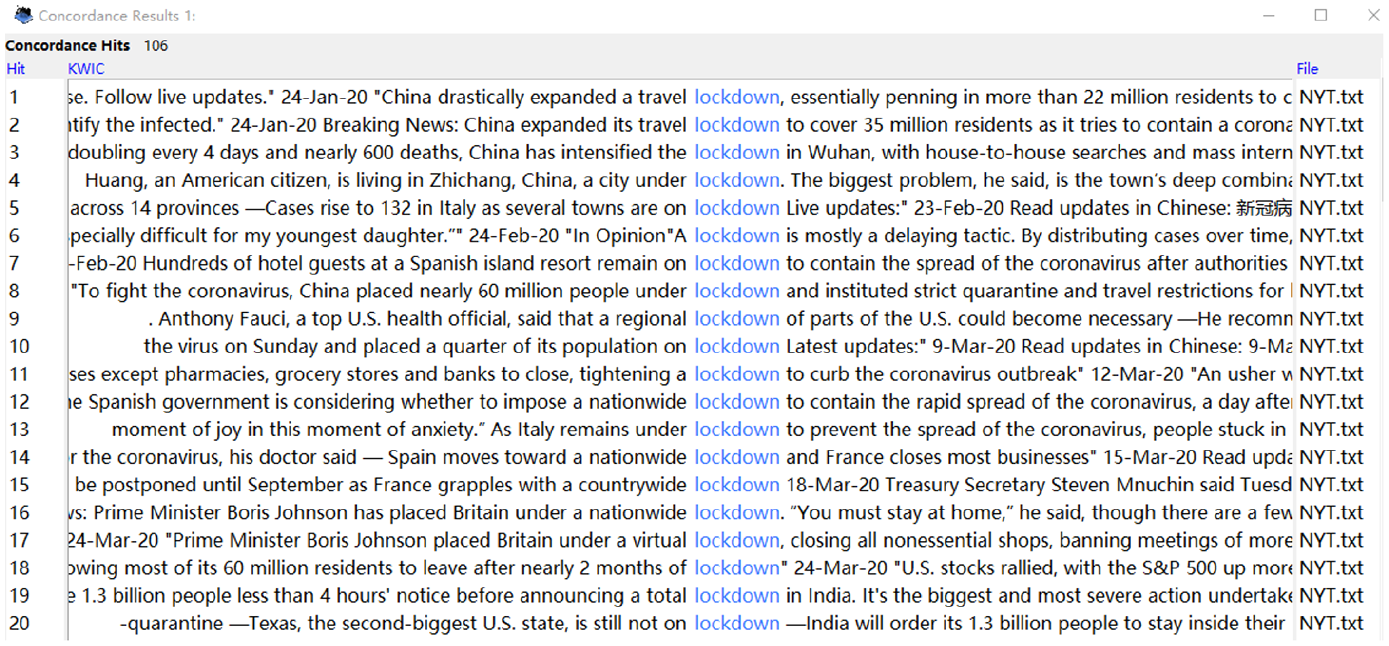
A sample of concordance lines of the keyword ‘lockdown’.
By carefully reviewing the representative tokens through the grouping of similar keywords, and a detailed examination of the concordance lines of these tokens, we identified the prominent themes related to coping strategies and emotions in COVID-19 communication from mainstream news media in the U.S. and China. For coping strategies, we examined the keyword lists to look for tokens referring to or associated with responses and solutions to the COVID-19 pandemic. A keyword was identified as a representative token of coping strategies if it mentioned or was related to discussions of any past or current crisis response actions and those planned for the future. This entailed overall policy decisions and government-led initiatives (Shih et al., 2008), specific medical responses by health care services (Liu and Kim, 2011) and cases of resource allocation implemented at the community level. The identified keywords were extracted, and by performing concordance analysis carefully, they were categorized based on their use in context. Prominent themes related to coping strategies then emerged inductively after an examination of the established categories.
Similarly, we examined the keyword lists for words that were associated with emotional experience in the COVID-19 pandemic. Keywords were identified as emotion tokens if they denoted or were directly linked to negative emotions such as anxiety, anger, fear, and sadness, which are common in crisis situations (e.g., Basch et al., 2020; Goodall et al., 2012; Han et al., 2020; Henrich and Holmes, 2011). We also identified tokens of positive emotions such as reassurance, gratitude, and pride (e.g., Fredrickson et al., 2003; Holland and Blood, 2010; Lazarus, 1999). Through scrutinizing such keywords of emotions and their use in concordance, we subsequently identified prominent emotion categories by drawing insights from studies on psychology (e.g., Cowen and Keltner, 2017; Darwin, 1897; Szabó, 2011) and especially the taxonomies proposed in discrete emotion theories (e.g., Cowen and Keltner, 2017; Ekman, 2016; Ekman and Cordaro, 2011). For example, when we came across emotions related to Chinese and English keywords such as 加油 (cheer on/keep it up), 致敬 (show respect), 感谢 (thanks), fears (38, 76.35), anxiety (24, 27.03), worried (25, 35.71), we matched them with the dimensions developed in previous studies to identify the prominent emotion categories. A typical example is that 致敬 (show respect) was placed under the category ‘Admiration’ and ‘worried’ was placed under ‘Anxiety’ as proposed in Cowen and Keltner’s study (2017).
Findings and discussion
This paper analyzed whether there were differences in mainstream news media coverage of the coping strategies communicated and emotions exhibited relating to COVID-19 in the U.S. and China.
News media coverage of COVID-19 coping strategies in the U.S. and China
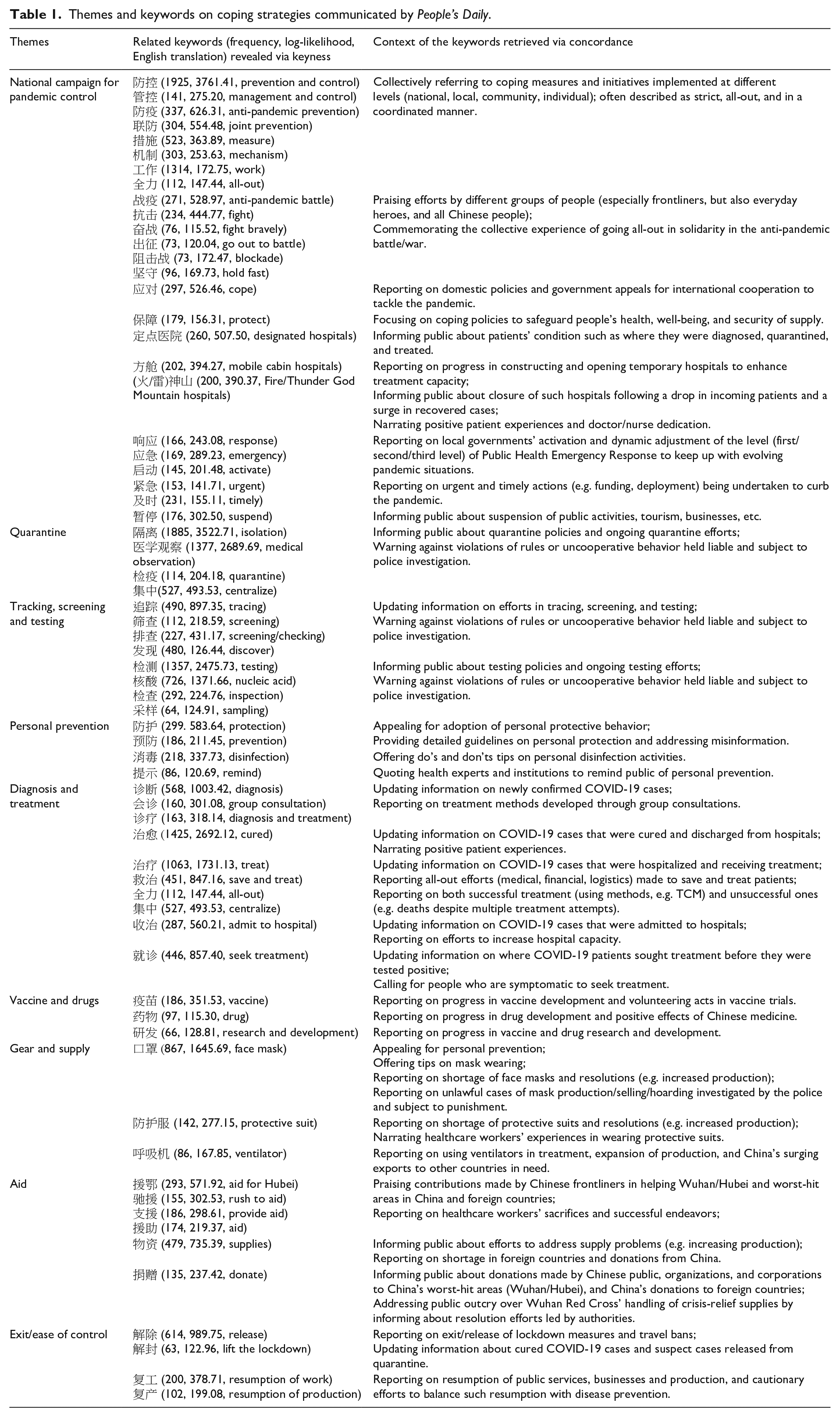
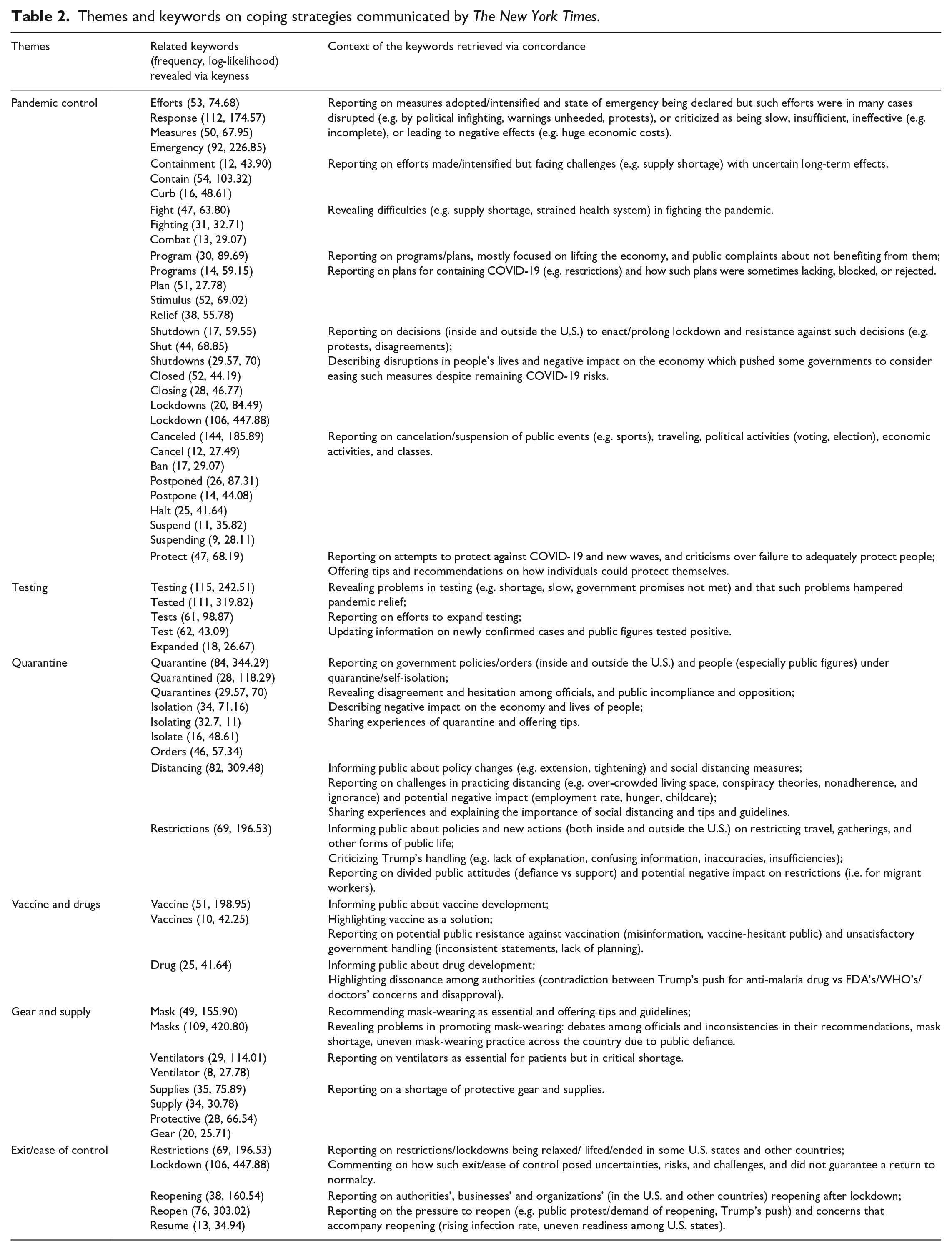
For RQ1 on coping strategies, it was found that PD presented a larger range of themes in a more positive manner. These themes consisted of the national campaign for pandemic control, quarantine, tracking/screening/testing, personal prevention, diagnosis and treatment, vaccine and drugs, gear and supply, aid, and exit/ease of control (See Table 1). On the other hand, the NYT presented a smaller range of themes (i.e. pandemic control, testing, quarantine, vaccine and drugs, gear and supply, exit/ease of control) predominantly in a negative light (See Table 2).
Themes and keywords on coping strategies communicated by People’s Daily.
Themes and keywords on coping strategies communicated by The New York Times.
Regarding PD, most sub-themes were presented in a positive light and emphasized the actions the government was taking to contain the spread of COVID-19. The national campaign for pandemic control was given the greatest emphasis. Words such as ‘sparing no effort’, ‘effective and fruitful’, ‘greatness’, and ‘patriotism’ were often associated with the keywords, framing the actions taken in a positive tone. The use of ‘greatness’ and ‘patriotism’ underscored the contributions of those who had helped fight the COVID-19 battle and showed respect for them. In line with studies indicating that news coverage of new viruses relies on military metaphors (Chiang and Duann, 2007; Williams Camus, 2009), war metaphors tied to serving a common heroic cause were frequently seen in PD such as ‘fight bravely’ and ‘anti-pandemic battle’ aiming to build a sense of solidarity with the public to bolster efforts for pandemic control. These findings are aligned with prior research that the mainstream news media in China often functions as the mouthpiece of the Chinese government, serving to build a sense of solidarity and maintain harmony (Luther and Zhou, 2005; Wu, 2006), so crises are usually presented in a positive manner. Such differences have also been evidenced in the reporting of other health issues such as SARS (Beaudoin, 2007) and the Chinese baby formula scandal (Feng et al., 2012). This finding suggests that the political context in a certain news environment can lead to variations in the way different countries of origin frame COVID-19.
Different from previous research where it was found that the Chinese government downplayed the health crisis (e.g. Beaudoin, 2007; Feng et al., 2012), our study revealed that COVID-19 was treated as a top priority in light of the keywords used including ‘全力 all-out’, “紧急 urgent”, and ‘及时 timely’ . This might be attributed to that China experienced the highly life-threatening SARS in 2003 and understood the importance of promptly containing an epidemic. Some negative phrases were evident, primarily serving as a deterrent for the theme of quarantine and tracking/screening/testing to warn against violations of rules and uncooperative behavior. Negative phrases were also present for the sub-theme of face masks under gear and supply, aiming to prevent the circulation of fake masks. Different types of protective gear were given emphasis by using keywords such as ‘masks’ and ‘protective suit’, which were often in shortage, and were described as important for protecting frontline workers while also causing them discomfort because their bodies ‘were sealed in stuffy protective suits’ and ‘masks left deep marks on their faces’, highlighting the immense effort expended by frontline workers.
On the other hand, for the NYT, only six themes emerged for coping strategies. For the most salient theme of pandemic control, keywords such as ‘imposed’, ‘expanded’, ‘disrupted’, ‘blocked’, ‘slow’, ‘insufficient’, and ‘huge costs’ indicated that efforts were made to contain the virus but were undermined and criticized for not being timely, leading to undesirable effects. Concerning the theme of gear and supply relating to wearing masks, expressions used were indicative of disagreements, debates, and inconsistencies among the government and authorities in terms of the recommendations regarding wearing masks. Similar expressions were also present for the themes of testing, quarantine, and vaccine and drugs. These findings may be explained in that the U.S. did not experience the deadly SARS outbreak, rendering them unable to have a realistic awareness of the severity of a new pandemic like COVID-19. Further, the U.S. mainstream news media serves as an autonomous entity, monitoring and challenging the government’s actions and promoting an ideology that is different from China (Beaudoin, 2007; Chang et al., 1998; Feng et al., 2012; Wu, 2006), so it might have framed COVID-19 coping strategies in a more negative or skeptical tone. These findings resonate with prior studies which have found that the U.S. media tends to highlight the negative impact of issues such as the negative economic effect caused by SARS and attributing responsibility to others for the spread of diseases like SARS (Beaudoin, 2007; Luther and Zhou, 2005) and HIV/AIDS (Wu, 2006) in its media discourse.
Emotions exhibited in media coverage of COVID-19 coping strategies in different countries
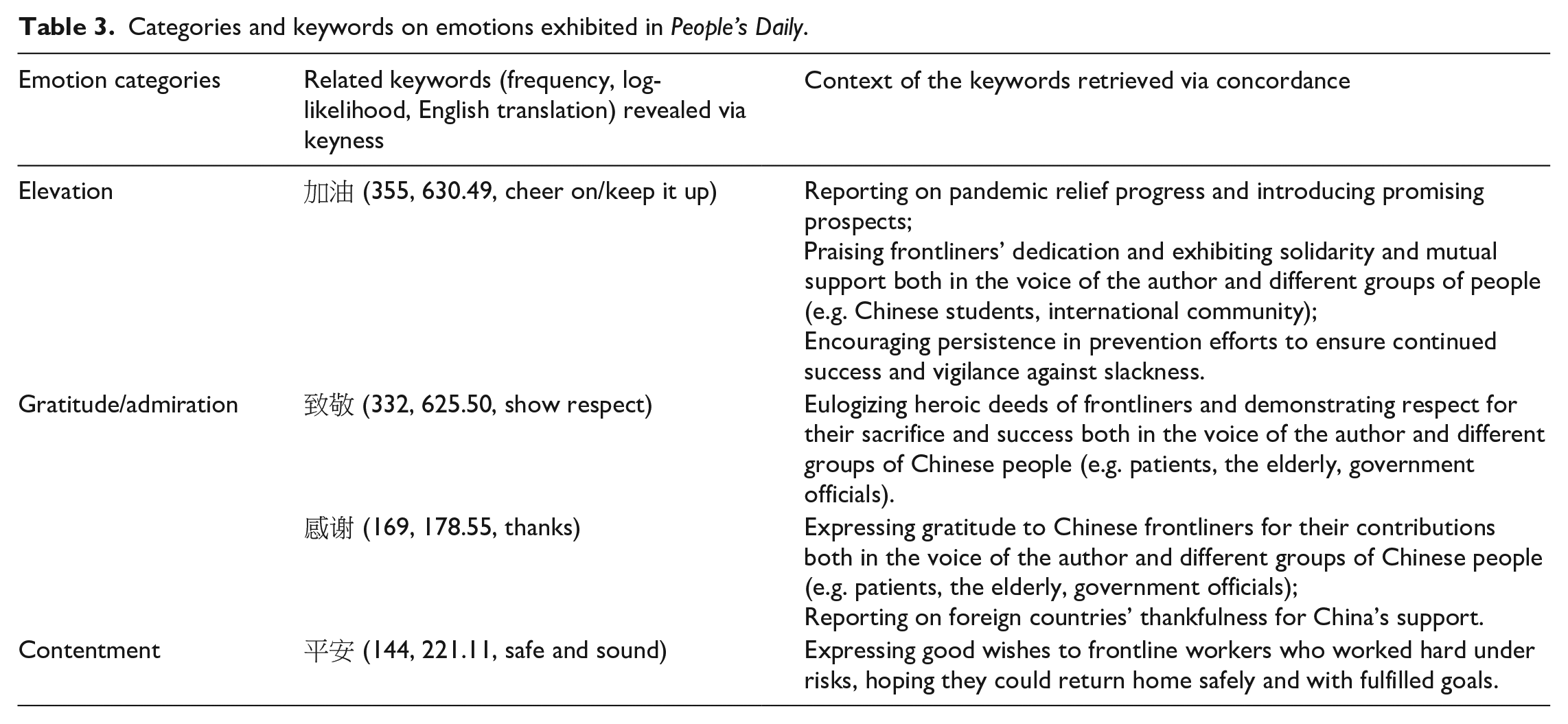
In relation to RQ2, which asked if there were variations in the mainstream news media’s portrayal of emotions in the U.S. and China, the findings indicated distinct differences. Positive emotions of cheer, gratitude, and good wishes were primarily emphasized by PD. As revealed from the keywords (see Table 3), cheer was expressed to the public for their ‘solidarity’ and ‘support’ while gratitude was expressed to ‘frontline workers for their sacrifice and success’. Good wishes were also offered to ‘frontline workers to return home safely and with fulfilled goals’.
Categories and keywords on emotions exhibited in People’s Daily.
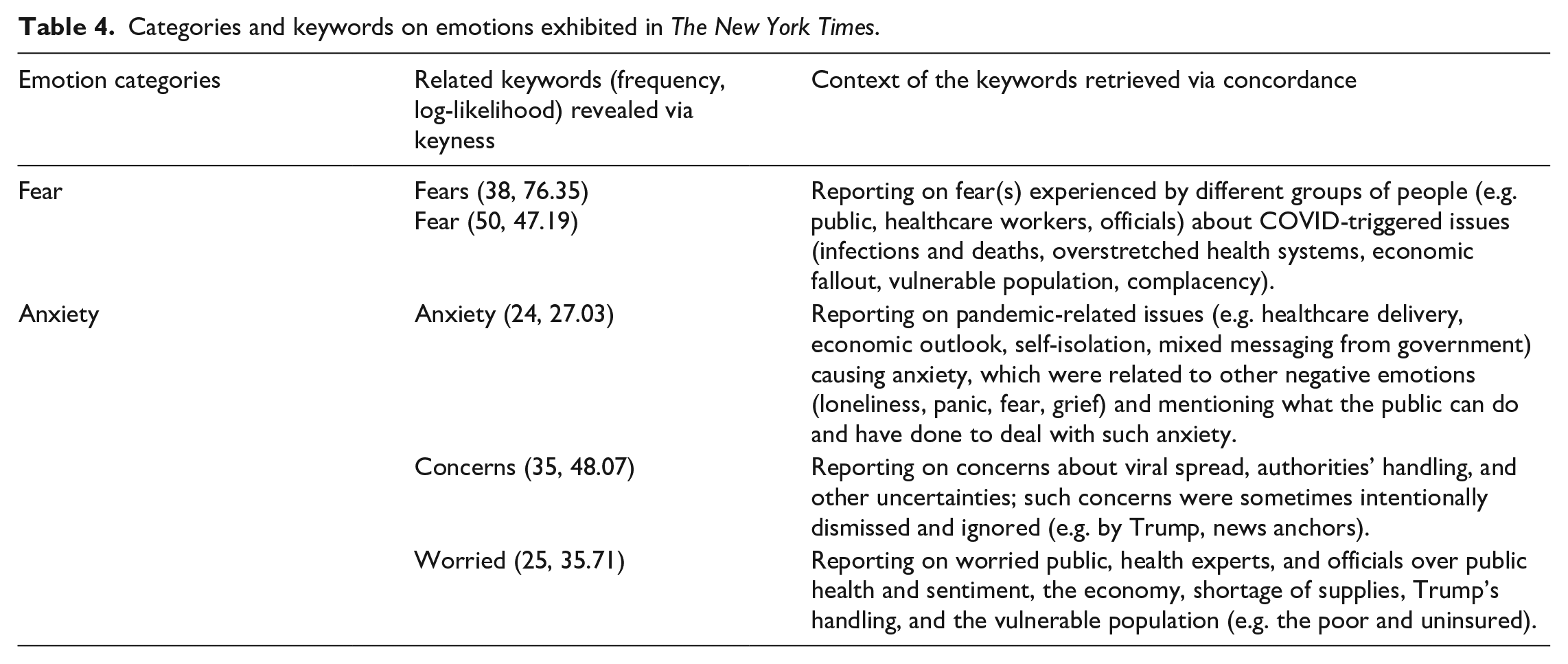
A stark contrast was noted in the NYT where a predominance of negative emotions (i.e. fear and anxiety) were portrayed in its news coverage. For example, it presented ‘fears about health (infections/deaths)’, ‘economic fallout’, the ‘overstretched health systems’, and ‘fears from different groups of people’. Fear was often linked to anxiety, the latter of which pinpointed emotions and mental issues such as ‘panic, grief, loneliness’. Some positive keywords on anxiety were noted, informing what ‘the public can do and have done to deal with such anxiety’. Negative keywords indicative of concerns (e.g. concerns about authorities’ handling) and worries (e.g. worried public over issues such as public health and sentiment, economy, Trump’s handling) were also rampant in the NYT (see Table 4).
Categories and keywords on emotions exhibited in The New York Times.
The greater prevalence of positive emotions in PD makes sense in terms of the different news environments of the two nations. The Chinese news environment aims to represent the government and maintain harmony, political stability, and growth of the Chinese economy (Beaudoin, 2007; Liebman, 2005; Wu, 2006) whereas the U.S. news environment is more liberal, presenting a diverse range of debatable and divergent views (Briggs, 2004; Chang et al., 1998). Additionally, these findings appear to be linked to the public’s need for clear information on how the health crisis will be handled (Seeger et al., 2002) from news media because such information can allay fear (Jin et al., 2016; Kilgo et al., 2019). Considering that the NYT focused on fewer themes regarding coping strategies which were subject to heated debates, disagreements, and hesitations, it is likely that this was tied in with the negative emotions exhibited in its news coverage. In fact, coping strategies adopted in the U.S. were guided by President Trump’s initial recognition of COVID-19 as not being a serious threat (Trump, 2020), which might have thus led to disagreements and hesitations among different stakeholders, and hence, negative emotions (Harper et al., 2021). Contrarily, PD presented a larger number of themes with clear coping strategies without any indication of disagreements, which was thus linked to the portrayal of positive emotions. It has to be stressed that COVID-19 first emerged in China and was more severe initially, generating the perception of a serious health threat. This might have prompted the Chinese government to disseminate information about a wider range of coping strategies in a more positive light to obtain public support.
The literature surveyed has shown that emotions exhibited in news coverage on crisis communication can impact outcomes by promoting preventive behavior, information seeking, and sharing behavior (Finucane et al., 2000; Loewenstein et al., 2001; Turner et al., 2006). Negative emotions such as fear about health risks motivate the public to adopt protective measures (Baron et al., 2000; Harper et al., 2021), thus serving to control the disease. As seen in the NYT, fears exhibited resulted in suspension of classes and closure of businesses, reducing the likelihood of virus transmission. Positive emotions in the form of respect and gratitude promote pro-social behavior (Haidt, 2003; McCullough et al., 2001; Schnall and Roper, 2012), which resonate with our findings on how cheer for the public and respect for frontline workers in PD may have motivated them to work harder to stem the spread of COVID-19.
Implications and limitations
The extent of the news coverage and portrayal of emotions, however, varied between the U.S. and China. The NYT focused on a smaller range of themes, leaning more toward a negative tone and expressing negative emotions while PD relied on a more comprehensive range of themes, presenting the coping strategies in a positive light and using positive emotions. This may have implications for the U.S. and China with respect to how effectively they were able to control the spread of COVID-19. When the mainstream news media presents clear information about coping strategies in a positive tone, thereby helping to garner public support, the public is more likely to follow the recommended strategies. This is consistent with prior research on SARS where the presence or absence of certain elements in news frames influenced how the public perceived and processed information, and behaved (Beaudoin, 2007).
As Kilgo et al. (2019) noted, the media can alleviate panic by providing actions taken to control the health crisis and showering praise on those handling the crisis, which was reflected in PD. However, a caveat is that a balance of both a reduction of panic and an over-emphasis on positivity is required as the latter can lead to slackness in adopting preventive measures (Dolinski et al., 2020; Klemm, 2016; Mertens et al., 2020). The news media, therefore, plays an important role in framing messages about COVID-19 and presenting them in a certain tone. Considering that social media promote the sharing of news, can reach a large audience and provide emotional support during crises (Bruns et al., 2012; Ngai et al., 2020; Stephens and Malone, 2009; Zheng et al., 2020), mainstream news media should harness the power of social media to offer potentially new solutions.
The limitations of comparing PD with the NYT would include the reason behind the specific selection. Although both papers covered the same theme of coping strategies and demonstrated a range of emotions, and both are the top mainstream news media outlets in terms of their readership in their respective countries, generalization of the current findings to other news media outlets is not implicitly warranted given that there may be significant inherent differences. Additionally, the data were collected from a particular period of December, 2019–May, 2020, and would warrant replication to examine whether news coverage of COVID-19 at other times varied. Future research can also explore other frames in news coverage and how mainstream news media outlets in different countries omit or strengthen certain news frames depending on some considerations. An investigation into the extent of negative emotions expressed as the health crisis evolves is worth undertaking based on previous research noting that these emotions decrease over time (Kilgo et al., 2019; Ungar, 2008).
Our study has offered insights into the comparative differences between U.S. and Chinese mainstream news media’s coverage of coping strategies and emotions via social media as a prevalent framing for a new pandemic that has engulfed the world. In particular, the NYT covered a smaller range of themes on coping strategies in a more negative tone while PD presented a comprehensive range of themes in a more positive light. This may be attributed to their political contexts intertwined with the news environment and prior experience in handling a similar health crisis. Although the news environment in China aims to represent the government and maintain harmony, COVID-19 first arose in China and was severe. This prompted PD to post information about a variety of coping strategies in a positive light to garner public support. The government’s prior experience in handling SARS and knowledge of its deadly consequences might also have played an important role in PD’s decision of what themes on coping strategies to present to the public. It appears that the portrayal of the coping strategies frame with positive/negative emotions had a subsequent impact on how the U.S. and China made efforts to minimize the spread of COVID-19 and how effective they were.
Footnotes
Acknowledgements
The authors would like to thank Prof. van Dijk (Editor-in-chief) and the reviewers for their constructive feedback and support.
Declaration of conflicting interests
The author(s) declared no potential conflicts of interest with respect to the research, authorship, and/or publication of this article.
Funding
The author(s) received no financial support for the research, authorship, and/or publication of this article.