




Abstract
Whilst previous research into mothering on social media has focused on representations of intensive mothering ideology, this paper argues that social media are fundamentally changing mothering discourses for some users. The paper explores ‘good’ mothering in digital communities by considering: the legitimised expression of ambivalent emotions in digital mothering communities; the shifting relationship between private and public, with implications for new forms of maternal intimacy; the forms of surveillance engaged in, and resisted, online; and the opportunities for women to play with alternative identities. Through analysis of posts on the British mothering internet forum ‘Mumsnet’, the paper suggests the concept of virtual mothering to encapsulate the emerging ways in which mothering is performed through online spaces. Four aspects of virtual mothering discourse are explored – perfection, privacy, politics and play.
Keywords
Introduction
Over the last two decades, motherhood online has emerged as a distinct field of scholarly enquiry (Mackenzie and Zhao, 2021). Using a range of sites, apps and social media, researchers have sought to understand how motherhood is performed and represented in online spaces (Astudillo-Mendoza and Cifuentes-Zunino, 2022; Krzyżanowska, 2020; Zhao and Bouvier, 2022). Some authors have started to explore how, in the contemporary world, online activity is not something that somehow happens after the tasks of mothering, a way of representing activities that have been completed, but is actually part of doing mothering per se. As we hurtle towards the hypothetical metaverse, fusing our online and offline worlds into a fully immersive digital reality, so that we live online rather than access the online (Dionisio et al., 2013), such a way of examining our digital engagement will become increasingly important. This emerging work looks, for example, at how mothers manage their children’s online identity, suggesting that, after the double-shift of work and parenting, mothers have to do a ‘third shift’ as they take most responsibility for managing children’s presence online (Ammari et al., 2015).
In this paper, I draw on an extended study of mothering on Mumsnet to theorise emerging norms for what I term ‘virtual mothering’. This mothering is virtual in both senses of the word, it is something that exists in a digital space and also something that is almost but not completely achieved. This is differentiated from ‘motherhood online’ (Moravec, 2011) as both offline and online aspects of mothering may be fused within it. The paper suggests that the virtual mother may use social media to stop short of fully embracing intensive mothering, to subvert assumptions about her private world and the domestic sphere, to express negative or ambivalent emotions towards her maternal identity, and to play with the forms of surveillance that are established online.
Several previous authors have used data from the Mumsnet Talk posts to investigate aspects of mothering, such as discourses of mothering (Mackenzie, 2018), regretting motherhood (Matley, 2020), postnatal depression (Kinloch and Jaworska, 2021) and accounts of good and bad mothering (Pedersen, 2016). However, much of this work has been focused on the use of language to represent mothering (Mackenzie, 2018), rather than exploring how this discourse represents participation in the Mumsnet community as part of mothering. The concept of virtual mothering therefore contributes to a significant gap in the field.
Conceptualising virtual mothering
Previous studies have suggested that people present their selves self-consciously on social media, aware of an imagined audience and carefully constructing the image they wish to present to them (Marwick and Boyd, 2011). Their imagined audiences may be multiple and complex, and they actively craft their posts in response to this and their conceptualisation of the specific social media site (Tagg and Seargeant, 2021). Motherhood online involves the presentation of the mothering self through social media posts, but also representations of the family more generally (Kumar and Schoenebeck, 2015). Four recurrent themes have predominated in the research into motherhood online – perfection (DeGroot and Vik, 2021; Newman and Nelson, 2021; Pedersen, 2016), privacy (Orton-Johnson, 2017), politics (Ehrstein et al., 2020; Gambles, 2010; Moravec, 2011) and play (Mackenzie, 2017; Pedersen and Smithson, 2013). First, some writers have analysed the extent to online behaviour reflects the idealised norms of intensive mothering ideology (Pedersen, 2016). Second, others have examined the interplay between the public and the private through sharing of the intimate on social media (Orton-Johnson, 2017). A third priority has been to investigate the extent to which social media have empowered mothers to pursue political agendas (Ehrstein et al., 2020). Fourth, the literature related to play has sought to understand how humour, adversarial approaches, swearing and other linguistic features have playfully subverted gendered norms about feminine forms of communication (Mackenzie, 2017). However, the interactions between these four dimensions of motherhood online and their implications for offline behaviours remains little explored. These four themes are posited as a conceptual framework for understanding virtual mothering which is then applied to the data analysed in the second half of this paper.
Perfection
There is evidence that women feel pressure to present themselves as ‘perfect’ mothers, both offline and online (Atkinson, 2014; DeGroot and Vik, 2021). Much discussion of motherhood online compares expressions of mothering there with the expectations of intensive mothering ideology. Intensive mothering ideology, identified by Hays (1996) in her analysis of US parenting, is the assumption that good mothering involves committing maximum energy, resources and time into child(ren), to ensure their social, moral, cognitive, physical and emotional development, and placing children’s needs ahead of their mother’s. Not all mothers are able to meet this ideal, not least those with limited resources, but Hays suggested that it had become the touchstone against which all mothers were judged.
Intensive mothering ideology emerged as a phenomenon prior to the widespread use of the internet, but more recent research has focused on assessing its applicability to contemporary mothering practices in the digital world. The literature suggests that within online spaces there is both replication of, and tension with, intensive mothering. Analysis of online representations of mothering suggests that mothers are held responsible for shaping their child(ren) (Feldman, 2021), often through consumption-focused visions of motherhood (Krzyżanowska, 2020), and that women feel a pressure to self-present online as enjoying motherhood, with well-presented children (DeGroot and Vik, 2021).
Previous research into good and bad mothering on Mumsnet has explored how women’s employment outside the home is framed in terms of a mother’s duties to her children, justified either as providing for them economically or as offering a positive role model (Pedersen, 2016). Although some accounts of bad mothering on Mumsnet are humorous, more serious ones are couched in terms of guilt, with mothers reassured that they are really good mothers because of the regret they feel for falling short of the intensive mothering ideal. However, some posters reject the pressure to be perfect, replacing it with ‘good enough’ mothering instead (Pedersen, 2016).
In addition, in recent years a ‘wine mom’ discourse has emerged online. This involves women bonding over the tribulations of motherhood, promoting alcohol as a form of self-care (Newman and Nelson, 2021) and an escape from being a perfect mother. Wine mom discourse acknowledges that mothering is challenging and exhausting, rather than exhorting women to aspire to effortless perfectionism. However, by normalising mothers’ feelings of failure, it does not fundamentally challenge hegemonic intensive mothering ideology (Newman and Nelson, 2021).
Nevertheless, online media can facilitate the expression of transgressive views (Matley, 2020) that challenge this ideology. Research suggests that posts regretting motherhood are an established feature of Mumsnet, although responses to expressed regret frame it as either temporary or deficient (Matley, 2020). In one analysis of transgressive posts on Mumsnet, Jaworska (2018) identifies two narratives used in accounts of post-natal depression. First, the form of a confession is often employed with frequent use of the verb ‘admit’, and statements implying that this has hitherto been a secret. Second, the responses to these confessions often take the form of an exemplum, with the poster typically relating their own story of experiencing post-natal depression, and then explaining how it was resolved. In other words, the transgressing mother is expected ultimately to return (happily) to the intensive mothering fold.
Privacy
There is a growing focus on privacy and intimacy in contemporary societies, associated with the ascendancy of the project of the self which has replaced traditional social structures (Miguel, 2018); individualisation has weakened the link between the intimate and the private by pointing to ‘the frailty of human bonds’ (Bauman, 2013). The online world threatens privacy further by potentially increasing both surveillance and self-surveillance over the details of our daily lives (Orton-Johnson, 2017), and through the intermingling of the private and the public online with what Dobson et al. (2018) describe evocatively as ‘digital intimate publics’. The private sphere of the home has traditionally been associated with women and their bodies, while men are seen as belonging naturally to the public sphere; supposedly feminine behaviour often involves women working hard to maintain privacy, for example by concealing their ‘leaky’ bodies (Moffat and Pickering, 2019). However, the concept of privacy has been problematised by contemporary academics researching online practices, with an awareness that ‘privacy’ is historically shifting, and must be actively practised through ongoing boundary work asserting the division between public and private (Berriman and Thomson, 2015).
Online activity takes communication into otherwise private spaces. Researchers have suggested that a sense of presence in computer-mediated communication (Lowenthal, 2010) is enhanced by three factors – co-presence, intimacy and immediacy (Al-Ghaith, 2015). Co-presence refers to the sense of being together, despite being online. Intimacy refers to the care and trust that are demonstrated in the relationship. Immediacy refers to the cues that encourage a sense of closeness, such as expressions of respect, encouragement and help (Burgoon and Dillman, 1995).
Social media have led to a subversion of the relationship between intimacy and privacy. Whereas offline intimacy is reciprocal, based on mutual disclosures of the private, online intimacy may be asymmetrical and create intimate publics which generate new forms of belonging (Dobson et al., 2018). Online activity creates a new form of surveillance (Marwick, 2012) that takes place between individuals, rather than between social entities and individuals, and is reciprocal in nature (we all both post and read posts). Several researchers have consequently suggested ways to conceptualise the relationship between privacy and social media; for example, Marwick (2013) has developed the concept of ‘lifestreaming’ to explain how the need to be public on social media permeates our lives.
Most research into privacy on social media has focused on the practices of teenagers and young adults (Miguel, 2016); for example, Berriman and Thomson (2015) employ the concept of ‘spectacles of intimacy’ to explore transgressions of the private in young people’s use of social media. However, there is increasing attention to conceptualising privacy in accounts of motherhood online. Posts about mothering mean that surveillance of mothers has now entered the once private domestic sphere (Orton-Johnson, 2017). Orton-Johnson (2017) argues that ‘mummy blogs’, with their intimacy and detail, feel like the domestication of surveillance, although they are written for public consumption. She notes how some bloggers have been shamed by invoking the imaginary future impact of their writing on their children, implying that they must sacrifice their own voice for the sake of their children.
Politics
Much research literature on Mumsnet suggests that it constructs a neoliberal, consumerised version of motherhood (Meyer and Milestone, 2016). However, the literature has also explored the extent to which motherhood online also offers a space for women to engage politically (Ehrstein et al., 2020; Pedersen, 2020), and to express disappointment and anger with gendered inequalities in their own homes (Ehrstein et al., 2020). For instance, some previous research has suggested that Mumsnet has subverted the division between the personal and the political as posters take sharing their personal experiences on the site as a springboard for shared political engagement (Gambles, 2010); indeed, Mumsnet has become increasingly politicised in its content, and equally has been leveraged by various politicians in the UK (Pedersen, 2020). In such ways, online mothering communities may be politically empowering (Moravec, 2011).
Play
Attention needs to be paid to the tenor of communications made online, for example the use of humour, emojis, acronyms and other linguistic devices, in order to understand the intended impact of posts. These may be used to establish a play frame – a shared interpretative schema that participants rely on to make sense of events (Goffman, 1974) –which communicates that the communicative act should not be taken seriously. In spoken language, features such as overlapping speech, repetition, co-construction of utterances and use of metaphors may signal conversational humour, and be used to establish intimacy (Coates, 2007). In online communications, participants cannot make use of paralinguistic devices such as smiling, pitch of voice or laughter to establish a play frame; nevertheless, they may use linguistic ways to communicate playfulness, and these deserve interrogation for their semiotic representation of what it means to be feminine (Kalsoom and Kalsoom, 2019).
Humour has previously been explored as a feature of motherhood online, for example in Mackenzie (2017) analysis of humour in a Mumsnet thread purporting to ask for a child swap. She identifies four discourses that are interwoven in the thread: commercialisation; gendered parenthood; classed parenthood; and child-centric motherhood, and shows how the playful humour is used to subvert each of these discourses. More broadly, Pedersen and Smithson (2013) argue that Mumsnet enables women to subvert norms for feminine forms of communication online. They argue that conventionally male forms of online communication are typically more adversarial, involve assertions rather than questions, put-downs rather than politeness, and sarcasm rather than apologies; by contrast, on Mumsnet swearing is common and an adversarial style is often adopted.
In summary, these four themes of perfection, privacy, politics and play have been important to previous accounts of motherhood online; however, previous studies have stopped short of seeing motherhood as a virtual practice that fuses the online and offline world. The analysis below looks at how these four concepts are interwoven in Mumsnet posts about parenting to develop the central idea of virtual mothering, identifying key elements within each one.
Research methods
The discussion below is based upon Critical Discourse Analysis (CDA) of posts on the Mumsnet ‘Talk’ discussion board. This analysis has emerged from a wider study of representations of mothering on Mumsnet ‘Talk’. This discussion board is a well-known parenting network (Pedersen, 2021), which claims to be the UK’s largest such site, so influential that it has supposedly influenced British general elections (Giles, 2016). Mumsnet’s own data suggests that visitors to the site are predominantly female and based in the UK (Matley, 2020). Available research suggests that Mumsnet users are predominantly middle-class, more educated, more likely to be employed and slightly older than the average UK mother (Jaworska, 2018; Pedersen, 2016), and therefore not representative.
This paper is focused on analysis of a single thread, an approach also productively employed by Mackenzie (2017). The thread appeared under the topic of ‘Parenting’ and consists of 242 messages under the title ‘I absolutely hate being a parent’, all posted in the period 7th January 2022 to 14th January 2022. A further post was made on 27th March to enquire how things were going with the (Original Poster (OP). In total, it comprises a corpus of just over 17,000 words.
Critical discourse analysis has been widely used to study representations of mothers and mothering in diverse media (Astudillo-Mendoza and Cifuentes-Zunino, 2022; Atkinson, 2014; Kinloch and Jaworska, 2021; Zhao and Bouvier, 2022). CDA seeks to understand how texts have systematic social effects, for example through language choices that privilege certain ways of looking at the world. The interest in the analysis below is not in what discourse describes but in what it accomplishes (Potter and Wetherell, 1987; Wetherell and Potter, 1988); in other words, how the four discursive scripts (Zhao and Bouvier, 2022) of perfection, privacy, politics and play are constructed and contested through these texts.
CDA has been used across diverse disciplines and does not prescribe specific methods (Fairclough, 2013). This study is rooted in feminist CDA in that it sought to explore relationships between gender and power inherent in, and sustained through, discourse (Krzyżanowska, 2020; Lazar, 2014). Specifically, it followed the seven stages of CDA identified by Mullet (2018): identify the discourse; locate relevant texts; explore text background, demarcating its key characteristics; code text content for salient themes; analyse the social relationships governing text production; analyse the social representations within the text; and, finally, interpret the data, through synthesis of the previous steps. Using NVivo, the text was coded not only for its explicit content, but also presuppositions, inferences and salient linguistic features. For example, following Hunter et al. (2019), taken-for-granted facts about gendered parenting implicit in the posts were identified. The sequencing of posts was interrogated for both what could be said and what ought to be said in discourses of virtual mothering – that is both the permissible and the mandated was explored.
In line with previous researchers using Mumsnet Talk data, posts were deemed to be in the public sphere – they are discoverable by a Google search and posters are warned that posts are public – and therefore consent was not sought from individual posters (Bailey, 2022; Jaworska, 2018; Pedersen and Smithson, 2013). Mumsnet encourages posters to use a pseudonym, in contrast to other social media which prefer use of a ‘real’ (offline) identity, and so posts were already anonymised. Nevertheless, posts were scrutinised for potentially identifying material and this is not quoted below.
Being a virtual mother
On 7th January, the thread begins in a manner conventional to posts on Mumsnet – with a confession (Jaworska, 2018). The OP describes her personal circumstances of struggling to get a young child to sleep, leading to stress and exhaustion. The thread has a non-gendered title, ‘I absolutely hate being a parent’, but the discussion is quickly gendered. In the opening sentence, the poster describes herself as a ‘mum’ and within the opening post judges herself as sounding ‘like a total cow’, a derogatory expression only used to describe women. Initially, responses take the form of the exemplum identified by Jaworska (2018), with responses explaining how they too felt this way but have now overcome it, along with advice for coping with the situation. In addition, however, there is reflection on whether people want a second child, and observations on contemporary mothering. A distinctive feature of this thread is that, during successive evenings, the OP reports on what is going on in her home, for example whether her child is currently crying, who has gone in to comfort him, and what she herself is doing. There is a ‘real time’ aspect to this, with many of the posts written in the present tense.
The framework of virtual mothering in Figure 1 shows how the codes identified from the 243 posts are related to the four dimensions of motherhood online identified from the literature; together, they suggest a framework for conceptualising discourses of virtual mothering.
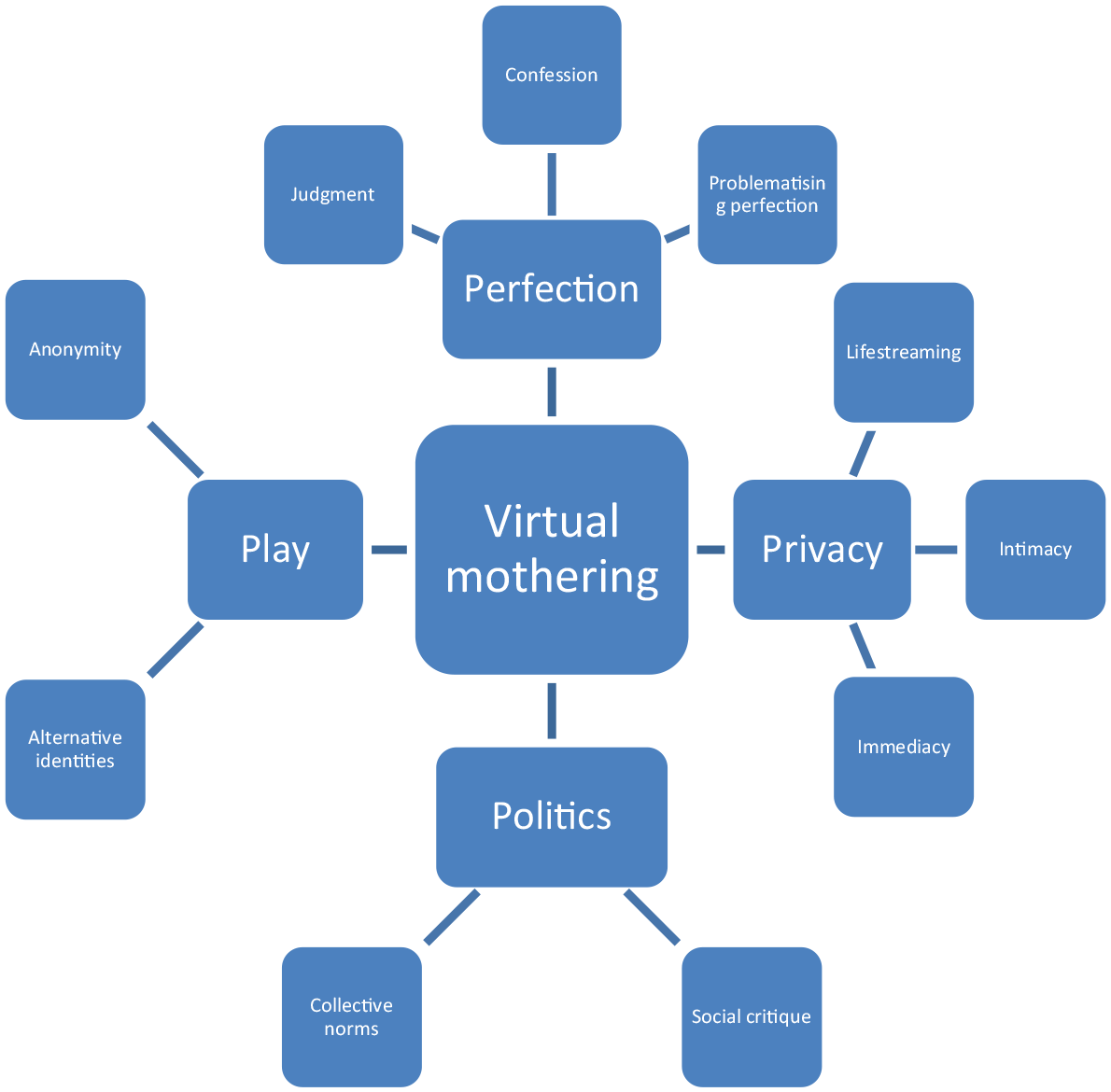
A framework for virtual mothering.
Perfection
There are several ways in which intensive mothering ideology (Hays, 1996) is represented as perfect mothering in the thread, but the notion of perfect parenting is simultaneously subverted. This aspect of the framework was salient in the data, with three key sub-themes appearing in the coding – judgements about what constitutes perfection; confessions of imperfection; and problematising perfection through failure, guilt, insanity or lack of reality.
Over several posts, the OP and others finding motherhood difficult, variously represent that feeling as failure, a source of guilt, and a form of insanity. Mothers describe themselves as ‘going insane’ when expressing their difficulties in coping with small children’s behaviour. One responder describes herself as a ‘complete failure’ while the OP says she feels ‘immensely guilty’. Fearing judgement is a recurrent theme throughout, although responses tell the OP not to judge herself. Rather, Mumsnet users validate these feelings (e.g. ‘that is literally how I felt’), empathise (e.g. ‘You don’t sound unhinged you just sound exhausted’) and advise (e.g. ‘Get away from him for a couple of days’).
The discourse represents bad mothering as deviation from the expectations of intensive mothering. For example, after just 10 minutes of not attending to a crying child, the OP says:
‘I just left him to cry for 10 minutes tonight because I couldn’t take it anymore. Then DH went in. I’m a shit mother’.
She continues in a later post, ‘I’m now feeling horrendously guilty for letting him cry for 10 minutes’.
Additionally, responses expressing sympathy also draw on intensive mothering, with her exhaustion, her guilt after leaving her child for only 10 minutes and her decision to seek support on Mumsnet all being cited as evidence that she is a good mother:
‘When I hear a mother is exhausted, fed up, at the end of her tether, and asking for advice - this tells me that she’s a caring mum who has been working hard to care for her children, dedicating too much time to them if anything’. ‘you sound very committed to him and a very good parent. Which is why you can’t leave him to cry or leave him with anyone else’. ‘You are far from a shit parent, you have sought an appropriate outlet where you can vent and ask for advice’.
However, some responses reject the extremes of intensive mothering, with the first quote above acknowledging that a mother can devote ‘too much time’ to her children, and several other posts suggesting that the OP should take a break from her child:
‘You need to stop judging and criticising yourself! Being a parent, working, being a wife and running a house can be TOO MUCH. We all love our kids with every part of our soul but at some point some of us have felt like they are the most fucking irritating little monsters that we just want break from and that’s ok’.
In addition, several mothers consciously reject the dominant mothering expectations with their advice: ‘obviously I will be slayed alive for this by other Mumsnetters’. For instance, many advocate sleep training rather than being endlessly available in the evenings.
The supportive atmosphere of Mumsnet is contrasted with the images of perfect parenting that dominate other social media. The OP observes:
‘I think I also need to come off Instagram. I’m following so many accounts by mums/experts who are clearly far better at this parenting thing than I am and just make me feel guilty as hell’.
Several responses reassure her that what is presented on social media isn’t ‘real’ and rejecting the image of ‘perfect’ parenting that is portrayed there:
‘Get off of IG, like, now! It’s a load of rubbish, all made to look pretty and perfect for the sake of “likes” and “traffic”. None of what you see on there and I mean NONE of it, is even close to being accurate’.
In summary, there are tensions in the way that ‘perfect’ parenting is discussed on this thread. Whilst some posts espouse intensive mothering ideology, others problematise it (Pedersen, 2016) or reject it as not being ‘real’; they question the assumption that good mothers are made happy for motherhood (DeGroot and Vik, 2021). In addition, it should be noted that the assumption that a mother should be omnipresent for her child is being subverted by virtual mothering itself in the live commentary style of this thread. The OP is engaging in an online dialogue instead of being present for her child; even as she says that he is currently crying and demanding her attention, the mother’s phone (or whichever technology is being used is being used for posting) is being used to claim personal space. This is further explored in the following section.
Privacy
The division between the public and the private can be subverted by online behaviour, through its valorisation of what Berriman and Thomson (2015) term a ‘spectacle of intimacy’. Although the OP is a woman in a nuclear family in a private residence, privacy is subverted throughout. First, she rapidly becomes part of a community of women, communicating with large numbers of people as she engages in her parenting practices. Second, through responses to this continued lifestreaming, intimacy and immediacy with others outside the nuclear family is achieved.
The first response to the initial message comes in less than 6 minutes. Within the next half an hour, 18 different people respond with supportive messages. Just over 30 minutes have passed when a critical message is posted by ‘HonestlyFFS’, which is deleted by Mumsnet admin and immediately derided by the other responders.
On the following evening, 8th January, the OP updates the others:
‘DH put him down at 8.45 and he cried hysterically for five minutes, so DH has gone back in. I’m currently eating the dinner I made for the two of us on my own’.
Over the next 10 minutes, she posts twice more about what is happening. There is a debate between the OP and several other users about whether the child may have earache, and whether pain relief medication would help.
The following evening, 9th Jan, again the OP describes the events in her home as bedtime takes place and is given support and advice through the crying in synchronous exchanges, this time with discussion about whether the child is too cold. Similar exchanges, describing the details of what is happening within the OP’s home at bedtime and collectively planning interventions, are repeated on the following night.
Throughout these nightly exchanges, there are a number of ways in which the Mumsnet thread achieves a sense of presence (Al-Ghaith, 2015). Co-presence is achieved through the ‘lifestreaming’ (Marwick, 2013) undertaken by the OP. Intimacy is constructed by the expressions of care that users express in their responses, for example when one response says ‘I’m returning to this post in the morning to see how you’re doing’. Immediacy is achieved through the encouragement and help that she is offered (Burgoon and Dillman, 1995), with, for example, posters asking a short time later whether the medication helped.
The intermittent use of the present continuous tense by both the OP and those responding, as well as the use of time and space deictics (Dancygier, 2019) – such as ‘this post’ and ‘currently eating’ – are key linguistic features of this lifestreaming. For example, the OP uses the present continuous space during the course of an evening, but reverts to the past or present tense at the beginning and end of each of these episodes of lifestreaming. Another move made during the lifestreaming is to refer explicitly to the time: ‘It’s 9:30, he must be exhausted, surely!!’ or ‘I just left him to cry for 10 minutes tonight’.
This running commentary style implicates the responders in the OP’s behaviour; she is not looking for validation about completed actions, but seeking advice about what to do right now. Together, they brainstorm what, if anything, might be wrong, suggest solutions, and the OP reports back to the group on what next transpired. If motherhood is a performance, the OP is inviting her audience to be involved in the writing of the script. This transgresses the private sphere of the home, and makes the parenting of her child a collective endeavour.
Such virtual mothering is subverting the division between the private and the public. The poster states that she feels she does not matter, but through Mumsnet she is purposely centring herself and events in her home in a public conversation; she is thereby rendering her invisible labour of mothering visible. In providing a commentary on what is happening inside her house at bedtime, this mother is rendering public a usually private moment. She is also deliberately exposing a time at which she feels vulnerable and ashamed. The other Mumsnet users are part of her ‘real-time’ parenting, advising her what to do each evening; in other words, this discourse is performative, it is not about parenting, but it is parenting per se (Potter and Wetherell, 1987).
Politics
This thread espouses a form of feminist politics in two ways. First, the users make explicit statements about social change and its impact on gender equality. Second, the form and content of the thread reflect new collective norms of virtual mothering. Three collective norms are evidenced in this thread: being non-judgemental; conveying care and solidarity; and expressing ambivalence.
Echoing the posts in Ehrstein et al. (2020) study of mothering on Mumsnet, a number of the posts refer explicitly to their views about women’s position in contemporary society, and how inequality is sustained through current parenting norms. The OP explicitly connects her unhappiness and frustration to these. Other users analyse the consequences of what one poster describes as ‘the new normal’ for women, being expected both to be mothers and to work outside the home. There is extensive discussion of the pressure this places on women. For example, the OP says:
‘I don’t care what anyone says, I wish I was a mum in the 1950s, when women didn’t need to be a parent AND hold down a career. It’s so fucking stressful. Judge away’.
Another poster replies directly to this post:
‘Agreed. We (society) seem to be in a position now where we all try and do everything and it is bloody exhausting!. . .And there are no clear roles so you can never ever feel truly off with “deserved” free time’.
There is a disconnect between the ostensible focus of this thread on ungendered parenting and the actual addressing of the position of mothers in these posts, an elision similar to that noted in the analysis by Sunderland (2006) in childcare magazines.
Several posts critique the assumption that a woman is necessarily fulfilled by young children either by stating that they feel more comfortable with older children or by considering the benefits of not having children. For example, one poster reflects:
‘Parenting is pretty shit no matter how much you adore them. If I could have my time again and know how hard it was well I’m sure my life would be very different’.
Alongside this social critique is a second form of political engagement, whereby Mumsnet establishes expectations for how women should treat each other collectively. Some aspects of this are attributable to Mumsnet rules and guidelines, whereas others are unstated aspects of Mumsnet discourse. Each Mumsnet Talk page has 22 ‘Smiley Hints’ at the bottom – a list of emojis, with a definition beside each – and Mumsnet has its own list of acronyms. By creating its own new ‘language’ (NAC, 2019), Mumsnet is constructed as a special group to which women can belong, with a shared slang which celebrates female support online.
Alongside these explicit norms, the community within a thread reinforces unstated norms. First, there is a clear expectation that posts should be non-judgemental. While there are a few judgemental posts (e.g. one person suggests that the OP could put their child up for adoption), they are rapidly rebutted. Indeed, the discussion goes so far as to suggest that judging other women is incompatible with good mothering:
That is such a horrible, judgy, offensive, awful message. I have to assume you’re not a mother yourself.’
This post establishes an opposition between making negative judgements and being a mother. Although previous researchers have suggested that social media can act as a form of surveillance or self-surveillance (Orton-Johnson, 2017), whereby the minutiae of our daily lives are scrutinised by others, leading us to feel additional pressures to conformity, by contrast during these posts, it is the constant reassurance that enables the OP to express her ambivalence and negative feelings (Matley, 2020).
Second, in place of judgement, a discourse of care and solidarity is established. For example, on 11th January, the OP posts: ‘It’s 4am and he’s awake and crying’. Twenty minutes later, she receives a response: ‘I’m awake too with my little one. You’re not alone’. Over 2 months after the OP’s last post, one user demonstrates she has held the OP in her thoughts: ‘How are things now @anonforthis? Hope they got better x’. While caring has traditionally been seen as a feminine trait, the form which it takes in virtual mothering is not simply an reflection of conventional gender norms, but a qualitative shift from the usual assumption that women care for individual family members, friends or neighbours (Tronto, 1989) to caring to the wider mothering community.
Third, the sharing of ambivalent feelings about parenting is a norm within the thread. Part of the act of solidarity and care online is to acknowledge your own discontents, often through the use of humour. The following is a typical response:
‘They get a bit better at 2, they are almost human at 4 and by the time they go to school you even kind of miss them when they’re there!’
In this way, the discourse does not simply facilitate the expression of negative aspects of mothering (Matley, 2020), but implicitly obligates them.
What we are seeing here is that women are conscious of intensive mothering ideology, and are using an online space to explore different ways of mothering and effect an active engagement in gender politics (Pedersen, 2020).
Play
Both the OP and the responders are using this discussion board to enable them to subvert expected modes of offline behaviour (Mackenzie, 2017; Pedersen and Smithson, 2013) and to play with alternative identities. This behaviour is playful, not always in the sense of being light-hearted, but in the sense that it is facilitating exploring of an imaginary, counter-factual world. Play was manifested in two sub-themes; presentation of identities through user names and freedom facilitated through anonymity.
Mumsnet urges posters to adopt a user name that conceals their actual identity, and the norm within the site is to create usernames that challenge, amuse or confront, reminiscent of the playful online subversion of gender reported by Kalsoom and Kalsoom (2019). For example, the usernames of those posting on this thread include ‘Coronawireless’, ‘Thickasmincepie’, ‘IWasHotInTheNineties’, ‘PiffleWiffleWoozle’, ‘AllotmentTime’ and ‘RandomMess’. These are identities that are deliberately distanced from their mothering selves, and challenge the diminution of personal identity for the sake of the child that is integral to intensive mothering ideology. These usernames serve as contextualisation cues (Lytra, 2007) for each post that frame the discussion as playful and divorced from daily life, although the excoriation of one poster who suggests adoption as a solution suggests that this kind of play excludes teasing. Following Caldwell (2013), I suggest that such engagement with social media can be understood as a form of play through its centring of the defining features of play – ‘freedom, self-satisfaction, enjoyment and expression’ (Caldwell, 2013: 505), and that further research is needed to identify the key features of the online play frame. This was not such a strong feature of this particular thread as the preceding three themes, however, possibly owing to the emotional tenor of the original post.
Going further, the OP in this thread calls herself ‘anonforthis88’, and this is the only thread on which she has used this username. She has therefore not simply concealed her offline identity, but also prevented other users from constructed a more holistic online identity for her as well. They are unable to cross-check her posts on this thread with her posts elsewhere on Mumsnet, which it is clear on other threads that users regularly do to contextualise a particular post.
In these ways, Mumsnet operates as a space where posters can ‘try out’ new identities, play with new selves, with the OP saying: ‘I’m not sure I could share this with anyone in real life, due to fear of judgment!’
Virtual mothering: Preliminary conclusions
The analysis above has added to the burgeoning research into discourses of mothering on the discussion board on Mumsnet (Bailey, 2022; Kinloch and Jaworska, 2021; Mackenzie, 2017; Matley, 2020; Pedersen, 2016) and to investigation of motherhood online more generally (Mackenzie and Zhao, 2021). It has proposed the concept of virtual mothering to encapsulate the changes to mothering that are exemplified in this post.
Perfection, privacy, politics and play are four aspects of mothering that are salient in its virtual rendition on this thread of Mumsnet. The thread self-consciously investigates how ‘good’ mothers should behave in digital communities (DeGroot and Vik, 2021), by discussing whether seeking online support is part of being a good mother, and how social media may portray perfect mothering in unrealistic ways. The division between public and private is problematised through these accounts, with the online mothering community establishing intimacy and support in new ways (Dobson et al., 2018). This discussion board articulates gender politics through its support for a struggling mother, legitimising (Matley, 2020) or even expecting the expression of negative or ambivalent accounts of mothering a part of its social critique, although stopping short of complete rejection of mothering norms. Finally, the mothers posting on this thread play with alternative identities distanced from their mothering selves and are able to imagine things that are not possible in their offline worlds; far from being a form of surveillance (Orton-Johnson, 2017), the virtual here serves as a form of liberation, albeit in small ways. However, within each of these four aspects of virtual mothering, tension and contradiction preclude simplistic conclusion that this is an entirely new form of mothering.
Mothers now have additional expectations upon them, with the representation of their families online and their children’s cyber safety predominantly falling to them (Ammari et al., 2015; Kumar and Schoenebeck, 2015), and increased scrutiny of their online selves. However, the analysis above suggests we should be wary of an additive approach to virtual mothering; online discourses have not added to offline accounts of mothering, with virtual mothering instead fusing the two, for example through the lifestreaming (Marwick, 2013) and synchronous dialogue which characterises this thread. It remains unclear to what extent distinctions remain between online and offline identities and the role played by different platforms in the construction of a relationship between the two. Further research is needed to explore whether and how women reconcile virtual mothering with their offline selves.
Footnotes
Declaration of conflicting interests
The author declared no potential conflicts of interest with respect to the research, authorship, and/or publication of this article.
Funding
The author received no financial support for the research, authorship, and/or publication of this article.