




Abstract
A scholarly consensus suggests that the press largely followed public opinion in its coverage of the Vietnam War, only becoming critical after the US public turned against the conflict in Fall 1967. A similar consensus holds for photojournalists, whose work is found to be generally uncritical of the war. This scholarship offers little valuation, however, of the performance of photojournalists alongside the decline of public support for the war during its escalation from 1965 to 1967. In this article, the author reexamines this consensus through case study-based criticism of photoessays by Henri Huet, Catherine Leroy, and David Douglas Duncan, and suggests that changing conventions for the representation of US casualties could have contributed to the emergence of the climate of controversy surrounding the war. The author examines the visual narratives present in this photoessay as well as audience reactions, and argues that the ambivalent juxtaposition of romantic and ironic conventions for telling tragic stories allowed Vietnam era photojournalism to be used to support arguments on either side of the debate.
Press coverage of the Vietnam War has been remembered, and perhaps misremembered, as critical of the US involvement. Clarence Wyatt (1993: 7) has observed that many believe that the news media played a pivotal role in the transformation of public attitudes toward the war. The press, in this view, functioned as a watchdog, challenging official proclamations and criticizing military tactics. Liberal and conservative commentators on the war would seem to agree about this confrontational role of the press, although they make very different judgments about the propriety of that role (Hallin, 1989: 3). For anti-war commentators, the press performed valiantly, challenging government propaganda and hastening the US military departure from an unwinnable, immoral war; for the proponents of the war, the performance of the press was shameful, undercutting popular support and contributing to the nation’s first wartime defeat.
Collective memory of Vietnam War photojournalism is consistent with this narrative of press–military antagonism. In this version of events, Vietnam was the first ‘living room war’ in which US citizens were exposed to graphic depictions of the suffering of US soldiers and Vietnamese civilians (Hickey, 2001). 1 Such claims sit well with memories in the US of the war’s icons: Malcolm Browne’s photograph of a Buddhist monk’s self-immolation in 1963; Eddie Adams’s photo of a summary execution during the Tet Offensive in 1968; John Filo’s picture of a college student’s fatal shooting at Kent State in 1970; and Nick Ut’s searing image of a naked young Vietnamese girl crying out in pain from napalm burns in 1972. Such images, through their supposed capacity to shock, touch, or outrage the public, are thought to have raised critical questions about US tactics, increased public support for the anti-war movement, and hastened the US military withdrawal (Perlmutter, 1998: 39).
However, the argument that Vietnam imagery sparked opposition to the war cuts against the grain of established journalism and media studies scholarship debunking the myth of press politicization during the conflict. Early content analyses of Vietnam War imagery by George Bailey (1976), Lawrence Lichty (1982, 1984), and Oscar Patterson III (1984) demonstrate that, more often than not, Vietnam era imagery was no more shocking than that of previous conflicts. Many wartime images supported romantic, pro-war narratives while others were mere stock images offering a largely sanitized view of the ‘living room war’ on television (Arlen, 1997). Such sanitized images, by covering up the realities of wartime violence, would do little to spark public conversations about the strategies, tactics, and larger purposes of the fighting (Knightley, 2004).
Taken together with studies of the war’s print journalism by Daniel Hallin (1989), Clarence Wyatt (1993), and William Hammond (1998), which have demonstrated that news articles disproportionately reported government statements and were generally supportive of the conflict until well into 1967, one might be led to the conclusion that wartime photojournalism played into official Cold War interests. Michael Griffin (2010: 13) draws just such a conclusion, arguing that ‘the Vietnam War provides an example of an historical record that has been filtered and shaped over time to represent a powerful, but largely mythological, vision of independent and largely unfiltered coverage.’ Instead, according to Griffin, ‘Images were vetted and rationed cautiously by news organizations, not only in deference to government and military officials, but for fear that they would alienate mainstream audiences’ (p. 17).
Although this view offers an important corrective to the conventional wisdom about the critical role of photojournalism, such revisionism may overstate the case. In an effort to make a coherent statement about overall press performance, revisionists have downplayed the ambivalence of the visual record. Pro-escalation critics of the Johnson administration could see in Vietnam imagery the failure of politicians to support the troops and properly escalate the war for decisive victory, whereas escalation opponents could see in such imagery a view of the war itself as morally objectionable. As David Perlmutter (1998: 54) has suggested, images of the fighting thus ‘could have served the war effort and the peace movement equally well’. 2 The larger divisions in public opinion, then, would be understood to drive reception of Vietnam imagery rather than vice versa.
The reception of these images, however, is not fully explained by audiences’ preconceived attitudes toward the war. As a matter of fact, the decision to study such images exclusively in these terms may itself hinder their scholarly understanding. This article attempts to avoid getting trapped in the question of whether or not such imagery was ‘pro-war’ or ‘anti-war’, and instead discover what such images can tell us about the ways photojournalistic representation emerged as a locus for debate and resource for public argumentation.
I explore these issues surrounding the photojournalistic representation of war through rhetorical criticism of three photo-essays. The first, taken by Henri Huet, was published in Life magazine on 11 February 1966. I draw on photography and narrative theories to unpack the meaning of stories of wartime sacrifice, arguing that Huet’s photo-essay provides an ambivalent account of the significance of these sacrifices. On the one hand, the photo-essay presents a romantic narrative in which soldier injury and death function as displays of courage, strength, and dedication. On the other hand, it depicts soldier sacrifice as a bitter, ironic waste. Of course, not all Vietnam photo-essays were ambivalent in their account of wartime sacrifice. I examine related narrative designs in contemporaneous work by Catherine Leroy and David Douglas Duncan in 1967 in order to show the contrast between ironic and romantic conventions for depicting wartime tragedy, both of which suffused visual coverage of the fighting.
On the whole, I argue that narrative ambivalence like that present in Huet’s photo essay or suggested by the contrast between Duncan and Leroy’s photo essays may have further polarized the ways that audiences saw, understood, and debated the American involvement. Although case study-based rhetorical criticism cannot provide strong causal evidence to demonstrate the influence of war imagery on public opinion, what it can do is support a reasoned argument as to how debate about the war emerged around the publication of certain striking photographs. Spectators responded in multiple, conflicting ways when faced with the photojournalistic record – and, through this debate over the meaning of the images, these spectators expressed distinct attitudes toward the war and its relation to larger Cold War narrative frames.
Furthermore, this case study addresses a gap in content or discourse analyses of Vietnam imagery, which treat the image as either a mere informational supplement to written coverage or as ideological support for the views of media, government, or military elites. By aggregating imagery and seeking a norm, such scholarship has done important work identifying larger patterns in news coverage; but it has not attended sufficiently to the complexity or ambivalence of Vietnam imagery, both of which come into view through rhetorical criticism.
Finally, this article suggests that turning to narrative theories may provide media scholars with new insights into how visual narratives generate complex, conflicted affective responses and how such responses could set the stage for public engagement with the perceived causes of soldiers’ suffering. In this way, the narrative ambivalence of tragedy across the poles of romance and irony discussed here may be another example of the kinds of visual ambivalence that Barbara Kozol (2014) argues structure spectators’ varied responses to images of distant violence in the present.
Rethinking the public significance of images of war
War photography’s impact on public audiences has been a recurring theme in photography theory and criticism. A common assumption in this literature is that images of wartime death gain their power from their capacity to shock the audience into action through graphic display of dead or wounded bodies. Susan Sontag (1973: 19) was initially responsible for articulating the economy of spectatorship at work here in a brief account of her own encounter with Holocaust images: one that moves from the intimate, shocking encounter with horror to the ethical response aimed at bearing witness to suffering and preventing it in the future.
In the context of Vietnam imagery, the assumption of a capacity to shock has at times been taken for granted by both conservative apologists for the war, who blame such imagery for turning an overly emotional public against the war, and revisionist media scholars, who have disputed this view by demonstrating that the coverage was not on the whole more bloody or violent than it had been previously. Media self-censorship of shocking imagery, as discussed by Griffin (2010), would accordingly be understood as editorial weakness, as only ‘unflinching’ coverage could have provoked critical responses by audiences (p. 14). Similarly, Patterson (1984: 39) shows that, between 1968 and 1973, ‘the data do not support the contention that magazine coverage become more pictorially “bloody”’, and thus ‘the possibility must be considered’ that media sources presented audiences with ‘a pre-digested, opinionated view of the war’. Vietnam imagery, in such views, is faulted for not being shocking enough to provoke robust debate.
However, much scholarship – including Sontag’s own – has challenged the view that war images are influential through their capacity to shock. Sontag (1973: 21) concludes her discussion of Holocaust images by suggesting that a ‘saturation point may have been reached’ such that ‘photography has done at least as much to deaden conscience as to arouse it’. Roland Barthes (1997) has suggested that ‘shock photos’ are overconstructed and analytical, failing to convey any sort of emotional response in the first place. Susan Moeller (1999) has suggested the opposite, namely, that in the face of such images, viewers succumb to compassion fatigue, a process facilitated by shocking imagery’s frequent repetition in news media.
In spite of apparent differences, the critiques of Sontag, Barthes, and Moeller have a common outcome: a negative claim about the inability of the violent or shocking image to have any social or political function at all, except perhaps as titillation or propaganda. No attempt is made to grapple with the complicated and diverse pathways through which such images participate in the larger cultural or public frameworks for understanding, debating, or addressing the issues captured in the frame.
Some recent scholarship on the social and political uses of photography starts in this conceptual space, critiques photography’s early critics, and uses that critique as a means of reassessing the rhetoric of the image. Ariella Azoulay (2008: 11) suggests that critics such as Sontag and Barthes ‘loudly proclaimed that viewers’ eyes had grown unseeing, proceeding to unburden themselves of the responsibility to hold onto the elementary gesture of looking at what is presented to one’s gaze’. Azoulay argues that ethical spectatorship entails understanding how photographers, photographed subjects, and spectators inhabit a virtual space of sociopolitical relations through the act of photography (p. 17). Susie Linfield (2010) suggests that a hermeneutics of suspicion characterizes photography’s early critics, arguing that these ‘critics have made it easy for us to deconstruct images but almost impossible to see them’ (p. 30). Robert Hariman and John Louis Lucaites (2007) similarly argue that an iconoclastic hermeneutics of suspicion runs throughout much early photography criticism (pp. 39–40, 322: fn 38), and seek to replace it with an understanding of the rhetorical power of the iconic photograph as a mode of public address, as an opportunity for civic performance, and as constitutive of public culture and identity (pp. 30–34, 42–44). Following from these approaches to criticism, what is needed, then, is an account of the visual power of Vietnam images that is not reducible to a study of the extent to which such images shocked (or failed to shock) the public.
To this end, this article argues that a significant shift took place in escalation period photojournalism at the level of narrative form. New visual conventions for telling tragic stories could be found from the very outset of the US ground intervention in 1965 and would be prevalent in newsmagazine coverage throughout the following years, well before ‘pivotal’ events such as the Tet Offensive in 1968 and even prior to the transformation of editorial and public opinion about the war in 1967 (Karnow, 1997; Wyatt, 1993). In this period, an ironic mode for telling the story of tragic sacrifice emerged and came to exist side-by-side with the romantic, affirming mode of telling the same story. This juxtaposition demonstrates the narrative ambivalence of tragedy in Vietnam era photojournalism. Such changes emerged independently from the war’s major icons – although it would not be difficult to show how the icons, too, participated in this aspect of the debate about the war.
Visual narrative conventions are important because narratives make the action of depicted agents comprehensible and coherent in changing times and contexts. They thus articulate the kinds of social knowledge that, according to Hariman and Lucaites (2007: 11–12), present a ‘model for civic life’ that can ‘offer performative guides for public judgment and action’. Life magazine was well positioned to offer such a model to at least one segment of the public – the white, urban middle class that primarily made up the magazine’s reader base (Doss, 2001) – and was in any event an important arbiter of judgment in regard to photojournalism, with the highest circulation and pass-along rate of any of the general interest or picture magazines (Baughman, 2001). Visual narratives of combat in the escalation period presented in Life thus had the potential to modify the meaning and practical significance of soldier suffering for Life’s audiences and thus provide them with opportunities to make diverse judgments about the public significance of that sacrifice and the political actions underwriting it. In the following section, I will discuss these changes in narrative conventions for telling tragic stories by analyzing their use in ‘The war goes on’ by Henri Huet (1966), ‘Up hill 881 with the Marines’ by Catherine Leroy (1967), and ‘Con Thien’ by David Douglas Duncan (1967). To understand what exactly has changed about visual representation, however, I start with a consideration of preceding wartime visual narratives.
Romance, irony, and the narrative ambivalence of tragedy
War photography often tells stories of either adventure or tragedy. In the guise of adventure, it is romantic, identifying a journey to be taken and a challenge to be overcome through the dedication of protagonists to shared military, national, or masculine values. In its more tragic modes, the protagonist suffers and dies, but often does so in an affirming way: through the romantic elevation of the sacrifice of the individual on behalf of these same values. As historians and media scholars have shown, such adventuristic and tragic stories of war as romance characterized visual representation in much (although admittedly not all) World War II and Korean War photojournalism (Griffin, 1999; Moeller, 1989: 223; Roeder, 1995: 78).
But more than any other war in recent US memory, the Vietnam War has been remembered as a different kind of tragedy, one in which the act of sacrifice loses its nobility and in which pain is encountered with an immediate urgency. Ironic conventions animate such wartime narratives. Paul Fussell (1975: 7) explains this kind of tragic irony in his history of World War I, The Great War and Modern Memory, where he claims that ‘Every war is ironic because every war is worse than expected. Every war constitutes an irony of situation because its means are so melodramatically disproportionate to its presumed ends.’ 3 Ironic narratives overturn ideals and frustrate expectations. They demonstrate the limits of protagonists’ knowledge and agency, the unintended consequences of their actions, and the callousness of society and institutions toward their suffering. In the context of war, these narratives emphasize the mismatch between the larger purposes of the fighting and the bitter realities on the ground.
According to Northrop Frye (2000: 162), romance, tragedy, comedy, and irony together ‘describe general characteristics of literary fictions, without regard to genre’. For Frye, these four categories are mythoi: pre-narrative literary archetypes or modes with distinct themes and categorical relationships. 4 Authors may blend the four mythoi in various ways, but some narrative modes stand in contrasting relationships and thus resist combination. For example, tragic narratives may be romantic or ironic, but in their tendency to separate the hero from society, they resist comedy. Similarly, ironic narratives may be comic or tragic, but, in their skepticism about ideals, they resist the elevating impulses of the romance (p. 162). Frye’s admittedly literary classifications of narrative form can benefit our understanding of wartime photojournalism precisely because the vocabulary of romance, tragedy, and irony, as suggested above, is already endemic in the way public spectators, soldiers, photographers, and critics speak of wartime experience and its media representations. Journalism packages human action, itself fundamentally narrative in explanation (Carr, 2008), into relatable, coherent stories (Ettema and Glasser, 1998; Tuchman, 1978) just as photojournalism constructs visual narratives to tell stories within and across images.
An escalation period example demonstrating the blending of these narrative modes can be found in a photo-essay by French-Vietnamese photographer Henri Huet, which was published in Life magazine on 11 February 1966. The photographs in this essay were Huet’s most recognized: they appeared in multiple press sources (‘The war goes on’, 1966; U.S. bombs N. Viet again’, Chicago Tribune, 1966) and eventually won Huet the Overseas Press Club’s Robert Capa Gold Medal in 1967. They emerged from his coverage of Operation Masher/White Wing in 1966.
Huet’s photojournalistic coverage of the operation provides a tragic visual narrative about the consequences of the fighting. The protagonist of Huet’s story is an Army combat medic, Private first class Thomas Cole, who is photographed treating injured soldiers in a combat zone in the Ia Drang valley during the operation. Different conventions for telling the story of wartime tragedy, however, are present in distinct moments in Life’s arrangement of Huet’s photography: specifically, the cover of the magazine depicts war in terms of tragic irony whereas the photo-essay itself displays tragic romance.
Huet’s photo-essay, depicting a field medic providing care for others in spite of his own wounds, would be the very essence of wartime romance. Susan Moeller (1989: 396) interprets Huet’s photographs in this way, arguing that ‘the barely audible voice of protest evident in [Larry Burrows’s ‘Yankee Papa 13’ photographs] continued – only to be overwhelmed by the louder voice and number of those images [like Huet’s] that gave a reflexively patriotic portrayal of the American soldiers in combat’ through a close, sympathetic view of the injured. Partly, such romantic effects were produced through the framing of the photographs in captions and other accompanying text: as Life described the images: ‘A medic, calm and dedicated’ provided his charges with ‘tender care’ in ‘an unforgettable sequence [of images] of one man’s dedication’ (‘The war goes on’, Huet, 1966: 24D).
Such romance was not a purely textual construction, however: photographs like Huet’s can operate in the romantic mode because of their capacity to blend together naturalism and myth. As Frye (2000: 196) argues:
Myth, then, is one extreme of literary design; naturalism is the other, and in between lies the whole area of romance, using the term to mean … the tendency … to displace myth in a human direction and yet, in contrast to ‘realism,’ to conventionalize content in an idealized direction.
If this is correct, then the camera’s capacity to veil the ideal in the cloak of the real makes it a powerful tool for romantic narratives. 5
Such romantic designs are not neutral. As Lance Bennett and Murray Edelman (1985: 159) have argued:
Narratives create a particular kind of social world, with specified heroes and villains, deserving and undeserving people, and a set of public policies that are rationalized by the construction of social problems for which they become solutions. In other words, stock political narratives disguise and digest ideology for people who prefer to represent themselves as passive or objective reporters of the world around them.
Frye (2000: 196) would agree, as he claims that romantic narratives, through their elevation of ideals, legitimate values dominant within a society by recognizing the actions of those who struggle to uphold them. Romantic depictions of wartime sacrifice, then, uphold masculine, military, and patriotic values in the face of wartime threats. Viewers are invited by such narratives to identify with these values and thus come to an assenting judgment about the necessity or rightness of the soldiers’ actions.
Huet’s photographs encode these values through their treatment of the protagonist’s agency. In the images in the Life photo-essay, Cole is active in the medical treatment of his compatriots. We can see this active agency in Cole’s gaze and body language: in the photo-essay’s opening image, he is attentive, looking outside the frame to the right as he cradles a wounded soldier’s head in his hands (Figure 1). The soldier underneath Cole’s arms appears to be unconscious or in shock. A second soldier kneels to the left, helping Cole prepare the wounded soldier to receive treatment. In the lower two images, Cole treats a different soldier, Staff Sergeant Harrison Bell, whose heavily bandaged head rests limply against Cole’s knee as Cole opens a can of C-rations for Bell to eat. 6

First Cavalry Division medic Thomas Cole tends to an unidentified soldier in a trench during battle at An Thi in the Central Highlands during the Vietnam War, January 30, 1966. © Henri Huet/AP/Imaginechina.
Both are images of recovery, in which the sting of the audience’s experience of wartime casualty is mitigated by the action of a doctor at the scene, already saving lives. In none of these images is there any suggestion that Cole’s own injuries might prevent him from effectively doing so. No further action is required of the audience – the initial shock of the encounter with wartime casualty is sublimated through a cathartic identification with the medic’s action.
A similar romantic depiction of combat can be found in David Douglas Duncan’s (1967) coverage of the fighting at Con Thien. The photo-essay, ‘Con Thien’, includes 27 black and white photographs across 16 pages. In the essay, Duncan has captured a combination of scenes of attack, sorrow, relaxation, and intimacy. His images show his arrival at the base, the experience of an enemy mortar attack, the treatment of casualties, and the return to normalcy that follows. Where tragic narratives seem to be in the offing, romantic correctives turn the experiences of suffering and death into dedication, recuperation, and purpose. As managing editor George Hunt (1967) wrote to introduce Duncan’s piece, ‘Using all his natural instincts for photographing violence plus all the artistry he had learned from those years of showing beauty, Duncan began recording men at war again’ (p. 3); Duncan’s photos display the beauty of men at war, their values, heart, camaraderie, and bravery.
Duncan’s writing throughout the photo-essay suggests such romantic themes. He describes his photo-essay ‘as a letter to the families and friends’ of the depicted Marines, men who ‘view Con Thien in the same light as Tarawa and Iwo Jima and [who] are proud and happy to have held this hillock in a remote land’ (p. 42B). This attitude can best be seen in Duncan’s descriptions of everyday life at the base. He describes the safety and comfort of the Marines, as well as their commitment to larger values, in his discussion of evening activities: after the nightly briefing,
every man in that massively timbered haven ripped open rations and began cooking, cleaning weapons, writing home, or talking: of communism; of there being no retreat for a Marine; of God – an intensely personal God; of their hatred but respect for enemy Charlie. (p. 39)
Similarly, two pages describe the friendship of Pfc Charles Tisby and Lance Cpl Toby Hooten – with Tisby buying time for Hooten to finish shaving by challenging nearby hecklers: ‘Man – with his muscles, and my mind, you gonna tangle with us?’ (p. 42A). An accompanying image shows Hooten and Tisby, eyes closed, sharing an intimate moment where one lights his cigarette off the burning tip of the other’s. The men, in Duncan’s words, are ‘angels’ with ‘no special laws or codes except mutual support’.
Duncan’s romanticization of base life at Con Thien is extended equally to the experience of war’s horror and tragedy. His treatment of the experience of live combat and view of war casualties offers a romantic corrective to shift audience understanding away from the violence captured in the scene and toward its larger meaning or purpose. In the opening story of the photo-essay, Duncan narrates the harrowing experience of diving for cover alongside the Marines during a mortar attack on Con Thien. The mortars barely miss Duncan’s position, but a Marine in a bunker 50 meters away is hit. Duncan’s photo-essay shows the wounded man being removed from the bunker, receiving treatment in the base medical tent, and evacuating to a medical facility in a repurposed helicopter. Duncan’s photographs demonstrate treatment and successful evacuation. All that can be done for the Marine has already been done, and the implication is that the man will live – without further thought or action on the part of audiences.
Casualties in this recuperative vision are treated as a minor barrier to the return to the everyday life and camaraderie at the base. The following image in the photo-essay depicts a Marine with a bandage underneath his helmet, grinning as he chats with his buddies while walking about the base. Duncan even describes the joking manner of a man wounded the following evening by NVA fire: in Duncan’s narration:
Corpsmen … had the forward observer, Cpl. Harry Hutchinson, back in Mike Company’s bunker almost before shock set in – but not before he weakly joked, ‘Oh mercy, friends, whatever was that noise?’ Shock, concussion, the burned arm and the sense of humor apparently balanced each other. Harry Hutchinson was back in OP One two nights later. (p. 41)
Duncan’s photographs, captions, and story consistently associate tragic scenes with such recuperative romanticism.
In contrast to Duncan’s romantic depiction of wartime violence and the active agency displayed by Cole in Huet’s photo-essay, Life’s cover for the 11 February 1966 issue is an image of passivity and failed agency in which Cole himself is presented as a suffering victim (Figure 2). As Meredith Lair (2011: 6) argues about the cover, ‘no single image better captures the combat world of the Vietnam War than Henri Huet’s famous photograph’, which ‘depicts a world of mud and shadow, brutality and tenderness, privation and want; a world of limitless violence and endless horror; a world in which no other world exists beyond the frame. 7 Cole’s eyes are covered in bandages, and he reaches out with a limp gesture of supplication toward the camera. In Cole’s lap, Bell lies wounded with a bandage wrapped around his head, grasps a can of rations, and raises it with some difficulty toward his mouth. The two men are shot at medium depth and sit with a muddy ridge to their backs. Cole’s head is tilted backwards, so that he can almost but not quite look into the camera from underneath the bandage covering his right eye. Through this arrangement, Cole addresses the viewer, seeming to ask: ‘I can’t help him. Can you?’
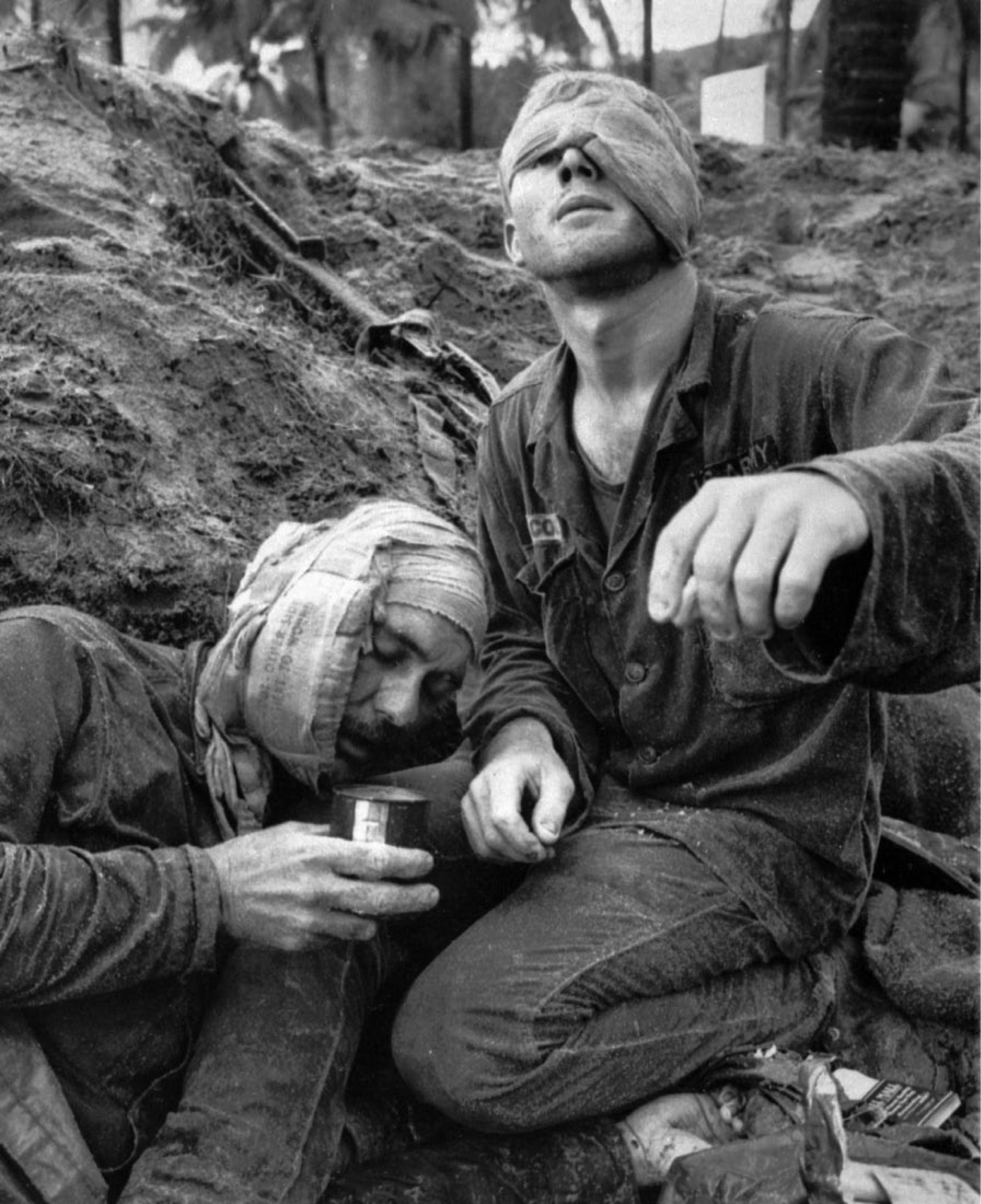
Staff Sergeant Harrison Bell rests his head on the knee of Thomas Cole during the fighting at An Thi. This photograph appeared on the February 11, 1966 cover of Life. © Henri Huet/AP/Imaginechina.
This depiction of Cole on Life’s cover casts the tragedy of wartime suffering in an ironic mode. The story presented is that of a wounded medic, who himself has no one to care for him. He has tried to help his buddy but cannot, and thus offers a gesture of supplication to the reader, but the gesture itself is limp, and the reader is powerless to help. Both Cole and Bell are presented as passive wartime victims rather than heroic wartime agents. The emotional power of this ironic narrative is enhanced through several compositional techniques. Close focus creates a sense of intimate proximity between the viewer and the soldiers, drawing the spectator closer into the scene; purifying or recuperative symbolism is lacking, magnifying the horror of the moment; and war is depicted as a vicious affair with terrible human consequences. Here one can even see the deployment of dirt or filth as a visual trope in the placement of the men against a muddy ridge, a trope well suited to future public interpretation of the war as a ‘quagmire’ in which the United States was stuck (Engelhardt, 1995: 199–201). As a result of these elements of ironic narrative design, the relevant emotional experience for comprehending the lived experience of war becomes that of the suffering survivor of wartime trauma.
A similar example of a photo-essay suggestive of these dynamics – with the balance placed more on the ironic descent into tragedy than on the ascent to romantic heroism – was taken by Catherine Leroy for Life in May 1967 as part of a story covering fighting south of the demilitarized zone (DMZ) near Khe Sanh. The story, titled ‘Up Hill 881 with the Marines’, includes 15 black and white photographs across six magazine pages. Each two-page spread clusters together a different set of related images. The opening two-page spread depicts a group of Marines, under fire from automatic rifles and mortars, as they begin their advance towards Hill 881 North. In the series, Leroy has captured the blasted landscape and destruction caused by war. The foliage, reduced to splinters, provides no cover. Instead, the landscape suggests the incredible destructive force of modern industrial warfare. And, like Huet’s Life cover, Leroy captures the moment of live combat in all of its intensity and danger.
The next two-page spread includes one of her most famous photographs from the war. The image series depicts medical corpsman Vernon Wike as he stops his advance to treat the wounds of a fallen Marine. In one image, he applies a compress to the fallen man’s chest, and in another he presses his head against the man’s chest, listening for a heartbeat. In the middle of the sequence, Leroy captures the moment when Wike realizes that the fallen Marine is dead and turns his eyes to the sky with a distraught expression (Figure 3). In the final images, Wike rushes off towards another fallen Marine. Like Huet, Leroy has exposed the emotional turmoil faced by combat troops in their encounter with the injury of their peers. She does not code the moment of death through the romantic lens of sacrifice. Instead, she has depicted combat as an ironic, realistic tragedy through the ‘dynamics of hope abridged’ – the hope for survival and the traumatic reversal of that hope in the recognition of death (Fussell, 1975: 15).
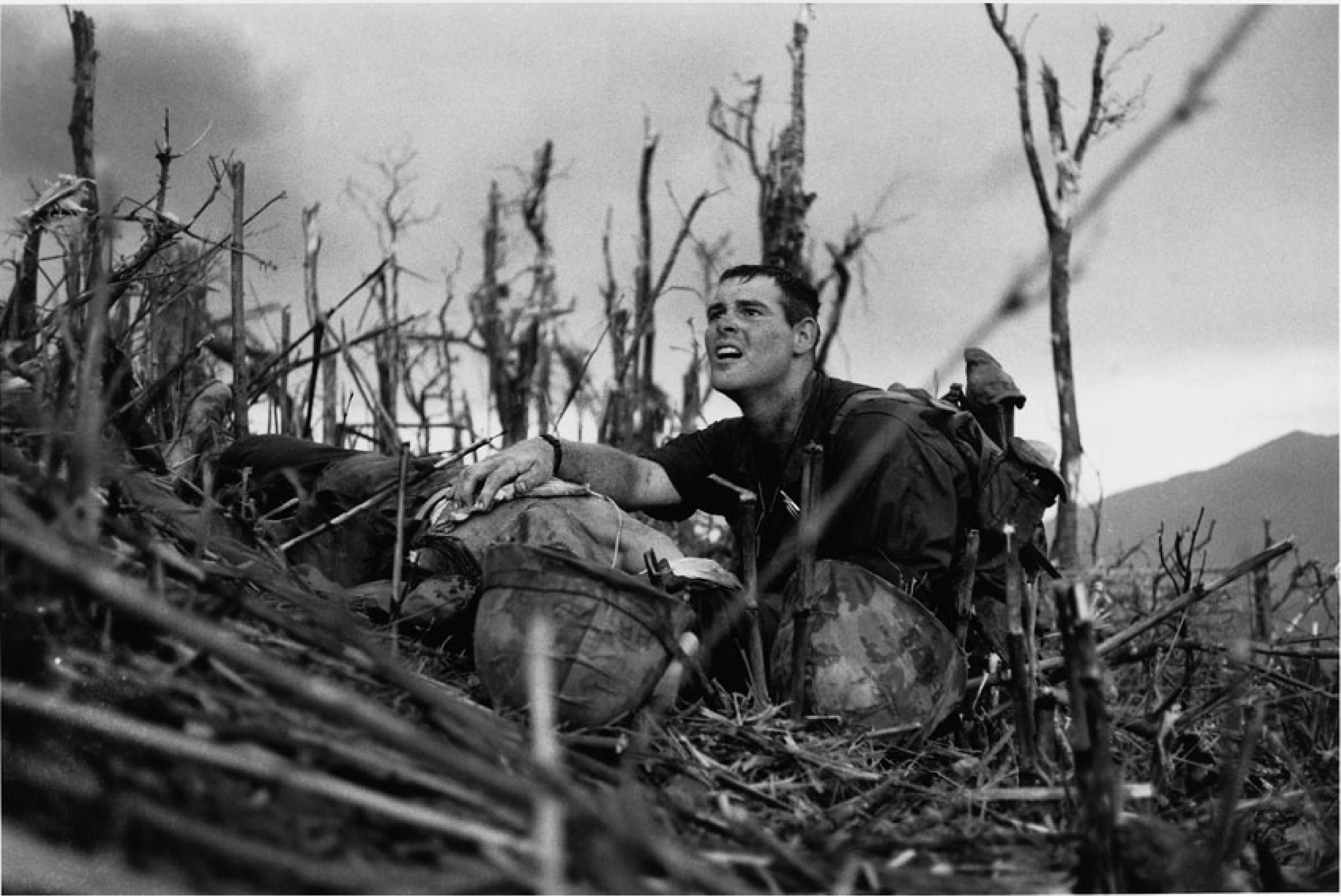
Vernon Wike looks into the sky as he realizes that the man he is attempting to treat is dead. ? Catherine Leroy/Contact Press Images.
Ironic narratives like the one present in Leroy’s photo-essay or in Huet’s Life cover invite audiences to view the war as unnecessarily harmful to soldiers and thus have the potential to provoke moral judgments about the conflict. As James Ettema and Theodore Glasser (1988: 11) have argued in the context of investigative reporting,
[Because] the same set of facts do lend themselves to alternative story forms, whether tragedy, comedy, romance, or farce, the wise selection of story form provides the opportunity to ‘teach what it means to be moral beings’ and ‘to judge the moral significance of human projects.
Following literary theorist DC Muecke, Ettema and Glasser (1994) argue that ironic narratives may hold special power in this regard, as irony allows investigative reporters to call out the outrageous actions of those who violate a publicly accessible moral order. In this case, the treatment of soldiers becomes a moral outrage, with either pro-escalation, military values (support for the troops) or anti-war, humanist values (opposition to war in general) violated by placing soldiers in such situations. Neither violation would be supportive of President Johnson’s attempts to keep the war limited to fighting against a guerilla war in the South.
Two narrative modes are thus present in Huet’s photo-essay: it can be read, on the one hand, as an ironic recognition of war’s terrible human costs, and, on the other, as a romantic portrayal of the courage of a medic working to save lives. The former reading is activated by the photo-essay’s cover, which treats Cole as an ironic victim of wartime violence; just as the latter reading is activated by the essay itself, in which a much more active Cole, stoically ignoring his own injuries, seems in control of the care and recuperation of his wards. Huet’s photographs thus suggest the narrative ambivalence of tragedy because they employ both the romantic conventions of earlier US combat photography as well as the ironic conventions that distinguish Vietnam era photos. Similarly, the contrast between Duncan’s more romantic coverage and Leroy’s more ironic coverage in contemporaneous images of fighting south of the DMZ suggests ambivalence across Life’s coverage of the war. The desire for striking images and evocative narratives was more important to picture editors than selection of images that could persuade readers to adopt Life’s editorial views, whether in the pro-escalation or anti-escalation period of their coverage.
That these narratives made an effort to visualize the cost, consequences, and morality of the fighting for the public is clear; the degree to which they moved the public, on the other hand, cannot be definitely known. However, if we take seriously Michael Warner’s (2002) notion that publics are constituted by the reflexive circulation of discourse, and Cara Finnegan and Jiyeon Kang’s (2004) suggestion that images cannot be dismissed as mere spectacle or a subversion of public discourse, then we might further consider how visual narrative patterns circulated across imagery, and how those patterns could have occasioned political judgments. Although such judgments are largely unrecorded, it is safe to say that, for some, newsmagazine imagery provided a lens through which the fighting could be interpreted and judged.
Such judgments, as suggested by letters to the editor published a few weeks later, demonstrated implicit understandings of both romantic and ironic aspects of the story, and these understandings were put to service in articulating attitudes toward the war. A number of letter writers emphasized the romantic themes of dedication and courage in their responses. P Hauser (1966: 16) writes that Huet’s images showed ‘a simple picture of our boys’ real sufferings and dedication in Vietnam’, which Barbara Sebeil (1966: 16) hopes ‘have stirred the heart and changed the mind of just one anti-Vietnam demonstrator’. Another letter writer, Gary Blome (1966: 16), similarly used Huet’s imagery to make an argument in support of larger Cold War narratives:
Henri Huet’s pictures show us dedication to a human life, destruction and fatigue all of which are symptoms of war … Yet what do we at home do? We criticize, demonstrate and burn draft cards. No one likes war, yet we have to safeguard freedom and stop Communist aggression.
These responses suggest the ways that the romantic narrative mode in Huet’s photography could be used by audience members to support pro-war views.
More ironic understandings of Huet’s photo-essay, on the other hand, may engage audiences to the task of critical judgment, insofar as they point out the grave problems faced by all soldiers, problems that exceed Cole’s or Huet’s capacity to address. For some letter writers, the solution to such suffering was to oppose the war and its larger Cold War justifications. As D Bragdon (1966: 16) suggested:
[Life’s] cover is not easy to gaze upon – and not easy to turn away from. I hope I see the day when many Americans protest the sacrifice so candidly depicted. I care not if this Administration says that it is conducting a Holy War against Communism – in the name of peace, democracy, or chocolate ice cream – it is still wrong.
A similarly critical appeal was made by Nancy May (1966: 16), who ‘implore[s] Mr. Huet to keep photographing … Life to print more such pictures … [and] President Johnson to look at them’. Huet’s imagery, understood as an ironic tale of sacrifice, gave audiences an opportunity to express critical views about the morality of the war and make a claim on others to interpret the images in the same way.
What these two competing responses suggest is that, through the narrative ambivalence of tragic imagery, different moral judgments about the war could be and were expressed in public. This does not mean that Huet’s photo-essay (or any other single photo-essay) was the critical factor in the fracturing of the American consensus – it clearly was not. Rather, it suggests the ways that Vietnam era photojournalism participated in that larger shift by offering citizens an opportunity to debate the war and providing them with evidence to justify their views.
Conclusion
The horizons for the visual representation of war broadened during the Vietnam era, and this broadening began from the outset of the US ground troop involvement in the conflict. New conventions placed US soldiers at the center of the story, but at times cast their actions within an ironic register in which tragic sacrifice could do little to bring the war itself to its conclusion. In this context, Huet’s or Leroy’s photography was not an aberration. Similar ironic narratives could be identified in photographs taken during the escalation period for the wire services and newsmagazines by Larry Burrows, Tim Page, Horst Faas, Kyoichi Sawada, Don McCullin, Paul Schutzer, and others. This should not suggest, however, that national purpose was absent: in the escalation period, photography could emphasize the professionalism, courage, and compassion of US troops, as exemplified in Duncan’s or Co Rentmeester’s photography. And, according to content analysts like Lichty (1984) and Patterson (1984), much Vietnam imagery offered no narrative at all. Stock images of troops unloading from helicopters, walking on patrol, or unloading shipments at base did not participate in the shifts in narrative form described here.
But with the addition of new avenues for telling wartime stories, ironic conventions came to coexist with romantic conventions, suggesting the larger ambivalence of imagery depicting the war as tragedy. Even though the magazines and newspapers had yet to turn against the war, and despite the fact that the photographers often understood themselves to be supportive of the larger Cold War aims of the conflict, changes in visual narrative conventions for telling war stories could raise the stakes of the image for audience members regardless of their previous views. By providing both hawks and doves with argumentative resources to make public judgments about the conflict, photojournalists contributed to the polarization of public debate as it mounted in the escalation period. This can be seen in the ways that audiences took up the task of interpreting the images from Vietnam arriving in their newspapers and magazines, and on their television screens.
Studying Vietnam imagery in this regard can also help us to explain how it may have informed more contemporary modes of spectatorship. As Lilie Chouliaraki (2013) suggests, a break took place in the spectatorship of suffering around the end of the Cold War – with the liberal politics of pity being displaced by a more knowing, ironic way of viewing suffering. Vietnam era imagery may have contributed to this shift toward irony in public viewing practices: the encounter with irony as a common mode of visual narrative could have quickened the contestation and ultimate displacement of heroic depictions of combat and nationalism, but, in undermining such grand narratives, simultaneously helped to usher in ‘post-humanitarian’ ways of looking at and acting on suffering characteristic of the present. Thinking through the narrative form of Vietnam era imagery can thus better our understanding of historical shifts in the practice of public spectatorship.
Further work can and should be done revisiting the visual legacy of the Vietnam War in a way that is sensitive not just to the icons defining American collective memory of the conflict, or the stock images that circulated most frequently, but also the powerful images taken by expert photojournalists on the ground. Such study can tell us not just about the role of photography in the debate about the war, but also about issues regarding history of representations of combat, the cultural and political values associated with suffering and sacrifice, and the privileging of particular narratives about the war. Further work could explore, for example, the (in)visibility of Vietnamese civilian suffering in Vietnam reportage at different points in the war effort, or the representation of military might through air power in Vietnam’s aerial photography. Through such work, scholars can begin a much-needed reassessment of the visual rhetoric of the Vietnam era.
Footnotes
Declaration of Conflicting Interests
The author(s) declared no potential conflicts of interest with respect to the research, authorship, and/or publication of this article.
Funding
This research received no specific grant from any funding agency in the public, commercial, or not-for-profit sectors.