



Abstract
To assist researchers studying the relationships between mass media messages and escalating conflict or peace-building, this article introduces two new datasets generated from Belfast, Northern Ireland, during the critical period before the Belfast Peace Agreement’s ratification. The first, the Northern Ireland Media Dataset (NIMD), contains coded data from a stratified, systematic random sample of articles from the three daily newspapers plus available articles from two paramilitary-related publications. The second, the Northern Ireland Community Relations Dataset (NICRD), resulted from merging one existing database – the Northern Ireland section of the Global Terrorism Database from the University of Maryland (College Park) – with the University of Ulster’s Chronology of the Conflict and coding the combined data for new variables that signify degrees of antagonism, non-antagonism, or peace-building. The latter set contains significant events, such as acts of violence, demonstrations, ceasefires, elections and peace rallies. Together and with other datasets, the NIMD and NICRD help researchers analyze and measure different aspects of mass media messages in either the escalation of violence or building peace in one conflict region. As a small showcase of the data, the research tests one hypothesis of newsworthiness in times of conflict and peacemaking, demonstrating that news norms of drama, conflict and events favor coverage of political parties like Sinn Fein, which used these norms to become the most covered political party during this time.
Introduction
Scholars have been studying the relationship between mass media, conflict and peacemaking, finding a probable connection between media, messages and support for violence toward a particular group (Allen and Seaton, 1999; Bennett and Paletz, 1994; Bennett et al., 2008; Carruthers, 2011; Cottle, 2006; Gilboa, 2002; Hoskins and O’Loughlin, 2010; Tumber and Palmer, 2004). In the worst case scenarios, for example, the genocides of Rwanda and Nazi Germany and the wars of the former Yugoslavia all featured concentrated mass media messages that demonized and dehumanized ‘the others’ and justified their destruction, which helped fuel lethal violence, according to research (Allen and Seaton, 1999; Armoudian, 2011; Bytwerk, 2004, 2005; Chretien, 2007; Dallaire, 2007, 2009[2003]; De la Brosse, 2007; Des Forges, 2007; Hardy, 1967; Hatzfield, 2005; Herf, 2006; Herzstein, 1978; Hoffmann, 1996; Kabunda, 2007; Kallis, 2005; Kellow and Steves, 1998; Kolsto, 2012; Kurspahic, 2003; Li, 2007; Price and Thompson, 2002; Seaton, 1999; Sofos, 1999; Thompson, 1999, 2007). In fact, after the Nazi Holocaust and the Rwandan Genocide, international tribunals convicted media professionals of international crimes, including incitement to genocide (International Law: Genocide, 2004).
Scholars have also examined how mass media have exacerbated conflicts in other specific regions, including Israel and Palestine, finding that negative framing, negative portrayals of ‘the others’ and sensationalism exacerbated the conflict and stymied the peace process (Wolfsfeld, 1997, 2004). In that conflict, the media acted as ‘peace spoilers’ by focusing on negative violent events more than on reconciliation (Maoz, 2006; Sheafer and Dvir-Gvirsman, 2010). In the two Gulf Wars, scholars (for example, Bennett et al., 2008) found that news media failed to provide independent analysis in their reports, instead indexing their content to elite discourse, which was often inaccurate and misleading (Bennett and Paletz, 1994; Bennett et al., 2008). Media also appeared to exacerbate conflict in African states, such as Nigeria and Uganda. In Nigeria, researchers believe that mass media are increasing religious tensions, particularly between Muslims and Christians, but argue that more research is needed; in Uganda, too, media appear to have fueled, rather than abated conflict (Acayo and Mnjama, 2007; Hackett, 1998). Some scholars reversed the independent and dependent variables, instead examining how peace affects media content, finding that after peace, media only temporarily portrayed ‘the others’ more positively in Israel and Jordan (Wolfsfeld et al., 2002).
There have been a growing number of studies suggesting that media messages can contribute to peace processes (Armoudian, 2011; Bratic, 2006, 2008; Melone et al., 2002; Reljic, 2001; Spencer, 2008; Wolfsfeld, 2004). In Burundi, for example, in efforts to prevent another genocide, international NGOs and local journalists organized new media that attempted to focus on the common humanity between Hutu and Tutsi and challenge rumors and warmongering alongside other peacemaking efforts. The collective efforts ostensibly culminated in a peace agreement (Armoudian, 2011; Bratic, 2008; Hagos, 2001; Rich, 1997; Sinduhije, 1998).
Northern Ireland is another region in which research has suggested media’s role in supporting the peace agreement’s acceptance. For example, Gadi Wolfsfeld (2004) focused primarily on editorials in the daily newspapers, analyzing them for support or opposition to the peace process. When comparing editorials in Northern Ireland to those in the Middle East, Wolfsfeld found that the op-eds in Northern Ireland overall supported the peace process, ultimately aiding the Belfast Peace Agreement’s ratification. In contrast, the media articles in the Middle East exacerbated the conflict between Israel and Palestine, contributing to the breakdown of the peace process (ibid).
Another important feature to the Northern Ireland media contribution was advertising. The British government also retained an advertising agency to help persuade voters to accept the peace agreement (Bratic, 2006; Finlayson and Hughes, 2000). Additionally, a ‘propaganda of peace’ grew from a combination of cultural sources, according to McLaughlin and Baker (2010), who qualitatively identified themes arising from media, primarily during the crucial periods before finalizing the Belfast Peace Agreement. Scholars have also analyzed the construction of the ‘troubles’ and the peace process through television coverage (McLaughlin and Baker, 2010). Other scholars have explored the ‘propaganda wars’, the media control (e.g. the broadcasting ban), how the foes were portrayed, and alternative means of communication, such as murals (Armoudian, 2011, 2013, 2015; Condit and Cottle, 1997; Curtis, 1998, Miller, 1993, 1994; Ralston, 1992; Ralston and Miller, 1996; Shinar, 2000).
While political communication scholars see media as an important factor in building, exacerbating or allaying conflict, others argue there is still insufficient evidence to assert that media and technology affect violent conflict (Shoemaker and Stremlau, 2014). The latter scholars argue that, to date, the studies are largely case studies that examine short periods of time, rather than longer periods of time.
That more studies are needed to determine the precise relationship between media, conflict and peace is undisputed, and many scholars emphasize that the latter – media and peacemaking –remains underexplored (Gilboa, 2008; Price and Thompson, 2002; Wolfsfeld, 2004). Eytan Gilboa (2008, 2009), for example, argues that to date, most studies of media and conflict resolution suffer from structural and methodological weaknesses. In particular, he argues that the field needs additional empirical studies and greater collaborations.
This dataset is one effort toward building additional empirical studies and collaborations that might specify and quantify these relationships. It appears from surveying the literature that scholars create individual datasets for their own research projects, which have resulted in important studies, such as framing effects on conflict and peace processes (e.g. Wolfsfeld, 2004; Sheafer and Dvir-Gvirsman, 2010; Shinar, 2003). But shared datasets are not widely available for building empirical or collaborative projects. Such contributions could help scholars specify relationships between media, conflict and peace with more variables.
In the case of Northern Ireland, databases such as Lexis-Nexus were also not complete for gathering data. Lexis-Nexus contained only one Belfast newspaper that contained articles from the key years of negotiation, 1994–1998, and its collection was quite limited (1996 through 1998). Further, that particular newspaper, the Belfast Telegraph, the only evening newspaper in Northern Ireland’s capital city, while ideologically moderate, was considered unionist, meaning its editorial leadership preferred maintaining union with Great Britain. However, two other newspapers also served Belfast’s residents: the Irish News was nationalist in its ideology, meaning it tended to support reuniting with the Republic of Ireland. The other, the Ulster News Letter (also called the Belfast News Letter), was strongly unionist in its ideology (Darby, 1997; Horgan, 2001). Neither of the latter two newspapers were available in traditional databases during the so-called ‘troubles’ or the period of the peace process before the Belfast Agreement was signed.
There was also no database or dataset that included the publications that served two other key communities, republican and loyalist, which are also vital for understanding the Northern Ireland conflict. Similar to the nationalist community, the republican community desired reuniting the northern six counties with the Republic of Ireland. However, their constituents were historically willing to support violence as a means of attaining that goal. For example, the Irish Republican Army (IRA) and its progeny arose from the republican philosophy that viewed the British presence as an unjust occupying force that urgently needed expulsion. The loyalist community, which included paramilitary groups, such as the Ulster Volunteer Force (UVF), was willing to support violence as a means of maintaining union with Great Britain. Thus, as a means to address their grievances and fight for the future they desired, these groups committed most non-state violence (Fitzduff, 2002), and each published their own periodicals (Personal interviews with scholars, political party leaders and journalists, 2009, 2010). Two of the key media from these groups included the republican-published An Phoblacht (meaning ‘the republic’), which evolved into a weekly publication, and the loyalist periodical, Combat, published approximately every five weeks (Hutchinson, 2016).
To contribute to the important work of understanding media, conflict and peace, this article introduces two new datasets, with several variables, in an effort to further analyses. Together and with other datasets, they can help scholars quantify the various relationships between and among several variables in media content and the real events in the Northern Ireland peace process. For example, considerable political and psychological research suggests that dehumanizing or demonizing ‘the others’ in conflict settings encourages and justifies human rights abuses, such as torture, and lethal violence (Allen and Seaton, 1999; Bandura et al., 1975; Goff, 2008; Kelman, 1973; Rothbart and Korostalina, 2006; Smith, 2011). Using these two datasets, researchers can measure, for example, the relationship between portrayals of ‘the others’ – one of the key variables in the media dataset – and the political violence committed by or against those ‘others’. Another growing area of conflict and peace studies has suggested that particular emotions expressed toward ‘the others’ are a key antecedent in lethal conflicts and in peacemaking (Armoudian, 2011, 2013; Bar-Tal et al., 2007; Halperin, 2008, 2009; Jarymowicz and Bar-Tal, 2006; Moisi, 2010; Petersen, 2002). The NIMD contains a set of variables that is coded for groups of emotions. With these variables, researchers can explore the relationships between the emotional content of the articles and the real violence, other antagonisms, and peacemaking overtures contained in the NICRD.
The next two sections will first provide an overview of these two datasets, their sources, and the variables available for analysis. The NIMD’s variables, for example, measure media portrayals of ‘the other’, presence of blame, positive and negative emotions, legitimacy, and how to relate or deal with the parties. The NICRD, on the other hand, codes significant events, such as acts of terrorism, riots, and ceasefires. The subsequent section discusses some ways that researchers might use these datasets together and with other datasets to enhance our understandings of media’s role in conflict and peacemaking.
The Belfast media dataset
Overview
The media dataset contains consistent, comparable media content from each distinct community in Northern Ireland (nationalist, unionist, republican and loyalist). Because the daily newspapers’ audiences and editorial leadership were largely demarcated along lines of identity and ideology, the researcher drew a systematic, stratified random sample of articles from three daily newspapers that each represented a different identity and ideology for analysis of mass media content in the Northern Ireland region. For example, those who identified as ideologically nationalist tended to be Catholic and primarily read one newspaper (discussed below), while people identifying as unionist, tended to be Protestant and read a different newspaper. The dataset also contains a sample from one key republican-oriented publication and one loyalist-oriented publication. Loyalists and republicans, while identifying with unionists and nationalists (respectively), still maintained distinct identities, ideologies, and publications. The media dataset thus contains articles derived from the key publications in each community – unionist, nationalist, republican, and loyalist. These publications, the sample, and their variables are detailed below.
Constructing the media content database
Literature reviews and interviews revealed Northern Ireland’s three most relevant local daily newspapers, which served the nationalist and unionist communities, and the two relevant publications that served the republicans and loyalists. The republican community generally contained paramilitary organizations such as the Irish Republican Army (IRA), and the loyalist community contained paramilitary organizations such as the Ulster Volunteer Force (UVF). The three large-scale Northern Ireland newspapers collected for the dataset included the Irish News, the Ulster News Letter and the Belfast Telegraph (see Table 1). The Belfast Telegraph and the Ulster News Letter each circulated to approximately 100,000 readers per day, while Irish News sold roughly 47,000 copies, according to McLaughlin and Baker (2010).
Irish News is a daily, independent morning newspaper with a ‘nationalist’ 1 identity and ideology that primarily serves the Catholic population (Horgan, 2001). Political observers consider the newspaper to be ideologically moderate and generally reflective of the Social Democrat Labor Party (SDLP)’s politics, rather than those of the republican parties, such as Sinn Fein (personal interviews 2009, 2010 with party and community leaders).
The Ulster News Letter/Belfast News Letter is a daily, morning Protestant-oriented newspaper that is strongly unionist in its ideology. The News Letter had historically expressed anti-Catholic, anti-nationalist and anti-republican views (Horgan, 2001).
The Belfast Telegraph is a daily, evening newspaper that is considered Protestant and unionist in its identity, although it is considered more ideologically moderate than the Ulster News Letter with content that sought to appeal to both the nationalist/Catholic and unionist/Protestant communities (Horgan, 2001; personal interviews 2009, 2010).
Publications in Northern Ireland media dataset.

‘Party affiliation’ is approximate for the newspapers, as they were not directly affiliated with any particular party. The paramilitary publications were, however, much more closely aligned with their parties. SDLP stands for Social Democratic Labour Party; UUP is the Ulster Unionist Party, DUP is the Democratic Unionist Party, and PUP is the Progressive Unionist Party.
The republican and loyalist publications included in the NIMD include the following:
An Phoblacht/Republican News (AP/RN) – Sinn Fein’s primary publication was issued on a weekly basis during the timeframe of this work. At the height of its readership – during the 1981 Irish hunger strikes – its then managing editor estimated its readership at 80,000 (personal interviews 2009, 2010). Other researchers have estimated it closer to 60,000 (Davis, 1994). Current staff at the publication suggested that circulation is approximately 15,000 (interview conducted 2009).
Combat – One of the more prominent publications issued for the loyalist community was published about every five weeks during the timeframe of this work. While loyalist publications were not considered to be as professionally produced as those of republicans, Combat’s readership at times still reached roughly 60,000 (Davis, 1994; personal interviews with loyalists, journalists and scholars, 2009, 2010).
Drawing on the literature from political psychology and political communication for identifying useful content, the dataset used the portrayal and framing of ‘the others’ as a key organizational tool for collecting the sample (described below). The next subsections describe the process for drawing the article sample and the variables for the Northern Ireland Media Dataset.
Identifying ‘the others’
Past scholarship has found that extremely negative portrayals that demonize or dehumanize ‘the others’ have been one important antecedent for human rights abuses and lethal political conflict (Allen and Seaton, 1999; Armoudian 2011, 2013; Bandura et al., 1975; Des Forges, 1999, 2007; Goff et al., 2008; Kelman, 1973; Rothbart and Korostalina, 2006; Smith, 2011; Staub, 2003). The research has suggested, for example, that portraying ‘the others’ as evil and subhuman has been used by some political leaders through mass media to justify violence toward their foes. This past scholarship suggested the importance of identifying the oppositional groups to ensure that the dataset facilitates analysis about mass disseminated portrayals of ‘the others’ and ‘our own’ alongside additional variables.
The literature and field interviews guided the identification of these oppositional parties, which varied by identity group. For example, unionists’ and loyalists’ primary foes were republicans and, to some extent, nationalists. This was due to the threat that these groups represented to the unionist community who held the preponderance of political power in Northern Ireland. The republicans’ primary political party, Sinn Fein, represented the IRA, while the Social Democratic and Labour Party (SDLP) represented the non-republican nationalist community, mostly Catholics. Both republicans and nationalists sought to unite Northern Ireland with the Republic of Ireland, but Sinn Fein was historically distinguished by its more militant commitment and willingness to support violence to attain that goal before the signing of the Belfast Peace Agreement (English, 2003, 2006; personal interviews with party and community leaders, 2009, 2010).
For republicans, the British government, which they viewed as an occupying force, served as the primary ‘other’, and by extension, unionists and loyalists, which were called by one Sinn Fein official as ‘all British’ (personal interview, 2009). The non-republican nationalists ostensibly shared a milder version of the republicans’ perspective but had sought civil rights from the established unionist-dominated government. Among the unionist parties, the Ulster Unionist Party (UUP) represented the establishment, status quo unionist, mostly Protestant community. But more importantly, the Democratic Unionist Party (DUP) emerged as a protest unionist group that formed to oppose any peace process with republicans. This party actively campaigned against the peace process and refused to sign the April 1998 Belfast Peace Agreement, making it the more important ‘other’ unionist party for the dataset. Another important ‘other’ for nationalists and republicans included those who identified as loyalists, which included armed groups who assassinated Catholics. Loyalists generally belonged to one of two parties, the Progressive Unionist Party (PUP) or the Unionist Democratic Party (UDP), which at times worked together. Because the PUP was slightly larger and continued after the UDP became defunct, this database used the PUP as the party representing loyalists. While loyalists shared the fundamental goal of maintaining the union with Great Britain, they were distinct from the unionists in their willingness to engage in violence as a means to defeat the republicans (personal interviews with party and community leaders and journalists, 2009, 2010).
After determining the key oppositional parties to observe and compare, the researcher chose a strategy for obtaining a statistically sound sample that deliberately included these groups. The archival arrangement and the reporting style of the newspapers complicated the process. These complications and the solution are described more in the next subsection.
Collecting the articles
In addition to the deliberate inclusion of oppositional parties, the researcher sought comparable content across the publications, particularly the newspapers. But no searchable index, nor electronic copies of newspapers were available for searching by party or subject. Archives contained hardbound copies organized by date of publication. Further, the newspapers segregated reportage of each political party into disparate articles, and used particular parties for commentary on specific subjects but not others. For example, when seeking comment on security issues, some newspapers sought comment from the party Sinn Fein. But for other subjects, they often sought other parties’ responses.
To address these concerns, and particularly to ensure the availability for comparative analysis, the dataset relied on a systematic random sample, stratified by newspaper. 2 This ensured consistency across the newspapers, such that the sample included articles reporting on the same dates from all three daily newspapers. All articles that included a political party or group on each 17th day from each newspaper were included in the dataset. 3 The newspaper portion of the Northern Ireland Media Dataset includes 814 articles from the nationalist Irish News, 711 articles from the unionist Ulster News Letter, and 802 articles from the unionist-leaning Belfast Telegraph.
All newspaper articles that mentioned a political group or party (approximately 10 political parties and several additional groups), or their acronyms, leaders, and code words (such as ‘loyalist’, ‘republican’, ‘nationalist’, ‘unionist’, ‘provos’, ‘IRA’, ‘UDA’, ‘UVF’, or ‘Orange Order’) were digitally stored. Researchers entered each article into the dataset with the date, headline and a list of groups mentioned. Those articles that included any of the four ‘other’ political parties (Sinn Fein, the Social Democratic Labour Party, the Democratic Unionist Party, and the Progressive Unionist Party) underwent thorough coding for each of the variables (discussed later in this article).
Because the newspapers publish on a daily basis, the random stratification approach was straightforward. However, the two paramilitary-related periodicals published at different intervals: Combat published about every five weeks, while An Phoblacht published weekly during the time frame of the study, requiring a different sampling approach. Missing issues in the original library collections also generated gaps in the data. For the An Phoblacht sample, the sampling interval included every other available issue (roughly twice a month). And for Combat, it included every available issue. After obtaining special permission to use a digital device from the Linen Hall library, a camera digitized and transported the articles’ images of all articles that mentioned a political group from the available publications. The dataset thus includes 420 articles from the republican publication, An Phoblacht, and 139 from the loyalist publication, Combat. Combined with the newspaper articles, the total articles in the media dataset reach approximately 3,000 articles. Using the same process as with the newspaper articles, these articles were entered with their headlines, subject matter, summary of the article, and all groups mentioned. However, the articles that included the four key oppositional parties underwent a much more thorough analysis that is described below.
Data analysis
Researchers entered each article in the random sample that mentioned a group, or its acronym, leader or synonym with their headlines, dates, subjects, publication names, and summary of content into the dataset. These variables can assess frequency and types of coverage for each group, source, and subject and to see and compare the following: (1) coverage of groups and topics in each publication; (2) coverage differences in each publication; and (3) changing coverage over time. Additionally, articles that included any of the four key oppositional, non-establishment parties – Sinn Fein (SF), the SDLP, the PUP, or the DUP – underwent extensive analysis and coding for an additional set of variables (9 variables per party and 3 for the situation). Approximately one third of the circa 3,000 articles in the dataset underwent the extensive analysis and coding. The codes and variables are discussed in the next sections.
The variables and their codes
The Northern Ireland Media Dataset offers two broad variable categories. In the first category – the framing of the political situation – the codes measure three variables: presence of blame; focus on hostility or focus on calm/accord; and presence of fear and/or hope. These are detailed below and summarized in Table 2.
Presence of blame: This variable assessed if someone blamed a person, group or government for a political problem or negative event, or if, instead, a more contextual explanation was offered for the problem or event. Blame has been considered an important attribution in political conflict. It is a key component in framing a conflict and is often used to establish meanings and assert legitimacy (Wolfsfeld, 1997). Blame increases negative attack-oriented emotions such as anger, resentment, and hate toward the target of blame, particularly when the event is deemed unjust. These negative emotions correspond with aggressive behaviors (Beck, 1999; Beck and Pretzer, 2005; Frijda, 1996, 2004, 2007; Gudjonsson and Singh, 1989; Lazarus, 1991; Sternberg 2005). The codes ranged from −1 (blame), 0 for no blame; to +1 (contextual explanations/understandings)
Focus on hostility or calm/accord: This variable measured the focus on hostility or calm/accord in the media frames and the degree to which either was present. Media scholars have found that journalists tend to focus on drama and conflict (Bennett, 2007; Wolfsfeld, 2004), which may exaggerate the public’s sense of conflict and compound negative emotions and behaviors. This variable sought to determine whether the framing focused on the hostility or on the calmer engagements during the so-called ‘troubles’ and peace process. The codes for this variable included the following: these variables ranged from −2 for extreme hostility and conflict (e.g. focus on extreme violence such as more than one bomb, multiple shootings or a sense of pandemonium) to +2 (focus on high level of accord and engagement).
Presence of fear and/or hope: This variable draws from the psychology literature, which suggests that fear and the sense of threat or danger heighten awareness and surveillance and evoke impulses of either avoidance or aggression (Frijda, 1986; Lazarus, 1984; Marcus et al., 2000). In contrast, positive emotions, such as hope, can create greater openness, creative cognitive activity and neutralize negative emotions (Bar Tal, 2001; Fredrickson, 2004; Lazarus, 1991). 4 With future focused emotions and expectations, people tend to adjust behaviors according to their anticipation of positive or negative outcomes, which can create self-fulfilling prophesies without realization (Edelman, 2001, 2013; Zimbardo, 2007). Coding for this variable ranged from presence of fear = −1 to +1 for presence of hope.
Situation variables and their codes.

The parties
The second category addresses the depictions of ‘the others’, the four oppositional, non-establishment parties. Coders evaluated 10 variables that measure the parties’ treatment and framing within each article. The variables’ codes offer comparative opportunities to assess the parties’ framing within each publication, across all five publications, and over time. Analysts coded the variables using the following questions and guidelines (see also Table 3):
Blame: Was this particular group (or its members/leader) blamed for a negative development? As discussed earlier, blame portrays parties and people in terms of guilt or innocence and generates negative, attack or punishing emotions, which are important in conflict settings. It also distances people, often dehumanizes the target of blame, and defeats compassion (Lazarus, 1991: 289). The blame variable’s codes ranged from −1 for blame to 0 for no blame.
Tenor/tone: What was the dominant tone or portrayal used for the party? Similar to blame, depictions can arouse positive or negative opinions and emotions, and their action tendencies. Using a 7-point scale, this variable’s codes included two dimensions: the negative–positive dimension, and its intensity. These variables’ codes ranged from −3 for extremely negative (e.g. dehumanized) to +3 for extremely positive (e.g. heroic).
Counter-tone: This measure assessed the diversity of the parties’ depictions within each article. If a second perspective or minority tone entered the article to counter the dominant tone/depiction, coders assessed the positivity or negativity, marking it as either −1 or +1. If there was no counter tone, the code remained 0.
Voice: Did the party have a voice in the article? Scholars suggest that having a public voice contributes to a person’s or party’s legitimacy (Bucy and Gregson, 2001). The variable helps determine which political parties were able to publicly articulate their positions and grievances, including paraphrasing or quotation, as either +1 (voice) or 0 (no voice).
Positive or negative voice: If the party had a public voice, coders assessed the positivity or negativity of the voice, with a range of −2 for extremely negative to a +2 for extremely positive.
Legitimacy: Was the party or its constituents portrayed as legitimate members of society? Scholars have found that legitimacy alters the degree of anger and aggression against the target of blame. If the act for which one is blamed, for example, is considered legitimate, aggression tends to be intermediate whereas acts that are considered illegitimate evoke the highest levels of other-directed aggression (Kulik and Brown, 1979: 183). Similarly, legitimacy of persons, parties, governance and grievances are often at the heart of conflict. Coders evaluated legitimacy on a 5-point scale, ranging from −2 for ‘definitely not legitimate’ to a +2 for ‘definitely legitimate’.
Emotions: As drivers of behavior, emotions are increasingly important in political conflict research (Moisi, 2010; Petersen, 2002). Psychologists suggest that emotions contain at least two dimensions – intensity and the negative–positive dimension. For example, irritation is considered a mild form of anger while rage is a more intense form, according to some emotions scholars (Lazarus, 1991). Analysts coded groups of emotions that are affiliated with either aggression or reconciliation. These included the following emotions and questions: Positive emotions: Scholars argue that positive emotions promote positive cognitions, creativity, flexibility, negotiation and reconciliation, and counter negative emotions (Fredrickson, 2004; Isen, 2000). If positive emotions were associated with the parties analyzed, coders marked them as either 1 for low-intensity emotions (e.g. acceptance) or 2 for high-intensity positive emotions (e.g. pride or adoration). Negative or attack emotions: Many researchers (Frijda, 1993; Halperin, 2008; Moisi, 2010; Peterson, 2002; Sternberg, 2005) have found that emotions such as anger, rage, hate, and resentment elicit aggressive or punishment behavioral tendencies. Analysts coded negative emotions according to their intensity with either a −1 for low intensity (e.g. upset, irritation, mild anger) or a −2 for high intensity emotions (e.g. rage, outrage, disgust or hate expressed toward the party or its members). Fear: A negative, distancing emotion, emerges when people believe or expect that someone or something will harm them or their in-group (politically, economically, culturally or physically), for which they adjust behaviors by either distancing themselves or attacking (Lazarus, 1991), which can create a self-fulfilling prophesy, according to psychology scholars. Coders marked presence of fear with a −1. Hope: Similar to fear, hope is future-focused, corresponding with expectations that the party or its members will do something positive. When people hope, they often adjust their behaviors in a more constructive way. Coders marked hope associated with the party with a +1.
Future relations: This variable assessed the subtle cues suggesting future relations and political solutions to be used to deal with the party. Analysts coded this ranging from −3 for killing or torturing to +3 for honoring or exalting party members.
Party variables and their codes.

Using a comprehensive set of coding instructions and these variables, one coder assessed and quantified the articles’ content. A second coder analyzed 5 percent of the articles to test for inter-coder reliability using the same coding instructions. Each category attained at least of 80 percent inter-coder reliability.
These eight variables measure key facets of the four oppositional, non-establishment parties within the five publications in the dataset. These can be used individually or in combination(s) for comparative purposes and to assess changes over the key 4.5 years before the voters ratified the Belfast Peace Agreement. Those years offer considerable ebb and flow of important events such as political violence, renunciation, and negotiations. They also contain a period in which the British broadcasting ban was in effect. This ban prohibited the airing of particular voices of people who were considered terrorists, which included members of Sinn Fein, some of whom were elected officials.
The next subsection describes the statistical properties of these variables. The subsequent section describes the second dataset and how these two datasets – on their own or in combination with other datasets – can be used to better assess the role of mass media messages in the escalation or de-escalation of lethal political violence. These follow with a test of newsworthiness in times of ‘Troubles’.
Statistical properties: Central tendency and dispersion
Using the individual variables’ values from each article, researchers calculated combined frame scores for each party and for the overall situation in each article, then calculated the mean scores for the parties and situation in each publication at each data point. Because each publication communicates to a different community, the aggregate scores allow scholars to quantifiably understand the different messages that each community received about the opposing parties and the overall situation. The mean frame scores and standard deviations are represented in Figures 1 and 2.

Mean variables combined for each party by publication (N = 2937).
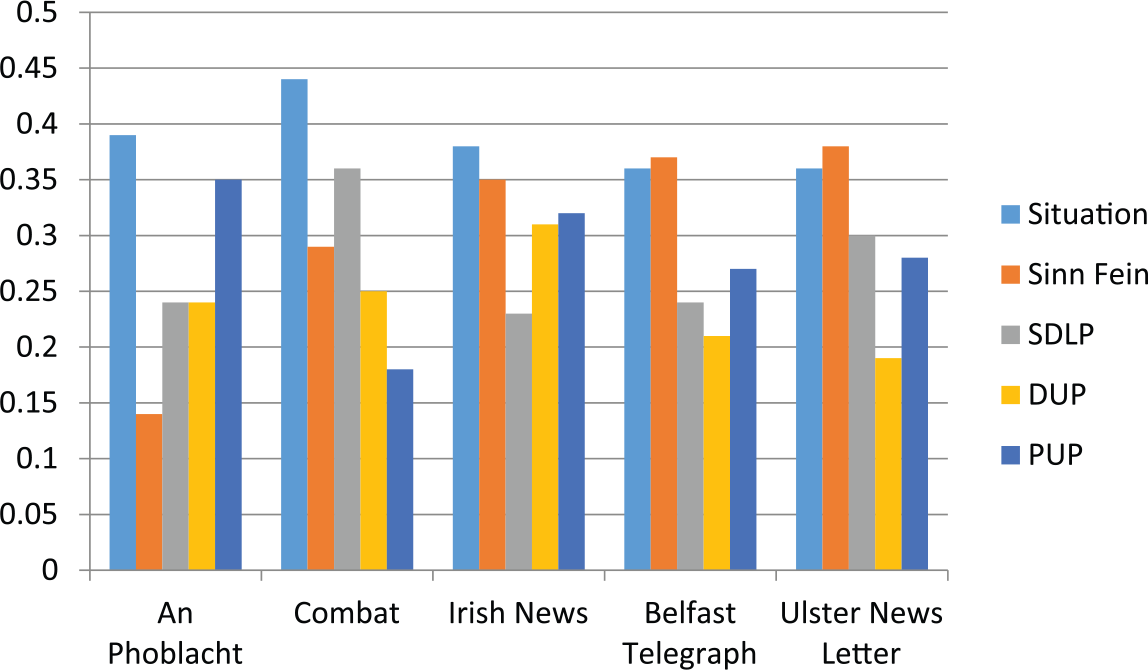
Standard deviations of the situation and combined variables for parties.
The aggregate scores quantify the situation and the parties’ framing in each publication. Researchers can see and compare the variation between the messages disseminated by each publication. Figure 1 shows this variation between the aggregate mean framing values for the situation and party in each publication. The standard deviations of these aggregate values are shown below in Figure 2.
Similar to Figure 1, Figure 2 displays the standard deviations of the aggregate frame values for the situation and each party. These offer opportunities to see and compare the standard deviations for the combined variables stratified by party and situation in each publication. Figure 2 displays the variation of the standard deviations stratified by publications for the situation and party frames.
The community relations database
The second dataset, the Northern Ireland Community Relations Dataset (NICRD), offers scholars a compact dataset of events that are coded for their level of antagonism or potential reconciliation impact during the key period of the peace process. This dataset emerged combining two existing sets of data. The first, the Northern Ireland data from the Global Terrorism Database at the University of Maryland (LaFree and Dugan, 2007) contained acts of political violence. The second, the University of Ulster’s Chronology of the Conflict (CAIN, 2016), contained many types of significant events, ranging from ceasefires, demonstrations, riots, and apologies. This ensured inclusion of relevant events related to the conflict and peacemaking efforts for the 4.5 years before the May referendum that ratified the Belfast Peace Agreement. Where data conflicted, such as dates or perpetrators, the NICRD relied upon the University of Ulster’s Chronology of the Conflict. The final dataset included 410 significant events, including acts of political violence, antagonistic parades, peace rallies, ceasefires, apologies, and other acts that signified a measure of intercommunity relations – overtures toward peace or hostility.
A coder ranked the events on a scale of −3 to +3 to quantify each event’s degree of antagonism or accord/reconciliation and entered the code into the responsible group(s)’ column(s). If more than one group was engaged in the event, such as in the case of a standoff, a riot, or a peace rally, each group received the code. The codes explained below can also be seen in Table 4 and ranged from ‘extreme hostility’ to ‘honoring the other’.
Events of Northern Ireland and their codes.

Table 4 shows the coding strategy for significant events in Northern Ireland during the 4.5 years before the Belfast Peace Agreement was ratified with their numeric codes that signify the incidents’ relationship to conflict or peace-building potential. This next section describes how these datasets can be used together and with other datasets to analyze the relationship between media messages and conflict or peace-building.
Using the datasets
Together and with other datasets, these two new datasets give researchers opportunities to experiment with several variables. Among the important questions, on their own and with other existing datasets, the NIMD and NICRD allow researchers to quantify the relationships between and among multiple variables related to media messages and other variables related to conflict or peacemaking. Using the NIMD on its own, researchers may assess trends in media in times of conflict and peacemaking. For example, Armoudian (2015) used the five publications to analyze how the foes were constructed in media, finding that there are dual forces: the norms and structures of traditional journalism and the force of ideology/identity.
It can also be used to assess newsworthiness of groups, which is conducted below. Given the definition of ‘news’ and its focus on drama, conflict and individual events, it is expected that Sinn Fein will be the most ‘newsworthy’ party in the time period under study. This will be demonstrated simply by the number of articles in which the party is included compared with other parties during the same time frame. This is discussed further below.
The construction of newsworthiness
News norms dictate that the news media focus on particular issues, people, and parties, suggesting newsworthiness, which traditionally means novelty, drama, conflict, the violation of values and particular kinds of events (Bennett, 2007; Gans, 1980; Wolfsfeld, 1997, 2004). The institutional structures, norms and routines, such as the definition of ‘good’ reporting, indexing frames to public officials, the use of beats, regular reliance on particular sources, and populating traditional news media with journalists of moderate ideology also shape news (Bennett, 2007; Cook, 1998; Gans, 1980; Gitlin, 1980).
During the Northern Ireland conflict and peace process, eight interviewed journalists said they focused most on republican activities – the IRA and its affiliated party, Sinn Fein (personal interviews, 2009, 2010). They also, however, expressed a deep interest and enthusiasm about the activities of John Hume and his party, the SDLP, and admitted that unionist and loyalist parties captured their imaginations the least (personal interviews 2009, 2010). This may reflect the standards of newsworthiness – after all, it was the republicans (Sinn Fein) and the SDLP who were seeking change, while the goal of unionists and loyalists was continuing the status quo. And the means by which republicans sought change was dramatic, conflict-ridden and a violation of societal values.
The dataset corroborated this news focus (see Figure 3). Of the four political parties under study, Sinn Fein, the change-pursuing, drama and conflict-creating party, appeared in the articles most frequently across all publications. Among the three traditional, daily newspapers, the nationalist Irish News sample included Sinn Fein in 45 percent of the articles, while the two unionist newspapers, the Ulster News Letter, and the Belfast Telegraph both included Sinn Fein in 41 percent of the sample’s articles. In its own ideological publication, the republican An Phoblacht, Sinn Fein dominated coverage, appearing in nearly 72 percent of the sampled articles. The loyalist publication, Combat, included Sinn Fein the least of the publications – a total of 37 percent of the articles sampled. But even so, it featured its foe more frequently than its own party, the PUP.
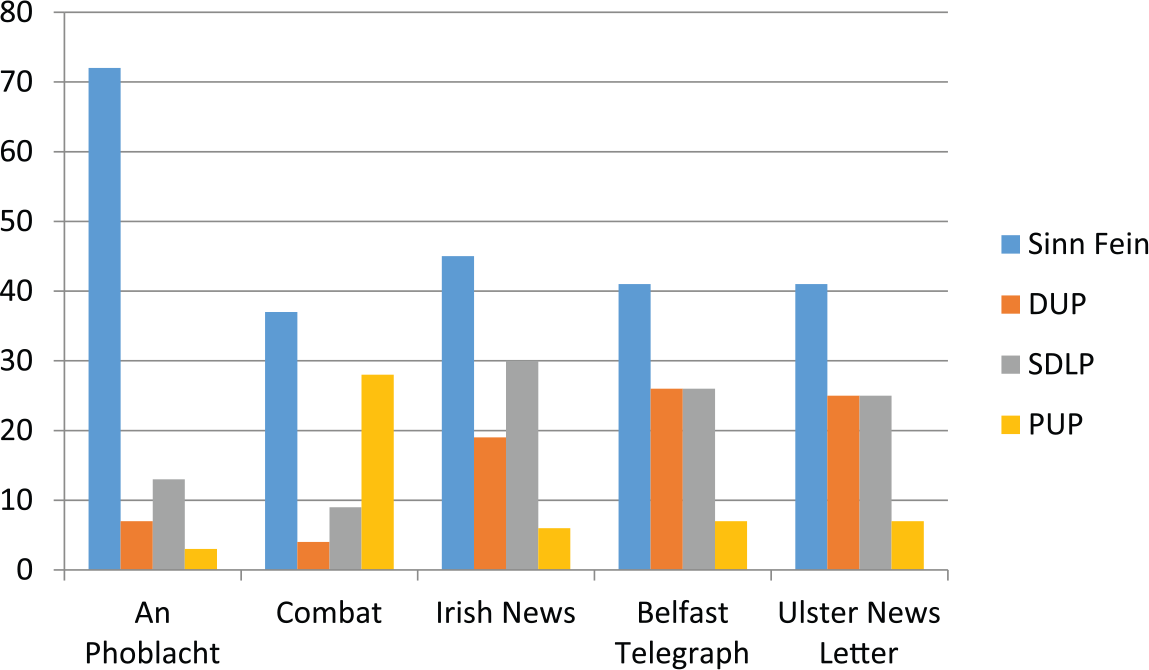
Percentage of articles including the parties.
Also reflective of interviews and the literature, the nationalist SDLP, another change-seeking party, followed as a somewhat distant second to Sinn Fein. It appeared in the Irish News in nearly a third of the articles sampled (30%) and the two unionist daily newspapers a quarter of the time (26% in the Belfast Telegraph and 25% in the Ulster News Letter). The nationalist party was much more adamant about seeking change through changing the system and without violence, which was still ostensibly newsworthy but did not measure up in terms of drama and conflict.
The paramilitary-associated publications were far less inclined to include the SDLP in their coverage. The republican An Phoblacht included the nationalist party in 13 percent of sampled articles, while the loyalist Combat included it in 9 percent of the sample. The variation across publications conformed to expectations, particularly with the republican An Phoblacht and the loyalist Combat, which both operated outside of the traditional journalism institution. Ideologically, while sympathetic to their nationalist counterpart, the SDLP, republicans opposed the SDLP’s strategy and considered the party a rival to Sinn Fein. Thus, it makes sense for a ‘party paper’ to focus strategically on its own favored party, Sinn Fein. Similarly, with Combat, because loyalists were primarily concerned and organized against republicans, the pages contained less focus on the nationalist party.
As expected, in the two unionist newspapers, the unionist protest party DUP’s coverage matched that of the SDLP, with appearances in 25 percent of Ulster News Letter sampled articles and 26 percent of Belfast Telegraph sampled articles. But the party, which fought to maintain the status quo unionist-dominated power structure and protested against the peace process, appeared considerably less frequently in the nationalist Irish News, mentioned in only 19 percent of the sampled articles (as compared to the SDLP’s 30%). Both paramilitary-affiliated publications largely ignored the DUP. An Phoblacht mentioned the party in only 7 percent of the sampled articles, and Combat covered the group even less – in 4 percent of articles sampled. With An Phoblacht, republicans had framed the conflict as ‘republicans-versus-the British Government’, and the unionists were generally considered de facto representatives of the British. Thus, the party’s general absence in An Phoblacht is not surprising. Similarly, Combat was affiliated with loyalist paramilitaries and rival parties to the DUP. The loyalist parties had eventually decided to support the peace process and agreement that included republicans – an end that the DUP opposed.
Also reflective of interviews, the loyalist PUP appeared in only 6 percent of the Irish News’ sampled articles and nearly 7 percent of the two unionist newspapers’ sampled articles (the Ulster News Letter and the Belfast Telegraph). Although the loyalist party had been engaged in Northern Irish politics for decades, it had only held one elected seat through most of the time period under study and was often called a ‘fringe’ party in the media. An Phoblacht was less inclined than the traditional newspapers to include the loyalist party (3% of sampled articles). As expected, the loyalist publication, Combat, was the notable exception, including the PUP in 28 percent of sampled articles (see Table 5).
Newsworthiness of the parties (N = 2937).

Other research opportunities
With the combined NIMD and the NICRD, scholars can use the coded variables to assess how the media-content variables individually and collectively correspond with changes in violent conflict and/or efforts toward peacemaking. For example, Figure 3 demonstrates the patterns of the aggregate yearly mean frame values for the situation and for each party alongside the mean community relations’ scores in one newspaper, the Belfast Telegraph over the 4.5 years before the ratification of the Belfast Peace Agreement.
Using aggregate yearly mean values, Figure 4 demonstrates the changes in community relations and the situation’s and parties’ framing in one newspaper, the Belfast Telegraph, during the 4.5 years before the ratification of the Belfast Peace Agreement.
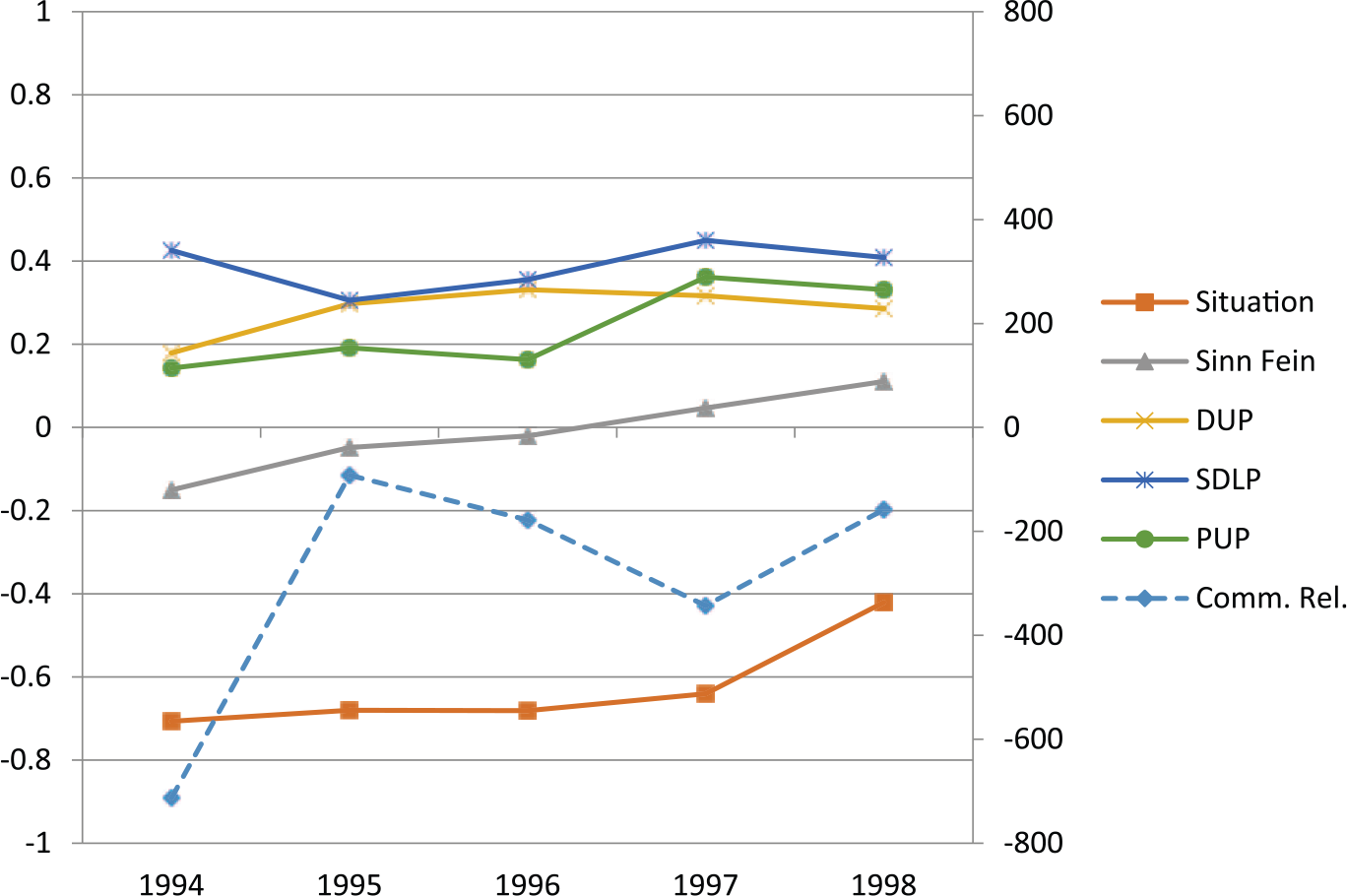
Belfast Telegraph yearly mean framing and community relations.
Researchers can use statistical analyses to better measure the relationships that appear to follow a similar trajectory while controlling for other variables that may come into play. With a time series analysis, for example, scholars can measure these relationships and determine if the individual variables, such as disseminating negative portrayals of ‘the others’, contributed to greater violence toward those groups, or if legitimizing the parties led to greater peace. The time series analysis can also help analyze the effects of other individual variables, such as blame, hostile framing, presence and intensity of positive or negative emotions, or suggestions for future relations with the parties, on the conflict or its resolution. Researchers may also measure the reverse relationships – the effects of escalating or diminishing violence on aspects of media’s portrayal of the parties.
The stratified nature of both datasets (by publication in the media dataset and by identity group in the community relations dataset) permits researchers to isolate the variables and thus see the impacts within and on particular communities and each publication. In other words, scholars can separate the media messages about each party and those received by each community, as well as can also use correlations to compare issue framing and party portrayals in each publication.
The data also offers potential natural experiments. Researchers can compare the media content variables just prior to and just after particular events, such as a bombing, shooting, antagonistic parades or ceasefire. Using these two datasets alongside attitude surveys, such as the Northern Ireland Attitude Survey, scholars can also evaluate the relationships between media messages, other means of communication (e.g. parades, violent acts), and changing attitudes toward one another in each community. Finally, when used with other datasets, such as the Minorities at Risk (MAR), which measures factors such as deprivation or grievances (Gurr, 1999), or the Ethnic Power Relations (EPR), which measures access to executive-level state power (Cederman et al., 2009), researchers can incorporate and/or control for the role of media content – or aspects of media content – with other factors that might either escalate or quell conflicts.
Ireland and beyond
Beyond the Northern Ireland conflict and peace process, additional datasets of mass media content can build upon and improve the NIMD and NICRD so scholars can conduct quantitative data analysis across many different conflicts and peace processes. A dataset of mass media content from multiple conflicts and peace efforts can provide a wealth of material to help scholars measure the communication factors in the escalation or alleviation of violent conflict. Similarly, a dataset of events coded for a variety of events that signal different levels of antagonism or peacemaking help scholars assess these relationships that may provoke, build or allay violent conflict. As scholars develop similar media and event datasets, they can control for these factors, such as the variables in this media dataset, or for other variables from multiple conflicts and compare outcomes.
Conclusion
This article introduces two new datasets to assist international relations and political communication scholars in measuring the relationships between escalating or quelling of political violence and media content. The first dataset, the Northern Ireland Media Dataset contains coded variables such as the portrayals of oppositional parties, the ‘us’ and ‘them’, emotions, legitimacy, blame, and future relations in a random sample of articles from three daily newspapers, and available data from two publications that serve the republican and loyalist communities. In addition to the multiple variables, the stratified nature of the samples allows scholars to assess media processes, compare content, and the changes in each community. In other words, because these five publications emerge from and disseminate to the disparate communities in Northern Ireland, researchers can isolate and compare the impacts on each community, assessing the quantified differences of media messages. Similarly, the community relations dataset divides the real events by date, level of antagonism/non-antagonism, intensity, and source of the activity (by group). This dataset, the Northern Ireland Community Relations Dataset, resulted from merging one existing database – the Northern Ireland section of the Global Terrorism Database from the University of Maryland (College Park) – and the University of Ulster’s Chronology of the Conflict – and coding the new combined data for degree of hostility or reconciliation. The latter set contains significant events, such as acts of violence, demonstrations, ceasefires, elections, and peace rallies.
Together, these datasets can assist scholars assess a range of questions related to the role of media content, conflict, and peacemaking. As a small showcase, this article demonstrated the newsworthiness of ‘the other’ parties across media outlets during times of conflict and peace talks. By isolating the focus on each of the four parties in the aggregate data in each publication, newsworthiness appears to confirm earlier definitions of ‘news’ as the search for drama, conflict, events, the violation of values, and challenges to the status quo. But the datasets can be used for more. For example, researchers can correlate the media content variables and increased antagonisms or peacemaking. With a time series analysis, they can better determine the direction of those relationships. Further, researchers can devise natural experiments before and after events – or before and after a particular media portrayal – as another window into these relations. When used in conjunction with other datasets, these two new datasets can enrich the data palette from which scholars can draw when looking closer at particular conflicts, adding in media content variables – or overall media frames – to quantify relationships between mediated messages and violence or peacemaking. Used with other existing datasets, international relations and political communication scholars can better understand how conflict processes and conflict resolution interact with both overall media messages and specific components within the messages. Finally, the media dataset provides a possible model for future media datasets from other conflict zones and peacemaking efforts.
Footnotes
Funding
This research received no specific grant from any funding agency in the public, commercial, or not-for-profit sectors.