



Abstract
Through interviews with 100 journalists and editors in seven countries, the authors examine safety as the main challenge for journalists covering war and conflict in both local and international contexts. The article places a particular focus on the situation for Filipino and Norwegian journalists. The underreporting of legal aspects of international conflict, combined with less security, means less presence and more journalistic coverage based on second-hand observation. The article argues that reduced access to conflict hotspots owing to the tactical targeting of journalists might distort the coverage of wars and conflicts, and affect the quality of journalism in future.
Keywords
Introduction
This article presents findings from a study among reporters covering war and conflicts from conflict zones (Høiby and Ottosen, 2015). It will argue that the traditional reporter is a threatened species.
The whole history of war journalism is one of journalists trying to get access to events in order to serve the interests of the public. The history of reporters’ ability to follow unfolding events is as old as war journalism itself. Stig A Nohrstedt and Rune Ottosen have argued that the media’s ability to serve as the Fourth Estate, even in time of wars and crisis, depends on the journalist’s ability to cover wars and international conflicts through first-hand knowledge (Nohrstedt and Ottosen, forthcoming). But when the correspondent for the Norwegian Broadcasting Company (NRK), Sigurd Falkenberg Mikkelsen, returned to Norway in autumn 2016 after serving five years in the Middle East, he stated, with reference to the conflict in the region, that: ‘By and large we don’t lack information. What we lack is quality journalism from trustworthy journalists … such reports are essential for giving Norwegian democracy as realistic as possible a picture of what is really going on’ (Klassekampen, 24 September 2016).
The concern for journalism today is that the lack of safety and security for reporters will increasingly be a problem for the media as well as for the public. Ultimately, these are issues of freedom of expression, press freedom and democracy. The concern of this article, based as it is on a survey among reporters covering war and conflicts, is that the pressure on the safety of reporters will prevent the public from getting first-hand knowledge of the conflicts. The underreporting of legal aspects of international conflict, media strategies and use of information from second-hand sources may contribute to put journalists’ safety at stake (Nohrstedt and Ottosen, 2014). This article argues that contemporary warfare has brought new rules of engagement for journalists at work in war and conflict zones, which in many cases leads to less presence and more journalistic coverage based on second-hand observation. Targeting the press in war and conflict challenges their role as the Fourth Estate.
This article is based on information from structured interviews with 100 journalists and editors in seven countries across four continents. It is in addition augmented with in-depth details from Norway and the Philippines, and throughout the article examples from these two countries will be used to support general findings.
Historical background
The title of Phillip Knightley’s book The First Casualty (1986) has almost become a cliché, pointing to the fact that truth is the first casualty in war if reporters are prevented access to unfolding events in the war zone. Actually it was US Senator Hiram Warren Johnson who in 1918 is purported to have said: ‘The first casualty when war comes is truth.’ No one is surprised any longer when new wars are started based on lies, disinformation and propaganda (as an example, the alleged weapons of mass destruction before the war in Iraq in 2003). Knightley takes the Crimean War as a case study and his point of departure in the history of war correspondents. In that war, William Russell was a war correspondent for The Times. He was the classic male war correspondent, reporting from the frontline, side by side with the soldiers in the battlefield. Although he later obtained a good reputation as a journalist, his reporting at the time was biased and fits well the propaganda of the British Empire. Russell used the technique with which we have been familiar in so many wars. On one side are the good guys, and on the other side the bad guys. (Of course, at that time The Times had limited circulation compared to that of modern mass media, communicating mainly with the power elite and the educated middle class.)
The Geneva Convention offered protection to the traditional war reporter following the troops (often in uniform), as we saw during the First World War and Second World War. But this is hardly relevant in the new forms of war. Jump to the Gulf War in 1991: one television channel, CNN, had a global mass audience and reported 24 hours a day, seven days a week (24/7) for the first time in history. The combination of the military’s ability to control the media through censorship, disinformation and war propaganda, and the physical control of access to the battlefield was a breakthrough for the military. The pool system organized by the military was introduced with success for the first time during the US invasion of Grenada in 1983. It was reporters’ only safe way of getting first-hand access to the frontline. Censored reports were then sent from the battleground (Ottosen, 1994). This system was reintroduced by the military during the Gulf War in 1991. The result was a uniform global coverage distributed globally by CNN with its monopoly. George Gerbner (1992) stated that during the Gulf War: ‘The boiling point is reached when the power to create a crisis merges with the power to direct the movie about it.’
Stig A Nohrstedt and Rune Ottosen have made the point in their books that the global distribution of propaganda through news reporting reflects the close relationship between the mainstream media and the hegemonic position of the US-dominated security policy in the Western world (Nohrstedt and Ottosen, 2004, 2014).
During the Gulf War, Peter Arnett of CNN reported alone from Baghdad, as the other reporters had been expelled by Saddam Hussein. Arnett mostly reported with a Western perspective. He was the only reporter able to observe live, from his hotel window, when the bombs starting falling over Baghdad.
The dominant position of CNN during the Gulf War was the most important reason for establishing Al Jazeera in 2006. The Arab world refused to be subjected only to Western images during crises and wars (Figenschou, 2004). The propaganda victory of the Gulf War has been called ‘a triumph for the image’ (Mowlana et al., 1992). As the British had done during the Crimean War, the US Empire could celebrate victory through images of the traditionally male, brave war heroes, distributed to the audience by (mostly) male war reporters from the press centre in Riyadh, Saudi Arabia. Some of them were even dressed in battle uniform as they travelled to the frontline under strict military control and censorship (Nohrstedt and Ottosen, 2001).
The experience of the Gulf War motivated the largest media companies to send a letter of protest to the Pentagon, refusing censorship and similar restrictions in the future (Ottosen, 1994). Partly as a result of this, the Pentagon organized the embedded programme during the Iraq war of 2003 – this made it possible for the reporters to follow the events as a part of the military unit without censorship but with restrictions on reporting the position of the troops and restraints on revealing the identity of wounded soldiers. The system also raised ethical issues such as only being able to report from one perspective and not really getting access to the civilian population affected by the warfare (Katovsky and Carlson, 2003) but, as this was the only way to secure the safety of the reporters, most media companies accepted it as the only safe way to cover the war.
When Norwegian reporters covered the NATO/ISAF warfare in Afghanistan, most of them were embedded with the Norwegian defence forces and with ethical issues similar to those discussed above (Ottosen, 2010). Partly because of this, the Norwegian freelance reporter Anders Sømme Hammer decided to settle in Kabul and build his own network source to secure independent reporting (Hammer, 2009). In recent wars such as those in Libya and Syria, many freelancers have drawn the same conclusion and organized their own work with multiple employers.
The media scene and the methods of warfare have seen vast changes. Since the media have been fragmented through the introduction of the internet and social media, and more than 20 global TV channels are operating 24/7, no channel can now have a monopoly.
The so-called ‘Global War on Terror’ (GWT) started with the war in Afghanistan in 2001 and progressed as a response to the 9/11 terrorist attacks and with the occupation of Iraq in 2003, the invasion in Libya in 2011 and the ongoing war against ISIS in Syria and Iraq. In the aftermath of these interventions, there is the danger of creating more ‘failed states’. This is an indication of the threat society as a new stage of late-modernity and the risk society analysed by Ulrich Beck (1992[1986]). The exploitation of threats and risks is fundamental to news journalism as an institution. On the one hand, new phenomena such as WikiLeaks make it more difficult to keep information from the public and journalists and, on the other hand, journalists increasingly find it difficult to get access to the first-hand information at the frontline (Ottosen, 2012). The use of drones in warfare, sent from distant bases in the US and from battleships directed towards multiple targets, splits up the site of warfare. The frontline to which the classic war correspondent was sent is replaced by multiple fragmented frontlines (Nohrstedt and Ottosen, 2014: 183). Reporters are increasingly on their own in differing locations. The new wars have new frontlines, and the mainstream media – as shown by the interviews in this study – are reluctant to send their staff to conflict zones for both financial and safety reasons.
The new role of the freelancer
As mentioned above, it took a freelancer like Anders Sømme Hammer to make Norwegian media coverage more critical and independent. The Italian freelancer Francesca Borri, with her experience of covering the war against ISIL/Daesh in Syria and Iraq, had made the point that in the new wars the freelancers carry the burden of getting facts from the frontline to the public because, for safety and financial reasons, traditional Western media avoid sending their own reporters to the frontline. Borri is highly critical of the mainstream media for paying their journalists poorly at the same time as modern wars (such as that in Syria) are not waged solely by states but involve multiple parties, with jihadists and rebel groups supported by different governments – and modern journalists reporting these conflicts meet new challenges. National media are no longer at the frontline to report according to the framework of national interest. As pointed out by Borri (2014), mainstream media leave the risk and the burden to the freelance reporters.
It is paradoxical that journalists in conflict zones have never had better formal legal protection – and at the same time never have so many journalists been targeted while doing their jobs as reporters (Nohrstedt and Ottosen, 2014). According to the Committee to Protect Journalists (CPJ), 1189 journalists have been killed since 1992 (CPJ, 2016). The 2015 press freedom index of Reporters Sans Frontières declares that freedom of expression is on retreat on all five continents, and argues that the main reason lies in information wars and in increasing attempts to control information.
In 2006, the United Nations Security Council, after lobbying by the International Federation of Journalists (IFJ), unanimously voted for a resolution condemning attacks against journalists:
Deeply concerned at the frequency of acts of violence, including deliberate attacks, in many parts of the world against journalists, media professionals and associated personnel, in armed conflicts, the Security Council today condemned such attacks and called on all parties to put an end to such practices.
In its 2015 world trend report, UNESCO states that ‘international standards on the safety of journalists have been strengthened significantly in the past two years’ (p. 156). In spite of these efforts, however, an increasing number of journalists face violence and murder as a consequence of doing their jobs.
This article will examine in what way the risks of terror and violence against journalists affect them in news gathering. Globalization and its effects on modern warfare problematize the drawing of clear-cut lines between the local, the global and the national. Thus, we aim to include journalists and editors working in both national and international contexts, to see how they are affected by global and local conflicts. Our research questions are: (1) how does local and global conflict affect working conditions for journalists in conflict zones; (2) what are the specific threats to journalists in conflict zones; and (3) why, despite greater attention and legal protection from international bodies, are journalists increasingly facing violence and murder?
Methodology and structural considerations
With funding from the Norwegian National Commission for UNESCO Commission, the study sought to understand how journalists respond to a degraded security situation in the field and it sought to map editorial practices and policies for journalists at work in conflict zones. A team of collaborative partners was temporarily employed to undertake structured interviews with informants and additional analyses of the media landscape in Nepal, the Philippines, Uganda, Nigeria, Tunisia and Nicaragua. We carried out interviews with Norwegian informants and an analysis of the Norwegian media landscape. Although we aimed to include countries across all continents, the eventual sample of countries was influenced by our immediate access to collaborative partners.
In addition, detailed in-depth interviews were carried out for Norway and the Philippines; therefore, quotes and more detailed information from these two countries are used to support our findings. Apart from that, this study can only investigate to a limited degree issues of differences and similarities in informants’ responses. Their answers depend to a large extent on whether they stay permanently in the conflict area; if they are on short visits (parachute journalism); or if they live and work in countries with regional or local conflict (these differences need to be examined more closely in further research). Significantly more data was gathered from the Philippines and Norway, and the article will draw on journalists’ and editors’ accounts from these two countries.
Interviews were (for the most part) conducted in personal meetings and accompanied by interview forms. The forms posed 30 questions, most of which required only one answer. A few required multiple answers, and three or four questions sought open answers. The interview forms developed for the editors were only slightly different from those of the journalists: the content was similar but some adjustments had to be made owing to the different nature of the work and working conditions.
The definition of conflict reporting decided upon for this study is outlined on the first page of the interview form: ‘reporting on armed or violent social conflict’. The statement further clarifies that ‘we aim to include answers related to both armed conflict and organized crime; any type of reporting in which the journalist is putting her or his life at risk for the job based on potential threat from actors involved in the conflict’. For safety reasons, the identities of interviewees are protected and kept confidential.
About the informants
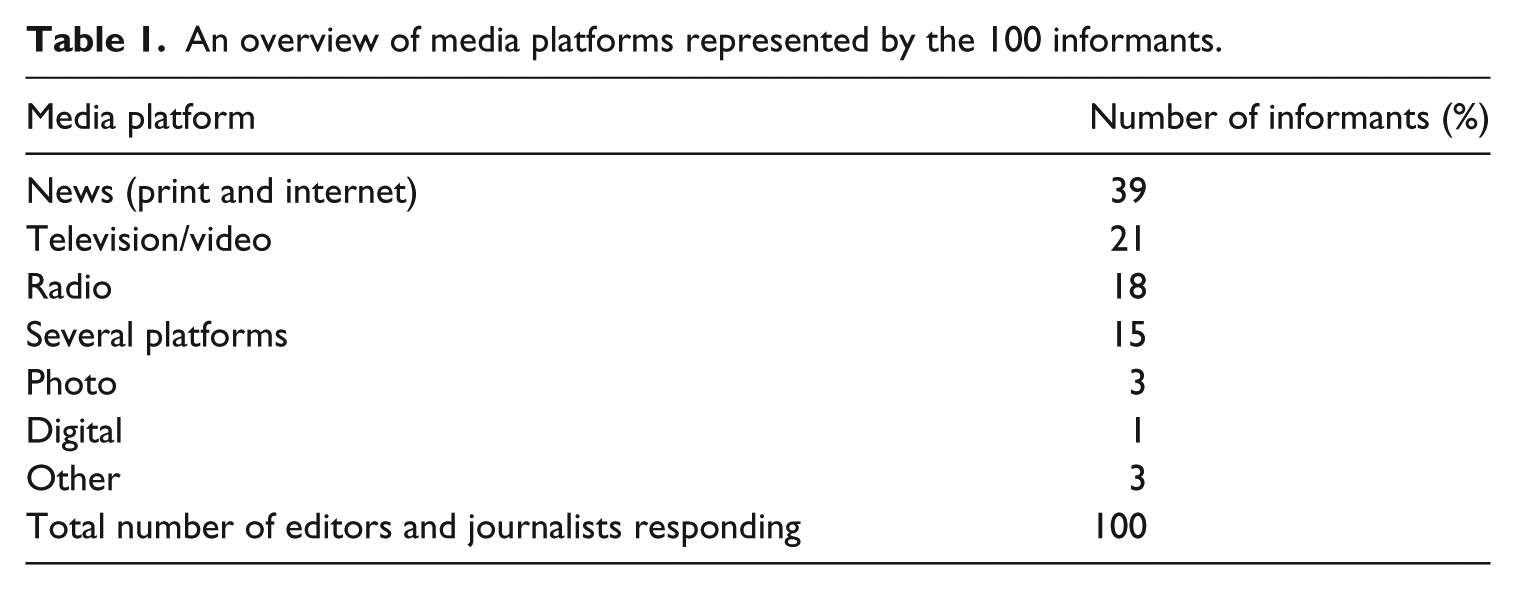
Most of the informants interviewed are journalists – between 10 and 12 from each country. In addition, 3 to 5 editors from each country were included to support or to compare statements from the journalists. Altogether, the study encompasses information from 100 informants: 73 journalists (24 women and 49 men) and 27 editors (8 women and 19 men). In choosing informants, we aimed specifically for journalists who have covered conflict frequently during the past 5 years. We also aimed to include a certain percentage of female reporters in order to gain gender perspectives of conflict reporting, although this would create a distorted image of women’s participation, given the unequal share of gender representation in this sector. In spite of our efforts to include female informants, their total representation was a mere 32 per cent. Table 1 shows an overview of media platforms represented by the 100 informants including journalists and editors.
An overview of media platforms represented by the 100 informants.
With respect to the 27 editors, the interview form offered four options for identification of their positions in the editorial management. The number of respondents listed for each option was editor-in-chief (10); editorial leader of a section or department (15); administrative leader (1); other (1). All editors were leaders of media outlets or sections covering war and conflict and many had years of experience of covering war and conflict themselves.
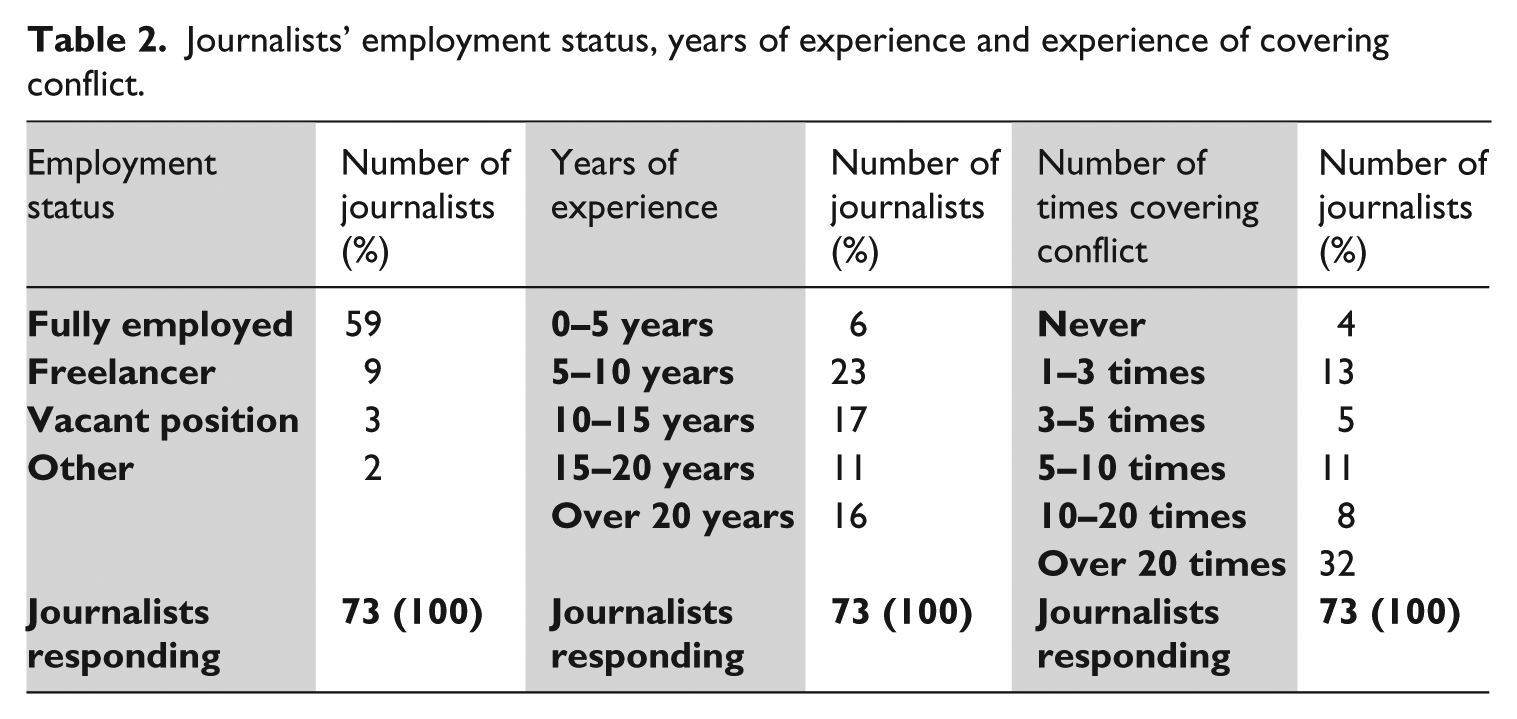
The 73 journalists comprised approximately 20 per cent freelancers or journalists employed on temporary contracts, while the remainder are staff reporters. Journalists from the Philippines, Norway and Nepal reported the highest level of experience in conflict coverage (counted by the number of times conflict had been covered). However, estimating the level of experience of reporting conflict is highly dependent on the reporter’s subjective understanding of what a conflict is and how a ‘time’ is measured. If a journalist goes to a conflict zone to cover 10 days of fighting, that may qualify as anything from a single time to the number of times the journalist actually observed fighting during the stay. Adding even more uncertainty to this measurement, those journalists who live in a conflict zone may not report conflict as number of times but, rather, as a constant state of reality. Nevertheless, the purpose of including this dimension in the study was to measure the relevance of their experiences.
It was important to understand the informants’ backgrounds. Table 2 shows the journalists’ employment status, years of experience (the level of experience is estimated by giving journalists options for how many years – in 5-year periods – they have worked as a reporter), and their experience of covering conflict or warlike conditions in their own country or abroad, given in the number of times they have covered conflict.
Journalists’ employment status, years of experience and experience of covering conflict.
The informants from Norway and the Philippines who gave in-depth interviews are mainly senior reporters working with the larger media institutions. They show several similar characteristics such as high levels of training, experience and media understanding, and they are often provided with safety equipment, security routines and more adequate insurance than their fellow local journalists. Most of the Filipino journalists in this study are resident in safer areas (such as metropolitan Manila) than those about which they report, such as the southern islands or abroad. The Norwegian group of informants work as correspondents, parachute journalists and freelancers, and the conflicts they cover are situated abroad. As such, the Norwegian and Filipino informants encounter many of the same challenges with respect to safety and access. Their editors usually have the choice of keeping them away from the hotspots, which our study proves to sometimes be the case.
Empirical findings: Threats towards journalists
A majority of the journalists interviewed report experiencing direct threats in relation to their work during the past 5 years. Only 11 out of the 73 journalists reported not having been exposed to direct threats during that time, and all but 2 of them reported significantly less experience as a journalist or less experience in covering conflict. A total of 32 reported having been threatened, or having been in an especially threatening situation, 2 to 5 times, and 19 counted 5 to 10 times or more. Journalists from the Philippines came out as considerably more threatened than any of the others, whereas Uganda and Nigeria reported slightly higher levels of threat than the rest.
The question that encouraged them to define the threats they experienced clearly showed incidents in which most people would be likely to feel threatened (see Figure 1). Most of them consisted of violent offence (24 journalists reported this), verbal threats (29) and unease in the area (31) – for which several specifically mentioned the constant risk of turmoil when covering demonstrations. Furthermore, 18 had been threatened with weapons and 19 had received personal threats via SMS, e-mail or voicemail; 6 had experienced threats against family members or friends and 5 had experienced ‘other’ undefined threats. The data is overlapping, meaning that each informant had the opportunity to check all applicable options. Also, it should be noted that those answering this question were for the most part those who reported feeling threatened in the previous question; the few not having felt threatened at all were instructed to ignore this question altogether.
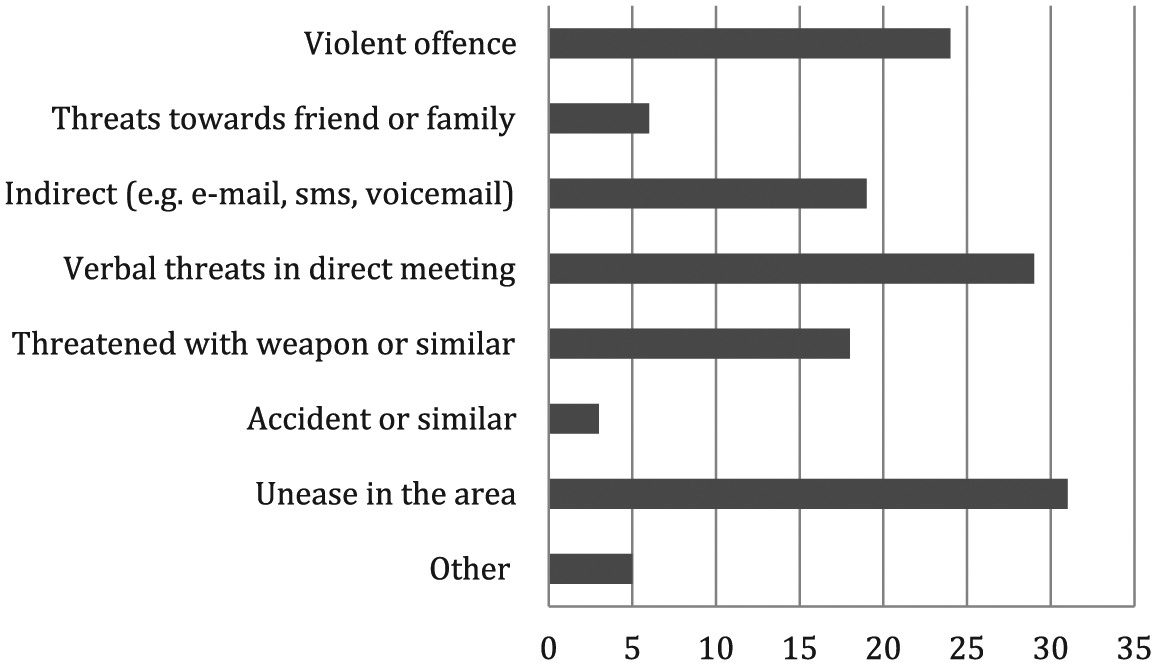
The types of threats experienced by the journalists (given in numbers in the horizontal axis) in the past 5 years.
The journalists appear to be mentally and physically affected by the threats they experience. A total of 28 of the 100 journalists and editors interviewed stated that, even though they were not physically harmed, they suffered psychologically to some extent; 9 stated that their experiences resulted in minor injuries; 3 that they required treatment by a doctor; and 1 reported being hospitalized.
Covering war, conflict, crime and corruption: In-depth interviews with Filipino and Norwegian journalists
As mentioned in the previous section on methodology, most of the informants from Norway and the Philippines are working for larger media houses, such as national or international news stations, wires and bureaus – as stringers, correspondents or parachute journalists. Thus, they have in fact many coinciding commonalities such as high levels of training (significantly higher than the average in the outcome of this study), safety equipment, insurance, etc. (see Høiby and Ottosen, 2016). The reason could be merely methodological: a result of variations within the team of researchers working on the project when selecting informants and carrying out interviews. Samples were essentially affected by their access, contacts and professional networks. Norwegian and Filipino informants also appear to have considerably more experience as conflict reporters than the average informant.
To understand the journalists’ roles in this section it must be noted that employment arrangements differ slightly in the two countries. In the Philippines, the larger news companies often hire their correspondents locally; they already live in the provinces which they are set to cover and are either paid piece-by-piece or with monthly wages. For these journalists, threats are part of daily life. In Norway, the larger companies hire correspondents as full-time staff members to live abroad on long-term assignments often lasting for several years; they have a high status, are well paid and have employee rights, but their life abroad can also be strenuous depending on the city where they reside. While the Norwegian correspondents often depend on local journalists or fixers, the Filipino correspondents become the local journalists or fixers when their colleague reporters from metro Manila parachute into their area of coverage. In the Philippines, the parachute journalists are usually staff reporters who reside in Manila and largely combine national and international work, taking assignments in the provinces of their own country and international assignments. They regularly work with fixers and local journalists in the area they travel to. This group of journalists often have a high status and are fairly well protected by their employers. They face threats mostly when they are on assignment, but can also be pursued for stories running in their national media when working on home ground – unlike the Norwegian parachutes, who are almost only in danger when on assignment and feel relatively safe when back in Norway.
However, the informants in this study are all veterans and most of them have the status of an acknowledged news company with resources for protection. If their editors do not think it is safe to send them or keep them in a conflict hotspot, they will hold them back or evacuate them. One mentioned specifically the growing risks of working as a bureau staff reporter, but also how they are protected in comparison to the stringers their companies often depend on:
There must be a higher awareness on safety. What if you get beheaded like Foley? Yesterday, there was another beheading. There have been so many journalists from [the bureau] who have died. Like in Iraq and Palestine. In Thailand, someone also died during the protests. That’s why at [the bureau], we’re required to wear protective gear, vest, and helmet even for civil disturbance coverage. When it comes to conflict, we stay away. Those who are covering Iraq, they’re covering it from a safe place. We rely on our stringers. Staff safety is very important.
In contrast to the risks of working as an international reporter, a great part of the threats reported by the Filipino informants are targeted hostilities aimed at them or their family in reprisal for their work. The concern they and their editors have about safety is not necessarily due to crossfire or shrapnel but, rather, to the risk of being followed and attacked in a personal encounter with the enemy, pressured with bribery and/or, as they say, ‘slapped with libel’. Such reprisals are specifically triggered when exposing issues of corruption or electoral fraud. One of the informants from the Philippines said that he had been brought to a gambling bar by a police official and told that, ‘We won’t keep you from writing, but we ask you not to press on the Major.’ The journalist was offered anything from shares in the gambling business to a two-storey house:
I could not refuse it right then and there because I was afraid they would kill me. So I told them I would think about it and give my answer the next day. Then they brought me back home. I noted that the vehicle they used was of the Police Criminal Investigation and Detention Group (CIDG).
A Filipino editor said: ‘There are so many [threats]. Threats like “we will file a case against you”. The top anchors get death threats. The reporters receive death threats for covering stories like the Maguindanao massacre, smuggling, drug trafficking and organized crime.’ The following account from one of the informants is another example of how journalists experience being pursued and threatened when on assignment in one of the southern provinces:
We were covering the clash until darkness fell. So instead of going back to the city, about a five-hour drive, we decided to stay in the jungle. We found an abandoned nipa hut and we decided to spend the night there. In the middle of the night it was raining hard when suddenly, out of nowhere, four heavily armed men appeared … They were looking for me. The one who looked like the leader asked, ‘Who among you is Miguel Reyes?’ My jacket branded with [my company name] had gotten wet going to the hut and it was hanging just above me. That really got me nervous. He repeated, ‘Who among you is Miguel Reyes [pseudonym]?’ It was Jeff [pseudonym] who answered, ‘We don’t know him.’ Then they left, but before leaving they looked at me. They stared at me for a very long time.
In cases of threats to journalists in the provinces, a news outlet in Manila may send their Manila reporter to cover the story instead of using their local stringer or correspondent: ‘Because the [political] competition there is more personal. The journalists and politicians there know each other well. That’s why more journalists are killed in the provinces.’ The threats journalists receive due to reporting in their own community find their way to reach them and there is little or no space in which to feel safe. Local political instability or rivalry between (family) clans is a main cause to the threats that these journalists face.
In general, many of the threats the Filipino informants experience seem to be of a somewhat different nature than threats reported by the Norwegian informants. Whether working for regional or metropolitan offices, they appear to be experiencing a higher level of directed threats and pursuit when operating within the national context. While the Norwegian journalists are exposed to various threats and risks when entering areas of war, insurgency, demonstrations and direct combat, they do not to the same extent risk being targeted and pursued in personal attacks (Idås, 2013). However, they do receive a high level of threats and harassment directed towards them through online media, both from within and outside their national audience and especially for reporting on politically sensitive conflicts situated in the Middle East. Still, according to the Committee to Protect Journalists (CPJ), most of the journalists being killed are those chasing particular stories of organized criminal activity within their local communities or national context. Often they receive one or multiple threats before they eventually face murder and death.
The Maguindanao massacre took place in the Philippines in 2009. It is considered by the CPJ to be the deadliest event ever, for journalists. According to reports, as many as 36 news workers were killed in a roadside ambush at the town of Ampatuan in the province of Maguindanao. The journalists were part of a convoy aiming to deliver – and, for the journalists among them, to cover – the filing of a certificate of candidacy for Esmael Mangudadatu, whose political rivals from the Ampatuan clan were charged with the crime. Thus far, there have been no convictions or any significant juridical progress, except for the arrests of members of the Ampatuan family – and in the aftermath more journalists have been murdered for reporting on it. The massacre has become the most gruesome symbol to date of the increasingly dangerous work of journalists. As one journalist recounted:
[After] the Maguindanao massacre in 2009, we were stopped and held by the military. This was just before the Ampatuans were arrested. Our convoy was stopped for about an hour. We then directly informed the higher-ups of the military [to be] released. When I asked the soldier why we’re being held, he cocked his M-16 towards me as if he was ready to shoot. I told the soldier that a colonel would like to speak to him [on the phone]. ‘We don’t follow orders from anyone here’ [he answered].
One journalist said that when he reported on the massacre, he received serious threats and constant attempts to bribe him:
They repeatedly sent me emissaries. One time, I was having breakfast at my hotel. Someone approached me telling me that someone wanted to give me this brown envelope to cover my breakfast and coffee. Imagine. The envelope was four inches thick, full of money … For my coffee.
The journalist did not report the attempts at bribery, he said, because there was a ‘no-take policy’ in his company. ‘They offered me a weekly amount – five figures – just to tone down the story, until the court hearings. I could have been rich.’ The same journalist tells a story of a grenade thrown at him after he had reported on the tampering of election returns in the provinces. ‘It was the driver who noticed it: “Sir, we have a grenade at the back of our pick-up.” The satellite that we use to feed our stories, they poured water over it.’
Despite the obvious differences in covering war and organized crime, editors in Norway and in the Philippines agree in their assessments of the security situation. A Norwegian editor says: ‘Now we are in a very particular situation [journalists are pursued] … for us, Syria is a no go. The importance of security training has increased, there is no doubt about that.’ An editor in the Philippines says:
The only difference is that we now have stricter safety protocols, especially with the directed attacks against the media. It also depends on the change to the nature of conflicts. Nowadays, there is less respect for the media. We should be regarded as a neutral party like the Red Cross, but this no longer happens. Attacks are now coming from different sides, from people with political power, the military or the armed rebels.
Newsrooms in the Philippines have developed routines about how to assist their staff in cases of threats from their local environment. When they see the need, they transfer their journalists to a safe house or hotel. ‘A reporter who was able to film a police shootout … was really threatened so he stayed in a safe house for three weeks.’ When there is a lot of ‘heat’ against a certain journalist, they scatter the story to several others so that the heat is not concentrated against just one. When a journalist is sent to a safe house, another will pursue the story. An editor explains:
For [an anchor who frequently receives death threat] we already have an existing workflow … When there’s a death threat, we inform the head of security who is a former military and former member of the Presidential Security Group [the Philippine President’s security] … We offer to transfer him to a safe house. [He] refuses, because he’s a ‘tigas’ [tough or ‘badass’]. So we sanctioned that a company vehicle must pick him up from his house to the office and bring him back home together with the driver and the cameraman. They are already trained. They know that they should be changing routes. When they feel that someone is following them, they have a number to call and security will be sent. He has an evening show on radio and we advised him to give up his show for a while so he can go home earlier.
Norwegian newsrooms have not developed these routines, the main reason being that the conflicts they cover are located away from the news station. A Norwegian editor explained that they usually trust the journalists to make the risk assessment themselves. ‘Even though I have some knowledge of the areas in which our journalists reside, they have a much better understanding of the conditions there. Circumstances can change rapidly, then it’s difficult for us to assess the situation.’ And there have been incidents in which the editorial staff have had to step in from across borders. In 2010, one of the Norwegian newspapers evacuated their journalist in Pakistan after they had published the Mohammed cartoons. ‘I was in a hotel room in Lahore, and flyers were spread in the streets encouraging violence against everyone who had anything to do with the paper. I was their correspondent in Pakistan’, the correspondent wrote in a commentary (Aftenposten, 8 January 2015). Although perhaps not a new phenomenon, international conflicts and political tension across borders create an environment that complicates the presence of journalists and jeopardizes their safety.
It seems that journalists working abroad, or on dangerous assignments in conflict zones away from their resident area, to a larger extent carry the responsibility of assessing their own security situation.
New wars, insurgency and new rules of engagement
Over the last decade, kidnapping by insurgency groups has become a major concern for journalists and their editors. The agendas of some insurgency groups are increasingly concealed and they are difficult to trust, which makes certain conflicts harder to cover, especially for those working in foreign countries – the motives of insurgency groups could vary from political to financial, and as foreigners (sometimes from countries involved in the conflict) and/or representing profitable companies, journalists are high-value targets. One Norwegian journalist said: ‘I would’ve been more restrictive. You go in and you don’t have control. In some conflicts journalists are much more likely to be targets, but you also have to consider that the warfare has become more complex.’ One of the journalist informants, a Norwegian veteran, said that showing your press card or having PRESS spelled out on your flak jacket or the company vehicle no longer works as a white flag from an impartial actor, as it used to do. ‘I experienced this for the first time in the Balkans’, he said. The complexity of the wars taking place in the former Yugoslavia in the 1990s put journalists at risk in a way that he had not experienced before. Censorship regimes were implemented and journalists were arrested. Since then, he said, media have regularly become targets and are not seen as independent.
In 2009, the Norwegian freelance journalist and film director Pål Refstal and his interpreter were kidnapped while in Afghanistan shooting a documentary entitled On the Other Side, about the Taliban and their lives as fathers, sons and brothers. Pål Refsdal was accepted into a Taliban camp and stayed with them in combat for a time, but during the second visit he was captured and a ransom was claimed for his release.
Afghanistan is not the only place where getting the story from ‘the other side’ is becoming increasingly complicated. One of the Nigerian journalists covering Boko Haram in Nigeria commented that it is ever more difficult to understand what the group is fighting for. He pointed to a lack of ‘rules of engagement’. He also said that they do not invite journalists to capture their side of the story any more, and that this differs significantly from the Niger Delta militants who fought for resource control and the repair of their degraded environment as a result of the exploration for oil. The Niger Delta militants had given access to journalists to properly capture their side of the story. This journalist said that even though he is Muslim from Maiduguri, Borno State, he is not seeking to interview any member of Boko Haram, even if he is invited to do so:
I cannot trust people who are out to kill and destroy with no definite reason. Niger Delta militants had a vision with demands, but for Boko Haram, what do they want? If [it] is to Islamatize Nigeria, why are they also killing Muslim faithful?
The same goes for the covering of the Abu Sayyaf Group in the Philippines, one of the journalists said:
We’re very particular with the Abu Sayyaf. They used to say they’re ideologists, but now it’s just about money. They used to be kind to journalists – accommodating them inside the camp, letting them conduct interviews. But now, the journalists have become high-value targets so you have to be careful.
Abu Sayyaf has claimed millions in ransoms and, when holding German hostages in 2014, they additionally demanded that Germany must stay out of the war in the Middle East, suggesting their motives could be both economic and political in nature.
More safety precautions
The 100 interviews conducted with journalists and editors cannot give a statistical answer to whether reporters across the continents have become more cautious over the past 5 years. However, the information provided responds to the conditions of the journalists and the editors interviewed, and the tendencies reported are very clear: nearly half of the journalists interviewed say that they have become more careful, and more than three-quarters of the editors say that they have become more cautious about keeping their reporters in conflict areas or sending them to conflict zones, even for short assignments.
Several informants from Nepal and Tunisia reported that they have become less restricted, or that they experienced no significant change (see Figure 2): in Nepal, they reasoned that it was safer after the civil war had ended, and at the time this study was conducted, in 2014, Tunisian informants were hopeful for a more peaceful time ahead. Nicaraguan informants did not report any significant change. However, informants from Nigeria, Uganda, Norway and the Philippines described becoming much more careful. Altogether, the majority report that increasing insecurity and the targeting of journalists in the field limits their ability and willingness to cover conflict from the site and increases safety rules from the editorial leadership.
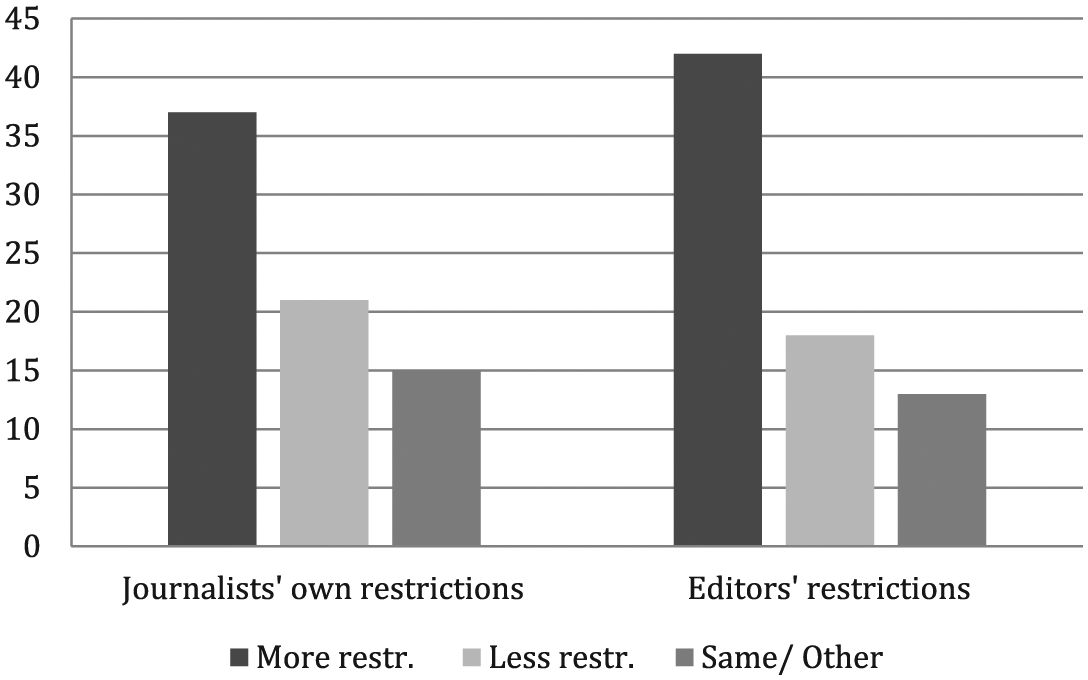
Journalists’ opinion of their own restriction level for covering conflict in the past 5 years and their opinion on their editors’ restriction level for covering conflict in the past 5 years. The number of journalists responding to each value is given in the vertical axis.
Particular incidents concerning ambushes, kidnappings and attacks on journalists and media houses often trigger extra cautiousness in the editorial leaderships and can incite a sudden push towards stricter protocols for assignments. A handful of unrelated events that took place in 2008 and 2009 (the aforementioned Maguindanao massacre; the kidnapping of Ces Drilon in the Philippines; the murder of Norwegian journalist Carsten Thomassen and kidnapping of Norwegian freelancer Pål Refsdal, both in Afghanistan) prompted implementation of more systematic safety protocols and clearance systems, some even at official level. Editors in both countries mention that there has been a turning point or shift in their consciousness on security, directly related to situations in which their own staff or a reporter they knew well had been kidnapped or murdered. An editor explained:
The turning point for us was when Ces was kidnapped. Ces has been covering the Abu Sayyaf Group. We do that, so you wouldn’t think that it would happen to you. There was a time when they looked up to you, or believed in you, because you were a journalist, because you’re from ABS-CBN. So even with the ‘bad guys’, the communist rebels, the private armies, there’s the invincibility. When Ces was kidnapped, this is where we came to our senses. Since then, we have held several training sessions on hostile environments for journalists. It has become compulsory. We imposed a structure of permits to go through and workflows during conflict coverage. It’s not only the desk or head of news who should know; everybody should know, and there’s a briefing or discussion before you’re deployed. You’re included in weighing up the situation. This process has been institutionalized.
Similarly, a Norwegian editor said that they experienced a major change after the fatal shooting of the journalist Carsten Thomassen at the Serena Hotel in Kabul. He said that the shift of focus towards security training was significant. ‘Until now, media houses have perhaps not been the ones best prepared.’ Now, he said, it was time to change this. A journalist explained how this also affects their access to conflict hotspots. ‘We are no longer allowed to go to Sulu. You need the approval of editors when you go. You can go if you’re accompanied by the Embassy, but on your own, it’s prohibited … ever since Ces [Drilon] was kidnapped.’
Reduced access and increasing use of freelancers and stringers
A Norwegian journalist says that even though they spend more time and resources on safety than previously, media institutions are in general increasingly reluctant to send their own staff. A Norwegian editor says: ‘There are now stricter requirements for security, and at the same time we are cut off from access. Because of this, we are more reliant on stories from freelancers, especially to get pictures.’ The consequence is that staff reporters are protected and held back from conflict hotspots, and that freelancers, stringers or local journalists and fixers are left to take the highest risk. A Filipino journalist said:
We exercise a higher level of caution amid the increasing risks and dangers. In the past, they allowed you to cover attacks or armed battles. Now, you can only cover that from a certain distance. So those who are kidnapped in war are mostly freelance, because they have to make an effort to get the story and sell it to the agencies. Agencies impose higher safety measures so [their reporters] stay away. [Freelancers] need to get the story, to sell it. If you have a stringer there, you can just pass the assignment on to them.
On the other hand, one of the freelance journalists interviewed said that the big media houses have also become more cautious about what they accept from freelancers, as they too are limited by growing concerns for their wellbeing: ‘They’ve become more restrictive, as there’s a greater risk. Some won’t take material from freelancers. The BBC, for example, require that you have safety training.’ The journalists also show concern for local reporters and fixers with whom they cooperate to get information and access to sources. If they are instructed to retreat from an area or are evacuated from a sudden threat, they feel that this is unfair to their co-workers who are left behind. A stringer based in the Middle East said: ‘The local freelancers suffer the most, they take the highest risks, they are untrained and unequipped, they barely get paid, and they don’t even get the bylines.’ One of the correspondents summarizes the dangerous situation of the freelancers in one sentence: ‘If you find yourself standing next to a freelancer, that’s when you know that you’ve gone too far.’
It’s a common practice, but personally as a journalist, when you’re not in the area and you rely on them, the credibility of the news lessens because it becomes second-hand information. It’s not direct and you rely on their opinion. It’s better if you have direct access to the people involved. I’m not saying that stringers are incompetent. They are excellent! They know the area as well as the culture. But the interpretation becomes different, especially when they’re also directly involved in the conflict.
Some of the informants who answered that they did not think they would cover wars and conflicts to a lesser degree in the future explained this by the continuing (or even increasing) demand for such coverage. Alternative solutions such as using second-hand information from local actors often affect the content.
Several of the Filipino journalist informants said that they sometimes avoid asking for the editor’s permission. They give information about their location only after they have already entered a dangerous place. ‘One time, a couple of journalists and I were following a convoy when an Improvised Explosive Device (IED) exploded, I just told the desk right after the incident and they asked me why I didn’t even tell them I was in the convoy. But they used my photo anyway.’
Conclusions: Increasing demand for witness accounts from conflict zones
As a point of departure in this article, we raised the concern that the threats and dangers facing reporters covering conflicts represent a threat in the long run to the role of the media as an independent critical corrective to governments, and as living up to the expectations of a Fourth Estate. The most noticeable trend in the findings is that editors and journalists in seven countries on four different continents have experienced threats to their safety when reporting on conflict – and to a greater extent today than 5 years ago.
The legal protection of journalists at work in conflict zones is adequate in theory, owing to UN declarations, but in reality it is not respected. Although UNESCO adopted the UN Plan of Action on Safety of Journalists and the Issue of Impunity in April 2012, our findings when talking to experienced reporters in the field suggest that unless governments are willing to follow up on the resolution, reporters on the ground increasingly find themselves in harm’s way. The greatest need is to tackle the issue of impunity for perpetrators committing crimes against journalists, in order to enhance freedom of expression and democracy. Moreover, more critical reporting of international law in relation to ongoing conflicts, also involving reporters’ own countries, has the potential to raise awareness of legal issues in general. The complexity of contemporary international wars contributes to obscuring the role of journalists. That the mainstream media reflect the dominant security policy of their own governments to a large extent puts journalists at further risk, while compromising their ‘eyes and ears’ on the ground. In its place, for higher risk and lower pay, freelancers are increasingly carrying the burden.
Footnotes
Funding
The author(s) received no financial support for the research, authorship, and/or publication of this article.
Author biographies
Address: Hogskolen i Oslo og Akershus, Potsboks 4 St Olavsplass, Oslo 0130, Norway.
Email: