




Abstract
Recent years have seen the migration of Ministries of Foreign Affairs (MFAs) to social media in a practice referred to as digital diplomacy. Social media enable MFAs to craft frames so as to influence audiences’ perception of foreign affairs. Such framing is especially relevant during times of war as states seek to legitimize their policies. Notably, given that social media are inherently visual platforms, MFAs are now visual narrators. Few studies to date have extended the reach of framing theory to that of digital diplomacy during conflict. This study addresses this gap by analysing 795 tweets published by the Israeli MFA during the 2014 Gaza War. The authors’ analysis demonstrates that the Israeli MFA crafted 14 linguistic frames that were used to legitimize Israel’s policies. Notably, the MFA used images to support these frames and it is through images that the linguistic frames were made to resonate with Israeli strategic narratives. The authors pay attention to how images published by the Israeli MFA constitute three visual tropes and highlight how images function to augment frames (which focus on the present) to broader narratives that involve the past, present and future. Here, they explore how images invoke the past to illuminate the present and future, and create a shared identity in the context of the Gaza War.
Introduction
Since Robert Entman’s seminal (1993) article ‘Framing: Toward clarification of a fractured paradigm’, a rich and diverse research corpus has sought to define what framing is, identify how frames are constructed and investigate the influence of frames on audiences. However, the emergence of new communication platforms and new communicators necessitates that the study of framing continues to expand, particularly in regard to the framing of contemporary conflict. In this study, we seek to extend the reach of framing theory to the realms of social media and diplomacy during war. This is especially pertinent given the advent of ‘digital diplomacy’ (Bjola and Holmes, 2015; Manor, 2016). It is our contention that the practice of digital diplomacy has transformed Ministries of Foreign Affairs (MFAs) into communicators who seek to frame government action so as to enable states to achieve their foreign policy objectives during war. While governments have traditionally sought to influence the framing of foreign policy issues, we contend that digital diplomacy enables MFAs to communicate directly with global audiences, thus circumventing the press and other elites. Moreover, as social media are inherently visual platforms, we argue that scholars need to investigate the role images play in the framing of contemporary conflicts on social media. To investigate how MFAs frame war on social media and how images are used in the framing process, we analysed 795 tweets published by the Israeli MFA during the 2014 Gaza War. Our analysis demonstrates that the Israeli MFA constructed a series of 14 frames throughout the war and that, through images, these frames resonated with Israeli strategic narratives and narratives of Israel. The important distinction here is that Israeli strategic narratives are authored and disseminated by Israel while narratives of Israel are authored and disseminated by others.
The article begins by discussing the nascent literature on framing and argues that there are currently three gaps in framing theory and its applicability to the study of modern war and conflict. The first concerns a lack of understanding in how MFAs use social media to frame conflict. The second gap lies in understanding the relationship between narratives, on the one hand, and frames, on the other. The third relates to how visual media fit into this tapestry of MFA framing and narrating conflict on social media. We address these gaps through our analysis and the article proceeds to investigate the frames constructed by the Israeli MFA during the Gaza War. We then explore how visual media played a fundamental role in framing the Gaza War. We conclude by reflecting on the implications of our research for the broader study of framing and contemporary conflict.
Framing war and conflict in the digital age
Framing theory has enjoyed contributions from numerous fields. It is grounded in the works of Erving Goffman who argued that individuals constantly strive to make sense of the world around them by employing cognitive schemata, or primary frameworks, that enable them to classify and interpret information (Goffman, 1974; Pan and Kosciki, 1993; Scheufele and Tewksbury, 2007). Goffman’s work suggests that framing is second nature to humans. Thus, the process of framing is considered to be an instrument of power as frames can shape people’s world view, opinions and actions (Entman, 1993; Garrison, 2001). According to Robert Entman (1993: 52), to frame is ‘to select some aspects of a perceived reality and make them more salient in a communicating text, in such a way as to promote a particular problem definition, causal interpretation, moral evaluation and/or treatment recommendation for the item described’. Notably, framing rests on selection, exclusion and emphasis as a communicator chooses which information to include, which to omit and which to highlight through placement, repetition or association with culturally significant symbols (De Vreese et al., 2001; Entman, 1993).
Framing studies have traditionally focused on analysing mainstream media given that these shape public opinion. Indeed, news frames influence how people interpret events and also set the parameters for public debate (Neuman et al., 1992; Tuchman, 1978). As such, framing is understood as the representation of events, actors and actions with the intent to influence. Framing thus ‘bears the imprint of power’ (Entman, 2004) and scholars have investigated how elites and journalists create and disseminate frames (De Vreese, 2005; De Vreese et al., 2001; Yang, 2003; Zhou and Moy, 2007).
Given that frames serve both the press when reporting on events and the public when interpreting events, framing can be characterized as a dynamic process that involves frame building (how frames are created), frame setting (the interaction between frames and audiences’ dispositions or prior knowledge) and the societal consequences of framing (D’Angelo, 2002; De Vreese, 2005). However, news organizations and journalists are not the only actors to use framing techniques. Governments also construct information in the form of frames so as to ensure their policies are presented to the public by the media in a positive light (Entman, 2004). The use of frames by governments is evident in the realm of foreign policy and war.
Framing, diplomacy and conflict
Numerous studies have explored the relationship between foreign policy makers and the press. These demonstrate that the news press influence foreign policy by drawing public attention to certain issues and demonstrating how issues influence national interests (Brewer, 2006; Herrmann et al., 1999; Seaver, 1998; Wood and Peake, 1998). Such studies have found that where public opinion leads, foreign policy makers follow (Hartley and Russett, 1992; Jacobs and Page, 2005). Conversely, other studies have evaluated journalists’ willingness to promote government frames during times of crises (Bloch-Elkon, 2007; Kim, 2000; Lee and Yang, 1996; Park, 2003; Yu and Riffe, 1998). While the foreign policy maker–journalist dyad has received ample attention from scholars, few studies to date have analysed how governments employ frames in the realm of diplomacy. Garrison (2001: 7756) argues that framing is instrumental in diplomacy as it is comprised of complex and ill-defined events that are, by nature, ambiguous and rapidly evolving. Entman (2004) also demonstrates the manner in which leaders frame crises by analysing the comments of George W Bush following the 9/11 terror attacks. When addressing the American people, Bush stated that the attacks on the US were an act of war and that the American people must unite in the struggle of good versus evil. Thus, Bush offered a problem definition (attack), a causal interpretation (war), a moral evaluation (good versus evil) and a solution (resolve). Entman goes on to conceptualize government framing using the Cascading Activation Model. In this model, a frame extends from the White House to the public while passing through other elites and the press. The model includes two important elements. The first is a hierarchy demonstrating an administration’s need to push a certain frame down the cascade. The second is the administration’s reliance on journalists to transmit a frame to the public (p. 10).
Recent work has drawn upon Entman’s conceptualization and has demonstrated the utility of using framing theory to understand war and conflict (Dimitrova and Connolley-Ahern, 2007; Dmitrova and Strömbäck, 2008; Dimitrova et al., 2005; Maslog et al., 2006). Scholars have also drawn attention to the importance of visual analysis in understanding the framing of war and conflict (Fahmy, 2010a; Parry, 2010, 2011, 2012; Schwalbe and Dougherty, 2015). This attention to visual framing and war demonstrates that images function in a different way from written/spoken language and subsequently researchers need to understand images in regard to their iconicity (how they become icons that capture the meaning of a broader frame), their indexicality (how they imply that a broader frame is real and truthful) and their syntactic implicitness (how they communicate broader frames in a more implicit way than words) (Fahmy, 2010b; Messaris and Abraham, 2001: 220). Despite the important insights of Entman’s model and the subsequent work on framing foreign policy and conflict, framing research often remains focused on traditional media given the perceived hegemony of the newsroom elite. However, the development of social media has changed the environment in which foreign policy issues are framed and has enabled more actors to exert influence through framing. These changes are explored in the following section.
Framing and digital diplomacy
The past decade has seen the mass migration of MFAs and diplomats to social media sites in a practice commonly referred to as digital diplomacy (Bjola and Holmes, 2015; Kampf et al., 2015). Digital diplomacy is intrinsically linked to the need to frame events, issues and actors in a new digital media ecology (Hoskins and O’Loughlin, 2010) and one of the main drivers of US digital diplomacy was the need to counter Al-Qaeda’s use of online platforms to spread its narrative of jihad against Western imperialism (Hallams, 2010; Manor, 2016). An additional driver was the rise in prominence of citizen journalism during the Arab Spring and its ability to disseminate frames to global audiences via social media (Causey and Howard, 2013; Seib, 2012; Xiguang and Jing, 2010). Through social media, MFAs can now frame foreign policy events and communicate these frames directly to national and global audiences (Cassidy and Manor, 2015; Manor, 2016; Seib, 2016). For instance, the Israeli, US and Iranian MFAs all used social media to frame the consequences of the nuclear accord signed between Iran and the P5+1 (Seib, 2016). This newfound framing ability may have reduced diplomats’ reliance on the press and effectively enabled MFAs to circumvent the traditional media. Put in Entman’s (2004) terminology, the Cascading Activation Model had been digitally disrupted.
However, digital diplomacy has also complicated the art of diplomatic framing as social media are contested framing environments in which numerous actors vie for audience attention, including traditional media outlets, new media outlets, citizen journalists and a plethora of diplomatic actors (Manor, 2016). Indeed, one MFA’s framing of an event may immediately be countered by another’s (Cassidy and Manor, 2015). Such was the case when the Israeli MFA framed the Iran accord as a modern day appeasement policy while the US State Department framed the accord as the triumph of diplomacy over force.
An important question here concerns the role the images play in MFA framing. It is imperative to understand the role of visual framing in digital diplomacy because social media – the very fabric of digital diplomacy – are intrinsically visual and are shaping how war is visually framed by those involved in it (Alper, 2014; Crilley, 2015, 2017; Hoskins and O’Loughlin, 2010). While the digital diplomacy literature suggests that MFAs now increasingly use social media to frame events, few studies to date have actually investigated if and how such frames are constructed and disseminated. Moreover, scholars have yet to employ framing concepts and methodologies to MFA social media content, particularly in regard to visual images and digital diplomacy. In addition, scholars and practitioners frequently use the terms frames and narratives interchangeably. Yet the relationship between the two concepts has not been sufficiently explored.
Between frames and narratives
According to Entman (1993), frames may be found in four locations: the communicator, the text, the receiver and the culture. By culture, Entman refers to ‘a stock of commonly invoked frames. In fact, culture might be defined as the empirically demonstrable set of common frames exhibited in the discourse and thinking of most people in a social grouping’ (p. 53). Gamson (cited in Garrison, 2001) states that frames bring social groups together if frames are conveyed with culturally significant slogans, historical analogies, stereotypes and visual images. Thus, frames may be able to create a shared sense of identity.
Recent work on narratives suggests that they too evoke the past to make sense of the present and rely on culturally significant symbols. Moreover, like frames, narratives are also representations of events, actors and actions with the intent to influence. According to Miskimmon et al. (2014: 2), there are three elements that are central to the definition of strategic narratives. The first is that narratives do not emerge naturally but, rather, are crafted by political actors with a specific intent in mind. Second, narratives have a temporal dimension – they invoke the past to understand the present and to predict the future. Third, narratives offer a shared meaning of the past and present as they define who ‘we’ are and what kind of world ‘we’ want (Miskimmon et al., 2014). Thus, narratives help create a shared identity, often by referencing historical analogies and culturally significant images and phrases.
Subsequently, we note that the distinction between narratives and frames ‘is often overstated’ (Olsen, 2014: 248). However, as Miskimmon et al. (2014: 7) suggest, frames lack a temporal dimension. Whilst framing may imply a sense of causality and a solution for the problems identified in a frames ‘call to arms’ (Benford and Snow, 2000: 613), they do not always provide a sequencing of events that links the present with the past and future. Following Olsen (2014: 249), we theorize frames as contextual and specific, often focused on the present and, whilst they may imply a sense of causality, they do not always do so. Therefore narratives differ from frames as their primary characteristic lies in their sequencing and the ways in which they give ‘meaning to past, present, and future in order to achieve political objectives’ (Miskimmon et al., 2014: 5). This may be clarified by way of an example. For example, the Israel MFA’s tweet that ‘Since June 12, almost 200 rockets have been fired at southern Israel from #Gaza, aimed deliberately at civilians’ is constitutive of a frame, yet not of a strategic narrative as it does not explicitly sequence events, link the past, present and future, nor does it state what should be done in response. Despite these differences, images are employed in both frames and narratives for similar ends, namely in an attempt to appeal to a shared culture as manifest through stereotypes, historical analogies and commonly used frames of reference (Barthes, 1977). Because of this, we theorize images as key sites in which contextual and specific frames are situated within broader narratives.
To summarize, there are presently three important gaps in the framing literature. First, few studies to date have investigated how MFAs use social media to craft and disseminate frames. Second, scholars have yet to clearly articulate the relationship between frames and narratives. While both aim to influence, bear the imprint of power and relate to culture and identity, they differ from one another in that frames are contextual and may lack a sense of temporality, whereas narratives are broad and always involve a notion of temporality and a sequencing of events and actions that links the past, present and future. Third, studies have yet to investigate the role images play in MFAs’ online framing. Such an analysis is warranted given that social media are visual platforms and MFAs have now become visual narrators. We now outline how our research framework and analysis addresses these gaps.
Research framework
This study aimed to explore the interaction between images, frames and narratives in the context of digital diplomacy during times of war. To do so, we analysed the Israeli MFA’s use of Twitter during the 2014 War in Gaza. This case study was deemed relevant for three reasons. First, it is during times of conflicts and crises that diplomats are most likely to construct and disseminate frames, given a desire to influence both the press and the public’s perception of events. Second, times of conflict are marked by great uncertainty and rapidly evolving events. Thus, it is during conflicts that MFAs may invoke the past so as to make sense of the present and provide publics with a sense of continuity. Finally, we chose to focus on the Israeli MFA as it is one of the most active and followed ministries on Twitter (Manor, 2016; Twiplomacy, 2016). The Israeli MFA currently has 128,000 Twitter followers and is one of the most followed ministries on Twitter (Manor, 2016). In addition to attracting other diplomatic institutions, the Israeli MFA is followed by a plethora of news organizations and journalists throughout the world (Manor, 2017). The MFA has also amassed a sizeable global following in Europe, the Middle East, South East Asia and North America alongside a large domestic following. This, combined with Israel’s actions in the Gaza War of 2014, make the Israel MFA an important case study for understanding framing and war in the context of digital diplomacy.
Our conceptual framework consisted of three premises. First, that the Israeli MFA would use Twitter to construct and disseminate frames that were comprised of the elements identified by Entman (1993). We hypothesized that Israeli tweets would identify the problem at the heart of the conflict given that, by framing the problem, actors begin to legitimize their actions and articulate a desired solution. Further to this, research to date suggests that the MFA would identify the cause of the problem so as to assign blame for the war on the other side, in this case the Hamas movement that rules the Gaza strip (Mor, 2012). Finally, we assumed that MFA tweets would include a moral dimension as morality breeds legitimacy in global politics (Natarajan, 2014; Van Ham, 2013).
Our second premise was that the Israeli MFA would invoke the past to make sense of the present. This would be achieved by referencing Israeli strategic narratives. Israel currently employs two broad strategic narratives that are used to narrate its policies and actions. The first is that of the ‘start up nation’ which presents Israel as a global hub of technological innovation and ingenuity (Aharoni and Grinstein, 2017; Gilboa, 2006; Lemelshtrich, 2014; Molad, 2012). The second is that of ‘the only democracy in the Middle East’ (Anholt, 2006; Avraham, 2009; Hassman, 2008: 52). According to this narrative, Israel is a bastion of liberal values in the Levant and at the forefront of the global struggle against Islamic extremism.
The third narrative we examined is one commonly employed by other actors when depicting Israel; that of David versus Goliath. Following the 1967 War, Israel was framed by the press as David miraculously overcoming the assault of Goliath: the armies of Syria, Egypt and Jordan (Avraham, 2009). Yet in recent years, this narrative of Israel has been reversed as Israel is now seen as the mighty Goliath, being the strongest army in the region and oppressing a Palestinian David through a violent occupation (Aharoni and Grinstein, 2017; Galloway, 2005). We postulated that images and videos created by the Israeli MFA would resonate with all three of these narratives.
Finally, we hypothesized that images would play an important role in the interaction between narratives and frames. It is through images that frames can resonate with narratives as images perform a function of abstraction through which a frame, which is contextual and often lacks a temporal dimension, can resonate with a narrative, which is universal and details a sequence of events. This is achieved by employing images that summon the past to the present. Moreover, images can foster a shared sense of identity as they are cultural artefacts imbued with meaning. As such, images articulate the demarcation line of a collective ‘we’ and once again abstract from the level of the frame to the level of the narrative.
In summary, this article offers three important contributions to the framing research corpus. By analysing the Israeli MFA’s tweets, it extends Entman’s framing model to an important environment of contemporary diplomacy: social media. In addition, it elaborates on the role images play in the framing process on social media by demonstrating how they abstract from the frame to the narrative. Finally, it explores how the Israel MFA used images during the Gaza War.
Methodology
We began our study using the TwimeMachine application to scrape the 3200 most recent tweets published by the Israel MFA (
We adopted an inductive approach to framing analysis. In the inductive approach, frames arise from the research corpus itself (De Vreese, 2005). To identify the frames constructed and disseminated by the Israeli MFA, we grouped tweets into three-day clusters. We grouped tweets into these clusters given the assumption that the Israeli MFA would continuously craft and disseminate new frames, given a need to react to rapidly evolving events. We then analysed all tweets published over these three-day periods and identified the frames employed by the Israeli MFA. Frames were defined as consisting of the four elements identified by Entman (1993) and were operationalized by the authors categorizing tweets into those identifying: (1) the root problem that led to a violent altercation between Israel and Hamas; (2) the cause of the altercation; (3) a possible moral evaluation; and (4) a suggested solution.
Once we detected a change in one of the frame’s dimensions (i.e. a new suggested remedy or moral evaluation), a new frame was defined and all subsequent tweets were analysed based on this definition. While this study’s unit of observation is frames crafted by the Israeli MFA, our unit of analysis is individual tweets. We drew upon previous approaches to the visual framing of war to analyse the images shared by the Israeli MFA. Overall, a total of 243 images (photographs, videos, infographics and cartoons) were analysed and coded based upon how their visual content framed events and actions (Crilley, 2017: 138; Fahmy, 2010a: 702; Parry, 2010: 72–73). Specifically, we analysed who was in the image, what they were doing, what other equipment/setting was in the image, what cultural symbols were in the image, technical aspects of the image (such as composition, light, colour) and whether the image resonated with linguistic frames. Due to spatial limitations, rather than presenting all of our visual analysis below, we draw attention to several specific instances that capture the essence of broader tropes. This enables us to discuss how visual media were used by the Israeli MFA to frame the Gaza War in certain ways.
Framing the Gaza War on Twitter
Our analysis suggests that the Israeli MFA disseminated 14 different frames throughout the Gaza War. The first frame, lasting between the 29 June and 6 July (see Supplemental material) focused on the kidnapping of three Israeli teenagers by the Hamas movement. The cause of the kidnapping was framed as part of Hamas’s nature as a terrorist organization. The moral evaluation, made evident in one mother’s statement, was that every child has the right to arrive safely at their home.
The second frame, first disseminated on 7 July, identified a new problem: Hamas’s launching of rockets at Israeli cities. The cause was identified as Hamas’s deliberate attempt to target Israeli civilians. Notably, the moral evaluation in this frame portrayed Hamas as similar to ISIS and Boko Haram. As such, Israel framed the conflict as a war between democracy and radical Islam as opposed to a national struggle for self-determination. This frame begins to demonstrate how morality breeds legitimacy in diplomacy. For, if Hamas is ISIS, then surely Israel has an obligation to fight it. This was exactly the solution proposed by the Israeli MFA. This frame also demonstrates that, during crises, framing is as much a reactive process in which actors must react to events as it is a proactive process.
The third frame, which lasted for three days, focused on Israel’s acceptance of an Egyptian-brokered ceasefire and Hamas’s rejection of that ceasefire. Markedly, it was in this frame that Israel introduced a new problem: Hamas war crimes. According to the MFA, by firing rockets at Israeli cities from within populated Palestinian areas, Hamas was committing a double war crime. This frame is an example of proactive framing.
On 17 July, the Israeli MFA began disseminating a frame meant to legitimize Israel’s new military initiative: a ground invasion of the Gaza strip. This was achieved by framing Hamas as a powerful military organization rather than a terrorist movement. Hamas’s military capabilities were made apparent when its operatives emerged from tunnels dug from Gaza to Israel. Moreover, the MFA repeatedly stated that Hamas rejected ceasefire proposals while Israel opened humanitarian windows during which Gazans could receive medical attention. What follows is that Hamas left Israel no choice but to invade. This frame demonstrates how a diplomatic actor can employ frames to justify a chosen policy.
Between 18 and 19 July, the MFA continued to legitimize the ground invasion of Gaza by depicting Hamas’s advanced capabilities as it ‘fires rockets from above and digs tunnels from below’. Importantly, the cause of the conflict was now Hamas’s objective of destroying the ‘state of Israel and the Jewish people’. It is the invocation of the Jewish people as a whole that suggests that the MFA was creating frames with a multitude of audiences in mind, including the Jewish diaspora.
However, between 20–22 July, the MFA found itself yet again on the defensive as the global press focused on the high death toll of civilians in Gaza, no doubt a result of Israeli aerial bombardments (al-Mughrabi and Balmer, 2014; Beaumont et al., 2014). This forced the MFA to create a new frame. While the problem identified was the loss of civilian life, the cause was Hamas’s use of civilians as human shields. The proposed solution was two-fold: more humanitarian windows and the construction of a field hospital near the Gaza border. This frame suggests that the press remains a dominant force in the formulation of MFA frames.
On 23 July, the Israeli MFA created a one-day frame meant to respond to attacks on Israel at the UN Human Rights Council. This short-lived frame was soon replaced with a proactive one calling for a new government in Gaza that would invest in housing and schools rather than terror tunnels. Ironically, by alleging that Hamas was conducting war crimes and referring to its national priorities, the Israeli MFA granted Gaza a notion of statehood and independence. This, however, served to legitimize Israel’s use of military force.
The need to reform and replace the Palestinian government in Gaza, and demilitarize the Gaza strip, was evident in all frames up to 5 August when Israel called on Arab states and other nations to aid in the cause of ‘saving Gaza’ from the hands of Hamas. Between 6 and 7 July, the MFA again framed Hamas as the extension of ISIS and Israel as the forefront of a global war on terror. The last three frames crafted by the MFA, lasting from 8 August to 27 August, all focused on ceasefire initiatives by various actors. During this time span, Israel repeatedly distinguished itself from Hamas through the phrase ‘we cease, they fire’.
In total, the framing analysis revealed that the MFA crafted 14 different frames. The average frame lasted for 4.3 days. However, the frames disseminated during the escalation period (the ground invasion of Gaza) were much shorter, averaging 2.1 days, while frames used before and after the invasion lasted for an average of 6 days. These results could suggest that during conflicts there is a continuous need to craft and disseminate new frames given rapidly evolving events and the need to respond to the faming of other actors, be they the media or diplomatic actors (e.g. the UN). Our framing analysis offers four insights. First, that during times of conflict, framing is both a proactive and reactive process as MFAs must respond to the framing and actions of other actors. Second, during conflicts, MFAs are forced to continuously create new frames as events outpace one another. Third, morality plays a key role in MFA framing during conflict. This is related to the fact that morality breeds legitimacy and moral arguments serve to legitimize state action. Finally, during times of conflict, MFAs may frame adversaries in addition to framing events.
The results presented in this section validate our first research hypothesis and demonstrate that the Israeli MFA did in fact construct frames and that these included the four elements identified by Entman (1993). While the aforementioned frames may appear to be a chronology of events during the Gaza war, as frames, they all focus on the present. Despite this, these frames employed by the Israeli MFA share certain core elements. First, in most frames, Hamas was depicted as an equal adversary of Israel, whether this was due to its advanced capabilities or its affiliation with other terrorist organizations such as ISIS. Second, in most frames, Hamas was depicted as being proactive, while Israel was reactive. Such was the case when Hamas kidnapped three Israeli teenagers or when it refused to accept ceasefire proposals. Furthermore, most frames included a moral comparison between Israel, which ceases, and Hamas, which fires. Thus, while the Israeli MFA used linguistic frames to account for new circumstances as they unfold in the present, these frames share similar components and it is through visual media that these frames resonate with broader and more longstanding strategic narratives. We explore the importance of images in the following section.
Visually framing the Gaza War
We now explore the importance of images in the Israel MFA’s framing of the Gaza War. In doing so, we highlight how images resonate with these frames and Israel’s broader strategic narratives, and we suggest that images are therefore a vital component of contemporary digital diplomacy and framing in war and conflict. Out of 795 tweets, 242 tweets included an image such as a photograph, infographic, cartoon or video. These were diverse in their content and, rather than exploring all of these images in detail, we now focus on several examples that encapsulate three important visual tropes. We understand visual tropes as collectives of visual representations (apparent in multiple images) that link the linguistic and contextual frames that focus on the present, with broader narratives that link the past to the present and the future. We identified three prominent visual tropes in our analysis, and these concern representations of Israel as the only democracy in the Middle East, Israel as an innovative start-up nation, and Israel as a David still fighting Goliath.
Visual Trope 1: Israel is the only democracy in the Middle East
One of the strategic narratives employed by Israel is that of ‘the only democracy in the Middle East’ and a bastion of Western values in the Levant (Anholt, 2006; Avraham, 2009; Hassman, 2008: 52). Throughout the Gaza War, the Israeli MFA published a series of videos which resonate with this narrative. One of these was published on 15 July alongside a tweet that read ‘If Imagining rockets being fired at your city seems #surreal to you, then you should really watch this video.’ The video begins with the image of a woman riding the subway in New York, a couple kissing opposite the Eiffel Tower, and a woman meditating outside the Taj Mahal in India (Figure 1). These may be regarded as scenes of daily life in vibrant democracies. Yet these scenes are abruptly interrupted by the sound of wailing sirens and a caption that reads ‘for you it’s surreal, for Israel it’s real’. The siren is followed by images of Hamas rockets, Israeli women and children running for shelter in the street and children cowering on the floor as rockets fly overhead (Figure 2).

Images of democracy in ‘Rockets fired on your city? It’s surreal!’

Images of rockets in ‘Rockets fired on your city? It’s surreal!’
This video demonstrates the interaction between frames and narratives. The video’s second part, which depicts Israeli women and children running for cover, is contextual. It refers specifically to Hamas rocket attacks. Yet the first part of the video that depicts daily life in democracies is tied to the broader narrative of Israeli democracy. It proposes that Israel is like the US, France and India. It is democratic, it is vibrant and it is multicultural. Thus, this video creates a shared ‘we’ that consists of Israel and other democracies. By using images of Paris, New York and India, the video also articulates the kind of world ‘we’ want to see: one that is as accepting as France, as diverse as America, and as vibrant as India. These images are also imbued with iconic cultural meaning, and suggest that an attack on Israel is an attack on the values of liberté, égalité, fraternité, and by extension, Hamas is a threat to all democracies. It is therefore the images in this video that take the contextual, the events happening during the Gaza War, and invoke a notion of a universal threat to democracy from radical terrorism.
A second video that resonated with Israeli narratives was published on 16 July accompanying a tweet that read ‘Hamas endangers the lives of Palestinian in #Gaza by using them as human shields’ (see Figures 3 to 5). The video begins with a statement by Prime Minister Netanyahu to the press. Behind the Prime Minister is the Israeli flag while Netanyahu is himself adorned in the national colours of blue and white. According to Netanyahu, Hamas is endangering civilians by using them as human shields and firing from within populated areas. The statement is followed by a sequence of rockets fired into Israel and aerial footage from an IAF fighter jet. The footage reveals that the pilot has decided not to fire on a possible target given that there are children and civilians in the vicinity. The video ends with a statement by a Hamas leader that the movement is not condemning Palestinians to executions by firing from populated areas but, rather, ‘leading them to death’.

Netanyahu in ‘60 Seconds On How Hamas Uses People As Human Shields’.

Aerial footage in ‘60 Seconds On How Hamas Uses People As Human Shields’.
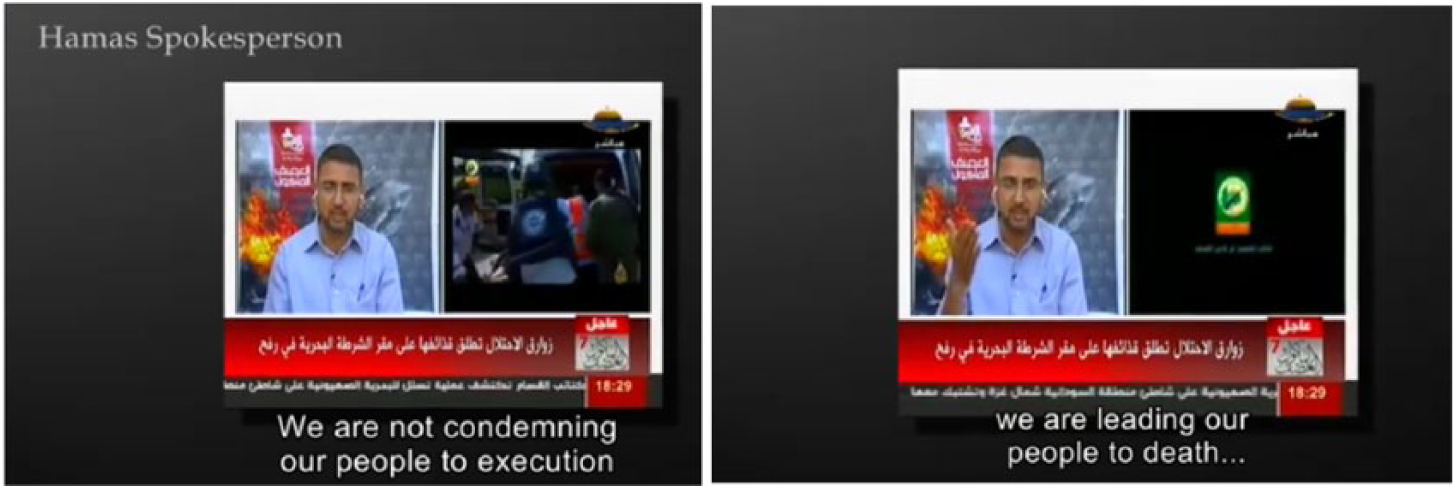
Hamas in ‘60 Seconds On How Hamas Uses People As Human Shields’.
Once again, this video functions as an act of abstraction. Dressed in white and blue and with a flag in the background, the video denotes that Netanyahu is the State of Israel and speaks on its behalf. Netanyahu’s visual statement is followed by a verbal one in which the video exemplifies Israeli priorities: saving the lives of innocent children over achieving military objectives. Similarly, the video ends with a statement by a Hamas leader that they are leading their people to death. The disparity between the two statements creates a moral contrast between ‘Western’ values of celebrating life and extremist values of celebrating death. Whilst these statements are contextual and focus on the Gaza war, they resonate with a larger narrative of Israel being a bastion of liberal values in the Middle East (Avraham, 2009).
This video also invokes the past to explain the present as it begins with the image of the Star of David, a symbol that has been associated with Jews since time immemorial. It is a symbol that has decorated Jewish synagogues, identified Jewish merchants and covered the lapel of children in the Warsaw Ghetto. The video ends with the Hamas statement ‘we are leading people to death’, a sentence that is strikingly similar to ‘leading lambs to the slaughter’, an analogy used by Israel in reference to the Holocaust (Raz, 1994). These two images combined suggest to Israeli and Jewish social media users that once again Jews are under attack, yet once again they will prevail. The past therefore illuminates the present. Here, images are constitutive of a visual trope that augments the MFA’s linguistic frames about the ongoing conflict between Israel and Hamas in summer 2014 with the broader narrative of Israel’s past, present and future role in the world as the only democracy in the Middle East.
Visual Trope 2: Israel as a high tech start-up nation
The aerial footage in the above video also plays two roles that concern the second prominent visual trope. First it has an indexical purpose by demonstrating Israeli values of avoiding civilian casualties. Second, the video resonates with the Israeli narrative of being the innovative start-up nation (Aharoni and Grinstein, 2017; Gilboa, 2006; Lemelshtrich, 2014; Molad, 2012). Israeli ingenuity and technological innovations are not represented as weapons of war but as instruments of peace. In this case, the Israel MFA suggests that advanced weapons systems and thermal imagery can enable pilots to identify individuals from great heights. It is implied that it is through the use of advanced technologies that Israel saves the lives of innocent civilians and so this video situates the framing of the Gaza war within a broader narrative of Israel as a start-up nation.
Another video that constructs this visual trope depicts Hamas’s firing of rockets from within schools, hospitals and cemeteries (see Figures 6 to 8). The video begins by defining each of these terms, before featuring aerial footage of rockets being fired from each location and a definition of Hamas as a terror organization that sacrifices the people of Gaza. The video ends with images of Hamas soldiers using advanced weapons systems and the caption ‘terror must be stopped, Hamas must be stopped’.

Definitions in ‘Hamas’ favourite spots: schools, hospitals and cemeteries’.
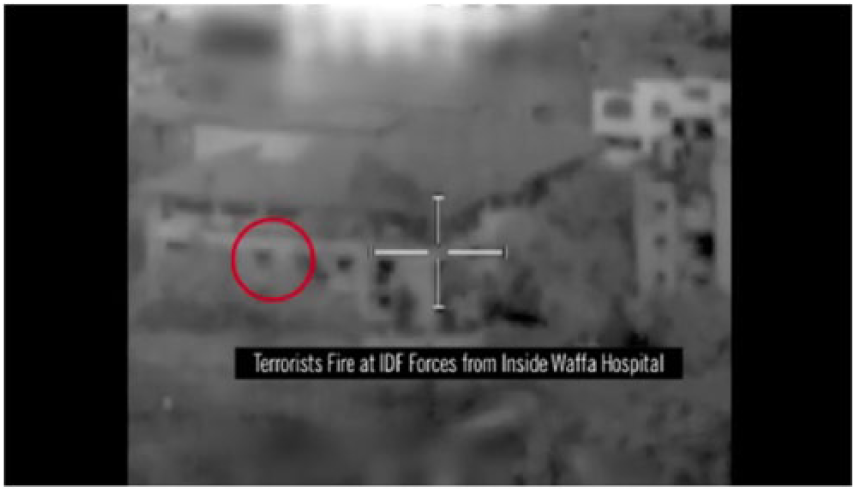
Aerial footage in ‘Hamas’s favourite spots: schools, hospitals and cemeteries’.
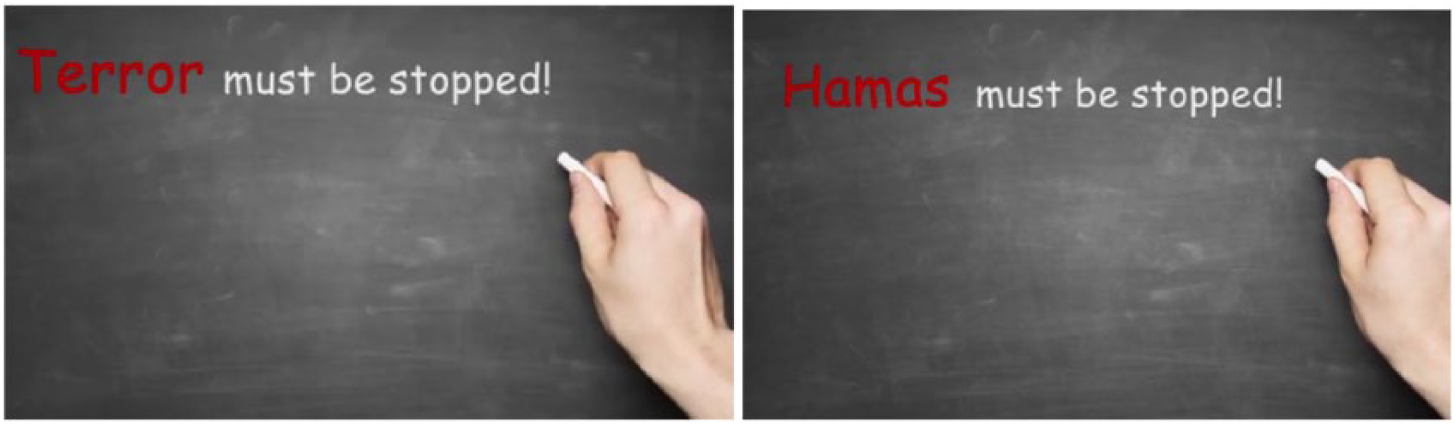
Stopping terror in ‘Hamas’s favourite spots: schools, hospitals and cemeteries’.
Once again, this video also features IAF aerial footage that is used to identify Hamas operatives as well as civilians. Notably, throughout the Gaza War, the Israeli MFA repeatedly published such footage demonstrating a fighter jet’s identification of children, civilians and ambulances and refraining from firing on nearby targets. The start-up nation is thus framed as the moral nation.
This video resonates with both Israeli strategic narratives discussed so far. This is made apparent through the referencing of two important institutions: schools, which are celebrated in democracies as preparing children for their civic duties, and hospitals in which states care for their sick and elderly. The images of rockets fired from these locations frame Hamas as violating their sanctity. Unlike Israel and the ‘West’, Hamas indoctrinates children rather than educating them; it glorifies death and it cares for itself not the sick. Once again, it is through these images that frames resonate with broader narratives. While the aerial footage is contextual to the Gaza War, the cultural connotations and association with schools and hospitals are part of a larger narrative of Israel being on the frontline of the battle against radical terrorism and its moral use of technology to fight this. The closing captions carry this message clearly by stating that Israel must stop terrorism in general and stop Hamas in particular.
Visual Trope 3: David versus Goliath
The narrative of David versus Goliath is one that captures the transformation of Israel from a fledgling state, surrounded by enemies, to the most powerful nation in the region (Aharoni and Grinstein, 2017; Galloway, 2005). As this narrative is often used to attack Israeli policies, we expected that the Israeli MFA would attempt to negate it by highlighting the threat posed to Israel from Hamas. Results suggest that the Israeli MFA did in fact attempt to do so by three means: equating Hamas with ISIS, demonstrating the reach of Hamas rockets and portraying Hamas as a military force rather than a terror organization. Again, visual media functioned to link the events of the Gaza War with a broader narrative that Israel was not a Goliath-like actor.
Between the months of June and August 2014, the Israeli MFA published a host of tweets equating Hamas with ISIS, two of which are shown below (Figure 9). The first image demonstrates that, like ISIS, Hamas also executes innocent people and is the enemy of ‘all civilized countries’. The second image argues that, like ISIS, Hamas is a threat to liberal values and the rights of minorities. While this equation is a moral one, it is also a military one. ISIS is not merely a terror organization but a fully-fledged military threat fighting a coalition of dozens of militaries. Thus, if Hamas is ISIS, than Israel is not Goliath fighting David but a nation fighting a foreign military.

‘Hamas is ISIS’.
The second type of images used to negate the David versus Goliath narrative were maps. One map, shown below (Figure 10), demonstrates that Hamas rockets can reach most Israeli cities. The phrasing of the tweet bears significance as it states that 6 million Israelis are under siege and this number alludes to Jewish history and the Holocaust. Yet, visually, this map also bears a noticeable resemblance to that of the partition plan of 1947 which was supposed to see the establishment of two states: one Israeli and one Palestinian. Both these maps can be seen below.
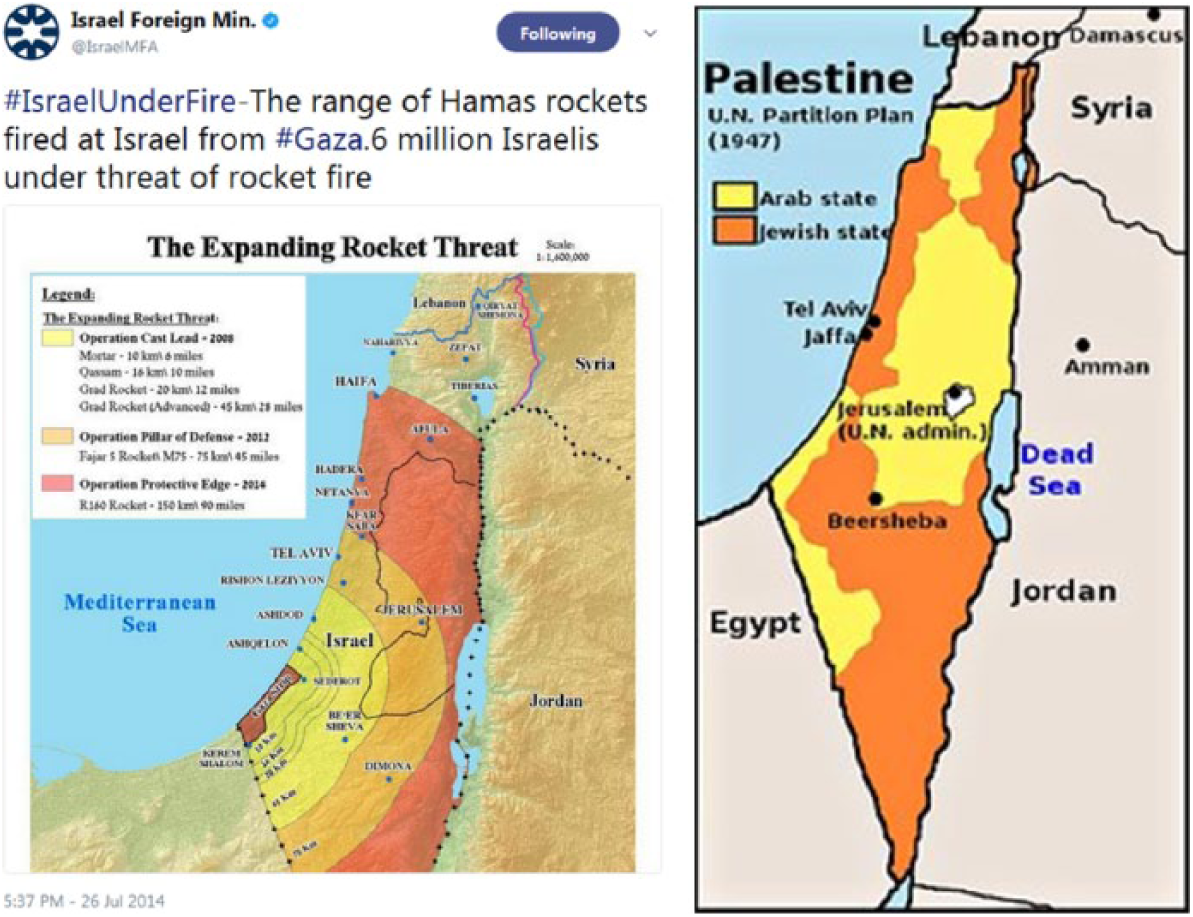
Map of Israel.
This visual similarity invokes the past. The partition plan of 1947 was one in which a small Israel would be besieged by enemies. It would be a nation born out of the ashes of the Holocaust and into an existential struggle. The map used by the MFA carries a similar message: that even today Israel is besieged by an enemy and even today 6 million Jews are under threat. Thus, once again, Israel emerges as David and not Goliath.
Finally, another set of maps was used to demonstrate the level of threat posed to Israel. These were battle plans identifying the location of Hamas terror tunnels. One such image, shown below (Figure 11), is important as it depicts Hamas infrastructure as military installations rather than improvised tunnels. By using a map resembling a battle plan, the Israeli MFA again framed Hamas as a military force with offensive prowess rather than a terrorist organization. By so doing, it challenged the notion of many against the few.

Hamas battle plans.
These results demonstrate that it is through images that Israeli MFA frames resonated with two Israeli strategic narratives – that of the start-up nation and the only democracy in the Middle East. Moreover, some images were used to challenge the narrative of Israel as a mighty Goliath fighting a Palestinian David. Our analysis illustrates the manner in which images, through the act of abstraction, enable contextual frames to correspond with broader strategic narratives. These findings validated our second and third research hypotheses that Israel’s framing is reliant on moral claims to be legitimate and that images played an important role in Israel’s framing of the Gaza War.
Discussion and conclusion
The mass migration of MFAs to social media, combined with the advent of digital diplomacy, necessitate that the framing research corpus continues to expand. This is because social media enable MFAs to craft and disseminate frames to connected audiences, thus circumventing the traditional media (Bjola and Holmes, 2015; Manor, 2016). Moreover, as social media are inherently visual platforms, there is a need to evaluate how MFAs use images as part of their framing activities in war (Crilley, 2016). There is also a need to better conceptualize the relationship between strategic narratives and frames as both can be used to influence audiences’ perception of world events and both can create a sense of shared identity through the use of historical analogies, stereotypes and images (Entman, 1993; Miskimmon et al., 2014). This article addressed the aforementioned gaps by analysing the Israeli MFA’s use of Twitter during the 2014 Gaza War. The analysis of 795 tweets demonstrated that during the Gaza War the Israeli MFA constructed 14 frames that included the four elements identified by Entman (1993). In each frame, the MFA framed the root problem causing the crisis so as to promote Israel’s desired solution. For instance, Hamas’s military capabilities necessitated an Israeli ground invasion of Gaza. By framing solutions to the War, Israel was also able to compete with solutions offered by other diplomatic actors.
In addition, each frame included a moral evaluation. It is evident that, during the Gaza War, the Israeli MFA attempted to create a moral dichotomy between Hamas and Israel. While Hamas was framed as being an extension of ISIS and committing war crimes, Israel was framed as taking the moral highroad by opening humanitarian windows and building a field hospital outside Gaza. The moral dichotomy was best captured by the tweet ‘We Cease, They Fire’. This finding suggests that, during war, MFAs may frame their adversaries and not just events they are embroiled in. Moreover, this moral dichotomy was part of an attempt by the Israeli MFA to legitimize Israel’s actions and policies.
However, results also demonstrate that, throughout the Gaza War, the Israeli MFA was forced to create frames that responded to negative press coverage and to diplomatic actions taken by other actors. MFA social media framing is therefore both a reactive and proactive process. Given that framing bears the imprint of power, framing competitions may be conceptualized as online power struggles between actors seeking legitimacy for their respective policies.
By crafting frames, and disseminating them on Twitter, the MFA attempted to take a proactive approach and influence not only how journalists covered the Gaza War but also set the parameters for online discussions about the war given that frames influence public debates (Neuman et al., 1992; Tuchman, 1978). However, our analysis of MFA frames also revealed that the press remains a powerful actor when it comes to MFA framing and that press coverage still warrants a response from diplomats (Hartley and Russett, 1992; Herrmann et al., 1999; Jacobs and Page, 2005; Seaver, 1998). This was evident in Israel’s attempt to re-frame the high Palestinian death tool as a consequence of Hamas’s immorality. As such, Entman’s Cascading Activation Model (2004) has only partially been disrupted.
By demonstrating how the Israeli MFA framed the Gaza War of 2014, this article has addressed an important gap pertaining to the frame building aspect of framing theory in the age of digital diplomacy. Yet it is important to note three limitations of our study. First, this study focused solely on the frames crafted and disseminated by the Israeli MFA. The MFA was, however, not the only actor to frame events during the Gaza War. The international press, the Israeli press, the Israeli military, human rights organizations, Hamas and the Palestinian leadership all used Twitter to craft and disseminate frames. Future studies could provide a comparative analysis and explore the interaction between the frames disseminated by different actors. Such an analysis could demonstrate how Twitter is used to counter an opponent’s frames. Future studies should also explore the context of frame production in order to better understand how and why the authors of MFA tweets construct and disseminate frames. Methods such as interviews with digital diplomacy practitioners would help provide a rich account of digital diplomacy and framing in war beyond what can be gained by studying the content of frames alone. Finally, our study does not provide an engagement with audience analysis. Future studies that engage with audience responses to the Israel MFA’s tweets could better highlight the effects and impact of the Israel MFA’s framing of war.
Nevertheless, our conceptual framework and analysis provide an important contribution. They highlight that, during war, an MFA will summon the past to make sense of a chaotic present. Furthermore, they outline how images enable frames, which are contextual, to resonate with narratives, which are universal and relate to the past, present and future. This is due to the fact that images play a role of abstraction and thus allow an interplay between frames and narratives. Our analysis revealed that the Israeli MFA summoned the Israeli and Jewish past to the present through the use of images and visual analogies. Moreover, MFA images summoned the past to illuminate the present and suggest what should be done in future. In this manner, MFA frames may have reduced some of the uncertainty accompanied by war (Garrison, 2001). By analysing images, we demonstrate how they perform an act of abstraction and enable a frame to resonate with a nation’s strategic narrative. For instance, the images of Paris, New York and India all enabled Israel to portray itself as a vibrant democracy. Consequently, Hamas’s war on Israel could be understood as part of a universal struggle between radical terrorism and democracy.
We also found that Israel used images that resonated with the start-up nation narrative. This emphasized Israel’s regard for human life above military needs. Throughout the Gaza War, the MFA repeatedly used images of IAF pilots refusing to fire on targets near civilians, demonstrating that MFA framing still rests on selection, emphasis and repetition (De Vreese et al., 2001; Entman, 1993). In addition to these images that resonated with Israeli strategic narratives, we also found that the MFA attempted to negate a narrative of Israel; that of David versus Goliath. This was achieved through images that equated Hamas with ISIS and suggested that Hamas is part of a global network of terror organizations. Thus, it is implied that radical terrorism is Goliath and Israel is David. The attempt to negate the David versus Goliath narrative suggests that MFAs attempt to claim legitimacy by making their social media content resonate with positive narratives and contradict negative ones. Finally, our analysis demonstrates that the MFA repeatedly used images to create a collective ‘we’. Some images, such as the Eiffel Tower, created a democratic ‘we’, while others created an Israeli or Jewish ‘we’. Images easily convey cultural symbols and historical connotations that relate to a group’s shared past and identity, and perform an important function in constituting identities (Hansen, 2011). It is subsequently imperative that future research on framing and conflict takes into account the role of visual media in the digital age.
Supplemental Material
Appendix – Supplemental material for Visually framing the Gaza War of 2014: The Israel Ministry of Foreign Affairs on Twitter
Supplemental material, Appendix for Visually framing the Gaza War of 2014: The Israel Ministry of Foreign Affairs on Twitter by Sumaya Al Nahed, Philip Hammond, Ilan Manor and Rhys Crilley in Media, War & Conflict
Footnotes
Funding
The author(s) received no financial support for the research, authorship, and/or publication of this article.
Supplemental material
Supplemental material is available for this article online.
Author biographies
References
Supplementary Material
Please find the following supplemental material available below.
For Open Access articles published under a Creative Commons License, all supplemental material carries the same license as the article it is associated with.
For non-Open Access articles published, all supplemental material carries a non-exclusive license, and permission requests for re-use of supplemental material or any part of supplemental material shall be sent directly to the copyright owner as specified in the copyright notice associated with the article.
