



Abstract
Right-wing extremists and Islamist extremists try to recruit new followers by addressing their national (for instance, German) or religious (Muslim) social identity via online propaganda videos. Two studies examined whether capitalizing on a shared group-membership affects the emotional and cognitive response towards extremist propaganda. In both studies, Germans/non-migrants, Muslim migrants and control participants (N = 235) were confronted with right-wing extremist and Islamist extremist videos. Emotional and cognitive effects of students (Study 1) and apprentices (Study 2) were assessed. Results showed a general negative evaluation of extremist videos. More relevant, in-group propaganda led to more emotional costs in both studies. Yet, the responses varied depending on educational level: students reported more negative emotions and cognitions after in-group directed videos, while apprentices reported more positive emotions and cognitions after in-group directed propaganda. Results are discussed considering negative social identities.
Keywords
Propaganda is about talking grievance into people, as Hitler did to the Germans. There is always the harsh residuum of grievance in any society that can be exploited by a demagogue. (O’Shaughnessy, 2012: 38)
Extremists abuse online media for the spreading of recruitment-oriented online propaganda. In this article, propaganda refers to a strategic attempt to manipulate emotions and cognitions to steer behaviour in the name of an ideology which often claims absolute validity (Frischlich and Rieger, 2017). Although propaganda has accompanied every political, or religious change in the history of mankind (Taylor, 2003), the internet has largely extended propaganda’s geographical reach (Archetti, 2013a; Baldauf et al., 2011; Chatfield et al., 2015; Frankenberger et al., 2015) easing the access to global audiences. Particularly, right-wing extremists 1 and Islamist extremists have discovered these benefits of internet propaganda (Bates, 2012; Europol, 2011), building on a variety of online propaganda media that aim at the recruitment and mobilization of new followers, for instance via YouTube (Conway, 2012; Finsnes, 2010; Glaser, 2011).
The new followers who are targeted by right-wing extremists and Islamist extremists are defined by a certain national or religious collective or social identity. In the case of right-wing extremism, recruitment propaganda is directed towards a national or ethnic in-group (e.g. ‘German’, or ‘white’). In the case of Islamist extremist extremism, this target group is defined through religion (‘Muslim’, tackling followers of Islam, often referred to in propaganda as ‘the right Muslim’). In both cases, extremist propaganda directly capitalizes on the respective social identity calling for a defence of ‘our people’ against ‘the enemy’ by using an ‘othering’ strategy (Burnap and Williams, 2015, 2016). Accordant visual propaganda is used by combating parties across ideologies to present the in-group’s unity, its victories and the threat from the enemy (Seo and Ebrahim, 2016).
Although most internet users will not inevitably feel any belonging to the respective extremist group, their accordant social identity might nonetheless be affected. The prevalence of extremist videos and its algorithmic linkage to other non-extremist videos (e.g. on YouTube) might slowly blur the lines between extremist and non-extremist interpretations of social identities, making extremist views an average part of media consumption (Costello et al., 2016; Schmitt et al., 2018). Further, members of the target groups (e.g. Muslims stumbling over Islamist extremist propaganda) might ‘learn’ through extremist propaganda that their country or religion (e.g. Islam) is perceived negatively, which might result in anger (Neumann et al., 2018). One of the central narratives of right-wing extremist as well as Islamist extremist propaganda emphasizes the presumed threat of the in-group, e.g. the ‘conspiracy against Muslims’ or ‘the conspiracy to replace the Germans’ (Hafez, 2007; Juergensmeyer, 2003).
Overall, the strong capitalizing on intergroup boundaries in extremist propaganda makes propaganda a prototypical example of intergroup communication (Iyengar et al., 2012), suggesting that intergroup theories can contribute to our understanding of propaganda effects. Intergroup communication occurs when ‘either party in a social interaction defines self or others in terms of their group membership [and communication] is influenced by the group membership of the involved individuals (Harwood et al., 2005: 2). Research on intergroup communication is deeply inspired by social identity theory (SIT, Tajfel and Turner, 1979, 1986). SIT assumes that individuals not only own a unique personal identity but also a set of social identities formed by the social groups they belong to, their in-groups. Being personally addressed by extremist online videos puts this group’s moral legitimacy into doubt which has been found to threaten people’s self-esteem (Ellemers et al., 2002).
To cope with this aversive state, recipients of extremist propaganda could either increase the tolerance for extremist content – thus decreasing the threat on their in-group identity – or, on the contrary, reject extremist propaganda even more harshly to distance themselves from the ‘black sheep’ (Marques et al., 1988). To put it simply: recipients could either reject in-group directed propaganda more strongly than out-group directed propaganda (devaluation hypothesis) or reject in-group directed propaganda less than out-group directed propaganda (revaluation hypothesis). The current two studies aimed to test these conflicting response patterns by examining the cognitive and emotional effects of extremist propaganda that either capitalized on a social identity of the recipient (‘in-group directed propaganda’) or addressed a different target audience (‘out-group directed propaganda’). While Study 1 used a student sample, Study 2 aimed to extend the findings towards a non-academic sample of apprentices. 2
Extremist propaganda as a function of social identity
Initial evidence shows different responses depending on whether one’s social in-group or an out-group is targeted by extremist propaganda supporting the devaluation hypotheses. For instance, a qualitative study examining the response of British Muslims towards in-group directed Islamist extremist propaganda found participants judged such videos as ‘irresponsible and childish’ (p. 6), showing a pronounced third-person effect (Duck, 1995) suggesting a pronounced devaluation of in-group propaganda (Baines et al., 2010). In a related vein, Roessing and Siebert (2006) found that Germans evaluated internet propaganda as more dangerous when framed as being produced by a national in-group member (right-wing extremist) as compared to being produced by left-wing activists, thus not addressing one’s national identity. However, there is also evidence for the ‘revaluation’ hypotheses. Ramírez and Verkuyten (2011) found Dutch participants to be more tolerant towards a right-wing extremist speech targeting them as in-group members than towards an Islamist extremist speech directed towards an out-group. At first sight, these findings support both conflicting hypotheses, suggesting that additional moderating variables might play a role. Indeed, there is initial evidence that existential anxieties might foster the approach to extremist propaganda, whereas the absence of existential anxieties fostered the devaluation of such content (Frischlich et al., 2015; Rieger et al., 2017). This result speaks for the special condition when one’s social identity is addressed (in this case, the national social identity).
Social Identity Theory
SIT posits that people own a set of social identities related to the groups they feel psychologically belonging to, their in-groups. This means that groups have to be identifiable from within as well as from outside the group (Tajfel and Turner, 1986). Cultural identities such as those addressed within extremist propaganda videos are an easily identifiable social category and a prototypical example for a social identity (Hogg et al., 1995).
The basis of social identity is a process of social comparison. Relevant to this process is: (1) a spontaneous social comparison in evaluation of people of the same group (intragroup comparison), and (2) a choice of an out-group for the comparative intragroup process. Via these comparisons, individuals gain important information about their own worthiness and status (Branscombe and Wann, 1994).
Due to the central role of in-groups for one’s identity, individuals are motivated to see their in-group in a positive light (Hogg, 2006). Not surprisingly, people have been found to engage in a variety of behaviours in order to preserve a positive group image (Machunsky et al., 2009; Turner et al., 1987) and are often more tolerant towards in-group members in comparison to out-group members (Koval et al., 2012). However, the same desire to see one’s in-group in a positive light can also lead to harsher devaluations of in-group members that are perceived to threaten the overall positive image of a social group (the so-called black sheep effect, see Marques et al., 1988).
Not all social groups one belongs to are beneficial for one’s self-esteem or positively distinct from all other groups. For instance, negative behaviours of in-group members or a negative status of one’s in-group in comparison to another group can threaten the beneficial effects of in-group status on self-esteem (Tajfel and Turner, 1979) and trigger emotional costs and negative feelings even when the individual is not personally responsible for the wrongdoing (Gunn and Wilson, 2011; Lickel et al., 2005). For instance, reminding young Germans (born two generations after the end of WWII) of their country’s Nazi past triggers shame (Dresler-Hawke and Liu, 2006). Likewise, Americans also reported vicarious shame after contemplating an in-group member expressing anti-Muslim prejudice (Johns et al., 2005). These results demonstrate the nature of emotional costs after confrontation with negative social identities.
How do people react when they are confronted with a social identity that appears in a negative light? To protect against these emotional costs, individuals can apply different defensive responses. Former research on negative social identities, for instance, found people symbolically or literally distanced themselves from the in-group in order to preserve their positive self-image (Branscombe et al., 2012). For instance, anger about one’s in-group has been found to decrease the identification with that group (Kessler and Hollbach, 2005). Transferring this to extremist propaganda, people might devaluate in-group directed propaganda more strongly than out-group directed propaganda. Another defensive response would be to change one’s perception of the whole group to preserve the positive group image. This would result in a movement towards the in-group and a more positive evaluation of the entire group (Branscombe et al., 2012; Jackson et al., 1996). In the case of extremist propaganda, people might revalue extremist propaganda directed towards their in-group.
The current research
The present study used SIT (Tajfel and Turner, 1986) to describe the immediate responses of German non-Muslim recipients without migration background in comparison to Muslim migrants and control participants, when experimentally confronted with right-wing extremist and Islamist extremist videos. Overall, we expected Germans/non-migrants to show similar reactions towards right-wing extremist propaganda as Muslims migrants towards Islamist extremist propaganda while control participants would not respond differently to both types of extremist videos.
Based on research on emotional costs after in-group wrongdoings (Branscombe and Doosje, 2004), we expected in-group propaganda to increase shame and guilt in comparison to out-group propaganda. We expected an interaction effect in such a way that:
H1: Germans/non-migrants will report more shame and guilt after right-wing extremist propaganda whereas Muslim migrants will report more shame and guilt after viewing Islamist extremist propaganda.
We also distinguished further emotional and cognitive responses. As prior research argued that negative social identity might trigger devaluation as well as revaluation, we formulated research questions regarding the emotional and cognitive responses towards in-group versus out-group directed extremist propaganda:
RQ1: Does in-group directed propaganda differ from out-group directed propaganda in terms of evoked aversion (RQ1a) and interest (RQ1b)?
RQ2: How do participants perceive in-group versus out-group directed propaganda’s persuasiveness (RQ2a) and one-sidedness (RQ2b)?
Study I
Method and design
The study realized a 3(Cultural background: German/non-migrant vs Muslim migrant vs control) X 2(Propaganda: right-wing extremist vs Islamist extremist) mixed design with Propaganda as a repeated factor.
Participants
A total of N = 121 students from a large German university took part. As intelligence reports at the time of data collection mention the members of extremist movements as being mainly young males (Claus et al., 2010; Munton et al., 2011), our sampling focused on male participants. To realize the in-group/out-group relations, three ethnic backgrounds were distinguished: (1) participants with both parents originating from Germany (n = 62), and either Christian or no religious affiliation, were coded as ‘Germans/non-migrant’, the right-wing extremists’ target audience; (2) participants with both parents originating from a mainly Muslim country (such as Iraq or Syria) and Muslim religious affiliation were coded as ‘Muslim migrants’ (n = 21), representing the Islamist extremists’ target audience; (3) participants with both parents originating from a non-Muslim country (e.g. Argentina, Russia) and either Christian or no religious affiliation, were coded as ‘control’ (n = 25). A total of 13 participants did not match these criteria and were thus excluded. The remaining n = 108 participants were on average 26.75 years old (SD = 4.05).
Procedure and materials
We recruited participants via university mailing lists for a study about ‘propaganda reception’. The study took place in a laboratory allowing up to six subjects per session. Participants were rewarded with €15 per hour. Upon arrival, they signed an ethical consent form and were seated in separate cubicles equipped with headphones and notebooks. Participants entered an anonymous code and started the experiment by themselves.
In a first step, a series of demographic (age, nationality, religion, parental origin, current educational level) and personality control variables was presented. 3 Afterwards, participants started either with a block of right-wing extremist or of Islamist extremist videos. All videos addressed in- and out-group differences. Either ‘the Muslims’, or respectively ‘the Germans’, were directly addressed, or the aggression of out-groups and suffering of in-group members were discussed in detail. Further, group activities stressing the ‘strong community’ were displayed (for an overview of the videos, see supplemental material; for a detailed description, see Rieger et al., 2013. The order of the blocks was randomized).
After each video, participants were asked to answer 14 items regarding their evaluation of the propaganda videos (see Rieger et al., 2013). Seven items assessed participants’
Final items for the five factors of emotional and cognitive responses towards extremist propaganda.
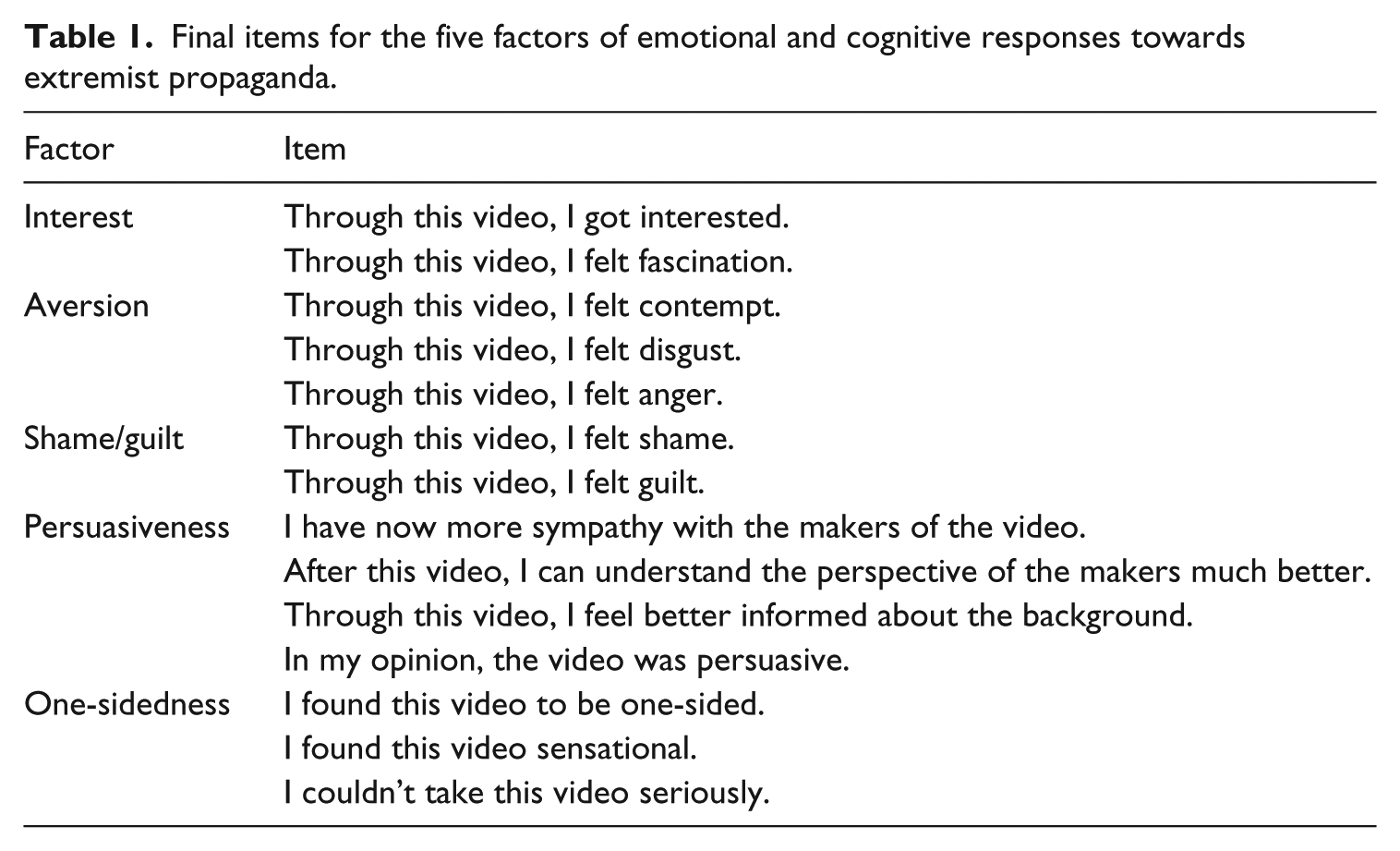
The remaining two factors displayed participants’ cognitive responses, mirrored in the amount of one-sidedness perceived, and the persuasiveness ascribed to the videos. All cognitive items were assessed on a 4-point scale ranging from 1 = ’I absolutely disagree’ to 4 = ’I absolutely agree’. For the analyses, the items for each factor were aggregated to a single mean per participant and ideology (right-wing extremist versus Islamist extremist). After the last questionnaire, participants were thanked, paid and fully debriefed.
Results
A series of 3 (Cultural background: Germannon-Muslim, Muslim migrant, non-Muslim migrant) X 2 (Propaganda: right-wing extremist versus Islamist extremist) mixed analyses of variance (ANOVAs) with the last factor as repeated measure were conducted for the five dependent measures.
Emotional costs
Using
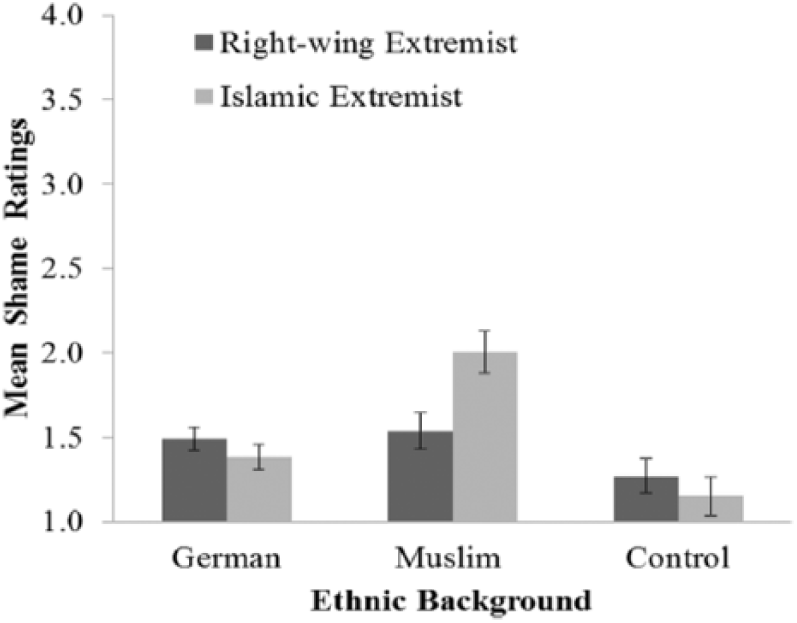
Shame/guilt reported after the propaganda reception (Study 1). Error bars represent standard errors.
Emotional defence reactions
RQ1 asked whether in-group directed propaganda would lead to more versus less negative aversion (RQ1a) and interest (RQ1b). For
Emotional and cognitive effects of extremist propaganda (Study 1).
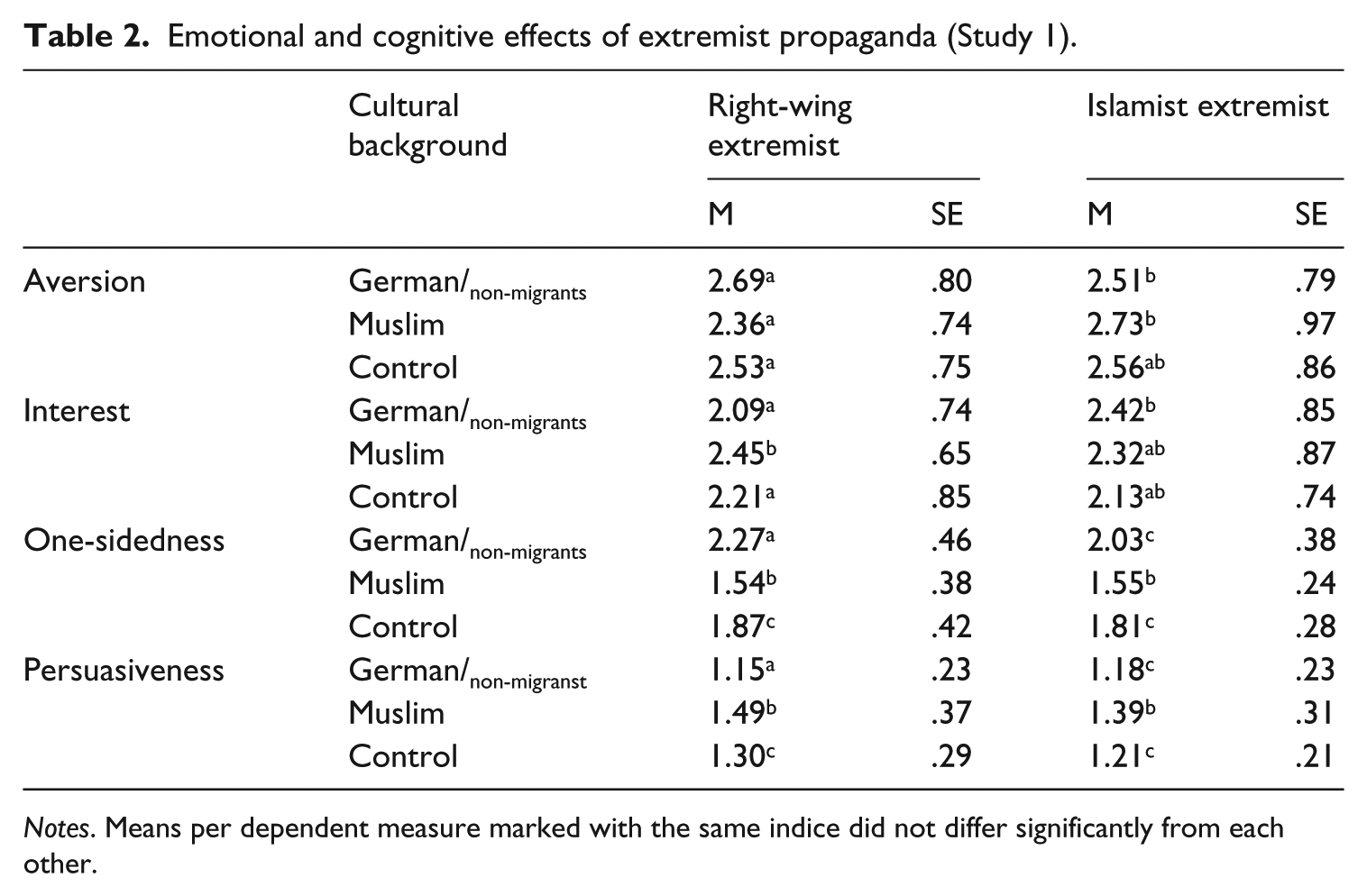
Notes. Means per dependent measure marked with the same indice did not differ significantly from each other.
Cognitive defence reactions
RQ 2 asked for the cognitive consequences of in-group directed propaganda. For
Discussion Study I
In line with our expectations derived from SIT, students reacted differentially to propaganda that threatened them as in-group members as compared to propaganda addressing a different target group. In-group directed videos increased emotional costs in terms of shame/guilt both among Germans/non-migrants and Muslim migrants. SIT suggests that individuals deal with negative in-groups by either distancing from the accordant group (devaluation hypothesis) or by positively biasing one’s in-group perception (revaluation hypothesis). To test these conflicting predictions, we measured participants’ emotional (aversion and interest) and cognitive reactions (persuasiveness and one-sidedness), always including positive (interest and persuasiveness) as well as negative responses (aversion and one-sidedness).
For Germans/non-migrants, all four dependent variables showed a more negative evaluation of in- in comparison to out-group directed propaganda. They evaluated the right-wing extremist videos as being more aversive and one-sided and as being less interesting and less persuasive than the Islamist extremist videos. The pattern was nearly reversed among Muslim migrants. They evaluated the Islamist extremist videos as being more aversive and slightly less interesting. They also rated the videos as being more one-sided and less persuasive by trend, yet the latter effects failed to reach significance. Underlying the crucial role of the shared social identity link, non-German/non-Muslims did not distinguish between right-wing extremist and Islamic extremist propaganda in their response.
Although the results can be regarded as a first hint that similar devaluation response towards in-group extremist propaganda was evoked among Germans/non-migrants and Muslim migrants, the pattern was less present among the latter.
Significantly, Study 1 relied on a student sample. One might argue that extremist propaganda is not primarily aimed at recruiting academics and descriptions of extremist networks point towards educational level as a potentially relevant variable for the effects of extremist propaganda (see Arzheimer and Carter, 2006, for an overview). A low educational status or a gap between education and profession has frequently been found among Islamist as well as right-wing extremists (Lützinger, 2010). In consequence, evidence for the revaluation hypotheses might be found primarily when examining a non-student sample. The second study sought to examine this possibility.
Study II
Study II addressed in- and out-group propaganda effects by replicating Study I in a non-student sample. To realize a comparable sample with a non-academic background, we focused on apprentices within the German tertiary educational system.
Method
Participants
A total of N = 114 male apprentices took part. Five of them had to be excluded because they did not match the sampling criteria (see Study I). The remaining n = 109 were split into n = 63 Germans/non-migrants, n = 23 Muslim migrants and n = 23 control individuals. Participants were on average 21.36 years old (SD = 2.60).
Procedure and materials
The procedure was the same as in Study I. We conducted the study on site at the respective vocational schools under parallel conditions. Participants watched the videos (N = 8, 4 for each ideology) in separate cubicles and were equipped with headphones. After each video, they answered the same items as in Study I. For the subsequent analyses, we aggregated the scales per participant and ideology.
Results and discussion
Separate 3(Cultural background: Germannon-migrant vs Muslim migrant vs. Control) X 2(Propaganda: right-wing extremist vs Islamist extremist) mixed ANOVAs with the last factor as a repeated measurement were conducted for each of the dependent variables.
Emotional costs
Concerning
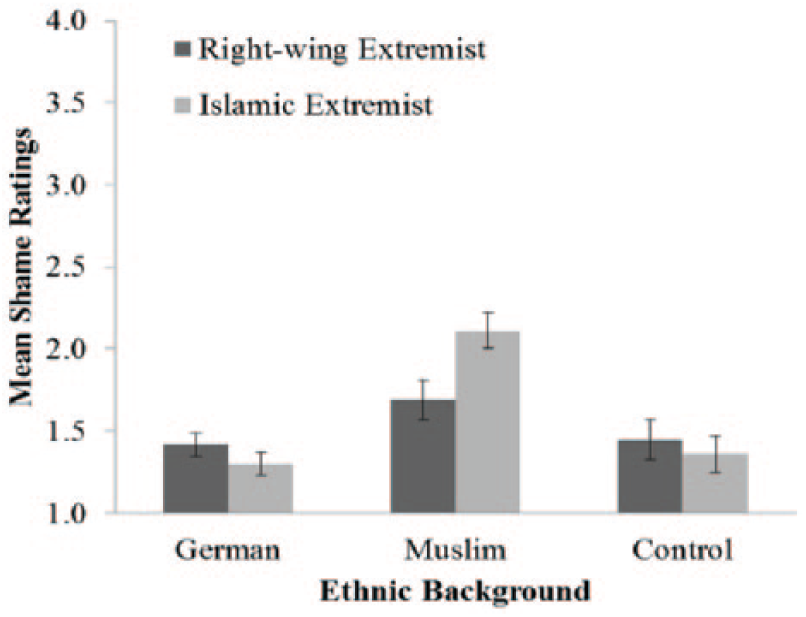
Shame/guilt reported after the propaganda reception (Study 2). Error bars represent the standard errors.
Emotional and cognitive effects of extremist propaganda (Study 2).
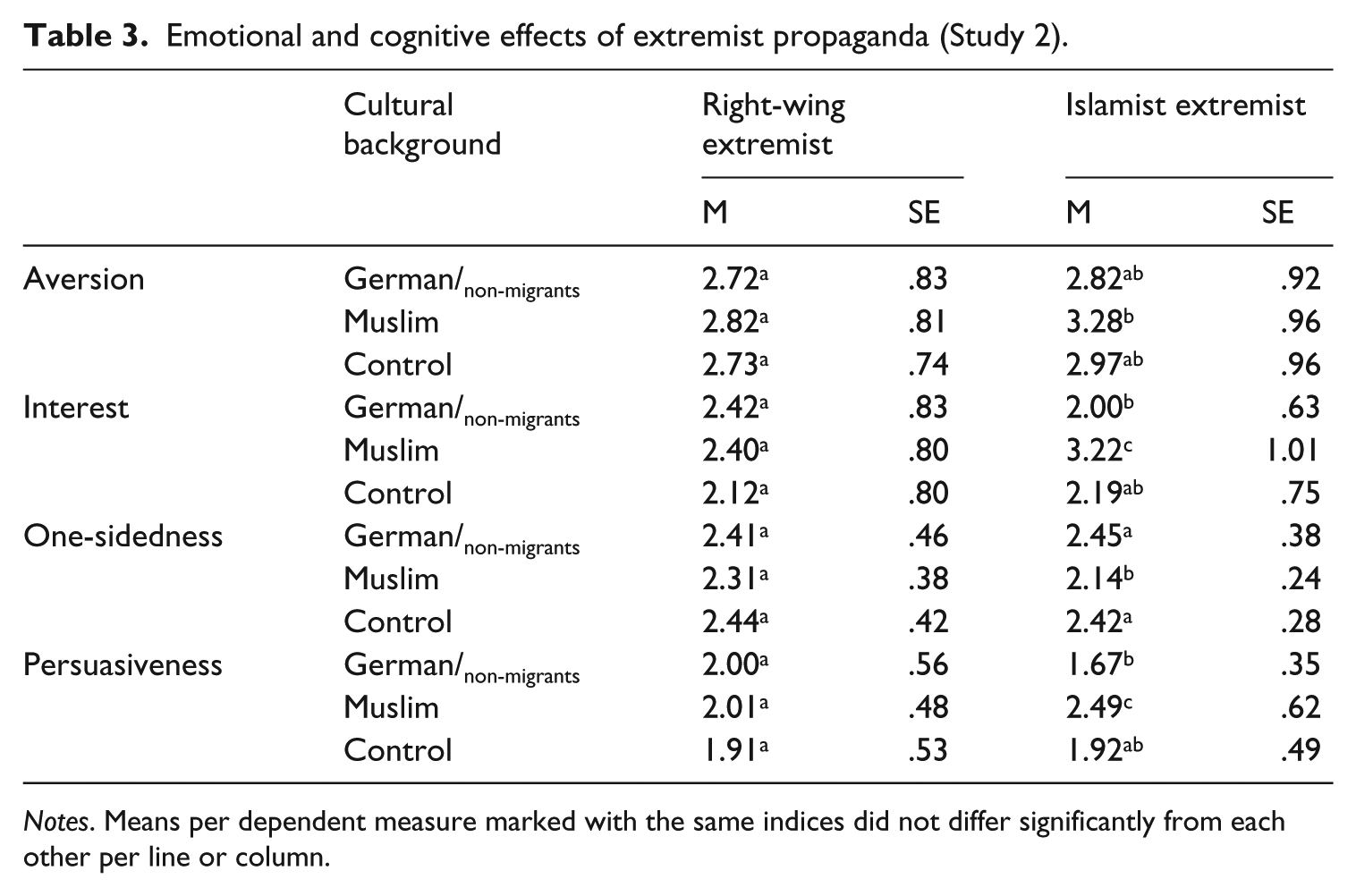
Notes. Means per dependent measure marked with the same indices did not differ significantly from each other per line or column.
Emotional defence reactions
For
Cognitive defence reactions
None of the effects reached significant for reported
Discussion Study II
The emotional costs after the reception of extremist propaganda were the same for apprentices as they were for students in Study I. However, the emotional and cognitive responses to in-group directed extremist propaganda differed between both studies. From a SIT perspective, the observed pattern in Study II supported the approach hypotheses amongst both Germans/non-migrants and Muslim migrants. Significantly, the effect concerned both emotional and cognitive approach measures (interest and persuasiveness), but not emotional or cognitive defence measures (aversion and one-sidedness).
General discussion
The increasing amount of right-wing extremist and Islamist extremist propaganda videos on the internet has raised the concern of security agencies and mass media, proclaiming an immediate radicalizing effect of such content on the target groups addressed by the videos. In two studies, we examined how the confrontation with extremist propaganda that either addressed the recipient as an in-group member or was directed towards a different target group affects young adults sampled from universities and vocational schools.
In two studies, we found systematic variance in the recipients’ response towards extremist propaganda, depending on whether the videos capitalized on a recipient’s social identity or not. Students as well as apprentices reported higher levels of emotional costs after the consumption of in-group directed as compared to out-group directed propaganda videos. The pattern of both studies speaks for the activation of a negative social identity via extremist propaganda among Germans/non-migrants as well as Muslim migrants (H1).
Therefore, our results are meaningful in three ways: (1) they extend research on collective emotions (Doosje et al., 1998; Leyens et al., 2000; Smith et al., 2007) to the field of propaganda research showing that the sheer exposure to extremist propaganda leads to emotional costs on the side of the recipients; (2) they show that extremist propaganda raises similar responses irrespective of cultural background allowing for comparisons between different ideologies and recipient groups; and (3) they add to the scarce experimental research investigating the emotional effects of modern internet propaganda. In the case of the results for shame/guilt, it must be acknowledged, however, that an increased guilt and shame in response to German right-wing extremist propaganda might be a specific German (post-Nazi) emotional response, a kind of emotional heritage, represented in ‘liberal guilt’ when confronted with such thoughts. It could thus be the case that these results are not fully generalizable to other countries. However, we did find comparable effects on shame and guilt among Muslim migrants, making it implausible that the propaganda – shame/guilt link is a unique German phenomenon.
Our studies also found evidence for the revaluation as well as for the devaluation hypotheses inducted from SIT depending on participants’ educational level. SIT-inspired research addressing how individuals deal with negative social identities suggests two fundamentally different strategies: distancing from the messed group (devaluation hypothesis) versus turning towards the group denying the faults of the group (revaluation hypothesis). We measured both strategies via tackling emotional (aversion and interest) as well as cognitive (persuasiveness and one-sidedness) responses. In Study 1, in-group directed propaganda raised more aversion and was rated as being more one-sided, raised less interest and was perceived as being less persuasive than out-group directed propaganda. Notably, the effect was more pronounced among Germans/non-migrants. From a SIT perspective, this pattern is best described as social distance from the negative in-group (Branscombe et al., 2012), a devaluation of the flawed social group. In Study 2, apprentices evaluated in-group directed propaganda as being more interesting and persuasive than out-group directed videos consistent with the revaluation hypotheses. No differences regarding devaluation responses (one-sidedness and aversion) were observed.
As such, our results raise the question of why different educational levels show these opposing responses. Several social theories deal with explaining the connection between lower educational level and acquiescence with right-wing extremism (for an overview, see Arzheimer and Carter, 2006), among which are several socio-demographic factors (mostly linked with economic interests by limiting the rights of immigrants and asylum-seekers) and political opportunity structures. For these reasons, people outside the university-educated social strata might find more plausibility in the idea presented through propaganda by an extremist group claiming to represent their in-group. This could mean that they are more vulnerable to an influence or that they feel more empathy for extremists to fight for their cause. In both possible cases, this could occur with no greater susceptibility to support an extremist ideology (see also Arzheimer and Carter, 2006, for an explanation that more support for right-wing extremist parties does not necessarily increase their votes).
Overall, our results suggest caution in over-interpreting the effects of extremist propaganda videos on increasing interest in extremist ideologies as proclaimed in prior research (Europol, 2011; National Coordinator for Counterterrorism, 2009; Sageman, 2008). Across studies, we found overall low ratings for interest in and persuasiveness of such content, making a strong influence of such videos implausible. On a meta-level, these studies provide evidence for the way in which recipients perceive extremist media products. Communication and terrorism research have long followed the idea of a strong media effects paradigm implying that even single exposure can influence a person’s emotions, cognitions and even behaviour. Archetti (2013b) even claims that the way media are approached by most terrorism research is stuck in the early 20th century. In this context, the strong media effects paradigm would relate to the fear that online radicalization is possible through exposure to extremist propaganda. The present studies, however, support a notion of moderated media effects, that is, that exposure to extremist content does not necessarily lead to approaching tendencies but should be contextualized.
Relatedly, there is first evidence that dispositional as well as situational factors can further shape the evaluation of extremist propaganda. While these studies mention the relevance of an in-group relatedness for propaganda evaluations, they focus on relevant dispositional factors, such as authoritarianism, violence acceptance (Rieger et al., 2013) or the importance of self-threatening situations, such as existential threats or uncertainty (Frischlich et al., 2015; Rieger et al., 2017). Future studies should examine this idea more directly, and take the interaction between in-group relatedness, disposition and situation into account.
Last but not least, media effects do not happen without context. Extremist propaganda effects can be understood as a complex interplay between societal conditions, intergroup relationships and interpersonal susceptibility factors (Frischlich, 2018). For instance, do the mainstream media play an important role in escalating certain topics and contributing to real-world consequences (Brosius and Esser, 1995). By repeating extremist narratives and portraying their media products during prime-time news shows they offer a new stage for extremists (Beck and Quandt, 2011). Addressing the links between these different levels is a fruitful venue for future research.
Limitations and research directions
As our study was a first attempt to address the effects of right-wing extremist and Islamist extremist internet propaganda, our results primarily represent a starting point for future research emerging from the current studies’ limitations.
First, we included only Germans/non-migrants and Muslim migrants with German Muslims without migration background explicitly excluded due to their very low number in our sample. Addressing the specific role of converts seems to be an interesting venue for future research. We also focused on the effects of German propaganda videos. As extremism and propaganda are transnational phenomena, extending our findings to other cultural samples is an important step in order to generalize the effects of propaganda videos.
Addressing the experimental design and setting, participants saw the videos in a laboratory setting and the videos of both ideologies were presented in randomized order. 5 Sitting at home alone – maybe even after a frustrating experience - might have diverging effects. As demonstrated by Schmitt et al. (2018), many internet users stumble over extremist content through algorithmic linkage. That is, a forced exposure does not resemble media consumption nowadays, in times of being permanently online and permanently connected in a continuous stream of information (Klimmt et al., 2017). Future research accounting for accidental exposure is thus necessary to examine the generalizability of our results.
We did not aim to investigate causal chains into radicalization and only addressed short-term effects. Research on persuasion has shown that the effect of mediated information on attitudes generally decreased over time (Petty and Wegener, 1998). Under certain circumstances, persuasive appeals were found to be stronger after a while, e.g. in the form of a mere-exposure (Zajonc, 1968) or sleeper effect (Hovland and Weiss, 1951; Kumkale and Albarracín, 2004). Relatedly, from a communication perspective, it can be argued that ongoing confrontation with being targeted (e.g. by one’s social identity) by extremist messages can contribute to radicalization as this perceived closeness to extremism is coped with by antisocial behaviour (Neumann et al., 2018). Future studies should thus consider including long-term measures.
Nonetheless, our studies provided initial evidence for the crucial role of social identity in shaping the emotional and cognitive response towards extremist propaganda and for educational level as relevant moderator of participants’ response towards extremists’ video offerings.
Supplemental Material
Table_videos_supplementarymaterial – Supplemental material for Dealing with the dark side: The effects of right-wing extremist and Islamist extremist propaganda from a social identity perspective
Supplemental material, Table_videos_supplementarymaterial for Dealing with the dark side: The effects of right-wing extremist and Islamist extremist propaganda from a social identity perspective by Diana Rieger, Lena Frischlich and Gary Bente in Media, War & Conflict
Footnotes
Acknowledgements
We gratefully acknowledge the support of the German Federal Criminal Police Office – Terrorism/Extremism Research Unit and National Coordinator for Counterterrorism in The Netherlands. We thank the Joint Internet Center (gemeinsames Internetzentrum, GIZ) and the Network for Youth Protection ( ), who provided us with the extremist video material and assisted in selecting appropriate videos for the studies.
Funding
The author(s) disclosed receipt of the following financial support for the research, authorship, and/or publication of this article: The present studies were part of a project commissioned and accompanied by the German Federal Criminal Police Office – Terrorism/Extremism Research Unit (Bundeskriminalamt, BKA). It was co-funded by the German Federal Ministry of the Interior (Bundesinnenministerium, BMI) and the National Coordinator for Counterterrorism (NCTv, The Netherlands). There is no conflict of interest.
Supplemental material
Supplemental material for this article is available online.
Notes
Author biographies
References
Supplementary Material
Please find the following supplemental material available below.
For Open Access articles published under a Creative Commons License, all supplemental material carries the same license as the article it is associated with.
For non-Open Access articles published, all supplemental material carries a non-exclusive license, and permission requests for re-use of supplemental material or any part of supplemental material shall be sent directly to the copyright owner as specified in the copyright notice associated with the article.
