



Abstract
This article investigates whether, in light of the political and economic changes that occurred in the region in the last decades, crises are still a catalyst for foreign reporting on Latin America. The study comprises 3,831 articles related to the 20 Latin American countries published from 2000 to 2014 in the German press: the dailies Süddeutsche Zeitung and Frankfurter Allgemeine Zeitung, the political magazine Der Spiegel and the alternative newspaper tageszeitung. The author found that more than half of the coverage on the continent depicted some sort of crisis, especially non-violent ones and controversies (36.4%). However, the portrayal of crises is sectorial. The ‘invisible’ Central American states (Honduras, Haiti, Guatemala and El Salvador) and the countries against the Washington Consensus (Bolivia, Ecuador and Venezuela) exhibit a higher coefficient of crisis intensity. Colombia, despite considerable press attention, has the most crisis-centred reporting due to the conflict with FARC.
Keywords
Introduction
The analysis of crises in global reporting is fundamental since the majority of the conflicts portrayed in the media are, in general, not only geographically, but also culturally and politically outside readers’ milieu. Therefore, the audience, in general, lacks the direct experience and possibility of verifying and interpreting global events by themselves (Wetzstein, 2011: 43). In addition, conflicts are regarded as permanent topics of foreign reporting and have immense news value (Eilders and Hagen, 2005; Schulz, 1976; Staab, 1993). In the case of Latin America, however, it is not possible to generalize due to the vulnerability to crises, their intensity and scope, and the capacities to cope with extremities that vary significantly among the region (Boeckh and Öhlschläger, 2006: 13). On the one hand, Latin America is marked by the cliché of ‘revolutionary romanticism’ (Wienand, 2008: 323). On the other hand, the deficit of real crises with fundamental social changes is paradoxically a decisive reason for the continent’s susceptibility to crises (Boeckh and Öhlschläger, 2006: 14).
Hafez (2002: 59) argues that a social or political crisis is not just a moment when conflicts escalate but also a period of change in the direction of the events and, therefore, the beginning of a solution to the problem. From this perspective, one can understand a non-violent conflict as positive, a turning point of social change. In Latin American history, unexpected changes of governments or even regime shifts from democratic to authoritarian structures and vice versa occurred (wars of independence, right-wing dictatorships, or the wave of democratization during the 1980s). However, there is much continuity behind these Latin American crises (Boeckh and Öhlschläger, 2006: 14). Despite economic growth and the shift to the left at the beginning of the 21st century, continuously observed and emphasized by the press, scholars still argue that there is a lack of revolution as well as significant social changes in the continent.
The so-called ‘distribution crisis’ is a ‘historical constant’ in Latin America (p. 23), but actually, no one considers it as a crisis since it is not primarily virulent from a political point of view. Even if the media discourse had emphasized a shift to the left on the continent, especially after the super election year of 2006 when many South American nations voted for left-oriented candidates, these new leftist governments did not necessarily mean a political turnaround. Many heads of state, for example, the former Brazilian President Luiz Inácio Lula da Silva, were genuinely oriented towards a policy of compromise, while radical representatives of the left, such as the previous Venezuelan President Hugo Chávez, were an exception (Wienand, 2008: 323). For this reason, it is not surprising that the Conflict Barometer of the Heidelberg Institute for International Conflict Research found in 2006 that systemic ideological disputes were dominant within the violent conflicts in Latin America (HIIK, 2006: 34). However, despite the lack of structural changes in Latin American societies, the continent remains in German perception as ‘a place for romantically transfigured fantasies of the political left’ (Wienand, 2008: 323). There were crises in Latin America, but democracy has survived in spite of shortcomings. In addition, we are not dealing with a general Latin American crisis, but several crises limited to particular states (Nolte, 2006: 50). The focus of this article is to investigate whether the German press presented the Latin American countries within a conflict-oriented framework. Furthermore, considering that studies on Latin America’s foreign reporting are either scarce or outdated in the Western world (Cazzamatta, 2020a; Göbel et al., 2009), this article should fill this gap in the literature of global reporting and crises as a news value.
Theoretical background: The terminology of crises, conflicts and war
According to Löffelholz (2004a: 48), crises are a probable threat to the central values of a system. Security is reduced, i.e. there is a threat to existence, time and resources are limited, and there is enormous pressure to make decisions. Moreover, the main characteristics of crises are the unintentional threat to ‘dominant goals’, the ambiguous and unpredictable outcome, and the only partially influenceable course of events. In contrast to Löffelholz, who distinguishes between the terminology of crises and conflicts, this article understands the term conflict within the concept of crisis, as proposed by Wetzstein (2011: 109). The author explains crisis as a ‘more highly escalated conflict’, although ‘crises may focus more on political and humanitarian conflicts and their consequences and circumstances’. HIIK (2013) defines conflicts as:
. . . clashes of interest (positional differences) over national values (territory, secession, decolonization, autonomy, system/ideology, national power, regional predominance, international power, resources) of some duration and scope between at least two parties (organized groups, states, groups of states, organizations of states) determined to decide them in their favor.
From the perspective of the systems theory, the physical and social systems involved in conflicts (e.g. companies, nations, banks) compromise further contradictions, ‘the loss of common values’, or the severe modification of the current system situation (Görke, 2004: 122). According to Görke, conflict is either ‘extraordinary’ or ‘dysfunctional’. While, during conflicts, one reacts to systems’ contradictions through communication, during wars, the opponents are deprived of their communication possibilities. In case of conflicts, the system existence is not necessarily threatened.
War, on the other hand, must be seen as another form of conflict. In contrast to conflicts, wars aim to dispose of the opponent’s ability to communicate, even though their existence and survival are endangered. Wars involve at least two military or social systems equipped with weapons, and they are characterized by high intensity, in particular physical violence against people or property, as well as by an absolute continuity of militant action (Löffelholz, 2004b: 48). This definition goes beyond the usual interpretation of the war as an interstate conflict. Wars are about the escalation of conflict and the use of ‘organized’, ‘extreme physical violence’, in other words, a ‘continuing crisis’ that is violently exacerbated. That includes all types of armed conflict or the threat of violence or military conflict.
Crises and conflicts among the news values theory
Journalists in the Western world internalize that events involving conflicts are far more probably to become news than those that reproduce the status quo (Phillips, 2014). Since the press tends to apprehend affairs in terms of controversy, endeavour and competition based on the idea that conflicts mean the most compelling news, Östgaard (1965: 55) concluded in his study that ‘the news media tend to present the world as being more conflict-laden than it is, to emphasize the use of force rather than more peaceful means in solving such conflicts.’ However, conflicts or crises are surprisingly not explicitly included in the catalogue of the significant pioneer studies of the news values theory. In the milestone publication of Galtung and Ruge (1965), negativity appeared as an essential factor. However, their work is based on three major international crises and did not consider the reporting of daily events. They focused on content explicitly related to crises and, in that sense, it would be hard to analyse the importance of the factor outside a conflict-laden situation (Harcup and O’Neill, 2001). In the literature, conflict and aggression can be understood as damage or negativity. However, it should be noted that conflict and crisis reporting is not necessarily unfavourable. Peace efforts and dialogues can have a positive element of improvement, although conflict tends indeed to be emphasized while conciliation is not (Galtung and Ruge, 1965). One can also relate conflict to social relevance since it can keep or alter the status quo and hence delineate potential social changes (Eilders, 2006).
An explicit mention of the conflict factor appeared first in the turning-point study of Schulz (1976), who enlarged and adapted Galtung and Ruge’s catalogue. For the first time, Schulz empirically operationalized the news factors and demonstrated their factual influence on journalistic selection statistically. The factor was coded in four levels of intensity: (4) open aggression, i.e. a conflict that is carried out with armed force; (3) latent aggression such as the threat of violence during warlike disputes; (2) controversies, i.e. verbal expression of differences of opinion and different points of view (without the threat of violence) and (1) no conflicts whatsoever. Staab (1990a), on the other hand, analysed aggression and controversy separately in two different categories, and defined controversy as the ‘contrasting nature of differences of opinion’. The factor was encoded even if only one judgment was explicitly mentioned, but knowledge of the other (controversial) viewpoint was assumed or could be regarded as known. In addition, it had to be a matter of current conflicts, not the description of permanent ones. Finally, aggression was understood as a threat or use of force to cause harm (Staab, 1990a). However, since it is difficult to differentiate ‘non-violent conflicts’ from ‘controversies and differences of opinion’, this article considers the two concepts under the same category as suggested by Schulz (1976).
Extremely relevant in Staab’s (1990b) work is also the proposal of a ‘functional model’ of news selection (contrary to the ‘causal model’). According to this functional framework, journalists do not solely choose an occurrence due to their characteristics. They can also attribute and highlight news factors to a story in order to emphasize some events, i.e. journalists instrumentalize news factors for their purposes (p. 429). For this reason, some newspapers, as stated by Phillips (2014: 18), ‘also go out of their way to make events appear negative’.
Current studies within the Anglo-American tradition have also looked for a broader definition of bad news (negativity) and added conflict as a different category of analysis. For instance, Harcup and O’Neill (2017) defined conflict as ‘stories concerning conflict such as controversies, arguments, splits, strikes, fights, insurrections, and warfare’ (p. 1482), although they did not indicate any operationalization of the variable. In an ethnographic study of journalistic practices in Danish newsrooms, Schultz (2007) also recognized five specific news factors: timeliness, relevance, identification, conflict and sensationalism.
Based on this short literature review on news values, our research assumption is that, even though considerably economic and political changes have occurred in Latin American in the last 15 years, the presence of crisis reporting should still be a constant as it used to be during the 1970s and 1980s (Lowenthal and Baron, 2015). In particular, for small states, crises and conflicts should act as a catalyst for press attention. Thus, we formulated the following research questions:
RQ1: Can the foreign reporting on Latin America be classified as crises-oriented?
RQ2: Which types of crises are most pronounced in the coverage about Latin America?
RQ3: Which countries are mostly afflicted by crisis reporting?
RQ4: Are crises a stimulus for foreign reporting on Latin America?
Methodology
Research corpus
Our empirical analysis includes the two leading national German broadsheets initially – the Süddeutsche Zeitung (liberal and politically broad) and the Frankfurter Allgemeine Zeitung (economically liberal and politically conservative) – since both newspapers have the most substantial network of correspondents in Latin America. Apart from that, we incorporated the most traditional political magazine in Germany (Der Spiegel). Finally, we also considered the alternative tageszeitung (taz) due to its agenda-setting importance in the country. A study by Mathes and Pfetsch (1991) corroborated a ‘spin-over’ effect within the press, mostly originated by taz, i.e. a counter-issues flow from the alternative to the long-established outlets. Moreover, as observed by a foreign correspondent in Buenos Aires, only the channel Das Zweite Deutsche Fernsehen (ZDF), the news agency Deutsche Presse-Agentur (DPA) and the Frankfurter Allgemeine Zeitung (FAZ), the Süddeutsche Zeitung (SZ), the tageszeitung (taz), Der Spiegel and Die Zeit provide us with regular foreign reporting on Latin America (Malcher, 2018).
Among these outlets, we analysed just the print publication since their news values are the result of journalistic selection in an enormously competitive market (Harcup and O’Neill, 2017). Furthermore, the press has a substantial impact on decision makers, such as official state representatives, politicians and socially organized groups (Jarren and Donges, 2011: 262). The term ‘nationwide newspapers’ refers to outlets whose journalistic work reaches the whole nation. We disregarded regional newspapers because they prioritize local events rather than global occurrences (Pürer and Raabe, 2007). Finally, studies showed that the prestigious press also exercise an opinion leadership function amidst other small and regional newspapers (Jandura and Brosius, 2011).
Thus, our corpus choice incorporated three essential variables: the magnitude of readership, the impact on other communicators and the political spectrum. The proposed outlets comprise the leading sales volume and broader readership among the quality press in Germany (AWA, 2019; IVW, 2019). Regarding sale volume, taz is a deviation. Nonetheless, we included it to enlarge the political scope of our study (Noelle-Neumann et al., 2002: 435; Pürer and Raabe, 2007: 15). Finally, we also consider these three outlets as ‘leading media’, as stated by the ‘hypothesis of coordination’, i.e. they have an impact on the reporting of other publications (Brosius et al., 2009: 164).
Sampling process
We selected every article published between January 2000 and December 2014 from the printed version of the outlets mentioned above related to the 20 Latin American countries. First, we listed every single contribution in order to structure the central unity of our analysis (21,929 articles). We disregarded articles published in the SZ.de, FAZ.NET, taz.de, and Der Spiegel Online, since a study comparing newspapers and their online version within 18 European countries demonstrated that 70 percent of the most significant online news items are in general remarkably similar to their printed counterparts (Wurff, 2008: 70).
The search criteria comprised every mention of ‘Latin America’ or the name of its 20 states and corresponding capitals and principal cities, not only in the title but also mentioned in the first paragraph. We also considered the several adjectives and their German declension to fine tune the search procedures. SZ and FAZ have their online archives, while the contributions from taz and Der Spiegel were retrieved from the LexisNexis databank. To guarantee that every single country had the same chance of being picked up for the empirical investigation, we drew a layered sample of 25 percent of published news items from each state.
Furthermore, we ignored small articles (less than 150 words) because they have almost no news factors to be analysed. Each n–4th printed articles (25%) of a state within each newspaper was then chosen based on the rotation principle. Thus, the prerequisites for a layered sample were fulfilled since we were aware of the previous population distribution. The ultimate sample comprises 3,831 items. Finally, we ran a Holsti coefficient reliability test for the category ‘orientation on crises’ based on a 5 percent sample, and the results exhibited a 97.6 percent correspondence (5 mistakes out of 211 code decisions) between the two researchers.
Levels of crisis and category definitions
Based on the classification of the Conflict Barometer of the HIIK, we distinguished between four types of crises: (1) non-violent crisis; (2) violent crisis; (3) limited war (up to 2011 called severe crisis); and (4) disaster and accidents.
No crises whatsoever
Non-violent conflicts and controversies. This refers to descriptions of social conflicts, economic crises, legal conflicts, sanctions, corruption, electoral fraud, positional differences, verbal pressure, controversies, etc. Although the HIIK differentiates between ‘latent’ and ‘manifest’ conflicts, this article considers both cases as ‘non-violent conflicts’ to reduce the coding effort and ensure better reliability. This category also includes controversies, differences of position and disagreements. Controversies are understood as the ‘verbal expression of differences of opinion’ (Schulz, 1976: 137) or comparison of differences of opinion and various viewpoints, but without the use of the threat of violence.
Violent crises. This category describes ‘a state of tension in which at least one of the parties uses violence in isolated instances’ (HIIK, 2003). A few examples from Latin American reporting can be found under this category, such as the Brazilian demonstrations against the increase in the price of transport in 2013, coups in Honduras in 2009 and Haiti in 2004, the clashes between the government and the opposition in Venezuela and various demonstrations in Bolivia.
Conditional war. A conflict is defined as a severe crisis when ‘repeated and organized violence is used’. Examples are the crimes of the drug cartels in Mexico or Brazil; the violent actions of the Mara youth groups in Central America; the dispute between Brazilian landless people and powerful landowners; the clashes between indigenous populations and large landowners, etc.
Disasters, accidents, illnesses and crime. Disasters are characterized by their irregularity, unpredictability, surprise, and the enormous damage they cause to people and social structures such as deaths, injuries, damage to buildings, etc. (Bieber, 2011: 34). Crimes committed by drug cartels in Mexico or Brazil should not be coded under this characteristic but under ‘conditional war’. In this category, we generally considered specific individual offences.
Findings
Looking first at the entire foreign reporting on Latin America (the 20 countries altogether), it is possible to talk about orientation on crises, since 54.53 percent of all analysed articles are dealing with some kind of crisis (RQ1). The majority of them, though, were related to ‘non-violent crises’ (36.4%), i.e. disagreements and controversies, followed by ‘violent crises’ (5.66%), ‘conditional war’ (6.68%) and ‘natural disasters & accidents’ (5.77%), to answer our RQ2. The research assumption of orientation on crises was therefore generally confirmed, as can be seen in Figure 1.

Types of crises in Latin America’s global news coverage in the German press.
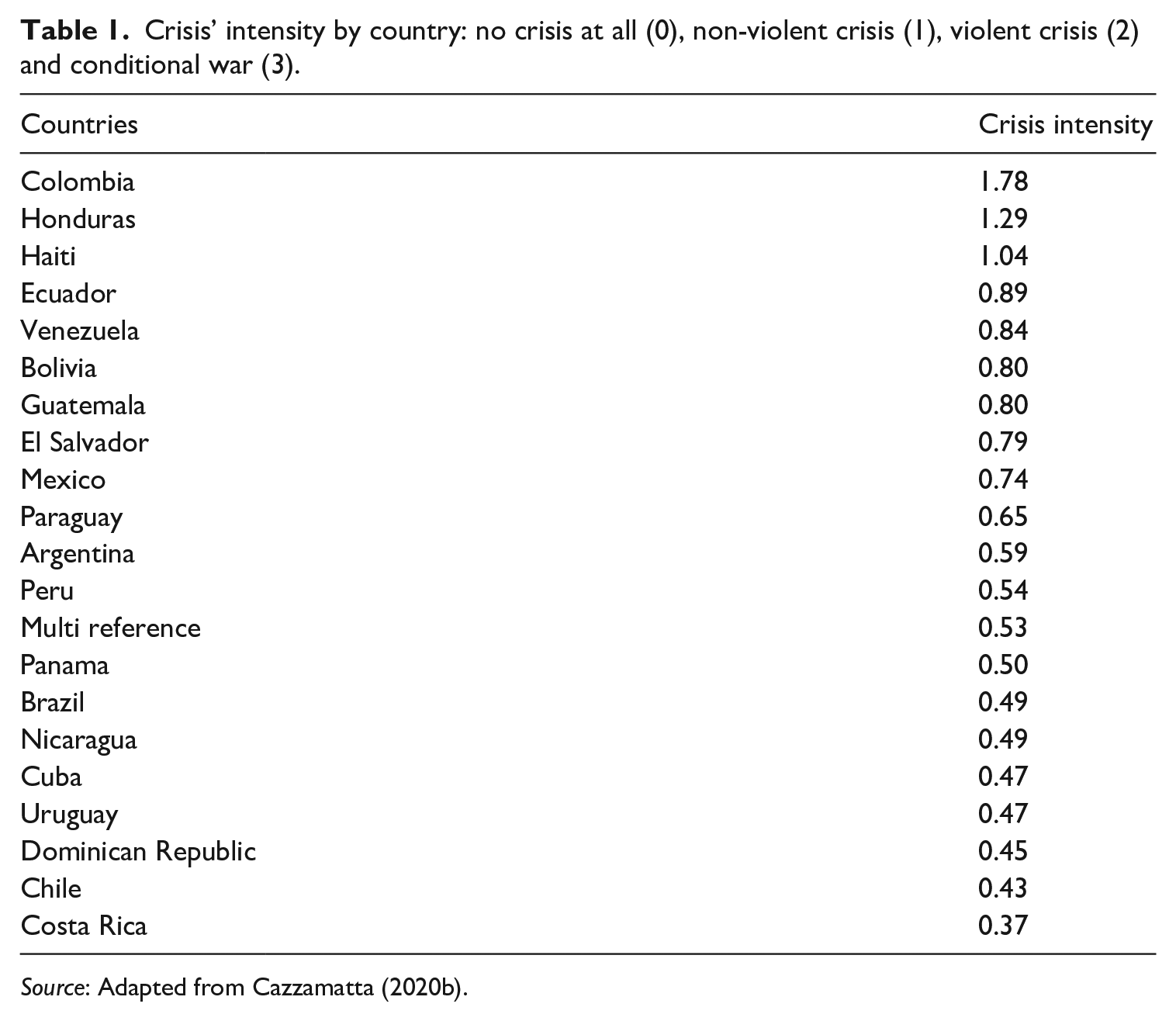
In addition, a crisis intensity coefficient (between 0 and 3) was calculated for each country, 1 and a significant correlation was found between the coverage of domestic politics and orientation on crises. Countries such as Brazil, Mexico and Cuba, which have intense coverage and a broader thematic spectrum (Cazzamatta, 2018), tend to have a smaller crisis coefficient, as can be seen from Table 1. On the other hand, nations such as Colombia, Honduras, Ecuador, or Venezuela, which are heavily burdened by political crises and characterized by a strong focus on domestic politics, have a higher coefficient (RQ3).
Crisis’ intensity by country: no crisis at all (0), non-violent crisis (1), violent crisis (2) and conditional war (3).
Source: Adapted from Cazzamatta (2020b).
One should consider that the ‘whole’ picture of the news coverage on Latin America is strongly marked by the most reported countries such as Brazil, Argentina, Mexico, Cuba, Colombia and Venezuela (Cazzamatta, 2018). Since these nations comprise different patterns of foreign reporting (Cazzamatta, 2020a), it is also essential to look into the orientation on crises within each country.
The next sections present the results according to the type of crisis. In addition, attention should be paid to the specificities of the countries within the categories that are more marked by crises reporting.
Conditional war: Colombia, Mexico, Guatemala and El Salvador
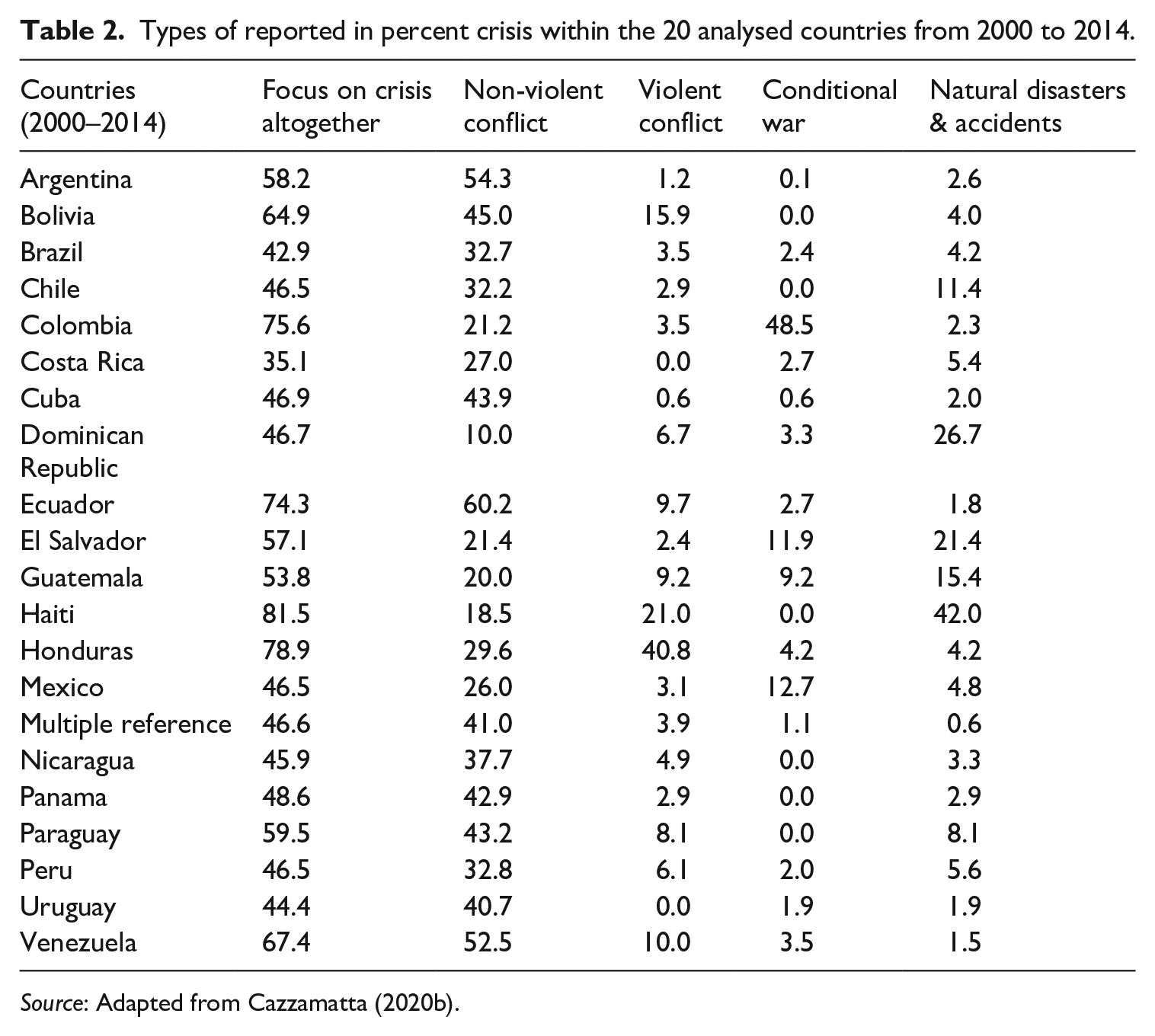
The percentage of conditional war, i.e. ‘when repeated and organized violence is used’ (HIIK, 2006), is most pronounced in countries such as Colombia (48.5% in Colombian reporting), Mexico (12.7%), El Salvador (11.9%) and Guatemala (9.2%), as shown in Table 2. In these cases, the main factor is a ‘penetration crisis’ (Boeckh and Öhlschläger, 2006: 23), in which the monopoly of the use of force has been questioned (Colombia) or in which the states are no longer able to ensure public security and have no influence in a few neighborhoods (Central America and Mexico). Looking at the areas of coverage within this crisis category (conditional war), the subjects of domestic politics (59.8%) and crime and delinquency play the most crucial role, in which political crises and organized crimes are the main topics of coverage. The most reported events are related to the Colombian civil war, the problems of the Mara groups in Central America, and the intensification of the war on drugs in Mexico.
Types of reported in percent crisis within the 20 analysed countries from 2000 to 2014.
Source: Adapted from Cazzamatta (2020b).
In the case of El Salvador and Guatemala, the Mara gangs are responsible for the primary coverage within the category. Most of them are adolescents who emigrated to the USA during the migration wave but were then deported to El Salvador or Guatemala because of crime, infectious diseases, or illegal residence (Zinecker, 2006: 143). Through their connection to Latin gangs in the USA, which are presumably dominated by Mexican drug organizations, these young people experienced very specific socialization and usually had an experience of imprisonment. By and large, the ‘homies’ remained in contact with their gangs in Los Angeles or San Francisco after their unwanted return to Central America. This phenomenon of the violent crisis is not found in Costa Rica and Nicaragua, which explains their comparatively low press crisis intensity coefficient. Costa Rica is considered a ‘democratic and prosperous country in Central America’ (p. 150), while one still deems the low level of violence in Nicaragua after the civil war a ‘great mystery’.
While Mexico and the Central American nations are strongly affected by organized crime and drug trafficking, one can describe Colombia as a complete ‘crisis country’. Indeed, Colombia has been most affected by events classified as ‘conditional war’, and the state, therefore, shows the highest intensity of crisis among Latin American nations (see Table 1). It is possible to talk about a permanent or endemic crisis. The thematization of the Colombian civil war is a constant in its foreign reporting, which is not only evident in the area of domestic politics (activities of the rebels such as terrorist attacks, hostage-taking, extortion, mass murder, expulsion, cross-border drug trafficking or the clashes between the government and paramilitaries), but also in foreign affairs (disagreement with other Latin American governments).
The problematic aspect of Colombia’s foreign reporting is that its crisis symptoms – the drug traffic or the suffering of the population due to the violence – are perceived as self-explanatory. Generally, the reporting is strongly event-centred, without reflection on the reasons for the crisis, its dimension, or historical background (Fischer, 2006: 192). Although the press consistently observed Colombia’s civil war and the activities of the guerrillas, it paid little attention to domestic political disputes such as, for instance, possible parliamentary bribery in the 2006 constitutional amendment. The press did not follow systematically the congressional investigation committee created in May 2008 to examine the supposed bribery during the 2006 congressional vote for the constitutional amendment that allowed Uribe’s second candidacy. On the other hand, the spectacular liberation of Ingrid Betancourt, the astonishing attack on the guerrilla camps and the related diplomatic confrontation in 2008 were intensively reported. From the media logic perspective, these spectacular and punctual events comprise many more news factors than an internal and complicated legal dispute and the question of the independence of the Colombian judicial system.
Our main assumption that crises (especially the ‘violent’ and ‘conditional war’) work as a catalyst for press attention can be confirmed. Small, ‘invisible’ nations are reported solely in case of crises, as we are going to see in the next section. On the other hand, other countries with more power status, such as Colombia, exhibited increased reporting during crises’ period (RQ4). For example, Colombia’s news coverage declined from 2002 onwards after the retreat of the FARC guerrillas and their activities in remote territories under the hard regulations of Uribe’s administration. The reporting initially increased again in 2008 because of the diplomatic conflict called the Andean crisis, when Colombia bombed guerrilla camps inside Ecuadorian territory, and the Colombian government succeeded in the bloodless liberation of former presidential candidate Ingrid Betancourt.
The reported violent crises
Among the ‘violent crises’, i.e. ‘a state of tension in which at least one of the parties uses violence in isolated instances’ (HIIK, 2013), the subject area of ‘domestic politics’ (79.7%) and the main topic of ‘political conflicts’ (63.6% within the main category topic) play the most critical role. If one observes just the articles within ‘violent crisis’, nations such as Honduras (40.8%), Haiti (21%), Bolivia (15.9%) and Venezuela (10%) play a central stage as Table 2 illustrates.
Honduras is a typical example of event-centred reporting and the most affected by violent conflicts. In 2008, Honduras took the last position in the press attention ranking among all 20 nations. However, suddenly, because of the political crisis in 2009, it rose to the first position of press attention (Figure 2), even ahead of Brazil and Argentina (Cazzamatta, 2018). That again confirms the catalytic effect of the (violent) crises on foreign reporting, especially in the case of ‘invisible countries’ (RQ4). Different news factors – crisis, damage, violence, negativity, the involvement of international organizations and the associated sanctions, and relevance – were responsible for the increase in the amount of coverage. However, it was mainly event-centred reporting without any further depiction and interpretation of developments in the domestic political situation. The press rarely considered other aspects of culture, research, or other favourable events in Honduras (Cazzamatta, 2020a).

Course of the international news coverage about Honduras in the German press.
A similar phenomenon was found in the case of the violent political crisis in Haiti. In 2004, the country was in the third position of press attention due to the coup against former President Aristides, an amount of coverage that is not really typical for small Central American states. After the earthquake in 2010, the increase of reporting was even more pronounced. In 2009, Haiti was in the penultimate position of press attention (19th) among all the Latin American states. Nevertheless, the catastrophic earthquake and its aftermath were followed so closely by the press (Figure 3) that Haiti took first position in 2010, even ahead of Argentina and Brazil.

Foreign reporting on Haiti in the German press from 2000 to 2014.
Violent crises also played a prominent role in Bolivia’s reporting, mainly until the end of 2005. After the 2006 election, the factor ‘ideologization’ should be considered, since Morales came to the forefront of reporting as a representative of Bolivia’s shift to the left. The climax of reporting on Bolivia in 2006 cannot be explained solely by violence. News factors such as ‘personalization’ (Evo Morales becoming centre stage), ‘controversy’, ‘non-violent conflicts’, ‘ideologization’ and ‘surprise’ (the triumphant election success) are responsible for the media attention during this phase. The press follows Bolivia’s national political development in an inconsistent and not entirely systematic manner, but during the intensive outbreak of violence, the country received correspondingly more attention. Violence and aggressive political crises acted as a catalyst for ibid., especially in 2003, 2005, and then in 2008 (RQ4).
In the case of Venezuela, ‘violent conflicts’ are particularly evident in 2002 and 2014. The high points of attention in 2007–2008 and 2013 cannot be justified exclusively by violent clashes. They are mostly ideological differences of opinion (‘non-violent crises’), ‘personalization’, ‘slight damage’ and ‘surprise’, quite different from the two-day coup in 2002 when real violence broke out. The German press failed to observe the role of the Venezuelan media in the coup and the construction of Hugo Chávez’s image as an enemy. The regional Venezuelan media tried to legitimize the 2002 coup by broadcasting a video montage that blamed Chávez for the deaths of civilians. However, it turned out later that the people killed were pro-Chávez demonstrators who were shot by three snipers (Castillo, 2003: 153). The SZ, for instance, based on this version of the local media, reported: ‘The tragedy began when shots were fired into the crowd, most of the shooters belonged to the organized Chávez militias, videos prove this’ (SZ, 19 April 2002). Afterwards, the local and correspondingly the international media ignored what happened on the streets just after the coup when the government’s supporters outside the palace demanded the reinstatement of the elected president (Sapiezynska, 2017: 208). Based on this example, it is evident that no correspondents were even present in the country during the coup. Otherwise, they would have immediately sensed that thousands of government supporters were demonstrating for the return of Chavez, but nothing was being reported on television. Indeed, 66 percent of the articles on the 48-hour coup were produced in the neighbouring Latin American countries (not in Venezuela) and 33 percent in the central editorial offices (in Germany). These violent events of April 2002 show that, at the international level, foreign reporting tends to reproduce the version of the dominant elites and to simplify the causes and results of complex historical events.
Non-violent conflicts and controversies
If just ‘non-violent crises and controversies’ are taken into account, then the articles are mostly distributed among domestic politics (37.8%), foreign affairs (23.7%), the economy (22.2%) and the environment (4.8%). However, when analysing just the subject areas of coverage, it is evident that controversies and non-violent crises are strongly present within foreign affairs (60.1%), the environment (59.3%) and the economy (53.2%). It was amidst, within this category, the following countries come to the forefront: Argentina with 54.3 percent of its coverage (mainly because of its economic crisis reporting); the states against the Washington Consensus, e.g. Ecuador (60%), Venezuela (52.5%), Bolivia (45%) and Cuba (43.9 %), and additionally Paraguay (43.2%) and Panama (42.9%).
This category plays a particularly significant role in Ecuador, with 60 percent of its coverage. In particular, the controversial oil production in the world-famous Yasuní National Park was responsible for the majority of foreign reporting. In 2007, President Correa proposed to the international community that, in return for compensation payments, the region should be under protection. Several nations, including Germany, had agreed to the measure. The parliamentary coalition of CDU/CSU, SPD and the Greens decided at that time to participate in the project to preserve the rainforest. However, when the FDP politician Dirk Niebel became Federal Minister for Economic Cooperation and Development after the 2009 elections, he cancelled German support. He wanted to protect the environment by reducing CO2 emissions and not through a counter payment (Steffen and Oneko, 2013). When Ecuador’s President Correa gave the green light for the production of the oil fields, the discussion was again marked by strong differences of opinion. Another controversial topic in Ecuador was the already mentioned Andean crisis (see conditional war). That was a diplomatic dispute between Colombia, Ecuador and Venezuela because the Colombian armed forces bombed a FARC facility on Ecuadorian territory and violated Ecuadorian sovereignty.
Argentina’s foreign reporting is also strongly influenced by ‘non-violent crises and controversies’ (54.3% of its total contributions), mainly due to its long-term coverage of economic development before and after the financial crisis at the end of 2001. Among the controversial sub-topics were the difficult talks with the International Monetary Fund and the contentious conditions of debt restructuring.
In the case of Bolivia, in its turn, the political conflicts in 2003, 2005 and 2008 were responsible for the majority of crisis reporting (violent and non-violent). The articles coded within this category did not mention any violence or bloody demonstrations. Despite the political crisis, the press also reported on different related events without any aggression: President Carlos Mesa’s proposal to bring forward the 2005 elections, decrees for the referendum on the autonomy issue, discussion about election dates, agreement on a referendum and others. Topics such as the promotion of the nationalization of oil and gas reserves, resignations of presidents, the constituent assembly under Morales, or referendums can be observed in both categories (violent and non-violent).
A thematic overlap can also be observed between violent and non-violent crises in the case of Venezuela. Concerning the political disruption in 2002, which caused the two-day coup, there were also reports of crisis-ridden but at the same time non-violent events: demand for the resignation of the president by generals and the deterioration of the economic situation, among others. As long as there were no bloody demonstrations and outbreaks of violence as the primary reason for the articles’ publication, we classified events such as the procedural course of the 2004 referendum to vote Chávez out of office or the 2007 constitutional referendum and development of the constitutional debate as non-violent.
In Venezuela’s reporting, the diplomatic crisis in the Andes in 2008 became noticeable within the non-violent turmoil, as it did in Colombia and Ecuador. A broad conflict perspective generally characterizes Venezuela’s reporting, and the country received much more press coverage than expected in terms of its power status or economic proximity (Cazzamatta, 2018). One reason for this is that the factors ‘ideologization’ and ‘difference of opinion’ play an essential role alongside ‘crisis’. A typical example of different ideological opinions and controversies in Venezuela under Chávez can be perceived in the following statement by Christoph Twickel:
Hugo Chavez ousted the parliament? No, he is applying for limited powers to enact laws and draft a constitutional reform. Spain’s Aznar ruled almost exclusively by decree in the last months of his term of office. No one would have thought of calling him a dictator. (taz, 16 January 2007)
This anti-hegemonic perspective can also be observed in Cuba’s foreign reporting. However, Cuba is an exception among the countries against the Washington Consensus. Unlike Venezuela, Bolivia, and Ecuador, it comprises a lower crisis intensity coefficient (Table 1). Since Cuba’s political and cultural identity and its influence on its international projection have considerable force, the low intensity of the crisis seems plausible. In addition, ‘Cuban foreign policymakers show an uncanny ability to obtain support from progressive sectors in various regions of the world’ (Alzugaray, 2015: 189), which may explain the country’s comparatively balanced image in the press. Nevertheless, the category ‘non-violent crisis and controversy’ plays a vital role in Cuba’s reporting. Although the small island is characterized by almost no ‘violent crisis’ or ‘conditional wars’, ‘controversy and polemics’ strongly characterize its reporting (43.9% of the contributions). In general, topics such as the relationship with the USA within the area of foreign policy and the question of human rights in domestic politics are extremely controversial.
Paraguay (43.2% of the articles) and Panama (42.9%), two of the least reported countries, also show a coverage marked by controversy and non-violent conflict. Regarding Paraguay, topics such as the corruption scandal of the German Kolping Foundation in the country and the sanctions dictated by Mercosur owing to the questionable deposition of the left-wing President Fernando Lugo in 2012 became apparent. Indeed, the press observed the impeachment marginally and reported much more on the reaction of regional alliances such as Mercosur and UNASUR. Since the media did not follow Paraguayan politics continuously and systematically, the controversial development of the impeachment process was not entirely comprehensible.
Finally, Panama is mostly associated with the waterway from the Atlantic to the Pacific Ocean. Controversies concerning the referendum on the expansion of the canal in 2006 and the delay in its constructions for the 100th anniversary were responsible for the press attention. Concerning the plebiscite, there were fears among critics of the enlargement proposal regarding environmental damage and the high costs of the project. In 2014, the ‘unforeseeable additional costs’, communicated by th e building consortium (FAZ, 15 August 2014), were also the subject of much discussion.
Natural disasters and accidents
The last category of crises – natural disasters and accidents – primarily affects the Central American countries: Haiti (42% of its reporting), the Dominican Republic (26.7%), El Salvador (21. 4%) and Guatemala (15. 4%), as Table 2 illustrates. Other nations were also affected by natural disasters, but their impact was not as noticeable, as their thematic coverage was comparatively more or less balanced. In the case of Chile, 11.4 percent of its foreign reporting was affected by natural disasters and accidents. That was caused by the 2010 earthquake and the large-scale, months-long rescue operation involving 33 miners buried at a depth of 700 meters in the Chilean Atacama Desert. News factors such as ‘damage’ (after the landslide), ‘surprise’ (the miners were alive) and ‘emotionalization’ (communication with families, the struggle for survival underground, the difficulty of rescue drilling) were crucial for the reporting.
Conclusion and discussion
Foreign reporting on Latin America can be considered partially as crises-oriented since 54.53 percent of its coverage over the analysed 15 years portrayed some type of crisis (RQ1). The most pronounced reporting is controversies (non-violent crises with 36.4% of the total coverage), followed by conditional wars (6.68%), natural disasters (5.77%) and violent crises (5.66%), to answer RQ2. However, Latin America is not a uniform political–cultural sphere, and the coverage of crises is sectorial. In addition to the most five reported countries – Brazil, Argentina, Mexico, Cuba and Colombia/Venezuela (Cazzamatta, 2018) – several nations seem to be of minor importance for the German press, or appear solely if political crises and natural disasters come into play. Extreme cases are the invisible Central American states such as Honduras and Haiti, which made the headlines mainly connected to earthquakes and coups, two important catalysts of event-centred foreign reporting (RQ4). Due to the longstanding conflict with the FARC guerillas, Colombia comprises the highest coefficient of crises (1.78), and almost half of its foreign reporting depicted it (conditional war). Apart from Colombia, the Central American countries and the nations against the Washington Consensus (Ecuador, Venezuela, and Bolivia) are also strongly marked by an intense coefficient (RQ3).
The reporting of these left-oriented countries is, in a broader sense, captured between two main ideas. The first relates to the traditional liberal discourse focused on ‘negative freedom’, which completely rejects state interference and regulation. On the other hand, the ‘post-liberal’ discourse based on ‘positive freedom’ includes the collective right to self-realization, especially for the marginalized (Sapiezynska, 2017: 199).
Furthermore, it is crucial to note that countries with more power status or economic proximity to Germany, such as Brazil, Argentina, Mexico and even Cuba, exhibit more balanced reporting and a more diverse range of topics (politics, culture and finance). Thus, reporting of crises is present, but not dominant. Considering the perspective of the agenda-setting research, not only the amount of coverage but also how the media frame a country can influence public perception (Wanta et al., 2004). Thus, those countries with a high degree of crisis-oriented reporting would probably be much more identified with conflicts than their counterparts, which can have a substantial political and economic impact in a globalized world (Lim and Barnett, 2010).
Since our study comprises just the first 15 years of the 21st century, it does not include either the development of the political crisis in Brazil, which started with the impeachment of President Dilma Rousseff, or the peace agreement in Colombia. Further studies should investigate if these two occurrences were able to change the pattern of reporting in the long run. While we can suppose that the coefficient of crisis in Colombia might have decreased, the opposite could be the case in the escalation of the Venezuelan political and economic crisis under the Maduro administration. Apart from that, it would be worth questioning if the same results could be reproduced in other Western media systems, considering the impact of the primary four news agencies in global reporting. This article should be the starting point for more qualitative analyses and case studies based on Latin American crises and their reporting.
Footnotes
Acknowledgements
I would like to thank my advisor Professor Kai Hafez for his theoretical background and research support, my colleagues in the German Institute of Global and Area Studies and Professor Detlef Nolte for receiving me as a visiting scholar in Hamburg, and finally my life partner Rodrigo Panosso Macedo for his full support.
Funding
This work had the financial support of the German–Brazilian research program DAAD/CNPQ (290017/2014-9), a partnership between the German Academic Exchange Service and the Brazilian National Council for Scientific and Technological Development.
