



Abstract
This study uses a CADS (Corpus Assisted Discourse Studies) approach to identify a series of axes around which degrees of persuasion can be mapped in debates about international affairs. The author investigates how US and UK news media reported Obama’s use of the term ‘red line’ to describe the potential transgression if Syrian leader Assad used chemical weapons on civilians, which Assad then did. The article examines the connotational, argumentational and rhetorical behaviour of ‘red line’ across news media in the period 4–28 September 2013. In a corpus-assisted analysis of ‘red line’, six discoursal factors emerged as persuasive axes at work: (1) leader’s image; (2) ideological positioning, even in mutual intervention; (3) persuasion consistency; (4) factual investigation; (5) factual interpretation reporting; and (6) evaluated metaphor development. These axes proactively work at the crossroads of metaphor and narrative as transformative and mutually interactive agents in discoursal change. The analysis also identified other subcategories of research potential, plus correlated lexis and concepts such as ‘weakness’ vs ‘strength’. The study’s significance is to ground reflection on the function of metaphor and narrative in steering sense-making in diplomatic practice and to highlight their pragmatic force and dynamics – here in the news genre.
Keywords
Introduction and theoretical context
In Obama’s Nobel acceptance speech in 2009, the line that encapsulated his approach to international affairs, according to US foreign policy historian David Milne, was ‘There’s no simple formula here’: In light of the Cultural Revolution’s horrors, Nixon’s meeting with Mao appeared inexcusable – and yet it surely helped set China on a path where millions of its citizens have been lifted from poverty and connected to open societies. Pope John Paul’s engagement with Poland created space not just for the Catholic Church, but for labor leaders like Lech Walesa. Ronald Reagan's efforts on arms control and embrace of perestroika not only improved relations with the Soviet Union, but empowered dissidents throughout Eastern Europe. There's no simple formula here. But we must try as best we can to balance isolation and engagement, pressure and incentives, so that human rights and dignity are advanced over time. (Obama, 2009, cited in Milne, 2015: 477, emphasis added)
Once settled in office, President Obama did everything he could to avoid foreign policy actions based on simple formulas. Indeed, he later admitted to being guided by the maxim ‘Don’t do stupid shit’, having seen the catastrophic consequences of his predecessor George W Bush’s interventions in Afghanistan and Iraq (Goldberg, 2016). Every issue had to be assessed on its own merits and action considered with extreme caution. In an interview with Obama in The Atlantic magazine, Jeffrey Goldberg sets the scene by summarizing how Obama’s reticence to commit to action infuriated members of his administration who wished for US intervention to remove Syrian President Bashar Assad. For Obama, ‘don’t do stupid shit’ was an organizing principle that would limit the damage US foreign policy might cause. In 2012, however, Obama had committed to a simple formula. On 20 August 2012, Obama said to the White House press corps that, if Assad moved chemical weapons around or actually used them, that would be ‘a red line for us’: ‘That would change my calculus. That would change my equation’ (Obama, 2012).
By framing US foreign policy towards Syria in terms of the red line metaphor, Obama became dependent upon the actions of Assad (Ferrari and O’Loughlin, 2018). To use another metaphor, the red line concept ‘anchored’ debate by providing a simple cognitive heuristic against which any development could be judged (Tversky and Kahneman, 1974). Developments would involve either Assad crossing the line or not crossing it. In the summer of 2013, when speculation intensified that Assad’s regime had used chemical weapons against its own population, pressure built on Obama and his administration to consider military intervention. A UN report published on 16 September 2013 indicated the Assad regime was ‘culpable’ for the use of chemical weapons (Gladstone and Chivers, 2013). It may have been a flippant remark to journalists – Obama regularly used the term ‘red line’ across a range of policy issues including, for instance, the economy (Bentley, 2014). Instead, it appeared to leave him no choice but to consider ‘doing stupid shit’ by launching a military intervention in the Middle East.
The puzzle this article addresses concerns how news media reported this story. This falls within the wider study of the persuasive role of language within global politics, a field that scholars using a CADS approach (Corpus Assisted Discourse Studies) have entered in the past decade. We develop this with a particular focus on the role of metaphor and narrative, also in sight of ideology in the news. First, we use a specific metaphor identification procedure to identify and explain how the red line metaphor functioned in Obama’s political discourse in 2012–2013. We explain how particular interpretations of this and alternative metaphors anchored a set of narratives about Syria during that period. We are concerned with how the metaphor has been moved and changed according to context, time and political actions, and to what extent it has affected Obama’s image as an international leader. Second, a corpus analysis approach allows us to identify particular axes of meaning operating in news texts. Six discoursal factors emerged as persuasive axes at work: (1) leader’s image; (2) ideological positioning, even in mutual intervention; (3) persuasion consistency; (4) factual investigation; (5) factual interpretation reporting; and (6) evaluated metaphor development. These axes even proactively work at the crossroads between metaphor and narrative as transformative and mutually interactive actors in discoursal change. Third and finally, corpus-assisted analysis of ‘red line’ in the news opens up other subcategories of research potential as well as correlated lexis and concepts – for instance ‘weakness’ vs ‘strength’ – whose articulation may be further investigated in relation to the six axes, to categories such as strength and weakness, and within the practice of persuasion management. In particular, we argue that news media representations of (1) leader’s image and (2) ideological positioning go a long way to explaining how journalists presented Obama and his policies as weak or strong.
Following the traces left by Ferrari and O’Loughlin (2018), content-wise, this study’s significance is to open up reflection on the function of metaphor, narrative and ideology in steering sense-making in diplomatic practice. Its aim is also to highlight its pragmatic force and dynamics along various degrees of genre variation (official vs news voices) within the complexity of discourse as an ever-changing interactive mutual vocal practice.
More specifically, this article is grounded in the notion of conceptual metaphor as developed by Lakoff and other researchers working within a cognitive approach to language and thought (Kövecses, 2002; Lakoff, 1993; Lakoff and Johnson, 2003[1980]; Steen, 1999). According to this view, metaphor would not just be a way of expression, but a ‘mode of thought’ (Lakoff, 1993: 210). The conceptual metaphor would then primarily consist of a conceptual transference at this article’s thought level: ‘a cross-domain mapping in the conceptual system . . . from a source domain . . . to a target domain’ (pp. 203–207, quoted in Ferrari, 2018: 213). Such conceptual transference reflects more or less explicitly in the linguistic metaphorical expressions that can be encountered on the surface of discourse. This approach is premised on the claim that cognition is embodied because thought has evolved through our sensory and motor system functions, such that we think (often unconsciously) in terms that correspond to how our bodies experience the world: in terms of movement, degree of light and darkness, being contained or in the open, and so on (Charteris-Black, 2005). To extrapolate conceptual metaphors from the text, specific procedures have been conceived starting with those of Steen (1999), which Ferrari (2018) developed into her ‘four-step’ version, also in sight of exploring metaphors’ emotional and persuasive impact. Besides, in her approach, conceptual metaphor interacts operationally with other analytical tools at a lexical, structural and narrative level – frames, ideologies, discourse worlds (Chilton, 2004), and narratives. But ideology and narrative also play an important role in our analysis. How do we understand them?
Ideology has been defined as ‘a belief system through which a particular social group creates the meanings that justify its existence to itself’ (Charteris-Black, 2005: 21). In the domain of politics and international relations, political ideology refers to constellations of political concepts that rationalize political action. Ideologies are normative and positive understandings of how the world should be, and hence what is wrong now and what broadly should be done. Just as a political concept like ‘freedom’ is a cluster of components – a notion of the individual, a notion of choice, a notion of constraint – that evolves through use and through conscious attempts at redefinition within political contest, so ideologies are constellations of concepts that alter over time through a morphological process (Freeden, 1996). That is, an ideology has a common core of concepts, but is evoked in a changing context. The work of political actors will alter the composition of the ideology, with new concepts brought in and old ones discarded. At any moment, for the analyst, concepts are stable, empirically-verifiable features; ideologies become ‘sedimented’ as they reach a high degree of successful decontestation of concepts. This is what freedom is; this is what the national interest means. In this article we see sedimented conservative and liberal ideologies in different newspapers. Through a process of ‘explaining, interpreting, decoding and categorizing’ (Norval, 2000: 318), we can identify how ideologies interact with conceptual metaphors and narratives to provide meaning to Obama’s Syria dilemma.
This definition of ideology as a cluster of concepts that provide a sense of how to act in politics is consistent with the conceptual metaphor approach employed here. But a concept of narrative that is equally consistent is also required. Here this study draws on the growing field of strategic narrative employed as an analytical framework in the International Relations discipline (Levinger and Roselle, 2017; Miskimmon et al., 2017). Using the work of Kenneth Burke (1957) to identify constituent dimensions of narrative from texts (actors, scene, instrument, and so on), these scholars argue that the narratives held by actors in international affairs give them a sense of moving through history, together or against each other, in ways that explain decision-making. They distinguish between narratives about the international system, narratives about the identity or character of actors within that system, and narratives about specific issues (climate, finance, security) through which actors sustain or challenge the system. Detecting how leaders project sequential arrangement of events, actors and problems in foreign policy, discourse, like ideology analysis and metaphor analysis, is another way of identifying how leaders rationalize political action and give meaning to events as they are unfolding (Miskimmon et al., 2017).
Whether the focus is narratives, discourse, frames or other communication forms, what matters is how ‘they act in combination with one another rather than in isolation’ (Charteris-Black, 2005: 7, emphasis in original). Analysing a metaphor or narrative alone will not explain why a speech is persuasive. Persuasion works through the activation of associations, often very subtle, in the interaction of different modes and figures of speech. In this analysis we will see how narratives are embellished or underpinned by key metaphors and discourses. For that reason, the analysis examines the interaction of metaphor, narrative and ideology. This is achieved through analysis of leaders’ speeches and newspaper coverage of the debate in September 2013 about whether the US and other states should intervene in Syria. A CADS approach is employed to organize and analyse these texts (Partington, 2008; Stubbs 2001). This allows for the identification of collocations, defined as the co-occurrence of two words or terms within a certain number of words. By identifying collocations around the metaphor ‘red line’ we are able to make claims about how newspapers represent aspects of a leader’s image, describe events in ways that privilege a particular ideology, or how they mix facts and opinion to build a particular interpretation of events. These claims are generated from understanding how these representations reflect particular narratives about the Syria crisis at the time, and the narratives were identified through ethnographic analysis with diplomats, policymakers, NGOs and journalists involved in the crisis. O’Loughlin met and discussed the crisis with actors from the US, UK, NATO, and Syrian intermediaries liaising between the Syrian government and various opposition groups at the time. 1
From a methodological and theoretical point of view, with respect to Ferrari and O’Loughlin (2018), which combines cognitive linguistics and political sciences to approach political communication, this study further challenges interdisciplinary boundaries. It develops the growing literature combining CADS with qualitative approaches to explain the role of language in International Relations. For example, the project team Discourses of Refugees and Asylum Seekers in the UK Press 1996–2006 combined a 140 million-word corpus analysis of UK news articles with Critical Discourse Analysis (CDA) to identify the political cultural context within which this issue is discussed and then the ideological perspectives present in news reporting in tabloids and broadsheets (Baker et al., 2008). This generated important findings: quantitatively, the terms ‘refugee’, ‘asylum seeker’, ‘immigrant’ and ‘migrant’ were used almost synonymously, which reinforced nature metaphors that reduced all of these human beings to an unstoppable flood. However, qualitative analysis showed ambiguities, for instance the phrase ‘pose as’ (this migrant posed as a refugee) was used in both positive and negative ways. This allowed the team to demonstrate greater nuance in the broadsheets than tabloids. Similarly, Germond et al. (2016) showed the normalization of the notion of the European Union (EU) as able to exert military force through a CADS study of policy, scholarly and think tank reports about EU counter-piracy strategy. Frequencies in their 5.7 million-word corpus to the EU as a force-projecting actor – terms such as ‘acting together’ and ‘fighting together’ – were woven into interpretive analysis to test the International Relations theory that the EU has shifted from a soft or normative power actor to an instrumental security actor. Nabers (2009) has combined CADS using Wordsmith 5, Concord and KeyWords software with CDA to explain the linguistic construction of the war on terror. Moreover, Lischinky’s (2011) CADS study of the way financial institutions described the 2008 financial crisis lends itself to interpretive International Relations analysis in the way certain word frequencies reflect certain understandings of the international system as sovereign/Westphalian or liberal. Within this field, this study seeks to develop the attention to persuasion and strategy so present in the work of Partington, and particularly his study of White House press briefings, which are at once a dance, a wrestling match and a chess game (Partington, 2003). In our analysis, not only do several of Obama’s key statements cross his lips when briefing the press, but we see how political leaders and the journalists who report their words are similarly locked into a relationship of reciprocity and conflict.
The next section outlines the materials and terrain or panorama under study. Then the four-step metaphor identification procedure (Ferrari, 2018) is introduced and applied to articulate the key linguistic moves being made in political speeches during that period. Next, an analysis is presented of the news media corpus, from which the six axes of persuasion emerge. The concluding section considers what the findings mean for further study in this area.
Scope and materials
In the context of conflict in Syria, the trajectory and remediation (Bolter and Grusin, 2000) of the red line metaphor is now examined and how actors use it to accomplish their objectives – to be seen to acknowledge, affirm, support, challenge, or subvert Obama's strategic narrative. The study begins with Obama’s official declarations: We have been very clear to the Assad regime, but also to other players on the ground, that a red line for us is we start seeing a whole bunch of chemical weapons moving around or being utilized. That would change my calculus. That would change my equation. (Obama, 2012)
This shifted in September 2013 as Obama transferred ownership of the red line from his own person to the world: Let me unpack the question. First of all, I didn’t set a red line; the world set a red line. The world set a red line when governments representing 98 percent of the world’s population said the use of chemical weapons is abhorrent and passed a treaty forbidding their use even when countries are engaged in war. Congress set a red line when it ratified that treaty. Congress set a red line when it indicated – in a piece of legislation titled the Syria Accountability Act – that some of the horrendous things that are happening on the ground there need to be answered for. (Obama, Joint Press Conference in Sweden, 4 September 2013)
This triggered a period in which important diplomatic speeches (which are referred to throughout the article with ‘official texts’) were made about Syria. In September 2013, a debate occurred at the UN Security Council at which US Ambassador to the UN, Samantha Power (2013) and her international peers discussed the consequences of military intervention in Syria: the US Secretary of State discussed the red line at a press conference both alone and with Russian Foreign minister Lavrov; UN Secretary General Ban Ki-moon intervened with remarks ‘on the report of the United Nations Missions to Investigate Allegations of the Use of Chemical Weapons’ on 16 September, and various other members of the Permanent Five weighed in on likely action (United Nations, 2013). Specific metaphor and narrative based analysis of such ‘official texts’ has been made in Ferrari and O’Loughlin (2018). Here, combining metaphor and narrative analysis with a CADS approach, responses in international media are traced. On the basis of the discoursal plethora of official voices considered, a selection was made of two US and two UK newspapers, belonging to different ideological orientations and balanced for genre. In the US, the New York Times (broadsheet, liberal) and Washington Times (mid-market, conservative) were chosen and in the UK the Guardian (broadsheet, liberal) and the Daily Mail (mid-market, conservative). Corpus design criteria (Atkins and Clear, 1992) are fundamental to define the materials under analysis, together with retrievability constraints.
More specifically, the Corpus ‘Syria News 1309’ is composed of four small mini corpora, each corresponding to the news coverage by the New York Times – papers (12,997 tokens), the Washington Times (51,818 tokens), the Guardian (87,847 tokens) and the Daily Mail (40,825 tokens) in September 2013. These mini corpora have been retrieved from a larger corpus called SiBol 2013 (Partington, 2017): ‘SiBol’ is a portmanteau of Siena and Bologna, the universities involved in their compilation. These are sister corpora each containing all the articles from the UK broadsheets The Guardian, The Times and The Telegraph in the years 1993, 2005 and 2010, whilst SiBol 2013 is a wider collection containing these and a selection of other English-language newspapers from 2013 and from other parts of the world, including the US, India, Nigeria, Hong-Kong and the Arab world. (Partington, 2017: 351)
News for the period 4 September until 28 September 2013 inclusive was analysed for the connotational, argumentational and rhetorical behaviour of the term ‘red line’ across the newspapers. An analysis was also made of how the metaphor has been moved and changed according to context, time and political actions followed by an attempt to identify how this affects representations and normative evaluations of Obama’s image as an international leader. Ultimately, several axes of persuasion are identified that offer a basis for future analysis in this field using corpus analysis techniques.
Methods and the preliminary findings from four-step analysis of the ‘red line’
The analytical approach merges qualitative with quantitative approaches to detect and project persuasion in strategic communication. More specifically, a qualitative framework was used combining Strategic Metaphors and Narratives (preliminary analysis – Ferrari and O’Loughlin, 2018) plus a quantitative perspective inspired by CADS approach (Partington, 2008).
The qualitative framework consists of a ‘persuasion oriented procedure’ (Ferrari, 2012, 2013, 2018) for identifying strategic metaphors in text: the ‘four-step persuasion-oriented procedure’ (Ferrari, 2018), see Table 1, to be combined with a narrative perspective.
Persuasion-oriented four-step procedure for the identification of strategic metaphor in text (Ferrari, 2018).
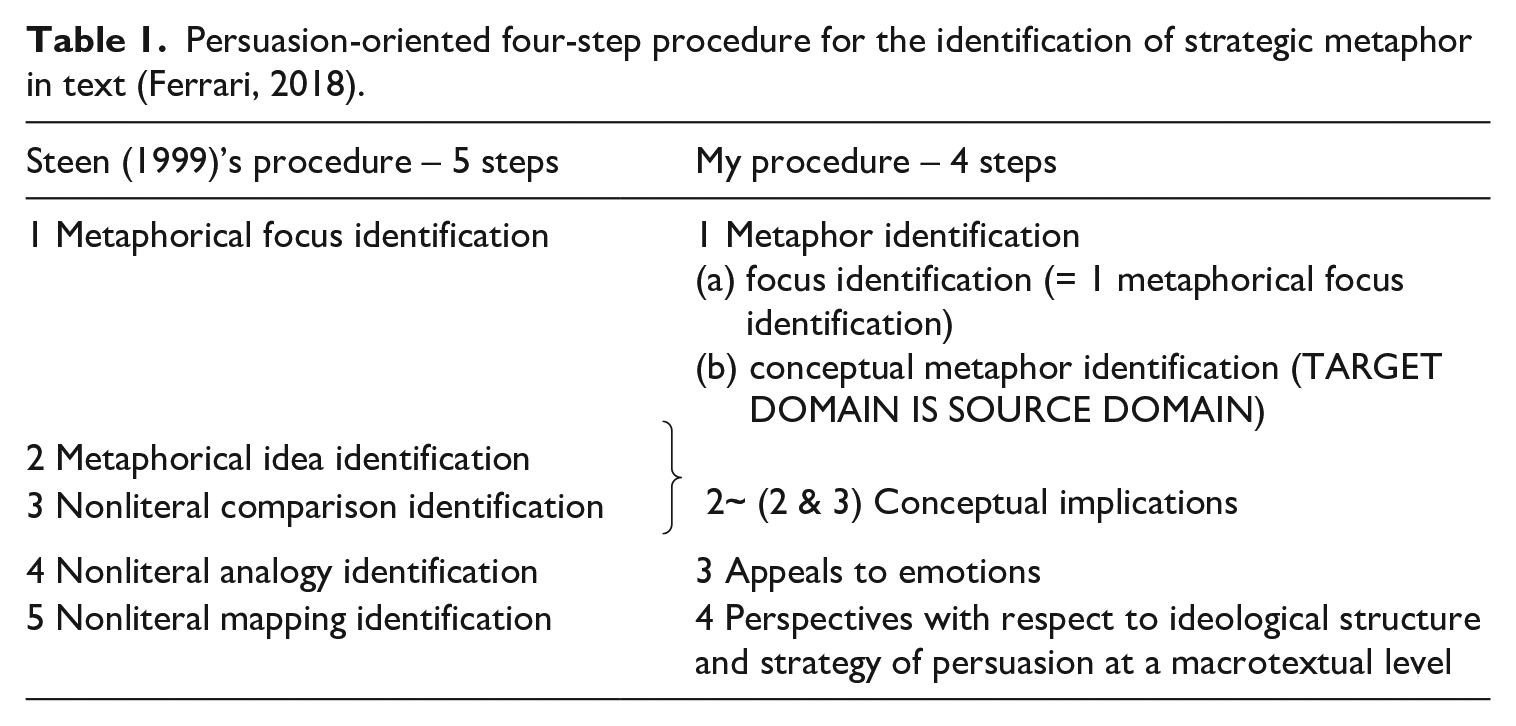
As is evident from Table 1, the four-step procedure, originally inspired by Steen (1999), aims to extrapolate conceptual metaphors from the text, with an eye towards their persuasive impact. In this respect, the first two steps are devoted respectively to (1) identifying TARGET and SOURCE DOMAINS starting from the foci 2 of the metaphorical expression(s) and then (2) to developing the conceptual implications of the conceptual transference. The following two steps are instead aimed at (3) identifying the potential, and presumed, emotional impact of the specific metaphorical choice, and (4) their strategic function and effect at a macrotextual level and with respect to wider persuasive strategies in discourse. This procedure, combined with a narrative analysis approach (Ferrari and O’Loughlin, 2018) gives rise to a series of preliminary considerations. The narrative approach allows the consideration of metaphor as strategic in time dynamics and according to narrative constraints.
More specifically, this is what was found in a preliminary analysis (Ferrari and O’Loughlin, 2018). Qualitative analysis of official texts gave rise to the emergence of some hypotheses on the conceptual grounding of the ‘red line’ metaphor (see Obama, 2012), further re-negotiated (see Obama, 2013). This resulted in narrative misalignment and persuasion failure, up to when Syria is ‘yoked’ to the ‘path forward’ – ‘Yoke metaphor’ cf. ‘Path forward’ metaphor (see Ferrari and O’Loughlin, 2018) – consisting of narrative re-alignment, persuasion and international order restored.
Some evidence from previous analysis is offered here. First, through qualitative analysis of leaders’ speeches before and around the September 2013 international debate, metaphor and narrative analysis were applied to arrive at preliminary findings that provide the context for the analysis in this article (Ferrari and O’Loughlin, 2018). First, the four-step procedure introduced above and in Table 1 was applied to Obama’s first statement to the White House Press Corps on 12 August 2012, mentioned above and reported here again to provide evidence for the following analysis: we have been very clear to the Assad regime . . . that a red line for us is we start seeing a whole bunch of chemical weapons moving around or being utilized. That would change my calculus. That would change my equation. (Obama, 2012)
Through step 1 (metaphor identification) the red line emerges as standing for an alarm signal: a red line emerges when and if chemical weapons are used. More specifically, the conceptual metaphor identified as strategic was: OUR EMERGENCY SIGNAL – USE OF CHEMICAL WEAPONS – IS A RED LINE, 3 which makes the political situation change, to use the Copenhagen School’s (Buzan et al., 1998) terms, from ‘politicization’ into ‘securitization’ allowing, if not suggesting extraordinary measures for protecting ‘security’. In clarifying the contribution of securitization theory to the analysis of political practices, Williams (2003: 512) already highlighted how its ‘core claim’ that ‘security has to be understood’ immediately collocates it within the ‘realm of political argument and discursive legitimation’. Developing this discoursal action from a metaphor analysis perspective, in terms of conceptual implications (step 2) the line can define a limit and create a threat. A limit has been imposed in terms of a threat and stands for a line, the end of US patience and the beginning of other measures to escalate the crisis. The line is a potential threat. Countermeasures have not been promised or specified yet. Simultaneously, whether it is a vertical line (thermometer) or horizontal line (a border which has not to be crossed), this is a line set to stop Syria from acting. The line by itself can move, and therefore can be negotiated. Emotional implications follow (step 3): fear and concern for the situation in Syria are called upon, and pride might be invoked amongst the expected emotional imports of the rhetorical action or ‘tough talk’ of the line.
In a broader macrotextual perspective with respect to ideological positioning and persuasion strategy (step 4), we found: Obama here seeks to project the image of a strong international leader, managing the Syria crisis with different measures. The nurturing mother morality of Obama is yet to change here (cf. Lakoff, 1995), but the line sets up a point – the point from which Obama can or will exercise his power to defend international security and create a vinculum which cannot but affect the future management of persuasion. But the line is a problem for Obama’s positioning. In affirming strength, the line creates conditions for potential weakness, for the very fact that it creates dependency conditions. Obama’s scope for action is dependent upon Assad’s willingness to cross the line, which Obama cannot control. The line here, which is not yet a threat in itself, creates a bond, binding Obama’s behaviour to Syria’s behaviour. The problem of the line, once it has been stated, is that it forces Obama, the speaker, to do something if the line is crossed. (Ferrari and O’Loughlin, 2018: 400)
What of the narratives? By early September 2013, three narratives were present in leaders’ speeches (Ferrari and O’Loughlin, 2018). First, a narrative about the attacks of 21 August 2013: who carried them out, with what consequences. The projected narrative ending focuses on whether those responsible can be held to account. Second was a narrative about the Syria conflict. This began in early 2011, and involved the failure of the UNSC to stop the crisis – the killing on all sides. The ending of this narrative focused on whether the Syria conflict could be stopped. The 27 September UNSC resolution proposed a transition government for the medium term and for Assad to allow aid into Syria to address the immediate humanitarian crisis. Finally, a third narrative centred on the failure of the UNSC since its formation in 1945. This narrative involved past failures (Rwanda) and current failure in Syria. The happy ending would be if the UNSC could be functional and effective, enforcing international law and punishing transgressors. What is even more interesting is that: These three narratives interacted. The 21 August chemical weapon attack was a symptom of the horror of the conflict (second narrative) and a symptom of the failure of the UNSC (third narrative). The failure to prevent the 21 August attack was both a symptom of Assad’s unruliness within a conflict but also a failure of the international system to control that conflict. (Ferrari and O’Loughlin, 2018: 396)
Since our metaphor analysis shows how Obama is bound to Syria’s fate by the red line, Obama is forced into a tricky verbal manoeuvre.
To justify this in terms of a system narrative, on 4 September 2013, Obama said, ‘I didn’t set a red line; the world set a red line.’ Bentley (2014: 1,034) proposes this was a strategic move: The American response to Syria is not a straight adoption of the taboo, but a case in which the very idea of the taboo has been rhetorically engineered to reflect and facilitate political interests. In particular, this has focused on using the taboo to force an understanding of intervention as an inherently international issue (as opposed to a purely US concern), thereby promoting the multilateral approach Obama craved.
By labelling it the world’s red line, Obama described something objectively existing in the world independent of his speech and therefore not something he or the US created alone. By implication, it was for ‘the world’ to enforce the line. This justified a multilateral response and not an Iraq-like situation of the US taking the lead.
Based on the qualitative analysis of leaders’ speeches, we expect to find newspapers focusing on whether Obama or other leaders were especially persuasive either in their use of the red line metaphor or in the shift to the yolk and path metaphor.
Discoursal analysis of media corpus; In focus: Corpus analysis of ‘red line’
The combined qualitative procedure explained above has been applied in combination with a CADS approach (Partington, 2008) to the corpus News coverage – ‘Syria News 1309’: all the news considered in the period 4–28 September 2013. This analysis allowed an observation of the connotational, argumentational and rhetorical behaviour of ‘red line’ across the news in this period. Consideration was also made of how the metaphor has been moved and changed according to context, time and political actions and to what extent it has affected Obama’s image as an international leader.
Corpus analysis of ‘red line*’ (searching for ‘red’, sorted by 1R, with focus on ‘line*’) gave rise to the emergence of 13 occurrences in the Daily Mail, 41 occurrences in the Guardian, 108 occurrences in the Washington Times, and 88 in the New York Times. Some crucial discoursal factors emerge, to be explored as persuasive axes at work — (1), (2), (3), (4), (5), (6) – in the discourse, ultimately interacting with the pivotal starting metaphor. This analysis of the ‘red line’ allows us to observe integrated persuasive axes such as (1) leader’s image; (2) ideological positioning, even in mutual intervention; (3) persuasion consistency; (4) factual investigation; (5) factual interpretation reporting; and (6) evaluated metaphor development. These axes even proactively work at the crossroads between metaphor and narrative as transformative and mutually interactive actors in discoursal change. Additionally, corpus-assisted analysis of ‘red line’ in the news opens up other subcategories of research potential as well as correlated lexis and concepts – for instance ‘weakness’ vs ‘strength’ – whose articulation may be further investigated in relation to the above-mentioned categories and within persuasion management. These discoursal factors and axes are ultimately interacting with the pivotal starting metaphor – the red-line ‘anchor’ used at the beginning.
(Axis 1) Leader’s image
Concordance analysis allows us to investigate the complexity of the political case at issue and observe potential backlash, first on the leader’s image. See, for instance, the following example: ‘Obama may have fallen victim to his “red-line” bravado, but he has drawn Russia into closer involvement’ (Concordance 284 sorted 1R and then 2R, the Guardian, 18 September, 2013). Here a liberal newspaper criticizes Obama’s language for its bravado, which trapped Obama himself, leaving him the ‘victim’ of such aggressive rhetoric. It caused him to fall, in prestige and credibility. Strong (language) implies weakness. Yet, for the Guardian, this had unintended consequences that are not all bad. Given Russia’s longstanding ties with Syria, drawing Russia into the debate about possible action against Assad makes a deal by the ‘international community’ more likely. If even Assad’s ally Russia is ready to discipline Syria and yoke it to the path forward, then ‘power in concert’ by the great powers is possible (cf. Mitzen, 2013). This renders Obama somewhat bumbling: he has stumbled towards a solution.
We see below how the political ideology of the newspaper can lead to a very different representation of the leader.
(Axis 2) Ideological positioning
Ideological positioning emerges from debate reporting in accordance with the political orientation of the news and the contextual articulation of the case in point. For example: Mr. Obama has gotten by until now with redefining reality as what he says it is. Red line? What red line? Now he wants to similarly redefine war . . . (Concordance 31, Washington Times, 10 September 2013).
First of all, this may seem if nothing else ironic, at least in sight of a previous orientation of the same newspaper with respect to a different candidate. The Washington Times supported the George W Bush administration at a time when one administration aide, in 2002, said to the New York Times journalist Ron Suskind (2004): The aide said that guys like me were ‘in what we call the reality-based community,’ which he defined as people who ‘believe that solutions emerge from your judicious study of discernible reality.’ . . . ‘That’s not the way the world really works anymore,’ he continued. ‘We’re an empire now, and when we act, we create our own reality. And while you're studying that reality – judiciously, as you will – we’ll act again, creating other new realities, which you can study too, and that’s how things will sort out. We're history’s actors . . . and you, all of you, will be left to just study what we do.’
It was in fact this hubristic drive to author world history that led to the very events that prompted Obama’s foreign policy to be cautious: Abu Ghraib, Guantanamo Bay, Fallujah, Haditha, daily killings in Iraq, and other contradictions of the ‘reality’ the US administration may have wished to create. Now, it is almost as if Obama is being accused of similarly trying to create reality through language.
Hence, ideological positioning can be both in reference to the leader’s image, as in the previous example, or in reference to the object at issue, or political plan, as in the analysis from the Washington Times. As expected, given the ideological positioning of the liberal Guardian and conservative Washington Times, here we have a negative connotation for the former towards ‘strength’ through military action and a positive connotation for the latter. For the Washington Times, military intervention would: hasten the end of the conflict. It also would reinforce the notion that there are levels of barbarity unacceptable to the international community and demonstrate that American red lines are meaningful. That message would be punishing, and it would resonate. It would boom louder than a shot across the bow. Here, a mix of old adages rings true. (Concordance 119, sorted 1R 2R, Washington Times, 2 September 2013)
The Washington Times likes the red line but dislikes Obama. Critically, the leader’s image is damaged regardless of the ideological positioning of the newspaper. In the Daily Mail, Obama’s image is damaged as a confirmation of its preexisting devaluation of the leader: the logic being: <good idea but he is not the right person>. To explain the subjective logic at work here: <Obama wanted to ‘play macho’ but he is not>. Strong action to combat the red line menace could have been desirable and effective per se, but Obama is not the right person to perform it: Where, now, was the president’s commitment to act if Assad crossed the red line? Obama allowed himself to be persuaded by his advisers that he must deliver at least a gesture strike in Syria, to preserve America’s reputation. (Concordance 227 Daily Mail sorted 1R, 2R, 11 September 2013)
More specifically, the devaluation here is played on the grounds of contrasting strength with weakness. This Daily Mail source article is an opinion piece by Max Hastings entitled ‘The Humiliation of Obama as Putin swaggers on his Moscow dunghill’. Earlier in the piece, Hastings writes: Fareed Zakaria, one of the country’s most influential commentators, calls the Washington administration’s handling of Syria a case study in how not to do foreign policy.
Hastings is representing Obama and his policies in terms of weakness. He continues: This presidency has touched a low point. Over the past five years, Obama’s lassitude and political ineptitude have increasingly become apparent. His rhetoric remains as impressive as ever, but his conduct of office is hallmarked by weakness and indecision. (Source text of Concordance 227 Daily Mail sorted 1R, 2R, 11 September 2013)
In contrast, the Guardian supports Obama but dislikes the policy. For the Guardian, Obama’s image is damaged because of his political plan. This disappoints their pre-existing positive stance towards him. In the concordance quoted previously from the Guardian – ‘red-line*’ vs leader’s image – Obama’s reputation is negatively evaluated due to the policy he has chosen. The logic here is <stupid idea, how could he think of it: image damage>: ‘Obama may have fallen victim to his “red-line” bravado, but he has drawn Russia into closer involvement’ (Concordance 284 sorted 1R and then 2R, Guardian, 18 September, 2013).
(Axis 3) Consistency
So far, we find that the leader’s image and ideological positioning intertwine as persuasive axes of news discourse. This gives rise to a third factor also crucial for persuasion: consistency. More specifically, the two previous examples in reference to leader’s image provide a principle of persuasion management for leaders. For the Guardian, it is disappointing for a liberal President who seeks to avoid the recklessness of his predecessor to fall victim to macho rhetoric. It is not the ‘real’ Obama. For the conservative Washington Times, the policy is inconsistent with their pre-existing interpretation of the ‘real’ Obama as weak, being a liberal. This points to the importance of consistency and authenticity for persuasion management. The importance of consistency in the worlds projected in discourse has been highlighted by Ferrari (2011), with consequences for both the leader’s image and their narrative efficacy. For leaders to be perceived as reliable there must be consistency between their image and the messages they are sending. Persuasively speaking, a message is not good per se but only with regard to the leader who is delivering it. 4 The same can be said in regard to the narratives being referred to. ‘In order for change to happen in international relations, actors must ensure these three types of narrative mesh together to produce a compelling sense of where actors are heading together on an issue’ (Ferrari and O’Loughlin, 2018: 392). Notwithstanding their political views and projected narratives, leaders have more probability of catching and maintaining their audiences’ attention and favour until the moment when they are capable of keeping consistency in the reason they appeal to. The reason they use to support their arguments has to be not only logical but emotional, in order to appeal to the unconscious as well. This is what George Lakoff (2010) calls ‘real reason’, as opposed to ‘false reason’.
This factor is an indirect factor of textual persuasion, in the sense that it cannot be directly extrapolated from text analysis, but indirectly extrapolated from contrastive text analysis newspapers with opposing ideologies.
(Axis 4) Factual investigation
News analysis can be used for factual investigation to detect further grey areas of the narrative in official texts. Factual reporting provides the reader with evidence that may challenge the claims made in previous axes, for instance by establishing the truth or falsity of claims about leadership or how decisions are made. In the following case, taken from the Guardian, factual reporting links Obama’s decision to then Secretary of State Hillary Clinton.
[Clinton] . . . should end up succeeding Obama in the White House. After all, there is strong evidence to suggest Obama agreed to the original chemical weapons ‘red line’ only under pressure from Hillary Clinton’s state department. Yet the president may not be able to sustain his brand of minimalist interventionism. (Concordance 181, sorted 1R, 2R, Guardian, 7 September 2013)
Of course, factual news reporting is not necessarily factual. The Guardian does not present transparently the ‘strong evidence’ and the word ‘suggest’ merely reveals that all evidence is subject to interpretation. The framing of the ideology of Obama’s foreign policy approach as ‘minimal interventionism’ is widely shared – and reflected in the Atlantic magazine interview discussed in the introduction. However, it is still a framing of Obama’s foreign policy and critics would suggest it omits the Obama administration’s use of drones for violent interventions overseas.
(Axis 5) Factual interpretative reporting
From factual investigation, news analysis of ‘red line’ can shift to factual interpretative reporting, as in the following example taken from the New York Times: But there is an argument that Mr. Obama’s own caution about foreign interventions put him in this box. Horrific as the Aug. 21 chemical weapons attack was, it was no more horrific than the conventional attacks that caused the deaths of 100,000 Syrians. Those prompted only a minimal American response – international condemnations, some sporadic arms shipments for a ragtag group of rebels, and an understandable reluctance by an American president to get on the same side of the civil war as Al Nusra Front, an affiliate of Al Qaeda. Now the crossing of the red line has forced Mr. Obama’s hand. He says he is intervening to stop the use of a specific weapon whose use in World War I shocked the world. But he is not intervening to stop the mass killing, or to remove the man behind those attacks. ‘This is not like the Bush decision in 2003,’ Benjamin J. Rhodes, a deputy national security adviser, said on Thursday. ‘That intervention was aimed at regime change. This is designed to restore an international norm’ against the use of poison gases. (Concordance 637, sorted 1R, 2R, New York Times, 1 September 2013)
First of all, we find the reporting of the existence of ‘an argument’. This argument pertains to the consequences of the minimal interventionism reported in the previous axis. The New York Times does not say ‘we argue that’. Yet, in reporting the existence of an argument and not contradicting it, the reader can only infer that this is an argument the newspaper at least takes very seriously. This is not simple objective reporting. The newspaper goes on to evaluate degrees of horror: the chemical weapons attack was ‘no more horrific’ than conventional attacks. In the second paragraph, the newspaper alerts readers to potential hypocrisy or the ‘say–do’ gap in the conduct of foreign policy (Simpson, 2012: 181). ‘He says he is intervening’ is followed by ‘But he is not intervening’. In short, the New York Times evaluates the logical and moral quality of Obama’s foreign policy, by contrasting words and actions in ways that affect the leader’s image (axis 1). It questions the ideological positioning by considering arguments against it (axis 2), by suggesting inconsistency (axis 3), and drawing on factual figures such as death tolls and previous foreign policy decisions (axis 4).
(Axis 6) Evaluated metaphor development
Finally, in corpus assisted news analysis of the red line metaphor, factual investigation can mix with evaluated metaphor development. Discoursal analysis suggests a development of the original ‘red line’ metaphor through both evaluation and the shifting of agency. It is as if the red line continues to change agency or parenthood, or ownership: from Obama’s (2012) to the world’s (2013) to the public’s as in the following example from the New York Times: Red lines do matter, which is why the president pivoted and became interested in getting Congress on board. Obama recognized that the American public has its own red line that he was reluctant to cross on his own. That line is the one that keeps us from engaging, once again, in hostilities in the Middle East. To cross that one, he wants accomplices. (Concordance 665, sorted 1R, 2R, New York Times, 6 September 2013)
This suggests an axis along which the red line can be singular and fixed or, in contrast, plural and evolving. Obama realizes he has his red line but his domestic public has another.
What becomes clear is that Obama is damned by all sides through the interplay of these six axes of persuasion. In the metaphor and narrative analysis of the previous section we saw that ultimately it was the UN report and Russian agreement that led to a deal. In this discoursal analysis of the media corpus we find expressions of why Obama was not able to resolve the situation himself, either due to his own character, ideology, policies, or the manner in which the news genre can combine factual and interpretive reporting to raise questions and grey areas concerning foreign policy conduct.
Discoursal analysis of the media corpus also illustrates narrativization. In the last example above, the New York Times writes ‘That line is the one that keeps us from engaging, once again, in hostilities in the Middle East.’ Here the journalist constructs an identity narrative that articulates newspaper, readership and nation-state as a single ‘we’ within a sequence of successive engagements and hostilities in the Middle East. Through the six axes of persuasion we find emplotment, characterization, contextualization and other core components of narrative (Burke, 1957; Miskimmon et al., 2017; Shenhav, 2006). This opens up a pathway for future research to identify how forms of persuasion present in the six axes explored in this article are woven into narratives by political leaders.
Conclusion
This study used a CADS approach to identify a series of axes around which degrees of persuasion can be mapped in debates about international affairs. In a previous study, Ferrari and O’Loughlin (2018) used a combination of metaphor and narrative analysis to explain how Obama’s use of the ‘red line’ metaphor concerning use of chemical weapons in Syria by the Assad regime trapped Obama into dependence upon Assad’s action – whether Assad would cross the line. Eventually the international community applied a different metaphor, yoking the Syrian body politic to a path forward, saving face for Obama and the UN Security Council. In contrast to that previous study, this present study focused on media coverage, to provide evidence of the discoursal backlash of such a metaphor choice on a wider scale, and its (potential) consequences on communication and politics. Our analysis here of news media reporting of this issue and the ‘red line’ allowed us to observe integrated persuasive phenomena such as (1) leader’s image; (2) ideological positioning, even in mutual intervention; (3) persuasion consistency; (4) factual investigation; (5) factual interpretation reporting; and (6) evaluated metaphor development. These axes even proactively work at the crossroads between metaphor and narrative as transformative and mutually interactive actors in discoursal change. In addition, corpus-assisted analysis of ‘red line’ in news media opened up other subcategories of research potential as well as correlated lexis and concepts – for instance, ‘weakness’ vs ‘strength’ – whose articulation may be further investigated in relation to our six axes and within persuasion management. These discoursal factors and axes are ultimately interacting with the pivotal starting metaphor – the red line ‘anchor’ that we began with.
From a theoretical-cum-methodological perspective, this study shows the advantages of a transdisciplinary approach which foresees the interplay amongst different and complementary perspectives of investigation (metaphor and narrative analysis, CADS) within a fruitful dialogue between qualitative and quantitative analysis. Furthermore, opening the scope of investigation to different disciplines with different priorities does not limit but, on the contrary, empowers the value of linguistic research to address complex socially and politically situated phenomena.
The significance of the argument presented here is to open up reflection on the function of metaphor and narrative in steering sense-making in diplomatic practice and to highlight its pragmatic force and dynamics along various degrees of genre variation (official vs news voices) within the complexity of discourse as an ever changing interactive mutual vocal practice.
Footnotes
Acknowledgements
I am extremely grateful to my colleague and friend Ben O’Loughlin, who discussed this paper with me at a conference in Lancaster (CL 2015), and who contributed to the creation of this work with his analytical perspective and eclectic intelligence. Without him, this work would not have come into existence.
Funding
The author received no financial support for the research, authorship and publication of this article, and there is no conflict of interest.
