



Abstract
Platforms are conditioning the way public communication is conducted while presenting themselves as neutral connectors. Social media logic encompasses norms, strategies, mechanisms and economies acting at the intersection between online platforms and society. Military communication is adapting itself to communicative and socio-technical innovations dictated by online platforms and social network sites. Armies are currently using digital media and online platforms in at least two different ways: a promotional one, based on the ‘normalization’ of militarism, and a conflictual one, based on the display and management of conflicts. In this article, the authors apply qualitative content analysis to investigate the platformed strategy of the Israel Defense Forces (IDF) Twitter account. Results show how the IDF embraces platformization and uses social media logic to develop a coherent narrative, projecting an attractive image, establishing an international positioning and defining international interlocutors. The institution of communicative formats, the multiplication of themes and representational artefacts, and a re-defined aesthetics of army and violence are enabled by social media logic. Tweets from the IDF follow a dual path: they contribute to normalizing militarism and act on the conflictual display of current affairs.
Keywords
From digitalization to platformization: Online platforms and social media logic
This article aims to understand how online platforms contribute to developing the public display of ordinary military communication: the materiality of platforms (Couldry and Hepp, 2016) is increasingly intertwined with social and political processes, influencing legacy institutions and their practices. Armies and military communication are not immune to platformization (Helmond, 2015): in this article, we propose an overview of the role of platforms in their public presentation, describing – with a qualitative approach – the presence of the Israel Defense Forces (IDF) on Twitter. Online platforms are programmable architectures that enable the organization of relationships between users (Van Dijck et al., 2018).
The social media logic encompasses norms, strategies, mechanisms and economies (Van Dijck and Poell, 2013) determined by the intersections between platforms and social life. Consequently, ‘social media have the ability to transport their logic outside the platform that generates them, while their distinctive technological, discursive, economic, and organizational strategies tend to remain implicit or appear “neutral”’ (p. 5).
Thus, digital mechanisms affect the identification and construction of military power, the political planning of representation and the construction of legitimacy, imposing limits to agency (O’Hagan, 2013).
The social media logic can be applied to the digitalization of military communication. As defined by Van Dijck and Poell (2013), social media logic encompasses multiple types of logic:
programmability implies a technological dimension, where coding, data, algorithms, interfaces and protocols define how content is produced and spread throughout the internet;
popularity is a mix of algorithmic success and social-economic components: it may popularize narratives and tools;
connectivity implies human participation in social activities: platforms may induce some strategic connections, suggesting links and encouraging the formation of communities;
datafication transforms public life aspects into data.
Platforms contribute to the redefinition of public values: datafication, selection and commodification fuel platform societies (Van Dijck et al., 2018). Platform owners’ entrepreneurial spirit starts to struggle when multilevel governance, national attitudes and local safety are at stake. 1 Geopolitics is not out of the game, as platform ecosystems can be inferred from the dominant characteristics of the country hosting the infrastructural platforms. Legal and moral values on freedom of expression, the rule of law, mechanism of production and economic systems are embedded into platforms as consumer goods (Van Dijck et al., 2018).
The metaphor of platforms can easily explain the narrowing of the focus from the broader mediatization of war (Maltby, 2012) to the adaptation to digital and commercial logic.
Seeking to avoid moderation by traditional intermediaries, actors accepted other, more subtle intermediaries. Platforms are the ‘custodians of the Internet’: even if they do not determine public discourse, they ‘shape the shape’ of civic discussions (Gillespie, 2018: 23). Following this perspective, this article illustrates the implications of platformization and the adoption of social media logic for military communication by focusing on the IDF: first, exemplifying some insights from previous literature, then analysing the results of empirical content analysis.
Platforms and the military, between normalization and conflictual communication
Governing disruption: digital technologies and military communication
The consequences of the information revolution for the discipline of International Relations have been investigated since the 1990s. Knowledge and production expertise (Rosecrance, 1996), information and communication processes for a new political sphere (Ronfeldt and Arquilla, 2008), transparency and the enabling of users’ skills (Rosenau, 2005) were pointed out as the outcomes of a process leading to a ‘farewell to arms’ caused by a sometimes not well-defined mix of technology tout-court, digitalization and networked connectivity. Nevertheless, analysts indicated how technologies could interfere with (cyber)security issues and international equilibriums (Drezner, 2019; Eriksson and Giacomello, 2007). Moreover, digital technologies can shape enemy behaviours, with information used to influence the outcomes of conflicts: cybercortical warfare (Conway, 2005) is a compound mix of public diplomacy techniques to shape the information environment in a competitive way promoted by credible actors.
The domestication of digital technologies led to the analysis of their role in ordinary phenomena (Wellman, 2004). Consequently, the attention of military experts and security concerns is shifting from infrastructural matters (such as hacking, manipulation of power grids, data breaches) to the content dimension (Singer and Brooking, 2018). 2 Reflections on the role of digitalization for international politics involve the pervasiveness and seamless persistence of the web for the self-expression of international actors (Jackson, 2018). Yet, disruptive technologies follow a peculiar path: first, they conquer niche audiences, then they enter the broader market (Owen, 2015). Rarely, states or canonical political actors are innovators able to anticipate trends and online practices.
Nevertheless, military actors are rapidly adapting to the new media environment: their connection with private and commercial actors is one of the most peculiar traits of the modern age (Der Derian, 2009). Armies are using social media and online platforms in at least two different ways: a promotional one, based on the ‘normalization’ of militarism (Jackson et al., 2021) and a conflictual one, based on the display and management of conflicts (Merrin, 2018). These dimensions are explored in the following sections.
Ordinary practices: moving militarism to online platforms
Platforms and social practices are a mutual construction: they are computational resources and ordinary places where people can display political instances (Papacharissi, 2015). The military can occupy relational spaces otherwise dedicated to personal expressions and break into everyday life. Even militarism transfers to online platforms: it defines the legitimacy of violence and the centrality of armies in managing issues related to security (Skjelsbaek, 1979). Kuntsman and Stein (2015: 6) state that ‘digital militarism describes the process by which digital communication platforms and consumer practices have . . . become militarized tools in the hands of state and non-state actors, both in the field of military operations and in civilian frameworks.’ In online platforms, military issues become more and more like public diplomacy, while public diplomacy becomes militarized in themes and languages (Jackson et al., 2021).
Landing in digital spaces has also allowed the evaluation of military message production based on non-traditional analytical and cognitive devices. The public display in online platforms has allowed for the investigation (as well as the adoption in self-representation strategies) of gendered perspectives (Stengel and Shim, 2019; Wright, 2019), the redefinition of military masculinities (Jester, 2021), or the visual construction of military bodies (Baker, 2020). Normalization is also demonstrated by the military’s commitment to strategically use ‘civil’ dialogue with users to counter or disclose traditional issues, such as terrorism (Khan and Pratt, 2020).
Expressions of popular culture, nurtured by platformization (Helmond, 2015), enter into the political representation changing politics itself, as ‘the production and circulation of popular culture makes world politics what it currently is’ (Grayson et al., 2019). The activation of relational dispositions through the witty and ‘smart’ practices (Silvestri, 2016) characterizing affective communities (Papacharissi, 2015) allows for the shaping of collective perceptions toward the identification of military forces as ‘good, natural, and necessary’ (Jackson, 2019: 257). These practices operate through camouflage mechanisms: for example, using irony in ‘unsuspected’ content such as recruitment promotion videos serves a dual strategy of promoting militarism and its contemporary concealment while keeping public criticism at bay (Beck and Spencer, 2021).
These symbolic interventions in the public construction of the armed forces are facilitated by cultural shifts and the progressive acceptance of social media logic in military information production routines (Jackson et al., 2021): popularity suggests a progressive de-militarization of themes, formats and languages, while connectivity activates relational and communal arrangements between armies and citizens.
Participative wars: spreading conflicts all over the internet
Social media reduce information costs, increase the ability to rapidly disseminate news and information, transform cognitive activity about conflict and create new forms of participation (Jackson et al., 2021; Zeitzoff, 2017). In sum, social media profoundly impact conflict management and representation to the point where Merrin (2018) calls ‘digital wars’ a complex and interdisciplinary new field of study.
Indeed, warfare is becoming more and more society-centred, especially for non-state entities defying Western actors (Levite and Shimshoni, 2018): war and conflicts involve citizens acting on their understanding of international confrontations. As demonstrated by the televised conflicts of the 1990s, broadcast media representations contribute to hiding civilian involvement in conflicts far from general audiences while transforming conflicts into a ‘media genre’ (Hoskins and O’Loughlin, 2015). Nevertheless, digital media allow citizens to participate in conflictual phenomena. Citizens can report their testimonies autonomously from the battlegrounds (Allan, 2013). As a result, militaries are losing exclusive control of information production and diffusion. Participative wars, Merrin (2018; ch. 10) argues, derive from the contemporary hypermediated environment, representing ‘an ecological transformation in how conflicts are fought, mediated and experienced, making every warzone a global battlefield’.
At the same time, belligerent actors can bypass the gatekeeping of traditional media, using platforms and their features to promote their views (Jackson et al., 2021; Zeitzoff, 2017). Emotional appeals (Callahan, 2020), diplomatic quarrels (Duncombe, 2017), intimidations and insults (Jackson et al., 2021) are shared via online platforms, as exemplified by the trans-platforms confrontation that opposed US President Donald Trump to the Qasem Soleimani (Merrin and Hoskins, 2020). As Merrin and Hoskins claim, ‘this is conflict today’ (p. 186): digital media are weaponized (Singer and Brooking, 2018). Online platforms and social media are used as an effective weapon of war and not just as a tool to intervene in framing stories created by third parties.
Online platforms create new forms of visibility, affecting the volume of information transmitted, its speed and the opportunity to bypass gatekeeping. In this case, the features contribute to programmability (algorithms, protocols, interfaces) that induce adjustments in military representation (Jackson et al., 2021).
Moreover, the very presence on the platforms induces new forms of data collection that retroact on conflicts, facilitated by the logic of datafication. Zeitzoff (2017) claimed that digital data are not only a powerful resource for conflict participants, but they profoundly change the information available for the players, shaping the conflict itself.
Under surveillance: IDF multi-platform presence and strategies
As demonstrated by Crilley (2016), the social media accounts of military institutions have gained popularity over the years. Control over the publication of content exacerbates the linkage between media, war, visibility and technologies (Der Derian, 2009).
Moreover, the biographical control of information enables strategic narratives (Miskimmon et al., 2014): establishing an online presence implies the colonization of a networked space where the definition of power and the construction of public imagination take place (Castells, 2009). For all those reasons, it is understandable why a peculiar actor, like the IDF, demonstrates professional activism calling for academic enquiries. Previous literature has examined conflict communication, explored private communication in public spaces, as online platforms, and scrutinized legitimate narratives.
Some scholars have analysed the usage of platforms in the daily routines of self-representation: Kohn (2017) describes the visual tropes underlying the Instagram images reposted on the IDF official website, linking user experience to ideological aspects. Three prominent motifs have emerged from the pictures: the consideration of soldiers as private individuals, the relationship between the army and nature, and the admiration of weapons.
Other inquiries aim to investigate the role of SNS (social networking sites) during conflictual confrontations, as the Gaza operations in 2012 and 2014. Analysing the content posted by the IDF and the Al Qassam Brigades Twitter accounts during the Gaza conflict in 2012, Zeitzoff (2018) demonstrates the possible influence of social media on the development of war: Twitter is mainly used to record conflict evolution and as a communication tool.
Twitter images can spread visual propaganda. An analysis of photos posted on Twitter from November 2012 to January 2013 by the IDF and Al Qassam Brigades accounts demonstrates that IDF prefers showing visual content to testify their resistance, relying on analytical propaganda contrasting the emotional one proposed by Hamas (Seo, 2014).
However, military communication is not confined to official expressions: other research scrutinizes how single users exploit digital platforms to express themselves. On the one hand, social network sites are helpful for the expression of a common and shared perception of different military sensibilities, as in the case of unofficial Facebook groups (Stern and Shalom, 2021). On the other hand, the impossibility of controlling what soldiers post online can cause some ‘collateral damages’ to the image, as digital technologies can reveal to international public opinion an uneasy treatment of civilians, inappropriate behaviours and the triviality of soldiers outside the battlefield (Kuntsman and Stein, 2015).
The military occupation of digital space can be helpful in conveying an official narrative linking armies, violence and its public visibility. That is the case of the IDF official website, considered by Golan and Ben-Ari (2016) as an example of the will of militaries to represent themselves as legitimate social institutions.
Research design and methods: Identifying the weight of platforms on everyday content production
Our research aims to identify how ordinary content construction interacts with platform suggestions through an exploratory study of the expected content production of the IDF by answering the following research questions:
RQ1: What are the main themes narrated by the IDF in its daily content production?
RQ2: How does social media logic act on the formal and strategic content production and diffusion?
As suggested by Golan and Ben-Ari (2016), we decided to focus on the IDF because it is a military institution embedded in public life and keen on using non-military tools to extend its presence. Moreover, as reported by journalistic reconstructions and academic literature, the IDF has shown a proactive presence on social media (Singer and Brooking, 2018).
We analysed the daily flux of tweets produced by the official IDF Twitter account in English 3 (@IDF). Consequently, we have selected a time interval in which a mix of different events (conflictual episodes, military operations, popular culture tendencies, religious festivities, political affairs) took place. We analysed all posts published between 1 October 2018 and 31 January 2019 (N = 416). Posts were retrieved using Twimemachine, a free online tool that makes it possible to archive old tweets. 4
The number of tweets allowed us to undertake qualitative/interpretative analysis. This kind of content analysis aims at identifying both manifest and latent content. As Kuckartz (2014: 31) states, ‘qualitative content analysis [is] focused on discovering the meaning within texts and analyzing their communicative content.’
The first step has been the identification of manifest content using content analysis. As stated by Krippendorff (2004: 18): ‘content analysis is a research technique for making replicable and valid inferences from texts (or other meaningful matter) to the contexts of their use.’ We organized a thematic content analysis to describe qualitative data from these assumptions. Thematic content analysis guarantees a sufficient objective organization of data insights by highlighting common themes in texts (Anderson, 2007).
A coder trained in the themes of this research first analysed the content posted in a month by the IDF Twitter account using open coding to identify recurring themes and issues. This sample contributed to the saturation of the themes, allowing us to define some mutually exclusive categories. The categories retrieved from this first identification have been used to analyse all the tweets produced by the IDF in the selected timespan.
We applied the defined categories to the entire collection of posts, attributing a single theme to each tweet, determined by its textual content. The organization of content and the number of characters that characterize Twitter (maximum 280) make tweets very peculiar. We often found single-issue posts centred on a single event or theme. Tweets rarely fit between two categories but, in the case of conflict of attribution, the content of non-textual elements determined the dominant category.
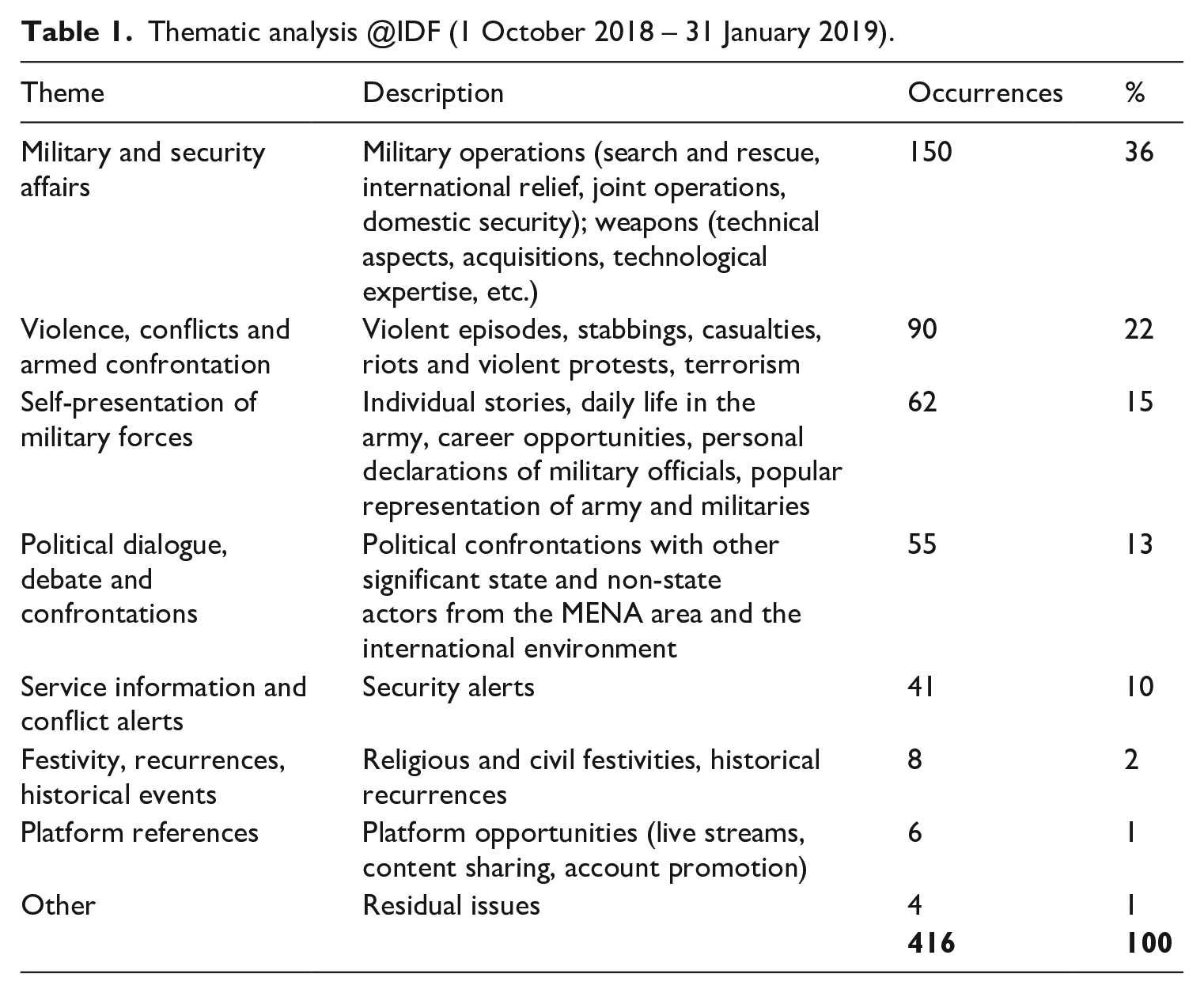
In addition, for each post, we identified the presence of video, static images, platform opportunities (retweets, mentions, links, etc.) and the call for participation of other actors. Categories and their distribution are described in Table 1. Categories have been built to facilitate data reduction (Drisko and Maschi, 2016). For instance, the category named ‘Violence, conflicts, armed confrontation’ differs from ‘Security alerts’ in that the former describes events, provides details and is usually accompanied by visual evidence. The latter consists of stringent messages warning of the activation of security procedures. Moreover, the ‘platform references’ category cannot be overlapped with the others since it only includes those tweets about events or topics that happen thanks to platforms (announcements of live broadcasts, number of followers, etc.). For this reason, even though specific themes may have their hashtags or may involve online activities, in the analysis they were brought back to the category of closest relevance.
Thematic analysis @IDF (1 October 2018 – 31 January 2019).
After identifying and classifying content, we qualitatively analysed the posts. This kind of analysis helps the recognition of narrative strategies and regularities. Nevertheless, it implies more obtrusive participation of researchers in the organization and interpretation of the results as it relies on ‘connotative codes not based on explicit words but on the overall or symbolic meaning of phrases or passages’ (Drisko and Maschi, 2016).
Platformed narratives: Representational strategies and online adaptation
General overview: main themes and some insights from platformization
The IDF Twitter account was founded in 2009 and has a total of 1.5 million followers (on 15 August 2021).
From 1 October 2018 to 31 January 2019, the IDF tweeted 416 times. The topics identified (see Table 1) are traditionally linked with army matters: military and security affairs (N = 150); violence, conflicts and armed confrontation (N = 90) and service information and conflict alerts (N = 41) represent nearly 68 percent of the overall number of tweets. Political questions, like the political dialogue, debate and confrontations (N = 55), are secondary, as are the generic – and sometimes ‘promotional’ – representation of military forces (N = 62).
The narration is highly centralized: the IDF produces almost all posts directly. There are only three retweets in the entire corpus of tweets (two from the IDF spokesperson’s account and one from an Israeli military official). The control of content intentionally demonstrates the management of the public image: 199 posts (48% of the total tweets) contain at least one element enabled by the platform, like mentions or hashtags; of those, 16 tweets respond to other content posted by other users.
Indeed, the involvement of everyday users is restricted to bland calls for action (as the appeal to watch or listen to content, or the search for retweets), while only 20 tweets contain a request for users’ engagement.
Covering violence: formats of real-time narratives between transparency and platform remediation
This section explores the organization of the communication related to violent episodes (see Table 2).
Visual and iconographic content in covering violence.
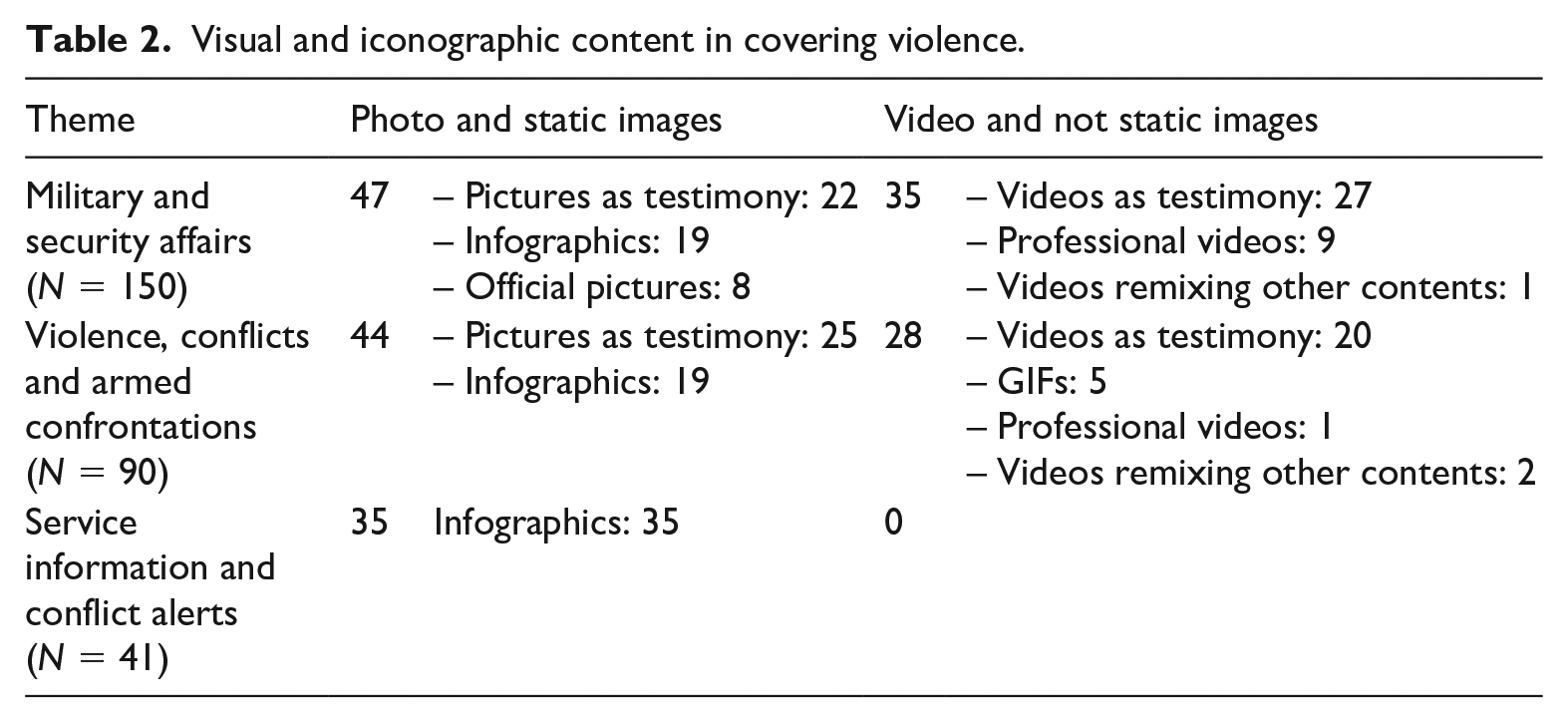
Security concerns form a considerable portion of IDF narratives. Military and security affairs (N = 150) mainly illustrate everyday and routine activities. Tweets are focused on the description of military operations: there are primarily supportive ones, such as search and rescue operations abroad, that symbolize the military relationship and the integration of the IDF with the security complex – overseas and in the neighbourhood. The army is functional in preserving international security, giving material and professional support: this peaceful effort – as in the case of natural disasters – makes it possible to openly show skills and knowledge, hiding the threatening actions in conflicts. Violence prevention is another military theme. The strategic intent is to promote ‘necessary’ militarism, insisting on IDF and its social utility.
Numbers, data and valuable information are presented to inform the population of the entity of the enemy presence; sometimes, current affairs are contextualized and explained in a causal linkage, transforming the IDF into a reliable source.
The role of the IDF in ordinary but violent confrontations is emphasized through the creation of a connection with users’ everyday life, exalting the necessary action of military forces: @IDF: Imagine that a terrorist who belongs to an organization whose mission was to kill you and your family, was minutes away from your home. Today, a Hamas terrorist broke through the Gaza border fence into Israel. Our troops stopped him before he could reach Israeli families.
The ordinary public display of violent confrontations is synthesized into the Violence, conflicts and armed confrontations category (N = 90). Posts aim to show ongoing and continuative situations, even when presented as a novelty, as shown by the frequent labels opening the tweets, indicating the starting point, and suggesting further developments (‘Initial report’; ‘Just now’; ‘Breaking’). These captivating stratagems indicate the intention to catch the attention of networked publics (boyd, 2010) in a high-choice media environment (Prior, 2007). Tweets are oriented to spread some elements of recognizability and public sensibilization. On the one hand, as also shown by the previous literature (Heemsbergen and Lindgren, 2015), the presence on social network sites aims to mobilize foreign audiences using emotional strategies. Indeed, several posts show the effect of violence in everyday life, involving children or women. Some other posts are intended to involve users with the experience of violence, using platforms to recreate an immersive reality where the possibility of entanglement with different lifestyles leads towards knowledge based on personal involvement and ‘sentimental’ connections. Twitter acts on the conflictual display, allowing immersive narratives based upon affective activations (Callahan, 2020; Papacharissi, 2015), enhancing connectivity: @IDF: Imagine if YOUR car in YOUR neighborhood went up in flames. This just happened – an explosive balloon launched from #Gaza at #Israel set this car on fire.
On the other hand, the repetitive narratives exacerbate the ordinariness of violence and military issues, constituting Israeli security branding (Anzera et al., 2019). The representation of weapons insists on their daily presence; sometimes, they are objects of everyday use (such as kitchen knives); in some other cases, the representation indulges on the linkage between weapon and consumer cultures – connecting, once again, violence with the everyday experience of transnational audiences: @IDF: An IDF soldier just found this knife . . . in a box of @Pringles. Our intel says the woman carrying it intended to use it for a stabbing attack. Our soldiers at the Qalandiya security crossing stopped her from doing so. This is why security checks are necessary.
The enemies’ weapons are represented as ‘low tech’, trivial resources, but not innocuous, as demonstrated by the so-called arson balloons.
In addition, security concerns are presented in a rational/supporting narrative: the security operations made by the IDF are commonly represented as a reaction to opponents’ actions; they are consequently framed as defensive operations: @IDF: We struck Hamas’ military intelligence HQ in response to the 300+ rockets that terrorists in #Gaza fired at #Israel. This is where Hamas’ intelligence operatives gathered information to launch attacks on Israelis. Hamas intentionally established their HQ next to a school.
This helps legitimate military intervention and mitigate the possible ‘overreaction’ claims; the IDF acts as a news source while imposing an interpretative frame on the narration of military actions, presented as necessary and ‘compulsory’.
Conflict alerts are diffused using a standard format: an emoticon of a siren usually introduces information (place, nature of the threat and other relevant details), confirming to the nearby citizens the nature of the sound alarm. The ‘service’ dimension is helped by the similarity of the posts, immediately recognizable by users. However, these tweets fulfill a double purpose: on the one hand, they give real-time information about the beginning of a potentially dangerous situation – stimulating the curiosity of users, who are invited to stay connected; on the other hand, they can be considered as an additional strategy in the empathy construction, virtually answering to the ‘What’s happening?’ question, posted on the Twitter homepage, with information that suggests the precarious lifestyle of those living in the affected areas.
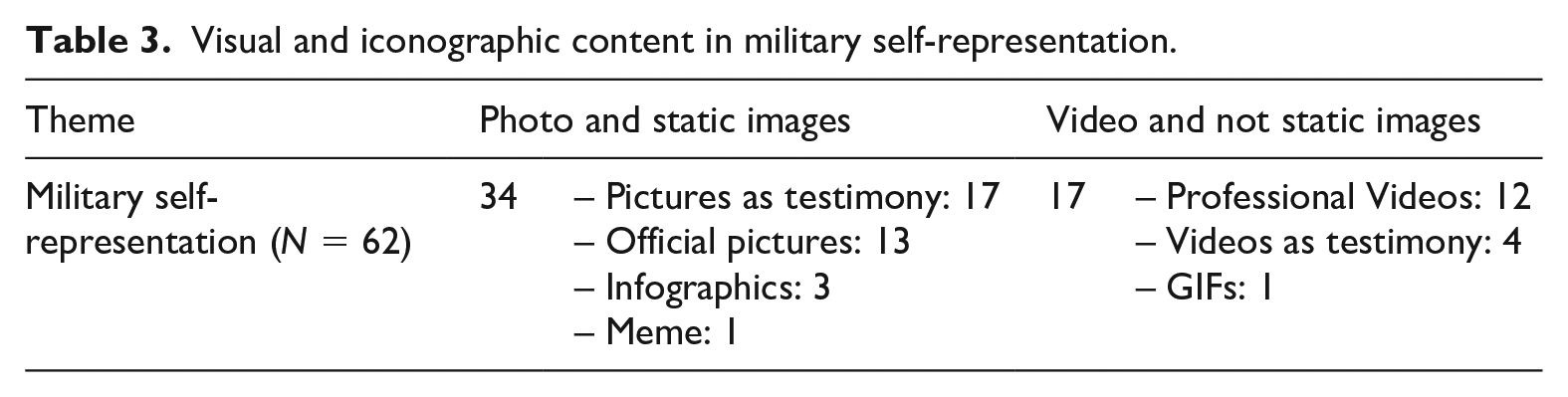
Even the diffusion of images seems to fit into a platformed narrative facilitated by programmability features. As a result, visual elements are well distributed in the tweet stream (see Table 3). However, each content section presents some peculiarities.
Visual and iconographic content in military self-representation.
Both military and security affairs, and conflict information show how visuals are oriented towards an exaltation of the real-time feature. Images are mainly used as ‘testimony’: they are usually raw pictures or footage, not professionally edited (or just apparently so). Visual content seems to replicate the logic behind the accidental testimony (Allan, 2013). The documentation material resulting from an (even deceptively) random and non-concerted presence is automatically considered truthful. Moreover, the personal perspective applied to images – not infrequently taken as a subjective shot – fits the digital era’s common representational logic. As the idea of ‘militainment’ (Stahl, 2010) suggests, nowadays the representation of violent affairs is increasingly similar to videogames, where immersive perspectives, first-person experiences and generical gamification of events give a mediated representation of tech-conflicts, in which violence is filtered and anaesthetized, hiding the victims and the role of civilians.
Military operations shared by the IDF’s Twitter account are sometimes first-person testimonies filmed with soldiers’ eyes. While trends in conflict representation oscillate between sanitization (Der Derian, 2009) and gamification (Stahl, 2010), platforms’ features, allowing the creation of content with easy-to-use simple tools, may facilitate the normalization of militarism, presenting a personal and immediate point of view.
Conflicts are narrated thanks to the pictures of weapons, mainly the rudimentary ones used by the counterpart, and the documentation of their effects on civilian buildings and belongings (accordingly to textual narratives) – where the latter is a digital reprise of a bilateral and alternate ‘David vs. Goliath’ roleplay (Manor and Crilley, 2018), adding, once again, an emotional value involving identification and sensitivity.
Conflict alarms maintain their service vocation: texts are almost always accompanied by an infographic showing the location on a map, while military affairs and conflict representation, in addition, employ infographics (in these cases, intended as a combination of bold texts and images) to frame the content (with recurring labels, such as ‘breaking’, ‘stabbing attacks’ and so on). Infographics locate texts in a place and catch users’ attention.
This strategic use of images and real-time information can be seen as a tool for normalizing militarization while diffusing propaganda intended as a purpose of specific conflictual strategies. As stated by Jowett and O’Donnell (2015: 7), ‘propaganda is the deliberate, systematic attempt to shape perceptions, manipulate cognitions, and direct behavior to achieve a response that furthers the desired intent of the propagandist.’ Referring to the 2012 conflict between Israel and Gaza, Heemsbergen and Lindgren (2014) observed that the IDF spokesperson Twitter and Facebook accounts were mainly used strategically. Images were functional to increase transparency. Despite the fact that this strategy may seem the opposite of propaganda – especially thinking of contemporary forms of networked propaganda, made up of a complex mix of concealment, ‘black hat’ techniques and computational deception (Benkler et al., 2018) – Heemsbergen and Lindgren (2014: 571) claim that ‘transparency becomes both a tool and a target of effective messaging.’ Thanks to this kind of information management, the IDF may become an agent of influence, manipulating reality’s perception (and definition) (Till, 2021). Indeed, propaganda can be spread, conveying information that may seem to come from a verified and credible source (Jowett and O’Donnell, 2015) – as suggested by the blue checkmark on Twitter, signalling a verified account. The media environment affects how propaganda is strategically planned as well as audiences’ perceptions. Digital media and social media logic have an impact on how propaganda is conceived: popularity acts on strategic message construction, programmability defines ‘official sources’ and their actions allowed by platform features, and connectivity determines the way sources are experienced and how those experiences may be shared with connections of digital proximity.
Finally, datafication suggests that data deriving from the public reaction may inform future strategies – the ‘what would you do?’ rhetoric evidenced by Heemsbergen and Lindgren (2014) and the activation of personal connection (like the tweets that follow the ‘Imagine if it happened to you’ format) may be considered to be a hint of such a strategy. Contemporary reality is a mediated reality (Couldry and Hepp, 2016): Till (2021: 1366) suggests that this process ‘occurs through fundamental components of sociality and that digital media provide new tools for observing and directing these everyday actions and interactions of users. This creates new opportunities for political actors to influence opinion.’
‘Strike a pose’: military self-representation between networked appeal and image curation
We have identified 62 tweets on military self-representation. These tweets are mainly based on representing soldiers according to a ‘one of us’ logic. This logic follows a double look: an ‘insider’ one, presenting the individuality of soldiers and the peculiarity of the army, and an ‘external’ one – outside the military realm – that may wink at an imagined networked community.
The representation of the private side of the army seems to have several functions. The most frequent narrative device is based on individual stories. Some tweets are about the biographies of individual soldiers, paying particular attention to those who can boast a personal commitment or who benefit the presentability of the army. The story of the deeds – sometimes ordinary and routine – of the soldiers exploits the privatization of the public representation logic to improve the external presentability of the IDF, characterized as a group of virtuous men and women: @IDF: This soldier collected over 24,000 bottles and cans so that he could donate the money he raised recycling them to Holocaust survivors and people in need. That’s the spirit of #GivingTuesday. That’s the spirit of the IDF.
To all this, we can add the desire to create an empathetic bond with soldiers (for example, through narratives of their family relationships). Cull (2011) defines the effort behind digital diplomacy – particularly when conducted through a personal account – like the imposition of a frame in which the public figure is ‘like us’. Personalization of public representation implies the narration of personal position and vicissitudes instead of institutional ones, in the process of individualization, and a dimension of privatization, where officials are represented according to their characteristic, separated from their public role (Van Aelst et al., 2012).
The representation of the military oriented towards an external projection, instead, exploits the trends of the internet. This connective representation is fuelled by the reference to popular topics on the platform, such as international annual events or festivities. Tweets feed themselves with the popularity of celebrities on the platform: they are often a direct response to them; however, at other times, they just mention a celebrity, aiming to establish a link with popular imagery. Online trends dictated by the popularity logic are transformed into tools of self-representation: this is an effort towards popularization and a strategy to infiltrate the image-building device into the collective content construction, such as digital challenges, implying the connection between personal expression, searchability and the awareness of the quantification of the outputs (likes or retweets) in the very moment of creation of the content.
Visual strategies are suitable for this double logic (see Table 3). Both static images and dynamic ones, see the dual presence of a testimony intent – as if soldiers have been personally shooting the photos, or filming the surrounding situation – and a glamourizing one, as demonstrated by young men and women, smiling and looking directly into the camera, that symbolizes both the professional orchestration and the desire for responsiveness to an (alleged) platform aesthetic.
Monological dialogue: strategic conversations and relational display of neighbourhood affairs and international positioning
This section briefly analyses the dialogical (and contentious) intentions established with the neighbouring actors and international operators, summarizing the political dialogue, debate and confrontations category (N = 55). Hamas and Hezbollah are the direct targets of Israeli public protests; often, this happens in a dialogical way, although this is only an expedient for the public shaming of the political practices of such actors.
The possibility of generating the involvement of other users and, in general, provoking arguments (pressing on the algorithmic advancement) is symbolized by using an ironic and witty style (typical of digital expressive forms such as memes). Further confirmation of the connection with the consumption practices considered familiar to online users can be traced. An example of this is the long sequence of tweets denouncing the funding of the tunnels leading to Israeli territory by Hezbollah, supported by Iranian financing: @IDF: Iran annually funnels $1 billion to Hezbollah in Lebanon for terror – including attack tunnels into #Israel. This money is equivalent to: 333,333,333 @McDonalds Happy Meals. Let that sink in. #CondemnTheTunnels.
In other cases, advertising claims are remediated, and popular expressions are used in contentious communication: @IDF: Iran’s annual funding of Hezbollah in Lebanon to attack Israel: 1 billion dollars. Hezbollah cross-border attack tunnel: A few million dollars. Destroying this attack tunnel and protecting Israeli civilians: Priceless. © @Mastercard.
Legacy media are also public interlocutors for the IDF: in this case, the gatekeepers are not bypassed but contested. In addition, attention is often paid to correcting information deemed wrong, responding directly to erroneous tweets.
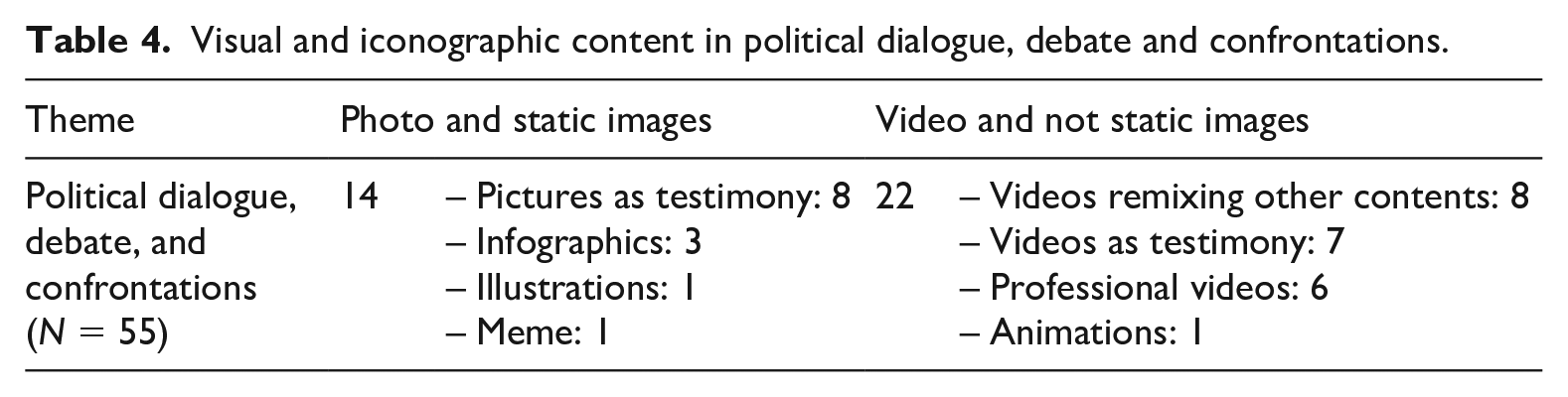
The revealing of (political and military) opponents’ practices is made evident by the remediation of the contents produced by the challengers. The visual equipment consists of videos from Hamas-related broadcasters, in which portions of television programmes are presented. In these videos, the intention to commit violence against Israel or Israeli citizens is stated. Sometimes, children are involved in these declarations. The decision to re-launch others’ propaganda – by means of the proposition of their content, even consenting traceability, keeping the broadcaster logo in plain sight – is determined by the audience’s understanding and by the capability of imposing a condemning frame to the same images.
The visual apparatus (see Table 4) is oriented towards the testimony of the counterpart’s actions (e.g. tunnels) and by the critical exposure of their actions to the internet audiences.
Visual and iconographic content in political dialogue, debate and confrontations.
What is happening? ‘Old’ new media logics and platformed strategies
This section discusses how the sequence of posts analysed can respond to the phenomena of platformization underway. The content production mainly aims to narrate traditional security issues, as demonstrated by the prevalence of tweets describing military and security affairs, armed confrontations and security alerts. Even if platforms can be a venue for cultivating soft issues, a classical vision of conflictual themes managed by the official war-rooms still prevails (RQ1). Nevertheless, these narratives are not immune to platform logic. We have seen how the centralized and personalized management of the contents leads towards a strategic narrative (Miskimmon et al., 2014) functional to constructing and projecting an international (and domestic) image. We can speak of a narrative because transforming the issues in distinct and recognizable formats allows a frequent user to follow and link the different events.
There is a multiplication of themes and styles of communication: the IDF account is a source of news, a promoter, an international interlocutor, a network node devoted to horizontal entertainment. Platform logic can be found in the overall strategic planning of content (RQ2). Programmability suggests that Twitter’s features strategically narrate conflicts and, above all, current affairs in real-time. Platform features, such as live streaming or promotion, are marginal in narratives: the category ‘platform references’ includes residual tweets (N = 6). Indeed, the continued display of the witnessing capacity of the IDF is amplified by the opportunity to bypass intermediaries and, through the features of the platforms, enter visual contents apparently recorded with devices of daily use, mainly focusing on the narratives concerning offline activities. Programmability also acts on representing the violence re-mediated by the platforms and its public consequences. We have observed a ‘sweetened’ and ‘light’ version of violence in the IDF production when performed in a self-representational perspective: platformed violence may become an entertaining tool and a traffic booster. Moreover, it should not be forgotten that algorithms condition what is seen and that (human or mechanical) censorship prevents information actors from showing too explicit content.
Popularity logic sees the attempts – even if they cannot always be said to be bi-directional – to exploit bottom-up narratives and practices recurring to Twitter features (mentions, replies, hashtags). Even if themes and issues do not always answer to popularity imperatives, as they assessed within the framework of hard issues, we are witnessing changes in languages and formats – even towards a trivialization and an affective promotion of armies and their global standing, as suggested by the transformative diplomacy idea (Duncombe, 2017). Connectivity relies on creating relationships that bind the followers’ community. From this perspective, the underlying strategy is to polarize and conquer. Narratives and arguments are mainly intended to retain followers’ loyalty rather than recompose conflicts.
Finally, even if features that consent to datafication are far from public scrutiny (and cannot be adequately investigated through content analysis), it is evident that the tweeting activity facilitates the analysis of followers’ reactions.
Military tweets are aimed at involving affective publics (Papacharissi, 2015). These interconnected audiences, with variable fidelity, seem to be driven by (even weak) connections and by the ability of issues to intercept interests close to their personal beliefs and emotions. Soldiers’ stories are (almost always) the stories of individual soldiers; violence is always traced back to its effects on everyday life; invitations are more directed towards identification than rational understanding. Security display is a performative act: media representations and digital performances may help to define security reality and enhance the trustworthiness of security actors. The IDF’s strategy can be considered a step towards the so-called sensible politics (Callahan, 2020). Callahan argued that people are experiencing international politics thanks to visual media – as we have noted, strict control on conflict and army visual representation strongly contributes to the formulation of IDF’s strategic self-presentation – playing on issues’ visibility. Visuals have not only an ‘ideological-value’, but they contribute to ‘affect-work’ (p. 2). The materiality of platforms will lead to ‘sensitive’ violence representation while its protagonists will employ platforms to legitimate themselves. The representation of ‘hard’ military issues (violence, security and military affairs) is intended to normalize militarism as it depicts the army’s social relevance and platformizes conflict, relying on every logic that allows for a favourable representation. Army self-representation is primarily devoted to normalization, as proved by personal narratives, popular culture elements and celebrity culture appeal. Finally, the military engagement in political confrontations follows a dual strategy: it promotes the normalization of the army as an actor entitled to intervene in political issues while transforming information into a conflictual element to be managed by the actor traditionally committed to managing security.
Footnotes
Declaration of conflicting interests
The authors have no conflict of interest to disclose.
Funding
The authors received no financial support for the research, authorship and publication of this article.
