



Abstract
Research examining coverage of Western media on the Palestinian–Israeli conflict shows an imbalance in reporting the news and favoritism towards an Israeli government interpretation of the story. This article aims to examine how the so-called Intifada of the Knives (IK) was framed in Western print newspapers. The research also examines the representation of Palestinians and Israelis during that period. Media Framing Analysis (MFA) is deployed to present a detailed examination of 16 articles that appeared in prominent British, American, Canadian, and Australian print newspapers during that period. Findings show that negative frames were more dominant than positive frames. Overall, the articles framed the Intifada as a religious dispute and empathized more with Israelis who were described as victims while Palestinians were framed as terrorists or anti-Semitic. Little or no background was given as to why Palestinians opted for such actions against Israelis.
Keywords
Introduction
Violence has been associated with the framing of Palestinians in the media for a long time. While British colonialism retracted from Palestine in 1948, Zionist militias advanced and purged more than half the indigenous population from the land to declare a state called Israel (Abdo, 2014). Since then, every generation of Palestinians has been and continues to be punished through unlawful killings, arrests, and demolition of their homes (Amnesty International, 2001). This reality, however, is not always reflected in media coverage. Research examining coverage of Western media on the Palestinian–Israeli conflict shows an imbalance in reporting the news and favoritism towards the Israeli side of the story. Western media tend to reinforce the Israeli narrative showing minimal to no interest in the Palestinian perspective. This imbalance is evident in the way Palestinians are represented in the news in comparison to Israelis. Palestinians are often portrayed as terrorists while Israelis are presented as victims (Deprez and Raeymaeckers, 2010). Assessing the coverage of the first and second Intifadas, both of which are key events in the history of Palestinians, Manor and Crilley (2018) concluded that delegitimizing the Palestinian cause is a prevailing frame in Western media coverage, especially in US media outlets. Indeed, Israel is the largest beneficiary of US economic and military aid since 1976 (Mearsheimer and Walt, 2008). The favorable framing in the media and the millions of dollars in aid benefitting Israel are partially due to the growing influence of Zionist lobby groups who drive a narrative that reinforces Palestine as a historic land for Jews (Abdo, 2014).
The goal of this article is to analyze Western English language media coverage from a period in the Palestinian history that is not well researched yet marked the start of what some called a third Intifada (Hassan, 2016b). The Intifada of the Knives (انتفاضة السكاكين) was also referred to as the Intifada of the Individuals. The Intifada started in October 2015, when 19-year-old law student Muhannad Halabi from Surda in the occupied West Bank stabbed four Israelis in Jerusalem (Hassan, 2016a). The media’s coverage of this Intifada, that lasted until October 2016 (Jraba, 2015), alleged violent attacks against Israeli forces and citizens by individual Palestinian youths using kitchen knives or, as in the allegations made in November 2015 against 14-year-old Hadil Awwad, her art-class scissors (Hassan, 2015). Israeli forces shot and killed many of the alleged attackers, including Halabi and Awwad, resulting in condemnation of excessive force and accusations of war crimes from local human rights organizations (International Middle East Media Center, 2015). Afterwards, the Israeli government collectively punished the families of the alleged attackers, demolishing their homes and refusing to transfer the bodies of the Palestinian youths shot dead by the Israeli military to the grieving families (Hassan, 2015).
Much of the Israeli media framed the alleged attackers as terrorists but, for some Palestinian media, the accused were heroes. In the latter, news reports acknowledged that Palestinian youths opted for such drastic measures as a direct result of the oppression that seeks to strip Palestinians of their national identity and human dignity (Wilson, 2015). Amongst the reasons discussed in the local press were the ongoing Israeli far right-wing attacks on Palestinian neighborhoods as part of Israel’s state aggression to remove Palestinians by and for Jewish settlers (Shahwan, 2021). In 2015, 224 Israeli settler attacks against Palestinians were documented (Defense for Children International – Palestine, 2015). One of the most tragic cases was the burning alive of an 18-month Palestinian toddler who died along with his parents when Jewish settlers threw firebombs at their home. Most complaints made by Palestinians about settler violence were dismissed or closed by Israeli police and less than 2 percent were investigated (Defense for Children International – Palestine, 2015). The Western media analyzed here did not report on Palestinian complaints. However, Palestinian media reported on these complaints in the local media in Arabic and for international audiences in English through news websites such as the International Middle East Media Center and the Electronic Intifada. During the IK, false accusations and illegal arrests targeting Palestinian youth increased drastically. Over 14,000 Palestinians were imprisoned, including 437 women and 3,100 children (Alsaafin, 2017). In many cases, the children arrested were subjected to physical violence during imprisonment while most interrogations took place without the presence of lawyers or family members. Additionally, administrative detention was used against Palestinian minors to extend their jail sentence without trial or charges (Defense for Children International – Palestine, 2015). Administrative detention is ‘an extreme and regularized procedure’ exercised by the Israeli military, security forces, and police ‘without a due legal process’, often locking-up Palestinians, including minors, ‘for prolonged periods of time, preventing them from seeing lawyers and family members and denying them access to legal recourse’ (Abdo, 2014: 31, 33). Despite the significance of the events marking a third Intifada, there is a lack of research concerning the IK. This article examines the following research questions: how was the IK framed in Western print-newspapers? How were Palestinians represented versus Israelis during that period?
Specifically, this article examines British, American, Canadian, and Australian print newspapers, all of which demonstrate a common orientalist ideological framing that ignores the colonial conquest of Palestine, and the injustice Palestinians endure under the Israeli regime (Greenstein, 2019). The research questions are investigated through conducting Media Framing Analysis (MFA) technique. MFA is a systematic method that draws upon Entman’s (1991) framing work. It is a procedure that covers five key steps in examining media texts. These steps include identifying the placement of a story, and examining the characters, narrative, language, and recurring themes (Shaw and Giles, 2009). A purposive sample of 16 articles published between October 2015 and October 2016 were selected for examination. The article first reviews literature concerning media framing and the Palestinian Intifadas to introduce the methodology of data collection and inform the analysis of the data. The conclusion section reflects on key findings and identifies areas for future research.
Literature review
The role of media framing in shaping news
Media framing was first described by Goffman (1974) as the lens by which societies view and organize everything around them. The idea of framing is the ability to see any topic, issue or problem from different angles and perspectives (Chong and Druckman, 2007). According to Entman (1993), framing is about focusing on a certain aspect of a perceived truth and positioning it as the only valid option. With time, framing became an essential part of news making. It is through framing that journalists organize the stories and messages they want to direct the reader’s attention to (Scheufele, 1999). Frames focus on the usage of techniques that shed light on specific symbols that give a specific meaning to a media text (Gamson and Modigliani, 1989). Media tend to frame a specific issue in a way that influences public opinion to focus on what they deem important (De Vreese, 2005). Framing studies suggest that how the media cover an issue is what makes it salient in people’s minds (Pan and Kosicki, 1993).
Some argue that framing is a passive process with an influence that can only be determined based on the reader’s knowledge of a specific topic (Iyengar, 1994). Similarly, Gamson (1989) concluded that motives behind media frames can sometimes be intentional or unintentional. Other studies have argued against a passive notion of frames and concluded that a frame is put in place for an audience to engage with it, approve or disapprove of it (Druckman, 2001). News frames are considered active and influence people differently based on their political leaning, upbringing, ideology, and beliefs. What this means is that a frame is effective when the messages are linked to the logic of its receivers (Scheufele and Tewksbury, 2007). Research continues to provide an insight into the effect of framing in shaping public opinion and understanding of world events outside the receiver’s direct interests (Entman, 1993). Applying framing theory to the present article thus allows us to better understand how the IK was framed in Western media and how Palestinians were represented during that period.
How the media frame foreign affairs and political issues
Just like any type of news, reporting of political news utilizes frames that highlight certain information deemed important (London, 1993). Framing of political issues has been explored by many scholars (e.g. Entman, 1991; Iyengar, 1994; Kent and Davis, 2013). When covering political events and conflict, the media tend to use framing techniques that dramatize certain aspects of the story in favor of a specific political group (Jamieson and Waldman, 2003). Media framing of foreign conflicts focuses on repeating messages that direct the public to empathize with one party and ignore other facts deemed less important (Evans, 2010). Specific words, supporting material and images are used in political media frames that direct a receiver’s attention towards a desired outcome (Entman, 1993). To do so, media frames draw upon a narrative with vivid details and complexity that leads the audience to identify with whoever the media labels as victims or heroes (Robinson, 2000). Similarly, Gross (2008) concluded that it is not the presentation of accurate information that is salient in covering political events but the focus is on frames that guide the public towards a certain reality around the political issue (Chong and Druckman, 2007).
A study conducted by Miller and Reichert (2001) revealed that news value reinforces the opinions of those in power and framing of political issues is shaped accordingly. When it comes to covering sensitive issues, the Israeli–Palestinian conflict being one of them, self-censorship within media organizations dictates how a story is told. Journalists often practice self-censorship out of necessity or pressure to stay in line with a media organization’s prevailing ideology often determined by ownership (Day, 2021). This results in unbalanced reporting supported by terminologies and facts that serve the dominant political power in a country (Dunsky, 2008). Thus, media coverage of foreign affairs is heavily shaped by a country’s hegemonic political and economic interests, often following the dominant political context governing international relations (Oliver and Maney, 2000). Factors, including geo-political and economic goals, play a crucial role in how the media frames news (Chang and Lee, 1992). What this means is that media frames of war and conflict are not free of censorship and operate based on a predetermined agenda (Nossek, 2004). Accordingly, Western mainstream media constantly reinforce an anti-Semitic or a terrorism narrative when framing Palestinians who oppose Israeli state oppression (BreakThrough News, 2021). Deprez and Raeymaeckers (2010) concluded that certain words with negative connotation are often used when describing Palestinians in Western mainstream media, which serves a foreign policy that supports the intersecting interests of the US and Israeli governments. These words include ‘terror’, ‘slaughter’, ‘tragedy’, and ‘murder’. Similarly, Brewer (2006) examined US media coverage of foreign policy and concluded that countries in conflict with the US are often framed as a threat, especially in the Middle East.
Another key factor shaping media framing of foreign affairs is the budget and human resources allocated to international news. In many cases, stories rely on correspondents with little knowledge of the Middle East and end up with stories that reinforce a common narrative without any depth (Dor, 2004). Another limitation is the pressure to adhere to specific values and regulations adopted by media outlets which guide framing of foreign affairs reflecting the views of those in power (Luyendijk, 2008). In the recent 2021 war on Gaza, Canadian journalists raised their concern over restrictions banning them from using the word ‘Palestine’ in their stories (Lacy, 2021). These restrictions affect Western media reporting of the Palestinian–Israeli conflict which is influenced by Zionist lobby groups that frame Palestinians as enemies and Israelis as victims (Ibrahim, 2003).
Western media framing of the First Palestinian Intifada
Palestinians barely made headlines until the First Intifada. Historically, Western reporting of issues related to the Arab region was one that is based on Orientalism. Orientalist depiction is the representation of a culture foreign to the West from a colonial ideology and perspective. This is an ideology that frames Arabs as uneducated and barbarians, and results in silencing voices of Muslims and Palestinians of whom the majority are Muslims. To that end, Palestinians are expected to accept their dispossession and abandon their national identity and, thus, their voices are either silenced or dismissed in media frames (Said, 1986).
Studies that examined coverage of the first Intifada, which started in 1987 and lasted till 1993, showed that the events were framed with an Israeli lens in Western media (Philo and Berry, 2004). This was evident in coverage of death tolls. In many Western media outlets, Palestinians killed by Israeli forces were almost never reported while the focus was constantly on Israeli families and victims (Korn, 2004). Western media also referred to Palestinians in Israel or in Israeli settlements but failed to mention the occupied land of Palestine (Nir and Roeh, 1992). Western media in general and US media in particular framed Palestinians as old angry Bedouins who are uneducated, racists and anti-Semitic. They were never presented as victims living under occupation but stereotyped instead to fit a certain image. The Israelis, on the other hand, were portrayed as peace-loving, victims of hate, and suffering at the hands of Palestinians (Ross and Lester, 2011). Kressel (1987) concluded that Western media presented a partial truth that favored Israelis over Palestinians, and Zionism was framed as a liberal idea that protected both Arabs and Jews.
Additionally, the Zionist lobbying body in the US and across the world pushed a media frame that reinforced Palestine as ‘a land without people for a people without land’ (Abdo, 2014: 46). Publications such as The New York Times and media such as CNN avoided representation of Palestinians and downplayed their side of the story. This was a result of the strategic relationship between the US and Israel, which translated into media frames that reinforced their national interests in the Middle East (Kanazi, 2006). As an example, the most dominant frame of the First Intifada in Western media was one that depicted Palestinians as oppressed individuals and rebels against law and order (Daniel, 1995). Thus, acts of resistance by Palestinians were framed as hate attacks aimed at disrupting Israelis’ peace in the promised land (Wolfsfeld and Gadi, 1997). Additionally, Western media relied heavily on Israeli media sources after restriction of movement into Gaza and the West Bank in 1988 (Griffin, 1990). These events resulted in a narrative that reinforced the Israelis’ claims and, with time, moved away from covering the Israeli–Palestinian conflict (Gilboa, 1993).
Western media framing of the Second Palestinian Intifada
During the Second Intifada, Western media generally framed the conflict between Palestinians and Israelis from an angle that presented Israelis as victims (Kandil, 2009). Examining coverage of the UK’s BBC, Philo and Berry (2004) concluded that the public was led to believe that Palestinians did not even live in Palestine and that they tried to occupy Israel during the Second Intifada. Similarly, coverage in US media was influenced by an Israeli narrative which was evident across media websites and TV stations. For example, Palestinians were referred to as ‘Arabs living in Israeli settlements’ rather than naming the country as Palestine or citizens as Palestinians to avoid acknowledging the land is occupied by the Israeli military (Ozohu-Suleiman, 2014). The same was evident in Australian media reporting on the Second Intifada. An analysis of media coverage in The Australian and Sydney Morning Herald concluded that, while Palestinian refugees were framed as an important issue to resolve the Israeli–Palestinian conflict, little to no background information or context was provided as to why Palestinians became refugees (Han and Rane, 2011). This was reinforced by other studies that concluded that Western media attempt to delegitimize Palestinians by refraining from using the word ‘occupation’ (Bapat, 2011; Kandil, 2009). A recurring theme in Canadian papers reinforced the efforts of the Israeli government to maintain peace while Palestinians opted for violence instead (Baltodano et al., 2007). Moreover, Western media outlets constantly quoted Israeli officials during the second Intifada while silencing Palestinian voices, which shaped how people view the conflict between Palestinians and Israelis (Philo and Berry, 2004).
Terrorism also emerged as a dominant frame during the Second Intifada. Terror attacks became the primary framing of Palestinians and Arabs after several airplanes were hijacked simultaneously and crashed into buildings in the US during the events of September 11, 2001 (Jackson, 2021). Afterwards, the US declared war on terrorism (Ross, 2011). This was followed by coverage of the Second Intifada that reinforced words such as ‘Palestinian terrorists’ and ‘suicide bombers’ (Moghadam, 2003). Prominent UK media outlets framed Palestinians as ‘violent agents of war’ while US media labeled Palestinians as ‘terrorists’ (Kandil, 2009). In the period that followed 9/11, Palestinian voices were silenced, and more favorable coverage was given to Israelis. Dehumanizing Palestinians was used as a tactic by not mentioning Palestinian victims’ names and referring to them as terrorists while Israelis were always framed as grieving or in fear of their lives (Siddiqui and Zaheer, 2018). Similarly, Canadian media coverage of the Second Intifada supported the terrorism narrative. Sydora (2018) concluded that a dominant frame in both The Globe and Mail and the National Post focused on associating Palestinian resistance with terrorism. The terrorism narrative justified Israeli forces’ attacks on Palestinians under ‘self-defense’ while Palestinian resistance was framed as extreme acts of hate (Viser, 2003). Palestinian retaliation acts were also framed as ‘acts of terror’ aimed at killing Israelis (Moghadam, 2003). The narrative deployed by Western media outlets reinforces the influence of government agendas on how Palestinians are framed. The US, UK, Canada, and Australia are colonial settler states whose territories were gained by committing genocide, assimilating, or removing indigenous peoples from the lands. This colonial history translates today into media coverage that supports the welfare of Israel (Greenstein, 2019). Another example is a study by Kandil (2009) which examined the power of colonial alliances over media coverage. Results showed that Qatari-owned Al Jazeera framed the resistance as a much-needed action to achieve liberation, while both CNN and BBC, operating from the US and UK, respectively, labeled Palestinian resistance as terrorism.
Given the significance of the October 2015–2016 Intifada in Palestinian history, this article investigates the representation of Palestinians and Israelis during that period. Specifically, this article examines the frames that international online news outlets employed in covering the IK. Through framing analysis, this article will show how UK, US, Canadian, and Australian newspapers framed the IK.
Methodology
This article draws upon Media Framing Analysis (MFA). MFA is a systematic method, specifically used for the analysis of media texts. The focus is on examining key features in a story, including the placement of a story (identifying the section the article appeared in), examining the characters (who was quoted in the article and to what end), narrative and reader’s identification (identifying the villain and the hero/victim of the story), language categories (words and phrases deployed to describe the main characters), and generalization (recurring themes). Additionally, this method helps in determining whether negative or positive framing was deployed after examining the text (Shaw and Giles, 2009).
The purposive sample compiled 16 stories that were published between October 2015 and October 2016 by online news outlets in prominent British, American, Canadian, and Australian print newspapers. Four outlets from each of the selected countries have been chosen for examination. These are the UK’s Daily Mirror, Daily Express, Daily Mail, and The Guardian in addition to the US’s USA Today, The Washington Post, Chicago Tribune, and The New York Times. Canadian outlets include The Globe and Mail, The Hamilton Spectator, Toronto Star, and The National Post while Australian outlets include The Age, The Sydney Morning, Herald Sun, and The New Daily. These newspapers were chosen as they ranked amongst the most prominent newspapers by circulation according to Agility PR Solutions (2021a, 2021b, 2021c) and Australian Newspaper Readership (Roy Morgan, nd). They also did not require any subscription to search their online archive. The selected articles were found by entering keywords in the search engine of each newspaper’s online archive and the first article that appeared on the IK was selected for review.
Results
This section summarizes the findings of the MFA technique applied to all 16 newspapers mentioned above. The results detailed here provide a comprehensive analysis and evidence of how Western media framed the IK and the Palestinians versus Israelis during that period. Overall, the data shows that all 16 articles provided predominantly negative stories in their representation of the Intifada and Palestinians.
Placement of story
Table 1 organizes and analyzes the headlines according to the first step of the MFA technique, which is identifying the placement of a story or the section in which the article appeared. The table indicates that the majority of stories were published in the World or International News sections. In the Australian papers, all of the stories were featured in the World section. In the US newspaper, three of the stories were featured in the World section but, in Canada and the UK, only half the stories were in the World or International sections. Other placements include the Crime section and a section for Israel & the Middle East news.
Placement of story.

Identifying characters
Figure 1 shows the exposure given to Israeli officials, eyewitnesses, families, and supporters versus Palestinian officials, eyewitnesses, families, and supporters. Investigating the characters quoted in each story provides evidence that the news articles favor Israel. Quotes from Israeli officials were included in all 16 articles. Only five quotes were included from Palestinian officials in US, Canadian and Australian papers while the UK papers did not include any quotes from Palestinian officials (labeled as –4 in Figure 1). A total of 10 quotes were included from Israeli families, eyewitnesses or supporters in the UK, US, Canadian, and Australian papers, while only The Chicago Tribune included interviews with family members of Palestinians who were killed or arrested by Israeli forces. These quotes, however, supported an Israeli perspective that reinforced the Intifada as a religious dispute fueled by Palestinian hate while the overall narrative framed Hamas as the main instigator of violence.
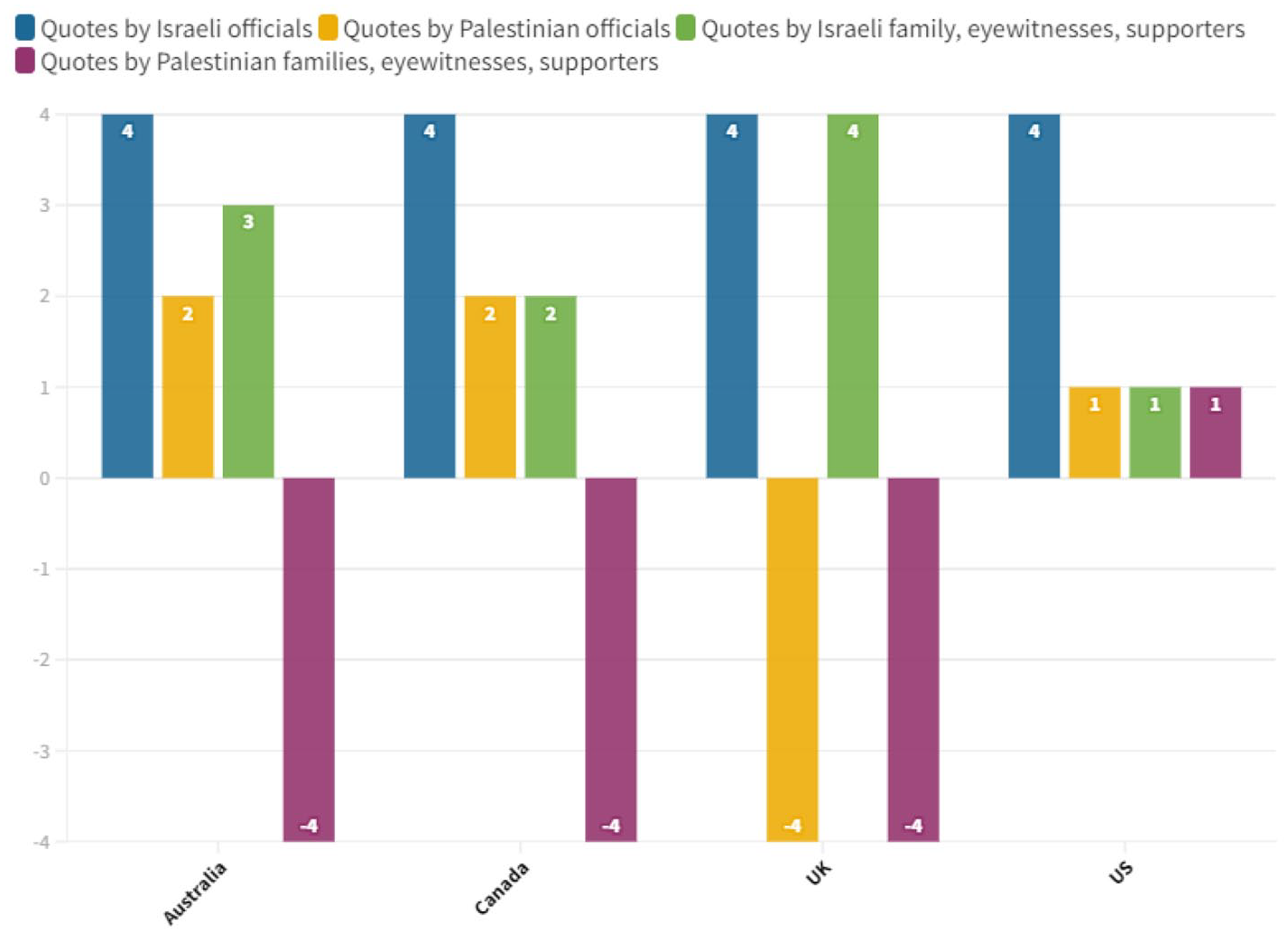
Identifying characters.
Narrative form and reader identification
The next illustration, Figure 2, shows that all 16 articles framed Palestinians as instigators of violence and terror while Israelis were presented as heroes, peace makers and victims of hate and violence. All 16 news outlets framed Israelis as victims or heroes fighting for their lives while Palestinians were presented as villains or instigators of terror attacks. When framed as victims, Palestinians were victims of their own culture or Islamic terrorist groups and not victims of the Israeli forces. USA Today framed Palestinians as instigators but also briefly covered the struggles of Palestinians at Israeli checkpoints, which was justified under ‘security measures to maintain peace’. The choice of supporting material was a story of an Israeli mother who carried a gun to protect herself from Palestinian violence. An additional hyperlink was connected to another article that talked about the violence and chaos caused by the Palestinian ‘Knife Intifada’ (Chabin, 2015). Australia’s New Daily highlighted the struggles of journalists who try to speak to Palestinians and cover their side of the story, stating that Israeli military forces make it very difficult for them to do their job and secure testimonies from Palestinians. That said, Palestinians were labeled as ‘Islamic terrorists’. Overall, the narrative in all stories frames Palestinians as ‘Muslim terrorists’ or ‘violent or brainwashed Arabs’ while readers are invited to identify with Israelis who are victims of Muslim extremists.
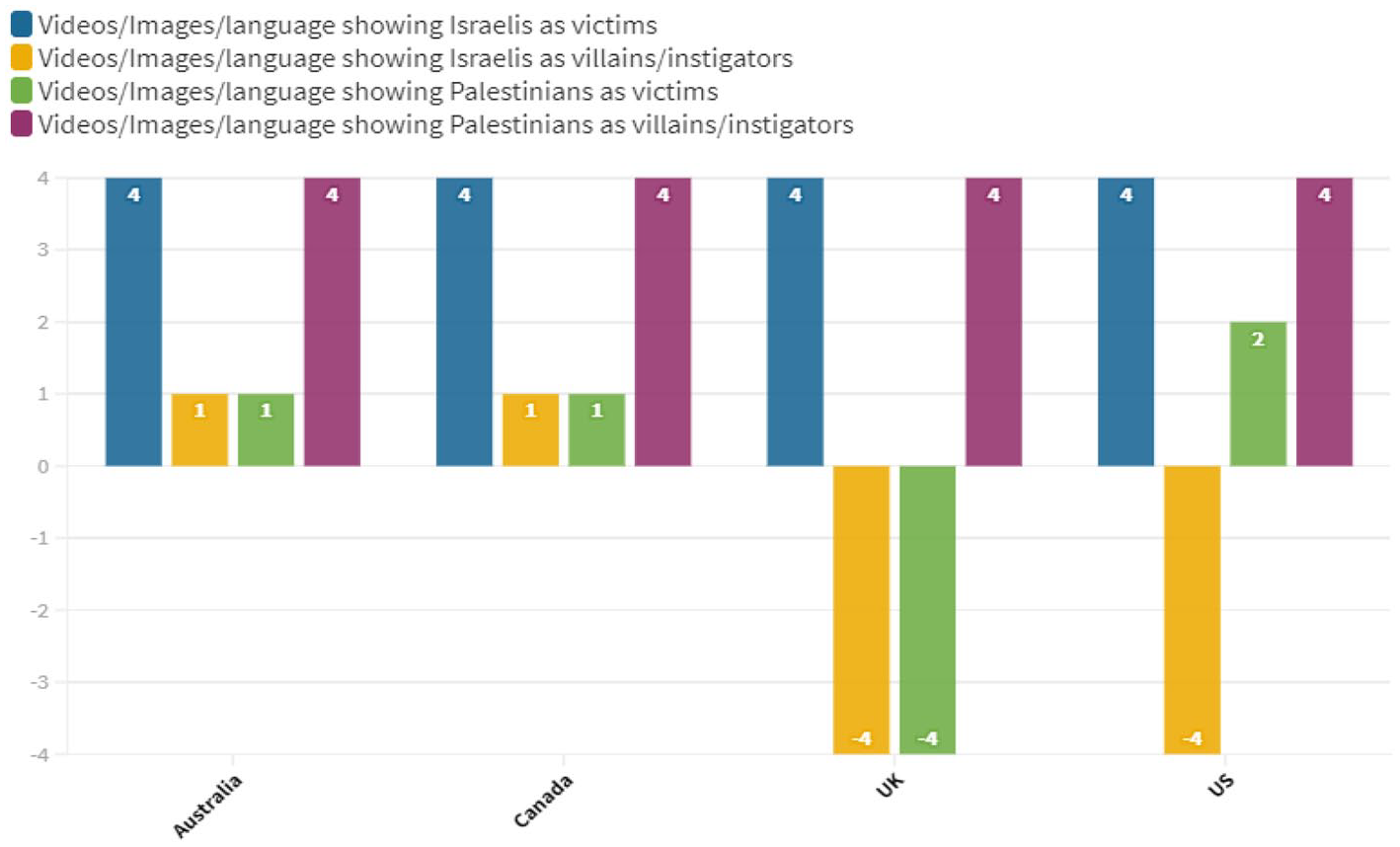
Narrative form and reader identification.
Analysis of language categories
Figure 3 shows the language categories examined within each article. This step in the analysis identified three categories: (1) Israelis who were framed as victims; (2) Palestinians who were framed as either terrorists or violent Arabs and anti-Semitic; and (3) the Intifada which was framed as a religious dispute inspired by Islamic extremists against Jews. In all 16 articles, the words associated with Israelis described them as ‘victims’, ‘peacemakers’, or ‘terrified citizens who want to live in peace’. The wording associated with Palestinians framed them as ‘Arab attackers’, ‘terrorists’, ‘extremists’, ‘Jihadists’, or ‘violent agents’. As for the language associated with the event itself, the description included ‘terror attack’, ‘stabbing attacks’, ‘Muslim terrorism’, or ‘anti-Semitic acts against Jews’. It is worth noting that none of the articles framed the IK as a direct result of the injustice Palestinians endure under an apartheid regime in Israel (United Nations Economic and Social Commission for Western Asia [UN-ESCWA], 2017).

Analysis of language categories.
Recurring themes
The last step in the MFA procedure is to summarize the recurring themes found across the 16 articles examined. The generalization of the data analyzed shows that all 16 articles included quotes from Israeli officials and only one article included quotes or interviews with family members of Palestinians who were killed or arrested by Israeli forces. In addition, 15 out of 16 articles framed Palestinians negatively, accusing them of violence or terrorism in the headline or subheading. As an example, ‘Palestinians set fire to Jewish shrine as man posing as journalist stabs soldier’ was the headline choice of The Sydney Morning Herald. Similarly, The Guardian’s headline was, ‘Two killed and two injured in Jerusalem during stabbing attack by Palestinian’. Additional generalizations found across the data set included Palestinians being described as ‘terrorists’, ‘violent Arabs’, or ‘anti-Semitic’ and a general oversimplification of the reasons behind the Intifada. All the articles presented the IK as a religious dispute fermented by Muslims who hate Jews. The Daily Mail published 16 almost identical images of the attack with the burning of Joseph’s tomb by Palestinians being a focus area. The choice of supporting material also included a hyperlink of US President Obama’s speech highlighting Israelis’ right to defend themselves in their homeland. Indeed, the analysis found that a dominant frame in the news articles that represented Arabs and, more specifically, Muslims as uneducated and oppressed by their own culture. This was evident in the USA Today article titled ‘Palestinian teen girls play bigger role in terror attacks on Israelis’, profiling the assailants as ‘brainwashed scarfed teenager Palestinian girls responsible for terror attacks’. The Daily Express, on the other hand, justified the separation wall, stating that it protects Israelis from ‘brainwashed Palestinian and suicide bombers’.
Omissions were also noted among the generalizations, including that none of the articles covered the illegal arrests and torture Palestinians endured in prison during the period under examination. Also, none of the articles described Israel as a colonial settler state and the Intifada being a direct result of the ongoing occupation of Palestine and the oppression of Palestinians. These omissions reinforced Israel’s assumed right to defend itself against Palestinian terror. Only one article by The News Daily referenced the censorship journalists are met with when they attempt to cover the Palestinian side of the story, but the reasons behind such censorship were omitted.
Discussion
The results provide clear evidence of the lack of representation of Palestinians and a dominant narrative that defends Israelis and justifies their brutality against Palestinians. While some articles did frame Palestinians as possible victims, they were framed as victims of their own culture that produces ‘Islamist terrorists brainwashing them to kill Jews’ and not victims of Israeli oppression. For example, The Daily Mail quoted President Obama who reinforced ‘Israelis’ right to defend themselves in their homeland while [he] labeled Palestinian violence as dangerous acts of hate against Jews’. Further, all the quotes attributed to Palestinians reinforced an Israeli narrative that supported the need for ‘peace talks initiated by Israelis’. Additionally, the results demonstrate that coverage of Western mainstream media still does not present challenging views to the Israeli colonialist narrative, which is also highlighted in the literature section that presents an historical trajectory of the framing of the First and Second Palestinian Intifadas. Historically, Palestinians were isolated and ignored, referred to as Arab refugees. When they took up arms in the Second Intifada, Palestinians were depicted as terrorists and, with time, we started seeing a change in the representation, framing Palestinians as victims of their own culture (Abdo, 2014; BreakThrough News, 2021).
As for the framing of the IK, it is important to note that none of the articles presented a critical analysis of the reasons behind the Intifada. The narrative deployed ignored the possibility that this Intifada was a direct result of ongoing discrimination, oppression, and escalating destruction of Palestinian neighborhoods; 11 out of 16 articles framed the Intifada as ‘acts of terrorism’. The description and language used included words like ‘terror attacks’, ‘attacks inspired by Islamic extremists’, ‘Jihadists’, ‘Muslim terrorists’, ‘Al Qaeda’, and ‘ISIS’. This representation reinforces a narrative that became dominant in news after the 9/11 attack when the US, supported by Israel and other Western countries, declared war on terrorism and more precisely on Muslims (Ross, 2011). As an example, framing the IK as a ‘terror attack’ was a consistent message in The Daily Mirror that started in the headline and was reinforced through two hyperlinks allegedly accusing Palestinians of further ‘terror attacks’ for carrying knives without citing any evidence that these knives were used.
Conclusion
The results demonstrate that coverage of Western mainstream media in the countries selected (the UK, the US, Canada and Australia), all of whom have roots in the British Empire that includes the colonial conquest of Palestine, continue to frame Palestinian Intifadas under a terrorism or anti-Semitism narrative. These countries have sustained a colonial approach, dispossessing the Palestinian people through continuing and justifying political, economic, and military relations with the Israeli apartheid regime (United Nations Economic and Social Commission for Western Asia [UN-ESCWA], 2017). This approach translates into framing in mainstream media that favors Israeli voices and censors Palestinian voices. These findings and results are consistent with previous research on the Palestinian Intifadas, confirming that Western mainstream media are more likely to frame Israelis as victims while framing Palestinians as terrorists or anti-Semitic (BreakThrough News, 2021; Deprez and Raeymaeckers, 2010; Ibrahim, 2003; Lacy, 2021).
This is part of a systematic approach to silencing and omitting Palestinian voices as demonstrated in the scholarship reviewed above. The silencing of Palestinian voices is evident in the headlines, the language, narrative and supporting material deployed in the articles examined, all of which amplify the Israeli point of view. The Globe and Mail quoted Israeli police officers, Israeli security officials, Israeli Prime Minister Benjamin Netanyahu, Israeli commentator Ben Caspit, and the Palestinian Health Ministry, all of whom supported the Israeli government narrative. The other characters referenced in the story were the victims, all of whom were Israelis, ‘Israeli troops, security, media, and the mentally ill Israeli assailant’. As for the instigators, or who did this to the victims, these were described as ‘Islamic group Hamas, Palestinian stabbers, Islamic head scarfed attacker, lone-wolf attackers’. Similarly, The Hamilton Spectator included quotes from Israeli eyewitnesses and Israeli victims’ family members. The remaining individuals referenced in the story were the victims described as ‘Israeli citizens, government, and Jewish society’. As for the instigators, who did this to the victims, these were ‘angry Palestinians, Arabs, stabbers, and attackers’.
The IK was framed by the majority of the articles as a religious dispute instigated by Palestinians. There was also no mention of the increase in illegal arrests, house demolitions, torturing and beating of Palestinian adults and children alike, or killing of accused Palestinians and abduction of their bodies that Israeli forces practiced during that period. Additionally, the illegal occupation of the Palestinian territories was not mentioned, and Israel was not described as a colonial settler project or an apartheid regime in any of the articles examined. As mentioned above, this omitted the historical context of settler colonialism and the facts of the illegal Israeli occupation of Palestine silence the indigenous narrative.
The results presented here report on 16 articles published by newspapers from countries that have colonial roots and common geo-political interests with Israel. The data however may have been different if other European countries, not associated with the British Empire or with diverging geo-political interests, and independent media or Palestinian-owned media that oppose the apartheid regime in Israel were included, thus this is an area for future research. In addition, all of the news articles from Canada and three of four of the articles from Australia were originally published by wire services, indicating another area of further study should investigate the political economy of newswires to understand how the ownership of wire services (such as Associated Press, Reuters, or Agence France-Presse) impacts the framing of Palestine in syndicated news. Analyzing which characters are quoted and what narratives are omitted in these articles in this study indicates that censorship of Palestinian voices and content is also another area that should be further examined in future research. In the recent May 2021 war on Gaza, social media platforms like Facebook and Twitter openly blocked activists’ accounts and practiced censorship on pro-Palestinian content (BreakThrough News, 2021; HRW, 2021; King, 2021). Also, during the war, journalists in Canada signed an open letter presenting their concern around media standards and the ban of using the word ‘Palestinian’ when covering the Israeli–Palestinian conflict (King, 2021; Lacy, 2021). Indeed, this article highlights that Western media continue to deploy an anti-Semitic or terrorist framing when representing Palestinians, which reinforces the need for further research to investigate these oppressive frames within coverage of the more recent war on Gaza in 2021.
Footnotes
Funding
The authors received no financial support for the research, authorship and publication of this article, and there is no conflict of interest.
