



Abstract
The fall of Kabul signified the termination of the democratically elected government in Afghanistan and reinstated the Taliban as the prevailing authority in the country. The ascension of the Taliban in Afghanistan holds significant importance considering the profound suffering experienced by both Afghanistan and Pakistan. This study looks at how well-known Pakistani and Afghan television channels, specifically Geo News, PTV News and TOLO News, covered the fall of Kabul in 2021 for eight days. The study utilizes content analysis as a research methodology. The authors’ primary aim was to determine if the selected television channels offered their viewers coverage of the event from a counterterrorism perspective, besides knowing if they covered it through the lens of high-ranking officials or from the perspective of local residents. The results indicate that the three chosen television channels did not prioritize the counterterrorism perspective in their coverage. Additionally, it is noteworthy that Pakistani TV channels covered the event from the standpoint of elite officials. Conversely, TOLO News, an Afghan media outlet, provided coverage from the vantage point of local individuals. The extensive coverage of such events carries significant implications for a nation such as Pakistan, where a substantial number of individuals lost their lives and the country incurred substantial economic losses amounting to billions of dollars in its efforts to combat terrorism. Furthermore, attaining public support is consistently pursued as a crucial component of a productive counterterrorism strategy aimed at eradicating militancy, extremism and acts of violence. This research study is informed by the theory of ‘priming’.
Keywords
Afghanistan has been a significant area of interest in regional and global affairs for several decades (Shafiq, 2016). The enduring impact of events in Afghanistan on the political, social, cultural and security aspects of the lives of their citizens for many years has led various regional and global powers to attach momentous significance to them (Jonegard, 2019; Rome, 2013; Stobdan, 1999). During the reign of Taliban, Afghanistan became a hub of extremist ideology and terrorist groups continued conducting their activities within its borders (Rashid, 1999; Rubin, 1999). The September 11, 2001, events significantly impacted the political and social landscape of the region and the world (Milewski et al., 2021).
Pakistan has served as a vital ally of the US in the global fight against terrorism and has suffered significant losses (Jamal, 2021). Specifically, the country has experienced the loss of 83,000 lives and a substantial economic impact of 252 billion dollars (Pasha, 2018). According to researchers, the emergence of various terrorist organizations and splinter groups in Pakistan and the implementation of different military operations can be attributed to the country’s initial support for and subsequent rejection of the Taliban (Fair, 2009). This shift in stance by Pakistan towards the Taliban led to a change in the dynamics on the ground, inspiring other groups to adopt similar ideologies and resulting in significant bloodshed within the country (Shah, 2007). The nation has experienced numerous military operations that have led to elimination of terrorists, forced displacement of civilians from their places of origin and various other forms of hardship (Yamin, 2015).
Despite the military high-ups’ repeated claims of having dismantled the backbone of the Taliban, the country has experienced indiscriminate assaults from the Tahreek-e-Taliban-e-Pakistan (TTP) and other splinter factions. The first National Internal Security Policy of Pakistan, as released by the Interior Ministry of Pakistan, asserts a strict stance against any group that advocates for violent and terrorist activities (NACTA, 2014). The Pakistani government released a roster of proscribed entities within the country and disseminated it through various media channels to promote public cognisance (NACTA, 2018).
The 15 August 2021 event holds great significance as it marks the resurgence of the Taliban as the dominant governing power in Afghanistan, having forcefully overthrown the democratically elected government of Ashraf Ghani (Murtazashvili, 2022). There were concerns regarding the potential acceleration of extremism in Pakistan and the surrounding region, as various splinter groups operating under the influence of the Afghan Taliban may once again gather support and launch attacks against Pakistan with similar fervour and potency (Kaura, 2022;Mir, 2022). There were concerns regarding the difficulty of achieving a peaceful future in light of the presence of the Taliban in the vicinity (Threlkeld and Easterly, 2021; Zhou, 2022).
Shockingly, on the ground, a large number of Pakistanis expressed support and enthusiasm for the Taliban after they took control of Kabul in 2021. According to the survey carried out by Gallup Pakistan, 55 percent of Pakistanis expressed happiness with the Taliban’s control in Afghanistan, while 25 percent expressed discontent and an additional 16 percent remained uncertain
Various scholars have emphasized the significance of mass media in raising public awareness regarding governmental policies (Koser, 2017). Mass media can effectively educate and shape individuals’ perspectives on various topics through the strategic employment of media channels (Al-Dmour et al., 2022; Wang and Zhou, 2021). This research endeavour aims to examine the events surrounding the fall of Kabul as reported by the major media outlets in Pakistan and Afghanistan. The study seeks to ascertain the specific areas of emphasis by the selected Pakistani and Afghan television channels in the aftermath of the Taliban’s resurgence in Afghanistan. The inquiry pertains to whether the counterterrorism perspective was employed to communicate the potential resurgence of extremism or terrorism in Pakistan or the surrounding region and whether the potential ramifications of such an event on the populace were underscored for viewers. Moreover, it aims to provide insight into the perspective from which the event was covered, whether from the vantage point of high-ranking officials or the local populace, by elucidating the effects of the Taliban’s resurgence on their daily lives.
The following are the research questions answered in this research study:
Q1: What did the selected TV stations underline to viewers in the introduction and body of their primetime news bulletins following the fall of Kabul in 2021?
Q2: Did the selected TV channels cover the Taliban’s return following the fall of Kabul in 2021 from a counterterrorism standpoint?
Q3: Did the selected TV channels cover the Taliban’s return to power following the fall of Kabul in 2021 from the perspective of elite officials or the general public?
Literature review
The significance of media in the contemporary political landscape has increased exponentially. Several prominent researchers, such as Dahlgren (2009) and Baum (2005), argue that the mass media can influence individuals’ understanding of fundamental political matters. The perspective has garnered endorsement from numerous scholars in mass media studies, such as Becker (2009) and Martin (2008), who assert that it possesses the capacity to shape public opinion by altering individuals’ perceptions of various political matters, thereby allowing them to reassess their position on such matters.
Scholars such as Al-Rfough (2005) and Bloch-Elkon and Nacos (2014) have underscored the significance of mass media in countering terrorism. It is achieved through raising public awareness of the state’s security policies and garnering support from the populace. Mass media outlets are also recognized for educating the public on the root causes of terrorism and identifying the responsible actors. Similarly, according to McTernan et al. (2023), television news can be considered a form of adult education to make people aware about the different issues. According to Al-Rfough (2005), it is imperative for mass media platforms to incorporate the insights of specialists to elucidate prevailing national security concerns to the general public effectively.
Ford (2020) asserts that the efficacy of counterterrorism policies implemented by the government operates on multiple levels. The process encompasses acquiring and disseminating intelligence, community involvement, incident response, de-radicalization and post-incident management of terrorist activities. Various terrorist groups depend on mainstream media platforms to enhance their public image. The government must take measures to counteract these individuals and expose their true identities to the populace (Ford, 2020).
Wilkinson (1997: 59) emphasizes that media and political leaders can influence public opinion about any violent group by facilitating the exhibition of its true nature by displaying its barbaric tendencies and transgressions against human rights and the laws of warfare. He also stresses that media entities ought to furnish a platform for examining the societal and political ramifications of terrorism (p. 60).
Scholars such as Chan (2007) and Han and Yu (2005) have engaged in discourse regarding the significance of public opinion within societies. They posit that public opinion holds considerable sway during times of crisis and, as such, effectively managing and directing public opinion can serve as a means of controlling the situation. Therefore, D’Souza (2009) asserts that governments exercise caution while disseminating information through media channels to influence public sentiment in their favour.
Theoretical framework
This research study is guided by the ‘priming’ theory, which was introduced by Iyengar and Kinder (1987). The theory emphasizes the potential of mass media to shape the criteria for evaluating candidates seeking public office or state policy by selectively emphasizing certain aspects while disregarding others. The selective coverage of mass media outlets, whereby certain aspects are emphasized while others are ignored, significantly impacts individuals’ perceptions. According to Weaver (2007) and other scholars, media coverage highlighting specific issues or attributes related to a problem can influence public opinion. According to Natarajan (2020: 210), the ‘priming‘ theory provides further evidence that mass media messages can potentially shape the audience’s perceptions of various groups, ideas, or policies depicted on television.
Cicchirillo et al. (2015) discuss another facet of the ‘priming’ theory, suggesting that it can expedite an audience’s cognitive and affective responses based on prior media exposure. According to their perspective, priming involves the activation of a specific node within a network, which subsequently contributes to forming an audience’s judgement regarding a given issue. According to Weiss (2009: 32), the recurrence and emphasis placed on a media message about a particular matter can influence our cognitive processing of said matter. Natarajan (2020) acknowledges that media messages become ingrained in the audience’s minds, thereby influencing the formation of future judgements regarding individuals or issues. According to Weiss (2009), the formation of our attitude towards those issues is a consequence of it. The author posits that such coverage elevates the topic to a prominent position at the forefront of active cognition. The information is readily accessible to the memory, resulting in faster recollection. According to Natarajan (2020), mass media can influence the emotions of its audience in a manner that aligns with the media’s intended message.
Based on the preceding discourse, the investigators employed the ‘priming’ theory in the present research investigation to ascertain the thematic emphasis of the chosen television channels in their coverage of the 2021 fall of Kabul and any themes that were not emphasized. An analysis of the coverage provided by selected television channels could aid in comprehending the potential perceptions held by viewers in Pakistan and Afghanistan regarding the event. The researchers would also ascertain whether such media coverage is conducive to the efficacious implementation of the state’s counterterrorism and counter-extremism policy.
Research framework
The researchers chose three television channels from Afghanistan and Pakistan for the intended purpose on the basis of their resourcefulness, popularity and reach with the audience. The selection comprises Geo News, PTV News (originating from Pakistan) and TOLO News (originating from Afghanistan). The researchers tried to examine the coverage of one more Afghan news channel; however, the availability of its news bulletins could not be ensured, despite contacting officials of many Afghan TV channels. It is also pertinent to mention that, after the fall of Kabul, none of the newspapers updated their online page or even published a newspaper. The researchers constantly monitored their websites and even requested Afghan students to visit their head offices in Kabul to collect the hard copies of the newspapers – but they were all shut down.
The three chosen television channels are 24/7 news and current affairs channels that are popular in their respective nations. Geo News is Pakistan’s inaugural privately-owned television network, considered highly resourceful (Media Landscapes, 2017), and it also boasts a higher viewership than any other television channel in the country (Similarweb, 2023). Geo News is the only TV channel in Pakistan that sent three reporters to Kabul to cover the fall of Kabul from Afghanistan – thus having boots on the ground.
In contrast, PTV News is the state-owned broadcasting corporation in Pakistan, boasting a wider terrestrial reach than other (private) television channels (BBC, 2023; Freedom Network, 2018). The phenomenon in question is predominantly observed in rural regions of Pakistan, where individuals have low access to dish antennas, cable networks, or internet connectivity. Thus, the coverage of PTV News matters greatly in sharing the narratives with the people.
TOLO News is a widely recognized television network in Afghanistan that boasts a more extensive audience share than any other news outlet (Mohseni, 2021). TOLO News is widely recognized for providing reliable coverage of various events and issues, which many appreciate.
The researchers chose a singular primetime news broadcast from each television network – the 9 pm Khabarnama of PTV News, the flagship bulletin of Geo News at 9 pm and the News Hour of TOLO News at 10 pm – and analysed its substance. They examined, coded and analysed all news stories containing the terms ‘Kabul’, ‘Afghan’, ‘Afghanistan’, ‘Taliban’, ‘Talib’ and ‘Doha Agreement’ that appeared in any order within the bulletin.
Various scholars assert that it is imperative to choose a period for analysis that accurately reflects the characteristics of the sample (for example, Erlingsson and Brysiewicz, 2017). Thus, the investigators examined the media reporting spanning from 15 August 2021 to 22 August 2021. On 15 August 2021, Kabul experienced a significant event, and the researchers conducted a study on the media coverage of this event from the day of its occurrence until one week later. It is significant to mention that, initially, researchers attempted to look at the event’s coverage for two weeks. However, the news bulletins of TOLO News were not available on the TV channel’s website or even on their YouTube channel. The Director of News of TOLO News was also contacted, but in vain. Given that this research study is centred on the coverage of a singular event, the researchers acknowledge that analysing the initial eight consecutive days of coverage is sufficient as, with time, there is a decline in the frequency of news in all three TV channels.
Research methodology
The researchers employed content analysis as a research methodology to examine the reporting of the events surrounding the fall of Kabul in 2021. Maier (2017) defined content analysis as ‘A quantitative process for analyzing communicative messages that follow a specific process… to determine the frequency of specific ideas, concepts, terms and other characteristics and make comparisons to describe or explain communication content.’ She argues that content analysis facilitates the comprehension of the frequency with which a specific topic is referenced. Holsti (1969) highlights the significance of content analysis in identifying the occurrence of specific words, themes, or concepts within a given text. Hansen et al. (1998: 95) provides a comprehensive definition of content analysis as a quantitative method that emphasizes the identification and enumeration of specific characteristics or dimensions of text. This approach enables researchers to draw conclusions about the messages, images and representations conveyed by the text and their broader social implications.
The researchers employed content analysis to identify the themes or topics discussed in the introduction and body of selected TV news stories in the designated time frame. The researchers designed the coding sheet for data collection, containing the variables ‘theme discussed in the introduction of news stories’ and the ‘first two additional themes discussed in the body of news stories’. The researchers manually wrote down the discussed themes in the introduction and body of stories in the coding sheet, which was applied separately for each selected TV news story. Once the data was collected, all the data was entered into SPSS, and all the relevant themes were clubbed together into another category of broader theme(s). Thus, a total of 11 broader themes emerged in the coverage that has been produced in the tables below. In the end, the researchers analysed the data to demonstrate what was more and less emphasized.
Findings and discussion
The findings of this research study are presented in two sections. The first section provides information about the themes (topics or narratives) discussed in the introduction of news stories. In contrast, the second section focuses on the first two additional themes (topics or narratives) discussed in the body of news stories.
Section 1: Main theme discussed in the introduction of news items
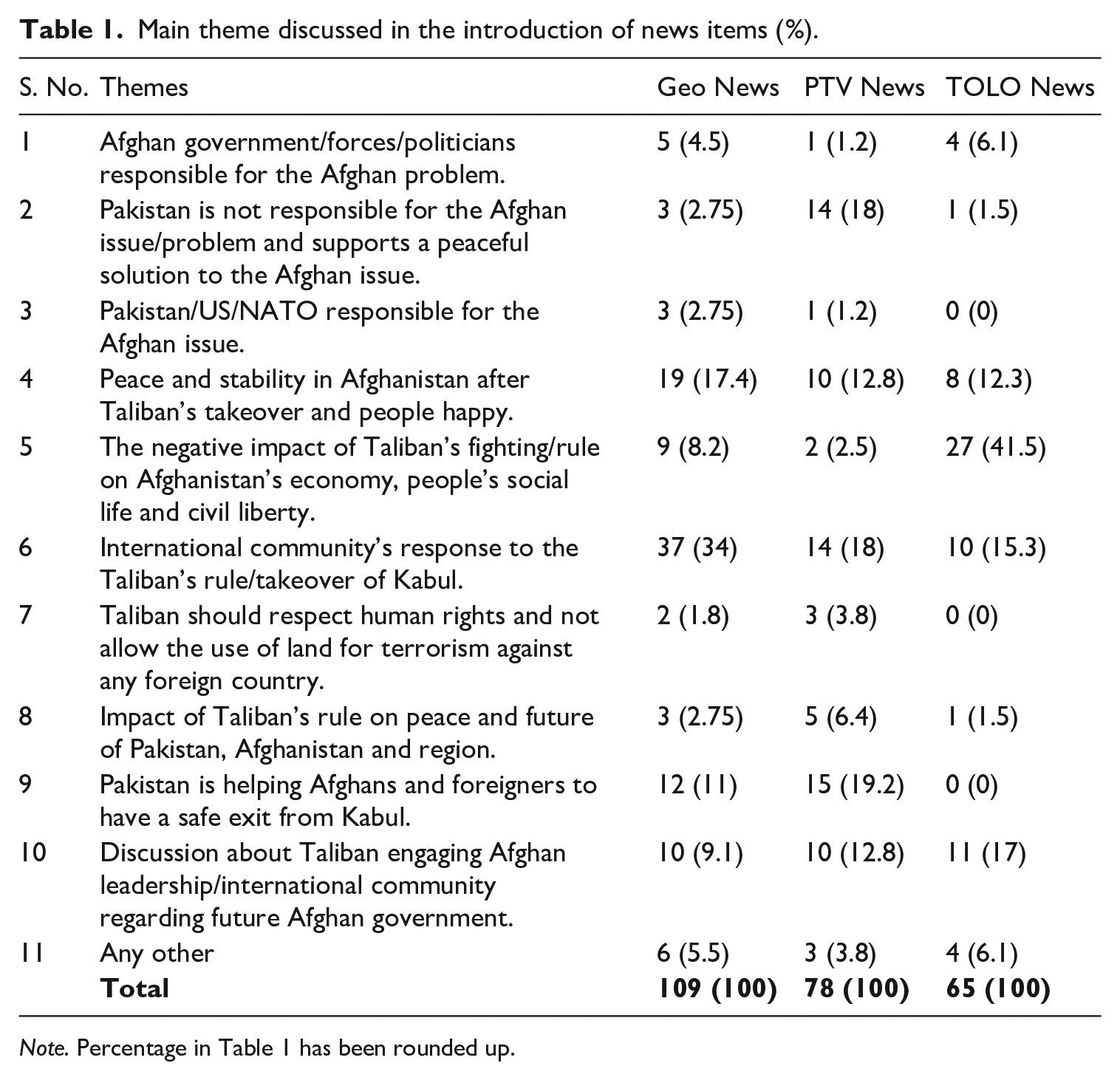
This section provides a discussion of themes (or narratives) in the introduction of news items (see Table 1).
Main theme discussed in the introduction of news items (%).
Note. Percentage in Table 1 has been rounded up.
The results in Table 1 indicate that Geo News prioritized the global community’s reaction to the Taliban’s rule and seizure of Kabul in their reporting, constituting 34 percent of the total thematic discourse in their introduction. The news coverage of Geo News primarily focused on the statements made by prominent foreign officials such as the US President, UK Prime Minister, Russian President, Indian Prime Minister and other high-ranking officials from various countries regarding the Taliban’s seizure of Kabul and their rule in Afghanistan. The second contentious theme, constituting 17.4 percent of the Geo News coverage, pertained to the assertion that Afghanistan had achieved peace and stability after the Taliban assumed power and that the populace was content. The television channel conveyed to its audience that Afghanistan is experiencing a state of tranquility after the Taliban’s resurgence to authority, and the populace is content with their return. The third contentious theme, making 11 percent coverage of Geo News, pertained to the provision of services by the Pakistani government to facilitate the safe evacuation of Afghans and foreign nationals from Kabul.
Interestingly, Geo News highlighted the adverse effects of the Taliban’s combat and governance on Afghanistan’s economy, societal norms and civil liberties, which constituted 8.2 percent of the total coverage. Despite the figures not being statistically significant, they still indicate the level of concern exhibited by a prominent private broadcaster in Pakistan towards the citizens of Afghanistan. The reportage by Geo News not only accommodated the viewpoints of high-ranking officials, both domestic and foreign, regarding the Taliban’s arrival but also underscored the impact of the Taliban on the populace of Afghanistan. The evidence suggests that Geo News knew about the unfolding events in Afghanistan and the challenges faced by individuals there.
Conversely, the coverage of Geo News features relatively little discussion of certain themes. Specifically, only 1.8 percent of the total coverage of themes in the introduction pertains to the expectation that the Taliban will uphold human rights and prevent the utilization of Afghan territory for terrorist activities. The implication is that Geo News failed to prioritize the emphasis on the Taliban’s obligation to prevent the utilization of Afghan territory for acts of terrorism in any foreign nation, as they had done previously. The coverage of Geo News also encompasses lesser-discussed themes, such as examining the potential ramifications of the Taliban’s governance on Pakistan, Afghanistan and the surrounding region. This topic constituted 2.75 percent of the overall coverage. The statement suggests that Geo News did not perceive the Taliban as a potential menace to Pakistan or the surrounding areas.
The analysis of PTV News reveals that the news outlet prioritized the perspective of the Pakistani government in their coverage. Specifically, the news outlet emphasized the efforts of the Pakistani government in facilitating the safe evacuation of Afghans and foreigners from Kabul, constituting 19.2 percent of the total coverage of themes. The subsequent section of the analysis pertains to the coverage of two additional themes, which account for 18 percent of the total coverage each. These themes include an examination of the international community’s response to the fall of Kabul, as well as an emphasis on the narratives within the coverage that absolve Pakistan of responsibility for the Afghan issue and advocate for a peaceful resolution. PTV News underscored the Pakistani government’s provision of services to Afghan and foreign nationals while also emphasizing the official responses of Pakistan and the international community to the Taliban’s assumption of power and the fall of Kabul. The analysis reveals that PTV News predominantly presents an account of the events surrounding the collapse of Kabul from the vantage point of government officials to both domestic and global viewership. Moreover, they have strengthened the discourses of tranquility and stability in Afghanistan after the resurgence of the Taliban.
The coverage of PTV News has been found to place relatively less emphasis on certain themes, such as the potential impact of the Taliban’s fight and rule on Pakistan, Afghanistan and the wider region. Specifically, this topic accounted for only 6.4 percent of the total coverage. PTV News did not perceive the Taliban as a prospective menace to Pakistan or the surrounding area, which may have accounted for their propagation of pacifist accounts about the group. The analysis reveals that the discussion about the Taliban’s obligation to uphold human rights and refrain from permitting the utilization of Afghan territory for acts of terrorism in foreign nations was a topic that received relatively limited attention, constituting only 3.8 percent of the total coverage. Similarly, the theme highlighting the adverse effects of the Taliban’s conflict and rule on Afghanistan’s economy, social fabric and civil liberties was also among the least discussed, accounting for 2.5 percent of the overall coverage. The analysis indicates that PTV News prioritized disseminating official versions over counterterrorism coverage and public perspectives.
The results indicate that TOLO News, Afghanistan’s inaugural round-the-clock news and current affairs channel, primarily emphasized the adverse effects of the Taliban’s combat and rule on the nation’s economy, societal interactions and civil liberties, accounting for 41.5 percent of the overall coverage. The prioritization of the Afghan populace’s plight in the aftermath of the Taliban’s ascension was of greater significance to TOLO News. The closure of various institutions and government offices, as well as the impact of the Taliban on the Afghan economy, were emphasized.
The research outcomes indicate that the second theme, extensively discussed in TOLO News, making 17 percent of the overall coverage, pertained to the endeavours of the Taliban to initiate communication with either the Afghan leadership or the international community regarding the prospective Afghan government. This observation suggests that the Taliban’s diplomatic and democratic persona was prominently displayed on Afghanistan’s privately-owned broadcasting network. The third most prominent topic of discussion pertained to the international community’s response to the Taliban’s assumption of power in Kabul. This theme constituted 15.3 percent of the overall coverage, albeit falling short of the coverage provided by the two Pakistani television channels under consideration. The coverage by TOLO News prioritized the perspective of local individuals, followed by an examination of the Taliban’s efforts towards the future Afghan government, and concluded with the perspective of high-ranking officials.
It is noteworthy that TOLO News failed to mention in its coverage that the Taliban must refrain from permitting the use of its territory for terrorist activities in foreign nations. Their coverage was notably lower than that of Geo News and PTV News, accounting for only 1.5 percent of the total coverage. The analysis indicates that TOLO News did not provide coverage of the fall of Kabul through the counterterrorism lens and did not acknowledge the potential threat posed by the Taliban to the stability of Pakistan, Afghanistan, or the region.
The above findings indicate that TOLO News provided coverage of the fall of Kabul from the viewpoint of local individuals, with Geo News following suit. However, PTV News could have provided comprehensive coverage from the perspective of the populace. Additionally, the results indicate that the viewpoint of the global elite officials held sway across all three designated television channels, with Geo News placing a greater emphasis on this perspective. Additionally, the results indicate that the three chosen television channels did not cover Kabul’s fall from a counterterrorism standpoint. Furthermore, they did not view the Taliban as a potential threat to Pakistan, Afghanistan, or the surrounding region.
The preliminary analysis, based on the coverage of Geo News in the introduction of the stories, indicates that it may not effectively fulfil the informational needs of the Pakistani populace as it appears to lack comprehensive guidance on the emergence of the Taliban and its potential ramifications on various aspects of their lives, including social, political and cultural domains. It was imperative that the adverse impact of the Taliban on the Pakistani populace should have been emphasized as they mentioned the negative impact on the Afghan populace. It is imperative to note that Pakistan suffered the most severe consequences of the War on Terror after it collaborated with the US in its campaign against terrorism.
The coverage provided by PTV News is deemed unfavourable towards the Pakistani populace due to its lack of emphasis on the potential implications of the Taliban’s resurgence on Pakistan and the surrounding region. Additionally, the broadcaster fails to prioritize the counterterrorism perspective in its reporting. Pakistan has endured a tumultuous period marked by severe militancy and terrorism, which has been attributed to the backlash of Taliban and extremist factions in Afghanistan, as well as the tribal districts of Pakistan. It was anticipated and necessary for PTV News to have discerned the emergence of the Taliban and the resurgence of TTP in Afghanistan, which remains a fundamental concern for Pakistan and a point of contention between Afghanistan and Pakistan.
TOLO News coverage serves the Afghan populace by bringing attention to various issues such as the closure of government offices and educational institutions, concerns of Afghan women regarding their future, the presence of the Taliban, protests across Afghanistan demanding action from the Taliban, the dire state of the Afghan economy since the Taliban’s rise to power and the Taliban’s agenda of lawlessness and retribution. The study’s results indicate that TOLO News provided a more comprehensive depiction of the prevailing circumstances in Afghanistan. However, the news outlet did not prioritize the dissemination of counterterrorism viewpoints to its Afghan audience. It is imperative to recall that the populace of Afghanistan underwent significant hardship after the Taliban’s sanctioning of Al Qaeda and other extremist groups to conduct operations within the country.
As previously noted, Weaver (2007) has observed that mass media channels utilize the technique of priming to emphasize certain attributes, rendering them more salient and accessible for forming opinions on a given issue. The assertion is corroborated by scholars such as Scheufele and Tewksbury (2006), who posit that ‘priming’ can facilitate individuals in their decision-making processes pertaining to various matters. Considering the findings above, it can be inferred that the coverage of the fall of Kabul on prominent television channels in Pakistan and Afghanistan did not facilitate the formation of a comprehensive perspective among the Pakistani populace regarding the resurgence of the Taliban in Afghanistan and its potential ramifications for the neighbouring countries and the wider region.
Section 2: First additional two themes discussed in the body of a news story
This section provides information about the first two additional themes discussed in the body of a news story aired on the three selected TV channels. There is a strong possibility that the selected TV channels’ coverage in the body of a story, which may be the package, live reporting, interaction with experts, or even a table story, might be different from their introduction.
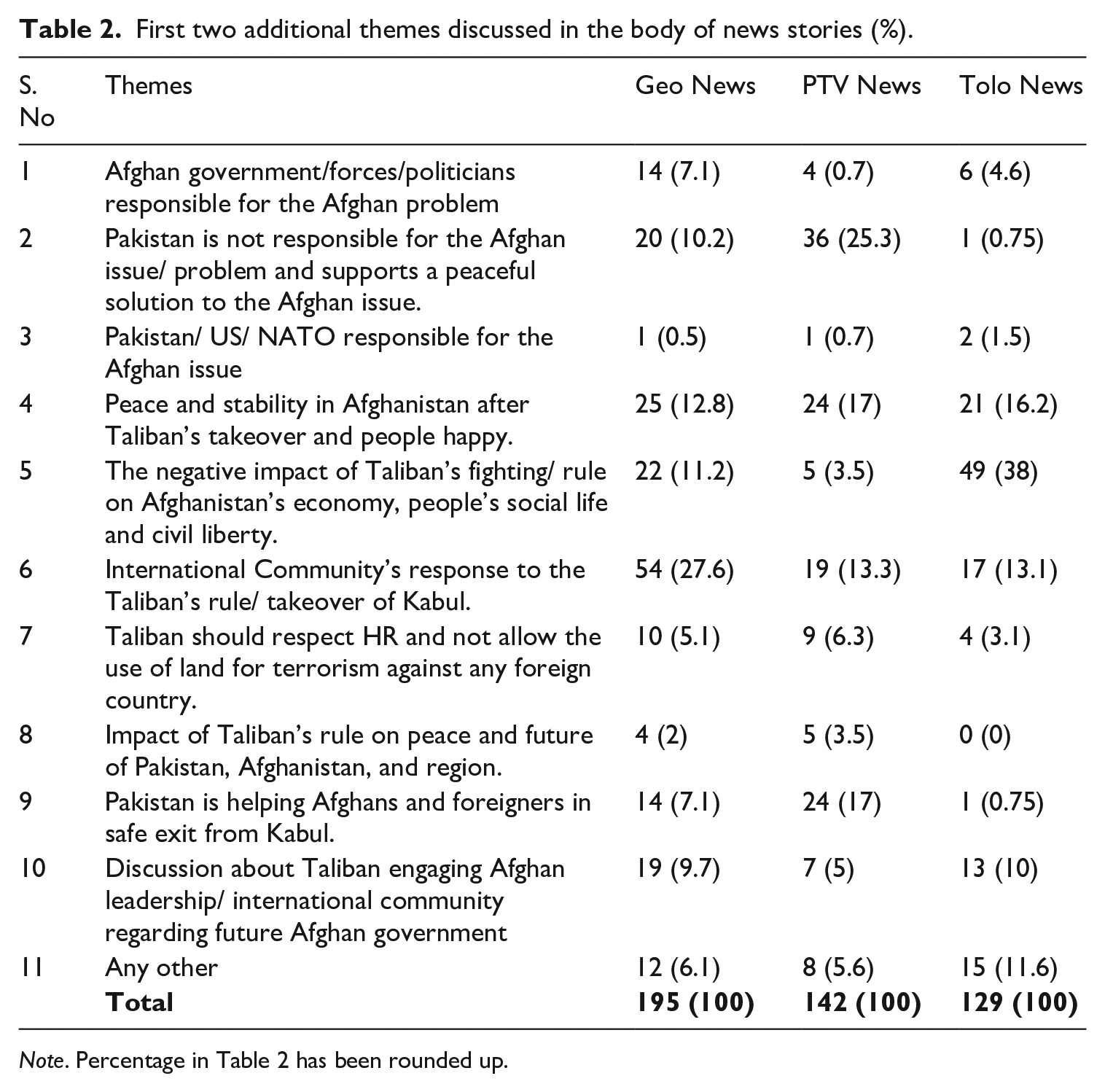
The findings can be seen in Table 2 below.
First two additional themes discussed in the body of news stories (%).
Note. Percentage in Table 2 has been rounded up.
The results in Table 2 indicate that the coverage of Geo News remained consistent throughout the study. Notably, the news stories about the international community’s response to the fall of Kabul received the highest coverage (27.6%), followed by narratives highlighting the perceived peace and stability in Afghanistan following the Taliban’s takeover and the resulting happiness of the people (12.8%). Additionally, news stories highlight the adverse effects of the Taliban’s fighting/rule on Afghanistan’s economy, people’s social life and civil liberty (11.2%).
Conversely, the themes that received less emphasis in Geo News’s coverage were the discourse about the Taliban’s demand to prohibit the utilization of Afghan territory for acts of terrorism in Pakistan or any other foreign nation, constituting a mere 5.1 percent of the coverage. Additionally, the coverage that underscored the ramifications of the Taliban’s rule on the future of Pakistan, Afghanistan, or the region was only allotted 2 percent of the coverage.
These findings indicate that, although Geo News allocated more airtime to the reactions of prominent national or international figures, the network did prioritize the viewpoint of the Afghan populace by accentuating the repercussions of the Taliban’s governance on their lives. The Pakistani media’s responsible approach is demonstrated by their examination of the issue from the viewpoint of local individuals, in addition to conducting a national and global analysis. Nevertheless, it is concerning that Geo News failed to approach the event from a counterterrorism standpoint, which would entail urging the Taliban to prevent the exploitation of Afghan territory for acts of terrorism against Pakistan. Nevertheless, after the ascension of the Taliban as the rulers in Kabul, they predominantly disregarded it. Moreover, Geo News failed to acknowledge the potential threat posed by the Taliban to Pakistan or the wider region.
The analysis indicates that Geo News exhibited a greater degree of favourable disposition towards the Taliban than the democratically elected administrations of Ashraf Ghani and Hamid Karzai. The statement implies that the Taliban was viewed through a solution-oriented lens rather than problem-oriented thinking. The findings suggest that Geo News exhibited a more significant concern for Afghanistan’s citizens than Pakistan’s citizens. The channel emphasized the impact of the Taliban’s governance on the local populace in Afghanistan while failing to address the potential consequences for the people of Pakistan or the surrounding region. They disregarded the potential threat posed by the Taliban. It is imperative to recognize the potential threat that the Taliban may pose to Pakistan and the wider region. Given the media’s significant role in shaping public opinion, the government and television channels must address these issues and provide accurate and timely information.
Based on the coverage of PTV News, the study’s results indicate that it emphasized Pakistan’s official stance regarding the fall of Kabul. Specifically, it conveyed to its viewers that Pakistan bears no responsibility for the event and advocates for a peaceful resolution (25.3%). The subsequent discourse pertains to Afghanistan’s prevailing peace and stability after the Taliban assumed power – approximately 17 percent of the discussion centres on the populace’s contentment with the current situation. Additionally, there is a discussion regarding the Pakistani government’s provision of services to foreign nationals, particularly Afghans, to ensure their safe evacuation from Kabul, constituting 17 percent of the discourse.
Conversely, it is noteworthy that the PTV News allocated a relatively lower proportion of its coverage, specifically 6.3 percent, to the imperative that the Taliban refrain from permitting the exploitation of Afghan territory for terrorist activities in any foreign nation, including Pakistan. Notably, the adverse effects of the Taliban’s governance and conflict on Afghanistan’s economy, social fabric and civil liberties constituted 3.5 percent of the overall discourse on the subject matter. Furthermore, the potential ramifications of the Taliban on the future of Afghanistan or Pakistan appear to receive a mere 3.5 percent of media coverage.
The results indicate that PTV News prioritized the elite national and international viewpoint over the local populace’s perspective in their coverage. The text highlights that the counterterrorism aspect related to the Taliban’s arrival following the fall of Kabul was understated, and the Taliban was viewed as a potential threat to Pakistan or the surrounding area. PTV News boasts the most extensive terrestrial coverage among all Pakistani television channels. However, it would have been more advantageous if the coverage had approached the fall of Kabul from a perspective that would have allowed viewers to comprehend the implications of the Taliban’s arrival on their lives or future. Given that the operations of PTV News are under the purview of the governing administration, adherence to the state’s policies is the predominant determinant for such coverage. However, this media coverage can limit individuals’ comprehension of an occurrence by excluding various accessible and observable viewpoints.
The results of the analysis of TOLO News’ coverage indicate that a significant portion, namely 38 percent, of the discourse focused on the adverse effects of the Taliban’s governance on Afghanistan’s economy, social fabric and civil liberties. The second topic that garnered significant attention, 16.2 percent of the coverage, was the discourse surrounding peace and stability in Afghanistan after the Taliban assumed power. The third most prominent topic of discussion, accounting for 13.1 percent of the overall coverage, pertained to the international community’s response towards the fall of Kabul.
The coverage of TOLO News gave relatively less attention to certain themes, such as the Taliban’s demands regarding the prohibition of Afghan land for terrorist activities (3.1%) and the potential implications of the Taliban’s governance on the future of Afghanistan, Pakistan and the wider region (0%). The coverage by TOLO News indicates a greater emphasis on the perspective of local individuals than that of the national or international elite. The previous observation suggests a lack of coverage of the event from a counterterrorism standpoint and a failure to acknowledge the potential threat posed by the Taliban to the stability of Afghanistan, Pakistan, and the surrounding region. This indicates that the current disturbances in individuals’ daily routines after the Taliban’s arrival were emphasized.
Price et al. (1997) posit that the mass media can enhance the salience of particular issues, consequently impacting the cognitive processes involved in individual decision-making. The findings suggest that the selected television channels in Pakistan preferred the viewpoint of the privileged stratum in their coverage of the Taliban’s takeover of Kabul and its subsequent developments. The study’s findings suggest that the selected television channels in Pakistan and Afghanistan did not give precedence to the counterterrorism perspective in their coverage. This is evidenced by their failure to provide context to the actions of the Taliban and to educate their viewers on the consequences of their governance in Afghanistan for Pakistan, the broader region, or to explicitly demand that the Taliban refrain from using Afghanistan as a base for terrorist activities in foreign countries. The researchers assert that such media coverage is not advantageous to the effectiveness of the government’s counterterrorism strategy, as well as failing to promote a favourable outlook on domestic and international occurrences among the general public.
Conclusion
Media institutions play a crucial role in society by disseminating information to the public regarding various current events and issues. They show the existence of events in society and help people understand them from their own perspective. Consequently, discourse about media facilitates individuals in comprehending an event or matter accurately, formulating a rational viewpoint and arriving at an appropriate conclusion.
The expert analyst acknowledges that neglecting to examine the Taliban through the lens of counterterrorism or failing to recognize their potential to disrupt regional stability and peace warrants the consideration of media proprietors, policymakers and scholars. The Pakistani government’s historical practice of differentiating between ‘good’ and ‘bad’ Taliban has been the subject of ridicule by various critics (Marwan, 2015). This differentiation persists, as evidenced by the media coverage of Geo News and PTV News. Government officials in Pakistan have repeatedly emphasized their firm stance against terrorism and extremism within the nation and surrounding areas. As mentioned above, this policy must be duly reflected in the coverage, particularly in light of the abrupt change in government in Afghanistan. According to the data, Pakistani television channels have tended to approach the topic of the Taliban from a solution-oriented perspective instead of a problem-oriented perspective. The Taliban were regarded as the inherent rulers of Afghanistan instead of being perceived as coercive rulers.
Pakistan has been severely affected by terrorism and extremism in the region, significantly negatively impacting the country’s economic and social well-being. Media outlets provided continuous coverage of various terrorist incidents and analysed the shortcomings in the governing administration’s counterterrorism policies aimed at promoting peace. Media organizations needed to distance themselves from the narratives of the ruling government and instead advocate for the populace’s safety, security and improved future. Both Geo News and PTV News failed to capitalize on the opportunity to present a compelling argument for improving public perception regarding counterterrorism efforts within the nation.
The findings suggest that media entities within Pakistan are inclined to contribute towards the efficacious implementation of the government’s strategy to combat extremism or terrorism within the nation (Hussain et al., 2021; Salman, 2020). In such instances, it would be advisable to revise the existing policy and train reporters to adopt a localized perspective rather than one influenced by national or international elites. Media organizations have the potential to effectively educate individuals and foster informed perspectives regarding terrorism, including the perpetrators, victims and associated consequences.
Geostrategic politics play a significant role in the complex Pak–Afghan relations, which significantly influence the media coverage of Pakistani TV channels. There is a deep feeling of insecurity among the Pakistani establishment about having an elected and stable government in Afghanistan; as such, government has always sought better relations with India, which remains a concern for Pakistan (Fair, 2014). To have an influence in Afghanistan and to end the hegemony of India in the region, Pakistan has always pursued the policy of ‘strategic depth’ in Afghanistan to have a friendly ruler in Afghanistan – more inclined to Pakistan – despite cautions by many that Pakistan should treat Afghanistan equally, not like its ‘fifth province’ (Qaiser, 2020).
In addition to journalists and media proprietors, these findings also provide an opportunity for policymakers in Pakistan to reevaluate their current strategy towards the (good and bad) Taliban. Pakistani government officials are strongly urged to reassess their stance on extremism, terrorism and the groups that practise and encourage it. The current approach of ‘run with the hare and hunt with the hound’ is detrimental to the well-being of the people of Pakistan and to those who aspire to a peaceful world.
Neglecting to prioritize such coverage or revisit previous policies would result in significant repercussions, particularly for the people of Pakistan, who are already grappling with the challenge of determining what is good or bad for them. The Pakistani people’s enthusiastic support for the Taliban’s resurgence in Afghanistan, while disregarding the pain inflicted upon them by the same forces, represents a profoundly disheartening episode in their history. This kind of ignorance may benefit a small group of the ruling class in Pakistan, but it has devastating consequences for the general population. This ignorance impacts all aspects of society, including their democratic, socio-cultural and religious spheres. Media outlets and officials in Pakistan must prioritize advocating for the people of Pakistan.
The research conducted by TOLO News suggests that, while their coverage of local issues is rooted in the perspectives of the community, there is a need to revise their approach to inform their audience about the potential ramifications of these issues at both national and global levels. The observation that the destabilization in Afghanistan is predominantly attributed to the actions of external agents is a cause for concern. Therefore, it is necessary to assess whether the current regional situation can trigger any future destabilization in Afghanistan. In doing so, the comprehension of the Afghan population would be expanded to comprehend this occurrence and establish links to various facets of existence.
Footnotes
Funding
The authors received no financial support for the research, authorship and publication of this article.
