




Abstract
This article examines the ideological dynamics of the initial phases of the Russo–Ukrainian war through a discourse analysis of two leading Russian media outlets in exile. With a point of departure in conflict transformation theory, the study focuses on mediated representations of the Self as a means of mitigating antagonistic conflict dynamics. These representations are approached through discursive struggles over the identity of ‘the people’, one of the classical questions in democratic theory. Four empirical models of articulating ‘the people’ are identified: Essentialist, Nationalist, Elitist, and Populist. These models differ in how they position the Self in relation to ‘the people’, in their perceptions of internal diversity, and in their acceptance of violence when addressing dissent – ranging from dehumanization and pathologization to persuasion and inclusion. The author argues that differing understandings of ‘the people’ shape the intensity of the conflict, steering it toward a more antagonistic or more agonistic form.
Introduction
Armed conflicts vary in origins, contexts, and objectives, yet they display strikingly similar patterns in how they are ideologically represented and justified. In particular, they share key features in representations of the identity of the Self and the Enemy (Carpentier, 2015). While previous research has focused on how media sustain violent conflict through antagonistic representations of the Other, and how these binary constructions can be overcome (Voniati, 2021; Yüksek, 2020), less attention has been paid to how media may contribute to nonviolent conflict transformation by rearticulating the identity of the Self. This article brings together several fields – primarily Media and Communication Studies and Peace Studies – to analyze mediated representations of the Self, proposing a particular angle: ideological struggles over the definition of ‘the people’. Located at the core of imaginaries about the Self, ‘the people’ is a key discursive category that negotiates collective self-image and conditions political action, also in relation to war itself (Galtung, 2003; Lederach, 2014).
Russian exiled media offer a well-suited case for such analysis as they occupy a unique position within the tightly controlled Russian mediascape. On the one hand, they present uncensored coverage of Russia’s actions in, and public response to, the ongoing war in Ukraine, while operating from European countries whose governments support Ukraine. On the other hand, they address domestic audiences in Russia, and incorporate a variety of discourses from diverse sources – state officials and opposition figures, foreign politicians, intellectuals, ‘opinion leaders’, reader letters, and vox pop. As a result, they present a more nuanced and multifaceted set of positions than either Russian state media, which closely adhere to official narratives, or foreign mass media, which often lack access to local sources.
Drawing on discourse analysis of two key media outlets in exile, this article shows that the representations of the Self are driven by different articulations of ‘the people’. Some of these identify the Self with ‘the people’, while others construct the Self in ways that exclude or, in discourse-theoretical terms, disarticulate ‘the people’ from it. At the same time, representations of the Self shape the discursive conditions for a particular type of conflict, each marked by different intensities of violence. Together, these two dimensions – the Self’s relationship to ‘the people’ and the type of conflict – form a matrix of four empirical models: Essentialist, Nationalist, Elitist, and Populist, which are discussed through the lenses of conflict transformation theory and democratic theory.
Mediating war dynamics
The theoretical starting point of this article is the ideological model of war that seeks to capture discursive logics of warfare (Carpentier, 2015). Here, the Self is portrayed as good, just, innocent, civilized, heroic, and engaged in necessary and legitimate violence to defeat the Enemy. By contrast, the Enemy is depicted as evil, unjust, culpable, barbaric, and cowardly, with actions characterized as criminal, provocative, indiscriminate, and senseless. Often, a third identity – the Victim – is also present, defined in relation to both the Enemy and the Self (and sometimes overlapping with the Self). While the Enemy is seen as a threat and oppressor of the Victim, the Self is cast as its protector. This polarized view creates an antagonistic relationship that sustains violent conflict. Lastly, Allies may also appear, supporting the identities of the Self and the Victim.
This ideological model of war explains the underlying discursive and cultural structures of an armed conflict, going beyond the realist view that seeks a final resolution through mutual alignment of strategic interests. Pioneering the subfield of conflict transformation (CT), Lederach (1997: 83) wrote of the need for “insight into underlying causes . . . social conditions [and] cultural patterns that contribute to the rise of violent expressions of conflict”. The focus on violence is crucial: if conflict is “a natural, common experience present in all relationships and cultures” (Lederach, 1996: 9), then the focus should lie on its nonviolent transformation, rather than an ultimate ‘resolution’. This idea is within shouting distance of Mouffe’s concept of agonism defined as a we/they relation where the conflicting parties, although acknowledging that there is no rational solution to their conflict, nevertheless recognize the legitimacy of their opponents. They are ‘adversaries’ not enemies. (Mouffe, 2005: 20)
Transforming a military conflict, therefore, suggests the need for discursive re-articulation of the identity of the Enemy in humanistic, nonviolent terms. While Mouffe has been criticized for the lack of theoretical explanation for conditions for nonviolent conflict (Erman, 2009, as cited in August, 2024), empirical studies have investigated CT in and through media practice (Voniati, 2021; Yüksek, 2020). These works have shown how the internal diversity of the Enemy disrupts the image of a monolithic sinister force, enabling new political alliances and solutions, but also de-essentializing an identity often constructed in ethnonationalist terms. The strategy also involves humanization of all sides of the conflict, including the Other.
Exiled media represent a compelling case for examining CT and have attracted growing scholarly attention in recent years (Arafat, 2021; Badran and Smets, 2021; Hoskins and O’Loughlin, 2015; Porlezza and Arafat, 2022; Rodina and Dovbysh, 2025; Wiik and Johansson, 2025): according to the Scopus database, the number of published papers on exile media nearly doubled between 2021 and 2025 compared to the five preceding years. Displaced by circumstances such as war and political persecution, exiled journalists tend to adopt the role of advocacy media, seeking to influence political developments at home as well as shape international media narratives and foreign policy agendas (Balasundaram, 2019; Skjerdal, 2010). In addition, they are often based outside of the territory of actors of armed conflicts or even on the territory of the ‘enemy’. Thus, they are uniquely positioned as insider–outsiders, which allows them to perform an alternative to antagonistic logics of warfare, challenging rigid we/they dichotomies. That said, in practice this transformative potential is constrained by the need to maintain relevance for audiences, satisfy financial donors, extend visas, and meet political expectations in their war coverage (Yablokov and Gatov, 2025).
People, media and conflict
The category of ‘the people’ is crucial for unpacking self-perceptions of a given community in a war context. Lederach (2014: 48) highlights the link between the identity of the Self and people as a collective ‘we’: “At the deepest level [conflict] is lodged in the narratives of how people see themselves, who they are, where they come from, and what they fear they will become.” We find a call to place people at the center of journalistic reporting and analysis in Galtung’s (2003) normative model of peace journalism, which argues for prioritizing the experience and suffering of ordinary citizens in order to emphasize war trauma rather than represent war as a zero-sum game between elite actors.
Yet, from a discourse–theoretical perspective, ‘the people’ is not a fixed category. It functions as an ‘empty signifier’ whose meaning depends on specific discursive articulations (Laclau, 1996, 2005). This inherent openness allows ideological representations of war to be co-articulated with other political discourses, and specific claims about/over ‘the people’ can arguably shape conflict dynamics in particular ways – toward more violent or more agonistic forms. I draw on Laclau and Mouffe’s (2014: 54) concept of hegemonization to refer to such claims. The notion builds on the Gramscian understanding of hegemony as the appropriation and reconfiguration of ideological elements in the formation of new political alliances – a process described as one of disarticulation and rearticulation (Mouffe, 1979: 197).
Democratic theory has assigned different roles and meanings to ‘the people’. Classical theories of competitive elitism largely disengaged from ‘the people’, articulating them as unreliable, ignorant and emotional ‘masses’ in contrast to educated and rational elites (Schumpeter, 1942; see also Held, 2006: 149). The opposite holds true for populism and its two principal schools of thought. The ideational approach constructs an opposition between a virtuous, homogeneous people and a corrupt elite (Mudde, 2017). The discursive approach (Laclau, 2005) similarly rests on the fundamental distinction between us/People and them/Elite but rejects any a priori assumptions about the specific articulations of their identities (Katsambekis, 2022). A key question in the discursive approach concerns the contents of ‘the people’ as well as who is included and excluded from the definition (Nootens, 2024). Following Laclau’s approach, this article adopts a neutral perspective on populism as a method for structuring the political field.
Populism, however, is not the only ideological project that makes claims over ‘the people’, which brings us to the distinction between populism and nationalism. Whereas populism draws the line between the haves and have-nots within or across state borders in an up/down logic, nationalist discourses construct ‘a people’ through an antagonism toward other nations or peoples, based on an in/out logic (De Cleen and Carpentier, 2010: 180–181). For example, both Russian state-owned and Ukrainian partisan media have been shown to imbue ‘the people’ with political will and legitimacy, but the definition of ‘the people’ depended on the delineation of the antagonistic force – whether as ‘oppressive’ government forces or foreign ‘hostile’ nations (Pasitselska and Baden, 2020).
Within Media and Communication Studies, a particularly salient articulation of ‘the people’ is that of ordinary people, appearing in news reports (Ge and Wang, 2018) or more specific formats such as audience participation (Carpentier and Hannot, 2009) and vox pop (Beckers, 2017). Juxtaposed against social elites – celebrities, experts or media professionals – ordinary people are disarticulated from fame, knowledge, and, more broadly, agency (Carvalho, 2010; Höppner, 2010; Turner, 2010). Furthermore, they are represented as passive recipients of advice from more privileged social groups (Filimonov and Carpentier, 2022) or as objects of public shaming (Waller and Hess, 2011).
Data and method
The study analyzed 110 articles published by two leading independent Russian newsrooms in exile. The first, Meduza (n = 68), has operated from abroad since 2014 and is currently the largest independent Russian media outlet (JX Fund, 2023). The second, Novaya Gazeta Europe (n = 42, hereafter NGE), was established in April 2022 following legal challenges faced by its parent publication, the Nobel Peace Prize-winning Novaya Gazeta, which was accused by the Russian authorities of spreading ‘disinformation’ about the national armed forces (Kuznetsov, 2025). Both media outlets have condemned Russia’s invasion of Ukraine.
The sample covers two phases of Russia’s full-scale invasion of Ukraine: the initial three months (24 February–24 May 2022), marked by shock, confusion, and spontaneous protest; and the final three months of the war’s first year (1 December 2022–28 February 2023), when discursive representations of the war had largely stabilized. Articles were drawn from Factiva and the Russian Independent Media Archive (RIMA). Each article was randomly assigned an identifier (see Appendix 1), with the prefix M for Meduza and N for NGE. Quotes from the two outlets are mixed in the analysis, as no analytically significant difference has been found between their discursive articulations.
Selection was based on the presence of signifiers related to the discursive construction of the Self, the Enemy, and the Victim. These included terms such as ‘identity’, ‘emigration’, ‘aggression’, and ‘borders’. The dataset consists primarily of op-eds, exclusive interviews, and foreign articles translated by the two media outlets, along with a smaller number of news reports that matched the thematic criteria. It is important to note that the purpose of the analysis was to reconstruct the map of discursive representations of Russian identity, rather than to delineate the political positions of exiled media as such. Therefore, some articulations included in the dataset do not necessarily reflect the editorial stance of these media. For example, if Vladimir Putin makes a statement about Ukraine, the exiled media are likely to report it as news; consequently, such statements were coded as data units. In other cases, pro-war statements by ordinary Russians may be framed unfavorably by highlighting internal contradictions, insincerity or negative personal traits of the speakers. Although the tonality and context of such representations matter, these positions were still included in the media coverage and thus coded at face value. Similarly, op-eds – some of them radically oppositional – are typically accompanied by disclaimers stating that the views expressed do not necessarily reflect those of the outlet. Nevertheless, the editorial decision to publish these contributions is itself significant and thus also constituted a data unit. These nuances are addressed in the analysis where relevant, with respect to the word limit. It should also be noted that the models presented here are not rigidly distinct in practice; they often overlap and complement one another, and individuals may articulate multiple positions at once.
The central research question was: How are the Other and the Victim articulated? Does the Self relate to the Other antagonistically or agonistically?
The research followed an abductive approach (Reichertz, 2019), where the theoretical framework was iteratively developed in dialogue with emerging empirical patterns. The study drew on key sensitizing concepts such as the ideological model of war, antagonism and agonism, which guided the initial stages of qualitative coding. In turn, the coding process helped refine the theoretical framework – adding, for instance, a theoretically informed notion of ‘ordinary people’ that emerged in data.
This was complemented by a retroductive approach (Glynos and Howarth, 2007, 2019), understood as an identification of underlying ideological mechanisms of the phenomenon, whose social and political logics are constructed and named by the analyst (Glynos and Howarth, 2007: 139). For example, the article introduces the populist model of articulation, even though the term populism does not explicitly appear in the data. This reflects an effort to “move beyond self-interpretations to the study of rules and the interpretation of self-interpretations” (p.158).
Four models of articulating ‘the people’
Essentialist model
The first model dissociates the identity of Self from ‘the people’, who are portrayed in homogenized, distinctly negative, and essentialized terms. No boundary is drawn between ‘the people’ and the state. Instead, they are fused into a single antagonistic block as enemies of the civilized, healthy, peaceful, and truthful Self, while the role of the Victim is attributed to Ukraine. Not surprisingly, these discursive positions are more often adopted by foreign speakers interviewed or quoted in the corpus. Still, there are also instances in which Russian-born speakers articulate this model, which is made possible mainly by aligning with the Allies of the Victim.
A particularly salient signifier within this model is the medicalization of the people, collectively diagnosed with a series of mental disorders and articulated through various psychoses and unhealed traumas: “Psychiatrists say that delusions cannot be reasoned away. It is pointless to explain the illogical nature of their worldview to someone in a psychotic state” (M1), or elsewhere: “The people have fallen ill . . . Not on their own – they were quite literally poisoned” (N13). An especially illustrative text, Orphanage Russia: How the Nation’s Attachment Disorder Made the War Possible, was published on 5 December 2022, in NGE by the artist and public figure Ekaterina Margolis: Russian society is deeply afflicted. Behind this lie centuries of trauma – familial, educational, and societal violence against human dignity – along with the doublethink and distorted perception of reality, both cognitive and moral, that emerged in response. The current leadership of the Russian Federation [appears] as a malignant growth that has developed from within the diseased organism . . . (N17)
Margolis argues that years of political repression have established an atmosphere of collective fear, stating that “the post-revolutionary rupture of historical and generational continuity, the fear of looking back at one’s own roots, the arrests, and the war, has produced traumatized individuals from generation to generation” – a condition she terms orphanhood. The personal story of Russia’s president is presented as a case study in this pathology: a lonely “street kid” who rose through the ranks of the Soviet bureaucracy, perhaps “rejected by a Ukrainian girl in his youth” and “reprimanded by a teacher with a Ukrainian surname,” forming a sense of inferiority and resulting in “bestial anti-Ukrainian aggression.” This pathological reading is then extended to the entire Russian people: This is about orphanhood on the scale of an entire nation, about broken attachments and deprivation that reflect the essence of Russian reality . . . The most evident psychological consequences of this orphanhood . . . are the absence of principles, morality, and conscience, as well as a pervasive moral relativism. (N17)
In a similar vein, the Essentialist model constructs ‘the people’ as a monolithic entity collectively responsible for the war, encapsulated in the idea that “there is no more such a thing as ‘a good Russian’” (M24). Russians are said to have ignored the “atrocious” (N21) transformations of their country and the subsequent violence in Ukraine. Examples of individual Russians helping Ukrainians are similarly interpreted through the lens of collective guilt: “I find it absolutely unbearable to hear ‘thank you’ from Ukrainians because we deserve no gratitude whatsoever,” one Russian refugee states (N2). Overcoming this guilt is framed as a long, possibly never-ending task: “This is a shame that will stay with us forever” (M10).
Another prominent theme is the attribution of a colonial and imperial mindset to Russians, who are said to possess a “great-power mentality” (velikoderzhaviye) and an “imperial essence” (M5). A Ukrainian reader called on Russians to “squeeze the imperial chauvinism out of yourself” (M30). Russian language is folded into this antagonistic assemblage, perceived as “a language of aggression, violence, and lies” (N5). Russian culture is likewise scrutinized, portrayed as uniform and harmful. As one Meduza contributor put it: Many think that Russian literature is inherently colonial in nature, with a condescending and arrogant attitude toward other peoples embedded within it . . . In this regard, many of us are considering reinterpreting and reassessing the Russian literary canon. (M8)
More broadly, dangerous primordial affects are said to be inherent to the Russian people, articulated through genetic fear, deep resentment, and an “archaic dichotomy” of ‘us’ vs. ‘them’ (M1). Also here, this affective condition is projected onto Russian culture, with its alleged “constant sense of mortal danger and threat” (M14). Aggression is a particularly pervasive affect in the data, with Russia and its people depicted as “ferocious” (N7), a “savage tribe in an aggressive search for its borders” (N8) that has “acted this way for at least a century” (N5).
The phrase “savage tribe” underscores the disarticulation of the Russian people from civilization in the Essentialist model, positioning them as inferior to the outside world. A Ukrainian interviewee highlights this backwardness: Judging by what the ‘saviors’ are dragging out of homes in Ukraine, they have nothing at all. Back in the village where I come from, we had toilets and paved roads, and now I see Russian children wading through knee-deep mud to get to school. (N2)
This civilizational contrast centers on values, again casting Russia unfavorably, often in relation to the Victim’s Allies. In one interview, an NGE reporter compares Russian politics to that of “normal countries” (N15). Another regular contributor writes about Russian armed forces: “The armies of civilized countries do not fight like this. There were no cases of Americans in Iraq looting homes en masse . . .” (N10). Simply being associated with Russianness undermines one’s credibility: “Since February 24 [2022], Russians (of any orientation) are not the people to lecture Europeans about freedom, democracy or human rights” (N28).
Defined by a colonial ‘essence’, primordial emotions, and an inferiority complex, ‘the people’ are equated with the state and thus distanced from the Self: . . . most Russians would rather live in a great power that inspires fear in its neighbors than in a modest country with a high standard of living. From this perspective, it seems that Putin is now delivering what the people have long desired. (M18)
This articulation culminates in a broad distrust of all Russians, captured succinctly by one interviewee: “A Russian is a suspect by definition . . . automatically suspicious, potentially dangerous” (M13).
Nationalist model
In the second discursive model, the Self includes not only ‘the people’ but also the state, fusing them into a single block. It follows the typical pattern of the ideological model of war discussed earlier, with an unproblematic positive self-characterization and negative characterization of the Other based on national belonging. Unlike the three other models, these articulations mainly mirror the views of Russian state representatives and vox pop interviewees. Exiled media tend to undermine these positions, either by directly challenging them in pieces that blend reporting and commentary or through the framing and context provided in more ‘objective’ journalistic formats. For example, coverage of a pro-governmental rally may quote the pro-war opinions of attendees while emphasizing their apparent fear and lack of motivation. Yet, in exceptional cases mentioned here separately, some contributors still articulate elements of the Nationalist model.
The key trait of the Self in this model is benevolence. The invasion of Ukraine – framed as a ‘military operation’ – is presented as a noble cause. Russia is depicted as reluctantly drawn into the conflict but committed to defending its ‘interests’ and restoring ‘justice’. While the Essentialist model tends to portray Russians as inferior to the West, the Nationalist model inverts this view: Russia is seen as the defender of traditional values and a world worth protecting, as shown in a speech at a soldier’s funeral in a North Caucasian village: People born as true fighters, endowed with readiness for heroic deeds – such were the sons of Dagestan, who refused to accept attempts to destroy our traditional values . . . Today, our soldiers and officers, fully confident in their righteousness, are fighting for the world that their grandfathers and great-grandfathers once defended and preserved. (M23)
Unlike in other discursive models where Ukraine is represented as the Victim, the Nationalist model constructs dual victimhood. On one level, it is assigned to the people of Donbas in eastern Ukraine, justifying Russia’s military intervention and its “clear and noble goals” (M7). At the same time, victimhood is claimed by the Self – the people/state block – which is portrayed as humiliated, weakened, deceived, and hated for its distinctive virtues: You know why they don’t like us? Because of our kindness. We trust everyone, and that’s why they take advantage of us, deceive us, and we forgive everyone. Russians have a soul that’s too kind. (M1)
Furthermore, the Nationalist model subjectifies Ukraine as part of the Self rather than an independent entity (and thus disconnects it from the ‘Kyiv regime’, seen as the Enemy). The label ‘Russians’ is used to signify all Slavic peoples: “We called ourselves Russian people and were united. Slavic tribes were called Russian peoples (russkimi narodami) until the middle of the last century” (M16). Some speakers express regret over the outbreak of the war – somewhat paradoxically, considering the model’s antagonistic character. By denying the subjectivity of the Ukrainian people, the Russian invasion is articulated as a kind of civil war – painful but necessary: in the words of an attendee of a pro-war rally, “they [sic] have set the Slavs against each other, Russians are fighting against Russians” (M17).
The vague pronoun ‘they’, common in such statements, typically refers to the abstract category of ‘the West’, understood as a participant in the war (and thus also part of the Enemy) despite the absence of direct military confrontations with Russia. Presented as a unified and unequivocally malevolent force, ‘the West’ is portrayed as violent, deceitful, conspiratorial, untrustworthy, hypocritical, arrogant, and even racist toward Russians. Uncharacteristically, this position cuts across the divide between supporters and opponents of the Russian government: Did anyone in the world care when the Russian population was being robbed for thirty years straight? When the mafioso state took what belonged to the people and divided it among the oligarchs – where was the outrage of the world thirty years ago? Where were ‘international law’ and ‘enlightenment’? (N1) The widespread notion that Russians harbor imperial ambitions simply by virtue of being Russian offers a convenient and internally consistent view of the world. It creates the illusion of understanding – “they’re all just imperialists!” – and helps legitimize calls to isolate Russia . . . Ultimately, it also reinforces racist perceptions of Russians. (N12, emphasis added)
Frequently, the Enemy is obscured through generalizations, zero-subject clauses, or passive constructions, producing a sinister and amorphous threat: “Everyone is rejoicing, rubbing their hands, that they have set one people [Russians and Ukrainians] against each other” (M1); “We were always one people, but then we were divided” (M22). In addition, the antagonism is essentialized as timeless and inevitable: “The West has never liked us and never will” (M1); “For Russia, every century begins from a war with the West” (M33).
In managing dissent through expulsion, the Nationalist model leans toward an antagonistic dynamic: opponents of the state/people block are required to “leave our country” (M6) or face violent assault: “We are too tolerant toward ideological enemies; they should be beaten to a bloody pulp at the slightest display of anti-Russian behavior” (N16).
Elitist model
The interplay between the Self, the state, and the people remains central to the third model. Overlapping with the Essentialist model in its critical view of ‘the people’, the Elitist model does not construct identities rooted in inherent qualities such as Russian cultural upbringing. Instead, it distinguishes between the identity of a privileged Self, typically assumed by the speakers and authors of published materials, and a ‘flawed’ people, understood here as the ‘ordinary people’ and aligned with the state. Still, a certain degree of reconciliation between the Self and ‘the people’ remains possible.
The ‘flaws’ used to define the ‘ordinary people’ fall into three categories: cognitive, emotional, and moral. Cognitively, they are described as inane and misled by state propaganda: “The people have been brainwashed no less effectively than Goebbels once managed to do” (N11); “I want people [in Russia] to learn to distinguish propaganda and to seek out other sources of information. I want people to stop being zombified” (M19).
Emotionally, the people come across as immature and resigned. A recurring childhood metaphor is used: “People in Russia right now are like a child who’s been told their father is a maniac and a murderer . . . they go into denial, get angry, make up stories, look for someone to blame” (M1). Thus, rethinking national identity is understood as “coming-of-age of the Russian people” (M5). Obedience is another salient theme: the people are said “to play by any rules, as long as they are left alone” (N17), and, in more dehumanizing terms, to “walk to the slaughter without resistance” (N17), “like sheep” (N22). This results in a profound sense of powerlessness, reinforced by references to “learned helplessness” (N20) and “the distance that separates them from the decision-makers” (M26).
Morally, the people are presented as irresponsible and in denial about the war: “It was always me who started the conversation about the war – my relatives try to ignore it, to turn a blind eye and a deaf ear” (M12). For ‘the people’, this denial enables a more comfortable life in which inconvenient information can be avoided: “The sickness of our government and our society is frightening not because of its depth or incurability, but because both the authorities and the people feel quite comfortable within it” (N13). Ultimately, denial serves to preserve a self-righteous self-image: “People couldn’t allow themselves to think that we had started a terrible war, and they were ready to invent any explanation to protect their good self-image” (M1). Ordinary Russians thus appear cynical and opportunistic, more focused on personal benefits than moral principles. The tone among war supporters is described as “brazen and indifferent” (M1), and they “look for ways to survive – and even profit – in the new situation” (M29). This adaptiveness is interpreted as conformism and a lack of integrity: Those who support Putin aren’t people with specific views . . . they’re the ones who don’t care about anything. They don’t support him or his policies, but power as such. If someone else comes to power and flips the policy 180 degrees, they’ll support that too. (N14)
Furthermore, the people are defined through fear. As in the Populist model, which will be presented later, this affect is triggered by the repressive state; however, the Elitist model articulates the people in a disempowering way – as “a mass that is afraid of everything” (N18). Fear helps explain not only the lack of widespread protest against the war but also the reluctance to speak out at all: When asked by a Meduza correspondent why Nurmagomed was supposed to defend his homeland specifically in Ukraine, Murad replies briefly: ‘No comment.’ Interviews like that often end with a ‘no comment’ once the camera is on. But without it, up in the mountains, you hear people arguing fiercely about the war. (M23)
As discussed earlier, the identity of the ‘ordinary people’ in the media is constructed in contrast to more powerful social or professional groups, such as experts or celebrities. In the Elitist model, the Self is constructed in opposition to the cognitively, emotionally, and morally flawed (ordinary) people: We have many people who are uneducated, angry, and believe all sorts of nonsense – just like everywhere else. But we also have people who are brave and noble (again, just like everywhere else). (N12)
This division is most vividly expressed as the split between ‘good Russians’ (the opposition-minded, anti-war minority) and “bad Russians” – the majority of “patriotic’ cannibals” (M25) supportive of the war and political leadership. In contrast to the cynical masses, the Self displays a sense of responsibility and critical awareness: “The war, forced emigration, and the sense of responsibility for what’s happening in Ukraine . . . have had a heavy impact on their emotional state” (M27), or elsewhere: “I’m afraid there won’t be a mass anti-war movement now, and those Russians who recognize what’s happening with horror and pain will remain a minority” (M20). This sense of responsibility extends beyond domestic developments and encompasses the ordinary people: “The Russian-speaking cultural elite may be criticized for not doing enough to reach out to ‘the people’” (N6). Notably, the elite is assigned a civilizing mission: Perhaps we . . . will be given a chance to once again become the Russian intelligentsia – to take responsibility for our people and try to bring back what remains of Russia ‘afterwards’ into the fold of human civilization. (N6)
A defining element of the Self is its presumed sense of access to truth, which empowers the speakers to challenge the ‘ordinary people’. For instance, a reader’s letter recounts an argument with her grandmother: She told me that my brain had been washed by Western propaganda. I replied, “No, it’s your brain that’s been washed by the propaganda from the federal TV.” So we spent some time arguing about whose brain had actually been washed. (M12)
The split between the elite and the (ordinary) people/state is presented as so deep that it undermines the idea of a unified national identity. Instead, there are “two different peoples today – speaking not quite the same language, holding different values, and essentially forming two diverging cultures” (N4). However, while the conflict between the (oppositional) elite and the state is articulated in antagonistic terms, its relationship with the ordinary people is framed through what can be called persuasionism – a strategic use of diverse arguments to implement a change deemed necessary (Filimonov and Carpentier, 2022: 112). The fantasy of an ultimate reunification is expressed through metaphors of awakening and rescue, sometimes with almost magical overtones: Anyone who cares about Russia’s fate . . . must think about how to break the spell cast over its people. Break the spell, not declare them all monsters and fight them to the bitter end. (M5)
Populist model
The final model builds on an opposition between ‘the people’ and ‘the elite’, which aligns with conceptualizations of populism discussed earlier. Self is embedded in a heterogeneous people and juxtaposed against the Enemy – a malevolent state/elite that threatens both the Self and the Victim (Ukraine retains the latter role).
First, the model acknowledges the ethnic diversity of ‘the people’, challenging its homogenized representation as simply ‘the Russians’. One ethnic group within Russia – the Chechens – is particularly salient in the corpus. In the following example, a Ukrainian speaker recalls encountering Chechen soldiers fighting for Russia in a Kyiv suburb: They said: ‘We are looking for [Ukrainian] nationalists among you, but your nationalists defended us. We used to fight with Russia, but now we live in peace’ . . . And then they added that we were lucky it was them who came to us, not the Russians. They said that in Grozny, when a Russian soldier entered an apartment, he would first throw a grenade. Many civilians in Grozny were killed during those cleansing operations. (M15)
This excerpt offers insight into the entanglement of prior war trauma and colonial oppression, which prompts the Chechen soldiers to express an unexpected solidarity with the Ukrainians, rooted in a shared experience of subjugation under Russian rule. This moment of empathy contrasts with the subsequent portrayal of the violent behavior of ethnically Russian soldiers who arrived after the Chechens had left. While the data also contain less favorable accounts of Chechen soldiers’ conduct, the article suggests a remarkable deconstruction of the identity of Self, showing deep and painful internal contradictions, thereby complicating any monolithic representation – whether overtly positive, as in the Nationalist model, or negative, as in the Essentialist and Elitist models.
Second, the Populist model highlights the political diversity of the people. Alongside examples of conformity with the official position on the war against Ukraine, we encounter instances of silent sabotage and critical thinking – traits of the people largely absent in other models. For example, “propaganda lectures in Russian universities often replace regular classes, and some are held – on the personal initiative of instructors – even during scheduled class time”; however, “some instructors . . . refused to deliver lectures based on official guidelines, citing concerns about the quality of the material and the propaganda it contained as their reasons for refusal” (M9). The diversity of political positions can be managed respectfully – for instance, through support for the Victim: “An emigrant with radical right-wing views and a far-left feminist have surprisingly learned to cooperate well in exile: together, they are gathering humanitarian aid for Ukraine” (M11).
Third, people’s diversity relates to the socioeconomic dimension. In contrast to the patriotic discourse of the Nationalist model, where the war is viewed as a noble duty of the (male) citizen, the Populist model contextualizes and problematizes class divisions and the urban–rural divide. The recruits are said to come largely from “poor families, without other [life] prospects, from depressed areas” (N7), and driven by economic necessity rather than nationalist sentiment: Many in Donbas join the army not out of a desire to kill Ukrainians, but simply because the pay is better. For many, fighting is preferable to working in a mine – because no other job opportunities are available to us. (M34)
In this framing, participation in the war is rationalized: combatants and their families are portrayed not as perpetrators (as in the Essentialist or Elitist models) or as heroes (as in the Nationalist one), but as hostages of structural inequality. A poignant article describes life in a remote Siberian town, left behind by political and media elites: Mentions of these settlements are limited to the arrival of soldiers’ coffins, visits by captains or majors accompanied by troops, and volleys fired at cemeteries. Other events related to life – rather than death – that might deserve the attention of the country and the world . . . have not been recorded over many decades, indeed centuries. (N7)
Two additional elements of diversity – age and religion – are also present. The younger generation is shown as more (source-)critical than their elders, who are articulated as loyal supporters of the government. Such representations are particularly characteristic of pollsters, which lends them a degree of legitimacy as truth claims. Religion, too, is evoked in terms of Russia’s multiconfessionalism, whose potential is neglected: “Russia’s ideology could be built around [multiculturalism]: a home can be found here for Jews, Muslims, and Buddhists alike” (M28).
The problematization of the unity of the (Russian) people is thus a defining feature of the Populist model. Yet, despite the heterogeneity, unity is not abandoned; rather, it is rearticulated through shared experiences of grief and suffering. This allows for the reconstruction of ‘the people’ not as a homogeneous ethnic or national entity, but as a pluralistic subject united by trauma and oppression: “We are in a historical moment marked by widespread suffering – affecting those who stayed, those who left abroad suddenly, and those who left with some degree of preparation” (N3). Here, collective grief and suffering – inflicted by the state/elite – constitutes ‘the people’ as a unified subject. The state is held responsible for manufacturing loyalty through coercion – making citizens “love their homeland through force” (N19), instilling fear, and suppressing resistance. In this articulation, the Russian people are cast as “the first victims of ‘Putin’s’ regime” (N1).
As the Other, the state is portrayed as hostile to the people, abusive and punishing of their good intentions, “intimidating Russian society throughout all the years of Putin’s rule – and in [2022], it has tripled its efforts” (M29). The state – used interchangeably with ‘elite’, ‘system’, ‘regime’, and ‘leader(ship)’ – is articulated as destructive to the people, economy, and culture: “The country’s leadership destroyed everything we had been building over the past thirty years – in less than two weeks” (M32). In contrast to the creative potential of the people, the state is described as “soulless” and “inhuman” (M3), constructing “alternative political ‘reality” through “lies, manipulations, and . . . fakes” (M3). Political and business elites are ascribed overwhelmingly negative characteristics: lying, selfish, delusional, greedy, corrupt, cowardly, and “out of touch with the people” (N22). Cultural elites are also criticized for “a rather deep contempt toward the masses . . . They also describe their fellow citizens as poor, inactive, unambitious, and culturally distant” (N9).
Against the backdrop of malevolent state/elites, the model highlights positive moral qualities of the people. The key among these is courage, exemplified by individual acts of resistance that are highlighted and praised – such as taking risks in speaking out against perceived injustice or choosing to leave the country in protest: “We know that you are suffering the consequences of your bravery. You are being detained . . . imprisoned . . . beaten. You are my new heroes” (M2). Another prominent trait is benevolence, illustrated through acts of solidarity with Ukrainian refugees: “People themselves have little money and face an uncertain future, yet somehow they feel a duty to come here, take a Ukrainian family under their wing, and help them” (N2). Freedom is emphasized as another core value, evoking counter-hegemonic narratives from Russian history, such as the democratic traditions of the Novgorod Republic or the progressive ideas of earlier thinkers: “All centralist ideas were imported into Russia. Ideas of freedom, mutual aid, and dignity flowed in the opposite direction” (M31). Finally, the people are ascribed empathy, ambition, diligence, self-awareness, and remorse for the actions of the elite.
Conclusion and discussion
This article has analyzed ideological struggles over the definition of the Self in the context of an ongoing war through discursive articulations of ‘the people’, which, in turn, contribute to particular conflict dynamics. These dynamics are captured in a matrix below (see Figure 1), bearing in mind that articulatory practices are inherently fluid and that elements from multiple positions may be used simultaneously.
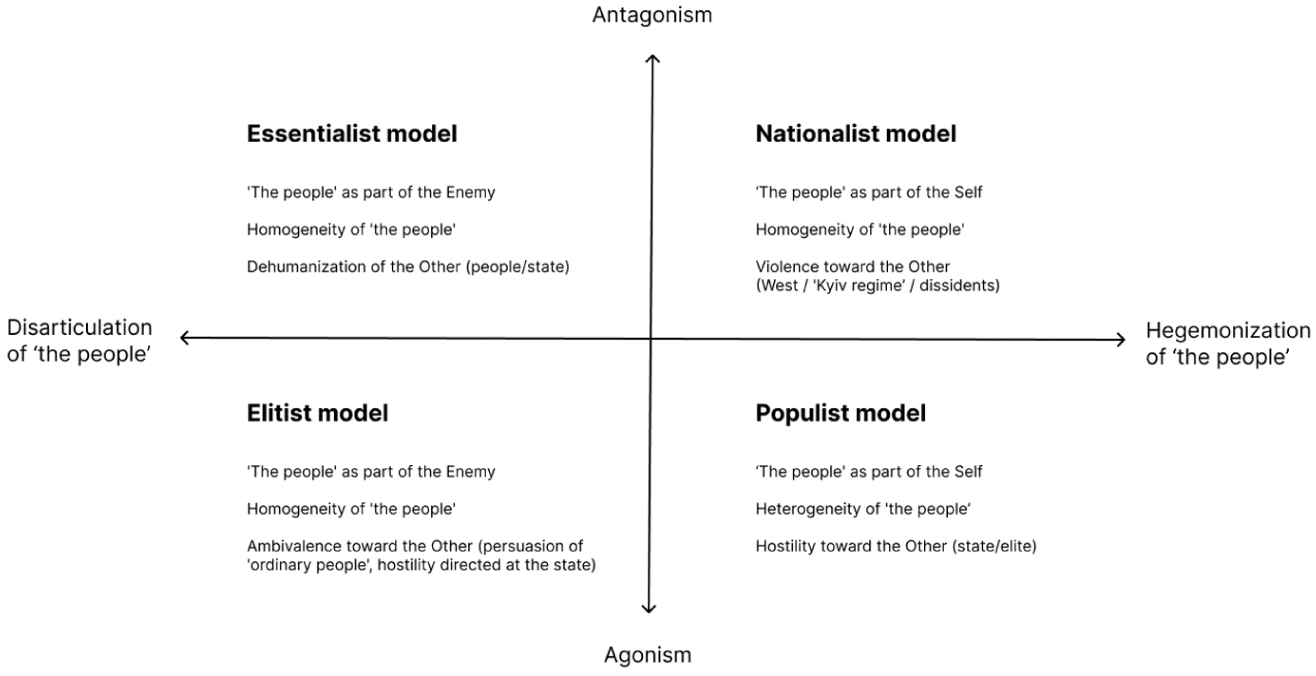
The four empirical models of constructing ‘the people’: Essentialist, Nationalist, Elitist, and Populist.
The first axis concerns the relationship to ‘the people’, ranging from hegemonization – that is, the making of political claims over a group – to disarticulation, where the Self distances itself from the popular subject. While the Essentialist and the Elitist models construct ‘the people’ as part of the antagonistic Enemy block, the Populist and the Nationalist models seek to incorporate ‘the people’, albeit in different ways. The Nationalist model presents a homogenized notion of the people, subsumed under the universal signifier ‘Russian’, whose loyalty to the state is assumed. The Populist model offers a more inclusive and nuanced articulation, acknowledging internal heterogeneity rooted in multiple positionalities.
The second axis captures conflict dynamics produced by these articulations. The Nationalist and Essentialist models tend to display antagonistic modes of conflict. It is particularly salient in the former, which shows readiness to manage difference through expulsion and abuse toward individuals inside and outside the country based on political, national, or ethnic identification. The Essentialist model, while less explicitly violent, reproduces antagonistic patterns through dehumanization, pathologization, and disarticulation of ‘the people’ from a civilizational frame. Conversely, the Elitist and Populist models foster nonviolent approaches in line with the Gramscian notion of hegemony as a struggle over the definition of the ‘collective will’. This places both models on the agonistic end of the spectrum. The Elitist model relies on persuasive strategies toward ‘the people’, seen as capable of being ‘woken up’, ‘rescued’, or ‘disenchanted’ from the state. However, it also assumes a privileged Self – possessing a priori access to truth – which distinguishes the Elitist model from the Populist model. Although both engage in hegemonic struggle over the people, the latter respectfully acknowledges differences while retaining a hostile attitude toward the state and elites.
The article contributes to a broader discussion on discursive conditions of conflict transformation (CT). Building on previous work (Voniati, 2021; Yüksek, 2020) that connects CT to rearticulation of the Other, it looked into (re)articulations of the Self in a war context and argued that the latter is invariably constructed in relation to the category of ‘the people’. Consequently, by unpacking the diversity of the articulations of ‘the people’, we can start analyzing to what extent particular representations (re)produce antagonistic or agonistic dynamics of a conflict. The analysis demonstrates how they maintain or disrupt the ideological model of war (Carpentier, 2015) by repeating or moving beyond the unproblematic vision of the Self as a monolithic actor facing the equally uniform Enemy.
This article shows how we can draw on democratic theory in order to better understand reconfiguration of conflict dynamics insofar as they, too, are constituted through relations of power, inclusion, and exclusion. First, the strategy of persuasionism, while still resting on a negative view of ‘the people’, seeks to avoid violence by focusing on mitigating the effects of propaganda and state manipulation. Second, populist articulations open space for political contestation of ‘the people’, and while stopping short of making demands to the state, they aim to “mobilise the invisible” (De Barros and Aiolfi, 2025: 8) – a potential for political action that remains to be discovered. Their emphasis on the internal diversity of ‘the people’ reflects a pluralist democratic logic, seeking to reinvigorate collective agency through shared experience of state oppression and across intersecting axes of differentiation such as ethnicity, class or political beliefs. This stands in contrast to totalizing and exclusionary imaginaries that underlie both the dehumanizing articulations of the ‘people-of-the-Enemy’ in the Essentialist model or the ethnocentric vision of the Nationalist model. Nevertheless, exclusionary articulations of the Self remain an ever-present possibility.
Notably, the voice of the people rarely comes through directly – it remains a subject mostly spoken about rather than one speaking for itself. Articles that explicitly aim to understand what ‘ordinary Russians’ think tend to present their voices in a cacophonic manner, often as anonymous participants of rallies or strangers on the street, and these articulatory practices typically align with the Nationalist model. Individual voices emerge in formats such as readers’ letters and are mostly critical of the war, predictably so given the positionality of both media. Yet, the very individualized format of these interventions further reinforces the notion of an isolated anti-war minority, which is particularly characteristic of the Self in the Essentialist and Elitist models. While this pattern of aggregation and atomization is largely in line with previous work on mediated construction of ordinary people (see Filimonov and Carpentier, 2022), further research could shed light on how exiled media producers navigate the challenges of physical remoteness from the very ‘people’ they seek to describe, and how material circumstances of exile may reinforce particular models of representation.
It is also worth acknowledging indigenist and decolonial articulations of the Self, which were not pursued in the analysis due to their focus on deconstruction of the Russian identity as opposed to its (re)articulation, as well as their limited presence in the dataset and the word-count constraints of the article. Future research could account for these representations, which contain important counter-hegemonic perspectives on and decolonial critiques of Russian identity. Furthermore, while the focus on ‘the people’ has opened a new perspective on CT, future studies could examine alternative entry points into mediated representations of the Self in the context of war. In particular, a focus on state propaganda could enrich the Nationalist model, refining the specificities of its antagonistic constructions.
Supplemental Material
sj-zip-1-mwc-10.1177_17506352261424856 – Supplemental material for The Self at war: Four models of constructing ‘the people’ in Russian exiled media
Supplemental material, sj-zip-1-mwc-10.1177_17506352261424856 for The Self at war: Four models of constructing ‘the people’ in Russian exiled media by Kirill Filimonov in Media, War & Conflict
Footnotes
Acknowledgements
A shorter version of this article was presented at the International Communication Association (ICA) conference in June 2025 in Denver, CO, USA. I am grateful to Nico Carpentier for a series of conversations that were helpful in the early stages of developing this article during my research stay at Charles University in Prague in May 2024. Generative AI tools were used to translate quotes in Russian, under the author’s careful supervision.

Ethical approval
The research project has been approved by Swedish Ethical Review Authority (Etiksprövningsmyndigheten), dnr 2024-01453-01.
Funding
This research was funded by the Ryoichi Sasakawa Young Leaders Fellowship Fund and further supported by a grant from Stiftelsen Karl Staaffs Fond.
Declaration of conflicting interests
The author declared no potential conflicts of interest with respect to the research, authorship, and publication of this article.
Data availability statement
Data corpus is available upon request.
Supplemental material
Supplemental material for this article is available online.
Author biography
References
Supplementary Material
Please find the following supplemental material available below.
For Open Access articles published under a Creative Commons License, all supplemental material carries the same license as the article it is associated with.
For non-Open Access articles published, all supplemental material carries a non-exclusive license, and permission requests for re-use of supplemental material or any part of supplemental material shall be sent directly to the copyright owner as specified in the copyright notice associated with the article.
