



Abstract
Trauma has entered the virtual domain of Second Life. Unsanctioned memorials to 9/11 and re-imaginings of a digitized Guantanamo Bay are but some of the more recent installations of traumatic memory to be found in this relatively new online territory. This article seeks to understand how Second Life participates in an affective economy of performative empathy through remediating the traumas of ‘those’ who have suffered ‘elsewhere’. In contemplating one particular online Holocaust museum – the US Holocaust Museum’s Kristallnacht in Second Life, it examines how Second Life participates in the circulation of a range of ‘wound culture’ affects in problematic ways.
Introduction
Trauma has entered the virtual domain of Second Life. Unsanctioned memorials to 9/11 and re-imaginings of a digitized Guantanamo Bay are but some of the more recent installations of traumatic memory to be found in this relatively new online territory. This article investigates the social, political and discursive implications generated by the production of embodied traumatic memory in one recent example of virtual culture – the US Holocaust Museum’s online memorial entitled Kristallnacht in Second Life. Reading the site as a remediation of the already mediated memory texts created by ‘real life’ counterpart memorials, Kristallnacht in Second Life can be seen to be constitutive of a category of cultural activity that might be termed virtual trauma. By connecting the virtual Kristallnacht to an existent cultural framework that has been varyingly identified as ‘trauma tourism’ (Clark, 2009) or ‘tragic tourism’ (Lippard, 2000), I seek to understand how virtual culture newly remediates traumatic memory, and how it thereby constitutes new formats for the generation of empathic witnessing in spectator/participant bodies and subjectivities.
Launching from early discussants of online behaviour such as Julian Dibbell (1993) and Theresa M Senft (1996), and by conducting a self-reflexive practice of what Christine Hine (2000) has argued is the new frontier of virtual ethnography, this article contemplates how virtual practices of witnessing history make claims for the ‘truthful’ nature of their memorial artefacts, testimonials and material traces in an oddly mimetic synchronism with real-life counterpart memorials. Indeed, Kristallnacht in Second Life simulates the presence of a real-life museum that simulates a traumatic history. In doing so, it reinforces recent trends in practices of embodying memory that are seen to be generative of empathic witnesses to a history. This article argues that just as virtual culture gives rise to increasing possibilities for spectator/participant embodiment, it also produces the practitioning of embodiment as an unquestioned, or moot-point ethical and empathic practice for the purposes of restorative justice that attend traumatic contexts. Through its emphasis on embodied knowledge, Second Life participates in the circulation of a range of ‘wound culture’ affects in ways that serve the moral certitude of the spectator/participant as witness over the subject being recollected.
Pixels in distress
As the historic incident of ‘rape’ in cyberspace made clear in the early 1990s, the online sphere is not devoid of trauma. The event came to notoriety after technology journalist Julian Dibbell (1993) published an article in The Village Voice contemplating the kinds of embodied subjectivity enabled by online communities, and the kinds of ethical and cultural repercussions that necessarily result when a broad spectrum of human ‘real-life’ behaviours are transported into the digital realm of the internet. The ‘Bungle Affair’ as Dibbell called it, raised questions about ontologies of the live as they connect to epistemologies of the virtual, about a somewhat disembodied sexual ethics, about the political formation of activist cyberspace communities and ‘the curious notion of rape by voodoo doll’ (1993: 37). As Dibbell explained, the Bungle Affair occurred on one evening in LambdaMOO (one of the earliest online, multi-player, real-time virtual worlds) at a room in a venue used for both its homely familiarity and its potential for playful interaction. Party-goers gathered, until the assailant Mr Bungle:
began … using his voodoo doll to force one of the room’s occupants to sexually service him in a variety of more or less conventional ways. … [I]n his private chambers somewhere on the mansion grounds [he] … continued without interruption since the voodoo doll worked just as well at a distance as in proximity. (1993: 37)
As the account continues, we understand that Mr Bungle’s activities grew more violent: he began attacking other players – forcing them into unwanted liaisons, making them eat his and each others’ pubic hair, forcing one of them to self-harm with a cutlery piece (1993: 37). We understand that the after-effects of these acts – what the victim of this virtual rape post factum called ‘post-traumatic tears’ (1993: 38) – were also in fact the embodied sensation of disembodied action: events that had been written in code and occurred in pixels had nonetheless generated a sense of corporeal violation. This doubling of virtual reality and real life was further complicated by the clumsiness of the technology itself, where ‘raping’ here consisted of the un-permitted attribution of an action to a character by another player through the voodoo doll subprogram function – the description of one player’s actions in text. In this way, as Dibbell put it, while some live bodies felt, ‘[n]o bodies touched. Whatever physical interaction occurred consisted of a mingling of electronic signals sent from sites spread out between new York City and Sydney, Australia’ (1993: 37).
While discussions around ontologies of the self as they are produced by virtual reality (or by new media technologies more generally) have come a long way since Dibbell’s early account, as have the technologies themselves, the particular coincidence of the virtually traumatic as a highly specific – and equally proliferate – cultural paradigm of experience still remains to be fully explored. As Dibbell was right to foretell, his essay functions as a caveat for the more serious consideration of ‘a future in which human life may find itself as tightly enveloped in digital environments as it is today in the architectural kind’, such that, poised with the vista of an increasing cultural paradigm of virtual traumata, we might ‘shut our ears momentarily to … techno-utopian ecstasies’ (1993: 37) and indeed consider the stakes of how the virtual sphere engages traumatic histories, enactments and workings.
For one thing, as Theresa M Senft has pointed out, the potential for prosthetic or hypothetical identity-making practices offered by the convenient anonymities of cyberspace can often carry with it a kind of problematic rhetoric: the ‘wrong assumption that only an online textual body is performative, whereas a biological body at the end of the terminal is stable’ (1996: 17). Senft makes it clear that the internet ought to be considered ‘a series of cooperative performance gestures from multiple computer and telephone systems’ (1996: 14), which also beckons us to ask, via Butler, ‘[w]hich bodies come to matter – and why?’ (1996: 13). As Senft explains, matter here importantly designates both ‘materiality’ and ‘significance’ (1996: 13) and her reading of the internet as a paradigm productive of bodies that matter, and of bodies as matter, opens out an important consideration to the kinds of spectator bodies engaged in the virtual reproduction of post-traumatic states and their histories.
Virtual trauma
Dibbell’s account anticipates the range of discursive paradigms by which trauma and its historical legacies are now being virtually constituted. The new millennium’s explosion in Web 2.0 user-interactive applications such as Twitter, Facebook and YouTube as well as the increasing accessibility of cross-platform technologies such as the iPhone, has paralleled both the democratization and sensationalization of the production of traumatic memory in contemporary life (see Andén-Papadopoulos, 2009 or Rao et al., 2007). Web 2.0 applications are distinguished by their creation of active producers of information, rather than passive consumers. While each new media format generates specific processes for information dissemination, what they do have in common is their potential for positioning the everyday citizen at the centre of meaning generation and its dispersal. This can be seen in instances such as the use of Twitter in the lead up to the 2009 Iranian elections, or in the highly mediatized death of Neda Agha-Soltan, which was posted on YouTube during those same elections and then spectacularized by the world’s media (see Burns and Eltham, 2009 or Mortensen, 2011). As Paul Arthur explains in relation to online archives, ‘the online environment allows unprecedented scope for a diversity of stories to be told about the same events, regardless of how dispersed, geographically, the contributors might be’, at the same time that ‘in making public the intensely private experience of trauma, there is a danger of overexposure and exploitation, and of turning trauma into entertainment’ (2009: 69; see also Burgess, 2006 or Klaebe and Foth, 2006).
In broad terms, virtual trauma can be understood as the social, political and discursive dynamics of the remediation of traumatic events by, and in, contemporary digital culture. If we understand trauma via Cathy Caruth’s reading of its inherent belatedness – the fact that it is the way that it is ‘precisely not known in the first instance’ (1996: 4) that haunts the traumatized subject – then rethinking trauma through, and as, the practices of digital culture both expands and reproduces trauma’s own internal (and pre-digital) sense of virtuality. As Caruth herself explains:
the experience of trauma, the fact of latency, would thus seem to consist, not in the forgetting of a reality that can hence never be fully known, but in an inherent latency within the experience itself … it is only in and through its inherent forgetting that it is first experienced at all. (1996: 17)
Given trauma’s inherent latency, we understand that it is always already experienced as a kind of corporeal and psychic after-effect. Trauma inhabits the subject belatedly but also as a searingly immediate form of belatedness: it is simultaneously dis/located, a/temporal and dis/embodied, or as Caruth puts it: ‘it is referential precisely to the extent that it is not fully perceived as it occurs’ (1996: 18). When the virtuality that is present in trauma’s experiential condition becomes constituted by technologies of the virtual, then we might also begin to ask how the technologically virtual manages trauma’s inherent structural virtuality. How might digital technologies (re)structure the incomplete perception situated at the heart of trauma’s repetitious delay?
Jay Bolter and Richard Grusin’s definition of remediation as an activity that ‘refashion[s] or rehabilitate[s] other media’ (2000: 56) here becomes key to reading the specificities of a culture that generates trauma via digital means. Joanne Garde-Hansen et al. explain that ‘implicit within remediation … is always already a concept of memory: the memorialisation of an older medium by digital media’ (2009: 14). While Bolter and Grusin point out that remediation existed long before the digital era, in visual art practices, for example, their thesis also emphasizes what contemporary media bring to its functions: ‘the transparent presentation of the real and the enjoyment of the opacity of the media themselves’ (2000: 21). In this respect, remediation as a capacity in and of itself – as a meta-effect – becomes the prime performative tool for any new technology on the market. While this reading emphasizes the meta-mnemonic capacities of remediation – wherein the ‘older medium’ is memorialized as a techné by the newer one – Bolter and Grusin also point out that memory technés are not just vehicles for memory content that is held elsewhere, but themselves constitute meaning: ‘because all mediations are both real and mediations of the real, remediation can also be understood as a process of reforming reality as well’ (2000: 56).
The duplicity enacted by a technology that in both function and effect mediates the real whilst it performs as the real is key to understanding the contentions to be found within the remediation of trauma as a cultural practice. Virtual traumas not only remember the belatedly experienced event as a ‘first’, but constitute it in reality as such. They (re)structure that which was not known the first time around as knowable, feel-able and experiential, at the same time as they perform that very perceptual blindspot as a knowable, feel-able and experiential origin.
Marc Redfield positions the rise of virtual trauma at the geopolitical turn-point of 11 September 2001 – a marker of both global rupture, located trauma, and the post-millennial realization of the capacities of digital technologies. Nonetheless, Redfield’s account begins with linguistics: a discussion of the discursive performativities of nomenclature that frame the event now categorically known as ‘9/11’. In his argument, virtual trauma signifies both the real of an event and its complicity within/as mediation: it is ‘a making-legible, within the medium itself, of a violence inherent to all media technologies, which record and remember the unique only by effacing and forgetting it’ (2007: 68). The processes of effacement begin, however, in the forgetting enacted by such axiomatic phrases as ‘9/11’ and ‘Ground Zero’. The plural historical legacies these phrases might otherwise suggest (the 1973 Chilean coup in the case of 9/11, the bombing of Hiroshima in the case of Ground Zero), are erased by a linguistic deixis that arises to subsume all other reference points, erecting the US event as a totality: ‘you shall have no other September 11ths; should you mention others, they will be secondary to this absolute, toxic punctum: … to refer to Chile, you will have to speak of “the other September 11”’ (2007: 59).
Redfield positions the performativity of the speech act 9/11 as a signature impulse of what he terms the ‘vast representational and commemorative machine’ (2007: 61). Its function as a name-date that forgets its own year enables it to provide the context for mourning as well as to seemingly perform mourning itself: it is ‘a fetish precisely because it is always naming its own loss’ (2007: 61). This kind of duplicitous mourning, in which the term produces the effect that it also names, is for Redfield idiomatic of a larger cultural practice of virtually traumatic memory, which produces dislocated, atemporal traumas through the spectacle of ‘tele-vision’, generating spectator-witnesses who identify with the experiential motif of ‘a wound that exceeds the difference between the real and the unreal’ (2007: 75). In this respect, it is the very enactment of the disaster as a kind of screen memory, or fiction, that deems its particular ‘real’ really real.
In my reading, a framework of virtual traumas understands that digital technologies not only remediate traumatic memory, but in doing so, actively constitute memory as history. This means that the digital realm not only produces new perceptions of particular events or contexts, but also new ideologies around how and what cultural mnemonics should be. Andrew Hoskins describes the arrival of the digital as enacting a cultural transformation into ‘a more publicly and visually explicit new memory’ that comprises:
the media-affected formation and reformation of shared or social memory in the contemporary age and the consequential reassessment of the nature and the very value of remembering (and forgetting) subject to the technologies of and the discourses disseminated by the mass and other media. (2009: 28)
His reading is itself akin to Susannah Radstone and Katherine Hodgkin’s broader argument that memory, like history, is also a cultural regime – what they both ‘produce as knowledge is also contingent upon the (contestable) systems of knowledge and power that produce them’ (2003: 11).
The impact and concept of virtual trauma hence arrives with how the digital structures and performs traumatic memory, and how this in turn transforms the discursive, social and political acceptability of new memory formations, enactments, behaviours and operations. In this regard, virtual traumas are those cultural texts that have been produced by digital media in response to traumatic events, but are also, and importantly, the constitution of those events specifically though, and as, digitalization. Even more importantly, virtual traumas are, first, the constitution of the event as originary by the particular performative functions of the technology itself, and second, the after-effects that these performative functions generate. In this framework, we can begin to understand that virtual culture newly remediates traumatic memory and constitutes new formats for, for instance, the generation of witnessing in spectator bodies and subjectivities. In this, it becomes apparent that the digital has shifted the body’s relation to the iteration of traumatic memory and history in both radically new and problematic ways.
Bodies in memory
Richard Urban et al. point out that some of the conventions enabled by online worlds such as Second Life include a wide range of virtual museums. These collide the new kinds of cultural mnemonics enabled by digital technology with the existing cultural treatment for the recollection of the past. For Urban et al. virtual museums:
allo[w] visitors to find out what it would be like to be caught in a tsunami (at NOAA’s Meteroa Island), take a rocket ship ride into space (courtesy of the International Spaceflight Museum), or parachute from the top of the Eiffel Tower (in Paris 1900). (2007)
They thereby note with possible irony: ‘In a world where the sun always shines, there is no reason not to display artifacts in the open air or even floating in mid-air; since SL avatars are able to fly’ (2007; see also Harrison, 2009).
While museums in Second Life certainly represent a new frontier in capacities for collection and recollection, they also typify cultural trends noted long before the digital realm got hold of memory. Theorists such as Andreas Huyssen have commented on the ‘musealizing’ tendencies of the west, which commodify the past into repetitious collections, situated like fast food chains, throughout the globe (1995: 14; see also Lowenthal, 1985 or Morris-Suzuki, 2005). Observations from writers such as Ann E. Kaplan similarly position us as progenitors of the ‘empty empathies’ of a trauma culture that spectacularly remediates itself over distance in an instant (2005: 87). Mark Seltzer’s (1998) study of serial killing in the USA against a cultural backdrop of ‘wound culture’ also makes plain the now enmeshed connections between the creation of acts of witness and addictions to visual spectacle in the generation of new forms of public. He writes:
the mass attraction to atrocity exhibitions, in the pathological public sphere, … encodes, in turn, a breakdown in the distinction between the individual and the mass and between private and public registers. One discovers again and again the excitations in the opening of private and bodily and psychic interiors: the exhibition and witnessing, the endlessly reproducible display, of wounded bodies and wounded minds in public. (1998: 254)
Implicit in these studies is a critique of the spectacularization of trauma and memory by the late capitalist culture machine (see also Butler, 2009; Guerin and Hallas, 2007). Their critique is positioned alongside a reading of memory’s new performative mechanics: if a founding modernist myth was that memory was all about loss, then a postmodern memory phenomenon might inscribe both ‘loss’ and its ‘loss’ instead.
Seltzer’s reading of wound culture connects to contexts of trauma tourism (Clark, 2009) or tragic tourism (Lippard, 2000), which equally exploit ‘the opening of private and bodily and psychic interiors’, only now under the rubric of the importance of social forms of remembrance. Writing on trauma tourism across locations such as Rwanda, Nagasaki and Phnom Penh, Laurie Beth Clark discusses the ways that the memorial impulse arising from these traumatic sites consists in a site’s own performativity, to produce a dogmatic ‘never-againness’ (2009: 23). At the same time, this never-againness is created in the context of a sense of ‘“always already” againness’, whereby, as she notes, ‘the construction of a memorial has been invariably followed (not causally but temporally) by a subsequent instance of atrocity’ (2009: 24).
In my reading, the tension performed between ‘never-againness’ and ‘always already againness’ also situates any given site between two readings of the function of enactment located by performance studies. This on the one hand theorizes performance as repetition (see Roach, 1996; or Taylor, 2003) and on the other hand theorizes it as an original event (see Phelan, 1993). In this view, the repetitious aspect of a culture of trauma tourist sites commodifies the unspeakability of a particular history to generate, for tourist/witnesses, a paradoxical sense of the ‘always already againness’ of ‘never againness’ itself. In terms of a broad cultural vista of such trauma performatives, it then becomes the site’s ability to perform itself uniquely that registers the success of its trauma performative for outsiders.
Feeling prosthetically
As evidenced by contexts of trauma tourism, recent trauma culture foregrounds the role of the spectator/participant body in the recollection of history. Here, relations between bodies and memory have been said to incur a kind of ‘prosthetics’, which is brought about by digital technologies, but also by the participatory, sensorial strategies encouraged by more ordinary museum and memorial design. Alison Landsberg has an affirmative take on prosthetic culture, arguing that through it, ‘an experience occurs through which the person sutures … herself into a larger history’ (2004: 2). In this, we ‘tak[e] on a more personal, deeply felt memory of a past event through which … [we] did not live’ (2004: 2). For Landsberg, prosthetic culture occurs with the mass circulation of images and memories brought about by cinematic modernity. These both destabilize ethnic/local groupings and also enable their transmission to occur in a more embodied way:
these memories, like an artificial limb, are actually worn on the body; these are sensuous memories produced by an experience of mass-mediated representations. (2004: 20)
In Landsberg’s reading, there is an important connection to be made between the spectatorial practice of prosthetic ‘suturing’ and a politics or practice of empathy, which, she argues, emerges in the critical ability to experience feelings that belong to another person or history. Scholars such as Vivian Patraka and Jill Bennett have been similarly seminal in reading techniques that position the spectator body in less cognitive, more physiogenic ways. For Patraka, museum visitors become metonyms for the dead; ‘rehears[ing] with [their] bodies … the immeasurability of the loss’, ‘because the critical actors are gone, and it is up to [them] to perform acts of reinterpretation’ (1999: 127, 122). For Bennett, spectator bodies are rather affectively arrested by art practices that trigger emotion. She explains: ‘[i]t is impossible to feel emotion as past. … One cannot be a spectator of one’s own feelings; one feels them, or one does not feel them’ (2005: 22). Art practices that help us feel, as Bennett puts it, reduce relations between past and present; feeling is devoid of ‘precod[ing] by a representational system’ (2005: 35).
While Landsberg, Patraka and Bennett emphasize different aspects of bodily perception, what they implicitly argue for is an equation between sensorially, corporeally feeling certain aspects of a traumatic history and feeling emotions (most often empathy) as a result of that kinaesthetic engagement. The positioning of the spectator body as a body that must undergo certain sensorial experiences becomes paramount to witnessing histories in, as Landsberg suggests, presumably ethical ways. An alternative reading might suggest that, based on Redfield’s definition of virtual trauma as the experiential motif of ‘a wound that exceeds the difference between the real and the unreal’ (2007: 75), what might be being felt is rather the affective currency of the trauma performative itself.
Patricia Ticineto Clough and Jean Halley explain that there are divergent lineages marking how affect is understood to work, which either ‘focus on the body’ or offer an ‘exploration of emotions’ (2007: ix; see also Gregg and Seigworth, 2010: 6–8). While for theorists such as Clough affect precedes both bodily motility and emotion – it is ‘a substrate of potential bodily responses, often autonomic responses, in excess of consciousness’ (Clough and Halley, 2007: 2) – it also importantly operates on the level of ‘self-feeling’ in which the potential for relationships between bodies and other bodies, objects, or affects, is engaged (2007: 2). Brian Massumi (2002) explains that this kind of self-feeling points to the temporality and multi-dimensionality by which intersubjectivity occurs. ‘Sensation is the mode in which potential is present in the perceiving body’, he writes, ‘it is a channeling of field-potential into local action’ (2002: 75). In Massumi’s reading, we feel our potential for action and for feeling as we simultaneously enact that action or feel it. He offers this as a kind of ‘intensity’ (2002: 27): ‘[t]he body … enfolds contexts, it enfolds volitions and cognitions that are nothing if not situated’ (2002: 30). We feel ourselves as relationally engaged in the kinaesthetic and spatial system through which we become.
For Clough, however, while there is a pre-social dimension to the body’s experience of affect, affect can also manipulate relations between bodies. She explains:
Some bodies or bodily capacities are derogated, making their affectivity superexploitable or exhaustible unto death, while other bodies or body capacities collect the value produced through this derogation and exploitation. (Clough and Halley, 2007: 25)
She further suggests that this operation of affect is paramount in contexts of trauma, as can be seen in ‘the relationship made between victimized, terrorized, and hated bodies brought forth for the discourse and practices of counter/terrorism, surveillance and unending war’ (Clough and Halley, 2007: 26).
In this respect, the positivity around notions of prosthetic ‘suturing’ fails to recognize the possible coercions by which the body’s sensorial and emotional potential affectively works. Sara Ahmed, for instance, discusses emotion as the politicized circulation of affect: ‘feelings do not reside in subjects or objects, but are produced as effects of circulation’ (2004: 8). Further, ‘[i]t is through emotions … that surfaces or boundaries are made: the “I” and the “we” are shaped by, and even take the shape of, contact with others’ (2004: 10). Eve Sedgwick asserts a similar idea, but with opposite emphasis, in her book titled Touching Feeling, which indicates how touch produces both tactility and sentiment (2003: 17). For Sedgwick, touching is primarily intersubjective: to touch ‘is always already to reach out, to fondle, to heft, to tap, or to enfold, and always also to understand other people … as having effectually done so before oneself’ (2003: 14). She notes a further kind of refraction, seen in how we might – when touching – develop a duplicity of feelings: ‘[a]ffects can be, and are, attached to things … including other affects. Thus, one can be excited by anger, disgusted by shame, or surprised by joy’ (2003: 19).
In this regard, certain deployments of affect might be understood as a politicized cultural project, woven into what Ann Cvetkovich and Ann Pellegrini have termed ‘archives of public sentiment’ (2003) – or indeed – what Ahmed calls the ‘regimes of difference’ that are built through intersubjective practices of touch (2000: 8). Mobilizing affective intensity – particularly as it relates to regimes of memory – is then both an ‘aesthetically’ ethical response to the project of ‘witnessing’ others, and constitutive of the terms by which those others come to be ‘felt’. In virtual trauma culture, the affective potential of the body as wound, and as witness to the wounded, is co-opted to produce spectacle for mediatized consumption. The performativities between practices of embodied feeling and emotional feeling might be then rather understood to circulate trauma affects – which are operative as autonomic potentials for intersubjectivity, but also demand trauma’s inevitable deployment within the social.
In the reading of the US Holocaust Museum’s virtual Kristallnacht in Second Life that follows, I consider how the affective potential of virtual trauma is constituted by this particular example of 3D, virtual museum design. My reading can be situated alongside forms of online ethnography discussed by Christine Hine, in which: ‘[t]he ethnographer inhabits a kind of in-between world, simultaneously native and stranger’ (2000: 5), whose research ‘involves real-time engagement with the field site … [as] key in highlighting the processes through which online interaction comes to be socially meaningful to participants’ (2000: 27; see also Boellstorff, 2008). Alternately, methodologies of tourism fieldwork at memorial spaces equally foreground a reverse ethnography in which it is the practices of the Euro- or Anglo-centric West that are under examination (see Clark, 2009; Patraka, 1999; or Tumarkin, 2005).
Online memorial sites present embodiable affects as key to a cultural apparatus that operates in the name of the ethical remembrance of what are otherwise difficult histories. In the study that follows, I hence consider: (1) how I am constituted as a spectator whose job it is to ‘witness’ a history of Kristallnacht, and how my own constitution is co-created by the spatial and semiotic design of the site itself; (2) how my avatar is given to prosthetically ‘experience’ the history of Kristallnacht, and so to perform certain attributes of memorial subjectivity such as empathy; and (3) how the particular circulation of traumatic affects through my embodied engagement can be understood as typical of a cultural landscape of virtual trauma.
Kristallnacht in Second Life
I am moving through deserted streets, it seems as if I am the only one around here. I look and feel too white, too perky and too young, dressed in an outfit I didn’t choose – a pink dress with small white polka dots, my head topped with a neat and purposeful pony tail (see Figure 1). Even the way I’m holding myself makes it clear that I’m new around these parts. I entered this place through a small museum ‘newsroom’, set up as a space in which I was to read information bulletins and receive a dossier that instructed me on my ‘journalistic’ mission ahead. Its walls were covered with dominating photographs in black and white, amplifying a certain chronotope that wanted to denote either capital ‘H’ history or capital ‘M’ memory – I couldn’t decide which. Wooden desks and books were placed around the room – one supporting a curiously antiquated telephone – but I found I couldn’t activate the phone. Instead I perused the information displays, focusing on the captions illuminating their otherwise anonymous images of destruction:
Caption 1. View of the destroyed interior of the Hechingen synagogue the day after Krisallnacht. Caption 2. Newly arrived prisoners, still in their civilian clothes, and after shaving and disinfection, stand at roll call in Buchenwald concentration camp shortly after Kristallnacht, 1938. Caption 3: Germans pass by the broken shop window of a Jewish-owned business that was destroyed during Kristallnacht. Berlin, Germany, November 10, 1938.

Streetscape with flying avatar
The photographs themselves were high resolution, and as digitized images of what were once photographic stills, they punctuated the space’s otherwise oversaturated cartoonness – making me look like a silly animation in the face of all of that photographic reference they were able to produce. The final wall-sized depiction of Germans in front of a broken shop window rendered a much clearer vision of humanity ‘passing by’ than my own pixellated, polka dotted state of ambulation would allow. It was arresting for the dynamics of looking – or looking away from looking – that it happened to set up (see Figure 2).

Digitized photograph: Germans pass by the broken shop window of a Jewish-owned business, screenshot Kristallnacht in Second Life
Some instructions appeared out of a glowing ledger on a desktop:
As you leaf through the accounts of eyewitnesses, your mind takes you back to that night … and you begin to reconstruct the events of Kristallnacht through their stories.
While I slyly resented the use of the second person, present tense address to denote what I should be doing (‘As you leaf …’) and thinking (‘your mind takes you back …’), I nonetheless followed through, stepping out of the newsroom and into the Second Life memorial titled ‘Witnessing History: Kristallnacht, the November 1938 Pogroms’. As black and white pixels disintegrated around me, I arrived in streets of colour.
Kristallnacht in Second Life was designed by high school students in collaboration with the US Holocaust Museum, with the idea that ‘the folks that come through will not only learn more about history, but absorb it differently’. 1 The particular history in question occurred in Germany and Austria on 9 and 10 November 1938, when violent anti-Jewish pogroms facilitated the murder of almost 100 Jewish people and incarcerated another 25,000 to 30,000 in concentration camps. In the blogosphere, virtual Kristallnacht has been lauded as one of the most important contributions Second Life can make to real life for its approach to intergenerational remembrance.
The site offers an investigative journey undergone by an avatar whose job it is to experientially reinterpret the ruins of history. I enter the site as I would any museum information centre (in this I learn through reading data and facts); I am given the task of interpreting history through artefacts, and I then move through a dissolving photographic image to arrive on an abandoned historical streetscape (in this I experientially learn). Testimonial words and voices haunt the streetscape, punctuating my movements with the grain of the disembodied ‘real’. Photographs and documents have been digitized, re-performing the referentiality of the Barthesian ‘this-has-been’ (1981[1980]: 79) – or the document’s artefacticity – whilst repressing the digital’s alternate potential for a more divergent mode of recollection. I visit a range of places, including one family’s claustrophobic hidden living space. I then travel to an atrium or Reflection Space to perform mourning (in which I emotionally feedback), offer my own testimonial comments, and see digitized video footage of the survivors who have contributed to this site in the final room, the Witness Rotunda (see Figure 3).

Witness Rotunda, screenshot Kristallnacht in Second Life
Remediating the traumascape
Kristallnacht in Second Life can be understood as a recent virtual trauma performative that interestingly illustrates the tensions between ‘never-againness’ and ‘always already againness’ (Clark, 2009) to generate a certain paradox: the ‘always already againness’ of ‘never againness’ itself. This tension is made more complex for the fact that the site is written in code in online space. It is not a physical museum, nor is it a site-specific location. It in fact holds a very ambivalent form of indexicality to the history it wants to unravel for how it mimetically imitates a combination of both real-life site-specific and museum-based design strategies. As Bolter and Grusin would argue, its make-up creates ‘the transparent presentation of the real and the enjoyment of the opacity of the media themselves’ (2000: 21). How the site then constitutes the avatar (and, by correlation, the avatar’s lived ‘self’) as a ‘material’ body becomes key to unpacking – as Senft has intimated – a politics and ethics by which some (memorial) bodies come to matter and why.
The décor of the newsroom at the site entry resembles a partial reconstruction of a historical time period, offering a kind of ornamental semiotic to the instructional function of this section’s images, texts and photo-captions, which prepare for the experiential journey ahead. This study centre is then housed in the larger construction of the entire museum building itself, whose externalities resemble a cross between modernist grey architecture and a mausoleum. From the newsroom the avatar is invited to move through one dissolving, wall-sized photographic image (Figure 2) to arrive at a site-specific themed landscape of deserted streets portraying the aftermath of Kristallnacht.
The decision to replicate the aftermath of Kristallnacht rather than the attacks themselves positions the streetscape as a pseudo-traumascape, replicating the tropes of what Maria Tumarkin has observed of the real-life locations of tragedies, which ‘emerge as spaces, where events are experienced and re-experienced across time’ (2005: 12). While Tumarkin emphasizes how the memory of place produces certain memorial affects, the notion of a traumascape might also identify a landscape that performs itself as experientially unique by using the traits of memory, recognizing that places require embodied action in order for the recollection of traumatic histories to take place. Traumascapes in this sense are culturally occasioned sites that are participated within for their meanings to be retained and/or made.
In Second Life the cultural semiotics of a real-life traumascape (deserted, broken buildings and debris, uninhabited landscapes, etc.) are remediated such that my avatar can deploy a range of limited behaviours in response to its spatial, textural and coloured schematics. Both mimetically authentic, and a referent without its real, Kristallnacht in Second Life speaks to pop cultural practices of living history museums for the kinds of authenticity it wants to generate (see Magelssen, 2007), and also to sacrosanct memorial activities for the kinds of mourning it wants to produce. In this respect, it is the site’s assemblage of its peculiar kind of (in)authenticity that is designed to incite practices of remembrance in its avatar-visitors. Akin to Redfield’s reading of the performative basis of virtual traumas, it also importantly fetishizes its own wound point by ‘always naming its own loss’ (2007: 61). It does so by exploiting its unboundedness to material circumstances: to paraphrase Urban et al., by offering a world of continuous weather in which artefacts (and visitors) can float mid-air (2007).
Artefactual autonomy in cyberspace
Lisa Saltzman’s notion of the post-indexical here illuminates how the site functions in relation to the history it attempts to recollect. For Saltzman, who is discussing visual arts practice in relation to memory, the indexicality of a memorial artwork operates as a ‘mode of making meaning in relation to the world that is predicated on physical contiguity, on material relation, on the trace of the touch’ (2006: 12). The post-indexical, as Saltzman alternatively points out, can be considered the ‘empty index, the impotent index, the index at one remove, the index that is no longer a sign, but instead, pure signifier’ (2006: 3) and is as such endemic to the proliferation of memorial artworks in postmodernity that represent ‘a renunciation of a certain relation to the real’ (2006: 13).
Kristallnacht in Second Life alternately suffers from a kind of hyper- or doubled indexicality, where what the visitor experiences is a virtual space that is designed to look like a museum that – in real life – might have been designed to recollect the past. The museum’s index is not the historical referent itself (there is no material relation), but other real-life museums that portray traumatic histories. As such, there is no post-indexical ‘renunciation of a certain relation to the real’ but rather an obsessive manufacturing of it. The online museum saturates itself in its own indexicality, it does not produce its own Holocaust performative per se, but rather mimetically defers itself to real-life counterpart museums for its performative effects. In this, the trace of the touch – or contiguity to the original – has been both doubly displaced, and at the same time, made doubly ‘real’ owing to the ways that the ‘opacity’ of its own media formation simulates a museum simulating the past.
If remediation is the memorialization or refashioning of older media within a digital media format, then the site’s attention to the ‘artifactual autonomies’ (Kirshenblatt Gimblett, 1998:17) of conventional museum practice, particularly in relation to the visual display of photographs, also becomes curiously inverted. Barbara Kirshenblatt Gimblett’s theorization of practices of ethnographic display suggests that the autonomy of a museum object is generated through practices of detachment and display: ‘ethnographic artifacts … are artifacts created by ethnographers’ (1998: 17). For Kirshenblatt Gimblett, ‘autonomy makes it possible to display objects in and of themselves, even when there is little to inspect with the eye’ (1998: 17). While the digitized photographs in Kristallnacht are indeed visually compelling, they also attempt to function according to the rules of physical rather than virtual space. Their autonomy is first gained through a presumed indexicality that does not exist. If a photograph indexes the real (via Barthes’ logic), a digitized copy of a photograph indexes the index of the real. Their autonomy as objects is, second, more usually gained through the photograph’s survival as a material trace. In this, the digitized photographs in Second Life rely on a doubled – but failed – semiotics of indexicality and artefactual autonomy: if the photographic object is not materially ‘real’, the evidentiary capacity it attempts to produce via its indexicality is annulled.
In imitating a museum that is designed to recollect the historical specificity of the Holocaust, I want to suggest that this site replicates certain authenticities of wound culture through an alignment between its hyper-indexicality (to a real-life museum) and the kinds of embodied, affective identification it expects of me within it.
Embodying pixellation
Unlike the victims of Mr Bungle’s virtual rape, I don’t hold a close connection to my avatar. In Second Life speak, I am a ‘newbie’ – and visibly so for the way my avatar’s appearance is so seemingly generic (I haven’t invested in self-styling). Having moved into the experiential phase of the museum, I find myself on a deserted streetscape. There are anti-Semitic graffiti slogans written in German on building walls – translating as, for instance, ‘You Jewish Pigs’. From a birds-eye view (my avatar can fly above the cityscape), the streets comprise a small town centre, which holds a synagogue at one end, a police station, some shops and a house with a hidden room. The space is designed with the intention of my own gradual uncovering of it – in many of the buildings, there are digitized historical documents and archives of family histories and events to encourage my active participation in reconstructing the history that occurred ‘here’.
There is also a repeated spoken transcript that echoes across the rooms and spaces, derived from the testimonial voices of victims of Kristallnacht who appear later in full length digitized videos in the final annex. Sections of this text interrupt each other, to produce a background soundscape of disembodied voices:
You have to tell the people what happens, so they know it will never happen again … It’s terrible when you live under a dictatorship, it’s horrible, it doesn’t matter what dictatorship … We call ourselves homo sapiens, the wise man, but sometimes I wonder whether we should call ourselves … the most foolish one … If we stopped this at the beginning … such horrors as the ghettos and the concentration camps would never happen.
While Patraka’s conception of the Holocaust performative points out that performance is accountable for its remediation of the ‘goneness’ incurred by an originary traumatic event (1999: 7), writers such as Theresa M Senft have noted that the ontology of performance is challenged by online temporality: the internet is a ‘place that does not defeat death but is itself deathless’ (1997: 155). In terms of a Holocaust performative, then, the internet doesn’t do ‘goneness’ – it rather makes goneness gone: it loses the loss that we might otherwise seek to recollect. As a constellation of pixels, the deathlessness of my perky, bright little avatar body is made apparent in its ability to fly, to see across walls, and to bump into objects and corners without damage. My avatar – as distinct from my own bodily ‘self’ – does not experience a corporeal affinity with the historical specificities of traumatic loss, it does not materially feel nor cannot materially ‘die’. My own sensory awareness of this ontological advantage becomes particularly acute when it engages with the lived and corporeal histories of Kristallnacht victims.
One of the first activities my avatar body occasions in this respect is the breaking of shop-front glass. The exhibit is titled ‘Aryanized shop’ – a shop called ‘Strauss’ that sells hats and luggage (see Figure 4). Walking past the shop-front, my avatar activates the explosion of its glass window. In doing so, I shift from being ‘journalist’ to being a victim/perpetrator of the histories the site wants to portray. And yet, having ‘flown’ into this space, and being able to walk through other concrete objects such as desks, chairs and some walls, the position from which I ‘experience’ the smashing of glass is somewhat limited. Indeed, my own experience – or the site’s presumption of my right to experience – seems to allow a similar kind of apathetic looking, or passing by, figured by the photographic image in the entry to the streetscape itself (Figure 2). In this, one could recall Redfield’s notion of the ‘violence inherent to all media technologies’ (2007: 68), which in this case uses violence violently by effacing and erasing it as violence. It is the script that permits the perfunctory, unemotional breaking of glass but that nonetheless produces me as an avatar/subject engaged in the successful embodied practitioning of a history.

Aryanized Shop, screenshot Kristallnacht in Second Life
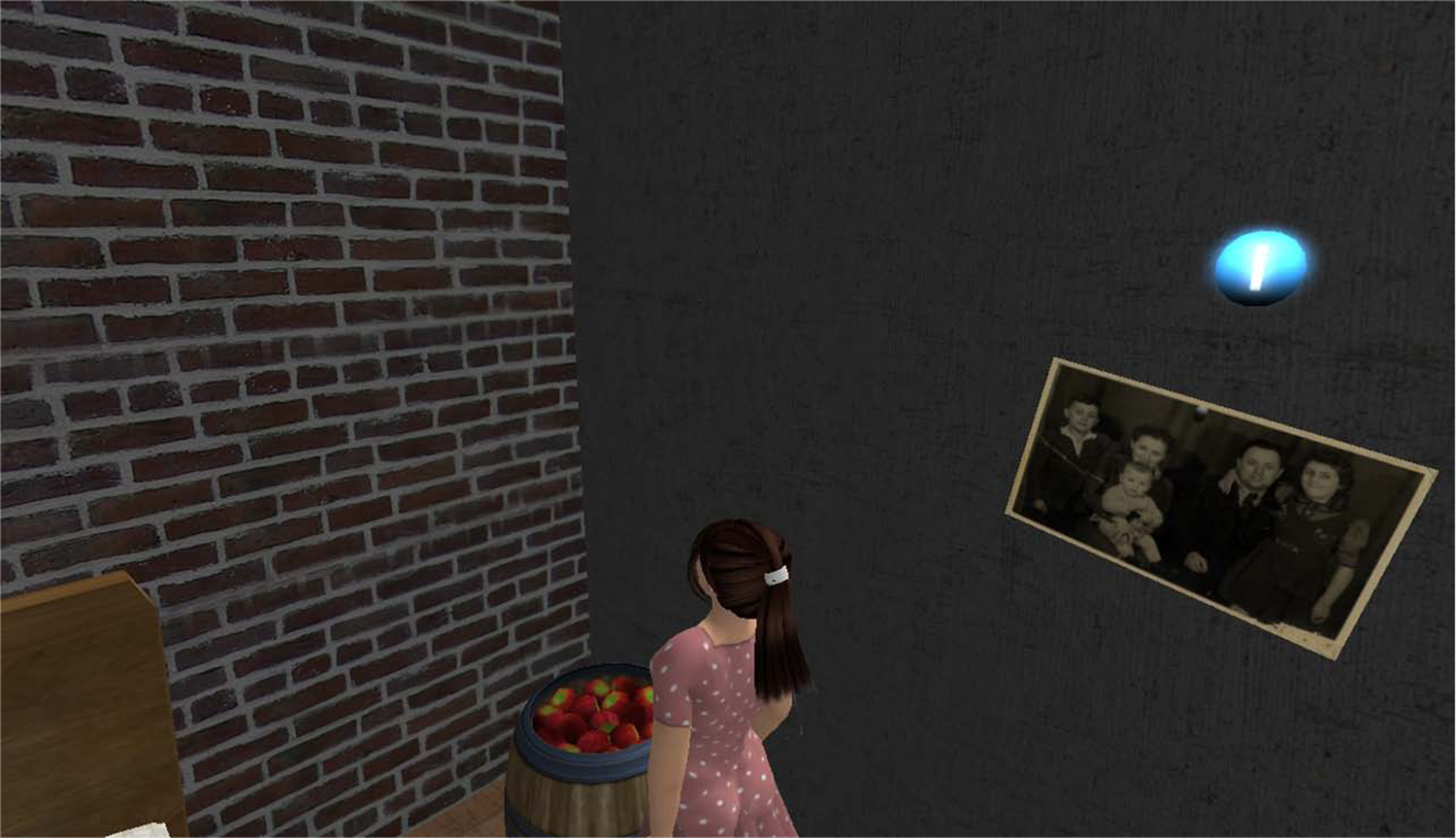
Hidden Room, screenshot Kristallnacht in Second Life
If, as Ahmed argues, feelings are ‘produced as effects of circulation’ and the ‘“I” and the “we” are shaped by, and even take the shape of, contact with others’ (2004: 8, 10), a certain politics, or even ethics, of memory is to be observed in how my own avatar ‘feels’ the history of others in this place. This might be understood via the inverted sense that it is my own practitioning of feeling that constructs ideas of otherness – in this case victims and their perpetrators – in Kristallnacht in Second Life. It is my (dis)embodied behaviours that occasion the memoried existence of violence done to other bodies. While the virtual re-enactment of violence in turn erases violence altogether, it nonetheless produces me (my avatar identity) within the conceit of a spectatorial practice of prosthetic ‘suturing’, in which I am to empathically engage with the histories being portrayed. And yet, the site’s presumption of an alignment between corporeal ‘feeling’ and emotional ‘feeling’ here rather fails. If Massumi’s emphasis on ‘field-potential’ (2002: 75) signals the kind of affective possibilities my avatar holds within the space, Clough’s reading of the social deployment of affect, in which ‘[s]ome bodies or bodily capacities are derogated, making their affectivity superexploitable or exhaustible unto death’ (Clough and Halley, 2007: 25), inevitably produces me as an avatar who feels my own capacity for feeling the feelings of others, more than I feel anything in particular.
Hidden affects in the hidden room
Trauma discourse revolves around the impossibility of perceiving the imperceptible, the sense that every narrative evolution holds a kernel of traumatic history that is not yet known, even to the narrator, but that nonetheless produces (and answers to) the testimonial fact of the narrative itself. The location of a central lacunae that is temporally and subjectively specific to the trauma survivor is undone by the claims of prosthetic culture that alternately argue for a politics in which anyone can wear the lacunae, or indeed, feel its after-effects. As Landsberg has made plain: such after-effects operate sensorially, corporeally, ‘like an artificial limb … worn on the body’ (2004: 20). In my reading, and in terms of contexts of virtual trauma, these after-effects might be alternately understood as trauma affects, which both circulate and generate intersubjective boundaries between bodies who suffer and those who witness or watch.
The lacunae of virtual Kristallnacht is configured via the spatial narrative of the site: a hidden room within one family’s digitally rendered household. Unlike the other buildings in the museum, this building is designed to render the distinctly personal over the institutional (police quarters, courtroom) or grandiosely sacrosanct (synagogue). The text that is spoken upon entering the room sounds: ‘We don’t know what is happening right now, but for now we will hide in the attic of our building … apples for the Fall…’. In Paul Arthur’s terms, access to the hidden room ‘makes public the intensely private experience of trauma’ (2009: 69) by inviting us inside (an idea of) the hearth/heart of the family home. More strongly in Mark Seltzer’s terms, it manufactures for ‘the pathological public sphere’ an ‘opening of private and bodily and psychic interiors’ (1998: 254), which, in an interesting inverse to the terms of Seltzer’s study, fetishizes not ‘wounded bodies’ but rather their absence. In this the site generates the affect of loss, in imitation of other real-life Holocaust performatives, such as the Anne Frank Museum in Amsterdam, which is famous for its Secret Annex in which the child writer and her family hid for two years.
As an online, digital replica of a hypothetical site-specific wound-point this virtual trauma carries its lacunae as one anonymous family’s lived history. The site assembles us as subjects who have a right to explore – expose – what is presented as the privately personal. Its semiotics perform homeliness through the affective contagion produced by intimate spaces, cosy furniture and a bowl of red apples. It is claustrophobic inside, it is difficult to get out, there is nothing to do in its space: we become its trespassers-cum-captive-family members. While the history of the house and its inhabitants is indexically ambiguous, it performs itself as authentic – reinforced by family photographs hanging on the walls. As a fictionalized house representing the history of other hidden rooms/houses, the house comes to perform as both a house ‘bereft’ (of inhabitants) and a house bereft of ‘houseness’ (it is after all in online, digital form). In this, the house materializes virtual trauma for how it produces the affectivity of mourning through naming itself as a house of ‘loss’ at the same time as its aesthetics ‘lose’ the loss it would rather claim. As a virtual trauma, and as the centrally visualized blindspot within virtual Kristallnacht, the house tries to become ‘a wound that exceeds the difference between the real and the unreal’ (Redfield, 2007: 75).
Conclusion
While the virtual traumas of Second Life can in some senses generate further binaries in discussions around memorial culture more broadly, it is not my intention to argue that Second Life memorials are ‘fake’ while real life memorials are ‘real’. Rather, I am interested in arguing that Second Life memorials – in mobilizing the digitally virtual – highlight the contingencies, performativities and truth-effects of real-life memorial-museum culture itself. At the same time, Second Life memorial museums such as the Kristallnacht site do participate in the wound culture affects of memorial culture in problematic ways. Mobilizing affective intensity, as both emotional and sensorial potential – particularly as it relates to regimes of memory – here becomes questioned as an ‘aesthetically’ ethical response to the project of ‘witnessing’ others, while it is also constitutive of the terms by which those others come to be ‘felt’.
Senft’s suggestion that discourses on virtual embodiment promote the ‘wrong assumption that only an online textual body is performative, whereas a biological body at the end of the terminal is stable’ (1996: 17) here reveals that the biological body at the terminal end is also constituted by its relationship to its online self and online ‘others’. This kind of intersubjectivity is generated by the mobilization of trauma affects in online space. It is through the spectre of these absent others that virtual Kristallnacht creates both avatar ‘selves’ and their biological counterparts as subjects who become touched by their own capacities for feeling, whilst not feeling anything in particular. What does occur, however, is the participation of such avatar bodies in the circulation of wound culture affects in a way that makes some bodily histories ‘derogated’ or ‘superexploitable’ while other bodies ‘collect the value’ (Clough and Halley, 2007: 25) of this intersubjective inequality.
Footnotes
Acknowledgements
This work was supported by a 2010 Faculty of Arts and Social Sciences Research Grant, University of New South Wales, Australia. It first received helpful critical feedback from generous respondents at the Performance Studies International conference #16, 2010.