




Abstract
In this article I elaborate on the potential role of the arts in the becoming post-apartheid of South Africa. As the close readings of discursive and visual artefacts such as Country of my Skull (Antjie Krog), The Man who Sang and the Woman who kept Silent (Judith Mason), and Indlovukati (Nandipha Mntambo) underline, articulating the memory of trauma in order to be able to create something new is not a linear and finite process but a cycle that has to be reiterated, time and again. Art’s dialogical character, materiality, and medium specificity allow it to perform contested truths and articulate complexities, in such a way as to help constitute new and multilayered communities.
Keywords
‘It is works of art that hold the promise of new ways of being in post-colonial Africa’ claims former freedom fighter and judge of the South African Constitutional Court Albie Sachs in a lecture delivered at the Centre of Humanities Research of the University of the Western Cape. 1 More than a decade after the widely broadcast presentation of the massive five-volume Truth and Reconciliation Commission of South Africa Report, Sachs argues for a repositioning of art as an actor in the process of social transition. Art is no longer a weapon in the struggle, as the African National Congress (ANC) would have it during apartheid. Instead, Sachs claims, art should be seen in postcolonial and post-apartheid Africa as a practice that transcends politics and continues to produce new beginnings by performing the ambiguity and contradiction of historical events in a way that tribunals and truth commissions cannot. Art – this is the implications of Sachs’s plea – may yield truths that do not easily fit political or social mandates.
The guiding question that preceded the installation of South Africa’s Truth and Reconciliation Commission (TRC) in 1995 was how something really new could be achieved while taking the legacies of repression into account. Its five volumes name 400 perpetrators, many of whom confessed to apartheid-era violations, and list thousands of historically marginal South African voices, now made part of the official history of the country. In that sense, the report is a founding document. It unequivocally incorporates into national history the view that the apartheid system was based on a vicious ideology justifying economic and social privilege, which had enormous and unjustifiable human costs (Wilson, 2001). For this reason the South African Truth and Reconciliation process is considered to be revolutionary and the most effective in its genre (Rotberg and Thompson, 2000). Another revolutionary aspect of the TRC process and the TRC report is the distinction made between different kinds of truth and different kinds of justice. The commission discerns forensic (factual), narrative (personal and emotional), dialogical (social truth established through interaction, discussion and debate) and restorative truth (acknowledgement of accountability) next to retributive and restorative justice (Boraine, 2000; Sachs, 2002). Restorative justice seeks to restore dignity and voice to victims of injustice, to hold perpetrators accountable for the harms they have inflicted on people, but also to adopt as an overriding goal the creation of conditions in which both victims and perpetrators are treated with respect (Kiss, 2000; James and Van de Vijver, 2001). It had always been the TRC’s hope that insight into the truth, the different kinds of truth, would eventually bring about reconciliation, the underlying assumption being that reconciliation was necessary before something new could emerge. Since the presentation of the TRC report, however, it has been generally recognized that the task of giving memory a home, of placing it within the visible domain, cannot rest solely on the publication of the testimonies in the TRC report; that the experience of injustice seeks acknowledgement in multiple ways (Bester, 2002; Bennet, 2005; Coombes, 2003; Jolly, 2010; Sanders, 2007). The monumental instrument of the TRC was only the beginning of a transition still to be completed and of the emergence of a dialogical truth, still to be negotiated. The question of how something really new could be achieved evolved accordingly into another question: how can the attempt to articulate a collective memory steer clear of bringing on new dissent?
From his perspective as a former judge, Sachs has now explicitly advocated taking the potential of art seriously, arguing that it should be granted a proper position in the public debate on the new South Africa. Art can be expected to be able to deal with contradictions and ambiguities and to add complexity and multilayeredness to politics: ‘Without the support for the arts in those spaces that experienced the force of apartheid most acutely, our ability to sustain the humanity and sense of freedom that underwrote South Africa’s transition would be jeopardized’, he concluded.
Recent aesthetic theories have indeed defined the peculiar feature of art to be its ability to address a particular nexus within a culture that is perceived as resisting or exceeding preexisting determinations. Or, to put it differently, the arts are considered to have medium specific ways to an opening up of otherness. As Derek Attridge (2004), among others, has emphasized, the ability of the arts to perform an encounter with otherness and alterity arises from the possibilities and impossibilities inherent in a culture as embodied in a subject or a group of subjects. Following this reasoning, art should be able to demonstrate the ways in which apartheid produced the possibility of its own transformation (Sanders, 2007). 2
In this article I will elaborate on the potential role of the arts in the becoming post-apartheid of South Africa. I do so by tracing some conspicuous tropes in the work of three South African artists, the author Antjie Krog and the sculptors Judith Mason and Nadipha Mntambo, analysing how they both contribute to and transcend the South African political debate on Truth and Reconciliation in their performance of the engineering of memory, truth and justice. As will become clear, these processes are performed both by the choice of TRC-related subjects – in particular the vicissitudes of ANC freedom-fighter Phila Ndwandwe – and by the use of medium-specific styles and particular materials.
The man who sang and the woman who kept silent
Country of My Skull (Krog, 1998) is the first and up to now most influential work of literary non-fiction on the TRC hearings. This impressionistic testimony, composed with the help of a range of literary genres and narrative techniques, was put together by the white, Afrikaans-speaking TRC radio reporter and poet Antjie Krog. It tells of a deeply personal struggle with the many questions concerning memory, truth, justice, and reconciliation evoked by the TRC. In particular Krog’s account addresses, in light of her own socio-spatial locatedness, a cluster of ethical and political questions regarding truth-finding through confession, as well as the historical and political differences between oppressor and oppressed. Krog’s rural Afrikaner background involuntarily but unavoidably brings on a feeling of affiliation with the white male perpetrators, while she simultaneously feels sympathy and commiseration for the mainly black female victims. That complex position has been addressed in the reception of her work and many commentators accused Krog of not being able to dis-identify with the white Afrikaners and of therefore failing to offer a proper analysis of whiteness and thus of political complicity in a South African context (Graham, 2009; Nuttall, 2009). However, if we follow the thread of Krog’s despair about precisely this inevitable complicity and focus on the different literary registers she deploys, we might be able to nuance this claim. In the end, I will argue, Krog’s turn to poetry and visuality has the potential to articulate new alliances.The tension between the reporter’s identifications and her identity leaps from every page and forms the correlative of the book’s at first sight somewhat puzzling title. The literal reference to Country of my Skull occurs only once in the book, at the crucial moment of Krog’s breaking down into a deep existential crisis when simultaneously identifying with both the white male perpetrator and the black female victim. This moment occurs, as we will see, just after Krog has reported on the amnesty hearings of the perpetrators, which were cloaked in a media spectacle. Moving cautiously and in a circumnavigating narrative, she discusses the issue of perpetrators’ confessions about the existence of death farms in the outback serving to kill and bury ANC activists. Exemplary for this stage in the hearings concerned with the death farms and secret burials is the case of Phila Ndwandwe, a high-placed freedom fighter who had been missing since 1988 and who turned out to have been murdered by the security police. She was the first victim whose remains were exhumed on the indications of the perpetrator appearing before the Amnesty commission. The exhumers found Ndwandwe’s body naked, with a piece of plastic enveloping her loins. She had been killed, it appeared, by a bullet to the top of her head.
Krog delivers these facts with striking succinctness, as if the incident and/or the feelings it evokes in her touch upon the inexpressible, the unspeakable. Digging for truth here apparently becomes too literal. At most 15 sentences in her voluminous report refer to this tragic event, with the emphasis, moreover, not on the vicissitudes of Phila Ndwandwe, but on the reporter’s rage and despair. The anger with the perpetrators is present continuously in Krog’s account, but it reaches its zenith at this point. Abhorred, Krog quotes the security branch member who, in exchange for the promise of amnesty, points out the grave of the missing Phila Ndwandwe to the commission members and, while her body is being exhumed, chuckles at the recall of Ndwandwe being such a tough one: ‘She was brave this one; hell, she was brave. She simply would not talk’ (Krog, 1998: 167, 2000: 169). Krog’s loathing of the perpetrators is compounded by F.W. De Klerk’s refusal to see any connection at all between the National Party’s policies and the secret burials in Kwazulu Natal. At this point in her narrative, Krog starts to despair of the process’s goal. The possibility of reconciliation appears to be further removed than ever; the commission members are shattered; TRC chairman Bishop Tutu has an ashen look, disillusioned. How can justice take shape and forgiveness ever take place if the principal politically responsible figure, de Klerk, will not even acknowledge that what happened, happened? In other words, with the investigations into the secret burials, the TRC process, according to Krog, had reached rock bottom. A rock bottom that was over-determined at the same time. Because this was the moment that the question of what kind of justice could be achieved by the TRC became acute. The forensic truth appeared to be inacceptable, the gap between victims and perpetrators too wide. And consequently, Krog no longer knows who she is. At that very moment in Krog’s text, the poet takes over from the reporter, generating a passage that functions as a mise en abyme and provides the book’s title:
And suddenly it is as if an undertow is taking me out … out … and out. And behind me sinks the country of my skull [emphasis added] like a sheet in the dark – and I hear a thin song, hooves, hedges of venom, fever, and destruction fermenting and hissing underwater. I shrink and prickle. Against. Against my blood and the heritage thereof. Will I forever be them – recognizing them as I do daily in my nostrils? Yes. And what we have done will never be undone. It doesn’t matter what we do. What De Klerk does. Until the third and the fourth generation. (Krog, 1998: 171)
Krog is Afrikaner, the perpetrators are Afrikaners. Speaking the same language, sharing the same history. That shared history is the story of those who willy-nilly profited from the apartheid regime. All kinds of threads, visible and invisible, sayable and unsayable, connect her to the perpetrators’ camp. Which is why she is physically affected, gagged in the New South Africa, by the lack of remorse in the white leadership. She is barely capable of continuing as a reporter of the TRC to name and narrate the naked facts of the crimes committed. The reference to the history of Phila Ndwandwe drowns in the reporter’s despair and so the reader of Country of My Skull barely remembers that story at first. Only in retrospect does Krog’s flight into poetic elegy work as an indexical sign.
This opening up of an encounter with the essential other of the text by means of turning to the register of the lyrical becomes even more interesting in the Dutch translation of the book. The Dutch edition of Country of My Skull has an elaborate afterword written especially for this translation. Here Antjie Krog ends her book with a short report on visiting a gallery exhibiting work by the South African artist Judith Mason (b. 1938). The final words reflecting on her position as a TRC reporter in the Dutch edition are devoted to the effect this visual work has on her while deploying the literary convention of ekphrasis, the verbal representation of visual representation. As W.J.T. Mitchell has argued, ekphrasis, as a poetic mode, is a way of giving voice to a mute art object: like the colonized, the powerless and the voiceless everywhere, visual representation cannot represent itself, but requires the mediation of words. Ekphrasis as a poetic mode can thus be seen as the expression of a hope that such otherness can be overcome (Mitchell, 1994: 156). So too in the case of Krog’s representation of her encounter with the work of Judith Mason. In a completely empty space, Krog sees a wire clothes-hanger perched from the ceiling. A dress is hung on it, made of the blue-coloured plastic used for shopping bags. The tiny shoulder straps hold a bodice embroidered in blue; from the soft pleated, tight-fitting waist the dress flows carefree (Figure 1). Krog describes how she has to catch her breath when seeing this blue plastic dress. Straightaway, she realizes why and for whom the dress was made: it pays tribute to Umkhonto commander Phila Ndwandwe, whose suffering could be brought to light because of the labours of the Amnesty Committee. The description of the affect provoked by Mason’s artwork, the plastic dress, retrospectively turned the spotlight, as in a deferred action, on the pivot in Krog’s earlier testimony. There is only room for the story of Phila Ndwandwe once a touch of relief is added to the awareness of the heavy burden of historical legacy, that country of my skull. That affect is performed by a non-linguistic sign: a plastic dress. Seeing the plastic dress, experiencing the productive power of sexual difference, immediately although intuitively grasping the multilayeredness of this image, liberates Krog from the snare of her own situatedness and returns to her a perspective on a new South Africa that had become lost.

Judith Mason, The Man who Sang and the Woman who kept Silent (1998): sculpture from triptych-central panel
But first the story of what exactly had happened to Phila Ndwandwe. As we now know, not as much from Krog’s text as from the TRC report, Phila Ndwandwe had been trained in Quatro camps and had functioned as the acting commander of Natal Umkhonto activities from Swaziland. She was responsible for the infiltration of ANC cadres into Natal. But after the unbanning of the ANC she did not return to her family and a number of stories started to circulate, explaining for instance that she had not gone missing but had become a police collaborator (an askari). However, as the whole nation could witness in the special TRC reports dedicated to the exhumations and broadcasted by SABC-TV in 1997, and as we can read in the 1998 TRC report, security branch members had abducted her from Swaziland. This abduction happened with the help of two askaris but she never became an askari herself. The security police members clearly stated that she had not been prepared to cooperate with the police. Consequently, as the policemen did not have admissible evidence to prosecute her and as they could not release her either, they killed her and buried her on the Elandskop farm. In the end, the exhumation of the remains of Phila Ndwandwe took place in KwaZulu-Natal on 12 March, 1997. On that occasion, amnesty commissioner Richard Lyster noted that this was one of ‘the most poignant and saddest’ of the exhumations. According to Lyster:
She was held in a small concrete chamber on the edge of the small forest in which she was buried. According to information from those that killed her, she was held naked and interrogated in this chamber, for some time before her death. When we exhumed her, she was on her back in a foetal position, because the grave had not been dug long enough, and had a single bullet wound to the top of her head, indicating that she had been kneeling or squatting when she was killed. Her pelvis was clothed in a plastic packet, fashioned into a pair of panties indicating an attempt to protect her modesty. (TRC, 1998: Volume II, Chapter 6)
Thus, the plastic dress that causes Krog to catch her breath, turns out to constitute a multilayered and complex sign that can only be conveyed to us by the deployment of ekphrasis, i.e. the association of verbal art and visual art. The translation of a visual image into discursive language here functions as a key to the differences within language and exposes the power structures of the dominant stereotypes of social representation. Translating the affect caused by seeing the plastic dress simultaneously seems to perform the act of digging and the act of (re-)covering. It underlines the fact that the trauma cannot be remembered when it cannot be grasped, when it cannot be seen and/or articulated. This image text negotiates between the seen and the unseen, the said and the unsaid, the known and the unknown. The exhumations most literally brought hidden truths to the surface in such a way that this surface will never be the same. In that vein, Mason’s dress performs a sense of dialogical truth as well as a sense of restorative justice for both the perpetrators (or those who suffer from identifications with this position) and the victims. The dress not only symbolically makes up for Phila Ndwandwe’s forced nakedness but it also commemorates her struggle, the grand gesture of keeping silent while being pressed to betray one’s comrades. Phila Ndwandwe risked being commemorated as a traitor instead of as a loyal comrade, so this case is often cited as a proof of the rightness of the truth above justice principle. As a result, the dress restores the truth as well as her dignity and her agency. In this context, the very materiality of the plastic dress as well as its ekphrastic potential opens up possibilities for both the oppressor and the oppressed to think about the historically raced and gendered space of South Africa in a different way. The blue plastic shopping bag, which really is omnipresent in South Africa, is paradigmatically related to the blue plastic bag that at least minimally warranted Phila Ndwandwe’s dignity as well as her agency. Every simple South African blue plastic shopping bag subsequently has become an intertextual sign, a mnemonic trace, a gesture of dialogical truth and thus of restorative justice, through its reuse in the dress by Judith Mason. The present and the past, the personal and the political, truth and justice acquire a specific form through the reuse of a plastic shopping bag as a dress.
Concurrently, the case suggests that the evolution from a less democratic regime into a more democratic one is not a linear process, as the term transition might suggest, but instead involves reiteration and recycling, and the remembering of history in such a way that the repetition gradually reforms and rebends traditional forms and relationships: between the oppressor and the oppressed, between the different sorts of oppressors, within the grey area of askaris and beneficiaries, and ultimately also the relationship between the white female Afrikaner TRC radio reporter and the white male Afrikaner perpetrators. In that vein, Mason’s work of art, the monumental dress made of plastic for Phila Ndwandwe, constitutes an attempt to embody the process of transitional justice, visualizing a new collective skin while recognizing the differences within. Recognizing and dealing with difference thus becomes a process that, no matter how slow its pace, consciously and unconsciously inscribes itself ever more securely into the cultural memory of postcolonial, post-apartheid society, as on every occasion a new memory is triggered by any arbitrary flimsy plastic shopping bag. 3
The poetics of scrap
The reuse of a plastic shopping bag in the installation by Judith Mason has a very specific and special significance, as we have now seen. However, the multilayered performance of the past as well as the future by deploying recycled material is also a core theme in the works of other South African sculptors. In part, this has to do with economics. But more importantly, found materials have a history that is layered into the new work. The choice of materials in South African art is therefore thoroughly intertwined with the artwork’s political effect. We could call this the poetics of scrap. Wim Botha, for example, uses extremely unconventional materials to carve his sculptures: piles of old bibles, dictionaries in four of the 11 official languages of South Africa, prison release papers and other such documents. Obviously those materials are intricately linked with the effect and the affect of each particular piece. Recently I have discussed Willy Bester’s similar use of scrap materials such as industrial rubbish, parts of medical cabinets, spades, children’s shoes or old anti-apartheid signs. As I demonstrated regarding his famous Sarah Bartmann statue, the way in which he deploys his material is a form of pictorial research that creates a geopolitical and intertextual depth that could not be achieved by using new materials (Buikema, 2009). 4
A good example with which to explore further the way in which South African artists are creating the new by means of rebending the old in the particular context of the post-TRC area, is to be found in the powerful oeuvre of Nandipha Mntambo, a young sculptor born in Swaziland and working in Cape Town. Beyond offering another significant example of the aesthetic and political power of recycled material, the context of her work points at the memory of the human rights violations under apartheid in general and at another dimension to the story of Ndwandwe in particular. Mntambo is known for her sculptural costumes made of cowhide. Cowhide is not exactly the same as scrap or waste material, but shares the feature of having served elsewhere, of baring a history. The symbolism of cowhide and its historical significance has made it Mntambo’s material of choice. Cows are historically associated with affluence and prosperity in agrarian societies in Sub-Saharan Africa. Those families who could afford it used to bury their dead wrapped in cowhide. Traditionally only men were allowed to dye and cure the hides. In some contexts, cows are still the accepted currency that a prospective groom must offer his bride’s family in the age-old practice of bride-price (lobola). These practices are recalled in Mntambo’s sculptures, but also criticized, because women are deprived of agency and reduced to the level of possessions. The equation of women and trade, women and passivity, but also the representation of women as agents is thus foregrounded in the use of hide for Mntambo’s sculptures. As she herself points out: ‘This material memory that seems to live within the skin cells of the animals I use means that the medium itself can be seen as one that physically engages the concept of recollection, both on a cellular and physical level’ (Mntambo, 2007). Dressing the cowhide is an essential part of the way she works. Mntambo describes how she literally has to work her way through layers of fat that need to be removed. She then shapes the cured skins on casts of her own body and those of women close to her. The end result is hairy life-sized women, who are not necessarily or unequivocally repulsive, and a fascinating performance of all kinds of boundary blurrings. The animal skin allows her to shape morphing structures that are part human and part animal, part alive and part dead, part grotesquely revolting and part sensually enticing. The fragments of female form may elicit repulsion, not only because of their hairyness, but also because of the particular smell and the touch of the material. However, it is repulsion intended to evoke the residue of life and the actual presence of the corporeal rather than the female body as victim, damaged, abused or abject, as Mntambo states in the Ingabisa catalogue. The literal and symbolical references to digging, memory and forgetting, victimhood and agency, thus thematically link all of Mntambo’s art to the broader political context of South Africa, a political context that has everything to do with the sense of unease, the ambivalence, the two-ness, provoked by the smell and the shapes of the animal skin. But one particular piece deserves to be highlighted here because its engineerings of trauma and memory seem to echo Ndwandwe’s story as referred to in the TRC report, Krog’s testimony, and Mason’s dress.
Indlovukati (2007; see Figure 2) is a single pale-coloured skin which sensuously delineates the back and buttocks of an absent woman. This dress-like statue made of smelly hairy cowhide is floating in the exhibition space just like The Man who Sang and the Woman who kept Silent, Mason’s famous dress installation. The form of the absent, ghostlike body here is that of a kneeling woman. As the TRC report taught us, Phila Ndwandwe was kneeling or squatting when she was killed. Against that background this dress called Indlovukati seems made to cover Phila Ndwandwe’s humiliated falling body. The particular shape of the animal skin is here occupying the space in between the living and the dead in a very significant way. At the same time, ‘indlovukati’ is Nguni for ‘mother of the king’ who, together with her son, functions at the head of the political hierarchy. Further investigation into the meaning of this title reveals that the name Ndwandwe refers to a Swazi clan that included a famous indlovukati called Nukase Ndwandwe (1890–1957), who played an active role in the religious and social welfare of Swaziland (Irvine, 1995; Kuper, 1978; Matsebula, 1987) . These connotations, evoked by the title of this floating dress, commemorate another aspect of the story of Phila Ndwandwe that adds further to the iconic value of her life story. One of the appealing facets of Ndwandwe’s story is the fact that she was not only a freedom fighter suspected of collaborating with the police, but also a mother and a lover. ANC historiography describes her as the woman breastfeeding her baby in one arm and holding a gun in the other. When she did not return in 1990, her parents reported her as being missing to the TRC but it was only after the Amnesty hearings that they learned about the existence of their grandson Thabang. On the occasion of the reburial of Phila Ndwandwe’s remains – a few weeks after the exhumation – the ANC posthumously awarded her a medal for bravery and asked her son Thabang to accept it. Against the background of those historical events, Indlovukati, the mother of the king, shapes the absent body as well as the body to come. The dress sculpted out of cowhide, working through layers of matter, layers of history, has come to simultaneously perform absence and presence in a very significant way. This hairy dress has a multilayered history and a still to be decided future. It is a gesture, an index of a community of the living and the dead. It performs the need to fight and the need to be protected. The glossy fur of the hide betrays traumatic origins; it can be inhabited, not only by Phila Ndwandwe’s story, but also by the stories and bodies of other as yet unnamed heroines. As long as the story of subaltern voices needs to be visualized, told and retold.
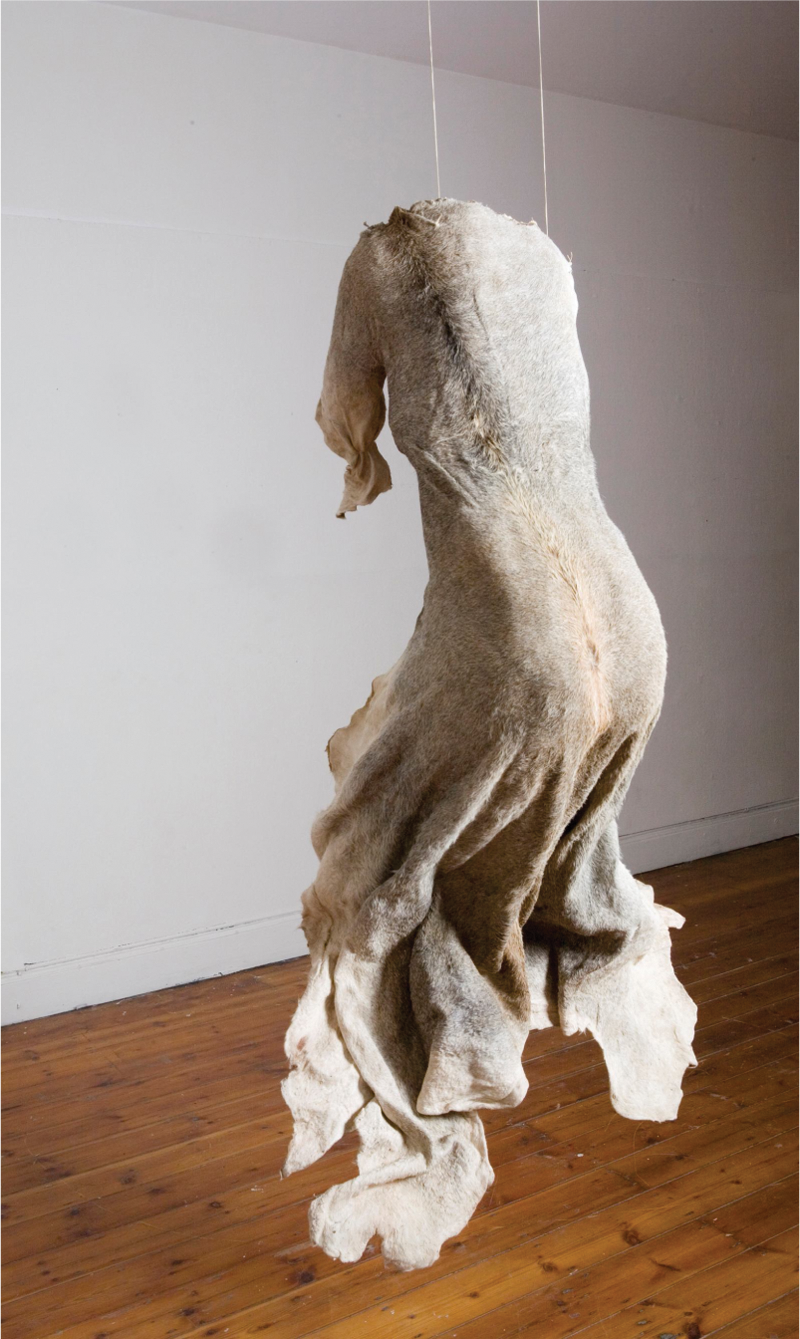
Nandipha Mntambo, Indlovukati (2007): cowhide, resin, polyester mesh, waxed cord. 153 × 89 × 70 cm
To conclude this exemplary excursion into the field of South African art in the post-TRC area: the artistic negotiation of the past indicates that articulating the memory of trauma in order to be able to create something new is not a linear process, but a cycle that has to be reiterated, time and again. 5 Truth is a process that cannot be grasped in one gesture. Historical and personal traumas will never fully be disclosed. However, as the close readings of Country of my Skull, The Man who Sang and the Woman who kept Silent, and Indlovukati underline, it is precisely art’s dialogicity, materiality and medium specificity that enables artefacts to tentatively perform contested truths and contain intricate complexities, thus functioning as possible constitutors of new and multilayered communities.
Footnotes
Acknowledgements
I would sincerely like to thank Cris van der Hoek as well as the anonymous reader for their valuable comments on earlier versions of this essay.