



Abstract

Tanya Voges is an Australian-based choreographer and dance artist. Over the past 5 years, Tanya has developed a number of interactive dance works inspired by concepts, and the experience, of human memory. ‘Retracing Steps’ is a dance theatre work about one’s sense of self and its association with place, home and community. It draws on individual and collective memories of the community in which the work is made and presented. ‘Retracing Steps’ refers to a suite of interconnected performances that invite the audience to be co-creators in an immersive experience. The works have been developed and presented at the Malthouse Theatre, Melbourne; Blacktown Arts Centre, Sydney; Canberra Theatre, Canberra; Movement Research, New York; and Critical Path, Sydney. In an early version of the work, Tanya would mingle with audience members before the performance and record their spoken answers to questions about their earliest memory. During the performance, audio excerpts in random order would be presented to Tanya through her iPhone’s earbuds, and she would shadow or say aloud the audio feed as she heard it while improvising movement material (Figure 1). In a subsequent performance of the work, the audience and Tanya travelled some distance to the venue by bus with that excursion being part of the performance and a source of memories. When ‘Retracing Steps’ was further developed at Critical Path in 2014, Tanya and visual artist collaborator Kellie O’Dempsey used dance and live performance drawing to create an interactive performance environment.

Choreographer and dance artist Tanya Voges in ‘Retracing Steps’ at Movement Research, New York, 2013. To improvise, in early performances of ‘Retracing Steps’, Tanya ‘shadowed’, or spoke aloud, randomly ordered excerpts of audience members’ spoken recollections of their first memory. Photo: Samir Ambady.
Tanya brings people into a space where they share something usually considered ‘internal’ (early memories) or private (domestic spaces) with her, and through her, with others at the show. This context is a central element of ‘Retracing Steps’ (and subsequent works). The ‘public’ or ‘visible’ nature of movement with, or around, or visible to others makes the experience very different to individually attempting to remember an early experience, or one’s childhood house. As Tanya makes clear in the interview, that is because there is someone else, outside you, who is taking an interest (apparently) and eliciting a sense of self in relation to them, and what they are going to do or understand. Tanya’s pleasure at working with these mechanisms to elicit feeling and connection is clear, as is her slight sense of surprise at how motivated audience members are to dwell in these memory spaces. There is also clearly an expectation by audience members of her interest in them as people.
Tanya’s desire to engage audiences as performers comes through connecting movement to memories. As we are moving all the time, the movements that ‘connect’ us tend to be about spaces we share with others. It is the presence (or absence) of others or things that others do, which ‘move’ us to memory. Tanya’s ‘Retracing Steps’ ask us to explore how her movement is also a version of how people see and remember themselves.
Would you describe your initial ideas for the work that you and I were involved with and, in particular, the role of memory?
Over the past five years, I’ve been working on a suite of works under the name ‘Retracing Steps’. It started as an exploration of my own past to create a solo work. As a dancer, I’m often mining my own movement history and presenting that in a very personal way but wanting to draw the audience’s personal history into the performance as well. I asked myself the question: how many different ways could I have an audience interact with me in the performance without making anyone stand up and volunteer and dance? The process working with memory started right back at thinking of one’s earliest memory. Initially, I had the idea that I’d incrementally go through different stages of someone’s life, but the richness that comes in exploring earliest memories was just so intriguing to me. I got hooked into that point for quite a while. Even before I involved you in this most recent research project together with a lot of other artists as advisors and collaborators, I had looked at what were my earliest memories and by doing that I created a language of physical movement and dance. We call these choreographic scores or choreographic phrases. And the phrases were more fixed movements that I would repeat every time I’d do the performances but the choreographic scores were a list of instructions that would elicit a response from me physically based on these memories. Kind of like a jazz musician having the range of notes or the range of musical sounds that they could draw on and then mixing it up when it’s in performance, so that there’s always variation from one performance to another. I guess it used my memory in a current, instantaneous way as well, while reflecting on these really early memories.
What I found from the audience’s experiences was that when I asked them if I could record their response to questions about their earliest memory, I gathered a heap of data that was voice recorded. I’d cut my own question out, ‘What is your earliest memory?’, but I’d record the audience member one-on-one, answering me. Through that, I noticed that people had three different ways of referring to their earliest memory. They’d say ‘Oh, I was probably about 3 or 4’, so it was age related or they’d start by saying ‘it’s connected to a photo, there’s a photo on the mantelpiece or it’s in the photo album’ or with younger people, younger audience members, they’d say ‘there’s a video of it and we’d watched it many times’. And people feel – and this might be because they were coming to a dance performance, so they were people who were very interested in movement practices or perhaps they’re let’s say sensitive people because they were sensitive to the arts and interested in this collaborative art form with which I was working. There were often people who would say ‘Oh, my earliest memory is just a feeling, I don’t know if that counts’. And they were the ones that were really interesting to me because that in a way is what I have as my earliest memory as well and that’s how I can most accurately bring forth choreographic movement from the recollection of a memory, this feeling, this kinaesthetic response.
And I think there’s still that same question, my initial ideas for the work and the role of memory is that in the dance studio when I’m working with other dancers, whether I’m being a dancer or a choreographer, we start off with a discussion about pain and physical capabilities. We’re very judgmental about what our bodies can and can’t do.
Did you say pain?
Pain, yes. The beginning of a dancer’s day is to overcome any pain or injury that you’re carrying with you and then do a warm up as a group to open the body to different movement practices before you get into the creative responses that you make with choreography. It’s just an interest point that I’ve had when I’ve invited other dancers to work with me. We look at parts of our body where we hold the most tension or pain or where we feel the most limitation to achieving set dance movements that we’ve learnt in our careers, whether it’s, you know, at university in the dance courses or in our ballet classes in the past and we often talk about whether that’s an emotional residue in that painful site. Maybe something happened in our past and it was – when we were hunched forward and it’s an emotional space and perhaps that’s where we hold that point. So I experimented with asking this question of the audience – ‘Do you recall a time when you where injured?’. It was included in the version of ‘Retracing Steps’ when I worked with a group of dancers, and we also asked the audience if there was a time they had to leave somewhere or someone, and what that experience of loss meant. In the rehearsal process, I tried to mine my body and its physical responses in relation to these memories of sensations that might be residual, like habitual movement, even before I’m dancing… If I’m walking slightly lopsided, is the reason my foot turns out because that hip has always had this injury from the past. Where is the body memory and how can we make an enquiry about that?
In the work that we’re talking about in particular or the series of works, what are some of the most striking, even surprising, things that came from the performances?
What I found really intriguing was that the things that I thought would happen were pretty consistent. It didn’t matter whether I was performing in Sydney, in a smaller state with a different type of population, like Canberra, or when I went to New York and performed there. It led to similar responses within the performance, so that I had a model of choreography and a sequence of events for me to perform because the audience gave me the same kind of data. As well as the earliest memory question that I asked everyone, as I said before, people would come back with either a story about their earliest memories from a photo, a feeling or something that happened when they were about the age of three. I tried to work on another spatial memory, which we’d worked out as the age of 12, we thought of that as being a passageway into the next step out of childhood and into pre-adult life. So it’s quite a memorable time for many people, perhaps because of that circumstance, that coming of age, but it was something that the audiences could relate to. I think a lot of dance is about spatial relationships, so how do I get an audience member, when they’re sitting in a seat watching a dance performance, to experience the sense of space within their memory. Instead, I had the audience all standing in the same space as the performer(s) and I guided them to walk through their imagined home from where they lived at age 12 (see Figure 2). What was really amazing was that this was a joyful, playful experience for audiences – audiences from different age groups, audiences from different locations around Australia and from New York. It was an enjoyable thing – although I didn’t invite the audience members to talk to one another, because they’d had the experience of speaking to me before entering the space, and then the experience that everyone was living in their memories and reliving walking through rooms and being guided as I asked them to explore where they slept or did they have a bedroom that they shared with a sibling, or where was their dining room, and all of these things, contributed to people walking around and suddenly just talking to one another and having a laugh and ‘Oh, you’re standing in my bedroom while I’m standing in the kitchen’, or something like that. That was surprising and it became a very playful thing. I thought, if this wasn’t actually structured well this could a) go on forever or b), go into a place where you couldn’t rein people back into sitting down and watching the performance. The other surprising thing was that when I left people where they were in the space to watch the performance, the rest of the show would happen in very close proximity to them. So it was different from a traditional dance performance where the audience member would be separated by the ‘fourth wall’; there wasn’t that structure.
People were quite happy to just sit on the floor or stand and observe. I always had some chairs available for people with mobility issues or who were just too shy to have taken their shoes off and sit on the ground. But it was really a communal experience.
I mentioned the experiment where I did ‘Retracing Steps’ in New York. What I wanted to add was an event, like the earliest memory, that anyone I questioned could have an experience of. I know now what I was seeking was a ‘collective memory’ and you helped me to understand flashbulb memories I chose September 11 as an event to ask people about. So that was another question that I’d ask and gather audience data on. What was their experience of September 11, where were they in the world, how old were they at the time that it happened? By having that connection to such a big world event that we can all reflect on, that’s been heavily covered in the media, it’s not something that many people would have been isolated from hearing about. And people were really able to drop into how old they were when it happened and what they’d felt at the time.
Surprisingly, when I was in New York, most of the people that I spoke to, either weren’t from New York or weren’t in New York at the time it happened. So I also explored the question of their personal or individual experience of Hurricane Sandy. My first time I went to New York I arrived the night before Hurricane Sandy hit, so I had a shared experience of this with the community, even though I wasn’t from there. Obviously, there were people for whom both these experiences were very emotional points to discuss. Emotion and memory are strongly linked and I’ve found are rich sources for creating performances.
In each performance of ‘Retracing Steps’ the audience observed bits of data that I used from that questioning before the performance, in the performance, creating a whole experience. Even if I didn’t repeat their answer to the audience, or use the response in a choreographic way, even if I used just two responses from audience members, everyone knew what questions had been asked and they could further reflect on their own experience by seeing someone else’s experience reiterated on stage in a different mode, whether it was through talking about it or through movement. The way that I used their recorded data was that I would record it on an iPhone as a voice memo. In the performance, I had a set of headphones that were Bluetooth connected to the phone so that I didn’t have to be holding up the phone while dancing, but the headphones I wore were visible. I would replay those recordings and as I heard them I would speak those words. For a lot of the time, I wasn’t completely conscious of what would come next, but that’s when I would commit to the choreographic phrases where I’d be doing known dance movement – and instead of performing it to music, I was performing it at the same time as speaking the words of the audience. That was a random selection, a random process to select which audience response I would use, so as to not overly control that outcome.
Because audience response to the works has consistently been so positive, I want to continue to explore this mode of working. It does seem to draw people into the experience a lot more by knowing that someone else in the room, who they are watching the performance with, has actually just answered those questions.
Are there other things about the actual performances that you’d like to touch on?
Just to touch on this last reiteration at Critical Path. During 2014, I had my residency at Critical Path, which is a space in Sydney for New South Wales-based choreographers to research and develop their choreographic practice. During that research and development period, I had the opportunity to work with you a cognitive psychologist and with visual artist, Kellie O’Dempsey, dramaturg, Martyn Coutts and media specialist, Mic Gruchy. Placing myself in a position with these other experts, gave me different ways of looking at the performance making and different ways to see which directions the performance could go. I already had so many consistent things that were happening, I wanted to be able to create a system that would enable taking the performance to different locations, taking it to different sites, whether it was indoors, in a theatre space or outdoors in a public space. I started to play with the idea of ‘Vestiges’ as the work that we played with in Critical Path in this last incarnation of ‘Retracing Steps’, because it had a lot more components. It had the mediation of live and recorded projections that was explored, that it hadn’t had prior to that, and it had Kellie as a visual artist interacting, both as a performer and doing performance drawing (Figure 3).
The things that started to come to the fore were memories being recalled in a repetitive way, using the way that the body could trace movement through the space and illustrating that with performance drawing (Figure 4). There was a very strong connection and I remember you, Kate, making a point about the memory trace being visible. Some of the movements and actions that I was going through were like a path of evolution or the path of going from early life through growing old and maybe even reflecting on death and that our memories at a very cellular level, are connected to movement practices, even though whenever I think of memory, it seems to go back into the mind space, the body memory is more powerful than a memory of sitting and thinking about it and just talking about it.
In the works I know of yours, you’ve made explicit what I think is so much of an influence on artworks anyway. Memory is at the heart of much visual and performing art and you’ve brought it into relief.
When we articulate what we create as artists, using words to describe movement there is quite often something lost in translation, but regardless of that everyone’s past experience is going to influence their experience of your art. They’re going to look through the window of their own experience. I was intrigued by my own memories. I think I do have a good memory and I don’t know why that feels like it’s important to the process, but I am really interested in people who tell me they don’t have a good memory of the past and they maybe have blocked out those things that they don’t want to remember. I know that you’ve made a good point that it might be adaptive that there are things that we do forget. It’s there for our safety, our mental capacity. If we remembered everything that happened to us, we wouldn’t have time to be in the present moment, our brains would be over loaded. But it’s a given that art is viewed through one’s own experiences.
I also didn’t want to pressure people into experiencing something that was scary or foreign or had to be questioned further when they left the performance. Contemporary dance is such an abstract form, but to have people leave a performance and go ‘I wonder what that was about? What does that have to do with me and my life? Why did the dancer roll around on the floor all the time?’ I don’t want people to be left so much with those questions that they then didn’t get the point of the performance and this is a way that I think speaks to my sensibilities and interest in community and communal experiences, that, you know, we are so separated from one another, the whole experience of social media, you’re networked and connected to people, but actually isolated in your own home or in an office situation where you’re not able to have face to face time with other people who are part of your clan or part of your community. But this experience allows for that very primal response of doing something with a group of people and what impression it leaves on you after that.
As audience members, our contribution was authentic and real. You weren’t asking us to perform, all you were asking was to time travel, to recollect, to go back in time.
Yes, we really played with that element. I must say that, talking about this again, having not been working on it for a short period of time, but being invited back into the creative process literally by talking about it and interrogating my memory of exploring memory, makes me excited to do it again literally just to meet new people. And they’re not people that I’m going to have a long lasting relationship with, but I feel like the impact that an artistic experience, a performance experience, can have just by cracking open those little opportunities for an audience member to get into the creative process through the performance, it means that I will have had an effect on their impression of performance and their impression of seeing a collaborative art work or going through a multimedia performance and that this might actually contribute to the culture around art in Australia or in other cultures similar to ours, and I think that’s important to me, because it’s always been part of my life.
A captivating aspect of Tanya’s practice is her concern with making the audience part of the performance. She does this, in part, by establishing a relationship with the audience, and among the audience through the medium of eliciting past memories. Her experiments have two aspects in this regard. Firstly, Tanya is interested in establishing a sense of a personal connection between herself as performer, and audience members. Secondly, facilitated by this rapidly achieved but potentially intimately felt connection, there is an opportunity for audience members to ‘move through’ memory spaces and experience memory through movements. Her idea of extended bodies in space highlights aspects of the extension of persons through memories, to other people, and other spaces of experience. Memory is complexly social here, with spatial memory elicited by a specific way of establishing context for experience. The dual approach: of establishing a ‘relationship’ with and among audiences, and the subsequent experience of space and memory, is central.
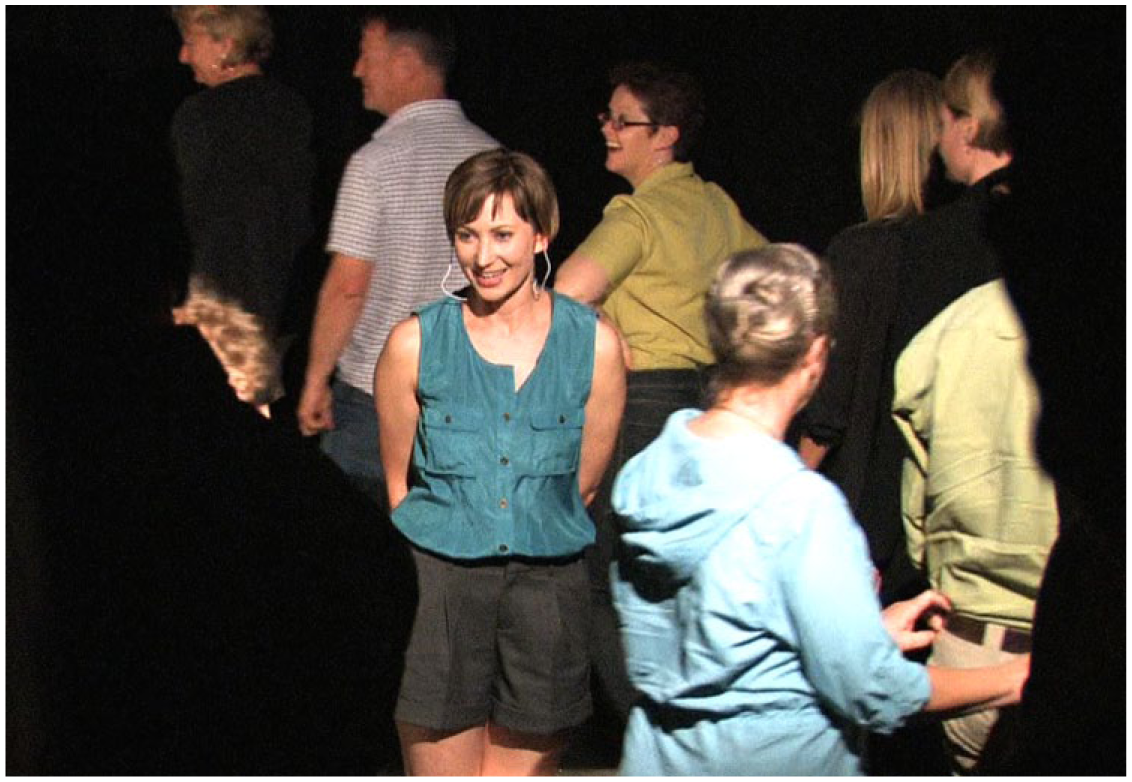
Tanya guiding audience members to recollect where they lived when they were 12 years of age, and to move through the layout of their home at that time. ‘Retracing Steps’ at Canberra Theatre, Canberra, 2013. Photo: David Keany.
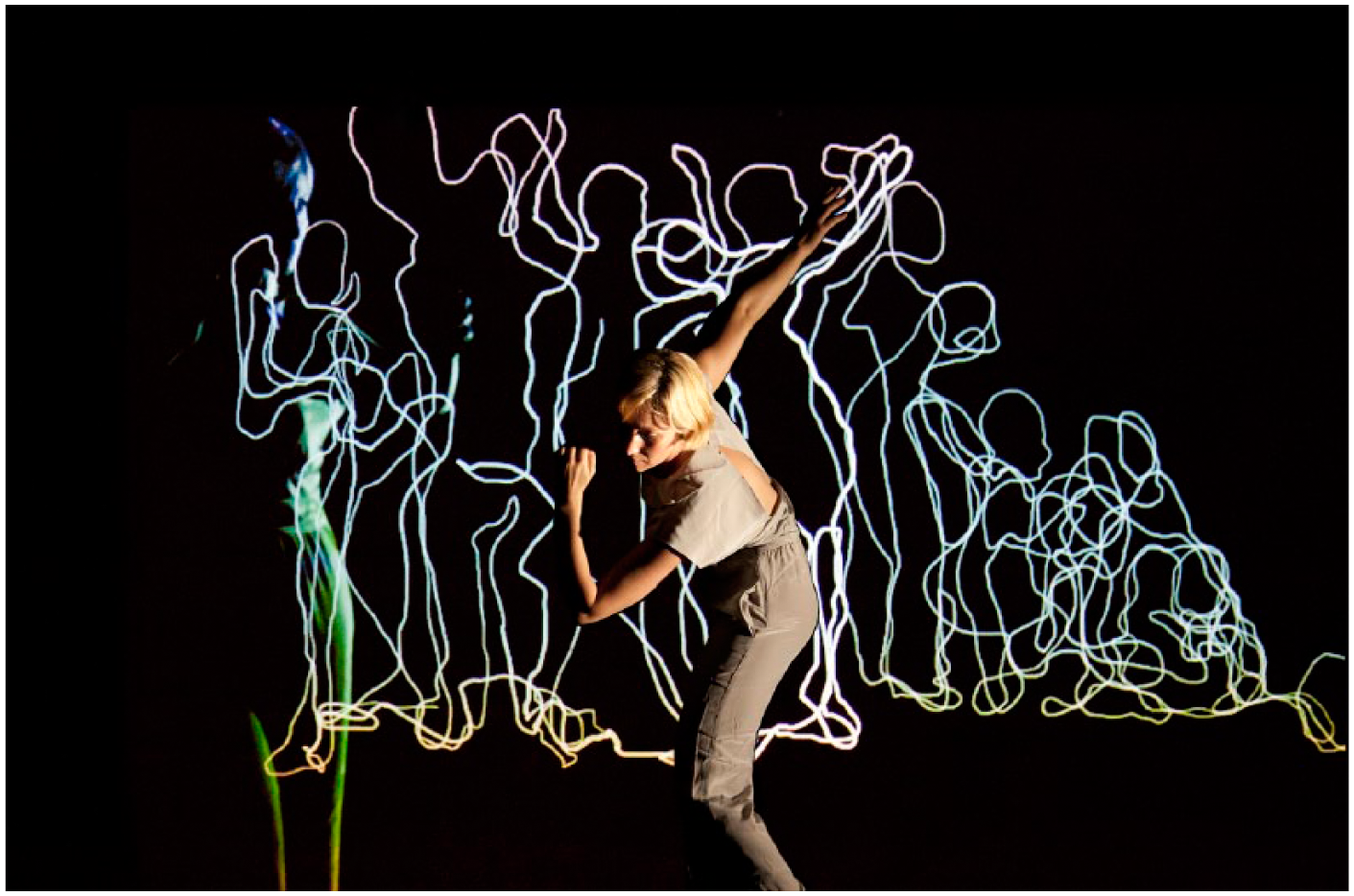
Tanya Voges in ‘Retracing Steps’ with live performance drawing by visual artist Kellie O’Dempsey at Critical Path in Sydney, 2014. Photo: Maylei Hunt.
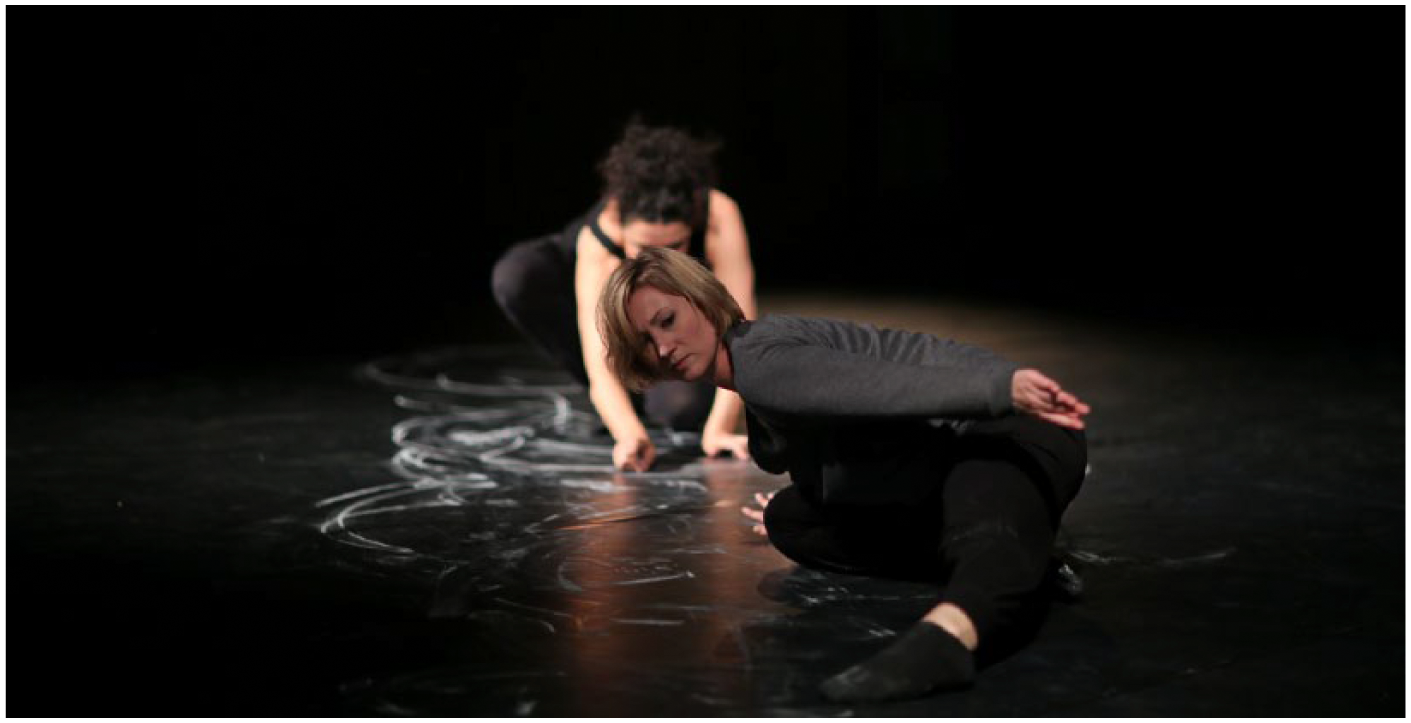
‘Retracing Steps’, Critical Path, Sydney, 2014. Tanya Voges, foreground, and Kellie O’Demspey, background. Photo: Tim Standing.
Footnotes
Acknowledgements
The authors thank the ‘Retracing Steps’ creative team Tanya Voges, Kellie O’Dempsey, Mic Gruchy, Martyn Coutts, Tim Standing and the Directors of Critical Path, Margie Medlin and Claire Hicks. Cognitive psychologist Catherine Stevens was an advisor for the 2014 residency at Critical Path and subsequently interviewed Tanya Voges. Social anthropologist James Leach observed Tanya’s approach during the ‘Developing Experiments’ Lab at Critical Path in 2015 and again in Adelaide in 2016. Based on his observation and interviews, James has provided the opening and closing commentary on ‘Retracing Steps’ here. Further information: http://www.tanya.voges.net and  .
.
Declaration of Conflicting Interests
The author(s) declared no potential conflicts of interest with respect to the research, authorship, and/or publication of this article.
Funding
The author(s) disclosed receipt of the following financial support for the research, authorship, and/or publication of this article: This collaboration was supported by Critical Path, Australia Council for the Arts, and Arts NSW through Tanya Voges’ artistic residency in 2014 and the ‘Developing Experiments’ interdisciplinary lab in 2015, an Australian Research Council Linkage Project grant (LP130100670), and MARCS Institute for Brain, Behaviour and Development, Western Sydney University.
Author biographies
).
).