



Abstract
Despite the crucial transformations that Spain has experienced since Franco’s death, and in contrast with other countries that have democratized in recent decades, considerable reluctance remains toward implementing transitional justice measures. On the contrary, there is a tendency to hold on to a framework that combines the Amnesty Law of 1977 with partial reparations as the best guarantors of democratic stability. According to extant literature, generational change has played a fundamental role in the direction taken by recent initiatives dealing with the memory of Francoist repression, particularly since 2000. A small but very active part of the “grandchildren’s generation” has driven various initiatives that have influenced political and judicial agendas. We provide empirical evidence showing that while, in general terms, it would be true to say that third and fourth generations have been more supportive of the implementation of bolder memory policies, their contribution must nevertheless be subjected to careful nuancing.
The Spanish transition has often been presented as one of the most successful democratic transitions of recent decades. The population’s traumatic memories of a brutal civil war and a cruel and protracted dictatorship were not easy to overcome. However, for many years it was widely believed that the basis for the stabilization of democracy in Spain was precisely the decision to leave behind the thorniest aspects of the past (Encarnación, 2014). In the last 15 years, however, different voices have challenged this perspective, arguing that the Spanish transition was not as exemplary as it had initially been portrayed, mainly because it failed to provide truth and justice to the victims of Francoism. Several victims’ organizations, the most prominent of them founded by the grandson of a Republican executed by the Francoists, have given new impetus to the politics of memory, resorting to international jurisdiction to obtain the recognition they have not been able to find in Spain (Tamarit, 2013).
Against this backdrop, this article discusses two contradictory tendencies regarding the recovery of the memory of the recent past that coexist in Spanish society. The first, mainly top-down driven and found among the political elites of the transition, opposes digging into the past. Notably, those who hold this position belong mainly to the second generation born after the Civil War. The second tendency is mainly bottom-up driven and mostly embodied by people belonging to the third (and increasingly fourth) generation, in other words, the grandchildren (and great-grandchildren) of those who lived through the Civil War, particularly, but not only, those belonging to Republican families. This tendency is in favor of the provision of truth, justice, and reparation to the victims of Francoism. 1 While a great majority of the Spanish population from the second generation after the Civil War tends to believe that the decision to leave the past behind was fundamental to the success of Spanish democracy (Juliá, 2004; Ortega Díaz-Ambrona, 2015), a significant part of the third generation believes that the quality of Spanish democracy would substantially improve if victims’ rights were upheld, and truth and justice provided (Silva and Macías, 2003). However, as we will argue, this generation is internally more heterogeneous than some authors have suggested and probably not strong enough to radically change, at least in the short term, the politics of memory in Spain.
This article traces the work of various authors who have emphasized the importance of generational change in explaining variations in the politics of memory over time (e.g. Davis, 2005; Jelin, 2007; Jelin and Kaufman, 2006; Jerez-Farrán and Amago, 2010). Although we have taken this literature as a point of departure, its reliance on qualitative data may, in our view, have led scholars, particularly those who have emphasized the leading role of the third and fourth generations after the Spanish Civil War, to overestimate the internal homogeneity of this group. Also, the attention that has been given to the role played by these more recent generations has contributed to shadow the exhumations and homages that were promoted by the first and second generations after Franco’s death. Under much less favourable conditions than nowadays, many exhumations took place in several towns of Extremadura, Navarra, La Rioja and Soria in the earlier years of the transition (Aguilar, 2016). The leaders of the second cycle of exhumations, however, have often failed to recognize the pioneering role of their elders.
The article’s contribution is threefold. First, we argue that existing literature on the politics of memory and trauma has not yet paid sufficient heed to the tension that exists between the intergenerational transmission of memory and trauma—which, in principle, would imply continuity—and the different and specific ways in which each generation faces up to the same past—which, to the contrary, would entail change. 2
Second, most literature on the Spanish case which has sustained that the grandchildren’s generation has been the driving force behind recent developments in the country’s politics of memory has used either circumstantial evidence or limited representative examples. Here, while considering the different qualitative studies on the topic, we also incorporate quantitative data extracted from the only existing survey exploring Spanish attitudes to the Civil War and its legacies. This survey, conducted in 2008 by Spain’s official sociological survey center, the Centro de Investigaciones Sociológicas (CIS), is the only monographic survey that has ever been produced in Spain about (1) the memories of the Civil War and the dictatorship, (2) the legacies of both phenomena, (3) transitional justice (TJ) measures, and (4) mechanisms of socialization. Given that this survey is representative of the whole Spanish population (it even contains two additional samples representative of the Catalan and Basque populations), it constitutes the best and only available source to produce robust and generalizable evidence about both intragenerational and intergenerational dynamics. 3
Finally, while this article builds on the work of various authors who have emphasized the importance of generational change in explaining variations over time in the politics of memory in Spain, we contend, however, that these authors’ reliance on qualitative data has led them to underestimate the internal heterogeneity of different generations, and thus difficulted to better identify the different dynamics in play. One aspect that has not yet been sufficiently addressed, for example, is the crucial stimulus that the grandchildren’s generation has provided in helping to break the apparently frozen silence of their grandparents. This has helped to create strong complicity between the most committed members of these two generations, clearly visible in exhumations, judicial initiatives, and all kinds of memory activities.
This article is divided into two sections. The first sets the context for discussion, briefly summarizing how demands for justice and memory have evolved in Spain from the second to the third generation. The second deals with the complexities of memory transmission and generational change in Spain and includes the latest developments in memory issues, particularly those undertaken by the third and fourth generations. Finally, we present our conclusions.
TJ and the politics of memory
Following a 40-year long dictatorship, political change arrived in Spain in 1977, after a complex negotiation between the reformist sectors of Francoism and the moderate forces of the democratic opposition. The decision of the political elites of the time not to implement any measure to provide truth, justice, or symbolic reparation was nonetheless widely supported by the Spanish society, which, at that time, greatly feared the renewed outbreak of a civil conflict like the Civil War of 1936–1939 (Aguilar, 2008a). The peculiarity of this decision lays in the fact that it largely transcended ideological boundaries, with both leftists and rightists in the mainstream agreeing that it was the best possible route to guarantee successful democratization. 4 It was, however, based on a fictional moral equivalence between the winners and the vanquished, and between the supporters of the dictatorship and those who risked their lives fighting against it.
During the first 25 years of democracy (1977–2000), a series of reparatory laws were passed to compensate victims of Francoist repression economically, although, in the wake of 40 years of complete oblivion and discrimination, such reparation measures were of only a very limited and fragmentary nature. Indeed, these measures were never part of a broader comprehensive policy aimed at dealing with the legacy of the past and their intention was neither to establish the truth nor obtain justice. On the contrary, the first piece of legislation passed by the new democratic parliament was an amnesty law. While releasing the few remaining political prisoners of the Franco era, and providing pensions to some of the victims of Francoism, it also pardoned violations committed by the officers of the dictatorship (Aguilar, 2008a).
In the social sphere, a number of brave initiatives took place, but they had a very low profile. According to the Spanish National Registry of Associations, during the 1970s and 1980s, a small number of associations were created by Spaniards in exile and Republican war veterans. And, particularly after Franco’s death (and, occasionally, even before), there were numerous exhumations of mass graves where Republican victims had been buried during and in the immediate aftermath of the war, and many monuments honoring the Republicans were built in several villages (Aguilar, 2016). In sharp contrast to the “second wave” of exhumations that would begin in 2000 and spread all over the country, this “first wave” was spontaneous and private. 5 With the notable exception of the maganize Interviu (Aguilar and Ferrándiz, 2016), and sometimes also of the local press, they had very scarce resonance in the national public arena. 6
After these very limited initiatives of the early transition, for many years the majority of Spaniards decided to leave the past behind, during which period the victims of the war and the dictatorship became almost invisible. However, as it has also happened in other contexts, after more than two decades of democratic forgetfulness, what we might call a post-TJ phase began to emerge within the broader Spanish process of memory recovery, transcending the institutional arrangements established during the transition. 7 This phase began from 2000 onwards with the creation of several memory associations that managed to insert some of their demands into the political agenda of some leftist and nationalist parties, eventually leading to the adoption of a relatively comprehensive reparation law in 2007 (Law 52/2007, which recognizes and expands the rights, and establishes measures in favor of those who suffered persecution or violence during the Civil War and the dictatorship), also known as the Law of Historical Memory (LHM). 8 The factors that contributed to this unexpected development in the Spanish politics of memory have already been addressed extensively elsewhere (Aguilar and Ramírez-Barat, 2014; Golob, 2008). Here, we will outline only those most relevant for our argument.
First, as other authors have argued, generational change has proved a crucial variable in the recent emergence of memory issues in Spain. The grandchildren of the Civil War, who brought this issue to public attention in 2000, grew up under a stable democracy, are devoid of the feelings of guilt or fear of their predecessors, and are much more comfortable with the international human rights law framework. 9 A significant part of this generation is also convinced that challenging the institutional arrangements of the transition will not destabilize the political situation and that the time has come to provide public recognition to the victims of Francoism .
Second, the Asociación para la Recuperación de la Memoria Histórica (ARMH) and various other organizations established from 2000 onward helped catalyze this trend. 10 Despite their heterogeneity, all these organizations are firm advocates of recovering the “silenced” memory of the Republican victims. In particular, ARMH, founded by Emilio Silva, a journalist whose grandfather was executed by the Francoists during the Civil War, has promoted many successful exhumations all over Spain, as well as a handful of initiatives to recover the memory of the victims of the Civil War and Francoism that have played a key role in providing public visibility for justice claims. Significantly, in 2000, Silva was the first to promote the exhumation of a mass grave from the Civil War using a scientific protocol and the first to identify his grandfather’s remains with DNA tests. 11 This first DNA identification had a tremendous impact, encouraging many other families to seek the same sort of scientific “truth.”
Third, the evolution of international human rights and international criminal law frameworks following the end of the military dictatorships in the Southern Cone of Latin America and the lobbying efforts of international non-governmental organizations (NGOs) and international institutions have also proved highly relevant. In this context, those from the third and fourth generations looking to recover historical memory in Spain are considerably more familiar and comfortable with the language of human rights and crimes against humanity and have consciously and strategically adopted this language to pursue their demands (Ferrándiz, 2010).
Finally, a strategic political turn took place within the Spanish Socialist Party (Partido Socialista Obrero Español, PSOE), after it first lost power in 1996 following four legislative terms in office (1982–1996) during which the past was mostly ignored (Aguilar, 2008b). Only 2 months after Rodríguez Zapatero, who also represented a generational change among its ranks, started his premiership in 2004, 12 the Congress approved a non-legislative motion calling on the government to undertake a study into the legal situation of the victims of the Civil War and of Franco’s regime, and advance proposals to improve their economic situation. Two years later, a government-appointed commission presented two reports and a draft law. The submission of the bill initiated a difficult negotiation process between the PSOE and the other political parties. While the conservative party (Partido Popular, PP) strongly opposed the law, leftist parties and human rights and victims’ groups criticized the proposal as insufficient. Finally, an amended version of the original text was passed in December 2007, the LHM above mentioned.
The main accomplishments and shortcomings of the LHM have been addressed profusely elsewhere (Aguilar and Ramírez-Barat, 2014; Escudero, 2014; Tamarit, 2013). Here, we will highlight two points. On one hand, this was the first law providing a comprehensive framework, includign revision of the reparations policies already implemented and the provision of economic subsidies for exhumations and acts of public recognition to the victims (something unthinkable before 2000); on the other hand, the law did have major limitations, due mainly to the second generation who remain politically and socially influential (e.g. political trials and sentences have not been annulled and the State has not taken responsibility for the exhumation of mass graves). Despite these limitations, a nationwide survey conducted by the CIS, during the time the Law was being discussed, reveals that, in 2008, the younger generations had a more positive view of this Law than their elders: 55% of respondents aged 35–44 considered it positively or very positively, in contrast to 40% over 65 who thought the same. More importantly, while only 18% of the respondents between 18 and 24 years considered that “the LHM is not an opportune law, because it revives old hatreds,” 43% of respondents over 65 agreed with this statement. The LHM law had been considered both inopportune and dangerous by the right and the Catholic Church. However, the youngest respondents of the survey were the least supportive of this opinion because they did not perceive this Law, which aimed to address some of the existing lacunae regarding the victims of Francoism, to be dangerous at all for the stability of Spanish democracy.
The victims and human rights groups’ disappointment with the Law’s shortcomings at the time it was being discussed in parliament partially explains why, in 2006, five organizations of families of disappeared during the Civil War and under Francoism presented claims to the National High Court. Two years later, Judge Baltasar Garzón allowed the case to be heard in the face of opposition from the public prosecutor, leading later to dismissal of the case and eventually putting Garzón himself in the dock on charges of abuse of power. 13 The closure of Spanish and European judicial venues triggered a significant change in the strategy of victims’ associations, which in 2010 decided to present their claims in a foreign court, the Federal Chamber of Buenos Aires in Argentina. These judicial cases, which have undoubtedly given a crucial impulse to historical memory in Spain, have been made by possible by a highly engaged part of the younger generations, who have established very strong ties with their elders and are helping them to deliver their testimonies in very different settings, from law courts to documentaries, stage plays, and ceremonies.
Transmission of memory and generational change
Research on the intergenerational transmission of political identities has a long tradition in political science (Balcells, 2012; Jennings et al., 2009; Martín, 2004; Pesquera, 2012; Styskal and Sullivan, 1975; Wood, 2008). The same is true of the intergenerational transmission of trauma in psychology and related research fields (Adonis, 2015; Assmann, 2006; Carmil and Breznitz, 1990; Danieli, 1998; Fromm, 2012). Numerous studies have been carried out with different generations of Holocaust survivors. In this context, Hirsch (2008) coined the term “generation of postmemory” to describe
the relationship that the generation after those who witnessed cultural or collective trauma bears to the experiences of those who came before, experiences that they ‘remember’ only as a result of the stories, images and behaviour among which they grew up.
According to her, “these experiences were transmitted to them so deeply and affectively as to seem to constitute memories in their own right” (pp. 106–107). Renshaw (2011) considers that “[t]he condition of postmemory identified amongst the children of the Holocaust survivors” can be applied to the descendants of the Republican victims of the Spanish Civil War (p. 33). In a similar vein, Miñarro and Morandi (2009) sustain that the traumas do not die “with the generation that directly suffered the experience, but are transmitted to their descendants, affecting second, third and fourth generations” (p. 448).
In the family realm, deeply traumatic experiences tend to be treated in at least two opposing ways. Some families opt for explicit transmission of their traumatic experiences in the private realm, as a way of both conveying the family identity across generations and of protecting its memory against official denial. This transmission has sometimes proved too overwhelming for the offspring, who are forced to keep it in the private sphere and assimilate devastating family events. Other families decide to silence these painful memories, either as a form of psychological survival (i.e. to avoid re-traumatization by narrating the past) or even physical survival. 14 These opposing mechanisms are likely to lead to different outcomes: an overwhelming transmission of the traumatic past can instill in the second generation a wish to move on, whereas, in other cases, repression of the past can eventually become an invitation to find out more about what happened and, eventually, try to repair the harm endured. In general terms, the strategy of concealment is more likely to take place in contexts of authoritarianism and with the persistence of violence after the traumatic events—as it was the case during the Spanish Civil War and the subsequent 40 years of Francoist dictatorship—in contrast to open transmission, which is more common in democratic contexts. Moreover, when a democratization process immediately follows the worst period of human rights violations, it is likely that the victimized generation will have to decide how to deal with the past. If such violations are followed, however, by a protracted dictatorship, as it happened in Spain, it will probably be left to subsequent generations instead to decide how to tackle the violations suffered by their forebears. 15
Previous empirical research on the memory of the Civil War and Francoism has proved the “long-term relevance of victimization and socialization on political identities” and confirmed “the decisive importance of intergenerational transmission of views about traumatic events” (Aguilar et al., 2011: 1419–1420). The extreme repression suffered by the defeated side during the dictatorship and the social stigma associated with being considered a “loser” of the war help explain why many Spanish families opted to remain silent after the war about the past, as collected testimonies from that period abundantly show. 16 While some families managed to convey their traumatic experiences, albeit with extreme caution, and sometimes even socialized their offspring in their ideological commitments, most Republican families, particularly in villages and small towns, opted to conceal the past. The overwhelming presence of trauma and fear within the family realm had a tendency to leave psychological traces. 17 In fact, this concealment, which could not hide the obvious presence of unspeakable secrets, was often so evident that descendants can even be said to have inherited the condition of “victim.” Moreover, the social and economic discrimination suffered by the losers of the war undeniably impacted not only their own life opportunities but also those of their descendants (Casanova and Cenarro, 2014).
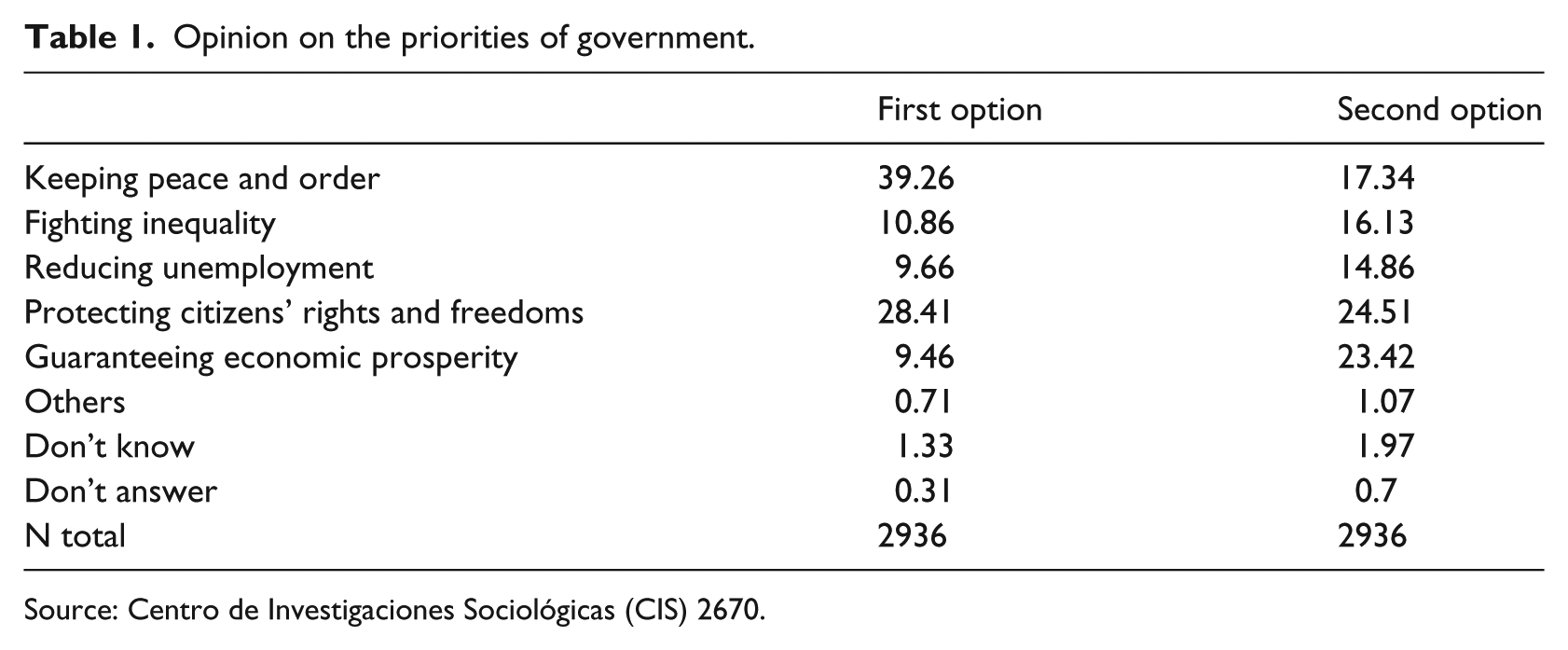
Such factors help explain why the second generation after the war—of those who later led the democratic transition—has overwhelmingly insisted on overcoming the past by avoiding it. Their obsession with peace and order has already been established in the literature (Aguilar, 2008a), but is confirmed by the aforesaid CIS survey of 2008. According to the data collected 39.3% believe the first priority of a democratic government is “to keep peace and order,” while only the 28.4%, consider it to be, “to protect citizens’ rights and freedoms” (see Table 1). Yet interestingly, among the respondants, the youngest group (18 to 24 years) favors “to protect citizens’ rights and freedoms” over “to keep peace and order” (33.3% vs 28.5%), whereas the oldest group (older than 65 years) clearly prefers “to keep peace and order” than “to protect citizens’ rights and freedoms” (54.9% vs 18%). Under the dictatorship, the older generations were socialized in an obsession with peace, with the regime insistently presenting “peace” and “order” as its main achievements. This would explain why 47% of those over 55 think that there was more peace and order under Francoism than under democracy, whereas only 25% of the youngest generation agrees. Despite the clear contrast between these two generations, it is nonetheless highly significant that a quarter of the youngest generation still subscribes to this statement.
Opinion on the priorities of government.
Source: Centro de Investigaciones Sociológicas (CIS) 2670.
Different generations can be expected to display different attitudes toward the same traumatic past. The socialization context differs for every generational group and, though they may share commonalities with a predecessor, their relationships with the past are likely to be diverse. Despite the unquestionable transmission of memories between succeeding generations, well-established academic research has proved that the members of each generation are uniquely and deeply affected by a set of crucial events that take place during a “critical period” in an individual’s personal development, generally considered to be between the ages of 17 and 25 (Schuman and Corning, 2012; Schuman and Scott, 1989). An additional caveat is required: as Ros (2012) has shown in her analysis of post-authoritarian scenarios in Argentina, Chile, and Uruguay, descendants do not passively inherit the past, but they engage in an active dialogue with their predecessors, questioning the narratives received.
All of this is consistent with the data collected in the CIS survey, in which 17.6% of those interviewed acknowledged having feared the outbreak of another civil war during the 30 years of democracy. Of these, 81.1% of respondents between 45 and 54 associated this fear with the failed coup d’état of 1981, whereas only 8.6% of those between the ages of 18 and 24 made this association (in fact, 50% of this age group linked the possibility of another civil war with the political polarization experienced in recent years). Given that this younger generation was born after the attempted military coup, it was very unlikely they could associate the probability of a new civil war with that event. However, for the older age group, this traumatic episode happened during their “critical period,” leaving an indelible mark on their memory.
The relevance of the “age” variable in Spaniards attitudes towards TJ and the politics of memory has already been empirically proven. However, in the regression model presented by Aguilar et al. (2011), the effect of this “age” variable is assumed linear, whereas here we argue that it is not (pp. 1419–1420). Considering generations, instead of simply age groups, provides interesting insights into attitudinal differences towards the past. Having been socialized in an authoritarian atmosphere, where objective narratives of the past were extremely difficult to find, the second generation after the Spanish Civil War inherited not only the fear of repression (particularly on the losing side) but also the traumatic memory of extreme violence experienced by both sides during the war. The aim of avoiding another civil war at all costs thus became a fixation for many members of this generation. 18
Tellingly, according to the CIS survey, the second generation is also the least inclined to support the recognition and reparation of victims, for it tends to associate any attempt to dig into the past with the irruption of old hatreds and the destabilization of democracy. Only 31% of this age cohort over 55 supported the creation of a truth commission to investigate human rights violations during Francoism, while almost 50% of those between ages 18 and 34 were in favor. (It is also interesting to point out that, even if more supportive than older generations, the measure is not supported by the majority of the younger generation, with one-third clearly against it). When asked what should be done with the human remains buried in mass graves, 35% of respondents over 55 affirmed that “nothing should be done; it is better to leave things as they are now,” while only 19% between 18 and 34 agreed with such a claim. With respect to collective memory, between 42% and 48% of those over 55 thought “the best thing to do is to forget about the past, because, if it is stirred up, the Civil War could be repeated,” but only 26% between 18 and 34 agreed with this statement. Also, whereas 59% of the youngest group considered that Francoist authorities that committed human rights violations had to be put on trial, only 34% of the older group supported this option. Finally, 70% of the youngest group favored erecting a monument to the victims of Francoism, in contrast to 52% of those over 65.
As mentioned above, Holocaust research is already showing interest in the traces of traumatic memory in the third generation of survivors (De Grom, 2011; Kahane-Nissenbaum, 2011; Scharf, 2007). In Spain, according to the CIS survey, the third and fourth generations have proved in general terms to be more sensitive to victims’ demands and more favorable to their reparation. This generation of grandchildren is devoid of the feelings of guilt still present in the first generation and of the fear experienced by the second, while its members often feel indebted to their grandparents 19 and feel they owe this first generation the public tribute which the second generation did not provide—initially because of the dictatorship, and later because such recognition was considered incompatible with democratic stabilization. 20 This “duty of memory” 21 has also been found in recent research conducted in Spain on the psychology of Civil War trauma transmission.
Nevertheless, there is also abundant evidence of the repression of memories, not only in the second but also in the third and even fourth generations. 22 The vast majority of those belonging to the younger generations cannot be described as outspoken about the past. On the one hand, some are relatively indifferent and/or show great historical ignorance; 23 on the other hand, some have either never discovered family secrets or have been raised without family memory. According to the CIS survey, 40% of respondents from the youngest generation do not know which side his or her family supported during the Civil War, while 41% claim they did not learn about the Civil War from their families when they were children, and 33% say the same about Francoism. Members of this age group also have very little knowledge about how many family members died or suffered different kinds of repression during the war, while even those who do cannot, in many cases, identify which side was responsible.
Tensions have sometimes arisen between second and third generations. The interesting paradox of the Spanish case is that whereas the second generation has often assumed that the best way of showing loyalty to the first is by respecting its silence, the third generation sees the first as unjustly treated and poorly compensated, considering the best way to honor its members to be by publicly acknowledge their suffering and seek truth and justice. The second generation sometimes interprets the bold initiatives of the third as an attack to its own inactiveness and considers that its offspring—who are much more critical of the democratization process—are failing to recognize the crucial contribution their predecessors have made to the stabilization of the Spanish democracy.
By contrast, those members of the third generation that have lead this renewed memorial movement have been responsible for creating organized groups and platforms, showing a notable capacity for mobilization and less apprehension about publicizing its demands. This group, which to the date has been the most ambitious in terms of pursuing justice, truth, and memory in Spain, has been the first to adopt the language of international human rights to express the traditional claims of the victims of Francoism, and has often converted reburial ceremonies of exhumed bodies into bold vindication acts. It has also taken advantage of international human rights instruments, resorting to national and international courts to articulate their justice demands. 24 Leaving aside the undoubtedly daring steps taken by some representatives of the former generations, it can be argued that the real “memory entrepreneurs” of the Spanish democracy have been a small, though very committed, part of this third cohort. 25 Although it is not the only generation to have mobilized around memory demands, the renewed irruption of the past in Spain in 2000 and the political measures undertaken subsequently by the socialist government cannot be explained without its initiatives, and the strength and both logistic and emotional support it has given the older generations. The cooperation between three or even four generations, already underlined by Golob (2008: 134) and Renshaw (2011: 234–235), is crucial to explain the exhumations that began after 2000 (where personal testimonies have been decisive in locating mass graves), and many of the cultural activities that are now taking place, where young activists invite elders to tell their personal stories. It has also resulted in judicial initiatives, including the lawsuit presented in Argentina in 2010 with the active support of the third generation, in which some members of the second generation, tortured in Francoist prisons in the 1960s, have joined forces with victims of the Civil War and the post-war period, belonging to the first generation.
In view of the above, it might be argued that, in the early years of democracy, the apparent social and political indifference, often driven by fear, of the great majority of the Spanish society forced most survivors to remain silent. However, as time has shown, some were merely waiting to be given the opportunity to revisit their traumatic memories. The younger cohorts have repeatedly invited their elders to provide testimony of their experiences in very different formats. The book by Armengou and Belis (2004) based on oral testimonies provides, for example, abundant evidence of the inherited fear of older people and their reluctance to talk about the past. However, it also shows that, given the incentive provided by people belonging to the third generation, many of the first and second generations have agreed, sometimes for the first time in their lives, to talk about the past. One such story cites the brother of a Republican executed in the Civil War who, 10 years ago, stated, “I am fighting for the young people. The old don’t want to know anything! […]. People have got used to not talking about these things” (Armengou and Belis, 2004: 185, 207).
This incentive to talk had other fundamental consequences. According to therapists working with Civil War victims and their offspring, “the long-lasting effects of repression can be interrupted by talking about the experience and its effects with an empathetic person” (Garriga, 2012: 605). Others have emphasized the role played by memorial associations in satisfying victims’ need to talk (Miñarro and Morandi, 2012). In Spain, many of those who suffered Francoist repression have only been able to talk, for the first time, in the midst of an exhumation process. The healing consequences of giving testimony, especially where the mourning process has not been properly done, should not be underestimated.
These tendencies coexist with the inertia inherited from the democratization period which, though more tangible in the older generations, is also present in the younger ones. The literature has sustained that the second generation after the war largely attributes the success of the Spanish transition and democratic consolidation to the fact that the past was left behind. However, the CIS survey revealed that the differences between generations in assessing the democratization period are not as sharp as predicted: 78% of respondents over 65 felt proud of the transition compared to 65.5% between 18 and 34. Indeed, 19.5% of the youngest generation admitted to not feeling proud of the transition, in comparison with 15.7% of the total Spanish population.
Interestingly, there seem to be no differences between generations when asked if they agree with the following statement: “The memories of the Civil War are still very much alive among Spaniards,” with which more than 50% agreed. Moreover, about 45% of the population thinks the divisions and resentments of the Civil War have not been forgotten yet. Additionally, there is very wide support (more than 80% of the population) for the following statement: “Any public recognition of the victims of the Civil War must include both sides.” However, there are generational differences regarding the causes of the war: the older a respondent is, the more likely he or she is to place the blame on the Second Republic, even though only a minority of the total population (16.4%) agree with this statement.
Since the CIS survey was conducted, some interesting developments have occurred regarding memory issues in Spain. On one hand, at the end of 2011, the first Socialist government really committed with the legacy of the War was replaced by a conservative government that completely abandoned the implementation of the LHM. In 2012, official support for memory initiatives was drastically cut, and in 2013 totally eliminated from the national budget. On the other hand, a deep economic crisis, which was met with harsh cuts in social policies, triggered the organization of the 15M social movement of the indignados, in 2011, which was importantly driven by young people. This social movement called into question some key features of the political system (such as bipartisanship, lack of social participation, and political disaffection). More importantly, it has directly blamed the democratic transition for these malfunctions and has included, among its main political demands, the need to recover the historical memory (Kornetis, 2014: 87–88).
In the general elections of December 2015, two relatively new parties, founded by people belonging to the third and fourth generations, aim to put an end to the bipartisan political system that has governed Spain since 1982. Podemos (literally ‘We Can’), founded in Madrid in 2014, includes some of the more visible faces of the 15M movement, 26 has a highly critical stance toward the Spanish transition, 27 and supports a bold agenda on memory issues. The opposite is true of Ciudadanos (literally ‘Citizens’), which was founded in Barcelona in 2006, but is running for the Spanish Congress for the first time in 2015. It subscribes to the mainstream discourse of the second generation regarding the political transition and does not consider further advances in memory, truth, and justice issues necessary, claiming that the Civil War and Francoism are out-dated issues that should be left in the past.
Interestingly, the positions of these two parties, led by the third and fourth generations, clearly illustrate in the issues defended in this article: the internal heterogeneity of these cohorts regarding memory issues. It should be mentioned that, despite this heterogeneity, with the passage of time, and the increasing presence of the younger generations in the political space, the number of—often intergenerational—initiatives that seek to recover the significance of the past, though very fragmented, are substantially increasing. Together with the Plataforma contra la Impunidad del Franquismo, which groups together more than 30 associations, a significant development has been the creation of the Plataforma por la Comisión de la Verdad sobre los Crímenes del Franquismo, which includes more than 100 associations, and the Coordinadora estatal de apoyo a la Querella Argentina contra crímenes del franquismo (CeAQUA; previously Red Aqua), which groups all associations and private individuals who support the criminal process in Buenos Aires. The vindication of victims’ rights has also become a fundamental part of the work of human rights organizations such as the Asociación Española para el Derecho Internacional de los Derechos Humanos (AEDIDH) and Rights International Spain (RIS), which, in December 2012, submitted an official report on Spain to the United Nations (UN) Committee on Enforced Disappearances. More recently, in 2015, we have seen the creation of a still minor, but for the first time since the beginning of the historical recovery movement in Spain, a completely youth-led, social initiative, Jóvenes por la Memoria Histórica. 28
Conclusion
This article has focused on the Spanish case to examine how societies deal with a past of political repression over longer periods of time, by reflecting on the dynamics of memory across generations. It has shown that during the post-TJ phase, attitudes to avoid tackling the past have coexisted with initiatives aimed at providing truth, justice, and reparation to victims, causing tension among and within different generational cohorts with different attitudes to the past. Empirical evidence has been provided to demonstrate that while, in general terms, the third and fourth generations in Spain are more supportive of implementing bolder politics of memory after a traumatic historical event, this notion must nevertheless be subjected to careful nuancing, as generational cohorts are not as internally homogeneous as it has often been portrayed.
As we have argued here, different generations have different approaches and needs regarding the past, depending on their personal experience with trauma, their socialization, the new opportunities provided by change in the socio-political context, and the availability of new legal tools with which to articulate their demands for memory and justice. This explains why the arrival of new generations in positions of power usually entails a revision of the politics of memory previously adopted and why, from a long-term perspective, TJ should be considered an open-ended process.
Generational change in Spain, especially the third and fourth generations’ bolder attitude toward the past, has been decisive in the vigorous recent memory avalanche. A committed group of people from this generation has been crucial in the recent attempt to bring visibility to the legacy of the past. At the same time, no official truth or justice has been obtained. Francoist trials have not been annulled and the State has not taken responsibility for the identification or exhumation of Civil War victims in mass graves. Many of the limitations on implementing memory policies are due to ongoing resistance in large sectors of Spanish society, reluctant to dig up the past.
The grandchildren’s generation is internally complex, and the committed group within it—with resolute but minority groups from the older generations, who together have been responsible for recent developments in memory issues—does not yet seem broad enough to unleash, for the time being, a radical change in the official agenda. The extreme prudence inherited in Spain regarding dealing with the past, and the continuing popularity of the “exemplary” transition, seem—despite intergenerational and intragenerational differences—to be shared values that are too well established to be easily shaken. Nevertheless, the new generations’ lack of fear and stronger commitment to international human rights principles has already facilitated many creative memory, truth, and justice initiatives, both national and international. Some recently elected municipal governments (after May 2015 elections), particularly where left-oriented and led by the third generation, have already begun to demonstrate unequivocal determination to change the politics of memory, at least at the local level. The cities of Barcelona and Pamplona are two outstanding examples. Their capacity to change the national government agenda in the mid- to long-term remains to be seen.